
Davie City Zoning Code
ARTICLE VI
SITE LANDSCAPING, TREE PRESERVATION AND LAND CLEARING7
Editor's note— Ord. No. 2010-020, § 2, adopted Sept. 7, 2010, amended Art. VI to read as set out herein. Former Art. VI, §§ 12-100—12-114, pertained to similar subject matter and derived from Ord. No. 96-27, § 2, adopted June 19, 1996; Ord. No. 96-046, § 1, adopted Nov. 20, 1996; Ord. No. 97-73, § 1, adopted Dec. 10, 1997; Ord. No. 2001-026, § 1, adopted May 16, 2001; Ord. No. 2002-35, § 1, adopted Oct. 16, 2002; Ord. No. 2007-013, § 7, adopted June 20, 2007; Ord. No. 2007-016, § 3, adopted July 18, 2007; Ord. No. 2007-39, § 2, adopted Dec. 19, 2007; and Ord. No. 2009-25, § 2, adopted Dec. 2, 2009. Subsequently, Ord. No. 2016-014, § 2(Exh. A), adopted July 27, 2016, amended Art. VI by changing the title from "Site Landscaping" to read as set out herein.
Sec. 12-100. - Purpose and intent.
(A)
The intent of this division is as follows:
1.
To provide standards for the development, installation, and maintenance of landscaping that adheres to the principles of Florida-friendly landscaping and encourages creative landscape design, construction and management to minimize the potential adverse impacts associated with adjacent land uses of varying intensities.
2.
To provide the physical benefits of using plant material as a function of sustainability.
3.
To provide minimum standards for landscaping new developments or for redevelopment.
4.
To promote water conservation, water quality improvement, and vegetation protection objectives by providing for:
a.
The reestablishment of native plant communities;
b.
The use of plant materials appropriate to the location, including hardiness zone, soil type, moisture conditions, light and mature plant size;
c.
The implementation of Florida-friendly landscaping principles as identified by the Florida Yards and Neighborhoods program operated by the University of Florida's Institute of Food and Agricultural Services Extension ("UF/IFAS Extension") and A Guide to Florida-friendly Landscaping: Florida Yards and Neighborhoods Handbook, Best Management Practices ("BMPs") identified in the Florida-friendly Best Management Practices for Protection of Water Resources by the Green Industries (2008), and as provided by law; and
d.
The use of specific management guidelines to minimize negative secondary and cumulative environmental effects associated with the misuse of fertilizers.
(B)
This division shall be a minimum standard. This division shall not be interpreted to restrict creative designs or the inclusion of landscape elements such as vegetable gardens, fruit trees, arbors, or water gardens.
[Comment: Florida Statutes 125.568(3), 166.048(3), and 373.185(3) provide that a deed restriction or covenant entered after October 1, 2001, may not prohibit any property owner from implementing Xeriscape or Florida-friendly landscape practices on his or her land. Any restriction[s] created after this date are void]
(Ord. No. 2010-020, § 2(Exh. A), 9-7-10; Ord. No. 2016-014, § 2(Exh.A), 7-27-16)
Sec. 12-101. - Applicability.
(A)
The provisions of this section shall apply to the development, redevelopment, rehabilitation, and maintenance of all property within the Town of Davie.
Whenever regulations or restrictions imposed by this section conflict with other ordinances or regulations, or are either more or less restrictive than regulations or restrictions imposed by any governmental authority though legislation, rule or regulations, the regulations, rules or restrictions which are more restrictive or which impose the highest standards or requirements shall govern.
1.
No permit shall be issued for building, paving, grading or tree removal unless the landscape plans and specifications comply with the provisions hereof; and no certificate of occupancy, certificate of completion or similar final approval shall be issued until the requirements herein are met. In addition, a town landscape permit shall be required for any new development comprising five (5) or more acres and for any new development that includes landscaping within public or private streets or within planned common areas, such as landscape buffers and community recreation areas.
2.
All town facilities, except parks, opens spaces, and trails will be managed in accordance with these practices by September 7, 2011. All new and renovated town facility landscapes will be designed in accordance with these principles and be constructed and installed using Florida-friendly landscape materials. Parks, open spaces and trails will be designed with these principles in mind, as applicable. All town landscape service contractors will adhere to these practices. All new bid specifications and contracts will reflect this requirement beginning one (1) year after the approval of this regulation.
3.
Specific application of the Florida-friendly landscape provisions shall include, but not be limited to:
a.
All new landscapes for private development projects including, but not limited to, industrial, commercial, residential, and recreation projects, including new single-family and two-family homes;
b.
Developer-installed landscapes at entrances into and common areas of single-family and multi-family projects;
c.
Any development approved prior to the September 7, 2010, if the site plan, or other permit guiding landscaping for modification is amended, to an extent greater than fifty (50) percent.
4.
Exempted from the provisions of the Florida-friendly landscape requirements (note: not irrigation requirements) are the following, as applicable:
a.
Bona fide agricultural activities;
b.
Other properties not subject to or covered under the Florida Right to Farm Act that have pastures used for grazing of livestock;
c.
Athletic fields;
d.
Golf course play areas;
e.
Any development with an approved site plan or valid building permit issued prior to September 7, 2010, subject to the modifications listed above;
f.
Turfgrass in a dedicated stormwater management area or canal maintenance area or similar and shall not be calculated in the percentages of turfgrass;
g.
Public parks and other play areas indicated on an approved site plan;
h.
Cemeteries;
i.
Rights-of-way for public utilities, including electrical transmission and distribution lines, and natural gas pipelines; and
j.
Exemptions to Florida-friendly landscape requirements may be granted by Variance for individual projects if the applicant can demonstrate acceptable reasons for the requested exemption.
(Ord. No. 2010-020, § 2(Exh. A), 9-7-10; Ord. No. O2025-014, § 2(Exh. A), 5-7-25)
Sec. 12-101.1. - Definitions.
The following terms, when used in this division, shall have the meanings ascribed to them in this section, except where context clearly indicates a different meaning:
Accent tree means a tree placed in the landscape with the purpose of drawing attention to a particular area.
Application orapply means the actual physical deposit of fertilizer to turf or landscape plants.
Applicator means any person who applies fertilizer on turf and/or landscape plants in the Town.
Aquascape means the planting of aquatic and wetland plants in the enhancement, restoration, or creation of freshwater, estuarine, or marine systems.
Automatic controller means a mechanical or electronic device, capable of automated operation of valve stations to set the time, duration and frequency of a water application.
Best management practices (BMPs) means a practice or combination of practices based on research, field-testing, and expert review, determined to be the most effective and practicable on-location means, including economic and technological considerations, for improving water quality, conserving water supplies and protecting natural resources.
Bioretention means an engineering process to manage stormwater runoff, using the chemical, biological and/or physical properties found in natural, terrestrial-based community of plants, microbes and soils.
Canopy tree means a medium to large tree usually twenty (20) feet or more in height used to create overhead coverage of an area.
Commercial fertilizer applicator means any person who applies fertilizer on turf and/or landscape plants in the Town in exchange for money, goods, services or other valuable consideration.
Constant pressure/flow control means a device that maintains a constant flow, or pressure, or both.
Character tree means any tree with natural, unusual or outstanding features that separate it from other trees.
Drought-tolerant means a plant that is capable of surviving a dry spell of more than two (2) or three (3) months without supplemental watering.
Emitter primarily refers to devices used in microirrigation systems.
Fertilize, fertilizing, or fertilization means the act of applying fertilizer to turn specialized turf or landscape plant.
Fertilizer means any substance or mixture of substances, except pesticide/fertilizer mixtures such as "weed and feed" products, that contains one or more recognized plant nutrients and promotes plant growth, or controls soil acidity or alkalinity, or provides other spoil enrichment, or provides other corrective measures to the soil.
Filter means a device in irrigation distribution systems that separates sediment or other foreign matter.
Florida-friendly landscape. The principles of Florida-friendly landscaping include planting the right plant in the right place, efficient watering, appropriate fertilization, mulching, attraction of wildlife, responsible management of yard pests, recycling yard waste, reduction of stormwater runoff, and waterfront protections. Additional components of Florida-friendly landscape include planning and design, soil analysis, the uses of solid waste compost, practical use of turf, and proper maintenance.
Ground cover means low growing plants, other than turfgrass, used to cover the soil and form a continuous, low mass of foliage.
Guaranteed analysis means the percentage of plant nutrients or measures of neutralizing capability claimed to be present in a fertilizer.
Hardscape means areas such as patios, decks, driveways, paths and sidewalks that do not require irrigation.
High water use plants means plants that require irrigation to provide supplemental water on a regular basis in addition to natural rainfall, or are so identified by a regulatory agency having jurisdiction. When placed in a naturally high water table area appropriate to the plant such that irrigation is not required, such plants shall not be considered high water use for the purposes of this ordinance.
Hydrozone means a distinct grouping of plants with similar water needs and climatic requirements. Also referred to as water use zone.
Infiltration rate means the rate of water entry into the soil expressed as a depth of water per unit of time (inches per hour).
Institutional applicator means any person, other than a non-commercial or commercial applicator that applies fertilizer for the purpose of maintaining turf and/or landscape plants. Institutional applicators shall include, but not be limited to, owners and managers of public lands, schools, parks, religious institution, utilities, industrial or business sites and any residential properties maintained in condominium and/or common ownership.
Irrigated landscape area means all outdoor areas that require a permanent irrigation system.
Irrigation system means an artificial watering system designed to transport and distribute water to plants.
Irrigation zone means a grouping of sprinkler heads, soakers, bubblers, or microirrigation emitters operated simultaneously by the control of one valve.
Landscape means any combination of living plants (such as grass, ground cover, shrubs, vines, hedges, or trees) and non-living landscape material (such as rocks, pebbles, sand, mulch, walls, fences, or decorative paving materials).
Landscape design means consultation for and preparation of planting plans drawn for compensation, including specifications and installation details for plant materials, soil amendments, mulches, edging, gravel, and other similar materials. Such plans may include only recommendations for the conceptual placement of tangible objects for landscape design projects. Construction documents, details, and specifications for placement of tangible objects and irrigation systems shall be designed or approved by licensed professionals as required by law.
Landscape plan means plans and drawings showing the location of buildings, structures, pedestrian, transportation, or environmental systems, and the detail for placement of site amenities, accessibility components, plantings and other tangible objects. Plans shall be numbered, dated, North arrow indicated, scaled, and sealed by an appropriately licensed professional where required by Florida Statutes chapter 481, part II.
Landscaped area means the entire parcel; less the building footprint, driveways, hardscapes such as decks and patios, and non-porous areas. Water features are included in the calculation of the landscaped area. This landscaped area includes xeriscape as defined in chapter 373.185(1)(b), F.S.
Low-flow point applicators means irrigation applicators with output less than sixty (60) gallons per hour (gph).
Low water use plants means plants that do not need supplemental water beyond natural rainfall, or are so identified by a regulatory agency having jurisdiction.
Microclimate means the climate of a specific area in the landscape that has substantially differing sun exposure, temperature, or wind, than surrounding areas or the area as a whole.
Microirrigation (low volume) means the application of small quantities of water directly on or below the soil surface, usually as discrete drops, tiny streams, or miniature sprays through emitters placed along the water delivery pipes (laterals). Microirrigation encompasses a number of methods or concepts including drip, subsurface, bubbler, and spray irrigation, previously referred to as trickle irrigation, low volume, or low flow irrigation that deliver water directly to plant root zones with a high degree of efficiency, no runoff, and little to no evaporation.
Moisture sensing device or soil moisture sensor means a device to indicate soil moisture in the root zone for the purpose of controlling an irrigation system based on the actual needs of the plant.
Mulch means non-living, organic or synthetic materials customarily used in landscape design to retard erosion and retain moisture.
Native vegetation means any plant species with a geographic distribution indigenous to all, or part, of the State of Florida as identified in: Guide to Vascular Plants of Florida, R.P. Wunderlin, 1998, University Press of Florida, Gainesville or the Atlas of Florida Vascular Plants (http://www.florida.plantsatals.usf.edu/). Native vegetation shall consist of those plant species indigenous to the ecological communities of South Florida.
Naturescape means local landscape program sponsored by Broward County that promotes Florida-friendly landscape principles and best management practices, the incorporation of at least fifty (50) percent native vegetation, the creation of wildlife habitats, and the planting and propagation of native, non-invasive, and drought tolerant plants.
Palm tree means a tree with a single bud and fibrous trunk.
Pervious paving materials means a porous asphaltic, concrete or other surface and a high-void aggregate base which allows for rapid infiltration and temporary storage of rain on, or runoff delivered to, paved surfaces.
Plant bed means a grouping of trees, shrubs, ground covers, perennials or annuals growing together in a defined area devoid of turfgrass, normally using mulch around the plants.
Plant communities means an association of native plants that are dominated by one (1) or more prominent species, or a characteristic physical attribute.
Planting plan means specifications and installation details for plant materials, soil amendments, mulches, edging, gravel, and other similar materials.
Point of connection (POC) means the location where an irrigation system is connected to a water supply.
Pop-up sprays means spray heads that pop up with water pressure and provide a continuous spray pattern throughout a given arc of operation.
Pressure tank means a pressurized holding tank for irrigation water coming from wells to minimize cycling of the water pump.
Prohibited application period means the time period during which a flood watch or warning or a tropical storm watch or warning. Or a hurricane watch or warning is in effect for any portion of the town, issued by the National Weather Service, or if heavy rain is likely.
Pump cycling means irrigation pump coming on and shutting off frequently during operation of irrigation systems.
Rain sensor device means a low voltage electrical or mechanical component placed in the circuitry of an automatic irrigation system that is designed to turn off a sprinkler controller when precipitation has reached a pre-set quantity.
Runoff means water that is not absorbed by the soil or landscape and flows from the area.
Shade tree means any tree that provides an extended area of protection from the sun's rays.
Site appropriate plant means a plant that after establishment, will thrive within the environmental conditions that are normal for a specific location without artificial supplements such as irrigation.
Slow release, or controlled release or timed release or slowly available or water insoluble nitrogen means nitrogen in a form which delays its availability for a plant uptake and use after application, or which extends its availability to the plant longer than a reference rapid or quick release product.
Sod or lawn means a piece of turf-covered soil held together by the roots of the turf.
Soil moisture sensor. See Moisture sensing device.
Soil texture means the classification of soil based on the percentage of sand, silt, and clay in the soil.
Street tree means any medium to large tree used to line the streets.
Tree means any single or multiple trunked, self supporting plant, upright in growth, with at least a three (3) inch caliper DBH and minimum height of ten (10) feet.
Turf and/or turfgrass means a mat layer of monocotyledonous plants such as Bahia, Bermuda, Centipede, Seaside, Paspalum, St. Augustine, and Zoysia.
Valve means a device used to control the flow of water in the irrigation system.
Water use zone. See Hydrozone.
(Ord. No. 2010-020, § 2(Exh. A), 9-7-10; Ord. No. 2016-014, § 2(Exh. A), 7-27-16)
Sec. 12-102. - Florida-friendly landscaping.
(A)
General Provisions. Within the Town of Davie the principles of Florida-friendly landscaping shall be incorporated into all landscape designs. These include the following:
1.
Preserving existing native trees and vegetation, if feasible. Where established natural vegetation is incorporated into the landscape design, irrigation of those areas shall not be required.
2.
The plant palette and irrigation system shall be appropriate for site conditions, taking into account that, in some cases, soil improvements can enhance water use efficiency. Drought resistant plants are emphasized.
3.
Plants shall be grouped together by irrigation demand.
4.
The percentage of landscaped area in irrigated high water use hydrozones shall be minimized. The maximum percentage of irrigated landscape area that may be included in high water use hydrozones, excluding turfgrass, shall not exceed twenty (20) percent. These high water use limits shall not apply to landscaped areas requiring large amounts of turf for their primary functions, e.g., ball fields and playgrounds.
5.
Soil improvements are encouraged to improve the soil with organic materials prior to the installation of any irrigation system.
6.
An efficient irrigation system shall be required and designed according to the water needs of the planting groups.
7.
Reclaimed or non-potable water should be used for irrigation if an acceptable source is determined to be available by the Town Utilities Department. If such reclaimed water or non-potable water is available from the Town to service a site, a local water provider, if different than the Town, shall allow such use of reclaimed water, unless prohibited by Statute.
8.
Low impact design principles such as bio-swales, bio-retention areas and other creative stormwater management techniques.
(B)
Design Standards.
1.
Site designs and landscape construction documents shall be prepared in accordance with the requirements of all applicable Florida Statutes. All landscape and irrigation system design shall be consistent with the standards required under [Section] 373.228, Florida Statutes.
2.
Site Plans shall consider natural drainage features to minimize run-off. The use of pervious surfaces and areas is preferred; therefore impervious surface and material within landscaped areas shall be limited to borders, sidewalks, step stones and other similar material and shall not exceed 10% of the landscaped areas. Use of pervious paving material for driveways and sidewalks is strongly encouraged. A maintenance plan may be required for certain pervious products to ensure that they remain pervious in the long term.
Gravel, river rock, shell and similar material shall not be used as major landscape ground cover or mulch. In no case shall these materials exceed 10% of the landscape area as they increase the need for herbicide use, have no habitat value, reflect rather than absorb heat and do not produce oxygen like plants.
3.
Site plans shall detail, at a minimum, all vegetated areas to be preserved by species.
(Ord. No. 2010-020, § 2(Exh. A), 9-7-10)
Sec. 12-103. - Plant material and soil.
(A)
Plant materials used in conformance with provisions of this division shall conform to the standards for Florida No. 1 or better, as given in the most current edition of Grades and Standards for Nursery Plants Part I and Part II, State of Florida, Department of Agriculture, Division of Plants Industry, Tallahassee, Florida, or most current edition. Grass sod shall be clean and reasonably free of weeds and noxious pests or diseases. By the square foot, sod must be ninety (90) percent species and variety as specified on the drawing.
(B)
The following plant material is prohibited from being planted within the Town of Davie:
Acacia auriculaeformis: Earleaf Acacia.
Araucaria excelsia: Norfolk Island Pine.
Ardisia solancea: Shoebutton, Ardisia.
Bischofiajavanica: Bischofia, Toog, Bishopwood.
Brassia actinophylla: Schefflera.
Casuarina spp.: Australian Pine (all species).
Leucanea leucocephala: Lead Tree, Jummie Bean.
Melaleuca quinquenervia: Melaleuca, Punk Tree, Papebark [Paperbark].
Metopium toxiferum: Poison Wood.
Pongamia pinnata: Pongam.
Rhodomyrtus tomentose: Downy Rose Myrtle.
Shinus Terebinthifolius: Brazilian Pepper, Florida Holly.
All Category I invasive exotic plants listed on the Florida Exotic Pest Council's most recent list.
(C)
Trees used in required landscaping adjacent to a public or private street and within five (5) feet of public or private infrastructure shall utilize a root barrier system, as deemed acceptable by the town. Tree root barriers shall be installed at the sidewalk edge in those circumstances where tree roots are causing or potentially causing a tripping hazard because of lifting of some portions of the public sidewalk. Species with invasive root systems whose roots are known to cause damage to pavement or utilities shall not be planted closer than twelve (12) feet from a pavement edge, unless an approved root barrier structure is installed, or closer than twenty-five (25) feet from a public water, sewer or drainage line or structure.
(D)
Native vegetation/drought tolerant. Fifty (50) percent of required landscaping materials, excluding turfgrass, shall be of a species native to South Florida or drought tolerant. Existing native trees or palms may be credited towards the native requirements of this division if not relocated. A minimum of twenty-five (25) percent of all required landscape material shall be native to South Florida.
(E)
Trees. Trees shall be of a species having an average mature crown of greater than twenty (20) feet and having trunks which can be maintained with over six (6) feet of clear wood. Trees or palms having an average mature crown spread of less than twenty (20) feet may be substituted by grouping the same so as to create the equivalent of a twenty (20) foot crown spread. A grouping of three (3) palms shall count as one (1) tree meeting the tree requirements for any provisions herein. If palms are used, they shall constitute no more than ten (10) percent of the total tree requirement for any provisions herein and shall have a minimum height as specified in this division.
1.
Trees used in the required landscaping adjacent to a public right-of-way are subject to approval by the Town Administrator, or designee, so that the character of the public street can be maintained.
2.
Trees required to be a minimum of ten (10) feet in height shall have a minimum spread of three (3) feet with a diameter at breast height (DBH) of two (2) inches, at four and five-tenths (4.5) feet above grade at time of planting. Trees required to be a minimum of twelve (12) feet in height shall have a minimum spread of four (4) feet with a DBH of two and one-half (2½) inches at time of planting. Trees required to be a minimum of fourteen (14) to sixteen (16) feet in height shall have a minimum spread of five (5) feet with a DBH of three (3) inches.
(F)
Shrubs and hedges. Shrubs shall be a minimum of two (2) feet in height at the time of planting. When shrubs are used as a screen around vehicular open space areas, said shrubs shall be a minimum of two (2) feet above the vehicular open space pavement surface that directly abuts the shrubs. Hedges, when required, shall be planted and maintained so as to form a continuous, unbroken, solid, visual screen within a maximum of one (1) year after planting.
(G)
Vines. Vines shall be a minimum of thirty (30) inches in height immediately after planting and may be used in conjunction with fences, screens or walls to meet physical barriers requirements as specified. The method of attaching vines to a wall or fence must be specified on the plans.
(H)
Ground cover. Ground covers used in lieu of grass in whole or in part shall be planted with a minimum of seventy-five (75) percent coverage with one hundred (100) percent coverage occurring within six (6) months of installation.
(I)
Landscape buffer. The required landscape buffers may not be contained within any lot line or lot(s). No tree(s) or shrub(s) shall be removed from said landscape buffer without first obtaining approval from the development services department. No obstructions shall be placed within the landscape buffer except as provided for in subsections 12-111(A)(5)(c) and 12-111(B)(5)(c).
(J)
Turfgrasses. All turf areas shall be sodded using species suitable as permanent lawns in Davie. Where appropriate, turf species that require minimum irrigation are encouraged. The type and location of turf areas shall be selected in the same manner as with all other plantings. Irrigated turf areas, as opposed to non-irrigated turf areas, are considered to be a high water use hydrozone, except as exempted herein. Irrigated turf shall not be treated as fill-in material but rather as a planned element of the landscape. No gaps greater than one-quarter (¼) inch between newly laid sod shall be accepted.
1.
Turf shall be placed so it can be irrigated using separate zones. Irrigated turfgrass areas should be encouraged to be consolidated and limited to those areas on the site that receive pedestrian traffic, provide for recreation use, provide cover for septic tank drainfields and required drainfield reserve areas, or provide soil erosion control, such as on slopes or in swales and, in limited circumstances, where turfgrass is used as a design unifier, or other similar practical use.
2.
Turfgrass areas shall be identified on the landscape plan. No more than sixty (60) percent of the pervious area of single-family or duplex lots, or fifty (50) percent for all other uses, shall be in high water use turfgrass such as St. Augustine. There is no limitation on the percentage of the lot that may be planted in extremely drought tolerant grasses, such as Bahia and Fakahatchee.
(K)
Native and drought-tolerant landscaping. A minimum of fifty (50) percent of the non-turfgrass landscape area on all land use or zoning districts in the Town shall be in native or drought-tolerant landscaping.
(L)
Soils.
1.
Where landscape plans are required, applicants are encouraged to seek a soil analysis from a reputable soil testing lab to determine soil texture, indicating the percentage of organic matter, measurement of pH, and total soluble salts; and estimated soil infiltration rate.
2.
Existing horticulturally suitable topsoil shall be stockpiled and re-spread during final site grading.
3.
The use of solid waste compost as a soil amendment is encouraged where it is appropriate.
4.
The following shall be required on all landscape plans unless specifically waived by the Town Administrator or designee:
a.
All trees, shrubs and ground cover areas must include an approved topsoil mix of muck and sand in installation.
b.
Topsoil mix: Fifty (50) percent sand, forty (40) percent muck and ten (10) percent humus, free of construction debris, weeds, and rocks larger than one-half (½) inch, and having a pH between 6.5 and 7.0.
c.
Minimum two (2) inches topsoil mix required for sodded or seeded grass areas.
d.
Minimum four (4) inches to six (6) inches topsoil mix required for landscape beds (twelve (12) inches when adjacent to a building).
e.
Tree pits must be excavated to the width and depth of the rootball except that there must be a minimum of twelve (12) inches of approved topsoil mix under the root ball and the upper twelve (12) inches shall be three (3) times the width of the rootball prior to being backfilled with the required topsoil mix.
f.
Prior to installation within landscape islands and other previously compacted areas, planting areas shall be excavated to a minimum of thirty (30) inches and backfilled with approved topsoil mix.
(M)
Credit for existing trees. Credit for trees preserved on a site shall be granted toward meeting the tree requirement of any landscape provision of this section. No credit will be granted for preserved trees which are extremely poor specimens or which are in declining health. No credit shall be given for those trees excluded in the Tree Preservation Ordinance. Credit for existing trees shall be reviewed by the appropriate town department and approved as to the amount of credit under this division.
(N)
Overhead electric utilities. Trees to be installed beneath overhead electric utility lines shall be limited to those species which will avoid conflicts with overhead service lines and poles. Refer to the town's landscape materials list for appropriate tree species.
(O)
Invasive exotic plant material. As a condition of development approval, the property owner shall remove all invasive exotic plant species from the property.
(Ord. No. 2010-020, § 2(Exh. A), 9-7-10; Ord. No. 2014-23, § 2(Exh. A), 12-2-14; Ord. No. 2016-014, § 2(Exh. A), 7-27-16; Ord. No. O2022-013, § 2(Exh. A), 8-17-22; Ord. No. O2024-015, § 2(Exh. A), 5-15-24)
Sec. 12-104. - Landscape plan requirements.
(A)
Landscape plans submitted in accordance with section 12-372 shall include at a minimum:
1.
Same scale as the site plan, but no smaller than one (1) inch equals fifty (50) feet.
2.
Existing trees to remain, to be relocated or removed, including size, condition, and disposition for each non-invasive tree consistent with any mitigation provisions necessary to comply with divisions 3 and 4 of this article.
3.
Existing trees, shrubs and site improvements on abutting properties within twenty-five (25) feet of the property, including overhead utility lines.
4.
The location and outline of proposed buildings and site improvements, including existing hardscape features such as driveway(s) and sidewalk(s) as necessary.
5.
Proposed and existing parking spaces to remain and other vehicular use areas, access aisles, driveways and sidewalks.
6.
All existing and proposed easements, rights-of-way and drainage structures.
7.
A table of data indicating required quantities and provided quantities of proposed plant material, gross and net acreage, square feet of parking areas and buildings, number of trees to remain, number of trees to be relocated, and the number of trees to be removed.
8.
Proposed plant list by symbol, quantity, botanical name, common name, size and specification, and degree of drought tolerance (as determined by the South Florida Water Managements District's Waterwise Guide, as amended) and indication of whether native to South Florida.
9.
Site lighting.
10.
Existing and proposed structures and water bodies or retention ponds including pools, fountains, fences, and retaining wall(s).
11.
Preliminary irrigation plan or note on plan indicating that an irrigation plan shall be submitted for approval prior to issuance of a building permit.
12.
Planting details and planting specifications.
13.
Such other information that may be required to give a complete understanding of the proposed plan.
14.
A table showing the total square footage(s) of the various hydrozones on the plan. If more than one (1) water meter serves the site, the total hydrozones square footages of the various hydrozones must be identified with each point of connection and meter providing water service.
15.
Phasing plan, if applicable.
16.
A list of permits required prior to implementation of the landscape plan, such as a tree removal/relocation permit or a clearing and grubbing permit.
(B)
Landscape plans should be signed and sealed by a landscape architect licensed in accordance with F.S. § 481.311.
(C)
A note shall be included on the landscape plans stating that an irrigation system shall be provided with one hundred (100) percent overlap, if irrigation is required by this division. Irrigation plans shall be submitted for review and permitting at the time of application for building permit.
(Ord. No. 2010-020, § 2(Exh. A), 9-7-10; Ord. No. 2016-014, § 2(Exh. A), 7-27-16; Ord. No. O2018-009, § 2(Exh. A), 4-4-18)
Sec. 12-105. - Irrigation.
(A)
Irrigation Plans.
1.
Irrigations plans shall be designed to recognize different irrigation requirements of the landscape described in this division.
2.
The irrigation shall show the following:
a.
Irrigation points of connection and design capacity;
b.
Water service pressure at irrigation point of connections (POC);
c.
Water meter size when revising existing irrigation plans or when utilizing reclaimed water;
d.
Reduced-pressure-principle backflow prevention devises for each irrigation POC on potable water systems.
e.
Major components of the irrigation system including all pumps, filters, valves, and pipe sizes and lengths;
f.
Precipitation rate expressed in inches per hours for each valve circuit. The preparer must attach to the project data sheet the calculations for deriving precipitation rates for each irrigation valve circuit.
g.
Total flow rate (flow velocity not to exceed 5 feet per second) in gallons per minute (gpm) and operating pressure (psi) for each individual overhead and bubbler circuit, and gallons per hour (gph) and operating pressure for low-flow point irrigation circuit.
h.
Irrigation legend shall have the following elements:
i.
Separate symbols for all irrigation requirements with different spray patterns and precipitation rates and pressure compensating devices; general description of equipment; manufactures name and model number for all specified equipment; recommended operating pressure per nozzle and bubbler and low-point pressure per nozzle and bubble and low flow emitter; manufactures recommended overhead and bubble irrigation nozzle rating in gallon per minute (gpm) or gallon for hour (gph) for low flow point applications; minimum (no less than 75% of maximum spray radius) and maximum spray radius per nozzle; and manufactures rated precipitation rate per nozzle at specified psi.
i.
Location of rain shut-off devices or soil moisture sensors.
(B)
Efficient Design. All irrigation installations after September 7, 2010, shall meet the irrigation standards identified per [Section] 373.228, F.S. These include:
1.
Irrigation systems, including the use of micro-irrigation as appropriate, shall be designed to meet the needs of the plants in the landscape.
2.
When feasible, irrigation systems shall be designed to separately serve turf and non-turf areas.
3.
The irrigation system plans and specifications shall identify the material to be used and the construction methods.
4.
The design shall consider soil, slope and other site characteristics in order to minimize water waste, including overspray, the watering of all impervious surfaces and other non-vegetated areas, and off-site runoff.
5.
The system shall be designed to minimize free flow conditions in case of damage or other mechanical failure.
6.
The system shall be designed to use the lowest quality water feasible.
7.
Rain switches or other approved devices, such as soil moisture sensors to prevent unnecessary irrigation, shall be incorporated. (Section 373.62, F.S.)
9.
A recommended seasonal operating schedule and average precipitation rate for each irrigation zone for both establishment and maintenance conditions shall be provided.
10.
Control systems shall provide the following minimum capabilities:
i.
Ability to be programmed in minutes, by day of week, season, time of day,
ii.
Ability to accommodate multiple start times and programs,
iii.
Automatic shut off after adequate rainfall,
iv.
Ability to maintain time during power outages for a minimum of three (3) days, and
v.
Operational flexibility to meet applicable year round water conservation requirements and temporary water shortage restrictions.
11.
Recommended maintenance activities and schedules shall be included.
12.
Precipitation rates for sprinklers and all other emitters in the same zone shall be matched, except that microirrigation emitters may be specified to meet the requirements of individual plants.
13.
Irrigation systems shall be designed to maximize uniformity, considering factors such as:
i.
Emitter types.
ii.
Head spacing.
iii.
Sprinkler pattern.
iv.
Water pressure at the emitter.
14.
Irrigation systems with main lines larger than two (2) inches or designed to supply more than seventy (70) gallons per minute shall incorporate a means to measure irrigation water use, at a minimum of ninety-five (95) percent accuracy across the flow range.
15.
Irrigation system plans and specifications shall require the system installer to conduct final testing and adjustments to achieve design specifications prior to completion of the system and acceptance by the owner or owner's representative.
16.
The irrigation system shall be designed to correlate to the organization plants into zones as described in section 12-102 above. The water use zones shall be shown in the irrigation plan. All plants (including turf) require watering during establishment. Temporary facilities may be installed to facilitate establishment.
17.
Rain shut-off switch equipment shall be required on automatic irrigation systems to avoid irrigation during periods of sufficient soil moisture, in accordance with Florida Law ([Section] 373.62, F.S.). Said equipment shall consist of an automatic mechanical or electronic sensing device or switch that will override the irrigation cycle of the sprinkler system when adequate rainfall has occurred.
18.
The installation of tracer wire along main lines and laterals shall be required to permit easy location and prevent inadvertent cutting of pipes.
19.
If the water supply for the irrigation system is from a well, a constant pressure flow control device or pressure tank with adequate capacity shall be required to minimum pump "cycling".
20.
Check valves must be installed at irrigation heads as needed to prevent low head drainage and puddling.
21.
Nozzle precipitation rates for all heads within each valve circuit must be matched to within twenty (20) percent of one another.
22.
No water spray from irrigation systems shall be applied under roof overhangs.
23.
Irrigated areas shall not be less than four (4) feet wide, except when next to contiguous property or using micro or drip irrigation.
24.
A pressure-regulating valve shall be installed and maintained if static service pressure exceeds eighty (80) pounds per square inch. The pressure regulating valve shall be located between the meter and the first point of division in the pipe and set at a not more than fifty (50) pounds per square inch when measured at the most elevated fixture in the structure served. This requirement may be waived if satisfactory evidence is provided that high pressure is necessary in the design and that no water will be wasted as a result of high-pressure operation.
(C)
To assist the end user to operate the system property, in addition to the minimum requirements of [Section] 373.228, F.S., the following shall be provided to the owner at the time of installation. The map shall be attached inside each irrigation controller or be kept in another readily available location if it is not practical to insert into a small container.
1.
Irrigation schedule information, with instructions for seasonal timer and sensor changes;
2.
Irrigation system plans and specifications including as-constructed drawings, recommended maintenance activities and schedules;
3.
Operations schedules, design precipitation rates, and instructions on adjusting the systems to apply less water after the landscape is established;
4.
Maintenance schedule, water source, water shut-off method, and the manufacturing operational guide for their irrigation controller;
5.
To the extent feasible, similar information should be made available for subsequent property transfers.
(D)
Reduced-pressure-principle backflow preventers shall be recertified yearly.
(Ord. No. 2010-020, § 2(Exh. A), 9-7-10; Ord. No. 2016-014, § 2(Exh. A), 7-27-16)
Sec. 12-106. - Yard waste management, composting and use of mulches.
(A)
Yard wastes shall not be disposed of or stored directly adjacent to or in canals, in ditches or swales, or near storm drains. In no case shall grass clippings, vegetative material, and/or vegetative debris either intentionally or accidently, be washed, swept, or blown off into stormwater drains, ditches, conveyances, water bodies, wetlands, or sidewalks, or roadways.
(B)
Grass clippings should be left on lawns. Grass clippings are a benefit to lawns, replacing nutrients drawn from the soil and as mulch that helps retain moisture, lessening the need to irrigate. Mulching mowers are recommended, because the grass clippings are chopped very finely by special blades. If a conventional mower equipped with a side discharge chute is used, when mowing near the shoreline, direct the chute away from the waterbody and when mowing upland areas, direct the chute back onto the yard, not onto the road or driveway.
(Ord. No. 2010-020, § 2(Exh. A), 9-7-10)
Sec. 12-107. - Fertilizer and pesticide management.
(A)
Fertilizer Management.
(B)
Applicability. The provisions of this section shall apply to all fertilizer applications within the Town of Davie with the following exceptions:
1.
Bona fide farm operations as defined in Florida Right to Farm Act, Section 823.14, F.S., as amended, provided that fertilizers are applied in accordance with the appropriate best management practices manual adopted by the Florida Department of Agriculture and Consumer Services, Office of Agricultural Water Policy for the crop in question; and
2.
Fertilizer application for golf courses, parks, and athletic fields shall follow the provisions as indicated in Rule 5E-1.003(2)(d), F.A.C., as amended.
3.
Non-commercial applicators not otherwise required to be certified, such as private citizens on their own residential property, are encouraged to follow the recommendations of the UF/IFAS Extension and UF/IFAS Florida Yards and Neighborhoods program when applying fertilizers.
(C)
Licensing and Training of commercial fertilizer applicators.
1.
By January 1, 2014, any commercial fertilizer applicator to an urban landscape must be certified by the Department of Agriculture and Consumer Services pursuant to Section 482.1562, F.S., as amended.
2.
All commercial and institutional applicators of fertilizer within the Town of Davie, shall successfully complete and apply fertilizers in accordance with the six-hour training program in the "Florida-Friendly Best Management Practices for Protection of Water Resources by the Green Industries" offered by the Florida Department of Environmental Protection through the UF/IFAS Extension.
(D)
Fertilizer content and application rates.
1.
Fertilizers applied to turf and/or landscape plants within the Town of Davie shall be formulated and applied in accordance with requirements and directions provided on the fertilizer bag and by Rule 5E-1.003(2), F.A.C. Nitrogen or phosphorus fertilizer shall only be applied to turf or landscape plants during growth periods, not during dormant periods. These fertilizer shall not be applied except as provided for by the directions on the fertilizer bag unless soil or plant tissue deficiency has been verified by UF/IFAS Extension or another accredited laboratory or test.
(E)
Timing of fertilizer application.
1.
Care should be taken to limit the application of fertilizers containing nitrogen and/or phosphorus to turf and/or landscape plants during the summer rainy season.
2.
In no case shall fertilizers containing nitrogen and/or phosphorus to turf and/or landscape plants during times which a flood, tropical storm, or hurricane watch or warning issued by the National Weather Service is in effect for any portion of Broward County.
(F)
Application practices.
1.
Spreadable deflector shields are required when fertilizing via rotary spreaders. Deflectors must be positioned such that fertilizer granules are deflected away from all impervious surfaces, fertilizer-free zones and water bodies, including wetlands.
2.
Fertilizer shall not be applied, spilled or otherwise deposited on any impervious surface.
3.
Any fertilizer applied, spilled or deposited, either intentional or accidentally, on any impervious surface shall be immediately and completely removed to the greatest extent practicable.
4.
Fertilizer releases on an impervious surface shall be immediately contained and either legally applied to turf or any other legal site, or retuned to the original or other appropriate container.
5.
In no case shall fertilizer be washed, swept, or blown off impervious surfaces into stormwater drains, ditches, conveyance, or water bodies.
(G)
Fertilizer Free Zones.
1.
Fertilizers shall not be applied within ten (10) feet or three (3) feet if deflector shield or drop spreader is used, of any pond, lake, canal or wetlands.
(H)
Pesticide Management.
1.
All landscape applications of pesticides, including "Weed and Feed" products, for hire should be made in accordance with State and Federal Law and with the most current version of the Florida-Friendly Best Management Practices for Protection of Water Resources by the Green Industries, as amended.
2.
Property owners and managers are encouraged to use an Integrated Pest Management Strategy as currently recommended by the UF/IFAS Extension publications.
3.
When using pesticides, all label instructions of State and Federal law should be adhered to. The Florida Department of Agriculture and Consumer Services is responsible for enforcement of pesticide laws.
(Ord. No. 2010-020, § 2(Exh. A), 9-7-10)
Sec. 12-108. - Installation and maintenance.
(A)
All landscaping shall be installed according to accepted planting procedures with the quality of plant materials as hereinafter described. All elements of landscaping inclusive of plant material, except hedges, shall be installed so as to meet all other applicable ordinances and Code requirements.
1.
Topsoil shall be clear and reasonably free of construction debris, weeds and rocks over one (1) inch in diameter. The planting soil for all planting areas shall be composed of a minimum of thirty (30) percent muck or horticulturally acceptable organic material. The minimum planting soil depth shall be four (4) inches of thoroughly amended soil for landscape beds and two (2) inches for sodded or seeded grass areas. All trees, shrubs and ground cover areas must use topsoil soil in installation. All areas where trees are to be planted shall be excavated to the width and depth of the rootball except that the upper twelve (12) inches shall be excavated to at least three (3) times the width of the rootball prior to being backfilled with the required topsoil mix.
2.
All trees and palms shall be properly guyed and staked at the time of planting to ensure establishment and erect growth. Trees and palms shall be re-staked in the event of a blow-over or other failure of staking and guying. Nail staking or other methods which cause cosmetic or biological damage to the tree are prohibited.
(B)
A qualified representative of the agency charged with the issuance of building permits shall inspect all landscaping, and no certificate of occupancy or completion will be issued unless the landscaping meets the requirements herein provided.
(C)
Landscaping Maintenance.
1.
Landscape maintenance for hire shall be performed in accordance with recommendation in the Florida-Friendly Best Management Practices for Protection of Water Resources by the Green Industries.
2.
Landscape maintenance by homeowners should be performed in accordance with recommendations of the University of Florida Cooperative Extension Service and Florida Yards and Neighborhoods publications.
(D)
Irrigation maintenance.
1.
A regular irrigation maintenance schedule shall be included, but not be limited to, checking, adjusting, and repairing irrigation equipment; and resetting the automatic controller according to the season yearly.
(Ord. No. 2010-020, § 2(Exh. A), 9-7-10)
Sec. 12-109. - Effect of failure to correct violation upon notice.
(A)
If any owner of any lot or premises covered by this division refuses or neglects, for a period of thirty (30) days after receiving notice from the town of any violation, to cure such violation, the town may act to cure such violation without further notice.
(B)
The town may cause the work to be removed, replaced and/or cutting to be done, and the cost of such work shall forthwith be paid by the owner.
(C)
Upon failure of the owner to promptly pay the cost of such work, the town clerk shall cause an affidavit to be placed upon the public records of the county describing the work done and the amount of cost incurred by the town, such affidavit shall constitute a claim of lien against the property, foreclosable in the manner of mechanics liens, together with the cost of the action and all reasonable attorneys' fees incurred by the town.
(D)
Notices required by this chapter may be mailed to the owner of record as shown on the tax roll of Broward County.
(Ord. No. 2010-020, § 2(Exh. A), 9-7-10; Ord. No. 2016-014, § 2(Exh. A), 7-27-16)
Sec. 12-110. - Miscellaneous requirements.
(A)
Bonds to ensure completion. If the landscaping requirements of this division have not been met at the time that a certificate of occupancy or a certificate of completion is requested, the Town, for good cause, may accept a cash bond or letter of credit of one hundred and ten (110) percent of the cost to ensure completion.
(B)
Irrigation system coverage. In all districts, pervious areas shall be provided with an automatic underground irrigation system, adequate to service the landscape areas, except when not required under the provisions of this division. All common open space or landscaped areas shall be provided with an underground irrigation system. All irrigation systems shall be designed to provide one hundred (100) percent coverage with one hundred (100) percent overlap.
(C)
Maintenance. The landowner shall be responsible for the maintenance of all landscaping, which shall be maintained in good condition so as to present a healthy, neat and orderly appearance and shall be kept free from refuse and debris. Maintenance shall include the replacement of all dead plant material.
(D)
Maintenance of right-of-way. The owner of real property shall at all times be responsible for the maintenance of the unpaved portion of the public right-of-way between the paved portion of the public right-of-way and the boundary of the owner's property.
(E)
Irrigation system verification. The irrigation system shall be in working condition prior to a certificate of occupancy or completion being issued. The system must be able to be turned on at the time of the final landscape inspection to ensure proper overlap is provided. No individual pump shall exceed twenty-five (25) horsepower.
(F)
As-built irrigation plan. An "as-built" landscape and irrigation document shall be submitted to the Town prior to the issuance of Certificate of Occupancy if changes were made between plans approval, installation and final sign off. A copy of the final plans, either "as-built" or approved plans, shall be delivered by the applicant to the homeowner, when applicable. The purpose of this provision is to help avoid damage to underground irrigation systems.
(Ord. No. 2010-020, § 2(Exh. A), 9-7-10; Ord. No. 2016-014, § 2(Exh. A), 7-27-16)
Sec. 12-111. - Landscaping standards for lots and sites.
(A)
Single-family and two-family districts.
1.
Tree requirements. A minimum of three (3) trees per eight thousand (8,000) square feet of lot area (excluding house and paved areas). For lots over eight thousand (8,000) square feet, one (1) additional tree per three thousand (3,000) square feet of lot area, or fraction thereof, shall be provided. Trees required to be adjacent to the street or in the swale area are to be selected from the current Town of Davie Landscape Materials List.
a.
Tree requirements. For lots eight thousand (8,000) square feet: one (1) tree to be located in or adjacent to the swale area, second tree in the front yard and the third tree located at the discretion of the developer.
b.
For lots larger than eight thousand (8,000) square feet: two (2) trees to be located in or adjacent to the swale area, one (1) tree located in the front yard and the remainder at the discretion of the developer.
c.
For corner lots, an additional one (1) tree for each forty (40) linear feet of street frontage shall be required on the side street.
2.
Shrub requirements. For every linear foot of building frontage (excluding entries and garage openings), one (1) shrub per eighteen (18) inches of building frontage or fraction thereof. Shrubs are to be twenty-four (24) inches in height at time of planting.
3.
Ground cover requirements. Ground cover is required at the same quantity as shrubs.
4.
Sodding. All portions of the development site not dedicated to buildings, driveways, walkways or landscaping shall be sodded in accordance with the Florida-friendly landscape requirements of section 12-103(J) above.
5.
Required landscaping buffer and street trees for single-family and two-family districts adjacent to public rights-of-way.
a.
A required landscape buffer shall be provided for all residential districts in accordance with the following, except that additional buffer width may be required as provided in paragraph c. of this subsection:
University Drive and State Road 84 shall be thirty (30) feet wide.
Arterial and collector streets shall be twenty (20) feet wide.
All other streets, except for internal residential community roadways, shall be ten (10) feet wide.
b.
Such landscape buffer shall include one (1) fourteen- to sixteen-foot tree for every forty (40) linear feet or fraction thereof of street frontage and one (1) accent tree shall be provided for each one hundred (100) feet or fraction thereof.
c.
In addition, unless otherwise approved by town council, a hedge, wall, or fence of a height not less than two and one-half (2½) feet, and not to exceed the maximum permitted height, shall be placed within the landscape buffer for all developments subject to site plan review. A variety of species and/or materials shall be used with no more than sixty (60) percent of the plants being one (1) predominate species.
If a fence or wall is used in the buffer, then the fence or wall shall be placed at the rear of the landscape buffer. A continuous row of hedges and the required trees shall be placed on the right-of-way side of the fence or wall, and the trees shall be staggered. The town council may waive the requirement of this subsection, if it determines that the wall or fence is an architectural feature such that esthetics will be better served by leaving it unscreened.
d.
Street trees shall be installed in the swale area of the street if deemed by the Town Administrator, or designee, to be safe. Such trees shall be planted at a minimum height of fourteen (14) to sixteen (16) feet. The quantity of trees shall be based upon one (1) tree for every forty (40) linear feet of street frontage or fraction thereof. The type of trees shall be consistent with other swale trees along the street and approved by the Town Administrator, or designee, department. Suggested street trees may be found in the Town of Davie Landscape Materials List.
e.
Necessary accessways from the public right-of-way through all such landscape strips may be subtracted from the linear dimension used to determine the number of trees. Trees shall not be located in the required sight triangle found in section 12-113.
f.
University Drive, State Road 84 and Griffin Road from University Drive east to the town's limits shall include planting, as required by this section, together with a continuous landscape berm of curvilinear design and variable height from eighteen (18) inches to forty-two (42) inches, with an average height of thirty (30) inches.
g.
Required landscape buffers shall not be contained in any lot and shall be in addition to any recreational trail requirements of a minimum of fifteen (15) feet.
6.
Required landscape buffer for proposed public rights-of-way or private ingress/egress easements. Where a public right-of-way or private ingress/egress easement is proposed that abuts an adjoining property not under the same ownership, a ten-foot landscape buffer shall be provided between the adjoining property and the proposed right-of-way or ingress/egress easement.
Within the landscape buffer, one (1) fourteen- to sixteen-foot tree shall be installed for each forty (40) linear feet of property line along with a continuous row of hedges.
(B)
Zero lot line developments.
1.
Tree requirements. A minimum of three (3) trees and one (1) palm shall be installed on the lot. The three (3) trees shall consist of one (1) shade tree located in the front yard and two (2) accent trees placed in the rear yard. The palm tree shall be located in the front yard.
For corner lots, an additional one (1) tree for each forty (40) linear feet of street frontage shall be required on the street side.
2.
Shrub requirements. For every linear foot of building frontage, one (1) shrub per eighteen (18) inches of building frontage or fraction thereof. Shrubs are to be twenty-four (24) inches in height at time of planting.
3.
Ground cover requirements. Ground cover is required at the same quantity as shrubs.
4.
Sodding. All portions of the development site not dedicated to buildings, driveways, walkways or landscaping shall be sodded, in accordance with the Florida-friendly landscape requirements in section 12-103(J) above.
5.
Required landscape buffer and street trees for zero lot line developments adjacent to existing public rights-of-way.
a.
A required landscape buffer shall be provided for all residential districts in accordance with the following:
University Drive and State Road 84 shall be thirty (30) feet wide.
Griffin Road from University Drive east to the town's limits shall be twenty (20) feet wide.
Arterial and collector streets shall be twenty (20) feet wide.
All other streets shall be ten (10) feet wide.
b.
Such landscape buffer shall include one (1) fourteen- to sixteen-foot tree for every forty (40) linear feet or fraction thereof of street frontage and one (1) accent tree shall be provided for each one hundred (100) feet or fraction thereof.
c.
In addition, a hedge, wall, or other durable landscape barrier of a height of not less than two and one-half (2½) feet and not more than six (6) feet shall be placed within the landscape buffer. A variety of species and/or materials shall be used with sixty (60) percent of the plants being one (1) predominate species.
If a fence or wall is used in the buffer, then the wall shall be placed at the rear of the landscape buffer. A continuous row of hedges shall be installed on the public right-of-way side of the wall. The required trees shall be placed on the right-of-way side of the wall at forty-foot intervals. Planting should be of such size and spacing that seventy-five (75) percent of the total linear length is covered by plantings. The town council may waive the requirement of this subsection if it determines that the wall or fence is an architectural feature such that esthetics will better be served by leaving it unscreened.
d.
Street trees shall be installed in the swale area of the street if deemed by the Town Administrator, or designee, to be safe. Such trees shall be planted at a minimum height of fourteen (14) to sixteen (16) feet. The quantity of trees shall be based upon one (1) tree for every forty (40) linear feet of street frontage or fraction thereof. The type of trees shall be consistent with other swale trees along the street and approved by the Town Administrator, or designee, department. Suggested street trees may be found in the Town of Davie Landscape Materials List.
e.
Necessary accessways from the public right-of-way through all such landscape strips may be subtracted from the linear dimension used to determine the number of trees. Trees shall not be located in the sight triangle found in section 12-113.
f.
University Drive, State Road 84 and Griffin Road from University Drive east to the town's limits shall include planting, as required by this section, together with a continuous landscape berm of curvilinear design and variable height from eighteen (18) inches to forty-two (42) inches, with an average height of thirty (30) inches.
g.
Required landscape buffers shall not be contained in any lot and shall be in addition to any recreational trail requirements of a minimum of fifteen (15) feet.
6.
Required landscape buffer for proposed public rights-of-way or private ingress/egress easements. Where a public right-of-way or private ingress/egress easement is proposed that abuts an adjoining property not under the same ownership, a ten-foot landscape buffer shall be provided between the adjoining property and the proposed right-of-way or ingress/egress easement.
Within the landscape buffer, one (1) fourteen- to sixteen-foot tree shall be installed for each forty (40) linear foot of property line, along with a continuous row of hedges.
(C)
Multifamily districts.
1.
Tree requirements. One (1) tree shall be installed for every eight (8) feet of building frontage or fraction thereof, and eighty (80) percent of the required number of trees shall be planted within twenty (20) feet of the building. Twenty (20) percent of the required trees shall be planted as open space trees.
a.
Twenty (20) percent of the required trees shall be a minimum of ten (10) feet in height; palms shall have a minimum of ten (10) feet of clear trunk.
b.
Twenty (20) percent of the required trees shall be a minimum of twelve (12) feet in height; palms shall have a minimum of twelve (12) feet of clear trunk.
c.
Sixty (60) percent of the required trees shall be a minimum of fourteen (14) to sixteen (16) feet in height; palms shall have a minimum of fourteen (14) to sixteen (16) feet of clear trunk.
2.
Shrub requirements. A minimum of twenty (20) shrubs per unit on the first floor and five (5) shrubs for each additional unit above the first floor, and are intended to be designed and installed as foundation plantings.
3.
Ground cover requirements. Ground cover is required at the same requirements as shrubs.
4.
Perimeter landscape buffer for multifamily districts adjacent to abutting properties. A ten-foot landscape buffer shall be provided adjacent to abutting properties. A wall, hedge or other durable landscape barrier shall be installed. One (1) fourteen- to sixteen-foot tree shall be planted for each forty (40) linear feet of property line or fraction thereof, along with a continuous hedge. The shrub and/or wall requirement of this section may be waived if the adjoining property has a buffer that meets the minimum requirements of this section.
5.
Required landscape buffer and street trees for multifamily districts adjacent to existing public rights-of-way.
a.
A required landscape buffer shall be provided for all residential districts in accordance with the following:
University Drive and State Road 84 shall be thirty (30) feet wide.
Griffin Road from University Drive east to the town's limits shall be twenty (20) feet wide.
Arterial and collector streets shall be twenty (20) feet wide.
All other streets shall be ten (10) feet wide.
b.
Such landscape buffer shall include one (1) fourteen- to sixteen-foot tree for every forty (40) linear feet or fraction thereof of street frontage and one (1) accent tree shall be provided for each one hundred (100) feet or fraction thereof.
c.
In addition, a hedge, wall, or other durable landscape barrier of a height of not less than two and one-half (2½) feet and not more than six (6) feet shall be placed within the landscape buffer. A variety of species and/or materials shall be used with sixty (60) percent of the plants being one (1) predominant species.
If a fence or wall is used in the buffer, then the wall shall be placed within the landscape buffer at the inside edge. A continuous row of hedges shall be installed on the public right-of-way side of the wall. The required trees shall be placed on the right-of-way side of the wall at forty-foot intervals. Planting should be of such size and spacing that seventy-five (75) percent of the total linear length is covered by plantings. The town council may waive the requirements of this subsection if it determines that the wall or fence is an architectural feature that such esthetics will better be served by leaving it unscreened.
d.
Street trees shall be installed in the swale area of the street if deemed by the Town Administrator, or designee, to be safe. Such trees shall be planted at a minimum height of fourteen (14) to sixteen (16) feet. The quantity of trees shall be based upon one (1) tree for every forty (40) linear feet of street frontage or fraction thereof. The type of trees shall be consistent with other swale trees along the street and approved by the Town Administrator, or designee. Suggested street trees may be found in the Town of Davie Landscape Materials List.
e.
Necessary accessways from the public right-of-way through all such landscape strips may be subtracted from the linear dimension used to determine the number of trees. Trees shall not be located in the required sight triangle found in section 12-113.
f.
University Drive, State Road 84 and Griffin Road from University Drive east to the town's limits shall include planting, as required by this section, together with a continuous landscape berm of curvilinear design and variable height from eighteen (18) inches to forty-two (42) inches, with are average height of thirty (30) inches.
g.
Required landscape buffers shall not be contained in any lot and shall be in addition to any recreational trail requirements of a minimum of fifteen (15) feet.
6.
Required landscape buffer for proposed public rights-of-way or private ingress/egress easements. Where a public right-of-way or private ingress/egress easement is proposed that abuts an adjoining property not under the same ownership, a ten-foot landscape buffer shall be provided between the adjoining property and the proposed right-of-way or ingress/egress easement.
Within the landscape buffer, one (1) fourteen- to sixteen-foot tree shall be installed for each forty (40) linear foot of property line, along with a continuous row of hedges.
7.
Interior landscape for parking areas. Interior landscaping for all parking and drive areas shall be in accordance with section 12-112.
8.
Sodding. All portions of the development site not occupied by buildings, walkways, or parking and driveways shall be sodded in accordance with the Florida-friendly landscape requirements in section 12-103(J) above.
(D)
Commercial, industrial and community facilities districts.
1.
Requirements for sites under twenty thousand (20,000) square feet.
a.
Tree requirements.
(i)
One and five-tenths (1.5) trees per five thousand (5,000) square feet of gross site area or fraction thereof shall be planted in areas approximately ten (10) feet wide.
(ii)
Twenty (20) percent of the required trees shall be a minimum of ten (10) feet in height; palms shall have a minimum of ten (10) feet of clear trunk.
(iii)
Twenty (20) percent of the required trees shall be a minimum of twelve (12) feet in height; palms shall have a minimum of twelve (12) feet of clear trunk.
(iv)
Sixty (60) percent of the required trees shall be a minimum of fourteen (14) to sixteen (16) feet in height; palms shall have a minimum of fourteen (14) to sixteen (16) feet of clear trunk.
b.
Shrub requirements. Ten (10) shrubs per five thousand (5,000) square feet of gross site area.
c.
Ground cover requirements. Ground cover is required at the same requirements as shrubs.
d.
Interior landscape for parking areas. Interior landscaping for all parking and drive areas shall be in accordance with section 12-112.
2.
Requirements for sites over twenty thousand (20,000) square feet.
a.
Tree requirements. For sites over twenty thousand (20,000) square feet of gross site area, four (4) trees for the first twenty thousand (20,000) square feet, plus one (1) tree for each additional ten thousand (10,000) square feet or fraction thereof, shall be planted in an area approximately ten (10) feet wide.
(i)
Four (4) trees for the first twenty thousand (20,000) square feet, plus one (1) tree for each additional ten thousand (10,000) square feet or fraction thereof, shall be planted in an area approximately ten (10) feet wide.
(ii)
Twenty (20) percent of the required trees shall be a minimum of ten (10) feet in height; palms shall have a minimum of ten (10) feet of clear trunk.
(iii)
Twenty (20) percent of the required trees shall be a minimum of twelve (12) feet in height; palms shall have a minimum of twelve (12) feet of clear trunk.
(iv)
Sixty (60) percent of the required trees shall be a minimum of fourteen (14) to sixteen (16) feet in height; palms shall have a minimum of fourteen (14) to sixteen (16) feet of clear trunk.
b.
Shrub requirements. Twenty (20) shrubs for the first twenty thousand (20,000) square feet of gross site area, plus five (5) shrubs for each additional ten thousand (10,000) square feet of gross site area or fraction thereof.
c.
Ground cover requirements. Ground cover is required at the same requirements as shrubs.
d.
Interior landscape for parking areas. Interior landscaping for all parking and drive areas shall be in accordance with section 12-112.
e.
In properties used as a recycling, scrap metal processing and automobile wrecking yard, trees and shrubs shall not be required within the perimeter wall except in connection with the construction of parking areas. If, after reasonable efforts to plant all of the required trees and shrubs in areas within the applicant's property, required trees and shrubs in excess of those that can be placed in locations not subject to damage from recycling, scrap metal processing and automobile wrecking yard operations may be planted within areas designated by the town or the equivalent monetary value may be donated to the town for use in planting trees and shrubs.
3.
Perimeter buffer areas adjacent to residential property. A landscape buffer of ten (10) feet shall be required adjacent to any residentially zoned or used property. An eight-foot masonry wall shall be installed at the inside edge of the landscape buffer. In addition, the landscape buffer shall contain one (1) fourteen- to sixteen-foot tree for each forty (40) linear feet or fraction thereof of property line, and a continuous row of hedges shall be installed.
4.
Perimeter landscape buffer adjacent to all other abutting properties. A ten-foot landscape buffer shall be provided adjacent to abutting properties. One (1) fourteen- to sixteen-foot tree shall be planted for each forty (40) linear feet of property line or fraction thereof, along with a continuous hedge. The shrub requirement of this section may be waived if the adjoining property has a buffer that meets the minimum requirements of this section. If two (2) buildings are adjacent to each other on abutting properties, the hedge requirement may be waived by the Town Administrator, or designee.
5.
Required landscape buffer and street trees adjacent to existing public rights-of-way.
a.
A required landscape buffer shall be provided in accordance with the following:
University Drive and State Road 84 shall be thirty (30) feet wide.
Griffin Road from University Drive east to the town's limits shall be twenty (20) feet wide.
Arterial and collector streets shall be twenty (20) feet wide.
All other streets shall be ten (10) feet wide.
b.
Such landscape buffer shall include one (1) fourteen- to sixteen-foot tree for every forty (40) linear feet or fraction thereof of street frontage and one (1) accent tree shall be provided for each one hundred (100) feet or fraction thereof.
c.
In addition, a hedge, wall, or other durable landscape barrier of a height of not less than two and one-half (2½) feet and not more than eight (8) feet shall be placed within the landscape buffer. A variety of species and/or materials shall be used with sixty (60) percent of the plants being one (1) predominant species.
If a wall is used in the buffer, then the wall shall be placed at the inside interior edge of the landscape buffer. A continuous row of hedges shall be installed on the public right-of-way side of the wall. The required trees shall be placed on the right-of-way side of the wall at forty-foot intervals. Planting should be of such size and spacing that seventy-five (75) percent of the total linear length is covered by plantings. The town council may waive the requirements of this subsection if it determines that the wall or fence is an architectural feature that such esthetics will better be served by leaving it unscreened.
d.
Street trees shall be installed in the swale area of the street if deemed by the town administrator, or designee, to be safe. Such trees shall be planted at a minimum height of fourteen (14) to sixteen (16) feet. The quantity of trees shall be based upon one (1) tree for every forty (40) linear feet or fraction thereof of street frontage. The type of trees shall be consistent with other swale trees along the street and approved by the town administrator, or designee. Suggested street trees may be found in the Town of Davie Landscape Materials List.
e.
Necessary accessways from the public right-of-way through all such landscape strips may be subtracted from the linear dimension used to determine the number of trees. Trees shall not be located in the required sight triangle found in section 12-113.
f.
University Drive, State Road 84 and Griffin Road from University Drive east to the town's limits shall include planting, as required by this section, together with a continuous landscape berm of curvilinear design and variable height from eighteen (18) inches to forty-two (42) inches, with are average height of thirty (30) inches.
g.
Required landscape buffers shall not be contained in any lot and shall be in addition to any recreational trail requirements of a minimum of fifteen (15) feet.
6.
Required landscape buffer for proposed public rights-of-way or private ingress/egress easements. Where a public right-of-way or private ingress/egress easement is proposed that abuts an adjoining property not under the same ownership, a ten-foot landscape buffer shall be provided between the adjoining property and the proposed right-of-way or ingress/egress easement.
Within the landscape buffer, one (1) fourteen- to sixteen-foot tree shall be installed for each forty (40) linear foot of property line, along with a continuous row of hedges.
7.
Interior landscape for parking areas. Interior landscaping for all parking and drive areas shall be in accordance with section 12-112.
8.
Sodding. All portions of the development site not occupied by buildings, walkways, or parking and driveways shall be sodded in accordance with section 12-103(J), except that for recycling, scrap metal processing and automobile wrecking yard uses, areas interior to the perimeter wall shall not require sodding but may consist of dirt, asphalt and/or concrete. Commercial and industrial developments involving outdoor uses authorized by section 12-33(X) may substitute artificial turf for sod where necessary to avoid conflicts with automatic sprinkler systems.
(E)
Sodding. All portions of the development site not covered by buildings, walkways, or parking lots shall be sodded in accordance with the Florida-friendly landscape requirements in section 12-103(J) above.
(Ord. No. 2010-020, § 2(Exh. A), 9-7-10; Ord. No. 2016-014, § 2(Exh. A), 7-27-16; Ord. No. O2018-009, § 2(Exh. A), 4-4-18; Ord. No. O2019-004, § 2(Exh. A), 1-23-19)
Sec. 12-112. - Landscaping for parking lots.
(A)
In all zoning districts, the total area of interior open space in all off-street parking and circulation areas shall be equal to and not less than fifteen (15) percent of the total paved vehicular use area of the site, including all parking and circulation areas.
(B)
Interior landscaping shall be installed in landscape areas designated and arranged for the explicit purposes of controlling traffic, providing shade, screening unnecessary views into and within the vehicular use areas, and separating parking circulation and service areas.
(C)
Where feasible, parking lots should be designed to be sustainable and to function as part of the developments stormwater management system, utilizing vegetated islands as bioretention/swale areas, at/or below grade and with curb cuts. Existing natural drainage ways and vegetated channels shall be incorporated into the design, rather than the standard soil mounding, continuous concrete curb and gutter configuration to decrease flow velocity and allow for stormwater infiltration.
(D)
Landscape areas shall have the following dimensional requirements:
1.
No landscape area shall have any dimension less than ten (10) feet.
2.
Islands in parking bays shall have a minimum size as follows:
(a)
All terminal islands shall be a minimum width of ten (10) feet and length of eighteen (18) feet of green area, including curbing.
(b)
All intermediate islands shall be a minimum width of ten (10) feet and length of sixteen (16) feet of green area, including curbing.
(c)
Every island shall have one (1) tree in addition to one (1) tree for every two hundred (200) square feet of remaining interior landscape area or fraction thereof.
3.
Islands may be consolidated to group trees if the design provides a greater degree of sustainable shade as determined by the Town Administrator, or designee.
4.
Islands or medians shall be provided to separate parking bays from major internal access drives and shall have a minimum width of ten (10) feet, including curbing.
5.
Medians between double parking bays shall be a minimum width of ten (10) feet, not including curbing.
6.
Intermediate islands shall be provided on the following basis:
(a)
Every tenth space in multifamily residential areas.
(b)
Every twelfth space in all other districts.
Such green spaces shall be at least the size set forth in subsection (D)2(b), above; however, such green spaces shall be deemed an additional landscape requirement and shall not relieve the developer of providing the required number of paved off-street parking spaces called for by other provisions of the Town's Code of Ordinances, nor shall any credit be given for open space for these green areas within perpendicular paved parking spaces, except where the town council finds special conditions or site design solutions would dictate that such green spaces be shifted, varied, or waived in part or in whole.
7.
A list of suggested parking lot trees may be found in the current Town of Davie Landscape Materials List.
(Ord. No. 2010-020, § 2(Exh. A), 9-7-10; Ord. No. 2016-014, § 2(Exh. A), 7-27-16)
Sec. 12-113. - Sight triangles for driveway and street intersections.
(A)
Minimum sight triangles. Except as provided in paragraph (B), wherever a driveway intersects a public or private street right-of-way or wherever a parcel of land abuts the intersection of two (2) or more public or private street rights-of-way, the triangular areas described below shall provide unobstructed cross-visibility between the levels of three (3) and eight (8) feet above the ground. No trees, palms or structures shall be located within a sight triangle. Sod, ground cover and shrubs may be placed in a sight triangle but shall be maintained at a height not to exceed three (3) feet.
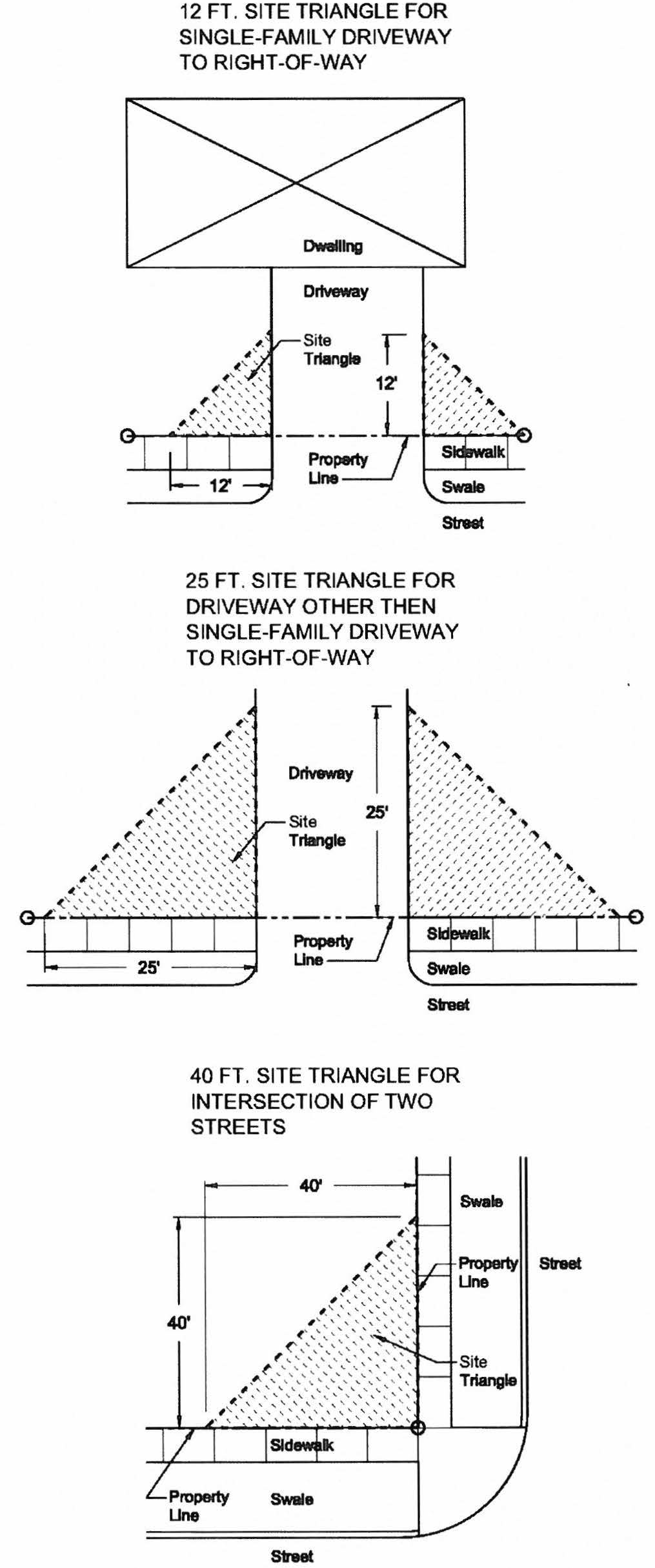
(B)
Exceptions. The Town Engineer may authorize different sight triangle designs which do not compromise public safety.
(Ord. No. 2010-020, § 2(Exh. A), 9-7-10; Ord. No. O2018-009, § 2(Exh. A), 4-4-18; Ord. No. O2019-012, § 2(Exh. A), 6-5-19)
Sec. 12-114. - Completion of common area, landscape buffers and street trees for all districts.
(A)
All required landscape installation for common areas, landscape buffers and street trees shall be completed for the entire project prior to the issuance of twenty-five (25) percent of the certificates of occupancies or completions.
(B)
A phased landscape plan may be submitted for approval; however, all common areas, landscape buffers and street trees shall be completed for each phase prior to the issuance of twenty-five (25) percent of the certificates of occupancies or completions in each phase.
(Ord. No. 2010-020, § 2(Exh. A), 9-7-10)
Sec. 12-115. - Minimum landscaping requirements for outdoor equipment or facilities.
(A)
In all zoning districts, outdoor equipment or facilities (i.e. a/c units, swimming pool equipment, FPL boxes, generators, and aboveground containers) visible from the street, parking lot, driveway, or public access drive shall be screened from view on three (3) sides with shrubs. Shrubs are to be three (3) feet in height and planted twenty-four (24) inches apart at the time of planting. Required access to equipment box doors shall be incorporated into the overall design.
In lieu of shrubs, the outdoor equipment or facilities/may be hidden from view from the street, parking lot, driveway or public access drive by a privacy wall of a height necessary to totally block the public view.
(B)
(Reserved.)
(Ord. No. 2010-020, § 2(Exh. A), 9-7-10)
Sec. 12-116. - Trees planted under power lines or telephone lines.
(A)
Trees placed under or near power lines or telephone lines shall be of a species listed in the Town of Davie Landscape Materials List.
(B)(Reserved.)
(Ord. No. 2010-020, § 2(Exh. A), 9-7-10)
Sec. 12-117. - Buffering and landscaping for telecommunications towers, antenna, related accessory structures and other communication antenna apparatus.
(1)
Buffer requirements. Bufferyard shall be required surrounding all ground mounted telecommunication towers, antennas, related accessory structures or other communication antenna apparatus, as follows:
1.
A minimum fifteen (15) feet perimeter landscape buffer shall be provided on all properties with a residential zoning or land use classification, or for parcels planned directly abutting, utilizing minimum setback requirements, a residential zoning district, land use or existing use.
2.
A minimum ten (10) feet perimeter landscape buffer shall be provided on all properties with a zoning or land use classification of commercial or land use classification not mentioned herein.
3.
A minimum five (5) feet perimeter landscape buffer shall be provided on all sites with a zoning or land use classification of industrial or zoning.
(2)
Fence requirements. All telecommunication facilities or communication antenna apparatus shall be surrounded by a maximum eight-foot-high, green, vinyl clad chain-link fence. The use of barbed wire shall be prohibited. All associated required landscape material shall be placed on the outside of said fencing. The fence requirement may be waived, for a telecommunication tower exclusively, if said telecommunication tower is located separate from related accessory buildings.
(3)
Planting requirements. The planting requirements shall be designed to form a living screen consisting of various layers and heights of plant material. Said material shall consist of the following; groundcover, shrubs, large shrubs and/or small accent trees, and canopy trees and/or palms.
1.
Groundcover shall be installed at a minimum quantity equal to one hundred (100) percent of the overall length of the required landscape buffer.
2.
Shrubs shall be installed at a height of two (2) to four (4) feet, at time of installation. One (1) shrub shall be required for each eight (8) square feet of required landscape buffer.
3.
Large shrubs and small accent trees shall be installed at a height of four (4) to six (6) feet at time of installation, adjacent to said fencing. One (1) shrub and/or tree shall be required for every six (6) linear feet of required landscape buffer. In instances where shrubs can be installed at heights in excess of six (6) feet, the small shrub requirements may be reduced to one (1) small shrub for every ten (10) linear feet.
4.
Canopy trees, ten (10) feet minimum in height and/or palms, minimum ten-foot clear trunk, shall be provided for as stated in section 12-111(D)1.(a)(i), (ii), (iii). One (1) canopy tree shall be required every twenty (20) linear feet of required landscape buffer. However, where palms are substituted, one canopy tree is equal to three palms. No more than fifty (50) percent of required trees shall be palms.
5.
All other areas within the landscape buffer shall be sodded in accordance with the Florida-friendly landscape requirements in section 12-103(J).
6.
All plantings shall match in material and design any existing landscape plantings upon an existing site. Designs shall be encouraged to be natural in appearance. Straight line plantings shall be prohibited. The use of berms shall be required in residential zoning or land use classifications, or any other parcel which meets the requirements of section 12-117(1)1., and encouraged in all other classifications, if adequate space is provided at a maximum slope of 4:1.
(4)
Plant material. Plant materials shall meet the requirements as stated in section 12-103. Native vegetation, as required in section 12-103(D) shall meet, at a minimum, fifty (50) percent native species. In addition, all plant material shall be one hundred (100) percent drought-tolerant. The Town Administrator, or designee, shall maintain a list of planting material appropriate for said sites.
(5)
Irrigation. All landscape bufferyards shall be automatically irrigated with one hundred (100) percent coverage unless the Town approves an alternative watering system sufficient for the establishment of new drought tolerant plants. Irrigation plans shall be submitted in conjunction with site plan approval or other permit approval process.
(6)
Maintenance. All telecommunication or communication sites shall provide to the town, prior to the issuance of a building permit, a copy of an executed maintenance agreement with the owner of the overall subject site detailing the responsibility for the maintenance of the telecommunications site and repercussions for non-maintenance.
(Ord. No. 2010-020, § 2(Exh. A), 9-7-10)
Sec. 12-118. - Artificial or synthetic turf.
Artificial or synthetic turf may be used as an alternative to natural sod as set forth in this section.
(A)
Minimum standards for quality and installation.
1.
Must be installed in the manner prescribed by the manufacturer.
2.
Must be installed over a subgrade prepared to provide positive drainage and an evenly graded mass of compacted, porous crushed rock aggregate material that is a minimum of three (3) inches in depth.
3.
Must be anchored at all edges and seams and not have visible seams between panels.
4.
Must be affixed to a water-permeable backing.
(B)
Location and maximum area.
1.
Artificial or synthetic turf shall not comprise more than ten (10) percent of the horizontal area of a lot.
2.
Artificial or synthetic turf is not permitted within any required bufferyard or scenic corridor.
3.
Artificial or synthetic turf is not permitted within any canal maintenance easement, lake maintenance easement, or area of a lot designed to satisfy stormwater detention or retention requirements (wet or dry), regardless of whether such easements or requirements are those of the town, an independent water control district or any combination of such requirements.
4.
Artificial or synthetic turf is not permitted within any required front yard or the area between the front property line and nearest portion of the principal building, whichever is greater. When installed within a side yard, artificial or synthetic turf areas must be located behind a fence, as viewed from the street.
(Ord. No. O2024-015, § 2(Exh. A), 5-15-24)
Sec. 12-119. - Education.
(A)
To assist in public information, the education of its citizens, and the effective implementation of this division, the Town shall coordinate its efforts with those of the South Florida Water Management District and the Broward County Agricultural Extension Service and other agencies.
(B)
All persons providing landscape maintenance service for hire, including appropriate Town maintenance operation staff, shall be trained in Florida-Friendly Best Management Practices for Protection of Water Resources of the Green Industries, as amended:
1.
By September 7, 2011, if fertilizer is applied, or
2.
By September 7, 2012, if the business is not involved in the application of fertilizer.
(C)
Any person that applies fertilizer for hire or in the course of their employment shall hold a current Certificate of Completion in the Florida-Friendly Best Management Practices for Protection of Water Resources of the Green Industries.
(D)
At least one (1) person holding a current Certificate of Completion in the Florida-Friendly Best Management Practices for Protection of Water Resources of the Green Industries shall be present at all times on any job site while work is in progress.
(E)
New employees shall be trained within one hundred eighty (180) days of starting a new position.
(Ord. No. 2010-020, § 2(Exh. A), 9-7-10; Ord. No. 2016-014, § 2(Exh. A), 7-27-16)
Sec. 12-120. - Incentives.
(A)
Any development that provides one hundred (100) percent native/drought tolerant plants shall receive an expedited permit review.
(B)
Individual home owners or residents who are not required to but voluntarily submit a development/landscape design which would meet or exceed the Florida-friendly design principles and standards established by this division shall receive an expedited permit review.
(C)
Business[es] that use the recommended practices may be recognized as a green business through the FDEP Green Business Program and may use this in their advertising and promotion.
(Ord. No. 2010-020, § 2(Exh. A), 9-7-10; Ord. No. 2016-014, § 2(Exh. A), 7-27-16)
Sec. 12-121. - Enforcement and monitoring.
The Town shall provide policies and procedures that effectuate this division by February 7, 2011. Until such time the policies and procedures are established, there shall be no enforcement of the requirements of the fertilizer and pesticide sections of this division.
(Ord. No. 2010-020, § 2(Exh. A), 9-7-10; Ord. No. 2016-014, § 2(Exh. A), 7-27-16)
Sec. 12-140. - Purpose.
The purpose of this division is to establish rules and regulations governing the protection of trees and tree canopy within the town and to promote the proliferation of trees and other vegetation in recognition of their importance to air quality, the provision of wildlife habitat and natural beauty.
(Ord. No. 96-045, § 2, 11-20-96; Ord. No. 99-33, § 2, 9-15-99; Ord. No. 2016-014, § 2(Exh. A), 7-27-16)
Sec. 12-141. - Applicability.
The term and provisions of this division shall apply to all real property located within the town limits, except as provided herein.
(Ord. No. 96-045, § 2, 11-20-96; Ord. No. 99-33, § 2, 9-15-99; Ord. No. 2016-014, § 2(Exh. A), 7-27-16)
Sec. 12-142. - Definitions.
For the purpose of this division, the following terms shall have those meanings set forth below:
Destruction of the natural habit of growth means pruning that causes irreparable structural damage and/or permanent disfigurement to a tree such that, even with regrowth, the tree will likely never regain sound structure or the original characteristics of its species, and could pose a future danger to the public or to property; or pruning defined herein as tree abuse.
Diameter breast height (DBH) means the diameter of the trunk of a tree measured at four and one-half (4½) feet above natural grade. The DBH of trees with multiple trunks shall be the sum of the individual trunk diameters at breast height. Trees with less than four and one-half (4½) feet of clear trunk shall be measured as the diameter of the largest vertical branch or leader at breast height.
Effectively destroy means any act which will cause a tree to die or go into a period of unnatural decline within a period of one (1) year from the date of the act. Acts which may effectively destroy a tree include, but are not limited to, damage inflicted upon the root system by heavy machinery, excessive trimming, changing the natural grade above the root system or around the trunk, damage intentionally inflicted on the tree permitting infection or pest infestation, application of herbicides or other chemical agents, or intentional fire damage to the tree permitting infection or pest infestation, the infliction of a trunk wound that is fifty (50) percent or greater of the circumference of the trunk, or the removal of sufficient canopy to cause the unnatural decline of the tree.
Hatracking means to flat-cut the top of a tree, severing the leader or leaders; or pruning a tree by stubbing off mature wood larger than three (3) inches in diameter; or reducing the total circumference or canopy spread not in conformance with the "American National Standards Institute A-300" standards. Notwithstanding this definition, "hatracking" will not include such necessary tree cutting by authorized utilities providers around power lines or utility lines to prevent disruption of utility service or for safety reasons.
Land clearing means the clearing of vegetation and soils for the purpose of land development activities. This includes, but is not limited to, construction for buildings, rights-of-way, utility easements or access, drainageways, parking lots and other structures, rock mining, and agricultural activities that involve the removal of trees regulated by this article.
Protective barrier means fences or like structures at least four (4) feet in height that are conspicuously colored and prevent or obstruct passage.
Structure means anything built or constructed on, below or above the land.
Tree means any living, self-supporting, dicotyledonous or monocotyledonous woody perennial plant which has a DBH of no less than three (3) inches and normally grows to an overall height of no less than ten (10) feet in Southeast Florida.
Tree abuse means any of the following:
(1)
Hatracking a tree.
(2)
Destroying the natural habit of tree growth.
(3)
Pruning which leaves stubs or results in a flush cut; or splitting of limb ends.
(4)
Removing tree bark to the extent that if a line is drawn at any height around the circumference of the tree, over one-third (⅓) of the length of the line falls on portions of the tree where bark no longer remains.
(5)
Using climbing spikes, nails or hooks, except for purposes of total tree removal or as specifically permitted by standards set by the American National Standards Institute, as amended.
(6)
Pruning that does not conform to standards or recommendations set by the American National Standards Institute, as amended.
(7)
Pruning of live palm fronds which initiate above the horizontal plane.
(8)
Overlifting a tree.
(9)
Shaping a tree.
Tree canopy means the upper portion of the tree consisting of limbs, branches, and leaves.
Violator means a person who abuses a tree or otherwise violates this division. The owner of the property upon which the abused tree is located shall also be deemed a violator if the tree abuse is undertaken by the owner's employee, agent or person under the owner's control.
(Ord. No. 96-045, § 2, 11-20-96; Ord. No. 99-33, § 2, 9-15-99; Ord. No. 2016-014, § 2(Exh. A), 7-27-16; Ord. No. O2022-013, § 2(Exh. A), 8-17-22)
Sec. 12-144. - Tree trimming service providers.
(a)
Licensing and training. All businesses (including sole proprietorships) or governmental agencies that perform tree trimming in the Town of Davie must possess a current, valid Broward County Tree Trimmer's license. At each worksite, at all times, at least one (1) person present must carry on their person a current, valid Broward County Tree Trimmer's Licensing Ordinance Training card. Any vehicles engaged in pruning-related activities shall have prominently displayed on each side of the vehicle the following information in bold letters and numerals at least one and one-half (1½) inches high so as to be readily distinguishable from a distance of no less that ten (10) meters (32.8 feet):
(1)
The trade name, symbol or "logo" of the sole proprietorship or business organization utilizing the vehicle for commercial or business purposes;
(2)
The telephone number of the individual owning or operating the business; and
(3)
The Broward County Tree Trimmer License number of the sole proprietor or business organization or governmental agency.
The above information shall be permanently affixed to any vehicle used to conduct business which is over ten thousand (10,000) gross vehicle weight (GVW). Any vehicle under ten thousand (10,000) GVW shall have such required information either permanently affixed to the vehicle or the license holder may provide such information on a magnetic sign. However, any vehicle which utilizes a magnetic sign shall be required to have such sign affixed to the vehicle at all times when business is being conducted. In addition to the above-mentioned requirements pertaining to the Broward County Tree Trimmer's License, all businesses (including sole proprietorships) that perform tree trimming in the Town of Davie must possess a current, valid business tax plus a current annual tree trimmer registration certificate with the Town of Davie. A photocopy of each document must be available for inspection at each job site.
(b)
Professional conduct. All tree trimming service providers shall conduct all work according to the principles and guidelines set forth in "The American National Standards Institute A-300, Tree Shrub and Other Woody Plant Maintenance-Standard Practices", and "Z-133.1 Pruning, Repairing, Maintaining and Removing Trees, and Cutting Brush-Safety Requirements".
(Ord. No. 2016-014, § 2(Exh. A), 7-27-16)
Sec. 12-145. - Prohibition of tree abuse; exceptions; administrative appeal.
No person shall abuse a tree located within the town with the following exceptions:
(a)
The tree is one (1) of the following species and the abuse does not result in a tree that threatens public safety or adjacent property, as determined by the Town Administrator, or designee:
(1)
Schinus terebinthifolius (Brazilian pepper tree/Florida holly).
(2)
Metopium toxiferum (poison wood).
(3)
Melaleuca quinquenervia (cajeput tree/melaleuca).
(4)
Casuarina spp. (Australian pine, all species).
(5)
Bischofia javanica (bischofia, bishopwood).
(6)
Acacia auriculaeformis (earleaf acacia).
(7)
Araucaria excelsia (Norfolk Island pine).
(8)
Brassia actinophylla (schefflera).
(9)
Leucaena leucocephala (lead tree).
(10)
Cupaniopsis anacardiopsis (carrotwood).
(b)
The abuse is necessary to alleviate a dangerous condition posing an imminent threat to the public or property.
(c)
In emergency situations, county, town, or franchised utilities, water management districts, and their authorized agents, may prune trees in a manner that may be defined herein as tree abuse, provided such pruning is necessary to prevent service interruptions or to prevent interference with the operation of water control structures. In the aftermath of the emergency, remedial pruning must be performed in a timely manner to prevent the development of a future hazardous tree condition.
(d)
Shaping of trees to protect property, such as buildings and infrastructure, shall only be allowed at those specific locations where there is adequate evidence, accepted by the Town of Davie, that shaping has occurred historically.
(Ord. No. 2016-014, § 2(Exh. A), 7-27-16)
Sec. 12-146. - Stop work orders.
Whenever any tree trimming, tree removal, land clearing or similar work is being done by a person not in compliance with this division, the Town Administrator, or designee, may order that work be stopped and such persons performing such work shall immediately cease such work. The work may not resume until such time as the person is in compliance with this division. Any person aggrieved by stop work order issued by Town staff pursuant to this Division may file an appeal to the Town Administrator.
(Ord. No. 2016-014, § 2(Exh. A), 7-27-16)
Sec. 12-147. - Remedial actions required for tree abuse.
(a)
Natural habit of growth not destroyed. If a tree is abused without destroying the natural habit of growth, as determined by the Town, the violator shall be responsible for taking such remedial actions that the Town determines are reasonably necessary to aid in the long term recovery of the tree and to protect public safety and property.
(b)
Natural habit of growth destroyed. If a tree is abused to the extent that the natural habit of growth is destroyed, as determined by the Town, the violator shall obtain a tree removal permit pursuant to division 3, remove the abused tree and complete such corrective action as may be required by the Town pursuant to division 3. In the event that a person removes a tree from a site without first obtaining a tree removal permit, the violator shall be responsible for obtaining an after-the-fact tree removal permit.
(d)
Minimum standards for replacement trees. Where replacement trees are required, in addition to any other requirements set forth in division 3, such replacement trees shall have a DBH equal to or greater than the DBH of the abused trees. More than one (1) tree may be utilized for replacement if the aggregate sum of the DBH of the replacement trees is equal to or greater than the abused tree. The tree species, overall height and DBH of replacement tree(s) must adhere to any specifications set forth in the tree removal permit approved in accordance with division 3.
(e)
Off-site replacement trees. In the event the site cannot accommodate all required replacement trees, the remaining replacement trees may be installed on public lands, if approved by the Town and the applicable public entity (if the public land is not owned by the Town). If no suitable public land is available, the violator shall be required to pay any remaining tree replacement costs into the tree preservation fund, as set forth in section 12-159.
(f)
Completion of remedial actions. Remedial actions and/or planting of replacement trees required under this section shall be completed within sixty (60) days of the notice from the Town that such action is required, provided that the Town may require the violator to take immediate remedial actions in the event the abused tree is an immediate threat to the public or property.
(Ord. No. 2016-014, § 2(Exh. A), 7-27-16)
Sec. 12-150. - Tree removal/relocation permit required.
Except as set forth in section 12-152, no person shall remove or relocate a tree, or conduct any land clearing, site development, grubbing or similar activity which would cause the removal or destruction of a tree, without first obtaining a tree removal/relocation permit in accordance with this division.
(Ord. No. 96-045, § 2, 11-20-96; Ord. No. 99-33, § 2, 9-15-99; Ord. No. 2001-031, § 1, 6-20-2001; Ord. No. 2016-014, § 2(Exh. A), 7-27-16)
Sec. 12-151. - Definitions.
(a)
In interpreting the provisions of this division, if no definition is provided herein and the context permits, the latest editions of the following publications recognized as authoritative in the scientific field shall apply:
(1)
"Tree Protection Manual for Builders and Developers" by the Florida Department of Agriculture Division of Forestry.
(2)
"The American National Standards Institute A-300, Tree Shrub and Other Woody Plant Maintenance-Standard Practices."
(3)
"Z-133.1 Pruning, Repairing, Maintaining and Removing Trees, and Cutting Brush-Safety Requirements."
(b)
As used in this division, the following words and terms shall be defined as set forth below:
Diameter breast height (DBH) means the diameter of the trunk of a tree measured at four and one-half (4½) feet above natural grade. The DBH of trees with multiple trunks shall be the sum of the individual trunk diameters at breast height. Trees with less than four and one-half (4½) feet of clear trunk shall be measured as the diameter of the largest vertical branch or leader at breast height.
Drip line means the peripheral limits of the horizontal crown of a tree spread vertically to the ground; provided, however, that the same shall not be less than a circle with a five (5) foot radius measured from the center of the tree.
Effectively destroy means any act which will cause a tree to die or go into a period of unnatural decline within a period of one (1) year from the date of the act. Acts which may effectively destroy a tree include, but are not limited to, damage inflicted upon the root system by heavy machinery, excessive trimming, changing the natural grade above the root system or around the trunk, damage intentionally inflicted on the tree permitting infection or pest infestation, application of herbicides or other chemical agents, or intentional fire damage to the tree permitting infection or pest infestation, the infliction of a trunk wound that is fifty (50) percent or greater of the circumference of the trunk, or the removal of sufficient canopy to cause the unnatural decline of the tree.
Hatracking means to flat-cut the top of a tree, severing the leader or leaders; or pruning a tree by stubbing off mature wood larger than three (3) inches in diameter; or reducing the total circumference or canopy spread not in conformance with the "American National Standards Institute A-300" standards. Notwithstanding this definition, "hatracking" will not include such necessary tree cutting by authorized utilities providers around power lines or utility lines to prevent disruption of utility service or for safety reasons.
Horizontal plane means an imaginary line that begins at the base of the live frond petioles.
Land clearing means the clearing of vegetation and soils for the purpose of land development activities. This includes, but is not limited to, construction for buildings, rights-of-way, utility easements or access, drainageways, parking lots and other structures, rock mining, and agricultural activities that involve the removal of trees regulated by this article.
Overlift means the removal of the majority of the inner lateral branches and foliage thereby displacing weight and mass to the ends of the branches. The alteration of the tree's live crown ratio may be considered as evidence of overlifting.
Protective barrier means fences or like structures at least four (4) feet in height that are conspicuously colored and prevent or obstruct passage.
Prune or trim means to cut away, remove, cut off or cut back parts of a tree.
Shape means the regular and frequent shearing of outer tree branches, making pruning cuts of one (1) inch in diameter or less, for the purpose of controlling the size and shape of the tree canopy.
Shearing means the cutting of many small diameter stems of one (1) inch in diameter or less.
Specimen tree means any native tree which has a DBH of eighteen (18) inches or greater for conifers, native hardwoods and palms, which is well-shaped and in good health as verified by the Town Administrator, or designee; non-native trees which have a DBH of eighteen (18) inches for conifers, hardwoods and palms shall also be considered specimen trees; provided, however, that the following trees are not specimen trees:
(1)
Non-native fruit trees that are cultivated or grown for the specific purpose of producing edible fruit, including, but not limited to mangoes, avocados, or species of citrus.
(2)
Species of the genus Ficus except F. aurea (Strangler Fig), F. laevigata (Short Leaf Fig), F. rubiginosa (Rusty Fig or Rusty Leaf Fig), and F. jacquinifolia.
(3)
Paurotis palm (Acoelorraphe wrightii), and the Phoenix palm (Phoenix reclinata), which are less than fifteen (15) feet in height, and all other multi-trunk palms.
(4)
Trees that are in poor condition or form as determined by the Town of Davie.
Structure means anything built or constructed on, below or above the land.
Substantial deviation means any proposed modification or modifications to a development, a permit, or a permit application which, either individually or cumulatively with other changes, creates a reasonable likelihood of additional environmental impact, as covered by the scope of this division, or any change or proposed change that may result in any impacts on trees not previously reviewed by the Town Administrator, or designee, as covered by the scope of this division.
Topiary means the practice of pruning a tree into an ornamental shape by pruning branches one (1) inch in diameter or less.
Tree means any living, self-supporting, dicotyledonous or monocotyledonous woody perennial plant which has a DBH of no less than three (3) inches and normally grows to an overall height of no less than ten (10) feet in Southeast Florida.
Tree canopy means the upper portion of the tree consisting of limbs, branches, and leaves.
Tree survey means a document meeting the requirements of 21-HH, F.A.C., and must provide, at a minimum, the following information:
(1)
The location, plotted by accurate techniques, of all existing trees numbered in consecutive order.
(2)
The common and scientific name of each tree.
(3)
The DBH of each tree or, if a multiple-trunk tree, the sum DBH for all trunks.
(4)
Canopy coverage.
(Ord. No. 2016-014, § 2(Exh. A), 7-27-16; Ord. No. O2022-013, § 2(Exh. A), 8-17-22)
Sec. 12-152. - Tree removal/relocation permits—Exceptions.
The following situations do not require a town tree removal/relocation permit:
(a)
Regulated waters. Removal of tree species occurring in regulated waters, as defined by sections 27-331 to 27-339 of the Broward County Code Of Ordinances, when mitigation required by that permit for the removal of the trees is equal to or greater than the replacement requirements of this division.
(b)
Nursery operations. All licensed and governmental nurseries shall be exempt from the terms and provisions of this division, but only in relation to those plants which are planted and grown for sale or intended sale to the general public in the ordinary course of business or for public purpose.
(c)
Tree determined to be a danger to persons or property.
1.
Removal of any tree that, due to disease or other natural causes, has become structurally compromised to the extent that its continued existence threatens the health or safety of contiguous persons or property, provided that the owner of the property can document that such condition(s) existed prior to the removal of the tree. In the case of specimen trees, documentation must be presented to the town within forty-eight (48) hours of removal.
2.
Removal of any tree on a developed single-family lot that has been determined to pose an unacceptable risk to persons or property by an arborist certified by the ISA or a Florida licensed landscape architect in accordance with F.S. § 163.045. Replacement trees shall not be required for any tree removed pursuant to this paragraph (2).
(d)
Emergency conditions. Under emergency conditions such as hurricanes, war, or other natural disasters of similar scope, county and town utilities, water management districts, improvement districts, county agencies, the state department of transportation, or franchised utilities, except as provided below, may remove a tree or trees in order to prevent interruption of service or to restore interrupted service.
(e)
Temporary suspensions by the town. During emergency conditions caused by a hurricane or other disaster, the provisions of this division may be suspended by the direction of the town administrator.
(f)
Electric transmission and distribution line rights-of-way and easements. Removal of trees, except specimen trees, by electric utility providers after the town and the recorded owner of the property on which the tree or trees proposed to be removed are located received notification, delivered five (5) calendar days prior to tree removal. Tree removal may proceed after the expiration of the five (5) days, provided that the utility can prove, prior to tree removal, that:
(1)
The tree or trees will cause a continual disruption of service (specimen palm trees may be removed under this exemption);
(2)
The easement or property was in actual use conveying utilities prior to the effective date of this article; and
(3)
The threat of service interruption cannot be corrected by tree pruning in accordance with the "The American National Standards Institute A-300, Tree Shrub and Other Woody Plant Maintenance-Standard Practices," and "Z-133.1 Pruning, Repairing, Maintaining and Removing Trees, and Cutting Brush-Safety Requirements," or palm pruning in accordance with the standards listed in, Richard Harris, "Arboriculture Integrated Management of Landscape Trees, Shrubs and Vines," as amended; or
(4)
The removal is for the purpose of providing new/additional on-site service to existing development. Under this provision, notification shall be in writing prior to the tree removal. The franchised utility shall not be required to obtain a permit, but shall comply with all the standards, requirements, and conditions of this section.
(g)
Water management or improvement districts. Removal of trees, except specimen trees, by a water management district or improvement district in or immediately adjacent to canals and lakes operated by the district, provided that the district delivers to the town and to the record owner of the property in which the trees proposed to be removed are located written notification, at least five (5) calendar days prior to the removal of the tree or trees. Tree removal may proceed after the expiration of the five (5) days, providing that the district can prove, prior to tree removal, that:
(1)
The removal complies with all the standards, requirements and conditions, other than permitting and bonding of this division;
(2)
The canal or water body was excavated in compliance with all applicable regulations or the canal or water body was excavated prior to the effective date of this division;
(3)
The canal is not or was not an agricultural canal or ditch; and
(4)
The tree or trees are causing an immediate disruption of water flow so that the canal cannot function at its designated capacity, or that the canal was in existence, in actual use conveying water, and under a vegetation management program prior to the removal of the tree or trees as shown by a map of the district water management canal or water bodies.
(h)
State department of transportation. Removal of trees, except native and specimen trees, by the state department of transportation, the county, or the town on roads and road rights-of-way maintained by the department, provided, that the department delivers to the town and to the record owner of the property on which the tree or trees proposed to be removed are located written notification, at least five (5) days prior to the removal of the tree or trees. After the expiration of the five (5) days, the department may remove the tree or trees provided that:
(1)
The removal is necessary because the tree or trees are an actual and immediate traffic safety hazard to individuals using the road(s); and
(2)
The removal complies with all standards, requirement and conditions, other than licensing and bonding of this division; and
(3)
The traffic safety hazard caused by the tree or trees cannot be remediated by pruning in accordance with the "The American National Standards Institute A-300, Tree Shrub and Other Woody Plant Maintenance-Standard Practices," and "Z-133.1 Pruning, Repairing, Maintaining and Removing Trees, and Cutting Brush-Safety Requirements," or palm pruning in accordance with the standards listed in, Richard Harris, "Arboriculture Integrated Management of Landscape Trees, Shrubs and Vines," as amended.
(i)
Prevention or correction of destruction or damage to public property or public utilities.
(1)
Notice of destruction, damage or irreversible conflict required. Wherever there shall be any tree or trees growing upon or near any street, alley or right-of-way, or easement within the town in such way and manner that any part of such tree is irreversibly in conflict with, or has destroyed or damaged any existing or proposed sidewalk, curb, gutter, street pavement, bicycle path, water line, sewer line, drainage line or structure, or other public property or the property of a public utility, it shall be the duty of any official or employee of the town having knowledge thereof to immediately notify the town administrator, or designee. For purposes of this paragraph (1), "irreversibly in conflict" means that the conflict between the existing tree or trees and the existing or proposed public property or facilities cannot be alleviated through root pruning or other accepted arborist practices.
(2)
Trees on public land. Upon receiving notice pursuant to paragraph (1), if the tree or trees shall be growing on town right-of-way or town property, the town administrator, or designee, shall either:
a.
Immediately cause such tree or trees to be removed as necessary to protect and preserve public property or to ensure continuation of public services.
b.
Provide written notice to the abutting property owner identifying the particular tree or trees which are irreversibly in conflict with, or have destroyed or damaged public property, and providing the abutting property owner a reasonable time, not to exceed thirty (30) days, to remove the tree or trees pursuant to a tree removal/relocation permit, if applicable. In the event such owner shall fail to remove the tree or trees within the timeframe stated in the notice, then the town administrator, or designee, shall cause such tree or trees to be removed by the town.
(3)
Trees on private land. Upon receiving notice of damage or destruction pursuant to paragraph (1), if such tree or trees shall be growing upon private property, the town administrator, or designee, shall immediately provide written notice to such property owner identifying the particular tree or trees which are irreversibly in conflict with, or have destroyed or damaged public property, and providing such property owner a reasonable time, not to exceed thirty (30) days, to remove the tree or trees pursuant to a tree removal/relocation permit, if applicable. In the event such owner shall fail to remove the tree or trees within the timeframe stated in the notice, the tree or trees shall be deemed a public nuisance pursuant to section 12-33(U).
(j)
Removal of invasive/exotic species. Removal of the following invasive/exotic tree species, provided that any such removals also involving land clearing or clearing and grubbing activities shall be conducted only pursuant to a clearing and grubbing permit (see division 4):
(1)
Schinus terebinthifolius (Brazilian pepper tree/Florida holly).
(2)
Metopium toxiferum (poison wood).
(3)
Melaleuca quinquenervia (cajeput tree/melaleuca).
(4)
Casuarina spp. (Australian pine, all species).
(5)
Bischofia iavanica (bischofia, bishopwood).
(6)
Acacia auriculaeformis (earleaf acacia).
(7)
Araucaria excelsia (Norfolk Island pine).
(8)
Brassia actinophylla (schefflera).
(9)
Leucaena leucocephala (lead tree).
(10)
Cupaniopsis anacardiopsis (carrotwood).
(11)
Pongamia piñata (pongam)
(Ord. No. 96-045, § 2, 11-20-96; Ord. No. 99-33, § 2, 9-15-99; Ord. No. 2003-048, § 1, 12-3-03; Ord. No. 2016-014, § 2(Exh. A), 7-27-16; Ord. No. O2020-002, § 2(Exh. A), 2-5-20; Ord. No. O2023-001, § 2(Exh. A), 1-4-23)
Sec. 12-153. - Tree removal/relocation permit applications.
(a)
An owner of a fee simple title may apply for a tree removal permit after submitting verified documentation of the fee simple ownership; the agent of the owner, the leasee of the property, optionee, contract purchaser, or holder of an easement may apply for a tree removal permit. A holder of an easement may obtain a permit only when the proposed tree removal is consistent with the use granted by the easement. The Town shall require that any tree survey or site plans be prepared by any person qualified to do so under the laws of the state.
(b)
Application for a tree removal permit shall be made on town forms and be, at a minimum, accompanied by the following documents:
(1)
A complete, signed and notarized application form;
(2)
A map showing the size and location of the site where the permitted activities are to be conducted;
(3)
A starting date and duration of the proposed permitted activities;
(4)
A brief description of the work to be performed, including a drawing of the proposed work or a certified site plan as determined by the Town, showing the location of all existing or proposed buildings, structures, and site uses;
(5)
A certified tree survey and site plan of identical scale designating those trees which are proposed to be preserved, relocated, or removed, unless not required by the Town; however, in no case shall a tree survey be required when the property contains five (5) or less trees; and
(6)
The certified legal description of the site.
(c)
Application filing fee.
(1)
Before any application for a permit required under this division is accepted for review, a permit application fee shall be tendered. The amount shall be established by resolution of the town council.
(2)
The permit application filing fee is not refundable and may not be applied to any permit application other than the one (1) for which it was originally paid.
(3)
For any substantial deviation from the original application, there shall be an additional fee. The amount of the fee shall be established by resolution of the Town Council.
(d)
Application for a tree removal permit constitutes consent by the property owner or applicant for the Town to conduct site inspections in furtherance of this division on the subject property.
(Ord. No. 96-045, § 2, 11-20-96; Ord. No. 99-33, § 2, 9-15-99; Ord. No. 2016-014, § 2(Exh. A), 7-27-16)
Sec. 12-154. - Tree removal/relocation criteria.
(a)
Except as provided in section 12-154.1, a tree may be removed or relocated only when an applicant has demonstrated to the town that an otherwise lawful development cannot be conducted on the site without the removal or relocation of the tree, and that there is no practical way to avoid tree removal or relocation. In determining if the applicant may remove or relocate trees pursuant to a tree removal permit, the town shall, at a minimum, consider the following:
(1)
Whether the applicant has made every reasonable effort, consistent with the plan of development, to incorporate existing trees and to minimize the number of trees to be removed or relocated.
(2)
Whether the trees proposed to be removed or relocated are the minimum number necessary.
(3)
Whether the trees proposed to be removed or relocated are of poor health, poor quality or poor appearance.
(4)
Whether the trees proposed to be removed or relocated, are likely to significantly damage existing improvements, where such damage cannot otherwise be corrected or avoided by accepted tree management practices such as root pruning or canopy reduction.
(5)
Whether, the trees proposed to be removed or relocated are growing in too close a proximity to other trees to permit normal growth and development consistent with good forestry practice.
(6)
Whether a tree proposed to be removed or relocated is obstructing safe vehicular cross visibility.
(b)
As determined by the Town, a tree proposed to be removed must be:
(1)
Relocated in accordance with section 12-155; or
(2)
Replaced with one (1) or more trees in accordance with section 12-156; or
(3)
Mitigated in accordance with section 12-159.
(c)
The applicant shall be responsible for the relocation of trees removed for utilities, roads, drainage and other services constructed to benefit the property for which the application was filed.
(d)
The permittee shall only remove those trees so specified in the permit. Any damage to any other tree shall be a violation of this division.
(e)
A tree removal/relocation permit shall only be valid for one (1) year from the date of issuance. A one-time extension of up to six (6) months may be issued, provided there is no substantial deviation from the original application and the permit extension complies with all standards in effect at the time of the permit extension. Additional conditions may be imposed in the permit extension when there is a change in site conditions that may affect trees. Where any activity regulated by the tree removal permit has occurred, the permittee must comply with all conditions of the permit even though the permit has expired.
(Ord. No. 96-045, § 2, 11-20-96; Ord. No. 99-33, § 2, 9-15-99; Ord. No. 2016-014, § 2(Exh. A), 7-27-16; Ord. No. O2019-004, § 2(Exh. A), 1-23-19)
Sec. 12-154.1. - Tree removal/relocation criteria for certain single-family residential lots.
(a)
The owner of a single-family residential lot may be issued a tree removal/relocation permit pursuant to this division provided that such lot is owner-occupied and one-acre or less in size, and provided that the tree proposed to be removed or relocated is:
(1)
Not a specimen tree.
(2)
Not designated by the Broward County Commission as a historical tree.
(3)
Not required to meet the minimum tree requirements for the particular lot, as specified by Town Code or the approved residential site plan.
(4)
Not required to be preserved as a condition of a prior tree removal/relocation permit.
(b)
Any tree which is removed pursuant to this section (12-154.1) and not relocated or replaced shall be mitigated by payment into the tree preservation fund. The mitigation value shall be as determined by resolution of the town council.
(Ord. No. O2019-004, § 2(Exh. A), 1-23-19)
Sec. 12-155. - Tree relocation.
(a)
Before the Town issues a tree removal permit that allows the replacement of any tree, the applicant must demonstrate that relocation is not a viable alternative. Relocation shall occur either within the site or off-site with the concurrence of the Town, where the site is public property, or with the concurrence of the property owner, where the site is private property. A tree relocation plan, acceptable to the Town, shall be required for any proposed tree relocation and the Town may require a bond to ensure survivability in the manner set forth in section 12-161.
(b)
The following guidelines shall be utilized to ensure successful transplanting or trees designated for relocation:
(1)
Trees shall not be unnecessarily damaged during removal, transport or replanting of the tree.
(2)
If the tree has a dormant period, they should be transplanted during that time. Trees should not be transplanted during periods of strong winds, dry winter winds or during drought.
(3)
Adequate spaces for root and crown development shall be provided.
(4)
Trees shall be root and canopy pruned in accordance with sound arboricultural standards prior to transplanting.
(5)
During and following transplanting, the root ball and trunk shall be protected. The root ball must be kept moist at all times.
(6)
Transplanted trees shall be braced for a minimum of one (1) year.
(7)
Transplanted trees shall not be fertilized at planting time, but shall be watered sufficiently until the tree growth is reestablished.
(8)
All crown pruning shall be done in accordance with "The American National Standards Institute A-300, Tree Shrub and Other Woody Plant Maintenance-Standard Practices", and "Z-133.1 Pruning, Repairing, Maintaining and Removing Trees, and Cutting Brush-Safety Requirements" or palm pruning in accordance with the standards in, Richard Harris, "Arboriculture Integrated Management of Landscape Trees, Shrubs and Vines", as amended.
(Ord. No. 96-045, § 2, 11-20-96; Ord. No. 99-33, § 2, 9-15-99; Ord. No. 2003-048, § 1, 12-3-03; Ord. No. 2016-014, § 2(Exh. A), 7-27-16)
Sec. 12-156. - Tree replacement and relocation.
(a)
Amount and type of trees.
(1)
A tree mitigation plan shall be provided indicating the number, type, quality and DBH (in caliper inches) of each tree to be replaced or relocated.
(2)
Relocation of trees on-site or within one (1) mile of the site will be counted towards equivalent replacement. Relocation of trees more than one (1) mile from the original site shall be replaced at the rate of one hundred fifty (150) percent. In no case shall credit toward equivalent replacement be granted where trees are relocated outside of the Town of Davie.
(3)
The tree mitigation plan must demonstrate that the total DBH of trees to be removed from the site will be replaced or mitigated as allowed by this division except that DBH replacement rate shall be one hundred fifty (150) percent for trees proposed to be replaced solely to accommodate site development, where reasonable efforts to avoid tree removal have not been demonstrated and for trees which are necessary to replace trees removed without first obtaining a permit pursuant to section 12-151.
(4)
Shade/canopy trees shall only be replaced with a shade/canopy trees with a minimum DBH of two and one-half (2½) inches and with an overall minimum height of twelve (12) to fourteen (14) feet depending upon the species.
(5)
Palm trees may be replaced with palm trees of a similar quality and value provided that each replacement tree is a minimum of twelve (12) to fourteen (14) feet in height. Alternatively, palm trees may be replaced with shade/canopy trees on a one (1) shade/canopy tree per palm tree basis, provided that each replacement shade/canopy tree is a minimum of two and one-half (2½) inches in caliper and twelve (12) to fourteen (14) feet in overall height, depending upon species.
(6)
Pine trees shall only be replaced with pine trees such that the overall height of the pine tree(s) shall be replaced by one (1) or more pines. Replacement pine trees shall be a minimum of seven (7) feet in overall height. Shade/canopy trees may be used to replace a pine trees based on one (1) shade/canopy tree per pine tree to be removed. Replacement shade/canopy trees shall be a minimum of two and one-half (2½) inches in caliper and twelve (12) to fourteen (14) feet in overall height, depending upon species.
(7)
For tree replacement requirements of one (1) to five (5) trees, a minimum of one (1) species shall be utilized as a replacement tree. For six (6) to ten (10) replacement trees required, a minimum of two (2) species shall be utilized. For eleven (11) to twenty (20) replacement trees required, a minimum of three (3) species shall be utilized. For twenty-one (21) to fifty (50) replacement trees required, a minimum of four (4) species shall be utilized. For fifty-one (51) or more replacement trees required, a minimum of five (5) species shall be utilized.
(8)
The Town Administrator or designee may vary from the replacement standards of paragraphs (3) through (7) where necessary to address specific site conditions or good forestry practice.
(b)
Minimum standards for tree replacement.
(1)
All trees to be used as replacement trees shall be a minimum quality of Florida Grade No. 1 or better, as described in the Florida Department of Agriculture and Consumer Services Division of Plant Industry publication "Florida Grades and Standards for Nursery Plants".
(2)
Replacement trees shall be limited those species as set forth in the Town of Davie Landscape Materials List, as adopted by resolution of the Town Council. The selection of species from the approved list shall be at the discretion of the landowner provided that such selection is consistent with the approved site plan for the development and the requirements of division 1.
(3)
Replacement trees shall not be removed or effectively destroyed unless approval has been granted by a valid tree removal permit. The original permittee and owner of any property on which trees have been replaced or relocated shall place of [on] record a notice that shall inform subsequent purchasers, assigns and occupants of the replacement site that trees on the replacement site may not be removed without a valid tree removal permit.
(Ord. No. 96-045, § 2, 11-20-96; Ord. No. 99-33, § 2, 9-15-99; Ord. No. 2003-048, § 1, 12-3-03; Ord. No. 2016-014, § 2(Exh. A), 7-27-16; Ord. No. O2022-013, § 2(Exh. A), 8-17-22)
Sec. 12-157. - General relocation and replacement conditions.
(a)
Any tree remaining on-site shall not be unnecessarily damaged while relocating trees, planting or preparing the site for any replacement trees.
(b)
Replacement or relocated trees shall not be placed where they will interfere with existing or proposed utilities above or below ground.
(c)
Where practicable, replacement tree species, installation methods and maintenance methods shall follow xeriscape principles.
(d)
The permittee shall replace each tree specified in the permit within a time period of up to six (6) months with Town approval. A time extension may be granted if future construction will endanger the replacement trees; however, where an extension has been granted, each tree specified in the permit must be replaced prior to approval of a certificate of occupancy or completion.
(Ord. No. 96-045, § 2, 11-20-96; Ord. No. 99-33, § 2, 9-15-99; Ord. No. 2016-014, § 2(Exh. A), 7-27-16)
Sec. 12-158. - Maintenance and monitoring.
(a)
The permittee shall be responsible for maintaining the health of any replacement or relocated tree for one (1) year from planting.
(b)
Determination of success.
(1)
The permittee shall determine the condition of each tree one (1) year after the tree was relocated or planted. This determination shall be submitted to the town for approval within thirty (30) days of being made.
(2)
Should any tree die or be in a state of unnatural decline within one (1) year of being planted or relocated, the permittee shall be required to replace the tree within sixty (60) days of that determination. The one (1) year monitoring and approval period shall begin anew whenever a tree is replaced. If that replacement tree is found not to be viable at the end of the second-year monitoring period, the permittee may pay the appropriate amount into the tree preservation fund in lieu of planting a third replacement tree. If the permittee fails to replace the tree or to pay the appropriate amount into the tree preservation fund within sixty (60) days, then the permittee shall be in violation of this section.
(Ord. No. 96-045, § 2, 11-20-96; Ord. No. 99-33, § 2, 9-15-99; Ord. No. 2016-014, § 2(Exh. A), 7-27-16)
Sec. 12-159. - Mitigation via tree preservation fund.
Where the Town determines that replacement trees cannot be provided pursuant to sections 12-155 or 12-156, the applicant shall pay a replacement fee in lieu of actual tree replacement costs into the tree preservation trust fund. Except for specimen trees, which are governed by section 12-160, tree replacement costs shall be determined by the schedule of tree mitigation values adopted by resolution of the Town Council.
(Ord. No. 96-045, § 2, 11-20-96; Ord. No. 99-33, § 2, 9-15-99; Ord. No. 2010-12, § 3, 6-16-10; Ord. No. 2016-014, § 2(Exh. A), 7-27-16)
Sec. 12-160. - Specimen trees.
If it is determined by the Town that relocation of a specimen tree is not feasible, then payment shall be made into the tree preservation fund. Payment shall be based on the value of the tree or trees, determined by the Guide for Plant Appraisal, Ninth Edition, 2000. The Town will then calculate the number of replacement trees required to equal the appraised value to the specimen tree removed. This calculation shall include the purchase price of the replacement tree plus installation cost. The cost of the evaluation shall be borne by the owner of the property.
(Ord. No. 96-045, § 2, 11-20-96; Ord. No. 99-33, § 2, 9-15-99; Ord. No. 2003-048, § 1, 12-3-03; Ord. No. 2016-014, § 2(Exh. A), 7-27-16)
Sec. 12-161. - Bond requirements.
(a)
Bonds, as required by this article, shall be in the form of letters of credit, certificates of deposit, cash bonds, bonds issued by a insurance company legally doing business in the state, or other acceptable means agreeable to the Town Attorney. Letters of credit or certificates of deposit shall be drawn upon banks or savings and loans legally and actually doing business in the state. Such bonds must meet the approval of the Town Attorney. These bonds shall be in addition to any other bond required by any other governmental entity.
(b)
Bonds shall be required for permits involving the replacement of ten (10) or more trees, or the relocation of five (5) or more trees, or for the relocation of any tree with a DBH of ten (10) inches or greater.
(c)
Calculations for the amount of bonds shall be based upon the cost of the job, plus ten (10) percent. A copy of the contract for the job shall be presented to the Town in order to verify the bond amount. The bond period shall be for one (1) year from the date of the permit for the relocation or replacement [of trees] and may be extended if the Town feels it necessary.
(d)
Release of bonds. Upon successful tree relocation or replacement, as determined by this article, and written approval by the Town, bonds shall be released. Where possible, bonds shall be partially released for partially successful relocation/replacement projects, with the amount retained equal to the value of the additional replacement trees required, plus installation and maintenance, plus ten (10) percent.
(Ord. No. 96-045, § 2, 11-20-96; Ord. No. 99-33, § 2, 9-15-99; Ord. No. 2016-014, § 2(Exh. A), 7-27-16)
Sec. 12-162. - Protection from construction work.
During construction, land development, or land clearing, the contractor and the owner shall adhere to the following requirements:
(1)
Place and maintain protective barriers around the drip line of all trees to be retained on the site to prevent their destruction or damage. The protective barriers shall be conspicuous enough and high enough to be seen easily by operators of trucks and other equipment. Protective barriers shall be constructed of sturdy material, not flagging or ribbons.
(2)
Do not store or use materials or equipment within the drip line of any tree to be retained on-site.
(3)
Do not discharge or contaminate the soil within the drip line of any tree to be retained on-site with any construction materials that may cause adverse impacts.
(4)
Clearing of vegetation within the drip line of trees designated for preservation shall only be done by hand or light-rubbered wheeled equipment that will not damage tree roots.
(5)
Utilize retaining walls and drywells where needed to protect trees to be preserved from severe grade changes.
(6)
Pruning of trees to be preserved shall be in accordance with the standards for pruning established by the "American National Standards Institute A-300" standards or standards for palm pruning as listed in "Arboriculture Second Edition" by Richard W. Harris, as amended.
(7)
Make no attachments, other than those of a protective and nondamaging nature, to any tree to be retained on-site.
(8)
Do not change the natural grade above the root system within the drip line of any tree to be retained on-site unless it can be demonstrated to the Town that it will not damage any tree.
(9)
Any tree designated to be preserved which is damaged during construction shall be repaired or replaced by:
(a)
Corrective pruning for damage done to tree canopy.
(b)
Measures such as corrective root pruning, fertilization and soil enhancements for damage to tree roots.
(Ord. No. 96-045, § 2, 11-20-96; Ord. No. 99-33, § 2, 9-15-99; Ord. No. 2016-014, § 2(Exh. A), 7-27-16)
Sec. 12-163. - Tree preservation fund.
(a)
There is hereby created the Town Tree Preservation Fund (the "fund") for the purpose of accepting and dispersing the replacement fees paid to the Town as part of the tree removal permit and any other monies deposited with the Town for tree preservation purposes. This trust shall solely be used for those items listed in subsection (e).
(b)
The fund shall be continued from year-to-year unless specifically terminated by the Town.
(c)
All monies received hereunder shall be placed in the fund for, and inure to, the use and benefit of the Town and its successors and assigns in interest.
(d)
Trust administration.
(1)
Fund monies shall be expended, utilized and disbursed only for the purposes designated by this section.
(2)
All monies deposited hereunder shall be deposited in the fund.
(3)
Monies obtained hereunder may be accepted on behalf of the Town by the Town Administrator, or designee, and, upon receipt, shall be delivered to the director of finance, which shall cause the same to be deposited in the fund.
(e)
Disbursal of fund monies.
(1)
Fund monies may be used to obtain and/or install trees, obtain and/or install shrubs or ground cover material, sprinkler systems, and any other items or materials necessary and proper for their preservation, installation or maintenance of plant material.
(2)
To the extent receipts exceed disbursements, the Town will reserve a portion of its general fund unreserved and undesignated fund balance for the difference. Its use shall be restricted as provided in this section.
(Ord. No. 96-045, § 2, 11-20-96; Ord. No. 99-33, § 2, 9-15-99; Ord. No. 2016-014, § 2(Exh. A), 7-27-16)
Sec. 12-164. - Administrative appeals procedure.
Any person aggrieved by an administrative determination of Town staff pursuant to this Division may file an appeal to the Town Administrator.
(Ord. No. 96-045, § 2, 11-20-96; Ord. No. 99-33, § 2, 9-15-99; Ord. No. 2016-014, § 2(Exh. A), 7-27-16)
Sec. 12-170. - Purpose.
The purpose of this article is to establish rules and regulations governing the clearing and grubbing of land within the Town and to ensure the protection of natural resources valuable to the Town. These resources include the protection of wildlife, preservation of wetlands, and preservation of trees.
(Ord. No. 2001-031, § 1, 6-20-2001; Ord. No. 2010-020, § 2(Exh. A), 9-7-10; Ord. No. 2016-014, § 2(Exh. A), 7-27-16)
Sec. 12-171. - Applicability.
The terms and provisions of this article shall apply to all real property located within the town limits.
(Ord. No. 2001-031, § 1, 6-20-2001; Ord. No. 2010-020, § 2(Exh. A), 9-7-10; Ord. No. 2016-014, § 2(Exh. A), 7-27-16; Ord. No. O2024-015, § 2(Exh. A), 5-15-24)
Sec. 12-172. - Definition[s].
Clearing and grubbing means the preparation of land for development, involving the removal or significant disturbance of vegetation, roots and topsoil. For purposes of this definition, development includes, but is not limited to, construction of buildings, parking areas, streets, trails, utilities, drainage systems, rock mining and agricultural activities involving the removal of trees regulated by this article.
Endangered or threatened species means any species of fish or wildlife naturally occurring in Florida and listed section 68A-27.003 of the Florida Administrative Code, as amended from time to time.
Qualified field biologist or ecologist means a firm or individual currently certified to be professionally competent or capable to perform habitat assessments in South Florida by a nationally recognized organization or otherwise acceptable to the Florida Freshwater Fish and Game Commission, Non-Game Wildlife Division. The Town Administrator, or designee, shall determine the adequacy of the professional qualifications of such persons based upon the foregoing criteria.
(Ord. No. 2001-031, § 1, 6-20-2001; Ord. No. 2010-020, § 2(Exh. A), 9-7-10; Ord. No. 2016-014, § 2(Exh. A), 7-27-16; Ord. No. O2024-015, § 2(Exh. A), 5-15-24)
Sec. 12-173. - Permit—Required.
(a)
Except as provided in section 12-174, all clearing and grubbing of land shall require a town clearing and grubbing permit prior to commencement of said work.
(b)
Except as provided in section 12-174, a clearing and grubbing permit shall only be approved for the purpose of carrying out the removal of vegetation and/or soil consistent with an approved site plan. If the proposed clearing and grubbing area includes any tree species which would require a tree removal or tree relocation permit, such clearing and grubbing permit shall only be approved after the issuance of a tree removal/relocation permit.
(c)
A clearing and grubbing permit shall be obtained from the engineering division with review by both the planning and zoning division and engineering division. The applicant shall include the following information:
(1)
Tree removal/relocation permit (or complete tree removal/relocation application if being reviewed concurrently with a clearing and grubbing application).
(2)
A report from a qualified field biologist or ecologist:
a.
Summarizing the methods used to determine the presence or absence of endangered or threatened species on the site and whether the site is suitable for habitation by endangered or threatened species; and
b.
Listing any endangered or threatened species known to inhabit the site or which are likely to inhabit the site due to the suitability of the habitat provided; and
c.
Providing, if applicable, and in conformance with any federal or state requirement, a mitigation plan for any endangered or threatened species known to inhabit or likely to inhabit the site.
(3)
Wetlands determination.
a.
In the event no wetlands are present, a conceptual review letter or binding letter is required from the appropriate authority of Broward County stating there are no wetlands present.
b.
In the event wetlands are present, a wetland permit from the appropriate authority of Broward County, the South Florida Water Management District or the Army Corps of Engineers shall be required to ensure the protection or proper mitigation of wetlands during the clearing of land.
(4)
Sediment and erosion control plan. Prior to the issuance of a clearing and grubbing permit a sediment and erosion control plan shall be submitted as part of the permit application. Said plan shall be prepared by a registered engineer and shall indicate how and by which mechanism, all sediment and erodible land will be controlled during the clearing of the land so as not to impact roadways, waterbeds and/or wetlands.
(Ord. No. 2001-031, § 1, 6-20-2001; Ord. No. 2003-048, § 3, 12-3-03; Ord. No. 2010-020, § 2(Exh. A), 9-7-10; Ord. No. 2016-014, § 2(Exh. A), 7-27-16; Ord. No. O2024-015, § 2(Exh. A), 5-15-24)
Sec. 12-174. - Permit—Exemptions.
(a)
A town clearing and grubbing permit is not required where the clearing and grubbing activity is to be conducted on a parcel of land which is one (1) acre or less in area and not part of a larger parcel under the same ownership and the clearing and grubbing activity is otherwise conducted pursuant to a town building permit or town engineering permit.
(b)
A clearing and grubbing permit shall not be required for the removal of any non-native, invasive exotic plant species which may conflict with a lawful agricultural use.
(c)
The Town Administrator shall have the authority to approve a clearing and grubbing permit prior to approval of a site plan where:
(1)
Such work is necessary to correct a nuisance, as defined in section 12-33(U).
(2)
Such work is reasonably necessary to prepare land for marketing and development consistent with the current zoning or to help prevent or control invasive exotic plant communities. This is not intended to allow the creation of stormwater management areas, building pads or other changes to the drainage characteristics of the land.
(Ord. No. 2001-031, § 1, 6-20-2001; Ord. No. 2010-020, § 2(Exh. A), 9-7-10; Ord. No. 2016-014, § 2(Exh. A), 7-27-16; Ord. No. O2024-015, § 2(Exh. A), 5-15-24)
Sec. 12-175. - Permit—Application.
Applications for a town clearing and grubbing permit shall be filed with the Town Administrator, or designee, on forms provided by the Town Administrator, along with an application fee as established by resolution of the Town Council.
(Ord. No. 2001-031, § 1, 6-20-2001; Ord. No. 2016-014, § 2(Exh. A), 7-27-16; Ord. No. O2024-015, § 2(Exh. A), 5-15-24)
Sec. 12-176. - Wildlife protection.
Upon receipt of an application for a town clearing and grubbing permit, the town shall conduct a field survey by a qualified wildlife biologist or ecologist to determine whether the proposed clearing and grubbing activity is likely have a negative impact on any endangered or threatened species. If the field survey indicates no negative impact, the Town Administrator, or designee, may issue the clearing and grubbing permit in accordance with the requirements of this division and any other applicable provisions of the Town Code. If the field survey indicates a potential negative impact, the landowner must then submit a wildlife management plan for review by the Town Administrator, or designee, or otherwise demonstrate how the proposed development will be conducted in compliance with the applicable state or federal requirements for the particular species.
(Ord. No. O2024-015, § 2(Exh. A), 5-15-24)
Editor's note— Ord. No. O2024-015, § 2(Exh. A), adopted May 15, 2024, repealed the former § 12-176 and enacted a new § 12-176 as set out herein. The former § 12-176 pertained to requirements for wildlife protection prior to land clearing and derived from Ord. No. 2000-042, § 1, adopted Dec. 20, 2000; Ord. No. 2003-024, § 1, adopted July 2, 2003; and Ord. No. 2016-014, § 2(Exh. A), adopted July 27, 2016.
Sec. 12-177. - Term of clearing and grubbing permit.
A town clearing and grubbing permit shall be limited to a term of one (1) year and a new field survey conducted in accordance with section 12-176 prior to re-issuance or renewal.
(Ord. No. O2024-015, § 2(Exh. A), 5-15-24)
Editor's note— Ord. No. O2024-015, § 2(Exh. A), adopted May 15, 2024, repealed the former § 12-177 and enacted a new § 12-177 as set out herein. The former § 12-177 pertained to rare species and derived from Ord. No. 2003-024, § 1, adopted July 2, 2003; and Ord. No. 2016-014, § 2(Exh. A), adopted July 27, 2016.
Sec. 12-178. - Nuisance animal control.
On sites greater than one (1) acre containing areas of dense vegetation, including invasive exotic vegetation, the Town Administrator or designee shall be authorized to require nuisance animal control measures ensure that nuisance animals disturbed by land clearing do not impose an undue burden on neighboring properties. At a minimum, prior to town approval of a clearing and grubbing permit, the applicant shall demonstrate that the services of a qualified nuisance animal trapper have been retained, and providing for commencement of nuisance animal trapping at least thirty (30) days prior to commencement of actual clearing and grubbing. Failure to implement or complete nuisance animal control measures shall be grounds for the town to suspend all clearing and grubbing activity on the site. This section is not intended to address threatened or endangered animal species.
(Ord. No. O2021-030, § 2(Exh. A), 11-3-21)

