
Davie City Zoning Code
ARTICLE V
- DEVELOPMENT STANDARDS6
Editor's note— Ord. No. O2018-009, § 2(Exh. A), adopted April 4, 2018, deleted the titles for divs. 1—4 but retained the sections within.
Sec. 12-80.- Purpose.
The purpose of this article is to establish development standards to ensure compatibility of uses of land and water, while maintaining property values and open spaces.
(Ord. No. 90-4, § 7, 2-21-90; Ord. No. 91-33, 9-4-91; Ord. No. 2012-28, § 2(Exh. A), 12-5-12; Ord. No. O2018-009, § 2(Exh. A), 4-4-18; Ord. No. O2020-002, § 2(Exh. A), 2-5-20)
Sec. 12-80.1. - Standards applicable to all new development.
All new development shall conform to all applicable provisions of this chapter and provide such a design and arrangement of pertinent features as to:
(1)
Protect and minimize any undesirable effects upon contiguous and nearby residential property.
(2)
Provide sufficient off-street parking and loading facilities so that use of streets in the vicinity for this purpose will not be necessary.
(3)
Provide sufficient yard spaces adjacent to streets and to residentially zoned property, with adequate landscaping in such yard and setback areas in order to protect the appearance and character of the neighborhood.
(4)
Provide sufficient walls, fences, enclosures and/or hedges to prevent or minimize effects of noise, glare, odors, smoke and/or soot upon surrounding property.
(5)
Provide architectural consistency and harmony with the existing and approved developments in the surrounding area. Developments featuring multiple buildings should provide common architectural elements to ensure a unified and cohesive design.
(Ord. No. 2012-28, § 2(Exh. A), 12-5-12; Ord. No. O2020-002, § 2(Exh. A), 2-5-20)
Sec. 12-80.2. - Reserved.
Editor's note— Ord. No. 2018-006, § 2, adopted March 21, 2018, repealed § 12-80.2. Former § 12-80.2 pertained to life safety requirements for group homes and derived from Ord. No. 2017-029, adopted November 1, 2017. Similar provisions can be found in § 12-34(Z)(2)(f).
Sec. 12-81. - Residential/agricultural districts.
Table Notes:
(a) Net dry land area.
(b) In the Davie Chamber of Commerce Subdivision and the Davie Little Ranches Amended Subdivision minimum size of a dwelling unit constructed to replace an existing dwelling unit shall be seven hundred (700) square feet.
(c) 70,000 square feet of net dry land area required.
(d) Yards shall provide a minimum ten-foot variation in front setback for adjacent houses. Yards shall be stated as such on the site plan. All lots specifically designated on land platted prior to the date of this chapter shall be exempt from the yard variation requirements.
(Ord. No. O2018-009, § 2(Exh. A), 4-4-18; Ord. No. O2020-002, § 2(Exh. A), 2-5-20; Ord. No. O2021-005, § 2(Exh. A), 2-3-21)
Editor's note— Ord. No. O2018-009, § 2(Exh. A), adopted April 4, 2018, in effect, repealed § 12-81 and enacted new §§ 12-81—12-81.2 as set out herein. Former § 12-81 pertained to similar subject matter and derived from Ord. No. 90-4, adopted February 21, 1990; Ord. No. 91-33, adopted September 4, 1991; Ord. No. 96-4, adopted February 21, 1996; Ord. No. 96-20, adopted May 1, 1996; Ord. No. 97-12, adopted February 5, 1997; Ord. No. 2002-35, adopted October 16, 2002; Ord. No. 2003-001, adopted December 18, 2002; Ord. No. 2010-19, adopted September 7, 2010 and Ord. No. 2011-2, adopted January 5, 2011.
Sec. 12-81.1. - Mobile home districts.
* Note that some mobile home replacements may be governed by Article II, Division 5 of this Code and/or F.S. § 723.041.
(Ord. No. O2018-009, § 2(Exh. A), 4-4-18)
Sec. 12-81.2. - Multi-family residential districts.
Table Notes:
(a) Up to twenty (20) percent of the units may be four hundred (400) square feet.
(b) Additional regulations applicable to RM-22 Property:
1. Properties developed with a RM-22 zoning designation shall be designed to encourage pedestrian and bicycle use and shall be designed to facilitate access to mass transit. There shall be a system of internal pedestrian and bicycle areas within the development which provide access to public streets adjacent to the development. When feasible, a bus shelter shall be provided if the development is located on a roadway that has mass transit service with pickup and discharge locations adjacent to the development. Sidewalks shall be provided along all public streets and such sidewalks shall, when feasible, be landscaped with street trees and/or provide a landscape buffer along the street side of the sidewalk.
2. Where a side yard is adjacent to residential development zoned for thirty-five (35) feet in height or less, any portion of the building in excess of forty (40) feet in height shall provide a yard at least one-half (½) the height at that location.
3. Where a rear yard is adjacent to a residential development zoned for thirty-five (35) feet in height or less, any portion of the building in excess of fifty (50) feet shall provide a yard at least one-half (½) the height at that location.
(c) Attached dwellings (townhomes) and semi-detached dwellings (duplexes) developed within any RM district and arranged on fee simple lots, shall be exempt from the standards of section 12-81.2, provided that the overall development meets the forty (40) percent maximum building coverage requirement and provided that each fee simple lots meets the following minimum standards:
(Ord. No. O2018-009, § 2(Exh. A), 4-4-18; Ord. No. O2020-002, § 2(Exh. A), 2-5-20; Ord. No. O2021-005, § 2(Exh. A), 2-3-21; Ord. No. O2024-026, § 2(Exh. A), 9-18-24)
Sec. 12-81.3. - Commercial/other non-residential districts.
(a)
Side yard is a minimum five (5) feet each side, maximum twenty-five (25) feet each side. The total side yard requirement for both side lot lines combined shall equal ten (10) percent of the lot frontage.
(b)
Property abutting an interstate or parkway with a minimum elevation of twenty-five (25) feet for at least fifty (50) percent of the abutting property shall be subject to the following: Average elevation of abutting roadway multiplied by a factor of two (2).
(c)
Twenty (20) feet on sides abutting residentially zoned properties and twenty-five (25) feet adjacent to public or private rights-of-way.
(d)
Twenty-five (25) feet; except fifty (50) feet on sides abutting residentially zoned, occupied or land use plan-designated properties.
(e)
Twenty-five (25) feet from all street lines; fifty (50) feet for property lines adjacent to areas zoned, occupied or land use plan designated residential; ten (10) feet from property lines adjacent to areas zoned, occupied or land use plan designated for nonresidential use.
(f)
Twenty-five (25) feet from all street lines; fifty (50) feet from property lines adjacent to areas zoned, occupied or land use plan designated residential; ten (10) feet from property lines adjacent to areas zoned, occupied or land use plan designated for nonresidential uses; one hundred twenty-five (125) feet from all property lines for the manufacture, storage or processing of concrete, cement and lime, and for heavy manufacturing, fabrication and industrial uses, excluding yacht manufacturing and repair.
(g)
Twenty-five (25) foot yard required along all street lines except recycling, scrap metal processing and automobile wrecking yards, which shall have no minimum yard requirement within the perimeter wall; fifty (50) foot yard required along property lines adjacent to areas zoned, occupied or land use plan designated residential; ten (10) foot yard required along property lines adjacent to areas zoned, occupied or land use plan designated for nonresidential uses; two hundred (200) foot yards along all property lines for the manufacture, storage or processing of concrete, cement and lime, and for heavy manufacturing, fabrication and industrial uses, except within the perimeter walls of recycling, scrap metal processing and automobile wrecking yards.
(h)
The minimum OSR for vehicle, boat, truck and recreational vehicle sales and rentals in the CC District is .35.
(i)
The maximum height of all yacht manufacturing and repair, and marina structures shall not exceed 55 feet. All other structures for related yacht manufacturing and repair, and marina uses shall not exceed 40 feet in height.
(Ord. No. 90-4, § 7, 2-21-90; Ord. No. 91-33, 9-4-91; Ord. No. 97-9, § 3, 1-22-97; Ord. No. 2000-15, § 4, 5-17-00; Ord. No. 2007-013, § 6, 6-20-07; Ord. No. 2012-28, § 2(Exh. A), 12-5-12; Ord. No. 2015-017, § 2(Exh. A), 6-10-15; Ord. No. O2018-009, § 2(Exh. A), 4-4-18; Ord. No. O2020-002, § 2(Exh. A), 2-5-20; Ord. No. O2021-005, § 2(Exh. A), 2-3-21; Ord. No. O2024-026, § 2(Exh. A), 9-18-24)
Editor's note— Ord. No. O2018-009, § 2(Exh. A), adopted April 4, 2018, renumbered § 12-83 as § 12-81.3.
Sec. 12-82. - Development standards for planned residential uses.
All residential lots in developments listed as "single-family," "open space" or "planned" uses in section 12-53 shall comply with the following standards for each dwelling type. While the location of dwelling unit types are governed by Table 12-32A, these standards otherwise remain constant.
Parking requirements listed in this section are for the overall development. Fractional parking requirements shall be rounded up.
(A) Open Space or Planned Lots: This dwelling type consists of fully detached, single-family residences located on individual lots. Different lot standards apply depending upon the district in which the open or planned lot is located. All open space or planned lots must be located within a "open space" or "planned" development as permitted in section 12-32 and conforming to the residential performance standards contained in section 12-53.
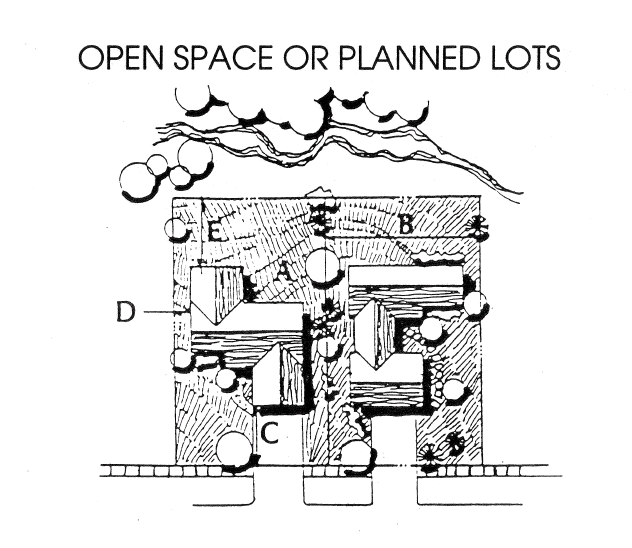
OPEN SPACES OR PLANNED LOTS
(B) Lot-Line House: This dwelling type consists of a single-family, fully detached residence located on an individual lot which is set within five (5) feet of the lot line. Either a five-foot maintenance easement shall be provided for the neighboring property; or the lot line house may be set back five (5) feet from the line; or a recreation, planting and use easement may be granted to the adjacent lot owner. In addition, the following table specifies the minimum standards for a lot-line house. A lot-line house is permitted only in planned developments as provided in section 12-32.
PASTEUP INSERT DIAGRAM
(C) Village House: This dwelling type is a single-family residence which is fully detached from neighboring structures. The village house is distinguished by very small front and side yards. The following table and text specify the minimum standards for a village house. A village house is permitted only in planned developments as provided in section 12-32.
PASTEUP INSERT DIAGRAM
(D) Duplex: This dwelling type consists of a semidetached dwelling for a single family. It has only one (1) dwelling unit from ground to roof and only one (1) wall in common with another dwelling unit. The following table specifies the minimum standards for a duplex dwelling. A duplex is permitted only in planned developments as provided in section 12-32.
PASTEUP INSERT DIAGRAM
(E) Patio House: This dwelling type is a detached or semidetached unit for a single family with one (1) dwelling unit from ground to roof. Each dwelling unit's lot shall be fully enclosed by a wall located at the lot line, thus creating a private yard between the house and the wall. Front, side and rear walls shall be a maximum of six (6) feet in height. That portion of the yard or patio area comprising "minimum patio area" is this housing type's minimum yard area. All living spaces, such as livingrooms, dens and bedrooms, shall face into the yard or patio. Patio houses shall be located on a cul-de-sac or an internal parking lot. The following table specifies the minimum standards for a patio house. A patio house is permitted only in planned developments as provided in section 12-32.
PASTEUP INSERT DIAGRAM
(F) Atrium House: This dwelling type consists of an attached, one-story unit with private individual access for a single family. Each dwelling unit shall have a private yard(s) or atrium(s). The entire lot area of atrium and house shall be enclosed by a wall. The wall shall be six (6) feet in height. All living spaces, that is, livingrooms, dens or bedrooms, shall face an atrium. Atrium houses must be located on a cul-de-sac or on an internal parking lot. The following table specifies the minimum standards for an atrium house. An atrium house is permitted only in planned developments as provided in section 12-32.
* If there is more than one (1) atrium, the secondary spaces need only have a minimum width of six (6) feet and a minimum area of thirty-six (36) square feet.
PASTEUP INSERT DIAGRAM
(G) Weak-Link Townhouses: This dwelling type consists of an attached or semi-detached dwelling unit, a single unit from ground to roof, with individual outside access, housing a single family. Each unit shall have both a one- and two-story section. The one-story section shall be at least ten (10) feet wide or thirty (30) percent of the lot width, whichever is greater. A group of attached, weak-link townhouses shall average no more than eight (8) dwelling units per group. Weak-link townhouses shall be located on a cul-de-sac or an internal parking lot. The following table specifies minimum standards for a weak-link townhouse. A weak-link townhouse is permitted only in planned developments as provided in section 12-32.
PASTEUP INSERT DIAGRAM
(H) Townhouse: This dwelling type consists of a single-family attached unit, with a single unit going from ground to roof, and with individual outside access. Rows of attached townhouses shall average no more than ten (10) dwelling units. Townhouses shall be located on a cul-de-sac or on an internal parking lot. The following table specifies the minimum standards for a townhouse. A townhouse is permitted only in planned developments as provided in section 12-32.
PASTEUP INSERT DIAGRAM
(I) Multiplex: This dwelling type may be either a single-family attached dwelling or a multiple-family unit. Each unit may take direct access to a private yard or access point, or units may share yards and access. The units may be arranged in a variety of configurations, including back-to-back, side-to-side or vertically; however, no fewer than three (3) and no more than six (6) units shall be attached in any single building. The following table specifies the minimum standards for multiplexes. A multiplex is permitted only in planned developments as provided in section 12-32.
PASTEUP INSERT DIAGRAM
(J) Apartment Buildings: Apartment buildings are buildings comprising multiple dwelling units which share common access to individual units and yards. The minimum lot area required shall be the sum of the areas required for each unit within the structure. Apartments shall contain three (3) or more units in a single structure. The following table specifies the minimum standards for apartment buildings. Apartment buildings are permitted only in planned developments as provided in section 12-32.
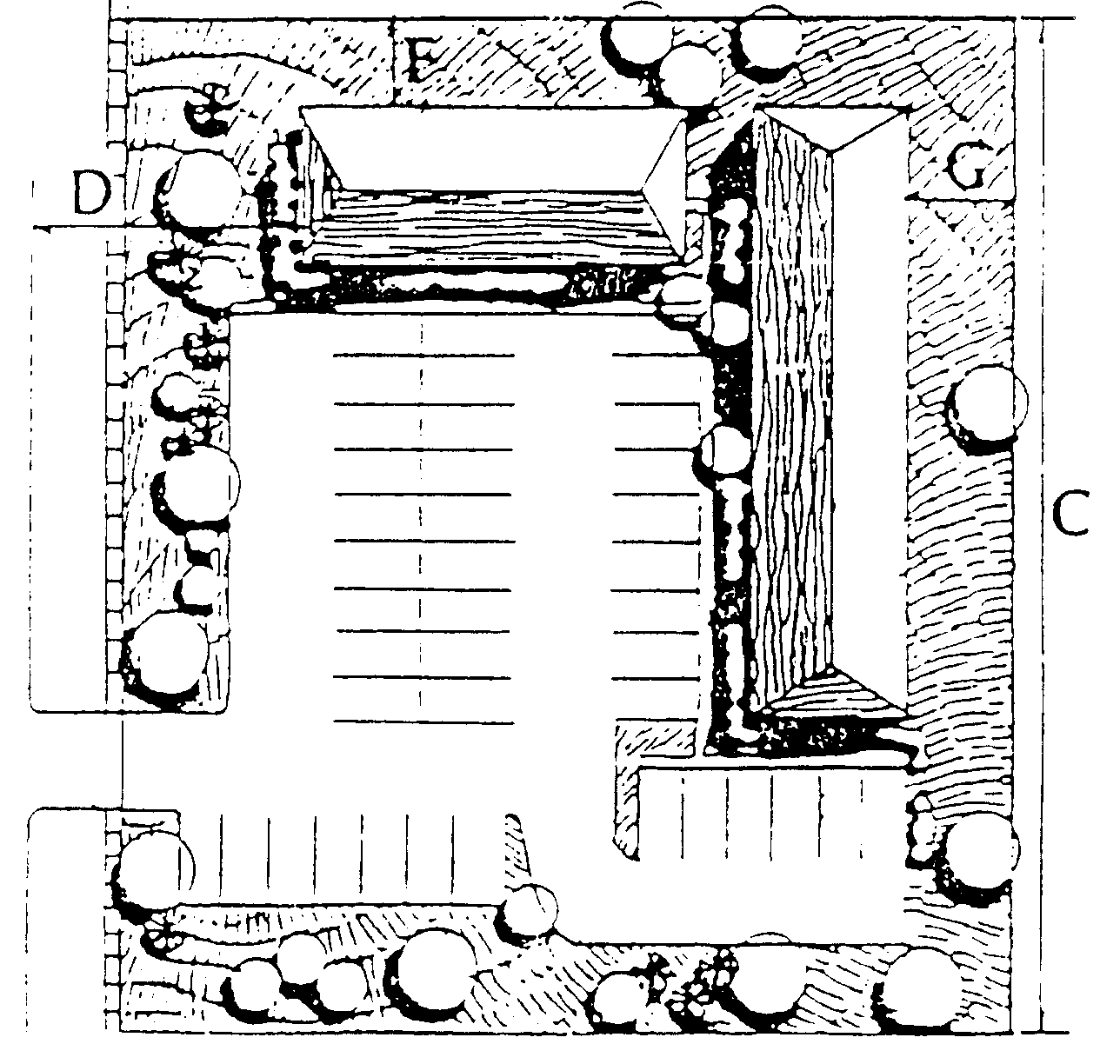
Apartments
Sec. 12-83. - Reserved.
Editor's note— Ord. No. O2018-009, § 2(Exh. A), adopted April 4, 2018, renumbered § 12-83 as § 12-81.3.
Sec. 12-84. - Urban Commercial (UC) District.
The purpose of this section is to enhance the character of the Urban Commercial (UC) districts by providing for safe and attractive areas for pedestrians and automobiles. Development in the UC district shall comply with the standards set forth in section 12-83 for the B-3 district except as otherwise set forth in this section.
(1)
The bufferyards as specified in article VI shall be the minimum front setback for parking.
(2)
Where buildings are located between the street and off-street parking areas or with off-street parking to the rear and side of the building, the minimum building setback shall be fifteen (15) feet, as shown in Illustration 12-84A, and entrance walks provided from the street sidewalk to the building entrances. Such areas shall be landscaped with one (1) streetscape planting unit for every forty (40) feet of walkway.
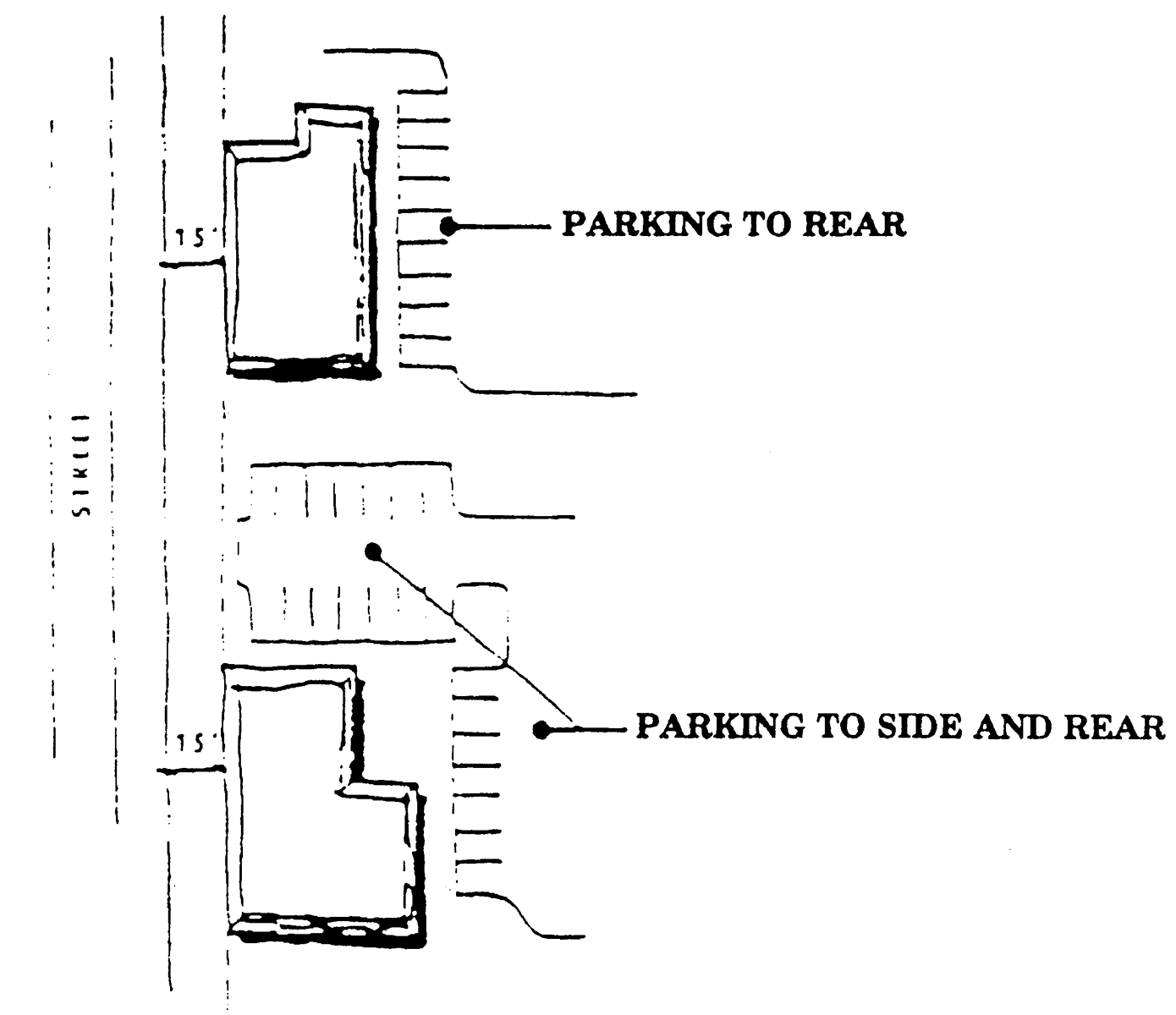
Illustration 12-84(A)
(3)
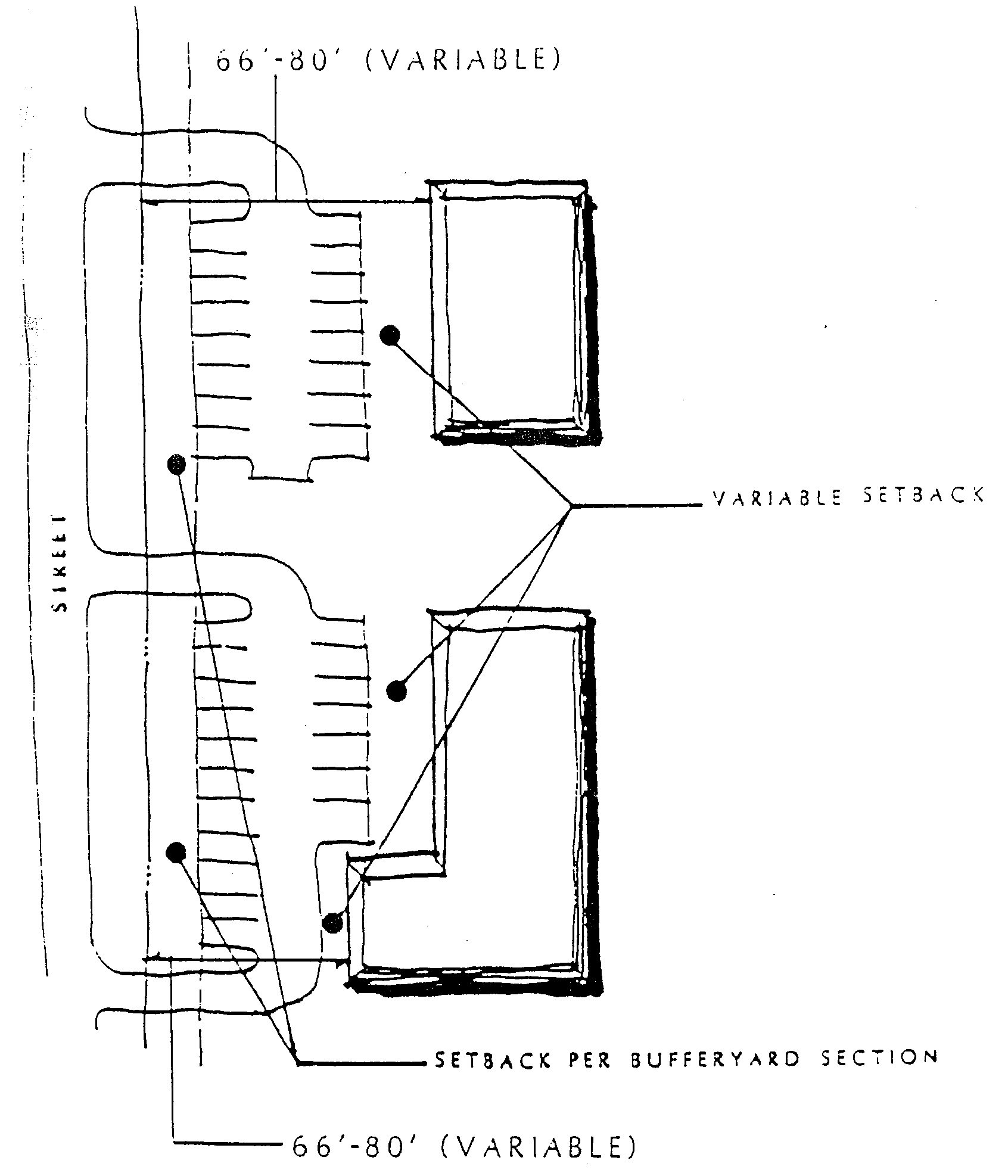
Where buildings are set back to the rear of an off-street parking area or in L-shape to the rear of such parking areas, the minimum building setback shall be sixty-six (66) feet to eighty (80) feet, based on the treatment between edge of curb and building and the landscape treatment as shown in Illustration 12-84B.
Illustration 12-84B
(4)
Where a bufferyard is required, the setback for buildings and parking or drives shall be the bufferyard or ten (10) feet, whichever is greater.
(5)
Where a bufferyard is required, the setback for buildings and parking or drives shall be the bufferyard or twenty-five (25) feet, whichever is greater.
(6)
Minimum lot area shall be ten (10) acres.
(Ord. No. 90-4, § 7, 2-21-90; Ord. No. 2016-014, § 2(Exh. A), 7-27-16)
Sec. 12-85. - Suburban Commercial (SC) District.
The purpose of this section is to ensure the desired character of the Suburban Commercial (SC) District by providing for safe and attractive areas for pedestrians and to emphasize the open character of the area in order to preserve the suburban character. Development in the SC district shall comply with the standards set forth in section 12-83 for the B-2 district except as otherwise set forth in this section.
(1)
The bufferyards as specified in article VI shall be the minimum front setback for parking.
(2)
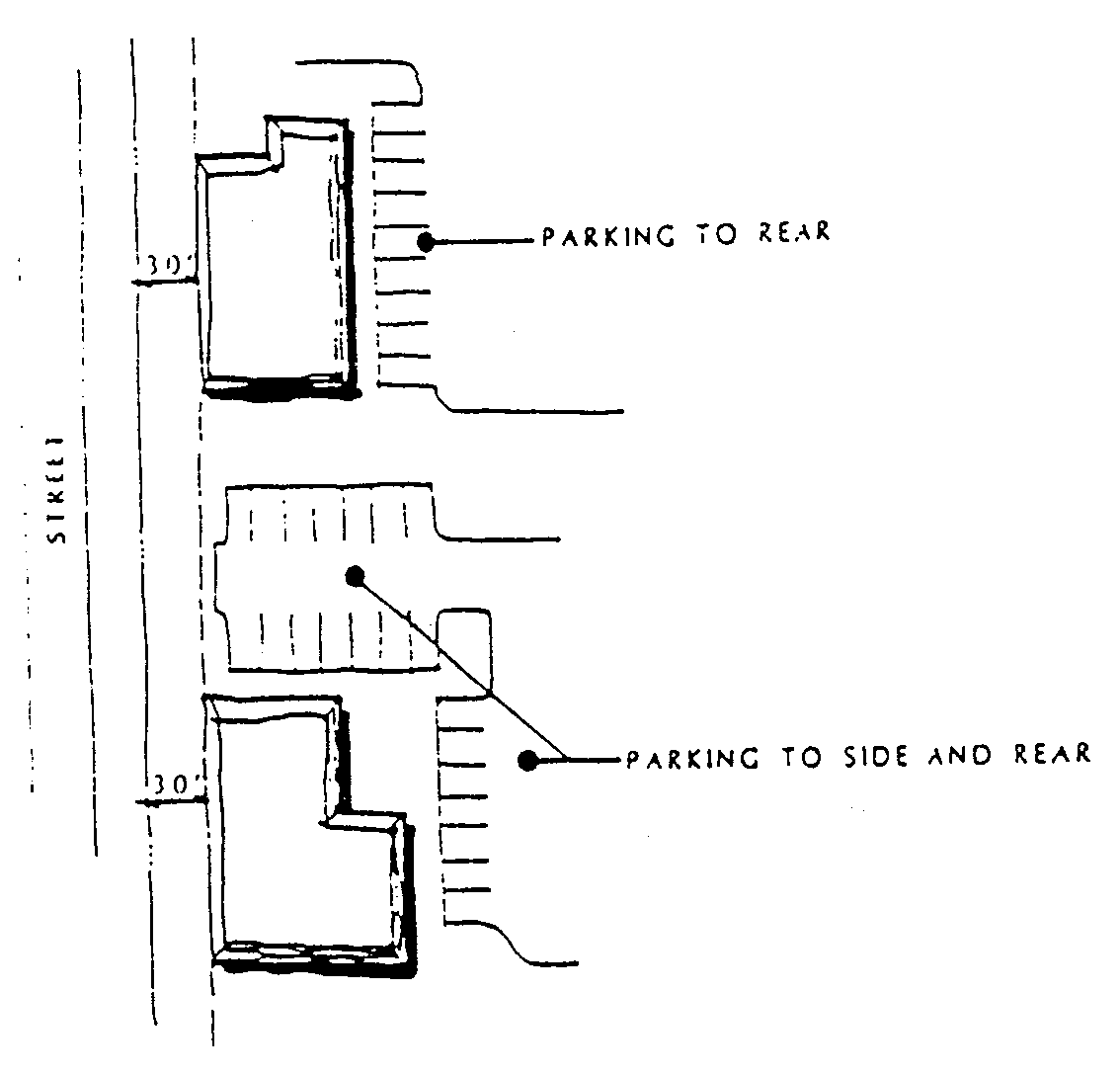
Where buildings are located between the street and off-street parking areas or with off-street parking to the rear and side of the building, the standard setback shall be thirty (30) feet, as shown in Illustration 12-85A, and an entrance walk provided from the street right-of-way to the buildings.
Illustration 12-85A
(3)
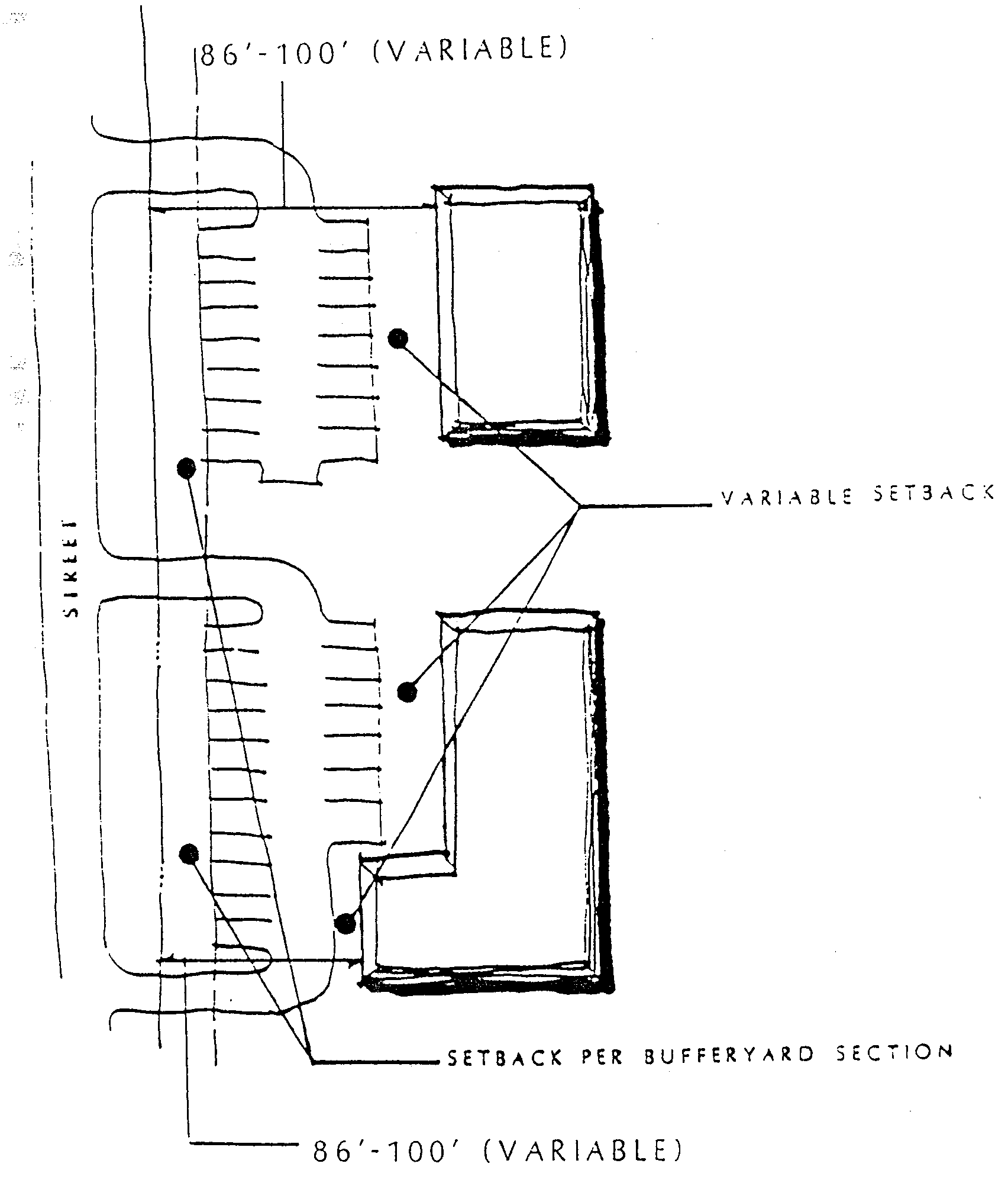
Where buildings are set back to the rear of an off-street parking area or in L-shape to the rear of such parking areas, the minimum building setback shall be eighty-six (86) feet to one hundred (100) feet, based on the treatment between edge of curb and building and the landscape treatment as shown in Illustration 12-85B.
Illustration 12-85B
(4)
Where a bufferyard is required, the setback for buildings and parking or drives shall be the bufferyard or ten (10) feet, whichever is greater.
(5)
Where a bufferyard is required, the setback for buildings and parking or drives shall be the bufferyard or twenty-five (25) feet, whichever is greater.
(6)
Minimum lot area shall be four (4) acres.
(Ord. No. 90-4, § 7, 2-21-90; Ord. No. 2016-014, § 2(Exh. A), 7-27-16)
Sec. 12-86. - Freeway Business (FB) District.
The purpose of this section is to ensure the desired character of the Freeway Business (FB) District by providing for safe and attractive areas for pedestrians and to ensure compatibility with adjacent residential uses. Development in the FB district shall comply with the standards set forth in section 12-83 for the B-3 district except as otherwise set forth in this section.
The setbacks in this district shall be width of the bufferyard required by article VI, or the standards below, whichever is greater.
(1)
Fifty (50) feet from any street or road except for those buildings qualifying for the incentive in item (2) below.
(2)
In buildings with four-sided architecture that are made entirely of brick, split-face concrete block with ten (10) percent glazed tile, and/or wood siding thirty (30) feet from any street or roads.
(3)
Where the adjoining use is residential, a distance equal to the rear yard requirement of the adjoining residential district.
(4)
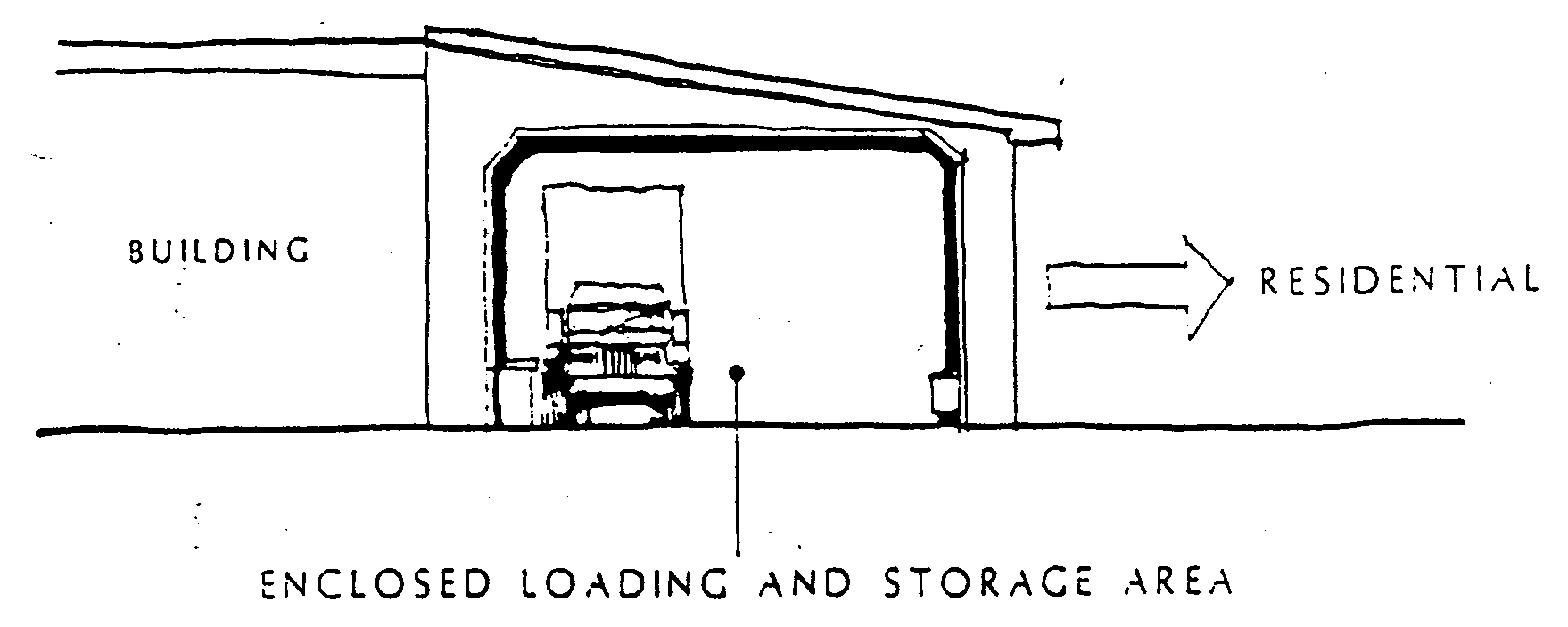
Where a loading area or trash area faces a residential district, the minimum buffer standards in article VI shall be increased by two-tenths (0.2) opacity rating, unless the loading areas and storage are enclosed as illustrated in Illustration 12-86A.
(5)
Minimum lot area shall be ten (10) acres.
(Ord. No. 90-4, § 7, 2-21-90; Ord. No. 2016-014, § 2(Exh.A), 7-27-16)
Illustration 12-86A
Sec. 12-87. - Business Park (BP) District.
The purpose of this section is to ensure the desired character of the Business Park (BP) District by providing for safe and attractive areas for pedestrians and to ensure compatibility with adjacent residential uses. Development in the BP district shall comply with the standards set forth in section 12-83 for the O district except as otherwise set forth in this section.
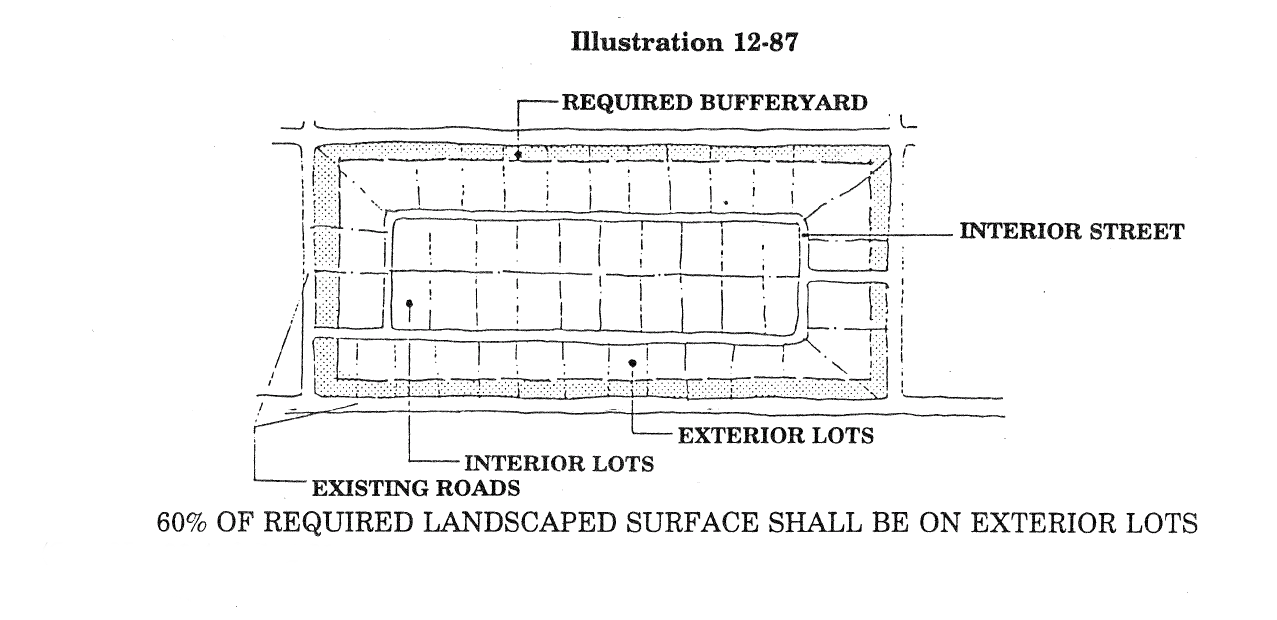
(A) Exterior Lots:
(1)
The minimum setback from exterior property lines shall be the width of the bufferyard selected from Tables 12-108A and 12-108B. It shall apply only to buildings with four-sided architecture that have exteriors of brick, split-face concrete block with a minimum of ten (10) percent glazed tile, or curtain wall construction (subject to approval by the town) and to parking lots that are fully screened from view to a height of at least five (5) feet.
(2)
An additional fifty (50) foot setback shall be added to the required bufferyard from all exterior property lines for metal-sided or stucco-faced concrete block buildings or for parking that does not meet the requirements above for screening.
(3)
A fifty (50) foot setback shall be required from any interior road that provides access to exterior roads outside the site.
(4)
Metal-sided or stucco-faced concrete block buildings shall have forty (40) foot setback from all interior roads.
(5)
All other buildings and parking shall have a twenty (20) foot setback from all interior roads.
(6)
All buildings shall have a minimum twenty (20) foot separation and no building may be installed closer than eight (8) feet from a side property line.
(B) Interior Lots:
(7)
All interior lots shall have a fifteen (15) foot setback from interior streets.
(8)
All buildings shall have a minimum fifteen (15) foot separation and no building maybe installed closer than five (5) feet from a side or rear property line.
(C) Minimum lot area shall be ten (10) acres.
(Ord. No. 90-4, § 7, 2-21-90; Ord. No. 2016-014, § 2(Exh. A), 7-27-16)
Sec. 12-88. - Exceptions to minimum yard requirements.
(A)
Corner lots.
1.
On a corner lot where both the front lot line and a side lot line are adjacent to a public or private street, both sides of the lot shall meet the minimum front yard requirement for the particular district; provided that the town council shall have the authority to waive this provision for new development on parcels zoned R-2, R-3, R-4 or R-5, where the side yard does not provide vehicular access to the adjacent street.
2.
When the rear yard of a corner lot adjoins the front yard of a lot to its rear, no accessory buildings on such corner lot shall be located nearer to the street line than a distance equal to the depth of the front yard requirement for that lot to the rear of the corner lot.
(B)
Architectural features of principal structures. The following shall be allowed to project into or be constructed within any required yard:
1.
Awnings and canopies not to exceed three (3) feet.
2.
Bay windows not to exceed two (2) feet.
3.
Cornices, eaves or gutters may project over one-third (⅓) of the required yard up to a maximum of five (5) feet; provided, that where the yard is less than five (5) feet in width, such projections shall not exceed one-half (½) of the width of the yard.
4.
Chimneys, fireplaces or pilasters may project not over two (2) feet into a required yard.
(C)
Accessory uses and structures.
(D)
Nonconforming yards. Wherever a single-family detached dwelling was lawfully constructed in accordance with minimum yard standards that are less restrictive than the currently applicable standards, such single-family detached dwelling, along with accessory attachments such as porches, patios, pools and screen enclosures, may be horizontally extended to the extent allowed by the previously applicable minimum yard standard as determined by the town administrator or designee. This provision does not apply to the construction of a new residential dwelling on a vacant lot or to the construction of detached accessory buildings, such as, but not limited to, detached garages or guest cottages.
(Ord. No. 90-4, § 7, 2-21-90; Ord. No. 91-33, 9-4-91; Ord. No. 2012-28, § 2(Exh. A), 12-5-12; Ord. No. 2013-10, § 2(Exh. A), 4-17-13; Ord. No. 2013-21, § 2(Exh. A), 9-18-13; Ord. No. O2020-002, § 2(Exh. A), 2-5-20; Ord. No. O2021-030, § 2(Exh. A), 11-3-21; Ord. No. O2022-013, § 2(Exh. A), 8-17-22; Ord. No. O2024-015, § 2(Exh. A), 5-15-24; Ord. No. O2025-014, § 2(Exh. A), 5-7-25)
Sec. 12-89. - Exceptions to height requirements.
(a)
Parapet walls may extend up to five (5) feet above the allowable building height for the particular zoning district.
(b)
Air conditioners and similar mechanical equipment necessary to the function of a building may exceed the building height limit of the particular zoning district by up to twenty-five (25) percent provided that such equipment is, to the maximum extent practicable, screened from view of from public rights-of-way and adjacent residential uses by means of a parapet or similar architectural features,
(c)
Cupolas, steeples, domes, and similar non-habitable architectural features of a building may exceed the building height limit of the particular zoning district by up to twenty-five (25) percent, provided that such structures do not exceed thirty (30) percent of the horizontal area of the roof (individually or in combination).
(d)
Water tanks, solar arrays, chimneys, exhaust stacks and similar non-mechanical components necessary to serve a building may exceed the building height limit of the particular zoning district by up to twenty-five (25) percent.
(e)
Flag poles meeting the standards of section 12-237(G) may exceed the building height limit of the particular zoning district by up to twenty-five (25) percent.
(Ord. No. 2012-28, § 2(Exh. A), 12-5-12; Ord. No. 2013-21, § 2(Exh. A), 9-18-13; Ord. No. O2020-002, § 2(Exh. A), 2-5-20)
Sec. 12-90. - Reserved.
Editor's note— Ord. No. O2024-026, § 2(Exh. A), adopted Sept. 18, 2024, repealed § 12-90, which pertained to exceptions to certain residential development standards and derived from Ord. No. O2021-005, § 2(Exh. A), adopted Feb. 3, 2021.

