
Douglasville City Zoning Code
ARTICLE 13
- GLOSSARY OF DEFINITIONS
Sec. 13.01.- General meaning of words and terms.
A.
For the purposes of the Douglasville UDO, words and phrases defined in this article shall have the meanings attributed to them; additional definitions may be located in other articles of this UDO as necessary.
B.
Any word or term not specifically defined in this article shall have its commonly accepted meaning.
Sec. 13.02. - Defined terms.
A
Abutting properties: Abutting properties are those that have contiguous lot lines at any point.
Academic school: See under "school."
Access: A way or means of approach to provide physical entrance to a property.
Accessory structure setback line: A line delineating the minimum allowable distance between a property line or the right-of-way line of an abutting street and an accessory structure or building on a lot.
Accessory use or structure: A use or structure that is permitted on a property in conjunction with a principal use. An accessory use is incidental to the principal use and would not exist independent of the principal use.
Addition: Any walled and roofed expansion to the perimeter of a building in which the addition is connected by a common load-bearing wall other than a fire wall. Any walled and roofed addition which is connected by a fire wall or is separated by an independent perimeter load-bearing wall shall be considered new construction.
Administrative review: means ministerial review of an application by the City of Douglasville relating to the review and issuance of a permit, including review by the appropriate city staff to determine whether the issuance of a permit is in conformity with the applicable provisions of this UDO.
Agricultural operations: Operations as defined by O.C.G.A. §48-8-3.3 (a)(2), agricultural operations.
Alley or service drive: A minor, permanent, public service way which is used primarily for vehicular service access to the back or the side or properties otherwise abutting on a street.
Alteration: Any change in the supporting members of a building (such as bearing walls, beams, columns or girders) except such change as may be required for its safety; any addition to a building; any change in use from that of one district classification to another; or of a building from one location to another.
Alternative tower structure: Man-made structures such as clock towers, bell towers, church steeples, water towers, light poles and similar alternative-design mounting structures that camouflage or conceal the presence of antennae and towers.
Amusement or recreational attraction: A business establishment offering leisure time activities such as a billiard or pool hall, bingo parlor, go-cart track, miniature golf, golf driving range, judo or karate instruction, softball field, batting cage or skating rink.
Amusement park: A business establishment that groups together a number of leisure time activities such as mechanical rides, amusement devices, refreshment stands and picnic grounds.
Amusement parlor: A business establishment providing leisure entertainment utilizing video games, pinball machines or other coin-operated amusement devices.
Antenna: Any exterior apparatus designed for telephonic, radio, or television communications through the sending and/or receiving of electromagnetic waves; or communications equipment that transmits and/or receives electromagnetic radio frequency signals used in the provision of wireless services. This definition does not apply to broadcast antennas, antennas designed for amateur radio use, or satellite dishes for residential or household purposes.
Appeal: A request for a review of the community development director's interpretation of any provision of this UDO.
Applicable codes: uniform building, fire, safety, electrical, plumbing, or mechanical codes adopted by a recognized national code organization to the extent such codes have been adopted by the City of Douglasville, including any amendments adopted by the City of Douglasville, or otherwise are applicable in the jurisdiction.
Applicant: A property owner or their authorized representative who has petitioned the city for approval of a zoning change, hardship variance, land-disturbance permit, development permit, building permit, special exception or appeal, or any other authorization for the use or development of their property under the requirements of this ordinance.
Application: A petition for approval of a zoning change, land-disturbance permit, development permit, building permit, hardship variance, special exception or appeal, or any other authorization for the use or development of a property under the requirements of this ordinance.
Aquifer: Any stratum or zone of rock beneath the surface of the earth capable of containing or producing water from a well.
Area of shallow flooding: A designated AO or AH zone on a community's flood insurance rate map (FIRM) with base flood depths from one to three feet, and/or where a clearly defined channel does not exist, where the path of flooding is unpredictable and indeterminate, and where velocity flow may be evident.
Area of special flood hazard: The land subject to a one percent or greater chance of flooding in any given year. This includes all floodplain and flood prone areas at or below the base flood elevation (including A, A1-30, A-99, AE, AO, AH, and AR on the flood hazard boundary map (FHBM) or the FIRM), all floodplain and flood prone areas at or below the future conditions flood elevation, and all other flood prone areas as referenced in subsection 8.01.04. All streams with a drainage area of 100 acres or greater shall have the area of special flood hazard delineated.
Arterial street: See "street classifications."
As-built survey drawings: Drawings specifying the dimensions, location, capacities, and operational capabilities of structures and facilities as they have been constructed.
Automobile parking lot, commercial: An area or structure dedicated to the temporary storage of automobiles or other vehicles for periods of less than 24 hours for a fee, operated as the principal use of the property or structure.
Automobile sales and service: The use of any building or premises for the display and sale of new or used automobiles, panel trucks, vans or busses, and which may include any repair service conducted as an accessory use. See also "boat dealers," "motorcycle sales and service," and "recreational vehicle dealer."
Automobile storage lot, wrecker service: Lots, premises or buildings, other than junkyards and salvage yards, where:
A.
Any automobiles are stored or held for a fee; or
B.
Wrecked, inoperable or dismantled automobiles are towed in a state of disrepair and held for repair or other disposition at another location; or
C.
The premises contains a business listed on the wrecker towing list for any state or local government.
Automobile service station: Buildings and premises where gasoline or diesel fuel is dispensed at retail for automobiles, recreation vehicles and motorcycles, and where in addition at least one of the following services is also rendered: sale, replacement, or servicing of spark plugs, oil, water hoses, batteries, ignition components, tires, carburetors, brakes, fuel pumps, or similar service items.
Uses permissible at an automobile service station do not include major mechanical and bodywork, straightening of body parts, painting, welding, or storage of automobiles not in mechanically operable condition. See "automotive repair shop" where major mechanical and bodywork activities are allowed.
Automotive repair shop: The use of a building or premises for the repair of automobiles or other motorized vehicles, or the installation or repair of equipment or parts on motorized vehicles such as mufflers, brakes, tires, radios, transmissions, glass, and engines or engine parts. Automotive repair shops also include:
A.
Automotive paint or body shop: The use of a building or premises for the repair of automotive bodies and/or major mechanical works, straightening of body parts, painting, welding, or storage of automobiles not in operable condition.
B.
Tire sales or repair shop: The use of a building or premises for the selling or repairing of automotive tires, with or without automotive tune-up services.
Available head: The depth of water that is present at the entrance to a pipe during a 100-year storm.
Awning: A roof-like cover that projects from the wall of a building for the purpose of shielding a doorway, walkway, or window from the elements. Awnings are often made of fabric or flexible plastic supported by a rigid frame, and may be retracted into the face of the building.
Awning sign: See "sign types."
B
Bank, savings and loan or credit union: A financial depository institution or related banking facility that accepts money for deposit into accounts from the general public or other financial institutions, and may include personal or business loans, wire transfers and safe deposit boxes as accessory uses. Institutions such as payday loan, checks cashed and car title loan establishments are not considered as banks, savings and loan or credit unions.
Banner: See "sign types".
Banquet hall: A commercial meeting hall establishment where food and drink may be provided to guests by staff, by the lessee/host, or by independent caterers, for pre-planned events only, and not for walk-in customers; a banquet hall is not a restaurant.
Base flood: The flood having a one percent chance of being equaled or exceeded in any given year, also known as the 100-year flood.
Base flood elevation: The highest water surface elevation anticipated at any given point during the base flood.
Basement: That portion of a building having its floor subgrade (below ground level) on two or more sides.
Bed and breakfast inn: A business establishment operated within a dwelling by the owner-occupant, offering temporary lodging and one or more meals to the traveling public while away from their normal places of residence.
Berm: A mound of earth, or the act of pushing earth into a mound.
Billboard: See "sign types".
Block: An area of land surrounded by streets.
Boarder: An individual who lives in a part of a dwelling unit at the behest of the resident family and is provided lodging or lodging and meals for pay or other consideration on a temporary basis.
Boarding house: See "rooming or boarding house."
Boat dealer: The use of any building or premises for the display and sale of new or used motorboats or other watercraft, and which may include the sale of marine supplies or outboard motors and repair service conducted as accessory uses.
Bond: A bond, letter of credit or approved surety method approved by the city attorney.
Breakaway wall: A wall that is not part of the structural support of the building and is intended through its design and construction to collapse under specific lateral loading forces without causing damage to the elevated portion of the building or the supporting foundation system.
Brewery means a manufacturer or producer of malt beverages exceeding 15,000 barrels of beer in a calendar year for wholesale off premises consumption and/or for consumption on premises, subject to the limitations provided in O.C.G.A. section 3-5-24.1. As used in this definition, the term "barrel" shall be defined as set forth in O.C.G.A. section 3-5-1.
Brewpub means any eating establishment in which malt beverages are manufactured, subject to the barrel production limitation prescribed in O.C.G.A. section 3-5-36. As used in this paragraph, the term "eating establishment" means an establishment which is licensed to sell distilled spirits, malt beverages, or wines and which derives at least 50 percent of its total annual gross food and beverage sales from the sale of prepared meals or food; provided, however, that when determining the total annual gross food and beverage sales, barrels of malt beverages sold to licensed wholesale dealers, as authorized pursuant to subparagraph (D) of paragraph (2) of Code section 3-5-36, or to the public for consumption off the premises, as authorized pursuant to subparagraph (D) of paragraph (2) and paragraph (4) of Code section 3-5-36, shall not be used.
Buffer: An area of natural vegetation or man-made construction which is intended to provide a visual and dimensional separation between dissimilar land uses.
A.
Natural buffer: A visual screen created by existing vegetation (and as may be supplemented with additional plantings) of such density so as to present an opaque visual separation when viewed from one side to the other throughout the year.
B.
Structural buffer: A visual screen created through construction of a solid wooden fence, decorative masonry wall, earthen berm, or combination of fence or wall with an earthen berm, which may be supplemented with vegetation, so as to present an opaque visual separation when viewed from one side to the other throughout the year.
C.
Undisturbed buffer: A natural buffer.
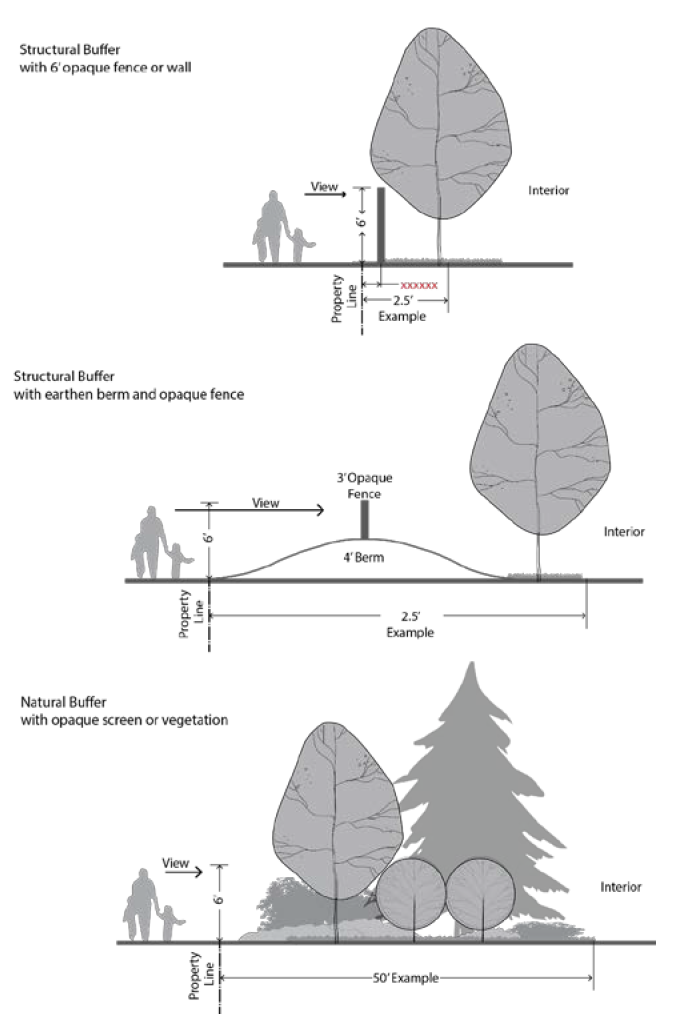
Figure 13-1 Buffer Types
Building: Any structure over 100 square feet in size permanently affixed to the ground, having a roof supported by columns or walls and intended for the shelter, housing, or enclosure of any individual, animal, process, equipment, goods, or materials of any kind.
Building floor area: The total floor area of all heated spaces within a building as measured within the outside of the exterior walls, exclusive of uncovered porches, terraces, and unheated stairwells, storage areas, garages and loading docks.
Building height: The vertical distance measured to the eaves of the highest habitable floor of a building from the average finished grade across those sides of a building that face a street.
Building materials sales: An establishment offering lumber or other construction materials used in buildings for sale to contractors or the general public.
Building sign: See "sign types".
Building system: Any utility, mechanical, electrical, structural, egress, or fire protection safety system.
Business or vocational school: See under "school."
Business, professional or trade association: A private organization that promotes the interests of business groups, such as the Chamber of Commerce; professions, such as the Bar Association; or members of a trade, such as a labor union.
Business service: The use of a building or premises primarily for rendering a service to other business establishments on a contract or fee basis, such as advertising, credit reporting, computer programming, photocopying, and employment services.
C
Caliper: The diameter of a tree (usually nursery stock) measured at a point six inches above the ground or top of root ball for up to and including four-inch caliper trees, and at a point 12 inches above the ground or top of root ball for larger sizes.
Canopy: A roof-like structure supported by columns or projecting from a building and open on at least three sides.
Canopy tree: A species of tree that normally reaches a height at maturity in excess of 50 feet and is used primarily for shade, such as Red Oak, Shumark Oak, Chinese Elm, River Birch, White Oak, Water Oak, American Elm, Trident Maple, Pin Oak, American Beech, Pecan, Southern Magnolia, Sweetgum and Willow Oak.
Capacity: The maximum number of persons who may be reasonably expected to be present in any building or on any floor thereof at a given time according to the use which is made of such building. The authority having jurisdiction shall determine and by rule declare the formula for determining capacity for each of the uses described in this section.
Carnival: See "special outdoor event."
Car wash: The use of a building or premises primarily for washing automobiles, recreation vehicles and motorcycles, whether by hand or mechanical means.
A.
Conveyor car wash: A commercial car wash where the car moves on a conveyor belt during the wash. The driver of the vehicle can remain in the vehicle or wait outside of the vehicle.
B.
In-bay automatic car wash: A commercial car wash where the driver pulls into the bay and parks the car; the vehicle remains stationary while a machine moves back and forth over the vehicle to clean it, instead of the vehicle moving through the tunnel.
C.
Self-service car wash: A commercial car wash where the customers wash their cars themselves with spray wands and brushes.
Cellular tower or antenna: See "transmission tower."
Cemetery: A facility for the burial of deceased human beings or animals.
Center line: That line connecting the succession of midpoints between the identifiable limits of any improvements on the ground or of any easement, or between the banks of any river, creek or stream.
Charitable organization: means an organization that is exempt from taxation pursuant to Section 501(c)(3) of the Internal Revenue Code, 26 USC 501(c)(3).
Church or place of worship: An establishment used primarily for worship and other religious ceremonies including religious education, rectories, parsonages, offices, social services and faith based community outreach programs.
City: The City of Douglasville, Georgia.
City arborist: The community development director or his/her designee responsible for the administering the provisions of this Unified Development Ordinance with respect to trees and landscaping.
Civic, social or fraternal association: An organization dedicated to public activities of a civic and non-profit nature, such as an alumni association, American Legion, Hibernian Society, Masonic Lodge or Oddfellows.
Clearing: The removal of vegetation from a property, whether by cutting or other means.
Collector street: See "street classifications."
Collocate: To install or mount a small wireless facility in the public ROW on an existing support structure, an existing tower, or on an existing pole to which a small wireless facility is attached at the time of the application. "Collocation" has a corresponding meaning.
Common open space: See "open space."
Communications facility: Collectively, the equipment at a fixed location or locations within the public ROW that enables communications services, including: (i) radio transceivers, antennas, coaxial, fiber-optic or other cabling, power supply (including backup battery), and comparable equipment, regardless of technological configuration; and (ii) all other equipment associated with any of the foregoing. A communications facility does not include the pole, tower or support structure to which the equipment is attached.
Communications service: Cable service, as defined in 47 U.S.C. § 522(6); information service, as defined in 47 U.S.C. § 153(24); or telecommunications service, as defined in 47 U.S.C. § 153(53).
Communications service provider. [Sic]
Comprehensive Plan: The text, maps and other data adopted in accordance with the Georgia Comprehensive Planning Act (O.C.G.A. 36-70-1 et seq.) and as officially amended from time to time.
Condition of zoning approval: A requirement adopted by the city council at the time of approval of a rezoning or special use, placing greater or additional requirements or restrictions on the property than provided in this UDO in order to reduce an adverse impact of the rezoning or special use and to further the protection of the public health, safety, or general welfare.
Congregate personal care home: See "personal care home."
Construction: Any building or erection of a structure or preparation of a property for same.
Construction contractor: An establishment engaged in the construction of buildings, engaged in heavy construction (such as streets, bridges or utilities), or specialized in such construction trades as plumbing, heating and air-conditioning, electrical wiring, masonry, roofing or gutters, well drilling, or house painting.
Construction sign: See "sign types".
Convalescent home: An intermediate care facility primarily engaged in providing inpatient nursing or rehabilitative services to residents who require watchful care or medical attention or treatment, but not on a continuous basis, although staff is on duty 24-hours per day.
Convenience gas station: A building or premises where gasoline, diesel fuel and oil may be dispensed at retail with no automobile repair facilities. Uses permissible also include the sale of cold drinks, packaged foods, tobacco and similar household convenience goods for station customers.
Critical root zone: The land area circular in shape and centered on the trunk of a tree, the radius of which circle is determined by the farthest extent of the drip line from the trunk.
Crosswalk: A right-of-way or public easement within a block dedicated to public use, ten feet or more in width, intended primarily for pedestrians and from which motor-propelled vehicles are excluded.
Cul-de-sac: A dead-end street that terminates in a permanent turnaround and not intended for future extension.
Curb break or curb cut: Any interruption or break in the line of a street curb for the purpose of connecting a driveway to a street, or otherwise to provide vehicular access to abutting property.
Creek: See "stream".
Custom service restaurant: See "restaurant, custom service."
Cut: A portion of land surface or area from which earth has been removed or will be removed by excavation; the depth below original ground surface to excavated surface. Also known as "excavation."
Cutting: The removal of any soil or other solid material from a natural ground surface.
D
Data processing facility or center: A facility, accessed only by employees, that houses computer systems and associated components, related to the transmittal and receiving of information, including but not limited to telecommunications systems, telecommunication and telephone switching systems, cloud storage systems, and server farms.
Day care facility: The use of a building or premises for the care and supervision of children or elderly adults who do not reside on the property, for periods of less than 24 hours.
A.
Child care learning center: Any place operated by a person, society, agency, corporation, institution, or group wherein are received for pay for group care for less than 24 hours per day, without transfer of legal custody, seven or more children under 18 years of age; provided, however, that this term shall not include a private school which provides kindergarten through grade 12 education, meets the requirements of O.C.G.A. Section 20-2-690, and is accredited by one or more of the entities listed in subparagraph (A) of paragraph (6) of O.C.G.A. Section 20-3-519 and which provides care before, after, or both before and after the customary school day to its students as an auxiliary service to such students during the regular school year only.
B.
Family child care learning home: A private residence operated by any person who receives therein for pay for supervision and care less than 24 hours per day, without transfer of legal custody, at least three but not more than six children under 13 years of age who are not related to such person and whose parents or guardians are not residents in the same private residence; provided, however, that the total number of unrelated children cared for in such home, for pay and not for pay, may not exceed six children under 13 years of age at one time.
C.
Group day care home: Any facility that is operated and maintained for and is qualified to furnish care and training to individuals with developmental disabilities or elderly adults on less than a 24-hour basis.
Dead-end street: A street connected to another street at only one end.
Dead plant or tree: Any living plant material that has lost 33 percent or more of its branches or leaves, shall be considered dead.
Decorative pole: A Pole that is specially designed and placed for aesthetic purposes.
Deflection angle: The angle between a deviation in the direction of the center line of a street and the extension of the center line along a straight course from the point from which the center line changed direction.
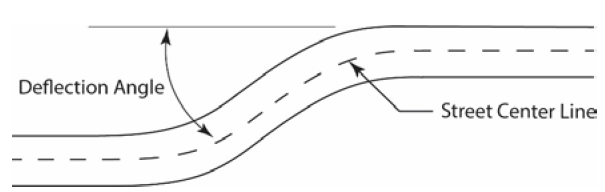
Figure 13-2 Deflection Angle
Density:
A.
Residential—The number of dwelling units per acre within a development or defined area;
B.
Nonresidential—The number of square feet of building floor area per acre.
Department: Department means the Community Development Department of Douglasville, Georgia.
Detention facility: See "Stormwater Detention facility."
Developer: The person, corporation or other legal entity that undertakes the subdivision of property, the alteration of land or vegetation in preparation for construction activity, or the construction of streets, utilities, buildings or other improvements required for the habitation or use of property.
Development:
A.
For purposes of floodplain management and flood damage prevention only, any manmade change to improved or unimproved real estate including but not limited to buildings or other structures, mining, dredging, filling, clearing, grubbing, grading, paving, any other installation of impervious cover, excavation or drilling operations or storage of equipment or materials;
B.
For all other purposes of this UDO:
1.
A land development project involving the construction of streets, utilities, buildings, or other improvements required for the habitation or use of property, such as a residential neighborhood, an apartment complex, a store, or a shopping center;
2.
Any manmade change to improved or unimproved real estate, including, but not limited to, buildings or other structures, mining, dredging, filling, grading, paving, excavating, drilling operations, or permanent storage of materials or equipment;
3.
The act of constructing or carrying out a land development project, including the alteration of land or vegetation in preparation for construction activity.
Development permit: The authorization necessary to carry out the planned development of land and construction of such site improvements as streets, utilities, drainage structures and parking lots, and which may include authorization to initiate and conduct such land-disturbing activities as clearing, grubbing and grading. See also "land-disturbance permit."
Development site: That portion of a tract of land that will be dedicated to a proposed development, including the land containing trees that will be counted toward satisfying the requirements of these provisions.
Diameter breast height (DBH): The diameter of a tree trunk (usually a mature tree) measured at a height of four and one-half feet above the ground. If a tree splits into multiple trunks below four and one-half feet, the trunk is measured at its narrowest point beneath the split.
Director: Means director of the community development department of the City of Douglasville or designee.
Directional sign: See "sign types".
Distillery means a manufacturer of distilled spirits for wholesale sales. A distillery may conduct promotional tours and offer free samples of distilled spirits in accordance with the Official Code of Georgia, and offer retail sales in accordance with the Official Code of Georgia.
Donation bin: Means any unattended container, receptacle, or similar device that is located on any property within the city used for soliciting and collecting donations of clothing or other salvageable personal property. This term does not include recycle bins for the collection of recyclable materials governed or regulated by the City of Douglasville Code of Ordinances or this UDO.
Drainage: A general term applied to the removal of surface or subsurface water from a given area either by gravity or by pumping; most commonly applied to surface water.
Drainage structure: A device composed of a virtually non-erodible material such as concrete, steel, plastic or other such material that conveys water from one place to another by intercepting the flow and carrying it to a release point for stormwater management, drainage control or flood control purposes.
Drainage system: The surface and subsurface system for the removal of water from the land, including both the natural elements of streams, marshes, swales and ponds, whether of an intermittent or continuous nature, and the manmade element which includes culverts, ditches, channels, detention facilities and the storm sewer system.
Drip line: A line on the ground established by a vertical plane extending from a tree's outermost branch tips down to the ground (i.e., the line enclosing the area directly beneath the tree's crown from which rainfall would drip).
Drive-in motion picture theater: See "theater."
Duplex: A two-family dwelling (see "dwelling, two-family dwelling").
Drug addiction rehabilitation center: A halfway house, drug rehabilitation center or any other facility for treatment of drug dependency.
Dwelling: A building or portion of a building arranged or designed to provide living quarters for one or more persons on a permanent or long-term basis.
A.
Single-family dwelling: A residential building, whether site-built or a manufactured home or an industrialized building, designed for occupancy by one family.
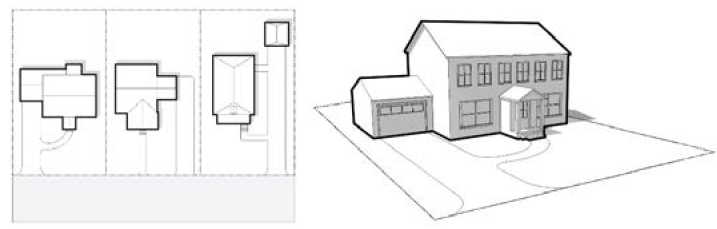
Figure 13-3 Single Family Detached Dwelling
1.
Site-built single-family detached dwelling: A single-family detached dwelling constructed on the building site from basic materials delivered to the site, and which is constructed in accordance with all requirements of the building codes as adopted by the city.
2.
Class A Single-family detached dwelling: A site-built single-family detached dwelling, a one-family manufactured home or a one-family industrialized home that meets or exceeds the standards for single-family and two-family dwellings under this Code.
3.
Class B single-family detached dwelling: A site-built single-family detached dwelling, a one-family manufactured home or a one-family industrialized home that does not meet the standards for single-family and two-family dwellings under this Code.
4.
Single-family attached dwelling: A single-family dwelling in which the dwelling units may adjoin one another only at the vertical walls and no dwelling unit may be located above another.
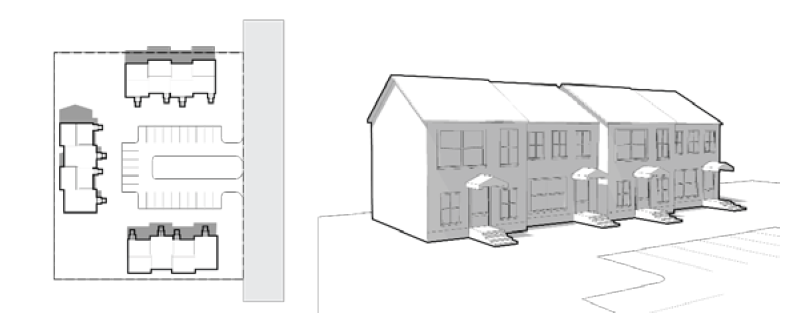
Figure 13-4 Single Family Attached Dwelling
B.
Two-family dwelling: A residential building designed exclusively for occupancy by two families in separate dwelling units living independently of each other.
1.
Site-built two-family dwelling: A two-family dwelling constructed on the building site from basic materials delivered to the site, and which is constructed in accordance with all requirements of the building codes as adopted by the city.
2.
Class A two-family dwelling: A site-built two-family dwelling, a two-family manufactured home or a two-family industrialized home that meets or exceeds the standards for single-family and two-family dwellings under this Code.
3.
Class B two-family dwelling: A site-built two-family dwelling, a two-family manufactured home or a two-family industrialized home that does not meet the standards for single-family and two-family dwellings under this Code.
C.
Multi-family dwelling: A residential building designed exclusively for occupancy by three or more families in separate dwelling units living independently of each other.
1.
Multi-family apartment building: A multi-family dwelling in which a dwelling unit may be located above another, such as in a garden apartment building.
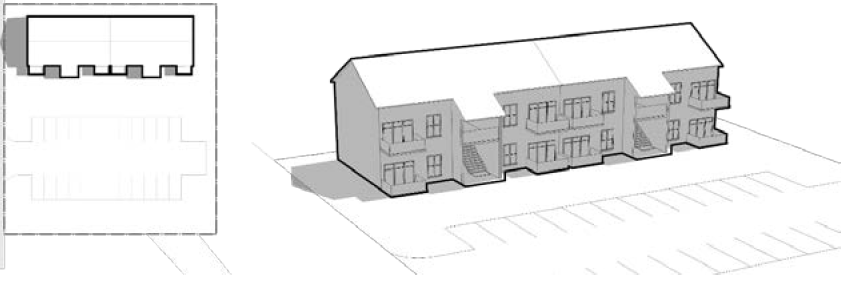
Figure 13-5 Multi-Family Apartment Building
2.
Quadraplex: A residential building designed exclusively for occupancy by four families in separate dwelling units living independently of each other.
3.
Triplex: A residential building designed exclusively for occupancy by three families in separate dwelling units living independently of each other.
D.
Multi-use dwelling: A dwelling unit located within a building that is also designed for or occupied separately by nonresidential uses, such as shops or offices.
Dwelling unit: One or more rooms connected together and constituting a separate, independent housekeeping establishment with complete provisions for cooking, eating, sleeping, bathing and personal hygiene, and physically set apart from any other dwelling unit in the same structure.
E
Easement: A strip of land on which the property owner has granted to another entity the right to use such land for specific purposes.
Elevated building: A building, without a basement, built to have the lowest floor of the lowest enclosed area elevated above the ground level by means of fill, solid foundation perimeter walls, pilings, columns, piers, or shear walls adequately anchored so as not to impair the structural integrity of the building during a base flood event.
Eligible facilities request: An eligible facility request as set forth in 47 C.F.R. Section 1.40001(b)(3), as that section may be amended from time to time.
Enforcement authority: The City of Douglasville Community Development Director, Building Official or the State of Georgia Fire Marshal.
Erosion: The process by which land surface is worn away by the action of wind, water, ice or gravity.
Erosion and sedimentation control plan: A plan for the control of soil erosion and sedimentation resulting from a land-disturbing activity.
Event center: A public or private facility used for the purposes of private receptions or parties or similar types of gatherings.
Excavation: The mechanical removal of earth material.
Existing building or structure: any completed building or structure which has been placed in service for a minimum of 25 years and was originally constructed prior to January 1, 1975.
Existing grade: See "grade."
F
Family: An individual or two or more persons living together as a household.
Family day care home: See "day care facility."
Family personal care home: See "personal care home."
Farmers market: A structure or location wherein space is provided to multiple farmers or growers to gather on a regular, recurring basis to sell a variety of fresh fruits and vegetables and other locally grown agricultural products directly to consumers.
Fast food restaurant: See "restaurant, fast food."
FCC: The Federal Communications Commission of the United States
FEMA: The Federal Emergency Management Agency.
Fence: An artificially constructed barrier of wood, wire, wire mesh, or decorative metal erected to enclose, screen or separate portions of a lot.
Fill: A portion of land surface to which soil or other solid material has been added; the depth above the original ground.
Filling: The placement of any soil or other solid material, either organic or inorganic, on a natural ground surface or excavation.
Finished grade: See "grade."
Flood or flooding: A general and temporary condition of partial or complete inundation of normally dry land areas from:
A.
The overflow of inland or tidal waters; or
B.
The unusual and rapid accumulation or runoff of surface waters from any source.
Flood hazard boundary map (FHBM): An official map of a community, issued by the Federal Insurance Administration, where the boundaries of areas of special flood hazard have been defined as Zone A.
Flood insurance rate map (FIRM): An official map of a community, issued by the Federal Insurance Administration, delineating the areas of special flood hazard and/or risk premium zones applicable to the community.
Flood insurance study: The official report by the Federal Insurance Administration evaluating flood hazards and containing flood profiles and water surface elevations of the base flood.
Floodplain: (with regard to stream buffer protection) Any land area susceptible to flooding, which would have at least a one percent probability of flooding occurrence in any calendar year based on the basin being fully developed as shown on the current land use plan (i.e., the regulatory floodway).
Floodproofing: Any combination of structural and nonstructural additions, changes, or adjustments to structures which reduce or eliminate flood damage to real estate or improved real property, water and sanitary facilities, structures and their contents.
Flood-resistant materials: Building materials capable of withstanding direct and prolonged contact with floodwaters without sustaining significant damage. The term "prolonged contact" means at least 72 hours, and the term "significant damage" means any damage requiring more than low-cost cosmetic repair (such as painting). See FEMA Technical Bulletin 2-93, and subsequent revisions thereto.
Floodway or regulatory floodway: The channel of a stream or other watercourse and the adjacent areas of the floodplain which is necessary to contain and discharge the base flood flow without cumulatively increasing the base flood elevation more than one foot.
Floor: The top surface of an enclosed area in a building, including basement (e.g. top of slab in concrete slab construction or top of wood flooring in wood frame construction). The term does not include the floor of a garage used solely for parking vehicles or storage, or the floor area of an attic used exclusively for storage.
Floor area, building: See "building floor area."
Floor area, gross: See "gross floor area."
Flowering ornamental tree: A tree, other than a canopy tree, that produces seasonal flowers and blossoms and is used primarily for aesthetic or ornamental purposes.
Free-flowing creek, stream, or river: See "stream".
Freight agency or shipping coordinator: An establishment primarily engaged in the remote arrangement of freight or cargo transportation, and not located where the freight or cargo is handled, stored or transported.
Frontage or street frontage: The width in linear feet of a lot where it abuts the right-of-way of any street from which access may be directly gained.
Functionally dependent use: A use which cannot perform its intended purpose unless it is located or carried out in close proximity to water.
Funeral home: A building used for the preparation of deceased human beings for burial or cremation and for conducting funeral ceremonies, and where cremations may be conducted as an accessory use.
Furniture or equipment rental establishment: A business establishment that rents or leases items of personal property such as furniture, tools, medical equipment, appliances and construction equipment to the general public, but not including automobiles or trucks.
Future conditions flood: The flood having a one percent chance of being equaled or exceeded in any given year based on future conditions hydrology. Also known as the 100-year future conditions flood.
Future conditions flood elevation: The flood standard equal to or higher than the base flood elevation. The future conditions flood elevation is defined as the highest water surface anticipated at any given point during the future conditions flood.
Future conditions floodplain: Any land area susceptible to flooding by the future conditions flood.
Future conditions hydrology: The flood discharges associated with projected land-use conditions based on the city's zoning map, comprehensive land-use plan, and/or watershed study projections, and without consideration of projected future construction of flood detention structures or projected future hydraulic modifications within a stream or other waterway, such as bridge and culvert construction, fill, and excavation.
G
Garden apartment building: See under "dwelling."
Garment services: A business establishment engaged primarily in such activities as linen supply, dressmaking, custom tailoring, or fur cleaning and storage.
Gated community: A subdivision approved as such, which may be served by private streets.
General business office: See under "office."
General merchandise store: A retail establishment that sells a number of lines of merchandise, such as dry goods, apparel, furniture, small wares, hardware and boutique foods (i.e. "department stores," "variety stores" and "country general stores.").
Grade: The level of the surface of the ground.
A.
Existing grade: The original elevation of the ground surface prior to cutting or filling.
B.
Finished grade: The final elevation and contour of the ground after cutting or filling and conforming to the proposed design.
C.
Highest adjacent grade: The highest natural elevation of the ground surface, prior to construction, next to the proposed walls of a building. If fill has been placed, it refers to the original ground level beneath the fill.
Grading: Altering the shape of ground surfaces to a predetermined condition; this includes stripping, cutting, filling, stockpiling and shaping, or any combination thereof, and shall include the land in its cut or filled condition.
Grading permit: Authorization necessary but limited to the initiation and conduct of a land-disturbing activity on a property.
Grandfathered use, structure or lot: A use, structure or lot that was legally established prior to the imposition of current regulations and that does not conform to the requirements of those regulations. Also known as a "nonconforming" use, structure or lot.
Greenhouse: A building whose roof and sides are made largely of glass or other transparent or translucent material and in which the temperature and humidity can be regulated for the cultivation of plants.
Greenway: An area along the course of any state waters to be maintained in an undisturbed and natural condition.
Gross floor area: The total area of all floors of a building, measured from the outside planes of the exterior walls.
Ground cover: A low growing plant, other than turf grass, which forms a continuous cover over the ground surface.
Ground elevation: See under "grade."
Group day care home: See under "day care facility."
Group home for the elderly: See "retirement community."
Group personal care home: See under "personal care home."
Growler: A bottle made of glass or other material customary to the malt beverage industry, provided that the bottle is capable of being sealed with a screw cap or flip top and then sealed for the purpose of complying with open container laws, and further provided that the bottle does not exceed 64 ounces and is filled by a licensee or employee of the licensed establishment with beer from a keg.
Guest house: An accessory use to a dwelling designed and intended for the temporary housing of visitors to property residents for no fee or other consideration, and meeting or exceeding the standards for single-family and two-family dwellings under this Code.
Guy tower: See under "transmission tower."
H
Handicapped parking space: A space laid out and designated by signage in accordance with the requirements of the Federal Americans with Disabilities Act.
Hardwood tree: Any leaf-bearing (not needle-bearing) tree that is not coniferous (cone-bearing).
Health club or fitness center: A business that provides facilities for aerobic exercises, such as running and jogging tracks, exercise equipment, game courts, gymnasium, or swimming facilities.
Health services facility: An establishment primarily engaged in outpatient health services and counseling, such as a kidney dialysis center, blood bank, or childbirth preparation center, but specifically excluding a "drug addiction rehabilitation center."
Height: See "building height," "sign height," "structure height" and "transmission tower height."
Heavily landscaped area: An area planted with a combination of shade and flowering trees, deciduous and evergreen shrubs, and flowering perennials such that the entire area is covered with landscape materials.
Highest adjacent grade: See "grade".
Historic structure: For purposes of floodplain management and flood damage prevention only, any structure that is:
A.
Listed individually in the National Register of Historic Places (a listing maintained by the U.S. Department of Interior) or preliminarily determined by the Secretary of the Interior as meeting the requirements for individual listing on the National Register;
B.
Certified or preliminarily determined by the Secretary of the Interior as contributing to the historical significance of a registered historic district or a district preliminarily determined by the Secretary to qualify as a registered historic district;
C.
Individually listed on a state inventory of historic places and determined as eligible by states with historic preservation programs which have been approved by the Secretary of the Interior; or
D.
Individually listed on the local inventory of historic places and determined as eligible by communities with historic preservation programs that have been certified either:
1.
By an approved state program as determined by the Secretary of the Interior, or
2.
Directly by the Secretary of the Interior in states without approved programs.
Home occupation: Any activity carried out for profit by the resident and conducted as an accessory use in the resident's dwelling unit.
A.
Home office: A home occupation that is limited to an office use and does not involve visits or access by the public, suppliers or customers, and does not involve the receipt, maintenance, repair, storage or transfer of merchandise at the home.
B.
Residential business: A home occupation that is limited to the office use of a practicing professional, an artist or a commercial representative, and may involve very limited visits or access by clients or customers, but does not involve the maintenance, repair, storage or transfer of merchandise received at the home.
Hospital: The use of a building or premises for the provision of diagnostic health services and medical or surgical care to inpatients and out-patients suffering from illness, disease, injury, deformity and other physical or mental afflictions, and including as an integral part of the institution, related facilities such as laboratories, outpatient facilities or training facilities.
Hotel or motel: A business establishment offering temporary lodging to the traveling public while away from their normal places of residence, and often including a restaurant as an accessory use.
Household: An individual living alone or a group of individuals living together in a single dwelling unit, sharing common use of and access to all living and eating areas, bathrooms, and food preparation areas, who mutually combine their efforts and share responsibilities for domestic chores such as child rearing, cleaning and cooking in a permanent and long-term relationship, as contrasted to one in a transient relationship who pays for lodging such as a boarder.
Hunting: The activity of catching and/or killing wild animals or game, especially for food or sport.
I
Illuminated signs: See "sign types."
Impermeable: Something that water cannot pass through or be absorbed by, such as a layer of rock.
Impervious surface or impervious cover: Man-made structures, improvements and surfaces that prevent or significantly limit the infiltration of stormwater. Examples of impervious structures and improvements are: buildings, structures, roads, driveways, parking lots, decks, swimming pools, patios, and sidewalks. Examples of impervious materials often used to construct such improvements are asphalt, concrete, gravel, brick, stone, wood, asphalt shingles, metal, and composite materials.
Improvements: The physical addition and changes to land that may be necessary to produce usable, desirable and acceptable lots or building sites.
Industrialized (or modular) home: A dwelling manufactured in accordance with the Georgia Industrialized Building Act (O.C.G.A. Title 8, Chapter 2, Article 2, Part 1) and the Rules of the Commissioner of the Georgia Department of Community Affairs issued pursuant thereto. State approved buildings meet the State Building and Construction Codes and bear an insignia of approval issued by the commissioner.
Intersection: Shall mean:
A.
The place where two streets cross;
B.
The point at which the centerline of a street intersects the center line of another street or railway.
J
Junkyard or salvage yard: A building or premises used primarily for the collecting, storage or sale of waste paper, rags, scrap metal or other discarded material; or for the collecting, dismantling, storage, or salvage of machinery or vehicles not in running condition and not awaiting eminent repair, or for the sale or reuse of parts removed from such machinery or vehicles.
K
Kennel: A shelter where dogs or cats are bred, raised, trained or boarded as a business, which commonly include outside facilities.
L
Land development: Any land change, including but not limited to clearing, grubbing, stripping, removal of vegetation, dredging, grading, excavating, transporting and filling of land, construction, paving and any other installation of impervious cover.
Land development activity: Those actions or activities which comprise, facilitate or result in land development.
Land disturbance: Any land or vegetation change, including, but not limited to, clearing, grubbing, stripping, removal of vegetation, dredging, grading, excavating, transporting and filling of land, that do not involve construction, paving or any other installation of impervious cover.
Land-disturbing activity: Any activity that may result in soil erosion from water or wind and the movement of sediments into state waters or onto lands within the state, including, but not limited to, clearing, dredging, grading, excavating, transporting and filling of land but not including agricultural practices that are exempt under the "erosion and sedimentation control" article of this development code.
Land disturbance permit: Any permit other than a building permit issued by the city that authorizes clearing or grading activities or any other land-disturbing activity on a site or portion of a site. Said permit may be a clearing, clearing and grubbing or grading permit as defined and authorized under any regulations of the city. See also "development permit."
Landscape materials: Any combination of living plant materials and nonliving materials such as rock, pebbles, wood chips, mulch and pavers, and decorative features, including sculpture, patterned walks, fountains, and pools.
Landscape plan: A component of a development plan on which it is shown The proposed landscaping for a development pursuant to the requirements of article 8.
Landscaping:
A.
An expanse of natural scenery;
B.
Lawns, trees, plants, and other natural materials, such as rock and wood chips, and decorative features, including sculpture, patterned walks, fountains, and pools.
Lattice tower: See under "transmission tower."
Laws: Collectively, any and all Federal, State, or local law, statute, common law, code, rule, regulation, order, or ordinance.
Live detention: The quantity of water capable of being effectively contained by a stormwater detention facility for a specified period of time.
Livestock: Animals used for the production of food or products, such as all animals of the equine, bovine and swine classes, including goats, sheep, mules, horses, hogs, cattle and other grazing animals; poultry, such as chickens, turkeys, geese, ducks and guinea fowl; and all ratites, such as ostriches, emus and rheas.
Lot: A parcel or tract of land held in single ownership.
A.
Corner lot: Any lot bounded by two streets at their intersection.
B.
Double-frontage lot: A lot bounding on two or more streets, but not at their intersection, so that it is not a corner lot.
C.
Interior lot: A lot having frontage on only one street.
D.
Panhandle lot (flag lot): A lot which utilizes a narrow strip of land, which does not meet frontage requirements, to provide access to a street. The strip of land is not counted towards calculating the lot area. Panhandle lots are not permitted in the city.
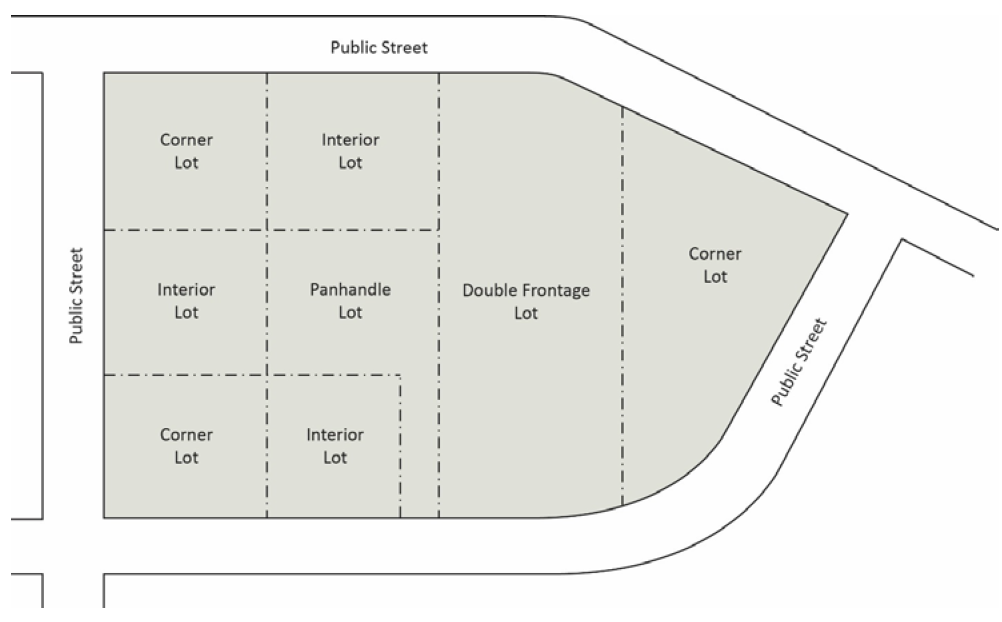
Figure 13-6 Types of Lots
Lot area: The total horizontal area included within lot lines.
Lot coverage: The portion of a lot that is occupied by structures that create an impervious surface on the ground, such as buildings, parking lots, loading areas, driveways, patios, plazas, recreation courts, and paved outdoor storage or display areas.
Lot line: The boundary dividing a given lot from the street or adjacent lots; the boundary defining the limit of ownership of a property.
A.
Front lot line: Any boundary line of a lot that abuts a street right-of-way line. A lot adjacent to more than one street will have more than one front lot line.
B.
Rear lot line: Any boundary line of a lot that does not intersect with a street right-of-way line and is not a front lot line.
C.
Side lot line: Any boundary line of a lot that intersects with a street right-of-way line and is not a front lot line.
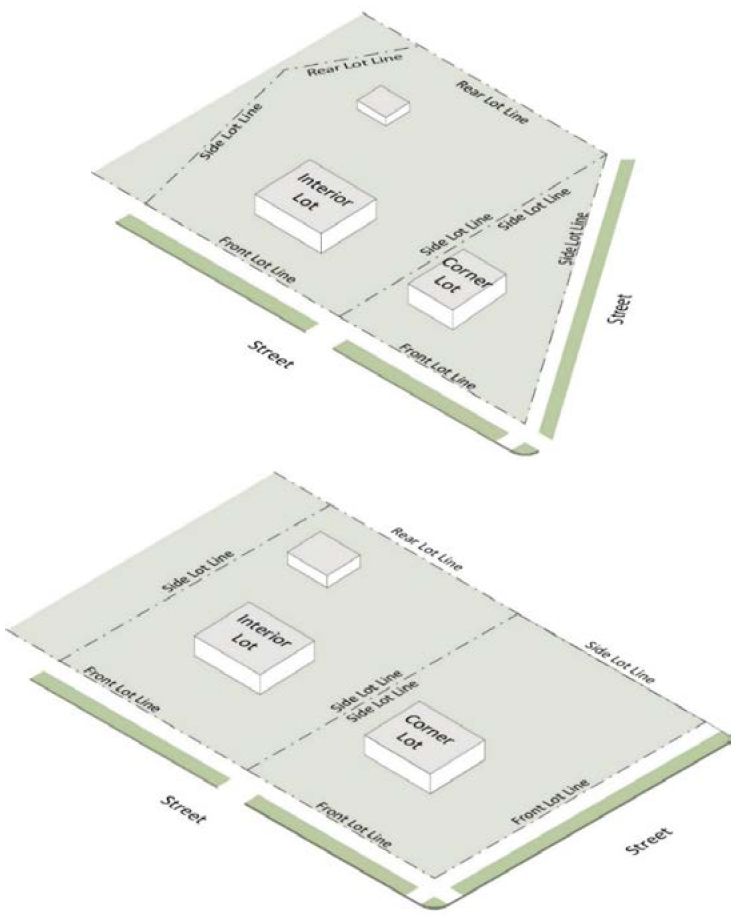
Figure 13-7 Types of Lot Lines
Lot of record: A lot which is part of a subdivision recorded in the Office of the Clerk of the Superior Court, the description of which has been so recorded.
Lot width: The distance measured along the front principal building setback line between intersecting lot lines. The lot width shall be measured along a straight line between such points of intersection.
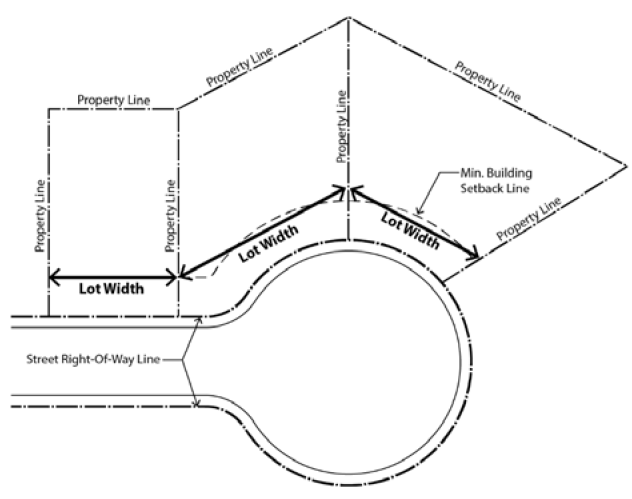
Figure 13-8 Lot Width Measurements
Lowest floor: The lowest floor of the lowest enclosed area, including basement. An unfinished or flood-resistant enclosure, used solely for parking of vehicles, building access, or storage, in an area other than a basement, is not considered a building's lowest floor, provided that such enclosure is not built so as to render the structure in violation of other provisions of this UDO.
M
Major street: A street, thoroughfare or highway classified as an arterial or collector in the comprehensive plan.
Manual for Erosion and Sediment Control in Georgia: A publication of the same name published by the Georgia Soil and Water Conservation Commission, and as amended or supplemented from time to time.
Manufactured home: A dwelling fabricated in an off-site facility for installation or assembly at the building site, bearing a label certifying that it is constructed in compliance with the National Manufactured Housing Construction and Safety Standards Act of 1974, 42 U.S.C. 5401, et seq.), which first became effective on June 15, 1976. The term "manufactured home" includes a structure, transportable in one or more sections, which, in the traveling mode, is eight body feet or more in width or 40 body feet or more in length or, when erected on site, is 320 or more square feet in floor area, and which is built on a permanent chassis and designed to be used as a dwelling with or without a permanent foundation when connected to the required utilities and includes the plumbing, heating, air-conditioning, and electrical systems contained therein; except that such term includes any structure which meets all the requirements of this definition except the size requirement and with respect to which the manufacturer voluntarily files a certification required by the Secretary of Housing and Urban Development and complies with the standards established under the National Manufactured Housing Construction and Safety Standards Act of 1974, 42 U.S.C. 5401, et seq.
Manufactured home park: Any lot or parcel under single ownership on which two or more manufactured homes are to be located or intended to be located for purposes of residential occupancy.
Manufactured home sales lot: A premises on which manufactured homes are displayed for sale.
Manufacturing: The creation of finished goods from raw materials or intermediate component parts.
A.
Heavy manufacturing: The extraction of natural resources or the transformation of raw materials through mechanical or chemical means into basic products for subsequent assembly, fabrication or use in the production of finished goods.
B.
Light manufacturing: The finishing, fabrication or assembly of previously manufactured parts into a final product or component products ready for retail sale. Light manufacturing is characterized by no emissions of noxious odors, dust, fumes, gas, noise, or vibration outside of any building.
Marquee sign. See "sign types, building sign."
Medical or dental office: See under "office."
Mean sea level: The average height of the sea for all stages of the tide. It is used as a reference for establishing various elevations within the floodplain. For purposes of article VIII the term is synonymous with National Geodetic Vertical Datum (NGVD) and/or the North American Vertical Datum (NAVD) of 1988.
Membership dwelling: A dwelling occupied by a group of people related through membership in a particular organization (as opposed to blood, adoption or marriage), such as a fraternity, sorority or convent.
Membership organization: An organization that operates on a membership basis for the promotion of the members' interests. Examples of membership organizations include:
A.
Business, professional or trade association: See "business, professional or trade association.
B.
Church or place of worship: See "church or place of worship".
C.
Civic, social or fraternal association: See "civic, social or fraternal association".
D.
Political organization: See "political organization".
Microbrewery means a manufacturer of malt beverages producing less than 15,000 barrels annually. Microbreweries may wholesale and may conduct promotional tours and offer free samples of malt beverages in accordance with the Official Code of Georgia, and offer retail sales in accordance with O.C.G.A. section 3-5-24.1.
Microdistillery means a small-scale distilled spirit manufacturing facility in which distilled spirits manufactured on-premises or at another of the distiller's licensed premises as defined in O.C.G.A. section 3-4-24.2 may be sold for consumption on-premises or by the package for off-premises consumption. Distilled spirits manufactured or distilled on-premises shall be limited to 3,000 barrels per calendar year, of which no more than 750 barrels may be sold at retail for on premises consumption or by the package for off-premises consumption.
Mini-warehouse (self-storage): A structure containing separate storage spaces of varying sizes leased or rented on an individual basis to the general public.
Mixed use: A type of development that combines residential, commercial, cultural, institutional, or entertainment uses, where those functions are physically and functionally integrated.
Mobile home: A dwelling manufactured prior to June 15, 1976, transportable in one or more sections, which, in the traveling mode, is eight body feet or more in width or 40 body feet or more in length or, when erected on site, is 320 or more square feet in floor area, and which is built on a permanent chassis and designed to be used as a dwelling with or without a permanent foundation when connected to the required utilities and includes the plumbing, heating, air-conditioning, and electrical systems contained therein. See "manufactured home" for dwellings manufactured after June 15, 1976.
Mobile home court: See "manufactured home park."
Modular home: See "industrialized home."
Monopole tower: See "transmission tower."
Monument sign. See "freestanding sign."
Motel: See "hotel or motel."
Motion picture theater: See "theater."
Motor freight truck terminal: A building or premises where trucks load and unload cargo and freight and where the cargo and freight may be broken down or aggregated into smaller or larger loads for transfer to other vehicles or modes of transportation.
Motor vehicle dealers, miscellaneous: A business establishment primarily engaged in the sale of motorized vehicles and related equipment other than automobiles, motorboats, motorcycles or recreation vehicles, such as aircraft, dune buggies, go-carts, snowmobiles and utility trailers, and which may include a repair service conducted as an accessory use.
Motorcycle sales and service: The use of any building or premises for the display and sale of new or used motorcycles, scooters or mopeds, and which may include any repair service conducted as an accessory use.
Mulch: Pine straw, pine bark, pebbles, lava rock, or processed trees. By-products of unprocessed grinding operations may not be used for mulching under landscaped plants or trees.
Multi-faced sign: See "sign types".
N
National Geodetic Vertical Datum (NGVD): As corrected in 1929 is a vertical control used as a reference for establishing varying elevations within the floodplain.
Natural ground surface: The ground surface in its original state before any grading, excavation or filling.
New manufactured home park or subdivision: For purposes of floodplain management and flood damage prevention only, a manufactured home park or subdivision for which the construction of facilities for servicing the lots on which the manufactured homes are to be affixed (including at a minimum, the installation of utilities, the construction of streets, and either final site grading or the pouring of concrete pads) is completed on or after June 25, 1982.
Non-safe-fall tower: See under "transmission tower."
North American Vertical Datum (NAVD) of 1988: A vertical control used as a reference for establishing varying elevations within the floodplain.
Nursery school: See "day care facility."
Nursing home: A skilled nursing care facility primarily engaged in providing full-time convalescent or rehabilitative care to individuals who, by reason of advanced age, chronic illness or infirmity, are unable to care for themselves and require continuous care under the direction of a physician. See in contrast "convalescent home."
O
Office: The use of any building or premises primarily for conducting the affairs of a business, profession, service, industry, or government, and generally furnished with desks, tables, files, and communication equipment.
A.
General business office: An office used primarily for the administrative or legal affairs of a company.
B.
Medical or dental office: An office occupied and maintained for the provision of services by a person licensed by the State of Georgia to practice in the healing arts for humans, such as a physician, surgeon, dentist, or optometrist, but not including veterinary services.
C.
Professional office: An office occupied by a member of a recognized profession and maintained for the provision of professional services, such as a lawyer, architect, city planner, landscape architect, interior designer, or engineer.
One-hundred-year flood: A 100-year frequency flood that has the probability of occurring once every 100 years and thus has a one percent chance of occurring each year.
One-hundred-year flood plain: A land area adjoining a river, stream, watercourse or lake that has a probability of being flooded up to and including the 100-year flood.
Opaque: Impenetrable to view, or so obscuring to view that features, buildings, structures, and uses become visually indistinguishable.
Open space: An area of land or water that is permanently set aside through dedication, designation or reservation to remain in a natural and unimproved state or that may be improved only for active or passive recreation or enjoyment (if such use is otherwise allowed).
A.
Common open space: Land or water areas within a development project that are available to or benefit all occupants of the development on a continuing and permanent basis, such as walking trails, community centers or clubhouses, golf courses and other recreation areas, protected flood plains or wetlands, and fishing or boating lakes. Common open space does not include any streets or public rights-of-way, or yard areas or landscape areas located on private property.
B.
Public open space: Land reserved for preservation, leisure or recreational use but dedicated in fee simple to a governing body or agency to be responsible for operation and maintenance. Public open space may not be reserved for or dedicated to the exclusive use of the residents of a particular development.
Operator: means a person, entity, association or organization who places, maintains or operates unattended donation box(es) to solicit donations of salvageable personal property.
Ordinary maintenance and repair: Inspections, testing and/or repair that maintain functional capacity, aesthetic and structural integrity of a communications facility and/or the associated support structure, pole or tower, that does not require blocking, damaging or disturbing any portion of the public ROW.
Outdoor display area: An outdoor portion of a lot where merchandise, goods or other items are placed in public view for the purpose of customer selection or direct sale or lease to customers.
Outdoor seating: A permitted seating area on a public sidewalk or pedestrian oriented area or outside of a food or drink establishment that is used for seating purposes to consume the purchased items on-site.
Outdoor storage: The keeping within an unroofed area of any goods, material, merchandise or vehicles in the same place for more than 24 hours for the primary purpose of storage.
Outparcel: A lot deeded separately from a larger tract for individual development, but generally sharing access with the larger tract. Outparcels are most generally associated with shopping centers.
Overlay zone: A zoning district which may be placed on property in addition to its primary zoning district.
Overstory tree: Any deciduous or evergreen tree that has the potential to grow to a mature height of 40 feet or more.
Owner: A person having or controlling a majority fee simple interest in a property, or their authorized representative.
P
Parking aisle: The traveled way, which is not the public right-of-way, by which cars enter and depart parking spaces.
Parking area: Any public or private area at grade or within a structure used for the express purpose of temporarily parking automobiles and other vehicles otherwise in operation for personal or business use.
Parking bay: Three or more parking spaces adjacent to one another and aligned side-by-side.
Pawn shop: A type of used merchandise store in which merchandise is offered as collateral for obtaining loans, and (for other than title pawn) wherein such merchandise is offered for sale in recompense for default of loan repayment; see also "title pawn".
Parcel: Any plot of land or acreage shown as a unit with a metes and bounds description on the latest county tax assessment records.
Performing arts theater: See "theater."
Permanent subdivision sign: See "sign type".
Permit: The first permit issued by the city required for undertaking any land development activity.
Permittee: means the applicant who is issued a permit authorizing placement of unattended donation box(es).
Person: Any individual, partnership, firm, association, joint venture, public or private corporation, trust, estate, commission, board, public or private institution, utility, cooperative, city, county or other political subdivision of the state, any interstate body or any other legal entity.
Personal care home: Any dwelling, whether operated for profit or not, which undertakes through its ownership or management to provide or arrange for the provision of housing, food service, and one or more personal services for two or more adults who are not related to the owner or administrator by blood or marriage. This term shall not include host homes, as defined in paragraph (18) of subsection (b) of O.C.G.A. Section 37-1-20.
Personal enrichment school: See "school."
Personal service establishment: A business primarily engaged in providing a service generally to individuals, such as a laundry, portrait photographic studio, or beauty or barber shop.
Pervious surfaces: Surfaces capable of being significantly infiltrated by stormwater.
Pet: An animal most commonly kept for personal enjoyment or companionship, such as a dog or a cat.
Place of public assembly: Any building, structure or parcel of land were people congregate for such purposes as celebration, worship, amusement, entertainment, or deliberation.
Planned commercial center: Three or more commercial establishments that are planned, developed, and managed as a unit and which provide parking facilities on one lot or contiguous lots.
Plant nursery: Land or greenhouses used to raise flowers, shrubs, trees, and other plants for sale to distributors or for subsequent replanting by the owner, a landscape company or others.
Pole: A legally constructed pole, such as a utility, lighting, traffic, or similar pole made of wood, concrete, metal or other material, located or to be located within the public right-of-way. A pole does not include a tower or support structure and does not include a pole or structure that supports electric transmission lines.
Political organization: An organization established to promote the interests of a local, state or national political party or candidate.
Political season: The time between the date of close of filing for qualification of candidates and final determination on each ballot issue or candidate.
Premises: An area of land with its appurtenances and buildings which, because of its unity of use, is one unit of real estate.
Principal building: A building in which is conducted a principal use.
Principal building setback line: A line delineating the minimum allowable distance between a property line or the right-of-way line of an abutting street, and a principal building on a lot.
A.
Front building setback: The minimum allowable distance between the right-of-way line of any abutting street and any part of a principal building on a lot. The front setback distance is applied along the full length of the right-of-way line and is parallel to it.
B.
Rear building setback: The minimum allowable distance between a rear lot line and any part of a principal building on a lot. The rear building setback extends along and parallel to the full length of the rear lot line.
C.
Side building setback: The minimum allowable distance between a side lot line and any part of a principal building on a lot. The side building setback extends along and parallel to the side lot line between the front building setback and a rear building setback (if any).
Principal use: The specific, primary purpose for which land or a building is used.
Professional engineer: An engineer licensed and registered to perform the duties of a professional engineer (P.E.) by the State of Georgia.
Professional office: See "office."
Professional services: A business conducted for profit which primarily offers services to the general public, such as shoe repair, watch repair, barber shops, beauty parlors, dry cleaners, tax preparation and similar activities.
Prohibited use: A use that is not permitted in a zoning district.
Project: The entire proposed development project regardless of the size of the area of land to be disturbed.
Project entrance sign: See "sign type".
Projecting sign: See "sign type, building sign."
Property or parcel of land: See "lot."
Property owner: means the person, entity, association or organization who owns the real property where the unattended donation box(es) are or are proposed to be located.
Protection area, or stream protection area: The combined areas of all required buffers and setbacks applicable to such stream.
Provider: A communications service provider or a wireless services provider and includes any person that owns and/or operates within the public ROW any communications facilities, wireless facilities, poles built for the sole or primary purpose of supporting communications facilities, or towers.
Public improvement: The construction, enlargement, extension or other construction of a facility intended for dedication to the public, including but not limited to a street, curb and gutter, sidewalk, cross drain, catch basin, traffic control and street name sign, or other roadway appurtenance other than a driveway apron connection; domestic water supply system main, fire hydrant, valve or other appurtenance other than a supply line to a building; or sanitary sewerage main or outfall, lift station, force main, manhole or other appurtenance other than a drain line from a building.
Public open space: See "open space."
Public right-of-way or public ROW: The area on, below, or above property that has been designated for use as or is used for a public roadway, highway, street, sidewalk, alley or similar purpose, and for purposes of this section shall include public utility easements, but only to the extent the City of Douglasville has the City of Douglasville to permit use of the area or public utility easement for communications facilities or poles, towers and support structures that support communications facilities. The term does not include a federal interstate highway or other areas that are not within the legal jurisdiction, ownership or control of the City of Douglasville.
Public utility: A utility owned and operated by a government or public authority.
A.
Public sewerage system: A sanitary sewerage system for the collection of water-borne wastes complete with a sewage treatment plant that is owned and operated by a public agency or authority.
B.
Public water system: A system for the intake, treatment and distribution of potable water that is owned and operated by a public agency or authority.
Public utility easement: unless otherwise specified or restricted by the terms of the easement, the area on, below, or above a property in which the property owner has dedicated an easement for use by utilities. public utility easement does not include an easement dedicated solely for City of Douglasville use, or where the proposed use by the provider is inconsistent with the terms of any easement granted to the City of Douglasville.
Q
Quadraplex: See under "dwelling, multi-family dwelling."
Quasi-public: A use that performs a government or public function but is under private ownership or control.
R
Recharge area: Any portion of the earth's surface, where water infiltrates into the ground to replenish an aquifer.
Recreation facility, community: A swimming pool, tennis court, or other recreation facility owned by or provided for the use of the residents of a subdivision, apartment project, or other residential development.
Recreation facility, private: An accessory use to a dwelling designed and equipped for the conduct of personal leisure time activities such as a swimming pool, tennis court, deck, or patio. See also "community recreation facility."
Recreational vehicle: A motorized camper, converted bus, tent trailer, motor home, or other similar vehicular or portable structure used or designed for temporary portable housing or occupancy while on vacation or other recreational trip and provided with sleeping accommodations.
Recreational vehicle dealer: The use of any building or premises for the display and sale of new or used recreational vehicles, and which may include any repair service conducted as an accessory use.
Recycled water system: A water system that captures and reuses water previously used in wash or rinse cycles.
Recycling center: A use operated exclusively for the collection and temporary storage of used paper, glass, metal, and similar materials suitable for reprocessing, which are transported elsewhere for separating, processing, or storage.
Registered land surveyor: A land surveyor licensed and registered to perform the duties of a registered land surveyor (R.L.S.) by the State of Georgia.
Regulated stream: See "stream ".
Repair shop, miscellaneous: A business establishment primarily engaged in specialized repair services such as bicycle repair, leather goods repair, lock and gun repair, musical instrument repair, septic tank cleaning, furnace cleaning and taxidermists.
Replace orreplacement (in connection with an existing pole): Support structure or tower, to replace (or the replacement of) same with a new structure, substantially similar in design, size and scale to the existing structure and in conformance with this section and any other applicable City of Douglasville [charter/code regulations], in order to address limitations of the existing structure to structurally support collocation of a communications facility.
Reserve strip: A strip or tract of land reserved for the purpose of controlling or limiting access from properties to abutting streets.
Residential business: See under "home occupation."
Residential district: includes residential zoning districts as established pursuant to this UDO, as defined in article 3.
Restaurant, custom service: An establishment where food and drink are prepared to individual order, ordered and served at the table, and consumed primarily within the principal building or in established outdoor dining areas, as contrasted to a fast food restaurant. Any restaurant that provides drive-in or drive-through service to customers in their cars is considered a "fast food" restaurant.
Restaurant, family: A custom service restaurant primarily oriented to sit-down service, occasionally with take-out service but no drive-in or drive-through facilities, and having an average turnover rate generally of less than one hour. Family restaurants are usually moderately priced and frequently belong to chains such as Denny's, Pizza Hut and Shoney's.
Restaurant, fast food: Any establishment, building or structure where food or drink are served for consumption, either on or off the premises, by order from or service to persons either over an interior counter, outside the structure or from an outdoor service window or automobile service window, or by delivery. This definition shall not include otherwise permitted restaurants where outdoor table service is provided to customers in established outdoor dining areas or where take-out service is provided incidental to a custom service restaurant.
Restaurant, quality: A custom service restaurant primarily oriented to fine dining and often associated with a particular cuisine. Quality restaurants are characterized by table settings of better silverware, china, glassware and cloth tablecloths, and have average turnover rates generally of one hour or more.
Retail store: An establishment principally engaged in offering a category of similar goods or products for sale to the general public, such as a grocery store, hardware store, pharmacy, clothing shop, home furnishings store, office supplies store, and the like.
Retirement community: An age-restricted residential development that offers significant services and facilities for the elderly, including social and recreational activities, personal care services, or health facilities limited to use by the development's residents.
Right-of-way: Land reserved for and immediately available for use as a street or other public purpose.
River: A natural, free-flowing watercourse that is typically of greater volume than a stream or creek.
Riparian: (with regard to stream buffer protection) belonging or related to the bank of a river, stream, lake, pond or impoundment.
Roadbed: That portion of a street improved for vehicular travel, including the curbs and shoulders.
Roadway: The paved portion of a street improved for vehicular travel, measured from back of curb to back of curb, or from edge of pavement to edge of pavement for swale ditch roads.
Roadway drainage structure: A device such as a bridge, culvert or ditch, composed of a virtually non-erodible material such as concrete, steel, plastic or other such material that conveys water under a roadway by intercepting the flow on one side of a traveled way consisting of one or more defined lanes, with or without shoulder areas, and carrying water to a release point on the other side.
Roof sign: See "sign type, building sign."
Rooming or boarding house: A dwelling within which a resident family or resident manager offers lodging or lodging and meals to two or more persons not under the resident's parental or protective care in exchange for monetary compensation or other consideration.
Runoff: The portion of precipitation on the land that reaches the drainage system.
Runoff rate Coefficient: The numerical factor which, when multiplied with the average slope for a particular site, will give the release rate of water from that site.
S
Safe-fall tower: See under "transmission tower."
School: A facility used for education or instruction in any branch of knowledge.
A.
Academic school: A private educational facility offering instruction following the same curriculum used in a public kindergarten, elementary, secondary, trade or technical, or higher education facility, and accredited to award diplomas as such.
B.
Business or vocational school: A business establishment offering courses of instruction oriented to improving business skills or securing employment in a specific field, such as data processing, secretarial or office services, banking, commercial art, nursing, real estate, truck driving, or other trade or vocation.
C.
Personal enrichment school: A business establishment offering courses in the arts or personal skills, not necessarily related to employment, such as automobile driving, drama, ceramics, cooking, diction, languages, modeling, music, public speaking or reading.
Sediment: Solid material, both organic and inorganic, that is in suspension, is being transported or has been moved from its site of origin by air, water, ice or gravity as a product of erosion.
Sedimentation: The process by which eroded material is transported and deposited by the action of water, wind, ice or gravity.
Semi-public use: A use owned or operated by a nonprofit, religious, or charitable institution for the purpose of providing educational, cultural, recreational, religious, or social services to the general public.
Service station: See "automobile service station."
Setback: The shortest straight-line distance between a street right-of-way or lot line and the nearest point of a structure or building or projection therefrom (excluding roof overhangs of 18 inches or less).
Setback, minimum: The shortest distance allowed between a street right-of-way line or any other lot line and any principal or accessory building on a lot. Minimum setback requirements for buildings are associated with the type of lot line from which the setback is taken; for instance, a "side yard setback" is measured from a side lot line.
Shade tree: A broadleaf hardwood tree having an average height at maturity of at least 20 feet and having a broad spread relative to its height (excluding trees with pyramidal, conical, or columnar crowns) and a dense canopy, so as to provide shade to structures or parking areas in the summer months.
Shipping container structure: A prefabricated metal structure or steel intermodal container (cargo container) used as a main structural element. These structures were originally designed for overseas shipping and/or to be mounted on a rail car as freight.
Short term rental: Any residential dwelling rented out for personal use for a period not exceeding 30 days at a time and as further described in section 2.04, residential use standards.
A.
Accessory short term rental: The short term rental of an accessory dwelling unit.
B.
Temporary short term rental: The short term rental of a primary residential structure.
Siding type A material: Material used for the finish for exposed exterior walls, and limited to the following permitted materials: face, brick, granite, stone, marble, terrazzo, concrete panels cast with patterns and textures, EIFS, stucco, wood siding, fiber-cement siding, limestone or insulated window wall panels; metal siding is prohibited.
Siding type B material: Material used for the finish for exposed exterior walls, and limited to the following permitted materials: metal panels with a baked-on or acrylic finish which must be expected to retain its appearance without substantial maintenance for a period of ten years, plain reinforced concrete slabs, plain concrete block with sculptured treatment or stack bond with raked joints, T-111 plywood, aluminum siding, stainless steel, porcelain treated steel, or anodized or other permanently finished aluminum.
Siding type C material: Material used for the finish for exposed exterior walls, and limited to the following permitted materials: steel and aluminum without finish prescribed as type B, plain concrete block, masonite, particle board, vinyl siding and sheet wafer board.
Significant recharge area: Those areas mapped by the Georgia Department of Natural Resources in Hydrologic Atlas 18 (1989 edition).
Single-family detached dwelling: See under "dwelling."
Site: The parcel of land being developed, or the portion thereof on which the development project is located.
Slope: The degree of deviation of a surface from the horizontal, usually expressed in percent or degree.
Small wireless facility: A Facility that meets both of the following qualifications: (i) each antenna could fit within an enclosure of no more than 5 cubic feet in volume and (ii) all other wireless equipment associated with the antenna, including the Provider's preexisting equipment, is cumulatively no more than 24 cubic feet in volume.
Soil and water conservation district approved plan: An erosion and sediment control plan approved in writing by the soil and water conservation district.
Soils: The upper layer of earth that can be dug or plowed; the loose surface material of the earth in which vegetation normally grows.
Solid waste transfer station: A facility where refuse and garbage, but no hazardous waste, is delivered for compaction or aggregation and loaded on trucks for shipment to a remote landfill or other disposal facility.
Special outdoor event: An event which is conducted in the open air or within a tent or other temporary structure and is produced for a limited time, and is:
A.
A festival, carnival or exhibition where:
1.
Unpackaged food is served, sold or transferred to members of the public, or
2.
Motorized amusement devices, a tent or an outdoor stage is used; or
B.
Any temporary commercial event conducted on residential property, other than a yard sale; or
C.
Any temporary event conducted on residential property where more than 100 guests or attendees are expected on any one day; or
D.
Any outdoor sales or commercial activity by a peddler or transient merchant on non-residential property, other than a licensed flea market.
E.
Provided, however, that "special outdoor event" excludes the following:
1.
Any event conducted on property owned by any government entity if authorized by the property owner; and
2.
Any event conducted on the grounds of any developed lot whose principle use is one of public assembly, such as a church, school, library, park or membership organization.
Special land use: A use generally compatible with other uses in a zoning district, but which requires individual review of its location, design, configuration, operation and/or density or intensity that may merit the application of conditions to ensure the appropriateness of the use at that particular location.
Specimen tree: Any tree which qualifies for special consideration for preservation due to size, type and condition as follows:
A.
Any tree in fair or better condition which equals or exceeds the following diameter breast height (DBH) sizes:
1.
20-inch DBH - Overstory hardwoods such as oaks, hickories, yellow poplars, sweetgums, etc.
2.
30-inch DBH - Overstory softwoods such as pines, etc.
3.
4-inch DBH - Understory small trees such as dogwoods, redbuds, sourwoods, etc.
B.
A tree in fair or better condition must meet the following minimum standards:
1.
A life expectancy of greater than 15 years.
2.
A structurally sound trunk, not hollow and having no extensive decay, and less than 20 percent radial trunk dieback.
3.
No more than one major and several minor dead limbs (hardwoods only).
4.
No major insect or pathological problem.
C.
A lesser-sized tree can be considered a specimen tree if it is a rare or unusual species, or of exceptional or unique quality, subject to approval of the community development director pursuant to the standards set forth in this UDO.
D.
A lesser-sized tree can be considered a specimen tree if it is specifically used by a builder, developer, or design professional as a focal point in a landscape project, subject to approval of the community development director pursuant to the standards set forth in this UDO.
Specimen tree stand: A contiguous grouping of trees which has been determined to be of high value in the opinion of the community development director. Determination is based upon the following criteria:
A.
A relatively mature, even-aged stand.
B.
A stand with purity of species composition or of a rare or unusual nature.
C.
A stand of historical significance.
D.
A stand with exceptional aesthetic quality.
Sports facility, commercial: The use of any building, structure or premises for the conduct of a professional or semi-professional sport, such as a boxing pavilion, track and field racetrack, stadium or sports field, where admission is charged in order to pay the players or fund a prize purse.
Start of construction: The date the permit was issued, provided the actual start of construction, repair, reconstruction, or improvement was within 180 days of the permit date. The actual start means the first placement of permanent construction of the structure such as the pouring of slabs or footings, installation of piles, construction of columns, or any work beyond the stage of excavation, and includes the placement of a manufactured home on a foundation. Permanent construction does not include initial land preparation, such as clearing, grading and filling; nor does it include the installation of streets and/or walkways; nor does it include excavation for a basement, footings, piers or foundations or the erection of temporary forms; nor does it include the installation on the property of buildings appurtenant to the permitted structure, such as garages or sheds not occupied as dwelling units or part of the main structure. (NOTE: Accessory structures are not exempt from any ordinance requirements). For a substantial improvement, the actual start of construction means the first alteration of any wall, ceiling, floor, or other structural part of a building, whether or not that alteration affects the external dimensions of the building.
State waters: Any and all rivers, streams, creeks, branches, lakes, reservoirs, ponds, drainage systems, springs, wells and other bodies of surface or subsurface water, natural or artificial, lying within or forming a part of the boundaries of the state which are not entirely confined and retained completely upon the property of a single individual, partnership or corporation. "State waters" excludes channels and drainage ways which have water in them only during and immediately after rainfall events and intermittent streams which do not have water in them year-round.
Storage: The placement, keeping, or retention of vehicles, equipment, materials, goods, or products on a temporary basis for intermittent use or subsequent distribution or transfer.
Stormwater detention facility: A facility that provides storage and controlled release of stormwater runoff during and after a flood or storm.
Story: That portion of a building comprised between a floor and the ceiling or the floor next above. The first floor of a two or multi-story building shall be deemed the story that has no floor immediately below it that is designed for living quarters or for human occupancy, other than a basement.
Stream: A natural, free-flowing watercourse with either constant or intermittent flow sufficient to wrest the vegetation and form a defined channel.
Stream, perennial: (with respect to watershed protection) a stream that has normal stream flow consisting of base flow (discharge that enters the stream channel mainly from groundwater or both base flow and direct runoff during any period of the year.
Stream bank: (with regard to stream buffer protection) the sloping land that contains the stream channel and the normal flows of the stream. The land forming the bank is considered part of the stream buffer.
Stream buffer: a strip of natural indigenous vegetation (of width determined by the watershed protection regulations and the stream buffer protection regulations) adjacent to the bank of a stream designed to preserve and improve the quality if water within the stream and its watershed. A stream setback does not include the adjacent stream buffer.
Stream channel: (with regard to stream buffer protection) means the portion of a watercourse that contains the base flow of the stream.
Stream setback: (with regard to stream buffer protection) the area established by division 5 [sic]. extending beyond any buffer applicable to the stream, and within which certain activities and structures are prohibited.
Street: An improved way for the conveyance of motor driven, rubber-tired vehicles, such as automobiles and trucks. For the purposes of this UDO, the term "street" shall include "alley".
Street classifications: Streets and roads are shown in the Comprehensive Plan according to their classification.
Street jog: the incidence where two streets or two portions of a single street are separated by a relatively short distance, usually at their intersection with another street.
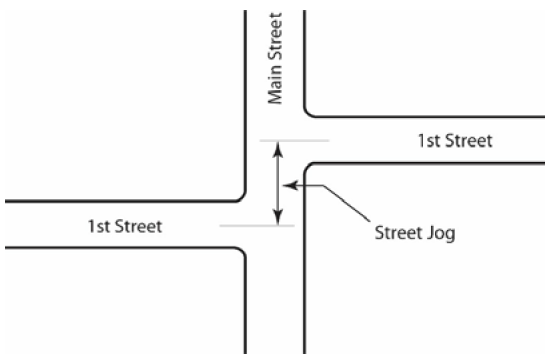
Figure 13-9 Examples of a Street Jog
Structure: Anything above ground constructed or erected with a fixed location on the ground or attached to something having a fixed location on the ground. Among other things, structures include but are not limited to buildings, walls, signs and fences other than rear-yard fences on residential lots.
Subdivider: Any person dividing or proposing to divide land under their ownership into two or more tracts or lots, including any agent of the property owner.
Subdivision:
A.
For purposes of article VIII and related definitions only, the division of a tract or parcel of land resulting in one or more new lots or building sites for the purpose, whether immediately or in the future, of sale, other transfer of ownership or land development, and includes divisions of land resulting from or made in connection with the layout or development of a new street or roadway or a change in an existing street or roadway;
B.
For all other purposes of this UDO:
1.
The division of a property or tract of land into two or more tracts or lots; or
2.
A land development project in which two or more lots are created, along with the streets and utilities needed to support construction of buildings on the lots.
Substantial damage: Damage of any origin sustained by a structure whereby the cost of restoring the structure to its before damaged condition would equal or exceed 50 percent of the market value of the structure before the damage occurred.
Substantial improvement: Any combination of repairs, reconstruction, alteration, or improvements to a building, taking place during a ten-year period, in which the cumulative cost equals or exceeds 50 percent of the market value of the structure prior to the improvement. The market value of the building means (1) the appraised value of the structure prior to the start of the initial repair or improvement, or (2) in the case of damage, the value of the structure prior to the damage occurring. This term includes structures which have incurred "substantial damage" regardless of the actual amount of repair work performed. For the purposes of this definition, "substantial improvement" is considered to occur when the first alteration of any wall, ceiling, floor, or other structural part of the building commences, whether or not that alteration affects the external dimensions of the building. The term does not, however, include those improvements of a building required to comply with existing health, sanitary, or safety code specifications which are solely necessary to assure safe living conditions, which have been pre-identified by this ordinance, and not solely triggered by an improvement or repair project.
Substantially improved existing manufactured home park or subdivision: Where the repair, reconstruction, rehabilitation or improvement of the streets, utilities and pads equals or exceeds 50 percent of the value of the streets, utilities and pads before the repair, reconstruction or improvement commenced.
Support structure: A structure in the public ROW other than a pole or a tower to which a wireless facility is attached at the time of the application.
T
Tangent: the straight-line distance between the ending of one curve of a line (center line of a street) and the beginning of another curve of the same line (center line).
Tap room means a type of establishment where malt beverages and wine are offered for sale for consumption on premises and for off-premises package sales. Specialty wines and craft malt beverages shall be the primary focus of this establishment. A tap room shall have an indoor seating area not to exceed 2,500 square feet. No food sales are required. Smoking of any kind, including but not limited to cigarette, cigar, vaping, and hookah, shall be prohibited in tap rooms.
Temporary land use: A use which requires review and approval by the city which is not permanent or has a limited duration time frame as a condition of approval.
Ten-year, 25-year and 100-year storms: Rainfall events having a probability of occurrence once every ten, 25 or 100 years, respectively, or a ten percent, four percent or one percent chance of occurring each year, respectively.
Tenant: One who possesses or occupies land or buildings by title, under a lease, or through payment of rent; an occupant, inhabitant, or dweller of a place.
Theater: A building or interior space devoted to showing motion pictures, or for live dramatic or musical performances.
A.
Motion picture theater: A building primarily used for the exhibition of movies or other prerecorded productions to the general public in an indoor setting.
B.
Performing arts theater: A building primarily used for the presentation of live performances of plays or music.
Theater, drive-in: An open lot with its appurtenant facilities devoted primarily to the showing of motion pictures or other prerecorded productions to patrons seated in automobiles.
Tire retreading or repair shop: See under "automotive repair shop."
Title pawn: A type of pawn shop in which the only type of merchandise accepted as collateral for obtaining loans is merchandise having a motor vehicle title issued by a state government; no merchandise shall be offered for sale on the premises, and no inventory shall be stored on premises for longer than 24 hours.
Townhouse: See "dwelling."
Transmission tower: A structure, such as a self-supporting tower, lattice tower, guy tower, monopole tower, a safe-fall tower, or a non-safe-fall tower constructed as a free-standing structure or in association with a building, or other permanent structure or equipment, on which is located one or more antennae intended for transmitting or receiving television, AM/FM radio, digital, microwave, cellular, telephone or similar forms of electronic communication. The term includes radio and television transmission towers, microwave towers, common carrier towers, and cellular telephone towers. The term excludes any tower and antenna under 70 feet in total height and owned and operated by an amateur radio operator licensed by the Federal Communications Commission, and satellite earth station antennae one meter in diameter or less which receive only home television transmissions, and any satellite earth station antennae two meters or less in diameter which is located in a commercial or industrial zoning district.
A.
Guy tower orguyed tower: A self-supporting transmission tower that is supported, in whole or in part, by guy wires and ground anchors.
B.
Lattice tower: A communications tower that has open-framed supports on three or four sides and is constructed without guy wires and ground anchors.
C.
Monopole tower: A communications tower consisting of a single pole, constructed without guy Wires or ground anchors.
D.
Non-safe-fall tower: Any tower other than a safe-fall tower as defined by this UDO, including but not limited to all guy towers and all monopole towers.
E.
Safe-fall tower: A self-supporting tower whose cross-sectional area diminishes with increasing height and which is certified by its manufacturer that any failure shall result in a collapse that will fall entirely or substantially within the base of the tower.
F.
Self-supporting tower: A transmission tower with its base located on the ground, as distinguished a rooftop tower.
G.
Unified tower array: A group of two or more self-supporting towers located on a single lot and functioning as one broadcasting antenna.
Transmission tower height: When referring to a transmission tower, antennae or other structure, means the distance measured vertically from the highest point when positioned for operation to the lowest point which is defined as the bottom of the base of the structure being measured at either roof or ground level, whichever is applicable. The height of a tower shall include the height of any antennae positioned for operation attached or which may be attached to the highest point on the tower.
Travel trailer: See "recreational vehicle."
Tree: Any self-supporting woody perennial plant, usually having a main stem or trunk and many branches, and at maturity normally attaining a trunk diameter greater than three inches at any point and a height of over ten feet.
Tree conservation plan: A plan that identifies tree protection areas, existing trees to be retained and proposed trees to be planted on a property to meet minimum requirements, as well as methods of tree conservation to be undertaken on the site and other pertinent information.
Tree density standard: The minimum number of tree density units per acre that must be achieved on a property after development.
Tree diameter: The cross-sectional dimension of a tree trunk measured at four and one-half feet above the ground for existing trees or at the ball for newly planted trees. If a tree has more than one trunk, only the largest trunk shall be used to establish the tree diameter for the tree.
Tree protection area: Any portion of a site wherein are located existing trees which are proposed to be retained in order to comply with the requirements of this article. The tree protection area shall include no less than the total area beneath the tree canopy as defined by the dripline of the tree or group of trees collectively, plus an additional three feet.
Tree replacement fund: An account, maintained by the Finance Director of the City of Douglasville, of funds contributed from developers as a form of alternative compliance to the tree density requirements set forth in this article. Funds from the tree bank are to be used solely for the purchase and planting of trees on public property.
Tree save area: An area designated for the purpose of meeting tree density requirements, saving natural trees, preserving the root system of natural trees and/or preserving natural buffers.
Triplex: See "dwelling, multi-family dwelling."
Truck loading docks: A portion of a building designed for the loading and unloading of trucks.
Truck terminal: See "motor freight truck terminal."
Two-family dwelling: See "dwelling."
U
Under canopy sign: See "sign type, building sign."
Understory tree: Tree that grows beneath the overstory and will generally reach a mature height of under 40 feet.
Uniform sign plan: Coordinated drawings and specifications that establish a unified design concept with regard to the location, materials, size, letter style, and color of all signs to be placed on a property.
Use: The specific purpose for which land or a building or other structure is designed or arranged, or for which it is occupied. See also "principal use", "special use", "temporary land use" and "accessory use or structure."
Used merchandise store: The use of a building or premises primarily for the retail sale of used merchandise or secondhand goods, such as used clothes, antiques, secondhand books or rare manuscripts, or items of architectural salvage, but not including used cars or other motorized vehicles. A pawn shop is a type of used merchandise store.
Utilities: All public and private, above or below ground, infrastructure systems providing water, stormwater, sewer, gas, telephone or cable television, and any other service controlled by the Georgia Public Services Commission.
Utility company: A private business providing electricity, natural gas, telephone, or other services under the regulation of the Georgia Public Services Commission.
Utility company substation: A facility used for the transmission or distribution of services provided by a utility company, such as an electrical transformer station, telephone junction box, cable television box or natural gas regulator station.
V
Variance: A grant of relief from the requirements of this UDO which permits construction in a manner otherwise prohibited by this UDO.
Vegetation: All plant growth, such as trees, shrubs, mosses and grasses.
Veterinarian: A hospital or clinic providing medical care and treatment for livestock or pets.
Violation: For purposes of floodplain management and flood damage prevention and related provisions only, the failure of a structure or other development to be fully compliant with the City of Douglasville's floodplain management regulations. A structure or other development without the elevation certificate, other certificates, or other evidence of compliance required in article VIII is presumed to be in violation until such time as that documentation is provided to adopt provisions of the Model Floodplain Management/Flood Damage Prevention Ordinance.
W
Wall sign: See "sign type, building sign."
Warehouse or indoor storage facility: A building used primarily for the storage of goods and materials. See also "mini-warehouse."
Watercourse: Any natural or artificial watercourse, stream, river, creek, channel, ditch, canal, conduit, culvert, drain, waterway, gully, ravine, or wash in which water flows either continuously or intermittently and which has a definite channel, bed and banks, and including any area adjacent thereto subject to inundation by reason of overflow or floodwater.
Watershed: The total area of land that is drained by a river or stream and its tributaries.
Wetlands: Those areas that are inundated or saturated by surface or groundwater at a frequency and duration sufficient to support, and that under normal circumstances do support, a prevalence of vegetation typically adapted for life in saturated soil conditions. Wetlands generally include swamps, marshes, bogs, and similar areas. The ecological parameters for designating wetlands include hydric soils, hydrophytic vegetation, and hydrological conditions that involve a temporary or permanent source of water to cause soil saturation.
Wetlands, jurisdictional: An area that meets the definitional requirements for wetlands as determined by the U.S. Army Corps of Engineers.
Wine bar means a type of eating establishment having adequate and sanitary kitchen and dining room equipment and personnel, which serves food and only beer, wine and non-alcoholic beverages, and where the sale of food and other non-alcohol items purchased on the premises constitutes at least 25 percent of gross sales of the establishment.
Wine tasting room and/or tasting room means an outlet, authorized by the State of Georgia, for the promotion of wine by providing samples of such wine to the public and providing for retail wine sales in closed packages for consumption off the premises. Samples of wine can be given free of charge or for a fee.
Winery means any establishment where wines are manufactured.
Wireless facility: The equipment at a fixed location or locations in the public ROW that enables wireless services. The term does not include: (i) the support structure, Tower or Pole on, under, or within which the equipment is located or collocated; or (ii) coaxial, fiber-optic or other cabling that is between communications facilities or poles or that is otherwise not immediately adjacent to or directly associated with a particular antenna. A small wireless facility is one type of a wireless facility.
Wireless services: Any wireless services using licensed or unlicensed spectrum, whether at a fixed location or mobile, provided to the public.
Wholesale trade establishment: A place of business primarily engaged in selling merchandise to retailers; to industrial, commercial, institutional, or professional business users, or to other wholesalers; or acting as agents or brokers and buying merchandise for, or selling merchandise to, such individuals or companies.
Window sign: See "sign type, building sign."
X
None
Y
Yard: An area that lies between the principal building on a lot and the nearest lot line.
A.
Front yard: A yard situated along any public street right-of-way or private street easement.
B.
Rear yard: A yard situated along a rear lot line.
C.
Side yard: A yard situated along a side lot line, but not extending into a front or rear yard.
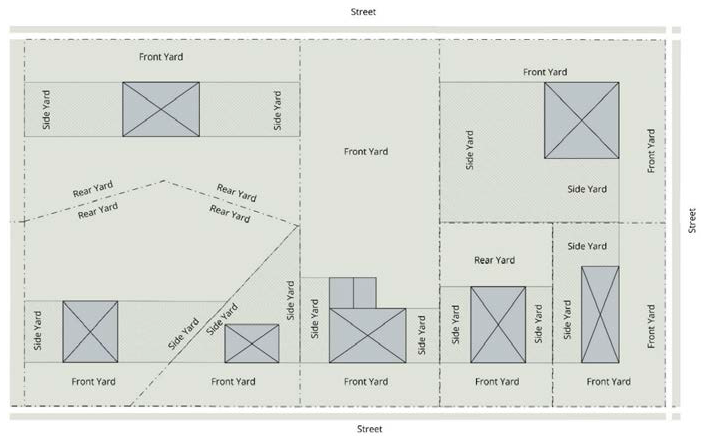
Figure 13-10 Types of Yards
Yard sale: The offering of household items and personal possessions for sale at the residence of the owner.
Z
Zoning change: An amendment to the zoning map (rezoning), approval of a special use, or approval of a change in the conditions of approval associated with a rezoning or special use.
(Ord. No. O-2020-3, § 2, 1-13-20; Ord. No. O-2020-70, § 2, 11-16-20; Ord. No. O-2023-40, § 4, 8-7-23; Ord. No. O-2023-46, §§ 5, 6, 9-18-23; Ord. No. O-2023-52, § 6, 10-16-23; Ord. No. O-2024-2, § 4, 1-16-24; Ord. No. O-2024-27, § 3, 8-5-24)

