
Douglasville City Zoning Code
ARTICLE 8
- GENERAL SITE DEVELOPMENT STANDARDS
Sec. 8.01.- Off-street parking and loading.
A.
Purpose. It is the purpose of these off-street parking and loading regulations to:
1.
Reduce the congestion on streets due to excessive use for parking and loading of motor vehicles;
2.
To prevent excessive amounts of off-street parking and loading through the appropriate control of the siting and number of spaces permitted.
3.
To prevent traffic congestion and hazard due to the movement of vehicles and pedestrians on private property.
These requirements apply uniformly to all buildings and uses, regardless of the districts in which they are located.
B.
Vehicle parking; when required. Off-street parking and/or loading shall be provided for every new, enlarged or modified building or use in connection with every use as applicable, in accordance with the requirements specified in this section.
C.
Number of parking spaces to be provided.
1.
At the applicant's option, parking spaces may be provided in accordance with the guidelines contained in this section. The guidelines establish the minimum number of spaces to be provided. An increase or decrease in the number of spaces can only be allowed through approval of an alternate parking plan.
2.
The number of parking spaces to be provided for a particular use or development may be established through administrative approval of an alternate parking plan. Use of an alternate parking plan is encouraged in order to tailor the parking to the particular needs of the use or development and to allow introduction of operational solutions such as ride-sharing programs or remote employee parking lots.
3.
Downtown area exemption. Off-street parking is not required for any nonresidential use located in the CBD zoning district. At the owner's option, parking may be provided up to but not exceeding the number of spaces allowed by the guidelines for vehicle parking in Table 8-1, Number of Parking Spaces Required, in this section. A larger number requires approval of an alternate parking plan.
4.
During any outdoor event where parts of the off-street parking areas are utilized for such event, the organizer shall ensure that adequate parking still exists for any businesses open during that special event.
D.
Alternate parking plan.
1.
Alternate parking plan; contents. A request for approval of an alternate parking plan is to be submitted to the community development director, and must be supported by the following information:
a.
A parking demand study or other data that establishes the number of spaces required for the specific use. Such a study or data may reflect parking for the same use existing at a similar location or for similar uses at other locations. References to published studies or to the guideline standards of this section are acceptable.
b.
If shared parking is proposed for a mixed-use development, the sum of peak parking demands by use category shall be accommodated for day and night hours on weekdays and weekends. The guidelines for shared parking contained in this section may be used in lieu of a separate study.
c.
If a remote or off-site parking lot is proposed to meet any portion of the parking required, the site and its current zoning classification must be identified, along with the method to transport parking patrons to the use. Written permission from the property owner, including the terms and conditions of the agreement, shall be included with the application. The remote site shall be no further than 500 feet from the use to be served.
d.
If more parking spaces are proposed than would be allowed under the guidelines for vehicle parking of this article, a landscaping plan shall be submitted that illustrates compliance with the parking lot landscaping requirements of the "landscaping, buffers and tree protection" section of this Code.
2.
Alternate parking plan; if approved.
a.
Following approval by the community development director, the requirements of the approved alternate parking plan shall be in writing and recorded by the owner in the office of the Clerk of Superior Court in the form of a covenant or deed restriction running with the land for not less than 20 years, prior to issuance of a certificate of occupancy for the development, and shall be included in any sale, lease, or other transfer of right of occupancy affecting any part of the development.
b.
All tenants of the property or development, whether an owner, lessee, subtenant, purchaser, or other occupant, shall comply with the approved alternate parking plan.
E.
Guidelines for vehicle parking.
1.
Guidelines; vehicle parking by land use. In lieu of establishment under an alternate parking plan, the number of parking spaces to be provided for each type of land use shall be determined by Table 8-1, Number of Parking Spaces Required, rounded to the nearest whole space. Developments containing two or more of the uses listed on the table shall provide the number of spaces required for each use (except as may be reduced under section 8.01 F., shared parking).
2.
Dedication to parking use. Parking spaces provided to meet the minimum requirements of this section, along with the aisles and driveways necessary to provide access to those spaces, shall not be used for any other purpose than the temporary parking of vehicles except as allowed by this UDO. Specifically, no such parking area may be used for the sale, repair, dismantling or servicing of any vehicles, or for the sale, display or storage of equipment, goods, materials or supplies.
3.
Not to exceed requirement. In order to prevent excessive lot coverage, an artificial increase in air temperature and an unnecessary increase in surface water run-off, no minimum off-street parking space requirement in Table 8-1, Number of Parking Spaces Required, shall be exceeded by more than 25 percent unless good cause can be shown by the applicant and approved by the community development director.
a.
Single-family, two-family and accessory dwellings are exempt from this provision.
b.
If the minimum number is exceeded, all square footage in excess of the minimum shall be of pervious pavement.
4.
Units of measurement. For the purposes of determining off-street parking requirements, the following units of measurement shall apply:
a.
Gross floor area shall include the total area of all floors, measured between the exterior walls of a building.
b.
In places of public assembly such as stadiums, sports arenas, religious places of worship and other similar places of assembly, in which those in attendance occupy benches, pews or other similar seating facilities, each 30 inches of such seating facilities shall be counted as one seat for the purpose of determining off-street parking requirements under this section. In cases where a place of assembly has both fixed seats and open assembly area, requirements shall be computed separately for each type and added together.
Table 8-1 Number of Parking Spaces Required
When gross floor area (GFA) is identified, that relates only to an indoor facility.
F.
Shared parking. The parking spaces provided for separate uses may be combined in one lot but the required spaces assigned to each use may not be assigned to another use, except as follows:
1.
Shared parking between day and night users. One-half of the parking spaces assigned to a church, theater or assembly hall whose peak attendance will be at night or on Sundays may be assigned to a use that will be closed at night or on Sundays.
2.
Mixed use developments. Parking spaces may be shared by more than one use if the Community Development Director finds that the total number of spaces will be adequate at the peak hours of the uses they serve. The following ratios may be used in determining the maximum number of spaces will be needed by the uses served by the shared parking facility based on the parking requirements of each use by time of day and the day of the week.
Table 8-2 Percentage of Required Parking Spaces by Time Period
3.
Availability of shared spaces. Parking spaces that are proposed to be shared among two or more uses must be clearly available to each use and not appear in any way to be serving a particular use, either through signage dedicating the spaces or through design techniques that would tend to orient use of the spaces to a particular business or building.
4.
Recordation of shared parking arrangement. Shared parking arrangements must be committed to writing in the form of a covenant or deed restriction running with the land for not less than 20 years and approved by the owners of each of the affected properties. The approved instrument shall be recorded, and a copy of the recorded document must be supplied to the community development director.
G.
Handicap accessible parking spaces.
1.
Method of computation. Handicap accessible parking spaces shall be counted as part of the total number of parking spaces provided under this section.
2.
Handicap accessible spaces; required. Handicap accessible spaces shall be provided in each parking lot in the following ratio to the total number of spaces required for the use:
Table 8-3 Handicap Accessible Spaces Required
3.
Design criteria for handicap accessible spaces.
a.
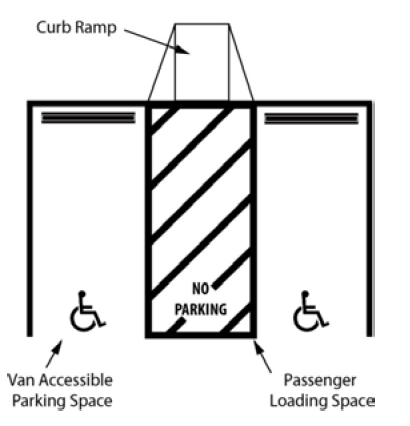
Handicap accessible parking spaces shall have an adjacent aisle five feet wide, and one in every eight handicapped spaces shall be adjacent to an aisle eight feet wide and the space shall be signed "van accessible." Handicapped parking space aisles shall be clearly demarcated by lines painted on or otherwise applied to the parking lot surface.

b.
Handicap accessible parking spaces shall be located on a surface with a slope not exceeding one vertical in 50 horizontal (1:50).
c.
Accessible parking spaces shall be located with the shortest accessible route of travel to an accessible facility entrance. Where buildings have multiple accessible entrances with adjacent parking, the accessible parking spaces shall be dispersed and located closest to the accessible entrances.
4.
Compliance with federal requirements. In addition to the requirements of this section, all handicapped parking shall comply with the requirements of the federal Americans with Disabilities Act.
H.
Proximity of off-street parking spaces to use.
1.
Location of parking spaces. Unless otherwise provided under an approved alternate parking plan, all parking spaces required to meet the guideline standards of this section shall be located in proximity to the use the spaces serve, as follows:
Table 8-4 Location of Parking Spaces
2.
Off-site parking. If required parking spaces are not located on the same lot as the particular use, building or establishment they are intended to serve, the following shall apply:
a.
The parking spaces must be set aside solely for the particular use, building or establishment, or be established as "shared parking" under the provisions for such under this section.
b.
The parking spaces must be located on a property that has the same zoning classification as the property that the spaces serve, or a less restrictive zoning classification. In no case shall a non-residential land use in an adjacent zoning district develop or use an off-street parking lot in a residentially zoned district.
c.
No required parking spaces may be located across any State or US highway from the use they are intended to serve.
d.
The parking spaces must meet the "location of parking spaces" requirements of this section, or adequate vehicular transportation must be provided that is acceptable to the development official.
I.
Design requirements for parking lots. The provisions of this section apply to all off-street parking spaces and parking areas, whether the parking meets or exceeds the number of spaces required to serve a particular use or the parking lot is operated as a principal use on a property and not dedicated to serving a particular use.
1.
Orientation to street. Except for parcels of land devoted to one-family, two-family or townhouse residential uses, all areas devoted to off-street parking shall be so designed and be of such size that no vehicle is required to back into a public street to obtain access.
2.
Off-street parking spaces.
a.
No parking spaces shall be accessible from an access driveway within the first 20 feet of the driveway, back from the street right-of-way line.
b.
Every parking space shall provide a useable area as follows:
Table 8-5 Off-street parking useable area
c.
Compact spaces may be permitted if reviewed and approved by the community development director.
1)
Compact spaces shall not be less than eight feet in width and 16 feet in length and shall not comprise more than 20 percent of any parking lot.
2)
Compact spaces shall be designated by signage identifying the compact parking spaces.
3.
Access and circulation.
a.
Access aisles shall not encroach into the parking space area. Access aisles in parking lots shall meet the minimum requirements:
Table 8-6 Access aisle requirements
b.
Minimum turning radius shall be 32 feet. One-way traffic aisles must be clearly marked with directional arrows on the pavement at each intersection with another aisle.
c.
Ingress and egress to parking areas shall be by means of paved driveways from the adjoining street. Driveway width, for the purpose of this section, shall include only the pavement and not the curbs and gutters. Access shall be so designed that vehicle are travelling in a forward motion.
d.
The distance from a parking area access drive to the intersection of two streets, and the distance between driveways at the street, shall be based on the driveway requirements in the "project design standards" Section of this UDO.
4.
Setback requirements.
a.
Off-street parking for single-family and two-family residential uses shall be setback a minimum of two feet from the adjacent property line.
b.
Off-street parking for all other uses, including multi-family residential, commercial, industrial, and institutional uses, shall be setback from front and rear property lines by at least ten feet and 15 feet from a side yard property line.
c.
The area between the front property line and the parking area shall be used for landscaping and/or screening as required in the "landscaping, buffers and tree conservation" section of this Code.
5.
Lighting of parking areas. Any lights used to illuminate the parking area shall be arranged, located, shielded or screened to direct light away from any adjoining residential use or public right-of-way.
6.
Improvement of parking areas.
a.
Permit required. Construction of a new parking lot or expansion of an existing parking lot requires issuance of a development permit from the engineering department. A permit is not required for resurfacing an existing parking area. A driveway permit is required for customary driveways for single-family and two-family residential dwellings.
b.
Surfacing and curbing. All off-street parking areas and all access drives shall be improved with a permanent and durable dust-free paved surface.
c.
Maintenance. Off-street parking areas shall be maintained in proper repair, including signage and pavement markings, with a durable and dust-free surface.
d.
Drainage facilities. For any use that will require a parking area to be newly constructed, added to, or altered in such a way as to affect drainage either on or off the site, stormwater drainage plans, including grading plans, shall be submitted to and approved by the water and sewer authority, prior to the issuance of a building permit or occupational license. Alternative methods of drainage, including the use of bio-swales, pervious pavement and pavers may be submitted as part of the stormwater drainage plan for consideration.
e.
Space and directional arrow markings. All designated parking spaces, other than those for single and two-family dwellings, shall be clearly marked on the surface of the parking area with paint or permanent marking materials and maintained in a clearly visible condition. This includes the marking of parking stall spaces and directional arrows.
f.
Curbs and wheel stops.
1)
All off-street parking areas shall include a perimeter curb, a minimum of six inches in height.
2)
All parking spaces shall include a wheel stop at the rear end of the parking space to prevent continued motion into landscaping islands.
g.
Interior design and landscaping. Interior design and landscaping shall be required as established in section 8.02, landscaping, buffering and screening.
h.
Screening. Screening shall be required as established in section 8.02, landscaping, buffering and screening.
7.
Time limit. All required off-street parking areas shall be ready for use, including the above surfacing requirement, before the occupancy of the use (in the case of a new building or addition) or within 45 days after the issuance of an occupational license (in the case of a change of occupancy in an existing building). An extension of time may be granted by the development official due to adverse weather conditions.
J.
Restrictions on vehicle parking.
1.
Restrictions in residential zoning districts.
a.
Parking shall not be permitted within the front yard in any single-family residential lot, except within a driveway, or in a roofed carport or enclosed garage. Within any single-family residential district not more than 35 percent of the total area between the street right-of-way line and the front of the principal building shall be paved. On any lot where adequate width exists meet the geometric design standards of the Institute of Traffic Engineers, a circular driveway shall be permitted, subject to the total driveway coverage authorized herein. However, no parking spaces or parking bays shall be established within any such front yard.
b.
In districts zoned for residential use, no person shall park or store any vehicle or trailer over 10,000 pounds gross weight or 24 feet in length except for the purpose of loading or unloading such vehicle or trailer. The loading or unloading of such vehicle or trailer shall be done within a reasonable time, but not to exceed 48 hours in any 15-day period.
c.
No trailer or recreational vehicle shall be parked in front of the principal structure, within ten feet of the side yard lot line, or within 20 feet of the rear lot line, unless it is parked or stored completely within an enclosed garage or roofed carport.
d.
No recreational vehicle or trailer may be occupied for human habitation exceeding 14 consecutive days while parked within a residential district.
e.
No recreational vehicle, trailer or storage container may be parked on a lot that does not contain a permanent dwelling unit or other structure intended for permanent human habitation as its principal use within any residential district.
f.
No truck body, trailer, or truck tractor, or part thereof may be parked or stored within the districts herein described unless specifically authorized by this UDO or a permit is issued by the community development director. If such a permit is issued, it shall be for one year and specific to the vehicle and location specified in the permit. Application shall be made to the community development director by the owner of the property where the vehicle is to be parked or stored. The application shall be accompanied by a nonrefundable application fee as set from time to time by the city council. Factors to be considered in issuing such a permit may include, but not be limited to the following: adequate screening from roadways and adjacent property, availability of rear yard parking, hours of vehicle parking and operation, size and type of vehicle.
g.
Nothing herein shall exempt any vehicle from the requirements of this UDO prohibiting the storing, parking or leaving of dismantled or other such motor vehicles.
2.
Inoperable vehicles. Inoperable vehicles must be removed, garaged or stored in accordance with article iv (abandoned or dismantled automobiles) of chapter 82 of the City Code of Ordinances.
3.
Construction equipment and construction vehicles. In districts other than the industrial zoning districts, construction equipment and construction vehicles may not be stored or repaired on the premises (other than in enclosed garages), except as follows:
a.
When being utilized for construction activities on the premises pursuant to a valid permit issued by the city for construction work necessitating use of such equipment, or when used for permitted work on the public right-of-way; or
b.
When the equipment is used as an accessory use customarily associated with an allowable primary business use, for example, forklifts used by some businesses to move merchandise; or
c.
When construction equipment and vehicles storage and repair are an intrinsic part of an allowable primary use, such as an equipment rental business.
K.
Off-street loading and unloading space.
1.
Generally. In addition to the parking requirements of this section, every lot with any building or structure hereafter constructed and used for business, trade, or industry, with the exception of the downtown area, shall provide and maintain space as indicated herein for the loading and unloading of vehicles, materials or merchandise, off the public right-of-way. Such space shall be in conformance with the following requirements:
a.
The loading and unloading area shall have access to a public alley or street and shall be so arranged that no vehicle is required to back onto a public street, road or highway in order to leave the premises or using the loading and unloading area.
b.
The size of each loading area shall be a minimum of 500 square feet with a minimum width of 12 feet and a minimum height clearance of 14 feet.
c.
All loading areas shall be graded as necessary and improved with extra duty asphalt or concrete and shall be provided with adequate drainage per plans approved by the community development director.
d.
Loading and unloading shall be done into and from doors, loading docks, loading areas, or other parts of the building which is at least 80 feet from any street or into or from any approved outside storage areas.
e.
Such loading and unloading areas shall be attractively screened from all streets or public rights-of-way by any dense planting of evergreens or by an attractive solid wall or fence or combination thereof or as approved by the community development director.
f.
Off-street loading areas shall be on the same lot as the specific use(s) served.
g.
Exterior lighting shall be designed and maintained so that glare is not cast on adjacent properties, regardless of use, or on adjacent public rights-of-way. All lighting structures shall be cut-off types which include shields or other similar devices.
2.
Minimum requirements for specific uses. Off-street space requirements for the following named use classifications shall be equal in area to at least the minimum requirements for the specific use set forth below. In the case of mixed uses, the total requirement for off-street loading facilities shall be the sum of the various uses computed separately.
Table 8-7 Number of Required Loading and Unloading Spaces
L.
Prohibited uses of off-street parking and loading/unloading spaces.
1.
The display for sale of all types of vehicles shall be prohibited within any required off-street parking area, except for a private individual selling a personal vehicle from a residence.
2.
The display, sales, or storage of any goods, wares, or merchandise shall not be permitted within any areas designated for required off-street parking, circulation and loading.
(Ord. No. O-2024-27, § 2, 8-5-24; Ord. No. O-2026-38, § 3, 7-20-26)
Sec. 8.02. - Landscaping, buffering and screening.
A.
Purpose. The purpose of this section is to improve the aesthetic qualities of the city and to protect and preserve the appearance, character and value of its neighborhoods and business areas by:
1.
Providing for quality and consistency in the design of landscaping and screening.
2.
Providing for the separation of incompatible types of land use.
3.
Providing for the conservation of existing trees and the planting of new trees in pace with the land development process.
4.
Providing for the improvement of air quality and water quality and a higher standard of environmental living.
B.
Benefits of landscaping and tree conservation. The benefits to the City of Douglasville derived from tree protection and replanting include:
1.
Improved control of soil erosion.
2.
Moderation of stormwater runoff and improved water quality.
3.
Interception of airborne particulate matter and the reduction of some air pollutants.
4.
Enhanced habitat for desirable wildlife.
5.
Reduction of noise and glare, and the establishment of wind breaks.
6.
Production of oxygen and reduction in the level of carbon monoxide in the air.
7.
Purification of the air through transpiration.
8.
Climate moderation.
9.
Aesthetics and scenic amenity enhancement.
10.
Increased property value.
C.
Applicability.
1.
General.
a.
No building permit for the construction, reconstruction, enlargement, extension or alteration of any building or structure, or change in the classification of use of land or for building occupancy be granted until required landscaping, screening or buffer yard has been provided in accordance with the provisions of this UDO. This section shall not apply to single family or two-family dwellings.
b.
If a building or structure covers the entire lot, an alternative must be proposed and approved which meets the purpose and spirit of this section.
2.
New development or redevelopment. Any new development or redevelopment of land shall be in full compliance with the regulations and standards of the is section.
3.
Additions and enlargements.
a.
Renovations or repairs. If a building renovation or repair involves an increase in the gross floor area of the building, or structure or an increase on the improvement of a lot (e.g. increase in off-street parking lot area), then additional landscaping, screening or buffer yards must be provided.
b.
Additions and increases in gross floor area.
1)
When a building, structure or accessory building or lot is increased in size up to 25 percent, landscaping, screening or buffer yards shall be required for the addition.
2)
When a building, structure or accessory building or lot is increased in size over 25 percent, the entire lot must conform to the requirements of this UDO.
4.
Change in use. Any change in use that increases the intensity or density of the building or lot shall fully comply with these regulations. For the purposes of this section, a change in use includes:
a.
A residential use to a multi-family use.
b.
A residential use to a non-residential use.
c.
A commercial use to an industrial use.
d.
An industrial use to a commercial use.
D.
Landscaping, buffering and screening; where required.
1.
Residential subdivisions, single-family or two-family lots. Landscaping, buffering and screening requirements are required for any residential subdivision for single-family or two-family development, or on the lot when a single-family or two-family dwelling is to be constructed, only to the extent required under this UDO.
2.
Multifamily and nonresidential uses. A suitable combination of landscaping, buffering and screening shall be installed on the property of any multifamily or nonresidential use or development as a condition of site plan approval, or issuance of a development permit or building permit, whichever occurs first. Plans shall be provided in accordance with the requirements of this article, section 8.02.G., plans, installation and maintenance, which includes the following:
a.
Within the yard areas of the property, in landscape strips along the street frontages, and within the minimum side and rear principal building setbacks.
b.
Within parking lots containing five or more parking spaces and between such lots and streets from which they are visible.
c.
As buffers between incompatible land uses and zoning districts.
d.
As replacement trees for those removed during construction, or as a supplement, in order to achieve the tree conservation requirements of this UDO.
E.
Landscaping of yard areas.
1.
Minimum requirements.
a.
The front yard of every single-family and two-family residential lot shall have a minimum of two hardwood trees, each of which shall be at least two and one-half inches in diameter.
1)
Every single-family and two-family residential lot shall have a minimum of one tree unit, the calculation for which may include the individual trees required in the front yard.
2)
The tree units required by this subsection may be counted toward compliance with the requirement for the tree density standard for the development.
b.
The minimum landscaping requirement for all uses is two shrubs per 1,000 square feet of total lot area.
2.
Open yard areas. All portions of the site not covered with pavement or buildings shall be landscaped. Open areas not covered with other materials shall be covered with turf or ground cover. Turf or ground cover utilized on all slopes in excess of 25 percent (one foot of rise in four feet of run) must be specifically selected to stabilize the slope.
3.
Screening of trash receptacles, storage areas and loading docks. All storage areas, loading docks or areas, trash and recycling receptacles, equipment storage, and service vehicles which are visible from any public right-of-way shall be screened from all streets or public rights-of-way by any dense planting of evergreens or by a solid wall or fence or combination thereof.
4.
Landscape strips along front lot lines.
a.
Landscape strips along front lot lines; where required. A minimum ten-foot-wide frontage landscape strip shall be provided along the full length of any street frontage of a multifamily or nonresidential development with the exception of the historic district.
b.
Location of structures in frontage landscape strip. Frontage landscape strips shall contain no structures, parking areas, patios, stormwater detention facilities or any other accessory uses except for the following:
1)
Retaining walls or earthen berms constructed as part of an overall landscape design.
2)
Pedestrian-oriented facilities such as sidewalks.
3)
Underground utilities including all above ground utility cabinets.
4)
Driveways required to access the property.
5.
Landscaping required in frontage landscape strips.
a.
All portions of a frontage landscape strip shall be planted with trees, shrubs, flowers, grass or approved ground cover, except for those ground areas that are mulched or covered by permitted structures.
b.
Trees shall be provided within the frontage landscape strip at the rate of one tree unit for every 75 feet of length of street frontage, or portion thereof. Such trees shall be hardwood and must be of a type that is suitable to local growing conditions and that will normally reach a height of at least 15 feet upon maturity.
c.
Upon planting, new trees shall have a caliper of no less than two and one-half inches, and may be clustered for decorative effect following professional landscaping standards for spacing, location, and design.
6.
Landscape strips alongside and rear lot lines.
a.
Landscape areas along side and rear lot lines; where required. All portions of a lot containing a multifamily or nonresidential use, between a side or rear lot line and the minimum required side or rear setback line for principal buildings, shall be landscaped as required by this section. Buffers, where required under section 8.02.G., buffers between incompatible land uses, shall be installed in lieu of the landscaping required under this subsection.
b.
Location of structures in side or rear landscape areas. Side and rear yard landscaping areas shall contain no structures, parking areas, patios, stormwater detention facilities or any other uses except for the following:
1)
Retaining walls or earthen berms constructed as part of an overall landscape design.
2)
Underground utilities.
3)
Driveways or other types of drives required in order to access neighboring property.
7.
Landscaping required in side and rear landscaping areas.
a.
All portions of a side or rear landscaping area shall be planted with trees, shrubs, grass or approved ground cover, except for those ground areas that are mulched or covered by permitted structures.
b.
With the exception of single family and two family uses, trees shall be provided within the side yard landscape strip at the rate of at least one tree unit for every 75 feet of length or portion thereof, or the side yard landscape strip may be planted in a continuous hedge or junipers (except for approved access drives and utility easements).
F.
Parking lot and loading area landscaping.
1.
Parking lot trees.
a.
Parking lot trees; where required. Hardwood trees shall be provided within any parking lot designed or intended to accommodate five cars or more, in accordance with the requirements of this section.
b.
Parking lot trees; minimum standards.
1)
Hardwood trees shall be provided within the parking lot at a ratio of at least one tree for every 15 parking spaces, or portion thereof. Each tree shall be located within the parking lot in reasonable proximity to the spaces for which the tree was required. Trees provided to meet the minimum requirements of any landscape strip or buffer under this section may not be counted toward this requirement.
2)
New trees shall have a caliper of no less than two and one-half inches upon planting and may be clustered for decorative effect following professional landscaping standards for spacing, location, and design.
2.
Parking lot interior islands and planting areas.
a.
As a minimum, a landscaping island shall be located at the end of every parking bay between the last parking space and an adjacent travel aisle or driveway. The island shall be no less than eight feet wide for at least one-half the length of the adjacent parking space. The island shall be planted in trees, shrubs, grass, or ground cover except for those areas that are mulched.
b.
Tree planting areas shall be no less than eight feet in width and shall provide at least 100 square feet of planting area per tree. No tree shall be located less than two and one-half feet from the back of curb. All parking lot landscape islands, strips or other planting areas shall be curbed with minimum six-inch high rolled or vertical curbs.
c.
Landscaping islands and tree planting areas shall be well drained and contain suitable soil and natural irrigation characteristics for the planting materials they contain.
3.
Street-side screening for parking and loading areas.
a.
Parking lot and loading area screening; when required. Any parking lot designed or intended to accommodate five cars or more, and any area set aside for loading or unloading of trucks or vans, that are visible from a street right-of-way, must provide a visual screen of the parking lot or loading area that meets the requirements of this subsection.
b.
Street-side screening; minimum standards.
1)
Screening must be provided along the edge of the parking lot or loading area closest to and parallel to the street, and along any edge closest to and within 30 degrees of being parallel to the street.
2)
A driveway to the parking lot or loading area may encroach into the landscaping.
3)
The screening shall be decorative and opaque to a height of two and one-half feet above the elevation of the parking lot or loading area or the street, whichever is highest.
c.
Street-side screening; techniques. Parking lot or loading area screening may be provided in any of the following ways:
1)
Planted only. A hedge consisting of at least 12 shrubs per 40 linear feet that will spread into a continuous visual screen within two growing seasons. Shrubs must be at least 18 inches tall at the time of planting and be certified by a registered Landscape Architect to be of a species that will normally exceed two and one-half feet in height at maturity and are suitable for the parking lot application.
2)
Earthen berm. An earthen berm constructed to a height of two and one-half feet above the adjacent elevation of the street or loading area, wherever is highest, shall not exceed a slope of one vertical in two horizontal (1:2) and shall have a crown of at least two feet. The berm shall be planted in ground covers or other plant materials to achieve a decorative effect.
3)
Wall. A wall of brick, stone or finished and textured concrete may be constructed to the required height and opacity and landscaped with plant material to achieve a decorative effect.
4)
Combination. Any combination of hedge, berm or wall that effectively provides a visual screen of the parking lot or loading area to a height of two and one-half feet and achieves a decorative effect through appropriate use of landscaping and plant material.
5)
Street-side screening; location. The loading area screening treatment may be located within the frontage landscape strip required under this section.
G.
Buffers between incompatible land uses. Buffers are intended to eliminate or reduce conflict between potentially incompatible, but otherwise permitted land uses on adjoining lots.
1.
Land use buffers; where required. A land use buffer shall be required in any multifamily or nonresidential development project along a side or rear lot line that abuts a less intense land use, as follows:
Table 8-8 Situations Where Land Use Buffer Required
2.
Buffer design standards.
a.
General. Buffer areas shall contain no driveways, parking areas, patios, stormwater detention facilities, or any other structures or accessory uses except for a fence, wall, or earthen berm constructed to provide the visual screening required to meet the standards of this UDO. Utilities may be permitted to cross a buffer if the screening standards of this UDO will be subsequently achieved. Vehicular access through a buffer may be allowed only as a condition of rezoning, special use or planned development approval by the city council.
b.
Minimum required screening. Minimum required screening shall consist of a natural buffer utilizing existing vegetation or, if existing vegetation is inadequate to provide an opaque screen, a structural buffer, in order to achieve an opaque continuous visual screen to a height of six feet, or any combination of existing and replanted vegetation which can reasonably be expected to create an opaque visual screen six feet high within two growing seasons.
c.
Natural buffers.
1)
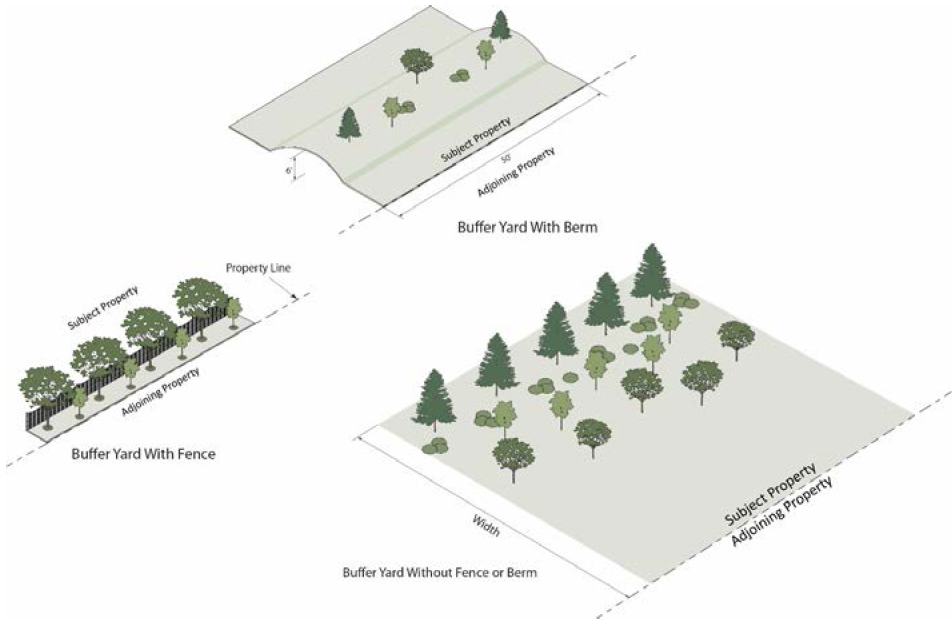
Width. A natural buffer shall have a minimum width of 50 feet, or greater as required to achieve an opaque visual screen.
2)
Natural buffers may contain deciduous or perennial vegetation but shall contain evergreen shrubs and trees suitable to local growing conditions that will provide an opaque visual screen during all seasons of the year.
d.
Structural buffers. Structural buffers shall meet the following criteria:
1)
Width. A structural buffer shall have a minimum width of 25 feet, or greater as required to achieve an opaque visual screen.
2)
Structural buffers shall be vegetated throughout the minimum area required for the buffer around any fences or walls and upon any earthen berms, which may include grass, ground covers, shrubs, and trees.
a)
All earthen berms shall have a maximum side slope one vertical of rise to two horizontal (2:1). Earthen berms shall not be constructed within the drip line of any existing trees that will remain on the property.
b)
Trees shall be located or planted within any structural buffer at a density of no less than one tree unit for each 30 feet of buffer length or portion thereof. New trees shall have a caliper of no less than two inches upon planting and may be clustered for decorative effect following professional landscaping standards for spacing, location, and design.
c)
Fences and freestanding walls shall present a finished and decorative appearance to the abutting property and shall be located no closer to the property line than two feet. Shrubs, ground covers, or other vegetation shall be provided between the fence or wall and the adjoining property line so as to provide a decorative effect, following professional landscaping standards for spacing, location and design.
d)
Fences used in buffers must be made of rot-resistant material or protected from deterioration with waterproofing material. All hardware used shall also be of a durable weather resistant material.
e.
Examples of Buffers. The accompanying illustration provides examples of natural and structural buffers. Other solutions meeting the minimum requirements of this section are also acceptable.
f.
Maintenance of buffers. Every buffer and every fence required by this UDO or by special stipulations of zoning shall be maintained by the property owner. Every buffer required by this section shall be maintained by the owner of the property where the buffer is located, so as to provide an opaque continuous visual screen to a height of six feet on a continuous, year-round basis.
g.
Buffer modifications. If a structural buffer is provided that creates an opaque screen to a height of no less than eight feet (instead of six), the buffer may be reduced to a width of no less than 15 feet.
h.
Location of buffers. Buffers may be relocated on the site to best achieve the screening required.
H.
Plans, installation and maintenance.
1.
Site landscaping plans; where required.
a.
Landscaping, buffer and tree conservation plans are required upon application for a development permit or for a building permit for new construction of buildings in any development to which landscaping, screening, buffer or tree conservation requirements apply.
b.
In cases where approval of the landscaping, buffer and tree conservation plans would cause harmful delay to the start of construction, the community development director may authorize footing and foundation permits for the project so that construction may proceed.
c.
Permits for construction beyond the footing and foundation shall not be issued until the landscaping, buffer and tree conservation plans have been submitted and approved.
2.
Site landscaping, screening and buffer plans; criteria. The technical specifications for landscaping, buffer and tree conservation plans are found under the "plans and permits" section of this UDO. However, the following must be identified on the plan:
a.
Adjacent land uses.
b.
The species and size of all existing trees two inches in diameter or greater, showing those proposed for removal and those proposed for retention.
c.
The species and size of all proposed trees at maturity.
d.
The species, size and quantities of all other proposed plantings including shrubs and ground cover indicating common names, scientific names.
e.
All proposed man-made barriers such as berms, fences or walls that are to be used for screening or buffering purposes.
f.
Proposed grading, drainage and erosion control measures.
g.
Description of proposed method of protecting existing trees during construction.
h.
Proposed irrigation system, if any.
i.
Maintenance plan.
3.
Exemptions from site landscaping plan requirements.
a.
The provisions of this section shall not apply to structures for which site landscaping plans have previously been submitted and approved unless there is a substantial change to the development or plant material proposed.
b.
Site landscaping plans shall be required for only that phase of development for which the development permit or building permit is being requested.
4.
Plant materials; standards.
a.
Acceptable plant materials. The following are the minimum plant sizes and conditions to be used in satisfying the requirements of this section. Acceptable plant materials for landscaping, screening buffers and tree replacement shall be as approved by a registered landscape architect.
1)
New plant materials.
a)
Medium shrubs, 18—24 inch balled and burlapped or two-gallon container.
b)
Large shrubs, 24—30 inch balled and burlapped or five-gallon container.
c)
Ground cover, two and one-half inch peat pot.
d)
Trees as required to meet the requirements of the tree conservation plan.
2)
The "American Standard for Nursery Stock," published by the American Association for Nurserymen, may be referred to for the determination of plant standards.
3)
Existing trees that are to be retained to satisfy the requirements of this UDO shall meet the following standards:
a)
For evergreen trees, the height shall be at least six feet at time of installation.
b)
For deciduous trees, the tree shall be a minimum diameter of two and one-half inches at time of installation.
c)
Trees shall be free from mechanical injuries, insect infestations and disease.
d)
Trees shall be protected from injury to roots, trunks and branches during grading and construction. Protective fencing, tree wells, or retaining walls shall be utilized where necessary to insure tree vigor upon completion of construction.
b.
Approval of plant materials. Approval of proposed plant materials shall be subject to a determination by a registered landscape architect that the proposed material is the most appropriate for:
1)
The specific location, given surrounding land uses and the type of screening used on nearby properties, and
2)
The specific topography, soil, existing vegetation, USDA plant hardiness zone, and other factors that may influence the effectiveness of a screen material.
5.
Installation and maintenance of plant materials.
a.
Installation of plant materials. Plant materials, as required by the provisions of this section, shall be installed by the date specified on the approved site landscaping plan. The community development director may allow one planting season in a 12-month period in which the installation of plant materials shall be completed. For the purposes of this UDO, there shall be two planting seasons, which are from February 15 through May 31, and September 15 through November 30. Buffers, if proposed or required, shall be installed before an occupancy permit is granted; except where the weather is not suitable for planting, and escrow provisions are made in accordance with guidelines of the engineering department.
b.
Maintenance of required plant materials.
1)
Residential landscaping shall conform to any care of premise or nuisance ordinance identified in the City Codified Ordinance.
2)
The owner, tenant and their agent, if any, shall be jointly responsible for the maintenance of the plant materials in good condition used to meet the minimum requirements of this section for landscaping, screening, buffer or tree conservation. The plant materials shall be kept free from refuse and debris.
3)
Plants that are not in sound growing condition, or which are dying or dead, shall be removed and replaced with a plant of the same species, variety or cultivator, as acceptable to the community development director. Such plant material shall meet the minimum requirements identified in section 8.02. G.2.a, acceptable plant material.
4)
Other landscape materials shall be maintained in proper repair and shall be kept clear of refuse and debris.
I.
Tree Conservation.
1.
Tree conservation; where required.
a.
Application to new development or disturbed areas. The requirements of this UDO shall apply to any activity on real property within the City of Douglasville, including, but not limited to, the following:
1)
Single-family and two-family lots. Single-family and two-family lots which are new or expanded.
2)
All new commercial, office, institutional, industrial, and/or manufacturing development and expansion of existing commercial, office, institutional, and/or manufacturing development into undisturbed areas;
3)
All new residential subdivisions and expansion of existing subdivisions (new units and/or phases);
4)
All new mixed-use developments and expansion of existing mixed-use developments into undisturbed areas;
5)
All new multifamily developments and expansion of existing multifamily developments into undisturbed areas; and
6)
All new townhouse developments and expansion of existing townhouse developments into undisturbed areas.
b.
Residential subdivisions.
1)
Residential subdivisions shall identify on the plats/plans the total tree density required by the completion of infrastructure under this section upon completion of infrastructure construction. At a minimum, the subdivider must fully meet the tree density requirements of this section prior to approval of a final plat or commit to such achievement through performance surety for tree planting.
2)
No certificate of occupancy shall be issued until the tree density requirements have been achieved as identified on the residential site plans.
c.
Nonresidential subdivisions. New commercial and industrial subdivisions are subject to a two-staged review process by the community development director (for the infrastructure and later for each individual lot). For this reason, these subdivisions may base density calculations on the net disturbed site area defined by the limits of clearance and construction. The phase 1 plan shall address the method and timing of ultimate compliance with this section.
d.
Nonresidential out-lots. Out-lots and separate parcels of a phased development must collectively meet minimum requirements for site density; however, in no case may an individual out-lot have less than 14 tree units per acre.
e.
Additions to existing projects. For additions to existing projects, the density requirements may be met in either of the following two ways:
1)
Calculate the area of any new land-disturbance and/or improvements and add replacement trees based on that area (existing trees elsewhere on the site may not be counted with this option); or
2)
Base density requirements on the total site area and count any existing trees on the site, exclusive of zoning buffers and stream buffers.
f.
Phased projects and reduced net site areas. Where development is going to occur in phases (by design or by implication), density calculations must be based on a site area defined by an established or estimated phase line.
Similarly, a reduced net site area may be achieved by using only the area of actual site disturbance (new projects only), provided that a limits of construction line is clearly shown on the plan (existing trees elsewhere on the site may not be counted with this option).
In both instances, the following criteria are applied regarding existing trees:
1)
Existing trees to be counted toward meeting the density requirements should be within the phase line or limits of construction.
2)
If the tree save areas must be established outside these areas, they must be located where future development will not impact them.
The trees in areas outside the phase line or limits of construction may not be counted toward the density requirement of subsequent phases or new projects.
g.
Alternative calculations. Calculations for alternative compliance to tree density requirements shall be made according to the guidelines set forth at section 8.02.J.6., alternative compliance to tree density requirements.
h.
Exemptions from tree conservation requirements. The tree conservation requirements shall not apply to the following:
1)
Horticultural or agricultural. Horticultural or agricultural operations, as follows.
a)
All plant or tree nurseries, Christmas tree farms, and botanical gardens shall be exempt in relation to those trees that are being grown for relocation and continued growth in the ordinary course of business, or for some public purpose.
b)
All orchards of trees in active commercial operation shall be exempt for bona fide agricultural purposes.
c)
Land clearing or clearing and grubbing activities for clearly agricultural purposes. Clearing or grubbing conducted as part of the land development process may be authorized only in accordance with the issuance of a land-disturbance permit under the requirements and provisions of this section. A development permit may not be issued on any property that has been cleared or grubbed as an exempt agricultural activity within the past 12 months, unless approved by the mayor and city council.
d)
Timber harvesting (selective cutting or clear cutting) for pulpwood or sawtimber shall be exempt when conducted as a bona fide agricultural activity. Timber harvesting conducted as part of the land development process may be authorized only in accordance with the issuance of a land-disturbance permit under the requirements and provisions of this section. A development permit may not be issued on any property that has had its timber harvested as an exempt agricultural activity within the past two years.
2)
Removal of disease or infestation. Removal of diseased or infested trees, upon the verification of the community development director or other qualified forestry professional acceptable to the community development director, is exempt.
3)
Imminent hazards to property owners. Removal of trees that have become, or threaten to become, a danger to human life or property, upon the verification of the development services director or other qualified forestry professional acceptable to the director of development services, are exempt.
4)
Roadway construction. Land clearing for designated roadway projects of the Georgia Department of Transportation and the City of Douglasville is exempt.
5)
Exemptions.
a)
The removal of trees from detention ponds and drainage easements is exempt.
b)
Public utility companies and government agencies conducting operations on public and utility rights-of-way and easements or on sites for electric power substations and similar facilities, which operations are for the purpose of assuring uninterrupted utility and governmental services and unobstructed passage on public streets, are exempt.
c)
Summary of applicability and exemptions. Table 8-9 summarizes the circumstances under which tree conservation requirements apply to specific projects.
Table 8-9 Summary: Applicability and Exemptions
d)
No land-disturbance or development permit may be issued within two years of agricultural clearing, clearing and grubbing or timber harvesting on a property unless variance pursuant to the UDO is approved.
i.
Trees to be provided or retained.
1)
Number of tree units upon completion of development.
a)
Minimum standard. On each property for which a tree protection plan is required by this section, existing trees may be retained and new trees shall be planted such that the property shall attain or exceed a tree density, standard meeting section 8.02.J.3, minimum standards. The trees, both existing and new, where feasible shall be reasonably distributed throughout the site, with emphasis on tree groupings to achieve aesthetic results following professional landscaping standards. Trees may be retained or planted for credit within a public right-of-way if granted approval by the community development director.
b)
Tree density standard calculation. The tree density standard shall be calculated by summing the following credits and dividing by the total acreage of the project included within the limits of the permit application.
i.
Credit for existing trees to be retained shall be calculated by multiplying the number of trees (by diameter) times the units assigned in Table 8-8 for existing trees. Credit shall be given all trees retained on a property having a diameter at breast height (DBH) of three inches or more, except for those trees retained to create a land use buffer required under section 8.02.G.1., land use buffers; where required.
ii.
Credit for new trees proposed on the site shall be calculated by multiplying the number of trees (by diameter) times the units assigned in the Table 8-9 for new trees. Credit shall be given all new trees on a property, except for new trees of less than one inch in caliper and those trees provided to create a land use buffer required under section 8.02.G.1., land use buffers; where required.
iii.
Additional credits may be granted under the following circumstances:
(a)
A total tree density credit not to exceed twice the units shown on Table 8-8, may be granted by the community development community development director, under the standards set forth in this section, for existing trees to be retained which have greater value as outstanding specimen trees or having historic value or being a rare or unique species.
(b)
Existing trees to be retained within a 100-year floodplain may be granted a bonus of 50 percent of the units assigned in Table 8-8.
2)
Retention of specimen trees. Existing specimen trees (as defined in this UDO) shall not be removed from property other than single-family residential property, unless development would cause irreparable damage to the critical root zones.
j.
Protection of existing trees. The following guidelines and standards shall apply to existing trees proposed to be retained for credit toward meeting the minimum required tree density standard on a property:
1)
Tree protection area. The root system within the dripline is generally considered to be the critical root zone. To protect these critical root zones, a tree protection area shall be established around each tree or group of trees to be retained.
a)
The tree protection area shall include, as a minimum, the total area within the dripline plus an additional three feet.
b)
Layout of the project site utility and grading plans shall avoid disturbance of the tree protection areas.
c)
All construction activities are prohibited within the tree protection area. Construction site activities such as parking, materials storage, concreted washout, burn-hole placement, etc., shall be arranged so as to prevent disturbances within the tree protection area.
d)
Once tree protection areas are established and approved, no changes shall be made without first obtaining approval from the community development director of the change, subject to the standards set forth in this section.
2)
Protective barriers.
a)
Protection. Tree protection devices are to be installed as shown on the plan or otherwise completely surrounding the tree protection area. The plan shall indicate whether the tree protection device is to be active or passive. Active protection is required where tree protection areas are located in proximity to construction activity. The locations of all tree protection devices will be verified by the community development director prior to the issuance of the construction permit for clearing and/or grading. Active tree protection shall consist of chain-link, orange laminated plastic, wooden post and rail fencing or other equivalent restraining material.
b)
Signage. All tree protection areas shall be designated as such with "tree protection area" signs. These signs are intended to inform subcontractors of the tree protection process. Such signs shall be a minimum of 16 square feet in sign face area and shall state with minimum three-inch lettering "Attention Subcontractors: You must observe Tree Protection Area—No Construction or Equipment Encroachment. You are responsible for damages" or similar wording. Signs requiring subcontractor cooperation and compliance with the tree protection standards shall be posted visibly at site entrances.
c)
Erosion and sedimentation control. All tree protection areas must be protected from soil erosion and sedimentation intrusion through the use of silt screens or other acceptable measures placed up-slope from the tree protection area. All erosion and sedimentation control measures shall be installed in a manner that will not result in the accumulation of sediment in a tree protection area.
d)
Inspection. All tree protection devices and erosion control barriers shall be installed prior to any clearing, grubbing, grading or any land-disturbance activity. The community development director must inspect the installation of tree protection and erosion and sedimentation control devices prior to the issuance of the development permit. Tree protection must remain in functioning condition throughout all phases of development but is to be removed prior to issuance of a certificate of occupancy.
3)
Encroachment or Removal. If encroachment into a tree protection area occurs that causes irreparable damage to the trees, the tree conservation plan shall be revised by the permittee to compensate for the loss, and the revised plan must be accepted by the community development director, subject to the standards set forth in this section. Under no circumstances shall the developer be relieved of responsibility for compliance with the provisions of this section, nor shall plan revision activities estop the department from instituting action for violation of this section.
4)
Damage prohibited to specimen trees.
a)
No person shall cut, carve, or otherwise damage or remove any specimen tree on nonresidential property or deface or damage any tree on residential property except in accordance with the provisions of this UDO.
5)
Prohibited activities.
a)
Compaction prohibited. All building materials, vehicles, construction equipment, dirt, debris, or other objects likely to cause soil compaction or aboveground damage shall be kept outside the tree protection area. Where a limited amount of encroachment is unavoidable, the tree protection area shall first be cut cleanly, then immediately mulched with a four-inch layer of processed bark or wood chips or in a six-inch layer of straw.
b)
Grade change prohibited. There shall be no raising or lowering of the ground level within the tree protection area. Stripping of topsoil in the tree protection area shall not be permitted. Where necessary, the use of moderate fill is permitted only with prior installation of an aeration system. Deposition of sediment in the tree protection area shall be prevented by placement of sediment barriers, which shall be backed by two inch by four-inch wire mesh in areas of steep slope.
c)
Ditches prohibited. No person shall excavate any ditch within the tree protection area. Where such encroachment is unavoidable, ditches or trenches shall be located as to minimize root damage. Any such excavation in a tree protection area shall require protective measures designed by a certified arborist and approved by the community development director. If roots must be cut, they must be cut cleanly and immediately mulched.
d)
Paving prohibited. No person shall pave with concrete, asphalt, or other impervious material within the tree protection area.
6)
Purpose of tree protection devices. Tree protection devices required by this section ameliorate the effects of activities detrimental to trees including, but not limited to:
a)
Soils compaction in the tree protection area resulting from heavy equipment, vehicular or excessive pedestrian traffic, or storage of equipment or materials;
b)
Root disturbance due to cuts, fills or trenching;
c)
Wounds to exposed roots, trunks or limbs by mechanical equipment;
d)
Other activities such as chemical storage, cement truck cleaning, fire, or other activities that will damage the critical root zone.
7)
Other specifications.
Clearing. Where clearing has been approved, trees shall be removed in a manner which does not adversely impact the trees to be preserved. Felling trees into tree protection areas or disturbing roots inside the protection areas is prohibited. Roots shall be cut cleanly before tree removal.
k.
Tree replacement standards. New trees proposed to be planted for credit toward meeting the minimum required tree density standards on a property shall comply with the following guidelines and standards:
1)
Placement and quality.
a)
The spacing of new trees must be compatible with the spatial site limitations and with responsible consideration towards species size when mature.
b)
Species selected for planting must be ecologically compatible with the specifically intended growing site. When practical, the replanted trees shall be of the same or similar species as those removed. Standards for transplanting shall be in compliance with those established by the International Society of Arboriculture, as included in the Tree and Shrub Transplanting Manual, latest edition or similar publication. Unless otherwise approved by the community development director pursuant to the standards set forth in this section, trees selected for replanting must be on the tree planting list in Table 8-10.
c)
Trees selected for planting must be free from injury, pests, disease, nutritional disorders or root defects, and must be of good vigor so as to assure a reasonable expectation of survivability.
Table 8-10 Approved Species List for Proposed New Trees
2)
Deferred planting. In the event that new trees proposed to be planted to achieve the tree density standard are not installed upon application for a certificate of occupancy or a final plat approval, then a performance bond or other acceptable surety in an amount equal to 125 percent of the value of the new trees and their installation shall be posted in accordance with the performance bonding requirements and provision of this UDO. Such request for deferred planting shall be in writing and the language must be satisfactory and acceptable to the city attorney prior to permitting deferred planting.
3)
Warranty for new plant materials. Upon final installation of new trees planted under the requirements of this section and following acceptance by the community development director, the owner shall warrant the new trees and provide for replacement of those which do not survive for a period of no less than two years.
J.
Calculation of tree units.
1.
Use of tree units. Where the requirements of this UDO with regard to the preservation or planting of trees are not expressed in terms of number of trees, they are expressed in terms of "tree units". This approach provides the developer with wide latitude of choice as to the number and sizes of trees to be planted, and their distribution following aesthetic landscaping practices, while achieving a common standard on all properties.
2.
Establishment of tree unit values. The diameter of a tree's trunk establishes the "tree unit" value of an existing tree, as shown on Table 8-11, Tree Unit Values for Existing Trees, or for a newly planted tree as shown on Table 8-12, Tree Unit Values for New Trees. The values assigned to trees of the same size are different for existing and new trees, as indicated in the tables. One "unit" is not the same as one "tree." Actual tree diameters or calipers are to be rounded to the nearest whole number for the calculation of tree unit values (e.g., four and one-half inches in diameter equals five inches).
Table 8-11 Tree Unit Values for Existing Trees
Table 8-12 Tree Unit Values for New Trees
3.
Minimum standards. On each property for which a tree conservation plan is required by this UDO, existing trees may be retained and new trees shall be planted so that the property shall attain or exceed the required tree density standard for the proposed use, exclusive of any acreage within a zoning buffer area (as required under this section) or a stream buffer. Existing tree retention, as opposed to tree clearing and replanting, is encouraged by this UDO. The minimum required tree density standard shall be as follows:
a.
Residential - 18 tree units per acre.
b.
Office/commercial - 20 tree units per acre.
c.
Industrial - 15 tree units per acre.
4.
Proposed project's tree density calculation. The proposed project's tree density shall be calculated by summing the credits for trees to be retained and trees to be planted and dividing that number by total acreage of the project (excluding zoning buffer and stream buffer acreage). Table 8-13 identifies an example.
Table 8-13 Example Calculation of Tree Units Required
5.
Achieving tree density required. Every reasonable effort must be made to achieve the minimum required tree density standard on each development site. However, this UDO contemplates that, due to topographic or other conditions, the exact number of tree units required by the proposed project's tree density calculation may not be able to be planted and still meet professional standards for spacing and survival. A method of alternative compliance, therefore is provided.
6.
Alternative compliance to tree density requirements.
a.
Overview. The intent of the tree conservation requirements is to ensure that the required density of trees is maintained on all developed sites. Occasionally, this intent cannot be met because a project site will not bear the required density of trees. To provide a viable alternative for such cases, the developer may be allowed to contribute to the City of Douglasville Tree Replacement Fund. The community development director must review and approve all requests for alternative compliance to ensure that physical compliance with established standards cannot be achieved due to site considerations. As many trees as can reasonably be expected to survive must be planted on the site in question. In no instances shall more than 50 percent of the required tree site density be met through alternative compliance.
b.
Number. The number of newly planted trees that can reasonably be expected to survive on a site shall be determined from the following criteria:
1)
Overstory Trees - 200 square feet of pervious root zone.
2)
Understory Trees - 75 square feet of pervious root zone.
c.
Plan. Developers are required to plan their projects in such a manner as to comply with the standards provided by this UDO. Overdevelopment of a lot will not be recognized by the city as a criteria allowing use of the alternative compliance method. Site characteristics permitting use of alternative compliance are limited to those physical features outside the control of the owner and/or developer, such as the presence of rock, unusually steep grades, or ravines.
d.
Land disturbance permit. The land-disturbance permit will only be issued after the community development director has verified entitlement to use the alternative compliance under the standards of this section.
e.
Tree replacement fund. If, in the determination of the community development director, conditions do not allow for the planting of the required tree units on site due to physical characteristics of the lot outside the owner/developer's control, the permit holder may pay the city 125 percent of the total cost of purchase, delivery and installation (including a two-year warranty) of trees at two-inch caliper, and the city will use this money to plant trees on public property for landscape design, planting and maintenance. Actual fees shall be set by the city council from time to time pursuant to the administration and enforcement article of this UDO regarding schedules and fees.
1)
Example: Calculating contribution amounts. How to determine the fee amount if there is a deficit of tree density on a parcel of land:
a)
A 4.0-acre commercial development project site has the following requirements as required in this UDO:
i.
A required tree density factor of 80.0 (20 tree units per acre times four acres).
ii.
Existing trees that will remain total 36.0 tree units.
iii.
There is enough room on the property to accommodate approximately 32.0 tree units.
iv.
Substantiation that sufficient open acreage exists to meet the ordinance standards, but physical features of the site preclude installation of the remaining required tree units.
b)
Determine the tree density deficit as follows:
80.0 tree units are required, minus 36.0 existing tree units on site, minus 32.0 new tree units = a deficit of 12.0 tree units that cannot be physically accommodated on site.
c)
Determine the acceptable contribution as follows:
The calculation for acceptable tree unit deficit contribution is calculated in the following manner:
(Deficit of tree units' x tree unit credit calculation (Table 8-9)) x fee = contribution amount. Example:
i.
There is a deficit of 12.0 tree units
ii.
The minimum diameter tree required is a two-inch tree unit for a tree unit credit of three-tenths per tree (Table 8-13)
iii.
The fee required is the cost of purchase, delivery, installation and two-year warranty of a two-inch caliper (DBH) times 125 percent.
In this example, (12.0 x 0.3) x $FEE = 36 x $FEE = contribution amount.
f.
Fund Administration. The City of Douglasville Tree Replacement Fund will be maintained by the finance director. A report for the City of Douglasville Tree Replacement Fund will be made available to the city council no less often than annually. Use of funds from the tree replacement fund shall be approved by city council.
g.
Specimen trees. The City of Douglasville strongly advocates the preservation of specimen trees. In order to encourage the preservation of specimen trees and the incorporation of these trees into the design of projects, the following shall apply:
1)
All specimen trees shall be located on the grading plan and the landscaping, buffers, tree conservation, and land-disturbance plans, whether or not the trees are proposed to be retained.
2)
The tree unit values shown on Table 8-11 may be increased by 100 percent for an existing tree that meets the definition of a "specimen tree" or for a "specimen tree stand" as defined herein, provided that extraordinary measures as needed are taken to protect the tree and assure its survival. Such measures may include, but are not limited to, the provision of tree wells, retaining walls, aeration, or supplementary irrigation, as applicable to the site of the tree and as approved by the community development director according to the provisions of this section.
3)
Removal of specimen trees. Specimen trees may not be removed from property other than single-family residential property for any reason not specifically enumerated as an exemption in section I.1.H. without first obtaining a variance. Such variance must be granted by the city council under the standards set for in section 10.03 of this UDO.
(Ord. No. O-2022-8, §§ 19, 20, 3-7-22)
Sec. 8.03. - Site lighting.
A.
Purpose. The purpose of section is to:
1.
Minimize the adverse offsite impacts of lighting such as light trespass and obtrusive light and glare.
2.
Establish regulations for safe nighttime outdoor lighting.
3.
Limit the degradation of the nighttime visual environment.
4.
Conserve energy and resources to the greatest extent possible.
B.
Outdoor lighting. All outdoor light sources on private property must be energy efficient, stationary and shielded or adequately recessed to ensure that all light is directed away from adjacent properties or the adjacent public rights-of-way. This includes the following types of lighting sources:
1.
Canopy.
2.
Perimeter.
3.
Pole.
4.
Flood.
5.
Security.
C.
Maximum height.
1.
The maximum height of any light, canopy, pole or wall mounted, shall not exceed 20 feet above the adjacent grade.
2.
Applicants who propose lighting that exceeds 20 feet in height may request an administrative variance from the community development director. Appeals to the community development director's decision may be taken to the board of adjustment and appeal.
D.
Lighting plan required. A lighting plan, to scale, is required identifying the following:
1.
Pole height,
2.
Type of luminaire to be installed,
3.
Site coverage with the average maintained footcandle,
4.
Uniformity of coverage including the maximum and minimum footcandles on site and at the property line.
E.
Nonconforming lighting.
1.
Permitted to continue. Any lawful lighting fixture established at the effective date of this UDO that does not conform to the provisions of this section may continue, provided that the lighting remains in conformance with the regulations of this subsection D., nonconforming lighting.
2.
Maintenance and repair. Normal maintenance and repair, including the replacement of light bulbs, cleaning or routine, minor repair of a legal nonconforming light fixture shall not be trigger loss of lawful status as described in subsection 3. Loss of nonconforming status, unless the repair or maintenance increases the nonconforming aspects of the lighting fixture.
3.
Loss of nonconforming status.
a.
Legal nonconforming status shall cease under one or more of the following conditions:
1)
Any lighting fixture not functional or used for a period of 12 months or longer shall be deemed abandoned and shall not be reestablished; or
2)
Any lighting fixture structurally altered that it increases its nonconformity; or
3)
Any lighting fixture relocated or replaced; or
4)
Any lighting fixture damaged and the cost of repair exceeds 50 percent of its replacement value.
b.
Upon the event of any of the aforementioned issues in the subsection above, the lighting fixture(s) shall be immediately brought into full compliance with this section or the lighting fixture shall be removed.
F.
Removal of lighting. Any lighting or lighting fixture that is determined to be in clear violation of these standards can be noticed and cities by the community development director or his/her designee.
G.
Maintenance of lighting. All lighting fixtures shall be maintained in good, working order. Any lighting fixtures where all bulbs or lighting elements are not 100 percent functional shall be immediately repaired or turned off until the light bulb or element is replace.
Sec. 8.04. - Building and construction.
A.
General.
1.
Title. These regulations shall be known as the Building Code of the City of Douglasville, hereafter referred to as "this code".
2.
Scope.
a.
The provisions of this code shall apply to the construction, alterations, relocation, enlargement, replacement, repair, equipment, use and occupancy, location, maintenance, removal and demolition of every building or structure or any appurtenance connected or attached to such buildings or structures.
b.
Exception: Detached one and two-family dwellings and multiple single-family dwellings (townhouses) not more than three stories above grade plan in height with a separate means of egress and their accessory structures shall comply with the International Residential Code.
c.
Shipping container requirements: Shipping containers that will be occupied either by employees of a business or the general public and where public restrooms are not provided within the structure, must be located not more than 500 feet to the nearest public restroom that is provided by the main primary structure on the property. Minimum number of required plumbing fixtures including water closets, lavatories and drinking fountains shall be in accordance with table 2902.1 of the International Building Code. All industrialized buildings and shipping containers must bear the city council's insignia of approval before installation.
3.
Appendices. Provisions in the appendices shall not apply unless specifically adopted.
4.
Intent. The purpose of this code is to establish the minimum requirements to safeguard the public health, safety and general welfare through structural strength, means of egress facilities, stability, sanitation, adequate light and ventilation, energy conservation and safety to life and property from fire and other hazards attributed to the built environment and to provide safety to firefighters and emergency responders during emergency operations.
5.
Referenced codes. The following codes, as adopted by the Georgia Department of Community Affairs, are adopted by reference as ordinances of the city as fully as though set out at length herein. Copies of the codes listed below shall be maintained on file in the office of the city clerk where it shall be available for inspection by the public.
a.
Building. The International Building Code, as adopted by the Georgia Department of Community Affairs, is adopted by reference as an ordinance of the city as fully as though set out at length herein. A copy of the International Building Code shall be maintained on file in the office of the city clerk where it shall be available for inspection by the public.
The provisions of the International Building Code shall apply to the construction, alteration, relocation, enlargement, replacement, repair, equipment, use and occupancy, location, maintenance, removal and demolition of every building or structure or any appurtenances connected or attached to such buildings or structures.
b.
Residential Building. The International Residential Code for One- and Two- Family Dwellings, as adopted by the Georgia Department of Community Affairs, is adopted by reference as an ordinance of the city as fully as though set out at length herein. A copy of the International Residential Code for One- and Two-Family Dwellings shall be maintained on file in the office of the city clerk where it shall be available for inspection by the public.
The provisions of the International Residential Code for One- and Two-Family Dwellings shall apply to the construction, alteration, movement, enlargement, replacement, repair, equipment, use and occupancy, location, removal and demolition of detached one- and two-family dwellings and townhouses separated by a two-hour fire-resistance-rated wall assembly, not more than three stories above grade plane in height with a separate means of egress and their accessory structures.
c.
Existing Building. The International Existing Building Code, as adopted by the Georgia Department of Community Affairs, is adopted by reference as an ordinance of the city as fully as though set out at length herein. A copy of the International Existing Building Code shall be maintained on file in the office of the city clerk where it shall be available for inspection by the public.
The provisions of the International Existing Building Code shall apply to the repair, alteration, change of occupancy, addition to and relocation of existing buildings.
d.
Gas. The International Fuel Gas Code, as adopted by the Georgia Department of Community Affairs, is adopted by reference as an ordinance of the city as fully as though set out at length herein. A copy of the International Fuel Gas Code shall be maintained on file in the office of the city clerk where it shall be available for inspection by the public.
The provisions of the International Fuel Gas Code shall apply to the installation of gas piping from the point of delivery, gas appliances and related accessories as covered in this code. These requirements apply to gas piping systems extending from the point of delivery to the inlet connections of appliances and the installation and operation of residential and commercial gas appliances and related accessories.
e.
Mechanical. The International Mechanical Code, as adopted by the Georgia Department of Community Affairs, is adopted by reference as an ordinance of the city as fully as though set out at length herein. A copy of the International Mechanical Code shall be maintained on file in the office of the city clerk where it shall be available for inspection by the public.
The provisions of the International Mechanical Code shall apply to the installation, alterations, repairs and replacement of mechanical systems, including equipment, appliances, fixtures, fittings and/or appurtenances, including ventilating, heating, cooling, air-conditioning and refrigeration systems, incinerators and other related systems.
f.
Plumbing. The International Plumbing Code, as adopted by the Georgia Department of Community Affairs, is adopted by reference as an ordinance of the city as fully as though set out at length herein. A copy of the International Plumbing Code shall be maintained on file in the office of the city clerk where it shall be available for inspection by the public.
The provisions of the International Plumbing Code shall apply to the installation, alteration, repairs and replacement of plumbing systems, including equipment, appliances, fixtures, fittings and appurtenances, and where connected to a water or sewage system and all aspects of a medical gas system. The provisions of the International Private Sewage Disposal Code shall apply to private sewage disposal systems.
g.
Property Maintenance. The International Property Maintenance Code, as adopted by the Georgia Department of Community Affairs, is adopted by reference as an ordinance of the city as fully as though set out at length herein. A copy of the International Property Maintenance Code shall be maintained on file in the office of the city clerk where it shall be available for inspection by the public.
The provisions of the International Property Maintenance Code shall apply to existing structures and premises; equipment and facilities; light, ventilation, space heating, sanitation, life and fire safety hazards; responsibilities of owners, operators and occupants; and occupancy of existing premises and structures.
h.
Fire prevention. The International Fire Code, as adopted by the Georgia Department of Community Affairs, is adopted by reference as an ordinance of the city as fully as though set out at length herein. A copy of the International Fire Code shall be maintained on file in the office of the city clerk where it shall be available for inspection by the public.
The provisions of the International Fire Code shall apply to matters affecting or relating to structures, processes and premises from the hazard of fire and explosion arising from the storage, handling or use of structures, materials or devises; from conditions hazardous to life, property or public welfare in the occupancy of structures or premises; and from the construction, extension, repair, alteration or removal of fire suppression, automatic sprinkler systems and alarm systems or fire hazards in the structure or on the premises from occupancy or operation.
i.
Energy. The International Energy Conservation Code, as adopted by the Georgia Department of Community Affairs, is adopted by reference as an ordinance of the city as fully as though set out at length herein. A copy of the International Energy Conservation Code shall be maintained on file in the office of the city clerk where it shall be available for inspection by the public.
The provisions of the International Energy Conservation Code shall apply to all matters governing the design and construction of buildings for energy efficiency.
j.
Electrical. The National Electrical Code, as adopted by the Georgia Department of Community Affairs, is adopted by reference as an ordinance of the city as fully as though set out at length herein. A copy of the National Electrical Code shall be maintained on file in the office of the city clerk where it shall be available for inspection by the public.
The provisions of the National Electrical Code shall apply to all matters relating to the installation, alteration, repair, replacement and modification of electrical distribution systems in all buildings, structures and premises.
k.
Pool and Spa. The International Pool and Spa Code, as adopted by the Georgia Department of Community Affairs, is adopted by reference as an ordinance of the city as fully as though set out at length herein. A copy of the International Pool and Spa Code shall be maintained on file in the office of the city clerk where it shall be available for inspection by the public.
The provisions of the International Pool and Spa Code shall apply to all matters affecting or relating to health, safety and general welfare of public and private swimming pools and spas.
l.
Amendment to local code of ordinances, Unified Development Ordinance, Section 8.04A5. The Georgia State Minimum Standard Plumbing Code has been adopted by the City of Douglasville as follows:
(1)
General Definitions.
KITCHEN FAUCET OR KITCHEN FAUCET REPLACEMENT AERATOR. A kitchen faucet or kitchen faucet replacement aerator that allows a flow of no more than 1.8 gallons of water per minute at a pressure of 60 pounds per square inch and conforms to the applicable requirements in ASME A112.18.1/CSA B125.1.
LAVATORY FAUCET OR LAVATORY FAUCET REPLACEMENT AERATOR. A lavatory faucet or lavatory faucet replacement aerator that allows a flow of no more than 1.2 gallons per minute at a pressure of 60 pounds per square inch and is listed to the WaterSense High Efficiency Lavatory Faucet Specification.
LANDSCAPE IRRIGATION.
Flow sensor. An inline device in a landscape irrigation system that produces a repeatable signal proportional to flow rate.
Lawn or Landscape Irrigation system. An assembly of component parts that is permanently installed for the controlled distribution of water to irrigate landscapes such as ground cover, trees, shrubs, and other plants. Lawn and Landscape Irrigation System refer to the same system.
Master shut-off valve. An automatic valve (such as a gate valve, ball valve, or butterfly valve) installed as part of the landscape irrigation system capable of being automatically closed by the WaterSense controller. When this valve is closed water will not be supplied to the landscape irrigation system.
Pressure regulating device. A device designed to maintain pressure within the landscape irrigation system at the manufacturer's recommended operating pressure and that protects against sudden spikes or drops from the water source.
Rain sensor shut-off. An electric device that detects and measures rainfall amounts and overrides the cycle of a landscape irrigation system so as to turn off such system when a predetermined amount of rain has fallen.
WaterSense irrigation controller. Is a weather-based or soil moisture-based irrigation controller labeled under the U.S. Environmental Protection Agency's WaterSense program, which includes standalone controllers, add-on devices, and plug-in devices that use current weather data as a basis for scheduling irrigation.
WaterSense spray sprinkler bodies. A sprinkler body with integral pressure regulation, generating optimal water spray and coverage labeled under the U.S. Environmental Protection Agency's WaterSense program.
SHOWER HEAD. A shower head that allows a flow of no more than the average of 2.0 gallons of water per minute at 80 pounds per square inch of pressure, is listed in the WaterSense Specification for Showerheads, and meets the US Department Definition of Energy definition of showerhead.
(2)
Maximum Flow and Water Consumption. Consistent with the general approach taken in Georgia, these Maximum Flow and Water Consumption requirements and related definitions in Subsection 8.04A5(f) of the UDO shall apply to all plumbing systems, including those in one- and two-family dwellings. The maximum water consumption flow rates and quantities for all plumbing fixtures and fixture fittings shall be in accordance with Table 8-14.
Exceptions:
1.
Blowout design water closets having a water consumption not greater than 3 1 / 2 gallons (13 L) per flushing cycle.
2.
Vegetable sprays.
3.
Clinical sinks having a water consumption not greater than 4 1 / 2 gallons (17 L) per flushing cycle.
4.
Laundry tray sinks and service sinks.
5.
Emergency showers and eye wash stations.
TABLE 8-14
MAXIMUM FLOW RATES AND CONSUMPTION FOR
PLUMBING FIXTURES AND FIXTURE FITTINGS
For SI: 1 gallon = 3.785 L, 1 gallon per minute = 3.785 L/m, 1 pound per square inch = 6.895 kPa.
a. A hand-held shower spray is a shower head. As point of clarification, multiple shower heads may be installed in a single shower enclosure so long as each shower head individually meets the maximum flow rate, the WaterSense requirements, and the US Department of Energy definition of showerhead. However, multiple shower heads are not recommended for water efficiency purposes.
b. Consumption tolerances shall be determined from referenced standards.
c. For flushometer valves and flushometer tanks, the average flush volume shall not exceed 1.28 gallons.
d. For single flush water closets, including gravity, pressure assisted and electro-hydraulic tank types, the average flush volume shall not exceed 1.28 gallons.
e. For dual flush water closets, the average flush volume of two reduced flushes and one full flush shall not exceed 1.28 gallons.
f. See 2014 GA Amendment to Section 301.1.2 'Waiver from requirements of high efficiency plumbing fixtures'.
g. Kitchen faucets are permitted to temporarily increase the flow above the maximum rate, but not to exceed 2.2 gpm (8.3 L/m) at 60 psi (414 kPa) and must revert to a maximum flow rate of 1.8 gpm (6.8 L/m) at 60 psi (414 kPa) upon valve closure.
(3)
Clothes Washers. Residential clothes washers shall be in accordance with the Energy Star program requirements.
(4)
Cooling Tower Water Efficiency.
(i)
Once-Through Cooling. Once-through cooling using potable water is prohibited.
(ii)
Cooling Towers and Evaporative Coolers. Cooling towers and evaporative coolers shall be equipped with makeup water and blow down meters, conductivity controllers and overflow alarms. Cooling towers shall be equipped with efficiency drift eliminators that achieve drift reduction to 0.002 percent of the circulated water volume for counterflow towers and 0.005 percent for crossflow towers.
(iii)
Cooling Tower Makeup Water. Water used for air conditioning, cooling towers shall not be discharged where the hardness of the basin water is less than 1500 mg/L. Exception: Where any of the following conditions of the basin water are present: total suspended solids exceed 25 ppm, CaCO3 exceeds 600 ppm, chlorides exceed 250 ppm, sulfates exceed 250 ppm, or silica exceeds 150 ppm.
(5)
Landscape Irrigation System Efficiency Requirements. The requirements in Section 604.4.3 apply to all new landscape irrigation systems connected to the public water system except those (a) used for agricultural operations as defined in the Official Code of Georgia Section 1-3-3, (b) used for golf courses, and (c) dependent upon a nonpublic water source. Nothing in this Code or this Section 604.4.3 is intended to require that landscape irrigation systems must be installed at all premises. The landscape irrigation efficiency requirements in this Section 604.4.3 apply only when someone voluntarily chooses, or is otherwise required by some requirement beyond this Code, to install a landscape irrigation system on premises.
(i)
Avoiding Water Waste Through Design. All new landscape irrigation systems shall adhere to the following design standards:
a.
Pop-up type sprinkler heads shall pop-up to a height above vegetation level of not less than four (4) inches above the soil level when emitting water.
b.
Pop-up spray heads or rotary sprinkler heads must direct flow away from any adjacent surfaces and must not be installed closer than four inches from impervious surfaces.
c.
Areas less than ten (10) feet in width in any direction shall be irrigated with subsurface irrigation or by other means that produces no overspray or runoff.
d.
Narrow or irregular shaped landscaped areas, less than four (4) feet in any direction across opposing boundaries shall not be irrigated by any irrigation emission device except sub-surface or low flow emitters with flow rates not to exceed 6.3 gallons per hour.
(ii)
Landscape Irrigation System Required Components. All new landscape irrigation systems shall include the following components:
a.
A rain sensor shut-off installed in an area that is unobstructed by trees, roof over hangs, or anything else that might block rain from triggering the rain sensor shutoff.
b.
A master shut-off valve for each controller installed as close as possible to the point of connection of the water but downstream of the backflow prevention assembly.
c.
Pressure-regulating devices such as valve pressure regulators, sprinkler head pressure regulators, inline pressure regulators, WaterSense spray sprinkler bodies, or other devices shall be installed as needed to achieve the manufacturer's recommended pressure range at the emission devices for optimal performance.
d.
Except for landscape irrigation systems serving a single-family home, all other systems must also include:
i.
a WaterSense irrigation controller; and
ii.
at least one flow sensor, which must be installed at or near the supply point of the landscape irrigation system and shall interface with the control system, that when connected to the WaterSense controller will detect and report high flow conditions to such controller and automatically shut master valves. The flow sensor serves to aid in detecting leaks or abnormal flow conditions by suspending irrigation. High flow conditions should be consistent with manufacturers' recommendations and specifications.
m.
Nonpotable water systems (reclaimed water systems; connections to water supply.) Reclaimed water provided from a reclaimed wastewater treatment system permitted by the Environmental Protection Division may be used to supply water closets, urinals, trap primers for floor drains and floor sinks, water features and other uses approved by the Authority Having Jurisdiction, in motels, hotels, apartment and condominium buildings, and commercial, industrial, and institutional buildings, where the individual guest or occupant does not have access to plumbing. Also, other systems that may use a lesser quality of water than potable water such as water chillers, carwashes or an industrial process may be supplied with reclaimed water provided from a reclaimed wastewater treatment facility permitted by the Environmental Protection Division. The use of reclaimed water sourced from any new private reclaimed wastewater treatment system for outdoor irrigation shall be limited to golf courses and agriculture operations as defined in the Official Code of Georgia Section 1-3-3, and such reclaimed water shall not be approved for use for irrigating any other outdoor landscape such as ground cover, tree, shrubs, or other plants. These limitations do not apply to reclaimed water sourced from existing private reclaimed water systems or from existing or new, governmentally-owned reclaimed wastewater treatment systems.
n.
Alternative water piping systems: Because of the variable conditions encountered in hydraulic design, it is impractical to specify definite and detailed rules for sizing of the water piping system. Accordingly, other sizing or design methods conforming to good engineering practice standards are acceptable alternatives to those presented herein. Without limiting the foregoing, such acceptable design methods may include for multi-family buildings the peak water demand calculator from the IAPMO/ANSI 2020 water efficiency and sanitation standard for the built environment, which accounts for the demands of water-conserving plumbing fixtures, fixture fittings, and appliances. If future versions of the peak water demand calculator including other building types, such as commercial, such updated version shall be an acceptable design method.
B.
Applicability.
1.
General. Where there is a conflict between a general requirement and a specific requirement, the specific requirement shall be applicable. Where, in any specific case, different sections of this code specify different materials, methods of construction or other requirements, the most restrictive shall govern.
2.
Other laws.
a.
The provisions of this code shall not be deemed to nullify any provisions of local, state or federal law.
b.
Additional regulations concerning buildings and building regulations maybe found in other chapters of the Douglasville City Code.
c.
Every lot developed after November 15, 2010 and having a ground irrigation system, shall have a rain sensor shut-off switch and a backflow preventer.
3.
Referenced codes and standards. The codes and standards referenced in this code shall be considered part of the requirements of this code to the extent of each such reference and as further regulated in subsections 3.a and 3.b.
a.
Conflicts. Where conflicts occur between provisions of this code and referenced codes and standards, the provisions of this code shall apply.
b.
Provisions in referenced codes and standards. Where the extent of the reference to a referenced code or standard includes subject matter that is within the scope of this code or the International Codes listed in section A.5, as applicable, shall take precedence over the provisions in the referenced code or standard.
4.
Partial invalidly. If any part or provision of this code is held to be illegal or void, this shall not have the effect of making void or illegal any of the other parts or provisions.
5.
Existing structures. The legal occupancy of any structure existing on the date of adoption of this code shall be permitted to continue without change, except as is specifically covered in this code, the International Property Maintenance Code or the International Fire Code, or as is deemed necessary by the building official for the general safety and welfare of the occupants and the public.
C.
Building division.
1.
Creation of enforcement agency. The building division is hereby created and the official in charge thereof shall be known as the building official.
2.
Deputies. In accordance with the prescribed procedures of the City and with the concurrence of the community development director, the building official shall have the authority to hire a deputy-building official, the related technical personnel, inspectors, plans examiners and other employees. Such employees shall have the powers and duties as delegated by the official job description for said position.
D.
Duties of the building official.
1.
General. The building official is hereby authorized and directed to enforce the provisions of this code. The building official shall have the authority to render interpretations of this code and to adopt policies and procedures to clarify the application of its provisions. Such interpretations, policies and procedures shall comply with the intent and purpose of this code. Such policies and procedures shall comply with the intent and purpose of this code. Such policies and procedures shall not have the effect of waving requirements specifically provided for in this code.
2.
Applications and permits. The building official shall receive applications, review construction documents and issue permits for the erection, alteration, demolition and moving of buildings and structures, inspect the premises for which such permits have been issued and enforce compliance with the provisions of this code.
3.
Notices and orders. The building official shall issue all necessary notices or orders to ensure compliance with this code.
4.
Inspections. The building official shall make all the required inspections, or the building official shall have the authority to accept reports of inspections by approved agencies or individuals. Reports of such inspections shall be in writing and be certified by a responsible officer of such approved agency. The building official may engage such expert opinion as deemed necessary to report upon unusual technical issues that arise, subject to the approval of the city's elected officials.
5.
Identification. The building official shall carry proper identification when inspecting structures or premises in the performance of duties under this code.
6.
Right of entry. Where it is necessary to make an inspection to enforce the provisions of this code, or where the building official has reasonable cause to believe that there exists in a structure or upon a premises a condition which is contrary to or in violation of this code which makes the structure or premises unsafe, dangerous or hazardous, the building official is authorized to enter the structure or premises at reasonable times to inspect or to perform the duties imposed by this code, provided that if such structure or premises be occupied, the building official shall make a reasonable effort to locate the owner or other person having charge or control of the structure or premises and request entry. If entry is refused, the building official shall have recourse to the remedies provided by law to secure entry.
7.
Department records. The building official shall keep official records of applications received, permits and certificates issued, fees collected, reports of inspections, and notices and orders issued. Such records shall be retained in the official records for the period required for retention of public records.
8.
Modifications. The building official shall have the authority to grant modifications for individual cases, upon application of the owner or owner's representative, provided the building official shall first find that special individual reason makes the strict letter of this code impractical and the modification is in compliance with the intent and purpose of this code and such modification does not lessen health, accessibility, life and fire safety, or structural requirements. The details of action granting modification shall be recorded and entered in the files of the department.
a.
Flood hazard areas. The building official shall not grant modifications to any provision required in flood hazard areas.
9.
Alternative materials, design and methods of construction and equipment. An alternative material, design or method of construction shall be approved where the building official finds that the proposed design is satisfactory and complies with the intent of the provisions of this code in quality, strength, effectiveness, fire resistance, durability and safety.
a.
Research reports. Supporting data, where necessary to assist in the approval of materials or assemblies not specifically provided for in this code, shall consist of valid research reports from approved sources.
b.
Tests. Whenever there is insufficient evidence of compliance with the provisions of this code, the building official shall have the authority to require tests as evidence of compliance to be made at no expense to the city. Test methods shall be specified in this code or by other recognized test standards. Tests shall be performed by an approved agency. Reports of such tests shall be retained for a period required for retention of public records.
E.
Permits.
1.
Required. Any owner or authorized agent who intends to construct, enlarge, alter, repair, move, demolish, or change occupancy of a building or structure, or to erect, install, enlarge, alter, repair remove, convert or replace any electrical, gas, mechanical or plumbing system, the installation of which is regulated by this code, or to cause any such work to be done, shall first make application to the building official and obtain the required permit.
2.
Work exempt from permit. Exemptions from permit requirements of this code shall be deemed to grant authorization for any work to be done in any manner in violation of the provisions of this code or any other laws or ordinances of this jurisdiction. Permits shall not be required for the following:
a.
Building.
1)
One-story detached accessory structures used as tool and storage sheds, playhouses and similar uses, provided the floor area is not greater than 100 square feet.
2)
Fences that are not over six feet in height.
3)
Retaining walls that are not over four feet in height measured from the bottom of the footing to the top of the wall, unless supporting a surcharge or impounding class I, II or IIIA liquids.
4)
Water tanks supported directly on grade if the capacity is not greater than 5,000 gallons and the ratio of height to diameter or width is not greater than 2:1.
5)
Sidewalks and driveways not more than 30 inches above the adjacent grade and not over any basement or story below and are not part of an accessible route.
6)
Painting, papering, tiling, carpeting, cabinets, counter tops and similar finish work.
7)
Temporary motion picture, television and theater stage sets and scenery.
8)
Prefabricated swimming pools accessory to a Group R-3 occupancy that are less than 24 inches deep, are not greater than 5,000 gallons and are installed entirely above ground.
9)
Shade cloth structures constructed for nursery or agricultural purposes.
10)
Swings and other playground equipment accessory to R-3 occupancies.
11)
Window awnings in R-3 and U occupancies, supported by an exterior wall that does not project more than 54 inches from the exterior wall and does not require additional support.
12)
Non-fixed and moveable fixtures, cases, racks, counters and partitions not over five feet nine inches in height.
b.
Electrical.
1)
Minor repair work, including the replacement of lamps or the connection of approved portable electrical equipment to approved permanently installed receptacles.
2)
Provisions of this code do not apply to electrical equipment used for radio and television transmissions but do apply to equipment and wiring for a power supply and the installations of towers and antennas.
3)
Temporary system required for the testing or servicing of electrical equipment or apparatus.
c.
Gas.
1)
Portable heating appliances.
2)
Replacement of any minor part that does not alter approval of equipment or make such equipment unsafe.
d.
Mechanical.
1)
Portable heating appliance.
2)
Portable ventilation equipment.
3)
Portable cooling unit.
4)
Steam, hot or chilled water piping within any heating or cooling equipment regulated by this code.
5)
Replacement of any part that does not alter its approval or make unsafe.
6)
Portable evaporative cooler.
7)
Self-contained refrigeration system containing ten pounds or less of refrigerant and actuated by motors of one HP or less.
e.
Plumbing.
1)
The stopping of leaks in drains, water, soil, waste or vent pipes, provided that if any are a concealed trap, drain pipe, water, soil, waste or vent pipe that becomes defective and it becomes necessary to remove and replace with new material such work shall be considered as new work and a permit shall be obtained and inspection made as provided in this code.
2)
The cleaning of stoppages or the repairing of leaks in pipes, valves or fixtures and the removal and reinstallation of water closets, provided such repairs do not involve or require the replacement or rearrangement of valves, pipes or fixtures.
3.
Emergency repairs. Where equipment replacements and repairs must be performed in an emergency, the permit application shall be submitted within the next working business day to the building official.
4.
Repairs. The replacement of lamps or the connection of approved portable electrical equipment to approved permanently installed receptacles is not required. Such repairs shall not include the cutting away of wall structural beam or load-bearing support, or the removal or change of any required means of egress, or rearrangement of parts of a structure affecting the egress requirements; nor shall ordinary repairs include additions to, alterations of, replacement or relocation of any standpipe, water supply, sewer, drainage, drain leader, gas, soil, waste, vent or similar piping, electric wiring or mechanical or other work affecting health or safety.
5.
Application for permit.
a.
Application contents. To obtain a permit, the applicant shall first file an application in writing on a form furnished by the department for that purpose. Such application shall:
1)
Identify and describe the work to be covered by the permit for which the application is made.
2)
Describe the land on which the purposed work is to be done by legal description, street address or similar description that will readily identify and definitely locate the proposed building or work.
3)
Indicate the use and occupancy for which the proposed work is intended.
4)
Be accompanied by construction documents and other information as required in section 8.04.G.
5)
State the valuation of the proposed work.
6)
Be signed by the applicant, or the applicant's authorized agent.
7)
Give such other data and information as required by the building official.
b.
Action on application. The building official shall examine or cause to be examined applications for permits and amendments thereto within a reasonable time after filing. If the application or the construction documents do not conform to the requirements of pertinent laws, the building official shall reject such application in writing, stating the reasons therefor. If the building official is satisfied that the proposed work conforms to the requirements of this code and laws and applicable ordinances, the building official shall issue a permit as soon as possible.
c.
Time limitation of application. An application for a permit for any purposed work shall be deemed to have been abandoned 180 days after the date of filing, unless such application has been pursued in good faith or a permit has been issued; except that the building official is authorized to grant one or more extensions of time for additional periods not exceeding 90 days each. The extension shall be requested in writing and justifiable cause demonstrated.
6.
Validity of permit. The issuance of a permit shall not be construed to be a permit for, or an approval of, any violation of any provisions of this code or of any ordinance of the city. The issuance of a permit based on construction documents and other data shall not prevent the building official from requiring the correction of errors in the construction documents or other data. The building official is also authorized to prevent occupancy or use of a structure where in violation of this code or any other ordinances of the city.
7.
Expiration. Every permit shall become invalid unless the work on the site authorized by such permit commences within 180 days after its issuance, or if the work authorized on the site by such permit is suspended or abandoned for a period of 180 days after the time the work is commenced. The building official is authorized to grant, in writing one or more extensions of time, for periods not more than 180 days each. The extension shall be requested in writing and justifiable cause demonstrated.
8.
Suspension or revocation. The building official is authorized to suspend or revoke a permit issued under the provisions of this code wherever the permit is issued in error or on the basis of incorrect, inaccurate or incomplete information, or in violation of any ordinance or regulation or any of the provisions of this code.
9.
Placement of permit. The building permit shall be on the site of the work and be visible from the public right-of-way until the completion of the project.
F.
Floor and roof load designs.
1.
Live loads posted. Where the live loads for which each floor or portion thereof of a commercial or industrial building is or has been designed to exceed 50 psf, such design live loads shall be conspicuously posted by the owner in the part of each story in which they apply, using durable signs. It shall be unlawful to remove or deface such notices.
2.
Issuance of the certificate of occupancy. A certificate of occupancy required by subsection K shall not be issued until the floor load signs, required by subsection F.1 have been installed.
3.
Restrictions on loading. It shall be unlawful to place, or cause or permit to be placed, on any floor or roof of a building, structure or portion thereof, a load greater than is permitted by this code.
G.
Submittal documents.
1.
General.
a.
Submittal documents consisting of construction documents, statement of special inspections, geotechnical reports and other data shall be submitted in two or more sets with each permit application. The construction documents shall be prepared by a registered design professional where required by Georgia state statutes. Where special conditions exist, the building official is authorized to require additional construction documents to be prepared by a registered design professional.
b.
Exception: The building official is authorized to waive the submission of construction documents and other data not required to be prepared by a registered design professional if it is found that the nature of work applied for is such that a review of the construction documents is not necessary to obtain compliance with this code.
2.
Construction documents. Construction documents shall be in accordance with sections G.2.a. through G.2.e.
a.
Information on construction documents. Construction documents shall be dimensioned and drawn upon plain paper of which the minimum dimensions shall be 11 inches by 17 inches in size. Electronic media documents are permitted to be submitted when approved by the building official. Construction documents shall be of sufficient clarity to indicate the location, nature and extent of the work proposed and shown in detail that it will conform to the provisions of this code and relevant laws, ordinances, rules and regulations, as determined by the building official.
b.
Fire protection system shop drawings. Shop drawings for the fire protection systems shall be submitted to indicate conformance to the construction documents, the International Fire Code and NFPA 13 and shall be approved prior to the start of system installation. Shop drawings shall contain all information as required by the referenced installation standards.
c.
Means of egress. The construction documents shall show in sufficient detail the location, construction, size and character of all portions of the means of egress including the path of the exit discharge to the public way in compliance with the provisions of the NFPA 9.
d.
Exterior wall envelope. Construction documents for all buildings shall describe the exterior wall envelope in sufficient detail to determine compliance with this code. The construction documents shall provide details of the exterior wall envelope as required, including flashing, intersections with dissimilar materials, corners, end details, control joints, intersections at roof, eaves or parapets, means of drainage, water-resistive membrane and details around openings.
The construction documents shall include manufactures installation instructions that provide supporting documentation that the proposed penetration and opening details described in the in the construction documents maintain the weather resistance of the exterior wall envelop. The supporting documentation shall fully describe the exterior wall system that was tested.
e.
Site plan. The construction documents submitted with the application for permit shall be accompanied by a site plan showing to scale the size and location of new construction and existing structures on the site, distances from lot lines, the established street grades and proposed finished grades and, if applicable the flood hazard areas, floodways, and design flood elevations; and it shall be drawn in accordance with an accurate boundary line survey. In case of demolition, the site plan shall show construction to be demolished and the location and size of existing buildings that are to remain.
1)
Design flood elevations. Where design flood elevations are not specified, they shall be established in accordance with the UDO and this code.
3.
Examination of documents. The building official shall examine or cause to be examined the accompanying submittal documents and shall ascertain whether the construction indicated and described is in accordance with the requirements of this code and other pertinent laws or ordinances.
a.
Approval of construction documents. When the building official issues a permit, the construction documents shall be approved, in writing or by stamp as "Reviewed for Code Compliance". One set of construction documents shall be retained by the building official. The other set shall be returned to the applicant, shall be kept at the site of work and shall be open to inspection by the building official or a duly authorized representative.
b.
Phased approval. The building official is authorized to issue a permit for the construction of foundations or any other part of a building or structure before the construction documents for the whole building or structure have been submitted, provided that adequate information and detailed statements have been filed complying with the pertinent requirements of this code. The holder of such permit for the foundation or other parts of a building or structure shall proceed at the holder's own risk with the building operation and without assurance that a permit for the entire structure will be granted.
c.
Design professional in responsible charge. When it is required that documents be prepared by a registered design professional, the building official shall be authorized to require the owner to engage and designate on the building permit application a registered design professional in responsible charge. If the circumstances require, the owner shall designate a substitute registered design professional in responsible charge who shall perform the duties of the original registered design professional in responsible charge. The building official shall be notified in writing by the owner if the registered design professional in responsible charge is changed or is unable to continue the duties. The design professional in responsible charge shall be responsible for reviewing and coordinating submittal documents prepared by others, including phased and deferred submittal items, for compatibility with the design of the building.
d.
Deferred submittals. For the purposes of this section, deferred submittals are defined as those portions of the design that are not submitted at the time of the application and that are to be submitted to the building official within a specified period. Deferral of any submittal items shall have the prior approval of the building official. The registered design professional in responsible charge shall list the deferred submittals on the construction documents for review by the building official. The deferred submittal items shall not be installed until those documents have been approved by the building official.
4.
Amended construction documents. Work shall be installed in accordance with the approved construction documents, and any changes made during construction that are not in compliance with the approved construction documents shall be resubmitted for approval as an amended set of construction documents.
5.
Retention of construction documents. One set of approved construction documents shall be retained by the building official for the life of the building or structure.
H.
Temporary structures and uses.
1.
General. The building official is authorized to issue a permit for temporary structures and temporary uses. Such permits shall be limited as to time of service but shall not be permitted for more than 180 days. The building official is authorized to grant extensions for demonstrated cause.
2.
Conformance. Temporary structures and uses shall conform to the structural strength, fire safety, means of egress, accessibility, light, ventilation and sanitary requirements of this code as necessary to ensure public health, safety and general welfare.
3.
Termination of approval. The building official is authorized to terminate such permit for temporary structure or use and to order the temporary structure or use to be discontinued.
4.
Temporary power. The building official is authorized to give permission to temporary supply and use power in part of an electrical installation before such installation has been fully completed and the final certificate of completion has been issued. The part covered by the temporary certificate shall comply with the requirements specified for temporary lighting, heat or power in NFPA 70.
I.
Fees.
1.
Payment of fees. A permit shall not be valid until fees prescribed by law have been paid, nor shall an amendment to a permit be released until the additional fee, if any, has been paid.
2.
Schedule of permit fees. On buildings, structures, electrical, gas, mechanical and plumbing systems or alterations requiring a permit, a fee for each permit shall be paid as required, in accordance with the schedule as established by the mayor and city council.
3.
Building permit valuation. The applicant for a permit shall provide an estimated permit value at the time of application. Permit valuation shall include total value of work, including materials and labor, for which the permit is being issued, such as electrical, gas, mechanical, plumbing equipment and permanent systems. If in the opinion of the building official, the valuation is underestimated on the application, the building official shall utilized the valuation table established by ICC.
4.
Work commencing before permit issuance. Any person who commences any work on a building, structure, electrical, gas, mechanical or plumbing system before obtaining the necessary permits shall be subject to a fee at a rate of two times the original permit fee.
5.
Related fees. The payment of the fee for the construction, alteration, removal or demolition for work done in connection to or concurrently with the work authorized by a building permit shall not relieve the applicant or holder of the permit from payment of other fees that are prescribed by law.
6.
Bond and letter of credit. It shall be the duty of every contractor or builder, to give good and sufficient bond to be approved by the building official, conditioned to conform to the regulations and ordinances of the city, Douglas County and the State of Georgia. The amount of said bond for residential building shall be $10,000.00 per contractor, regardless of the number of residential buildings under construction within a subdivision; for commercial buildings, separate bonds shall be posted for each building and the amount of each bond shall be equal to ten percent of the estimated cost of construction, but not less than $10,000.00 per building and not more than $50,000.00 per building. In lieu of a bond, a contractor or builder may obtain an irrevocable letter of credit from a financial institution licensed by the State of Georgia in the appropriate amount in favor of the City of Douglasville to be approved by the building official.
7.
Refunds. The building official is authorized to refund fees required for the issuance of a building permit provided work for such permit has not commenced.
J.
Inspections.
1.
General. Construction or work for which a permit is required shall be subject to inspection by the building official and such construction or work shall remain accessible and exposed for inspection purposes until approved. Approval as a result of an inspection shall not be construed to be an approval of a violation of the provisions of this code or to give authority to violate or cancel the provisions of this code or other ordinances of the city. Inspections presuming to give authority to violate or cancel the provisions of this code or other ordinances of the city shall not be valid. It shall be the duty of the permit applicant to cause the work to remain accessible and exposed for inspection purposes. Neither the building official nor the city shall be liable for expenses entailed in the removal or replacement of any material required to allow inspection.
2.
Preliminary inspection. Before issuing a permit, the building official is authorized to examine or cause to be examined buildings, structures and sites for which an application has been filed.
3.
Required inspections. The building official, upon notification, shall make the inspections set forth in sections J.3.a through J.3.j.
a.
Footing and foundation inspection. Footing and foundation inspections shall be made after excavations for footing are complete and any required reinforcing steel is in place. For concrete foundations, any required forms shall be in place prior to inspection. Materials for the foundation shall be on the job, except where concrete is ready mixed in accordance with ASTM C 94, the concrete need not be on the job.
b.
Concrete slab and under floor inspection.
1)
Concrete slab and under floor inspections shall be made after in slab or under floor reinforcing steel and building service equipment, conduit, piping accessories and other ancillary equipment items are in place, but before any concrete is placed or floor sheathing installed, including the subfloor.
2)
Minimum reinforcing steel in slab at grade or above grade is six inches by six inches, ten-gauge WWF and footing is #4 rebar with 2,500 PSI soil bearing capacity.
c.
Lowest floor elevation. In flood hazard areas, upon placement of the lowest floor, including the basement, and prior to further vertical construction, the elevation certification required by the UDO and this code shall be submitted to the building official.
d.
Frame inspection. Framing inspections shall be made after the roof deck or sheathing, all framing, fire blocking and bracing are in place and pipes, chimneys and vents to be concealed are complete and the rough electrical, gas, mechanical, plumbing, low voltage wires, pipes, ducts and draft stopping are approved.
e.
Gypsum board inspection of rated fire or smoke assemblies. Gypsum board inspections shall be made after gypsum board, interior and exterior, is in place, but before any gypsum joints and fasteners are taped and finished.
1)
Exception: Gypsum board that is not part of a rated assembly or shear wall.
f.
Fire and smoke resistant penetrations. Protection of joints and penetrations in fire-resistance-rated assemblies, smoke barriers and smoke partitions shall not be concealed from view until inspected and approved.
g.
Energy efficiency inspection. Inspections shall be made to determine compliance with the IECC and shall include, but not be limited to, inspections for: envelope insulation R- and U-values, fenestration U-value, duct system R-value, and water heating and mechanical equipment efficiency.
h.
Other inspections. In addition to the inspections specified in sections J.3.a through J.3.g, the building official is authorized to make or require other inspections of any construction work to ascertain compliance with the provisions of this code and other laws that are enforce by the city.
i.
Special inspections. For special inspections, see Chapter 17 of the International Building Code (IBC).
j.
Final inspections. The final inspection shall be made after all work required by the building permit is completed.
1)
Flood hazard documentation. If located in a flood hazard area, documentation of the elevation of the lowest floor is required by this UDO and shall be submitted to the building official prior to the final inspection.
4.
Inspection agencies. The building official is authorized to accept reports of approved inspection agencies, provided such agencies satisfy the requirements as to qualifications and reliability.
5.
Inspection requests. It shall be the duty of the holder of the building permit or the duly authorized agent to notify the building official when work is ready for inspection. It shall be the duty of the permit holder to provide access to and means for inspections of such work that are required by this code.
6.
Approval required. Work shall not be done beyond the point indicated in each successive inspection without first obtaining approval of the building official. The building official, upon notification, shall make the requested inspections and shall either indicate the portion of the construction that is satisfactorily completed, or notify the permit holder or agent wherein the same fails to comply with this code. Any portion that does not comply shall be corrected and such portion shall not be covered or concealed until authorized by the building official.
K.
Certificate of occupancy.
1.
Use and occupancy. No building or structure shall be used or occupied, and no change in the existing occupancy classification of a building or structure or portion thereof shall be made, until the building official has issued a certificate of occupancy. Issuance of a certificate of occupancy shall not be construed as an approval of a violation of the provisions of this code or other ordinances of the city.
2.
Certificate issued. After the building official inspects the building or structure and finds no violations of the provisions of this code or other laws that are enforced by the city, the building official shall issue a certificate of occupancy that contains the following:
a.
The building permit number.
b.
The address of the structure.
c.
The name of the owner.
d.
A description of that portion of the structure for which the certificate is issued.
e.
The name of the building official.
f.
The edition of the code under which the permit was issued.
g.
The use and occupancy, in accordance with the provisions of Chapter 3 of the International Building Code (IBC).
h.
The type of construction as defined in Chapter 6 of the International Building Code (IBC).
i.
The design occupant load.
j.
Any special stipulations and conditions of the building permit.
3.
Temporary occupancy. The building official is authorized to issue a temporary certificate of occupancy before completion of the entire work covered by the permit, provided that such portions shall be occupied safely. The building official shall set a time during which the temporary certificate of occupancy is valid.
4.
Revocation. The building official is authorized to, in writing, suspend or revoke a certificate of occupancy, or completion issued under the provisions of this code wherever the certificate is issued in error, or on the basis of incorrect information supplied, or where it is determined that the building or structure or portions thereof is in violation of any ordinance or regulation or any of the provisions of this code.
L.
Service utilities.
1.
Connection of service utilities. No person shall make connections from a utility, source of energy, fuel or power to any building or system that is regulated by this code for which a permit is required, until released by the building official.
2.
Temporary connection. The building official shall have the authority to authorize the temporary connection of the building or system to the utility source of energy, fuel or power for a period not exceeding 90 days. On new construction projects on lots where the building or structure is not substantially complete, a permit may be granted by the building official for a temporary pole to be set and used, provided that no electrical line shall be run or maintain above ground across any public street or across property owned or occupied by any person other than the user of the temporary pole. The building may require an affidavit prior to granting of any permit for temporary electrical or gas service. The building official may terminate temporary electrical or gas service upon the expiration of any temporary utility permit, upon the discovery of any unsafe condition related to use of the utility, upon issuance of a stop work order or permit suspension, or in other appropriate circumstances.
3.
Authority to disconnect service utilities. The building official shall have the authority to authorize disconnection of utility service to the building, structure or system regulated by this code and the referenced codes and standards set forth in section A.5 in case of emergency where necessary to eliminate an immediate hazard to life or property or when such utility connection has been made without the approval required by section L.1 or L.2. The building official shall notify the serving utility, and wherever possible the owner and occupant of the building, structure or service system of the decision to disconnect prior to taking such action. If not notified prior to disconnecting, the owner or occupant of the building, structure or service system shall be notified in writing, as soon as practical thereafter.
M.
Board of adjustments and appeals.
1.
General. In order to hear and decide appeals of orders, decisions or determinations made by the building official relative to the application and interpretation of this code, there shall be and is hereby created a board of adjustments and appeals. The board of adjustments and appeals shall consist of no less than four members of city council and shall be appointed by the mayor, to serve for annual terms and at the pleasure of the mayor. Any councilmember chosen to serve as a member of a board of adjustments and appeals need not hold the qualifications set forth for such post in this code. Three members of such board shall constitute a quorum, but no fewer than two affirmative votes shall be required to carry a motion. The board shall meet promptly after the filing of any appeal at a time to be designated by the building official or the chairman of such board. The board shall adopt rules of procedure for conducting its' business.
2.
Limitations on authority. An application for appeal shall be based on a claim that the intent of this code or the rules legally adopted thereunder have been incorrectly interpreted, the provisions of this code do not fully apply or an equally good or better form of construction is proposed. The board shall have no authority to waive requirements of this code.
N.
Violations.
1.
Unlawful acts. It shall be unlawful for any person, firm or corporation to erect, construct, alter, extend, repair, move, remove, demolish or occupy any building, structure or equipment regulated by this code, or cause same to be done, in conflict with or in violation of any of the provisions of this code.
2.
Notice of violation. The building official is authorized to serve a notice of violation or order on the person responsible for the erection, construction, alteration, extension, repair, moving, removal, demolition or occupancy of a building or structure in violation of the provisions of this code, or in violation of a permit or certificate issued under the provisions of this code. Such order shall direct the discontinuance of the illegal action or condition and the abatement of the violation.
3.
Prosecution of violation. If the notice of violation is not complied with promptly, the building official is authorized to request the legal counsel for the city to institute the appropriate proceeding at law or in equity to restrain, correct or abate such violation, or to require the removal or termination of the unlawful occupancy of the building or structure in violation of the provisions of this code.
4.
Violation penalties. Any person who violates a provision of this code or fails to comply with any of the requirements thereof or who erects, constructs, alters or repairs a building or structure in violation of the approved construction documents or directive of the building official, or of a permit or certificate issued under the provisions of this code, shall be subject to penalties as prescribed by law.
O.
Stop work order.
1.
Authority. Whenever the building official finds any work regulated by this code being performed in a manner either contrary to the provisions of this code or dangerous or unsafe, the building official is authorized to issue a stop work order.
2.
Issuance. The stop work order shall be in writing and shall be given to the owner of the property involved, or to the owner's agent, or to the person doing the work. Upon issuance of a stop work order, the cited work shall immediately cease. The stop work order shall state the reason for the order, and the condition under which the cited work will be permitted to resume.
3.
Unlawful continuance. Any person who shall continue any work after having been served with a stop work order, except such work as that person is directed to perform to remove the violation or unsafe condition, shall be subject to penalties as prescribed by law.
P.
Unsafe structures and equipment.
1.
Conditions. Structures or existing equipment that are or hereafter become unsafe, insanitary or deficient because of inadequate means of egress facilities, inadequate light and ventilation, or which constitute a fire hazard, or are otherwise dangerous to human life or the public welfare, or that involve illegal or improper occupancy or inadequate maintenance, shall be deemed an unsafe condition. Unsafe structures shall be taken down and removed or made safe, as the building official deems necessary and as provided for in this section. A vacant structure that is not secured against entry shall be deemed unsafe.
2.
Record. The building official shall cause a report to be filed on an unsafe condition. The report shall state the occupancy of the structure and the nature of the unsafe condition.
3.
Notice. If an unsafe condition is found, the building official shall serve on the owner, agent or person in control of the structure, a written notice that describes the condition deemed unsafe and specifies the required repairs or improvements to be made to abate the unsafe condition, or that requires the unsafe structure to be demolished within a stipulated time. Such notice shall require the person thus notified to declare immediately to the building official acceptance or rejection of the terms of the order.
4.
Method of service. Such notice shall be deemed properly served if a copy is (a) delivered to the owner personally; (b) sent by certified or registered mail addressed to the owner at the last known address with the return receipt requested; or (c) delivered in any manner as prescribed by local law. If the certified or registered letter is returned showing that the letter was not delivered, a copy of the letter shall be posted in a conspicuous place in or about the structure. Service of such notice in the foregoing manner upon the owner's agent or upon the person responsible for the structure shall constitute service of notice upon the owner.
5.
Restoration. The structure or equipment determined to be unsafe by the building official is permitted to be restored to a safe condition. To the extent that repairs, alterations or additions are made or a change of occupancy occurs during the restoration of the structure, such repairs, alterations, additions or change of occupancy shall comply with the requirements of section E.2 and Chapter 34 Existing Buildings and Structures of the International Building Code.
Q.
Application of building and fire code to existing historic buildings.
1.
Purpose. The purpose is to encourage the sensitive rehabilitation, restoration, stabilization, or preservation of existing buildings throughout the historic district of the city to any historic properties designated pursuant to chapter 48 of the City Code, and to encourage the preservation of buildings and structures deemed to be historic in total or in part; provided, however, such rehabilitation and preservation efforts should provide for the upgrading of the safety features of the building or structure to provide a practical level of safety to the public and surrounding property. It is the further purpose of this section to provide guidance regarding acceptable alternative solutions and to stimulate use of alternative compliance concepts wherever practical to permit the continued use of existing buildings and structures.
2.
Definitions. As used in this section, the term:
a.
Building system means any utility, mechanical, electrical, structural, egress, or fire protection/safety system.
b.
Capacity means the maximum number of persons who may be reasonably expected to be present in any building or on any floor thereof at a given time according to the use which is made of such building. The building official shall determine the capacity for each use.
c.
City means the City of Douglasville, Georgia or its building official.
d.
Enforcement authority means the City of Douglasville Building Official, Douglas County Fire Marshal or the State of Georgia Fire Marshal.
e.
Existing building or structure means any completed building or structure which has been placed in service and was originally constructed prior to January 1, 1975.
f.
Local enforcement authority means the City of Douglasville or its building official.
g.
State enforcement authority means the State of Georgia Fire Marshal.
3.
Scope and jurisdiction. The provisions of this section shall only apply to buildings and structures located within the commercial historic district of the city, and to any individual properties designated pursuant to chapter 48 of the City Code, but the provisions of this section shall not be applicable to new construction built after January 1, 1975, except as specifically provided herein.
Where an existing building or structure falls within the jurisdiction of both state and local enforcement authorities, the final review of any part of the project which is under the jurisdiction of both such enforcement authorities shall occur with the state authority; provided, however, no compliance alternative for any building may be approved by the state enforcement authority absent a written agreement with the building official for that building.
4.
Alteration or repair without total compliance with new construction requirements. The provisions of this section authorize the enforcement authorities to permit the repair, alteration, addition or change of use or occupancy of existing buildings without total compliance with any rule, regulation, code or standard for new construction requirements under the following conditions:
a.
All noted conditions hazardous to life, based on the provisions of applicable state and local codes for existing buildings, and outlined in Section Q.5, shall be corrected to a reasonable and realistic degree as set forth in this section.
b.
The existing building becomes the minimum performance standard; and
c.
The degree of compliance of the building after changes must not be below that existing before the changes. Nothing in this section will require nor prohibit compliance with requirements more stringent than those provided in this section.
5.
Identification and correction of certain conditions or defects. With reference to existing buildings, enforcement authorities shall assure that any of the conditions or defects described in this section are identified and corrected as deemed appropriate by the enforcement authority having jurisdiction and through the utilization of appropriate compliance alternatives:
a.
Structural. Any building or structure or portion thereof which is in imminent danger of collapse because of but not limited to the following factors:
1)
Dilapidation, deterioration, or decay;
2)
Faulty structure design or construction;
3)
The removal, movement or instability of any portion of the ground necessary for the purpose of supporting such building; or
4)
The deterioration, decay or inadequacy of the foundation.
b.
Number of exits. Less than two approved independent, remote and properly protected exit ways serving every story of a building, except where a single exit is permitted by the applicable state or local fire or building code or life safety code;
c.
Capacity of exits. Any required door, aisle, passageway, stairway or other means of egress which is not so arranged as to provide a safe and adequate means of egress to a place of safety; and
d.
Mechanical systems. Utilities and mechanical systems not in conformance with the codes in affect at the time of construction of a building which create a serious threat of fire or threaten the safety of the occupants of the building.
6.
Additions to existing buildings. Additions to existing buildings shall comply with the applicable requirements of state and local laws, rules, regulations, codes and standards for new construction. Such additions shall not impose loads either vertical or horizontal which would cause the existing building to be subject to stresses exceeding those permitted under new construction. If an existing building does not comply with the standards provided in this section and the authorized enforcement authority find that the addition adversely affects the performance of the total building, the authorized enforcement authority may require:
a.
The new addition to be separated from the existing structure by at least a two-hour fire wall with protected openings; or
b.
A one-hour fire wall with protected openings and the installation of an approved automatic fire suppression system; or
c.
Other remedies which may be deemed appropriate by the enforcement authority.
7.
Minor alterations and new mechanical systems. Minor alterations and repairs to an existing building which do not adversely affect the performance or safety of the building may be made with the same or like materials. Existing buildings which, in part or, as a whole, exceed the requirements of any applicable construction or fire safety code, may, in the course of compliance with this section, have reduced or removed, in part or in total, features not required by such code for new construction; provided, however, that such features were not a condition of prior approval. Existing buildings and structures which, in part, or as a whole, do not meet the requirements of the applicable code for new construction may be altered or repaired without further compliance to any such code by utilizing the provisions of this section, provided their present degree of compliance to any applicable construction or fire safety code is not reduced. Any new mechanical system installed in an existing building shall conform to the applicable codes for new construction to the fullest extent practical as approved by the authorized enforcement authority.
8.
Continued use. The legal occupancy of any building or structure may be continued without change, except as may be provided otherwise by this section or as may be legally provided for by any applicable state or local law, ordinance rule, regulation, code or standard.
9.
Change of use.
a.
A total change in the use or occupancy of an existing building which would cause a greater hazard to the public shall not be made unless such building is made to comply with the requirements of the applicable state and local rules, regulations, codes and standards for the new use or occupancy; provided, however, the compliance alternative provisions of this section may be utilized by the authorized enforcement authorities where total or strict compliance with the applicable state or local rules, regulations, codes or standards is not practical.
b.
When the proposed use is of equal or lesser hazard as determined by an authorized enforcement authority, further compliance with any code for new construction is not required unless otherwise provided in the section. Alterations or repairs to an existing building or structure which do not adversely affect the performance of the building may be made with like materials. Any proposed change to the existing building or change in type of contents of the existing building shall not increase the fire hazard to adjacent buildings or structures. If the fire hazard to adjacent buildings or structures increased, then requirements of applicable construction or fire safety codes for exterior walls shall apply.
c.
Exceptionally, for buildings located within the historic district and lying south of Veterans Memorial Highway, north of Church Street, east of Club Drive and west of Campbellton Street, installation of automatic fire sprinkler systems shall not be required.
10.
Change of use of a portion of a building.
a.
If a portion of a building is changed to a new use or occupancy and that portion is separated from the remainder of the building with vertical and horizontal fire separations complying with applicable state or local rules regulations, codes or standards or compliance alternatives, then the portion changed shall be made to comply to the applicable requirements for the new use or occupancy to the extent noted in section Q.9.
b.
If a portion of the building is changed to a new use or occupancy and that portion is not separated from the remainder of the building as noted in the section above, then the provisions of the applicable state and local rules, regulations, codes and standards applying to each use or occupancy of the building shall apply to the entire building to the extent noted in section Q.9; provided , however, if there are conflicting provisions in requirements for the various uses or occupancies, the authorized enforcement authority shall apply the strictest requirements.
c.
Exceptionally, for buildings located in the historic district and lying south of Veterans Memorial Highway, north of Spring Street, east of Club Drive and west of Duncan Street, installation of automatic fire sprinkler systems shall not be required.
11.
Floor loading. Any proposed change in the use or occupancy of an existing building or portion thereof which could increase the floor loading should be investigated by a Georgia registered professional engineer to determine the adequacy of the existing floor system to support the increased loads. If the existing floor system is found to be inadequate, it should be modified to support the increased loads, or the proposed allowable floor loading shall be reduced by and posted by the appropriate enforcement authority.
12.
Documentation. Whenever any compliance alternative pursuant to this article is requested, the applicant shall submit complete architectural and engineering plans and specifications consistent with the requirements of this article. Whenever action is taken on any existing building to repair, make alterations, or change the use or occupancy of an existing structure and, when said action proposes the use of compliance alternatives, the authorized enforcement authority shall ensure that at least one copy of the accepted compliance alternatives approved, including applicable plans, test data, or other data submitted for evaluation, be maintained on file in the office of the building official. If any structure also falls under the jurisdiction of a state level enforcement authority, at least one copy of the same material shall be maintained on file with that authority.
13.
Compliance alternatives. Sections Q.13.a through Q.13.e contain generally acceptable compliance alternatives illustrating principles which shall be applied to the rehabilitation of existing buildings by enforcement authorities in the city. It is recognized for purposes of this section that all building systems interact with each other; therefore, any consideration of compliance alternatives should take into account all existing and proposed conditions to determine their acceptability. The compliance alternatives are not all-inclusive and do not preclude consideration and approval of other alternatives by any enforcement authority.
a.
Compliance alternatives for inadequate number of exits include, but are not limited to, the following:
1)
Provide connecting fire-exit balconies acceptable to the enforcement authority between buildings;
2)
Provide alternate exit or egress facilities leading to safety outside the building or to a place of safe refuge in the building or an adjoining building as acceptable to the enforcement authority;
3)
Provide an exterior fire escape or escapes as acceptable to the enforcement authority where the providing of enclosed interior or enclosed exterior stairs is not practical; or
4)
Install early fire warning and fire suppression systems.
b.
Compliance alternatives for excessive travel distance to an approved exit include, but are not limited to, the following:
1)
Install an approved smoke detection system throughout the building;
2)
Install an approved automatic fire suppression system;
3)
Subdivide the exit travel route with smoke-stop rated doors acceptable to the enforcement authority;
4)
Increase the fire resistance rating of corridor walls and doors; or
5)
Provide additional approved means of escape.
c.
Compliance alternatives for unenclosed or improperly enclosed exit stairways or vertical shafts include, but are not limited to, the following:
1)
Improve enclosure of exit stairway;
2)
Add a partial fire suppression system acceptable to the enforcement authority;
3)
Add a sprinkler draft curtain; or
4)
Add a smoke detection system.
d.
Compliance alternative for inadequate or total lack of fire partitions or fire separation walls shall be set forth in subsection Q.13.c.
e.
Compliance alternatives for a lack of required protection of openings in exterior walls where fire exposure is a risk include, but are not limited to, the following:
1)
Improve fire resistance of existing openings and protect them with fire-rated windows or doors as appropriate;
2)
Seal the openings with fire-rated construction as approved by the enforcement authority; or
3)
Install an approved fire suppression system.
14.
Appeals and interpretations. Should any applicant disagree with a decision of the building official based on this article, an appeal may be made to the board of adjustments and appeals in writing and filed with the building official within 30 days of the decision. Should the building official desire an interpretation of any provision of this article, he may request an interpretation from the board of adjustments and appeals in writing any time. Should any applicant be dissatisfied with any ruling or decision on the state fire marshal pursuant to the provisions of this article, the applicant is granted to appeal to the commissioner as provided in O.C.G.A. 8-2-221.
15.
Liability provisions. Nothing in this UDO shall be construed to constitute a waiver of the sovereign immunity of the city or any officer or employee thereof in carrying out the provisions of this article. Further, no action shall be maintained against the city, or any duly authorized elected or appointive officer or duly authorized employee thereof, for damages sustained because of any fire or hazard covered by this article by reason of inspection or other action taken or not taken pursuant to this article. Nothing in this article shall be construed to relieve any property owner or lessee or person in charge thereof from any legal duty, obligation or liability incident to the ownership, maintenance or use of such property.
(Ord. No. O-2022-8, §§ 21—23, 3-7-22; Ord. No. O-2023-52, § 5, 10-16-23; Ord. No. O-2024-45, §§ 1—3, 10-21-24)

