
Douglasville City Zoning Code
ARTICLE 3
- RESIDENTIAL DISTRICTS
Sec. 3.01.- General provisions.
A.
The intent of the residential districts is to protect established residential neighborhoods as well as promote well designed and properly located future residential developments.
B.
The district provisions discourage any use that would substantially interfere with the residential nature of the districts. Compatible park, open space, utility and civic uses are permitted in residential districts as identified in article 2, uses, use regulations and restrictions.
Sec. 3.02. - Interpretation.
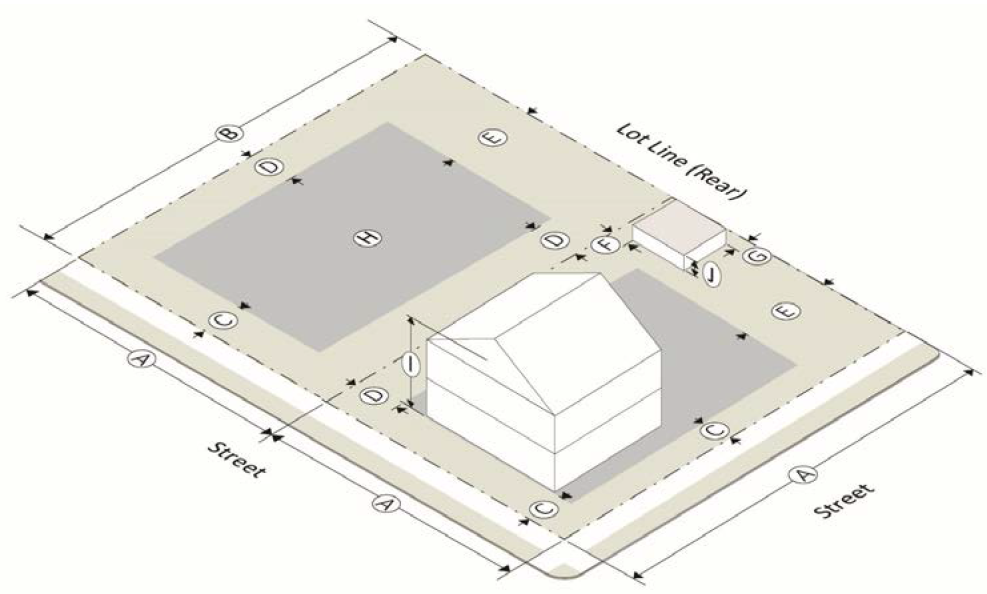
The following graphics depict the interpretation of lot development standards. The official definitions for these terms can be found in the article 12, definitions.
Sec. 3.03. - R-2 single family residential detached.
A.
Purpose. The R-2 zone is established to protect and promote a suitable environment for family life, to discourage any use which would generate other than normal residential area traffic on minor streets, and to protect the orderly future development of land in accordance with the land use plan for the city, at a density of not more than two units per acre.
B.
Lot development standards.
C.
Supplemental regulations.
1.
Traffic study required. A traffic study shall be required by the developer to determine the impact of the proposed development on the existing roadway system if the number of dwelling units exceeds 90 dwelling units. The report shall comply with the provisions of section 10.06.H., traffic study.
2.
Supplemental use regulations shall be as established in article 2, use regulations and restrictions as based on section 2.02, allowed uses.
Sec. 3.04. - R-3 single family residential detached.
A.
Purpose. The R-3 zone is established to protect and promote a suitable environment for family life, to discourage any use which would generate other than residential traffic on minor streets, to meet the needs and demands of single-family residences and to protect the orderly future development of land, all in accordance with the land use plan for the city. A minimum development site size of two acres is intended to assure compatibility with surrounding residential uses.
B.
Lot development standards.
C.
Supplemental regulations.
1.
Traffic study required. A traffic study shall be required by the developer to determine the impact of the proposed development on the existing roadway system if the number of dwelling units exceeds 90 dwelling units. The report shall comply with the provisions of section 10.06.H., traffic study.
2.
Supplemental use regulations shall be as established in article 2, use regulations and restrictions as based on section 2.02, allowed Uses.
Sec. 3.05. - R-4 single family residential detached.
A.
Purpose. The R-4 zone is established to protect and promote a suitable environment for family life, to discourage any use which would generate other than residential traffic on minor streets, to meet the needs and demands of attached and detached single-, two-, three-and four-family residences and to protect the orderly future development of land, all in accordance with the land use plan for the city. A minimum development site size of two acres and a minimum requirement that 50 percent of the units in the development be in single-family detached dwellings is intended to assure compatibility with surrounding residential uses.
B.
Lot development standards.
C.
Supplemental regulations.
1.
Traffic study required. A traffic study shall be required by the developer to determine the impact of the proposed development on the existing roadway system if the number of dwelling units exceeds 90 dwelling units. The report shall comply with the provisions of section 10.06.H., traffic study.
2.
Supplemental use regulations shall be as established in article 2, use regulations and restrictions as based on section 2.02, allowed uses.
Sec. 3.06. - R-5 single family cottage residential.
A.
Purpose. The R-5 zone is established to provide housing types that are responsive to changing household demographics including retirees and small families and to provide more opportunities for quality affordable housing in single family neighborhood settings.
B.
Lot development standards.
C.
Supplemental regulations.
1.
Traffic study required. A traffic study shall be required by the developer to determine the impact of the proposed development on the existing roadway system if the number of dwelling units exceeds 90 dwelling units. The report shall comply with the provisions of section 10.06.H., traffic study.
2.
Supplemental use regulations shall be as established in article 2, use regulations and restrictions as based on section 2.02, allowed uses.
3.
Alley access. If a detached or attached garage or attached or detached carport is located in the rear yard that abuts an alley, a minimum setback of two feet shall be required.
4.
Design standards. The community development director shall review and confirm the minimum design standards established below for all new dwellings in the R-5 district.
a.
Dwelling units shall have a minimum 6:12 roof pitch. Portions of a roof with a pitch less than 6:12 shall be limited to architectural features such as dormers, porch roofs and shed roofs.
b.
Each dwelling unit abutting a public right-of-way (not including alleys) shall have a primary entry and covered porch a minimum of 60 square feet in size, oriented towards the public right-of-way. If abutting more than one public right-of-way, the applicant, with community development director input, shall determine which right-of-way the entrance and covered porch shall be oriented towards.
c.
Covered porches shall be a minimum of six feet deep.
d.
As a guideline, dwelling units should not appear to exceed a ratio of one to one (ridge height to width) as viewed from off-site.
e.
Garage access: Dwelling units may have rear or front facing attached garages. For rear facing attached garages, not include attached garages unless the garage must abut an alley or shared parking lot and the alley must meet the standards of Table 11-5 Minimum Roadway Width.
1)
No less than 60% of homes in a development within the R-5 zoning classification must have rear facing attached garages. Homes with front facing attached garages may occupy no more than 40% of the development within the R-5 zoning classification.
f.
Attached or detached garages and carports associated with individual dwelling units shall not exceed 400 square feet in size.
g.
Architectural features such as roof eaves, cornices, chimneys, box or bay window may extend into the required setback a maximum of 18 inches.
h.
Exterior building materials shall be brick, stone or wood.
(Ord. No. O-2024-20, § 1, 7-15-24)
Sec. 3.07. - PRD planned residential development.
A.
Purpose. The PRD district is established to protect and promote a suitable environment for family life and to encourage flexibility in meeting the needs of families, by allowing for attached high-density apartment dwellings and townhouse dwellings in accordance with the city's land use plan. The minimum development site shall be at least two acres.
B.
Lot development standards.
C.
Supplemental regulations.
1.
Traffic study required. A traffic study shall be required by the developer to determine the impact of the proposed development on the existing roadway system if the number of dwelling units exceeds 90 dwelling units. The report shall comply with the provisions of section 10.06.H., traffic study.
2.
Supplemental use regulations shall be as established in article 2, use regulations and restrictions as based on section 2.02, allowed uses.
3.
Every application for zoning of land to PRD shall include a proposed written or graphic plan for its development, which shall include, at a minimum, the proposed maximum number of residential units and a proposed site plan. Every ordinance for zoning of property to PRD shall state stipulations of zoning to include, at a minimum, the approved maximum number of residential units and an incorporated site plan for the property. Such plans and stipulations shall comply with all requirements of this ordinance except to the extent any variance has been separately granted for the property.
(Ord. No. O-2020-3, § 1, 1-13-20; Ord. No. O-2026-32, § 1, 5-18-26)
Sec. 3.08. - MDR medium density residential.
A.
Purpose. The MDR zone is established to provide smaller detached single-family cottage style housing types that are responsive to changing household demographics, including seniors, retirees, and workforce housing. This will provide more opportunities for quality and affordable housing in single-family neighborhood settings.
B.
Lot development standards.
C.
Supplemental regulations.
1.
Traffic study required. A traffic study shall be required by the developer to determine the impact of the proposed development on the existing roadway system if the number of dwelling units exceeds 20 dwelling units. The report shall comply with the provisions of section 10.06.H, traffic study.
2.
Supplemental use regulations shall be as established in article 2, use regulations and restrictions as based on section 2.02, allowed uses.
3.
Design standards. The community development director or designee shall review and confirm the minimum design standards established below for all new dwellings in the MDR district.
a.
Dwelling units shall have a minimum 6:12 roof pitch. Portions of a roof with a pitch less than 6:12 shall be limited to architectural features such as dormers, porch roofs, and shed roofs.
b.
Each dwelling unit abutting a public right-of-way shall have a primary entry and a covered porch a minimum of 40 square feet in size, oriented towards the public right-of-way. If abutting more than one public right-of-way, the applicant, with the community development director's input, shall determine which right-of-way the entrance and covered porch shall be oriented towards.
c.
Covered porches shall be a minimum of six feet deep. Columns shall be decorative, i.e. round fluted, plain square, square recessed, and square fluted. Community development director or designee shall review designs for approval. Railings shall be optional.
d.
As a guideline, dwelling units should not appear to exceed a ratio of one to one (ridge height to width) as viewed from off-site.
e.
Attached or detached garages and carports associated with individual dwelling units shall not exceed 400 square feet in size.
f.
Architectural features such as roof eaves, cornices, chimneys, box or bay windows may extend into the required setback a maximum of 18 inches.
g.
Exterior building materials shall be brick, stone, wood, or fiber-cement siding. Secondary materials consist of a maximum of 25 percent of materials shall be comprised of natural wood and shake and shingles. No vinyl, aluminum or metallic siding may be used
h.
For crawl spaces the exterior skirting shall be brick on all four sides of the home only.
i.
Roofing—architectural asphalt shingles and standing seam metal. Metal roofs shall be a neutral color; i.e. charcoal gray, deep blue, forest green, beige, and terra cotta. Community development director or designee shall review designs for approval.
j.
Accessory structures shall be built using the same material requirements of the main structure.
k.
Five foot sidewalk required at the right-of-way from the property line.
(Ord. No. O-2026-38, § 2, 7-20-26)

