
Douglasville City Zoning Code
ARTICLE 5
- INDUSTRIAL DISTRICTS
Sec. 5.01.- General provisions.
The intent of the industrial districts is to protect established industrial areas as well as promote well designed and properly located future developments that create minimal impact on adjacent, incompatible uses.
Sec. 5.02. - Interpretation.
The following graphics depict the interpretation of lot development standards. The official definitions for these terms can be found in the article 13, definitions.
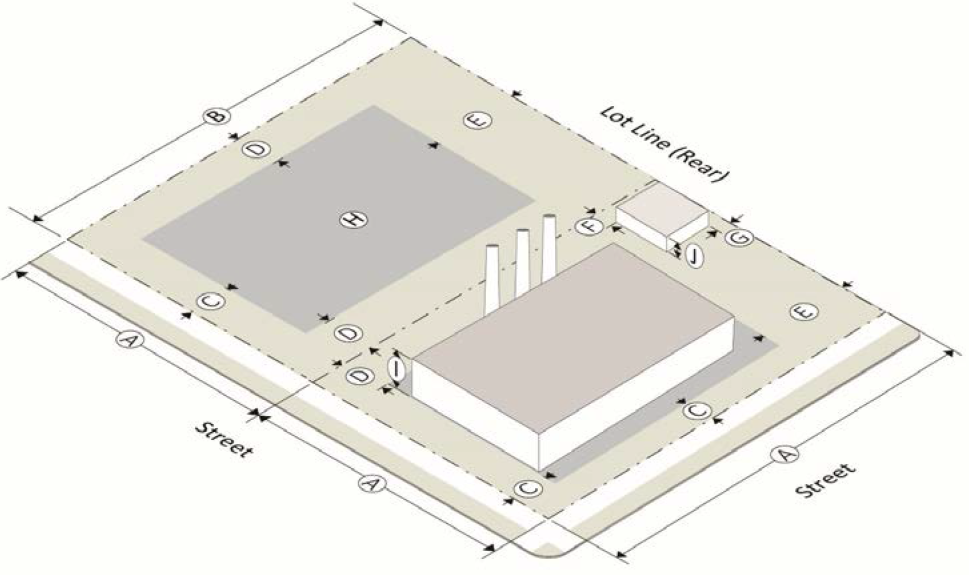
Sec. 5.03. - OD office distribution.
A.
Purpose. The OD office distribution district is established to encourage a suitable environment for uses that require both office and distribution facilities at the same site, as well as related and compatible commercial uses and appropriate accessory uses, in accordance with the land use plan for the city.
B.
Lot development standards.
C.
Supplemental regulations. Supplemental use regulations shall be as established in article 2, use regulations and restrictions as based on section 2.02, allowed uses.
1.
Traffic study required. A Traffic study may be required by the developer to determine the impact of the proposed development on the existing roadway system. The report shall comply with the provisions of section 10.06.H or specific criteria and guidelines.
(Ord. No. O-2025-39, § 3, 11-3-25; Ord. No. O-2025-20, § 8, 6-2-25)
Sec. 5.04. - LI light industrial district.
A.
Purpose. The LI light industrial district is established to protect and promote a suitable environment for light industrial purposes, including accessibility to major transportation facilities, availability of adequate utilities and other public services, and availability of large quantities of suitable land. Uses compatible with light industrial development are to be encouraged insofar as they are in accordance with the comprehensive plan for the city.
B.
Lot development standards.
C.
Supplemental regulations.
1.
Traffic study required. A traffic study shall be required by the developer to determine the impact of the proposed development on the existing roadway system if the floor area is 500,000 square feet or more. The report shall comply with the provisions of section 10.06.H., traffic study.
2.
Supplemental use regulations shall be as established in article 2, use regulations and restrictions as based on section 2.02, allowed uses.
(Ord. No. O-2025-39, § 4, 11-3-25)
Sec. 5.05. - HI heavy industrial district.
A.
Purpose. The HI heavy industrial district is established to protect and promote a suitable environment for heavy industrial purposes, including accessibility to major transportation facilities, availability of adequate utilities and other public services and availability of large quantities of open land. Uses compatible with light and heavy industrial development are to be encouraged insofar as they are in accordance with the comprehensive plan for the city and are compatible with surrounding properties or the impact on surrounding properties can be sufficiently mitigated.
B.
Lot development standards.
C.
Supplemental regulations.
1.
Traffic study required. A traffic study shall be required by the developer to determine the impact of the proposed development on the existing roadway system if the floor area is 500,000 square feet or more. The report shall comply with the provisions of section 10.06.H., traffic study.
2.
Supplemental use regulations shall be as established in article 2, use regulations and restrictions as based on section 2.02, allowed uses.
(Ord. No. O-2025-39, § 4, 11-3-25)

