
Douglasville City Zoning Code
ARTICLE 7
- SIGNS
Sec. 7.01.- Findings and purpose of sign regulations.
Regulation of the location, size, placement, and certain features of signs is necessary to allow for the free expression of ideas and information, to enable the public to locate goods, services, and facilities in the city without difficulty and confusion, to improve the general attractiveness of the city, to take advantage of the beauty of the city's natural environment, to ensure the orderly flow of traffic, and to protect property values therein. Such regulation is also necessary to facilitate and aid in the identification and location of businesses in the city in the event of police, fire, or other emergencies and to avoid confusion and delay in response to such emergencies. Accordingly, it is the intention of the city to establish regulations governing the display of signs that will:
A.
Promote and protect the public health, safety, morals and general welfare.
B.
Provide for the expression of commercial and noncommercial speech by citizens and businesses in the city.
C.
Enhance the economy of the city and the success of business and industry by promoting the reasonable, orderly, and effective display of signs.
D.
Restrict signs and lights that increase clutter, or which increase the probability of traffic accidents by obstructing or confusing the vision of drivers, bicyclists, or pedestrians.
E.
Ensure that signs are designed, constructed, installed and maintained according to minimum standards to safeguard life, health, property, and public welfare.
F.
Ensure that signs reflect and support the desired ambience and development patterns of the various zoning districts and promote an attractive built environment.
Sec. 7.02. - Scope of regulations; compliance required.
A.
This Article provides for the types of signs that may be placed on a property, and regulates the physical characteristics of signs, such as their size, number, placement, and timing (for temporary signs). The regulations and requirements of this article apply to all signs that are or are intended to be viewed from a public right-of-way or adjacent property, or that are intended to be viewed from outdoor areas of public property, except as otherwise exempt under this article.
B.
Signs placed on any property, building or other structure within the City shall conform with this article.
C.
The regulations of this article shall be in addition to any required provisions of state law, applicable building codes and other ordinances of the city. In the event of conflict between the provisions of this article and other laws or ordinances, the most restrictive provision shall prevail and be controlling.
D.
Notwithstanding any other restrictions in this article, any sign authorized under this article can contain any commercial or non-commercial message, other than messages containing obscenity as defined by Georgia law, or other than a sign that advertises an activity that is illegal under Georgia or federal laws.
Sec. 7.03. - Sign permits.
A.
Except as exempted from obtaining a permit as provided in section 7.04, exemptions from permitting, no sign shall be erected, reconstructed, expanded or replaced without first securing a permit from the community development director. Every such application shall be granted, denied or rejected for incompleteness in writing within ten business days of submission of the application. All applications meeting the requirements of this article shall be granted. If an application fails to meet the standards of this article, the denial shall identify the standards that are not met by the application. Any application rejected for incompleteness shall identify the reasons further action cannot be taken. If the community development director fails to act on a completed application within ten business days of submission, it shall be deemed approved, subject to the requirements and provisions of this article.
B.
Nonconforming signs require registration with the community development director.
C.
A permit and fee is required for the following signs:
1.
All permanent freestanding signs.
2.
All permanent building signs.
3.
Temporary signs as provided by section 7.10, temporary signs.
4.
Directional signs.
D.
Each application for a sign permit for a permanent sign shall be in writing and in the form prescribed by the community development director and shall contain the following information:
1.
Name, address and telephone number of the sign erector and sign owner, with written consent of the property owner.
2.
Location of the building, structure, or lot upon which the sign is to be attached or erected.
3.
A site plan showing setback from all adjacent streets, structures and property lines, as well as all existing signs upon the lot and the distance of a proposed freestanding sign to the nearest freestanding sign.
4.
Prints or drawings of the plans and specifications and structural details of construction and attachment to a building or in the ground (a single submission may be permitted for any standardized signs).
5.
The estimated cost of construction of the sign.
6.
An application for a planned center or for any commercial or industrial use having more than 100,000 square feet of gross floor area, must be accompanied by a uniform sign plan consistent with the standards of section 7.13, uniform sign plan.
7.
A performance bond or cash deposit, if for a temporary permit.
8.
An application fee as set from time to time by the mayor and city council.
9.
Any other information as may be reasonably required by the zoning official to determine compliance with all provisions of this article.
E.
Each application for a permit for a temporary sign shall be in writing and in the form prescribed by the community development director and shall contain the following information:
1.
A description of each temporary sign to be placed on the property, including its proposed location.
2.
Written designation of the time period during which the sign will be placed on the property, consistent with the durations allowed under section 7.10, temporary signs.
3.
For portable signs, banners and festoons, written and graphic evidence of compliance with all requirements of section 7.10, temporary signs. An application for portable signs shall be accompanied by a bond in the amount of $500.00 or cash deposit in the same amount to assure prompt and complete removal of such signs within 24 hours of the expiration of the permit.
4.
A scaled drawing with dimensions and specification, specifying materials, illumination, character sizes, colors, and support systems for each proposed sign.
5.
Written consent of the property owner.
6.
Any other information as may be reasonably required by the community development director to determine compliance with all provisions of this article.
F.
No permit and no fee are required for routine maintenance of a sign, repainting, repairs or cleaning, including replacement of the sign face, provided no structural change is made to the sign and the sign is not increased in size or height nor location changed. This exemption from permit and fee applies only to the owner of the sign. Change of sign owner necessitates a new permit for change of sign face.
G.
No permit or fee is required for the erection of yard signs meeting the standards of this article.
H.
No permit or fee is required for the erection of temporary window signs.
I.
An applicant may appeal the denial of a sign permit as an appeal of an administrative decision to the city council. Such appeals must be filed with the community development director within five business days of the denial of the sign permit. In hearing an appeal, the city council is bound by the standards of this article in rendering its determination. All appeals shall be heard within 30 days of filing and decision shall be reached no later than 30 days from date of hearing.
J.
Numbered decals shall be issued with permit numbers on the decal corresponding to the numbers on the approved permit application. The issued numbered decal must be affixed to the lower right-hand corner of the area of the sign. The numbered decals are not transferable from one sign to another and must be placed on the sign described and permitted in the corresponding numbered permit application at all times.
1.
Failure to have decal on a sign shall be prima facie evidence that the sign is not lawfully permitted.
2.
It shall be unlawful for any person to attach a sign decal to any sign for which it was not issued, or to remove a decal from any sign.
K.
A sign permit shall expire if the sign for which the permit was issued has not been substantially completed (to the extent of at least 60 percent completion based on the estimated cost of construction from the permit application) within six months of issuance. One six-month extension may be approved by the community development director for circumstances deemed extenuating and reasonable.
(Ord. No. O-2022-8, §§ 10—15, 3-7-22)
Sec. 7.04. - Exemptions from permitting.
The following are exempt from obtaining a permit under this article:
A.
Window displays of goods available on a site and temporary window signs.
B.
Brand names or logos on products, product containers, or product dispensers (such as but not limited to a soft drink machine or gasoline pump) that are an integral part of the product or the product's packaging.
C.
Property address numerals not exceeding four inches in height in residential districts and eight inches in height in non-residential districts.
D.
Holiday decorations and displays erected during the winter holiday period from November 1 through January 5.
E.
Incidental signs.
F.
Yard signs on residential properties meeting the standards of this article.
G.
Yard signs on non-residential properties meeting the standards of this article.
H.
Temporary window signs meeting the standards of this article.
I.
Public and private recreational signs meeting the standards of this article.
Sec. 7.05. - Prohibited signs.
A.
The following types of signs are prohibited in all locations:
1.
Animated signs.
2.
Signs that are painted on or attached to trees, fence posts, utility poles, or rocks or other natural features.
3.
Signs that are dilapidated or in such condition as to create a hazard, nuisance or to be unsafe.
4.
Signs containing obscene messages, as obscenity is defined by federal and Georgia law.
5.
Signs obstructing any fire escape, window, door, opening usable for fire prevention or suppression, or that prevents free passage from one part of a roof to any other part thereof or interferes with any opening required for ventilation.
6.
Signs placed on vehicles not regularly used in the normal course of business and parked in such manner as to attract attention to a business location.
7.
Any sign placed in public right-of-way; provided this prohibition does not apply to signs placed by the governmental entity controlling such right-of-way, or to private contractors providing emergency repair services in such right-of-way so long as the signs conform to the Uniform Manual of Traffic Control Devices, or to marking of public utility poles located in the right-of-way by franchised utilities.
8.
Signs posted on private property without the permission of the property owner.
9.
Roof signs.
10.
Signs imitating public warnings or traffic control devices.
11.
Signs emitting smoke or sound capable of being detected on any traveled road by a person of normal hearing.
12.
Signs erected within the railroad right-of-way except for official railroad signs.
B.
In addition to those signs identified in subsection 7.05.A., prohibited signs, the following signs are also prohibited within the historic district:
1.
Billboards.
2.
Monument entrance signs.
3.
Portable signs, except for A-frame signs that are permitted.
4.
Signs erected on or located on any street or public right-of-way, curbs, curbstone, hydrant, lamp post, tree, barricade, or temporary walk.
5.
Signs painted directly on the exterior wall of any building or structure.
6.
Signs with revolving or rotating beams of light.
7.
Signs placed upon a structure in any manner so as to disfigure or conceal any window opening, door or significant architectural feature or detail of the building.
8.
Signs with any visible element of plastic or similar manufactured materials, excluding temporary signs, background faces of sign changeable portions of wall copy signs, and yard signs.
9.
Signs with visible elements made of interior grade wood.
Sec. 7.06. - General requirements applying to all signs.
A.
Conformance to building codes.
1.
In addition to any sign permit required under this article, a building permit shall be obtained from the director prior to installation or placement of any freestanding sign having a sign face area greater than 15 square feet or any building sign having a sign face area greater than six square feet. All signs for which a building permit is required shall be constructed and maintained in conformity with all building code and electrical code requirements.
2.
Plans required for issuance of a building permit for a sign shall be certified as to conformance with all structural and wind-load resistive standards of the building code by a qualified structural engineer or be prepared using standard drawings prepared by a structural engineer or other qualified professional meeting or exceeding all requirements of the building code.
3.
All signs involving internal lights or other electrical devices, or circuits shall display a label certifying it as being approved by the Underwriter's Laboratories, Inc.
4.
All electrical service to a sign shall comply with the electrical code.
5.
Clearance from all electrical power lines shall be in conformance with the requirements of the electrical code.
B.
Conformance to state law. The following applies to any sign located or to be located within 660 feet of the nearest edge of the right-of-way of an Interstate, U.S. or State-numbered highway (or any other road designated as a "primary highway" by the State of Georgia and approved by the U.S. Department of Transportation), or located or to be located beyond 660 feet of such highway but visible and intended to be read from such highway:
1.
Such sign shall comply with all requirements of the Georgia Outdoor Advertising Act, O.C.G.A. 32-6-70 et seq.
2.
Such sign shall comply with all requirements of this article. Between the Georgia and Douglasville regulations, such sign must comply with the most restrictive requirements with respect to each and every item of regulation.
C.
Sign maintenance.
1.
All signs, together with all their supports, braces, guy wires, and anchors shall be kept in good repair and, unless constructed of galvanized or noncorroding metal, shall be given a protective coating as necessary to maintain a clean appearance and safe condition.
2.
All signs shall be maintained in accordance with all city regulations, including any regulations concerning nuisances and vegetation.
D.
Minimum sign setback.
1.
Sign installations on state and federal highways must meet set back and clear zone distance criteria based on the latest edition of the Roadside Design Guide, by the American Association of State Highway and Transportation Officials.
2.
No portion of a sign shall be located less than 12 feet from any back of curb or from street paving on streets with no curb.
3.
No sign or sign structure of any kind shall be located less than ten feet from a side or rear property line or within a required landscape strip.
E.
Ground clearance under signs. Signs extending over sidewalks or walkways shall maintain a minimum clearance of eight feet above such sidewalk or walkway.
F.
Visibility clearance area. Any portion of a sign located within 20 feet of the intersection of the right-of-way lines of streets, or within 20 feet of the intersection of the edge of a driveway and the right-of-way line of a street, shall be no more than 30 inches in height, nor shall such sign otherwise obstruct visibility or pose a threat to traffic safety.
Sec. 7.07. - Measurement of sign area and height.
A.
Computation of sign area. To determine compliance with the maximum allowable sign areas permitted under this article, the following shall establish how sign areas are measured.
1.
Sign face area.
a.
The area of a sign face shall be computed as the area within the smallest rectangle enclosing the limits of a sign face, or the combination of the areas of all such rectangles delimiting each sign module, together with any frame or material, texture, or color forming an integral part of the sign face or used to differentiate the sign face from the structure upon which it is placed.
b.
For signs that have no identifiable frame or border, the smallest rectangle that includes all the sign's words, letters, figures, symbols, logos, fixtures, colors, or other design elements intended to convey the sign's message shall establish the area of the sign's face.
c.
For signs applied to a kiosk or other cylindrical sign structure, the area of the sign face shall be computed as the largest rectangular area achieved from any one view of the sign. Measurements shall be made as a flat plane rectangle projected on the sign.
d.
The computation of the area of a sign face shall not include the structure, supports, or uprights on which the sign face is placed or any portions of a sign structure that are not intended to contain any message or idea and are purely structural or decorative in nature, other than those portions contained within the rectangle that delimits the sign face or a sign module.
e.
Changeable copy signs. For any sign on which any of the words, letters, figures, symbols, logos, fixtures, colors, or other design elements are routinely changed or are intended to be changed from time to time, the sign face area shall include the entire area within which any words, letters, figures, symbols, logos, fixtures, colors, or other design elements may be placed, together with any frame or material, texture, or color forming an integral part of the sign face or used to differentiate the sign face from the structure upon which it is placed. Both changeable and fixed elements of signs with changeable copy signs are counted toward a single sign face area.
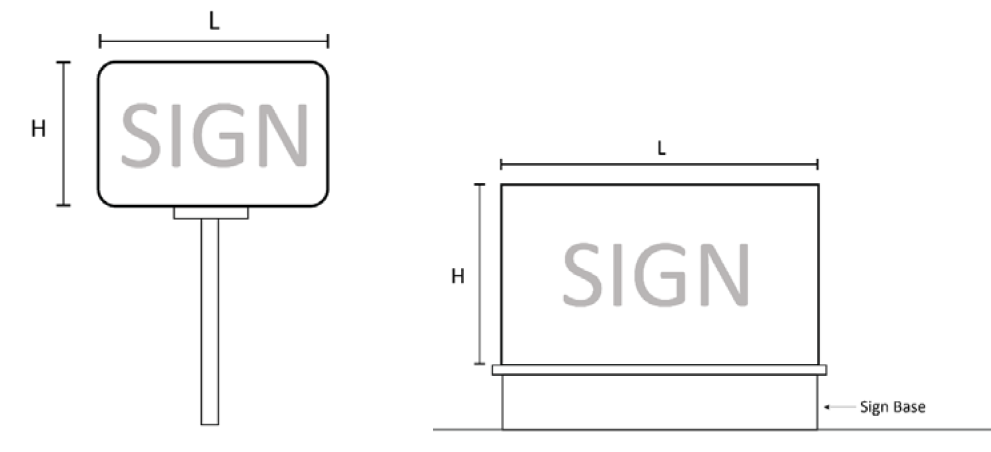
Figure 7-1 Sign Area Measurement Freestanding Sign
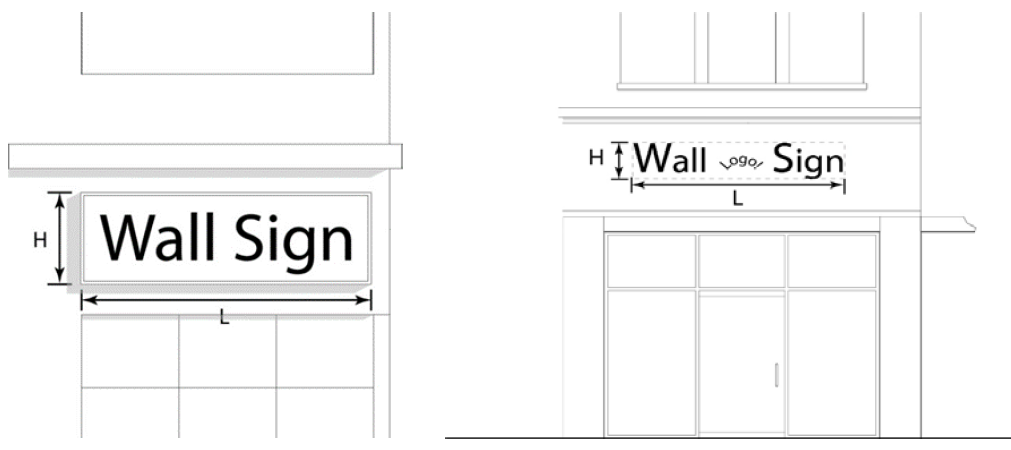
Figure 7-2 Sign Area Measurement Wall Sign
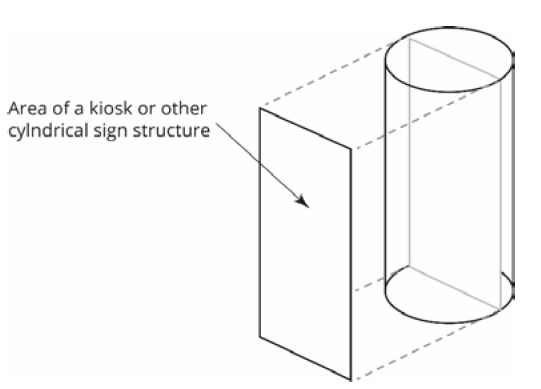
Figure 7-3 Sign Area Measurement Wall Sign Cylindrical or Kiosk Sign
2.
Treatment of open spaces. Any open space contained within the limits of the rectangle delimiting the sign face, sign module, or sign structure shall be included in the computation of the area of such sign face, sign module, or sign structure.
B.
Multi-faced signs.
1.
Double-faced signs. For double-faced signs, when the sign face surfaces are parallel (back-to-back), or where the smallest angle formed between the two faces is 60 degrees or less, the area of the sign shall be taken as the area of the largest side. For double-faced signs where the interior angle formed by the faces is more than 60 degrees, the area of the sign shall be the total area of all sides.
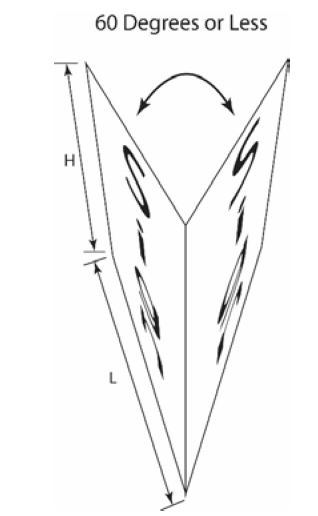
Figure 7-4 Sign Area Measurement Double-Faced Sign
2.
Signs with three or more faces. For sign structures having only three faces and the interior angle formed between all of the faces is 60 degrees, the area of the sign shall be taken as the area of the largest side. For all other multi-faced signs with three or more sides, the area of the sign shall be the largest total of all faces that are joined by an interior angle of more than 60 degrees that can be viewed from any one direction.
C.
Measurement of sign height and distance.
1.
Sign height. The height of a sign shall be equal to the vertical distance from the average grade at the base of the sign, or from the crown of the roadway of the nearest street within 100 feet of any portion of the sign, to the highest point of any portion of the sign, whichever results in the greater sign height. Any earthen berms and elevated foundations supporting signs, signposts or other sign supports shall be included in the height of the sign.
2.
Measurement of distance. Minimum distances required hereunder shall be measured along the shortest straight line from the nearest point on a sign structure to the nearest point on a property line, sign structure, building or structure to which the minimum distance requirement applies.
Sec. 7.08. - Regulation of specific types of permanent signs.
A.
Freestanding signs.
1.
Distance between. Each freestanding sign having an area of 75 square feet or less shall be located at least 50 feet from any other freestanding sign on the same side of the street. Each freestanding sign having an area of between 75 and 300 square feet shall be located at least 100 feet from any other freestanding sign on the same side of the street. The director may reduce the distance if it cannot be met due to the location of existing signs on separate but adjoining lots. Such reduction shall be the minimum required to maintain the greatest separation possible from such existing signs.
2.
Interior signs. Interior signs are allowed as accessory uses on a property occupied by a planned center or by any multi-family, commercial or institutional, or industrial use exceeding five acres if each sign complies with all of the following:
a.
One interior sign not to exceed 64 square feet in area nor more than eight feet in height may be located on the property for each principal building on the lot of a planned center, located at least 100 feet from any street right-of-way line.
b.
Other miscellaneous interior signs are allowed beyond the minimum front yard setback on a property developed for multi-family, commercial or institutional, or industrial use, provided that such signs shall have no more than three square feet in sign face area nor more than three feet in height (except signs that are required by law to be higher than three feet high, such as those marking a handicapped parking space).
3.
Entities with drive-through lanes. In addition to any other freestanding sign authorized by this section, if property contains a commercial or industrial building or structure where materials are delivered at a drive through delivery point located other than on the front side of the building, then one additional freestanding sign per drive through lane shall be allowed to be located on the property in the side or rear yard; no such sign shall exceed 32 square feet in area nor eight feet in height.
4.
Vacant properties. Vacant parcels of land zoned to non-residential classifications may contain one freestanding sign limited to 32 square feet in sign area with a sign permit.
5.
Monument entrance signs.
a.
Location. Monument entrance signs are signs located at an entrance into a residential subdivision, into a multi-family development, or into an office, commercial or industrial park consisting of two or more lots. Each monument entrance sign shall not exceed the number, area or height limitations shown on Table 7-1, Permitted Freestanding Signs—By Land Use Category.
b.
Placement of signs in the right-of-way. When the owner or developer of a residential development or of an office or industrial park desires a divided roadway entrance to the development with a landscaped island in the right-of-way, the director may approve a monument entrance sign within the island provided that the sign will not be internally illuminated, that it be in scale with the landscaping and overall design of the entrance, and that the placement of the sign will not be a hazard to traffic.
c.
Maintenance. Douglasville shall not be responsible to maintain any such monument entrance sign, where allowed, within or out of the street right-of-way. If a monument entrance sign within an island in the street right-of-way is allowed to become dilapidated, the city may require removal of such sign.
6.
Billboards. In lieu of a freestanding sign authorized by Table 7-1, Permitted Freestanding Signs—By Land Use Category, any property located within 500 feet of Interstate Highway 20 may contain one billboard which complies with the following:
a.
Location. All portions of the face and support members of any billboard shall be located within 500 feet of Interstate Highway 20.
b.
Setback. All portions of the face and support members of any billboard shall be set back from all buildings, structures, and property lines at least 75 feet.
c.
Sign area. The sign area of any billboard shall not exceed 14 feet in height and 48 feet in length, with or without trim, for a total size of 672 square feet.
d.
Illumination. Externally illuminated billboards shall use base-mounted fluorescent or mercury vapor lights and shall be activated by photoelectric cells. Digital lighting of billboards, including LED and other electronic forms of lighting, is permitted only as set out in this paragraph. For billboards erected as of right within 500 feet of Interstate Highway 20 or erected pursuant to a limited exchange allowed by section 7.14, digital lighting is permitted so long as:
1)
All requirements of O.C.G.A., Section 32-6-75 are met. Where the standards of state law and this UDO vary, the most stringent standards shall be met.
2)
Each message remains unchanged for its full display duration. No fading, scrolling or other simulated movement of the sign copy is permitted.
3)
No digital lighting shall be utilized within 150 feet of any single family residence or any property zoned for single family use.
4)
Digital billboards are limited as of right to commercially or industrially zoned propertied within 500 feet of the right-of-way of Interstate Highway 20.
5)
No digital billboard shall be erected within 5,000 feet of another digital billboard on the same side of the roadway.
6)
The display or message of a digital billboard may not change more frequently than once every ten seconds, with a transition period of one second or less.
7)
All digital billboards shall have installed an ambient light monitor which shall continuously monitor and automatically adjust the brightness level of the display based on ambient light conditions consistent with the terms of this article. Maximum brightness levels for digital billboards shall not exceed three-tenths foot-candles over ambient light levels measured within 150 feet of the sign. Certification shall be provided to the city demonstrating that the sign has been preset to automatically adjust the brightness to these levels or lower and that the sign operates within such standards.
8)
All billboards shall be designed in such a manner that any malfunction shall result in the sign going completely dark.
e.
Height above interstate grade. All billboards on property adjacent to the Interstate Highway 20 shall be a minimum of ten feet above the adjacent interstate pavement measuring from the lowest portion of the sign face.
f.
Extrusions prohibited. Extrusions beyond the face of any billboard, excluding aprons are prohibited.
g.
Location and number of signs. Only one billboard shall be allowed per lot. No billboard shall be placed on any lot that contains any other freestanding sign. Billboards shall be no less than 1,000 feet apart measured from the two closest points, and only one sign face shall be allowed to face the same direction per location. This allows back-to-back of "V" formation signs but prohibits two signs (side by side or over and under) facing the same direction.
h.
Spacing on interstate. Billboard locations on property adjacent to Interstate Highway 20 shall be no less than 1,000 feet apart, measuring from the two closest points of each sign. Electronic billboards shall be no less than 5,000 feet apart, measuring from the two closest points of each sign.
i.
Spacing at interchanges. Only four billboards shall be allowed per interchange adjacent to the interstate highway. All billboards at interstate highway interchanges are restricted to an area 1,200 feet long beginning 500 feet from the point where the pavement widens on the main traveled way to accommodate the longest exit/entrance ramp.
j.
Height. Billboards shall not exceed 100 feet in height. Two billboards in the same location, back-to-back or in a "V" formation shall be the same height above the interstate surface.
7.
Interstate signs. One interstate sign is permitted on lots located within 500 feet of an interchange for Interstate Highway 20, so long as no other free-standing sign is located on the lot. The 500-foot measurement commences and ends at the beginning and ending point of entrance ramps onto and from the interstate and extends 500 feet perpendicular to such ramps.
B.
Projecting signs.
1.
Projecting signs shall not project more than 42 inches beyond the face of the building.
2.
Projections shall be at a ninety-degree angle to the building face.
3.
All sides of a projecting sign shall be finished.
C.
Directional signs. Directional signs may be located within three feet of driveways that provide access into or from the property. There shall be no more than two such signs per driveway and each such sign shall not exceed two square feet in sign area nor be more than 30 inches in height. Such signs shall be no less than six feet from the back of curb (or edge of pavement, whichever is greater).
D.
Standards for signs not requiring building permits.
1.
Nonpermanent but water-resistant construction materials may be used, such as but not limited to poster board, foam core board or illustration board.
2.
Except for portable signs allowed under section 7.10, temporary signs, the words, letters, figures, symbols, logos, fixtures, colors, or other design elements that convey the sign's message shall be permanently applied to the sign's face. Automatic changeable copy signs shall not be allowed. No illumination of such signs is allowed.
E.
Changeable copy signs.
1.
Manual changeable copy signs are permitted in all commercial districts and for institutional entities in all districts. Electronic changeable copy signs are permitted only in highway commercial districts.
2.
In the historic district where the changeable copy portion of a sign face is limited to six square feet.
3.
Electronically controlled changeable copy signs shall comply with the following:
a.
The sign shall comply with industry intensity standards for brightness.
b.
The sign shall display static advertising messages and will not have animation or motion within the messages that might be distracting to drivers.
c.
The sign shall contain a default mechanism that will cause the sign to revert immediately to a black screen if the sign malfunctions.
d.
Transition from one message to another shall be instantaneous.
e.
The sign message shall remain fixed for a "hold time" of at least ten seconds or the most current regulations promulgated by the Georgia Department of Transportation, whichever is more restrictive.
f.
Each sign message shall be complete within itself and shall not continue onto subsequent sign messages.
g.
The sign company shall participate in the national amber alert program and FBI and emergency alert broadcasting program to bring emergency messages to the public as needed.
h.
The City of Douglasville Police department shall have the ability to submit emergency messages to the sign company for immediate broadcast should the chief of police determine an emergency situation warrants warning the public.
F.
Illuminated signs.
1.
Types of illumination.
a.
Externally-illuminated sign. An externally-illuminated sign, when permitted, shall have concealed wiring and controls, and shall have shielded and screened external light sources.
b.
Internally-illuminated sign. Internally-illuminated signs, where permitted, must completely shield the source of light from direct view. Internally channeled or reverse-channeled letters are permitted only in instances of wall signs affixed to buildings with a front setback of more than 100 feet.
c.
Each parcel housing a monument sign may utilize automatic changeable copy compromising not more than 50 percent of the sign face, subject to the following standards:
1)
Each message remains unchanged for its full display duration. No fading, scrolling, or other simulated movement of sign copy is permitted.
2)
No automatic changeable copy shall be utilized within 150 feet of any single family residence or any property zoned for single family use.
3)
The automatic changeable copy may not change more frequently than once evert ten seconds, with a transition period of one second or less.
4)
All automatic changeable copy shall have installed an ambient light monitor which shall continuously monitor and automatically adjust the brightness level of the display based on ambient light conditions consistent with the terms of this article. Maximum brightness levels for such copy shall not exceed three-tenths foot-candles over ambient light levels measured within 150 feet of the right. Certification shall be provided to the city demonstrating that the sign has been preset to automatically adjust the brightness to these levels or lower and that the sign operates within such standards.
5)
All automatic changeable copy shall be designed in such a manner that any malfunction shall result in the changeable copy portions of the sign going completely dark.
2.
Traffic control. No sign illumination device shall resemble an official traffic control or warning sign, nor shall it hide from view or distract from any traffic or street sign or signal.
3.
Hazards. Illumination devices shall be placed, filtered, and shielded so direct rays will not be cast into the eyes of drivers or pedestrians.
4.
Light pollution. Sign illumination shall not cast light directly upon adjacent properties or roadways. No illuminated signs are allowed within 100 feet of any residential zoning district or property occupied by a single- or two-family dwelling.
5.
Exposed wires. No sign may have exposed electrical wires.
6.
Strings of bulbs. Strings of bulbs are not permitted, except during the winter holiday period of November 1 through January 5.
7.
Hours of illumination. No sign shall be illuminated between 11:00 p.m. and 6:00 a.m. except for those hours during which the premises on which the sign is located is open for business or employees are on the premises.
G.
Under-canopy signs. Under-canopy signs of greater than four square feet shall be rigidly mounted.
H.
Yard signs.
1.
All residentially zoned properties in the city are permitted the use of yard signs conforming to the standards of this article without permit. Each yard sign shall measure no more than four and one-half square feet in sign area and be erected to a height of no more than three feet. No yard sign shall be illuminated, contain fluorescent or Day-Glo colors or ink, or contain extrusions beyond a rectangular face. One yard sign may be permitted at any time, provided that an unlimited number of yard signs are allowed during a political election, between the date of close of filing for qualification of candidates and final determination on each ballot issue or candidate.
2.
For all nonresidential zoned properties, one yard sign measuring no more than 16 square feet in sign area and at a height of no more than eight feet is allowed, without permit, located so that the stake is not closer than 12 feet to the back of curb or from the edge of the pavement on streets with no curbing, and no part of the placard is closer than 12 feet to the back of the curb or from the edge of the pavement on streets with no curbing. Exceptionally, an unlimited number of yard signs with sign area faces of 16 square feet or less and eight feet in height or shorter are allowed during a political election between the date of close of filing for qualification of candidates and final determination on each ballot issue or candidate, and permits shall not be required for these signs.
3.
No yard sign shall be illuminated.
I.
Window signs. Window signs are permitted without restriction, so long as:
1.
The aggregate sign area of all building signs, including window signs, does not exceed the limitations set out in Table 7-2, Permitted Building Signage—By Land Use Category.
2.
Window signage cannot cover more than 50 percent of the window and shall count towards the total square footage for allowable wall coverage area.
Sec. 7.09. - Permanent signs allowed, by land use category.
A.
Tables 7-1 and Table 7-2 on the following pages present the maximum number, size, height, and other restrictions relating to permanent signs that are allowed by right in each land use category. Additional signage is allowed under other sections of this article.
1.
For single-occupancy buildings, the maximum allowed area for all building signs shall be calculated based on the percentage of the entire area of said wall, including all windows and doors.
2.
For multi-tenant planned center buildings, the maximum allowed area for all building signs for each tenant shall be calculated based on the percentage of the area of the wall, including all windows and doors, of that portion of the structure occupied by the tenant.
3.
Additional wall signage is allowed for each tenant (up to a maximum of three signs per street-facing wall) when the tenant meets one or more of the following conditions: a) the tenant occupies more than 50,000 square feet of floor area (add one sign); b) the tenant occupies more than 100,000 square feet of floor area (add one additional sign).
4.
Projecting and under-canopy signs shall be limited to no more than one per tenant on a property, and each tenant shall have no more than one projecting sign or under-canopy sign, for each street that the tenant faces.
Table 7-1 Permitted Freestanding Signs—By Land Use Category
1 Multi-family districts are treated as commercial properties.
2 Residential properties are permitted one freestanding sign or, alternatively, one building sign, not both.
3 One monument entrance sign is permitted for residential subdivisions at their entrance from a public street.
Table 7-2 Permitted Building Signage—By Land Use Category
4 Residential districts are permitted one freestanding sign or one wall sign, not both.
a.
Guidelines for projecting signs in historic district.
1)
Introduction. This sign type is mounted perpendicular to a commercial building's façade, typically in the area above the storefront. These signs contribute to the streetscape by providing pedestrian-scaled advertising and wayfinding for commercial activities along the street. Projecting signs should be designed to be proportional to the scale and mass of the building, to be compatible to the character and materials of the building, and to be easily read from both sides. The location, size, and appearance of projecting signs should contribute to street activity and enhance the street-level experience. Projecting signs should have display surfaces that are made of wood, metal, or composite materials. Letters, logos, symbols, or designs should be engraved, painted, or surface mounted. Because of their pedestrian scale, it is not recommended to have internally illuminated projecting signs, although they may be externally illuminated with gooseneck or other suitable fixtures that are directed at sign. Projecting signs should not obscure or destroy the architectural details of historic buildings.
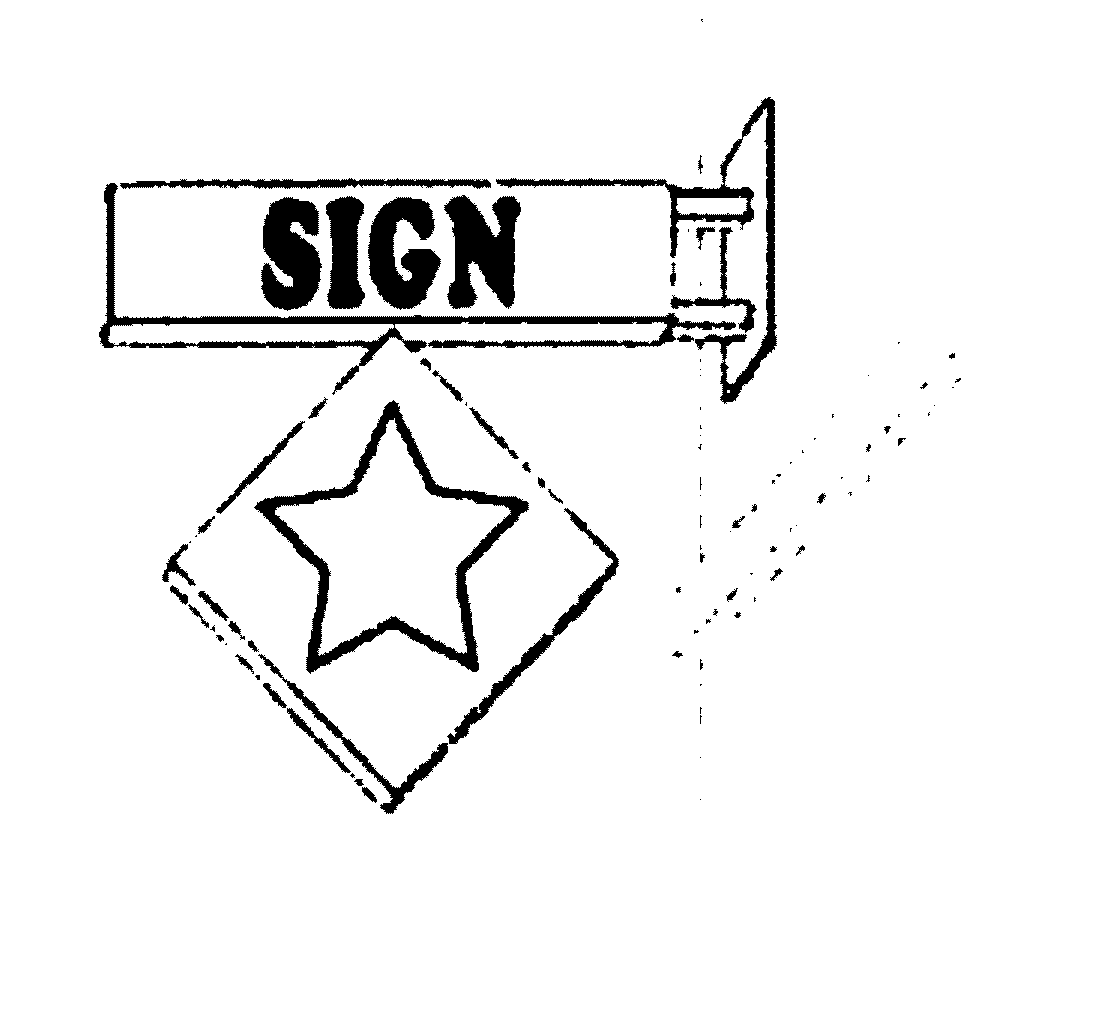
Figure 1
"Projecting sign" means a sign attached to a building or structure in such a manner that either:
a)
The sign is not parallel to that part of the building or structure to which it is attached. A sign is not considered to be projecting if it is placed vertically to a fascia or mansard that has an angle of not more than 30 degrees from the vertical, and if it is attached in a horizontal plane at either the top or bottom of the sign; or
b)
The sign extends horizontally, vertically or diagonally beyond that part of the building or structure to which it is attached. A sign placed parallel to a vertical fascia, wall or parapet and extending less than half of its height above the fascia, wall or parapet is not considered a projecting sign.
2)
Sign permit required. No person may place or maintain a sign or modify an existing sign (including changes to copy or colors) without a sign permit. This title and the sign permit requirements apply only to a sign or sign structure that is either located on or outside of a building, or intended to be seen from another public or private property.
General standards for approval. A sign permit may be granted by the reviewing body only when the proposed sign meets all of the following general standards:
i.
The materials, colors, design, height, size and scale of the sign are visually compatible with the structure, site, and use to which the sign corresponds, and the UDO's historic preservation standards in which the sign is located;
ii.
The placement and size of the sign will not threaten or impair the safety of pedestrians, bicyclists, or motorists;
iii.
The sign is of professional quality and is clear and legible;
iv.
The height and size of the letters and graphics on the sign enable pedestrians and motorists to readily identify the message, facility or site from a sufficient distance that will enable them to safely and conveniently read the message or access the facility or the site;
v.
The sign does not unreasonably impair the visibility of existing signs on adjacent property;
vi.
The sign complies with the purpose and standards of city's unified development ordinance historic district sign regulations.
3)
Sign permit procedures.
Application. The property owner, business owner, or designated applicant may file an application for a sign permit. The sign permit application shall be in a form and manner prescribed by the community development director. At the time of filing, a sign permit application shall be accompanied by the designated fee set forth by city council resolution, and by the following data and reports unless waived by the community development director:
i.
Site plan. A fully dimensioned site plan showing the specific location and size of the proposed sign(s);
ii.
Elevation(s). Fully dimensioned elevations showing the specific placement, size, and dimensions of the proposed sign(s) and the horizontal length (in feet) of the building frontage on which the proposed sign(s) would be placed;
iii.
Renderings or images of each sign requested; and
iv.
Colors and materials of the proposed sign(s) and all structural elements.
v.
Additional information may be required as determined by the community development director in order to provide a clear graphic description of the sign proposed, and in order to ensure that the sign can be adequately evaluated pursuant to this title.
Building permit. No building permit to install a sign that is subject to a sign permit under this title shall be issued prior to the approval of the sign permit.
Conditions. The reviewing body may impose conditions to ensure compliance with this title when granting approval of a sign permit application.
Decision. The reviewing body (community development department) may approve, approve with conditions or deny the application.
Other regulations. In case of a conflict between sign regulations, the stricter regulation applies. In addition to this title, signs in the city are governed by the general plan and by all applicable Federal, State, and city regulations.
Appeal. The decision of the reviewing body may be appealed to the next highest authority. A written request for appeal must be filed with the community development department within ten days after the date of the decision.
4)
Approval criteria for projecting signs. The community development director or designee may approve an application for a sign permit to place a projecting sign; provided, that the proposed projecting sign:
a)
Will be attached to a building frontage, or hung from the eaves or soffit along a building frontage occupied by the business or use identified by the sign;
b)
Will be placed only on the first story of a building when no sign program is established, or, when a sign program allows, may be placed above the ground floor to identify an occupant in a tenant space located above the ground floor;
c)
Will be attached to or hung from an eave or soffit only when the sign is a minimum of 15 linear feet away from an interior lot line;
d)
Will be placed below the roof line or parapet of the building;
e)
Will be placed so that the lowest portion of the sign is a minimum of eight feet above any pedestrian walkway and will not be placed above a vehicular passageway;
f)
Will be not more than four inches nor less than one inch thick, except as reasonably required in connection with some graphic element of the sign; and
g)
The minimum size of a projecting sign will be no smaller than ten percent of the wall facing a street;
h)
The maximum size of a projecting sign will be no more than 25 percent of the wall facing street;
i)
Will be not internally illuminated.
5)
Methods of calculating sign area, height, and number.
a)
Number of signs. There will be a limit of one frame per building frontage, however a frame may contain more than one projecting sign if the building is a multi-tenant unit.
b)
Sign Area. The size of a sign is measured by the square area of the sign face (to the perimeter of the sign) or, for random-element signs, the area of a circle or the smallest polygon containing six or fewer sides of the sign face. The supporting bracing, framework, or architectural embellishments of the sign that are clearly incidental to the display shall not be computed as sign area. Sign area shall be calculated as the area of the sign face. When calculating the size of a multi-sided sign, only one side of the sign face shall be included in the measurement of sign area.
c)
Sign area, maximum cumulative. Maximum cumulative sign area includes the total square footage of all signs pertaining to the use or business, except for signs specifically excused from the maximum cumulative sign area by this title.
d)
Sign height. The height of a building sign is measured as the vertical distance between the highest point on the sign and the grade immediately below the sign. The height of a projecting sign is measured as the vertical distance between the highest point on the sign and the grade adjacent to the sign footing.
e)
The sign is not placed higher than necessary to provide for the clear visibility of the sign and its message from a state highway, and is located within a reasonable proximity of the start of the off-ramp to which it applies;
f)
The size of the text and logo is large enough for drivers to safely identify the sign from a distance, yet not so large that it substantially exceeds a size necessary for the sign to be legible to vehicular traffic;
g)
Number. One projecting or suspended sign may be allowed per tenant space or building frontage. Projecting signs (Figure 1) or (Figure 2) are permitted in addition to allowable wall signage:
h)
Sign size. The face of a projecting or suspended sign shall not exceed 12 square feet in area.
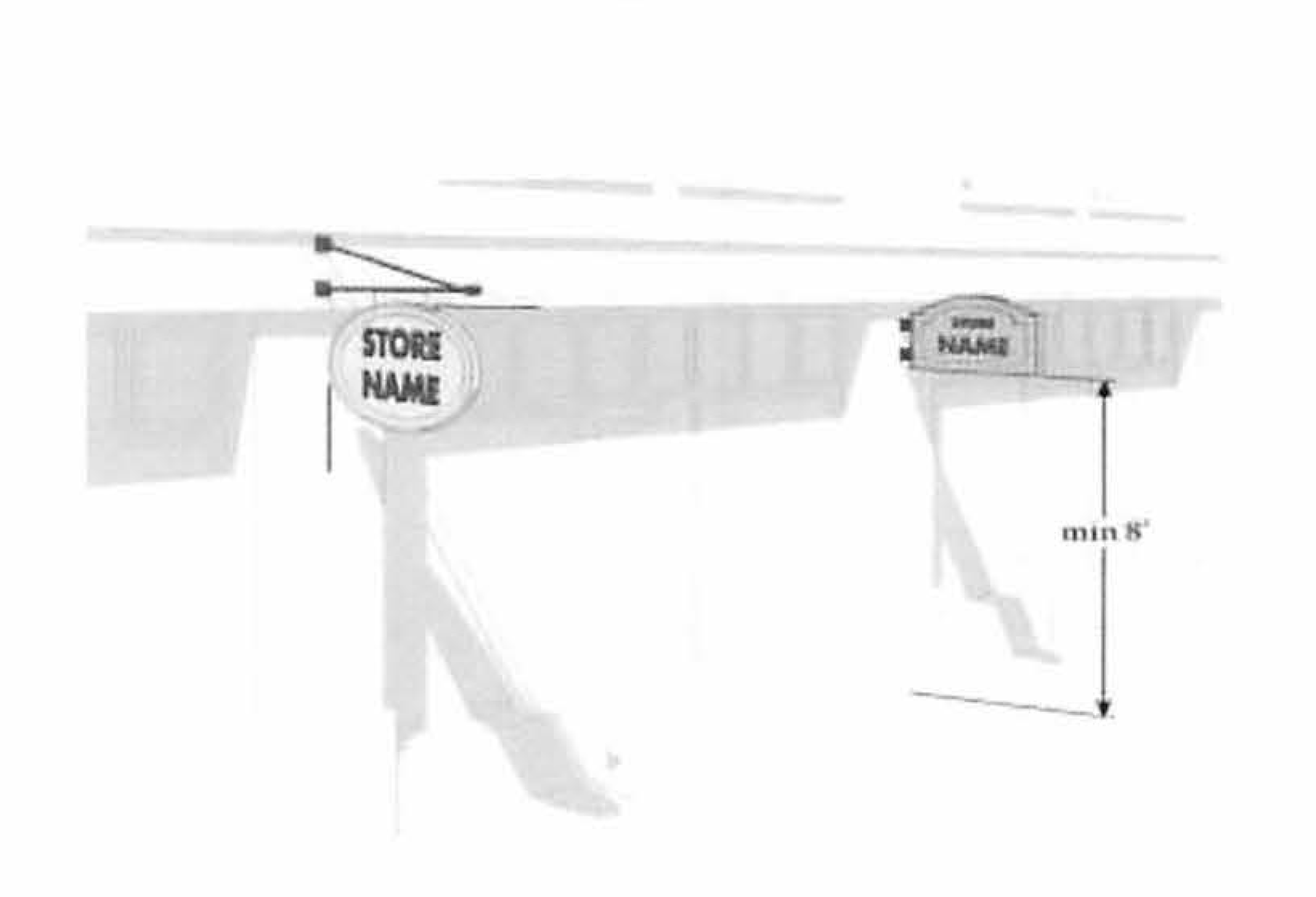
Figure 2
6)
Location.
a)
No part of any projecting sign shall be located lower than eight feet above the grade of sidewalk, walkway or driveway that is directly below the sign or within three feet of the sign.
b)
Projecting signs may extend a maximum of four feet from the building and shall be spaced a minimum of six inches away from the building.
c)
No projecting sign shall be located within 25 feet of another projecting sign on the same site or on the same building.
d)
No projecting sign shall be located higher than the first story level of the building.
e)
No projecting or suspended sign shall extend into the right-of-way, including the sidewalk.
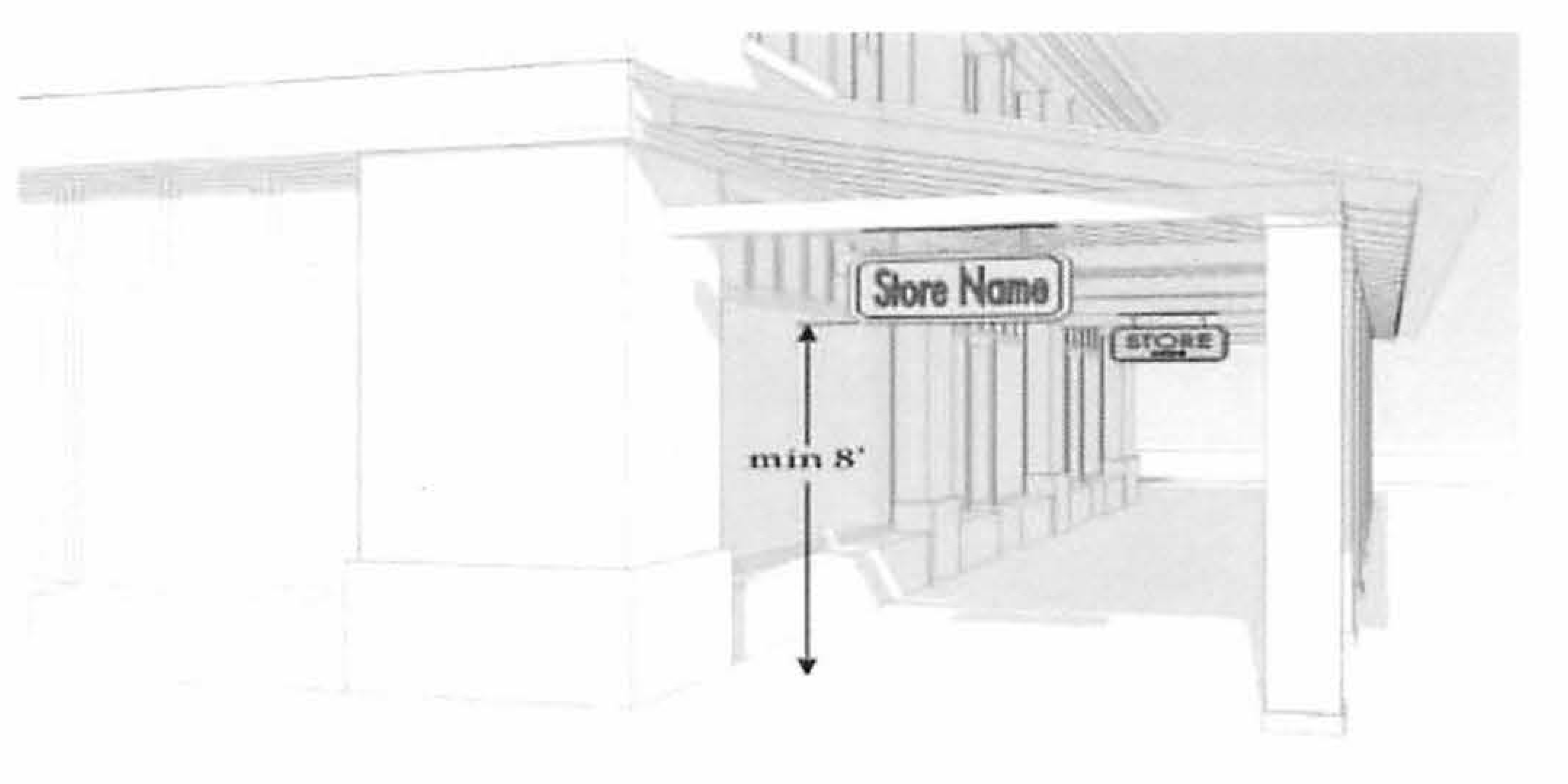
Figure 3
7)
Design.
a)
In the historic district, projecting sign may not be illuminated.
b)
Projecting signs shall be perpendicular to the building wall to which it is affixed. Suspended signs may be perpendicular or parallel to the building wall.
c)
Projecting signs shall not exceed four inches in thickness.
d)
Projecting signs shall be supported by or suspended from solid rods or otherwise tethered or reinforced to avoid movement in wind.
B.
Planned developments. For signs in a planned unit development (PUD) or master planned development, each property or individual development project within the planned development shall conform to the sign regulations established as part of the zoning approval for the planned development. If no such regulations exist, each property or individual development project within a planned development shall conform to the provisions of this article in accordance with the land use category of said property or individual development.
(Ord. No. O-2019-35, § 1, 7-15-19; Ord. No. O-2021-40, §§ 1(Exh. A), 2, 8-16-21)
Sec. 7.10. - Temporary signs.
A.
Short-term freestanding signs.
1.
For all nonresidential zoned properties, one additional short term freestanding sign measuring no more than 16 square feet in sign area and at a height of no more than 12 feet is allowed, without permit, located so that the stake is not closer than 12 feet to the back of curb or from the edge of the pavement on streets with no curbing, and no part of the placard is closer than 12 feet to the back of the curb or from the edge of the pavement on streets with no curbing.
2.
No short-term freestanding sign shall be erected on the same premises as a permanent freestanding sign. Exceptionally, an unlimited number of freestanding signs with sign area faces of 16 square feet or less and 12 feet in height or shorter are allowed during a political election between the date of close of filing for qualification of candidates and final determination on each ballot issue or candidate, and permits shall not be required for these signs.
B.
Setbacks, locations and limitations for temporary signs.
1.
All signs shall have a minimum setback of 10 feet from the rear and side property lines. For front setback, the sign must be three feet from a public right-of-way or more than 12 feet from any street paving or curb line, whichever is greater. However, in no case will a sign be allowed to obscure vision at a street or driveway intersection, or railway crossing nor, will a temporary sign be allowed to obscure a permitted permanent sign. For traffic safety, signs shall not be located within the triangular area on a corner lot formed by measuring 20 feet along both street side property lines from their intersection.
2.
A temporary sign shall be erected and maintained only with the permission of the owner of a property upon which the sign is located.
3.
No temporary sign shall be placed within the right-of-way of any street.
4.
No temporary sign shall be illuminated.
C.
Portable signs, inflatable signs, banners and festoons. Portable signs, inflatable signs, banners and festoons and other temporary signs are allowed as temporary signs on a property in nonresidential zoning districts, subject to the following additional restrictions.
1.
Portable or inflatable signs. One portable or inflatable sign per developed lot or business is allowed under the following conditions and requirements:
a.
Prior to the erection or placement of these signs or devices, all required fees and taxes shall be paid by the owner of the sign.
b.
The maximum number of portable or inflatable sign permits to be issued to a single location or site at any given time shall be one such sign permit, either for a portable or an inflatable sign, but not both simultaneously. Permits may be issued no more often than once every 90 days, and for a duration not to exceed 30 calendar days.
c.
No individual business in a planned center shall be allowed a portable or inflatable sign or be issued such a permit.
d.
The maximum size allowance for these devices and signs shall not exceed 16 square feet per sign face for a portable sign and 200 square feet for an inflatable sign. Said sign shall not have arrows, directional arrows, or flashing lights.
e.
The sign must be placed on the site in accordance with the setback requirements pertaining to temporary signs.
f.
To prevent wind damage to the sign or other property, the sign must be securely anchored to the site in a manner acceptable to the director.
g.
All electrical connections to the sign must be in compliance with the electrical codes as adopted by the city and must be inspected prior to use.
h.
The maximum height of any portable sign shall be four feet.
2.
Banners and festoons.
a.
The director is authorized to issue a temporary permit for pennants, banners, fringes, twirling, streamers, and feather flags. The maximum number of such temporary permits issued shall be one temporary permit every 30-day period. Each temporary permit will be for a period not to exceed 60 calendar days for each issuance.
b.
When allowed as temporary signage, a banner shall be allowed only as wall or window signage and shall be placed flush upon the wall or window to which it is attached. Banners shall not be hung as under-canopy signs, flown as flags, or used as any other form of sign.
c.
Such banners shall not be in addition to the maximum limitation on building signage for a tenant as shown on Table 7-2, Permitted Building Signage—By Land Use Category.
d.
A banner may be placed on an individual business within a planned center.
e.
No individual business shall have more than two temporary signs at any given time, regardless of the category of the temporary signs.
3.
A-Frame signs.
a.
A-frame signs constitute a form of signage that is granted by a permit, but which is utilized only during active hours for which the commercial entity is open. Where permitted in the central business district, A-frame signs are allowed on sidewalks in the public right-of-way. Where permitted elsewhere in the city, A-frame signs shall be located entirely on private property.
b.
A-frame signs shall not be illuminated.
c.
Plastic, dry erase boards, or unfinished plywood are prohibited materials for A-frame signs.
d.
A-frame signs shall be located on or adjacent to sidewalks in such manner that they do not encroach upon a required four-foot accessible pedestrian path.
e.
The base of an A-frame sign shall not be located more than 18 inches from the façade of the commercial entity responsible for the sign.
f.
A-frame signs may only be displayed during business hours and shall be removed when the commercial entity is closed.
g.
A-frame signs shall be composed of stained or painted wood with a sign face composed of wood or slate (chalk) board with a maximum height of 30 inches and a sign face area of no greater than six square feet.
h.
Permits are required for A-frame signs and may be issued on an annual basis.
(Ord. No. O-2022-8, § 56, 3-7-22)
Sec. 7.11. - Flags.
Flags are allowed in all zoning districts and may be flown without permit in accordance with the following standards:
A.
No more than two flags shall be permitted per lot.
B.
No flag shall exceed 24 square feet in area on any lot used for single and/or two-family residential use or 60 square feet when flown on a lot with a primary use other than single or two-family residential.
C.
Flags shall not be flown from a pole, the top of which is higher than 25 feet on a single or two-family residential lot or 40 feet in height on lots with a primary use other than single or two-family residential.
D.
Any flag not meeting any one or more of these standards shall be considered a banner and shall be subject to being permitted as such.
Sec. 7.12. - Variances.
There shall be no variances from the sign regulations of this article.
Sec. 7.13. - Uniform sign plan.
A.
A uniform sign plan is required for any planned center, such as a shopping center with three or more establishments, before any signs for the planned center or the center's tenants may be erected on the property.
B.
The uniform sign plan shall govern the placement and design of all signs within the planned center as to their location, materials, size, letter style, and color.
C.
A uniform sign plan shall be submitted and approved as follows:
1.
The uniform sign plan shall consist of such drawings and specifications as may be required to clearly illustrate the location, materials, size, letter style, and color of each and every sign to be placed as freestanding and building signs within the development.
2.
The uniform sign plan is to be submitted to the director. The uniform sign plan shall be approved upon a finding by the director that:
a.
The plan provides that signs of a similar type and function within the development shall have a consistency of size, lettering style, color scheme, and construction materials to present a unified design concept while respecting the differences between tenant types and occupancies.
b.
The signs proposed in the uniform sign plan shall comply with the requirements of this article, such as number, location, and size restrictions.
3.
All tenants of the planned center, whether an owner, lessee, subtenant, purchaser, or other occupant, shall comply with the approved uniform sign plan.
Sec. 7.14. - Nonconforming signs.
A.
In all use districts, signs which on the effective date of this article become nonconforming with respect to the requirements set forth in this article may continue in existence so long as the size is not increased beyond that existing as of the effective date of this article and no change is made in the technology of the sign other than as provided in subsection (F) of this section, provided that no portable sign shall be considered a nonconforming sign.
B.
Existing signs which were legally erected but which have become nonconforming and do not meet the setback requirements of this article due to a road widening project may be moved to meet the setback requirements of this article but shall not be increased in size, shape or changed in any manner except as to meet the requirements of this article, provided, however, this subsection shall not allow the relocation of any sign for which the value has been paid to the owner by an government or government agency in conjunction with a road widening project. No sign shall be relocated pursuant to this subsection before such time as the sign owner shall provide to the director a signed cop of the purchase contract or condemnation documents showing transfer of the owner's land for road widening.
C.
In all use districts, signs that were:
1.
Illegally erected or maintained with respect to prior ordinances,
2.
Made of paper, cloth, or nondurable materials, except yard signs,
3.
Located in the public right-of-way, shall be prohibited by this article and shall be removed by the owner. Upon failure to comply with requirements of this article, the director may cause the removal of such signs at the expense of the owner.
D.
A nonconforming sign shall not be replaced by another nonconforming sign, except that the substitution or interchange of poster panels, painted boards or demountable material on nonconforming signs shall be permitted.
E.
Minor repairs and maintenance of nonconforming signs such as electrical repairs or lettering repairs shall be allowed. However, no structural repairs or changes in the size, shape or technology of a sign shall be permitted except to make the sign comply with the requirements of this article. Signs damaged by fire or act of God may be restored to their original condition.
F.
Existing billboards on state and federal highways within the city that were legally erected, but which become nonconforming as a result of this article or prior sign ordinances are allowed to remain until purchased by the state department of transportation or the city or voluntarily removed by the owner, provided that the sign owner meets the requirements of state laws, rules and regulations governing such signs, including periodic maintenance to keep the sign from becoming dilapidated. The city finds that it is in the interest of the city that such nonconforming billboards be phased out of existence as they near the end of their useful life. The city further finds that the limited presence of some billboards along state and federal highways is useful in promoting local business, community events and other ideas within the city and the most efficient means of such promotion is through the limited use of digital billboards. The city, therefore, adopts a limited exchange program for nonconforming billboards in exchange for the right to erect one new digital billboard. The owner of any nonconforming billboard located within 150 feet of and oriented toward state or federal highways in the city may apply for a permit to replace such billboard with a new digital billboard meeting the standards of section 7.08.A.6.d. The condition for issuance of a replacement permit is the agreement by the applicant to remove, without cost to the city or state, one additional billboard also located within the city limits of Douglasville and to reserve one message segment per sign face for community use for a minimum of four weeks per year. Such community use need not be continuous and may be spread throughout the year at the sign owner's discretion. The sign owner shall institute a system for receiving requests for community use on behalf of the citizens of Douglasville and shall be responsible for ensuring compliance with this condition.
G.
Each nonconforming sign shall be registered with 90 days of the enactment of this article by the owner, and if it is determined that such nonconforming sign was legally erected under the prior ordinance or resolution requirements, then a sign permit shall be issued to the sign owner and the sign so marked with the permit decal. Should the owner of a nonconforming sign fail to register such sign within 90 days from the enactment of this article, such failure to register shall be deemed a violation of this article, and such person shall be subject to citation in the municipal court.
H.
Existing signs on property of newly annexed territory that were legally erected under the county ordinance which would become nonconforming under this section upon annexation by the city will be allowed to remain. Such signs shall be registered with the city within 90 days of being annexed by the city.
(Ord. No. O-2022-8, § 16, 3-7-22)
Sec. 7.15. - Enforcement.
A.
Enforcement responsibility. The community development director is responsible for general administration and enforcement of this article; the receipt, review and processing of all applications for sign permits and uniform sign plans, and of securing compliance with its terms.
B.
Citations. Any violation of this article may be tried upon a citation issued by the director or any other authorized representative of the city pursuant to the provisions of this article and state law. Without limitation, businesses, organizations, builders, developers, contractors, property owners, and such other parties responsible for the violation may be cited for violation of any provisions of this article.
C.
Removal of illegal signs. The director may order the removal of any sign in violation of this article by written notice to the permit holder; or if there is no permit holder, then to the owner of the sign; or if the sign owner cannot be found or cannot be determined, then to the sign erector and any party that procured the erection of the sign. If a permit was issued, such notice shall operate to revoke the permit. The removal order shall be issued only after the appropriate party fails to respond or otherwise comply within ten business days after the city gives written notice of non-compliance.
1.
Procedure following removal order. An aggrieved party may appeal the removal order within five business days from the date that the notice was mailed in accordance with section 7.03(I), sign permit.
2.
Removal without notice.
a.
The director or any other agent of the city having jurisdiction under the circumstances may remove or direct the removal of any sign in violation of this article, without giving notice to any party, if:
1)
Said sign is illegally placed upon the public right-of-way or upon other public property; or
2)
Said sign poses an immediate safety threat to the life or health of any members of the public.
b.
Following such removal, the city may collect the costs as provided in the following subsection (C)(3), costs of removal, below.
3.
Costs of removal.
a.
Removal of any sign found in violation shall be without liability to the city, its officers, agents, and employees. The permit holder shall be primarily responsible for the costs of removal. If there is no permit holder, then the sign owner shall be responsible. If the sign owner cannot be determined, then the costs of removal shall be the responsibility of any party that procured the erection of the sign.
b.
If payment or arrangement to make payment is not made within 60 days after the receipt of a statement of removal costs, the community development director shall certify the amount thereof for collection to the city attorney.
c.
Costs of removal shall be charged in accordance with a fee schedule adopted by the mayor and city council from time to time, or at the actual cost to the city.
4.
Disposal of removed illegal signs. Signs that are removed by the city pursuant to this Section shall be stored for a period of ten days from the date the sign is removed, and the date of removal shall be considered day one. The owner of the sign and/or their designee may arrange to pick up removed signs during the ten-day period of storage. Upon the expiration of ten days from the date of removal of the sign, the city shall dispose of the sign. The city shall have no liability to any party for enforcement and disposal under this subsection.
(Ord. No. O-2022-8, §§ 17, 18, 3-7-22; Ord. No. O-2024-1, § 1, 1-16-24)
Sec. 7.16 - Definitions.
The following words and phrases have specific meanings as used in this Article:
A.
A-frame sign: A sidewalk sign, the support structure of which is not embedded in the ground, but that is constructed in such a manner that the sign stands on its own yet is not permanently installed. A-frame signs are designed as two panels, hinged at the top, with the bottom edge of both panels spread so that the overall sign forms an "A" shape.
B.
Animated sign: A sign that has moving parts or includes action, motion, or color changes, or the optical illusion of action, motion, or color changes, including signs using electronic ink, signs set in motion by fans or other electrical devices, or made up of a series of sections that turn, including any type of screen using animated or scrolling; provided this definition does not include electronic changeable copy signs or digital billboards meeting the standards of this article. Animated signs also include signs that emit sound, smoke or other special effects.
C.
Awning: A roof-like cover that projects from the wall of a building for the purpose of shielding a doorway, or window from the elements. Awnings are often made of fabric or flexible plastic supported by a rigid frame and may be retracted into the face of the building.
D.
Awning sign: See "building sign."
E.
Banner: A sign, other than a flag, made of paper, cloth, thin plastic, or similar lightweight and pliable material, and usually containing a message or logo that can be mounted to a structure.
F.
Billboard: A freestanding sign with a sign area of 300 square feet or greater, which is supported by one or more columns, uprights, or braces in or upon the ground and is not attached to a building and is not mobile or temporary.
G.
Building sign: A sign that in any manner is fastened to, projects from, or is placed or painted upon the exterior wall, window, door, or roof of a building. The term "building sign" includes but is not limited to the following:
1.
Awning sign: A sign imposed, mounted or painted upon an awning.
2.
Canopy sign: A sign affixed to, imposed upon, or painted on any canopy, such that the sign is mounted in such a manner that a continuous face with the canopy is formed.
3.
Channeled letters: Internally illuminated letters or symbols mounted individually on a raceway or power source.
a.
Internally channeled letters: Letters or other symbols with recessed surface designed to accommodate incandescent bulbs or luminous tubing.
b.
Reverse channeled letters: Letters or other symbols with raised surface designed to be lighted from behind by incandescent bulbs or luminous tubing.
4.
Mansard sign: A sign imposed, mounted or painted upon a mansard and not extending above the top of the mansard.
5.
Marquee sign: Any sign attached flat against the marquee or permanent sidewalk canopy of a building and not extending above the top of the marquee.
6.
Parapet sign: A sign imposed, mounted or painted on a parapet and not extending above the top of the parapet.
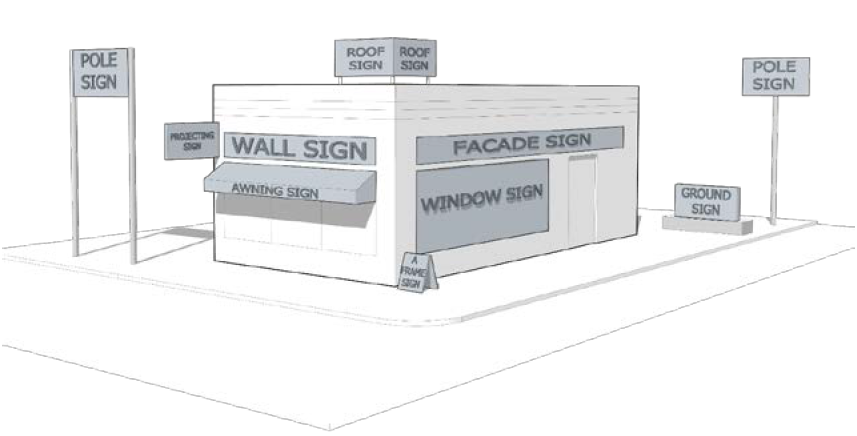
7.
Projecting Sign: A sign affixed to a wall and extending more than four (4) inches from the surface of such wall, usually perpendicular to the wall surface.
8.
Roof sign: A sign that is mounted on, applied to, or otherwise structurally supported by the roof of a building.
9.
Under-canopy sign: A display attached to the underside of a marquee or canopy and protruding over public or private sidewalks.
10.
Wall sign: A sign that is fastened directly to or is placed or painted directly upon the exterior wall of a building, with the sign face parallel to the wall, and extending from the surface of the wall no more than four inches.
11.
Window sign: A sign that is placed on or behind a windowpane or glass door and intended to be viewed from outside the building.
H.
Canopy: A permanent roof-like structure projecting from a building and open on at least one side for the purpose of shielding a pedestrian walkway from the elements, or a freestanding roof-like structure supported by columns intended to shield a vehicular driveway or service area from the elements.
I.
Canopy sign. See "building sign."
J.
Channeled letters. See "building sign."
K.
Changeable copy sign:
1.
Automatic changeable copy sign: A sign on which the copy changes automatically on a lamp bank or through mechanical means, e.g., electrical or electronic control. Copy shall mean words and numbers.
2.
Manual changeable copy sign: A sign on which copy is changed manually in the field, e.g., reader boards with changeable letters. Copy shall mean words and numbers.
L.
Digital billboard: A billboard, the sign face of which is composed of LED or other electronic units that, when displayed, constitute the sign face of the sign.
M.
Directional sign: A sign mounted on a single or double pole sign that serves the purpose of guiding safe vehicular and pedestrian traffic movements onto, from, or on property, and without which there is an increased risk of incompatible traffic movements, conflict, or confusion. Such signs shall be used for the direction of traffic movement and shall not be used of purpose of advertisement.
N.
Double-faced sign: A sign structure with two sign faces that are parallel (back-to-back) or that form an angle to one another, where each sign face is designed to be seen from a different direction and the two sign faces are separated from each other at their nearest point by no more than three feet.
O.
Feather flag: A sign composed of fabric, plastic or other pliable material oriented in a vertical direction and supported by a harpoon-style pole or staff driven into the ground as its primary means of support.
P.
Festoons: Strings of ribbons, tinsel, small flags, pennants, streamers, pinwheels or other pliable materials designed to move in the wind.
Q.
Flag: A sign consisting of any fabric containing distinctive colors, patterns, logos or symbols, used as an official symbol of a government or any other entity or organization. Feather flags are excluded from the definition of flag.
R.
Freestanding sign: A sign permanently attached to the ground and that is wholly independent of any building or other structure. The term "freestanding sign" includes but is not limited to the following:
1.
Pole sign: A sign that is mounted on one or more freestanding poles, columns, or similar support such that the bottom of the sign face or lowest sign module is not in contact with the ground.
2.
Ground sign: A freestanding sign in which the entire bottom of the sign face or structure is in contact with the ground, providing a solid and continuous background for the sign face from the ground to the top of the sign. Also referred to as a "monument sign."
S.
Ground sign: See "freestanding sign."
T.
Illuminated signs:
1.
Internally illuminated sign: Any sign that is illuminated by an artificial light source from within the sign structure, usually projected through a transparent or translucent sign face.
2.
Externally illuminated sign: Any sign that is partially or completely illuminated at any time by an artificial light source that directly or indirectly illuminates the face of the sign from outside the sign structure.
U.
Incidental sign: A small sign, emblem, or decal no larger than one square foot. Such signs are normally located on doors, windows, and gas pumps, and are generally not readily visible or legible from public rights-of-way.
V.
Interior sign: A small sign located within the interior of a planned center or of a commercial or industrial use comprised of more than five acres, located beyond the front building setback and not readable from the public right-of-way.
W.
Interstate sign: A freestanding sign not exceeding 100 feet in height or 200 square feet in sign area located with 500 feet of an interstate highway exit or entrance ramp.
X.
Internally illuminated letters: See "building sign, channeled letters."
Y.
Mansard: A steeply sloped, roof-like façade architecturally similar to a building wall.
Z.
Mansard sign: See "building sign."
AA.
Marquee: A permanent roof-like structure or canopy of rigid materials supported by and extending from the façade of a building.
BB.
Marquee sign: See "building sign."
CC.
Monument entrance sign: A permanent freestanding sign located at a discernible entrance into a multi-family development, residential subdivision or a planned center from a public street not part of the development.
DD.
Monument sign: See "ground sign" under "freestanding sign."
EE.
Multi-faced sign: A single sign structure consisting of two sign faces (see "double-faced sign") or three or more sign faces on different sides of the structure that are separated from each other at their nearest point by no more than three feet and face. Sign faces on a single sign structure that are separated by more than three feet are treated as separate signs.
FF.
Parapet sign: See building sign.
GG.
Planned center: For purposes of this article, a single nonresidential property or contiguous properties, planned, developed and managed as a unit for occupancy by two or more principal tenants that are separately owned and have no corporate relationship, such as a shopping center or office complex.
HH.
Pole sign: See "freestanding sign."
II.
Portable sign: A sign, excluding A-frame signs, designed to be transported or easily relocated and not attached to the ground, such as but not limited to the following:
1.
A sign designed to be temporarily placed upon the ground and not otherwise permanently affixed to it as otherwise required by the building code; or
2.
A sign mounted on a trailer, with or without wheels.
JJ.
Projecting sign: See "building sign."
KK.
Roof sign: See "building sign."
LL.
Sign: Any structure, display, or device visible from the public right-of-way that is used to advertise, identify, direct, or attract attention to a business, institution, organization, person, idea, product, service, event, or location by any means, including words, letters, figures, design characteristics, symbols, logos, fixtures, colors, movement, or illumination. "Sign" excludes purely artistic displays or decorations.
MM.
Sign face: That portion of the surface of a sign structure where words, letters, figures, symbols, logos, fixtures, colors, or other design elements are or may be located in order to convey the message, idea, or intent for which the sign has been erected or placed. The sign face may be composed of two or more modules on the same surface that are separated or surrounded by open space or by portions of a sign structure not intended to contain any message or idea and are purely structural or decorative in nature.
NN.
Sign height: The vertical distance to the highest point of a sign structure.
OO.
Sign module: Each portion or unit of a sign face that is clearly and physically separable from other such units by virtue of the expression of a complete thought, message, logo, or idea.
PP.
Sign structure: All elements of a freestanding sign, including the sign face, background, or decorative elements related to the presentation or support of the sign's message, and the structural supports.
QQ.
Tenant: For the purposes of the sign ordinance of article 7, a natural person, business or other entity that occupies land or buildings by ownership, under a lease, or through payment of rent; an occupant, inhabitant, or dweller of a place.
RR.
Under-canopy sign: See "building sign."
SS.
Uniform sign plan: Coordinated drawings and specifications that establish a unified design concept with respect to the location, materials, size, letter style, and color of all signs to be placed on or within a planned center.
TT.
Wall sign: See under "building sign."
UU.
Window sign: See "building sign."
VV.
Yard sign: A temporary sign intended for short-term use, containing no reflective elements, flags or projections and erected on a wooden support or metal frame.

