
Downers Grove City Zoning Code
ARTICLE 28
X General Development Regulations
Sec 28.10.010 Fences
- General. The general regulations of this subsection apply to all fences.
- Applicability. All fences, including plants and walls in the nature of a fence, must be erected and maintained in conformance with the requirements of this Section.
- Permits Required. It is unlawful to erect or alter any fence within the Village unless a permit has been issued by the Community Development Director. A written application for a fence permit, including applicable fees as established in the User-Fee, License & Fine Schedule must be filed with the Community Development Department. A fence permit issued under this Section is valid for a term of six (6) months.
- Public Safety. Fences may not be constructed or maintained in any way that would impair public protection services or impair public safety by obstructing the vision of persons using the street, sidewalks or driveways.
- Structural Elements. All fences must be constructed so that fence posts and structural elements are located on the side of the fence facing the property being enclosed.
- Open-Design Fences. Open design fences must be constructed in such a manner that no post or vertical and horizontal element exceeds a width of six inches (6"), and the open area is not less than fifty percent (50%) of the closed area, with the open area distributed uniformly over the entire fence surface. Open-design fences include split rail, post and board and similar designs, expressly excluding chain-link, shadow box and woven mesh fences. See Figure 10.1 below:
Figure 10.1 Open Design Regulations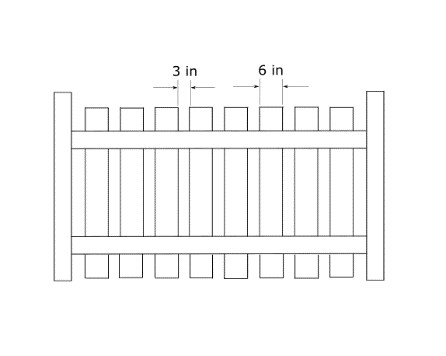
- Electrified or Barbed Wire Fences. Electrified or barbed wire fence are prohibited in all zoning districts, except that in business and manufacturing districts electrified or barbed wire fences may be approved through the special use process.
- Fences in R Districts. Fences in R zoning districts are subject to the general regulations of DGMC Section 28.10.010(a) and the R district regulations of this subsection. See Figures 10-1 and 10-2.
- Street and Corner Yards. The regulations of this subsection apply to fences in street and corner yards of lots located in R districts.
- Open-design fences that do not exceed four feet (4') in height are permitted within street and corner yards.
- Chain-link and woven mesh fences are prohibited in street and corner yards, except that chain-link fences, including those that are anodized or vinyl-clad, constructed without slats, are permitted in the street and corner yard area on corner lots when the side of any principal structure located on the subject lot faces a street, provided that the fence does not exceed four feet (4') in height and is located only in the area from the rear line of the structure to the rear lot line.
- Fences up to six feet (6') in height are permitted in the street and corner yard area on corner lots when the side of any principal structure located on the subject lot faces a street if the rear of the structure faces the rear of a structure that is located on an adjacent corner lot, provided that the fence is located only in the area from the rear line of the structure to the rear lot line.
- Fences up to six feet (6') in height are permitted in the street and corner yard area of an R-zoned lot occupied by a principal nonresidential use if the lot has multiple street frontages and contains a parking lot without a structure. Such fence must be an open-design fence (See DGMC Section 28.10.010(a)(5)) and be constructed along the parking lot perimeter immediately adjacent to an arterial street or non-residentially zoned property. All other landscaping and screening requirements of Article VIII of this Chapter apply.
- Side and Rear Yards. The regulations of this subsection apply to fences in the side and rear yards of lots located in R districts.
- Fences, including chain-link and woven mesh designs, are permitted in side and rear yards and required setbacks. Fences in side and rear yards may not exceed six feet (6') in height. In residential districts abutting nonresidential districts, fences of up to eight feet (8’) in height and closed in design may be erected only in the side and rear yards of the residential district properties that abut the nonresidential districts. On double-frontage lots, when the rear of any principal structure located on the lot faces a street, and all directly abutting lots share this layout, the yard along that street frontage is considered a rear yard for purposes of these fence regulations. On double-frontage lots, when the rear of any principal structure located on the lot faces a street, and one or more directly abutting lots has the front of a principal structure that faces the same street, the fence must adhere to the yard requirements of the front facing principal structure.
- On corner lots with three (3) lot lines abutting a street, fences up to six feet (6') in height, including chain-link and woven mesh designs, are permitted only within the two (2) street-facing side yard areas located from the rear building line to the rear lot line. Any fences outside this area are subject to a maximum height limit of four feet (4').
Figure 10-2: Residential Fence Regulations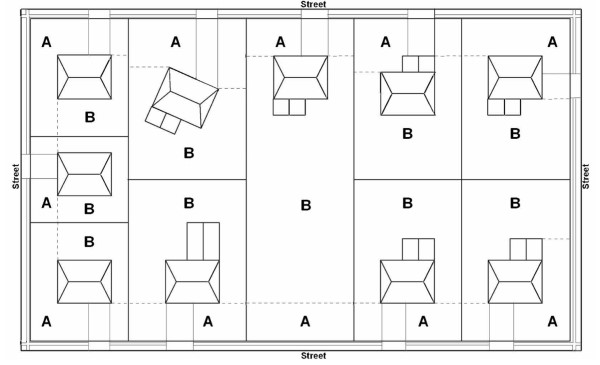
Figure 10-3: Residential Multi-Frontage Fence Regulations
Fence Regulations Quick Guide A – Fences may be open and not exceed four feet (4') in height. B – Fences may be open or solid and not exceed six feet (6') in height.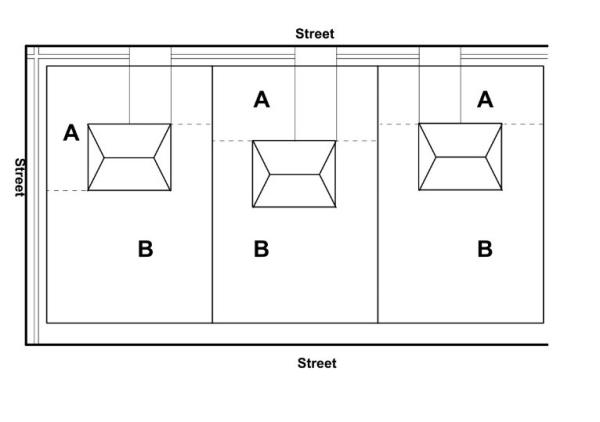
- Street and Corner Yards. The regulations of this subsection apply to fences in street and corner yards of lots located in R districts.
- Fences in Nonresidential Districts. Fences in nonresidential zoning districts are subject to the general regulations of DGMC Section 28.10.010(a) and the nonresidential district regulations of this subsection.
- Street and Corner Yards. Open-design fences up to eight feet (8') in height are permitted in street yards.
- Side and Rear Yards. Fences up to eight feet (8') in height are allowed inside and rear yards.
(Ord. No. 5804, 12/17/19; Ord. No. 5706, 7/10/18)
Sec 28.10.020 Intersection Visibility
No obstruction to the vision of persons using streets, sidewalks or driveways, and no structure, other than fences meeting the requirements of DGMC Section 28.10.010, may be located in any of the following areas on corner lots:
- In any R zoning district, within a triangular area formed by the lot lines abutting streets and a line connecting points on these lot lines located thirty-five feet (35') from the intersection of the lot lines abutting streets.
- In any nonresidential district within ten feet (10') of the intersection of the right-of-way lines bordering a corner lot, provided that this regulation shall not apply to that part of a building above the first floor.
Sec 28.10.030 Outdoor Lighting
- Purpose. The outdoor lighting standards of this Article are intended to protect the public health and general welfare by controlling the adverse impacts of glare and light trespass associated with poorly shielded or inappropriately directed lighting fixtures.
- Applicability. Unless otherwise expressly exempted, the regulations of this Article apply to all uses.
- Exemptions. The following are expressly exempt from the outdoor lighting regulations of this Article:
- temporary holiday light displays;
- outdoor light fixtures producing light directly by the combustion of fossil fuels, such as, kerosene lanterns or gas lamps;
- landscape accent lighting;
- Village street lights;
- illumination of official government flags; and
- construction and emergency lighting used by construction workers or police, firefighting, or medical personnel, provided the lighting is temporary and is discontinued immediately upon completion of the construction work or abatement of the emergency requiring the lighting.
- Exterior Lighting Plan. An outdoor lighting plan must be prepared by a professional lighting consultant and submitted to the Community Development Director for approval. The lighting plan must be reviewed to determine whether the proposed outdoor lighting complies with the regulations of this Section. The plan must include at least the following information:
- a photometric study and data on the types of lighting fixtures to be used;
- location of and catalog cut-sheet data for all proposed light fixtures, including those used for site lighting, canopy lighting and exterior building lighting;
- calculations showing contours of individual illumination values in foot-candles. The contours must include property lines and at least five feet (5') beyond; and
- a summary calculation table showing average foot-candles, minimum foot-candles, maximum foot-candles, average-minimum uniformity ratio, and foot-candles at property lines and at least five feet (5') beyond.
- General Regulations and Standards
- Flashing, revolving, or intermittent exterior lighting visible from any property line or street is prohibited.
- High-intensity light beams, such as outdoor searchlights and lasers are prohibited.
- Glare. All outdoor lighting must be directed, shaded, shielded, or otherwise located and designed to minimize perceived glare on adjacent properties and streets.
- Light Trespass. All outdoor lighting must be designed, installed and maintained to avoid the adverse impacts of glare and light trespass associated with poorly shielded or inappropriately directed lighting fixtures. Average maintained foot-candles at the property line may not exceed the values shown in Table 10-1.
Table 10-1: Light TrespassLand Use Maximum Horizontal Foot-Candles Residential to residential 0.10 Nonresidential to nonresidential 2.00 Nonresidential to residential 0.10 - Light Fixture Mounting Height. Parking lot light fixtures in R zoning districts may not exceed twenty feet (20') in height. Parking lot light fixtures in nonresidential districts may not exceed thirty feet (30') in height.
- Hours of Illumination. Outdoor lighting for nonresidential uses adjacent to residential districts must be extinguished or reduced to security-level intensity no later than thirty (30) minutes after the close of business of the use.
Sec 28.10.040 Operational Performance Standards
- General
- Applicability. The operational performance standards of this Section apply to the establishment and operation of all nonresidential uses.
- Testing. The Community Development Director is authorized to require that uses provide a certificate from a scientific testing laboratory certifying compliance with the standards of this Section. The cost of employing the testing laboratory must be paid by the owner if a violation of applicable standards is determined to exist; otherwise costs of testing and certification will be paid by the Village.
- Noise
- Unless otherwise expressly stated in this Section, it a violation of this zoning ordinance to operate in any manner that causes the daytime noise level to exceed 65 dB(A) or that causes the nighttime noise level to exceed 50 dB(A) on property located within an R zoning district. For the purposes of administering and enforcing these noise regulations:
- daytime hours include the hours from 7:00 a.m. to 8:00 p.m.;
- nighttime hours include the hours from 8:01 p.m. to 6:59 a.m.; and
- noise levels must be determined by measuring the dB(A) taken at least ten feet (10') inside the property line of the R-zoned property.
- It is not a violation of applicable noise standards if the noise source does not:
- exceed 5 dB(A) over the dB(A) allowed if the noise source operates at that level for less than fifteen (15) minutes in any one-hour period;
- exceed 10 dB(A) over the dB(A) allowed if the noise source operates at that level for less than six (6) minutes in any one-hour period;
- exceed 15 dB(A) over the dB(A) allowed if the noise source operates at that level for less than one and one half (1.5) minutes in any one-hour period; or
- occur as part of the typical operation of the Premises, including mowing, construction, tree trimming, and waste removal.
- Unless otherwise expressly stated in this Section, it a violation of this zoning ordinance to operate in any manner that causes the daytime noise level to exceed 65 dB(A) or that causes the nighttime noise level to exceed 50 dB(A) on property located within an R zoning district. For the purposes of administering and enforcing these noise regulations:
- Smoke and Particulate Matter
- The emission of particulate matter containing more than five percent (5%) (by weight) particles having a particle diameter larger than forty-four (44) microns, is prohibited.
- The rate of emission of particulate matter from all sources within the boundaries of a lot may not exceed one-half (1/2) pound per acre of lot area during any one-hour period.
- Emitted smoke may not be darker or more opaque than No. 0 (zero) on the Ringelmann smoke chart (as published by the United States Bureau of Mines), except that smoke no darker or more opaque than No. 1 on Ringelmann smoke chart may be emitted for periods not longer than four (4) minutes in any thirty-minute period. These provisions apply to visible gray smoke and to visible smoke of other colors but with an equivalent apparent opacity. Measurement of smoke and particulate matter shall be taken from the point of emission.
- Dust or other types of air pollution borne by the wind from sources such as storage areas, trash enclosures, and yards within the boundaries of any lot must be kept to a minimum by appropriate landscaping, screening, paving, wetting, or other acceptable means.
- Odors, Toxic or Noxious Matter
- Odors. The emission of odorous matter in such quantities as to be readily detectable at any point along lot lines or that is, harmful or injurious to the public health, comfort or welfare, is prohibited.
- Toxic or Noxious Matter. The emission or discharge of toxic or noxious matter in such concentrations as to be readily detectable at any point along the lot lines or that is detrimental to or endangers the public welfare, safety, comfort, or causes injury or damage to property or business is prohibited.
- Fire and Explosion Hazards. Materials that present potential fire and explosion hazards must be transported, stored and used only in conformance with all applicable federal, state, county and local regulations.
- Vibration Regulations. It is a violation of this zoning ordinance if any earthborn vibration caused by the operation of any use is detectable at any point off the lot on which the use is located.
- Glare and Heat. Any activity or operation of any use that produces glare or heat must be conducted so that no glare or heat from the activity or operation is detectable at any point off the lot on which the use is located. Exposed sources of light, originating from within a building, must be controlled so that direct or indirect illumination from any source within the lot line does not cause illumination in violation of any applicable Village regulations.

