
Downers Grove City Zoning Code
ARTICLE 28
VIII Landscaping And Screening
Sec 28.8.010 Purpose
The landscaping and screening regulations of this Article establish minimum requirements for landscaping and screening. The regulations are intended to advance the general purposes of this ordinance and specifically to:
- enhance quality of life for residents and visitors;
- protect property values;
- enhance the quality and appearance of new development and redevelopment projects;
- mitigate possible adverse impacts of higher intensity land uses abutting lower intensity land uses;
- promote the preservation, expansion, protection and proper maintenance of existing trees and landscaping;
- help ensure wise use of water resources;
- improve air quality;
- protect water quality and reduce the negative impacts of stormwater runoff by reducing impervious surface area and providing vegetated areas that filter and retain greater amounts of stormwater on site;
- moderate heat by providing shade; and
- reduce the impacts of noise and glare.
Sec 28.8.020 Parking Lot Perimeter Landscaping
- Applicability. The parking lot perimeter landscaping requirements of this Section apply to all of the following:
- the construction or installation of any new surface (open) parking lots containing six (6) or more parking spaces; and
- the expansion of any existing surface (open) parking lot if the expansion would result in six (6) or more total parking spaces, in which case the requirements of this Section apply only to the expanded area.
- Street Yards
- When a parking lot is located across the street from a residential zoning district, parking lot perimeter landscaping must be provided along one hundred percent (100%) of the street frontage opposite the residential zoning district. See Figure 8-1.
Figure 8-1: Street Yard Perimeter Landscaping Opposite R Zoning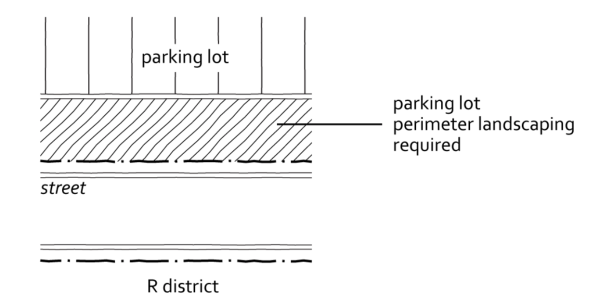
- When a parking lot is located across the street from a nonresidential zoning district, parking lot perimeter landscaping must be provided along at least seventy-five percent (75%) of the parking lot perimeter opposite the nonresidential zoning district. See Figure 8-2.
Figure 8-2: Street Yard Perimeter Landscaping Opposite Nonresidential Zoning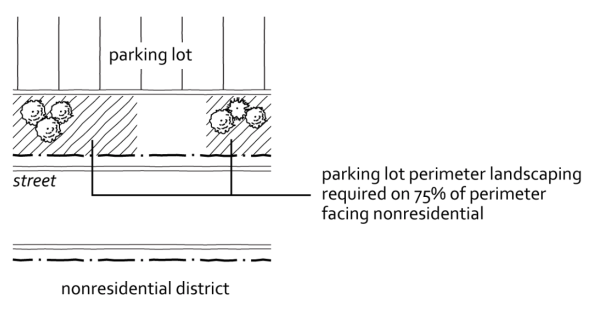
- Required parking lot perimeter landscaping must be provided in plant groupings of at least three (3) live plants. See Figure 8-3.
Figure 8-3: Plant Groupings within Perimeter Landscape Area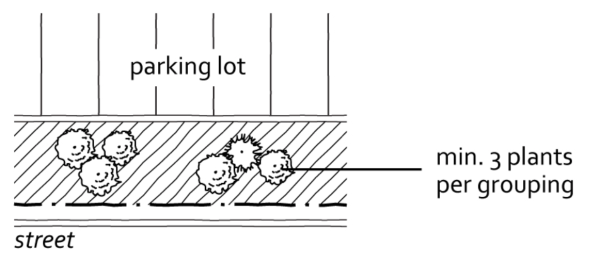
- Parking lot perimeter landscaping may consist of shrubs, ornamental grasses, trees and perennial plants, all of which must reach a minimum height of thirty-six inches (36") at maturity. See Figure 8-4.
Figure 8-4: Perimeter Landscaping Plant Height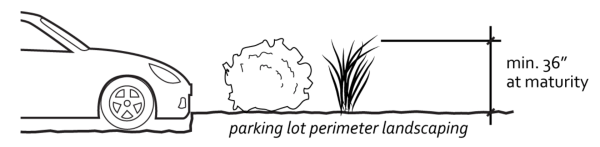
- Shade or ornamental trees must be provided within required parking lot perimeter landscape areas at a rate of at least one (1) tree per thirty (30) linear feet of street frontage, rounded to the nearest whole number. Parkway trees may be counted toward satisfying parking lot perimeter tree planting requirements. See Figure 8-5.
Figure 8-5: Trees within Street Yard Perimeter Landscape Areas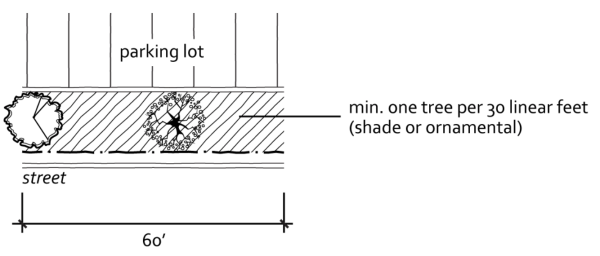
- When a parking lot is located across the street from a residential zoning district, parking lot perimeter landscaping must be provided along one hundred percent (100%) of the street frontage opposite the residential zoning district. See Figure 8-1.
- Interior Yards
- When a parking lot is located in the interior side or rear yard of a lot abutting an-other lot, parking lot perimeter landscaping must be provided as follows:
- Landscaping provided in plant groupings of no less than three (3) live plants must be provided along at least fifty percent (50%) of the parking lot perimeter along the abutting interior side and rear lot lines. See Figure 8-6.
Figure 8-6: Perimeter Landscaping within Interior Yards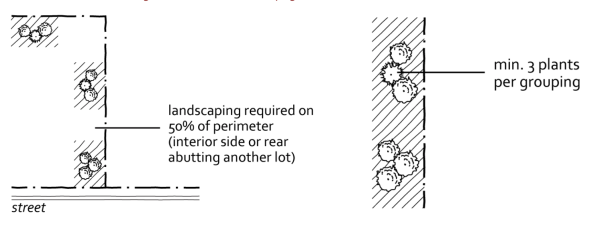
- Parking lot perimeter landscaping may consist of shrubs, ornamental grasses, trees and perennials, all of which must reach a minimum height of thirty-six inches (36") at maturity. See Figure 8-7.
Figure 8-7: Perimeter Landscaping Plant Height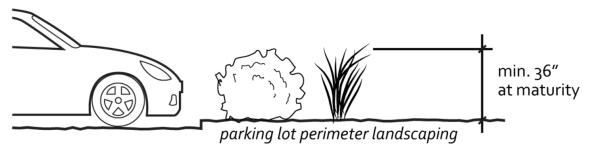
- Landscaping provided in plant groupings of no less than three (3) live plants must be provided along at least fifty percent (50%) of the parking lot perimeter along the abutting interior side and rear lot lines. See Figure 8-6.
- When a parking lot is located in the interior side or rear yard of a lot abutting a residential or FT zoning district, the parking lot perimeter landscaping required by DGMC Section 28.8.020(c)(1) must be supplemented by installation of a solid wood fence, wall, or comparable visual barrier with a minimum height of six feet (6') along one hundred percent (100%) of the parking lot perimeter immediately abutting the R or FT zoned property. See Figure 8-8.
Figure 8-8: Supplemental Wall or Fence Abutting R or FT zoned Property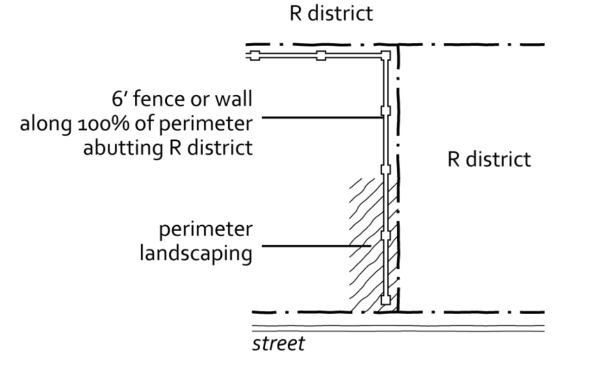
- When a parking lot is located in the interior side or rear yard of a lot abutting an-other lot, parking lot perimeter landscaping must be provided as follows:
- General
- Landscape material used to satisfy the parking lot perimeter landscaping requirements of this Section are subject to the landscape material and design regulations of DGMC Section 28.8.060.
- Parking lot perimeter landscape areas that meet the requirements of this Section may be counted toward satisfying zoning district landscaped open space requirements.
Sec 28.8.030 Parking Lot Interior Landscaping
- Applicability. The parking lot interior landscaping requirements of this Section apply to all of the following:
- the construction or installation of any new surface (open) parking lots containing six (6) or more parking spaces; and
- the expansion of any existing surface (open) parking lot if the expansion would result in six (6) or more total parking spaces, in which case the requirements of this Section apply only to the expanded area.
- Landscape Islands
- Landscape islands must be located at the end of each parking row and within each parking row so that the distance between islands is no greater than twenty (20) parking spaces. See Figure 8-9.
Figure 8-9: Parking Lot Landscape Islands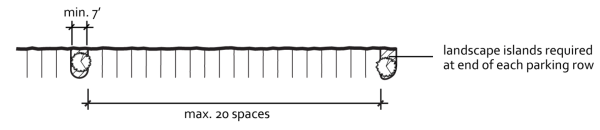
- Landscape islands must be a minimum of one hundred fifty (150) square feet in area when located in a single row of parking spaces and three hundred (300) square feet in area when located within a double row of (face-face) parking spaces. Islands must be at least seven feet (7') in width, as measured from the back of curb to back of curb.
- At least one (1) shade tree must be provided for each one hundred fifty (150) square feet of landscape island, rounded to the nearest whole number.
- Landscape islands must be located at the end of each parking row and within each parking row so that the distance between islands is no greater than twenty (20) parking spaces. See Figure 8-9.
- Landscape Divider Medians
- Landscape divider medians must be provided between at least every three (3) parking modules. Divider medians must be least six feet (6') in width. See Figure 8-10.
Figure 8-10: Parking Lot Landscape Divider Medians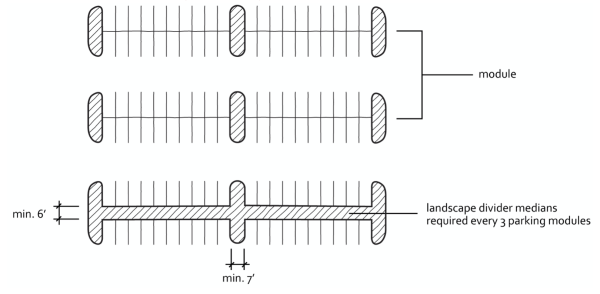
- At least one (1) shade tree must be provided for each forty feet (40') of median length, rounded to the nearest whole number. See Figure 8-11.
Figure 8-11: Tree Planting within Medians
- Landscape divider medians must be provided between at least every three (3) parking modules. Divider medians must be least six feet (6') in width. See Figure 8-10.
- General
- Landscape material used to satisfy the parking lot interior landscaping requirements of this Section are subject to the landscape material and design regulations of DGMC Section 28.8.060.
- All landscaped islands and divider medians must be crowned to provide positive drainage or designed to comply with the Village’s best management practices for stormwater.
- At least fifty percent (50%) of every landscape island and landscape divider median must be planted with live plant material, such as perennials, ground cover, shrubs, or turf grass to a maximum height of thirty inches (30') at maturity.
- Interior landscape islands and divider medians that meet the requirements of this Section that have a surface area of five hundred (500) square feet or more, as measured from the back of curb to back of curb, may be counted toward satisfying zoning district landscaped open space requirements.
Sec 28.8.040 Screening
- Applicability; Features to be Screened. When located on lots occupied by multi-unit residential or nonresidential uses, the following features must be screened from view of public rights-of-way, public open spaces and from lots used or zoned for residential purposes, as specified in this Section:
- ground-mounted mechanical equipment;
- roof-mounted mechanical equipment;
- refuse/recycling/grease containers; and
- outdoor storage of materials, supplies and equipment.
- Ground-mounted Mechanical Equipment. All ground-mounted mechanical equipment over thirty inches (30") in height must be screened from view by a fence, wall, dense hedge, or combination of such features providing at least eighty percent (80%) direct view blocking. The hedge, fence or wall must be at least as tall as the tallest part of the equipment. The hedge must be this tall at the time of planting. See Figure 8-12.
Figure 8-12: Screening of Ground-mounted Equipment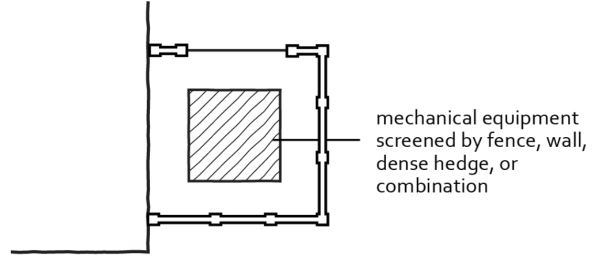
- Roof-mounted Mechanical Equipment. Roof-mounted mechanical equipment (e.g., air conditioning, heating, cooling, ventilation, exhaust and similar equipment, but not solar panels, wind energy or similar renewable energy devices) must be screened from ground-level view in one of the following ways (and as illustrated in Figure 8-13):
- a parapet that is as tall as the tallest part of the equipment;
- a screen around the equipment that is at least as tall as the tallest part of the equipment, with the screen providing at least eighty percent (80%) direct view blocking and which is an integral part of the building’s architectural design; or
- an equipment setback from roof edges that is at least three feet (3') in depth for each one (1) foot of equipment height.
Figure 8-13: Screening of Roof-mounted Equipment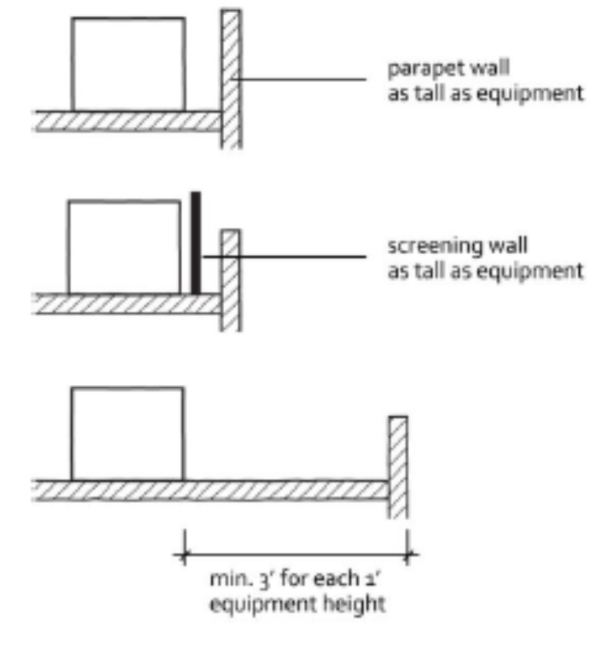
- Refuse/Recycling Containers. Refuse/recycling and similar containers must be located on an appropriately designed concrete or other paving material pad and apron and screened from view of streets and all abutting lots with a wall or other screening material providing at least eighty percent (80%) direct visual screening at least six feet (6') in height. Refuse/recycling containers may not be located in street yards. Enclosure doors must be located and designed so that, to the maximum extent possible, they do not face towards an abutting property, sidewalk, or street. Residential dwellings utilizing curbside pick-up service are exempt from these screening requirements. See Figure 8-14.
Figure 8-14: Screening of Refuse/Recycling Containers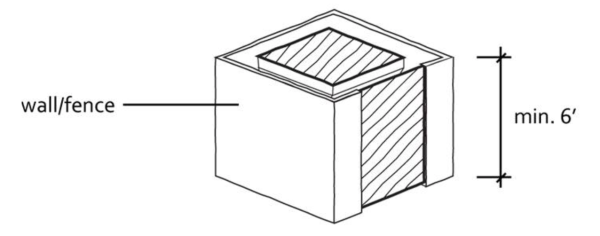
- Outdoor Storage of Materials, Supplies and Equipment. All stored materials, supplies, merchandise, vehicles, equipment, or other similar materials not on display for direct sale, rental or lease to the ultimate consumer or user must be screened by a fence, wall, dense hedge, or combination of such features with a minimum height of eight feet (8') at the time of installation.
- Landscape Materials and Design. Landscape material used to satisfy the screening requirements of this Section must be evergreens and are subject to the landscape material and design regulations of DGMC Section 28.8.060.
(Ord. No. 5706, 7/10/18)
Sec 28.8.050 Landscape Plans
All applications for development and construction activities that are subject to the landscape and screening regulations of this Article must be accompanied by a landscape plan. No building permit or similar authorization may be issued until the Community Development Director determines that the landscaping and screening regulations of this Article have been met.
(Ord. 5706, 7/10/18)
Sec 28.8.060 Landscape Material And Design
- Landscaping with Required Landscape Areas. All required landscape areas must be sodded or seeded with turf grass or appropriate ground cover. Alternatives that comply with the Village’s best management practices for stormwater are also allowed. Areas not required to be covered with live plant material must be covered with organic, biodegradable mulch.
- Existing Trees and Vegetation. Existing non-invasive trees may be counted toward satisfying the landscaping and screening regulations of this Article if they are located within the subject area and they comply with the plant height and size requirements of this Section.
- Plant Selection
- Trees and plants selected for required landscape areas must be well-suited to the microclimate and on-site soil conditions.
- Trees and plant material must comply with the specifications found in American Standards for Nursery Stock (ASNS).
- Invasive species may not be used to meet landscape requirements.
- All plant materials are subject to the approval of the Community Development Director.
- Trees
- Ornamental. Ornamental trees used to satisfy the requirements of this Article must be at least four feet (4') in height at time of installation.
- Shade. Shade trees used to satisfy the requirements of this Article must be a minimum two and one half inch (2.5") caliper at time of installation.
- Shrubs. Shrubs used to satisfy the requirements of this Article must be at least eighteen inches (18") in height at time of installation.
- Ornamental Grasses and Perennials. Ornamental grasses and perennials used to satisfy the requirements of this Article must be at least twelve (12) inches in height at time of installation.
- Curbs and Vehicle Barriers. Landscaped areas in or abutting parking lots must be protected by concrete curbing, anchored wheel stops, or other durable barriers approved by the Community Development Director. Alternative barrier designs that provide improved infiltration or storage of stormwater are encouraged. Curbs protecting landscape areas may be perforated, have gaps or otherwise be designed to allow stormwater runoff to pass through them.
- Installation
- All landscaping must be installed in a sound manner and in accordance with accepted landscape planting practices.
- Newly planted trees may not be staked or guyed unless they are unable to stand upright without support. Any staking and guying materials must be removed within one (1) year of installation.
- Maintenance. The property owner, occupant, tenant and respective agent of each, if any, are jointly and severally responsible for the maintenance and protection of all required landscaping, in accordance with all of the following regulations:
- Landscaping must be kept reasonably free of visible signs of insects and disease and appropriately irrigated to enable landscaping to exist in a healthy growing condition.
- Landscaping must be mowed or trimmed in a manner and at a frequency appropriate to the use of the material and species on the site so as not to detract from the appearance of the general area. Growth of plant material at maturity must be considered where future conflicts such as view, signage, street lighting, utilities and circulation might arise.
- All landscaping must be maintained to minimize property damage and public safety hazards, including removal of invasive species, dead or decaying plant material, and removal of low-hanging branches next to sidewalks and walkways obstructing street lighting.
- All pruning must be done in accordance with ANSI A300 (part 1) “Standards for Tree Care Operations—Pruning.” Tree topping is prohibited. Crown reduction pruning may be used instead to reduce the height of a tree when necessary. Topped trees may not be counted toward tree planting requirements.
- Failure to maintain landscaping is a violation of this ordinance.
(Ord. No. 5706, 7/10/18)
Sec 28.8.070 Alternative Compliance
In order to encourage creativity in landscape and screening design and to allow for flexibility in addressing atypical, site-specific development/redevelopment challenges, the Community Development Director is authorized to approve alternative compliance landscape plans when the Community Development Director determines that one or more of the following conditions are present:
- the site has space limitations or an unusual shape that makes strict compliance impossible or impractical;
- conditions on or adjacent to the site such as topography, soils, vegetation or existing structures or utilities are such that strict compliance is impossible, impractical or of no value in terms of advancing the general purposes of this Article;
- safety considerations such as intersection visibility, utility locations, etc., make alternative compliance necessary; or
- creative, alternative landscape plans will provide an equal or better means of meeting the intent of the landscaping and screening regulations of this Article.
(Ord. No. 5706, 7/10/18)

