
Downers Grove City Zoning Code
ARTICLE 28
VI Supplemental Use Regulations
Sec 28.6.010 Accessory Uses
- General Regulations. The general regulations of this subsection apply to all accessory uses and structures unless otherwise expressly stated.
- Accessory Uses Allowed. Accessory uses and structures are permitted in connection with lawfully established principal uses.
- Accessory Use Determinations. The Community Development Director is authorized to determine when a use, building or structure meets the criteria of an accessory use or accessory structure. In order to classify a use or structure as “accessory” the Community Development Director must determine that the use or structure:
- is subordinate and clearly incidental to the principal structure or principal use served in terms of area and function;
- provides a necessary function for or contributes to the comfort, safety or convenience of occupants of the principal use; and
- is customarily found in association with the subject principal use or principal structure.
- Time of Construction and Establishment
- Accessory uses may be established only after the principal use of the property is in place, unless approved in accordance with the special use procedures of DGMC Section 28.12.050.
- Accessory buildings may be established in conjunction with or after the principal building. They may not be established before the principal building is in place.
- Location. Accessory uses and structures must be located on the same lot as the principal use to which they are accessory, unless otherwise expressly stated.
- Accessory Buildings and Structures
- Applicable Regulations and Standards. Accessory buildings and structures are subject to the same regulations and standards that apply to principal uses and structures on the subject lot, unless otherwise expressly stated. Accessory buildings attached to the principal building by a breezeway, passageway or similar means are subject to the building setback regulations that apply to the principal building.
- Building Separation. Accessory buildings must be separated by a minimum distance of ten feet (10') from the principal building on the lot, unless the accessory building is located entirely within the principal building setbacks, in which case no separation is required.
- Residential Accessory Buildings. The following additional regulations apply to buildings that are accessory to (principal) residential uses:
- Accessory buildings are prohibited in street yards.
- No more than three (3) detached accessory buildings are allowed on any lot.
- The aggregate footprint or coverage of all accessory buildings on a lot may not exceed one thousand (1,000) square feet or the gross floor area of the principal building, whichever is less.
- Residential accessory buildings in the R-4 district are subject to minimum side and rear setbacks of five feet (5'). In all other R districts, the minimum side and rear setback for accessory buildings is six feet (6').
- Residential accessory buildings may not occupy more than forty percent (40%) of the corner, rear or side yard area.
- Residential accessory buildings may not exceed twenty-three feet (23') in height, as measured to the highest point on the building.
- Residential accessory buildings and structures are permitted in corner yards, as specified in Table 14-1 within DGMC Section 28.14.100.
- A building is not considered accessory if it is connected to the principal structure with a foundation and a covered access walkway.
- Nonresidential Accessory Buildings. The following additional regulations apply to buildings that are accessory to (principal) nonresidential uses:
- Accessory buildings are prohibited in street setbacks.
- Accessory buildings are subject to the lot and building regulations of the subject zoning district.
- Accessory Structures on Rooftops. The following accessory structures are permissible on a flat roof: arbors, decks, gazebos, hot tubs, pergolas, sports courts, swimming pools and trellis provided all of the following three (3) items are met:
- In combination, all accessory structures that exceed the height of the parapet may not exceed forty percent (40%) of the total rooftop area (as measured from the interior face of the parapet).
- The maximum height may not exceed twelve feet (12') above the top of the roof structure.
- All accessory structures that exceed the height of the parapet wall must be setback a minimum of one and one half (1.5) times the height of the difference between the height of the accessory structure and the top of the parapet wall.
- In combination, all accessory structures that exceed the height of the parapet may not exceed forty percent (40%) of the total rooftop area (as measured from the interior face of the parapet).
- Air Conditioning Units
- Air conditioning units and generators, excluding window AC units, are prohibited in street yards.
- Air conditioning units and generators, excluding window AC units, must be set back from side and rear lot lines as indicated in Table 6-1.
Table 6-1: AC Unit SetbacksDistrict Minimum Side and Rear Setback (feet) R-1 10 R-2 7 R-3, R-5, R-5A and R-6 6 All other 5
- Antennas
- Satellite Dish Antenna
- Satellite dish antennas up to one (1) meter (39.4 inches) in diameter are permitted as accessory structures in all districts. They are subject to accessory structure setback standards.
- Satellite dish antennas over one meter in diameter, up to three (3) meters (118.2 inches) in diameter, are permitted as accessory structures in all nonresidential districts, subject to accessory structure setback standards.
- Satellite dish antennas may be erected on the roof or attached to a principal building, provided the maximum height of the installation does not exceed the maximum allowable height of the subject district or more than fifteen feet (15') above the top of the building on which it is to be located, whichever is less.
- Satellite dish antennas not expressly allowed under this section may be approved as a special use in accordance with the procedures of DGMC Section 28.12.050.
- Amateur Radio Facilities
- Amateur radio facilities are subject to a maximum overall height limit of sixty-five feet (65'). Special use approval to exceed sixty-five feet (65') in height may be granted in accordance with DGMC Section 28.12.050 if the Village Council determines, based on evidence provided by the applicant, that the additional height is the minimum needed to engage in amateur radio communications under a license issued by the FCC.
- Antennas and supporting electrical and mechanical equipment must be of a neutral color that is identical to, or closely matching the color of the supporting structure, in order to make the antenna and related equipment as visually unobtrusive as possible.
- Microcell Networks
- The Community Development Director may authorize installation of cable microcell networks that operate through the use of multiple low-powered transmitters/receivers attached to existing wireline systems, such as conventional cable or telephone wires, or similar technologies that do not require the use of telecommunications towers.
- Signal transmissions may not interfere with any Village or other governmental radio signals, including those Village, police, fire, emergency dispatch and public works signals.
- Satellite Dish Antenna
- Donation Drop Boxes.
- Authorization of Use: Donation drop boxes may only be placed on properties zoned B-1, B-2, B-3, O-R, O-R-M, M-1, M-2, INP-1 and INP-2.
- Permit Requirement: A permit shall be obtained prior to the placement of a donation drop box outside of the principal building in the village. Applications for a permit to construct or locate a donation drop box shall include, in addition to any requirements contained in this code, the following documents:
- Proof of ownership or authorization from the property owner or authorized representative of the property upon which the donation drop box is to be located.
- A site plan drawn to scale of the lot upon which the donation drop box is to be located, showing thereon the proposed location of donation drop box.
- Plans and specifications of the donation drop box including the dimensions (height, width, depth) of the box, elevations, configuration, foundation and any additional information that may be requested by the Community Development Director.
- Number per Lot: Only one (1) donation drop box shall be permitted per lot or per shopping center, whichever is more restrictive.
- Location: Donation drop boxes shall be located within a parking lot or other paved surface, but in no case shall donation drop boxes be located in the following locations:
- Within a required street or corner setbacks areas.
- Designated driveway or drive aisle.
- Within five feet (5') of a fire hydrant.
- Designated pedestrian crosswalk.
- Private sidewalk unless at least five feet (5') of clearance can be maintained.
- Any parking space as required by DGMC or any ordinance or resolution governing the development of a property, or any parking space as deemed necessary by the Community Development Director. When a single lot is part of a larger planned development with shared parking, the required parking shall be determined based on the total required parking approved for the entire development.
- Any location in such a manner as to cause a sight obstruction for pedestrians or motorists.
- Any public right of way.
- Height and Size: A donation drop box shall not exceed a maximum of seven feet (7') in height and twenty-five (25) square feet in ground area.
- Required Information: Signage on donation drop boxes shall not exceed five-inch (5") letter height. All donation boxes shall contain the following contact information in two-inch (2") type visible from the front of the box: the name, address, email, and phone number of both the permittee and operator.
- Maintenance: Donation drop boxes shall be maintained in good condition and appearance with no structural damage, holes, or visible rust and shall be free of graffiti. All boxes shall be free of debris and shall be serviced regularly so as to prevent overflow of donations or the accumulation of debris or other material. All donations shall be placed within the donation drop box. No donations may be left outside of the donation drop box.
- Upon telephone and/or email notification from the Village that materials are being placed outside of the donation drop box, the donation drop box owner shall have twenty-four (24) hours to remove said materials. Failure to do so may result in penalties listed under DGMC Section 28.13.020 and/or revocation of permit. Three (3) violations of this Section shall result in immediate revocation of the permit.
- Revocation of Permit: Any permit granted pursuant to the provisions of this Section may be subject to revocation for cause by the Community Development Director (or his/her designee), including, but not limited to the failure to comply with this Section or any other applicable provisions of the DGMC. Upon revocation of the permit the donation drop box shall be removed immediately.
- Electric Vehicle Charging Stations
- General
- Private (restricted-access) electric-vehicle (EV) charging stations are permitted as accessory uses in all zoning districts.
- Public electric vehicle charging stations are permitted as accessory uses to al-lowed nonresidential uses in all zoning districts.
- Parking
- Electric vehicle charging stations may be counted toward satisfying minimum off-street parking space requirements.
- Public electric vehicle charging stations must be reserved for parking and charging electric vehicles.
- Equipment. Vehicle charging equipment must be designed and located so as to not impede pedestrian, bicycle or wheelchair movement or create safety hazards on sidewalks. Equipment is subject to the lot and building regulations of the subject zoning district unless otherwise expressly stated.
- Maintenance. Electric vehicle charging stations must be maintained in all respects, including the functioning of the equipment. A phone number or other contact information must be provided on the equipment for reporting when it is not functioning or when other problems are encountered.(
- General
- (i) Extended Family Accessory Housing
- Where Allowed. Extended family accessory housing units may be approved in R-1, R-2, R-3 and R-4 districts, in accordance with the special use procedures of DGMC Section 28.12.050.
- Location. An extended family accessory housing unit must be located within the principal detached house. It may not be located in an accessory structure.
- Regulations. Approved extended family accessory housing units are subject to all of the following regulations.
- Only one (1) extended family accessory housing unit is allowed within any detached house.
- A separate exterior entrance may be added to serve an extended family accessory housing unit, provided that the door does not face the street.
- The principal dwelling unit or the extended family accessory housing unit must be occupied by the legal or beneficial owner of the subject lot.
- Only persons related by blood, marriage, or adoption to the occupants of the primary unit may occupy the extended family accessory housing unit. Further, at least one (1) of the units—the principal dwelling unit or the extended family accessory housing unit—must be occupied by a person either sixty-two (62) years of age or older or by a person with a physical or developmental disability that renders joint occupancy of the detached house medically necessary, beneficial, or desirable. Applicants for special use approval for extended family accessory housing have the burden of proving that such physical or developmental condition renders the joint occupancy of the detached house medically necessary, beneficial or desirable. Special use approval for any extended family accessory housing unit will remain valid and in effect only such period of time as the occupancy requirements of this Section are met.
- No additional roomers or boarders are allowed in any detached house occupied by an extended family accessory housing unit.
- Detached houses containing extended family accessory dwelling unit must retain the appearance of a detached house. Floor plans and other specifications must be submitted and approved at the time of special use approval. Occupancy of an extended family accessory housing unit is subject to compliance with an approved floor plan for construction or conversion of the principal and accessory units, and to elevation drawings depicting the exterior appearance of the principal dwelling.
- All owners of any extended family accessory housing dwelling are required to permit an annual inspection of the premises to assure continuing compliance with the requirements of this Section, and to submit to the Village on or before January 31 of each year a sworn affidavit certifying continued compliance with these regulations. The affidavit must identify all owners and the occupants of the principal and accessory units and their relationship to one another. Failure to maintain compliance with these regulations or failure to file the required affidavit will result in lapse of approval of the special use on the thirtieth (30th) day following notice of noncompliance, unless within that 30-day period, the owner of the extended family accessory housing unit remedies any defects causing noncompliance and obtains village approval that compliance has been established.
- Special use approval for an extended family accessory housing unit will also lapse and be of no further effect if the owner occupying one (1) of the units transfers his or her interest to any other person or ceases to occupy the unit, unless the transfer is to a person who meets all applicable criteria and the Village is notified of the transfer, or unless the village approves a new special use for the extended family accessory housing unit.
- Within one hundred twenty (120) days of any expiration of special use approval for an extended family accessory housing unit, the property must be converted to a detached house (that does not contain an accessory housing unit) pursuant to reconversion plans submitted at the time of application for special use approval, unless the reconversion period is extended by the community development director for just cause shown.
(f)(ii) Extended Family Accessory Housing in the Fairview Transitional (FT) Zoning District: Notwithstanding anything in subsection (f)(i) above, to the contrary, the following general extended family accessory housing regulations, apply to properties located in the FT district.
- (1) Where Allowed. Extended family accessory housing units are permitted in the FT district.
- (2) Location. An extended family accessory housing unit may be located within the principal or accessory structure.
- (3) Regulations. Approved extended family accessory housing units are subject to all of the following regulations.
- a. Only one (1) extended family accessory housing unit may be located on a single lot of record.
- b. A separate exterior entrance may be added to a principal detached house to serve an extended family accessory housing unit, provided that the door does not face the street.
- c. The principal dwelling unit or the extended family accessory housing unit must be occupied by the legal or beneficial owner of the subject lot.
- d. Only persons related by blood, marriage, adoption, or civil union to the occupants of the primary unit may occupy the extended family accessory housing unit.
- e. No additional roomers or boarders are allowed in any principal or accessory structure occupied by an extended family accessory housing unit.
- f. Detached houses containing extended family accessory dwelling units must retain the appearance of a detached house.
- g. Floor area devoted to the extended family accessory housing unit located within the principal structure may not exceed forty percent (40%) of the floor area of the primary structure or one thousand (1,000) square feet, whichever is less. Within an accessory structure the floor area devoted to the extended family accessory housing unit may not exceed one thousand (1,000) square feet. See DGMC 28.6.010 for additional regulations on residential accessory buildings.
(g) Fences. See DGMC Section 28.10.010.
(h) Flag Poles. Flag poles must be setback from lot lines a minimum distance equal to the height of the pole and sited so the flag will not extend beyond any lot line. See Figure 6-1.
Figure 6-1: Flag Pole Setback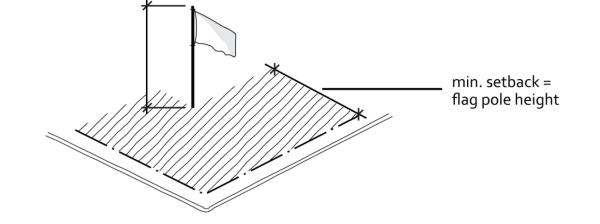 (i) Garages
- Only one (1) detached garage and one (1) carport are allowed per lot in R zoning districts.
Dwelling units are expressly prohibited in the space above any detached garage in all zoning districts, except for the Fairview Transitional District (FT) zoning district.
See Figure 6-2.
Figure 6-2: Space Above Detached Garage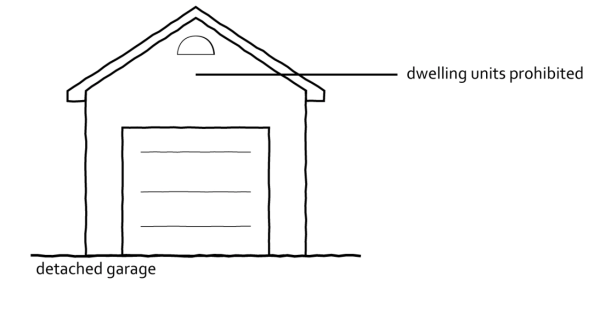 (j) Geothermal Energy Systems
- General. Geothermal energy systems are permitted as an accessory use in all zoning districts.
- Location
- Geothermal energy systems must be located entirely within the lot lines of the subject property excluding public easements.
- No portion of a geothermal energy system may be located within a stream, required riparian buffer or no-disturbance area.
(k)(i) Home Occupations. Home occupations are allowed as an accessory use to an allowed household living use, subject to the regulations of this Section.
(1) Day care homes are not regulated as home occupations and are exempt from the home occupation regulations of this Section. Day care homes are allowed as indicated in DGMC Section 28.5.010. Supplemental regulations applicable to day care homes can be found in DGMC Section 28.6.030.
(2) The operator of a home occupation must be a full-time resident of the dwelling unit, and no more than one (1) non-resident may be employed on the premises.
(3) Floor area devoted to the home occupation may not exceed twenty-five percent (25%) of the floor area of the dwelling or four hundred (400) square feet, whichever is less.
(4) The home occupation must be conducted entirely within the dwelling and not from a detached or attached garage or other accessory structure. Equipment, materials, samples and vehicles incidental to the home occupation may be stored in a detached or attached garage or other accessory structure, provided that the business activity is confined to the dwelling.
(5) The home occupation may not involve the sale of goods that are stored and delivered to the buyer on the lot, except as incidental to a permitted service. For the purposes of this provision, the term “sale of goods” does not include the sale of household goods in what is commonly known as a garage sale, provided such sales last for a period no longer than four (4) consecutive days and are held no more than four (4) times in any calendar year.
(6) There shall be no visible evidence of the conduct of a home occupation when viewed from the street or right-of-way or from an adjacent lot. There may be no change in the exterior appearance of the dwelling unit that houses a home occupation or site upon which it is conducted that will make the dwelling appear less residential in nature or function. Examples of such prohibited alterations include parking lots, or adding commercial-like exterior lighting.
(7) No exterior displays or signs are allowed, except for a single sign that complies with the regulations of DGMC Section 28.9.070(b).
(8) No outdoor storage of equipment or materials used in connection with the home occupation are allowed.
(9) No equipment or process shall be used in a home occupation that creates noise, vibration, glare, fumes, odors, or electrical interference detectable to the normal senses off the lot. In the case of electrical interference, no equipment or process may be used that creates visual or audible interference in any radio or television receivers off the premises, or causes fluctuations in line voltage off the premises
(10) The home occupation may not involve regular receipt or delivery of merchandise, goods or equipment by any motor vehicle bearing a Division of Motor Vehicles License Class “C” or higher.
(11) The home occupation may not result in the simultaneous presence on the subject lot and the adjoining street of more than three (3) motor vehicles in excess of the number of vehicles attributable to the residential use of the premises.
(12) If there is more than one (1) home occupation within the dwelling, the regulations of this Section apply to the sum total of the activity related to such home occupations.
(13) All of the following uses are expressly prohibited as home occupations:
- animal hospitals, veterinary clinics and kennels;
- eating and drinking establishments;
- retail sales;
- business or commercial storage of recreational vehicles, mobile homes, vehicles or mechanical equipment;
- funeral and mortuary services;
- manufacturing;
- medical or dental offices; and
- automobile, truck or large appliance repair.
(k)(ii) Home Occupations in the Fairview Transitional (FT) Zoning District
In addition to the regulations provided for in subsection (k)(i) above, home occupations in the FT zoning district are also subject to the following regulations. When in conflict with the general home occupation regulations in subsection (k)(i), the FT regulations contained in this subsection shall supersede.
(1) The operator of a home occupation must be a full-time resident of the principal residential structure.
(2) No more than three (3) non-resident employees may be on the premises at any time.
(3) The home occupation may be conducted in the principal structure or in an accessory structure.
(4) Floor area devoted to the home occupation located within the primary structure may not exceed forty percent (40%) of the floor area of the primary structure or one thousand (1,000) square feet, whichever is less. Within an accessory structure the floor area devoted to the home occupation may not exceed one thousand (1,000) square feet. See DGMC 28.6.010 for additional regulations on residential accessory buildings.
(l) Retail Sales Kiosks and Vending Machines. Retail sales kiosks and vending machines are allowed only if located entirely within an enclosed building or underneath a weather-protected canopy connected to the principal building. See Figure 6-3.
Figure 6-3: Vending Machine and Kiosk Location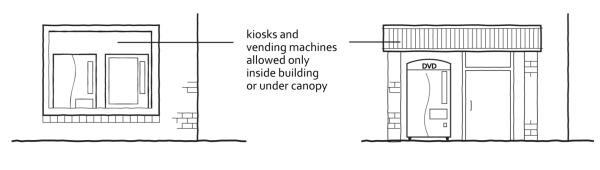
(m) Solar Energy Systems
- General
- Accessory solar energy systems must comply with all applicable building and electrical code requirements.
- Owners of accessory solar energy systems are solely responsible for negotiating with other property owners for any desired solar easements to protect access to sunlight. Any such easements must be recorded with the county recorder of deeds.
- Building-Mounted Solar Energy Systems
- Building-mounted solar energy systems may be mounted on principal and accessory structures. The below regulations apply to solar energy systems on both principal and accessory structures.
- All applicable setback regulations apply to building-mounted solar energy systems. Systems mounted on principal structures may encroach into interior side and rear setbacks in accordance with DGMC Section 28.14.100(b). Additionally, building-mounted solar energy systems may be installed up to the lawfully established building line of a principal structure, in cases where homes lawfully encroach into the required yard setback.
- Only building-integrated and/or flush-mounted solar energy system may be installed on street-facing building elevations and may not extend further than the lawfully established street facing building line of the principal structure.
- Solar energy systems may not extend more than three feet (3') above the applicable maximum building height limit for the subject building type or more than five feet (5') above the highest point of the roof line, whichever is less. See Figure 6-4.
Figure 6-4: Maximum Solar Panel Height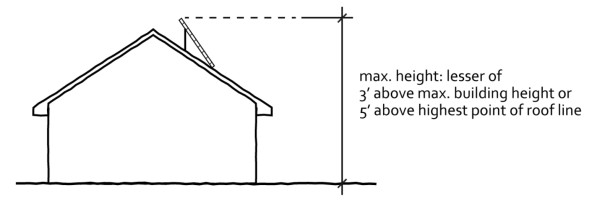
- Ground-Mounted Solar Energy Systems
- In residential zoning districts, ground-mounted solar energy systems may not be located in a required street setback or street yard.
- Ground-mounted solar energy systems may encroach a maximum of two feet (2') into the required interior side setbacks and ten feet (10') into the required rear setbacks.
(n) Swimming Pools. The regulations of this Section apply to private, accessory swimming pools in residential zoning districts. See Figure 6-5.
- A barrier (fence, wall, structure wall, or combination thereof) must be erected around swimming pools, as required by the building code and other applicable ordinances.
- Swimming pools are prohibited in street yards.
- Swimming pools must be set back at least ten feet (10') from side and rear lot lines in the R-1 and R-2 districts and at least seven feet (7') from side and rear lot lines in all other R districts.
- In-ground swimming pools may not be located closer than ten feet (10') to any principal structure unless engineering plans for protecting the principal structure’s foundation are submitted to and approved by the village.
Figure 6-5: Required Barrier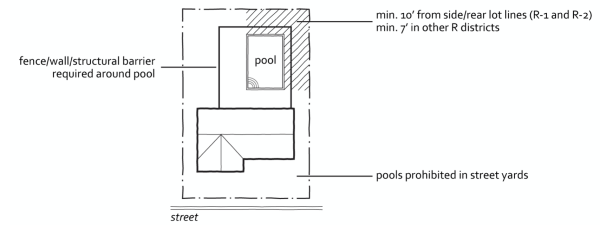
(Ord. No. 5804, 12/17/19; Ord. No. 5706, 7/10/18)
Sec 28.6.020 Adult Entertainment Establishments
Adult entertainment establishments are subject to licensing regulations in Chapter 8 of this Code and the following regulations:
- Except when separated by right-of-way of the Illinois Toll Highway Authority, an adult entertainment establishment may not be located within one thousand feet (1,000') of any R zoning district, or, for property located beyond the corporate limits of the Village, that is zoned for residential use pursuant to the zoning regulations of the governmental entity having jurisdiction. This separation distance requirement does not apply to any of the following:
- property owned, maintained and used by the Village and used for any water tower or fire station;
- property owned, maintained and used by the Forest Preserve District of DuPage County; or
- property owned, maintained and used as part of the Morton Arboretum.
- Except when separated by right-of-way of the Illinois Toll Highway Authority, an adult entertainment establishment may not be located within one thousand feet (1,000') of a religious assembly use, a school or another adult entertainment establishment.
- For the purposes of this Section, separation distances are measured in a straight line, without regard to intervening structures or objects, from the nearest portion of the structure occupied by an adult entertainment establishment, to the nearest lot line of a lot occupied by a religious assembly use or school, or to the nearest boundary of a residentially-zoned lot. See Figure 6-6. The distance between adult entertainment establishments is measured in a straight line, without regard to intervening structures or objects, from the nearest exterior wall of the structure in which each business is located. See Figure 6-7.
Figure 6-6: Required Separation from Protected Uses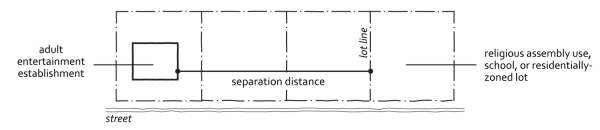
Figure 6-7: Required Separation between Establishments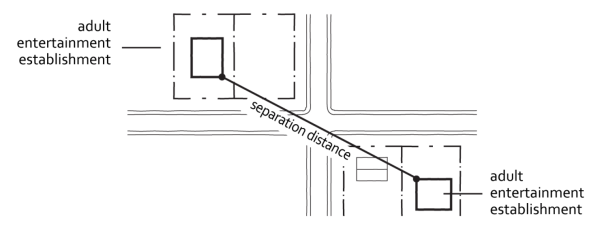
Sec 28.6.030 Day Care
- Day care centers and day care homes must be licensed by the State of Illinois under the Illinois Child Care Act (225 ILCS 10/2.09) or other applicable statute.
- Day care homes and day care centers for children in R districts must include an outdoor play area, fenced and screened from view from adjoining properties, with a minimum of two hundred fifty (250) square feet of outdoor play area for each child at the facility, based on maximum enrollment of the day care facility.
- Day care centers for children located in nonresidential districts must include an outdoor play area, fenced and screened from view from adjoining properties, with a minimum of seventy-five (75) square feet of outdoor play area for each child in the play area at any one time.
Sec 28.6.040 Fueling Stations
Fueling stations are subject to the following regulations:
- Setbacks
- Interior side and rear setbacks with a minimum depth of twenty feet (20') must be provided abutting R-zoned lots. Setbacks abutting all other lot lines must comply with district requirements.
- Except for approved driveways and drive aisles, setbacks may not be paved and must be landscaped green space.
- Protective Curb. All landscaped areas must be protected by a raised curb at least six inches (6") in height or by a bumper guard of not more than eighteen inches (18") in height. Protective curbing at least six inches (6") in height must be provided along the edges of all areas accessible to motor vehicles upon adjacent property or street rights-of-way, except that provision may be made for cross-access to abutting commercial development.
Sec 28.6.050 Group Homes
Group homes are subject to the following regulations:
- Small Group Homes. Group homes for eight (8) or fewer persons, including supervisory and oversight personnel, are permitted as of right in all districts that allow household living uses as of right, subject to the following regulations:
- The use must occupy a detached house, which is consistent in type and general outward appearance with other detached houses in the surrounding area.
- The facility must be operated by a governmental, religious or other not-for-profit agency.
- Occupancy may not exceed one (1) person per room, where “room” means a whole room used for living purposes, including living rooms, dining rooms, kitchens, bedrooms, furnished recreation rooms and enclosed porches suitable for year-round use, but not including strip or Pullman kitchens, bathrooms, open porches, balconies, halls, half-rooms, utility rooms, unfurnished attics, unfinished basements or unfinished storage spaces.
- A copy of the State license or certification for the group home, if a State license or certification is required it must be provided to the Village.
- Each proposed small group home must be separated by a minimum distance of five hundred feet (500') from any existing group home, as measured in a line from the nearest point of a lot line occupied by a group home to the nearest point of a lot line occupied by a group home.
- An inspection must be conducted by the Community Development Department to ensure that existing building code requirements for residences are met prior to any occupancy or re-occupancy.
- Small group home uses may not include any formalized counseling for persons other than the residents of the group home and may not include any formalized medical treatment other than physical or occupational therapy for residents only.
- Small group home uses may not be any type of “long-term care facility,” as defined in 210 ILCS 45/1-113.
- In order to implement these requirements, a statement of the number of proposed occupants, a copy of the necessary licenses or certificates, if any are required, a floor plan depicting the number, size and location of rooms, and a site plan must be submitted at the time of application for an occupancy permit.
- Large Group Homes. Group homes for homes for nine (9) or more persons, including supervisory and oversight personnel are subject to small group home regulations of DGMC Section 28.6.050(a) and the following:
- In order to grant special use approval for a large group home use, the Village Council must determine that cumulative effect of the use and its operation will not alter the residential character of the neighborhood, will not create an institutional setting and will not have an adverse effect on surrounding properties.
- The applicant must submit a statement describing the exact nature of the facility and its proposed occupants, the qualifications of the agency that will operate the facility, the number and type of personnel who will be employed and the number of residents who will occupy the facility.
Sec 28.6.060 (Repealed) Medical Cannabis Cultivation Centers And Dispensing Organizations
Sec 28.6.070 Massage Therapy
Massage Therapy establishments are subject to compliance with Chapter 8 of this Code and the following regulations:
- Except when separated by right-of-way of the Illinois Toll Highway Authority, a massage or massage therapy establishment may not be located within one thousand feet (1,000') of any R zoning district, or, for property located beyond the corporate limits of the Village, that is zoned for residential use pursuant to the zoning regulations of the governmental entity having jurisdiction. This separation distance requirement does not apply to any of the following:
- property owned, maintained and used by the Village and used for any water tower or fire station;
- property owned, maintained and used by the Forest Preserve District of DuPage County; or
- property owned, maintained and used as part of the Morton Arboretum.
- Except when separated by right-of-way of the Illinois Toll Highway Authority, a massage or massage therapy establishment may not be located within one thousand feet (1,000') of a religious assembly use, a school or another massage therapy establishment.
- For the purposes of this Section, separation distances are measured in a straight line, without regard to intervening structures or objects, from the nearest portion of the structure occupied by a massage therapy establishment, to the nearest lot line of a lot occupied by a religious assembly use or school, or to the nearest boundary of a residentially-zoned lot. The distance between massage therapy establishments is measured in a straight line, without regard to intervening structures or objects, from the nearest exterior wall of the structure in which each business is located.
Sec 28.6.080 Nursing Homes/Sheltered Care Facility
Nursing homes in R districts are subject to the following regulations:
- Building. Facilities must be located in buildings that were originally designed and constructed for use as a nursing home/sheltered care facility.
- Lot Area. Nursing homes/sheltered care facilities must be located on lots with an area of at least five (5) acres, except that the lot may contain less than five (5) acres but not less than two (2) acres if any part of such lot is contiguous to or directly across a street or alley from a zoning district other than R-1, R-2, R-3 or R-4.
- Building Coverage. No more than twenty-five percent (25%) of the lot area may be occupied by buildings.
- Setbacks
- Buildings must be set back at least fifty feet (50') from all lot lines.
- No off-street parking area may be located within thirty feet (30') of any interior side or rear lot line abutting R-zoned property.
- Landscaping and Screening. All outdoor recreation, outdoor parking or rehabilitation areas must be screened from view by a wall, fence or densely planted, evergreen hedge not less than four feet (4') and no more than six feet (6') in height. All parking designated in accordance with DGMC Section 28.7.100 shall be screened in accordance with Article 8 of this Chapter.
- Vehicle Access. Facilities for vehicular access to the lot must be designed so as not to interfere with normal traffic movement.
- Rehabilitation Therapy Services. Rehabilitation therapy and similar services may be provided for residents, and as an accessory use for others who do not require hospital services or admission to a nursing home. Rehabilitation therapy may include physical, speech, occupational or similar types of therapy for patients who, through injury or disease, require rehabilitation services to recover, function, or make adaptation in one or more basic life abilities, such as speech, ambulation, short-term memory, personal grooming, simple house-keeping, or motor skills. For non-residents, rehabilitation therapy does not include treatment for mental illness, alcohol or substance abuse, maternity or communicable diseases. Off-street parking requirements for any floor area devoted to accessory rehabilitation therapy or services must be based on the parking requirements for medical office use.
Sec 28.6.090 Offices
Office uses in R districts are subject to the following regulations:
- Office uses may be approved as a special use in an R district only if located on lots that abut property zoned as B-1, B-2, or B-3 or lots occupied by existing office uses.
- The entire building to be occupied by the office use must be located within one hundred fifty feet (150') of the B-1, B-2 or B-3 zoning district or within one hundred fifty feet (150') of the lot occupied by the existing office use.
- The lot to be occupied by the office use must have street frontage on the same street as the B-1, B-2 or B-3 zoned lot or on the same street as the lot occupied by the existing office use. See Figure 6-8.
Figure 6-8: Office Use in R District (R lot must be within one hundred fifty feet (150’) of B district and front on same street as B)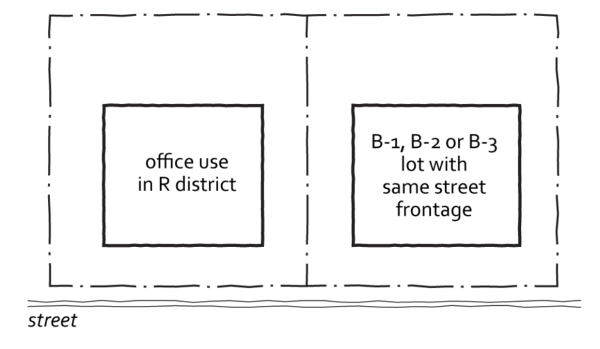
- The lot and building to be occupied by the office use must have frontage on a collector or arterial street.
- As part of the special use application, a site plan must be submitted depicting the location of all structures, any landscaping and/or off-street parking provided.
- Elevation drawings must also be submitted depicting the design of the building to be located on the site. Building designs must be consistent with or complimentary to residential buildings in the area.
Sec 28.6.100 Personal Vehicle Repair And Maintenance
Personal vehicle repair and maintenance uses are subject to the following regulations:
- Repair and service activities must be conducted within a completely enclosed building.
- No outdoor storage is allowed, except for customer vehicles waiting to be repaired or waiting for pick up.
- All repair and maintenance activities must be screened with a solid fence or wall with a minimum height of six feet (6') and a maximum height of eight feet (8').
Sec 28.6.110 Recyclable Material Drop-Off Facilities
Recyclable material drop-off facilities are subject to the following regulations:
- Location and Area
- Drop-off, collection and storage area locations are restricted to those shown on a site plan approved by the Village Council as a condition of approval. Any area outside of a building may not exceed two thousand (2,000) square feet in area.
- Except where separated by right-of-way of the Illinois Toll Highway Authority, a recyclable material drop-off facility may not be located within one thousand three hundred twenty feet (1,320') of any R zoning district, or, for property located beyond the corporate limits of the Village, that is zoned for residential use pursuant to the zoning regulations of the governmental entity having jurisdiction. This separation distance requirement does not apply to property owned, maintained and used by the Village and used for any water tower or fire station. Measurement of separation distance requirements must be made in a straight line, without regard to intervening structures or objects, from the nearest portion of the lot used as a part of the premises where a recycling, collection facility is conducted, to the nearest lot line of a lot zoned residential and used as residential property. See Figure 6-9.
Figure 6-9: Recycling Facility Separation from Residential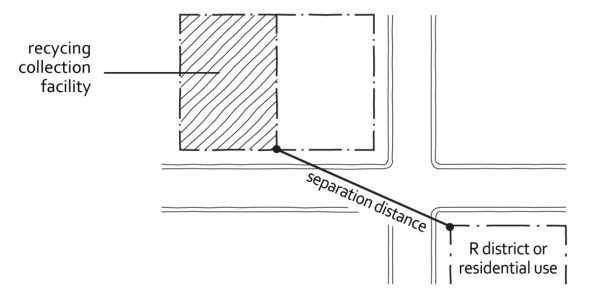
- Ownership. The organization or corporation operating the facility must file with the Community Development Department the name and address of its current registered agent or other person responsible for receiving notices on behalf of the operator. Any other provision of this zoning ordinance notwithstanding, the applicant for the special use may be a lessee or licensee, provided that proof of the property owner's permission for such use accompanies the application.
Sec 28.6.120 Religious Assembly
- Location Criteria. Religious assembly uses may be approved as a special use in an R district only if located on lots:
- that have frontage on an arterial or collector street; or
- that abut a B, M, or O-R-M zoning district on at least one side.
- Lot and Building Regulations
- The maximum allowed building coverage on lots occupied by religious assembly uses is forty percent (40%). All other lot and building regulations of the subject zoning district apply.
- Modifications of applicable lot and building regulations may be approved as part of the special use approval process if the village council determines that strict compliance with applicable lot and building regulations substantially burdens the exercise of religion, except that no modification is allowed if the Village Council determines that the burden: (1) is in furtherance of a compelling governmental interest and (2) is the least restrictive means of furthering that compelling governmental interest.
- In the event that a substantial burden (on the exercise of religion) is claimed, the applicant for religious assembly special use approval must submit materials and evidence describing:
- the alleged burden in detail, including why such burden is of such a substantial nature so as to justify modification of the zoning regulations;
- efforts employed by the applicant to avoid or reduce the burden;
- the minimal modification requested to avoid or reduce the burden;
- any adverse impacts of the requested modification on the area involved and efforts to reduce such impact; and
- other information or factors the applicant may deem relevant or as requested by the Community Development Director, the Plan Commission or the Village Council related to the alleged burden or requested modification.
- If the Village Council determines that there is a substantial burden, and that the regulation at issue is not in furtherance of a compelling governmental interest or is not the least restrictive means of furthering that compelling governmental interest, the Plan Commission may recommend and the Village Council may authorize modification of the lot and building regulations of the subject zoning district, subject to the following:
- The modification must be the smallest adjustment needed so that the regulation no longer substantially burdens the exercise of religion.
- The modification may be permitted only to the extent that and for the period of time that, the lot is used for religious assembly purposes. A covenant must be recorded with the DuPage County recorder of deeds, in a form acceptable to Village Attorney, stating that the property owner will bring the property into compliance with the affected regulation when the property ceases to be used for religious assembly uses.
- Conditions and restrictions may be imposed as appropriate to mitigate any adverse impact of the modification.
Sec 28.6.130 Self-Service Storage Facilities
Self-service storage facilities are subject to the following regulations:
- Location. The subject lot may not have more than one boundary abutting an R district.
- Landscaping. Portions of the site not occupied by buildings or paving must be landscaped in accordance with a landscape plan approved by the Village.
- Screening. Any portion of the site abutting an R district must be visually screened from the R zoned area by an eight foot (8') fence.
- Outdoor storage. No outdoor storage is allowed, and all refuse and garbage must be stored inside a building or in areas that are completely screened from view.
- Driveways. All driveways and parking areas must be paved.
- Security. The site must be completely fenced and accessed via a locked security gate.
Sec 28.6.140 Temporary Real Estate Offices
- General. The Community Development Director is authorized to issue a temporary use permit to allow a temporary real estate offices in any zoning district. Temporary real estate offices, where allowed, may be used for sales office purposes in connection with the construction, sales, or rental structures or for building construction activities in conjunction with an ongoing and permitted development or construction project.
- Application. A written application for a temporary real estate sales office permit must be submitted to the Community Development Director. The application must be signed by the owner of the subject lot and describe in detail the purpose, use and location of the proposed office. The application must be accompanied by an express agreement by the owner to discontinue the temporary real estate office use immediately upon the expiration or cancellation of the permit.
- R-1, R-2, R-3 and R-4 Districts. Temporary real estate sales offices in R-1, R-2, R-3 and R-4 zoning districts are subject to the following regulations:
- No more than twenty-five percent (25%) of the gross floor area of a dwelling may be used for sales office purposes. The remainder of the building may be used for displaying styles of architecture, construction work, interior decoration and similar matters related to real estate sales.
- Sales of lots or structures outside of the subject subdivision are prohibited, except that sales involving lots in an adjacent subdivision under the same ownership and control as the subject subdivision are allowed.
- No sales office is permitted for residential subdivisions containing fewer than ten (10) lots.
- In any subdivision in which more than one builder or general contractor is offering to construct residential buildings, a separate sales office may be maintained by each such general builder or contractor, provided that there may not be more than one sales office for ten (10) lots in the subdivision, and in no event may there be more than five (5) total sales offices in any single subdivision.
- Permits for temporary sales offices cease and terminate automatically with no further action on behalf of the Village, when: (i) building permits for eighty-five percent (85%) or more of the total number of lots in the subject subdivision have been issued by the Village, or (ii) fewer than six (6) lots remain in the subdivision for which building permits have not been issued or applied for, whichever occurs later.
- R-5, R-5A and R-6 Districts. Temporary real estate sales offices in R-5, R-5A and R-6 zoning districts are subject to the following regulations:
- Sales may be conducted in a model dwelling unit (apartment or condominium) situated within the same building as the subject dwelling unit, or within another building or temporary building on the same lot or in the same development.
- Not more than one (1) dwelling unit may be used for office purposes in any single building or development.
- No sales office is permitted in any building or development containing fewer than twelve (12) dwelling units.
- Permits for temporary sales offices cease and terminate automatically with no further action on behalf of the Village, when: (i) building permits for eighty-five percent (85%) or more of the total number of dwelling units in the building or development have been issued by the Village, or (ii) fewer than six (6) dwelling units remain for which no occupancy permit has been issued, whichever occurs later.
- Term of Permit. A temporary real estate sales office permit is valid for the period stated in the permit, not to exceed one (1) year. The permit may be renewed before its expiration for an additional period of not more than one (1) year if a building or occupancy permit for at least one (1) lot within the same subdivision, or an adjacent subdivision under the same ownership and control, has been issued before expiration of the temporary real estate sales offices permit.
- Revocation of Temporary Real Estate Sales Offices Permits. Temporary real estate sales office permits are subject to revocation by the Community Development Director for violation of any provision of this zoning ordinance. If the Community Development Director determines that a violation exists, the director must give the permit holder written notice of the violation. If the violation is not corrected within five (5) days after the notice is sent, the permit must be revoked.
- Construction Offices. Mobile homes may be used as temporary offices or shelters incidental to construction until construction is completed, when final grading is approved, or upon granting of an occupancy permit, provided that the mobile home must be located on the premises undergoing construction.
Sec 28.6.150 Portable Storage Containers
- Residential Districts. Portable storage containers in R zoning districts are subject to the following regulations:
- Containers may be temporarily stored for a period not exceeding an aggregate of ninety (90) days (which may or may not be consecutive) within any period of twelve (12) consecutive months. At the sole discretion of the Community Development Director, an additional maximum of ninety (90) days may be granted.
- No more than one container may be located on any lot.
- Containers may not exceed sixteen feet (16') in length, eight feet (8') in width, and eight and one half feet (8.5') in height. See Figure 6-10.
Figure 6-10: Maximum Container Size in Residential Districts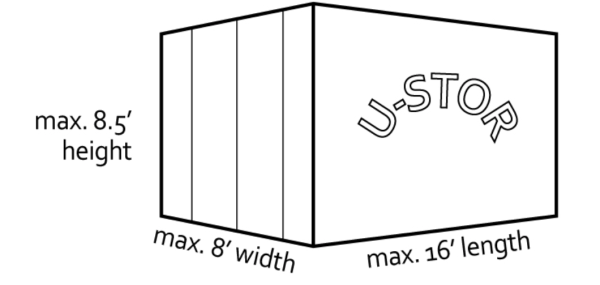
- Containers must be setback at least five feet (5') from all property lines.
- Containers must be placed on an improved hard, dust-free surface, generally asphalt, brick pavers, or concrete. Containers are prohibited within landscape areas, open spaces, stormwater basins, or any other location that may cause hazardous conditions, constitute a threat to public safety, or create a condition detrimental to surrounding land uses and development.
- Nonresidential Zoning District. Portable storage containers in nonresidential zoning districts are subject to the following regulations:
- Containers may be temporarily stored for a period not exceeding an aggregate of ninety (90) days (which may or may not be consecutive) within any period of twelve (12) consecutive months. At the sole discretion of the Community Development Director, an additional maximum of ninety (90) days may be granted.
- No more than three (3) containers may be located on any lot.
- Containers may not exceed twenty feet (20') in length, eight feet (8') in width, and eight and one half feet (8.5') in height. See Figure 6-11.
Figure 6-11: Maximum Container Size in Nonresidential Districts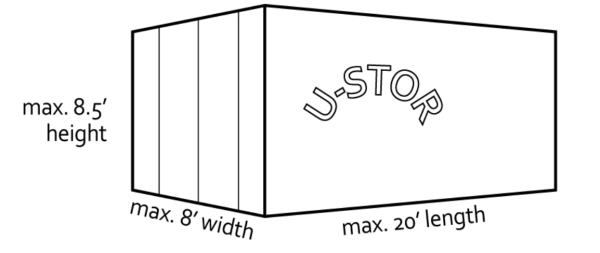
- Containers must comply with all setback requirements that apply to principal buildings and be separated by at least ten feet (10') from principal buildings.
- Containers may not be placed or located on a required parking space, circulation aisle/lane, or fire access lane.
- Vertical stacking of containers and stacking of any other materials or merchandise on top of any portable storage container is prohibited. No running gear or transport trailer may be left underneath any portable storage container.
- Containers must be placed on an improved hard, dust-free surface, generally asphalt, brick pavers, or concrete. Containers are prohibited within landscape areas, open spaces, stormwater basins, or any other location that may cause hazardous conditions, constitute a threat to public safety, or create a condition detrimental to surrounding land uses and development.
Sec 28.6.160 Veterinary Care
Veterinary care uses are subject to the following regulations:
- All medical care and boarding must be conducted within a completely enclosed principal building.
- Bio-hazard and/or medical waste must be disposed of pursuant to the medical waste disposal regulations of the Occupational Safety and Health Administration.
- The treatment of animals must be primarily limited to companion animals.
- Any treatment of dangerous or vicious animals is subject to all applicable regulations of Chapter 5 of this Code.
Sec 28.6.170 Wireless Telecommunications
- Purpose and Intent. The wireless telecommunication regulations of this Section are intended to:
- protect residential areas and land uses from potential adverse impacts of telecommunications towers;
- encourage the location of telecommunications towers in nonresidential areas;
- minimize the total number of telecommunications towers in the Village;
- promote the joint use of new and existing telecommunications tower sites as a primary option rather than construction of additional single-use telecommunications towers;
- encourage users of telecommunications towers to locate them in areas where the adverse impact on the community is minimal;
- encourage users of telecommunications towers to design and configure them in a way that minimizes the adverse visual impact of the telecommunications towers;
- ensure the ability of telecommunications service providers to provide such services to the community quickly, effectively, and efficiently; and
- avoid potential damage to adjacent properties from telecommunications tower failure through engineering and careful siting of telecommunications tower structures.
- Applicability. The regulations of this Section apply to all new telecommunications towers, except for amateur radio facilities (Section 6.010(c)(2)), receive-only antennas that do not exceed seventy feet (70') in height, and small wireless facilities as defined in 50 ILCS 835.
- Federal Law. The wireless communication facility regulations of this Section must be applied within the constraints of the Telecommunications Act of 1996 and Section 6409 of the Middle Class Tax Relief and Job Creation Act of 2012.
- Neighbor Communications. Applicants for telecommunication tower permits must comply with the neighbor communications requirements of DGMC Section 28.12.010(f)(3).
- Permit Required
- A permit is required for the construction or installation of a telecommunications tower. Telecommunication service providers are encouraged to submit a single application for approval of multiple telecommunications tower sites.
- Permit applications must be filed with, and in a form as prescribed by, the Community Development Director, and will be considered complete only upon the Community Development Director’s determination that all required fees, information and documents have been submitted.
- The permit application must include such submittals, material and information as may be required by the Community Development Director to establish that the request meets the standards and requirements of this Section. Any information of an engineering nature that the applicant submits, whether civil, mechanical, or electrical, must be certified by a licensed professional engineer. Information required to be submitted may include any or all of the following:
- An inventory of the applicant’s existing telecommunications towers, antennas, or sites approved for telecommunications towers or antennas, that are either within the corporate limits of the Village or within one and one half (1.5) miles of the Village’s corporate limits. This inventory must include such information as the Community Development Director may direct, including specific information about the location, telecommunications tower height, and design of each telecommunications tower. The Community Development Director may share such information with other persons seeking to locate a telecommunications tower or antenna within the jurisdiction of the Village.
- A scaled site plan clearly indicating the location, type and telecommunications tower height of the proposed telecommunications tower and/or antenna, on-site land uses and zoning, adjacent land uses and zoning (including when adjacent to other municipalities), zoning classification of the site and all properties within the applicable separation distances set forth in this Section, adjacent roadways, proposed means of access, setbacks from property lines, elevation drawings of the proposed telecommunications tower and any other structures, topography, parking, and other information deemed by the Community Development Director to be necessary to assess compliance with this Section.
- Legal description of the parent tract and leased parcel (if applicable).
- The setback distance between the proposed telecommunications tower and the nearest R-zoned properties.
- The separation distance from other telecommunications towers described in the inventory of existing sites submitted pursuant to this Section must be shown on an updated site plan or map. The applicant must also identify the type of construction of the existing telecommunications tower and the owner/operator of the existing telecommunications tower, if known.
- A landscape plan showing specific landscape materials.
- Method of fencing, and finished color and, if applicable, the method of camouflage and illumination, if any.
- A statement indicating compliance with the regulations of this Section and all applicable federal, State or local laws.
- A notarized statement by the applicant indicating whether construction of the telecommunications tower will accommodate co-location of additional antennas for future users.
- Identification of the entities providing the backhaul network for the telecommunications tower described in the application and other cellular sites owned or operated by the applicant in the Village.
- A description of the availability and suitability of the use of existing telecommunications towers, other structures, or alternative technology, not requiring the construction or use of a new telecommunications tower.
- A description of the feasible locations of future telecommunications towers or antennas within the Village based upon existing physical, engineering, technological or geographical limitations in the event the proposed tele-communications tower is erected.
- Telecommunications Tower Requirements
- Lot Size. For purposes of determining whether the installation of a telecommunications tower complies with the lot and building regulations of the subject zoning district, the dimensions of the entire lot must be used, even though the telecommunications tower may be located on leased parcels within such lot.
- Appearance. Telecommunications towers must be maintained in a clean condition, free from corrosion or rust, and subject to any applicable standards of the FAA, be painted a neutral color so as to reduce visual obtrusiveness. At a telecommunications tower site, the design of the buildings and related structures must, to the extent possible, use materials, colors, textures, screening, and landscaping that will blend them into the natural setting and surrounding buildings.
- Lighting and Illumination. Telecommunications towers may not be illuminated, unless required by the FAA or other applicable authority. If lighting is required, the lighting design must cause the least disturbance to surrounding views.
- State or Federal Requirements. All telecommunications towers must meet or exceed current standards and regulations of the FAA, the FCC, and any other agency of the State or federal government with the authority to regulate telecommunications towers. If such standards and regulations are changed, then the owners of the telecommunications towers governed by this Section must bring the telecommunications tower into compliance with the revised standards and regulations within six (6) months of the effective date of the standards and regulations, unless a different compliance schedule is mandated by the controlling state or federal agency. Failure to bring telecommunications towers into compliance with such revised standards and regulations constitutes grounds for the removal of the telecommunications tower or antenna at the owner's expense.
- Building Codes; Safety Standards. To ensure the structural integrity of telecommunications towers, the owner of a telecommunications tower must ensure that it is maintained in compliance with standards contained in applicable state or local building codes and the applicable standards for telecommunications towers that are published by the American National Standards Institute. If, upon inspection, the Village concludes that a telecommunications tower fails to comply with applicable codes and standards and constitutes a danger to persons or property, then upon notice being provided to the owner of the telecommunications tower, the owner will have thirty (30) days to bring such telecommunications tower into compliance with such standards. Failure to bring the telecommunications tower into compliance within the thirty-day period constitutes grounds for the removal of the telecommunications tower or antenna at the owner’s expense.
- Signs. Advertising signs are prohibited on an antenna or telecommunications tower.
- Buildings and Support Equipment. Buildings and support equipment associated with antennas or telecommunications towers must comply with all applicable regulations. For building mounted antennas and equipment screening shall be provided in accordance with DGMC Section 28.8.040(c).
- Setbacks and Separations. The following setback and separation requirements apply to telecommunications towers:
- For purposes of measurement, telecommunications tower setbacks and separation distances must be calculated and applied to facilities located in the Village irrespective of municipal and County jurisdictional boundaries.
- Guys and accessory buildings must comply with minimum zoning district setback requirements.
- Telecommunications towers in nonresidential zoning districts must be separated from R districts by a distance of two hundred feet (200') or three hundred percent (300%) of the height of the telecommunications tower, whichever is greater. See Figure 6-12.
Figure 6-12: Tower Separation from R Districts.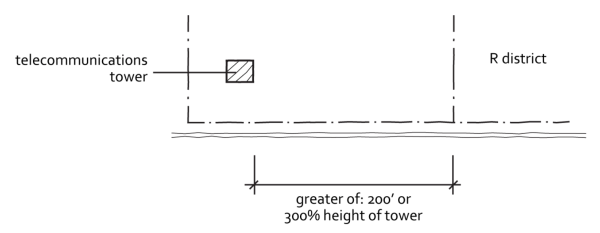
- Telecommunications towers in R zoning districts must be separated from all other telecommunications towers as provided in this paragraph. The minimum required separation distances between the proposed telecommunications tower on R-zoned property and any other preexisting telecommunications towers must be measured by drawing or following a straight line between the base of the existing telecommunications tower and the base of the proposed telecommunications tower. Minimum required separation distances (listed in linear feet) are be based on the height and type of telecommunications tower, as follows:
- Guyed or lattice telecommunications towers must be separated by at least three thousand feet (3,000') from any pre-existing lattice or guyed telecommunications towers; by at least one thousand five hundred feet (1,500') from any monopole seventy-five feet (75') in height or greater; and by at least seven hundred fifty feet (750') from any monopole less than seventy-five feet (75') in height. See Figure 6-13.
Figure 6-13: Required Separations for Guyed and Lattice Towers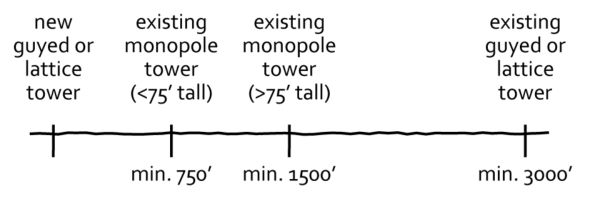
- Monopole telecommunications towers seventy-five feet (75') in height or greater must be separated by a distance of at least one thousand five hundred feet (1,500') from any pre-existing lattice or guyed telecommunications towers; by at least one thousand five hundred feet (1,500') feet from any monopole seventy-five feet (75') in height or greater; and by at least seven hundred fifty feet (750') from any monopole less than seventy-five feet (75') in height. See Figure 6-14.
Figure 6-14: Required Separations for Monopole Towers with a Height of seventy-five feet (75’) or More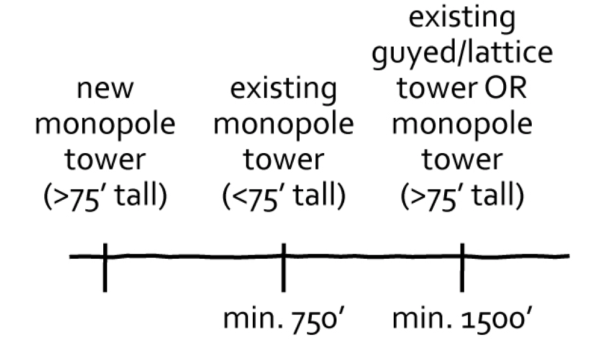
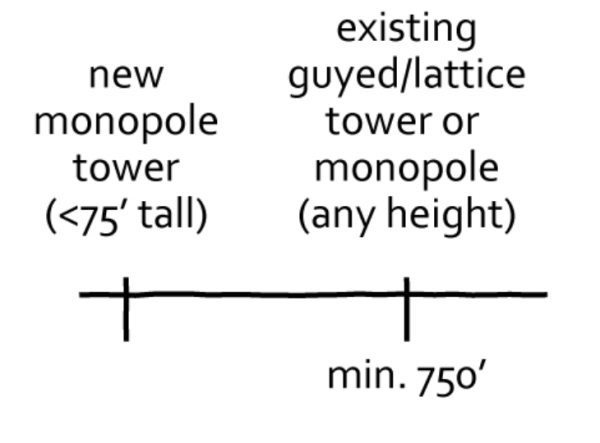
- Monopole telecommunications towers less than seventy-five feet (75') in height must be separated by a minimum distance of seven hundred fifty feet (750') from any pre-existing lattice or guyed telecommunications towers; by at least seven hundred fifty feet (750') from any monopole seventy-five feet (75') in height or greater; and by at least seven hundred fifty feet (750') from any monopole less than seventy-five feet (75') in height. See Figure 6-15.
Figure 6-15: Required Separations for Monopole Towers with a Height less than seventy-five feet (75')
- Guyed or lattice telecommunications towers must be separated by at least three thousand feet (3,000') from any pre-existing lattice or guyed telecommunications towers; by at least one thousand five hundred feet (1,500') from any monopole seventy-five feet (75') in height or greater; and by at least seven hundred fifty feet (750') from any monopole less than seventy-five feet (75') in height. See Figure 6-13.
 AM Array. For purposes of implementing this Section, an AM array, consisting of one (1) or more telecommunications tower units and supporting ground system that functions as one AM broadcasting antenna, is considered one telecommunications tower. Measurements of setbacks and separation distances must be measured from the outer perimeter of the telecommunications towers included in the AM array. Additional telecommunications tower units may be added within the perimeter of the AM array as of right.
- Security Fencing. Unless waived by the Community Development Director as provided in this Section, a security fence is required to enclose a telecommunications tower to protect the telecommunications tower and the public. This fencing requirement may be waived or modified for locations where the security and protection of the public and telecommunications tower is otherwise provided.
- Landscaping. The following requirements govern the landscaping surrounding telecommunications towers.
- Telecommunications tower facilities must be landscaped with a visual buffer of plant materials that effectively screens the view of the telecommunications tower compound from property used for residential purposes. The standard buffer must consist of a landscaped strip at least four feet (4') in width outside the perimeter of the compound.
- Existing mature tree growth and natural landforms on the site must be preserved to the maximum extent possible. In some cases, such as telecommunications towers sited on large, wooded lots, natural growth around the property perimeter may be a sufficient buffer.
- The landscaping requirements of this subsection may be waived or modified by the Community Development Director for locations where the visual impact of the telecommunications tower would be minimal, or where an alternative telecommunications tower structure is used.
- Height. Telecommunications towers are subject to the following height requirements:
- Residential Districts. The maximum height of telecommunications towers in R zoning districts may not exceed ninety feet (90') for a single user; one hundred ten feet (110') feet for two (2) users; or one hundred thirty feet (130') for three (3) or more users.
- Business Districts. The maximum height of telecommunications towers in B-1, B-2 and B-3 zoning districts may not exceed one hundred feet (100') for a single user; one hundred twenty feet (120') for two (2) users; or one hundred forty feet (140') for three (3) or more users.
- Office and Manufacturing Districts. The maximum height of telecommunications towers in O-R, O-R-M, M-1 and M-2 zoning districts may not exceed one hundred twenty-five feet (125') for a single user; one hundred fifty feet (150') for two (2) users; or one hundred seventy-four feet (174') for three (3) or more users.
- (4) Downtown Districts. The maximum height of telecommunications towers in DB, DC and DT zoning districts may not exceed one hundred feet (100') for a single user; one hundred twenty feet (120') for two (2) users; or one hundred forty feet (140') for three (3) or more users.
- Institutional Districts. The maximum height of telecommunications towers in INP-1 and INP-2 zoning districts may not exceed ninety feet (90') for a single user; one hundred ten feet (110') feet for two (2) users; or one hundred thirty feet (130') for three (3) or more users.
- Availability of Suitable Existing Telecommunications Towers, Other Structures, or Alternative Technology. No new telecommunications tower may be approved unless the applicant demonstrates that no existing telecommunications tower, structure or alternative technology that does not require the use of a new telecommunications tower or structures can accommodate the applicant's proposed antenna. Such demonstration may consist of evidence or information that establishes any of the following:
- No existing telecommunications towers or structures are located within the geographic area that meet the applicant's engineering or coverage requirements.
- Existing telecommunications towers or structures are not of sufficient height to meet the applicant's engineering or coverage requirements.
- Existing telecommunications towers or structures do not have sufficient structural strength to support the applicant's proposed antenna and related equipment.
- The applicant's proposed antenna would cause electromagnetic interference with the antenna on the existing telecommunications towers or structures, or the antenna on the existing telecommunications towers or structures would cause interference with the applicant's proposed antenna.
- The fees, costs, or contractual provisions required by the owner in order to share an existing telecommunications tower or structure or to adapt an existing telecommunications tower or structure for sharing are unreasonable. Costs exceeding those of installing a new telecommunications tower are presumed to be unreasonable.
- The applicant demonstrates that there are other limiting factors that render existing telecommunications towers and structures unsuitable.
- The applicant demonstrates that an alternative technology that does not require the use of telecommunications towers or structures is unsuitable. Costs of alternative technology that exceed new telecommunications tower or antenna development will not be presumed to render the technology unsuitable.
- Interference with Governmental Radio Signals Prohibited. Signal transmission may not interfere with any Village or other governmental radio signals, including Village police, fire, emergency dispatch and public works signals.
- Location in Residential Districts Restricted. Location of telecommunications towers in R zoning districts is discouraged. To that end and in addition to other provisions of this Section, no telecommunications tower may be approved in an R district unless one of the following is established:
- There are no sites within nonresidential zoning districts that will accomplish substantially the same coverage and that the proposed R-zoned site is necessary, from a technical perspective.
- Because of unique circumstances, such as the location of the property and proximity of residential structures, the proposed telecommunications tower will not have a significant adverse impact on existing or reasonably anticipated residential uses or property values in the area of the proposed tower.
- Community Development Director Approval
- Except in those districts where telecommunications towers are classified as a special use, the Community Development Director must review the application for a permit under this Section and determine if the application and the proposed telecommunications tower complies with the provisions of this Section. Within sixty (60) days following receipt of a complete application, the Community Development Director must do one of the following:
- approve the application as submitted and issue a permit;
- approve the application and issue a permit, subject to such conditions and restrictions as the Community Development Director may direct to ensure compliance with this Section; or
- deny the application.
- A telecommunications tower that is modified or reconstructed to accommodate the co-location of an additional antenna must be of the same telecommunications tower type as the existing telecommunications tower, unless the Community Development Director allows reconstruction as a monopole.
- To accommodate the co-location of additional users, the Community Development Director may approve modifications or rebuilding of an existing telecommunications tower to a taller telecommunications tower height, not to exceed the maximum height limits of this Section. The telecommunications tower’s pre-modification height will be used to calculate separation distance requirements; no additional separation distance will be required for the additional allowed co-location height.
- To accommodate the co-location of an additional antenna, the Community Development Director may authorize a telecommunications tower that is being rebuilt to be moved up to fifty feet (50') from its existing location. After the telecommunications tower is rebuilt to accommodate co-location, only one (1) telecommunications tower may remain on the site and the relocated telecommunications tower will continue to be measured from the original telecommunications tower location for purposes of calculating separation distances; no additional separation distance will be required for the authorized movement.
- To encourage co-location, the Community Development Director may authorize locating additional antennas on existing telecommunications towers.
- Except in those districts where telecommunications towers are classified as a special use, the Community Development Director must review the application for a permit under this Section and determine if the application and the proposed telecommunications tower complies with the provisions of this Section. Within sixty (60) days following receipt of a complete application, the Community Development Director must do one of the following:
- Removal of Abandoned Antennas and Telecommunications Towers. Any telecommunications tower or antenna located on a tower that is not operated for a continuous period of twelve (12) months will be considered abandoned. If there are two (2) or more users of a single telecommunications tower, then the telecommunications tower will not be deemed abandoned until all users cease using the telecommunications tower for a continuous period of twelve (12) months or more. The owner of any abandoned antenna or telecommunications tower must remove the antenna and tower within ninety (90) days of receipt of notice from the Village notifying the owner of abandonment. If the abandoned antenna or telecommunications tower is not removed within the required 90-day period, the Village has the right, but not the obligation, to enter the property and remove the facility. All costs incurred by the Village in causing removal must be promptly paid by the owner. In addition, the Village has the right to place liens on the property to recover the costs of removal.
- Preexisting Telecommunications Towers. Preexisting telecommunications towers are allowed to continue their usage as they presently exist without meeting the requirements of this Section, other than compliance with the federal and State requirements and applicable building and safety codes. Routine maintenance of such preexisting towers is permitted. In addition, telecommunications towers that are installed in accordance with the provisions of this Section will not be deemed to constitute the expansion of a lawful nonconforming use or structure. New construction other than routine maintenance on a preexisting telecommunications tower must comply with the requirements of this Section.
(Ord. No. 5804, 12/17/19; Ord. No. 5706, 7/10/18)
Sec 28.6.180 Warehousing In The O-R Zoning District
- Performance Standards
- The use is limited to the storage, processing and distribution of finished consumer ready product only.
- The use is limited to a gross floor area of no more than ten thousand (10,000) square feet per warehouse tenant.
- No more than twenty-five percent (25%) of the gross floor area of any single building may be dedicated to warehouse uses.
- The use may only take place within a principal building
- No forklifts or other mechanical devices, such as automated storage and retrieval systems, may be used to process or prepare materials for distribution.
- No on-site sales or pick-up of product may occur.
- Pick-up and delivery of all product is limited to delivery vans and trucks. The use of tractor-trailers for pick-up and delivery of goods is prohibited.
- Approval Criteria. In addition to the Special Use approval criteria in DGMC Section 28.12.050(h), no special use may be recommended for approval or approved unless the respective review or decision-making body determines that the proposed special use is consistent with and in substantial compliance with all village council policies and plans and that the applicant has presented evidence to support each of the following conclusions:
- The proposed use will not be detrimental to the existing parking, loading and circulation patterns on the premises.
- The existing building is suitable for the proposed use in being able to accommodate the size, weight and dimensions of the proposed finished consumer ready product.
- The proposed use will not be injurious to adjacent users via noise, odor, vibration or other environmental concerns.
(Ord. No. 5463, § 2, 6/2/15)
Sec 28.6.190 Automobile Dealership Off-Site Vehicle Storage
- Performance Standards
- Off-site storage must located within a three and one half (3.5) mile radius of the use served by the off-site storage area, measured between the nearest property lines of both uses.
- Off-site storage areas shall be separated from each other by a distance of one thousand feet (1,000'), measured between the nearest property lines of both uses.
- A parking study shall be required. Such study shall identify the number of required parking spaces for the existing use on the storage site per Table 7-1 and the number of excess parking spaces that the storage site has available. The number of storage spaces provided may not exceed the amount of available parking per the study.
- Screening and landscaping of the entire storage area is required only when the property is within one hundred feet (100') of a residential use or residential zoning district. Screening shall be in the form of an eight foot (8') tall solid fence and landscaping shall comply with DGMC Section 28.8.020.
- All stored vehicles must be located within a designated area. Such designated area shall be depicted on the Special Use application and clearly identified on the property. Stored vehicles must be parked within a striped parking space and must be in compliance with parking lot site design standards in DGMC Section 28.7.100.
- Only employees of the personal vehicle sales office shall be allowed on the storage site. Customers are prohibited from being on the storage site and any sales are prohibited from occurring on the storage site.
- Storage areas are to be only for the storage of vehicles ‘for sale’ or ‘for lease.’ Vehicles that have been damaged or waiting for repair or service or that are rental cars may not be stored in the storage area.
- The off-site storage area may be under separate ownership only if an agreement is provided, in a form approved by the Village Attorney, guaranteeing the availability of the storage, commensurate with the number of available storage spaces. Off-site storage privileges will continue in effect only as long as the agreement, binding on all parties, remains in force. If an off-site storage agreement lapses or is no longer valid, then the storage must be removed.
- Any Special Use approval shall be limited to only the applicant, the approval is non-transferable.
(Ord. No. 5571, § 3 11/22/16)

