
Downers Grove City Zoning Code
ARTICLE 28
XI Nonconformities
Sec 28.11.010 General
- Scope. The regulations of this Article govern nonconformities, which are lots, uses, and structures that were lawfully established but because of the adoption of new or amended regulations no longer comply with one (1) or more requirements of this zoning ordinance.
- Intent
- Occasionally, lots, uses, and structures that were lawfully established (i.e., in compliance with all regulations in effect at the time of their establishment) have been made nonconforming because of changes in the zoning regulations that apply to the subject property (e.g., through zoning map amendments or amendments to the text of this zoning ordinance). The regulations of this Article are intended to clarify the effect of such nonconforming status and avoid confusion with “illegal” buildings and uses (those established in violation of applicable zoning regulations). The regulations of this Article are also intended to:
- recognize the interests of landowners in continuing to use their property for uses and activities that were lawfully established;
- promote maintenance, reuse and rehabilitation of existing buildings; and
- place reasonable limits on nonconformities that have the potential to adversely affect surrounding properties.
- The regulations recognize that buildings and structures have a long useful life and allowing their continued occupancy and modernization can be more desirable than requiring them to remain vacant if they cannot be converted to conforming uses. Consequently, this ordinance authorizes the Planning and Zoning Commission to allow conversion of nonconforming uses and, under limited circumstances, expansions of nonconforming uses and structures.
- Occasionally, lots, uses, and structures that were lawfully established (i.e., in compliance with all regulations in effect at the time of their establishment) have been made nonconforming because of changes in the zoning regulations that apply to the subject property (e.g., through zoning map amendments or amendments to the text of this zoning ordinance). The regulations of this Article are intended to clarify the effect of such nonconforming status and avoid confusion with “illegal” buildings and uses (those established in violation of applicable zoning regulations). The regulations of this Article are also intended to:
- Authority to Continue. Any nonconformity that existed on the effective date specified in DGMC Section 28.11.030 of this Chapter or any situation that becomes nonconforming upon adoption of any amendment to this zoning ordinance may be continued in accordance with the regulations of this Article unless otherwise expressly stated.
- Determination of Nonconformity Status
- The burden of proving that a nonconformity exists (as opposed to a violation of this zoning ordinance) rests entirely with the subject owner.
- The Community Development Director is authorized to determine whether adequate proof of nonconforming status has been provided by the subject owner.
- Building permits, lawfully recorded plats, aerial photography owned by the Village and other official government records that indicate lawful establishment of the use, lot or structure constitute conclusive evidence of nonconforming status. If such forms of conclusive evidence are not available, the Community Development Director is authorized to consider whether other forms of evidence provided by the applicant are reliable and adequate to document nonconforming status. Common examples of evidence that may be determined to be reliable and adequate include:
- professional registrations or licenses;
- utility billing records;
- leasing records;
- advertisements in dated publications;
- listings in telephone or business directories; and
- notarized affidavits affirming the date of lawful establishment of the use, lot or structure.
- The Community Development Director’s determination of nonconforming status may be appealed in accordance with DGMC Section 28.12.100 of this Chapter.
- Repairs and Maintenance
- Nonconformities must be maintained to be safe and in good repair.
- Repairs and normal maintenance necessary to keep a nonconformity in sound condition are permitted unless the work increases the extent of the nonconformity or is otherwise expressly prohibited by this zoning ordinance.
- Nothing in this article is intended to prevent nonconformities from being structurally strengthened or restored to a safe condition in accordance with an order from a duly authorized order of a public official.
- Change of Tenancy or Ownership. Nonconforming status runs with the land and is not affected by changes of tenancy, ownership, or management.
Sec 28.11.020 Nonconforming Lots
- Description. A nonconforming lot is a lot that was lawfully created in accordance with lot area and lot width regulations in effect at the time of the lot’s establishment but that does not comply with currently applicable lot area or lot width regulations.
- Use of and Building on Nonconforming Lots
- A nonconforming lot in an R district may be used improved with a single detached house or accessory structure, subject to compliance with applicable lot and building regulations other than those pertaining to lot area and lot width, provided that when a structure is constructed across common lot lines of two (2) or more contiguous nonconforming lots that are held in common ownership, the lots must be consolidated in order to meet or come closer to meeting applicable minimum lot area and lot width requirements. Except that lot consolidations are not required for decks, front porches and stoops or when:
- an addition does not exceed three hundred fifty (350) square feet; or
- an addition does not include the installation of a foundation, footers or piers; or
- the construction of an accessory structure is less than eight hundred (800) square feet.
- Nonconforming lots in nonresidential districts may be improved with any use allowed in the subject zoning district, provided that:
- the lot area is not less than seventy-five percent (75%) of the minimums required in the subject zoning district, or the lot width is not less fifty feet (50') and the lot area is not less than seven thousand five hundred (7,500) square feet;
- if the zoning allows a variety of uses or a variety of intensities of uses and one or more uses or intensities would comply with applicable lot area and lot width standards, while others would not, then only the uses or intensities that comply with applicable standards are permitted.
- when a structure is constructed across common lot line(s) of two (2) or more contiguous nonconforming lots are held in common ownership, the lots must be consolidated in order to meet or come closer to meeting applicable minimum lot area requirements.
- All flag lots lawfully created before March 18, 2008 are deemed nonconforming lots. In addition to complying with the other nonconforming lot provisions of this Section, nonconforming flag lots are subject to the following additional requirements:
- the pole of the flag lot must be at least twenty feet (20') in width;
- an access corridor, including a paved surface with a width of at least ten feet (10'), must be maintained along the entire length of the pole. No encroachments that would interfere with emergency vehicle access are allowed within this access corridor;
- the street setback must be measured from a line parallel to the street where the lot meets the minimum width requirement of the subject zoning district;
- the address of the flag lot must be clearly displayed within three feet (3') feet of the property line adjacent to the public street and in a manner that clearly differentiates the flag lot from abutting property; and
- if there is no fire hydrant located within sixty feet (60') of the street property line of the pole section of the flag lot, a fire hydrant must be installed at the property owner’s expense. If a new hydrant is required, it must be operational prior to issuance of an occupancy permit. The fire department may, in its sole discretion, permit the property owner to install a dry-system standpipe on the flag lot property instead of requiring a new hydrant to be installed.
- All lots created by lot split before May 16, 2006 may be improved provided any such improvement complies with the lot and building regulations of the subject zoning district, provided that:
- the lot area and lot width are not less than seventy-five percent (75%) of the minimums required in the subject zoning district; or
- the lot width is not less fifty feet (50') and the lot area is not less than seven thousand five hundred (7,500) square feet.
- Lawfully established buildings and improvements on nonconforming lots may be used, maintained, repaired and replaced, provided that the amount, quantity or degree of any existing nonconformity is not increased and no new nonconformity is created.
- A nonconforming lot in an R district may be used improved with a single detached house or accessory structure, subject to compliance with applicable lot and building regulations other than those pertaining to lot area and lot width, provided that when a structure is constructed across common lot lines of two (2) or more contiguous nonconforming lots that are held in common ownership, the lots must be consolidated in order to meet or come closer to meeting applicable minimum lot area and lot width requirements. Except that lot consolidations are not required for decks, front porches and stoops or when:
(Ord. No. 5804, 12/17/19; Ord. No. 5706, 7/10/18)
Sec 28.11.030 Nonconforming Uses
- Description. A nonconforming use is a land use that was lawfully established in accordance with all zoning regulations in effect at the time of its establishment but that is no longer allowed by the use regulations of the zoning district in which the use is now located. Lawfully established uses that do not comply with any applicable separation (or spacing) distance requirements (e.g., those that require one land use to be located a certain minimum distance from another land use) are also deemed nonconforming uses.
- Change of Use. A nonconforming use may be changed to any other use that is allowed in the subject zoning district. Once changed to a conforming use, a nonconforming use may not be re-established.
- Expansion of Use
- The nonconforming use of land that does not involve a building or structure or that is accessory to the nonconforming use of a building may not be expanded or extended beyond the area the use occupied at the time the use became nonconforming.
- Nonconforming uses within a building may not be expanded except as expressly stated below:
- A nonconforming use within a building may be expanded into another part of the same building that was occupied by the subject nonconforming use at the time the use became nonconforming;
- Other expansions of a nonconforming use may be approved in accordance with the zoning exception procedures of DGMC Section 28.12.080. In order to approve such an expansion of a nonconforming use, the Planning and Zoning Commission must find that all of the following criteria have been met:
- in residential districts, the expansion will not result in an increase in the number of dwelling units;
- the expansion will comply with all applicable lot and building regulations of the subject zoning district;
- the appearance of the expansion will be compatible with the adjacent properties and neighborhood;
- off-street parking is provided for the expansion in accordance with the requirements of DGMC Section 28.7.010(b)(2) (for new uses);
- rezoning the property would result in an inappropriate spot zoning;
- the expansion will not be detrimental to the existing character of development in the immediate neighborhood or endanger the public health, safety, or general welfare; and
- the use is consistent with the comprehensive plan.
- Remodeling and Improvements. A building in which a nonconforming use is located may be remodeled or otherwise improved as long as the remodeling or improvements do not violate the other regulations of this Article.
- Moving. A nonconforming use may be moved in whole or in part to another location on the same lot only if the movement or relocation does not increase the extent of the nonconformity. A nonconforming use may be moved to another lot only if the use is allowed under the zoning regulations that apply to that (relocation) lot.
- Loss of Nonconforming Status
- Abandonment
- Except as expressly authorized in DGMC Section 28.11.030(f)(1)d, once a nonconforming use is abandoned, its nonconforming status is lost and any new, replacement use must comply with the regulations of the zoning district in which it is located.
- A nonconforming use is presumed abandoned when the use is discontinued or ceases for a continuous period of six (6) months or more.
- Any period of discontinuance caused by acts of God or accidental fire are not counted in calculating the length of discontinuance.
- Re-establishment of an abandoned nonconforming use may be approved in accordance with the zoning exception procedures of DGMC Section 28.12.080 if the Planning and Zoning Commission finds that all of the following criteria have been met:
- the subject property cannot reasonably or economically be used for a conforming use;
- the proposed use is equally appropriate or more appropriate in the proposed location than the existing nonconforming use;
- the traffic, hours of operation, noise and other operating characteristics of the proposed use will result in no greater adverse impact on the neighborhood than the previous nonconforming use;
- the proposed use will not be detrimental to the existing character of development in the immediate neighborhood or endanger the public health, safety, or general welfare; and
- the use is consistent with the comprehensive plan.
- Damage or Destruction
- When a building containing a nonconforming use is destroyed or damaged by acts of God or accidental fire, the building may be restored or repaired, provided that no new nonconformities are created and that the existing extent of nonconformity is not increased. A building permit to reconstruct a destroyed or damaged structure must be obtained within twelve (12) months of the date of occurrence of such damage.
- When a building containing a nonconforming use is demolished, damaged or destroyed by causes within the control of the owner and the extent of demolition, damage or destruction is more than fifty percent (50%) structure’s exterior walls measured in linear feet, the use may not be reestablished except in compliance with all regulations applicable to the zoning district in which it is located. Exterior walls include supporting structural elements, such as load bearing masonry walls, and in wood construction, studs, sole plate or top plate. Roofs, interior finishes, non-structural exterior finishes, and all foundation walls are excluded. See Figure 11.1 below:
Figure 11.1: Exterior Wall Calculation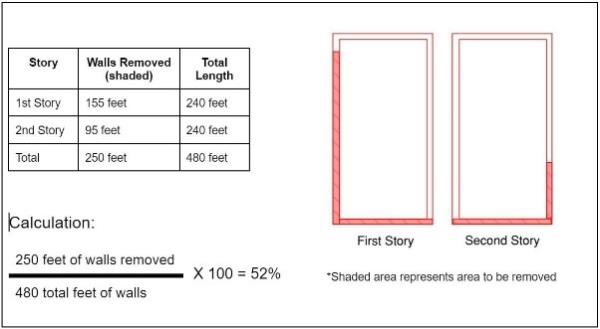
- Abandonment
- Accessory Uses. No use that is accessory to a principal nonconforming use may continue after the principal nonconforming use has been abandoned.
- Nonconforming Junk Yards and Outdoor Storage Yards. Junk yards, salvage yards and land used for outdoor storage purposes that are annexed into the Village must be discontinued within five (5) years of the date of annexation.
- Electric Transmission Lines and Electrical Substations. The use or holding for use by a public utility under the jurisdiction of the Illinois Commerce Commission of any premises before July 1, 1967, for electric transmission lines supported by towers or for an electrical substation are deemed a lawful special use for such purposes, without any restrictions against enlargement, extension, reconstruction or structural alteration of any such facilities that may be located on the subject property on or after July 1, 1967.
Sec 28.11.040 Nonconforming Structures
(a) Description. A nonconforming structure is any structure, other than a sign, that was lawfully established but no longer complies with applicable lot and building regulations or other dimensional or locational requirements of this zoning ordinance. Regulations governing nonconforming signs can be found in DGMC Section 28.9.090.
(b) Use. A nonconforming structure may be used for any use allowed in the zoning district in which the structure is located.
(c) Alterations and Expansions
(1) Nonconforming principal structures may be altered or expanded if the proposed alteration or expansion complies with all applicable lot, building, dimensional and locational requirements and does not increase the extent of the structure’s nonconformity. A principal building with a nonconforming street setback, for example, may be expanded to the rear as long as the rear expansion complies with applicable rear setback standards. (2) A principal structure with a nonconforming setback may not be expanded horizontally or vertically within the required setback area, except that the Planning and Zoning Commission may approve a either a horizontal or a vertical extension of the nonconforming exterior walls of a detached house in accordance with the zoning exception procedures of DGMC Section 28.12.080. In order to approve such horizontal or vertical extension, the Planning and Zoning Commission must find that all of the following criteria have been met:
a. the extended wall will comply with all other applicable lot and building regulations (other than the nonconforming setback); b. the extension will not obstruct farther into the required setback than the existing exterior building wall and will not extend the horizontal length of the nonconforming building wall more than fifteen percent (15%) of its existing length; c. the horizontal or vertical wall extension does not include windows that allow views onto an abutting lot occupied by a detached house; d. the appearance of the expansion will be compatible with the adjacent property and neighborhood; and e. the expansion will not be detrimental to the existing character of development in the immediate neighborhood or endanger the public health, safety, or general welfare.
(d) Moving. A nonconforming structure may be moved in whole or in part to another location only if the movement or relocation eliminates or reduces the extent of nonconformity. (e) Loss of Nonconforming Status
(1) Damage or Destruction
a. When a nonconforming structure is destroyed or damaged by acts of God or accidental fire, the structure may be restored or repaired, provided that no new nonconformities are created and that the existing extent of nonconformity is not increased. A building permit to reconstruct a destroyed or damaged structure must be obtained within twelve (12) months of the date of occurrence of such damage.
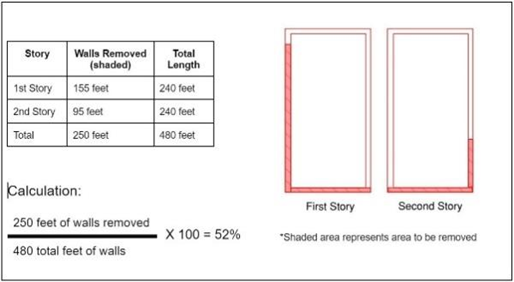
b. When a nonconforming principal structure is demolished, damaged or destroyed by causes within the control of the owner and the extent of demolition, damage or destruction is more than fifty percent (50%) of the structure’s exterior walls measured in linear feet, the structure may not be reestablished except in compliance with all regulations applicable to the zoning district in which it is located. Exterior walls include supporting structural elements, such as load bearing masonry walls, and in wood construction, studs, sole plat or top plate. Roofs, interior finishes, non-structural exterior finishes, and all foundation walls are excluded. See Figure 11.1 below:
Figure 11.1: Exterior Wall Calculation
(2) Damage or Destruction after Right-of-Way Acquisition. If a structure is rendered nonconforming or made more nonconforming by a public agency’s acquisition of right-of-way and the structure is subsequently damaged or destroyed by any means, the structure may be reestablished, provided that no new nonconformities are created and that the existing extent of nonconformity is not increased. A building permit to reconstruct a destroyed or damaged structure must be obtained within twelve (12) months of the date of occurrence of such damage.
(f) Nonconforming Fences. Nonconforming fences may be maintained or repaired without regard to the requirements of this zoning ordinance, provided that the extent of nonconformity of the fence is not increased. The damage or destruction provisions of DGMC Section 28.11.040(e)(1) apply to nonconforming fences. (g) Nonconforming Accessory Structures. Any nonconforming residential accessory structure such as a garage, shed, deck or porch may be razed and replaced in its entirety, provided that it is replaced in the same location, and for the same purpose, with no footprint expansion and no more than an increase of fifteen percent (15%) or the original height. This provision does not apply to nonconforming accessory structures located within in the Special Management Areas as defined in Chapter 26 or those structures that are located over common property lines or the public right-of-way.
Sec 28.11.050 Nonconforming Signs
See DGMC Section 28.9.090.

