
Downers Grove City Zoning Code
ARTICLE 28
XIV Measurements
Sec 28.14.010 District Area
District area is measured as the total contiguous land area contained within a mapped zoning district. When a district is directly across the street from or abuts a district of the same or a less restrictive classification, the area of the district directly across the street or abutting the property may be counted in determining whether minimum zoning district area requirements have been met. See Figure 14-1.
Figure 14-1: District Area Measurement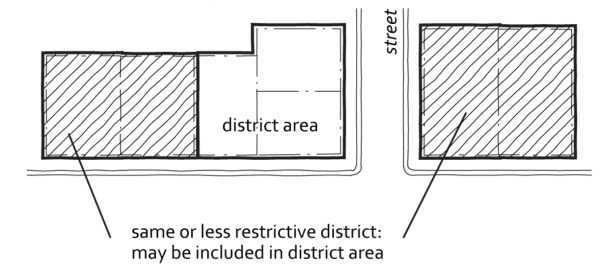
Sec 28.14.020 Lot Area
Lot area is measured as the total ground-level surface area contained within the lot lines of a lot.
Sec 28.14.030 Lot Area Per Dwelling Unit
Lot area per dwelling unit is a measure of residential density. It governs the amount of lot area required for each dwelling unit on the subject lot. To determine the number of dwelling units allowed on a lot, divide the lot area by the minimum lot-area-per-unit requirement, and round any fractional result down to a whole number. If, for example, a minimum lot-area-per-unit requirement of one thousand seven hundred fifty feet (1,750) is applied to a ten thousand (10,000) square foot lot, a maximum of five (5) units would be allowed on that lot (5.71 rounded down to 5).
Sec 28.14.040 Floor Area
The floor area of a building is measured as the sum of the gross horizontal areas of all floors of the subject building, measured from the interior faces of the exterior walls or from interior faces of walls between separate buildings. “Floor area” includes basement and cellar floor areas; elevator shafts and stairwells at each floor; penthouse; attic space having headroom of seven feet ten inches (7'10") or more; interior balconies and mezzanines; enclosed porches; and floor area devoted to accessory uses. Space devoted to off-street parking or loading is not included in floor area calculations.
Sec 28.14.050 Floor Area Ratio
The floor area ratio (FAR) of a building is the floor area of the building divided by the area of the lot upon which the building is located.
Sec 28.14.060 Lot Width
Lot width is measured as the horizontal distance between the side lot lines of a lot measured along the required street setback line. See Figure 14-2. On a lot with a radial front (street) lot line, lot width is measured as indicated in Figure 14-3.
Figure 14-2: Lot Width Measurement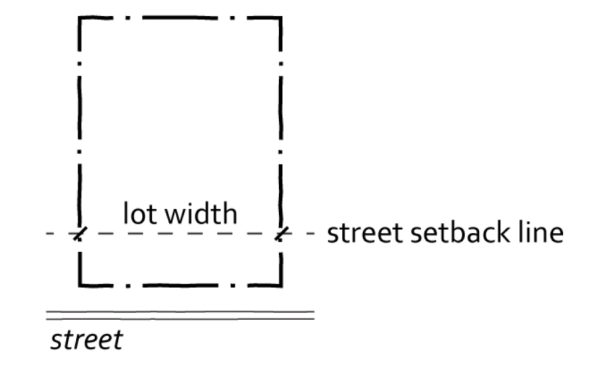
Figure 14-3: Lot Width Measurement (cul-de-sac)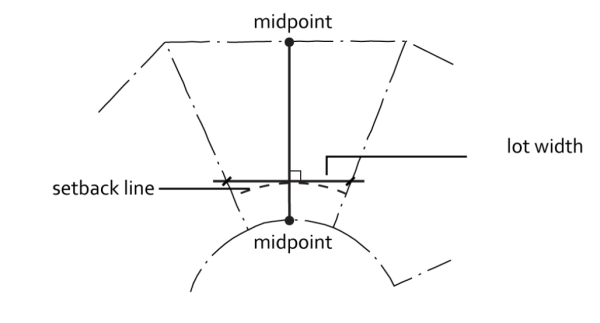
Sec 28.14.070 Lot Depth
Lot depth is measured as the horizontal distance from the midpoint of the front lot line to the midpoint of the rear lot line, or to the rear most point of the lot where there is no rear lot line. See Figure 14-4.
Figure 14-4: Lot Depth Measurement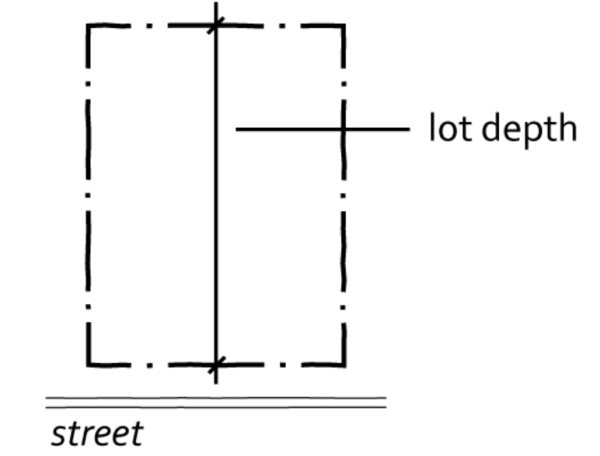
Sec 28.14.080 Building Coverage
Building coverage is measured as the area of the lot that is occupied by principal and accessory buildings and by structures with a surface area of more than four (4) square feet and a height of eighteen inches (18") or more, including pergolas and pools. All areas beneath a roof are counted for purposes of measuring building coverage, except on FT or R-zoned lots with a lot width of sixty feet (60') or less, detached garages, Extended Family Accessory Housing or Home Occupation units in the rear yard and rear-loading attached garages with a building footprint of five hundred (500) square feet or less are not counted towards overall building coverage provided that the detached garage, Extended Family Accessory Housing or Home Occupation units in the rear yard or the rear-loading attached garage is the only garage or unit on the subject property. (Ord. 5706, 7/10/18)
Sec 28.14.090 Street Frontage
Street frontage is measured between side lot lines of a lot along the lot line that abuts the street. See Figure 14-5.
Figure 14-5: Street Frontage Measurement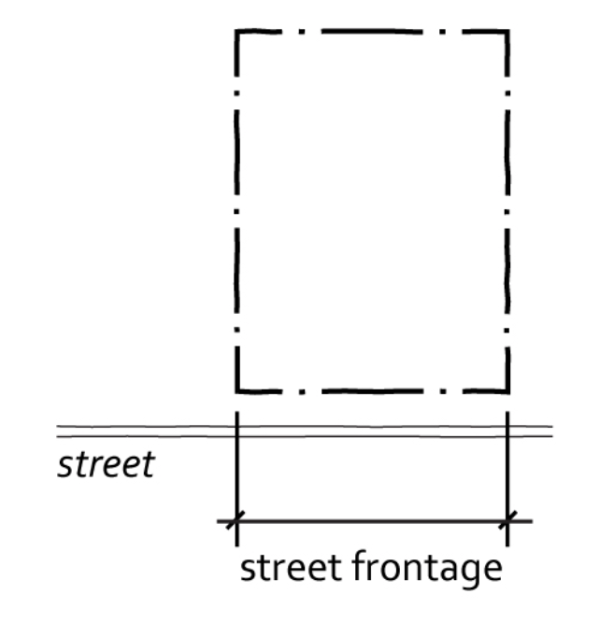
Sec 28.14.100 Setbacks
- Measurement. Setbacks are measured from the referenced lot line to the closest point of the building or structure.
- Street setbacks are measured from all lot lines that abut a street. See Figure 14-6. On corner lots, street setbacks apply along both streets, but applicable street setback requirements may be reduced along one of the street frontages if necessary to allow a building width of thirty feet (30'). On double-frontage lots, street setbacks apply along both opposing lot lines that abut the street.
Figure 14-6: Street Setback Measurement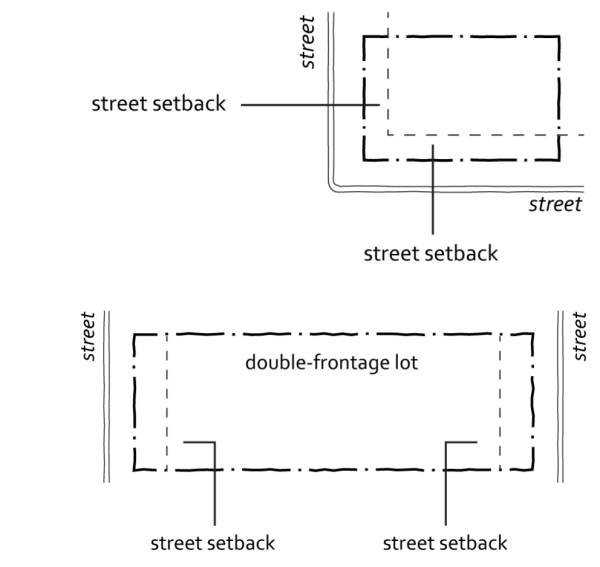
- Side (interior) setbacks are measured from all side lot lines that do not abut a street. See Figure 14-7. Interior side setbacks do not apply to attached or abutting walls in an attached house development.
Figure 14-7: Side (interior) Setback Measurement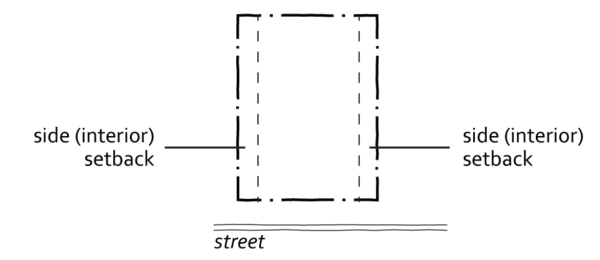
- Rear setbacks are measured from the rear lot line. See Figure 14-8.
Figure 14-8: Rear Setback Measurement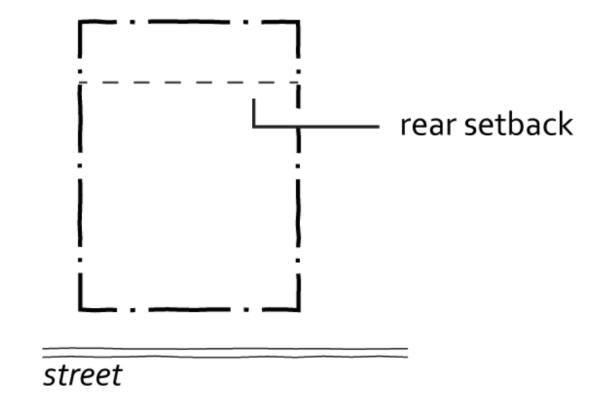
- Street setbacks are measured from all lot lines that abut a street. See Figure 14-6. On corner lots, street setbacks apply along both streets, but applicable street setback requirements may be reduced along one of the street frontages if necessary to allow a building width of thirty feet (30'). On double-frontage lots, street setbacks apply along both opposing lot lines that abut the street.
- Permitted Obstructions. Yards in all zoning districts must be unobstructed and unoccupied from the ground to the sky except as indicated in Table 14-1.
Table 14-1: Permitted Yard ObstructionsObstruction/Projection Permitted in these Yards Minimum Setback/Maximum Encroachment into
required setbackCorner Street Side Rear A/C units, generators, compressors, transformers, associated equipment, rainwater collection and geothermal equipment (ground-mounted) No No[1] Yes Yes 10 ft. min. setback in R-1 7 ft. min. setback in R-2 6 ft. min. in R-3, R-5, R-5A, R-6 5 ft. min. setback in all other districts Air conditioner (window unit only) Yes Yes Yes Yes No setback required Antenna, amateur radio No No No Yes Ground mounted only; 5 ft. min. setback in R-4 district 6 ft. min. setback in all other districts Antenna, receive-only and satellite dish Yes Yes Yes Yes Arbor, pergola or trellis Yes Yes Yes Yes 5 ft. min. setback in R-4 district 6 ft. min. setback in all other districts Architectural building features (e.g., sills, belt courses, cornices, wing walls) Yes Yes Yes Yes No setback in DB, DC, FC and FB.
1.5 ft. max. encroachment if setback is < 6 ft. 2 ft. max. encroachment if setback is ≥ 6 ft.
Awning, canopy architectural light shelf or solar shading device Yes Yes Yes Yes 1.5 ft. max. encroachment if setback is < 6 ft. 2 ft. max. encroachment if setback is ≥ 6 ft. (nonresidential districts - 2.5 ft. max. encroachment in street setback) Balcony Yes Yes Yes Yes Must meet required district street and side yard setbacks. 10 ft. max. encroachment in rear yard Basketball standards and backboards Yes Yes Yes Yes Bay window
(1st floor only; with or without foundation)Yes Yes Yes Yes Street setback - 1.5 ft. max. encroachment Side setback - 1.5 ft. max. encroachment if setback is < 6 ft. or 2 ft. max. encroachment if setback is ≥ 6 ft. Rear setback - 2.5 ft. max. encroachment Bicycle Parking Yes Yes Yes Yes 5 ft. min. setback in R-4 district 6 ft. min. setback in all other districts Breezeway No No No Yes 10 ft. max. max. encroachment Chimney Yes Yes Yes Yes 1.5 ft. max. encroachment if setback is < 6 ft. 2 ft. max. encroachment if setback is ≥ 6 ft. Clothesline No No Yes Yes 5 ft. min. setback Compost pile or container (See Chapter 13 of this Code) No No Yes Yes 5 ft. min. setback in R-4 district 6 ft. min. setback in all other districts Deck or patio, uncovered and open-air (see also “porch,” below) [2] Yes Yes Yes Yes 5 ft. max. encroachment in street setback 5 ft. min. setback in side and rear property line Dog house or dog run No No No Yes No setback in DB, DC, FC and FB districts.
5 ft. min. setback in R-4 district 6 ft. min. setback in all other districts
Driveway or uncovered walk Yes Yes Yes Yes No setback in DB, DC, FC and FB districts.
1 ft. min. (interior) or rear setback
Eaves and gutters Yes Yes Yes Yes In street setback and rear setback - 2.5 ft. max. encroachment In side setback - 2 ft. max. encroachment Electric vehicle charging equipment Yes Yes Yes Yes In front and rear - 2.5 ft. max. encroachment In side - 2 ft. max. encroachment Fence Yes Yes Yes Yes See also Sec. 10.010 Fire escape (open or lattice enclosed, fireproof outside stairways) Yes Yes Yes Yes 2 ft. max. encroachment Fireplace, fire pit, outdoor cooking/kitchen areas (See Chapter 13 of this Code) Yes[3] No Yes Yes 5 ft. min. setback in R-4 district 6 ft. min. setback in all other districts. Must meet required R district street setback in corner yards. Flag pole Yes Yes Yes Yes Equal to the height of the pole; no max. encroachment of flag beyond lot line Garage (detached)[4] No No Yes Yes 5 ft. min. setback in R-4 district 6 ft. min. setback in all other districts Garden features (e.g., cold frames, hoop houses, greenhouses) No No Yes Yes 5 ft. min. setback in R-4 district 6 ft. min. setback in all other districts Gazebo Yes No Yes Yes 5 ft. min. setback in R-4 district 6 ft. min. setback in all other districts Hot Tub (and associated equipment) Yes[3] No Yes Yes 10 ft. min. setback in R-1 and R-2 Districts
7 ft. min. setback in all other R districts. Must meet required R district street setback in corner yards
Parking, open Yes Yes Yes Yes See also DGMC Section 28.7.070 Playground equipment & playhouses (excluding equipment located on public parks and playgrounds or on school or day care center playgrounds, tot lots) Yes[3] No Yes Yes 5 ft. min. setback in R-4 district 6 ft. min. setback in all other districts
Must meet required R district street setback in corner yards.
Porch, covered and open on at least 3 sides (see also “deck,” above) Yes Yes Yes Yes 5 ft. max. encroachment in street setback and rear setback (See also DGMC Section 28.14.100(c)) Must meet required district side yard setbacks Shed, carport or storage structure No No Yes Yes 5 ft. min. setback in R-4 district 6 ft. min. setback in all other districts Sign Yes Yes No No See Article IX Solar panel and equipment (building-mounted) Yes Yes Yes Yes 1.5 ft. max. encroachment if setback is < 6 ft. 2 ft. max. encroachment if setback is ≥ 6 ft. Solar panel and equipment (ground-mounted) No No Yes Yes 2 ft. max. encroachment in side setback; 10 ft. max. encroachment in rear setback. See also DGMC Section 28.6.010(m) Sport courts & accessory lighting No No Yes Yes 5 ft. min. setback in R-4 district 6 ft. min. setback in all other districts Sports equipment No No Yes Yes 5 ft. min. setback in R-4 district 6 ft. min. setback in all other districts Steps (for access to building or lot; max. 4 feet above grade) Yes Yes Yes Yes No setback in DB, DC, FC and FB districts.
1 ft. min. setback
Swimming pool (in-ground & above-ground and associated equipment) No No Yes Yes 10 ft. min. setback in R-1 and R-2 districts 7 ft. min. setback in all other R districts Vegetable Garden Yes Yes Yes Yes No setback required Walkway (covered) No No No No In residential districts - principal building setbacks apply In nonresidential districts - no side or rear setback required Wall Yes Yes Yes Yes See also DGMC Section 28.10.010 Wall, retaining Yes Yes Yes Yes No setback in DB, DC, FC and FB districts.
1 ft. min. setback
Yard features (e.g., ornamental light standards, anchored lawn furniture and decorations, sundials, statues, bird baths, ponds, sculptures, seat walls, etc.) Yes Yes Yes Yes No setback in DB, DC, FC and FB districts.
5 ft. min. setback in R-4 district 6 ft. min. setback in all other districts
Wheelchair lifts and ramps that meet federal and state accessibility standards Yes Yes Yes Yes 1 ft. min. setback Window wells Yes Yes Yes Yes 1.5 ft. max. encroachment if setback is < 6 ft. 2 ft. max. encroachment if setback is ≥ 6 ft.
[1] Except for single family residential uses, units may be located on the building’s primary street facade and in front of a bump as long as the unit is screened by a wing wall made of the same material as the primary façade which is attached to the primary building via a full foundation and is at least as tall as the equipment.
[2] Provided that in Planned Unit Developments or other subdivisions containing ten (10) or more lots in which permanent common open space is provided under the terms of the recorded covenants or a pubic park, patios nd decks may be placed one foot (1') from the rear and side lot line.
[3] Only on corner lots, may be placed up to the minimum required setback, provided that they are screened on all sides by an open fence, wall, dense hedge or other landscaping that provides at least eighty percent (80%) direct view blocking. The hedge or landscaping must reach a minimum height of thirty-six inches (36") at maturity.
[4] Only on corner lots, detached garages may be placed up to the minimum required street setback provided that they are located between the rear property line and the rear wall of the building. - Front Porches. Front porches on R-zoned lots may encroach a maximum of five feet (5') into a required street setback, subject to the following restrictions:
- Front porches with a total footprint of two hundred fifty (250) square feet or less are not counted towards overall lot or building coverage.
- The total amount of porch encroachment into any required street setback may not exceed two hundred fifty (250) square feet.
- Porches that are constructed after September 1, 2006 and encroach into the street setback must remain open and not be converted into occupiable floor area at any time.
- On lots with multiple frontages, porches may encroach into both street setbacks, but the total amount of encroachments may not exceed five hundred (500) square feet; and only a maximum of two hundred fifty (250) square feet is not counted toward the overall lot or building coverage.
- Occupiable floor area and porch/deck space is prohibited above or below a porch that encroaches into a required street setback.
- Contextual Setbacks. When existing buildings on one or more abutting lots are closer to the street property line than the otherwise required street setback, additions to existing buildings or construction of new buildings on the subject lot may comply with the average street yard depth that exists on the nearest two (2) lots on either side of the subject lot instead of complying with the zoning district’s minimum street setback requirement.
- If one or more of the lots required to be included in the averaging calculation is vacant, that vacant lot will be deemed to have a street yard depth equal to the minimum street setback requirement of the subject zoning district. See Figure 14-9.
Figure 14-9: Contextual Setbacks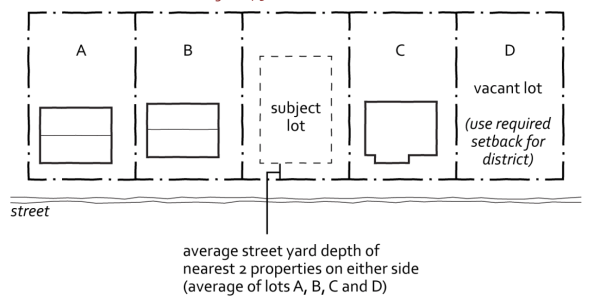
- Lots with frontage on a different street than the subject lot or that are separated from the subject lot by a street or alley may not be used in computing the average. See Figure 14-10.
Figure 14-10: Contextual Setbacks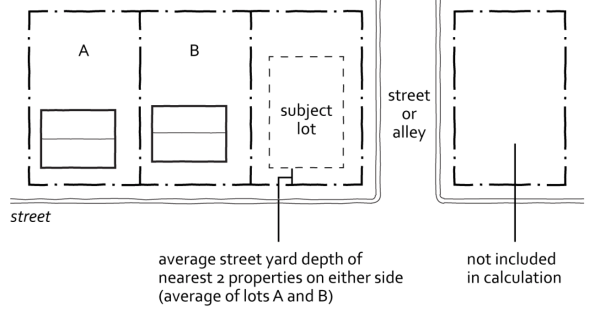
- When the subject lot is a corner lot, the average street yard depth will be computed on the basis of the nearest two (2) lots with frontage on the same street as the subject lot. See Figure 14-11.
Figure 14-11: Contextual Setbacks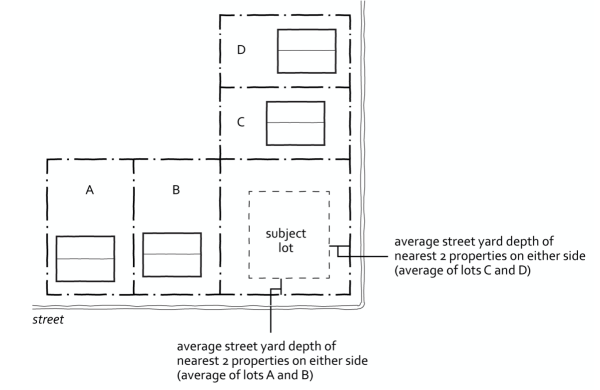
- When the subject lot abuts a corner lot with frontage on the same street, the average street yard depth will be computed on the basis of the abutting corner lot and the nearest two (2) lots with frontage on the same street as the subject lot. See Figure 14-12.
Figure 14-12: Contextual Setbacks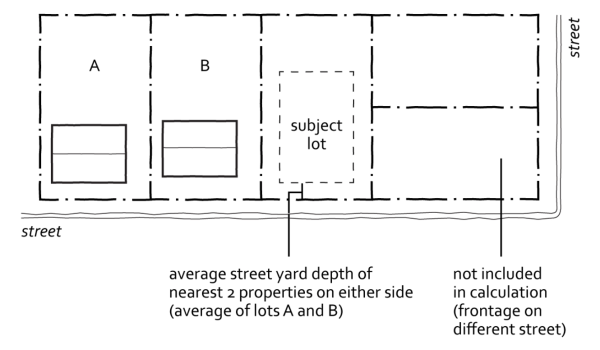
- These contextual setback provisions may not be used to reduce the setback of a street-facing garage door to less than twenty feet (20').
- If one or more of the lots required to be included in the averaging calculation is vacant, that vacant lot will be deemed to have a street yard depth equal to the minimum street setback requirement of the subject zoning district. See Figure 14-9.
(Ord. No. 5804, 12/17/19; Ord. No. 5706, 7/10/18)
Sec 28.14.110 Build-To Zone
- The build-to zone is the area on the subject lot where a specified percentage of the street-facing building facade must be located, measured as a minimum and maximum setback range from the edge of the abutting street right-of-way. See Figure 14-13.
Figure 14-13: Build-to Zone Measurement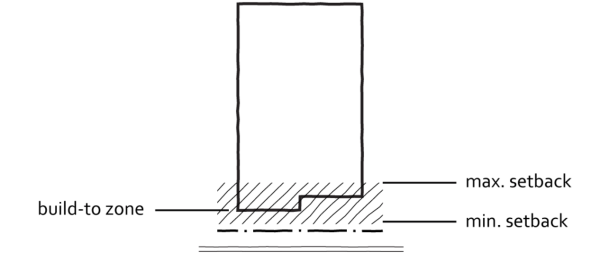
- The specified percentage identifies the amount of the building facade that must be located in the build-to zone, based on the width of the building façade divided by the width of the lot.
- On corner lots, the building’s façade must be within the required build-to-zone for the first twenty-five feet (25') extending from the intersection of the two (2) rights-of-way. See Figure 14-14.
Figure 14-14: "Holding the Corner"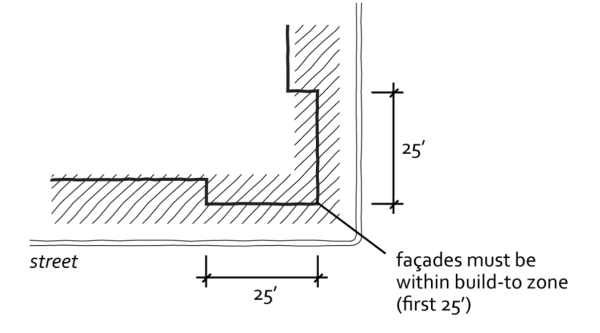
- Outdoor dining, plazas or similar programmed space are counted as part of the building for the purpose of measuring compliance with build-to zone requirements, provided that:
- in the DB and DC zoning districts:
- the space does not exceed thirty-three percent (33%) of the length of the building face or thirty feet (30'), whichever is less;
- the area is no more than twenty-five feet (25') in depth; and
- no more than one (1) such feature may be counted per frontage.
- in the FC and FB zoning districts:
- the space does not exceed thirty-three percent (33%) of the length of the building face or forty feet (40’), whichever is less and the area is no more than twenty-five feet (25’) in depth; or
- the space does not exceed twenty-five percent (25%) of the length of the building face or twenty-five feet (25’), whichever is less and the area is no more than forty feet (40’) in depth.
- with a or b above, no more than one (1) such feature may be counted per frontage.
- in the DB and DC zoning districts:
- For lots that have frontage on more than one (1) street, the Community Development Director is authorized to determine which street is the “primary street,” and which are “secondary streets.” The determination must be based on consideration of the following criteria:
- the established building orientation on the blockface;
- the street abutting the longest face of the blockface; and
- the street that the lot takes its address from.
(Ord. No. 5804, 12/17/19)
Sec 28.14.120 Landscaped Open Space
Landscaped open space requirements refer to the area on a lot that must be open and landscaped with live plant material including grass, groundcover plants, shrubs, trees, flowering plants, annuals, and perennials. The following may not be counted toward satisfying minimum landscaped open space requirements: artificial plants, synthetic turf, sidewalks, open terraces or patios, decorative walls, fences or other similar features.
Sec 28.14.130 Height
- Measurement
- For all buildings other than detached houses, two-unit houses and attached houses, height is measured as the vertical distance from established grade at the front of the building to the highest point of the roof surface of a flat roof, to the deck line for a mansard roof, to the mean height level between the eaves and ridge of principal roof structure for hip, gabled, and gambrel roofs. See Figure 14-15.
Figure 14-15: Generally Applicable Building Height Measurement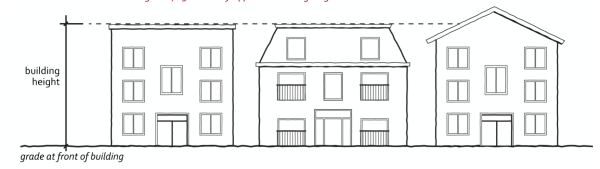
- For detached houses, two-unit houses and attached houses, building height is measured as the vertical distance from established grade at the front of the building to the highest point of any roof structure. See Figure 14-16.
Figure 14-16: Measuring Building Height: Detached Houses, Two-unit Houses and Attached Houses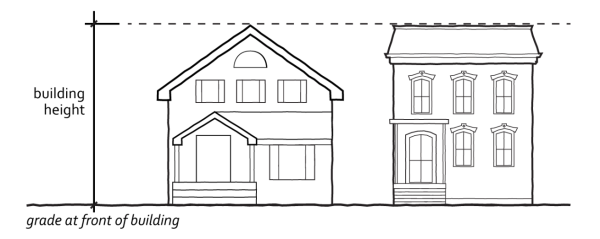
- For the purposes of measuring building height, “established grade” is the average level of the finished surface of the ground adjacent to the exterior walls of a building, excluding man-made berms, retaining walls, and the like.
- On lots with multiple street frontages, height must be measured from established grade of whichever street-facing building elevation or side of structure yields the greatest height measurement.
- For all buildings other than detached houses, two-unit houses and attached houses, height is measured as the vertical distance from established grade at the front of the building to the highest point of the roof surface of a flat roof, to the deck line for a mansard roof, to the mean height level between the eaves and ridge of principal roof structure for hip, gabled, and gambrel roofs. See Figure 14-15.
- Exceptions
- Lawfully established parapet walls, chimneys, elevators bulkheads, equipment penthouses, cooling towers, monuments, water towers, stacks, flag poles, stage towers and scenery lofts, ornamental towers, spires, and necessary mechanical appurtenances are exempt from zoning district height limits and are not included in building height measurements.
- Building-mounted solar energy systems may extend up to three feet (3') above the applicable maximum zoning district height limit, provided they do not extend more than five feet (5') above the roof line.

