
Downers Grove City Zoning Code
ARTICLE 28
VII Parking
Sec 28.7.010 General
- Purpose
- The regulations of this Article are intended to help ensure provision of off-street motor vehicle parking facilities, bicycle parking and other motorized and non-motorized transportation circulation facilities in rough proportion to the generalized demands of different land uses. By requiring such facilities, it is the intent of this Article to help avoid the negative impacts associated with spillover parking into adjacent areas, while at the same time avoiding the negative environmental and visual impacts that can result from unnecessarily large parking and vehicular use areas.
- The provisions of this Article are also intended to help protect the public health, safety and general welfare by:
- promoting multi-modal transportation options and enhanced safety and convenience for non-motorized travel; and
- providing flexible methods of responding to the transportation and access demands of various land uses in different areas of the Village.
- Applicability
- General. Unless otherwise expressly stated, the regulations of this Article apply to all districts and uses.
- New Uses and Development. Unless otherwise expressly stated, the parking regulations of this Article apply to all new buildings constructed and all new uses established in all zoning districts.
- Enlargements and Expansions
- Unless otherwise expressly stated, the parking regulations of this Article apply whenever an existing building or use is enlarged or expanded to include additional dwelling units, floor area, seating capacity, employees or other units of measurement used for establishing off-street parking requirements.
- In the case of enlargements or expansions that trigger requirements for additional parking, additional spaces are required only to serve the enlarged or expanded area, not the entire building or use. In other words, there is no requirement to address a lawful, existing parking deficit.
- Change of Use. When the use or occupancy of property changes, additional off-street parking and loading facilities must be provided to serve the new use or occupancy only when the number of parking or loading spaces required for the new use or occupancy exceeds the number of spaces required for the use that most recently occupied the building, based on the standards of this zoning ordinance. In other words, “credit” is given to the most recent lawful use of the property for the number of parking spaces that would be required under this zoning ordinance, regardless of whether such spaces are actually provided. A new use is not required to address a lawful, existing parking deficit.
- Existing. Existing off-street parking and loading areas may not be eliminated, reduced or modified below the minimum requirements of this Article.
Sec 28.7.020 Maximum Requirements
Commercial uses requiring one hundred (100) or more parking spaces may not provide more than four and one-half (4.5) spaces per one thousand (1,000) square feet of floor area unless otherwise approved through the special use approval process of DGMC Section 28.12.050. The special use permit application must include a parking study prepared by professional transportation planner or traffic engineer.
Sec 28.7.030 Minimum Motor Vehicle Parking Ratios
Except as otherwise expressly stated, off-street motor vehicle parking spaces must be provided in accordance with Table 7-1.
Table 7-1: Minimum Motor Vehicle Parking Requirements
| USE CATEGORY | Minimum Motor Vehicle Parking |
| Subcategory | |
Specific use (See DGMC Section 28.5.020) | |
| RESIDENTIAL | |
| Household Living (except for the following uses) | 2 spaces per dwelling unit |
| Apartment/condo in DB, DC, FC and FB zoning districts | 1.4 spaces per dwelling unit |
| Apartment/condo (for persons 62 or older) | 0.6 spaces per dwelling unit |
| Apartment/condo (for persons 62 or older and offering on-site assisted living services) | 0.4 spaces per dwelling unit |
| Apartment/Condo (Inclusive Dwelling Units provided for in the F Zoning Districts) | 1 space per Inclusive Dwelling Unit |
| Group Living | 0.5 spaces per bed |
| PUBLIC, CIVIC AND INSTITUTIONAL | |
| Aircraft Landing Area | per DGMC Section 28.7.040(g) |
| College or University | per DGMC Section 28.7.040(g) |
| Community Center | 1 space per 4 occupants (maximum capacity) |
| Fraternal Organization | 4 spaces per 1,000 square feet |
| Governmental Facility | per DGMC Section 28.7.040(g) |
| Hospital | per DGMC Section 28.7.040(g) |
| Library | 5 spaces per 1,000 sq. ft. |
| Museum or Cultural Facility | 2 spaces per 1,000 sq. ft. |
| Natural Resource Preservation | None |
| Parks and Recreation | |
| Park | 5 spaces per acre |
| Swimming pool | 10 spaces per 1,000 sq. ft. of water surface |
| Tennis court | 2.25 per court |
| Religious Assembly | |
| Existing as of 01-14-1991 and located within 1,000 feet of DC or DB zoning district | 1 space per 8 occupants (maximum capacity) |
| All other | 1 space per 4 occupants (maximum capacity) |
| Safety Service | per DGMC Section 28.7.040(g) |
| School | |
| Elementary and Junior High | 0.10 spaces per student |
| Senior High | 0.30 spaces per student |
| Utilities and Public Service Facility | |
| Minor | None |
| Major | per DGMC Section 28.7.040(g) |
| Wireless Telecommunications | None |
| COMMERCIAL | |
| Adult Entertainment Establishment | per DGMC Section 28.7.040G |
| Animal Service | 3.5 spaces per 1,000 sq. ft. |
| Assembly and Entertainment (except for the following uses) | 1 space per 3 occupants (maximum capacity) |
| Bowling alley | 4 per lane, plus parking required by this section for restaurants, bars, and other affiliated uses |
| Commercial Service (except for the following uses) | 3.5 spaces per 1,000 sq. ft. |
| Building service | 1.17 spaces per 1,000 sq. ft. |
| Personal improvement services | 4 spaces per 1,000 sq. ft. |
| Health club, fitness facility | 5 spaces per 1,000 sq. ft. |
| Studio or instructional services | 3.5 spaces per 1,000 sq. ft. |
| Research service | 1.17 spaces per 1,000 sq. ft. |
| Day Care | 2 spaces per 1,000 sq. ft., plus 1 drop-off or pick-up space per 1,000 sq. ft. (not to exceed a maximum of 10) |
| Eating and Drinking Establishment (except for the following uses) | 10 spaces per 1,000 sq. ft. or 1 space per 4 seats, whichever is greater, plus stacking spaces per Section 7.130. |
| Carry-out restaurant | 3.5 spaces per 1,000 sq. ft. |
| Restaurant with lounge | 12.5 spaces per 1,000 sq. ft. or 1 space per 4 seats, whichever is greater |
| Financial Service | 3.5 spaces per 1,000 sq. ft., plus stacking spaces per Sec. 7.130 |
| Funeral or Mortuary Service | 12.5 spaces per 1,000 sq. ft. |
| Lodging | 1.25 spaces per room, plus parking required by this section for restaurants, bars, banquet facilities and other accessory uses |
| Office | |
| Business and professional office | 3 spaces per 1,000 sq. ft. |
| Medical, dental and health practitioner | 4.50 spaces per 1,000 sq. ft. |
| Parking, Non-Accessory | None |
| Retail Sales (except for the following uses) | 3.50 spaces per 1,000 square feet |
| Furniture/large appliance store | 1.67 spaces per 1,000 sq. ft. |
| Grocery store over 20,000 sq. ft. | 4.0 spaces per 1,000 sq. ft. |
| Shopping center (multi-tenant) | 4.0 spaces per 1,000 sq. ft. |
| Self-service Storage Facility | 0.2 spaces per 1,000 sq. ft. |
| Trade School | 1 space per 4 occupants (maximum capacity) |
| Vehicle Sales and Service | |
| Commercial vehicle repair and maintenance | 1 per service bay, plus stacking spaces per Section 7.130. |
| Commercial vehicle sales and rentals | 2 spaces per 1,000 sq. ft. of showroom area, plus 0.4 spaces 1,000 sq. ft. of outdoor display space, plus 2 per service bay |
| Fueling station | 1 space per pump island, plus 1 space per service bay, plus 3.33 spaces per 1,000 sq. ft. of retail sales area, plus stacking spaces per Section 7.130. |
| Personal vehicle repair and maintenance | 1 per service bay, plus stacking spaces per Section 7.130. |
| Car wash | 1 per wash bay, plus stacking spaces per Section 7.130. |
| Personal vehicle sales and rentals | 2 spaces per 1,000 sq. ft. of showroom area, plus 0.4 spaces 1,000 sq. ft. of outdoor display space, plus 2 per service bay |
| Vehicle body and paint finishing shop | 1 per service bay, plus stacking spaces per Section 7.130. |
| WHOLESALE, DISTRIBUTION & STORAGE | 0.67 spaces per 1,000 sq. ft. |
| INDUSTRIAL | 1.17 spaces per 1,000 sq. ft. |
| RECYCLING | |
| Recyclable Material Drop-off Facility | per DGMC Section 28.7.040(g) |
| AGRICULTURE | |
| Community Garden | None |
| OTHER | |
| Drive-in or Drive-through Facility | Stacking spaces per DGME Section 28.7.130 |
| Medical Cannabis Dispensing Organization | 6 spaces per 1,000 sq. ft. (where shared parking is available) or 7.5 spaces per 1,000 sq. ft. (where shared parking is not available) |
| Medical Cannabis Cultivation Center | 1.17 spaces per 1,000 sq. ft. |
| Adult Use Cannabis Dispensing Organization | 6 spaces per 1,000 sq. ft. (where shared parking is available) or 7.5 spaces per 1,000 sq. ft. (where shared parking is not available) |
| Adult Use Cannabis Graft Grower | 6 spaces per 1,000 sq. ft. (where shared parking is available) or 7.5 spaces per 1,000 sq. ft. (where shared parking is not available) for dispensary portion of business plus 1.17 spaces per 1,000 sq. ft. for non-dispensary areas of business |
| All other Adult Use Cannabis Business Establishments | 1.17 spaces per 1,000 sq. ft. |
(Ord. No. 5804, 12/17/19; Ord. No. 5706, 7/10/18)
Sec 28.7.040 Calculation Of Required Parking
The following rules apply when calculating the required number of off-street parking spaces:
- Multiple Uses. Unless otherwise expressly allowed in accordance with the shared parking regulations of DGMC Section 28.7.050(b), lots containing more than one use must provide parking in an amount equal to the total of the requirements for all uses on the lot.
- Fractions. When measurements of the number of required spaces result in a fractional number, any fraction of less than one-half (0.5) is rounded down to the next lower whole number, and any fraction of one-half (0.5) or more is rounded up to the next higher whole number.
- Area Measurements. Unless otherwise expressly stated, all area-based (square footage) parking standards must be computed based on the sum of the gross horizontal areas of a building devoted to a use requiring off-street parking. The following areas are not counted as floor area for the purpose of calculating off-street parking and loading requirements: floor space devoted primarily to the housing of mechanical or electrical equipment, elevator shafts, stairwells, storage (except as otherwise noted), commercial kitchen areas, ramps, aisles, and maneuvering space devoted to off-street parking or loading facilities, or basement floor space unless the basement area is devoted to merchandising activities, the production or processing of goods, business or professional offices or dwelling uses.
- Bench Seating. Each twenty inches (20") of seating area in bleachers, pews or similar bench-seating arrangement counts as one seat for the purpose of calculating seating-based parking requirements. See Figure 7-1.
Figure 7-1: Bench Seating Measurement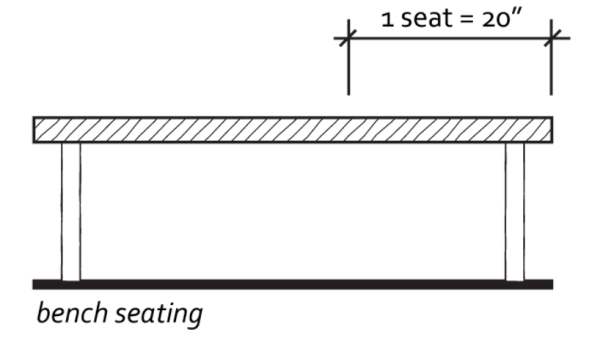
- Occupancy- or Capacity-based Standards. For the purpose of computing parking requirements based on employees, students, members, residents or occupants, calculations must be based on occupancy standards established by the building code.
- Unlisted Uses. Upon receiving a development application for a use not specifically listed in the off-street parking schedule, the Community Development Director is authorized to apply the off-street parking ratio specified for the listed use that is deemed most similar to the proposed use or establish a minimum off-street parking requirement for the proposed use in accordance with DGMC Section 28.7.040(g).
- Establishment of Other Parking Ratios. The Community Development Director is authorized to establish required minimum off-street parking ratios for unlisted uses and in those instances where authority to establish a requirement is expressly granted. Such ratios may be established on the basis of a similar use/parking determination (as described in DGMC Section 28.7.040(f)), on parking data provided by the applicant or information otherwise available to the Community Development Director. Parking data and studies must include estimates of parking demand based on reliable data collected from comparable uses or on external data from credible research organizations (e.g., Institute of Transportation Engineers (ITE) or American Planning Association [APA]). Comparability will be determined by density, scale, bulk, area, type of activity and location. Parking studies must document the source of all data used to develop recommended requirements.
Sec 28.7.050 Parking Exemptions And Reductions
- Downtown and Fairview Zoning Districts
- Minimum off-street parking requirements do not apply in the DC or DB zoning districts, except as follows:
- All residential uses, medical, dental and health practitioner offices are required to comply with off-street parking requirements; and
- Any nonresidential uses requiring Village Council approval (e.g., special uses and uses in approved PUDs) may be required to provide off-street parking as a condition of approval.
- Minimum off-street requirements do not apply in the FC zoning district, except as follows:
- Minimum off-street parking requirements do not apply in the FB zoning districts, except as follows: a. All residential uses are required to comply with off-street parking requirements; and b. Any non-residential uses shall provide parking in accordance with the following requirements: (i) Entertainment and assembly uses shall provide one (1) parking space per every eight (8) occupants; and (ii) All other nonresidential uses shall provide 1.5 parking spaces per one thousand (1,000) square feet; (iii) Any nonresidential uses requiring Village Council approval (e.g., special uses and uses in approved PUDs) may be required to provide off-street parking as a condition of approval.
- Parking that is voluntarily provided must comply with the parking area design and parking lot landscape regulations of this zoning ordinance. See Article VIII of this Chapter.
a. All residential uses are required to comply with off-street parking requirements; and
b. All medical, dental and health practitioner offices shall provide 1.5 parking spaces per one thousand (1,000) square feet.
c. Any nonresidential uses requiring Village Council approval (e.g., special uses and uses in approved PUDs) may be required to provide off-street parking as a condition of approval. - Minimum off-street parking requirements do not apply in the DC or DB zoning districts, except as follows:
- Shared Parking
- Purpose. Sharing parking among different users can result in overall reductions in the amount of motor vehicle parking required. Shared parking is encouraged as a means of conserving scarce land resources, reducing stormwater runoff, reducing the heat island effect caused by large paved areas and improving community appearance.
- Applicability. Shared parking facilities are allowed for mixed-use projects and for multiple uses with different periods of peak parking demand, subject to approval by the Community Development Director. Required residential parking and accessible parking spaces (for persons with disabilities) may not be shared and must be located on site.
- Methodology. The number of parking spaces required under a shared parking arrangement must be determined in accordance with the following:
- Multiply the minimum parking required for each individual use, as set forth in DGMC Section 28.7.030 by the percentage identified for each of the six (6) designated time periods in Table 7-2.
- Add the resulting sums for each of the six (6) columns.
- The minimum shared parking requirement is the highest sum among the six (6) columns resulting from the above calculations.
- Select the time period with the highest total parking requirement and use that total as the shared parking requirement.
Table 7-2: Shared Parking CalculationsWeekday Weekend Land Use Midnight–7:00 a.m. 7:00 a.m. –6:00 p.m. 6 p.m. –Midnight Midnight–7:00 a.m. 7:00 a.m. –6:00 p.m. 6 p.m. –Midnight Office and Industrial 5% 100% 10% 0% 60% 5% Lodging 100% 60% 90% 100% 65% 80% Eating and Drinking 50% 70% 100% 45% 70% 100% Religious Assembly 0% 10% 30% 0% 100% 30% Assembly & Entertain 10% 50% 100% 5% 80% 100% Retail & Comm. Service 5% 70% 90% 0% 100% 60%
- Other uses. If one or more of the land uses proposing to make use of shared parking arrangement do not conform to the land use classifications in Table 7-2, as determined by the Community Development Director, then the applicant must submit sufficient data to indicate the principal operating hours of the uses. Based upon this information, the community development director is authorized to determine the appropriate shared parking requirement, if any, for such uses.
- Alternative Methodology. As an alternative to the shared parking methodology established in DGMC Section 28.7.050(b)(3), the Community Development Director is authorized to approve shared parking calculations based on the latest edition of the Urban Land Institute’s or the Institute of Transportation Engineer’s shared parking model or based on studies prepared by professional transportation planner or traffic engineer. The shared parking analysis must demonstrate that the peak parking demands of the subject uses occur at different times and that the parking area will be large enough for the anticipated demands of both uses.
- Location. Shared parking may be located on-site or off-site. Off-site parking is subject to the regulations of DGMC Section 28.7.070(d).
- Motorcycle Parking. In parking lots containing over twenty (20) motor vehicle parking spaces, motorcycle or scooter parking may be substituted for up to five (5) automobile parking spaces or five percent (5%) of required motor vehicle parking, whichever is less. For every four (4) motorcycle or scooter parking spaces provided, the automobile parking requirement is reduced by one (1) space. Each motorcycle and scooter space must minimum dimensions of four feet (4') feet by eight (8'). This provision applies to existing and proposed parking lots.
- Car-Share Service. For any development, one (1) parking space or up to five percent (5%) of the total number of required spaces, whichever is greater, may be reserved for use by car-share vehicles. The number of required motor vehicle parking spaces is reduced by one (1) space for every parking space that is leased by a car-share program for use by a car-share vehicle. Parking for car-share vehicles may also be provided in any non-required parking space.
- Electrical Vehicle Parking. For any development, one (1) parking space or up to five percent (5%) of the total number of required spaces, whichever is greater, may be reserved for use by electrical vehicle parking. The number of required motor vehicle parking spaces is reduced by one (1) space for every parking space that is dedicated for electrical vehicle parking.
(Ord. No. 5706, 7/10/18)
Sec 28.7.060 Bicycle Parking
- Minimum Requirements. Bicycle parking spaces must be provided in accordance with the minimum ratios established in Table 7-3.
Table 7-3: Minimum Bicycle Parking RatiosUSE CATEGORY Minimum Bicycle Parking Spaces (% of Motor Vehicle Parking) Subcategory Specific use
(See DGMC Section 28. 5.020)PUBLIC, CIVIC AND INSTITUTIONAL Community Center None for first 9 vehicle spaces, then 10% or 2 spaces, whichever is greater Library None for first 9 vehicle spaces, then 10% or 2 spaces, whichever is greater Museum or Cultural Facility None for first 9 vehicle spaces, then 10% or 2 spaces, whichever is greater Parks and Recreation None for first 9 vehicle spaces, then 10% or 2 spaces, whichever is greater School Elementary and Junior High None for first 9 vehicle spaces, then 10% or 2 spaces, whichever is greater Senior High None for first 19 vehicle spaces, then 5% or 2 spaces, whichever is greater COMMERCIAL Assembly and Entertainment None for first 19 vehicle spaces, then 5% or 2 spaces, whichever is greater Commercial Service Health club, fitness facility None for first 9 vehicle spaces, then 10% or 2 spaces, whichever is greater Eating and Drinking Establishment None for first 19 vehicle spaces, then 5% or 2 spaces, whichever is greater Financial Service None for first 19 vehicle spaces, then 5% or 2 spaces, whichever is greater Office None for first 19 vehicle spaces, then 5% or 2 spaces, whichever is greater Retail Sales None for first 19 vehicle spaces, then 5% or 2 spaces, whichever is greater Studio, Instructional or Service None for first 19 vehicle spaces, then 10% or 2 spaces, whichever is greater RESIDENTIAL Apartment/condo None for first 9 vehicle spaces, then 10% or 2 spaces, whichever is greater. - Maximum Requirement. The minimum bicycle parking ratios of Table 7-3 notwithstanding, no use is required to provide more than twenty-five (25) bicycle parking spaces.
- Location. Bicycle parking spaces must be located in highly visible, illuminated areas that do not interfere with pedestrian movements. Bicycle parking spaces must be located within one hundred feet (100') of a customer entrance. Bicycle parking spaces must be set back in accordance with DGMC Section 28.14.100(b).
- Design. Bicycle parking spaces must:
- consist of bike racks or lockers that are anchored so that they cannot be easily removed;
- be of solid construction, resistant to rust, corrosion, hammers, and saws;
- allow both the bicycle frame and the wheels to be locked with the bicycle in an upright position using a standard U-lock;
- be designed so as not to cause damage to the bicycle;
- facilitate easy locking without interference from or to adjacent bicycles; and
- have minimum dimensions of two feet (2') in width by six feet (6') in length, with a minimum overhead vertical clearance of seven feet (7').
(Ord. No. 5804, 12/17/19)
Sec 28.7.070 Location Of Off-Street Parking
- General. Except as otherwise expressly stated, required off-street parking spaces must be located on the same lot and under the same control as the building or use they are required to serve.
- Setbacks. Except as otherwise expressly stated, off-street parking areas are subject to the principal building setbacks, exclusive of any additional setbacks for building height, of the subject zoning district.
- Off-street parking spaces accessory to a detached house, attached house or two-unit house may be located in any driveway The driveway must be improved with a hard, dustless material, generally asphalt or concrete, as approved by the Public Works Director.
- Off-street parking spaces accessory to any religious assembly use that was in existence before April 19, 1965 may be located in a required street setback, provided they are set back at least five feet (5') from the right-of-way.
- Off-street parking spaces for M-1 zoned lots that are located on the west side of Thatcher Road and also abut the Illinois State Tollway right-of-way may be located in the required street setback, provided they are set back at least five feet (5') from the right-of-way. Such spaces must be improved with a hard, dustless material, generally asphalt or concrete, as approved by the Public Works Director.
- Off-street parking spaces for M-1 zoned lots with frontage on Douglas Road between Rogers Street on the north and Maple Avenue on the south may be located in the required street setback on the Douglas Road frontage, provided that such spaces are improved with a hard, dustless material, generally asphalt or concrete, as approved by the Public Works Director.
- Downtown. Parking is prohibited in the street yard of any lot located within a DC, DB or DT zoning district except that parking is allowed on approved driveways serving detached houses, attached houses and two-unit houses.
- Off-Site Parking
- When Allowed. All or a portion of required off-street parking for nonresidential use may be provided off-site, in accordance with the regulations of this Section. Required accessible parking spaces and parking required for residential uses may not be located off site.
- Location. Off-site parking areas must be located within a one thousand foot (1,000') radius of the use served by such parking, measured between the entrance of the use to be served and the outer perimeter of the farthest parking space within the off-site parking lot. Off-site parking lots are allowed only in zoning districts that permit the principal use to be served by the off-site parking spaces, unless approved as a special use. See Figure 7-2.
Figure 7-2: Off-Site Parking Location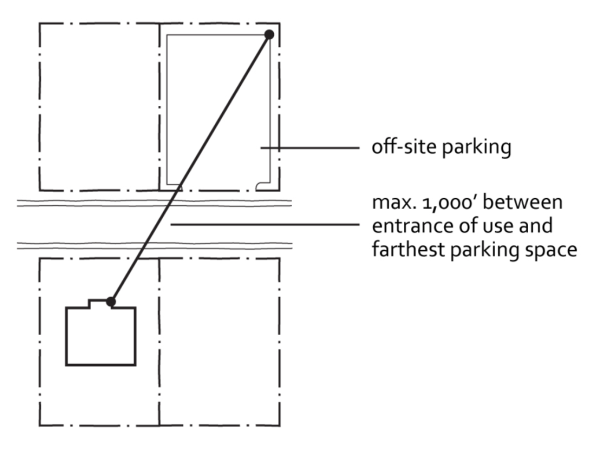
- Design. Off-site parking areas must comply with all applicable parking area design and parking lot landscape regulations of this zoning ordinance. See Article VIII of this Chapter.
- Control of Off-Site Parking Area. The property to be occupied by the off-site parking facilities must be under the same ownership as the lot containing the use to be served by the parking. The off-site parking area may be under separate ownership only if an agreement is provided, in a form approved by the Village Attorney, guaranteeing the long-term availability of the parking, commensurate with the use served by the parking. Off-site parking privileges will continue in effect only as long as the agreement, binding on all parties, remains in force. If an off-site parking agreement lapses or is no longer valid, then parking must be provided as otherwise required by this Article.
(Ord. No. 5706, 7/10/18)
Sec 28.7.080 Use Of Off-Street Parking Areas
- Required off-street parking facilities may be used only for the temporary parking of licensed passenger motor vehicles by residents, tenants, patrons, employees, or guests of the principal or accessory use. Off-street parking spaces required by this zoning ordinance must be maintained for the life of the principal use.
- Off-street parking spaces may not be leased to uses not on-site, including but not limited to schools and commuter parking, unless approved by a special use or shared parking agreement. Property owned by the Village, State or federal government is exempt from this provision.
- Off-street parking facilities may not be used for the parking of vehicles for the purpose of displaying the same for sale unless the principal use of the property on which the parking facility is located is the business of selling or leasing used or new vehicles. This provision is not intended to prohibit an owner or occupant of R-zoned property from displaying vehicles for sale on the property's off-street parking facilities provided the vehicle is owned by the owner or occupant of the residential property. Except for flagrant or repeated violations, the Village will endeavor to obtain voluntary compliance with the restrictions on displaying cars for sale prior to initiation of enforcement proceedings.
- No vehicle repair or service of any kind shall be permitted in conjunction with off-street parking facilities in a residential or business zoning district, except for minor repairs or service on vehicles owned by an occupant or resident of the premises. The sale of gasoline and motor oil in conjunction with off-street parking facilities is not permitted in any residential zoning district.
- No vehicle with a gross weight in excess of eight thousand (8,000) pounds may be stored overnight on a lot in a business, employment or special purpose zoning district unless the vehicle is being used in connection with a business currently operating on such lot, if the vehicle is serving a particular business on such lot or if the vehicle is providing a service to or activity upon such lot.
- No vehicle with a gross vehicle weight in excess of eight thousand (8,000) pounds, except vehicles registered as recreational vehicles under the Illinois Motor Vehicle Code; and no contractor's equipment, materials, supplies and tools, including the trailers used to haul such items and snow plow blades, may be stored or parked on any lot in any residential zoning district, unless:
- the vehicle, equipment, supplies or tools are located within a completely enclosed building, or
- the vehicle, equipment, supplies or tools are being used in connection with a legitimate service actually being rendered for the benefit of the subject lot.
(Ord. No. 5706, 7/10/18)
Sec 28.7.090 Parking Of Recreational Vehicles And Equipment
- Recreational vehicles, recreational equipment and utility trailers located on a zoning lot on or before December 31, 2007 are subject to the following regulations:
- Not more than one (1) recreational vehicle and one (1) piece of recreational equipment or utility trailer may be parked or stored in the rear or side yard of any lot in a residential zoning district. The vehicles and equipment must be set back at least two and one half feet (2.5') from any side or rear lot line. For the purpose of this provision, one piece of recreational equipment is equal to a single non-motor vehicle with no more than one watercraft or not more than two (2) snowmobiles, personal watercrafts or specialty prop-crafts. Recreational vehicles, recreational equipment and utility trailers may not be stored in the required street setbacks.
- Notwithstanding the regulations of DGMC Section 28.7.090(a)(1), recreational vehicles, recreational equipment and utility trailers may be temporarily parked in the rear or side yard or in the street yard if stored on a driveway, provided that the Community Development Director is given prior notice of the dates for such temporary parking. For purpose of this provision, temporary parking is the parking of vehicles or equipment during any period not exceeding ten (10) days in aggregate (which may or may not be consecutive) within any period of thirty (30) consecutive days.
- All recreational vehicles, recreational equipment and utility trailers parked in residential zoning districts must be parked on an improved area constructed of a hard dustless material, generally asphalt, brick pavers or concrete.
- Recreational vehicles, recreational equipment and utility trailers stored or parked in residential zoning districts must be owned by the owner or occupant of the subject property.
- Recreational vehicles located on a zoning lot after December 31, 2007 are subject to the following regulations:
- Not more than one(1) recreational vehicle and one (1) piece of recreational equipment or utility trailer may be parked or stored in the rear or side yard of any lot in a residential zoning district. The vehicles and equipment must comply with the principal building setback requirements of the subject zoning district. For the purpose of this provision, one (1) piece of recreational equipment is equal to a single non-motor vehicle with no more than one (1) watercraft or not more than two (2) snowmobiles, personal watercrafts or specialty prop-crafts. Recreational vehicles, recreational equipment and utility trailers may not be stored in the street yard.
- Notwithstanding the regulations of DGMC Section 28.7.090(b)(1), recreational vehicles, recreational equipment and utility trailers may be temporarily parked in the rear or side yard or in the street yard if stored on a driveway, provided that the Community Development Director is given prior notice of the dates for such temporary parking. For purpose of this provision, temporary parking is the parking of vehicles or equipment during any period not exceeding ten (10) days in aggregate (which may or may not be consecutive) within any period of thirty (30) consecutive days.
- All recreational vehicles, recreational equipment and utility trailers parked in residential zoning districts must be parked on an improved area constructed of a hard dustless material, generally asphalt, brick pavers or concrete.
- Recreational vehicles, recreational equipment and utility trailers stored or parked in residential zoning districts must be owned by the owner or occupant of the subject property.
- Any recreational vehicle, recreational equipment or utility trailer stored in a rear or side yard of a residential district must be screened on at least three (3) sides by a solid hedge a minimum of four feet (4') in height at the time of planting or by a six foot (6') privacy fence. The screening must be placed so that the equipment is screened from view of all abutting property owners throughout the year.
- The recreational vehicle, recreational equipment, or utility trailer must be properly licensed.
- No recreational vehicle, equipment, or utility trailer may have its wheels removed or be affixed to the ground so as to prevent its ready removal.
- No parked or stored recreational vehicle may be used for living, sleeping or business purposes.
Sec 28.7.100 Parking Area Design
- Tandem and Valet Parking Arrangements. Parking areas must be designed and constructed to allow unobstructed movement in-to and out of required parking spaces without interfering with fixed objects or vehicles except in the case of allowed tandem and valet parking, as follows.
- Tandem Parking. Tandem parking spaces may be used to satisfy residential parking requirements if the tandem spaces are assigned to the same dwelling unit.
- Valet Parking. Valet parking may be used to satisfy minimum off-street parking requirements for nonresidential uses if an attendant is present during all hours of operation. Valet parking arrangements may involve the stacked parking of vehicles (i.e., requiring one (1) or more vehicles to be moved to obtain access to other parked vehicles). Valet parking is not subject to the off-site parking distance limit of DGMC Section 28.7.070(d)(2). See also the valet parking regulations in Chapter 14 (Article XI) of this Code.
- Stall Sizes and Parking Lot Geometrics
- Off-street parking areas must be designed and constructed in accordance with the regulations of Table 7-4. See also Figure 7-3.
Table 7-4: Parking Area Dimensions
Angle of Parking 0º (Parallel) 45º 60º 90º Stall Width (feet) 7 9 9 9 Stall Length (feet) 21 (middle), 24 (ends) 18 19 18 Aisle Width (feet) 14 (one-way), 24 (two-way) 14 15 24 Module Width (feet) 50 53 60
Note: Dimensions must be measured from the centerline of the stripe delineating the space. - Stall dimensions may be reduced by up to six inches (6") in width and length in parking lots containing more than fifty (50) parking spaces if a parking study demonstrates that parking activity is projected at medium to low turnover conditions, defined as Class B or C by the Institute of Transportation Engineers (ITE), and that the typical parking space in such lot or structure will be occupied by no more than one (1) or two (2) different vehicles during the course of the business day. Stall size reductions are not allowed for parallel spaces.
Figure 7-3: Parking Area Dimensions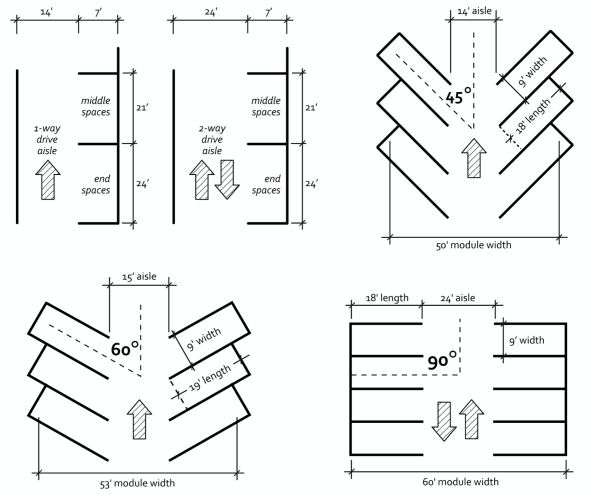
- Off-street parking areas must be designed and constructed in accordance with the regulations of Table 7-4. See also Figure 7-3.
Table 7-4: Parking Area Dimensions
- Striping. In all parking lots containing five (5) or more parking spaces, striping consisting of parallel lines, four inches (4") in width must be provided for each parking space. Striping must be yellow or white. Accessible parking spaces must be painted with the standard ADA white symbol on blue background. See Figure 7-4.
Figure 7-4: Parking Lot Markings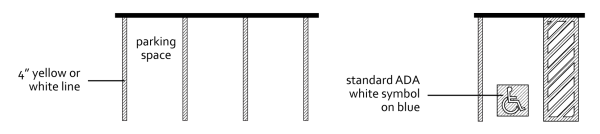
- Surfacing. All outdoor parking spaces must be properly engineered and improved with a compacted stone base and surfaced with asphaltic concrete, or other comparable all-weather, dustless material. Plans and materials must be approved by the Public Works Director.
- Wheel Stops. In all parking lots containing five (5) or more parking spaces, wheel stops must be installed where necessary to prohibit vehicle overhang onto adjacent pedestrian ways or landscape areas. Plans must be approved by the Public Works Director.
- Curb and Gutter. Combination concrete curb and gutter or concrete barrier curbs are required around the perimeter of all parking lots containing five (5) or more parking spaces and around all landscape islands and divider medians. Alternatives to curb and gutter that comply with the village’s best management practices for stormwater may be approved at the sole discretion of the Public Works Director.
- Drainage. The recommended slope of a parking lot to the drain is a minimum one percent (1%), with a one and one-half percent (1.5%) or two percent (2%) recommended minimum in all directions.
- Landscaping. All off-street parking lots containing five (5) or more spaces must be landscaped in accordance with DGMC Section 28.8.020 and DGMC Section 28.8.030.
- Lighting. See the outdoor lighting regulations of DGMC Section 28.10.030.
- Access
- Each required off-street parking space must open directly upon an aisle or driveway with a width and design that provides safe and efficient means of vehicular access to the parking space. In residential districts, parking pads may be located in the front yard, but must meet the required minimum street setback.
- All off-street parking must be designed with appropriate means of vehicular access to a street or alley in a manner that will least interfere with motorized and non-motorized traffic.
- Driveways leading to detached garages or parking areas serving a detached house, attached house or two-unit house must be at least nine feet (9') in width. However, if the distance between an existing house and the property line is less than ten feet (10') wide, an existing driveway may be replaced within the same footprint. New driveways must meet width and setback requirements. No driveway serving a detached house, attached house or two-unit house across public property or requiring a curb cut may exceed twenty-five feet (25') in width, excluding any flared pavement portion, as measured at the lot line. See Figure 7-5.
Figure 7-5: Driveway Width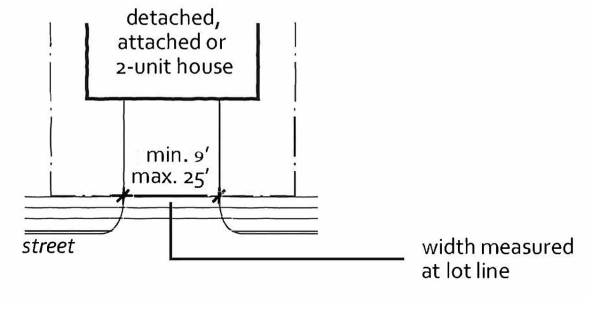
- The driveway width must match the apron width at the street lot line.
- All other uses must be designed with appropriate means of vehicular access from the street, as approved by the Public Works Director.
- All driveways must be improved with a compacted stone base and surfaced with asphalt, concrete or other comparable all-weather, dustless material.
- Shared driveways, lawfully existing before October 13, 2020, may be replaced if either property does not allow sufficient space to meet the minimum driveway width and setback requirements, as approved by the Community Development Director.
- Parking pads, lawfully existing before October 13, 2020, may be replaced, but not expanded or enlarged, unless behind the required street or corner street setback.
- If a legal nonconforming driveway is to be removed in part or whole in order to improve the driveway, it may be required to bring the driveway further into compliance. The Community Development Director is authorized to approve alternative design to promote compliance while recognizing site specific limitations. Sealcoating is not subject to this requirement.
- In the case that a parking pad cannot be located behind the street yard setback line due to the location of an existing home, and the principal driveway access to the home is via an arterial road, a hammerhead may be approved for the purpose of turning a car around. The maximum dimensions of a hammerhead are nine feet (9’) by nine feet (9’), anything larger will be considered a parking pad.
(Ord. No. 5706, 7/10/18)
Sec 28.7.110 Pedestrian Circulation
An on-site circulation system for pedestrian and non-motorized travel must be provided in accordance with the requirements of this Section. These pedestrian circulation requirements do not apply to lots occupied by detached houses, two-unit houses or attached houses.
- Connection to the Street. The on-site pedestrian circulation system must connect all adjacent public rights-of-way to the main building entrance. The connection must follow a direct route and not involve significant out-of-direction travel for system users. See Figure 7-6.
Figure 7-6: Connecting Building Entrances to Street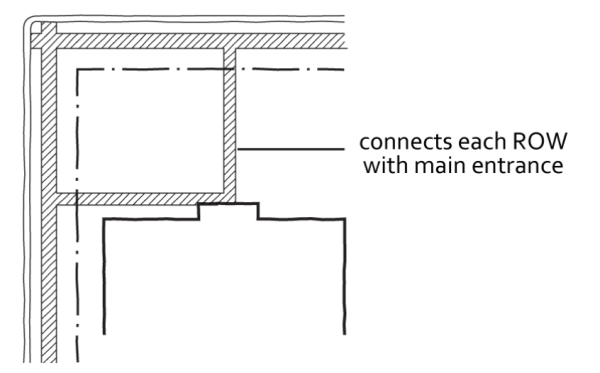
- Connection to Abutting Properties. The on-site pedestrian circulation system must provide at least one (1) connection to existing paths and sidewalks on abutting properties or to the likely location of future paths or sidewalks on those properties. When the Community Development Director determines that no paths or sidewalks exist on a neighboring property or it is not possible to determine the likely location of future path or sidewalk connections or ex-tending a connection would create a safety hazard on either property, no such connection is required. See Figure 7-7.
Figure 7-7: Connections to Abutting Properties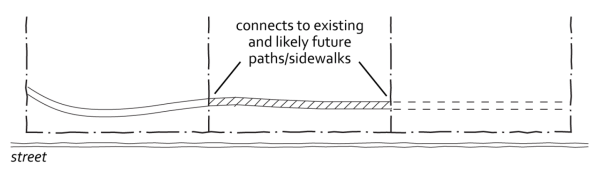
- Internal Connections. The on-site pedestrian circulation system must connect all buildings on the site and provide connections to other areas of the site likely to be used by pedestrians and non-motorized travel, such as parking areas, bicycle parking, recreational areas, common outdoor areas, plazas and similar amenity features. See Figure 7-8.
Figure 7-8: Internal Site Connections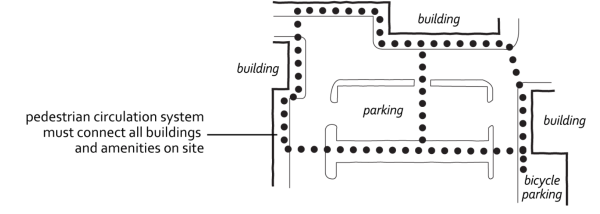
- Design. Required on-site pedestrian circulation facilities must be designed and constructed in accordance with the following requirements:
- The on-site pedestrian circulation system must be hard-surfaced, with a dust-free material and be at least five feet (5') in width.
- When the on-site pedestrian circulation system crosses driveways, parking areas or loading areas, it must be clearly differentiated through the use of elevation changes, a different paving material or other equally effective methods. Striping does not meet this requirement. See Figure 7-9.
Figure 7-9: Driveway Crossing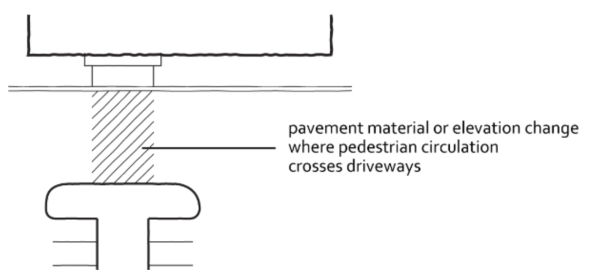
- When the on-site pedestrian circulation system is parallel and adjacent to a motor vehicle travel lane, it must be a raised path at least six inches (6") above the vehicle travel lane surface or be separated from the vehicle travel lane by a raised curb, bollards, landscaping or another physical barrier. If a raised path is used, the ends of the raised portions must be equipped with accessible curb ramps.
- The on-site pedestrian circulation system must be illuminated to ensure that it can be used safely at night by employees, residents, and customers. Lighting must be at a height appropriate for a pedestrian pathway system.
Sec 28.7.120 Accessible Parking For People With Disabilities
- The number, location and design of accessible parking spaces for people with disabilities must be provided in accordance with this section and the Illinois Accessibility Code.
- Accessible spaces must be provided in accordance with the Illinois Accessibility Code.
- Accessible parking spaces count towards the total number of parking spaces required.
- Each accessible parking space must be designed as required by the Illinois Accessibility Code.
- Accessible parking spaces must be signed in compliance with applicable state law and must identify the current fine amount for violations. The sign must be fabricated to be two (2) separate panels; one for the disability symbol and one for the current fine amount as established by the Village Council.
- Accessible parking spaces and accessible passenger loading zones that serve a particular building must be the spaces or zones located closest to the nearest accessible entrance on an accessible route. In separate parking structures or lots that do not serve a particular building, parking spaces for disabled persons must be located on the shortest possible circulation route to an accessible pedestrian entrance of the parking facility.
- The regulations of this section apply to required spaces and to spaces that are voluntarily designated for accessible parking.
(Ord. No. 5804, 12/17/19)
Sec 28.7.130 Drive-Through And Drive-In Facilities
- Purpose. These regulations of this Section are intended to help ensure that
- there is adequate on-site maneuvering and circulation area for vehicles and pedestrians;
- vehicles awaiting service do not impede traffic on abutting streets; and
- impacts on surrounding uses are minimized.
- Applicability. The regulations apply to new developments, the addition of drive-through and drive-in facilities to existing developments and the relocation of existing drive-through facilities.
- Stacking Spaces Required. Stacking lanes must be provided in accordance with the minimum requirements of Table 7-5.
Table 7-5: Stacking Space Requirements
Use Minimum Number of Stacking Spaces Required Bank/financial institution 4 spaces per drive-through lane Car wash 2 spaces per approach lane, plus 2 drying spaces at end of bay Vehicle repair/maintenance 2 per service bay (can be provided as parking spaces) Gasoline pump 2 spaces per pump per side Restaurant 8 total spaces, with at least 3 spaces between order and pick-up station Other 3 spaces per lane, ordering station or machine - Stacking Lane Dimensions, Design and Layout
- Stacking lanes must be designed so that they do not interfere with parking movements or safe pedestrian circulation. Stacking lanes must have a minimum width of ten feet (10').
- All stacking lanes must be clearly identified, through such means as striping, landscaping, pavement design, curbing and/or signs.
- Setbacks. Stacking lanes must be set back at least fifty feet (50') from any abutting residential zoning district.
- Noise. Sound attenuation walls, landscaping or other mitigation measures may be required to ensure that drive-through facilities will not have adverse noise-related impacts on nearby residential uses.
- Site Plans. Site plans must show the location of drive-through windows and associated facilities (for example: communications systems and access aisles), as well as adjacent residential uses.
(Ord. No. 5706, 7/10/18)
Sec 28.7.140 Off-Street Loading
- Minimum Ratios. Off-street loading spaces must be provided in accordance with Table 7-6.
Table 7-6: Off-street Loading RequirementsUse Type Minimum Loading Spaces Required Multi-unit or Mixed-use Residential Under 60 units None 60+ units 1 space per 60 units Nonresidential Under 20,000 square feet None 20,000–99,999 square feet 1 100,000+ square feet 1 space per 100,000 square feet - Design and Location
- Off-street loading spaces must be at least twelve feet (12') in width and thirty-five feet (35') in length unless off-street loading will involve the use of semi-tractor trailer combinations or other vehicles in excess of thirty-five feet (35') in length, in which case the minimum size of a loading space is twelve feet (12') by fifty-five feet (55'). All loading spaces must have a minimum vertical clearance of fourteen feet (14').
- All loading spaces must be located on the subject lot and include sufficient maneuvering space to prevent interference with pedestrian or vehicular circulation on the subject site and on public streets and sidewalks, as determined by the community development director.
- All loading spaces must be located on the subject lot, provided that the community development director is authorized to approve central off-street loading spaces for a group of contiguous lots as a substitute for loading berths on individual lots if the following conditions are met:
- each lot served must have direct access to the central loading area without at-grade crossings of streets or alleys;
- no lot served may be more than five hundred feet (500') from the central loading area; and
- the passageway connecting the central loading area with the lot served shall be at least seven feet (7') in width and have a vertical clearance of at least seven feet (7').
- All loading spaces for semi-tractor trailer combinations must be set back at least twenty-five feet (25') from the nearest point of intersection of any two street rights-of-way and at least fifty feet (50') from all residential zoning districts. Loading spaces may be located within fifty feet (50') of a residential zoning district if completely enclosed by a building wall or fence at least six feet (6') in height.
- All off-street loading areas must be properly engineered and improved with a compacted stone base and an all-weather, dustless surface, generally asphalt or concrete.
- Plans for the location, design and construction of all loading area are subject to approval by the Community Development Director.
- Loading spaces may not be used to satisfy off-street parking requirements or for the conduct of vehicle repair or service work of any kind.

