
Eastpointe City Zoning Code
ARTICLE 12
- ZONING PLAN REVIEWS
Sec. 12.01.- Intent statement.
A)
Purpose. The purpose of a zoning plan review is to ensure project compliance with the City of Eastpointe's zoning ordinance, along with other applicable ordinances and laws (e.g., Michigan's Building Code), all of which protect the health, safety, and well-being of a community.
B)
All projects require a zoning plan review. No building can be erected, moved, relocated, or structurally altered and there cannot be a change or addition of use, nor expansion or reduction of off-street parking, and no filling, excavation or grading can be undertaken until a required plan has been submitted for review and approval, as specified in this section.
(Ord. of 11-13-2023)
Sec. 12.02. - Types of zoning plans and reviews.
A)
Types of zoning plans and reviews. There are two types of zoning plans and reviews in the city:
1)
Planning commission site plans. Planning commission site plan projects involve major new construction and special planning processes such as special land use reviews, variances and planned unit development.
a)
All projects require a planning commission site plan, unless specified otherwise by the zoning administrator and unless the project falls within one of the administrative plan categories.
2)
Administrative sketch plans. Administrative sketch plan projects involve minor new construction and changes in site exterior, temporary uses, re-occupancies. Additionally, sketch plans are used for projects featuring new construction of one- to two-family structures and accessory structures.
B)
Discretion of the zoning administrator. The zoning administrator makes the final determination on the type of zoning plan review required and the criteria needed for each plan. The administrator has the right to waive and add additional criteria to a zoning plan review.
(Ord. of 11-13-2023)
Sec. 12.03. - Types of projects for zoning plans.
(Ord. of 11-13-2023; Ord. No. 24-1238, 6-4-2024)
Sec. 12.04. - Required plan elements.
The zoning administrator has final discretion over zoning plan submission criteria and requiring applicants to bring their property closer into compliance with zoning ordinance standards, such as architectural details. For most accurate information, reach out to the planning and zoning department. See overview of criteria below.
In the table below, the following colors represent the criteria required for an administrative sketch plan and planning commission site plan.
• Light gray: Administrative sketch plan, and planning commission site plan
• Medium gray: Planning commission site plan
(Ord. of 11-13-2023; Ord. No. 24-1238, 6-4-2024)
Sec. 12.05. - Review standards.
In the process of reviewing the sketch plan and site plan, consider the following standards:
A)
Application, descriptive and general site data. The proposed use has the potential to be compatible with the zoning district and surrounding uses. The plan submission provides all basic site information in a visually legible manner.
B)
Building form and design standards. Building form and design must relate to and be harmonious with the surrounding neighborhood in terms of texture, scale, mass, proportion, materials, and color. Buildings and structures must meet or exceed setback standards, build-to lines, height and other dimensional standards, and so placed to preserve environmentally sensitive areas.
C)
Parking and circulation. The pedestrian and vehicular circulation system planned for the proposed development must be in the best interest of the public health, safety, and welfare in regard to on-site circulation and the overall circulation of the neighborhood and community. Attention must be directed to the ingress/egress access points, maneuvering lane, turning movements, loading areas, street and alley intersections. The parking pattern proposed shall be in the best interest of the public health, safety, and welfare in regard to size, layout and quantity, and the location of parking facilities will not be detrimental to nearby developments, properties, or public streets.
D)
Landscaping and screening. Walls, earth berms, planting screens or combinations act as buffers to provide a more compatible, safer and visually attractive physical separation between various land use types. Where necessary, these devices create a definitive site improvement, thereby minimizing the impact that one type of land use may have on another. General landscaping enhances the appearance, character and value of property while having a positive impact on the community. Landscaping breaks up masses of paved and building areas and provides a cooling effect, encourages the preservation of existing vegetation where possible, and can provide a physical separation between pedestrian and vehicle traffic.
E)
Lighting. Encourage site lighting that will be attractive to the eye while at the same time adequately illuminating a site for safety and convenience. It is further the intent of this section to discourage excessively bright and harsh site illumination that creates undesirable halo effects on the property, diminishes the residential environment and presents a potential hazard to vehicle and pedestrian traffic on abutting streets and sidewalks.
F)
Signage. Site signing must meet the requirements of the zoning ordinance and must be approved by the director of public services.
G)
Engineering information. Utility services, including sanitary, water and storm runoff, must not exceed the existing or planned capacity of such services, and shall be developed in the best interest of the public health, safety, and welfare of the community. The proposed development must be designed and located so that public services, including streets and sidewalks, police and fire protection, and public schools have sufficient capacity to properly serve the development, and so that such services will not be adversely affected by the proposed development.
(Ord. of 11-13-2023)
Sec. 12.06. - Zoning plan review process.
A)
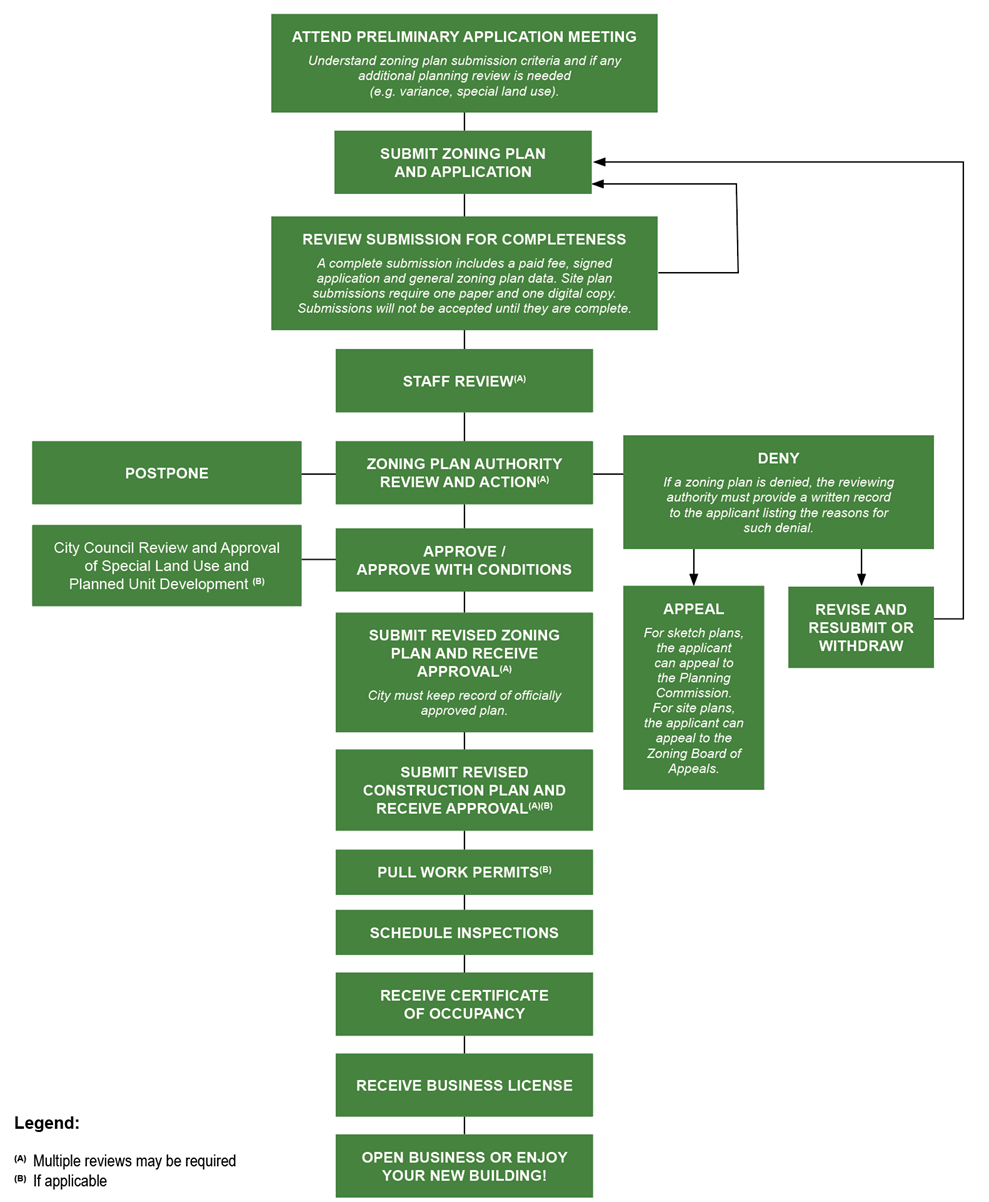
Process overview. See flow chart below.
B)
Pre-application meetings. Prior to beginning any development or zoning plan process in the city, applicants are encouraged to meet with city staff for a conceptual review of the proposed project. This meeting can help promote a smooth approval process once a formal application is submitted. Please contact the planning department to schedule a meeting and discuss what to bring to the meeting and what to expect. Bring a preliminary sketch of the project to the meeting (hand-drawings are acceptable).
It is at the discretion of zoning administrator to determine if a fee must be paid to attend the pre-application meeting. If a meeting is larger in scope and requires the attention of the city engineer, then a fee must be paid, as stated in the fee schedule.
C)
Decision statement. The planning commission must state, in the record of its proceedings, the grounds for the actions taken concerning each site plan submitted for its approval and list any conditions imposed.
D)
Performance guarantee. The planning commission may require a performance guarantee to be deposited with the community development department at the time of issuance of the building permit to ensure completion of the proposed project in accordance with MCL 125.3505.
(Ord. of 11-13-2023)
Sec. 12.07. - Procedures after plan approval.
A)
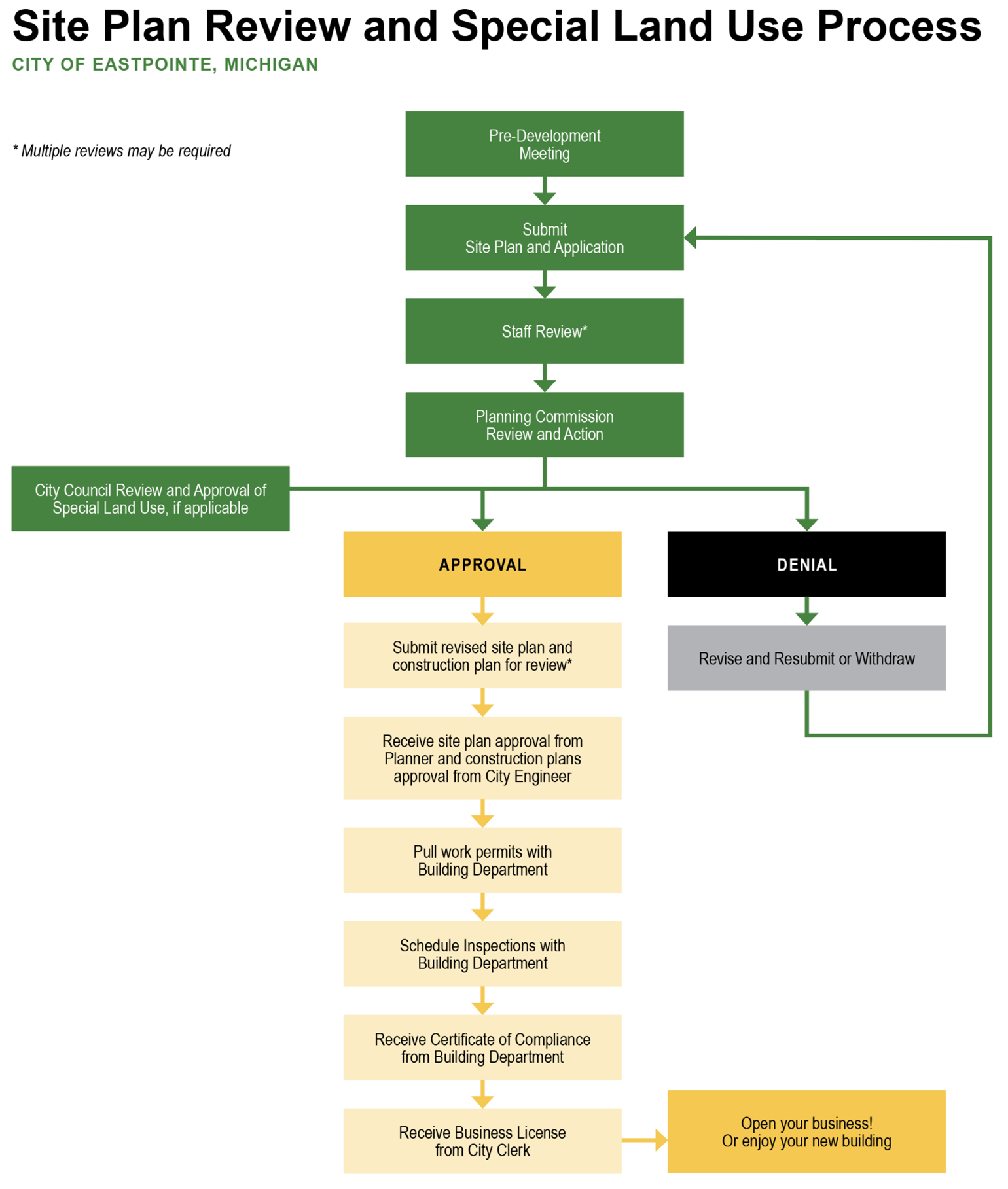
Final approved plan. The applicant must submit a final approved zoning plan with the changes required by the zoning administrator and the planning commission and list any conditions as a note on the plan, before receiving a work permit or submitting construction drawings. The final plan is a requirement of the planning process, and no project can move forward without an authorized final plan. Final plans are authorized by the zoning administrator.
B)
Approval expiration. The approval of a zoning plan shall be effective for a period of 12 months from the date of such approval. Approval dates are the date the site plan was approved, either with or without conditions, by the planning commission (if it is a site plan) or by the zoning administrator (if it is an administrative sketch plan). If a building permit has been obtained, construction has commenced, and an extension is requested by the applicant during the initial 12-month approval period, and if the extension is granted pursuant to subsection C, the zoning plan approval may be extended for up to 12 months, otherwise the zoning plan shall be null and void. In such a case, the applicant shall be required to obtain a new zoning plan approval as specified in this article.
C)
Approval extensions. Administrative sketch plans shall not be granted an extension. An extension of up to 12 months for an approved planning commission site plan may be granted by the planning commission. An extension may be granted provided the approved site plan continues to adequately represent current conditions on and surrounding the site, and that the site plan conforms to the standards of the city regulations in affect at the time of the applicant's request for an extension.
D)
Site maintenance after approval.
1)
It is the responsibility of the owner of a property for which zoning plan approval has been granted to maintain the property in accordance with the approved plans, including all site design elements and improvements, on a continuing basis until the property is razed, new zoning regulations supersede the regulations upon which plan approval was based, or a new plan is approved.
2)
Any property owner who fails to maintain an approved zoning plan in full compliance with approvals granted by the city according to the provisions of these regulations, is in violation of these regulations and required to return the site conditions consistent with the approved plans or they will lose their zoning plan approval and risk the loss of their certificate of occupancy and business license.
E)
Revocation. Any approved zoning plans may be revoked by the planning commission if construction on the site is not completed or is not progressing in a manner consistent with the approved plans. In such a case, the plan will be placed on the agenda of a planning commission meeting for consideration. The city must give written notice to the applicant at least ten days prior to the meeting. The CED director, other city staff, the applicant, and other interested persons shall be allowed to present information and testimony to the planning commission. If the planning commission finds that an inconsistency or violation of the approved site plan exists at the time of the hearing, then, by a majority vote of attending members, the planning commission may revoke the approval of the plan and order the site returned to its original condition by a date certain. Failure to comply with such an order is a violation of these regulations.
F)
Modification to approved plan. A previously approved plan may be subsequently modified, subject to the review and approval requirements of this article based on the scope of the proposed modifications. It is up to the zoning administrator to decide if a revised zoning plan must receive administrative or planning commission approval.
(Ord. of 11-13-2023; Ord. No. 24-1238, 6-4-2024)

