
Eastpointe City Zoning Code
ARTICLE 7
- GENERAL PROVISIONS
Sec. 7.02. - Clear vision triangle.
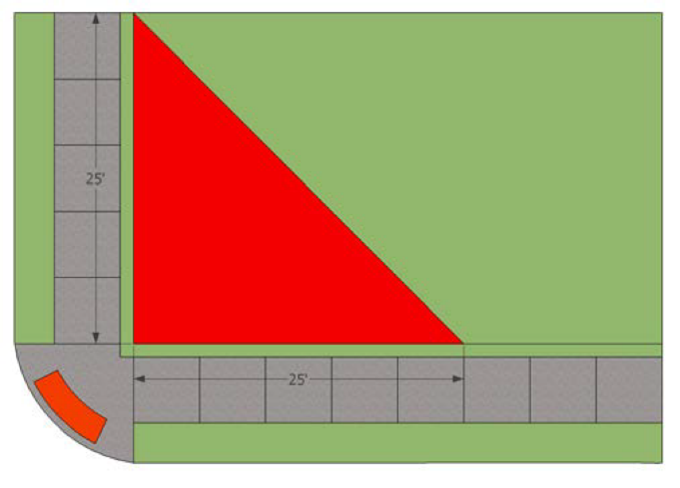
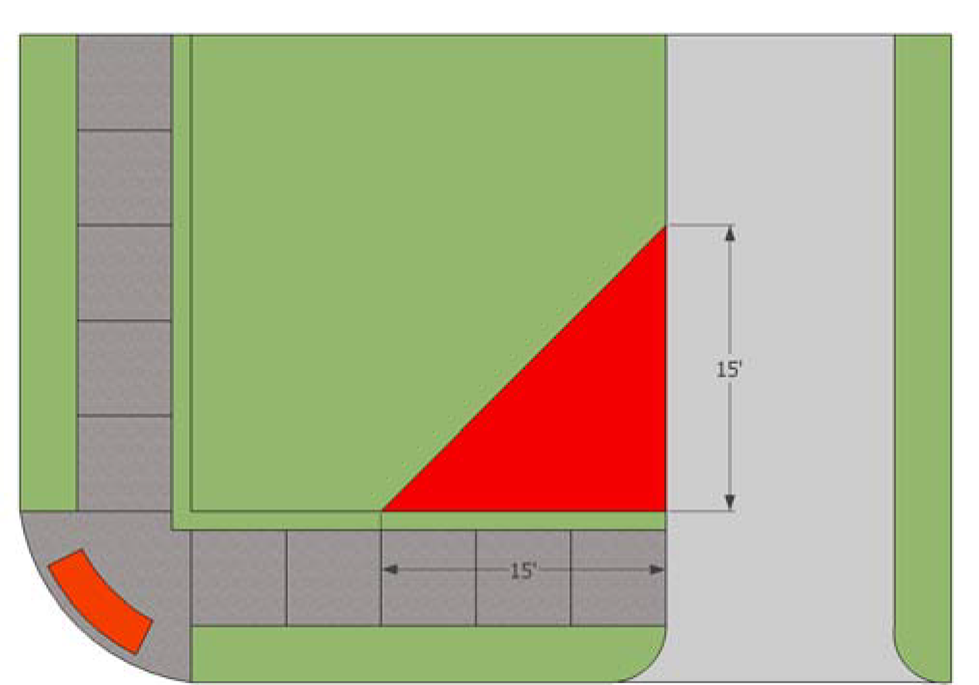
No fence, wall, shrub, or other forms of landscaping, signs, or any other obstruction to vision above a height of 30-inches, measured from the established centerline grades of the abutting street, is allowed within any of the following restricted clear corner vision:
A)
Within a triangular area formed at the intersection of two or more streets in any zoning district by a straight line intersecting the two rights-of-way lines at a point 25 feet along from their point of intersection.
B)
Within a triangular area formed at the intersection of a driveway serving a nonresidential or multiple family use with a street or alley right-of-way line, or interior property line, by a straight line extending between the right-of-way line or interior property line and the nearest edge of the driveway at a point 15 feet along the right-of-way line, or interior property line and the intersecting driveway line.
C)
Within a triangular area formed at the intersection of a driveway serving a single-family residential use with a street or alley right-of-way line, or an interior property line, by a straight line intersecting the right-of-way line or interior property line and the nearest edge of the driveway, six feet from the point of intersection.
(Ord. of 11-13-2023)
Sec. 7.03. - Parking and storage of commercial/recreational vehicles.
A)
Commercial vehicles. In all zoning districts, the parking or storage of any commercial vehicle which contains or has affixed to it commercial hardware, including, but not limited to, a dump truck, snowplow, or towing equipment, is prohibited. However, a commercial vehicle parked or stored which contains or has affixed to it a snowplow is permitted between November 15 and April 1.
B)
Recreational vehicles. Recreational vehicles, including, but not limited to, boats, jet skis, snowmobiles, truck camper bodies, travel trailers, off-road or other all-terrain vehicles, motor homes and utility trailers, as well as their trailers for carriage or storage, may be parked or kept on any lot or parcel in any residential district subject to the following:
1)
Recreational equipment parked or stored cannot have fixed connections to electricity, water, gas, or sanitary sewers, and at no time may such equipment be used for living, sleeping, or housekeeping purposes.
2)
Any recreational vehicle not parked or stored in a garage must be parked or stored in the rear or side yard, provided that a minimum of three feet of side or rear yard is maintained between the vehicle and the side or rear lot line, and except that such vehicle may occupy a front yard for loading and unloading purposes, not to exceed 48 hours, so long as such location does not obstruct the view of driveways or vehicular and pedestrian traffic of adjoining properties. Any recreational vehicle stored in the rear or side yards is subject to review by the building department and the fire department for compliance with safety requirements.
3)
The storage of recreational vehicles on a residential lot or parcel for more than 48 hours is limited to only those vehicles owned by, and licensed or registered to, the occupant of the residential lot or parcel on which the vehicle is stored. In the case of multi-family dwelling, the city council may upon recommendation of the planning commission and after site plan review, require that a screened area, in addition to required off-street parking spaces, be provided on the site for the parking and storage of recreational vehicles.
4)
Recreational vehicles must be fully operable, kept in good repair and display the current license plate and/or registration as may be appropriate under state law for the vehicle.
5)
Recreational vehicles cannot be used to store any flammable or explosive fuels or material contrary to federal, state, or local regulations.
(Ord. of 11-13-2023)
Sec. 7.04. - Fences.
A)
General standards.
1)
Fences cannot contain barbed wire or any other type of sharp-edged wire or have electric current or a charge of electricity.
2)
No chain link or similar type fencing can contain slats, webbing, synthetic materials, or other fabric for the purpose of creating a privacy type fence.
3)
Fences, over 30 inches in height (other than split rail and chain link) cannot be constructed within the clear corner vision triangle.
4)
For fences erected along a lot line, a joint permit application must be submitted and consent to install the fence provided by all property owners. Except for a fence with a common end or corner post, no fence can be attached to or touch a fence located on another property owner's lot or on the same lot.
B)
Residential district fences. Fences erected in residential districts between residential properties are permitted as follows:
1)
Fences on all lots which enclose property or are within the required side or rear yard cannot exceed four feet in height, measured from the natural grade of the lot, except for privacy fences. Fences are not required to be constructed on the property line if the fence extends from the residence to the detached garage or from the residence and/or the garage to the side property line.
2)
Fences on corner lots cannot extend toward the front of the lot nearer than the front of the house or the required minimum front yard, whichever is greater.
3)
A privacy fence may be erected along a side street property line which is in compliance with all provisions of this section regarding privacy fences.
4)
No fence may extend toward the front of the lot nearer than the front of the house or the required minimum front yard, whichever is greater.
5)
All fence support posts must be placed on the property line and face the property of the person erecting the fence. In the case of abutting property owners who elect to share the expense and erect a fence together, both are co-owners of the same and it is the responsibility of the property owners to determine the location of the posts in compliance with this article.
6)
Materials.
a)
Residential fences may be constructed of metal, wire, iron, vinyl (or similar), composite, naturally durable wood or treated wood.
b)
Hedges, ornamental shrubs, trees, and bushes may be considered fences for the purpose of this article when placed in a manner or position to serve as such.
C)
Business and industrial fences. Fences in the mixed-use and industrial districts are permitted as follows:
1)
No fence may be erected where a wall, berm, or greenbelt is otherwise required. Unless considered by the planning commission, no fence may be erected between the building setback line and the front property line. This provision does not apply to decorative fencing for outdoor patio space.
2)
A fence which is constructed on a side lot line between neighboring commercial and/or industrial properties cannot exceed 6-feet in height.
D)
Privacy fences. Privacy fences are only permitted in the side and rear yard along the property line and also along a side street property line on corner lots. Privacy fences are not permitted within the front yard or closer to the street than the established front building line of the adjacent property, whichever is greater.
1)
All privacy fences must be erected on the lot line and may be up to four inches off the ground; this requirement does not apply to those privacy fences erected along a side street.
2)
Privacy fences cannot exceed six feet, four inches in height measured from the surface of the natural grade of the lot.
3)
The posts for the privacy fence must face the property of the person erecting the fence. The posts for privacy fences which front a street must face the interior of the property.
4)
Privacy fences, once erected, must be of similar materials; a mixture of differing materials is not permitted unless otherwise dictated by existing neighboring fences.
5)
Plantings in the area of a privacy fence cannot block the clear vision or exceed the lawful height of any fence allowed in this ordinance.
E)
Maintenance.
1)
Fences erected between residential property and commercial or industrial property must be maintained in a neat and safe condition at the expense of the owner of the commercial or industrial property in accordance with this ordinance.
2)
Provisions regarding fences erected on or between residential properties are as follows:
a)
Fences erected on or between residential properties must be maintained in a neat and safe condition at the expense of the owner constructing the fence or as may be mutually agreed upon with the adjoining property owner, except that the city will not enforce any agreement regarding a mutual or separate payment for the costs of maintenance or repair.
b)
Where ownership of the fence and obligation to maintain or repair is, in the opinion of the building department, not reasonably and readily ascertainable, the city has the authority to require that any or all property owners abutting the fence maintain or repair the same. The city must not be required to have a property survey performed to discern ownership in any case.
3)
Construction of fences must comply with the state construction code.
F)
Erection, alteration, relocation; permit required. Unless otherwise provided, no person may erect, re-erect, alter, or relocate any fence unless a permit has first been obtained from the building department and a permit fee paid in accordance with the schedule adopted by resolution of the city council, unless a review has been conducted by the building department verifying that no permit or fee is required.
G)
Permit application and issuance. The building department has the authority to issue a fence permit, provided the application satisfies all requirements of this article and other applicable laws of the city and the state. An application for a fence permit must include:
1)
Plans and specifications showing the dimensions, materials and required details of erecting the fence.
2)
Plans indicating the location of the parcel of land upon which the fence is to be erected, the property line and the position of the fence in relation to adjoining houses, buildings, or structures (it is the responsibility of the person erecting the fence to identify the property lines).
3)
A plot plan or survey which details the property line.
4)
Such other information as the building department may require showing full compliance with this and other applications of the city and the state.
H)
Fence appeals.
1)
Any party who has been refused a fence permit by the building department for a proposed fence may seek a variance by filing a claim of appeal to the zoning board of appeals; the zoning board of appeals will follow its normal procedural requirements for variances.
2)
At the variance hearing, the zoning board of appeals may grant a variance from the provisions of this article upon a finding of all the following:
a)
The particular physical surroundings, shape or topographical conditions of the property would render compliance with the provisions of this article difficult and would likely result in a particular hardship on the person erecting the fence as distinguished from inconvenience of the requirements or a desire to increase financial gain or avoid the financial expense of compliance.
b)
Strict enforcement of the provisions of this article would be futile.
c)
The type of fence and the location proposed would not pose a significant risk to the public health, safety, and general welfare.
d)
The benefit of the fence to the general public and/or the applicant under the circumstances outweighs any risk to the health, safety and general welfare of the residents of the city.
e)
A variance is in the best interest of the city and not against the spirit and intent of the ordinance.
3)
In issuing a variance from the strict letter of the provisions of this ordinance, the zoning board of appeals may modify any fence requirement or place reasonable conditions or restrictions upon issuance of a permit.
(Ord. of 11-13-2023)
Sec. 7.05. - Keeping of chickens.
A)
Any person residing in the R-1, R-2, or MU-1 Districts, in a single-family, detached structure, desiring to keep live chickens must first obtain a license from the city and that person may keep not more than three hen chickens for personal use only and not for any business or commercial use. Completed license applications must be submitted to the building department along with the required fee. Applications must set forth the name and residence of the applicant, the purpose and number of chickens sought to be kept and include any drawings or other information required by the building department.
B)
The keeping of hen chickens cannot be permitted unless consent, in writing, is obtained by the applicant from all adjoining property owners (which must be detailed on a form provided by the building department). The building department must conduct an inspection of the proposed chicken coop and issue a license where the application is in compliance with all requirements, regulations and ordinances of the city.
C)
Approved license holders must also schedule an inspection by the animal control officer within 30 days of license issuance. Failure to schedule an inspection will result in an automatic revocation of the license. If an inspection identifies noncompliance with any of the city's requirement, the permit holder has 15 days to achieve compliance with the requirements, or the building department may revoke the license or seek prosecution of the violation. Licenses are valid for up to two years, are non-transferable, site-specific and expire on December 31 of the second year of issuance. A person who wishes to continue keeping chickens must obtain a new license prior to expiration of the previous license, provided the animal control officer makes an inspection and approves the request for a renewal. Application for a new license is pursuant to the procedures and requirements applicable at the time a person applies for a new license.
D)
Private restrictions on the use of property remain enforceable, including but not limited to deed restrictions, neighborhood association by-laws, and covenant deeds.
E)
The following requirements must also be met:
1)
Keep no more than three hen chickens at any time unless an additional amount is otherwise provided for by the ordinances of the city.
2)
Slaughtering of any chickens at the property is prohibited.
3)
Chickens must be maintained in a fully enclosed structure or a fenced enclosure and must be kept in the enclosed structure or fenced enclosure at all times. Fenced enclosures are subject to all fence provisions in this ordinance. An enclosed structure must be constructed of permanent materials and properly maintained in accordance with the city's property maintenance code, as amended.
4)
Chickens cannot be kept in any location on the property other than in the backyard: that portion of a lot enclosed by the property's rear lot line and the side lot lines to the points where the side lot lines intersect with an imaginary line established by the rear of the single-family structure and extending to the side lot lines.
5)
No enclosed structure can be located within any side or rear yard setback area.
6)
An enclosed structure or fenced enclosure cannot be located closer than ten feet to any residential structure on adjacent property.
7)
All structures and enclosures for the keeping of chickens must be constructed and maintained so as to prevent rats, mice, or other rodents or vermin from being harbored underneath or within the walls of the structure or enclosure. All feed and other items associated with the keeping of chickens likely to attract rats, mice, or other rodents or vermin must be secured and protected in sealed containers.
8)
Chickens must be kept in compliance with the Michigan Department of Agriculture Generally Accepted Agricultural and Management Practices for the Care of Farm Animals, as it relates to laying chickens, as amended.
9)
Any contact of chickens pursuant to this section by children is under the supervision of an adult.
10)
Roosters or male chickens and any other type of fowl or poultry are prohibited.
(Ord. of 11-13-2023)
Sec. 7.06. - Home occupations.
Permitted home occupations must meet the following regulations:
A)
Conducted wholly and entirely within the principal dwelling.
B)
Located either in the basement of the principal dwelling (subject to the building code), or when they are not located in the basement, they cannot occupy more than 25 percent of the floor area of the principal dwelling or accessory structures, excluding the basement.
C)
Conducted only by the inhabitants of the dwelling, there being no other employees or assistants employed in connection with a home occupation.
D)
No article made or sold or offered for sale except such as may be produced or provided by the inhabitants.
E)
No equipment or machinery used in connection with a home occupation which is industrial in nature, or which will have a negative impact on adjacent residential property.
F)
It does not change the character of the residential appearance, or the orientation of the dwelling unit as a residential use.
G)
It does not require internal or external alterations or construction other than that which may be required to meet local or state safety or construction code standards, as authorized by the city.
H)
Cannot require parking in excess of that required for a residential building by this ordinance.
I)
No signs, advertising devices or other manifestation located on the exterior of the dwelling structure or within any yard area which suggests or implies the existence of a home occupation.
J)
The home occupation does not include clinics, hospitals, barber or beauty shops, tearooms, tourist homes, kennels, millinery shops or any other use similar to the above use, or which does not meet the above requirements.
K)
Home occupations must be reviewed by the building department; the building department may forward the request to the planning commission for its review. When the building department or planning commission has determined that the above conditions are met, the building department must issue an occupancy permit with conditions enumerated thereon. Once established, no home occupation can deviate from the above required conditions. No home occupation may be continued when the same is found by the building department to be a nuisance or to be in violation of the above conditions due to noise, electrical interference, dust, smoke, odor, vibration, traffic congestion, reduction of parking, or reduction in the overall living environment of the dwelling or the surrounding area.
(Ord. of 11-13-2023)
Sec. 7.07. - Private pools.
Permitted private pools must comply with the following regulations:
A)
Must be located in the rear yard.
B)
The outside edge of the pool must be setback at least ten feet from any side street or alley right-of-way, or property line.
C)
A distance of not less than four feet between the outside pool wall and any building located on the same lot must be provided for.
D)
No swimming pool can be located less than 35 feet from any front lot line.
E)
No swimming pool can be located in an easement.
F)
All areas containing swimming pools must be completely enclosed by a fence not less than four feet in height. Gates must be a self-closing and latching type, with the latch on the inside of the gate not readily available for children to open and capable of being securely locked when the pool is not in use for extended periods. Fences of four to six feet in height may be permitted provided they meet the fence requirements of this article. These requirements are in addition to all those applicable requirements of the Michigan Building Code.
(Ord. of 11-13-2023)
Sec. 7.08. - Wireless communication facility.
A)
Intent. To authorize communication facilities needed to operate wireless telecommunication systems and to provide for such authorization in a manner which will retain the integrity of neighborhoods and the character, property values, and aesthetic quality of the community at large. Recognizing the number of providers authorized to establish and operate such services and coverage, it is the further intended to:
1)
Facilitate adequate and efficient provision of sites for wireless communication facilities.
2)
Establish zoning district for the establishment of wireless communication facilities, subject to applicable standards and conditions.
3)
Ensure that wireless communication facilities are situated in appropriate locations and relationships to other land use, structures, and buildings.
4)
Limit inappropriate physical and aesthetic overcrowding of land use activities and avoid adverse impact upon existing population, transportation systems, and other public services and facility needs.
5)
Promote the public health, safety, and welfare.
6)
Provide adequate information about plans for wireless communication facilities, in order to permit the community to effectively plan for the location of such facilities.
7)
Minimize the adverse impact of technological obsolescence of such facilities, including a requirement to remove unused and/or unnecessary facilities in a timely manner.
8)
Minimize the negative visual impact of wireless communication facilities on neighborhoods, community landmarks, historic sites and buildings, natural beauty areas and public rights-of-way. This contemplates the establishment of as few structures as reasonably feasible, and the use of structures which are designed for compatibility, including the use of existing structures and the avoidance of lattice structures that are unnecessary.
9)
City council finds that the presence of numerous support structures, particularly if located within residential areas, would decrease the attractiveness and destroy the character and integrity of the community. This, in turn, would have an adverse impact upon property values. Therefore, it is necessary to minimize the adverse impact from the presence of numerous relatively tall support structures having low architectural and other aesthetic appeal to most persons, recognizing that the absence of regulation would result in a material impediment to the maintenance and promotion of property values, and further recognizing that this economic component is an important part of the public health, safety, and welfare.
B)
Existing wireless communication facilities are permitted as follows:
1)
An existing structure which serves as an attached wireless telecommunication facility within a nonresidential zoning district, where the existing structure is not, in the discretion of the zoning administrator of the city, proposed to be either materially altered or materially changed in appearance.
2)
A proposed colocation upon an attached wireless telecommunication facility which had been preapproved for such colocation part of an earlier approval by the city.
3)
An existing structure which will serve as an attached wireless telecommunication facility consisting of a utility pole located within a right-of-way, where the existing pole is not proposed to be modified in a manner which would materially alter the structure and/or result in an impairment of sight lines or other safety interests.
4)
A wireless telecommunication support structure established within a right-of-way having an existing width of 204 feet or more.
C)
New wireless communication facilities may be permitted as a special land uses in L-1, Light Industrial District.
D)
All applications for wireless communication facilities must be reviewed in accordance with the following standards and conditions, and, if approved, constructed, and maintained in accordance with such standards and conditions. If the facility is approved, it must be constructed and maintained with any additional conditions imposed by either the planning commission or city council in its discretion.
1)
Facilities must be:
a)
Found to not be injurious to neighborhoods or detrimental to the public safety and welfare.
b)
Located and designed to be harmonious with the surrounding areas.
c)
Must comply with applicable federal and state standards relative to the environmental effects of radio frequency emissions.
d)
Designed with the lowest height possible; the applicant must provide justification for the proposed height of the structures and an evaluation of alternative designs which might result in lower heights.
2)
The following use standards must be also met:
a)
The maximum height of a new or modified support structure and antenna is the minimum height demonstrated necessary for a reasonable communication by the applicant and other entities to collocate on the structure, but not to exceed 120-feet in height. The accessory building contemplated to enclose such ground equipment is limited to the maximum height for accessory structures within the zoning district.
b)
The setback of the support structure from any residential district is at least the height of the highest point of any structure on the premises and the setback of the support structure from any existing or proposed rights-of-way or other publicly traveled roads is no less than the height of the structure.
c)
Where the proposed new or modified support structure abuts a parcel of land zoned for a use other than residential, the minimum setback of the structure, and accessory structures, must be in accordance with the required setbacks for main or principal buildings for the zoning district in which the structure is located.
d)
Unobstructed access to the support structure, for operation, maintenance, repair, and inspection purposes, which may be provided through or over an easement, must be secured. This access must have a width and location determined by such factors as the location of adjacent thoroughfares and traffic and circulation within the site; utilities needed to service the tower and any attendant facilities; the location of buildings and parking facilities; proximity to residential districts and minimizing disturbance to the natural landscape; and the type of equipment which will be needed to access the site.
e)
The division of property for the purpose of locating a wireless communication facility is prohibited unless all zoning requirements and conditions are met.
f)
Where an attached wireless communication facility is proposed on the roof of a building, if the equipment enclosure is proposed as a roof appliance on the building, it must be designed, constructed and maintained to be architecturally compatible with the principal building. The equipment enclosure may be located within the principal building or may be an accessory building. If proposed as an accessory building, it must conform with all district requirements for principal, building, including yard setbacks.
g)
The planning commission must, with respect to the color of the support structure and all accessory buildings, review and approve the same so as to minimize distraction and reduce visibility in its surroundings. It is the responsibility of the applicant to maintain the wireless communication facility in a neat and orderly condition.
h)
The support system must be constructed in accordance with all applicable building codes and include the submission of a soils report from a geotechnical engineer licensed in the state. This soils report must include soil borings and statements confirming the suitability of soil conditions for the proposed use. The requirements of the Federal Aviation Administration (FAA), the Federal Communication Commission (FCC), and the state aeronautics commission, must be noted.
i)
A maintenance plan, and any applicable maintenance agreement, must be presented and approved as part of the site plan for the proposed facility, and designed to ensure long term, continuous maintenance to a reasonably prudent standard.
E)
Applications for wireless communication facilities which may be approved as special land uses must be reviewed, and, if approved, constructed, and maintained in accordance with the standards and conditions of this section, and in accordance with the following standards:
1)
The applicant must demonstrate the need for the proposed facility to be located as proposed based upon the presence of one or more of the following factors:
a)
Proximity to an interstate or major thoroughfare.
b)
Areas of population concentration.
c)
Concentration of commercial, industrial, and/or other business centers.
d)
Areas where signal interference has occurred due to tall buildings, masses of trees, or other obstructions.
e)
Topography of the proposed facility location in relation to other facilities with which the proposed facility is to operate.
f)
Other specifically identified reasons creating facility need.
2)
The proposal must be reviewed in conformity with the colocation requirements of this section.
F)
Application requirements.
1)
A site plan prepared in accordance with article 12 must be submitted, showing the location, size, screening and design of all buildings and structures, including fences, and the location and size of outdoor equipment, and the location, number, and species of proposed landscaping. The site plan must include a detailed landscaping plan where the support structure is being placed at a location which is not otherwise developed, or where a developed area will be disturbed. The purpose of landscaping is to provide screening and aesthetic enhancement for the structure base, accessory buildings and enclosure. In all cases, there must be shown on the plan, fencing, which is required for protection of the support structure and security from children and other persons who may otherwise access facilities.
2)
The application must include a signed certification by a state-licensed professional engineer with regard to the manner in which the proposed structure will fall, which certification will be utilized, along with other criteria such as applicable regulations for the district in question, in determining the appropriate setback to be required for the structure and other facilities.
3)
The application must include a description of surety to be posed at the time of receiving a building permit for the facility to ensure removal of the facility when it has been abandoned or is no longer needed. In this regard, the surety shall, at the election of the applicant, be in the form of: cash; a surety bond; a letter of credit; or an agreement in a form approved by the attorney for the city and recordable at the office of the register of deeds, establishing a promise of the applicant and owner of the property to remove the facility in a timely manner as required under this section, with the further provision that the applicant and owner shall be responsible for the payment of any costs and attorneys' fees incurred by the community in securing removal.
4)
The application must include a map showing existing and known proposed wireless communication facilities within the city, and further showing existing and known proposed wireless communication facilities within areas surrounding the borders of the city in the location and in the area, which are relevant in terms of potential colocation or in demonstrating the need for the proposed facility. If and to the extent the information in question is on file with the city, the applicant shall be required only to update as needed.
5)
The application must include the name, address, and phone number of the person to contact for engineering, maintenance, and other notice purposes. This information must be continuously updated during the time the facility is on the premises.
G)
Colocation.
1)
It is the policy of the city to minimize the overall number of newly established locations for wireless communication and wireless communication support structures within the community, and to encourage the use of existing structures attached wireless communication facility purposes, consistent with the statement of purpose and intent set forth in this ordinance. Colocation is permitted when all the following are met:
a)
The wireless communication provider under consideration for colocation will undertake to pay market rent or other market compensation for colocation.
b)
The site on which colocation is being considered, taking into consideration reasonable modification or replacement of a facility, is able to provide structural support.
c)
The colocation being considered is technologically reasonable, e.g., the colocation will not result in unreasonable interference, given appropriate physical and other adjustments in relation to the structure, antennas, and the like.
d)
The height of the structure necessary for colocation will not be increased beyond a point deemed to be permissible by the city, taking into consideration the several standards contained in this section.
2)
Requirements for colocation.
a)
A special land use permit for the construction and use of a new wireless communication facility cannot be granted unless and until the applicant demonstrates that a feasible colocation is not available for the coverage area and capacity needs.
b)
All new and modified wireless communication facilities must be designed and constructed so as to accommodate colocation.
c)
The policy of the community is for colocation. Thus, if a person who owns or otherwise controls a wireless telecommunication facility fails or refuses to alter a structure so as to accommodate a proposed and otherwise feasible colocation, such facility cannot be altered, expanded or extended in any respect. If a party who owns or otherwise controls a wireless communication facility fails or refuses to permit a feasible colocation, and this requires the construction and/or use of a new wireless communication support structure, the person failing or refusing to permit a feasible colocation shall be deemed to be in direct violation and contradiction of the policy, intent, and purpose of the city, and, consequently, such persons must take responsibility for the violation, and shall be prohibited from receiving approval for a new wireless communication support structure within the city for a period of five years from the date of the failure or refusal to permit the colocation. Such a person may seek and obtain a variance from the zoning board of appeals if and to the limited extent the applicant demonstrates entitlement to variance relief, which, in this context, shall mean a demonstration that enforcement of the five-year prohibition would unreasonably discriminate among providers of functionally equivalent wireless communication services, or that such enforcement would have the effect of prohibiting the provision of personal wireless communication services.
H)
Removal.
1)
A condition of every approval of a wireless communication facility is an adequate provision for removal of the facility by its users and owners upon the occurrence of one or more of the following events:
a)
When the facility has not been used for 180 days or more. For purposes of this subsection, the removal of antennas or other equipment from the facility, or the cessation of operations (transmission and/or reception of radio signals), is considered as the beginning of a period of nonuse.
b)
Six months after new technology which is available at reasonable cost as determined by the city council, which permits the operation of the communication system without the requirement of the support structure.
2)
The situations in which removal of a facility is required, as set forth in this section, may be applied and limited to portions of a facility.
3)
Upon the occurrence of one or more of the events requiring removal, as specified in this section, the property owner or person who had used the facility shall immediately apply or secure the application for any required demolition or removal permits, and immediately proceed with and complete the demolition/removal, restoring the premises to an acceptable condition as reasonably determined by the building official.
4)
If the required removal of a facility, or a portion thereof, has not been lawfully within 60 days of the applicable deadline, and after at least 30 days' written notice, the city may remove or secure the removal of the facility, or required portions thereof, with its actual costs and reasonable administrative charges to be drawn, collected and/or enforced from or under the security posted at the time application was made for establishing the facility, completed within 60 days of the applicable deadline, and after at least 30 days' written notice, the city may remove or secure the removal of the facility, or required portions thereof, with its actual costs and reasonable administrative charges to be drawn, collected and/or enforced from or under the security posted at the time application was made for establishing the facility.
(Ord. of 11-13-2023)
Sec. 7.09. - Medical marihuana.
A)
Intent statement. Medical marihuana districts are intended to provide opportunities for the development of certain medical marihuana facilities that have been granted a permit by the city and have been granted a state license pursuant to the MMFLA. The city desires to allow approved medical marihuana facilities to operate exclusively within those zoning districts as identified in the table in subsection B) below, and that comply with the requirements of the buffer districts, and separation standards in order to limit any secondary effects of such operations.
B)
Districts permitted. The number of permits and zoning districts upon which medical marihuana facilities are authorized are as follows:
C)
Buffer districts and separation standards.
1)
The buffer district is defined as the area within 50 feet of any property with a residential dwelling unit on the property.
2)
The buffer district is further defined as the area within 500 feet of the following:
a)
Any private or public preschool, elementary, secondary, vocational or trade school, college, or university.
b)
Any public park.
c)
Existing licensed childcare centers.
d)
Any existing place of worship or religious assembly.
3)
A licensee cannot operate a medical marihuana facility within the buffer districts.
4)
Medical marihuana provisioning centers cannot be closer than 1,000 feet from any other medical marihuana provisioning center, measured from property line to property line.
D)
General provisions.
1)
A licensee cannot operate a marihuana facility at any place in the city other than the address provided in the application on file with the city clerk.
2)
A licensee must operate the medical marihuana facility in compliance with all applicable state and city regulations for that type of medical marihuana facility.
3)
The required separation distances from a marihuana facility to the various buffered uses listed above shall be measured at a right angle from the nearest point of ingress/egress of the proposed marihuana facility to the centerline of the road, along the centerline of the road and connecting at a right angle to the nearest property line of the buffered uses listed above.
4)
The medical marihuana facilities in this article follow the definitions provided the glossary.
(Ord. of 11-13-2023)
Sec. 7.10. - Donation bins.
Donation bins are permitted in non-residential districts, or on properties occupied by religious institutions, subject to the following:
A)
Proceeds from the sale of such clothing and/or household goods are utilized for charitable purposes.
B)
The owner, lessee, or other person or legal entity in control of the property where the clothing and/or household goods bin is being maintained and the person or entity which owns, maintains, or operates the clothing and/or household goods bin in violation of the city are jointly and severally liable for such violation(s).
C)
A clothing and/or household goods bin must have clearly identified, in writing, on its face the entity or organization that is maintaining the bin. A phone number and address for such entity must also be written on the bin.
D)
The bin(s) must be appropriately located so as not to interfere with sight vision triangles, on-site circulation, required setbacks, landscaping, parking, and any other requirements that may have been imposed as part of the site plan approval for the premises, and placed on a concrete surface.
E)
The bin(s) must be of the type that are enclosed by use of a receiving door and locked so that the contents of the bin(s) may not be accessed by anyone other than those responsible for the retrieval of the contents.
F)
Each bin cannot cover a ground surface area in excess of six feet by six feet, nor be more than seven feet in height.
G)
Each bin must be regularly emptied of its contents so that it does not overflow, resulting in used goods being strewn about the surrounding area.
H)
No more than two donation bins may be located outdoors on any single property.
(Ord. of 11-13-2023)

