Zoneomics Logo
search icon

Eastpointe City Zoning Code

ARTICLE 15

- PLANNED UNIT DEVELOPMENTS PUD

Sec. 15.01.- Intent statement.

A planned unit development (PUD) process is intended to create a cohesive development plan for tracts of land, integrating transportation systems with a variety of housing types and other uses, like park and open spaces and commercial or retail uses. A key goal of PUD regulations is to allow flexibility in deciding how to integrate these various uses, in exchange for a higher quality development that fulfills the city's master plan goals.

(Ord. of 11-13-2023)

Sec. 15.02. - Permitted uses.

Any uses (e.g., residential, commercial, office and public uses), except for industrial uses, may be developed together in a planned unit development provided that the uses are compatible, complementary, and demonstrate good site design and planning principles.

A PUD that seeks industrial uses is only allowed in industrial districts as indicated on the zoning map. Industrial use PUDs may be in combination with the uses listed above if they do not impair the public health, safety and welfare or quality of life of residents or the city.

(Ord. of 11-13-2023)

Sec. 15.03. - Application and review process.

A)

Process overview. A PUD is a development process that takes the form of an amendment (rezoning) to the zoning map. A PUD may be applied for in any zoning district. A PUD application shall require a rezoning by way of an amendment to the zoning ordinance upon the recommendation of the planning commission and approval by city council. The request may be made by the owner of record or by any person acting on behalf of the owner of record of the subject parcel, as long as they have owner permission. There are three phases of the PUD process in the city: pre-application; PUD eligibility plan; and final PUD site plan. For a PUD process flowchart, see subsection E) below.

B)

Phase 1: Pre-application (optional). The pre-application phase features a preliminary meeting with city staff and the planning commission to undergo a conceptual review of the project. This phase, although optional, is important because planned development projects are generally large or complex projects with higher intensity development that could have a larger impact on surrounding land uses and affect the health, safety and general welfare of city residents.

1)

Conceptual plan submission elements. A conceptual plan should contain the following: A layout of the entire planned area including all uses, building footprints, dwelling unit types, population densities, a traffic and pedestrian circulation plan, and areas reserved for recreational areas, parking areas, and other open spaces.

2)

Conceptual plan review procedure. The city planner will schedule the conceptual review of a PUD at the upcoming planning commission meeting. No formal action will be taken on a plan submitted for conceptual review.

3)

Meeting expectations. The conceptual review shall not constitute any form of approval of the planned development or the site plan. The process is intended to give the applicant an indication of the issues and concerns prior to formal PUD eligibility and site plan submission.

C)

Phase 2: Eligibility plan. PUD projects must undergo an eligibility plan review and approval process involving both the planning commission and the city council. Note, an additional site plan review is required, but this review happens in Phase 3.

1)

Eligibility plan criteria and approval standards.

2)

Eligibility plan submission elements.

3)

Eligibility plan review procedure.

a)

Applicant submits an application for rezoning to amend the zoning map along with detailed eligibility plan submission.

b)

City planner and engineer engage in a professional review and submit reviews to the planning commission.

c)

City planner schedules a public hearing and abides by all public notice requirements. Planner places the PUD request on an upcoming planning commission agenda.

d)

Planning commission hosts public hearing to observe the PUD project request.

e)

Planning commission reviews the eligibility plan and application for a PUD, along with public hearing findings, planner and engineer reviews, and any additional reports. Planning commission makes a recommendation to city council based on the requirements and standards of this ordinance. The commission may recommend approval, approval with conditions, denial, or they may table the project.

f)

Planner or city staff schedule the project to be presented at an upcoming city council meeting. Planner or staff transmit the planning commission findings to the city council.

g)

City council reviews the eligibility plan and application for a PUD, along with the findings of the planning commission, the city and engineer reviews, and any other additional relevant reports. Following completion of its review, city council shall approve, approve with conditions, or deny the PUD eligibility plan. If the city council determines that there is additional information needed to make a decision, and the developer is willing to provide such information, then the council may table the case to a subsequent meeting.

i.

Approval/conditional approval. An eligibility plan approval (or conditional approval) means that the planned development project and plan meet the eligibility plan requirements of this ordinance.

ii.

Denial. A denial shall mean that the proposed project and plan does not meet the requirements of this ordinance. Any denial shall specify the reasons for denial and those requirements of the ordinance that are not met.

D)

Phase 3: site plan review. The final review and approval phase of a PUD project, apart from any state or county approvals, is the site plan review. The planning commission has final authority over site plans.

1)

Site plan submission elements.

2)

Site plan review procedure.

a)

Applicant receives eligibility plan approval. If there are conditions of approval, applicant may incorporate eligibility plan conditions within the site plan submission.

b)

Applicant prepares site plan with the necessary elements as listed in the ordinance.

i.

Applicant and planner work together to determine when site plan is ready.

c)

Planner schedules site plan at an upcoming planning commission meeting.

d)

Planning commission reviews site plan and either approves, approves with conditions, denies, or tables the project. A project must be approved if it meets the zoning ordinance standards.

E)

PUD process flowchart.
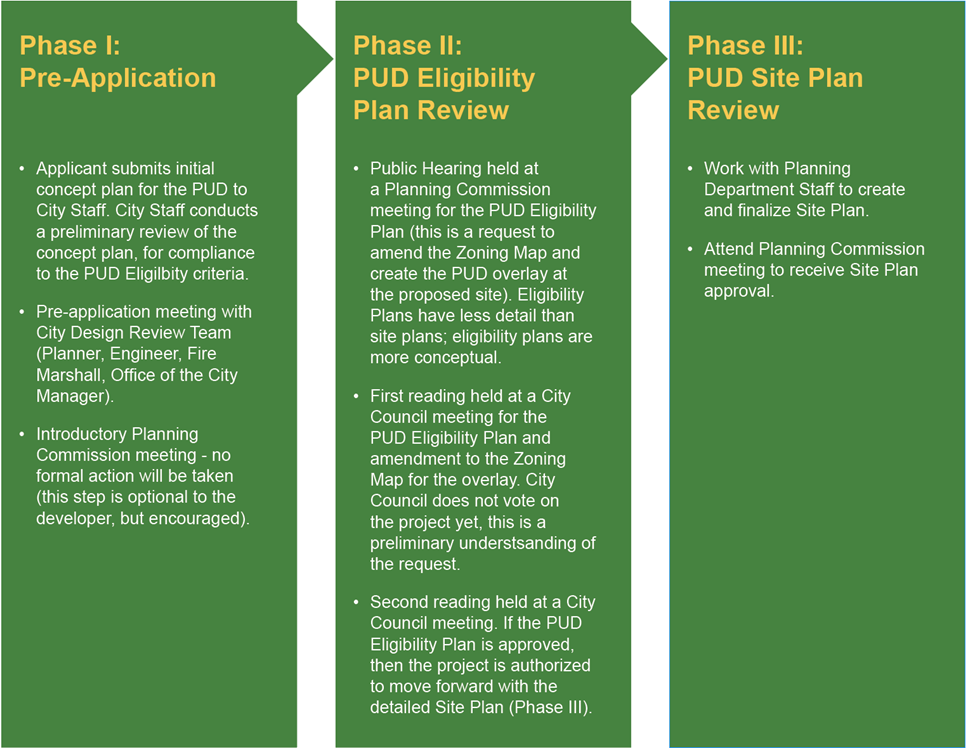
(Ord. of 11-13-2023)

Sec. 15.04. - Eligibility plan review criteria and approval.

The following criteria applies to all PUD eligibility plan reviews:

Criteria Approval Standards
Conformance with the Intent of a PUD The overall design and uses in a PUD must be consistent with and promote the intent of Eastpointe's PUD Ordinance, as well as the specific project design standards.
Must result in a recognizable and substantial benefit to the ultimate users of the project and to the community and result in a higher quality of development than could be achieved under conventional zoning. Project must have two or more separate and distinct uses, for example, multi-family and commercial uses. Project must have two or more separate and district uses, for example, multi-family and commercial uses.
Compatibility with Adjacent Uses The PUD, with respect to height, setbacks, density, parking, circulation, landscaping, views, and other design and layout features, is compatible to the development of surrounding properties and their uses. In determining whether this requirement is met, consideration will be given to:
1. The bulk, placement, and building materials of proposed structures.
2. The location and screening of vehicular circulation and parking areas. The resulting vehicular circulation must encourage cross-connectivity within the site and along its edges.
3. The location and screening of outdoor storage, outdoor activity or work areas, and mechanical equipment in relation to surrounding development.
4. The hours of operation of the proposed uses.
5. The provision of landscaping and other site amenities.
6. The anticipated level of noise, vibration, smoke, odor, or other environmental discharge.
Compatibility with Master Plan The proposed PUD must further the goals and objectives of the master plan (and/or sub-area plan). However, a PUD proposal that includes uses or a residential density which are not called for on the future land use map may be considered when the deviation is justified in light of the current planning and development objectives. In this case, the Planning Commission must initiate action (where necessary) to amend the master plan.
Public Services The PUD cannot exceed the capacity of existing and available public services, including but not necessarily limited to, utilities, public roads, police and fire protection services, and educational services, unless the proposal contains an acceptable plan for providing necessary services or evidence that such services will be available by the time the PUD is completed.
Traffic Impact The PUD must minimize the impact of traffic generated by the proposed project on surrounding uses. In determining whether this requirement is met, consideration will be given to:
1. Access to major thoroughfares.
2. Estimated traffic to be generated by the proposed development.
3. Proximity and relation to intersections.
4. Adequacy of driver sight distances.
5. Location of and access to off-street parking.
6. Required vehicular turning movements.
7. Extent and nature of road improvements.
8. Provisions for pedestrian and bicycle traffic.
Connectivity: Pedestrians and Vehicles If applicable, the site must be divided into blocks (with a maximum length of 500 feet to support walkability). Cul-da-sacs are not permitted, and sub-streets must be extended to complete the grid street network.
Travel lanes for new development must be ten feet and cannot exceed two lanes (excludes on-street parking areas and bike lanes). For existing sites, curb cuts must be reduced in width or eliminated to comply with MDOT standards (based on the speed of road).
Traffic calming techniques, such as horizontal deflections, road narrowing, ripples, pavers, central islands, entry, or gateway treatments, raised medians, on-street parking, roundabouts, textured pavements, must be provided where appropriate.
Sidewalks and non-motorized infrastructure to adjacent sites must be provided.
Streetscape Design At least three of the following streetscape design elements must be incorporated:
1. Pedestrian scale, decorative lighting
2. Planter
3. Trash receptacles
4. Street furniture (benches, etc.)
5. Bus shelter (including enhancements)
6. Traffic calming tools
7. Extensive sidewalks
8. Bicycle parking or lanes
Usable Open Space Exhibits significant natural features or open space encompassing at least ten percent or greater of the land area of the PUD.
In addition to providing the required landscaping and open space of the zoning district, the PUD must create a least two places of interest (this includes art installations, community gardens, plazas, outdoor dining areas, etc. that are inviting and accessible to the public).
Sustainable Design The project must incorporate sustainable design features, including but not limited to at least three of the following:
1. Public or alternative transportation access.
2. EV charging stations, non-motorized transportation amenities/improvements.
3. Low-impact design (LID) features.
4. Energy efficient building materials and utilities.
5. LEED or Living Building Challenge building design.
6. Adaptive re-use or redevelopment of a building or site.
Preservation of Natural, Cultural, or Historic Features The proposed development shall preserve distinctive natural features on the site to the maximum extent feasible, such as, but not limited to, woodlands, wetlands (including hydric soils), cultural or historic buildings or features, etc.
Positive Economic Impact The project cannot result in an unreasonable negative economic impact upon surrounding properties. In determining whether this requirement is met, consideration will be given to projects that meet at least one of the following:
1. Creates an economically impactful number of jobs for Eastpointe residents or gives job priority to Eastpointe residents.
2. Develops valuable social infrastructure such as schools, daycare centers, restaurants/cafes, public parks, owner occupied housing or establishments similar to those listed.
3. Offers affordable housing units.
4. Provides skill-trades job training for Eastpointe residents.
Unified Control The PUD must be under single ownership or such control (a single person or entity having responsibility for assuring completion of the project in conformity with this Ordinance). If there is more than one owner or entity, then a commitment in writing must be provided by each owner/entity to work in unison to complete the project.
The applicant(s) must provide legal documentation of single ownership, or joint unified control in the form of agreements and deed restrictions which demonstrate that the PUD can be completed as approved, and that all portions of the PUD that are not to be maintained or operated at public expense will continue to be operated and maintained by the developers or their successors. This provision does not prohibit a transfer of ownership or control, provided notice of such transfer is given to the city.


(Ord. of 11-13-2023)

Sec. 15.05. - Eligibility plan submittal requirements.

The following is a list of items to be incorporated within the eligibility plan submission. All items must address each requirement for the application to be considered complete.

Submission Requirements More information
Application Form and Fee The name, address, and telephone number of:
 1. All persons with an ownership interest in the land on which the planned development project will be located together with a description of the nature of each entity's interest (for example, fee owner, optionee, lessee, or land contract vendee).
 2. All engineers, attorneys, architects, or registered land surveyors associated with the project.
 3. The developer or proprietor of the planned development project.
The legal description and area of land (in acres) of the land on which the PUD will be developed, together with appropriate tax identification numbers.
Project Narrative A narrative describing the proposed project, including the period of time within which it is contemplated the project and all phases will be completed.
Conceptual Land Use Plan An overall conceptual land use plan for the planned development, drawn to scale. The overall plan shall graphically represent the development concept using maps and illustrations to indicate each type of use, square footage or acreage allocated to each use, and approximate locations of each principal structure and use in the development. The overall plan shall indicate types of residential use; office, commercial, industrial, and other nonresidential uses; each type of open space; community facility and public areas; and other proposed land uses.
The conceptual plan also must include:
 1. A general location map;
 2. Proposed vehicular circulation;
 3. Location of existing streets adjacent to the proposed development and indicate how they will connect with the proposed circulation system;
 4. Approximate number of proposed nonresidential buildings and residential units. For residential developments, an analysis must be provided to determine the number of units that could be developed on the property under existing conventional zoning;
 5. Approximate layout of dwelling units, parking, open space and recreation/park areas;
 6. Landscaped screening along the perimeter of the development.
Existing Zoning A map showing existing zoning designations for the subject property and all land within one-quarter mile.
Master Plan and Future Land Use Map A map and written explanation of the relationship of the proposed planned development to Eastpointe's master plan for future land use.
Development Experience Documentation that the applicant has sufficient development experience to complete the proposed project in its entirety (e.g., provide a list of developments completed by the applicant in the past ten years, with a description of the project, number of units, and time required to complete).
Community Impact Statement The Community Impact statement must be derived from a study of the city based on information from the following community elements:
 1. Planning and zoning issues, including conformance with the Master Plan, Zoning Ordinance, and other applicable City codes and policies.
 2. Land development issues, including topographic, soil conditions, and site safety concerns.
 3. Private utilities consumption, including electrical needs and natural gas utilization.
 4. Noise level conditions.
 5. Air quality conditions.
 6. Environmental design and historic values including visual quality and historic resources.
 7. Community facilities and services, including refuse collection, sanitary and storm sewer, and water supply.
 8. Public safety needs, including police, fire and emergency medical services.
 9. Open space landscaping and recreation, including cultural elements.
 10. Traffic impacts.
All Eligibility Requirements Demonstrate how the PUD meets the Eligibility Criteria.


(Ord. of 11-13-2023)

Sec. 15.06. - Site plan submittal requirements.

The following items must be incorporated within the site plan submission; all items must address each requirement for the application to be considered complete.

Submission Requirement Min. Information Required
Topographic survey and soils inventory General locations and approximate dimensions of wetland areas, floodplains, and significant site features such as tree stands, unusual slopes and water drainage areas.
Description of proposed stormwater management, drainage, sewage treatment and water supply systems Plans should be sufficiently detailed to demonstrate compliance with Macomb County's standards.
Maps and written analysis of significant cultural, historical and land features of and near the site Land features include but are not limited to rights-of-way, easements, and shared parking agreements. This includes written verification of access easements or agreements, if applicable.
Schedule A general schedule for completing the planned development, including the phasing or timing of all proposed public and private improvements.
PUD Agreement PUD agreement between the City and the applicant, which shall include, among other items, a provision as to such revisions to the site plan that may be approved administratively by the Planning Commission, any specific terms and conditions relating to an approved PUD including specific terms relating to the administration of the project.
Site Plan Requirements Include all items required by Site Plan Review in Article 12.


(Ord. of 11-13-2023)

