
Eastpointe City Zoning Code
ARTICLE 9
- LANDSCAPING
Sec. 9.01.- Intent statement.
A)
Landscaping.
1)
Intent. Recognizing that the proper management and use of trees, plants and other types of vegetation improves the appearance, value, character, quality of life, and the natural environment in Eastpointe, this article establishes standards for the development, installation, and maintenance of landscaping to accomplish the following:
a)
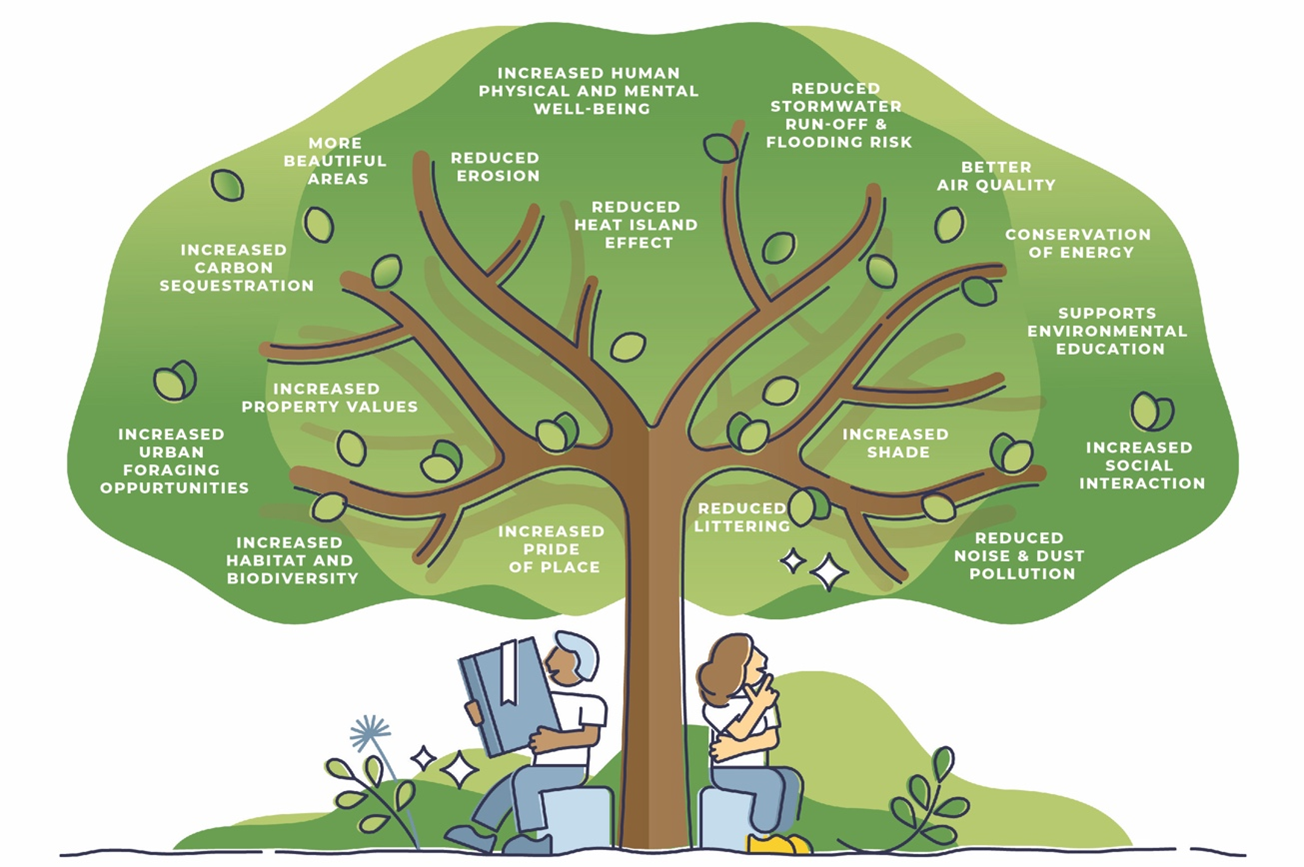
Preserve, protect, and enhance urban tree canopy and other nature-based assets. Recognizing trees and vegetation as vital infrastructure that improves air and water quality, combats the urban heat island effect, decreases UV radiation exposure, and lowers energy costs. (To understand more urban street tree benefits, see graphic below)
b)
Encourage the use of native plant materials and the diversification of species well-suited for urban conditions to reduce impervious surfaces.
c)
Provide buffers that enhance the beautification of Eastpointe.
d)
Safeguard and enhance property values.
2)
Benefits of urban street trees.
B)
Green infrastructure.
1)
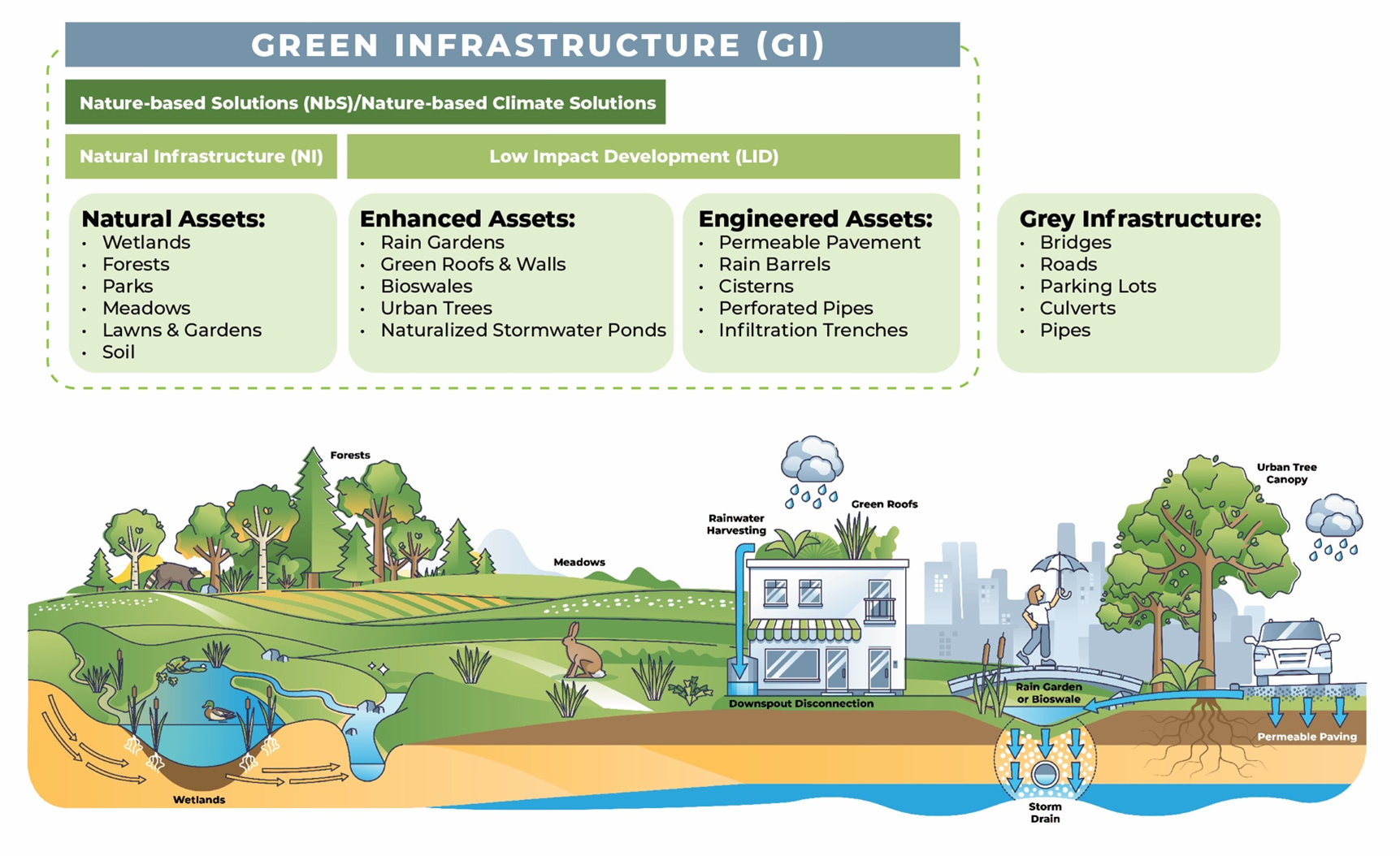
Intent. Furthermore, this article ensures that the City of Eastpointe's sustainable values align with low impact development (LID) standards and incorporates green infrastructure to advance environmental equity for the community (see below for a list and graphic of LID and green infrastructure benefits). By prioritizing the improvement of environmental equity conditions, this article reaffirms Eastpointe's commitment to nurturing a community that is resilient, inclusive, and fully invested in strengthening the quality of life current and future generations.
This article establishes a holistic framework that supports and enhances vulnerable natural ecosystems, creates quality green spaces and more efficient water management systems. LID practices address relevant environmental issues such as flooding and pollution from the outset and deliver tangible benefits including improved air quality, minimized streetscape erosion, and expanded access to quality green spaces.
2)
Benefits of low impact development (LID) standards/green infrastructure.
a)
Promote natural surface infiltration: Counteract the environmental impacts of impervious surfaces by preserving green, undeveloped spaces. (See Figure A. for pervious vs. impervious impacts)
b)
Decrease pollutants: Address the challenges of dense impervious surface areas that inhibit natural water absorption, leading to stormwater runoff and urban pollution. Prioritize the reduction of pollutants - such as oils, chemicals, pesticides, and metals - transported into local waterways to safeguard vulnerable vegetation, water quality, and public health.
c)
Decrease flooding risks: Manage the volume of stormwater runoff from residential and commercial areas. Recognizing the significant amount of water from rainfall that can contribute to overflow in combined storm drains and water management systems. (See Figure B. for stormwater impacts on combined sewer diagram)
d)
Protect and enhance biodiversity: Promote ecological diversity and healthy ecosystems, contributing to the improved well-being and resilience of the urban environment.
e)
Reduce gray infrastructure costs: Diminish long-term stormwater management expenses related to the maintenance of hard surfaces and infrastructure by utilizing natural systems for water filtration and storage.
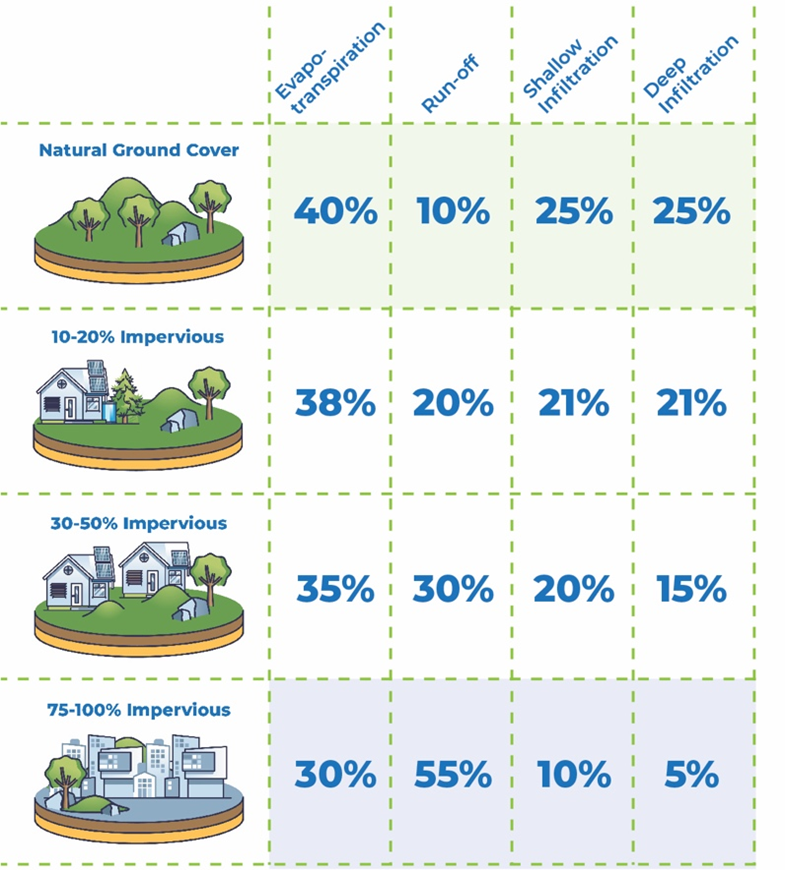
Figure A.
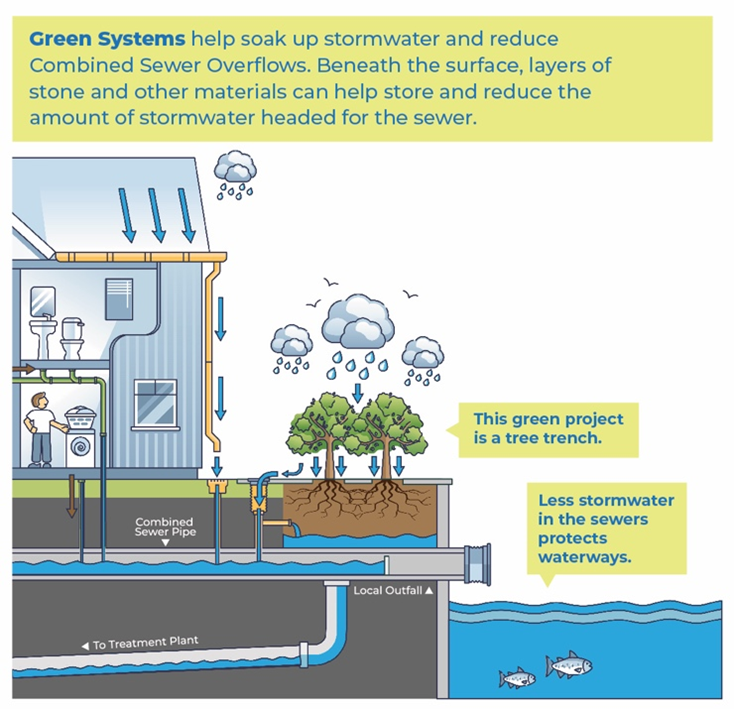
Figure B.
(Ord. of 11-13-2023; Ord. No. 24-1238, 6-4-2024)
Sec. 9.02. - Scope of landscaping and green infrastructure requirements.
A)
On developed sites (excluding one-family residential dwelling units, when developed on a parcel-by-parcel basis), landscaping must be brought into compliance with the zoning ordinance. New single family residential development must meet section 9.05 requirements. This scope of landscaping requirements standard applies to:
1)
New construction (or the modification of an existing building where the total building square footage is increased by 25 percent or greater).
2)
The total amount of impervious surface on the site has increased by 50 percent or greater.
3)
A special land use is required.
4)
A nonconforming use that seeks Class A designation.
5)
A re-occupancy that has required site improvements. Required site improvements include but are not limited to a screening device and a dumpster enclosure.
B)
No landscaped area may be abandoned, paved, or otherwise employed without submission and approval of a site plan.
C)
These requirements are minimum requirements, and nothing precludes a developer from proposing a more extensive landscape plan.
D)
The planning commission and building official may waive landscaping requirements at their discretion and offer a payment in lieu of landscaping plan.
(Ord. of 11-13-2023; Ord. No. 24-1238, 6-4-2024)
Sec. 9.03. - Landscaping waiver.
A)
Payment in lieu of landscaping. The planning commission, building official, or zoning administrator may waive landscaping requirements at their discretion and offer a payment in lieu of landscaping plan. The payment is an amount established by resolution of the city council, on a case-by-case basis, and must be used for tree planting elsewhere in the city. In doing so, rough proportionality between the number of trees that would be required to be planted and those that are being planted per the site plan is achieved.
B)
Green infrastructure in lieu of landscaping. Alternatively, the planning commission may require green infrastructure features (permeable pavers, rain gardens, bioswales, green roof) in place of tree plantings and instead of payment in-lieu of tree plantings, so long as there is not less than one street/interior tree on site. The alternatives may include:
1)
Pervious durable surface types (grass pavers, permeable interlocking concrete, resin-bound paving, permeable clay brick pavers, permeable asphalt, permeable concrete).
2)
Rain gardens are at least 150 square feet in size.
3)
Bioswales.
4)
Green roofs.
5)
Green Walls.
6)
Planters.
7)
Alternative green infrastructure feature determined suitable by planning commission, with recommendation by the planner/building official.
(Ord. No. 24-1238, 6-4-2024)
Editor's note— Ord. No. 24-1238, adopted June 4, 2024, renumbered the former §§ 9.03—9.05 as §§ 9.04—9.06, respectively, and enacted a new § 9.03 as set out herein. The historical notation has been retained with the amended provisions for reference purposes.
Sec. 9.04. - General standards.
A)
Plans. Landscape plans must be prepared, sealed, and signed by a licensed landscape architect, unless the application is for a re-occupancy only and no special planning processes (e.g., special land use, variance) are required.
B)
General requirements. The entire landscaped area (including lawn areas) must be planted with grass, groundcover, shrubbery, or other suitable plant material (excludes areas used as paved patios, terraces, sidewalks, and similar site features). If the site is a re-occupancy, then planter boxes may be allowed to meet landscaping requirements, to avoid asphalt excavation.
C)
Landscaped islands. Landscaped islands must be located below grade.
D)
Maintenance of existing landscaping. All existing landscaping must be maintained in good condition to present a healthy, neat, and orderly appearance, free from refuse and debris. All unhealthy and dead materials must be replaced within 45 days of notice from the city (or within the next planting period, whichever comes next). Grass areas must be kept weed free and mowed on a regular basis and all edges trimmed and maintained, unless designated as an approved no mow zone. Landscape inspections may be conducted on a regular basis to ensure long-term compliance.
E)
Preservation of existing vegetation. Existing healthy vegetation must be protected during construction with temporary fencing around the drip line. To promote the preservation of natural features, sites should be designed to preserve existing woodlands and wetlands to the greatest extent possible.
F)
Planting setbacks, rear and side yards. The trunks of trees cannot be planted closer than four feet to a property line.
G)
Private ponds. Ponds are permitted for recreational, scenic, or stormwater management purposes and must meet all federal, state, county, and city requirements. The property owner must maintain the pond and the filter system, including, but not limited to the cleaning of the pond, the mowing of grass, and the elimination of any nuisances created by standing water or a water body. Ponds must incorporate water tolerant grasses and seed mixes at the bottom of the pond/basin and appropriate trees, shrubs, and grasses along the banks based on the environment to improve views, filter runoff, and enhance wildlife habitat.
H)
Plant minimum requirements.
1)
Trees planted in Eastpointe must conform to the adopted list of approved species published by Macomb County: 2017 Green Macomb Recommended Tree Species List, as amended.
2)
All landscape plans must include a minimum of 50 percent native plants.
3)
All plant material must conform to the description consistent with generally accepted and published nursery and landscape standards. Plant materials must be typical of their species or variety, have normal habitat of growth, well-branched and densely foliated when in leaf.
4)
Artificial plants and invasive species are prohibited from satisfying landscape requirements.
I)
Mulch. Planting and tree beds must present a finished appearance, with shredded hardwood bark mulch or a similar natural material at a minimum depth of three inches. All mulched areas must be refreshed seasonally.
J)
Lawn areas. Lawns must be planted with species of grass normally grown as permanent lawns in southeast Michigan. Grass may be sodded or seeded and mulched. Sod or seed must be clean, free of weeds and noxious pests or disease. Where possible, Xeriscape design is highly encouraged.
K)
Minimum planting size. All plantings must meet the following minimum size at the time of planting:
1)
Deciduous trees. Two and one-half inches in caliper, measured at 18 inches above grade.
2)
Ornamental trees. Two inches in caliper, measured at 18 inches above grade.
3)
Evergreen trees. Eight feet in height, measured from grade.
4)
Shrubs. Thirty inches in height, measured from grade.
L)
Species variety required. The landscape plan shall not contain more than 33 percent of any single plant species. Landscape plans with less than three required plantings shall be exempt from this requirement.
M)
Prohibited species. Based on their undesirability, the following species are prohibited; the city may prohibit other species not listed in the following table:
N)
Installation. All landscaping must be installed in a manner consistent with generally accepted and published nursery and landscape standards, the approved landscape plan, and the following:
1)
All trees must be balled and burlapped at the time of planting.
2)
Plant material must be freshly dug, and nursery grown. Plant material must be of sound health, vigorous and uniform in appearance with a well-developed root system and free from disease, insects, pests, eggs, or larvae. Trees must have straight trunks with leaders intact, undamaged, and uncut.
3)
All planting areas shall be stabilized and maintained with seed, sod, ground covers, mulch, or other approved materials to prevent soil erosion and allow stormwater infiltration. Mulch shall be spread in a manner that avoids soil compaction and shall not overflow into public rights-of-way.
4)
A minimum of four inches of topsoil must be provided for all lawn areas, groundcovers, berms, and planting beds.
O)
Construction.
1)
For every one inch of diameter at breast height (DBH), there should be a one-foot radius of protection. Appropriate guards shall be maintained around all existing trees to be retained. Remaining trees shall have sufficient room for their root structures to be maintained during construction and in site plan design.
P)
Irrigation. All landscape areas will be irrigated by an automatic, underground irrigation system.
(Ord. of 11-13-2023; Ord. No. 24-1238, 6-4-2024; Ord. No. 24-1238, 6-4-2024)
Editor's note— See editor's note at § 9.03.
Sec. 9.05. - Non-single-family landscape design standards.
All landscaping must comply with the following minimum standards:
A)
Frontage landscaping. When a site abuts a road right-of-way, frontage landscaping must be provided in the front yard area adjacent to the right-of-way or within the right-of-way, per the table below. For the purposes of computing length of road frontage, openings for driveways and sidewalks are counted towards the total linear frontage. Trees and shrubs may be planted at uniform intervals, at random, or in groupings.
B)
Parking lot landscaping. To improve the safety of pedestrian and vehicular traffic, guide traffic movement, enhance surface permeability, and improve the appearance of parking lots, for every 20 off-street parking lot spaces, there must be two 150-square-foot below grade landscaped islands. Each landscaped island must contain at least one large deciduous tree of a minimum two-inch caliper and must be covered with mulch, grasses, and groundcover.
Groundcover examples include perennial flowers, ornamental grasses, flowering shrubs, xeriscape (i.e., succulents). Turf grass is not allowed as a singular groundcover method within landscaped islands but can be used as a method of permeability diversification. Planting required within the parking lot shall be in addition to, and not in lieu of, other planting requirements, such as for street trees. Refer to Green Macomb's Parking Lot Planting Guidance for design considerations and best practices.
C)
Screening from parking lot. Screening adjacent to a parking lot is not required if the parking surface area is completely screened from the right-of-way by an intervening building or structure. Where a parking lot is located adjacent to sidewalks, streets, and other rights-of-way, screening must be provided within ten feet of the parking lot with the following (or a combination thereof):
1)
Vegetative/landscaping screen. A three-foot-wide greenbelt with an evergreen, rose bush or deciduous hedge, at least three feet in height.
2)
Screen wall. A decorative masonry wall or black aluminum fencing, at least three feet in height. Walls must contain a stone or masonry cap and fences must incorporate stone or masonry piers at regular intervals.
D)
Screening from residential uses. All non-residential uses that abut a residentially used property must provide screening by one or a combination of the following:
1)
A reinforced, decorative masonry or CMU block wall, six feet in height above grade, with a stone cap.
2)
A three-foot-wide greenbelt with evergreen trees forming a continuous screen (trees planted ten to 15 feet apart (on center) in two staggered rows). Evergreens shall be a minimum of five feet in height at the time of planting.
3)
A six feet in height earth berm, with a slope (measured on the cross-section) no greater than 1:3 and at least a two-foot-wide planting area at its crest and landscaped. Berm slopes shall be stabilized with an approved ground cover type and be located outside of clear vision areas.
E)
Landscaping adjacent to buildings, front and side yards. All building walls visible from a right-of-way or publicly accessible area must have a three-foot-wide landscape area adjacent to them for at least 25 percent of their total width. This area may include inground landscaping, raised landscape beds, decorative landscape containers, or a combination thereof.
F)
Dumpster/refuse containers. Containers and permitted outdoor storage must be screened by a decorative masonry (brick or concrete) or composite wall, at least six feet in height above grade, or one foot above the object which it is screening, whichever is greater. A ten-foot concrete apron is required. A gate (constructed from metal or composite material) is required; chain link fencing with obscuring fabric or slats is prohibited.
G)
Loading zone screening. Loading zones (including service areas, staging areas, truck docks, etc.), must be screened from adjacent residentially used land and rights-of-way with a decorative masonry wall, building wing wall, or densely planted landscape buffer, or other means acceptable to the planning commission. The planning commission (or zoning administrator if the plan is under administrative site plan review) has the option to waive a permanent loading zone screening wall if they find it beneficial to the project and the community.
H)
Mechanical and utility equipment screening. Transformers, wireless communication facilities, climate control and mechanical equipment, and other above ground utility cabinets must be screened with evergreen plantings or a decorative opaque fence at least one-foot taller than the height of the cabinet/equipment. This requirement does not apply to equipment serving one- or two-family dwelling units or solar energy systems.
(Ord. of 11-13-2023; Ord. No. 24-1238, 6-4-2024)
Editor's note— See editor's note at § 9.03.
Sec. 9.06. - Residential landscape design standards.
A)
Single-family residential. Within one year of the issuance of a temporary certificate of compliance, the following is required for new single-family dwelling units:
1)
Lawns. Lawns must be sodded, seeded or hydro seeded, and installed in all areas of residential property not otherwise landscaped, and must be maintained and present complete coverage within three months of planting. The property owner is responsible for soil erosion protection prior to the installation and for maintaining the approved grade before and after lawn installation.
a)
Alternative groundcover. low-growing plants other than traditional turfgrass, including but not limited to fine fescues, buffalo grass, zoysia grass, microclover, native grass mixes, creeping thyme, sedum species, and mondo grass, which are used to cover the ground in a landscape setting. Alternative groundcovers selected for use must be appropriate for the local climate, soil conditions, and intended use of the area. Preference should be given to native species and those that provide ecological benefits such as pollinator support or nitrogen fixation.
b)
Planting pollinator habitat. Enhancing pollinator habitats through the strategic use of native plants and sustainable gardening practices can significantly contribute to the health and diversity of local ecosystems. (Refer to Green Macomb's Residential Planting Guidance for design considerations and best planting practices)
2)
Trees. Two deciduous trees (at least two-inch caliper) must be planted; at least one tree must be planted within the front yard, which includes the public right-of-way, and one in the rear yard.
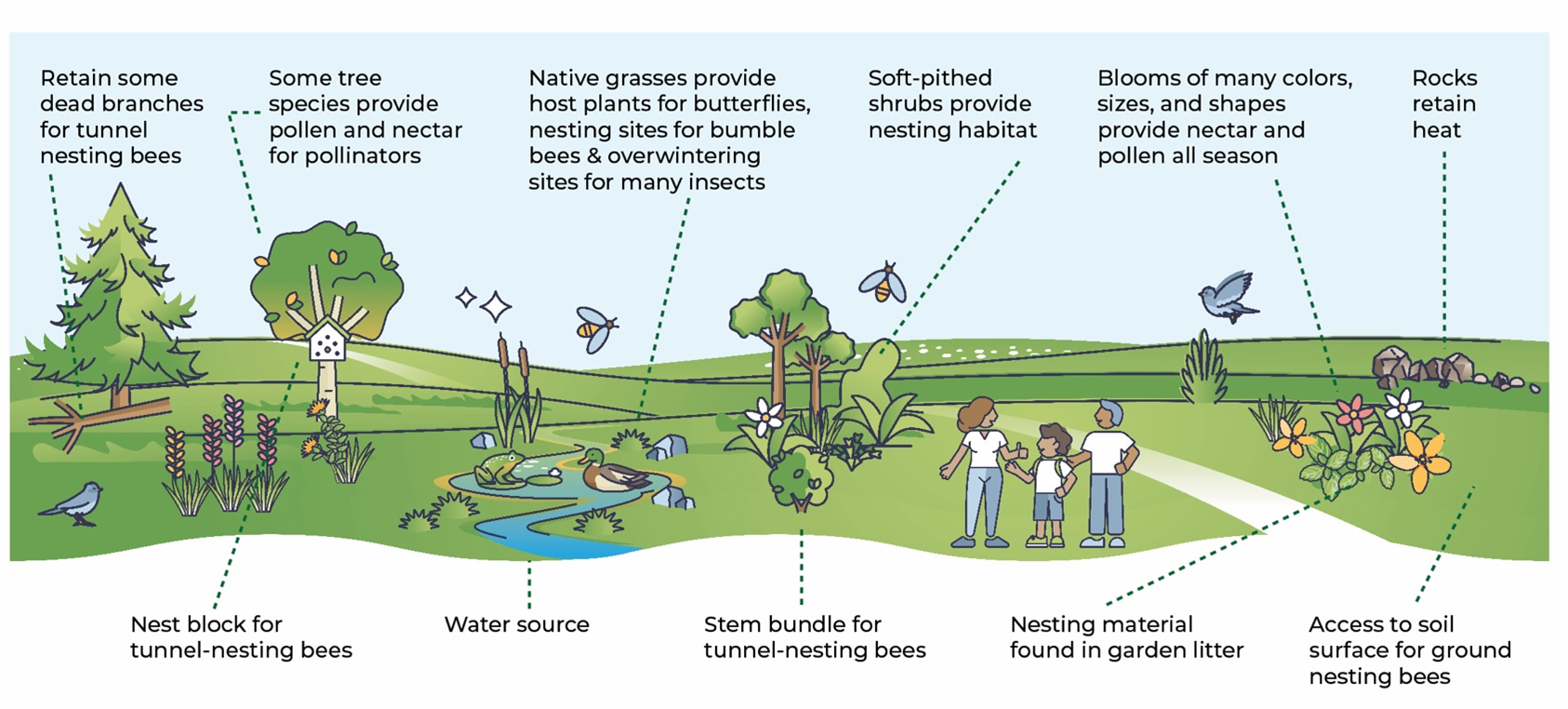
Source: Green Macomb's Residential Planting Guidance
B)
Multiple-family residential. In addition to the standards listed in 9.04, multiple-family residential uses must provide a minimum of two deciduous or evergreen trees per dwelling unit, unless otherwise determined by the planning commission.
(Ord. of 11-13-2023; Ord. No. 24-1238, 6-4-2024)
Editor's note— See editor's note at § 9.03.

