Elmhurst City Zoning Code
CHAPTER 25
FIRE PREVENTION CODE
25.01 - Title.
This Chapter shall be known as the "Fire Prevention Code" and may be cited as such.
(Ord. 4-2005 § 1 (part))
25.02 - Adoption of codes.
See Section 24.05 entitled "Adoption of Codes".
(Ord. 4-2005 § 1 (part); Ord. No. 07-2014, § 12, 7-7-2014)
25.03 - Fire apparatus access roads.
(a)
D103.3 Turning Radius. The minimum turning radius shall be determined by the Fire Code Official as referred to in the ICC International Fire Code, 2012 edition.
(b)
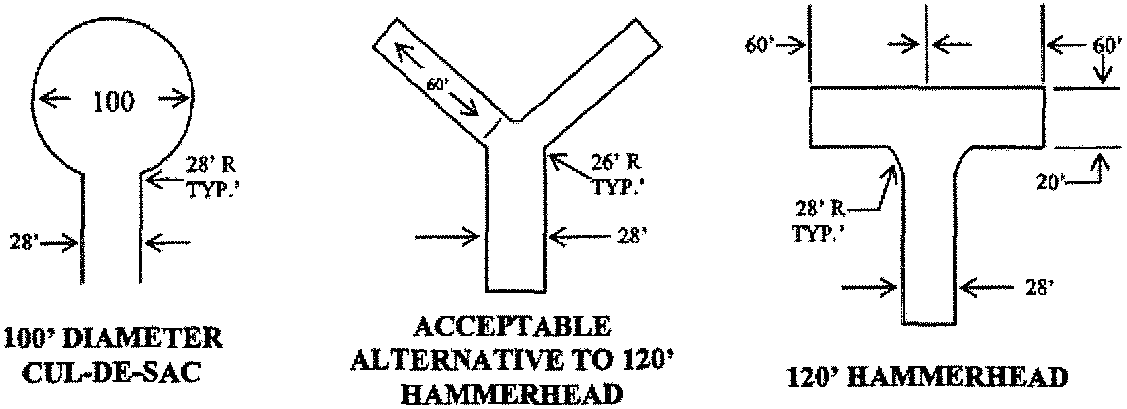
D103.4 Dead Ends. Dead-end fire apparatus access roads in excess of one hundred fifty (150) feet (forty-five thousand seven hundred twenty (45720) mm) shall be provided with width and turnaround provisions in accordance with Table 103.4 as referred to in the ICC International Fire Code, 2012 edition.
* One hundred sixty (160) foot right-of-way with one hundred (100) foot paved surface.
For SI: 1 foot = 304.8 mm.
(Ord. 4-2005 § 1 (part); Ord. 22-2006 § 4; Ord. 5-2008 § 2; Ord. 18-2008 § 1; Ord. 07-2009, § 2; Ord. No. 07-2014, § 13, 7-7-2014)
Editor's note— Ord. No. 07-2014, § 13, adopted July 7, 2014, amended the title of § 25.03 to read as set out herein. Previously § 25.03 was titled additions, insertions, deletions and changes to codes.
25.05 - Automobile fire and vehicle extrication response.
(a)
Findings. The City Council finds that:
(1)
Personnel and equipment used during response to automobile fires and vehicle extrications are a continuously increasing expense for the City, a substantial portion of which serve and benefit persons who are not residents of the City and who consequently do not pay taxes to support to fund the personnel and equipment necessarily required for response to such incidents.
(2)
Response to vehicle extrications requires the use of specialized and costly equipment and the training of personnel in the use of same.
(3)
Recipients of aid or emergency relief and services should be assessed for those extraordinary expenses when incurred by nonresidents who do not support the availability and supplying of such services and use of equipment as they do not pay taxes to fund same.
(4)
Subject to the provisions herein contained, the reimbursement for such expenses by the direct recipients of such services is appropriate given the disproportionate relationship in the amount of such expenses versus the general benefit to the City, and providing for the reimbursement of such extraordinary expenses will promote the general health, safety and welfare of the residents of the City.
(b)
Definitions. For the purpose of this Section, the following words and phrases shall have the meanings respectively described to them:
"Motor vehicle fire incident expense recovery" means that expense incurred by the City for responding to extinguishment of motor vehicle fires.
"Person" means any individual, partnership, corporation, trust, firm, company, estate, association or other legal entity.
"Vehicle extrication incident expense recovery" means that expense incurred by the City for responding to and performing the extrication of persons from motor vehicles.
"Vehicle extrications" mean the retrieving of a vehicle occupant that utilizes the use of specialized equipment and specially trained personnel.
(c)
Fees Authorized.
(1)
When emergency response services are rendered by the Elmhurst Fire Department for motor vehicle fires and motor vehicle extrications for persons who are not residents of the City, the following fees may be charged to such persons:
(A)
For motor vehicle fires: the actual expense incurred by the City, up to a maximum of two hundred dollars ($200.00) per response;
(B)
For vehicle extrications: the actual expense incurred by the City, up to a maximum of four hundred dollars ($400.00) per response.
No fee shall be charged if the actual expense incurred by the City is less than fifty dollars ($50.00).
(2)
The City of Elmhurst shall prepare and forward a bill for the total costs and expenses incurred to such person or persons who are responsible for payment pursuant to this Section. Payment of the total bill shall be made within thirty (30) days of receipt. Any bill or portion of a bill remaining unpaid after thirty (30) days of receipt shall accrue interest on the unpaid balance at the rate of one and one-half percent per month or fraction.
(Ord. 9-2005 § 1 (part))
25.06 - Specialized rescue team response.
(a)
Findings. The City Council finds that:
(1)
Supplies, equipment and training of specialized rescue teams are a significant expense to the City;
(2)
The benefits of specialized rescue teams accrue to a small number of persons or entities, as opposed to the typical service rendered by the Fire Department;
(3)
It is in the best interest of the City and its taxpaying residents, businesses and property owners to require those who benefit from specialized rescue team services pay fees to defer the cost of training and maintaining such rescue teams.
(b)
Definitions. For the purposes of this Section, the following words and phrases shall have the meanings respectively ascribed to them:
"Person" means any individual, partnership, corporation, trust, firm, company, estate, association or other legal entity.
"Specialized rescue team expense" means that expense incurred by the City for response to incidents by its specialized rescue team.
"Specialized rescue team services" mean and include emergency responses for tactical rescue, high angle rescue, underwater rescue/recovery, confined space rescue, below grade rescue and trench rescue.
(c)
Fees Authorized. The following fees may be charged for specialized rescue team services:
The City of Elmhurst shall prepare and forward a bill for the total costs and expenses incurred to such person or persons who are responsible for payment pursuant to this Section. Payment of the total bill shall be made within thirty (30) days of receipt. Any bill or portion of a bill remaining unpaid after thirty (30) days of receipt shall accrue interest on the unpaid balance at the rate of one and one-half percent per month or fraction.
(Ord. 9-2005 § 1 (part))
25.10 - Establishment of limits of fire districts.
The fire district of the City shall consist of those portions of the City which are classified as C-I, C-1a, C-2, C2-a, C-3, and C-3a use districts by terms of the zoning ordinance of the City. As such districts are, or may be hereafter changed by amendments to the zoning ordinance, the fire district shall automatically be changed in conformity therewith. A building or other structure shall be deemed to be within the fire district if one-third or more of the area of such building or structure is located therein.
25.11 - Construction within fire district.
(a)
No building or structure of frame or combustible construction shall be erected after May 8, 1950, within the limits established by law as the fire limits except the following:
(1)
A building occupied exclusively as a private garage, not more than one story in height nor more than seven hundred twenty (720) square feet in area, located on the same lot with a dwelling;
(2)
All other buildings shall be constructed of light noncombustible, ordinary, heavy timber, fire-resistive or fireproof construction.
25.12 - Flammable or combustible liquids.
Above ground bulk storage of flammable or combustible liquids in quantities greater than one hundred (100) gallons and not used as or for a day tank on an emergency generator is hereby prohibited within the corporate limits of the City.
25.13 - Storage of liquefied petroleum gas.
The above ground storage of liquefied petroleum gas in containers greater than one hundred (100) gallons capacity is hereby prohibited within the corporate limits of the City.
25.15 - Appliance shut-off valves.
Any appliance connected to a fuel gas piping system shall have an accessible manual shut-off valve installed up stream of the union or connector within six feet of the appliance it serves.
25.16 - Hazardous materials response and control.
(a)
Findings. The City Council finds that:
(1)
Supplies and equipment used during hazardous material responses are a continuously increasing expense for the City;
(2)
Supplies needed for hazardous material responses are often specifically fabricated materials that absorb spilled products without deterioration and are, therefore, very costly;
(3)
Much of the equipment used at such responses must be replaced after only a few episodes, depending upon the amount of exposure and the material encountered;
(4)
Overtime personnel are often called back to assist in neutralizing the situation or are deployed on reserve apparatus during such responses;
(5)
Recipients of aid or emergency relief and services should be assessed for those extraordinary costs incurred and payable to third parties for services rendered by such third parties and/or for replenishing supplies and equipment in the performance of the aid or emergency services expended;
(6)
Subject to the provisions herein contained, the reimbursement for such expenses by the direct recipients of the benefit is appropriate given the disproportionate relationship in the amount of such costs and the general benefit to the City and providing for the reimbursement of such extraordinary expense is in the best interests of the general welfare, health and safety of the residents and of the City.
(b)
Definitions. For the purpose of this Section, the following words and phrases shall have the meanings respectively ascribed to them:
"Combustible" means any substance with a flash point greater than one hundred (100) degrees Fahrenheit.
"Corrosive" means any substance which, in contact with living tissue, causes destruction of tissue by chemical action, but does not refer to action on inanimate surfaces.
"Flammable" means any substance which has a flash point of less then one hundred (100) degrees Fahrenheit.
"Hazardous material incident" means an incident which threatens public health or safety involving the actual or potential release of a hazardous substance or hazardous material.
"Hazardous substance" or "hazardous material" means any substance or material or mixture of substances which is toxic, corrosive, an irritant, strong sensitizer, radioactive, flammable, combustible, or which generates pressure through decomposition, heat or other means and which may cause injury, or illness to humans, domestic livestock, or wildlife as defined by the Illinois Environmental Protection Act or any federal law.
"Irritant" means any substance, not corrosive, which, on immediate, prolonged or repeated contact with normal living tissue, will induce local inflammatory reaction.
"Person" means any individual, partnership, corporation, trust, firm, company, estate, association or other legal entity.
"Radioactive" means any substance which emits ionizing radiation.
"Strong sensitizer" means any substance which will cause, on normal living tissue through an allergic or photodynamic process, a hypersensitivity which becomes evident on reapplication of the same substance.
"Toxic" means any substance (other than a radioactive substance) which has the capacity to produce bodily injury or illness to humans through ingestion, inhalation, or absorption through any body surface.
(c)
Control of Hazardous Substances or Hazardous Materials.
(1)
It shall be unlawful for any person to use, store, deliver or transport hazardous substances or hazardous materials, or cause the use, storage, delivery or transporting of hazardous substances or hazardous materials, in any manner inconsistent with the requirements of the fire prevention ordinances of the City of Elmhurst or any other applicable ordinance, state law or federal law.
(2)
It shall be unlawful for any motor vehicle carrying, transporting or containing a hazardous substance or hazardous material to park or stand, other than temporarily for the purpose of, and while actually engaging in, loading or unloading, on private property, without the knowledge and express consent of the person who is in charge of the property and who is aware of the nature of the hazardous substance or hazardous material the motor vehicle contains.
(3)
It shall be unlawful for any motor vehicle carrying, transporting or containing a hazardous substance or hazardous material to fail to comply with all applicable provisions of this Section.
(4)
It shall be unlawful for any person using, storing, manufacturing, producing, disposing, treating, transporting or causing the use, storage, manufacture, production, disposal, treatment or transportation of any hazardous substance or hazardous material in any manner which results in a hazardous material incident.
(d)
Hazardous Materials or Hazardous Substance Incident Expense Recovery.
(1)
Any person causing or permitting a hazardous material incident shall be responsible for all of the following:
(A)
Reimbursement, in full, of any and all costs incurred by the City of Elmhurst in connection with the operation, maintenance, and staffing required to respond to such hazardous materials incident at the rate of one hundred dollars ($100.00) per hour per vehicle (or any fraction of an hour) and the hourly rate of pay, including administrative costs, for each employee who participates in such response to a hazardous materials incident;
(B)
Reimbursement, in full, for any and all costs incurred by the City of Elmhurst for equipment and materials used, damaged, lost, spent, destroyed or rendered irreparable in connection with hazardous materials incident;
(C)
Assumption of, and all liability and costs for, any cleanup or removal resulting from a hazardous material incident, including, but not limited to, any independent cleanup contractor necessitated by such hazardous material incident.
(2)
The City of Elmhurst shall prepare and forward to the person or persons causing or permitting a hazardous material incident a bill for the total costs and expenses incurred for which such person or persons are responsible pursuant to this Section; provided, however, any cost in connection with any independent cleanup contractor shall be billed directly by such contractor. Payment of the total bill shall be made within thirty (30) days of receipt. Any bill or portion of a bill remaining unpaid after thirty (30) days of receipt shall accrue interest on the unpaid balance at the rate of one and one-half percent per month or fraction of a month.
(Ord. 9-2005 § 1 (part))
25.17 - Definitions.
As used in this Chapter, and unless the context clearly requires otherwise, the words and terms listed herein shall have the meanings ascribed to them in this Section.
"Fire alarm detection system" means a system of alerting devices that transmits a signal from fire detection or extinguishing equipment and alerts building occupants and proper authorities of a fire condition.
"Fire pump" means a pump that aids the existing supply, whether it be a public water main or other source, that is insufficient to meet the demands of the fire protection system.
"Fire suppression system" means an engineered system utilizing foam, wet or dry chemical, a halogenated extinguishing agent or an automatic sprinkler system designated and intended to automatically detect and suppress a fire through fixed piping and nozzles.
"Hood and duct fire suppression system" means a fire suppression system as defined in this Section that protects a commercial cooling appliance exhaust hood and duct system.
(Ord. 14-2003 § 1 (part))
25.18 - Permit required.
(a)
It shall be unlawful to install, construct or locate any fire suppression system, fire alarm detection system or hood and duct fire suppression system or portion thereof without first obtaining a permit therefor. Permits shall be obtained from the Fire Chief or his designee. Issued permits shall be kept on the premises designated therein at all times and shall be readily available for inspection by the Fire Chief or his designee(s).
(b)
Application for Permit. Application for a permit required by this Code shall be made to the Fire Chief on forms provided by the City. Applications for permits shall be accompanied by construction documents as required by the Fire Chief for evaluation of the application.
(c)
Time Limitation of Application. An application for a permit for any proposed work or operation shall be deemed to have been abandoned six months after the date of filing, unless such application has been diligently prosecuted or a permit shall have been issued; except that the Fire Chief may grant one or more extensions of time for additional periods not exceeding ninety (90) days each for reasonable cause shown.
(d)
Action on Application. The Fire Chief shall examine or cause to be examined all applications for permits and amendments thereto within a reasonable time after filing. If the application or the construction documents do not conform to the requirements of all pertinent laws, the Fire Chief or his designee(s) shall reject such application in writing, stating the reasons therefor. If the Fire Chief or his designee(s) is satisfied that the proposed work or operation conforms to the requirements of this Code and all laws and ordinances applicable thereto, the Fire Chief shall issue a permit therefor.
(e)
Partial Permits. Where permits are required and upon the request of a permit applicant, the Fire Chief or his designee(s) shall issue a partial permit to occupy the premises or portion thereof before the entire work or operations on the premises is completed, provided that such portion or portions will be occupied safely prior to full completion or installation of equipment and operations without endangering life, property or the public welfare. The Fire Chief or his designee shall notify the permit applicant in writing of any limitations or restrictions necessary to keep the permit area safe. The holder of a partial permit shall proceed only to the point for which approval has been given, at the permit holder's own risk and without assurance that approval for the occupancy or the utilization of the entire premises, equipment, or operations will be granted.
(f)
Conditions of Permit. A permit shall constitute permission to install fire suppression systems, fire alarm detection systems or hood and duct fire suppression systems, as the case might be, and equipment utilized in connection with such activities in accordance with the provisions of this Code. Such permission shall not be construed as authority to violate, cancel or set aside any of the provisions of this Code. Such permit shall remain in effect until revoked, or for such period of time as specified on the permit. Permits are not transferable and any change in occupancy, operation or tenancy shall require a new permit.
(g)
Approved Construction Documents. Construction documents approved by the Fire Chief or his designee(s) shall be approved with the intent that such documents comply in all respects with this Code. Any omissions or errors on the construction documents do not relieve the applicant of having to comply with all applicable requirements of this Code.
(h)
Revocation of Permit. The Fire Chief or his designee shall revoke a permit or approval issued under the provisions of this Code, if, upon inspection, any violation of the Code exists, or if conditions of a permit have been violated, or if there has been any false statement or misrepresentation as to material fact in the application, data or construction documents on which the permit or approval was based.
(i)
Suspension of Permit. Any permit issued shall become invalid if the authorized work or activity is not commenced within six months after issuance of the permit, or if the authorized work or activity is suspended or abandoned for a period of six months after the time of commencement.
(j)
Payment of Fees. A permit shall not be issued until the designated fees have been paid.
(Ord. 14-2003 § 1 (part))
25.19 - Inspections.
The Fire Chief or his designee shall inspect installations or construction of all fire suppression systems, fire alarm detection systems and hood and duct fire suppression systems for the purposes of ascertaining compliance with the provisions or intent of the Fire Prevention Code or any other ordinance affecting such suppression or detection systems.
(Ord. 14-2003 § 1 (part))
25.30 - Penalty.
Any person who shall violate any of the provisions of the Code hereby adopted, or fail to comply therewith, or who shall violate or fail to comply with any order made thereunder, or who shall build in violation of any detailed statement of specifications or plans submitted and approved thereunder, or any certificate or permit issued thereunder, or who shall fail to comply with such an order as affirmed or modified by the City or by a court of competent jurisdiction, within the time fixed herein, shall be subject to penalty according to any of the following:
(a)
Severally for each and every such violation and noncompliance respectively, be subject to a fine of not less than fifty dollars ($50.00) nor more than one thousand dollars ($1,000.00) and injunctive relief. The imposition of one penalty for any violation shall not excuse the violation or permit to continue; and all such persons shall be required to correct or remedy such violations or defects within a reasonable time; and when not otherwise specified, each five-day period that prohibited conditions are maintained shall constitute a separate offense;
(b)
For violations of Section 25.16 (Hazardous Materials Control), attorney's fees shall be assessed in addition to the penalties herein set forth;
(c)
Alternative penalties as provided in Section 1.06 of this Code;
(d)
The application of the above penalties shall not be held to prevent the enforced removal of prohibited conditions.
(3/18/96; Ord. 14-2003 § 1 (part))
(Chapter 25 passed and approved by Ord. MCO-03-96 on February 5, 1996)