
Fate City Zoning Code
ARTICLE XII
- DEFINITIONS
Sec. 36-12.1 - General rules of interpretation
Unless the context clearly indicates otherwise, the following rules shall apply in interpreting the terms and provisions of this article:
12.1.1. Meanings and intent. All provisions, terms, phrases, and expressions contained in this Ordinance shall be construed according to the general purposes set forth in Section 1.5, Purpose and Intent, and the specific purpose statements set forth throughout this Ordinance. When, in any specific section of this Ordinance, a different meaning is given for a term defined for general purposes in this article, the specific section's meaning and application of the term shall control.
12.1.2. Headings, illustrations, and text. In the event of a conflict or inconsistency between the text of this Ordinance and any heading, caption, figure, illustration, table, or map, the text shall control.
12.1.3. Lists and examples. Unless otherwise specifically indicated, lists of items or examples that use terms such as "for example," "including," and "such as," or similar language are intended to provide examples and are not exhaustive lists of all possibilities.
12.1.4. Computation of time. The time in which an act is to be done shall be computed by excluding the first day and including the last day. If a deadline or required date of action falls on a Saturday, Sunday, or holiday observed by the City, the deadline or required date of action shall be the next day that is not a Saturday, Sunday, or holiday observed by the City. References to days are calendar days unless otherwise stated.
12.1.5. References to other regulations/publications. Whenever reference is made to a resolution, ordinance, statute, regulation, or document, it shall be construed as a reference to the most recent edition of such regulation, resolution, ordinance, statute, regulation, or document, unless otherwise specifically stated.
12.1.6. Delegation of authority. Any act authorized by this Ordinance to be carried out by a specific official of the City may be carried out by a designee of such official or by a designee of the City Manager.
12.1.7. Technical and non-technical terms. Words and phrases shall be construed according to the common and approved usage of the language, but technical words and phrases that may have acquired a peculiar and appropriate meaning in law shall be construed and understood according to such meaning.
12.1.8. Public officials and agencies. All public officials, bodies, and agencies to which references are made are those of the City of Fate unless otherwise indicated.
12.1.9. Mandatory and discretionary terms. The words "shall," "must," and "will" are mandatory in nature, establishing an obligation or duty to comply with the particular provision. The words "may" and "should" are permissive in nature.
12.1.10. Synonymous terms. Unless otherwise specified:
A.
The word "building" includes the word "structure " and the word "structure" includes the word "building";
B.
The word "lot" includes the words "building site," "parcel", "plot," or "tract"; and
C.
The phrase "used for" shall include the phrases "arranged for," "designed for," "intended for," "maintained for," and "occupied for".
12.1.11. Conjunctions. Unless the context clearly suggests the contrary, conjunctions shall be interpreted as follows:
A.
"And" indicates that all connected items, conditions, provisions, or events apply; and
B.
"Or" indicates that one or more of the connected items, conditions, provisions, or events apply.
12.1.12. Tenses, plurals, and gender. Words used in the present tense include the future tense. Words used in the singular number include the plural number and the plural number includes the singular number, unless the context of the particular usage clearly indicates otherwise. Words used in the masculine gender include the feminine gender, and vice versa.
12.1.13. Undefined terms. For words not defined in this article, refer to the most current version of the Merriam-Webster Dictionary.
(Ord. No. O-2023-003, § 3(Exh. A), 1-3-2023)
Sec. 36-12.2 - Interpretations
The Administrator has final authority to determine the interpretation or usage of terms used in this Ordinance. Any person may request an interpretation of any term by submitting a written request and the applicable fee to the Administrator, who shall respond in writing within 30 days. When interpreting and applying the provisions of this Ordinance, such provisions shall be held to be the minimum requirements for the promotion of the public health, safety, convenience, comfort, and general welfare. Nothing in this Ordinance shall be construed as repealing any existing ordinance regulating nuisances or as permitting or requiring uses that are now prohibited by law.
(Ord. No. O-2023-003, § 3(Exh. A), 1-3-2023)
Sec. 36-12.3 - General land use categories and specific use types
This section defines the general use categories and specific use types listed in the tables of allowed uses in Section 4.1, the tables of allowed accessory uses in Section 4.3, and the tables of allowed temporary uses in Section 4.4.
12.3.1. Residential uses.
A.
Household Living
This use category is characterized by residential occupancy of a dwelling unit by a household. Tenancy is arranged on a month-to-month or longer basis (lodging where tenancy may be arranged for a period of less than 30 days is classified under the "Lodging Facilities" category). Common accessory uses include recreational activities, raising of pets, gardens, personal storage buildings, hobbies, and parking of the occupants' vehicles. Uses types under this category include:
1.
Dwelling, Single-Family Detached
A detached dwelling having accommodations for and occupied by only one family, and that is not attached to any other dwelling by any means and is surrounded by open space or yards. This definition does not include mobile homes or manufactured homes.
2.
Dwelling, Duplex
A detached house consisting of two single-family units on a single lot designed for and occupied exclusively as the residence of not more than two families, each living as an independent housekeeping unit in one of the two units.
3.
Dwelling, Townhouse (SF-Attached)
A building that has two or more single-family dwelling units erected in a row as a single building on adjoining lots, each unit being separated from the adjoining unit(s) by a fire wall along the dividing lot line, and each such building being separated from any other building by space on all sides. Each unit is intended to be occupied by only one family. Each individual townhouse unit has individual front and rear access to the outside. Townhouse units are typically surrounded by common areas owned and maintained by a property owners' association.
4.
Dwelling, Townhouse (Multifamily)
A building that has at least two but no more than five individual dwelling units on a single lot. Each unit may or may not be separated by a fire wall and shall meet the standards for fire separation between units applicable to a multifamily building. Each individual townhouse unit has individual front and rear access to the outside. This category is distinguished from the dwelling, multifamily definition by allowing dwelling units to be located side by side and not one over another.
5.
Dwelling, Live/Work
A structure or portion of a structure: (1) that combines a work activity with a residential living area; (2) where the work component is limited to the uses of professional offices, artists' workshops, studios, or similar uses constructed either as separate units or as a single unit; and (3) where the "live" component may be located on the street level behind the "work" component or any other level of the building. Live/work is distinguished from a home occupation in that the work use is not required to be incidental to the dwelling unit and customers may be served on site.
6.
Dwelling, Multifamily (4 DU/lot or fewer)
A dwelling or group of dwellings on one lot containing separate living units for at least two and no greater than four or more families, but which may have joint services or facilities. This category includes triplexes and quad-plexes. This category is distinguished from the dwelling, townhome multifamily definition by allowing dwelling units to be located on different floors of the same building.
7.
Dwelling, Multifamily (More than 4 DU/lot
A dwelling or group of dwellings on one lot containing separate living units for more than four families, but which may have joint services or facilities.
8.
HUD-Code Manufactured Home
A structure defined by and subject to the requirements of the Texas Manufactured Housing Standards Act, as amended. This definition includes the terms "manufactured home" and "manufactured housing."
9.
Mixed Use, Vertical
The development of a tract of land, building, or structure with residential uses on the floor(s) above a non-residential use and up to twenty-five (25) percent of the ground floor area used for residential purposes. Residential uses located on the ground floor may front onto an alley but shall not front onto a public street unless the public street serves only residential uses. Non-residential uses shall be as permitted by the applicable zoning district from the land use categories listed in Article IV, Use Standards, except for land uses in the Parks and Recreation Facilities, Animal Related Services, Other Commercial Uses, and Utilities use categories.
B.
Group Living
This category is characterized by residential occupancy of a structure by a group of people who do not meet the definition of "Household Living." Tenancy is arranged on a monthly or longer basis, and the size of the group may be larger than a family. Generally, Group Living structures have a common eating area for residents. The residents may receive care, training, or treatment, and caregivers may or may not also reside at the site. Accessory uses commonly include recreational facilities and vehicle parking for occupants and staff. Use types under this category include:
1.
Assisted Living Facility (≤ 6 residents)
An establishment, licensed by the State of Texas, that furnishes, in one or more facilities, food and shelter to four or more persons but no more than 6 who are unrelated to the proprietor of the establishment, and provides personal care services as defined by the State of Texas. These establishments may be located in single-family homes and share the house with the care giver. This category includes adult foster care homes and adult care group homes.
2.
Assisted Living Facility (≥ 7 residents)
An establishment, licensed by the State of Texas, that furnishes, in one or more facilities, food and shelter to seven or more persons who are unrelated to the proprietor of the establishment, and provides personal care services as defined by the State of Texas.
3.
Community, Group or Foster Home
A community-based residential home or facility that provides care for children 24-hours a day as defined and regulated by V.T.C.A., Human Resources Code ch. 42, or for adults 24-hours a day as defined and regulated by V.T.C.A., Human Resources Code ch. 123.
4.
Independent Senior Living Facility
A facility containing dwelling units, accessory uses, and support services specifically designed for occupancy by persons 60 years of age or older. Such facilities may include accommodations for people who are fully ambulatory or who require no medical or personal assistance or supervision, as well as accommodations for people who require only limited or intermittent medical or personal assistance.
5.
Nursing Home
A facility or area furnishing food and shelter in single or multiple facilities to five or more persons who are not related by blood, marriage, or adoption to the owner or proprietor of the establishment. In addition, the facility provides minor treatment under the direction and supervision of a physician, or provides a service which meets some need beyond the basic provision of food, shelter and laundry.
12.3.2. Public and institutional uses.
A.
Civic and Cultural Facilities
Buildings, structures, or facilities owned, operated, or occupied by a governmental entity or nonprofit organization to provide a service to the public. Specific use types include:
1.
Art Gallery, Museum or Special Purpose Recreational Institution
A facility or area that is open to the public and is intended for the acquisition, preservation, study, and exhibition of works of artistic, historical, cultural, or scientific value or recreational activity.
2.
Civic, Social, Philanthropic or Fraternal Organizations
Any organization operating under a nonprofit or similar charter, the activities of which are devoted exclusively to charitable, benevolent, patriotic, employment-related, recreational, or educational purposes not currently listed elsewhere in this Ordinance. Such an establishment may include the preparation and service of food and/or drink for members and their guests only.
3.
Labor and Political Organizations
Any organization promoting the interests of organized labor, union employees, national, state, or local political parties or candidates. Included in this category are labor unions, political groups, and political fund-raising groups.
4.
Business or Professional Organizations
Any organization promoting the business interests of their members, or of their profession as a whole. They may conduct research on new products and services; develop market statistics; sponsor quality and certification standards; lobby public officials; or publish newsletters, books, or other materials for distribution to their members. Included in this category are Chambers of Commerce, professional organizations, and similar uses.
5.
Religious Assembly and Institutions
A facility or area for people to gather together for public worship, religious training, or other religious activities including a church, temple, mosque, synagogue, convent, monastery, or other structure, together with its accessory structures, including a parsonage or rectory. This use does not include home meetings or other religious activities conducted in a privately occupied residence. Accessory uses may include meeting rooms and childcare provided for persons while they are attending assembly functions. Schools and other childcare services are not accessory uses and shall require approval as separate principal uses.
B.
Parks and Recreation Facilities
Park, recreation, and open space uses focus on a range of space types including natural areas, large areas consisting mostly of vegetative landscaping, hardscaping, or outdoor recreation or a combination, community gardens, public greens, public squares, and public plazas. Lands tend to have few structures. Accessory uses may include clubhouses, playgrounds, maintenance facilities, concessions, caretaker's quarters, and parking. Specific use types include:
1.
Community Garden
A facility for cultivation of fruits, flowers, vegetables, or ornamental plants by more than one person or family.
2.
Farmers Market
A seasonal and/periodic outdoor market open to the public, operated by a governmental agency, a non-profit, or other community organization at which regular vendors sell locally grown and made produce and products for home consumption.
3.
Park or Playground
A facility or area for recreational, cultural, or aesthetic use owned or operated by a public agency or homeowner's association and available to the general public. This definition may include, but is not limited to, plazas, square, greens, lawns, decorative plantings, walkways, active and passive recreation areas, playgrounds, fountains, swimming pools, pavilions, wooded areas, and water courses.
4.
Nature Preserve or Open Space
Nature Preserve includes protected natural habitats including significant environmentally sensitive areas such as wetlands, woodlands, etc. Public access may be limited to protect the nature preserve and there may be research or educational activities held on the land. Open space is land set aside in its natural or improved state for passive recreational use.
5.
Recreation Center
A facility or area for sports or recreation open to the general public for a fee where the activity takes place within an enclosed structure or outside courts and pools. Examples include but are not limited to, gymnasium or indoor arena; basketball, handball, and tennis courts; hockey rinks; swimming pools; and physical fitness centers. This category shall not include entertainment and amusement centers.
C.
Health and Human Services
Health Care Facilities are characterized by activities focusing on medical services, particularly licensed public or private institutions that provide primary health services and medical or surgical care to persons suffering from illness, disease, injury, or other physical or mental conditions. Accessory uses may include laboratories, outpatient, or training facilities, and parking, or other amenities primarily for the use of employees in the firm or building. Specific use types include:
1.
Clinics and Labs
An establishment primarily engaged in furnishing medical and lab services included but not limited to chiropractic, dental, medical, surgical, medical imaging, or other services to individuals on an outpatient basis. This includes the offices of chiropractors, physicians, dentists, and other health practitioners, medical and dental laboratories, outpatient care, and outpatient care facilities. Patients are not kept overnight except under emergency conditions.
2.
Nursing and Other Rehabilitative Services
An establishment that provides inpatient nursing and rehabilitative services and can accommodate patients for extended care. These establishments have licensed health care staff serving patients and other support staff for continuous personal care services. Convalescent homes, convalescent hospitals, inpatient care hospices, nursing homes, and rest homes with nursing care are a few examples of services these establishments provide. This category also includes mental retardation services (not licensed hospital care) to people with mental illness, substance abuse problems, psychiatric convalescent needs, etc. The focus of these services may include health care, but the primary purpose is protective supervision and counseling. Other terms used to describe these services are alcoholism or drug addiction rehabilitation, mental health halfway houses, group homes for the emotionally disturbed, and psychiatric convalescent homes. Other rehabilitation services establishments in this category include boot or disciplinary camps (except correctional), housing services for hearing or visually impaired, disabled, etc.
3.
Hospital
A facility or area for providing health services primarily for human in-patient medical or surgical care for the sick or injured and including related facilities such as laboratories, out-patient departments, emergency rooms, training facilities, central services facilities, food service establishments, retail stores, and staff offices that are an integral part of the facilities.
4.
Social Assistance and Welfare Services
Social assistance and welfare services provide public or community related service or charity services directly to individuals. They do not offer residential or accommodation services.
5.
Funeral Homes and Services (with or without cremation services)
This category comprises establishments preparing the dead for burial or interment and conducting funerals (i.e., providing facilities for wakes, arranging transportation for the dead, selling caskets and related merchandise). Funeral homes combined with crematories may also be included in this category. If included, crematories are establishments that operate sites or structures reserved for the interment of human or animal remains.
6.
Cemetery
A facility or area used or intended to be used for the interment or burial of the dead, including graveyard, burial park, mausoleum, columbarium, or any other area containing one or more graves.
D.
Public and Government Facilities (Office)
An office of a governmental agency that provides administrative and/or direct services to the public, such as, but not limited to post offices, employment offices, libraries, museums, police and fire stations, or motor vehicle licensing and registration services. This use does not include utilities as defined elsewhere in this Ordinance.
1.
Legislative and Executive Functions
This category shall include general government administration functions such as City Hall, County or School District Administration functions.
2.
Courts (local, state, and federal)
This category shall include all judicial functions such as courts.
3.
Correctional Institutions
These government establishments manage and operate correctional institutions. Their facilities are generally designed for the confinement, correction, and rehabilitation of offenders sentenced by a court.
4.
Public Safety Facility
This category comprises government-owned or volunteer establishments providing fire and rescue, police, and emergency response services.
5.
Other Government Functions
This category shall be utilized for any other government-owned and/or operated establishments not classified elsewhere in this Ordinance.
E.
Educational Service Establishments
Public, private, and parochial institutions at the primary, elementary, middle, high school, or post-secondary level, or trade or business schools, that provide educational instruction to students. Accessory uses include play areas, cafeterias, recreational and sport facilities, auditoriums, and before- or after-school day care. Specific use types include:
1.
Child Day Care
Child day care establishments primarily care for more than six infants and preschool children and often may offer pre-kindergarten education programs. Some provide care services for older children. These facilities are licensed, certified, or registered by the State to provide their respective services.
2.
Nursery and pre-school
These facilities are appropriately licensed, certified, or registered by the State to provide daytime care, training, and education for more than six children. This definition may include after-school and summer programs which coincide with the age brackets for public and private schools as provided in this Ordinance.
3.
Elementary and Middle Schools
These are public or private educational facilities that provide the appropriate grade school education that satisfies the compulsory education laws of the State of Texas.
4.
Senior and High Schools
These are public or private educational facilities that provide the appropriate higher grade school education that satisfies the compulsory education laws of the State of Texas.
5.
Colleges and Universities
This category includes junior colleges, colleges, universities, and professional schools. These establishments furnish academic or technical courses and grant degrees, certificates, or diplomas at the associate, baccalaureate, or graduate levels. The requirement for admission is at least a high school diploma or equivalent general academic training. This category may include a Seminary which is an institution for the training of candidates for the priesthood, ministry, rabbinate, or similar religious positions.
6.
Technical, trade, and specialty schools
These schools offer vocational and technical training in a variety of technical subjects and trades such as auto repair, welding, bricklaying, machinery operation, cosmetology, or other similar trades or crafts. The training often leads to job-specific certification.
12.3.3. Commercial uses.
A.
Agriculture
The use of land for purposes including farming, dairying, pasturage, horticulture, animal and poultry husbandry, and the necessary accessory uses for treating or storing of farm products and parking of equipment. Specific use types include:
1.
Crop Production
An area for raising or harvesting agricultural crops such as wheat, field forage, and other plant crops intended to provide food or fiber.
2.
Support functions for agriculture
This category comprises support establishments employed by the agriculture and forestry industries. They perform activities associated with production and distribution of forest and agricultural products. Many support establishments are independently run. This category may include farm and farm labor management, agricultural equipment sales and service, and similar functions.
3.
Greenhouse, nursery, floriculture
Establishments in this class grow nursery products, nursery stock, shrubbery, bulbs, fruit stock, sod, and so forth; or, grow short rotation woody trees with a growth and harvest cycle of 10 years or less for pulp or tree stock. Establishments growing trees on production cycles over 10 years are classified in "forestry and logging". This category shall also include floriculture establishments which grow or produce floriculture or ornamental horticulture products (e.g., cut flowers and roses, cut cultivated greens, potted flowering and foliage plants, and flower seeds).
B.
Animal Production and Ranching
This category is intended for facilities or areas for raising animals (including fish and birds) and the development of animal products, such as meat, fur, or eggs, on a commercial basis. Typical uses include beef, horse, or sheep ranching; piggeries; poultry; dairy; and fish farming. Establishments keep, graze, breed, or feed animals in ranches, farms, or feedlots. This use does not include raising animals to sell as pets. This category shall not include slaughterhouses.
1.
Livestock: Domesticated animals raised to produce commodities such as food, fiber, and labor.
2.
Large Livestock: Equine, cattle, swine, donkeys, mules, llamas, ostriches, goats, sheep, alpaca, and other similarly sized animals.
3.
Small Livestock: Rabbits, chickens, miniature, dwarf, or pygmy goats that are dehorned and neutered, and other similarly sized animals.
C.
Animal-Related Services
The boarding and care of animals on a commercial basis. Accessory uses may include confinement facilities for animals, parking, and storage areas. Specific use types include:
1.
Veterinary Clinic
A facility for the diagnosis, treatment, or hospitalization of animals. The incidental boarding or breeding of animals is included in this definition.
2.
Kennel, Commercial
A facility or area for keeping four or more dogs, cats, or other household pets, as specified in the "Animals" chapter of the Code of the City of Fate; or where grooming, breeding, boarding, training, or selling of animals is conducted as a business. This definition does not include a veterinary clinic (as defined in this Ordinance), a pet store, or an animal grooming shop.
3.
Stables, Commercial
A facility or area where horses, mules, or other domestic animals are kept, housed, boarded, lodged, fed, hired, trained, sold, or bred as a commercial activity. The definition includes accessory uses such as riding lessons, clinics, and similar activities.
4.
Pet and animal related sales and services (including grooming and care)
These establishments provide retails pet sales and animal and pet care services (except veterinary), such as boarding, grooming, sitting, and training.
D.
Auto-Related Sales and Service
This category includes a broad range of uses for the maintenance, sale, or rental of motor vehicles and related equipment. Accessory uses may include incidental repair, storage, and offices. Specific use types include:
1.
Motor Vehicle Sales, New
A motor vehicle retail establishment or "car dealer" operated by a franchised dealer. A "franchised dealer" means a person who holds a franchised motor vehicle dealer's license issued under the Texas Transportation Code, and is engaged in the business of buying, selling, or exchanging new motor vehicles and servicing or repairing motor vehicles under a manufacturer's warranty at an established and permanent place of business under a franchise in effect with a manufacturer or distributor. For purposes of this definition, motor vehicles are not considered outside storage. Accessory uses may include the sale of used motor vehicles (where used motor vehicles sales do not exceed 20% of inventory), auto service, and auto repair activities, as defined elsewhere in this Ordinance.
2.
Motor Vehicle Sales, Used
An establishment operated by a non-franchised or independent dealer that is engaged in the business of selling used motor vehicles. A "used motor vehicle" is a vehicle that has been sold to a retail customer for purposes other than resale.
3.
Large vehicle sales and service
These establishments retail new or used larger vehicles (not included in car dealer's category), such as buses, recreational vehicles (RVs), mobile homes, and large trucks. Commercial and industrial-related equipment are also included in this category. Often these establishments also provide repair services and sell replacement parts and accessories.
4.
Specialty Vehicle Sales, New
This class comprises establishments retailing new specialty vehicles. Specialty vehicles include motorcycles, motor scooters, motor bikes, mopeds, off-road all-terrain vehicles, boats, jet skis, and other similar vehicles and trailers. Included in this category are repair services and sales of replacement parts and accessories.
5.
Specialty Vehicle Sales, Used
This class comprises establishments retailing used specialty vehicles. Specialty vehicles include motorcycles, motor scooters, motor bikes, mopeds, off-road all-terrain vehicles, boats, jet skis, and other similar vehicles and trailers. Included in this category are repair services and sales of replacement parts and accessories.
6.
Auto Repair and Service, Minor
A facility or area for the servicing and minor repair of motor vehicles within enclosed service bays or stalls. Typical services include the retail sale and dispensing of lubricating oils, tires, filters, and other limited repair and maintenance work including the replacement of new or reconditioned parts in motorized vehicles of 10,000 pounds or less gross vehicle weight. This definition includes quick-lube shops and tire shops but does not include any operation included in the definition of "Auto Repair Garage, Major" or the overnight outdoor parking of customer vehicles.
7.
Auto Repair and Service, Major: A facility or area for one or more of the following activities:
a.
Reconditioning of any type of motorized vehicle, including any repairs made to vehicles over 10,000 pounds gross vehicle weight.
b.
Collision services, including body, frame, or fender straightening or repair.
c.
Overall painting of vehicles or painting of vehicles in a paint shop or paint booth.
d.
Dismantling of motorized vehicles in an enclosed structure.
e.
Overnight, outdoor parking of customer vehicles but not the storage of salvage vehicles.
8.
Car and Truck Wash: A facility or area for the cleaning or steam cleaning, washing, polishing, or waxing of passenger vehicles by machine or hand-operated facilities. A car wash may be:
a.
A single unit type that has a single bay or a group of single bays with each bay to accommodate one vehicle only; or
b.
A tunnel type that allows washing of multiple vehicles in a tandem arrangement while moving through the structure.
9.
Auto-related parts and accessory sales
Primarily comprising of automotive supply stores, these establishments retail new, used, or rebuilt automotive parts and accessories. They may also include repair and installation services. Examples include parts and supply stores, automotive stereo stores, speed shops, truck cap stores, and tires and lube shops.
10.
Gasoline Sales Pumps
A facility or area for the retail sale of motor vehicle fuel dispensed from pumps.
11.
Motor Vehicle Rental
A facility for the rental of new or used motor vehicles. Motor vehicles kept on the lot for rental purposes are not considered to be outside storage.
E.
Retail Sales
Retail sales establishments sell merchandise directly to the general public from a fixed point-of-sale location. Retail establishments are designed to attract a high volume of walk-in customers and they often have displays of merchandise and sell to the general public for personal or household consumption ccessory uses may include offices, parking, storage of goods, and assembly, repackaging, or repair of goods for on-site sale. Specific use types include:
1.
Furniture and Home Furnishings
These establishments sell products, such as household furniture (e.g., baby furniture box springs and mattresses) and outdoor furniture, office furniture (except those sold in combination with office supplies and equipment), floor coverings (rugs, carpets, vinyl floor coverings, and floor tile not only ceramic or wood), and window treatments (curtains, drapes, blinds, and shades). Some of these items may be sold in combination with major appliances or home electronics, or in combination with installation and repair services.
2.
Building Materials, Home and Garden Centers
These establishments include the retail sale of home building and repair, lawn, and garden supplies, and construction materials such as brick, lumber, and other similar materials. They may also sell other products, such as plumbing goods, electrical goods, tools, housewares, hardware, and home appliances.
3.
Swimming Pool, Spa, and accessory sales and service
These establishments are for the sales, general repair, and maintenance of swimming pools or spas and accessories, including but not limited to outdoor furniture, mechanical equipment, and chemicals.
4.
Department Store, Superstore, or Warehouse Club
These establishments are unique in that they have the equipment and staff capable of retailing a large variety of consumer goods from a single, and relatively large location (generally over 80,000 sq. ft.). They retail a wide range of products with no one merchandise line predominating. Products may include apparel, furniture, appliances and home furnishings, paint, hardware, toiletries, cosmetics, photographic equipment, jewelry, toys, and sporting goods. Merchandise lines may be arranged in separate departments. This classification is typically associated with establishments known as warehouse clubs, superstores or supercenters retailing a general line of groceries in combination with general merchandise.
5.
Electronics and Appliances
Establishments that sell retail electronics and appliance merchandise from point-of-sale locations. Products sold at these establishments include household-type appliances, cameras, televisions, stereos, and other electronic goods. These establishments often sell computer hardware and software along with other lines of merchandise.
6.
Durable Consumer Goods Sales
Establishments in this retail sales category offer a wide range of product lines that often include clothing, florists, sporting goods, art supplies, shoes, jewelry, toiletries, cosmetics, photographic equipment, toys, books & magazines, furniture, furnishings, appliances, electronics, automotive parts, and dry goods.
7.
Grocery Store or Supermarket
Supermarkets and other grocery (except convenience) stores retail a general line of food, such as canned and frozen foods; fresh fruits and vegetables; and fresh and prepared meats, fish, and poultry. Included in this class are meat and seafood markets, delicatessen-type establishments, and establishments retailing baked goods (usually made off-premises). These establishments may contain pharmacies, banks, or cafes.
8.
Small-box Discount Store
Small-box discount stores generally include retail sales uses within a floor area less than 12,000 square feet that offer retail sales of physical goods, products, or merchandise directly to the consumer, including food or beverages for off-premises consumption, household products, personal grooming and health products, and other consumer goods, with the majority of items being offered for sale at lower than the typical market price. Small-box discount stores do not include businesses that:
(a)
dedicate at least 15% of floor area to fresh foods and vegetables;
(b)
contain a prescription pharmacy; or
(c)
offer gasoline or diesel fuel for sale.
9.
Convenience Store
Convenience stores or food marts (except those with fuel pumps) that primarily retail a limited line of goods that generally includes milk, bread, soda, and snacks. In high traffic or tourism corridors, they also sell gifts, crafts, maps, and other goods normally associated with travel and tourism.
10.
Beer and Wine Sales (as primary use)
These include any retail sales establishment that also sells packaged alcoholic beverages, such as ale, beer, and wine for off-premises consumption only.
11.
Alcoholic Beverage Sales (as primary use, includes beer and wine sales as accessory use)
Any establishment, place of business, or person engaged in the selling of alcoholic beverages, as defined in the Texas Alcoholic Beverage Code, as amended, to the general public for off-premises personal or household consumption. Alcoholic Beverage Sales shall be subject to compliance with the Texas Alcoholic Beverage Code, as amended, and any applicable local option elections.
12.
Pharmacy or Drug Store
Pharmacies and drug stores primarily retail prescription or nonprescription drugs and medicines. They may include other household convenience items and cosmetics.
13.
Cosmetics and Beauty Supplies
Shall be considered as Durable Consumer Goods.
14.
Firearm Sales
A retail store used for the sale, vending, dealing, exchange, or transfer of firearms, with or without the sale of ammunition and/or firearm accessories.
15.
Pawn Shop
A building or premises (other than a bank, savings and loan, or mortgage banking company) used for the business of lending money on the security of pledged goods, the retail sale of pawned or repurchased items, or for the business of the purchase of tangible personal property on condition that it may be redeemed or repurchased by the seller for a fixed price within a fixed period of time.
16.
Used Goods Sales
Establishment for the sale of any goods, materials, or other articles of merchandise that are not new. This definition includes items that have been used or worn previously by another, consignment stores, antique malls, and "cash for gold" businesses.
17.
Specialty Retail and Paraphernalia Sales
Establishment where the primary use of the building or lease space includes any one or any combination of the following: the sale of cigarette papers, bongs, or other smoking accessories including e-cigarettes, hookah, and vapors. This definition shall include head shops. This definition shall not include massage therapy clinics, acupuncture clinics, retail tobacco shops, or cigar shops.
18.
Any retail sales use with outdoor storage
This category shall include any use under the Retail Sales category that includes outdoor storage of merchandise and equipment (with the exception of automobiles).
19.
Any retail sales use with gasoline sale pumps
This category includes any use under the Retail Sales category that includes gasoline sales pump.
20.
Any retail sales use with drive-thru facilities
This category includes any use under the Retail Sales category that includes drive-thru facilities.
F.
Financial and Real Estate Services
This category includes a range of uses related to retail banking and financial services to individuals and businesses. Specific use types include:
1.
Bank, Investment, or Financial Institution (without drive-thru service)
An establishment, open to the public, for the deposit, custody, loan, exchange or issue of money, the extension of credit, and/or facilitating the transmission of funds and that is licensed by the appropriate state or federal agency as a bank, savings and loan association, or credit union. Accessory uses may include automatic teller machines, offices, and parking.
This category excludes bail bonds, pawnshops, payday advance/loan businesses, and motor vehicle title loan businesses. Additionally, it excludes regulated lenders licensed in accordance with V.T.C.A., Finance Code ch. 342 that also offer services as credit access businesses under V.T.C.A., Finance Code ch. 393.
2.
Bank, Investment, or Financial Institution (with drive-thru service)
An establishment, open to the public, for the deposit, custody, loan, exchange or issue of money, the extension of credit, and/or facilitating the transmission of funds and that is licensed by the appropriate state or federal agency as a bank, savings and loan association, or credit union. Accessory uses may include automatic teller machines, drive-through service, offices, and parking.
This excludes bail bonds, pawnshops, payday advance/loan businesses, and motor vehicle title loan businesses. Additionally, it excludes regulated lenders licensed in accordance with V.T.C.A., Finance Code ch. 342, that also offer services as credit access businesses under V.T.C.A., Finance Code ch. 393.
3.
Alternative Financial Institution
A payday advance/loan business or a motor vehicle title loan business. An alternative financial institution does not include state or federally chartered banks, community development financial institutions, savings and loans, credit unions, or regulated lenders licensed in accordance with V.T.C.A., Finance Code ch. 342.
If a regulated lender licensed in accordance with V.T.C.A., Finance Code ch. 342, also offers services as a "credit service organization" and/or a "credit access business" under V.T.C.A., Finance Code ch. 393, that business is an alternative financial establishment.
a.
Payday advance/loan business. An establishment that makes or arranges small consumer loans, usually backed by postdated check or authorization to make an electronic debit against an existing financial account, where the check or debit is held for an agreed-upon term, or until an applicant's next payday, and then cashed unless the customer repays the loan to reclaim such person's check. A payday advance/loan business also includes any business that arranges or assists in arranging extensions of consumer credit that is a registered credit services organization and/or a licensed credit access business.
b.
Motor Vehicle title loan business. An establishment that makes or arranges small, short-term consumer loans that leverage the equity value of a car or other vehicles as collateral where the title to such vehicle is owned free and clear by the loan applicant and any existing liens on the car or vehicle cancel the application, and where failure to repay the loan or make interest payments to extend the loan allows the lender to take possession of the car or vehicle. A car title loan business also includes any business that arranges or assists in arranging extensions of consumer credit secured by a car or vehicle title that is a registered credit services organization and/or a licensed credit access business.
This excludes state or federally chartered banks, savings and loan associations or credit unions engaged primarily in the business of making longer term loans and which make loans that leverage the total equity value of a car or vehicle as collateral. The term does not include a "retail installment transaction" under V.T.C.A., Finance Code ch. 348 or another loan made to finance the purchase of a motor vehicle.
c.
Credit Access Business. Has the same meaning as defined in V.T.C.A., Finance Code ch. 393.
4.
Real Estate Services
Establishments in this category comprise those that lease real estate (except buildings), such as manufactured home (i.e., mobile home) sites, vacant lots, and grazing land. It also includes real estate appraisers (which estimate the market value of real estate), and other establishments performing real estate related services while not leasing buildings.
5.
Property Management Services
This category comprises establishments that manage real property for others. Management includes performing various services associated with overall operation of property, such as collecting rents, and overseeing services such as maintenance, security, and trash removal. Included in this category are owner-leasers and establishments renting real estate and then acting as leasers in subleasing it to others. Establishments may manage the property themselves or have another establishment manage it for them.
G.
Rental and Leasing Services
Establishments in the rental and leasing category include establishments that provide tangible goods, such as automobiles, computers, consumer goods, and industrial machinery and equipment, to customers in return for a periodic rental or lease payment.
1.
Car Rental
These establishments rent or lease passenger vehicles.
2.
RV, Trailers, and Truck Rental
Establishments in this classification rent or lease trucks, truck tractors or buses, semi-trailers, utility trailers, RVs (recreational vehicles), or off-highway transportation equipment.
3.
Recreational and Consumer Goods Rental
These establishments rent recreational goods, such as skis, canoes, bicycles, sailboats, etc. This category also includes establishments that rent personal and household type goods. Establishments generally provide short-term rental although in some instances, the goods may be leased for longer periods of time. These establishments often operate from a retail-like or store-front facility. Rental items include home health equipment; consumer electronics equipment, such as televisions, stereos, and refrigerators; clothing, such as formal wear, costumes, (except laundered uniforms and work apparel); furniture; and party supplies.
4.
Commercial and Industrial Machinery Leasing and Rental
These establishments rent or lease: a) office machinery and equipment, such as computers, office furniture, duplicating machines (i.e., copiers), or facsimile machines; b) heavy equipment without operators used for construction, mining, or forestry, such as bulldozers, earthmoving equipment, well-drilling machinery and equipment, or cranes; c) other non-consumer machinery and equipment, such as manufacturing equipment; metalworking, telecommunications, motion picture, or theatrical equipment; institutional (i.e., public building) furniture; or agricultural equipment without operators.
5.
Video, Music, and Software Rental
These establishments rent video, music, software, and other intellectual property.
H.
Food and Beverage Services
Businesses that serve prepared food or beverages for consumption on or off the premises. Accessory uses may include food preparation areas, offices, and parking. Specific use types include:
1.
Full-service Restaurant
Full-service restaurants provide food services to patrons who order and are served while seated (i.e., waiter/waitress service) and pay after eating. They may provide this service in combination with selling alcoholic beverages, providing takeout services, or presenting live entertainment. The sale of alcoholic beverages for on-premises consumption constitute no more than 75% of the gross sales of the establishment.
2.
Café or self-service Restaurant
These provide self-service food services where patrons order or select items and pay before eating. Food and drink may be consumed on-premises, taken out, or delivered to customers' location. Some establishments in this category may provide food services in combination with selling alcoholic beverages if those sales constitute no more than 75% of the gross sales of the establishment. This category includes cafeterias, which use cafeteria-style serving equipment, a refrigerated area, and self-service beverage dispensing equipment, and which display food and drink items in a continuous cafeteria line.
3.
Restaurant with take out or delivery service only
A food establishment that is open to the public, where food and beverages are prepared primarily for carry-out by the consumer or delivery by the establishment and not for consumption on the premises. This classification may include ice cream shops, pizza delivery, specialty food and beverage shops, or baked goods shops. This classification does not include mobile food establishments.
4.
Snack, coffee, juice, ice cream, or specialty food sales
These prepare and serve specialty snacks, such as ice cream, frozen yogurt, cookies, or popcorn, or serve nonalcoholic beverages, such as coffee, juices, or sodas for consumption on or near the premises. These establishments may carry and sell a combination of snack, nonalcoholic beverage, and other related products (e.g., coffee beans, mugs, and coffee makers) but generally promote and sell a unique food or beverage item.
5.
Catering Service
A food establishment without on-site banquet facilities that provides, prepares, and/or serves food at off-site locations for groups, where all food and service expenses are paid by the group and not for individual sale.
6.
Any food and beverage establishment with drive-thru facility
This category shall include any food and beverage establishment with drive-thru facilities.
7.
Any food and beverage establishment with outdoor or sidewalk service
Any outdoor eating and/or drinking area located on a public sidewalk or parkway and containing removable tables, chairs, planters, or related appurtenances.
8.
Bar or Drinking Establishment
An establishment, licensed by the State for the sale of alcoholic beverages, that derives more than 75 percent of the establishment's gross revenue from the on-premises sale of alcoholic beverages for on-premises consumption.
For purposes of this definition, "gross revenue" shall be calculated using the normal selling price of all items of food and alcoholic beverages served in the establishment and shall reflect the price normally charged for such items in the particular establishment for which the gross revenue figure is calculated, whether such items are actually sold at normal selling price, below normal entrance fee, or other consideration paid. Reduced prices charged during promotions, happy hours, and other occasions when drinks are sold at reduced prices or served at no charge, shall not be considered "normal selling price" for calculation of gross revenue.
I.
Lodging Facilities
This category includes for-profit establishments where lodging, meals, and the like are provided to transient visitors and guests for a defined period. Specific use types include:
1.
Bed and Breakfast Establishments
A house, or portion thereof, used by the record owner of the property and who is also a resident of the property, and where short-term lodging rooms and meals are provided.
2.
Limited Service Hotels/Motels, including extended stay hotels
A building or group of buildings designed for and occupied as a temporary dwelling place and that is not classified as a full-service hotel or residence hotel.
3.
Hotel, Full-Service
A building or group of buildings providing transient lodging accommodations to the general public for compensation, where each guest room is accessed from an interior corridor, and that includes ancillary facilities and services such as restaurants, meeting rooms, personal services, recreational facilities, daily housekeeping service, and 24-hour front desk service.
4.
Residence Hotel
Any hotel that offers more than five percent of its rental units for stays extending 30 consecutive days or more, or a multi-dwelling unit extended- stay lodging facility consisting of efficiency units or suites with a complete kitchen suitable for long-term (30 days or more) occupancy. Accessory uses include meeting rooms, clubhouse, and recreational facilities intended for the use of residents and their guests. This definition shall not include other dwelling units as defined by this Ordinance.
5.
Trailer Camp/RV Park
An area for locating, establishing, or maintaining one or more sites for occupancy by recreational vehicles of the general public as temporary living quarters for recreation or vacation purposes. The area is intended for use on a temporary basis by campers, vacationers, and travelers.
J.
Business Offices and Services
This category includes a range of office and business services and facilities that include executive, management, administrative, medical, professional, and business support services not specifically listed elsewhere in this Ordinance, but not involving the sale of merchandise except as incidental to a permitted use. Accessory uses may include cafeterias, health facilities, parking, or other amenities primarily for the use of employees in the firm or building.
1.
Offices for business, professional, or technical services
This category includes offices for corporate, professional, scientific, and technical services for others. Such services require a high degree of expertise and training. This category includes call/customer service centers, offices for real estate, insurance, property management, investment, employment, travel, advertising, law, architecture, design, engineering, accounting, research and development, and similar offices.
2.
Offices for Administrative Services
Typical office establishments in any business area fall in this category. They provide a variety of standard administrative services. These establishments are typically associated with white-collar workers. These may be independent establishments or part of conglomerates that serve one or more companies.
3.
Services related to buildings (janitorial, landscaping, cleaning, etc.)
These establishments provide services, such as pest control, janitorial activities, landscaping, carpet and upholstery cleaning, and other services for buildings and dwellings.
4.
Medical and Dental Offices
These establishments include offices for medical, dental, and related professionals.
K.
Personal Services
This is category includes establishments that provide individual services related to personal needs directly to customers at the site of the business, or that receive goods from or return goods to the customer, which have been treated or processed at that location or another location.
1.
General Personal Services
An establishment, whether for compensation or not, that provides care, advice, aid, maintenance, repair, treatment, or assistance, not including the practice of a profession and the wholesale or retail sale of goods. Typical examples include barber/beauty shop, spa/salon, shoe repair, tailor, laundry or dry-cleaning services, handcrafted or instructional arts studio, photography studio, safe deposit boxes, travel bureau, house cleaning services, weight reduction centers, florist (excluding greenhouses), or pet grooming shop. Boarding is not an incidental use to pet shops or pet grooming shops. This category shall not include the specific categories defined below.
2.
Bail bond services
An establishment that solicits, negotiates, and executes bonds or other security to guarantee the appearance in court of a person accused of a crime.
3.
Massage Therapy
Any building, room, place, or establishment other than where regularly licensed non-medical or non-surgical manipulative exercises or devices are practiced upon the human body manually or otherwise by a licensed massage therapist, physician, surgeon, dentist, occupational or physical therapist, chiropractor, or osteopath, with or without the use of therapeutic, electrical, mechanical, or bathing devices.
4.
Tattoo parlor or piercing studio
An establishment whose principal business activity, either in terms of operation or as held out to the public, is the practice of one or more of the following: (1) placing of designs, letters, figures, symbols, or other marks upon or under the skin of any person, using ink or other substances that result in the permanent coloration of the skin, by means of the use of needles or other instruments designed to contact or puncture the skin; (2) creation of an opening in the body of a person for the purpose of inserting jewelry or other decoration.
L.
Recreation and Entertainment, Indoor
This category includes uses that provide recreation or entertainment activities within an enclosed environment. Accessory uses may include concessions, snack bars, parking, and maintenance facilities. Specific use types include:
1.
Banquet or Meeting Facility
An establishment that is leased on a temporary basis by individuals or groups who reserve the facility to accommodate private functions, including, but not limited to, banquets, weddings, anniversaries, receptions, business and organizational meetings, and other similar functions, to which the general public is not admitted and for which no admission charge is imposed. Such establishments may include kitchen facilities for the preparation of food or catering of food and areas for dancing, dining, and other entertainment activities that customarily occur in association with banquets, weddings, or receptions.
2.
Fitness Club, Gym, or Sports Club
These establishments operate fitness and recreational sports facilities, or, provide services for fitness or recreational sports teams, clubs, or individual activities within enclosed structures. The facilities-operating establishments to be classified here include but are not limited to fitness clubs, gyms, enclosed arenas, and enclosed recreational ball parks and courts.
3.
Games Arcade
A building, facility, or other place that contains one or more mechanical or electronic machines or equipment for amusement. This category shall not include gambling establishments.
4.
Skating Rink (ice, roller skating, etc.)
A facility open to the public and used primarily for the conduct of ice or roller skating.
5.
Bowling, Billiards, Pool, Bingo, etc.
This category comprises establishments operating bowling alleys, billiards or pool tables, or bingo games. These establishments often provide food and beverage services.
6.
Indoor Amusement Establishment
This category shall include facilities for a wide variety of sport, entertainment, games of skill, or recreation to the general public for a fee where the activity takes place within an enclosed structure. Examples include but are not limited to, gymnasium or indoor arena; basketball, handball, soccer, and tennis courts; hockey rinks; swimming pools; physical fitness centers; and amusement devices. This category shall not include amusement devices that include gambling games.
7.
Shooting Club
This category includes indoor facilities specially designed for the safe discharge and use of handguns, rifles, or other firearms for the purpose of sport-shooting or military/law enforcement training.
8.
Theater (movie, music, drama, or dance)
A structure that is open to the public and is used for dramatic, operatic, musical, motion picture, or other performance or entertainment-related activities, where admission is charged per performance or event, and where there is no audience participation other than as spectators. Such establishments may include incidental services such as food and beverage sales and other concessions.
M.
Recreation and Entertainment Uses, Outdoor
This category includes uses that provide recreation or entertainment activities inside and/or outside of an enclosed environment. Accessory uses may include concessions, snack bars, parking, and maintenance facilities. Specific use types include:
1.
Outdoor Amusement Establishment
This category shall include uses that provide a variety of outdoor activities for entertainment and recreation including amusement rides, sports stadiums and arenas, basketball, baseball, batting cages, go-cart tracks, tennis courts, amusement and theme parks, water parks, marinas, water sports, outdoor roller or ice-skating rinks, driving ranges, swimming or wave pools, amphitheaters, drive-in theaters, and other activities not specifically listed under this general category. This category may also include indoor arcade facilities and food and beverage sales as accessory uses.
2.
Golf Course
A tract of land laid out with a course having nine or more holes for the playing of golf, including any accessory clubhouse, driving range, offices, restaurant, concession stand, picnic tables, pro shop, maintenance facilities, or similar accessory uses or structures.
3.
Country Club
A facility or area laid out for recreational, athletic, and social purposes, with limited membership, and the use of which is primarily restricted to members and their guests. A golf course may be included as an additional principal use. Accessory uses may include retail sales, a club house, and other recreational facilities.
4.
Shooting Club
A facility or area for the sport of shooting at targets to test accuracy in rifle, pistol, or archery practice, owned or operated by a corporation, association, or persons. This category includes skeet shooting facilities, target ranges, archery, and similar activities.
5.
Miniature Golf Establishment
These establishments operate miniature golf courses, and typically provide the necessary equipment to patrons. These establishments are distinct from golf courses and country clubs.
N.
Other Commercial Uses
1.
Surface Parking Lots
As a principal use, a surface parking area that is operated as a business enterprise with a service charge or fee being paid to the owner or operator for the storage or parking of privately owned vehicles, and is not reserved or required to accommodate occupants, clients, customers, or employees of a particular establishment or premises.
2.
Structured Parking
As a principal use, a structure for parking that is operated as a business enterprise with a service charge or fee being paid to the owner or operator for the storage or parking of privately owned vehicles, and is not reserved or required to accommodate occupants, clients, customers, or employees of a particular establishment or premises.
3.
Sexually-Oriented Business
An arcade, adult audio or video center, adult bookstore, adult novelty store, adult video store, adult cabaret, adult motel, adult motion picture theater, adult theater, escort agency, nude model studio, or sexual encounter center or other commercial enterprise a principal business of which is the offering of a service or the selling, renting, or exhibiting of devices or any other items intended to provide sexual stimulation or sexual gratification to the customer. The term "sexually oriented business" does not include:
a.
A bookstore, movie theater, or video store, unless that business is an adult bookstore, adult motion picture theater, or adult video store;
b.
A business operated by or employing a licensed psychologist, licensed physical therapist, licensed athletic trainer, licensed cosmetologist, or licensed barber engaged in performing functions authorized under the license held; or
c.
A business operated by or employing a licensed physician or licensed chiropractor engaged in practicing the healing arts.
A commercial establishment may have other business purposes that are not a sexually oriented business or related to a sexually oriented business. Such other business purposes will not serve to exempt such commercial establishments from being categorized as a sexually oriented business so long as one of its business purposes is a sexually oriented business.
12.3.4. Industrial uses
A.
Manufacturing
This category includes establishments involved in the manufacturing, processing, fabrication, packaging, or assembly of goods. Manufacturing establishments are located in plants, factories, or mills and employ power-driven machines and materials-handling equipment. Natural, constructed, raw, secondary, or partially completed materials may be used. Products may be finished or semi-finished and are generally made for the wholesale market, for transfer to other plants, or to order for firms or consumers. Custom industry is included, such as establishments primarily engaged in the on-site production of goods by hand manufacturing involving the use of hand tools and small-scale equipment. Goods are generally not displayed or sold on site, but if so, such activity is a subordinate part of sales. Relatively few customers come to the manufacturing site. Accessory activities may include retail sales, offices, cafeterias, parking, employee recreational facilities, warehouses, storage yards, repair facilities, truck fleets, and caretaker's quarters.
Specific use types include:
1.
Food and Beverage Processing
A facility or area in which food for human consumption in its final form, such as candy, baked goods, tortillas, soda, beer, and ice cream is produced, and the food is distributed to retailers or wholesalers for resale on or off the premises. Food or beverage processing using mechanized assembly line production of canned or bottled goods is excluded from this definition.
2.
Microbrewery, micro-distillery, winery
A microbrewery is a small-scale brewing facility designed for the production of malt liquors such as beer and ale, using grains such as oats, hops, rice, wheat, and barley, designed and managed to brew no more than 75,000 barrels of beer per year. A micro-distillery is a small-scale facility designed for the manufacture, bottling, labeling, packaging, and sale of distilled spirits and other liquors. A winery is a facility designed for the manufacture, bottling, labeling, packaging, and sale of wine containing not more than 24 percent alcohol by volume.
3.
Paper and Printing Materials
Establishments in this category primarily manufacture paper and offer printing-related products. Excluded are photosensitive papers, which are classified in chemical and plastics. Printing establishments print products (e.g., newspapers, books, periodicals, and greeting cards) and perform support activities, such as bookbinding, plate making services, and data imaging. Clothing printers are included if their primary activity is printing, not clothing manufacturing (e.g., T-shirt printing is included, but fabric printing is not).
4.
Furniture and related products
These establishments manufacture furniture and related articles, such as mattresses, window blinds, cabinets, fixtures, furniture parts, and frames. Processes include the cutting, bending, molding, laminating, and assembling materials, such as wood, metal, glass, plastics, and rattan. Aesthetic and functional design also plays an important part in the production of furniture. Design services may be performed by the furniture establishment's work force or may be purchased from industrial designers.
5.
Machinery, Appliance, Electrical Equipment, Electronics, and components
Establishments in this subcategory include a range of manufacturing activities. It includes establishments that make machinery for particular applications, such as agriculture, construction, mining, ventilation, industrial/commercial heating and cooling, and metalworking. It also includes establishments manufacturing electrical products, including motors and generators and manufacturers of household appliances, including heaters, refrigerators, and air conditioners.
6.
Transportation equipment and automobiles
Establishments in this subcategory produce equipment for transporting people and goods. Although transportation equipment is a type of machinery, assembly tends to be distinct from the production processes common in the machinery manufacturing.
7.
Miscellaneous Manufacturing
This category includes all other manufacturing establishments not classified elsewhere. Some of these include jewelry, silverware, dolls, toys, games, musical instruments, office supplies, inks, and signs.
8.
Artisan Industry
Establishments primarily engaged in on-site production of goods by hand manufacturing, involving the use of hand tools and small-scale equipment. May include retail sales of goods produced on-site as an accessory use.
B.
Warehouse and Storage
These service establishments operate warehouse and storage facilities for wholesale trade, general merchandise, refrigerated goods, and other warehouse products. They provide the facilities to store goods but do not sell the goods they handle. They may also provide a range of services related to the distribution of goods, such as labeling, breaking bulk, inventory control and management, light assembly, order entry and fulfillment, packaging, pick and pack, price marking and ticketing, and transportation arrangement. This category also includes commercial mini-storage or self-storage facilities. There is little on-site sales activity with the customer present. Accessory uses may include offices, truck fleet parking, and maintenance areas.
1.
Cold Storage Plant
A facility or area where refrigerated or frozen materials are processed, sold, packaged, or kept in protective storage, such as food, furs, or other products.
2.
Distribution Center or Warehouse
This category includes buildings or areas for storage, wholesale, and/or distribution of manufactured products, supplies, and equipment. This definition excludes the bulk storage of materials that are flammable or explosive or that create hazardous or commonly recognized offensive conditions.
3.
Self-Storage or Mini-Storage
A facility or area where enclosed storage space, divided into separate smaller compartments, is provided for use by individuals to store personal items or by businesses to store materials for operation of a business establishment at another location. Related activities, such as retail sale of packing and moving materials and the rental of moving equipment, including vans and trucks, are allowed as incidental uses provided the surface and screening requirements are met.
C.
Construction Related Businessesi
These establishments either build buildings or structures, or perform additions, alterations, reconstruction, installation, and repairs. They may also provide building demolition or wrecking services. Establishments engaged in blasting, test drilling, landfill, leveling, earthmoving, excavating, land drainage, and other land preparation are included as well. This category reflects the unique processes and site needs such as equipment and material storage, etc. of these establishments.
1.
Machinery related contractor's yards and storage
A facility or area for the outdoor storage of building materials, tools, heavy machinery, dump trucks, or commercial and heavy equipment used in relation to construction uses and businesses.
2.
Specialty Trade Contractors
Establishments in this category specialize in construction activities, such as plumbing, painting, and electrical work. Special trade contractors usually work at the job site, although they may have shops for storage, prefabrication, and other work. Specialty trade contractors include carpentry, floor, tile, roof, concrete, electrical, glass, glazing, masonry, drywall, painting, plumbing, HVAC, and similar activities.
3.
Asphalt or Concrete Batch Plants
A facility or area, which is not temporary in nature, for mixing concrete or asphalt.
D.
Transportation Related Uses
Physical facilities involved in the movement of people or goods, which may include highways, flight-related facilities, rail transit lines, and other similar facilities.
1.
Air transportation related uses
A facility or area for the landing and taking off of fixed or rotary wing aircraft. These uses shall include any terminal, air traffic control towers, hangars, and other related facilities. It shall also include heliports for the landing and takeoff of helicopters.
2.
Rail transportation related uses
A facility or area for the maintenance, repair, or storage of bus, rail, or other transit vehicles.
3.
Other local, regional, intercity transportation uses (public and commercial)
This category shall be a catch all for all other transportation related activities and storage including school bus transportation, rural and special needs transit operations, local transit, inter-city bus, charter bus, and similar establishments.
4.
Taxi and Limousine Service
These establishments provide passenger transportation by automobile or van, not over regular routes or regular schedules. Taxicab owner/operators, taxicab fleet operators, and taxicab organizations are included. Also included are limousine and luxury sedan establishments, which may provide an array of specialty and luxury passenger transportation services.
5.
Courier, Messenger, and Postal Service
Establishments in this category include courier and messenger services that provide air, surface, or combined courier delivery services of parcels and messages within or between metropolitan areas or urban centers. These establishments may form a network including local, and point-to point pick-up and delivery. This category also includes USPS establishments that perform one or more postal services, such as sorting, routing, and delivery on a contract basis.
6.
Truck and Freight Transportation Services
Establishments in the truck and freight transportation category provide over-the-road transportation of cargo using motor vehicles, such as trucks and tractor trailers. This category includes general freight trucking and specialized freight trucking. General freight transportation establishments handle a wide variety of commodities, generally palletized, and transported in a container or van trailer. Specialized freight transportation requires specialized equipment due to the size, weight, shape, or other inherent characteristics of the cargo.
E.
Utilities and Utility Services
The use of land for lines and facilities related to the provision, distribution, collection, transmission, or disposal of water, storm and sanitary sewage, oil, gas, power, information, telecommunication and telephone cable, and facilities for the generation of electricity.
1.
Utility Lines, Towers or Metering Station
Local utilities such as electrical power, telephone, gas, water, and sewer drainage lines; air pollution monitoring stations; in-line facilities such as gas regulating stations and water wells or pumping stations; sewage pumping stations; telephone exchange, switching and transmitting equipment; and electrical transmission lines operated by a municipality or a franchised utility company.
2.
Sewer, Solid Waste, Recycling and Related Services
Establishments in this subcategory collect, treat, and recycle or dispose of waste materials. Establishments locally haul waste materials; operate materials recovery facilities (i.e., sort recyclable materials from trash); provide remediation services (i.e., the cleanup of contaminated sites); operate sewer systems or sewage treatment facilities; or provide septic pumping or other miscellaneous waste management services.
3.
Natural Gas, Petroleum, Fuel Related Services
This encompasses: (1) establishments operating fuel (gas or petroleum) distribution systems (e.g., mains, meters); (2) fuel marketers that buy fuel from the well and sell it to a distribution system; (3) fuel brokers or agents that arrange the sale of fuel over fuel distribution systems operated by others; and (4) establishments that transmit and distribute fuel to final consumers.
4.
Electric Utility Services (including generating plants and substations)
A facility or area that generates electricity from mechanical power produced by solar, gas, coal, hydraulic power sources, or nuclear fission franchised by the State. This category also includes electric transmission lines, substation facilities for transforming electricity for distribution to individual customers.
5.
Telecommunications equipment and facilities (building-mounted)
This category includes any telecommunications equipment and facilities attached to an existing building or tower not built for the exclusive purpose of hosting such facilities or equipment.
6.
Telecommunications Towers
Any structure that is designed and constructed primarily for the purpose of supporting one or more antennae that transmit information (audio, video, data) in the form of electromagnetic signals to one or more receivers without the use of a physical connection between the transmitting and receiving source. The term includes but is not limited to lattice towers, guyed towers, and monopole towers. The term does not include a clock tower, bell tower, steeple, light pole, power pole, water tower, or similar structure that incidentally supports antennae. Towers may be freestanding or building-mounted and may be concealed or unconcealed. An auxiliary structure housing electronic communications equipment is permitted as part of this use. The following definitions shall apply to terms related to telecommunications towers and equipment standards per this Ordinance:
a.
Antenna
Any structure or device used to collect, receive, transmit, or radiate electromagnetic waves. Antennae may be mounted on towers or on buildings and may be concealed or unconcealed.
b.
Antenna Array
An arrangement of antennae and their supporting structures.
c.
Antenna, Dish
An antenna that is parabolic or bowl-shaped and that receives and/or transmits signals in a specific directional pattern.
d.
Antenna, Panel
An antenna which receives and/or transmits signals in a directional pattern.
e.
Antenna, Stealth
An antenna that is effectively camouflaged or concealed from view.
f.
Antenna, Telecommunications
An antenna used to provide a telecommunications service. This excludes lightning rods, private mobile radio systems, amateur radio antennas less than 50 feet (15 meters) in height, and whip antennas less than four inches (10 centimeters) in diameter and less than 10 feet (three meters) in height.
g.
Antenna, Whip
An omni-directional dipole antenna of cylindrical shape that is no more than six inches (15 centimeters) in diameter.
h.
Tower, Stealth
A clock tower, church steeple, bell tower, utility pole, light standard, flagpole, or similar structure, designed to support and camouflage or conceal the presence of telecommunications antennae. This definition includes a monopole tower with antennae concealed inside the tower.
i.
All other Utility related uses (Other Than Listed)
A facility or area for a utility installation not specifically listed in this Ordinance.
12.3.5. Accessory uses and structures.
A.
Accessory Buildings or Use A structure or use that:
1.
Is clearly incidental to and customarily found in connection with a principal building or use and is located on the same lot as the principal building or use served;
2.
Is subordinate to and serves a principal building or a principal use and is subordinate in area, extent, or purpose to the principal building or principal use served;
3.
Contributes to the comfort, convenience, or necessity of occupants, business, or industry in the principal building or use served; and
4.
When a substantial part of the wall of an accessory building is a part of the wall of the principal building, or where an accessory building is attached to the principal building in a substantial manner, as by a roof, such accessory building shall be deemed a part of the principal building.
B.
Alternative Energy System
1.
Solar Energy System
A ground- or building-mounted solar collection system consisting of solar photovoltaic cells, panels, or arrays and related equipment that relies upon solar radiation as an energy source for collection, inversion, storage, and distribution of solar energy for electricity generation, and that supplies electrical power independently of an electrical production and distribution network.
2.
Small Wind Energy System
A wind energy conversion system consisting of a wind turbine, a tower, and associated control or conversion electronics, which has a rated capacity of not more than 100 kW and is primarily intended for on-site production and consumption of utility power.
3.
Geoexchange System
A system comprised of a central pump that transfers heat to or from the ground by passing fluid through underground coils in the ground or in body of surface water for the purpose of preconditioning air used in building heating or cooling.
4.
Geothermal Direct Heat System
A system that removes steam or dry heat from underground geothermal sources for building heating or industrial use.
C.
Caretakers Quarters (Accessory)
A dwelling unit intended for an employee or owner who looks after or takes charge of goods or property. The unit shall be either inside or attached to a main structure by a common wall. The unit is a complete, independent living facility with provisions for cooking, eating, sanitation, and sleeping.
D.
Carport
A roofed structure with two or more open sides used for vehicle shelter and parking. A carport may either be free standing or attached to the primary building.
E.
Community Center, Private (Accessory)
A facility or area that is an integral part of a residential project or planned development and that is used by the residents of the project or development for a place of meeting, recreation, or social activity, but not primarily to render a service that is customarily carried on as a business. Such facilities include, but are not limited to, swimming pools, saunas, hot tubs, game courts, playgrounds, community clubhouse, cabana, pavilion or roofed areas, leasing office, laundry facilities, and other similar uses. This use need not be located on the same lot as the property it serves.
F.
Customary Incidental Use
A use of a building or premises, which use customarily or traditionally serves the principal use.
G.
Electric Vehicle Charging Station
A public or private parking space served by battery charging station equipment that has as its primary purpose the transfer of electric energy (by conductive or inductive means) to a battery in an electric vehicle.
H.
Garage Apartment (Accessory)
A dwelling unit designed or constructed as part of a private garage.
I.
Garage, Private (Accessory)
An enclosed structure, either attached or detached, that is accessory to the principal structure and designed for the parking and storage of vehicles by the occupants of the building, and with no facilities for mechanical service or repair of a commercial or public nature.
J.
Home-Based Business
A business or occupation, undertaken by a resident of the property that is customarily conducted in a residential dwelling unit and that is clearly incidental and secondary to the use of the dwelling.
K.
Outside Display and Sales (Accessory)
The outside placement of merchandise for sale, rental, or lease for a continuous period less than twenty-four hours.
L.
Outdoor Storage (Accessory)
Area (including maneuvering area) used for the long-term (more than twenty-four hours) retention of materials, machinery, equipment, and/or commodities, including raw, semi-finished, and finished materials, whether such materials, machinery, equipment, or commodities are to be bought, sold, repaired, stored, incinerated, or discarded. New or used motor vehicle sales and rental display and parking shall not be defined as outside storage.
M.
Recycling Collection Center
An enclosed trailer used for the collection and temporary storage of empty beverage containers, aluminum, glass, plastic, paper, clothing, or similar materials for recycling purposes. This definition includes automated can banks that crush cans as they are deposited. This definition does not include donation boxes for clothing, toys, household goods, and similar items.
N.
Secondary Living Unit (Accessory)
A second single-family residential living unit located on the same lot as the primary living unit, which provides independent provisions for living, sleeping, eating, cooking, and sanitation. This unit may either be attached or detached from the primary unit. A mobile home or HUD-Code manufactured home shall not be considered an accessory secondary living unit.
O.
Sidewalk Café
Any outdoor eating and/or drinking area located on a public sidewalk or parkway and containing removable tables, chairs, planters, or related appurtenances.
P.
Swimming Pool, Private (Accessory)
A swimming pool constructed for the exclusive use of the residents of a single-family or duplex dwelling.
Q.
Transit Passenger Shelter
A facility, area, or structure that provides protection from the weather to people waiting to board a publicly owned or franchised transit vehicle.
12.3.6. Temporary uses.
A.
Carnival, Circus, or Amusement Ride
A facility or area for a temporary traveling show or exhibition that has no permanent structure or installation, including but not limited to, a carnival, circus, or riding device(s) operated for profit.
B.
Construction Field Office
A facility or area used as a temporary field construction office.
C.
Construction Storage Yard
A facility or area for the temporary outdoor storage of construction equipment and materials associated with an active permit to demolish or construct.
D.
Real Estate Sales Office (Model Home)
A facility or area used as a temporary office to sell real estate within a specified area or subdivision.
(Ord. No. O-1785, § 1, 11-6-2017; Ord. No. O-2018-047, § 2, 9-4-2018; Ord. No. O-2021-037, § 2, 9-7-2021; Ord. No. O-2023-003, § 3(Exh. A), 1-3-2023; Ord. No. O-2024-030, § 25, 7-1-2024)
Sec. 36-12.4 - Subdivision regulations
Access
Ingress and egress between the site and a paved public street, private street, or
approved access easement.
Adequate Public Facilities
The minimum level of service required for transportation, utilities, drainage, park,
and other City services to serve the proposed development, taking into account surrounding
development.
Block
A tract of land bounded by streets or by a combination of streets and public parks,
cemeteries, railroad right-of-way, airport boundaries, bulkheads, or shorelines where
no bulkheads have been established, or corporate boundary lines of the city.
Block Face
A side of a block between two streets in which lots face an abutting street.
Cul-de-sac
A street with an approved turnaround having only one common entry and exit.
Dedication
The designation by the developer of land set aside for public purposes.
Easement
The granting of one or more property rights by the owner to a person, property, government
agency, or public utility for a specific purpose.
Escrow
Money placed in the possession of the City to accomplish a purpose set out in this
Ordinance, including funds for any public improvements necessitated by the development
that cannot reasonably be constructed at the time of development.
Feeder Line
Any line, wire, or cable that distributes, transmits, or delivers a utility service
to a general area and not to a specified end user.
Filed of Record
Plats and other legal instruments that are filed in the Plat Records or Deed Records
of Rockwall County, Texas.
Floodplain or Flood-Prone Area
Any land area susceptible to being inundated by water from any source.
Floodway
The channel of a river or other watercourse and adjacent land areas that must be reserved
in order to discharge the base flood without cumulatively increasing the water surface
elevation more than a designated height.
Landscape Area
An area which is covered by grass, ground cover, or other natural plant materials,
including screening.
Landscape Setback
A setback adjacent to a public street in which landscaping is required as measured
from the street right-of-way line for local streets, or as measured from the right-of-way
as required on the adopted Thoroughfare Development Plan for collector or arterial
streets.
Landscaping
Living plant material, including, but not limited to, grass, trees, shrubs, berms,
water forms, and planters.
Lateral Line
Any line, wire, or cable that distributes, transmits, or delivers a utility service
from a feeder line to two or more sites or end users of the utility service.
Letter of Final Acceptance
Letter issued by the City indicating that all requirements for a new development as
defined in all Articles of this Ordinance have been completed to the satisfaction
of the City.
Lot
A platted parcel of land intended to be separately owned or developed, and that is
recorded in the Property Records of Rockwall County, Texas.
Lot, Adjoining or Adjacent
Any lot, parcel, or piece of land that shares with the lot under consideration a common
lot line, alley, or any point of tangency.
Lot, Amenity
Any lot or parcel created to develop a neighborhood amenity such as open space, landscape
or entry features, drainage ways, or recreational areas, and is not required to meet
minimum lot area or dimension requirements.
Lot Area
That area of a horizontal plane bounded by the front, side, and rear lot lines, including
any portion of an easement which may exist within such property lines, and exclusive
of approved access easements or rights-of-way for public street, private street, alley,
or rail purposes.
Lot, Contiguous
Two lots which have one boundary or part thereof which is common to both lots.
Lot, Corner
A lot situated at the intersection of two or more streets.
Lot Depth
The average horizontal distance between the front and rear lot lines.
Lot, Double Frontage or Lot, Through
A lot having frontage on two parallel public streets, private streets, or approved
access easements.
Lot, Interior
A lot other than a corner lot.
Lot Line, Front
That boundary of a lot that abuts a public street, private street, or approved access
easement. On corner lots, the front lot line shall be the shorter line abutting a
public street, private street, or approved access easement.
Lot Line, Interior
A lot line which is common to two lots.
Lot Line, Rear
That boundary of lot that is opposite the front lot line and that is most nearly parallel
with the front lot line.
Lot Line, Side
That boundary that is not a front or rear lot line.
Lot of Record
An area of land designated as a lot on a plat of a subdivision recorded in the Plat
Records of Rockwall County, Texas, pursuant to statute, with the County Clerk of Rockwall
County, Texas.
Lot, Private Street
A lot created that comprises the area contained in an approved access easement or
private street and is not required to meet minimum lot area or dimension requirements.
Lot, Reverse Corner
A corner lot that has a front lot line perpendicular to an adjoining lot's front lot
line.
Lot Width
The horizontal distance between side lot lines measured at the required front setback
line.
Master Thoroughfare Plan
An element of the City's Comprehensive Plan that identifies the City's future street
system and roadway network and including policies and standards.
Municipal Separate Storm Sewer System (MS4)
The system of conveyances owned and operated by the City and designed or used for
collecting or conveying stormwater.
Natural Creek/Natural Undisturbed Area
An existing drainage feature or pristine area of land in its natural undisturbed state
that has not been graded, filled, modified, cleared, or created by equipment. Natural
creek also includes areas that have been naturalized or restored to mimic an undisturbed
state.
Off-site
All areas that lie outside the boundary of the proposed development.
On-site
All areas that lie within the boundaries of a development, including areas proposed
to be dedicated to the public.
Plat
The plan or map for the development to be filed for record in the Plat Records or
Deed Records of Rockwall County, Texas.
Plat, Amended
A plat correcting errors or making minor changes to the original recorded plat, as
permitted in the Texas Local Government Code.
Plat, Combination
A plat for 30 or fewer lots that combines both a preliminary plat and a final plat.
Plat, Conveyance
A plat utilized to subdivide land and to provide for the recording of the plat for
the purpose of conveying the property to another owner or selling the property or
interests therein, but without developing the property.
Plat, Final
The instrument that becomes the official, accurate permanent record of the division
of land.
Plat, Minor
A subdivision resulting in four or fewer lots and that does not require the creation
of any new public street or the extension of municipal facilities.
Plat, Preliminary
A preliminary plan or map indicating the proposed arrangements of streets, lots, easements,
public facilities, and other spaces in the development.
Plat Vacation
A plat that returns platted property to the condition of the property prior to the
filing of the latest plat filed of record.
Pollution
The alteration of the physical, thermal, chemical, or biological quality of, or the
contamination of, any water in the state that renders the water harmful, detrimental,
or injurious to humans, animals, life, vegetation, or property, or to the public health,
safety, or welfare, or impairs the usefulness or the public enjoyment of the water
for any lawful or reasonable purpose.
Private Access Easement
An easement across private property that provides access to one or more properties.
Public Facilities
Transportation, utility, and drainage infrastructure, parks, and other City services
required to serve a development.
Public Improvements
Facilities such as streets, streetlights, street signs, signals, pavement markings,
sidewalks, water lines, sewer lines, storm drain systems, parks, or other similar
facilities constructed within public right-of-way, public easements, or City properties
for use by the public.
Replat
A revision of existing platted lots, or existing platted lots in combination with
existing tracts, for the purpose of creating a new lot configuration.
Service Line
Any line, wire, or cable that distributes, transmits, or delivers a utility service
from a feeder line or lateral line to an end user.
Setback
An open space, other than a court, on a lot unoccupied and unobstructed from the ground
upward, unless specifically otherwise permitted in this Ordinance.
Setback, Interior Rear
A yard extending across the rear of a lot between the side lot lines and/or street
frontage setback and being the minimum horizontal distance between the rear lot line
and the rear of the principal building or any projections thereof other than steps,
unenclosed balconies, or unenclosed porches.
Setback, Interior Side
A yard extending along the side lot line that is not adjacent to a street, from the
street frontage setback to the rear setback, being the minimum horizontal distance
between any building or projections thereof and the side lot line.
Setback, Street Frontage Building
A yard extending along street frontages and being the minimum horizontal distance
between the street right-of-way line or private drive and main building or any projections
thereof other than steps and unenclosed porches.
Stormwater Management Site Plan
A plan that addresses the long-term effect of development on stormwater quantity or
quality and satisfies the requirement for post-construction water quality maintenance
in an EPA or TCEQ stormwater discharge general permit.
Stormwater Pollution Prevention Plan
A plan required by an EPA or TCEQ stormwater discharge general permit for the implementation
of best management practices to reduce pollutants in stormwater discharges associated
with construction.
Street, Perimeter
Any street that abuts a development and may be partially contained within the development.
Subdivision
The division of a tract of land or lot into smaller parcels for the purpose of selling,
conveying, transferring, leasing, or developing the property.
(Ord. No. O-2023-003, § 3(Exh. A), 1-3-2023)
Sec. 36-12.5 - Special districts
Block Perimeter
Is the sum total of all block face dimensions circumscribed by public or private streets
and pedestrian facilities with public access easements per the Special District requirements.
Build-to Zone (BTZ)
Is the area between the minimum and maximum front setbacks from the edge of the pedestrian
easement closest to the building facade. The principal building façade line shall
be located within this area.
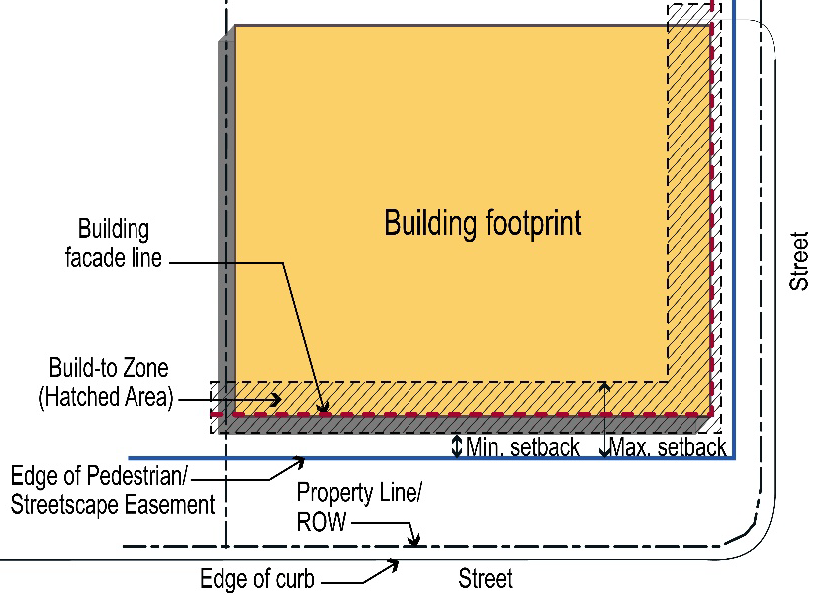
Illustration indicating the location of the build-to zone relative to the minimum
and maximum setbacks and the building façade line
Building Façade Line
Is the location of the vertical plane of a building along a street frontage.
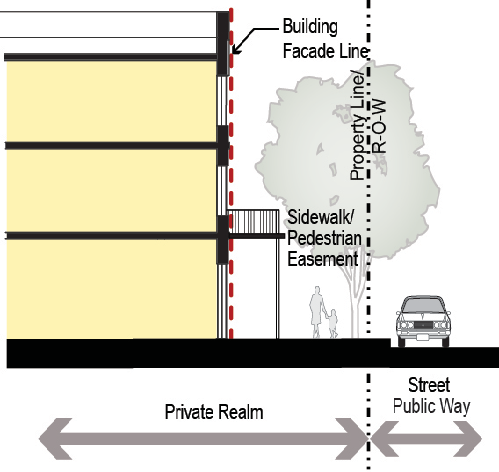 Section View - Gallery Building Section View - Gallery Building | 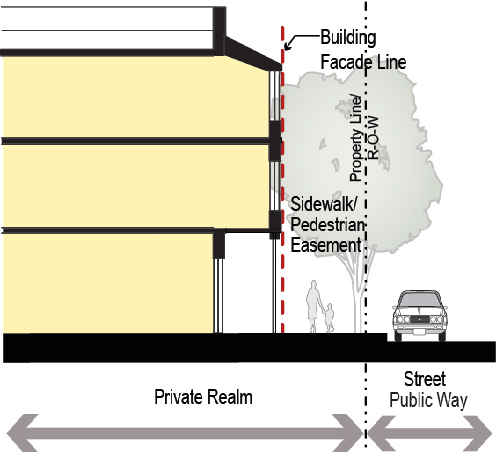 Section View - Arcade Building Section View - Arcade Building |
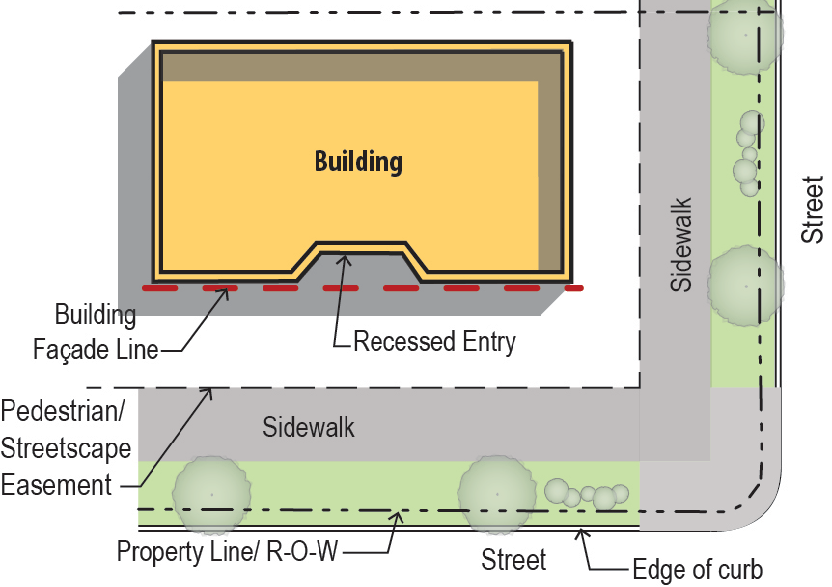 Plan View Building Façade Line Illustrations Plan View Building Façade Line Illustrations | |
Building Frontage
Is the percentage of a building's façade line that is required to be located within
the Build-to Zone (BTZ) as a proportion of the lot's width along the fronting public
street. Required driveways, stairs to access entrances, parks, plazas, squares, improved
forecourts, and pedestrian breezeway frontages shall count towards the required building
frontage.
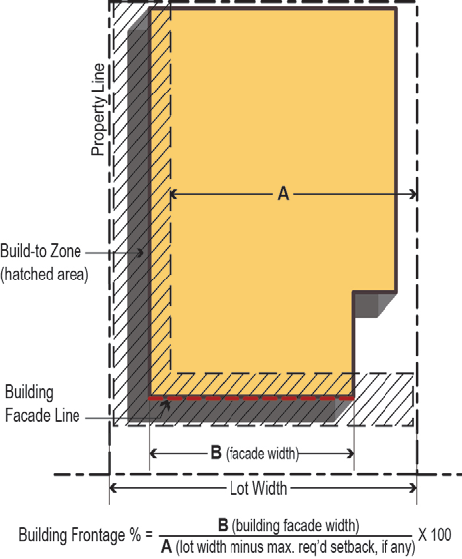
Image showing Building Frontage calculation
Building Step-back
Building step-back is the setting back of the building façade line away from the street
at a specific floor or height.
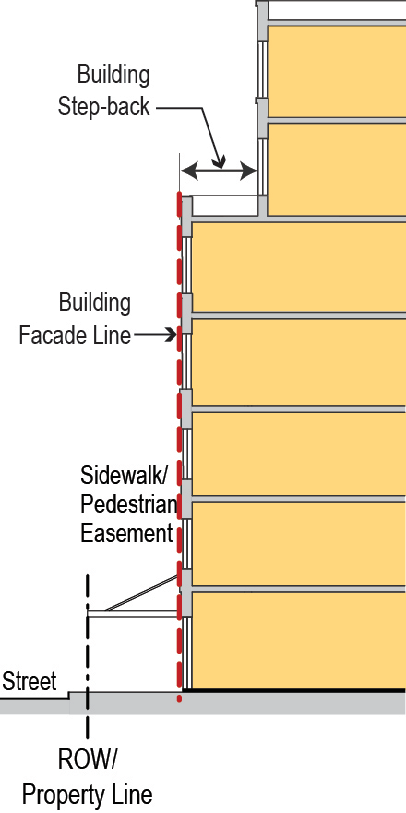
Illustration of a Building Step-back
Colonnade
Is a portion of the main façade of the building that is at or near the property line
and a colonnade supports the upper floors of the building. Colonnades are intended
for buildings with ground floor commercial or retail uses. The ground floor area within
the colonnade may be conditioned or non-conditioned space.
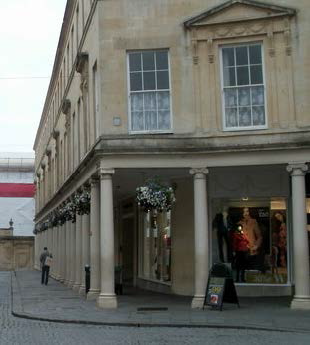 | 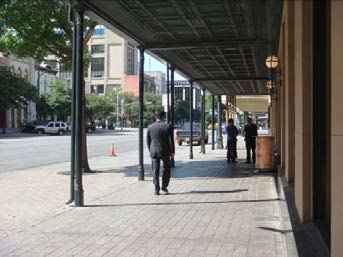 |
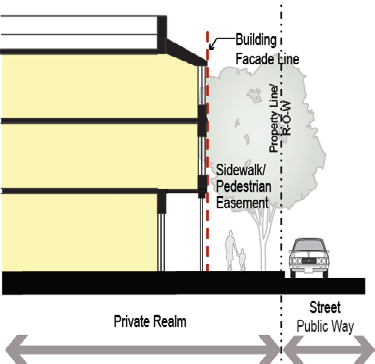 Images of colonnade buildings Images of colonnade buildings | |
Character Zone (or Sub-District)
Means an area or sub-district within any Special District that is intended to preserve
and/or create an urban form that is distinct from other areas. Arrangement and allocation
of the Character Zones are in the Zoning Framework Plan.
Commercial Use or Mixed-Use Building
Means a building in which at least the ground floor of the building is built to Commercial
Ready standards and any of the floors are occupied by non-residential or residential
uses.
Commercial Ready or Commercial Required
Means a ground floor space constructed with appropriate building orientation, entrance
and window treatment and floor-to-floor height in order to accommodate ground floor
retail/commercial uses (including but not limited to commercial, retail, restaurant,
entertainment, and lobbies for civic, hotel, or multifamily uses). Standards for Commercial
Ready or Active Edge frontages are to be established based on the requirements of
this PD. Prior to the issuance of a certificate of occupancy for a retail/commercial
use in a Commercial Ready space, the space must comply with all building and construction
Sections for commercial uses. The intent of Commercial Ready or Commercial Required
space is to provide the flexibility of occupying a space in accordance with market
demand and allowing the use in such space to change to retail/commercial uses accordingly.
Encroachment
Means any structural or non-structural element such as a sign, awning, canopy, terrace,
or balcony that breaks the plane of a vertical or horizontal regulatory limit, extending
into a setback, into the public right-of-way, or above a height limit.
Façade Area
Means the surface area of a building's elevation (including all floors) not counting
minor indentations fronting a particular street. Ground floor façade area is the surface
area of a building's ground floor elevation not counting minor indentations fronting
a particular street. Upper floor façade area is the surface area of a building's upper
floor elevations, not counting minor indentations fronting a particular street.
Frontage Designation (Pedestrian/Vehicular)
As identified on the approved Master Concept Plan, future streets in the Special Districts
shall be designated as "Pedestrian" or "Vehicular" oriented. Each frontage designation
establishes a certain development context in order to improve walkability and pedestrian
orientation within the district. Pedestrian-oriented streets prioritize pedestrian
safety and walkability, whereas vehicular-oriented streets are designed for vehicle
access and moving higher traffic volumes.
Gallery
Is a roofed promenade or canopy, especially one extending along the wall of a building
and supported by arches or columns on the outer side. The gallery space is unenclosed
(non-conditioned) space and may be 2 or more stories tall.
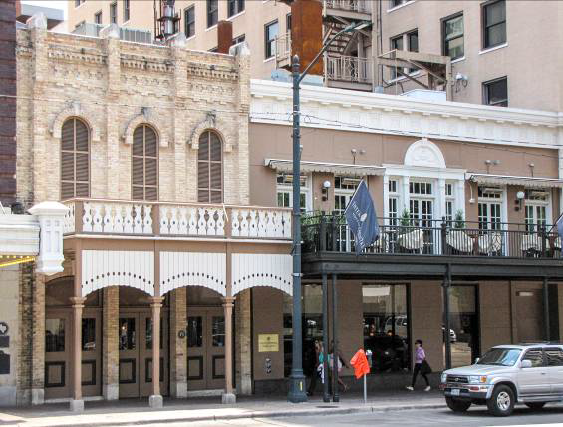 | 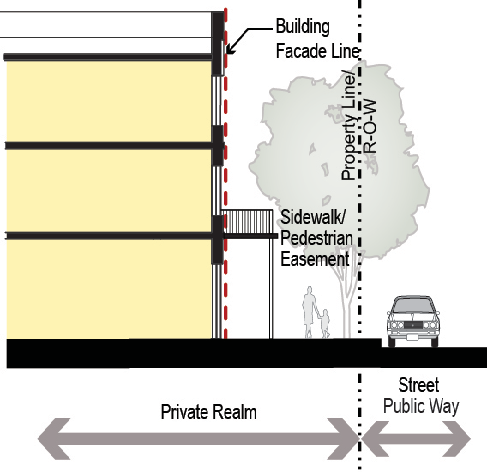 |
| Images of Galleries | |
ITE's Designing Walkable Urban Thoroughfares Manual
Daisa, James M., Designing walkable urban thoroughfares: a context sensitive approach.
Washington, DC: Institute of Transportation Engineers (most recent edition).
Live-Work Unit
Means a dwelling unit that is also used for work purposes, provided that the "work"
component is restricted to the uses of professional office, artist's workshop, studio,
or other similar uses and is located on the street level and constructed as separate
units under a condominium regime or as a single unit. The "live" component may be
located on the street level (behind the work component) or any other level of the
building. Live-work unit is distinguished from a home occupation otherwise defined
in that the work use is not required to be incidental to the dwelling unit, non-resident
employees may be present on the premises and customers may be served on-site.
Master Concept Plan (MCP)/Concept Plan
A Master Concept Plan is a plan for development that establishes the standards and
specifications for all the critical elements of the built environment based on a specific
development vision per all the requirements of this Section.
Minor Amendments
Means a requested amendment to an approved plan (site plan or MCP). The Administrator
shall have the authority to approve or approve with conditions or deny a minor amendment
to an approved plan. Appeal of the Administrator's decision shall be to the City Manager
whose decision shall be final.
Multi-Unit Home
Means a Residential building containing between 2 and 6 units either as leasable units
or individually owned. Architecturally, multi-unit homes are designed to appear similar
to single-family homes with only one or two primary entrances per street frontage.
Additional entrances are permitted along other non-street facing facades.
NACTO's Urban Street Design Guide
Urban Street Design Guide. New York City: National Association of City Transportation
Officials (most recent edition).
Open Space
Is publicly accessible open space in the form of parks, courtyards, forecourts, plazas,
greens, playgrounds, squares, etc. provided to meet the standards of this Ordinance.
Open space may be privately or publicly owned and/or maintained.
Primary Entrance
Means the public entrance located along the front of a building facing a street or
sidewalk and provides access from the public sidewalk to the building. It is different
from a secondary entrance which may be located at the side or rear of a building providing
private controlled access into the building from a sidewalk, parking or service area.
Residential Use Building
Means a building that is built to accommodate only residential uses on all floors
of the building such as a detached single-family home, attached single-family home
(i.e., townhome), two-family home (i.e., duplex), multiple-family (3 or more), apartment
building (under single ownership or under multiple owners within a condominium regime).
Sample Illustrative Plan
Is to provide guidance on how to translate the Zoning Framework Plan into a Master
Concept Plan that establishes the details required to develop areas within the Special
Districts under this Ordinance including, but not limited to, the allocation of component
zones, layout of streets and open spaces, and mix and intensity of uses. The Sample
Illustrative Plan will then be the basis to create a final Master Concept Plan by
property owners/developers.
Service-related site functions
Means all uses that support the principal use on the site including parking access,
garbage/trash collection, utility meters and equipment, loading/unloading areas, and
similar uses.
Street Screen
Is a freestanding wall or living fence or combination fence built along the frontage
line or in line with the building façade along the street. It may mask a parking lot
or a loading/service area from view or provide privacy to a side yard and/or strengthen
the spatial definition of the public realm.
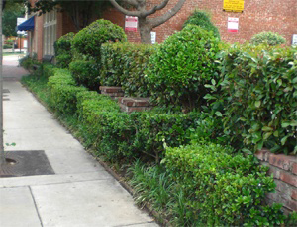
Image of a combination masonry and living street screen
Type 1 - 2 Applications:
Are the different types of applications with specific review and approval processes
tailored to the scope of proposed development within the Special Districts and other
Planned Developments. The application and development review flow charts in Article
II summarize the different application types and their respective processes.
Type "A" Frontage/Pedestrian-Oriented Streets
Means the block frontages identified as such on the adopted MCP. Type "A"' frontages
are the primary pedestrian frontages and buildings along Type "A" frontages shall
be held to the highest standard of pedestrian-oriented design. If Type "A" frontages
are facing Type "B" frontages along the same street, the Type "B" frontages shall
utilize enhanced streetscaping and/or landscaping to complement the streetscaping
or landscaping utilized by the facing Type "A" Frontage including the screening of
surface parking lots along the Type "B" Frontage in order to minimize the interruption
to the quality of pedestrian experience along such frontage.
Type "B" Frontage/Vehicular-Oriented Streets
Means the block frontages identified as such on the adopted MCP. Type "B" frontages
are intended to primarily accommodate access to parking, service, utility, and other
auto-related functions. See above requirement when Type "B" Frontages are located
facing Type "A" Frontages along the same street
Zoning Framework Plan
Shall be the Zoning Map for the Special District areas which shall establish the boundaries
of the different character zones, major roadway network, and open space locations.
(Ord. No. O-2023-003, § 3(Exh. A), 1-3-2023)
Sec. 36-12.6 - Other terms defined
Accessory Use
A use of land that is found on the same parcel as the primary use but is subordinate
and incidental.
Administrator
Means the City Manager or his/her designee.
Adult
Any person 18 years of age or older.
Application
An application for any permit or approval required by Article II of this Chapter.
Application or Project in Progress
An application for any permit or approval required by Article II of this Chapter that:
•
Is filed on or before the effective date of this Chapter, and
•
Provides the City fair notice of the project and the nature of the permit sought, and would be inconsistent with any regulation of this Chapter applicable to the zoning district in which it is located if completed as proposed or planned.
Architecturally Finished
A finish characterized by a uniform appearance pertaining to materials, features,
characteristics, or details most often specified for exposed surfaces used to build
or ornament a structure.
Articulation
Off-sets, projections, recessed walls, windows, doors, and similar features that provide
variation to a building facade and its roofline.
Balcony
A platform that projects from the wall of a building and is surrounded by a railing
or balustrade.
Banding
Narrow inlay of a color or grain which contrasts with the surface it decorates. Also
refers to other long narrow ornamentation, such as painting or carving.
Bedroom
A habitable room that is used primarily for sleeping in any dwelling unit.
Berm
A mound of soil, either natural or man-made, used to screen and visually separate,
in part or entirely, one area, site, or property from the view of another area.
Build
To erect, construct, convert, enlarge, reconstruct, restore, or alter a building,
structure, or infrastructure.
Building
Any structure which is built for the support, shelter, or enclosure or partial enclosure
of persons, animals, chattels, or movable property of any kind. The term includes
swimming pools.
Building, Detached
A building surrounded by yards or open space on its own building lot, or buildings
in a building group that are physically detached one from the other.
Building Line
A line established, in general, parallel to the front property line, over which no
part of a building shall project, except as otherwise provided in this Ordinance.
Building Official
The officer or other designated authority charged with the administration and enforcement
of City Ordinances related to construction, building, plumbing, electrical, or mechanical
work.
Building, Principal
A non-accessory building in which a principal use of the lot on which it is located
is conducted. All residential uses, except bona fide servants' quarters, shall be
deemed principal uses.
Caliper
For newly installed trees and landscaping, the caliper is the diameter of the trunk
measured twelve inches above ground level. For existing trees, the caliper is the
diameter of the trunk, measured at breast height, which is typically four and one-half
feet above the ground.
Certificate of Occupancy
A certificate issued by the Building Official prior to using or occupying a non-residential
or multifamily structure or building.
Change in Use
Changing permitted uses between or within land use categories in the use tables in
Article IV, Use Standards.
Cladding
The exterior building finish.
Co-location
A single telecommunications tower and/or site used by more than one telecommunications
service provider.
Column
An architectural support of definite proportions, usually cylindrical in shape, with
shaft, capital, and sometimes a base. A column may be free-standing or attached to
a wall.
Comprehensive Plan
The plan adopted by the City Council as the official policy to guide development of
the city and its extraterritorial jurisdiction. The Comprehensive Plan may include
all applicable sub-area, neighborhood, sector, or district plans; and other supporting
elements, studies, and documents as may be adopted by the City Council.
Conforming Use
A use that:
•
Conforms to the requirements of this Chapter, or
•
Meets the definition of a nonconformity but is not subject to any limits on the continuation or expansion of nonconformities.
Conical Surface
A surface extending outward and upward from the periphery of the horizontal surface
at a slope of 20-to-one for a horizontal distance of 4,000 feet.
Cornice
The uppermost horizontal molded projection or other uppermost horizontal element located
at the top of a building or portion of a building.
Court
An open, unoccupied space of at least 20 feet in depth bounded on more than one side
by the walls of a building or buildings and used as a primary means of access to all
or any part of said buildings.
Courtyard
A landscaped open space in the center of a block or building with no street frontage,
and that is inwardly oriented and large enough to allow for outside activities and
sunlight during midday.
Curvilinear
Streets that deviate from straight alignment and change direction without sharp corners
or bend.
Development or to Develop
"Development" shall mean:
1.
The construction of one or more new buildings or structures on one or more building lots;
2.
The existence of a building on a building lot;
3.
The use of open land for a new use;
4.
Any manmade change to improved or unimproved real estate, including, but not limited to, buildings or other structures, mining, dredging, filling, grading, paving, excavation, drilling operations, or storage of equipment or materials; or
5.
"To develop" shall mean to create a development.
Development Document
Means, regardless of capitialization which may be used, (in addition to any express
or customary usages otherwise applicable to a given city policy, agreement, or regulation),
any document, filing, submission, application, petition, request, or similar mechanism
which is intended to have, or may have by operation of law regardless of the submittor's
intent, any effect on how real property is ultimately developed or regulated by the
city or another government entity (e.g., Rockwall County), including without limitation
any petition or request for de-annexation, exclusion, or release from either the city's
territorial limits or the city's extra-territorial jurisdiction. Notwithstanding any
other provision of the Fate Code, this definition shall apply for purposes of all
city regulations, ordinances, and resolutions, adopted by the city, and also to all
agreements and contracts between the City of Fate and any other party unless expressly
contradicted by the terms set forth in such agreement or contract.
Director
Person designated as having the official title of "Director of Planning and Development
Services" of the City of Fate, Texas.
Display
The exhibition of goods, wares, or merchandise for retail sale, rental, or lease for
a period of time not in excess of one business day.
District
A zoning district; a section of the city for which the regulations governing the area,
height, and use of buildings and land are uniform.
Enclosed Addition
An expansion of an existing single-family structure that is enclosed on all four sides
by a wall. A substantial part of its wall is a part of the wall of the principal building
or is attached to the principal building in a substantial manner, as by a roof. An
attached garage, a patio enclosure, or a sunroom are considered an enclosed addition.
Enhanced Pavement
Any decorative pavement material intended for pedestrian or vehicular use. Examples
of enhanced pavement include brick, concrete, stone pavers, exposed aggregate concrete,
and stamped and stained concrete.
Entryway
The doorway into a building along with the architectural treatments that accompany
it.
Exterior Insulation and Finish System (EIFS)
A multi-layered exterior wall system typically consisting of insulation board that
is secured to the exterior wall surface with a specially formulated adhesive and/or
mechanical attachment; a durable, water-resistant base coat, which is applied on top
of the insulation and reinforced with fiber glass mesh for added strength; and a durable
finish coat which is both colorfast and crack-resistant.
Façade
Any face of a building that encloses or covers usable space. Multiple buildings on
the same lot will each be deemed to have separate facades. A roof is not a façade
or part of a façade.
Family
Individuals living together as a single housekeeping unit in which not more than four
individuals are unrelated to the head of the household by blood, marriage, or adoption.
The term expressly excludes residents of an assisted living facility, boarding house,
fraternity or sorority house, private dorm, halfway house, or nursing home, as defined
by this Ordinance.
Fence or Wall
A masonry wall or a barrier composed of posts connected by boards, rails, panels,
or wire for the purpose of enclosing space or separating parcels of land. The term
"fence" does include retaining walls.
Fenestration
Window treatment in a building or building façade. Also, a general term used to denote
the pattern or arrangement of openings (i.e., windows and doors, in a façade).
Fixture
The complete assembly that holds or contains a lamp, including any elements designed
to provide light output control such as a reflector or refractor, the ballast and
housing.
Front Porch, Covered
An unenclosed space with a permanent roof supported by columns generally located at
the front entry of a building.
Full cut-off fixtures
Fixtures, as installed, that are designed or shielded in such a manner that all light
rays emitted by the fixture, either directly from the lamps or indirectly from the
fixture, are projected below a horizontal plane running through the lowest point on
the fixture where light is emitted.
Garage, J-swing
A private garage protruding from the front of a residential dwelling that is detailed
to have the appearance of the main living space when viewed from the front of the
building and allows automobile access through the side internal to the lot.
Grade
The average of the finished ground surface elevations measured at the highest and
lowest exterior corners of a structure.
Gross Floor Area (GFA)
When applied to a building, the area in square feet measured by taking outside dimensions
of the building at each floor, excluding however, the floor area of basements or attics
when not occupied or used.
Ground Cover
Plants and turfs that normally reach a height of less than two feet upon maturity,
installed in such a manner so as to form a continuous cover over the ground.
Human Scale
The proportional relationship of a particular building structure or streetscape element
to the human form and function. Human scale relates the size and/or height of a structure
to the height and mass of a pedestrian traveling along the sidewalk or street adjacent
to that structure or element.
Illegal Use
A use, building, structure, or improvement that was not lawful when it was established
and does not comply with the requirements of this Chapter. Refer to Sec. 2.6.2 for
a list of violations.
Improvement
A structure, parking area, public facility, landscaped area, or other object that
is a physical addition or that is part of the infrastructure required by this Chapter
for real property.
Institutional
Nonprofit organizations such as public schools, religious institutions, and government
facilities.
Interested Property Owner
The record owner of any property subject to an application, or their authorized agent.
Irrigation System
A method of providing the proper amount of water for the particular type of plant
material used.
Landscape Architect
A person licensed to practice landscape architecture pursuant to the laws of the State
of Texas.
Lighting
Any source of light that does not include natural light emitted from celestial objects
or fire. The term includes any type of lighting, fixed or movable, designed or used
for outdoor illumination of buildings or homes, including lighting for billboards,
streetlights, canopies, gasoline station islands, searchlights used for advertising
purposes, externally or internally illuminated on- or off-premises advertising signs,
and area-type lighting. The term includes luminous elements or lighting attached to
structures, poles, the earth, or any other location.
Manufactured Home Park
A unified development of manufactured home sites, plots, or stands as arranged on
a large tract under single ownership, meeting the area and setback requirements of
this Ordinance, and designed to accommodate manufactured homes for a permanent duration.
Manufactured Home Subdivision
A unified development of manufactured home sites on lots platted for such purpose,
where said lots may be sold to the owners of manufactured homes situated thereon,
meeting the area and setback requirements of this Ordinance, and designed to accommodate
manufactured homes on a permanent basis.
Massing
Three-dimensional bulk of a structure: height, width, and depth.
Meandering
Taking a sinuous course with curves in alternate directions.
Mews
A narrow street with paving that is less than 22 feet in width.
Mixed use Development or Building
The development of a tract of land, building, or structure in a compact urban form
with a residential use and a non-residential use as permitted by the applicable zoning
district from the land use categories listed in Article IV, Use Standards, except
for land uses in the Parks and Open Space, Sexually Oriented Business, and Utilities
use categories. The layout of a mixed-use development may be vertical or horizontal
in design.
Motor Vehicles
Any vehicle propelled by mechanical power, such as a car, van, pickup or truck, recreational
vehicle, or a boat. For purposes of this Ordinance, this definition shall include
campers and recreational trailers that are not self-propelled, but shall exclude equipment
such as construction equipment, forklifts, farm implements, and neighborhood electric
vehicles.
Nonconforming Lot
A lot that does not conform to the lot area, width, or depth requirements of the zoning
district in which it is located, and as further defined in Article XI, Nonconformities.
Nonconforming Site
A lot or parcel that:
•
Includes an improvement that was lawfully constructed, but that no longer conforms to the applicable regulations of this Chapter, or
•
Does not include the improvements required by this Chapter for any existing use, building or structure on the lot;
•
See Article XI, Nonconformities.
Nonconforming Structure
Any existing structure that was erected according to all applicable City ordinances
at the time, but which does not now comply with all the regulations applicable to
the district in which the structure is located, and as further defined in Article
XI, Nonconformities.
Nonconforming Use
Generally, the use of an existing property or structure after the effective date of
this Ordinance, which does not comply with the use regulations applicable to the district
in which the property is located, and as further defined in Article XI, Nonconformities.
Nonconformity
Any nonconforming use, nonconforming lot, or nonconforming site.
Owner
Each and every person or entity who is a record owner of a fee simple interest or
an undivided fee simple interest in a parcel of land. If such parcel is subject to
a condominium or other multi-ownership regime, the owners' association representing
such multi-ownership regime, and not individual unit owners, shall be deemed the owner
thereof.
Parapet
That portion of the wall which extends above the roofline.
Parking Lot
Paved surfaces used for the storage of vehicles for limited periods of time, including
but not limited to: truck parking; motor vehicle display, loading, or storage areas;
and/or boat sales.
Parkway
The area of right-of-way between the curb and the property line normally owned by
the City and consisting of a variable width.
Permeable Pavement
A paving material that permits water penetration to a soil depth of 18 inches or more.
Person
An individual, firm, partnership, corporation, company, association, joint stock association,
or body politic, and includes a trustee, receiver, assignee, administrator, executor,
guardian, or other representative.
Playground
An outdoor area associated with a religious assembly, school, or park designed for
unorganized recreational play. Playgrounds may consist of open space or informal play
areas containing equipment such as swings, jungle gyms, seesaws, merry-go-rounds,
backstops, goals, and similar equipment. Areas designed specifically for organized
athletic events or containing buildings, bleachers, paved surfaces, field lights,
or outdoor speakers, are not included within the definition of playground.
Plaza
A predominantly hard-surfaced space that is a portion of a block with a minimum of
one side open to the street and is located to provide maximum sunlight during the
day. Building edges should contain continuous public uses at grade to animate and
support the open space. Unlike intimate scale urban gardens, a plaza may contain a
primary entrance to an adjacent building.
Portico
A roofed entrance porch, often supported by columns or pillars.
Primary Use
An activity or combination of activities of chief importance on the site and is the
main purpose for which the land or structures are intended, designed, or ordinarily
used, as distinguished from an accessory use. In certain cases, a site may have more
than one primary use, such as mixed-use buildings with commercial use on the ground
floor and residential use on upper floors.
Public Utility
The City of Fate and any corporation or authority franchised by the City of Fate to
provide water, sewer, refuse collection, natural gas, electricity, telecommunication,
or similar services on a community-wide basis.
Recreational Area
An area devoted to facilities and equipment for recreational purposes, swimming pools,
tennis courts, playgrounds, community clubhouses, and other similar uses.
Relative
A person related by blood, marriage, or adoption.
Right-of-way
A public or private area that allows for the passage of people or goods. Right-of-way
includes passageways such as freeways, streets, bike paths, alleys, and walkways.
A public right-of-way is a right-of-way that is dedicated or deeded to the public
for public use and under control of a public agency.
Salvage
Any discarded, abandoned, junked, wrecked, dismantled, worn out, or ruined motor vehicles
(including automobiles, trucks, tractor trailers, and buses), motor vehicle parts,
boats, travel trailers, trailers, cranes, machinery or equipment, machinery or equipment
parts, recreational vehicles, and/or any junk.
Screening Fence or Screening Device
A barrier of stone, brick, pierced brick or block, uniformly colored wood, or other
permanent material of equal character, density, and design.
Screening Shrub
Shrubs which provide a dense, evergreen, opaque visual barrier.
Secondary Use
A collateral use of land or buildings, which is customarily done or performed in conjunction
with a permitted principal use, but not constituting a majority of either the employment,
area, or revenues of the combined uses.
Security Fence
A barrier provided for security purposes, which may be composed of various building
materials including, but not limited to, decorative steel and masonry materials.
Service Bay
A part of a building or structure used for providing maintenance, installation, or
service to a single vehicle.
Shared Parking
One or more parking facilities shared by multiple users.
Sidewalk
A paved walkway along the side of a street.
Significant Stand
A clustering of at least three trees of two and one-half inches of caliper or greater
in size, and trunks spaced at no greater than 10-foot intervals, or as determined
by the Administrator to assist in the preservation of a stand of greater area. Trees
identified as being in a significant stand shall have existed in that location for
a period of at least one year and shall not have been considered as newly planted
trees.
Sill
The horizontal member forming the bottom of a window or exterior door frame.
Stables, Private
A facility or area for keeping horses for the private use of the property owner.
Steeple
A tall ornamental structure; a tower, composed of a series of stories of diminishing
size, and topped by a small pyramid, spire, or cupola.
Stoop
A small porch, platform, or staircase leading to the entrance of a building.
Story
That portion of a building, other than a basement, included between the surface of
any floor and the surface of the next floor above it, or if there is no floor above
it, then the space between the floor and the ceiling above the floor of such story.
This includes any mezzanine or loft which may comprise only a portion of a full floor
plate.
Street
A public way for vehicular traffic.
Street Frontage
The length of property along a street.
Street Tree
Trees planted within the streetscape.
Streetscape
The area between the building and edge of the vehicular or parking lanes. The principal
streetscape components are curbs, sidewalks, street trees, tree planters, bicycle
racks, litter containers, benches, and streetlights. Treatments may also include a
range of provisions such as paving materials; street, pedestrian, and wayfinding signs;
parking meters; utility boxes; public art; water features; bollards; informational
signage; and other elements.
Structural Addition
Any new construction that includes the construction of a new foundation and increases
the overall square footage of the structure or serves to increase the overall height
of the structure. Structural addition shall not be interpreted to include renovations,
remodeling, replacement, or similar construction resulting from routine maintenance
or cosmetic alterations to a structure or reconstruction of such structure in the
case of casualty loss.
Telecommunications
The transmission, between or among points specified by the user, of audio and/or visual
information of the user's choosing, without change in the form or content of the information
as sent and received.
Telecommunications Service
The offering of telecommunications for a fee directly to the public, or to such classes
of users as to be effectively available directly to the public, regardless of the
facilities used.
Tower, Height
The distance measured from grade to the highest point of any and all components of
the structure, including antennae, hazard lighting, and other appurtenances, if any.
Transitional Surfaces
These surfaces extend outward at 90-degree angles to the runway centerline and the
runway centerline extended at a slope of seven feet horizontally for each foot vertically
from the sides of the primary and approach surfaces to where they intersect the horizontal
surface.
Travel Trailer
A portable vehicular structure built on a chassis, designed to be used as a temporary
dwelling and to be towed behind a motor vehicle, being either of a gross weight of
not more than 4,500 pounds or an overall length of not more than 30 feet.
Tree
A perennial woody plant, single or multiple trunk(s), with few if any branches on
its lower part, which at maturity will obtain a minimum six-inch caliper. Trees may
be canopy or shade trees.
Tree, Multi-trunk
A tree from a common root stock if there is a visible connection between the trunks
above the ground. The caliper of a multi-trunk tree is determined by the full caliper
of the largest trunk plus half the caliper of the other trunks.
Tree, Ornamental
A perennial woody plant generally of 25 feet or less at maturity that may branch to
the ground and has significant seasonal color, texture, or other ornamental characteristics.
Tree, Protected
A protected tree shall constitute one of the following:
•
Any tree on a parcel that is identified in a tree protection plan as protected, or
•
Any tree on a parcel that is considered in "good" condition in accordance with universally accepted arboricultural standards, and that is at least 6 inches diameter at breast height (DBH), unless otherwise exempted per this Chapter.
Tree Replacement
A nonprotected tree which is planted or preserved to mitigate the loss of a protected
tree. The tree shall otherwise meet or exceed the definition of a "tree" listed above.
Use
When applied to land or buildings, the purpose or activity for which such land or
building thereon is designed, arranged, or intended, or for which it is occupied or
maintained.
Variance
An adjustment in the application of the specific regulations of this Ordinance to
a particular piece of property, which, because of special circumstances uniquely applicable
to it, is deprived of privileges commonly enjoyed by other properties in the same
vicinity and zone, and which adjustment remedies disparity in privileges. Granted
solely by the Board of Adjustment in accordance with the provisions of Article II.
Wainscoting
Decorative paneling covering the lower three to four feet of an interior wall, usually
made of wood in a plain design, or may be painted or varnished.
Xeriscape
A concept to conserve water through creative landscaping and use of native plants.
The main principles of xeriscape are:
1.
Reduction of turf area;
2.
Use of drought-tolerant and native or adapted plant materials;
3.
Grouping of plants with similar water requirements; and
4.
An irrigation system designed to meet plant needs.
Zoning Administrator
The Director of Planning and Development Services for the City, or the person otherwise
duly designated to administer the provisions of this Ordinance.
Zoning District Map
The map or maps, either physical or electronic, incorporated into this Ordinance as
a part hereof by reference thereto.
(Ord. No. O-2023-003, § 3(Exh. A), 1-3-2023; Ord. No. O-2023-043, § 3, 10-9-2023; Ord. No. O-2024-030, § 26, 7-1-2024)
Sec. 36-12.7 - Acronym Table
(Ord. No. O-2023-003, § 3(Exh. A), 1-3-2023; Ord. No. O-2024-030, § 7, 7-1-2024)

