
Fate City Zoning Code
ARTICLE V
- DESIGN AND DEVELOPMENT STANDARDS
Sec. 36-5.1 - Applicability
5.1.1. General applicability. Table 5.1-1 shall establish the applicability of the different standards in this section.
(Ord. No. O-2023-003, § 3(Exh. A), 1-3-2023)
Sec. 36-5.2 - Off-street parking and loading
5.2.1. Purpose. The regulations of this section are intended to ensure provision of off-street parking and loading facilities in rough proportion to the generalized parking, loading, and transportation demands of different land uses. This section avoids the negative effects associated with spillover parking into adjacent neighborhoods, while avoiding the negative environmental and urban design effects that result from large surface parking lots and other vehicular use areas. The provisions of this section are also intended to help protect the public health, safety, and general welfare by:
(1)
Helping avoid and mitigate traffic congestion;
(2)
Providing multi-modal transportation options and enhanced pedestrian safety;
(3)
Providing methods to help reduce stormwater runoff and the heat island effect of large, paved parking areas; and
(4)
Providing flexible methods of responding to the changing transportation and access demands of various land uses in different areas of the city.
5.2.2. Applicability.
(1)
Generally: The off-street parking and loading standards of this section shall apply to all parking lots and parking structures accessory to any building constructed and to any use established in every district. Except when specifically exempted, the requirements of this section shall apply to all temporary parking lots and parking lots that are the principal use on a site.
(a)
Parking Schedule A (Table 5.5-1) shall apply to all zoning districts except for OTC, NT, MU, and MUT.
(b)
Parking Schedule B (Table 5.5-2) shall apply to the OTC, NT, MU, and MUT zoning districts.
(2)
Expansions and Enlargements: The off-street parking and loading standards of this section shall apply when an existing structure or use is expanded or enlarged. In such cases, only the portion of the building that is expanded or enlarged shall be required to meet the minimum parking standards found in Tables 5.5-1 and 5.5-2.
(3)
Change in Permitted Uses: A permitted use that does not meet the parking requirements of this section may be converted to another permitted use without full compliance with the required number of parking spaces if the Administrator determines:
(a)
The maximum possible amount of parking spaces is provided without removing or partially removing a structure.
(b)
If a structure or a portion of a structure is voluntarily removed, the resulting area shall be used to provide the additional parking spaces necessary towards fulfilling the requirements of Tables 5.5-1 and 5.5-2.
(c)
The amount of parking available is at least 75 percent of the parking required for the new use in Tables 5.5-1 and 5.5-2.
(4)
Location: Required off-street parking, loading, and vehicle stacking spaces shall be located on the same lot as the principal use, except as otherwise provided in this section.
(5)
Use Limited to Parking: No required off-street parking facility or loading space shall be used for sales, display of merchandise, non-vehicular or rental vehicle storage, repair, or service activities unless specifically provided for in this Ordinance.
5.2.3. Off-street parking standards.
(1)
Off-Street Parking Schedule A: The off-street parking requirements for uses allowed by this Ordinance are listed in Table 5.5-1. The vehicle stacking requirements of Section 5.2.6, Drive-Through Vehicle Stacking Standards, may also apply to certain uses.
(2)
Old Town and Mixed Use Districts: Given the mixed use and redevelopment goals of the Old Town District and the focus on walkability in Old Town and mixed-use districts, Table 5.5-3 establishes the parking schedule for all uses in the OTT, MU, MUT, and NT Districts.
(3)
Unlisted Uses: Unlisted uses approved by the Administrator (see section 4.1.4) have widely varying parking characteristics that make it difficult to establish a single standard. Upon approving an unlisted use, the Administrator shall apply the off-street parking standard specified for the listed use that is deemed most similar to the proposed use.
(4)
Alternative Off-Street Parking Schedule: The Administrator may reduce off-street parking requirements based on a parking analysis prepared by the applicant, as follows:
(a)
The analysis shall include estimates of parking demand based on recommendations of the Institute of Transportation Engineers, or other acceptable estimates, and shall include other reliable data collected from uses or combinations of uses that are the same as or comparable with the proposed use.
(b)
The applicant shall prepare a parking evaluation that demonstrates a reduction is appropriate based on the expected parking needs of the development, internal trip capture, alternating peak demands, and similar factors. The parking evaluation shall be prepared in a form and manner prescribed by the Administrator. Comparability shall be determined by density, scale, bulk, area, type of activity, and location.
(c)
The analysis shall document the source of data used to develop the recommendations.
(d)
The applicant may appeal the off-street parking requirement determined by this analysis to the City Council. The City Council's determination is final.
(5)
Bicycle parking credit: For every five bicycle parking spaces provided for a development above and beyond the minimum established in Table 5.2-1, the minimum required vehicle parking spaces may be reduced by one. In no case shall the total reduction number of vehicle parking spaces from these credits exceed 10 percent of the minimum for a development.
5.2.4 Computation of parking and loading requirements.
(1)
Fractions. When measurements of the number of required spaces result in a fractional number, any fraction exceeding 0.5 is rounded up to the next higher whole number.
(2)
Multiple Uses. Except as provided in section 5.3.7, lots containing more than one use shall provide parking and loading in an amount equal to the total of the requirements for all uses. No off-street parking space provided for one type of use or building shall be included in calculation of the off-street parking requirements for any other use or building except as prescribed in Section 5.3.7, Parking Alternatives, of this Ordinance.
(3)
Area Measurements. Unless otherwise specified, all square footage-based parking and loading standards shall be computed based on gross floor area of the use in question. Structured parking within a building does not count as gross floor area in such measurement.
(4)
Off-Street Loading and Service Areas. Required off-street loading spaces shall not be counted as off-street parking spaces when calculating the total amount of required off-street parking spaces. Parking spaces located in buildings used for repair garages or car washes, and spaces in drive-through lanes shall not be counted as meeting the required parking.
(5)
Parking Based on Occupants. Except as provided for in this section, when the standards use the number of occupants as a unit of measurement, all calculations shall be based on the occupant load as determined by the International Building Code.
(6)
Parking Based on Seating. When the standards use seating as a unit of measurement, all calculations shall be based on the occupant load of the areas used for seating as determined by the International Building Code.
(7)
Parking for Unlisted Uses. Parking requirements for uses not specifically listed in Table 5.5-1, Off-Street Parking Schedule A, shall be determined by the Administrator based on the requirements for the closest comparable use, as well as on the particular parking demand and trip generation characteristics of the proposed use. The Administrator may alternately require the submittal of a parking demand analysis that justifies estimates of parking demand based on the recommendations of the Institute of Transportation Engineers, and includes relevant data collected from uses or combinations of uses that are the same or comparable to the proposed use in terms of density, scale, bulk, area, type of activity, and location. The off-street parking requirement determined by this analysis may be sent to the City Council for appeal. The City Council's determination shall be final.
(8)
Special Parking Requirements in Certain Zoning Districts.
(a)
Mixed Use Districts:
i.
In the Mixed Use (MU) and Mixed Use Transition (MUT) districts, the total requirement for off-street parking facilities shall be the sum of the requirements for the various uses computed separately.
ii.
The total number of required parking spaces in a mixed use district may be reduced by the Administrator if the applicant prepares a parking evaluation that demonstrates a reduction is appropriate based on the expected parking needs of the development, internal trip capture, alternating peak demands, and similar factors. The parking evaluation shall be prepared in a form and manner prescribed by the Administrator.
iii.
Surface parking lots, off-street parking spaces, and associated driving aisles shall not be permitted between the building and pedestrian-oriented streets. However, off-street areas for passenger drop-off or pick-up activity such as porte-cocheres are permitted.
(b)
Old Town Core and Neighborhood Transition Districts:
i.
Given the mixed use and redevelopment goals of the Old Town Core (OTC) and Neighborhood Transition (NT) districts in addition to the focus on walkability, Table 5.2-3 shall establish the parking schedule for all uses in these districts.
5.2.5. Accessible parking. In addition to the required off-street parking identified in Section 5.2.3, Off-Street Parking Standards, accessible parking shall be provided for multifamily and all non-residential uses in accordance with the Americans with Disabilities Act and the Texas Accessibility Standards, and the applicant shall demonstrate compliance therewith.
5.2.6. Drive-through vehicle stacking. The following standards shall apply to buildings that contain a drive-through use, regardless of whether the drive-through is part of another use (e.g., restaurant or financial institution) or if it is a stand-alone use (e.g., automatic teller machine):
(1)
Location of Stacking Lanes and Use of Audible Electronic Devices:
(a)
Stacking lanes shall not be located between the building and the street rights-of-way.
(b)
Audible electronic devices such as loudspeakers, automobile service order devices, and similar instruments shall not be audible beyond the property line of the site.
(c)
No service shall be rendered, deliveries made, or sales conducted within the required front yard or corner lot side yard; parking designated for curbside pick-up, drive-in dining, or in-vehicle service (i.e., drive-up carwash) shall be located on the side(s) and/or rear of the principal building.
(d)
All drive-through areas, including, but not limited to, menu boards, stacking lanes, trash receptacles, loudspeakers, drive-up windows, and other objects associated with the drive-through area shall be located in the side or rear yard of a property to the maximum extent feasible, and shall not cross, interfere with, or impede any public right-of-way.
(2)
Stacking Space and Lane Requirements:
(a)
The number of required stacking spaces shall be as provided for in Table 5.2-4, Stacking Space Requirements.
(3)
Design and Dimensions: Stacking lanes shall be provided for any use having a drive-through establishment and shall apply comply with the following standards:
(a)
When stacking lanes are parallel to other stacking or bypass lanes, separation shall be required by means of a three (3)-foot wide minimum landscape median or island.
(b)
Bypass lanes are required for all stacking lanes.
5.2.7. Alternative parking plan. Alternatives to providing the number of off-street parking spaces required by Section 5.2.3, Off-Street Parking Standards may be approved in accordance with the following standards:
(1)
Off-site Parking: An off-site parking facility may be approved to accommodate either required or additional parking subject to the following conditions:
(a)
The off-site parking facility shall be located within 600 feet from an entrance, as measured along the shortest practical walking route, to the structure for which it will be used.
(b)
Off-site parking shall be connected to the use by a minimum 5' sidewalk or surfaced path.
(c)
Residential parking or ADA accessible parking may not be provided in off-site facilities.
(d)
Off-site parking shall have the same or more intensive zoning classification as the primary use served.
(e)
Off-site parking must be located in a permanent offsite parking easement recorded on the Final Plat or recorded by separate instrument in a form approved by the City Attorney.
(2)
Shared Parking: Shared parking facilities for developments or uses with different operating hours or different peak business periods may be approved if the shared parking complies with all of the following standards:
(a)
Location: Shared parking spaces shall be located within 600 feet of a public entrance to the uses served unless remote parking shuttle bus service is provided.
(b)
Zoning Classification: Shared parking areas for non-residential uses shall not be located on residentially zoned property including multifamily residential property.
(c)
Shared Parking Analysis: Where shared parking is contemplated, the applicant may be required to include parking accumulation analyses as a part of the request for approval. The analysis shall include the parking demand for each hour over a 12- to 24-hour period for a typical high-volume day. This will determine the minimum number of spaces that shall be provided. Based on the analysis submitted, if the maximum number of vehicles accumulated during a peak hour or hours for all overlapping uses exceeds the number of spaces that are required to be provided, shared parking shall be limited. A prorated number of shared parking spaces may be permitted based on the justification information of the analysis.
(d)
Agreement for Shared Parking: A shared parking plan will be enforced through a written agreement among all owners of record. An attested copy of the agreement between the owners of record shall be submitted to the Administrator for review and approval. The applicant shall record the agreement prior to the issuance of a building permit or certificate of occupancy for any use to be served by the shared parking. A shared parking agreement may be terminated if all required off-street parking spaces are to be provided in accordance with the requirements of Section 5.2.3, Off-Street Parking Standards.
(e)
Shared parking agreements that existed prior to the adoption of this Ordinance shall continue in force.
(f)
Amendments to pre-existing agreements shall be made pursuant to the terms of this Section and shall be done by written agreement.
(3)
Public Parking: Credit for Nearby Public Parking: Spaces available in public parking areas located within 1,000 feet of the subject use may be counted toward the total amount of required off-street parking if connected to the use by a minimum 5' sidewalk or surfaced path and the Administrator determines that the spaces are reasonably available for the use.
(4)
Additional Reductions in Parking: The City Council may allow an additional reduction in the required number of parking spaces (less than what is determined using the adjusted off-street parking calculation). A parking demand analysis, prepared in accordance with the Administrator's guidelines by a qualified parking or traffic consultant, substantiating the basis for granting a reduced number of spaces is required.
5.2.8. Parking facility location and design.
(1)
Parking Space Dimensions:
(a)
No parking space shall be less than 18 feet in length and nine feet in width, except as provided below.
(b)
Parking spaces may be reduced in length when a tire-stop curb is installed 16 feet from the maneuvering lane and a clear space of two feet is provided for a vehicle to overhang. The overhang is not permitted over public property, sidewalks, a landscaped area, or a setback in which parking is not permitted. Such reduction is permitted only when the width of the maneuvering lane is maintained at 26 feet.
(c)
A maximum of 10 percent of the required parking spaces may be designed and reserved for compact cars. Compact car parking spaces will be a minimum of eight feet by 16 feet and shall be clearly identified with either a sign or pavement marking limiting the spaces to compact cars. The minimum parking aisle width is 24 feet.
(2)
Design of Parking Spaces: The following shall apply in all zoning districts:
(a)
Parking Prohibited in Rights-of-Way and Drive Lanes:
i.
No private off-street parking facility shall be located, in whole or in part, in a public street or sidewalk, parkway, alley, or other public right-of-way.
ii.
No off-street parking or loading space shall be located, either in whole or in part, within any fire lane required by ordinance of the City or within aisles, driveways, or maneuvering areas necessary to provide reasonable access to any parking space.
(b)
Off-street vehicle parking on private property serving residential and non-residential buildings or uses shall be constructed of concrete. Any circulation areas within off-street parking areas not serving as dedicated or shared fire lanes shall be constructed of concrete. Fire lanes shall be constructed in accordance with Section 5.5.4.(3).b.
(3)
Parking Area Location and Layout in Non-Residential Districts: The following shall apply in the non-residential zoning districts except in the RMU and OTC Districts:
(a)
Parking Location: Sites shall be designed with buildings closer to the street with parking located to the side and rear of the site to avoid views of large, paved parking areas from public rights-of-way. A maximum of two rows of parking and one 24-foot-wide drive aisle may be located in front of a non-residential building, with the remainder of the parking located on the site or rear of the building. An ADA-compliant, marked pedestrian accessway shall provide connection through this parking area between the public sidewalk and the primary building access.
(b)
Parking Area Layout: Surface parking areas shall be divided into sub-areas, each accommodating no more than 150 vehicles. Each parking sub-area shall be separated by a minimum 15-foot wide landscaped island, which shall include pedestrian walkways and shade features such as trees and/or arbors. This technique shall be used to minimize the view of a "sea of parking" between the building and the principal street and to require that the majority of off-street parking be located to the side or rear of the buildings served. Surface parking lots shall comply with the requirements in Article IX, Section 9.2.4, Parking Lot Landscaping.
(c)
Circulation Area Design: Circulation areas shall be designed to facilitate the safe movement of vehicles without posing a danger to pedestrians or impeding the function of the parking area. Parking lots shall maintain safe circulation patterns and access to public streets.
(4)
Parking Area Location and Design in the MUC, MUT, NT, and OTC Districts: Shall be in accordance with requirements specified in Article III, Zoning Districts.
5.2.9. Minimum off-street loading standards.
(1)
Off-street facilities shall be provided and maintained for receiving and loading of merchandise, supplies, and materials within a building or on the premises.
(2)
Required off-street loading facilities may be adjacent to an existing public alley or private service drive, or may consist of a berth within a structure.
(3)
No portion of a loading facility may extend into a public right-of-way or into an off-street parking facility.
(4)
The off-street loading spaces or truck berths shall provide maneuvering areas on site to prevent any blockage of public right-of-way.
(5)
Off-street loading spaces shall be screened in compliance with the provisions of Subsection 9.3.1.2, Screening of Service, Loading, and Storage Areas.
5.2.10 Materials, vehicle, and equipment storage.
(1)
Any parking areas for equipment, large vehicles (such as construction equipment, box trucks, or boats), or recreational vehicles not for sale, shall be constructed of asphalt, concrete, compacted flex base, compacted gravel, or another comparable durable surfaced material. Parking is prohibited on bare dirt, gravel, or grass. Any circulation areas within storage areas not serving as dedicated or shared fire lanes shall be constructed of concrete. Fire lanes shall be constructed in accordance with Section 5.5.4.(3).b. Storage of passenger vehicles, and recreational vehicles offered for sale, shall only be on concrete. Outdoor storage shall be screened in accordance with Subsection 9.3.2.
(Ord. No. O-2023-003, § 3(Exh. A), 1-3-2023; Ord. No. O-2024-030, §§ 15—17, 7-1-2024)
Sec. 36-5.3 - Residential building design standards (façade standards)
5.3.1. Purpose and Intent. The standards of this section are intended to:
(1)
Promote high-quality residential developments that are distinctive, have character, and relate and connect to established neighborhoods;
(2)
Provide variety and visual interest in the exterior design of residential buildings;
(3)
Create new neighborhoods that age gracefully and add long-term value to the City;
(4)
Enhance the residential streetscape and diminish the prominence of garages and parking areas;
(5)
Protect property values; and
(6)
Ensure the compatibility of infill residential development with the existing character of surrounding neighborhoods.
5.3.2. Single-Family and Two- to Four-Family Residential Building Design Standards.
(1)
Applicability: This section shall apply to all new and redeveloped single-family and two- to four-family residential development in all zoning districts with the following exceptions:
(a)
Planned Development districts that have specific residential design standards and are approved after the adoption date of this Ordinance,
(b)
Special Districts, and
(c)
Any lot platted prior to the adoption of this Ordinance.
(2)
Façade Design: Façades must be articulated by using color, arrangement, or change in materials to emphasize the façade elements. Exterior wall planes shall be varied in height, depth, or direction. Design elements and detailing, including the presence of windows and window treatments (for walls that face the public right-of-way), trim detailing, and exterior wall materials, must be continued completely around the structure. Doors and windows must be detailed to add visual interest to the façade.
(3)
Garage Design:
(a)
All lots less than 40 ft in width shall provide garages along alleys.
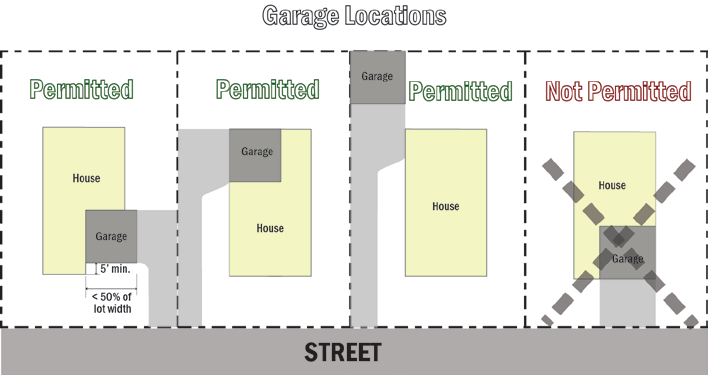
(b)
Any street fronting garage that is more than a one-car garage shall be articulated single garage doors. The garage width as a proportion of the front façade shall be no more than 50%.
(c)
The following graphics indicate the accepted location and placement of garages (attached or detached):
(4)
Building Entrances:
(a)
All buildings shall have at least one primary entry door oriented towards the primary street. The main entry to the home shall be visible from the street. Two- to four-family buildings may have side entrances for other units as long as at least one unit has an entrance door oriented towards the primary street.
(b)
All buildings shall provide a prominent entry feature (either projected or recessed) that reflects the home's architectural style. Common projected entries are porches and stoops. One and two-story recessed entry features that do not incorporate roof overhangs or stoops shall not be permitted.
(5)
Roof design:
(a)
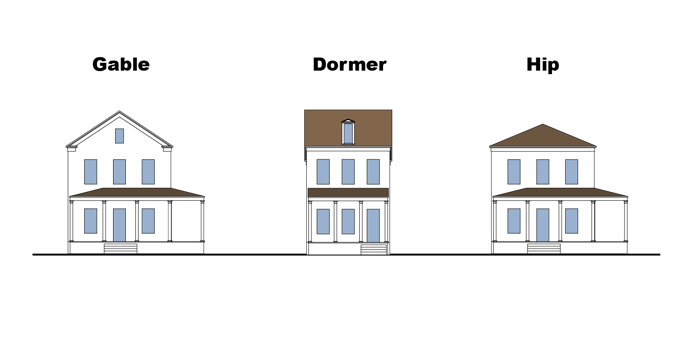
Shall be simple gabled or hipped roofs. Excessive number of roof ridges and forms shall be avoided. Gable roofs, if provided, shall have a minimum pitch of 9/12. When hipped roofs are used, the minimum pitch shall be 6/12. Other roof types and proportions shall be appropriate to the architectural style of the home.
(b)
Roof elements such as dormers, chimneys, skylights, and varying heights and ridgelines may be utilized to ensure good design and neighborhood continuity. However, these shall be appropriately scaled for the architectural style of the home.
(6)
Façade Variation Standards:
(a)
Purpose. This section promotes diversity in lot size and/or development features to avoid monotonous streetscapes and to encourage stimulating living environments.
(b)
Avoiding Monotonous Development Patterns.
(i)
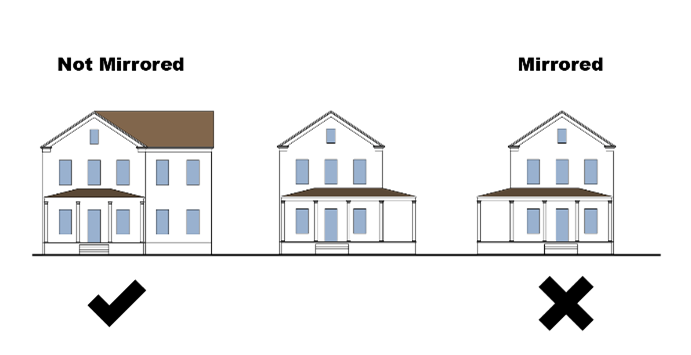
Lots shall not include the same house plan within 3 lots on either side of the lot along the same street side or block face and 5 lots on the opposite side of the street on the opposing block face. Lots along a block face must demonstrate variation in pattern by implementing the development characteristics described below.
(ii)
Mirror images of the same building configuration or elevation do not meet this requirement.
| FIGURE 5.3-1: Avoiding Monotonous Development Patterns | |
|---|---|
| Minimum Number of Lots | Avoid Mirroring Facades |
 |  |
(c)
Criteria for Determining Difference in Facade. A development shall avoid similar frontage conditions by demonstrating at least three of the following distinguishing characteristics of the front building elevation:
(i)
Roofline. Vary the roof type, orientation, and/or significantly change the roof pitch. Three or more of the articulated elements constituting the roof must vary in placement by at least 24 inches or in geometric shape by volume of a least 20 percent, or in angles by at least 30 degrees; or there is a difference in roof pitch of 2 inches or greater per 12 inches.
(ii)
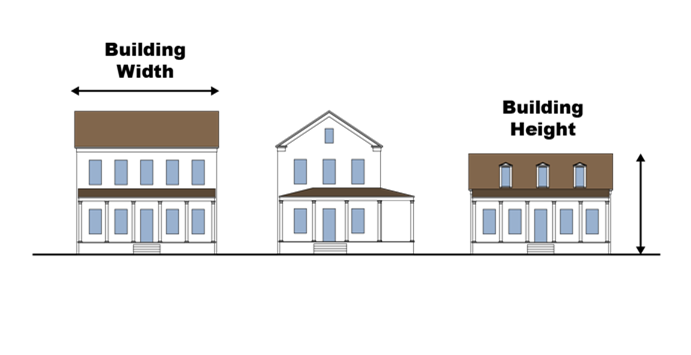
Building Height and Width. Vary the profile of buildings by changing the dimension of the height or width by 15 percent.
(iii)
Front Façade Plane. Wall planes along the face of the front façade may advance or recede from the line of the main façade by 3 or more feet.
(iv)
Front Setback. Vary the front setback distance by more than five feet.
(v)
Color and Texture. Use varying color pallet (e.g., wall, trim, and roof color), and/or wall textures. Color change must be of the hue and not of a shade or tint. Change in color and/or texture must occur throughout the front facade or elevation for a minimum of one story in height.
(vi)
Porch. Alter the configuration of the front porch width, type, architectural treatment, depth, and/or roof coverage.
(vii)
Windows. The aggregate area of the windows on the front façade shall vary by at least 15 percent from a building on an adjacent lot.
(viii)
Building Materials. Differ the primary façade material used by an amount greater than 60 percent. Material change must occur throughout the front façade or elevation for a minimum of one story in height.
(d)
Alternate Method Option. The developer may propose alternative methods of accomplishing anti-monotony goals. Such methods shall provide a visual difference and may be approved by the Administrator.
| FIGURE 5.3-2: Sample Images for Determining Variation in Facade | |
|---|---|
| Roofline | Building Height and Width |
 |  |
| Wall Planes | Front Setback |
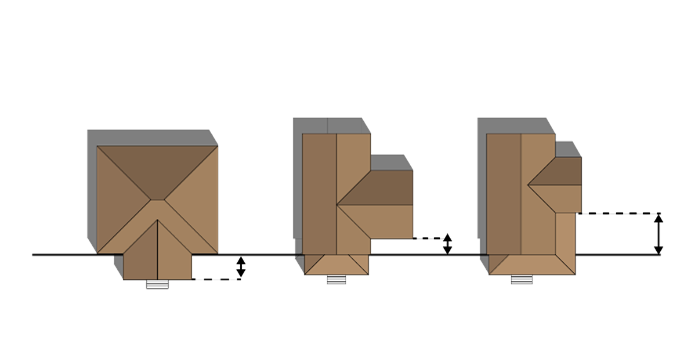 | 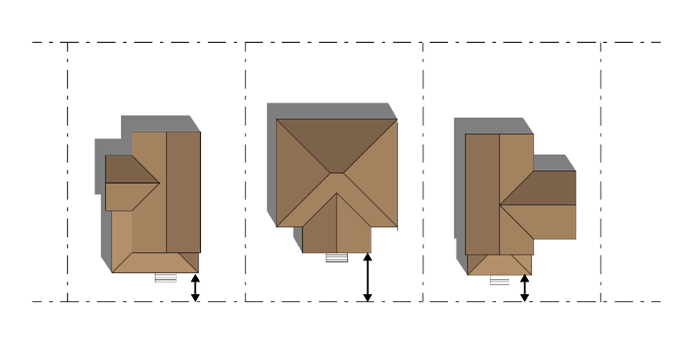 |
| Porch Types | Percentage of Window Openings |
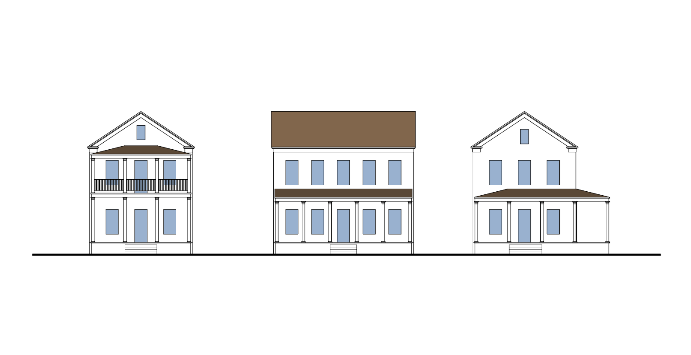 | 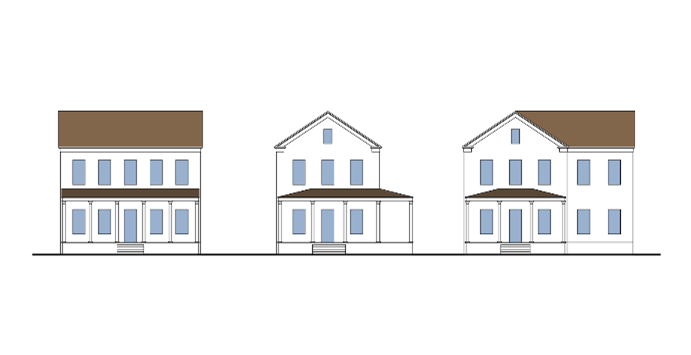 |
5.3.3. Multifamily Residential Building Design.
(1)
Applicability: This section shall apply to all new and redeveloped multifamily residential buildings in all zoning districts with the following exceptions:
(a)
Planned Development districts that have specific residential design standards and are approved after the adoption date of this Ordinance,
(b)
Special Districts (Section 5.10 shall apply), and
(c)
Any lot platted prior to the adoption of this Ordinance.
(2)
Site Design and Building Orientation:
(a)
Site Access:
i.
Except in the Old Town Core zoning district, new multifamily developments with greater than 20 units shall have primary access from an arterial or collector street and shall comply with the following standards:
a.
A minimum of one secondary point of ingress/egress into a multifamily development shall be required for public safety access.
b.
No primary vehicular access from a multifamily development shall be provided on a local street serving existing single-family detached development; however, secondary vehicle access may be provided onto local streets.
(b)
Entry feature design: The following landscaping standards shall apply to the primary entrance:
i.
The main site entry for multifamily developments shall be treated with special landscape elements and unique signage that will provide an individual identity to the project.
ii.
Primary site entry and access drives for multifamily development shall include at least three (3) of the following, and secondary access drives shall include at least one (1) of the following:
a.
A minimum 5-foot wide and 30-foot long landscaped median;
b.
Textured paving, interlocking pavers, or other decorative pavement (stamped concrete or stamped asphalt);
c.
Gateway elements such as lighting, bollards, entry fences, or monuments;
d.
A roundabout containing landscaping, water feature, or artwork; or
e.
Other improvements as approved by the City Council.
(c)
Building Orientation and On-Site Amenity Space:
i.
Building Orientation:
a.
Buildings must be oriented towards either the perimeter streets, or an internal drive (i.e., private street) or open space amenity (excludes required yards) that recreates a traditional grid, rather than orientation only to internal parking lots.
b.
Garage entries, carports, parking areas, and parking structures shall be internalized in building groupings or oriented away from the street frontages.
ii.
On-site Amenity Space:
a.
A minimum of 10% of the net site area shall be devoted to on-site amenity space.
b.
Large open space should be the fundamental organizing element of the site. On-site amenity space should be well defined by buildings and streets. Buildings should be oriented in such a way as to create courtyards and open space areas.
c.
Large existing trees and other natural features should be integrated into the site.
d.
On-site amenity space should be centralized and directly accessible to a majority of the surrounding units. It shall be linked by a minimum 5-foot sidewalk to adjacent parks, paths, and open space areas.
e.
The on-site amenity space shall be useable areas and no more than 25% of the open space shall be riparian areas or slopes exceeding 3:1.
(d)
Site Amenities Required: In conjunction with the on-site amenity space requirements, all multifamily projects shall provide three or more site amenities listed below for the residents. Amenities shall be centrally located for a majority of the residents and may be located within the common open space areas.
i.
Swimming pool.
ii.
Sports courts, such as tennis, basketball, or volleyball.
iii.
Natural open space area with accessible and connected benches.
iv.
Jogging trails.
v.
Fountains, art, or sculpture.
vi.
Playgrounds.
viii.
Dog parks.
ix.
Community gardens.
ix.
Other comparable amenity as approved by the Administrator.
(3)
Building Design:
(a)
360-degree architecture: All sides of a multifamily building shall display a comparable level of quality and architectural detailing as on the front elevation.
(b)
Articulation:
i.
Maximum length of any multifamily residential building shall be 200 feet.
ii.
No more than 6 townhomes may be attached in any single block.
iii.
Each elevation greater than 30 feet in length, measured horizontally, shall incorporate wall plane projections or recesses having a depth of at least 10 percent of the length of the façade, and extending at least 20 percent of the length of the façade.
iv.
The elevations of all multifamily buildings shall be articulated through the incorporation of at least five or more of the following:
a.
Balconies, a minimum of 25 square feet in area;
b.
Bay or box windows;
c.
Porches or covered entries that are compatible to the architectural design and size of the building;
d.
Dormers;
e.
Awnings or canopies;
f.
Structural offsets a minimum of four feet from the principal plane of the facade;
g.
Accent materials such as brick, stone, or stucco with banding highlights;
h.
Ornamental or decorative window grills and shutters;
i.
Vertical elements such as towers or building end-caps that demarcate building modules; or
j.
Other comparable feature as approved by the Administrator.
(c)
Height Transition Adjacent to Single-Family: The height of any part of a multifamily building shall not exceed 40 feet or 3 stories if the building is located within 50 feet of a property zoned, used, or intended to be used for detached single-family residential. Buildings and parts of buildings located more than 50 feet away from property zoned for detached single-family residential are subject to height restrictions of the underlying zoning district.
(d)
Building Entrances:
(i)
Building entries next to a public street, private drive or parking area must be pedestrian-scaled, providing an expression of human activity or use in relation to building size. Doors, windows, entranceways, and other features such as corners, setbacks, and offsets can be used to create pedestrian scale.
(ii)
Upper floor residential units shall be accessed via internal corridors and external common balconies on perimeter walls providing access to units are prohibited.
(e)
Windows:
(i)
All walls and elevations on all floors of multiple household buildings must have windows, except when necessary to assure privacy for adjacent property owners as determined by the Administrator.
(ii)
Windows should be located to maximize the possibility of occupant surveillance of entryways and common areas.
(f)
Roof Design:
(i)
On buildings with pitched roofs, the minimum roof pitch is 6:12.
(ii)
On buildings where flat roofs are the predominant roof type, parapet walls must vary by a minimum of ten percent in height and/or vary by shape once every 50 ft. along a wall.
(iii)
Changing roof forms or towers must be designed to correspond and denote building elements and functions such as entrances and stairwells.
(g)
Roof Materials:
(i)
Roof materials must be high quality, durable and consistent with the architectural style established for the overall development.
a.
High quality shall be defined as having a minimum 30-year life as established by the manufacturer's specifications.
(Ord. No. O-2023-003, § 3(Exh. A), 1-3-2023)
Sec. 36-5.4 - Non-residential building design standards (façade standards)
5.4.1. Purpose and Intent. The intent of this section is to establish design and development standards that foster high-quality, attractive, and enduring non-residential development. The standards are intended to:
(1)
Protect and enhance the character and quality of retail, office, and industrial areas in Fate;
(2)
Protect and enhance the long-term market value of property within Fate;
(3)
Enhance the human and pedestrian scale of retail and office developments and ensure compatibility between residential neighborhoods and adjacent commercial uses;
(4)
Mitigate negative visual impacts arising from the scale, bulk, and mass of large commercial and industrial buildings and centers;
(5)
Promote building designs and construction practices that are enduring and adaptable to multiple uses for extended building lifecycles;
(6)
Establish a sense of place for the commercial areas in Fate; and
(7)
Balance the community's economic and aesthetic concerns.
5.4.2. Applicability.
(1)
The general applicability standards in Section 5.1, Applicability of this Article, shall apply to this section.
(a)
These non-residential design standards shall apply to all new non-residential buildings and building expansions per Section 5.1 in zoning districts except:
i.
Special Districts (standards in Section 5.9 shall apply).
ii.
Planned Development Districts that have alternative building design standards adopted as part of an approved PD Ordinance.
5.4.3. Site Design and Building Organization.
(1)
Purpose: Site design standards address a development's relationship to its surrounding natural features, street network, and land uses. They also address the relationship between key elements within the site. Careful site design is critical to the success of non-residential projects, and the standards of this Section shall be considered at the outset, and throughout, the design process. The standards of this Section are intended to:
(a)
Ensure development is sensitive to all existing on-site conditions and surrounding properties; both the existing physical built environment and the existing native vegetation and natural geography of the site;
(b)
Ensure building scale, orientation, and design relates to the surrounding uses and streets, and creates a cohesive visual identity and an attractive street scene, especially in Neighborhood Commercial areas;
(c)
Ensure site design for efficient pedestrian, bicycle, transit, and vehicular circulation patterns, and create a high-quality pedestrian environment where appropriate;
(d)
Promote design environments built to human scale where appropriate;
(e)
Ensure delivery, trash, and loading facilities are located so as to be visually appealing and not impede regular vehicular and pedestrian circulation and access routes; and
(f)
Ensure safe pedestrian access between buildings and parking areas.
(2)
Building Organization and Orientation:
(a)
Individual Buildings:
i.
Development composed of one or two buildings shall be oriented so that the front façade faces the primary street. On corner lots, the building(s) shall face the higher street designation unless adjoining and connected development provides a context for street frontage along the lower designation street as determined by the Administrator.
ii.
In cases where the longer side of a building is perpendicular to the primary street, the portion of the building facing the primary street shall be designed as a building front with entrances, signage, and transparent windows.
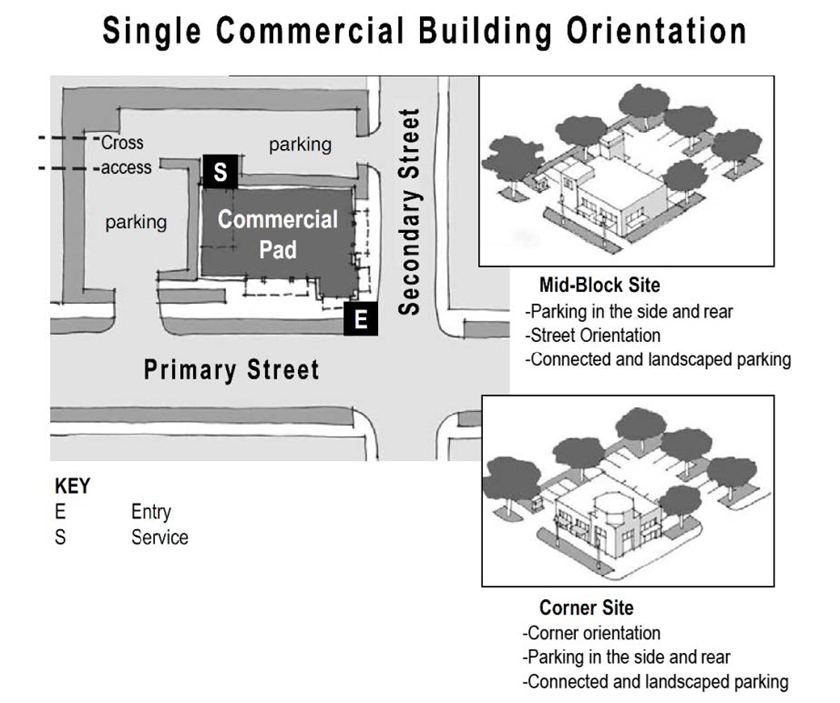
Figure 5.4-1 Illustration of a Single Building Orientation and Site Organization
(b)
Multiple Buildings: Development composed of three or more buildings shall be configured to (see Figure 5.5-2):
i.
Break up the site into a series of smaller internal "blocks" defined by on-site driveways, private streets, vehicle access ways, pedestrian walkways, or other circulation routes;
ii.
Buildings should frame internal streets and parking shall be located in the middle of the block;
iii.
Large parking areas should be broken up into smaller parking areas defined by internal landscaped drives designed as "quasi" streets (private access easements, driveways, etc. that have pedestrian frontages and streetscape);
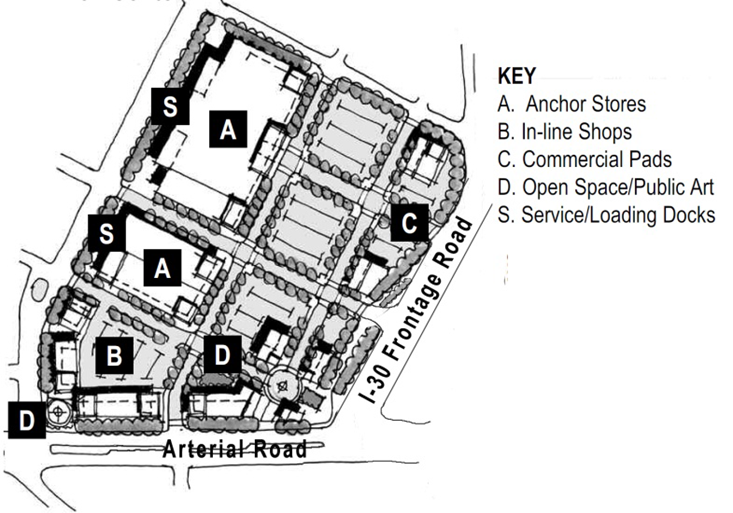 | 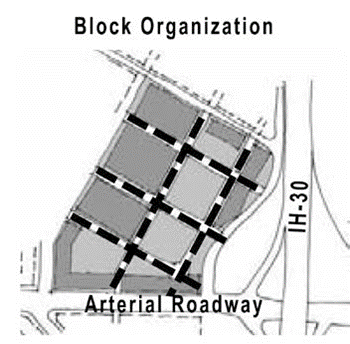 |
| Figure 5.4-2 Illustration of Site Organization of a Multiple Building Development | |
(c)
Building Entry Design:
i.
All buildings shall have their primary entrance directly off the street or through a recessed area, courtyard, or plaza located adjacent to the street.
ii.
The primary building entrance shall be readily apparent as a prominent architectural component from the street, thus creating a focal point. However, non-residential buildings with multiple tenants on the ground floor or multiple primary entrances shall have all entrances treated architecturally.
iii.
Primary building entrances are to be defined and articulated with architectural elements such as pediments, columns, porticos, porches, and overhangs.
(d)
Height Transitions: Transitions between non-residential buildings and adjoining residential neighborhoods shall be provided by using a combination of the following techniques:
i.
Concentrating the tallest buildings at the center of the site or along primary street frontages; or
ii.
Stepping down the height of buildings along any shared residential lot line or street frontage to no more than 15 feet above the average height of the adjacent residential structures.
(3)
Building Design:
(a)
Purpose: Building design directly influences the character and function of non-residential development. The standards of this section are intended to:
i.
Ensure that multiple building or phased commercial developments use compatible schemes of materials, colors, and architectural styles to ensure consistency. This includes accessory structures such as freestanding canopies, accessory and maintenance buildings, and dumpster enclosures;
ii.
Ensuring that individual buildings have a single definitive, consistent style. Mixing of various architectural styles on the same building is discouraged;
iii.
Ensure that buildings are designed to a human scale; and
iv.
Encourage adaptable development by designing buildings to be adaptable for multiple uses over time based on changing market demand.
(b)
3-Sided Architecture: All building elevations (except any rear service facades) shall be architecturally finished with comparable levels of materials and detailing (e.g., tiles, moldings, cornices, wainscoting, etc.). Blank walls void of architectural details or other variation are prohibited.
(c)
Building Form and Mass: A single, large, dominant building mass shall be avoided in new commercial buildings and redevelopment projects under this Ordinance. Changes in mass shall be related to entrances, tenant spaces, the integral structure and/or the interior space organization and activities, and not just for cosmetic effect.
(d)
Exterior Walls: All exterior walls (with the exception of rear/service facades) shall be designed with a base and top.
i.
Base: Façades and walls shall have a recognizable base with (but not limited to):
a.
Thicker walls, ledges or sills;
b.
Integrally textured materials such as stone or other masonry; or
c.
Storefront windows and displays.
ii.
Top: Facades and walls shall also have a recognizable top with (but not limited to):
a.
Cornice treatments, other than colored stripes or bands alone, with integrally textured materials such as stone or other masonry or differently colored materials;
b.
Sloping roof with overhangs and brackets; or
c.
Stepped parapets.
iii.
Building Articulation: Buildings shall be designed to reduce apparent mass by dividing facades into a series of smaller components. Components shall be distinguished from one another through two or more of the following:
a.
Variations in roof form or variations in roof height or parapet of two feet or more;
b.
Changes in wall plane of a minimum ten percent in width and a minimum 24 inches depth;
c.
Variations in the arrangement and recessing of doors and windows;
d.
Recognizable changes in texture or material; or
e.
Decorative columns.
iv.
Windows and Transparency:
a.
At ground level, buildings shall have a high level of transparency. Façades and walls that face the street, pedestrian walkways, plazas, and parking areas (excluding the building rear or side) must have transparent windows (visual transmittance of 0.6 or above) for at least 40% of the façade between 2 ft. and 7 ft. above the grade.
b.
Side facades must have transparent windows (visual transmittance of 0.6 or above) for at least 20% of the façade between 2 ft. and 7 ft. above the grade.
c.
Where the internal arrangement of a building makes it impossible to provide transparency along a portion of a wall as determined by the Administrator, a combination of changing color or texture to imitate the rhythm of windows or storefront displays may substitute for 50% of required transparent areas, except when fronting plaza or sidewalk café areas.
(e)
Roof Forms: Variations in rooflines shall be used to add interest and reduce the scale of large buildings. Roof features shall correspond to and denote building elements and functions such as entrances, arcades, canopies, etc. They shall also complement the character of the overall development.
i.
Flat Roofs: Flat roofs shall include parapets that adhere to articulation requirements for the main face of the structure. The average height of the parapet shall not exceed 15 percent of the height of the supporting wall unless rooftop equipment cannot be sufficiently screened. A three-dimensional cornice treatment is encouraged for parapets. Parapets shall look complete from all sides if visible at any distance from the ground. Parapets shall be constructed of the same material as the primary façade.
ii.
Sloped Roofs: Pitched roofs shall have a minimum pitch of 4:12 for all structures. This requirement excludes roofs for entries and dormers. Any overhanging eaves shall extend at least 2.5 feet past the supporting walls.
a.
Mechanical Equipment: All rooftop mechanical equipment shall be screened from public view.
(f)
Façade Color: Facade colors shall be low reflectance, subtle, neutral, black, or earth tone colors. The use of metallic or fluorescent colors may only be allowed with City Council approval.
(g)
Shade Requirements:
i.
All development shall provide shaded internal pedestrian walkways along at least 50 percent of all building facades along streets, outdoor gathering spaces, and internal drives along parking areas.
ii.
Buildings should be oriented to minimize direct solar exposure on the primary building façade and areas of high pedestrian activity.
iii.
Shade may be provided through any or a combination of the following:
a.
Arcades, canopies, or galleries;
b.
Canopy trees;
c.
Trellises or pergolas; or
d.
Any other shading device as approved by the Administrator.
(4)
Design of Auto-Oriented Elements:
(a)
Drive-Through and Drive-up Facilities:
i.
Off-street stacking lanes for drive-through aisles must be provided as follows (subject to stacking requirements in Table 5.2-4):
a.
Bank teller window, ATM: at least 60 ft. measured from teller, window or ATM.
b.
Restaurant drive-through: at least 40 ft. measured from order box, at least 60 ft. between order box and first payment or pick-up window.
c.
Car wash: at least 60 ft. measured from the wash bay entrance.
d.
Other uses with drive-through windows (pharmacy, dry cleaners, etc.): at least 60 ft. measured from window.
ii.
Drive-through aisles must be physically separated from parking and circulation areas by landscape islands, and:
a.
Cannot interfere with the on-site parking and circulation for other vehicles on the site;
b.
Cannot interfere with on-site parking; and
c.
Cannot result in traffic queuing into a drive aisle, adjacent property, or street.
d.
May not exit in a second driveway on the same street as the primary driveway.
iii.
All drive-through facilities shall require a bypass lane (this may also serve as a standard drive aisle).
iv.
Drive-through aisles and bypass lanes shall be 10 ft.— 12 ft. wide.
v.
Drive-through aisles, stacking, and service windows cannot be on a building façade facing a primary street. On a corner lot, the primary street shall be the street with a higher functional classification or serves as the dominant thoroughfare for the location, as determined by the Administrator.
(b)
Design of gas pumps and canopies:
i.
There shall be at least 20 ft. for one vehicle stacked behind the vehicle at the far end of a row of gas pumps, and room for other vehicles to bypass stacked vehicles at fueling areas.
ii.
Canopies shall include design elements found on the main building, including color and materials.
iii.
Canopy support poles shall include decorative corbels consistent with the overall architectural theme of the site, or pole covers at least 18 in. wide with a similar surface material and architectural treatments as the dominant material on the main structure.
iv.
Canopy fascias must be the same color as the dominant color of the main building. Striping and banding on canopies is prohibited.
(Ord. No. O-2023-003, § 3(Exh. A), 1-3-2023; Ord. No. O-2024-030, §§ 18, 19, 7-1-2024)
Sec. 36-5.5 - Transportation and connectivity
5.5.1. Purpose. The purpose of this section is to support the creation of a highly connected transportation system within the City in order to provide choices for drivers, bicyclists, and pedestrians; increase effectiveness of local service delivery; promote walking and bicycling; connect neighborhoods to each other and to local destinations such as employment, schools, parks, and shopping centers; reduce vehicle miles of travel and travel times; reduce emergency response times; mitigate the traffic impacts of new development; and free up arterial capacity to better serve regional long-distance travel needs. These standards attempt to avoid the creation of large, isolated tracts without routes for pedestrian and bicycle connections and through traffic.
5.5.2. Traffic impacts. The City Engineer may require a Traffic Impact Analysis (TIA) or other type of engineering study from the developer prior to any approval for plats or construction plans pertaining to the potential traffic impact of the proposed development on the City's street system. See the Design Criteria and Construction Standards for applicability and subsequent requirements for TIA.
5.5.3. Streets.
(1)
Basic Policy.
(a)
Street Improvements. In platting a new development, the property owner shall provide additional right-of-way needed for existing or future streets as required by the Design Criteria and Construction Standards and as shown on the Master Thoroughfare Plan. All street improvement requirements and right-of-way dedication shall be in accordance with the provisions of V.T.C.A., Local Government Code § 212.904, as amended.
(b)
Improvement of Existing Substandard Streets.
i.
If the proposed development is located along only one side of a substandard street, and if the City makes a determination that it is not feasible to improve the full width of said substandard street at that time the City may require the developer to pay into escrow, in accordance with Article VI of this Ordinance, funds for the future improvement of the street as a condition of Final Plat approval for the development.
ii.
The developer may request a Major Waiver or may file a proportionality appeal if the requirements for improving an existing substandard street would result in unnecessary hardship or would be disproportional to the impacts generated by the development on the City's street system.
(c)
New Perimeter Streets.
i.
When a proposed residential or nonresidential development is developed abutting an existing or planned major thoroughfare, minor thoroughfare or collector street (as shown on the Master Thoroughfare Plan), the developer shall construct that portion of the abutting street and its appurtenances (such as curbs and gutters, sidewalks, barrier- free ramps, street trees, etc.) necessary to serve the proposed development, all in accordance with the City's design standards for that type of street (per the Design Criteria and Construction Standards). If the City makes a determination that it is not feasible to construct the abutting street and its appurtenances at that time, the City may require the developer to pay into escrow, in accordance with Article VI of this Ordinance, funds for the future construction of the street as a condition of Final Plat approval for the development. A plat will not be approved unless all of the proposed lots have safe and reliable street access for daily use and emergency purposes as determined by the Fire Marshal.
(d)
New Internal Streets.
i.
All new streets and their associated easements and improvements internal to a proposed residential or nonresidential development shall, at a minimum, be built to a width and design which will adequately serve that development and shall conform to the City's design standards in the Design Criteria and Construction Standards. If oversizing of an internal street is deemed necessary by the City for traffic safety or efficiency (such as adjacent to a school or park site), then the City and/or the applicable Independent School District may participate in such oversizing costs as part of a Development Agreement with the developer. Development Agreement terms shall be in compliance with criteria outlined in Article VI of this Ordinance.
ii.
Streets that are shown on the Master Thoroughfare Plan as through streets, but which temporarily dead end at power lines, railroads or similar rights-of-way shall be constructed for at least one-half the distance across these rights-of-way, or provision shall be made to place the construction cost for said improvements in escrow with the City in accordance with Article VI of this Ordinance.
iii.
When, in the Administrator's judgment, it is not feasible to construct an internal street or appurtenances to an internal street at the time of development of the subdivision, the City may require the developer to pay into escrow, in accordance with Article VI of this Ordinance, funds for the future construction of the street or its appurtenances as a condition of Final Plat approval for the development.
(e)
Impact Fees. All fees due on the project shall be paid in accordance with the City's Impact Fee Ordinance and/or Development Agreement. Development Agreement terms shall follow the criteria outlined in Article VI of this Ordinance.
5.5.4. Street connectivity.
(1)
Residential Streets.
(a)
New developments shall provide street connections to adjacent developments, allowing access between developments for neighborhood traffic and to enhance pedestrian and bicycle connectivity as recommended in the Comprehensive Plan.
(b)
All residential subdivisions containing greater than 24 lots or greater than ten acres in size shall provide two points of access to provide adequate access for public safety. Where possible, the two points of access shall be from different streets. The use of emergency only access points to meet one of the required number of points of access is strongly discouraged.
(c)
The use of cul-de-sac streets shall be prohibited within new developments. The Administrator may grant a variance to this prohibition in cases where topography, watercourses, highways, or other barriers exist.
(d)
Traffic-calming techniques such as diverters, neck-downs, chicanes, raised crosswalks, and traffic circles are encouraged to reduce speeds and cut-through traffic.
(2)
Vehicular Access to Public Streets and Adjacent Land.
(a)
Frontage and access standards. All nonresidential lots established following the effective date of this Ordinance shall meet the following frontage and access criteria:
i.
Frontage. All nonresidential lots abutting an arterial or wider thoroughfare shall have a minimum 200 linear feet. All nonresidential lots abutting a collector or lower thoroughfare shall have a minimum of 150 feet of frontage. The minimum frontage requirement herein shall not apply to legally established lots of record or to lots platted before the effective date of this Ordinance.
ii.
Curb cuts. All nonresidential lots shall have access to the public street system by a driveway onto a public street or, in certain instances subject to review and approval by the Administrator, by a driveway onto a dedicated mutual access easement. Shared drives shall be used where applicable to reduce the number and proximity of curb cuts. Curb cuts and shared drives shall be located in accordance with the master thoroughfare plan, Design Criteria and Construction Standards and other applicable ordinances, if any.
iii.
Median openings. Median openings shall be located in accordance with the Master Thoroughfare Plan, Design Criteria and Construction Standards, and other applicable ordinances, if any. If direct access to a median opening is not available, lots shall have indirect access through a mutual access easement between adjacent properties. Such mutual access easement shall be indicated on the final plat.
(3)
Driveways, Fire Lanes, and Access Easements.
(a)
Standard Requirements. All driveway approaches, curbs, gutters, pavements, and appurtenances necessary to provide access to properties shall be provided by the developer and shall be designed, constructed, and maintained in accordance with standards in the City's Design Criteria and Construction Standards and Planned Development Ordinance (if applicable to the subject property).
(b)
Fire Lanes. Fire lanes are to be designed in accordance with the Design Criteria and Construction Standards. Fire lane easements shall be shown on the Site Plan and shall be maintained to the City's standards by the property owner. For safety and emergency accessibility reasons during construction, developments other than single-family detached or two-family residential subdivisions shall not be allowed to proceed with vertical structural construction above the foundation prior to:
i.
Completion and City inspection of all fire lanes and fire hydrants on the site; and
ii.
Issuance of a Building Permit for the structure.
(c)
Access Easements. Any required access easements shall be provided via plat or separate instrument. Access easements shall be perpetual in nature.
(4)
Visibility at Intersections. On all lots or parcels of land on which a front setback is required, no obstruction that will obscure the view of motor vehicle drivers shall be placed within the triangular area formed by the adjoining street property lines as specified in the Design Criteria and Construction Standards, except that trees may be permitted within said triangular area provided that those trees are placed in the street planter strip and the limbs are pruned to at least seven feet above the grade level of the adjacent street.
(5)
Connectivity Ratio. In order to ensure sufficient interconnectivity within a development, a minimum connectivity ratio has been established for various development types.
(a)
Definitions. The following terms are defined for purposes of this subsection only:
(b)
Generally. Streets within any proposed residential subdivision shall provide a connectivity ratio as provided in Table 5.8-1 below. The connectivity ratio is computed by dividing the number of street links and pedestrian connections by the number of nodes within the subdivision.
(c)
Modification. The Planning and Zoning Commission may modify the connectivity ratio by counting a feature as a street link or pedestrian connection or reducing the required ratio if:
i.
Existing topography or natural features make the required number of connections impractical, and
ii.
The applicant provides alternative solutions that substantially accomplish the purposes of this section.
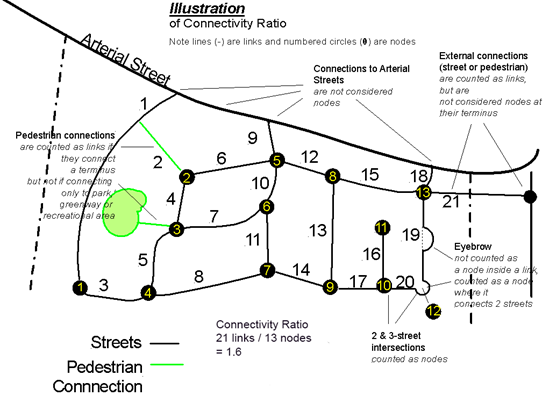
Figure 5.5-1 Connectivity Ratio
5.5.5. Sidewalks, bikeways and pedestrian access.
(1)
Standard Requirements.
(a)
Sidewalks shall be required along any street upon which a lot abuts, regardless of whether such lot faces, abuts on the side, or backs up to such street, or is separated from such street by an alley. Sidewalks shall not be required along freeways and freeway frontage, or along any street abutting residential lots in zoning categories RE and other residential districts requiring lots larger than the minimum requirements of RE.
(b)
Sidewalks shall be constructed by the owner along all collector and arterial thoroughfares, and along all perimeter streets abutting the subdivision, regardless of whether such collector, arterial, or perimeter thoroughfare abuts a lot, alley, or other space. Sidewalks shall be constructed along all collector and arterial thoroughfares and perimeter streets prior to the issuance of a certificate of acceptance for the subdivision by the City.
(c)
Sidewalks shall be constructed in accordance with the Design Criteria and Construction Standards.
(2)
Residential Subdivisions.
(a)
The developer shall construct all sidewalks along the street right-of-way adjacent to parks, open space, amenity centers, drainage ways, and other public or semi-public land. The developer shall also construct all required curb ramps. The developer is not responsible, however, for constructing a sidewalk along the frontage, as herein defined, of any residential lot except for model home lots.
(b)
The owner of a lot is responsible for the construction of all sidewalks along the frontage, as herein defined, of such residential lot, including where such lot fronts on a collector thoroughfare, and along that portion of the lot that sides or rears to a street other than a collector or arterial. Provided, however, that such sidewalk is not required on a lot until completion of building construction. Upon completion of building construction, sidewalks shall be provided in accordance with the provisions contained herein. Authorization for occupancy shall not be granted until this requirement has been met.
(c)
Exemptions. A residential lot that is platted as a single lot of record is exempt from this requirement unless:
i.
Sidewalks are existing on one side of the lot; or
ii.
The lot is located within 1,500 feet of a public or private school and is on the same side of the street.
(d)
In order to facilitate or improve pedestrian safety and accessibility, the council may require additional pedestrian access points from the streets to schools, parks, playgrounds, or other nearby streets, perpetual unobstructed mutual access easements at least 10 feet in width. Walkway widths shall be as determined by the City Council but may not be less than five feet wide. Easements shall be indicated on the plat.
(3)
Non-Residential and Multifamily.
(a)
All commercial, mixed use, and industrial development shall provide a network of on-site pedestrian walkways with a minimum width of six feet to and between the following areas:
i.
Entrances to each commercial building on the site, including pad site buildings;
ii.
Between buildings in developments with multiple buildings; and
iii.
Public sidewalks or walkways on adjacent properties that extend to the boundaries shared with the subject development.
(b)
On-site pedestrian walkways and crosswalks shall be identified to motorists and pedestrians using one or more of the following methods:
i.
Changing paving material, patterns, or paving color, but not including the painting of the paving material;
ii.
Changing paving height;
iii.
Decorative bollards;
iv.
Raised median walkways with landscaped buffers; or
v.
Stamped or stained concrete.
(c)
Pedestrian circulation routes shall include special design features at intersections and periodically along the route that establish them as areas where pedestrians are physically separated from the flow of vehicular traffic and/or are protected from the weather. Techniques and design features shall include at least one shade feature and one or more of the following:
i.
Pedestrian light features;
ii.
Bollards;
iii.
Seat walls or benches;
iv.
Wayfinding signs; and
v.
Water fountains.
(4)
Bikeways. Hike and bike sidewalks (bikeways) shall be constructed along streets designated for hike and bike trails in the Comprehensive Plan or in other additional locations selected by the owner. Design of bikeways and shared use paths shall be in accordance with the Design Criteria and Construction Standards and other applicable standards.
(5)
Responsibility for construction and repair; repair program of defective sidewalks, bikeways, and pedestrian access.
(a)
All sidewalks in the city shall be constructed, reconstructed, and kept in good repair by the owners of property fronting upon the sidewalks, at their sole expense. If any portion of a sidewalk is defective and does not meet the city's standards, the city may require that the owner of the sidewalk or owner of property adjacent to the sidewalk repair or replace the non-complying portion to bring it into conformity with city standards.
(b)
Any defective sidewalk or portions thereof shall be reconstructed or replaced:
i.
Where any vertical displacement of the adjoining sidewalk section exceeds two inches;
ii.
Where any lateral separation of adjoining sidewalk exceeds two and one-half inches;
iii.
Where the surface condition of the sidewalk has deteriorated, cracked, settled, chipped, and/or is spalling, so as to create or constitute a hazard or unsafe condition to the public; or
iv.
Where the transverse slope of the sidewalk exceeds eight percent or in which the combination of transverse or longitudinal slope is insufficient for adequate drainage of the sidewalk. Inadequate drainage would include the ponding of more than one-half inch of water in an area that results in the sidewalk being non-traversable or said ponding continues for a prolonged period of time (typically three (3) consecutive days in which no rain events occur) after the end of a rain event.
(c)
Repair program.
i.
If the city determines that a sidewalk is defective and does not conform to city standards, the administrator shall notify the property owner of the duty to repair or replace and that such owner has 60 days from the date of notice to complete such repair or replacement. The city may alter the time limit upon good cause shown by the owner. Notice shall be made by certified mail, return receipt requested, to the address of the known owner of the property on the records of the current city tax roll or hand-delivered to the owner of the property.
ii.
The city may include in the notice to a property owner, homeowner's association, or commercial property owner that owns, controls, or maintains a sidewalk, as an alternative, an agreement whereby the city will make the repairs and the property owner, homeowner's association, or commercial property owner will pay to the city the city's costs to make such repairs. The amount to be paid by the property owner, homeowner's association, or commercial property owner shall be fifty (50%) percent of the total cost of the city's cost to perform the needed repairs, and payment shall be made by the property owner, homeowner's association, or commercial property owner prior to the city beginning any work to make the needed repairs.
iii.
Any agreement authorized by this section may be executed only once in a five (5) year period, with said five (5) year period commencing on the execution date of an agreement. An agreement shall run with the property, including to its assigns, heirs, successors, parties, or subsequent purchasers. Notwithstanding the following, the city reserves the right to enter into an agreement under this section prior to the expiration of the five (5) year period where the Administrator determines in his sole discretion the existence of nonconforming, extraordinary circumstances that, if left unrepaired, would likely jeopardize the public health, safety, and welfare.
(d)
Civil liability of abutting property owners for injuries upon sidewalks.
i.
In the event the abutting property owner fails to comply with the terms of this article or otherwise permits a sidewalk to become hazardous or in a state of disrepair, the owner or occupant shall be liable for resulting damages or injuries. Any civil liability for injuries caused by the condition of the sidewalk or the failure to comply with this article shall be imposed solely upon the owner or occupant of the property and not upon the city.
ii.
The city shall not be held as assuming any such liability by reason of inspection or notice to the abutting property owner as authorized herein or by reason of the approval or disapproval of any access, facilities, surfacing, or appurtenances not made in accordance with the city's applicable design standards and specifications.
(e)
Repair by city; costs to be assessed against abutting property. If any person fails to comply with the provisions of this section within the time specified, the city may, in its discretion, but assumes no duty to, enter upon such property and do or cause to be done the work necessary to repair or replace the sidewalk to meet minimum city standards and assess the abutting property owner for the improvement as provided by this article.
(f)
Cleaning up sidewalks, driveway approaches, and alleys when construction completed. After the sidewalks, driveway approaches, streets, alleys, or curbs are completed in a subdivision, any debris, construction materials such as rock, dirt, and all unsightly and non-original debris of any nature will be removed from the sidewalk, driveway approach, street, alley, or curb, as necessary, by the developer, contractor, owner, occupier of the premises, or source of such materials. This includes, but is not limited to, the sweeping and removal of dirt and debris from all sidewalks, driveway approaches, alleys, streets, and curbs.
(g)
Reconstruction or repair of defects specifically caused. If the defect in the sidewalk, driveway approach, street, alley, or curb has been caused by actions of a developer, contractor, owner, or occupier of the premises, such developer, contractor, owner, or occupier shall be and hereby is required to reconstruct or repair the defect at his own cost. The developer, contractor, owner, or occupier failing to make such reconstruction or repair shall be deemed guilty of a misdemeanor.
(Ord. No. O-2023-003, § 3(Exh. A), 1-3-2023)
Sec. 36-5.6 - Drainage
The design and construction of the storm drainage system to serve new developments and redevelopments shall be in conformance with the City's Design Criteria and Construction Standards and the applicable Stormwater Management and Flood Control ordinances. The following exceptions will apply for the period of time set forth herein:
(1)
Subdivision phases for which a preliminary plat has been approved prior to the effective date of this ordinance and for which a final plat application is filed within the time specified in Article II of this Ordinance;
(2)
Developments for which construction plans have been submitted in compliance with the construction plan requirements of Article II of this Ordinance prior to the effective date of this Ordinance and for which construction is underway within one year from the effective date of this Ordinance.
(3)
Buildings for which a complete detailed site plan has been approved prior to the effective date of this Ordinance and for which construction is underway within one year from the effective date of this Ordinance.
(4)
Buildings for which a plat has been approved and recorded prior to the effective date of this Ordinance and for which construction is underway within one year from the effective date of this Ordinance.
(5)
Subdivisions recorded with a final plat prior to the effective date of this Ordinance for which a replat for administrative changes is filed.
5.6.1. Drainage and stormwater management policies.
(1)
Easements. Easements are required for all drainage systems that convey stormwater runoff across a development and must include sufficient area for operation and maintenance of the drainage system. The easements may be public or private, as determined by the Administrator. Public easements will be maintained by the City and private easements will be maintained by the owner or through an owner's association. The City shall have the right, but no obligation, to maintain private easements to protect the public. Types of easements to be used include:
(a)
Drainage Easements are required for both on-site and off-site public or private storm drains and for improved channels designed according to the City's Design Criteria and Construction Standards.
(b)
Floodplain Easements shall be provided on-site along areas that are in a designated flood zone on the effective FEMA FIRM maps. No construction shall be allowed within a floodplain easement without an approved floodplain development permit.
(c)
Temporary drainage easements are required off-site for temporary channels when future off-site development is anticipated to be enclosed underground or follows an altered alignment. Temporary drainage easements will not be maintained by the City and will not terminate until permanent drainage improvements meeting City standards are installed and accepted. Temporary drainage easements will require written approval from the Administrator.
(d)
Drainage and utility easements can be combined for underground storm drains and channels, subject to adequate easement width as approved by the Administrator.
(e)
Drainage easements shall include adequate width for access and maintenance beyond the top of bank for improved channels.
(f)
Improved channels shall have drainage easements dedicated to meet the requirements of the width of the channel, the one-foot freeboard, any perimeter fencing, and any underground tie-backs or anchors.
(g)
Easements for detention ponds and permanent stormwater control devices shall be provided in a form approved by the City Attorney.
(h)
The entire reach or each section of any drainage facility must be readily accessible to maintenance equipment. Additional easement(s) shall be required at the access point(s) and the access points shall be appropriately designed to restrict access by the public (including motorcycles).
(2)
Stormwater Quality. Designs for new development shall manage stormwater in a manner that protects water quality by addressing the development's potential to cause erosion, pollution, siltation, and sedimentation in the MS4 and natural Major Creeks. The goal is to maintain after development, to the maximum extent practicable, the predevelopment characteristics in the Major Creek, which ultimately receives stormwater runoff from the development. It is the developer's responsibility to ensure that designs for new development meet the stormwater management requirements in the General Permit for Stormwater Discharges from Construction Activities issued by the TCEQ and its successor agencies. This permit includes the requirement for measures that will be installed during construction to control pollutants in stormwater discharges after construction operations have been completed.
(3)
Stormwater Runoff. Stormwater runoff shall be calculated anticipating a fully developed watershed. The Comprehensive Plan, existing land use map, and zoning map shall be used to determine fully developed conditions. The Administrator reserves the right to review the determination of fully developed conditions and may require revisions.
(4)
Minimum Finish Floor Elevations. The minimum finished floor elevation for structures adjacent to a FEMA floodplain shall be two (2) feet above the effective FEMA base flood elevation.
(5)
Off-site Drainage.
(a)
When any proposed development requires off-site grading where stormwater runoff has been collected or concentrated, it shall not be permitted to drain onto adjacent property except in existing major creeks, channels, storm sewers or streets unless a drainage easement is provided in a form approved by the City Attorney.
(b)
In the event the developer cannot obtain a drainage easement, the developer shall provide the City with documentation of all efforts, including evidence of a reasonable offer made to the affected property owner and a written request for assistance. The City may, but is not obligated to, pursue acquisition of these easements through negotiations. If the negotiations are unsuccessful, the request may, at the developer's option, be submitted to City Council for consideration of acquisition through eminent domain. Any expenses, including attorney's fees, incurred by the City to acquire or attempt to acquire an easement shall be paid by the developer.
5.6.2. Construction and maintenance plan.
(1)
A Construction and Maintenance Plan shall be prepared by an Engineer licensed in the State of Texas and shall be submitted as a part of an application for a Preliminary Plat, and with the Final Plat application if no Preliminary Plat was required. The plan shall comply with the most current version of the city's Design Criteria and Construction Standards.
(2)
The plan shall be submitted with the submittal of a preliminary plat, replat, or minor plat for review and acceptance. The plan shall be labeled as "Preliminary." Upon acceptance of the plan, the plan shall be signed, sealed, and dated by the engineer, or shall contain a statement showing the engineer's name and license number and affirming the plan was prepared under the direction of the engineer.
5.6.3. Preliminary drainage plan.
(1)
This plan shall show the watershed affecting the development and how the runoff from the fully-developed watershed will be conveyed to, through, and from the development. It must comply with the standards outlined in this Ordinance and in the City's Design Criteria and Construction Standards. The preliminary drainage plan is a guide for the detailed drainage design. The review of the preliminary drainage plan does not constitute final drainage plan approval or authorize a waiver to this Ordinance.
(2)
For any property involved in the development process, a preliminary drainage plan shall be provided, at the developer's expense, for the area proposed for development. For property with a previously accepted preliminary drainage plan, the accepted preliminary drainage plan may be submitted and enforced unless a revised preliminary drainage plan is required by the City due to lot reconfiguration or other conditions created by the new plat. The City Engineer may waive the requirement for a preliminary drainage plan if the submitted plat is not anticipated to cause any significant change in runoff characteristics from a previously accepted drainage study or for single residential properties where no drainage problems are anticipated. If the applicant requests a waiver in writing, a copy of any previous drainage plan shall be provided.
(3)
The preliminary drainage plan shall be submitted with the submittal of a preliminary plat, replat, or minor plat for review and acceptance. The plan shall be labeled as "Preliminary." The plan shall be stamped by and dated by the engineer.
5.6.4. Floodplain development requirements.
(1)
All development proposed adjacent to or within the 100-year floodplain shall be in accordance with the City's Design Criteria and Construction Standards and this Ordinance.
5.6.5. Major creeks.
(1)
The 2020 Drainage Master Plan identifies the creeks classified as Major Creeks in the City. Major Creeks identified by the 2020 Drainage Master Plan include Camp Creek, Crenshaw Lake, Parker Creek, Tar Branch, Pond Branch, Pond Creek, Hackberry Creek, and Brushy Creek.
(2)
100-Year Floodplain Restrictions. For the health, safety and welfare of the City's residents and for the conservation of water, storm drainage and sanitary sewer facilities, the City prohibits development of any portion of a property that lies within the fully-developed 100-year floodplain of any Major Creek. Major Creeks shall be protected from destruction or damage resulting from clearing, grading, and dumping of earth, waste, or other foreign materials. Clearing, grading, excavation, or filling of any area within the fully-developed 100-year floodplain or within any Major Creek shall be prohibited unless authorized in writing by the City.
(3)
Major Creek Restrictions. All Major Creeks shall be protected and maintained in accordance with this Ordinance.
(4)
Access. Access to Major Creeks shall be dedicated for maintenance purposes. Proper access will require a twenty-five-foot (25') rear or side yard setback for adjacent lots not separated by a street. If site conditions warrant, an additional ten-foot (10') paved or other drivable surface between the adjacent lot line and the 100-year floodplain buffer may be required.
(5)
Retaining Wall(s). Retaining walls may be permitted on lots adjacent to a drainage easement in a residential area in order to reduce the easement width. Retaining walls adjacent to the channel are allowed in non-residential areas only if the property owner provides an agreement for private maintenance. All retaining walls, regardless of height or location, must be designed and the construction plans sealed by a professional engineer licensed in Texas.
(6)
Adjacent Street(s) Widths. The size of streets adjacent to a Major Creek shall have a minimum right-of-way width of fifty feet (50').
(7)
Adjacent Street(s) Types:
(a)
Parallel Streets. A minimum 60% of the linear frontage of the Major Creek shall be adjacent to a parallel street.
(b)
Cul-de-sac Streets. Cul-de-sacs, if allowed, shall comply with the following criteria:
i.
A minimum 50% of an adjacent cul-de-sac bulb shall be open to the Major Creek and no residential lot shall encroach within the area between this line and the Major Creek.
ii.
An entry monument(s) or feature(s) as well as landscaping shall be provided at the end of the cul-de-sac and a minimum 10-foot pathway located within a public pedestrian access easement shall be provided as access to the Major Creek.
(8)
Setbacks. Any side or rear lot line adjacent to a Major Creek shall provide a twenty-five-foot (25') building setback.
(9)
Fences. Fences adjacent to a Major Creek shall comply with the following criteria:
(a)
Have a height of six (6) feet to eight (8) feet as measured from grade at that location;
(b)
The lot owner is responsible for the maintenance of the fence.
(10)
Exceptions for Planned Development. For properties which have an approved Concept Plan that is part of a Planned Development Ordinance adopted prior to the effective date of this Ordinance, this Section shall not apply; provided, however, said properties are subject to the following conditions:
(a)
Any lot that backs to the 100-year floodplain shall have a minimum rear yard setback of twenty-five feet (25');
(b)
Any lot that sides to the 100-year floodplain shall have a minimum side yard setback of fifteen feet (15');
(c)
Alternating cul-de-sacs and looped streets shall be provided at intervals not to exceed one thousand two hundred feet (1,200') for access to the 100-year floodplain; and
(d)
The 100-year floodplain shall be available to public access from the end of a cul-de-sac.
(11)
Additional Studies. At the request of the City, the property owner shall submit additional studies, including but not limited to the following, as deemed appropriate and necessary by the City, as part of the Preliminary Plat submittal requirements. These studies shall be considered during review and approval of the Preliminary Plat.
(a)
Wetland Delineation Study;
(b)
Habitat Study;
(c)
Vegetative Study;
(d)
Erosion Hazard Setback Study;
(e)
Storm Drainage Study;
(f)
Riparian (i.e., Tributary) Study;
(g)
Flood Study; and
(h)
Downstream Assessment Study.
(Ord. No. O-2023-003, § 3(Exh. A), 1-3-2023)
Sec. 36-5.7 - Water and sanitary sewer standards
The design and construction of the water and wastewater system to serve the development shall be in conformance with the City's master plans for water and wastewater facilities, and with the Design Criteria and Construction Manual, and shall be subject to approval by the Administrator prior to approval of the Construction Plans and the Final Plat.
5.7.1. Basic policy.
(1)
Construction Requirements.
(a)
All public water and wastewater mains shall be located in the frontage of the property along streets, or in easements adjacent to the development in order to provide service to adjacent property.
(b)
Public water and/or wastewater mains shall not be located within a private street, drive or access easement unless a public utility easement is provided.
(c)
The minimum easement width for water or wastewater mains shall be fifteen (15) feet, or larger if depth of the main requires additional width. Where it is necessary for water and wastewater facilities to be located within the same easement, the easement shall be a minimum of twenty (20) feet in width.
(d)
No portion of a structure (including, but not limited to, walls, foundations, porches/patios and porch/patio covers, canopies, roof extensions/overhangs, chimneys, fire flues, etc.) shall encroach over or into any easement, except that wall-attached window awnings, "bay" style windows, and roof eaves shall be allowed to encroach into an easement a maximum of twenty-four inches (24").
(e)
A water or wastewater easement between two lots must fall entirely on a single lot.
(f)
Easements shall be dedicated for exclusive use for water and wastewater facilities and shall be shown on the Final Plat for the specific purpose intended. When it is necessary for additional utilities to be placed within an easement, additional width shall be provided and the easement shall be labeled for its intended purpose on the Final Plat.
(g)
When it is necessary to relocate or replace an existing water or sewer facility to accommodate a proposed subdivision, the developer is responsible for all costs associated with the relocation.
(2)
Construction Plans. Plans for construction of all water and wastewater facilities required by these regulations shall be prepared in accordance with the requirements and specifications contained in the Design Criteria and Construction Manual, the regulations of the Texas Commission on Environmental Quality (TCEQ), National Sanitation Foundation (NSF), Texas Department of Insurance, Insurance Services Office, and the City's current adopted Fire Code, which are incorporated by reference and made a part hereof. Plans for the improvements must be prepared by an engineer licensed in the State of Texas.
(3)
Acquisition of Easements. The developer shall be responsible for the acquisition of all required off-site easements. If the developer is unable to acquire the necessary off-site easement, the City shall be provided with easement or right-of way survey documents and exhibits, documentation, including evidence of a reasonable offer made to the affected property owner. Upon receiving a written request for assistance, the City may, at its option, acquire these easements either through negotiations or through condemnation in appropriate situations. The developer shall reimburse the City for the costs of acquiring the necessary easements including, but not limited to, attorney fees, expert fees, and title searches.
5.7.2. Preliminary utility plan.
(1)
Concurrent with the submission of a preliminary plat, replat, or minor plat, the developer shall submit a map or plan showing the location and size of water and wastewater mains, which will be required to provide adequate service and fire protection to the lots specified in the proposed plat. Plans and specifications for fire hydrant systems shall be submitted to the Fire Marshal for review prior to construction.
(2)
Plan Document. The plan shall be prepared in accordance with the City's Design Criteria and Construction Manual.
(3)
Coordination with other Utility Providers.
(a)
Preliminary Plat. When the subdivision is located in an area served by a utility provider other than the City, the developer must provide a water system analysis.
(b)
Minor Plat and Replat. When a subdivision is located in an area served by a utility provider other than the City, the developer must provide a letter from the utility provider stating that facilities exist in the area to provide adequate domestic service and fire protection. If the City has reason to believe that there may be water supply or pressure concerns, a water system analysis may be required.
(c)
Final Plat. The final plat will not be filed with the County until a letter has been provided from the utility provider stating that it has accepted the plans for construction.
5.7.3. Preliminary paving plan.
(1)
If a preliminary plat, replat or minor plat are not being submitted concurrently with a development plan or site plan, the developer shall submit a map or plan showing the location of all proposed paving, including streets, alleys, or parking, which will provide adequate service and fire protection to the lots specified in the proposed plat. The preliminary paving plan shall indicate pavement widths, horizontal curve data, intersection radii, and proposed pavement sections.
5.7.4. Miscellaneous requirements.
(1)
No building shall be constructed over an existing wastewater main, lateral, water main, or storm drain unless approved by the City Council.
(2)
Ownership and maintenance of water and wastewater mains and service connections shall be regulated as follows:
(a)
The title to all wastewater lines constructed, including wastewater service connections located in a right-of-way or dedicated easement, shall be vested in the City or the applicable utility provider.
(b)
The developer, or single customer, shall be responsible for all maintenance of the wastewater service connection, unless replacement of the service is required under the roadway or pavement. When replacement is determined to be necessary by the City, the City shall assume the responsibility for replacement of that portion under the pavement.
(c)
The title to all water mains and water meters constructed, and installed, including the title to service connections, shall be vested in the City or the applicable utility provider.
(3)
The City makes no guarantee that water supply or wastewater capacity will be available to accommodate new development.
(4)
Water or wastewater service lines shall not cross any adjacent lot. The public main shall be extended so as not to require the service to extend across another lot. Water and wastewater service lines shall be maintained by the property owner.
(5)
Public water and wastewater mains adjacent to federal, state, or county roadways shall be constructed outside the right-of-way in a separate easement unless otherwise agreed by those agencies and the City. Regional water and wastewater mains constructed and owned by federal, state, county, or any entity other than the City shall be constructed outside the City's right-of-way in a separate easement unless otherwise agreed by those agencies and the City.
5.7.5. Water. A Plat shall not be approved unless all of the proposed lots are connected to a public water system which is capable of providing adequate water for health and emergency purposes.
(1)
All lots shall be provided service connections from a looped water main providing water flow from two (2) directions or sources.
(2)
Water service shall be sufficient to meet the fire flow requirements of the proposed development, except where a suitable alternative means of fire protection is approved by the Director of Public Safety.
(3)
The City may require the phasing of development and/or improvements to the water system to ensure adequate fire protection.
(a)
Design and Construction.
i.
Installation of Water Facilities. Where water is to be provided through the City system, the property owner shall install adequate water facilities, including fire hydrants, in accordance with the City's Design Criteria and Construction Manual, the adopted Fire Code, the current Rules and Regulations for Public Water Systems of the Texas Commission of Environmental Quality (TCEQ), and the firefighting standards of the Texas Board of Insurance. If any such requirements conflict, the most stringent requirement shall apply.
ii.
Facilities for Health and Safety Emergencies; Alternative Water Sources. All water facilities connected to the City's water system shall be capable of providing water for health and emergency purposes, including fire protection and suppression. Water supply facilities shall be in accordance with the Design Criteria and Construction Manual. The design and construction of water system improvements and alternative water sources shall also comply with the following standards:
a.
Design and construction of a water source on the site shall be in accordance with applicable regulations of the Texas Commission of Environmental Quality (TCEQ).
b.
Design and construction of water service from the City shall be in accordance with the standards in the City's Design Criteria and Construction Manual.
c.
Design and construction of a fire protection and suppression system shall be in accordance with the standards in the Design Criteria and Construction Manual, and in accordance with the City's Department of Public Safety (DPS) and adopted Fire Code.
(b)
Location.
i.
Shown on Construction Plans. The location and design of all fire hydrants, all water supply improvements, and the boundary lines of special districts, private systems, and certified water service areas, indicating all improvements proposed to be served, shall be shown on the Construction Plans.
ii.
Extension of Lines. Extension of water lines shall be made along the entire frontage of the development adjacent to a street. If the subdivision is not adjacent to a street, the extension of water lines shall be accomplished in such a manner as to allow convenient future connections to said lines by new subdivisions as determined by the City Engineer.
iii.
Waiver for Requirement. If new subdivisions will never be constructed beyond a developing subdivision due to physical constraints a Minor Waiver may be approved for this requirement in accordance with Article II of this Ordinance prior to action on the Construction Plans or prior to action on any Plat.
(c)
Cost of Installation. The cost of installing all water supply improvements to be made by the developer, including off-site improvements, shall be included in the performance guarantees and Development Agreement, if applicable.
(d)
Cost of Extension. Where the City's water distribution system is not planned to be extended in time to serve a proposed new development, all necessary water facilities to serve such development shall be provided by and at the expense of the developer. If oversizing of a water facility is deemed necessary by the City Engineer for future developments, then the City may participate in such oversizing costs as part of a Development Agreement.
(e)
Alternative Water Systems. Developments may be approved with alternative water facilities according to the following criteria:
i.
Water well operation and quality shall meet the minimum requirements of the Texas Commission on Environmental Quality, Rockwall County, City health ordinances, and all other regulatory agencies, if applicable.
ii.
Water wells may not be used for commercial sale of water.
iii.
The cost to tie onto the public water system must exceed the certified initial capital cost of a well by twenty-five percent (25%). All costs and engineering designs shall be submitted by a licensed professional engineer. All costs and engineering designs shall be subject to approval by the Administrator. If a residence is located within one thousand feet (1,000') of a domestic water supply, that residence must connect to that service.
iv.
The water pressure and quality are adequate to meet all requirements of this Ordinance to meet public safety needs.
(f)
Individual Wells.
i.
Within the City's Extraterritorial Jurisdiction (ETJ). Individual wells within the City's ETJ shall be subject to approval by the applicable County health official, and this approval shall be documented by the health official's signature on the water system statement on the Preliminary and Final Plat. The property owner must submit with the Preliminary and Final Plat applications a certificate from a professional engineer who is registered, or a geoscientist who is licensed, to practice in the State of Texas verifying the adequacy of the proposed well water supply and potability prior to Preliminary Plat and Construction Plans approvals.
ii.
Compliance with Other Regulations. Installation, operations and maintenance of individual wells shall comply with City standards, regulations of the Texas Commission on Environmental Quality (TCEQ), and any other applicable County or State rules and regulations. In the event of conflict among these regulations, whichever is the most stringent shall apply.
5.7.6. Wastewater. A plat will not be approved unless all of the proposed lots are served by an approved means of wastewater collection and treatment.
(1)
The projected wastewater discharge of a proposed development shall not exceed the proposed capacity of the wastewater system.
(2)
The City may require the phasing of development and/or improvements to the sanitary sewer system so as to maintain adequate wastewater capacity.
(a)
Extension of and Connection to the City's Wastewater Collection System. Extension of, and connection to, the City's sanitary sewer system shall be required for all new developments within the City's limits. Extension of, and connection to, the municipal sewer system shall also be required for new developments within the City's ETJ for any proposed development, lot, tract or parcel that is less than one and one-half (1.5) acre in size. The City is not in any way obligated to allow extension of municipal sewers outside the City's limits. The required extension of, and connection to, the municipal sewer system may be waived as a Minor Waiver if it is determined that such extension would require unreasonable expenditures and that an on-site wastewater disposal system will function properly and safely.
(3)
Design and Construction. It is the policy of the City to require all wastewater collection lines to have gravity flow. The use of lift stations and force mains is prohibited unless a gravity design is impractical, as determined by the City Engineer. The location, design and sizing of all wastewater improvements shall be shown on the Construction Plans and are subject to approval by the City Engineer.
(4)
Cost of Installation. The cost of installing all wastewater improvements to be made by the developer, including off-site improvements, shall be included in the performance guarantees and Development Agreement, if applicable.
(5)
Extension.
(a)
Cost. Where the City's wastewater system is not planned to be extended in time to serve a proposed new development, all necessary wastewater facilities to serve such development shall be provided by and at the expense of the developer. If oversizing of a wastewater facility is deemed necessary by the City Engineer for future developments, then the City may participate in such oversizing costs as part of a Development Agreement.
(b)
Future Extensions. Pipe stub-outs shall be located in manholes to facilitate the future extension of wastewater lines. The City Engineer will determine the location and size of the stub-outs.
(Ord. No. O-2023-003, § 3(Exh. A), 1-3-2023)
Sec. 36-5.8 - Private infrastructure
5.8.1. Basic policy. All private infrastructure shall be designed and constructed in accordance with this Ordinance and the Design Criteria and Construction Manual.
5.8.2. Private streets.
(1)
Private streets within the City and/or the ETJ may be allowed in accordance with this Ordinance. Private streets within the City's ETJ require City Council action and approval. Private streets shall be designed and constructed to the City's standards for public streets, in accordance with the Design Criteria and Construction Manual.
(2)
City Council Action Required. Dedicated streets and rights-of-way shall not be designated or used as private streets and such use is prohibited, except where specific approval is given by action of the City Council for properties within the City's extraterritorial jurisdiction and upon approval of a Specific Use Permit for properties within the City limits. The City Council may add any conditions as deemed appropriate as part of the approval of a private street development.
(3)
Waiver of services. The subdivision final plat and the property owners' association documents shall reflect that the streets are private and certain City services shall not be provided on private streets. Among the services that will not be provided are routine police patrol, enforcement of traffic and parking ordinances, and preparation of accident reports.
(4)
Conversion of Private Streets to Public. The City may, but is in no way obligated to, accept private streets for public access and maintenance. Requests to convert private streets to public streets shall be subject to the following provisions:
a.
The homeowners' association (HOA) shall submit a petition signed by at least sixty-seven percent (67%) of its members/lot owners (or a greater number of signatures, if required by the HOA documents or Declaration).
b.
All of the infrastructure shall be in a condition that is acceptable to the City.
c.
All security stations and other structures not consistent with a public street development shall be removed by the HOA, at its cost, prior to acceptance of the streets and appurtenances by the City.
d.
All monies in the reserve fund for private street maintenance shall be delivered to the City.
e.
The HOA shall prepare and submit a Replat to Planning and Development Services for review. Upon approval, the City shall file the Replat to dedicate, in fee simple, the streets and appurtenances to the City.
f.
The HOA shall modify and re-file, at its cost, the HOA documents to remove requirements specific to private street developments. The City Attorney shall review the modified HOA documents prior to their filing. The HOA shall be responsible for the cost of review by the City Attorney.
(5)
HOA Requirements. Private street developments and the related HOA shall meet all requirements of Article VI of this Ordinance.
5.8.3. Franchise utility policy.
(1)
The City may require easements for poles, wires, conduits, gas, telephone, cable TV or other utility lines if necessary.
(2)
From and after the effective date of the Ordinance from which this chapter is derived, all subdivision and development plats, site plans and construction plans filed and submitted to the City for approval shall provide for utility services such as electrical, gas, telephone, and cable TV utility (lateral and/or service distribution) lines and wires including, but not limited to, street lighting, to be placed underground. Existing feeder and other major transmission lines that could not practically be placed underground, as determined by the City, may remain overhead. However, an owner shall endeavor, and whenever practical the City may require, that feeder lines are placed away from traffic arteries (Thoroughfare Types A6D, A4D, C4U, and C3U) and/or be placed underground. Overhead feeder lines shall not be placed along both sides of the street rights-of-way. The owner shall be responsible for obtaining verification from the utility companies for easement locations and widths prior to the final approval of construction plans by the City. Any changes during construction shall be approved by the utility companies and the City.
(3)
Where existing overhead service or lateral/distribution utilities lines are located within the land proposed for development and the lines must be relocated to accommodate the development, the owner is responsible for relocation and placement of the lines underground.
(4)
All new service lines shall be placed underground.
(5)
In special or unique circumstances or to avoid severe non-financial hardships, the City Council may authorize exceptions from this requirement and permit the construction and maintenance of overhead electric utility lateral or service lines and of overhead telephone or cable TV lines and may approve any plat or site plan with such approved exceptions.
(6)
Where electrical service is to be placed underground, all other utilities, including circuits for street and site lighting, except street lighting fixtures, shall be placed underground.
(7)
All ground-mounted equipment shall not be placed in visibility, access or maintenance easements.
a.
All ground-mounted equipment within view of a public street right-of-way shall be screened from the adjacent street by minimum five (5) gallon evergreen shrubs, or larger, on three-foot (3') centers on the side facing the right-of-way, as well as along both sides of the equipment such that it will be fully screened from view from the street.
b.
Planting materials selected shall be materials that will grow at least to the height of the equipment height and will provide a continuous and solid/opaque living screen, within two (2) growing seasons from the date planted. The screen planting shall consist of plant species that are freeze-hardy, low maintenance, well-adapted to the north central Texas area, and drought-tolerant such that they are self-sustaining with minimal irrigation and care.
c.
The proposed planting shall be included on the Landscape Plan as required by this Ordinance.
d.
Installation, irrigation, and maintenance of the screening of electrical pad transformers and switching equipment shall be the responsibility and at the cost of the owner.
e.
Public-owned ground-mounted equipment (such as City traffic controller boxes, etc.) shall be exempt from the screening requirements in this Section.
(8)
Each of the utility companies shall be responsible for developing administrative policies and cost reimbursement procedures for the installation and extension of its underground utilities. Each utility company shall have the right to charge or recover costs associated with installing underground utilities in accordance with the respective utility's tariff for service and/or line extension policy. No utility company shall be required to begin construction of underground facilities unless and until the owner of the subdivision has made arrangements with the respective utility company for payment in accordance with that respective utility's tariff for service and/or line extension policy governing utility installations and its cost.
(9)
Temporary construction service may be provided by overhead electric lines and facilities without obtaining a variance or exception, provided that when the underground utility service to any portion of a subdivision is completed, such overhead electric lines, and facilities are removed within 30 calendar days.
(10)
Utility easements may be located as follows:
a.
Utilities shall be located in easements provided adjacent to the street rights-of-way along the front or side of lots or tracts.
b.
The standard franchise utility easement width shall be 10 feet.
c.
Any damage made to the City's infrastructure during installation or work on utilities shall be repaired by the utility company at their cost.
5.8.4. Impact studies. The City may require that a developer prepare a comprehensive Traffic Impact Analysis (TIA), flood or drainage study or downstream assessment, or other facilities impact study(ies) in order to assist the City in determining whether a proposed private development will be supported with adequate levels of public facilities and services concurrent with the demand for the facilities created by the development. The study(ies) shall identify, at a minimum:
(1)
The adequacy and capacities of existing facilities;
(2)
The nature and extent of any current deficiencies;
(3)
The public improvements that will be needed to meet adequate levels of service assuming development at the intensity proposed in the application; and
(4)
The study(ies) shall be subject to approval by the City prior to approval of the Preliminary Plat and the Construction Plans. The City also may require, at the time of approval of a subsequent application (e.g., Final Plat), an update of a facilities impact study(ies) approved in connection with a prior application (e.g., Preliminary Plat).
5.8.5. Impact fees. All fees due on the private infrastructure shall be paid in accordance with the City's Impact Fee Ordinance and/or Development Agreement.
(Ord. No. O-2023-003, § 3(Exh. A), 1-3-2023)
Sec. 36-5.9 - Lighting
5.9.1. Purpose. This section protects public health and general welfare by:
(1)
Improving sleep by reducing light and acoustical pollution,
(2)
Establishing Dark Sky-inspired principles,
(3)
Locating residential areas at a safe distance from major sound and light polluters or limits hours and levels of illumination to allow for a period of darker skies between midnight and sunrise, and
(4)
Discouraging commercial uses that have intrusive levels of lighting from locating adjacent to residential land uses.
5.9.2. Applicability. This section applies to:
(1)
Outdoor Lighting. This section applies to outdoor lighting in the R-4, NC, GC, INV, IND, MU, MUT, NT, OTC, PP, and INS districts. For purposes of this section, "outdoor lighting" means temporary or permanent lighting that is installed, located, or used to cause light rays to shine outdoors.
(2)
Construction. This section applies to outdoor lighting installed on or affixed to any construction project for which a building permit is required.
(3)
Exemption. This section does not apply to:
a.
Lighting required by federal or state laws or regulations.
b.
Lighting required for the safe take-off and landing of aircrafts.
c.
Lighting needed during activities of law enforcement, fire, and other emergency services.
d.
Lighting employed during emergency repairs of roads and utilities may be unshielded provided the lights are positioned so they do not shine in the eyes of passing drivers.
e.
Lighting required for the safe operation of aircraft.
f.
Temporary lighting required to save life or property from imminent peril if the lights are positioned so they do not shine in the eyes of passing drivers.
g.
Temporary lighting for theatrical, television, performance areas, events, or construction areas if the lights are positioned so they do not shine in the eyes of passing drivers and the source of the illumination is shielded from any other property. This temporary lighting must not allow any light to be projected or reflect above the structures or trees on the property.
5.9.3. Generally. All outdoor lighting shall comply with this section, applicable electrical codes, energy codes, and building codes.
5.9.4. Lighting Fixtures.
(1)
Light fixtures in excess of 60 watts or one 100 lumens shall use full cutoff fixtures to prevent glare and spillover from the project site onto adjacent properties and roadways.
(2)
Except as permitted in Subsection (3) below, light fixtures shall be no more than 15 feet high whether mounted on poles or walls or by other means. Within the I-30 Corridor (the area within the City limits located within 400 feet of the centerline of Interstate 30), the maximum light fixture height may be 20 feet.
(3)
Light fixtures in parking lots containing more than 50 spaces shall be no more than:
a.
20 feet high if located within 100 feet of the boundary of an RE, R-1, R-2, R-3, R-4, or MH district, or
b.
25 feet high if located 100 feet or more from the boundary of an RE, R-1, R-2, R-3, R-4, or MH district.
(4)
Wherever possible, illumination of seating areas, building entrances, and walkways shall be accomplished by use of bollard-style fixtures or other low, ground-mounted fixtures not over four feet in height.
5.9.5. Light Intensity
(1)
Lights within 100 feet of a residential property line shall be reduced to no more than 0.05 footcandle of light after normal business hours.
(2)
Lighting from a property subject to this section shall not create greater than 0.05 footcandle of spillover light at the property line of any RE, R-1, R-2, R-3, R-4, or MH district.
5.9.6. Photometric Plan. Any building or development submitted for a site plan or building permit shall contain information on the type of lighting and illumination levels proposed (photometric plan) that includes the following:
(1)
Photometric calculations detailing all exterior security lighting drawn on twenty-four (24) inch by thirty six (36) inch format prepared to scale. Point to point photometric calculations calculated at intervals of not more than ten (10) feet at ground level and may also be required at six (6) feet above finish grade; and
(2)
A light fixture schedule; and
(3)
A copy of all cut sheets for light fixtures marked as to which information and data applies to the specific luminaire, including the lamp manufacturer; and
(4)
Photometric calculations based on the "mean" light output per the manufacturers of the specified lamp, including ballast depreciation and contamination factors. Light Loss Factor (LLF) shall be calculated at .68 for Metal Halide (MH) and .72 for High Pressure Sodium (HPS). All luminary photometric data formatted in accordance with the Illumination Engineering Society (I.E.S.) file compiled by an approved testing laboratory.
(Ord. No. O-2023-003, § 3(Exh. A), 1-3-2023; Ord. No. O-2024-030, § 20, 7-1-2024)

