
Fate City Zoning Code
ARTICLE IX
- LANDSCAPE, SCREENING, AND TREE PRESERVATION
Sec. 36-9.1 - Purpose and applicability
9.1.1. Purpose. The standards of this section are intended to enhance the quality of development through the provision of appropriate landscaping. The landscape regulations serve to safeguard and enhance property values while protecting public and private investment. The regulations encourage the preservation of the existing natural environment to aid in the stabilization of the environment's ecological balance whenever possible, and require property owners to provide landscape amenities, setbacks, and screening that promote a positive image and pride for new development in the City. In addition to new vegetation, a critical component of these regulations is the preservation of existing vegetation and trees that serve to clean the air, provide shade, reduce the amount of soil runoff due to erosion, beautify the environment, and preserve existing natural habitat. It is also the intent of this section to provide flexible requirements that encourage and allow for creativity in landscape design. The results of this effort will be to attract and maintain quality businesses and residential neighborhoods in the City of Fate.
9.1.2. Applicability.
1)
This section establishes minimum standards for landscaping for all new development and redevelopment in the City of Fate as follows:
(a)
All single-family residential development in subdivisions established after the adoption of this Ordinance shall meet the standards in Section 9.2.3, Residential Landscaping.
(b)
All multifamily and non-residential development shall meet the standards in Section 9.2.4, Non-Residential and Multifamily Landscaping.
(c)
All streets within the Mixed-Use, Mixed-Use Transition, and Neighborhood Transition zones shall meet the standards in Section 9.2.3, Residential Landscaping.
2)
All surface parking lots with 10 or more off-street parking spaces shall meet the standards in Section 9.2.4 on parking lot landscaping. Landscaping and screening requirements in other sections or parcel-specific development approvals include:
(a)
Any use that is required to provide landscaping or screening pursuant to Section 4.2, Additional Use Standards, shall comply with such requirements. In the event of a conflict between the additional use standards and the requirements of this section, the higher quality standards shall control.
(b)
Any use that is required to provide landscaping or screening pursuant to a parcel-specific ordinance, including PD zoning and/or approval conditions, shall comply with such requirements. In the event of a conflict between the parcel-specific zoning ordinance and/or conditions and the requirements of this section, the parcel-specific standards shall control.
3)
Landscaping Plan:
(a)
Prior to the issuance of a building or construction permit for any use other than single-family or duplex dwellings, a landscape plan reflecting all landscaping and screening required under this section shall be submitted to and approved by the City. The landscaping plan may be combined with any site plan, grading plan, or other development plan required for compliance with other sections of this Ordinance.
(b)
Landscaping plans for all non-residential and multifamily sites shall be prepared and scaled by a registered landscape architect and shall contain, at a minimum, the following information:
i.
Minimum scale of one-inch equals 50 feet or appropriate scale for legibility;
ii.
North arrow;
iii.
Date of preparation of the Landscaping Plan;
iv.
Location, size, quantity, and species of all trees to be preserved;
v.
Location, size, quantity, and species of all plant and landscaping and landscaping feature material to be used including plants, paving, benches, screens, fountains, statues, or other landscape features including proposed topography of site using 1' contours;
vi.
Spacing of all plant and landscaping and landscaping feature material to be used;
vii.
Irrigation Plan prepared by a licensed irrigator in the State of Texas.
a.
Layout and description of irrigation, sprinkler or water systems including placement of water sources and including freeze/rain sensors on sprinkled systems;
b.
Size and location of all existing and proposed utilities, including easements and duct banks, if any.
viii.
Planting and/or other details or cross-sections as required for clarification by the Administrator; and
ix.
Description of maintenance provisions for the landscape plan.
4)
Texas Local Government Code: The provisions of the V.T.C.A., Local Government Code § 211.016, regulating the timing of the placement of landscaping for single-family residential lots, shall be applicable to the requirements of this section.
(Ord. No. O-2023-003, § 3(Exh. A), 1-3-2023)
Sec. 36-9.2 - Landscaping requirements
9.2.1. General Requirements.
(1)
All required landscaped areas shall generally be covered with living plant material. Mulch and other similar materials can be used around required shrub and tree plantings. Supplemental plantings, hardscape, or other design elements may be considered on a case-by-case basis. Landscape plans must meet the minimum requirements of this Ordinance prior to approval by the Administrator. Other plant materials in excess of the quantities required in this Ordinance may be smaller than the required material.
(2)
Tree and plant materials shall be selected for energy efficiency and water efficiency; adaptability and relationship to the native environment; color, form and pattern; ability to provide shade; soil retention; and resistance to fire. The overall landscape plan shall be integrated with all elements of the project, such as buildings, parking lots, and streets, to achieve both an attractive environment and a desirable micro-climate and minimize energy demand.
(3)
Trees and plants installed to satisfy the requirements of this section shall meet or exceed the plant quality and species standards of the North Central Texas SmartScape program. The City's current Approved Planting List (Section 9.2.2) identifies appropriate plant species for use in Fate.
(4)
Plants shall be nursery-grown and adapted to the local area. Sod shall be clean and reasonably free of weeds and noxious pests and insects. No artificial turf, plants or vegetation shall be used to meet any standards of this section.
(5)
New or proposed plant materials will be measured and sized according to the Texas Association of Nursery (TAN) standards.
(6)
The landscaping for every development shall consist of a combination of three or more of the following types of planting materials including, but not limited to, grass, trees, shrubs, ground cover, and/or other forms of plant material.
(a)
Trees:
i.
Canopy trees shall have an average spread of crown of greater than fifteen feet (15') at maturity.
ii.
Trees shall be of a minimum of four inches (4") in caliper as measured twelve inches (12") above natural soil level and six feet (6') in height at time of planting.
iii.
Canopy trees shall be placed a minimum of three feet (3') from sidewalks, utility lines, screening walls and/or other structures. Ornamental trees can be placed closer than three feet (3') with approval from the Administrator. Any reduction in spacing requires a root barrier approved by the City. Utility installation that includes common trench and conduit banks is exempt from the canopy tree planting distance requirements, but the same quantity of landscaping shall be clustered in other locations.
iv.
Evergreen trees such as conifers intended for screening will have a minimum height of six feet (6') at the time of planting. Evergreen shrubs intended for required screening shall be a minimum of seven gallons (7 gal.) and be capable of attaining six feet (6') in height in two growing seasons.
v.
Ornamental trees may be substituted for canopy trees at the rate of three ornamental trees for each canopy tree with approval by the Administrator. Ornamental trees will have a minimum size of three-inch (3") caliper at the time of planting. This substitution shall not be allowed for required street trees.
vi.
Tree Preservation Credits:
a.
Existing trees that are to remain in a living and growing condition may be used to satisfy the tree planting requirements with the approval of the Administrator. The Administrator shall consider the location, type and size of trees, their health, and the degree of protection received both during and after construction. Any credits for existing trees shall be indicated on the landscaping plan.
b.
Credit for existing trees may be revoked if such trees die within two years of the initial certificate of occupancy and/or are damaged due to, among other things, construction, broken branches, soil compaction or soil cut/fill.
c.
If existing trees are preserved, the minimum distance between parking spaces and the saved existing tree may need to be expanded, subject to approval by the Administrator.
(b)
Shrubs and Vines:
i.
Shrubs other than dwarf variety shall be a minimum of two feet (2') in height when measured immediately after planting. A screening hedge, where required, shall be planted and maintained so as to form a continuous, unbroken, solid visual screen that will be three feet (3') in height and two feet (2') in width at the time of planting.
ii.
All shrubs intended for public, non-residential, or multifamily developments shall be at least two gallons (2 gal.) or more.
iii.
Vines shall be a minimum of two feet in height immediately after planting and may be used in conjunction with fences, screens, or walls to meet screening requirements as specified.
(c)
Ground Cover:
i.
Grass shall be block sodded, including in swales, berms, or other areas subject to erosion as determined by the Administrator. Seed, plugs and sprigs shall not be used.
ii.
Ground covers used in lieu of grass in whole and/or in part shall be planted in such a manner as to present a finished appearance and adequate coverage within one year of planting. Ground cover planting must provide and maintain adequate coverage as approved by the City.
(7)
Berms: Earthen berms shall not exceed a 3:1 slope (three feet (3') of horizontal distance for each one foot (1') of height). All berms shall contain adequate drainage and preventive erosion measures as may be required by the Administrator. Berms will not include construction debris. Slippage or damage to the smooth finish grade of the berm must be corrected prior to any Certificate of Occupancy or acceptance of improvements.
(8)
Sight Triangles: Rigid compliance with these landscaping requirements shall not be such as to cause visibility obstructions and/or blind corners at driveway and street intersections. Whenever a street or driveway intersects a public right-of-way, a triangular visibility area, as described in the adopted Design Criteria and Construction Standards, shall be created.
(9)
Shade Priority: All planting materials shall be selected for optimal shade production.
(a)
Trees for shade shall be provided for residential, commercial, and industrial buildings, parking lots and open space areas. These trees can be canopy or ornamental trees and are to be incorporated to provide natural cooling opportunities for the purpose of energy and water conservation.
(b)
Plants shall be placed in a manner considerate of solar orientation to maximize summer shade and winter solar gain.
(c)
All mature shade trees shall be kept trimmed to a minimum branching height of ten (10) feet, except when greater height clearances are required to eliminate any health or safety hazards.
(d)
Trees selected to provide shade in parking lots shall have the following characteristics:
i.
Moderate to fast growth rate;
ii.
Broad spreading crown;
iii.
Relatively clean and free of pests;
iv.
Deep rooting (no surface roots).
(e)
Trees planted for shade in parking areas shall be maintained to promote full canopy development to provide maximum shading. Pruning to reduce canopy coverage for any purposes other than tree health, or hazard reduction, shall be strictly prohibited.
(f)
A minimum of 50 percent of any sidewalk or pedestrian way should be shaded through the use of plant materials.
i.
Shade calculations shall be based on the summer solstice at 12:00 p.m.
(g)
In addition to the foregoing general requirements, the following special provisions shall apply to shade trees located in the commercial districts.
i.
A minimum sidewalk opening of four (4) square feet shall be required for each shade tree. The opening shall be paved with a flush, smooth, hard surface such as brick or concrete pavers laid on sand.
ii.
Only the canopy and ornamental trees with a "*" next to its name may be planted in the right-of-way. The planting of any other type of planting shall require permission from the Administrator.
iii.
Whenever a shade tree is removed in a commercial district, the shade tree shall be replaced in accordance with this ordinance. All removed shade trees shall be replaced in kind except when a change in street construction or land development makes it impossible or would cause the replacement to be a safety or health hazard. A decision not to replace a removed shade tree must be approved by the Administrator.
9.2.2. Approved Plant List.
(1)
Approved Plant List for Landscape Requirements. Trees shall be selected from the following Approved Plant List. Materials not on the list may be approved by the Administrator if it is determined that they are equally suitable for local soil conditions and climate and would provide the same level of visual benefits. Required landscaping shall not include artificial plants, trees, or other artificial vegetation.
| Table 9.2-1 Approved Plant List Elements | ||
|---|---|---|
| Xeriscape Option |  | Xeriscaping is the practice of landscaping or gardening that minimizes or completely does away with the requirement for watering. |
| Native Option |  | When planted in locations that meet their growth needs, native plants from the region have the most positive environmental effects. |
| Drought Resistant |  | The plant may endure a brief drought after its first establishing phase (up to two years). |
| Table 9.2-2 Approved Plant List | ||
|---|---|---|
| Common Name | Botanical Name | Note |
| Canopy Trees: An "*" indicates an approved street tree | ||
| Ash, Texas | Fraxinus texensis |  |
| Cedar Elm* | Ulmus crassifolia | |
| Cedar, Eastern Red | Juniperus virginiana | |
| Cypress, Bald | Taxodium distichum | |
| Elm, Lace Bark* | Ulmus parvifolia | |
| Magnolia, Southern | Magnolia grandiflora | |
| Maple, Bigtooth | Acer gradidentatum | |
| Maple, Caddo | Acer saccharum | |
| Oak, Bur | Quercus macrocarpa | |
| Oak, Chinquapin | Quercus muhlenbergil | |
| Oak, Escarpment Live | Quercus fusiformis | |
| Oak, Lacey | Quercus glaucoides | |
| Oak, Live | Quercus virginiana (Escarpment) | |
| Oak, Post | Quercus stellata | |
| Oak, Red | Quercus shumardi | |
| Oak, Texas Red | Quercus texana | |
| Osage Orange | Madura pomifers (thornless and fruitless) | |
| Pecan (native) | Carya illinoinensis | |
| Pistache, Chinese* | Pistacia chinenis | |
| Soapberry, Western | Sapindus drummondii | |
| Walnut, Black | Juglans nigra | |
| Ornamental Trees: An "*" indicates an approved street tree | ||
| Buckeye, Mexican | Ungnadia speciosa | |
| Buckeye, Texas | Aesculus glabra var. arguta | |
| Buckthorn, Carolina | Rhamnus caroliniana | |
| Chaste Tree* | Vitex agnus-castus | |
| Crabapple, Prairie | Pyrus ioensis | |
| Crape Myrtle* | Largerstroemia indica | |
| Eves Necklace | Sophora affinis | |
| Goldenball Leadtree | Leucaena rietusa | |
| Hawthorne* | Crataegus phaenopyrum | |
| Hawthorne* | Cratoegus crus-galli | |
| Hawthorne* | Cratoegus reverchonii | |
| Holly, Possumhaw | Ilex deciduas | |
| Indigo, False | Amorpha fruticosa var. angustipolic | |
| Mountain Laurel, Texas | Sophora secundiflora | |
| Persimmon, Texas | Diospyros texana | |
| Plum, Mexican | Prunus mexicana | |
| Redbud, Texas | Cercis canadensis var. texensis | |
| Smoketree | Cotinus obovatus | |
| Smoketree* | Cotinus caggyria | |
| Sumac, Prairie Flame-leaf | Rhus lanceolata | |
| Viburnum, Rusty Blackhaw | Viburum rufidulum | |
| Wax Myrtle | Myrica cerifera | |
| Willow, Desert | Chilopsis linearis |  |
| Yaupon Holly | Ilex vomitoria | |
| Shrubs | ||
| Agarita | Berberis trifoliolata | |
| Agave, Havard | Agave havardiana | |
| Agave, Neomexicana | Agave parryi var. neomexicana | |
| Agave, Parry's | Agave parryi var. parryi | |
| Althea | Hibiscus syriacus | |
| American Beautyberry | Callicarpa americana | |
| Aspidistra | Aspidistra eliator | |
| Barberry, Red | Berberis thunbergii | |
| Barberry, Texas | Berberis thunbergii | |
| Bayberry | Myrica pensylvanica | |
| Bird of Paradise | Caesalpinia gilliesii | |
| Burning Bush | Euonymus alata compacta | |
| Butterfly Bush | Buddleia sp. | |
| Cactus, Prickly Pear | Opuntia phaceacantha | |
| Cenizo | Leucophyllum frutescens | |
| Chokeberry, Red | Aronia arbutifolia | |
| Coralberry | Symphoricarpos obiculatus | |
| Dogwood, Rough Leaf | Comus drummondii | |
| Elaeagnus | Elaeanus macrophylla | |
| Flame Acanthus | Anisacanthus quadrifidus var. wrightii | |
| Forsythia | Forsythia sp. | |
| Germander, Upright | Teucrium chamaedrys | |
| Holly, Dazzler | Ilex cornuta "Dazzler" | |
| Holly, Dwarf yaupon | Ilex vomitoria | |
| Holly, "Nellie R. Stevens" | Ilex x "Nellie R. Stevens" | |
| Honeysuckle, Bush | Lonicera fragrantissima | |
| Hydrangea, Oakleaf | Hydrangea quercifolia | |
| Hypericum, Upright | Hypericum patulum | |
| Jasmine, Italian | Jasmine nudiflorum | |
| Lantana, Texas | Lantana urticoides (l. horrida) | |
| Mahonia, Leatherleaf | Mahonia bealeii | |
| Mimosa, Fragrant | Mimosa borealis | |
| Nandina, Compact | Nandina domestica compacta | |
| Nandina, Gulfstream | N.d. "Gulfstream" | |
| Nandina, Standard | N. domestica | |
| Rock Rose | Pavonia lasiopetala | |
| Photinia, Chinese | Photinia serrulata | |
| Privet, Southern River | Ligustrum vulgare | |
| Privet, Variegated | Ligustrum luicidum "variegata" | |
| Quince, Flowering | Chaenomeles japonica | |
| Sage, Cherry | Salvia greggii | |
| Sage, Texas | Leucophyllum frutescens | |
| Spiraea, Bridal Wreath | Spiraea sp. | |
| Spiraea, Anthony Waterer | Spiraea x bumalda "goldflame" | |
| Spiraea, Goldflame | Spiraea x bumalda "goldflame" | |
| Spiraea, Little Princess | Spiraea x bumalda "Little Princess" | |
| Spiraea, Shirobana | Spiraea japonica "Shirobana" | |
| Sumac, Aromatic | Rhus aromatica | |
| Sumac, Evergreen | Rhus virens | |
| Sumac, Smooth | Rhus glabra | |
| Turk's Cap | Malvaviscus drummondii | |
| Viburnum, Cranberry Bush | Viburnum opulus | |
| Viburnum, Small Leaf | Viburnum obavatum | |
| Viburnum, Snowball | Viburnum opulus | |
| Virginia Sweetspire | Itea virginica | |
| Wax Myrtle, Dwarf | Myrica pusilla | |
| Yucca, Arkansas | Yucca arkansana | |
| Groundcovers: | ||
| Avens, White | Geum canadense | |
| Frog Fruit | Phyla nodiflora | |
| Horseherb | Calyptocarpus vialis | |
| Pigeonberry | Rivina humilis | |
| Snake Herb | Dyschoriste linearis | |
| Wood Violet | Viola missouriensis | |
| Wooly Stemodia | Stemodia lanata | |
| Grasses: | ||
| Bermuda 419 Tifway | Cynodon dactylon | Good for golf and sports fields |
| Blue Gamma | Bouteloua gracilis | |
| Buffalo Grass | Bouteloua dactyloides | |
| Texas Bluegrass Sod | Poa arachnifera | |
| Zoysia Emerald | Zoysia japonica x Zoysia matrella. Cultivar | |
| Zoysia Palisades | Zoysia japonica Steud. x Zoysia matrella (L.) | |
9.2.3. Residential Landscaping.
(1)
Front Yard Landscaping:
(a)
Landscaping should be selected and placed in the front yards of residences to soften the effect of the built environment and create attractive streetscapes. An arrangement of vegetation such as trees, shrubs, and grass, together with other suitable materials such as flowering plants, ground cover, mulch, etc., arranged in a complementary fashion, is desired.
(b)
All residential lots shall have vegetation established per the requirements of this section prior to final inspection.
(c)
Canopy Trees:
(i)
Trees selected from the City's current Approved Planting List shall be planted on all single-family residential lots based on the zoning district as specified in Table 9.2-3.
(ii)
Canopy trees shall be a minimum of four inches in caliper as measured twelve inches above natural soil level and seven feet in height at time of installation.
(iii)
Fifty percent of the required canopy trees or at least one canopy tree shall be placed in the front yard. Trees shall be appropriately spaced for their ultimate size and species.
(d)
Front yard vegetation: In addition to the canopy tree requirement, all residential lots shall provide the following front yard landscaping:
(i)
Percentage Vegetative Cover: The following percentages of the front yard shall be landscaped with vegetative cover (as defined in this Article) other than turf grass. For the purposes of this requirement, front yard means the area between the house and the front property line.
a.
Single-family detached: at least 15 percent of the front yard with vegetative cover.
b.
Duplex or townhouse: at least 30 percent of the front yard with vegetative cover.
(e)
Design and Planting Standards:
(i)
Each ornamental tree shall count for 20 square feet of the required vegetative cover in the landscaped area.
(ii)
The use of native vegetation, drought-tolerant plants, or rain gardens is encouraged.
(iii)
On corner lots the front yard landscaping area shall wrap around the side for a minimum of 20 feet along the side street for single-family detached lots, and 10 feet in single-family attached or townhome developments.
(2)
Residential Streetscape Standards:
(a)
The intent of this requirement is to provide appealing and comfortable pedestrian street environments to promote pedestrian activity that, in turn, promotes public health through increased physical activity. An attractive streetscape is a significant community asset, and often helps maintain neighborhood values. Homes designed in relation to the streetscape become part of the neighborhood rather than a solitary residence.
(b)
Requirements: Streets shall be designed to include the following:
(i)
A landscaped buffer at least six feet wide shall be provided between the sidewalk and the back of the curb. The landscaped buffer area shall be designed as follows:
a.
Street trees shall be located within the buffer area and provided at the quantity and spacing of an average of one canopy tree per every 40 linear feet. Trees shall not be clustered and shall generally be evenly spaced.
b.
Trees shall be centered at a minimum distance of three feet from the back of the curb.
c.
Trees shall be selected from the list of species approved in the City's current Approved Planting List (Section 9.2.2). No single species of tree shall represent more than 30 percent of the trees required to satisfy the street tree requirement.
d.
Trees shall be planted based on the standards for planting in this Section.
e.
Street lamp posts and mailboxes shall be located in this buffer area, subject to post office regulations for mailboxes.
f.
Street trees shall not be located closer than 15 feet to a lamppost.
(ii)
Sidewalk Zone: A continuous sidewalk at least five feet in width shall be provided on both sides of the street at least six feet distant from and generally parallel to the back of the curb. Meandering sidewalks may be approved by the Administrator to preserve trees and create a more informal streetscape.
(iii)
Walkways: Separate walkways that connect the front doorway or porch to the sidewalk and to the driveway are recommended. These walkways shall be at least four feet wide.
(3)
Subdivision Perimeter Landscaping: Refer to Screening and Buffering Requirements in Section 9.3 - Screening, buffering and fences.
9.2.4. Non-Residential and Multifamily Landscaping.
(1)
Parking Lot Landscaping: Any non-residential surface parking area that contains ten (10) or more parking spaces shall provide interior landscaping, in addition to the required landscaped street buffer, as follows:
(a)
Fifteen (15) square feet of landscaping for each parking space shall be provided within the paved boundaries of the parking lot area.
(b)
Where an existing parking lot area is altered resulting in a parking lot of ten (10) spaces or more, interior landscaping shall be provided on the new portion of the parking lot in accordance with this Ordinance.
(c)
All surface parking lots shall incorporate the required landscaping in landscape median islands as follows:
(i)
One landscape median between two rows of head-in parking shall be required for every four rows of head-in parking. Each landscape median shall be not less than 8 feet in width and the parking spaces adjacent to the landscape median shall have wheel stops located not less than 2 feet from the landscape area.
(ii)
Landscape islands shall be installed at the terminus of each row of parking.
(iii)
Landscape islands shall not be separated by more than twelve (12) parking spaces. Where there is a landscaped median between two rows of head-in parking, landscaped islands shall be provided every fifteen (15) spaces.
(iv)
Landscape Island Design:
a.
Landscape islands shall contain at least one canopy tree (minimum 3" caliper) and at least 50 percent vegetative cover other than turf grass. Other materials may be approved by the Administrator.
b.
Landscaped islands shall be a minimum of one hundred (100) square feet, not less than eight feet (8') wide and a length equal to the abutting parking space.
c.
All landscaped areas shall be protected by a raised concrete curb. The Administrator may approve a curbless design for stormwater BMP or Low Impact Design (LID) purposes.
d.
No paving shall be permitted within three feet of the center of a tree.
(2)
Protected Trees: in order to preserve a protected tree on-site, the Administrator may authorize up to a ten percent reduction in the required number of parking spaces, through the Minor Waiver process, if the Administrator determines that reduction in the number or size of certain parking spaces will preserve a protected tree that would otherwise be removed to provide for required parking. Protected trees shall be designated in accordance with Section 9.6 of this Article.
(3)
Parking Lot Screening:
(a)
All parking, maneuvering, customer loading areas, vehicular display and storage areas that are not screened by on-site buildings shall be screened from view of public streets pursuant to the standards of this section.
(b)
Parking lot screen shall be a minimum of three (3) feet in height and two (2) feet wide at the time of planting and within a landscape buffer that is based on the roadway frontage specified in Table 9.2-4. A landscape buffer shall not be required when the building is located at the edge of, or within ten feet of the sidewalk.
(c)
Parking lot screening materials may be either:
(i)
The same building material as the principal structure on the lot, or
(ii)
A vegetative screen composed of shrubs planted to be opaque at maturity, or
(iii)
A combination of the two.
(d)
If a vegetative screen is selected, the shrub species shall be selected from the City's current Approved Planting List.
(e)
Parking lot screens shall not block any required sight triangles along a cross street or driveway.
(f)
Parking lot screens may include breaks to provide pedestrian access from any surface parking or service area to the public sidewalks.
(g)
Wheel stops shall be provided for parking spaces adjacent to a landscape setback where no curb is provided to prohibit any car overhang over the planting area. Wheel stops shall be located two feet from the landscape setback.
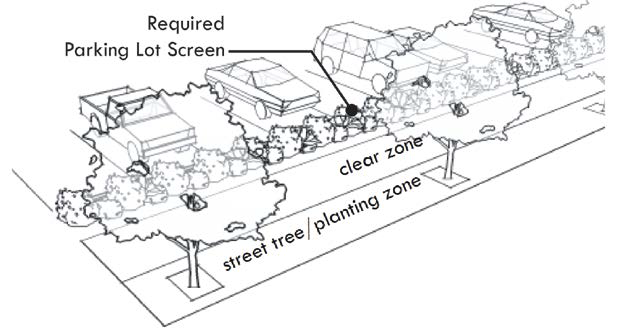
Illustration of Required Parking Lot Screening
(4)
Perimeter Landscaping Requirements:
(a)
A landscaped area consisting of living trees, turf, or other living ground cover shall be provided adjacent to and outside of the right-of-way on all properties per Table 9.2-4.
(b)
One (1) Canopy Tree, four-inch (4") caliper minimum, shall be planted on forty-foot (40') centers within the required landscape area. A minimum of fifteen (15) shrubs with a minimum size of five gallons (5 gal.) each will be planted in the landscaped area for each forty feet (40') of linear frontage. Parking abutting the landscape area shall be screened from the adjacent roadway per Section 9.2.4(3).
(c)
Where a non-residential development is adjacent to the property line of single-family zoned parcels or areas shown as single family use on the Future Land Use Plan, one (1) Canopy Tree, four-inch (4") caliper minimum, shall be planted on thirty foot (30') centers in the required landscape buffer, in addition to the required six-foot masonry fence (refer to Section 9.3, Screening, buffering and fences ). Areas where truck docks or loading spaces are adjacent to such property zoned single-family, screening devices meeting requirements in Section 9.3, Screening, buffering and fences will be required in addition to trees planted on thirty-foot (30') centers. Vegetation used for perimeter buffering may be evergreen trees and shrubs.
(d)
Where a non-residential development is adjacent to the property line of parcels zoned for uses other than residential land use categories on the Future Land Use Plan:
(ii)
Refer to Section 9.3, Screening, buffering and fences for landscape buffer requirements.
(iii)
If the property line is the centerline of a fire lane or drive aisle, the landscape buffer area will begin at the edge of the lane/aisle. If the drive aisle or fire lane only allows access to parking spaces, or if the site is part of a larger coordinated development the landscape area may be allowed to be eliminated or moved by a Minor Waiver.
(iv)
One (1) ornamental tree and one (1) five-gallon (5 gal.) shrub will be planted every fifteen linear feet (15'). At the discretion of the Administrator, these trees and shrubs may be clustered in lieu of placing them every fifteen feet (15').
(5)
Minimum Landscape Requirements for Non-Vehicular Open Space: In addition to the landscaping required for off-street parking and vehicular use areas, all remaining open spaces on any non-residential and multifamily developed lot or parcel shall conform to the following minimum requirements:
(a)
Grass, ground cover and shrubs shall be used to cover all open ground within 20 feet of any building or paving or other use such as storage.
(b)
All structures shall be treated with landscaping so as to enhance the appearance of the structure and to screen any unsightly appearance.
(c)
Landscaping shall be provided on each developed lot in accordance with the following standards:
(i)
A minimum of 15 percent of the total site area shall be devoted to feature landscaping with not less than 50 percent of the landscaping being located in the required front yard.
(ii)
Trees shall be planted in non-vehicular open space to meet the requirements in Table 9.2-5. Existing trees that are preserved on a developed site may be credited per the ratios established in Table 9.2-5 below.
(Ord. No. O-2023-003, § 3(Exh. A), 1-3-2023)
Sec. 36-9.3 - Screening, buffering and fences
9.3.1. Commercial and multifamily screening.
1.
Landscape Buffer Strip:
a.
A minimum ten-foot-wide landscape buffer-strip must be provided along the entire length of the perimeter of any commercial or industrial lot that abuts, without an alley or drive separation, or is directly across a public street from a residential zoning district, exclusive of driveways and accessways.
b.
If the proposed commercial structure exceeds 24 feet in height adjacent to an alley, a ten-foot buffer shall also be required along the length of the alley.
c.
No landscape buffer-strip will be required between any commercial lot that abuts another commercial lot or any industrial lot that abuts another industrial lot. A five-foot-wide landscape buffer strip must be provided between commercial lots and industrial lots.
2.
Screening of Service, Loading, and Storage Areas:
a.
All service areas in commercial zoning classifications shall be placed at the rear or side of the buildings and screened from:
i.
All public streets; and
ii.
Any residential district that abuts or is directly across a public street or alley from the service area.
b.
All service areas in industrial zoning classifications shall be placed at the rear or side of the buildings and screened from:
i.
Arterial streets, as indicated on the city's thoroughfare plan; and
ii.
Any residential district that abuts or is directly across a public street or alley from the service area.
c.
The screening device shall consist of an opaque architectural screen or fence (wood, tilt wall, chain link, and concrete block are prohibited) that substantially conforms to the color, detailing, and building materials of the principal structure unless otherwise approved by the Administrator. Screening shall be a minimum height of eight feet to screen truck berths; loading docks; and areas designated for permanent parking or storage of heavy vehicles, equipment, or materials shall have screening height no less than the height of the materials being stored.
d.
Screening shall be long enough to screen the maximum size trailer that can be accommodated on-site.
3.
Screening From Residential Uses:
a.
Any commercial or industrial use or parking lot that has a side or rear property line contiguous to any residential use or parking lot that has a side or rear property line contiguous to any residential use, shall be screened with a masonry fence (tilt wall and concrete block are prohibited) six feet in height. As an alternative, berms in conjunction with a minimum of a six-foot wrought iron fence and a generally equal combination of trees and shrubs can be utilized to meet the screening requirements if the Administrator determines that the proposed alternative will provide sufficient screening. The screen shall be located no closer to the street than the property line. Any ordinances concerning sight obstructions of intersections shall be applicable to the screen where it is intersected by a street or driveway.
b.
Prior to construction of any required screens, complete construction plans showing type of material, depth of beam, and structural support shall be analyzed by the Building Official to determine whether or not:
i.
The screen will withstand the pressures of time and nature;
ii.
The screen adequately accomplishes the purpose for which it is intended.
c.
Construction plans shall be designed and sealed by a licensed professional engineer and approved by the City.
d.
Such screen shall be constructed prior to the issuance of a certificate of occupancy for any building or portion thereof unless approved by the Administrator.
e.
The areas adjacent to the required screening wall, or areas adjacent to a public street or right-of-way, shall be maintained by the property owner in a clean and orderly condition, free of debris and trash in accordance with the applicable codes of the City.
9.3.2. Residential subdivision screening and buffering.
1.
Required Screening: Screening is required for all single-family detached, two-family, and townhome lots and subdivisions as follows:
a)
Back of Lots. The rear property line of all lots that back to an arterial or collector thoroughfare;
b)
Side of Lots. The side property line of all lots that side to an arterial or collector thoroughfare and the side property line of all lots that back to an arterial or collector thoroughfare and are at public entrance from arterial or collector thoroughfare; and
c)
Between Streets/Alleys. Between any street and an adjoining parallel alley.
2.
Screening Plan:
a)
Screening Plan. A Screening Plan, including entry features and showing all elevations and materials, shall be submitted with the construction plans. The Screening Plan shall be reviewed and considered for approval by the Administrator prior to approval of the construction plans, and prior to scheduling a Pre-Construction Meeting.
b)
Screening walls and fences shall be designed and sealed by a licensed professional engineer and approved by the City.
c)
Timing of Installation and Inspection. Upon installation of the required screening, the developer shall contact the Administrator to request final inspections of screening elements. All required screening shall be installed prior to City issuance of a Letter of Final Acceptance.
d)
Surety Provided for Delay. The developer may request delaying the installation of screening by providing a surety bond to guarantee the installation of required screening. Such surety shall be in an amount equal to 125% of the estimated cost as determined by a licensed landscape architect. The surety bond must be issued by a company licensed to do business in the State of Texas and shall be authorized by and subject to approval by the City Attorney. If the request to delay is approved by the Administrator, required screening shall be installed within the time specified by the Administrator but in no instance shall the time exceed six (6) months following the date of issuance of the Letter of Final Acceptance. Failure to complete the screening installation within the six months shall result in a hold on any inspections or unissued certificates of occupancy for units within the residential development.
3.
Landscape Buffer Design Standards:
a)
Landscape Plan. A Landscape Plan for landscaping that will be installed for the development, including landscaping for common and amenity areas, entryways, and thoroughfare screening, shall be submitted upon approval of the Final Plat by the Planning and Zoning Commission, and shall be approved by the Administrator prior to scheduling a Pre-Construction Meeting. The Landscape Plan and Screening Plan may be submitted under single cover.
b)
Standards. Landscape materials and installation shall be in accordance with Landscape Requirements found in this Article.
c)
Timing of Installation and Inspection. Upon installation of all landscaping, including that required for thoroughfare screening, the developer shall request a final inspection of landscaping elements by the Administrator. All required landscaping shall be installed prior to the City's issuance of a Letter of Final Acceptance, excepting model homes which may be released early.
d)
Surety Provided for Delay. The developer may request delaying the installation of landscaping by providing a surety bond to guarantee the installation of required screening. Such surety shall be in an amount equal to 125% of the estimated cost as determined by a licensed landscape architect. The surety bond must be issued by a company licensed to do business in the State of Texas and shall be authorized by and subject to approval by the City Attorney. If the request to delay is approved by the Administrator, required landscaping shall be installed within the time specified by the Administrator but in no instance shall the time exceed six (6) months following the date of issuance of the Letter of Final Acceptance. Failure to complete the landscaping installation within the six months shall result in a hold on any inspections or unissued certificates of occupancy for units within the residential development.
4.
Screening and Landscape Options: Screening required by this Section shall be installed by the developer in accordance with the approved Screening and Landscaping Plan(s), as applicable.
a)
Landscape Edge. All landscaping and screening walls provided to meet subdivision screening requirements shall be located within a private "non-buildable" lot (shown on the Preliminary and Final Plats) located between the City's right-of-way line and the nearest residential property line within the subdivision (with the exception of cul-de-sac bulbs (Option 4), where the required ornamental fence shall be located entirely upon the cul-de-sac lots abutting the adjacent street). The "non-buildable" lot shall be dedicated to, owned by, and maintained by the subdivision's Homeowners' Association (HOA). Required landscape edges shall be exclusive of all required street and right-turn rights-of-way, drainage easements, and utility easements and shall not count toward the minimum require open space.
b)
Screening Walls and Perimeter Fences. All required screening walls and fences shall be maintained by the HOA. A minimum five-foot wide Wall Maintenance Easement (WME), dedicated to the HOA, shall be provided on all lots abutting the required screening along the full length of the required screening wall or fence, unless separated by an alley. Refer to Section 9.3.3 in this Article for further information regarding perimeter fencing.
c)
Trees and Shrub Screens. All required screening trees and shrubs shall be planted within the landscape edge (except for as provided for cul-de-sac bulbs). All trees required for screening shall be of evergreen drought-tolerant species selected from the City's Approved Plant List (Section 9.2.2), and shall be subject to approval by the Administrator. Minimum tree size shall be at least four caliper inches (4"), and a single species of tree shall not exceed thirty percent (30%) of the plantings for all screening options. All trees shall be planted a minimum of four feet (4') from easements, curbs, utility lines, screening walls, fences, sidewalks and alleys, as determined by the Administrator.
i.
Solid Shrub Screens. For solid shrub screens, evergreen shrubs from the City's Approved Plant List (Section 9.2.2) shall be used that are low-maintenance, drought-tolerant, and insect- and disease-resistant. Shrubs shall be spaced such that they will provide a solid and unbroken minimum six-foot (6') tall and two-foot (2') wide screen upon planting.
d)
Cul-De-Sac Bulbs. For all cul-de-sac bulbs that abut, or "open", onto an adjacent street, the following additional screening standards shall apply:
i.
All required trees and other landscape materials shall be located within the side yards of the cul-de-sac lots abutting the adjacent street and within a landscape easement of an adequate width unless a landscape edge, dedicated to and maintained by the HOA, is provided.
ii.
Trees required for screening do not count toward the number of trees required for residential lots in this section of the Ordinance.
iii.
A minimum ten-foot (10') separation, or the required landscape edge width, whichever is greater, shall be provided between the right-of-way for the cul-de-sac and the right-of-way for the adjacent street. An unobstructed (no gate) sidewalk shall be provided to connect the sidewalk along the adjacent street to the sidewalk along the cul-de-sac within a fifteen-foot (15') public pedestrian access easement.
e)
Berms. Berms may be used in conjunction with any screening option, subject to approval by the Administrator. Berms shall be placed within the landscape edge on private property (i.e., not within public right-of-way), shall not exceed a three-to-one (3:1) slope, and shall be designed such that they do not hinder maintenance, storm drainage, accessibility or visibility. Topographic information for berms shall be shown on the Landscape Plan and on the Grading and Drainage Plans for the development.
5.
Wall Elevations and Living Screens:
a)
The minimum height of required walls and fences shall be measured from the nearest alley edge, rear lot property line (where no alley exists), or street-side sidewalk grade, whichever is higher. The maximum height of columns, including capstones, shall be nine (9) feet.
b)
If the top-of-wall elevation for a required screening wall is less than six (6) feet, as measured in accordance with this Section, a solid, irrigated living screen shall be used in combination with the screening wall to provide the necessary screening at the appropriate height from grade.
c)
An irrigated living screen consisting of large evergreen trees (a minimum height of six (6) feet at time of planting) and additional large evergreen shrubs (a minimum of seven (7) gallon and be capable of attaining six (6) feet in height in two growing seasons) that are appropriate for screening purposes (selected from the City's Approved Plant List in Section 9.2.2) shall be planted within the landscape edge where the height deficiency occurs.
d)
All plant materials used for living screens shall be insect- and disease-resistant and shall be plant species that are well freeze-hardy, low maintenance, well-adapted to the north central Texas area, and drought-tolerant such that they are self-sustaining with minimal irrigation and care.
e)
When an irrigated living screen is utilized, the Landscape Plan shall demonstrate adequate visual screening at the heights required and within required time frames.
6.
Irrigation Requirements: An automatic, underground irrigation system shall provide one hundred percent (100%) coverage for all living screens and plantings, and shall conform with the provisions in Section 9.4.
7.
Access Gate Emergency Access: All private perimeter fencing that creates a gated access shall be installed with a Knox security system or other approved access device located at one or more access gate for emergency access by the Department of Public Safety (DPS). All private perimeter fencing that creates a gated access shall be registered with the police department.
8.
HOA Responsibilities: All developments that have thoroughfare screening, entry features or common amenity areas shall be required to have a mandatory homeowners' association (HOA) to own and maintain such features. The documents creating the HOA shall be filed of record and contain the provisions set forth in Section 6.6.1.
9.3.3. Residential privacy fences.
1.
Applicability: This section applies to replacement of residential fences or construction of new fences. A fence permit is required when 25 percent or more of the length of the fence is replaced within an 18-month period.
2.
Height: Height shall not exceed eight feet as measured from the highest adjacent grade within ten feet of the fence. Maximum height of eight (8) feet includes entry gates. Fence columns may exceed eight (8) feet in height by no more than three (3) inches.
3.
Fence Posts: Fence posts for all residential fences shall be metal.
4.
Fence Foundation: Refer to Design Criteria and Construction Standards for required foundation depths, material, etc.
5.
Approved Materials:
a)
Masonry (brick, stone, reinforced cement concrete) or any other sustainable material as approved by the Building Official with more than a 30-year life expectancy;
b)
Ornamental metal rail fencing;
c)
Cedar and or redwood (chemically pre-treated or not);
d)
Composite or engineered plastic lumber fencing; and
e)
Other wooden picket fences, only if constructed with metal posts, metal brackets, and metal caps. Chemically pre-treated wooden horizontal members shall be at least 2" × 4".
6.
Prohibited Materials:
a)
Chain link (unless replacing or repairing an existing, lawfully installed chain link fence);
b)
Sheet, roll, or corrugated metal;
c)
Cast off, secondhand, or other items not originally intended to be used for constructing or maintaining a fence;
d)
Concrete block;
e)
Razor wire; and
f)
Slatted materials used to create opacity.
7.
Location of Fence: Privacy fences may be located along the property line with the following exceptions:
a)
In the interest of public safety and considering fences shall not block any sight/visibility triangles on any corner lots.
b)
For the purposes of this section, a parallel fence is a fence that runs in the same general direction of and is located within five feet of an existing fence. To be considered a parallel fence, the fence does not necessarily have to maintain a precise, constant distance from the other fence.
c)
All fences must be set back at least one foot from the right-of-way and/or open space lot line unless a stricter setback is required.
d)
Any fence that is more than two feet high shall be set back at least five feet from the side property line of a corner lot. In the case of a reverse corner lot, any fence that is more than two feet high shall be set back at least to the build-to line of the adjacent lot.
e)
Installation of parallel fences along a common property or easement line is prohibited.
8.
Orientation of Fence: When any fence or other screening device, whether required or not, is located on a lot adjacent to a public street, said fence or screening device shall orient the side with exposed posts or rails away from view from the adjacent public street.
9.
Fences in Front Yard Setback: Screening fences in front yard setbacks are prohibited and any fence shall be setback a minimum of 5' from the front facade, unless otherwise approved in district specific standards adopted by City Council. Decorative fencing not exceeding three (3) feet in height may be permitted in the front yard setback but shall be located at least one foot from the front property line. The fencing shall be constructed of any of the approved materials found in 9.3.3(5). Front yard fencing shall conform to all vision clearance standards.
10.
Fence Maintenance: Private residential fences shall be maintained in good condition, which shall be the responsibility of the property owner. Fence repairs or replacements shall use similar materials, colors, and dimensions of the original fence. Good condition shall be defined as:
a)
Any broken, loose, damaged, or missing parts greater than eight (8) inches and/or having a combined area of twenty (20) square feet or more of said fence shall be replaced or repaired.
b)
A fence that has deteriorated to a condition that is likely to fall shall be repaired, replaced, or removed.
c)
Fences shall not be externally braced in lieu of replacing or repairing posts, columns, or structural members.
9.3.4. Residential Screening of Utility Equipment. Utility equipment shall be screened from public streets. A combination of trees and shrubs shall be utilized to screen utility equipment from the adjacent residential street. Trees and shrubs shall be planted at a spacing that provides adequate screening from the street. The screen shall be located no closer to the street than the property line. Any requirements concerning sight or visibility triangles at intersections shall be applicable to the screen where it is intersected by a street or driveway.
9.3.5. Commercial Fences. Commercial fences installed for security purposes (non-residential screening shall conform to Section 9.3.1) shall meet the following regulations:
a.
Height Restrictions: A fence in a commercial or industrial zoning district may not exceed eight (8') feet in height nor be less than six (6') feet in height and meet the requirements of the Unified Development Ordinance as it currently exists or may be amended.
b.
Approved Materials:
i.
Masonry (brick, stone, reinforced cement concrete) or any other sustainable material as approved by the Building Official with more than a 30-year life expectancy;
ii.
Ornamental metal rail fencing;
iii.
Black vinyl-coated chain link on property lines other than the front property line (subject to screening requirements found in Section 9.3.1).
1.
Black vinyl-coated chain link fencing may not be placed along property lines facing public right-of-way or residential-zoned properties.
c.
Prohibited Materials:
i.
Chain link (unless replacing or repairing an existing, lawfully installed chain link fence);
ii.
Sheet, roll, or corrugated metal;
iii.
Cast off, secondhand, or other items not originally intended to be used for constructing or maintaining a fence, including wood pallets;
iv.
Concrete block;
v.
Razor wire; and
vi.
Slatted materials used to create opacity.
d.
Fences in districts zoned General Industrial (IND) may also contain the following material:
i.
Fence arms;
ii.
Barbed wire as accessory to other fencing material (may not be located within the public right-of-way);
iii.
Razor wire with special applications (may not be located within the public right-of-way).
(Ord. No. O-2023-003, § 3(Exh. A), 1-3-2023)
Sec. 36-9.4 - Irrigation standards
9.4.1. Irrigation Requirements.
(1)
The owner or any person in control of the property shall be responsible for the health and vitality of plant material through irrigation of all landscaped areas, turf, and plant materials, and shall:
(a)
Provide a moisture level in an amount and frequency adequate to sustain growth of the plant materials on a permanent basis.
(b)
Be in place and operational at the time of the landscape inspection for Certificate of Occupancy.
(c)
Be maintained and kept operational at all times to provide for efficient water distribution.
(d)
Provide and maintain rain, moisture, and freeze shut-off devices.
i.
All automatically controlled irrigation systems required to be installed by a Landscape or Irrigation Plan must include rain, moisture, and freeze shut-off devices and sensors or other technology designed to inhibit or interrupt operation of the irrigation system during periods of moisture, rainfall, or freezing temperatures. Following adoption of this ordinance, all properties where a new certificate of occupancy is requested will be required to submit a letter from a licensed irrigator that the irrigation system complies with the provisions of this ordinance and includes an operational sensor or other technology designed to inhibit or interrupt operation of the irrigation system during periods of freezing weather and moisture or rainfall. Repairs to existing automatic irrigation systems on all properties that require replacement of an existing controller must include an operational sensor or other technology designed to inhibit or interrupt operation of the irrigation system during periods of freezing weather and moisture or rainfall.
ii.
Irrigation systems adjacent to any street, sidewalk, alley, highway, or parking lot shall not operate so as to cause damage to other property, overspray onto the public right-of-way, or to interfere with the free movement of any vehicle or pedestrian.
iii.
This Subsection applies to all property within the city limits of the City of Fate.
9.4.2. Irrigation Methods.
(1)
Landscaped Areas: One of the following irrigation methods shall be used to ensure adequate watering of plant material in landscaped areas:
(a)
Conventional system. An automatic underground irrigation system which may be a conventional spray or bubbler type heads.
(b)
Drip or leaky-pipe system. An automatic underground irrigation system in conjunction with a water-saving system such as a drip or a leaky pipe system.
(c)
Temporary and above ground watering. Landscape areas utilizing xeriscape plants and installation techniques, including areas planted with native grasses and wildflowers, may use a temporary and above ground system, and shall be required to provide irrigation for the first two growing seasons only, however, the plant materials must be maintained in a healthy, living condition.
(2)
Natural Undisturbed Areas: No irrigation shall be required for undisturbed natural areas or undisturbed existing trees.
(3)
Compliance with state law: All irrigation systems shall comply with all applicable state laws, as may be amended.
(Ord. No. O-2023-003, § 3(Exh. A), 1-3-2023)
Sec. 36-9.5 - Landscape maintenance
9.5.1 Maintenance Requirements. The owner, tenant, their agent, and any person having control of the premises shall be jointly responsible for the maintenance of all required landscaping and irrigation systems. All required landscaping shall be maintained in a healthy and growing condition as is appropriate for the current season. This shall include mowing, edging, pruning, fertilizing, watering, weeding, and other such activities common to the maintenance of landscaping. Landscaped areas shall be kept free of trash, litter, weeds and other such material or plants not a part of the landscaping. Plant materials which die shall be replaced with plant material of similar variety and size of materials that died within 30 days or as approved by the Administrator. A Certificate of Occupancy may be revoked for failure to maintain required landscape materials or irrigation systems unless replaced or repaired within 30 days of written notice from the City.
(Ord. No. O-2023-003, § 3(Exh. A), 1-3-2023)
Sec. 36-9.6 - Tree preservation
9.6.1. Purpose. Tree Preservation standards help to ensure environmentally sensitive planning in the City of Fate. More specifically, the purpose of the ordinance is to:
A.
Prohibit the clear cutting of property;
B.
Protect healthy quality trees (trees listed in the City's current Approved Planting List) and promote the natural, ecological, environmental, and aesthetic qualities of the City;
C.
Facilitate design of developments to be more sensitive to the natural features of the land;
D.
Ensure that site design and construction will contribute to the long-term viability of existing trees;
E.
To control the removal of trees when necessary, and
F.
Promote the general health and welfare of the citizens of Fate.
9.6.2. Applicability. The terms and provisions of the section apply to all property as follows:
A.
All vacant and undeveloped property, and
B.
All property to be redeveloped, including additions and alterations per the Applicability Table 5.1-1 in Article V.
9.6.3. Exemptions. The following shall be exempt from the provisions of this section on Tree Preservation:
A.
Any tree that:
i.
Endangers the public health, welfare, or safety such that immediate alteration is required; or
ii.
That poses an imminent or immediate threat to persons or property.
B.
Any tree that has disrupted a public utility service due to a tornado, storm, flood, or other act of nature, provided that alteration of such a tree shall be limited to the portion of the tree reasonably necessary to reestablish and maintain reliable utility service;
C.
A tree located on the property of a licensed plant or tree nursery which has trees planted and growing on the premises for the sale or intended sale to the general public in the ordinary course of the nursery's business;
D.
Any tree, other than a street tree, located on a lot or tract shown on an application or plan for development submitted after the effective date of this ordinance in any residentially zoned district, including the RE, R-1, R-2, R-3, R-4, and lots zoned for residential only uses in the Mixed Use, Mixed Use Transition, Neighborhood Transition, Old Town Core, and PD districts, which is occupied by a person as a residence, shall be exempted from the application of this section except that any lot or tract, or portion thereof, designated as a tree preservation area, or protected area on any approved concept or development plan after the effective date of this Ordinance shall not be exempted from the provisions of this section.
9.6.4. Tree permit required. A tree permit shall be required to modify any tree unless exempted under Section 9.6.3 above.
A.
Non-development related tree permits: An application for a tree permit that is unrelated to development shall include the following information:
i.
The name, address and telephone number of those persons or entities who own the property and those persons or entities seeking the permit;
ii.
The address, existing use, and zoning of the property;
iii.
A detailed written statement stating the reasons for the requested alteration including citation to any relevant provision of this section that may authorize the alteration and including the following:
1.
The amount of land to be disturbed, if any;
2.
The method and equipment to be used; and
3.
The dates the proposed alteration would take place.
iv.
A legible diagram or map indicating the following for the area reasonably likely to be affected if the permit is issued:
1.
Location of all existing structures, improvements, streets or rights-of-way, property lines, setback and yard requirements;
2.
Location of all existing utility lines, utility service lines, and easements;
3.
The common and botanical name, size and location of all trees specifically designated by number; and
4.
Such additional information as the Administrator may reasonably require given the particular characteristics of the property.
B.
Development related tree permits: An application for a tree permit that is filed in conjunction with development shall include the following information:
i.
City approved Concept Plan or Development Plan depicting any tree conservation areas;
ii.
A tree survey clearly identifying whether each protected tree will be preserved after the proposed improvements are made, will be altered, or may be preserved based upon site specific conditions, including species and size;
iii.
Identification of critical environmental features of the site:
1.
All individually protected trees;
2.
Existing streams, drainage creeks, ponds, and other water bodies (if any).
iv.
Detailed site plan of all proposed improvements with extent and location of proposed improvements, including building pads, parking areas, driveways, streets, and utilities (including stormwater drainage facilities);
v.
A tree protection plan identifying the required tree protection measures including fencing and signage;
vi.
Clear delineation of construction related parking, storage, staging, and access areas;
vii.
Limits of clearing, grading, and trenching;
viii.
Approved grading and drainage plans;
ix.
Proposed landscaping, buffer yards, and/or replacement areas;
x.
Any conditions placed on the approved Concept or Development plan;
xi.
The names, addresses and telephone numbers of those persons or entities who own the property and those persons or entities seeking the permit; and
xii.
Such additional information as the Administrator may reasonably require given the particular characteristics of the property.
9.6.5. Standards for approval.
A.
When a complete application is filed under Section 2.4.4, the Administrator shall grant a tree permit with regard to a particular protected tree or trees if any of the following is true:
1.
The tree must be altered in order to install or maintain a required utility line or utility service line;
2.
The tree is located in a heavily wooded area and selective thinning is necessary to increase the likelihood of survival of the remaining trees, and will be carried out in accordance with standards promulgated by the American National Standards Institute for use by the International Society of Arboriculture;
3.
The tree is located on property zoned Agricultural (Ag) that is being actively used for agricultural purposes, and the granting of the permit will not result in more than seven (7) protected trees being altered on the property in any calendar year;
4.
The tree is diseased, damaged, dead or hazardous;
5.
The tree, if left unaltered, is reasonably likely to impair the structural integrity of existing structures or improvements;
6.
The tree is required to be altered by federal, state or local law, including an applicable regulation adopted by a federal, state, or local government agency;
7.
The tree must be altered to prevent significant risk of harm to the surrounding area caused by vermin infestation; or
8.
The tree must be altered to prevent a high risk of fire hazard as determined by the Fire Marshal.
B.
When a complete application is filed per Section 2.4.4, the Administrator shall grant a tree permit if all required tree protection and replacement procedures have been followed and the application conforms to the Concept Plan or Development Plan approved by the City Council. Where no Concept or Development Plan is required, the tree permit shall be granted if all required tree protection and replacement measures have been followed and the application complies with the criteria established under Section 9.6.5.A above. If a tree permit is issued for alteration of a diseased, damaged, dead or hazardous protected tree, the owner shall be exempt from the tree mitigation, tree mitigation fee and tree protection requirements for those trees covered by the permit. If such a diseased, infected or hazardous tree is not altered by the owner, the City may request permission (through formal notice and public hearing process) to alter such a tree to reduce the chance of spreading the disease or infection to nearby healthy trees or to protect the health, safety, and welfare of the general public.
C.
If the application for a tree permit seeks to alter a tree which is part of a Concept Plan or Development Plan approved by the City Council or the Administrator, the application may be deferred to the City Council. In addition, if a request for a Tree Permit does not meet any standards for approval under Section 9.6.5.A, the Administrator may defer the approval of such a tree permit to City Council.
9.6.6. Tree preservation plans. All development related-tree permits shall have a tree preservation plan as part of any approved Concept Plan or Development Plan application.
A.
Tree Preservation Plan: A Tree Preservation Plan shall be required as part of a Concept Plan, Development Plan, Site Plan, or Civil Plan set. A Tree Preservation Plan shall be a plan that illustrates the impact of all proposed development including the impact of buildings, parking areas, streets and all other infrastructure on all environmental features of the site such as protected trees, natural creeks, ponds, steep grades, and other critical resources. Information required on a Tree Preservation Plan shall include:
1.
Identification of critical environmental features of the site:
a.
All individually protected trees;
b.
Existing streams, drainage creeks, ponds, and other water bodies (if any);
c.
Stream/creek buffers, if any.
2.
Tree Survey or an alternative to a tree survey as approved by the Administrator.
3.
Two-foot contour map of the site.
4.
Protected trees within the tree preservation area including tree size and type.
5.
Critical root zones of groups of trees.
6.
Critical root zones for individual trees required for site plans only.
7.
Identification of areas of environmental constraints not suitable for development.
8.
Identification of areas of minimal environmental constraints that are suitable for development.
9.
Areas of encroachment into Critical Environmental Features identified on the site.
10.
Clear delineation, for each protected tree, of whether the tree will be preserved after the proposed development is constructed or altered due to proposed improvements or could potentially be saved based upon site specific conditions.
11.
Detailed plan of all proposed improvements.
12.
Setbacks, building lines, and buffer yards.
13.
The names, addresses and telephone numbers of those persons or entities who own the property and those persons or entities filing the application.
14.
Such additional information as the Administrator may reasonably require given the particular characteristics of the property and any approved Tree Preservation Concept Plan.
B.
Standards for Approval: A complete application per Section 2.4.4 shall be reviewed per the following standards:
The Administrator shall review all Tree Preservation Plans against the following criteria:
a.
The proposed tree removal is consistent with or within 10% of a City Council approved Concept or Development Plan;
b.
Placement of building pads, parking areas, driveways, streets, and utility easements so as to maximize the preservation of environmental features of the property including mature tree stands, natural creeks and ponds, and significant grades;
c.
Maximizes the preservation of existing tree stands with the potential to buffer residential areas from the noise, glare, and visual effects of nonresidential uses;
d.
Maximizes the preservation of existing trees, if any, adjoining a natural or man-made drainage creek;
e.
Maximizes the preservation of existing protected trees along rural roadways and other streets within areas identified for rural and estate density land use categories as established in the Future Land Use Plan; and
f.
Mitigates altered trees through proposed tree replacement procedures pursuant to this Section and Subsection 9.6.7.C.2.
C.
Deferral to City Council: If the application for a Tree Preservation Plan does not meet these standards for Administrator approval, it shall be deferred to the City Council for any reason.
9.6.7. Tree mitigation.
A.
Applicability:
1.
All protected trees identified for removal to construct the required and permitted improvements based on the approved Tree Preservation Plan are exempted from the tree replacement and protection requirements of this section. Such improvements may include building pads, required parking areas, driveways, fire lanes, streets, and required utility and drainage infrastructure that are required by City ordinances and have been approved by the appropriate boards or officers of the City.
2.
Any protected trees within the site that an approved Tree Preservation Plan determines do not have to be altered shall be subject to the tree protection requirements contained in Section 9.6.8.
B.
Exemptions: The following shall be exempt from tree mitigation standards; however, tree permit requirements shall apply per Section 9.6.4.
1.
Tree Alteration for Public Utility Projects: All protected trees that the Administrator determines must be altered in order to install utility lines within public rights-of-way (R.O.W.) or within approved utility easements, including required drainage easements, shall be exempt from the tree replacement and tree protection requirements.
2.
Selective Thinning and Removal of Underbrush: The Administrator may issue a tree permit authorizing the selective thinning of certain protected trees from a heavily wooded area under Section 9.6.5. If the Administrator issues a permit for selective thinning, the protected trees covered by the permit shall be exempt from the tree replacement and tree protection requirements.
C.
Tree Replacement Requirements When a Required Tree Permit Was Not Acquired: Unless exempt under Subsection 9.6.7.B above, the following standards for tree replacement shall apply when any person alters a tree without an approved tree permit, if one is required. This tree replacement requirement is not meant to supplant good site planning. Tree replacement will be considered only after all design alternatives which could save more existing trees have been evaluated and reasonably rejected, as determined by the Administrator.
1.
If a person alters a protected tree for which a permit is required, the person shall replace the protected tree as follows:
a.
Trees that are under 30 inches in caliper size shall have all caliper inches replaced at an inch-to-inch rate. The minimum size replacement tree shall be four (4) inch caliper.
b.
Trees that are larger than 30 inches in caliper shall have all caliper inches replaced at a rate of one and one-half (1½) inch per one (1) inch of removed tree. The minimum size replacement tree shall be four (4) inch caliper.
2.
Location: Each replacement tree shall be planted on the same lot or tract as the tree which was altered. However, if the replacement tree cannot be planted on the same lot or tract in accordance with universally accepted arboricultural standards, the Administrator may require any combination of the following:
a.
Replacement on other private property within the City of Fate, with the approval of the City of Fate, the owners of both the property on which the protected tree was altered and the property on which the replacement tree is to be planted;
b.
Replacement on public property; or
c.
Payment of a tree mitigation fee to the Reforestation Fund as provided for in Subsection 9.6.7.D below. However, a tree mitigation fee is not allowed to be charged for the removed tree if the tree is:
(i)
Located on a property that is an existing one-family or two-family dwelling that is the person's residence and is less than ten (10) inches in diameter at the point on the trunk 4.5 feet above the ground;
(ii)
Diseased or dead; or
(iii)
Poses an imminent or immediate threat to persons or property.
3.
Responsibility for Replacing Protected Tree: The Administrator will determine the time of replacement, and the location of the replacement trees and approve the contractor responsible for replacing a wrongfully altered protected tree. The requirement to replace trees shall be binding upon the person subject to such order even if such person sells, assigns, or transfers the property. In the event of such a sale, assignment or transfer of property, the person subject to such order may either obtain the consent of the current property owner to allow the replacement on such property, or may make payment to the Reforestation Fund as provided for in Subsection 9.6.7.D below.
4.
Time of Replacement: Any replacement trees required to be planted must be planted not later than ninety (90) days after the order of the Administrator, or within (30) thirty days of the date any appeal from such order becomes final, provided, however, that the Administrator may require the deferral of the planting of replacement trees up to an additional one hundred eighty (180) days based on weather and other arboreal considerations, and further provided that the Administrator may, upon request of the person subject to the requirement approve delaying the planting of replacement trees up to an additional one hundred eighty (180) days if the person subject to the order provides the City with a surety bond in an amount equal to the cost of purchasing and planting such trees or pay this amount into the Reforestation Fund within the earlier of the following: (1) within one hundred eighty (180) days of the last date approved for such delayed planting, (2) the date of issuance of the first certificate of occupancy on any portion of the subject property, or (3) other date as agreed by the City Council in an approved Tree Preservation Plan. The surety bond must be issued by a company licensed to do business in the State of Texas and shall be authorized by and approved by the City Attorney.
5.
Longevity and Duration: If a replacement tree dies within three years from the date it was planted, the person subject to the requirement to plant the replacement tree must replace the dead tree with another replacement tree within ninety (90) days of the order of the Administrator ordering such replanting. This requirement to replace trees shall be binding upon the person subject to such order even if such person sells, assigns, or transfers the property. In the event of such a sale, assignment or transfer of property, the person subject to such order may either obtain the consent of the current property owner to allow the replacement on such property or may make payment to the Reforestation Fund as provided in this Section.
D.
Reforestation Fund for Tree Mitigation Fees and Credit for Tree Planting: A person required to comply with Section 9.6.7 may request to make a payment of a tree mitigation fee to the Reforestation Fund or other specifically dedicated fund approved by the City Council for such payment in accordance with the following requirements:
1.
The amount of the payment required in lieu of each replacement tree shall be the average cost of a quality tree of similar size and type to the replacement tree which would otherwise have been required by this Section, plus the cost of planting such a tree, as determined by the City Council and provided in a fee schedule published by the City.
2.
The funds shall be used only for purchasing and planting trees on private property approved by the Administrator and the City Manager, on public property, for acquiring wooded property, including Conservation Easements which shall remain in a naturalistic state in perpetuity, or for establishing a landscape or wildlife preserve or similar nature area as approved by City Council.
3.
Credits for tree planting shall be in accordance with V.T.C.A., Local Government Code § 212.905, as amended.
4.
No tree mitigation fee may be charged unless in accordance with Subsection 9.6.7.C.2.c.
5.
The Reforestation Fund administrator shall submit periodic reports to the City Council of the deposits and disbursements from the Reforestation Fund.
9.6.8. Requirements for tree protection. All persons shall adhere to the following tree protection measures to protect trees that are to be preserved based on an approved Tree Preservation Plan during construction:
A.
Prior to grading, brush removal, or construction, the developer shall clearly tag or mark all trees to be preserved;
B.
The developer shall erect a plastic mesh fence, or other approved fencing material, a minimum of four feet in height around each tree or group of trees to prevent the placement of debris or fill within the drip line;
C.
During the construction phase of development, any cleaning, parking, or storage of equipment or materials under the canopy of any tree or group of trees being preserved shall be prohibited. The disposal of any waste material such as, but not limited to, paint, oil solvents, asphalt, concrete, mortar, etc. in the canopy area shall be prohibited;
D.
No attachments or wires of any kind, other than those of a protective nature shall be attached to any tree;
E.
No fill or excavation may occur within the drip line of a tree to be preserved unless there is a specific approved plan for use of tree wells or retaining walls. Major changes of grade (six inches or greater) will require additional measures to maintain proper oxygen and water exchange with the roots. These additional measures shall include:
i.
With grade changes, a reinforced retaining wall or tree well of a design approved by the city should be constructed around the tree no closer than half the distance between the trunk and the drip line. The retaining wall should be constructed so as to maintain the existing grades around a tree or group of trees.
ii.
At no time should a wall, pavement, or porous pavement be placed closer than five feet or one foot for every two inches in caliper, whichever is greater, to the trunk of the tree.
iii.
Root pruning when the critical root zone is to be disturbed.
F.
If a patio, sidewalk, drive, parking lot, or other paved surface must be placed within the drip line of an existing tree, material such as a porous pavement or other approved construction method that will allow the passage of water and oxygen may be required.
9.6.9. Tree preservation credits.
A.
Applicability: This section shall apply to all nonresidential and multifamily development.
B.
For every tree (eight inches in caliper or larger) preserved, the developer shall be given credit for two trees as required by this ordinance. Only trees in good condition, having been protected in accordance with the tree protection requirements, shall be considered for credit. A maximum credit of one-third of the required trees shall be allowed per site. Trees designated as mitigation trees are not subject to the tree credit and must be accounted for at 100%. Determination of credits shall be made by the City upon completion of site improvements. Field conditions may warrant submittal of a revised landscape plan to determine the number of tree credits. Review may include a field inspection of the site, and the plan may be referred to other departments for review and recommendations.
(Ord. No. O-2023-003, § 3(Exh. A), 1-3-2023)

