
Fontana City Zoning Code
ARTICLE XII
SIGN REGULATIONS
Sec. 30-718. - Purpose.
The purpose of this article is to provide a comprehensive system of reasonable, effective, consistent, content-neutral, and nondiscriminatory sign standards and requirements to:
(1)
Protect the general public health, safety, welfare, and aesthetics of the City;
(2)
Promote and accomplish the goals, policies, and measures of the general plan to encourage high-quality development throughout Fontana, reinvigorate downtown, and celebrate local historic and cultural resources;
(3)
Ensure freedom of expression for sign uses, including noncommercial speech, by maintaining a content-neutral approach and appropriately regulating the time, place, and manner under which signs may be displayed;
(4)
Preserve and improve the appearance of the City, protect the City from visual clutter and blight, and promote attractive and harmonious structures and environments by regulating the design, character, location, type, quality of materials, scale, illumination, and maintenance of signs;
(5)
Promote signs that identify businesses and premises without confusion through clear and unambiguous sign standards that enable fair and consistent enforcement;
(6)
Protect and improve the local economy and quality of life by preserving and enhancing the appearance of the streetscape; and
(7)
Allow adequate signage while meeting public safety objectives.
(Ord. No. 1868, § 9(Att. 2), 5-25-21)
Sec. 30-719. - Applicability.
(a)
Regulatory scope. The regulations of this article shall apply to all signs, as defined in Division 13 of this article, that are placed on private property, in the public right-of-way, and on property owned by public agencies other than the City and over which the City has zoning authority, unless specifically exempted in this article.
(b)
Design review sign application required. Design review sign applications shall be required for specific sign types in compliance with Division 4 of this article. In addition, the provisions of Chapter 5 of the Municipal Code relating to building and electrical codes, fees, penalties, and a method of enforcement shall also apply. Signs approved in conjunction with any other application shall be consistent with this article, unless modified by a discretionary permit. Where approval of a conditional use permit, minor use permit, design review creative sign, site plan or design review, or sign variance has been obtained, any applicable conditions of that approval may supersede the requirements of this article.
(c)
Figures and graphics. Figures, illustrations, graphics, and pictures are included in this article to help illustrate the minimum intent and requirement of the text. In the case of a conflict between the text of this article and any figure, illustration, graphic, or picture, the text shall govern.
(Ord. No. 1868, § 9(Att. 2), 5-25-21)
Sec. 30-720. - Severability.
If any part, section, subsection, paragraph, subparagraph, sentence, phrase, clause, term, or word in this article is held to be invalid, unconstitutional, or unenforceable by a court of competent jurisdiction, such decision shall not affect the validity or enforceability of the remaining portions of this article.
(Ord. No. 1868, § 9(Att. 2), 5-25-21)
Sec. 30-721. - Exemptions.
The following sign types are expressly exempted from the design review sign requirements of this article and shall not count towards cumulative allowable sign area, but must satisfy all other permit requirements, as applicable (e.g., building, electrical, plumbing, grading, encroachment, etc.).
(1)
Exempt signs without limitations. The following signs are exempt from design review sign requirements with no specific limitations, other than a prohibition on displaying general advertising signs (billboards), as defined in Division 13 of this article.
a.
Commemorative signs. Tablets and plaques installed by the City, or by a state, federal, or county recognized historical organization exempt from federal taxation under Section 501 of USC Title 26 (IRS Code) that are no larger than six square feet, or signs authorized and installed by City, county, state, or federal agencies on public owned lands.
b.
Equipment signs. Signs incorporated into allowed displays, machinery, or equipment by a manufacturer, distributor, or vendor and identifying or advertising only the product or service dispensed by the machine or equipment, such as signs customarily fixed to automated teller machines (ATMs), vending machines, and gasoline pumps.
c.
Interior graphics or signage. Signs or displays within a structure that are not visible (i.e., capable of being seen, whether or not capable of being read) by the public from any public right-of-way or publicly accessible area.
d.
Message substitution. Any permitted sign may contain, or substitute in lieu of any other message or copy, any commercial message or constitutionally protected noncommercial message, provided that the sign complies with the applicable requirements of this article. This substitution of message or copy may be made without any additional approval or permitting. This provision prevails over any more specific provision to the contrary.
e.
Non-signs. All devices that are excluded from the definition of a "sign," as set forth in Division 13 of this article.
f.
Official notices. Any non-internally illuminated (unless required by law) sign, posting, notice, or similar signs placed, installed, or required by law by the City, county, or a federal or state governmental agency in carrying out its responsibility to protect the public health, safety, and welfare, including, but not limited to, the following:
1.
Emergency and warning signs necessary for public safety or civil defense;
2.
Legal notices posted pursuant to law or court order;
3.
Traffic and parking signs erected and maintained by an authorized public agency or approved by an authorized public agency;
4.
Direction, warning, or information signs required or authorized to be displayed by law;
5.
Numerals and lettering identifying the address from the street to facilitate emergency response and compliant with City requirements; and
6.
Signs erected by a government agency.
(2)
Exempt signs with limitations. The following signs are exempt from design review sign requirements if they meet the size, height, duration, maximum number limitations, and any additional requirements set forth in Table No. 30-721.A. If the allowed duration is exceeded, as set forth in Table No. 30-721.A, exempt signs shall apply for design review sign approval.
Table No. 30-721.A.
Exempt Signs with Limitations
Exempt signs do not require design review sign approval, but may require building
permits
(Ord. No. 1868, § 9(Att. 2), 5-25-21; Ord. No. 1974, § 4(Exh. A), 9-9-25)
Sec. 30-722. - Prohibited signs.
Sign types not expressly permitted are prohibited. The following signs and sign components are prohibited except where specifically authorized.
(1)
Abandoned signs;
(2)
Animated signs;
(3)
Exposed raceways;
(4)
General advertising signs (billboards), except as provided by Division 8;
(5)
Illegal signs;
(6)
Pole signs;
(7)
Portable (A-frame) signs and projecting signs, except as permitted by Table No. 30-721.A within the downtown boundary;
(8)
Roof signs, except as permitted for roof signs on mansard roofs where, in the opinion of the Director of Community Development, no other useable sign area is available; and
(9)
Vehicle signs.
(Ord. No. 1868, § 9(Att. 2), 5-25-21)
Sec. 30-723. - Location restrictions.
Signs may not be placed in the following locations except where specifically authorized:
(1)
Signs on public property, except as required or authorized by a governmental agency, and except as permitted by Division 8 and Division 9 of this article.
(2)
Signs attached to trees.
(3)
Signs placed on any private property without the permission of the property owner.
(4)
Signs located so as to interfere with building access, including, but not limited to, points of ingress and egress from buildings and emergency exit routes, interfere with pedestrian movement within the public right-of-way, and/or block view of traffic control devices.
(Ord. No. 1868, § 9(Att. 2), 5-25-21)
Sec. 30-724. - Display restrictions.
Signs with the following display features are prohibited:
(1)
Signs containing lighting devices with intermittent, flashing, blinking, or varying intensity or light or color where the message is displayed for fewer than eight seconds (dwell time) before changing to another message, including animation or motion picture or any lighting effects creating the illusion of motion.
(2)
Signs that simulate in color or design a traffic sign or signal, or which make use of words, symbols, or characters in such a manner to interfere with, mislead, or confuse pedestrian or vehicular traffic.
(3)
Signs which emit sound, odor, or smoke.
(Ord. No. 1868, § 9(Att. 2), 5-25-21)
Sec. 30-725. - Reviewing bodies.
The following reviewing bodies shall make decisions on the design review sign applications provided for in this article. All reviewing bodies shall be responsible for the design review sign applications indicated in Table No. 30-725.A.
DCD—Director of Community Development—Approval Body
PC—Planning Commission—Approval Body
CC—City Council—Approval Body
X—Indicates the reviewing and/or the Approval Body
Table No. 30-725.A.
Responsible Reviewing Bodies
(Ord. No. 1868, § 9(Att. 2), 5-25-21; Ord. No. 1974, § 4(Exh. A), 9-9-25)
Sec. 30-726. - Application and process requirements.
(a)
Application required. All design review sign applications shall be filed on the forms provided by the Community Development Department, together with all required fees and all other information and materials specified by the application requirements list provided by the Community Development Department. It is the applicant's responsibility to provide evidence in support of the findings required by this division for the applicable design review sign approval.
(b)
Business license required. Where a commercial sign is affiliated with a business, that business shall have a valid business license prior to issuance of design review sign approval.
(c)
Hearing notification and appeals. Hearing notification, posting, and appeals shall comply with requirements for Planning Commission hearings as outlined in Sections 30-23 through 30-30.
(d)
Expiration and extension of design review sign approval.
(1)
Design review sign approval expires 12 months after the date of approval unless the sign has been installed or a different expiration date is stipulated in the approval. Notwithstanding these dates, the expiration date of the design review sign approval shall be automatically extended to concur with the latest expiration date of the companion building permit or other applicable permits.
(2)
Prior to the expiration of a design review sign approval, the applicant may apply to the Director of Community Development for one extension of up to an additional 12 months from the original date of expiration. In response to an extension request, the Director may make minor modifications to the original approval or deny further extensions.
(e)
Revisions to design review sign approval. The Director of Community Development may approve minor modifications to an approved application for design review sign if the intent of the original approval is not affected. Revisions that would substantially deviate from the original approval shall require the approval of a new/revised application by the responsible reviewing body.
(f)
Permit Streamlining Act. The reviewing bodies shall make decisions on design review sign applications in compliance with the Permit Streamlining Act as referenced in California Government Code Section 65920.
(Ord. No. 1868, § 9(Att. 2), 5-25-21)
Sec. 30-727. - Design principles.
The following sign design principles shall be used as criteria for review and approval of design review sign applications by the responsible reviewing body:
(1)
Architectural compatibility. A sign (including its supporting structures, if any) shall be designed as an integral design element of a building's architecture and shall be architecturally compatible, including in terms of color and scale, with any building to which the sign is to be attached and with surrounding structures. Where more than one sign is provided, all signs shall be complementary to each other.
(2)
Character context. A sign shall be sensitive in context to nearby uses in terms of height, sign type, quality, and type of illumination, as well as other factors that may be defined by the Director of Planning.
(3)
Downtown character. Where a sign is located within the boundaries of downtown, new signs shall contribute to an integrated appearance of the district. Character-defining treatments shall include:
a.
Use of pedestrian-oriented projecting and suspended signs.
b.
Use of floor inlay signs or graphic projection signs, which are allowed only in downtown.
c.
Use of sign colors and materials that are coordinated with building architecture.
(4)
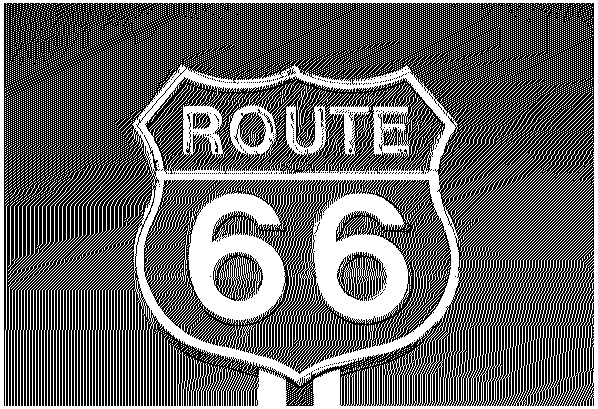
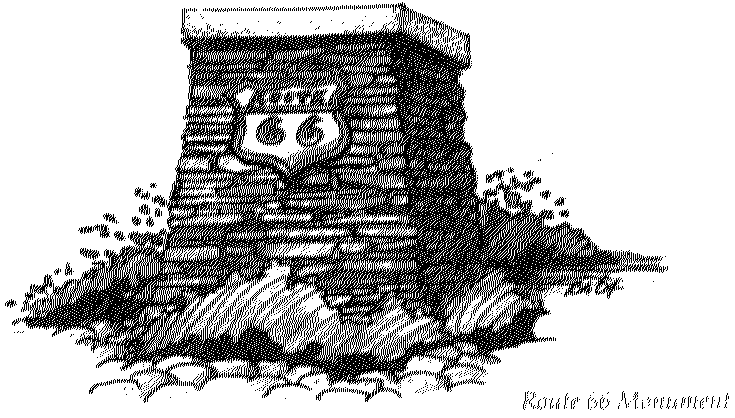
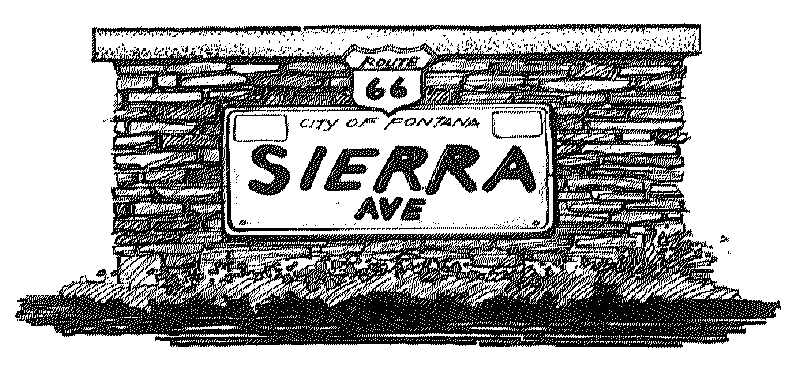
Route 66 character. As part of the design review or administrative site plan entitlement for development of properties located on the historic Route 66 (Foothill Boulevard), Route 66 themed signage shall be incorporated for one sign per property in the following locations:
• Southeast Corner of Ilex Street and Foothill Boulevard.
• Properties at the intersection of Cherry Avenue and Foothill Boulevard.
• Properties north of the intersection of Beech Avenue and Foothill Boulevard.
• Properties at the intersection of Citrus Avenue and Foothill Boulevard.
• Properties at the intersection of Sierra Avenue and Foothill Boulevard.
• Properties at the intersection of Alder Avenue and Foothill Boulevard
• Properties at the intersection of Maple Avenue and Foothill Boulevard.
Character-defining treatments shall include:
a.
Sign design that is consistent with and reminiscent of historic Route 66 signage.
b.
Use of approved Route 66 logo on signs of at least 24 inches in height.
c.
Use of sign colors and materials that are coordinated with building architecture.
d.
Character-defining treatments can include Route 66 theme signage exceeding the maximum sign area, including height, with Planning Commission approval.
(5)
Legibility. Signs shall be designed to provide clear, legible information that indicates the proposed sign's purpose. The size and proportion of the elements of the sign's message—including logos, letters, icons and other graphic images—shall be selected based on the average distance and average travel speed of the viewer. Sign messages oriented toward pedestrians shall be smaller than those oriented toward motor vehicle drivers.
(6)
Readability. A sign message shall be easily recognized and designed in a clear, unambiguous, and concise manner so that a viewer can understand or make sense of what appears on the sign. Colors chosen for the sign text and/or graphics shall have sufficient contrast with the sign background to be easily read during both day and night.
(7)
Visibility. A sign shall be readily distinguishable from its surroundings so a viewer can easily see the information it communicates.
(8)
Graphic interest. Sign colors and materials shall be selected to contribute to legibility and design integrity.
(Ord. No. 1868, § 9(Att. 2), 5-25-21; Ord. No. 1969, § 4(Exh. A), 5-27-25)
Sec. 30-728. - Design review permanent sign.
(a)
Applicability and exempt activities. A design review permanent sign approval is required to erect, move, alter, replace, suspend, display, or attach a permanent sign (general sign, freeway sign, and electronic message sign), unless otherwise specified in this article. The following sign activities are allowed without a design review permanent sign approval; however, any required building permit shall be obtained prior to the installation or modification of a sign:
(1)
The normal maintenance of a sign, including cleaning, repainting, or repairing, except when prohibited for a nonconforming sign by Section 30-776; and
(2)
Changes to the face or copy of a sign with changeable copy.
(b)
Compliance with standards. The following standards are required to be found in compliance in order for the responsible reviewing body to approve a design review permanent sign application, with or without conditions:
(1)
The sign complies with the standards of this article and any applicable specific plan or precise development plan;
(2)
The sign is in substantial compliance with the design principles outlined in Section 30-727;
(3)
The sign will not impair pedestrian and vehicular safety from right-of-way; and
(4)
The sign's design or proposed construction will not threaten the public health, safety, or welfare.
(Ord. No. 1868, § 9(Att. 2), 5-25-21)
Sec. 30-729. - Design review temporary sign.
(a)
Applicability and exempt activities. A design review temporary sign approval is required to erect, move, alter, replace, suspend, display, or attach a temporary sign, unless otherwise specified in this article.
(b)
Compliance with standards. The following standards are required to be found in compliance in order for the responsible reviewing body to approve a design review temporary sign application, with or without conditions:
(1)
The sign complies with the standards listed in Division 7 of this article;
(2)
The sign was reviewed and approved through an associated temporary use permit;
(3)
The sign is in substantial compliance with the design principles outlined in Section 30-727;
(4)
The sign does not impair pedestrian and vehicular safety; and
(5)
The sign's design or proposed construction will not threaten the public health, safety, or welfare.
(Ord. No. 1868, § 9(Att. 2), 5-25-21)
Sec. 30-730. - Design review creative sign (minor).
(a)
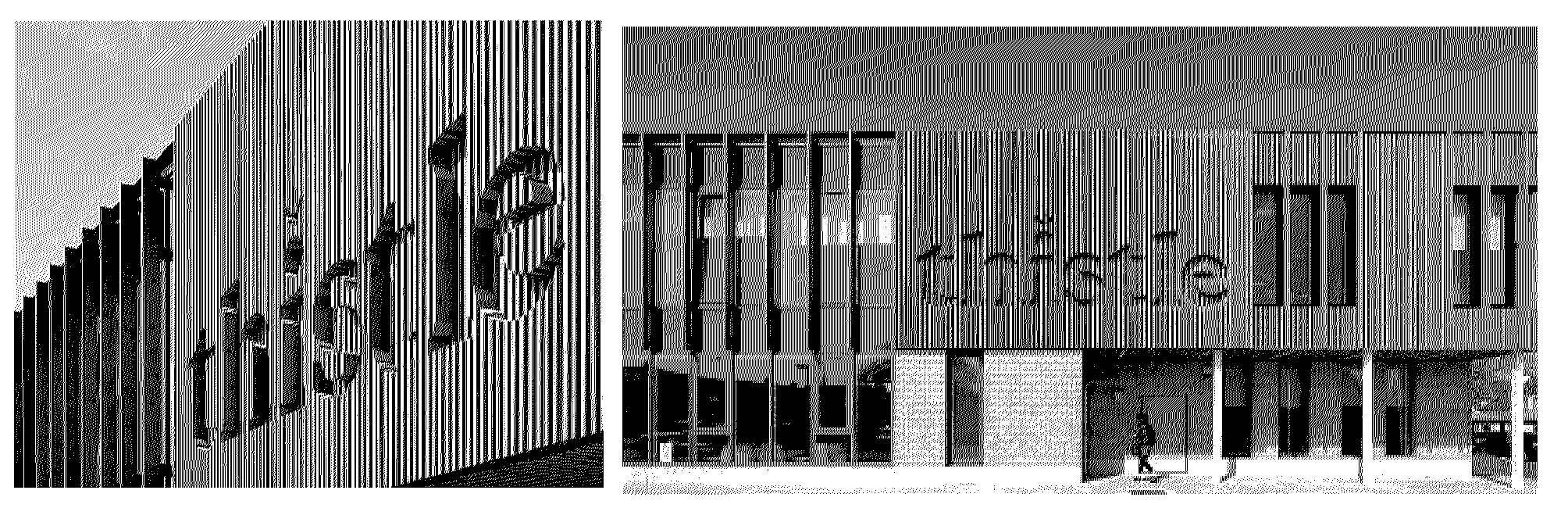
Purpose. The purpose of design review creative sign (minor) approvals is to encourage permanent signs that exhibit extraordinary aesthetic quality, creativity, and/or innovation through a minor increase to the maximum allowed sign area.
(b)
Applicability.
(1)
Location. An applicant may submit a design review creative sign (minor) request in the following areas:
a.
Within the downtown boundary;
b.
General commercial (C-2) designated properties; or
c.
On properties with frontage on Baseline Avenue, Foothill Boulevard, Sierra Avenue, or Valley Boulevard.
(2)
Requirements. An applicant may request design review creative sign (minor) approval to employ standards that differ from the standards applicable to signs established in this article but comply with the specific provisions of this section, consistent with the following:
a.
Permanent signs may deviate no more than ten percent from the applicable maximum sign area standard established in this article.
b.
A modification permitted by this subsection shall not allow a general advertising sign where it is not otherwise allowed.
c.
A modification permitted by this subsection shall not be additive to any other modification allowance permitted by this article.
d.
A design review creative sign (minor) approval shall not authorize any prohibited sign type or feature set forth in Section 30-722 except where specifically authorized.
Figure No. 30-730.1
Example of possible design review creative sign (minor) application
(c)
Findings and decision. The following findings are required to be made by the responsible reviewing body for approval of a design review creative sign (minor) application, with or without conditions:
(1)
The proposed creative sign complies with the design principles set forth in Section 30-727;
(2)
The proposed creative sign will provide strong graphic character through the effective use of color, graphics, proportion, quality materials, scale, and texture;
(3)
The proposed creative sign contributes a substantial aesthetic improvement to the site and has a positive visual impact on the surrounding area;
(4)
The proposed creative sign is located and designed so as not to cause light and glare impacts on surrounding uses, especially residential uses; and
(5)
The proposed creative sign utilizes or enhances the architectural elements of the building and is placed in an appropriate location in relation to the overall composition of the building's façade.
(Ord. No. 1868, § 9(Att. 2), 5-25-21)
Sec. 30-731. - Design review creative sign (PC).
(a)
Purpose. The purposes of design review creative sign (PC) approvals are to:
(1)
Encourage signs of unique design and signs that exhibit a high degree of thoughtfulness, imagination, and inventiveness;
(2)
Provide a process for the application of sign regulations in ways that will allow creatively designed signs that make a positive visual contribution to the overall image of Fontana, while mitigating the impacts of large or unusually designed signs; and
(3)
Provide a process for the approval of commercial murals and other emerging sign types that portray Fontana in a positive light and enhance the local aesthetic.
Figure No. 30-731.1
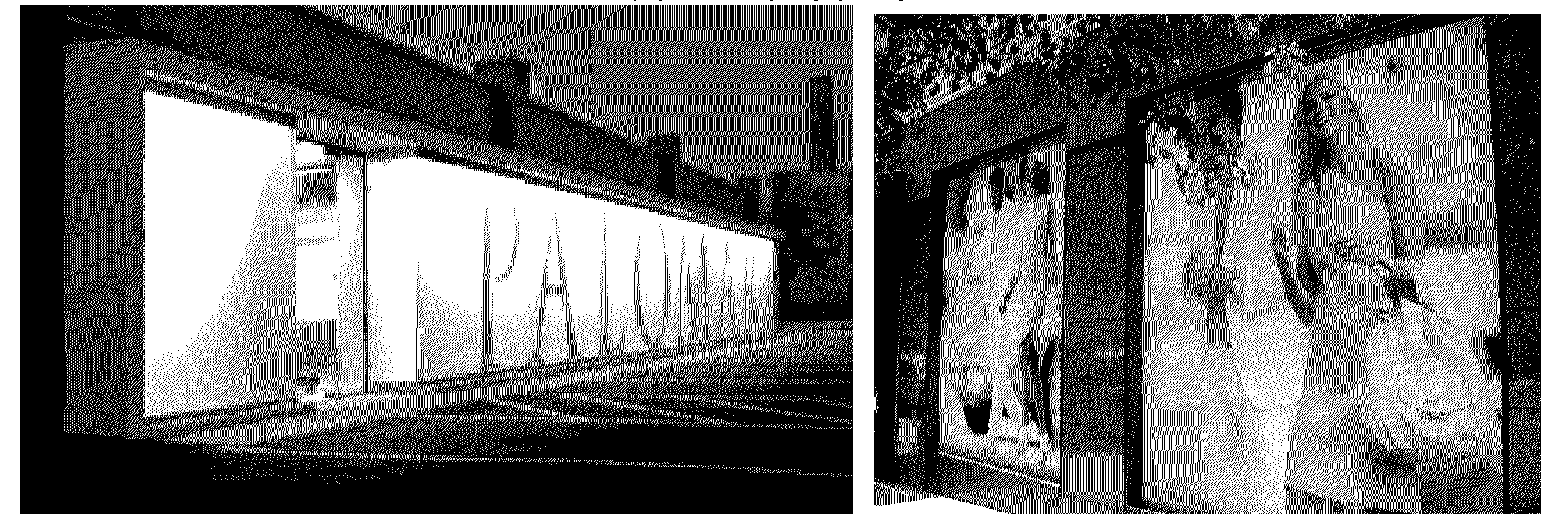
Examples of possible design review creative sign (PC) applications
(b)
Applicability.
(1)
Location. An applicant may request design review creative sign (PC) approval to authorize one on-site permanent creative sign in the following areas:
a.
Within the downtown boundary. For creative signs in the downtown core, Section 30-371.1 shall apply; or
b.
On properties with frontage on Baseline Avenue, Foothill Boulevard, Sierra Avenue, or Valley Boulevard.
(2)
Requirements. An applicant may request design review creative sign (PC) approval to employ standards that differ from the standards applicable to signs established in this article but comply with the specific provisions of this section, consistent with the following:
a.
A design review creative sign Planning Commission approval may deviate from the applicable standards established in this article, when approved by the Planning Commission.
b.
A modification permitted by this subsection shall not allow a general advertising sign where it is not otherwise allowed.
c.
A design review creative sign approval shall not authorize any prohibited sign type or feature set forth in Section 30-722 except where specifically authorized.
(c)
Findings and decision. The following findings are required to be made by the responsible reviewing body for approval of a design review creative sign (PC) application, with or without conditions:
(1)
Design criteria. The proposed creative sign:
a.
Complies with the design principles set forth in Section 30-727;
b.
Has a unique design and exhibits a high degree of imagination, inventiveness, spirit, and thoughtfulness through the imaginative use of color, graphics, proportion, quality materials, scale, and texture;
c.
Contributes a substantial aesthetic improvement to the site and has a positive visual impact on the surrounding area; and
d.
Utilizes or enhances the architectural elements of the building and is placed in an appropriate location in relation to the overall composition of the building's façade.
(2)
Contextual criteria. The creative sign shall be located and designed not to cause light and glare impacts on surrounding uses, especially residential uses. The sign shall also contain at least one of the following elements:
a.
Creative image reflecting current or historic character of Fontana; or
b.
Inventive representation of the logo, name, or use of the structure or business.
(Ord. No. 1868, § 9(Att. 2), 5-25-21; Ord. No. 1974, § 4(Exh. A), 9-9-25)
Sec. 30-731.1. - Downtown core creative sign.
(a)
Purpose. The purpose of this section is to:
(1)
Encourage distinctive signage that demonstrates unique design and exhibits a high degree of thoughtfulness, imagination, and inventiveness thereby creating a dynamic and attractive downtown core;
(2)
Establish a process for implementing sign regulations that facilitate the approval of creatively designed signs that shall make a positive visual contribution to the overall image of the downtown core, while mitigating the impacts of large or unusually designed signs; and
(3)
Provide a process for the approval of commercial or residential murals and other novel sign types that positively represent Fontana and enhance the local aesthetic.
(b)
Applicability.
(1)
Location. An applicant may seek approval to authorize the installation of one on-site permanent creative sign within the downtown core.
(2)
Requirements. An applicant may request approval to utilize standards that deviate from the requirements applicable to signs established in this article, provided such deviation complies with the specific provisions of this section, subject to the following conditions:
a.
A downtown core creative sign may deviate from the applicable standards established in this article with façade modifications, when approved by the Director of Planning through a design review sign application.
1.
Only one downtown core creative sign may be requested per design review sign application.
b.
This subsection shall not authorize general advertising where it is not otherwise allowed.
c.
A downtown core creative sign approval shall not authorize any prohibited sign type or feature set forth in Section 30-722 except where specifically authorized.
d.
Electronic message signs are only permitted to promote live events and screenings. The site must have a business associated with live events and/or screenings. In addition, the electronic message sign must comply with Section 30-734(c).
e.
Applicants proposing an electronic message sign must have the approval of a minor use permit to ensure compliance with the findings below.
(c)
Findings. The following findings are required to be made by the responsible reviewing body for the approval of a downtown core creative sign application:
(1)
Design criteria. The proposed creative sign shall meet the following design criteria:
a.
The sign complies with the design principles set forth in Section 30-727;
b.
The sign exhibits a unique design and a high degree of imagination, inventiveness, spirit, and thoughtfulness through the use of color, graphics, proportion, quality materials, scale, and texture;
c.
The sign contributes a substantial aesthetic improvement to the site and has a positive visual impact on the surrounding area;
d.
The sign utilizes or enhances the architectural elements of the building and is placed in an appropriate location in relation to the overall composition of the building's façade;
e.
Any proposed façade modifications are demonstrably necessary for the structural integration of the sign or are located in the immediate vicinity of the sign to enhance its visual interest;
f.
Any proposed commercial mural must depict imagery directly connected with the business and project a positive impression; and
g.
Electronic message signs may only be used for businesses to promote live events and screenings and must comply with Section 30-734.
(2)
Contextual criteria. The creative sign shall be located and designed not to cause light and glare impacts on surrounding uses, especially residential uses. The sign shall also contain at least one of the following elements:
a.
Creative image reflecting current or historic character of Fontana; or
b.
Inventive representation of the logo, name, or use of the structure or business.
(Ord. No. 1974, § 4(Exh. A), 9-9-25)
Editor's note— Ord. No. 1974, § 4(Exh. A), adopted Sept. 9, 2025, renumbered the former § 30-731.1 as § 30-731.2 and enacted a new § 30-731.1 as set out herein. The historical notation has been retained with the amended provisions for reference purposes.
Sec. 30-731.2. - Sign programs.
(a)
Purpose. The purpose of the sign programs are to:
(1)
Provide coordinated signage within a development project;
(2)
Create common design elements;
(3)
Provide customed tailored site-specific standards; and
(4)
Integrate the design of signs with the overall building and landscape design to form an architectural statement.
(b)
Applicability.
(1)
Location. An applicant may submit a comprehensive sign program application (design review sign program) if they meet the following criteria:
a.
A new or existing shopping center with a site area of six acres or more;
b.
Mixed-use or commercially zoned properties;
c.
On properties with frontage on Baseline Avenue, Foothill Boulevard, Sierra Avenue, or Valley Boulevard.; and
d.
For sign programs within the downtown core, Section 30-732.1 shall apply.
(2)
Requirements. An applicant may request Planning Commission approval of a sign program, consistent with the following:
a.
A site plan showing the location of buildings, parking lots, driveways, and landscaped area;
b.
The maximum total sign area, the maximum area for individual signs, the height of signs and the number of signs allowed;
c.
An accurate indication on the site plan of the proposed location of each proposed sign and existing sign which is to remain;
d.
Lighting and sign construction materials; and
e.
Sign dimensions (if tenants are not known, generic dimensions may be presented).
f.
Where proposed signage does not meet the requirements of existing sign regulations, the sign program shall provide enhanced design or other elements.
(Ord. No. 1898, § 13, 7-26-22; Ord. No. 1974, § 4(Exh. A), 9-9-25)
Editor's note— See editor's note, § 30-731.1.
Sec. 30-731.3. - Downtown core sign program.
(a)
Purpose. The purpose of downtown core sign program is to:
(1)
Provide coordinated signage within a downtown core site;
(2)
Create common design elements;
(3)
Provide custom tailored site-specific standards;
(4)
Integrate the design of signs with the overall building and landscape design to form an architectural statement; and
(5)
Allow façade improvements in direct vicinity of proposed signage.
(b)
Applicability and eligibility.
(1)
Location. The downtown core sign program must pertain to sites situated within the downtown core.
(2)
Eligibility. In addition to the general location requirement above, the site for which a downtown core sign program application is submitted must satisfy at least one of the following criteria:
a.
The site is a commercial or mixed-use property with commercial or office space measuring one acre or larger, excluding any stand-alone single-family residences (including ADU's); or
b.
The site is a commercial, mixed-use, or residential property that is two stories or higher.
(3)
Requirements. An applicant may request Director's approval of a downtown core sign program through a design review sign application, consistent with the following:
a.
A site plan showing the location of buildings, parking lots, driveways, lot size, building height, and landscaped area;
b.
The maximum total sign area, the maximum area for individual signs, the height of signs and the number of signs allowed;
c.
An accurate indication on the site plan of the proposed location of each proposed sign and existing sign which is to remain;
d.
Show areas of all façade changes including color and material which must be architecturally compatible with the proposed signage and close proximity to proposed signage;
e.
Lighting and sign construction materials;
f.
Sign dimensions (if tenants are not known, generic dimensions may be presented);
g.
Where proposed signage does not meet the requirements of existing sign regulations, the sign program shall provide enhanced design or other elements;
h.
Sites along Route 66 must meet the requirements of Section 30-727; and
i.
Electronic message signs are only permitted to promote live events and screenings. The site must have a business associated with live events and/or screenings. In addition, the electronic massage sign must comply with Section 30-734(c).
1.
Applicants proposing an electronic message sign must have the approval of a minor use permit to ensure compliance with this section.
(Ord. No. 1974, § 4(Exh. A), 9-9-25)
Sec. 30-733. - Content neutrality.
It is the City's policy to regulate signs in a constitutional manner that is content-neutral with respect to both noncommercial and commercial messages. For the purposes of this article, a content-neutral regulation is a so-called "time, place, or manner" regulation, which, as the name suggests, does no more than place limits on when, where, and how a message may be displayed or conveyed.
(Ord. No. 1868, § 9(Att. 2), 5-25-21)
Sec. 30-734. - Sign illumination, neon tubing, and electronic message signs.
(a)
General requirements.
(1)
Illumination method. Sign illumination may be internally or externally illuminated and shall not blink, flash, flutter, or change light intensity, brightness, or color unless consistent with the standards for electronic message signs in Section 30-734.
(2)
Bulb face exposure. Reflective-type bulbs and incandescent lamps that exceed 15 watts shall not be used on the exterior surface of signs so that the face of the bulb or lamp is exposed to a public right-of-way or adjacent property. This provision does not apply to light-emitting diodes (LEDs) associated with electronic message signs.
(3)
Energy efficiency. Sign illumination shall utilize energy-efficient light sources, such as LEDs, to the greatest extent possible.
(4)
Shielding—General. Sign illumination shall not interfere with the use and enjoyment of adjacent properties, create a public nuisance, or create public safety hazards. Exterior light sources shall be shielded from view and directed to illuminate only the sign face.
(5)
Shielding—Residential properties. Sign illumination shall be limited to avoid light projection of an intensity or brightness or directed in a manner that will negatively impact residential properties in direct line of sight to the sign.
(b)
Neon tubing.
(1)
Sign types. Neon tubing, including exposed neon tubing, for signs and architectural elements shall only be permitted in commercial zoning districts on canopy signs, marquee signs, and wall signs pursuant to the provisions in this section and Division 6 of this article. Neon tubing shall also be permitted in commercial zoning districts on projecting signs and window signs pursuant to this section and Section 30-721.
(2)
Standards. Neon tubing, including exposed neon tubing, for signs and architectural elements shall comply with the following standards:
a.
Neon tubing shall be UL (Underwriters Laboratories) listed with a maximum 20 amps per circuit and be designed to accommodate a dimmer in order to reduce the brightness of the neon;
b.
The neon manufacturer shall be registered with Underwriters Laboratories;
c.
Neon tubing shall not exceed one-half inch in diameter;
d.
Neon lighting adjacent to residential uses shall not exceed one-half foot-candle measured at the property line; and
e.
Neon tubing shall not be combined with any reflective materials (e.g., mirrors, polished metal, highly glazed tiles, or other similar materials)
(c)
Electronic message signs.
(1)
Sign types. Electronic messages shall be permitted on freestanding menu board signs, freeway signs, pylon signs, and theater marquee signs pursuant to the provisions in this section and Division 6 of this article. Electronic messages shall also be permitted on window signs pursuant to this section and Table No. 30-721.A.
(2)
Display change. Electronic message signs may display changing messages, provided that each message is displayed for no fewer than eight consecutive seconds, and shall not flash, blink, flutter, or display video messages (i.e., any illumination or message that is in motion or appears to be in motion). The transition or blank screen time between one display message and the next shall not exceed one second.
(3)
Nighttime brightness.
a.
Nighttime brightness shall be measured with an illuminance meter set to measure foot-candles accurate to at least two decimals. Illuminance shall be measured with the electronic message off, and again with the electronic message displaying a white image for a full color-capable electronic message or a solid message for a single-color electronic message.
b.
All measurements shall be taken perpendicular to the face of the electronic message at the following distance:

c.
The difference between the off and solid message measurements shall not exceed 0.3 foot-candles at night.
(4)
Ambient light sensor. Electronic message signs shall be equipped with a sensor or other device that automatically determines the ambient illumination and programmed to automatically dim according to ambient light conditions (e.g., photocell technology), or that can be adjusted to comply with the 0.3 foot-candle requirement.
(5)
Turn off. Electronic message signs located within 500 feet and in a direct line of sight of a residentially zoned property or a mixed-use property with residential uses shall be turned off daily at the close of business, or at such a time as specified by the Director of Community Development, and in no case shall be permitted to be turned on between the hours of 10:00 p.m. and 6:00 a.m. Direct line of sight shall be measured from any point on the property with residential uses and may be partially, but not wholly, obstructed.
(6)
Electronic sign certification. The owner of any electronic message sign shall arrange for certification by an independent contractor showing compliance with brightness standards.
(Ord. No. 1868, § 9(Att. 2), 5-25-21)
Sec. 30-735. - Sign measurement criteria.
(a)
Sign height.
(1)
Sign height, freestanding sign. The height of a freestanding sign shall be measured from the highest part of the freestanding sign, including any decorative features, to the highest elevation of the adjoining finished grade directly beneath the freestanding sign. The official City logo and/or Route 66 iconography as approved by the Director of Community Development and permitted by Section 30-741 shall not be included in any calculation of sign height. See Figure No. 30-735.1.
Figure No. 30-735.1
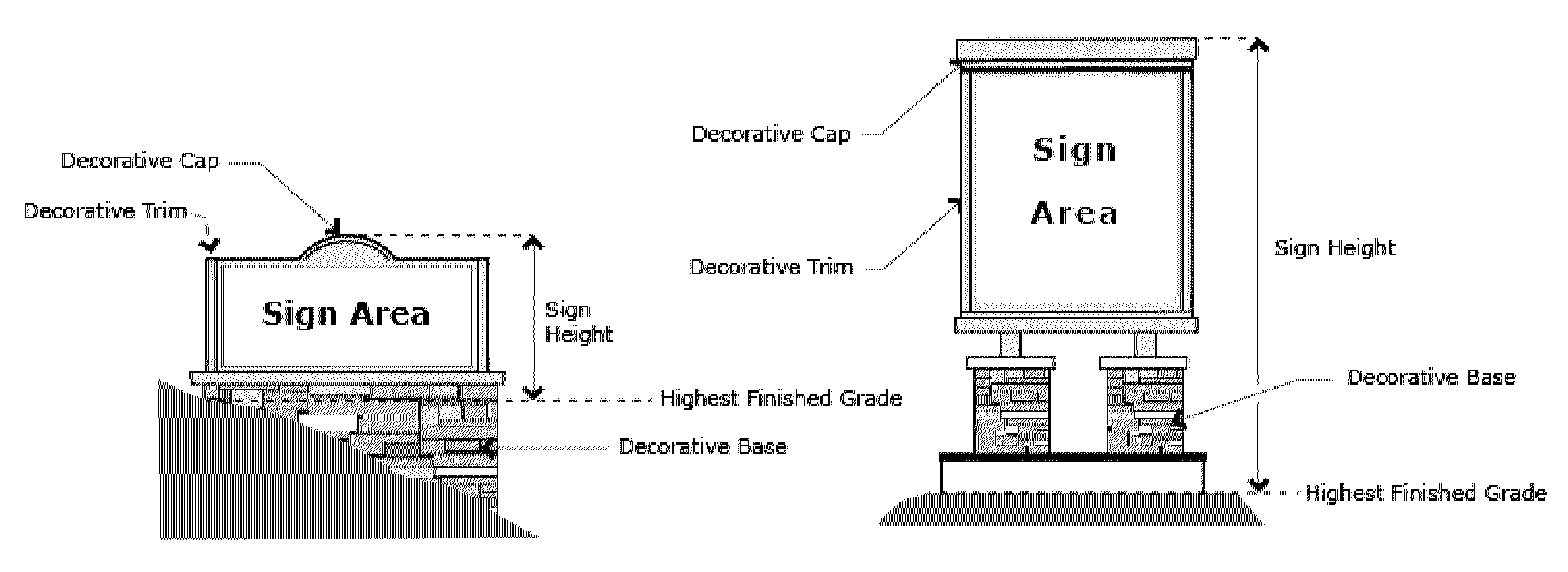
(2)
Sign height, wall sign. The height of a wall sign shall be the greatest vertical distance measured from the highest point of the wall sign to the lowest point of the wall sign. See Figure No. 30-735.2.
Figure No. 30-735.2
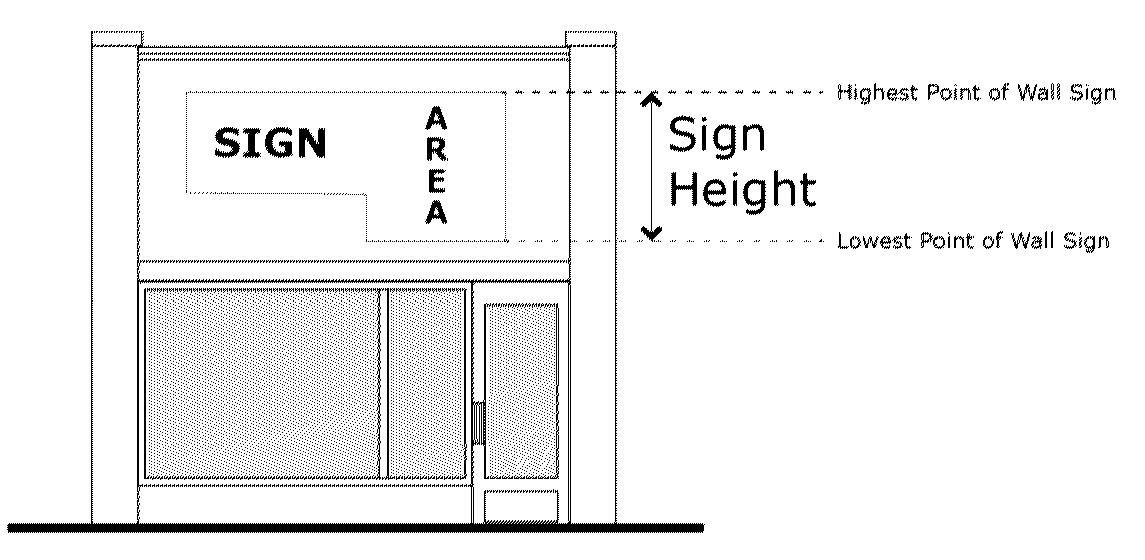
(b)
Sign clearance. Sign clearance shall be measured as the smallest vertical distance between finished grade and the lowest point of the sign, including any framework or other embellishments.
(c)
Building frontage. Building frontage is defined in Section 30-783. For buildings with two or more frontages, the length of the wall and allowable sign area shall be calculated separately for each building frontage.
(d)
Sign area.
(1)
Calculating sign area—Generally.
a.
Supporting structures, such as sign bases and columns, and decorative features shall not be included in any calculation of sign area, provided that they contain no lettering or graphics except for addresses. See Figure No. 30-735.3.
b.
Where separate or individual component elements of a sign are spaced or separated from one another, each component element shall be considered a separate sign.
c.
The official City logo and/or Route 66 iconography as approved by the Director of Community Development and permitted by Section 30-741 shall not be included in any calculation of sign area. See Figure No. 30-735.3.
Figure No. 30-735.3.
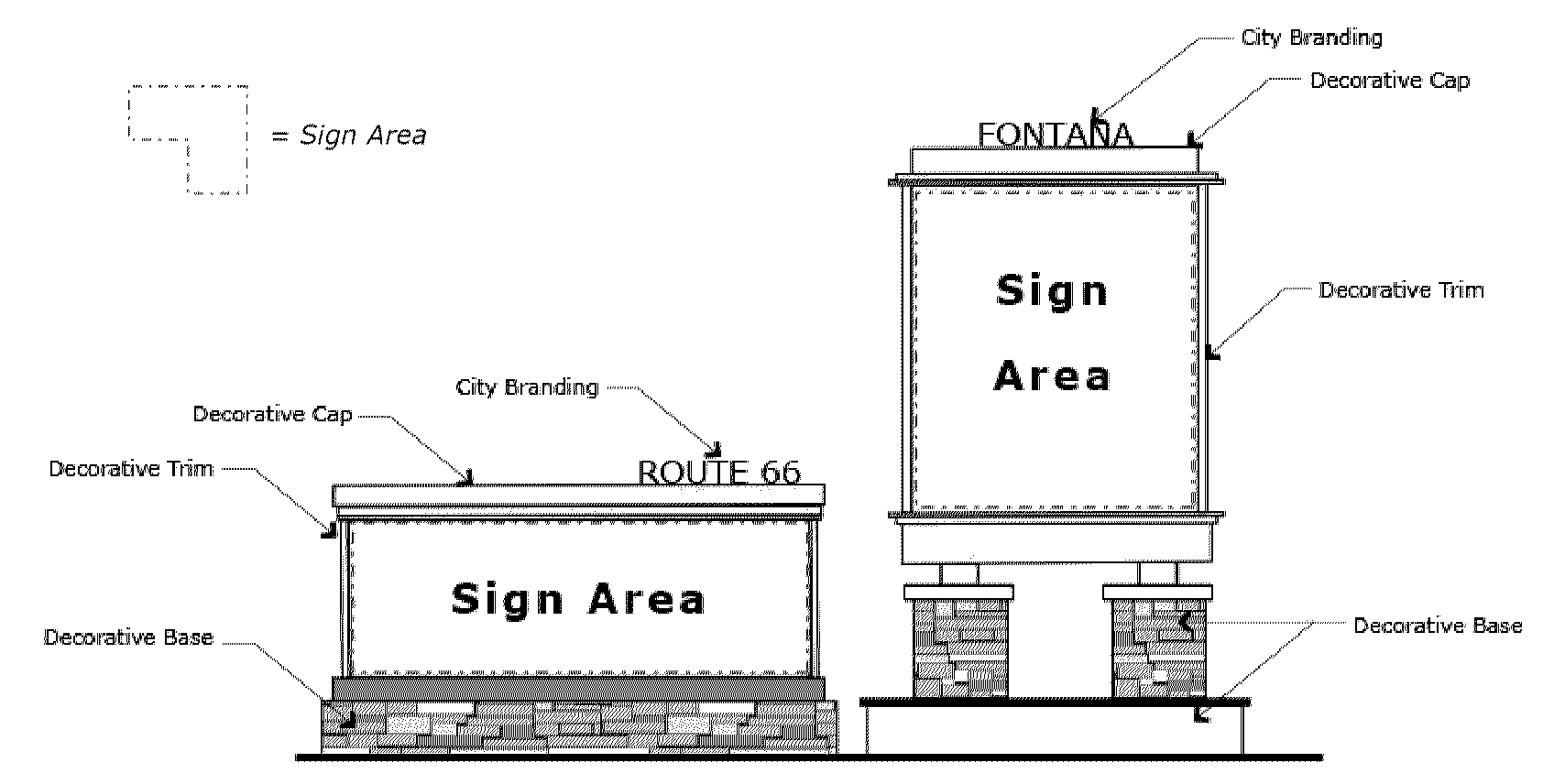
(2)
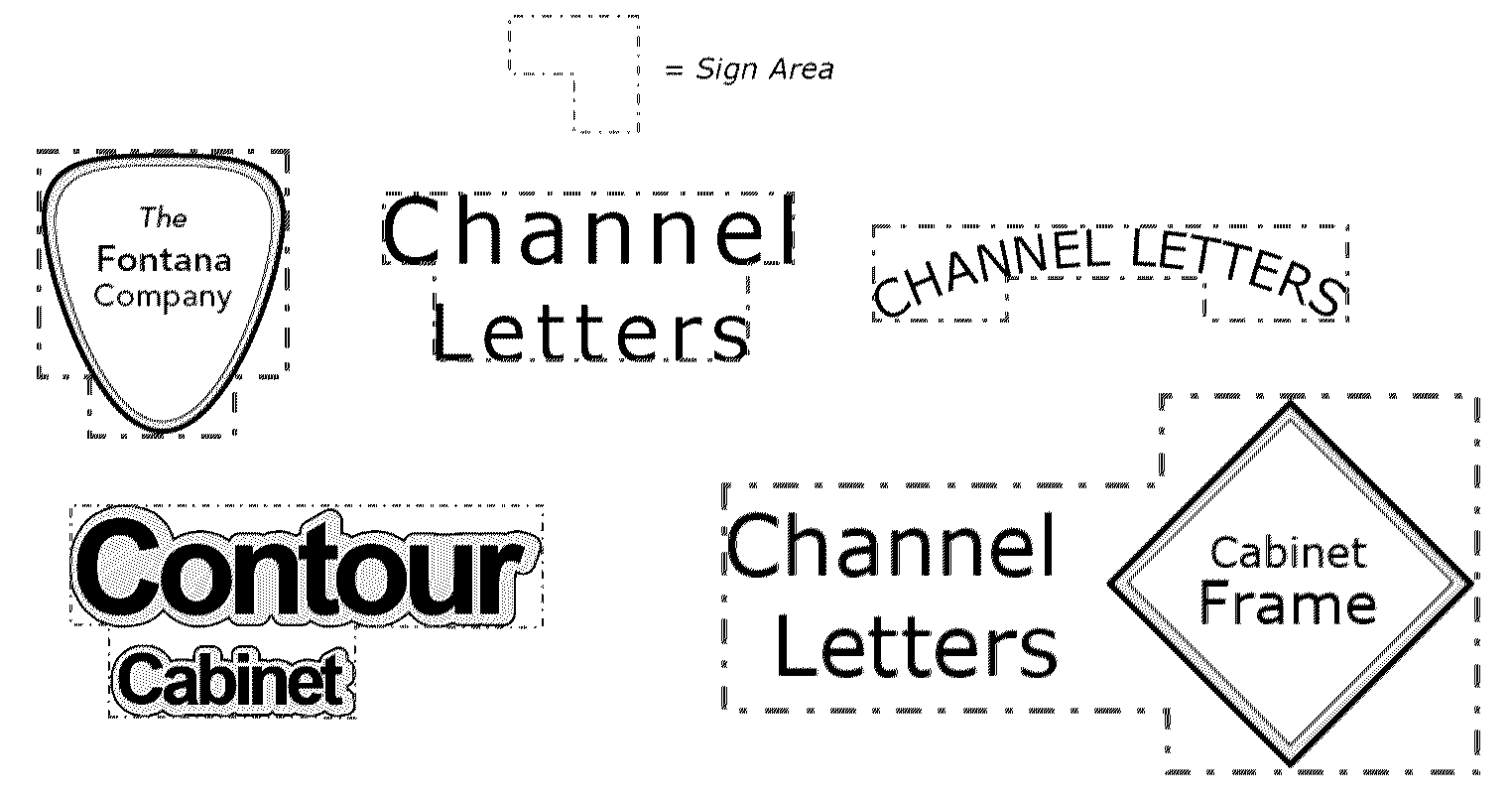
Calculating sign area—Single-faced signs. Sign area for single-faced signs shall be calculated by enclosing the extreme limits of all sign structures and borders, emblem, logo, representation, writing, or other display within a single continuous perimeter composed of horizontal and vertical lines with no more than eight corners. See Figure No. 30-735.4.
Figure No. 30-735.4.
(3)
Calculating sign area—Double-faced signs. Only one face of a double-faced sign shall be used to calculate the permitted area of a double-faced sign. Where the two faces are not equal in size, the larger sign face shall be used.
(4)
Calculating sign area—Multi-faced signs. On a multi-faced sign, the combined sum of the area of the largest and smallest faces shall be used to calculate the permitted area of the sign.
(5)
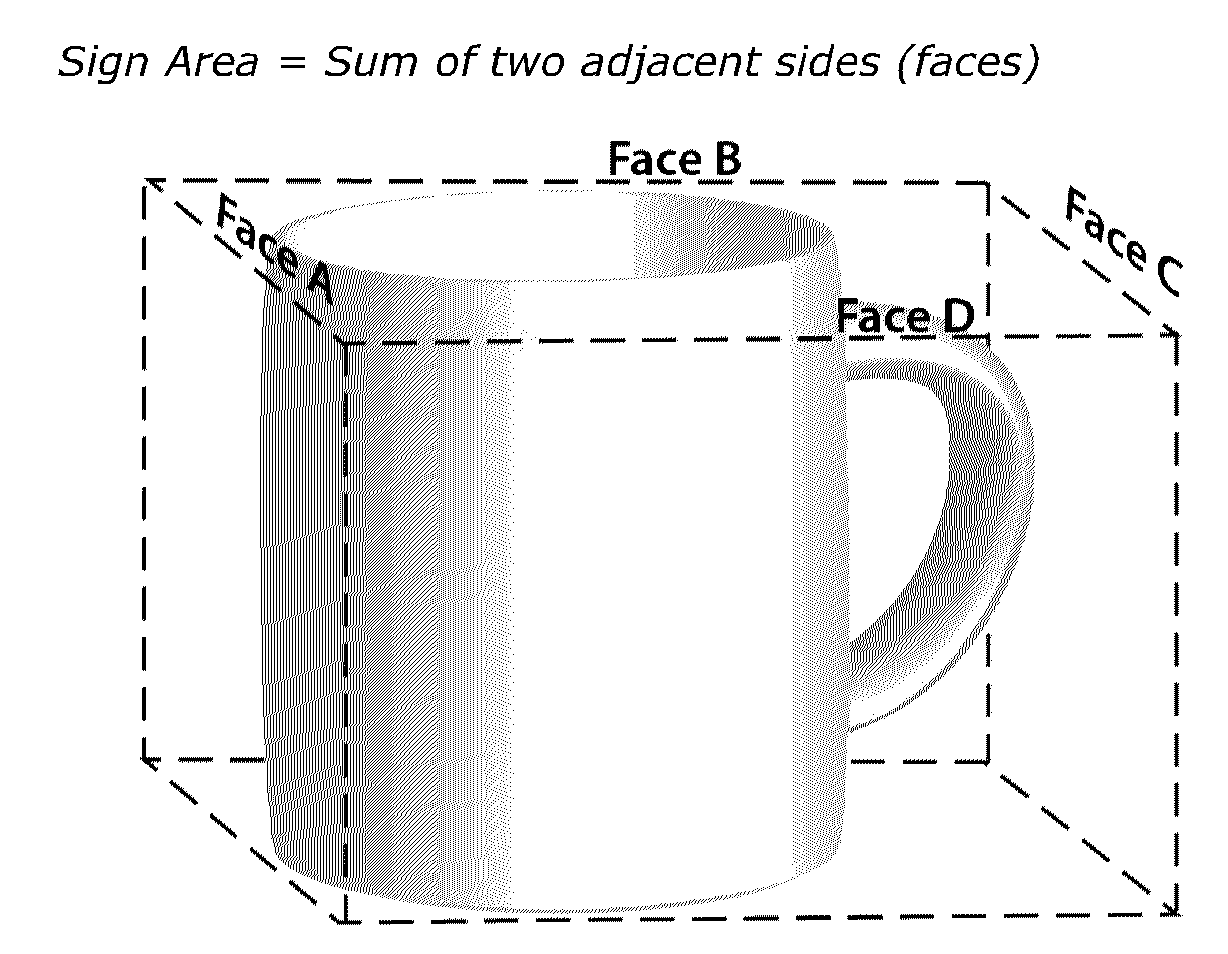
Calculating sign area—Three-dimensional signs. Signs that consist of, or have attached to them, one or more three-dimensional objects (i.e., balls, cubes, clusters of objects, sculpture, or statue-like trademarks), may have a sign area that is the sum of two adjacent sides of the smallest cube that will encompass the sign. Signs with three-dimensional objects that project six inches or less from the sign face shall be measured as a single-face sign. See Figure No. 30-735.5.
Figure No. 30-735.5.
(Ord. No. 1868, § 9(Att. 2), 5-25-21)
Sec. 30-736. - Sign construction and design.
(a)
Materials.
(1)
Sign materials shall be durable and capable of withstanding weathering over the life of the sign with reasonable maintenance. Paper, fabric, plywood, and other materials subject to rapid deterioration may only be used for temporary signs or as permitted awning signs.
(2)
Reflective materials shall not be included on signs.
(b)
Supporting structures. The size of the supporting structures shall be proportional to the sign they are supporting. In general, fewer larger supporting members are preferable to many smaller supports.
(c)
Mounting. All permanent signs shall be firmly anchored, shall comply with all requirements for public safety, and shall satisfy all applicable safety codes and all other applicable governmental enactments, rules, regulations, or policies.
(d)
Quality construction. All permanent signs shall be constructed by persons whose principal business is building construction or a related trade, including sign manufacturing and installation businesses, or others capable of producing professional results with a valid business license.
(e)
Relationship to buildings. Signs located upon a lot with only one main building housing the enterprise which the sign identifies shall be designed to incorporate at least one of the predominantly visual elements of such building, such as the type of construction materials, color, or other design detail. Each sign located upon a lot with more than one main building, such as a shopping center or other commercial or industrial area developed in accordance with a common development plan, shall be designed to incorporate at least one of such predominantly visual design elements common or similar to all such buildings or the buildings occupied by the main tenants or principal enterprises.
(f)
Relationship to other permanent freestanding signs. Where there is more than one permanent freestanding sign located upon a lot or shopping center, all such signs shall have designs that are visually related or complementary to each other by the similar treatment or incorporation of not less than four of the following six design elements:
(1)
Type of construction materials as used in the several sign components, such as cabinet, sign copy, and supports.
(2)
Letter style of sign copy.
(3)
Illumination.
(4)
Type or method used for supports, uprights, or structure on which sign is supported.
(5)
Sign cabinet or other configuration of sign area.
(6)
Shape of entire sign and its several components.
(g)
Relationship to other permanent wall signs. Multiple tenant complexes with more than one permanent wall sign shall design such signs to be visually related or complementary to each other.
(h)
Relationship to street trees and landscaping. Sign placement shall consider the location of required street trees and potential tree growth over time, with placement at locations most suitable for sign viewing while complying with all sign requirements. Landscaping shall be maintained at all times to avoid obscuring signs.
(Ord. No. 1868, § 9(Att. 2), 5-25-21)
Sec. 30-737. - Sign maintenance and upkeep.
(a)
Generally. All parts of a sign shall be maintained in a good and safe condition, painted, and adequately protected from weathering and deterioration so that they do not create a hazard to persons or property or constitute a nuisance.
(b)
Repairs. Any sign or supporting structure that is sagging, leaning, fallen, decayed, broken, deteriorated, missing or has inoperative lights, or is in an otherwise dilapidated condition shall be promptly repaired with materials and design of equal or better quality as the original design, to the satisfaction of the Director of Community Development, or removed.
(c)
Graffiti. Graffiti on a sign shall be removed within 48 hours of notice of its placement on such sign.
(d)
Landscaping. Landscaping required by this article shall be maintained in a neat, clean, and healthy condition, which includes pruning, mowing of lawns, weeding, removal of litter, fertilizing, replacement of plants when necessary, and the regular watering of all plantings.
(Ord. No. 1868, § 9(Att. 2), 5-25-21)
Sec. 30-738. - Sign removal or replacement.
When a sign is removed or replaced, all brackets, poles, and other supporting structures that supported the sign shall also be removed, and any electrical components shall be removed and/or capped, and any resulting holes filled. Affected building surfaces shall be restored to match the adjacent portion of the building.
(Ord. No. 1868, § 9(Att. 2), 5-25-21)
Sec. 30-739. - Sign location at intersections.
No sign, sign structure, or supporting structure shall exceed a height of 30 inches or create a visual obstruction that would constitute a traffic or pedestrian hazard, if located within the street corner cut-off or driveway corner cut-off, as defined in Section 30-443, subsection 30-488(d), and subsection 30-529(d) in this chapter. The plotting of sight distance lines shall conform to the intersection sight distance standard drawing located in the traffic section of the City of Fontana Standard Design Guidelines Manual.
(Ord. No. 1868, § 9(Att. 2), 5-25-21)
Sec. 30-740. - Interpretations by Director of Community Development.
Whenever the Director of Community Development determines that the meaning or applicability of any of the requirements of this article is subject to interpretation generally, or as applied to a specific case, the Director of Community Development may issue an official interpretation or refer the question to the Planning Commission for determination.
(Ord. No. 1868, § 9(Att. 2), 5-25-21)
Sec. 30-741. - Permanent sign standards by zoning district/use.
All permanent signs shall comply with the standards set forth in this division. Additional permitted signs are included for specific uses listed under Section 30-747. Table No. 30-742.A, Table No. 30-743.A, Table No. 30-744.A, and Table No. 30-745.A identify the sign type, number, location, area, and height allowed within each zoning district, along with any applicable additional regulations. The standards contained in this section are maximums, unless otherwise stated.
(Ord. No. 1868, § 9(Att. 2), 5-25-21)
Sec. 30-742. - Permanent sign standards for residential uses in all zoning districts.
Table No. 30-742.A.
Residential Uses in All Zoning Districts
(Ord. No. 1868, § 9(Att. 2), 5-25-21; Ord. No. 1974, § 4(Exh. A), 9-9-25)
Sec. 30-743. - Permanent sign standards for nonresidential uses in commercial, mixed use, and form-based zoning districts (C-1, C-2, RMU, FBC).
Table No. 30-743.A.
Nonresidential Uses in Commercial, Mixed Use, and Form-Based Zoning Districts (C-1,
C-2, RMU, FBC) and Specific Plans Without Sign Programs
(Ord. No. 1868, § 9(Att. 2), 5-25-21; Ord. No. 1974, § 4(Exh. A), 9-9-25)
Sec. 30-744. - Permanent sign standards for nonresidential uses in industrial zoning districts (M-1, M-2).
(Ord. No. 1868, § 9(Att. 2), 5-25-21)
Sec. 30-745. - Permanent sign standards by public and quasi-public zoning districts (P-PF, P-UC, OS-N, OS-R).
(Ord. No. 1868, § 9(Att. 2), 5-25-21)
Sec. 30-746. - Standards by permanent sign type.
(a)
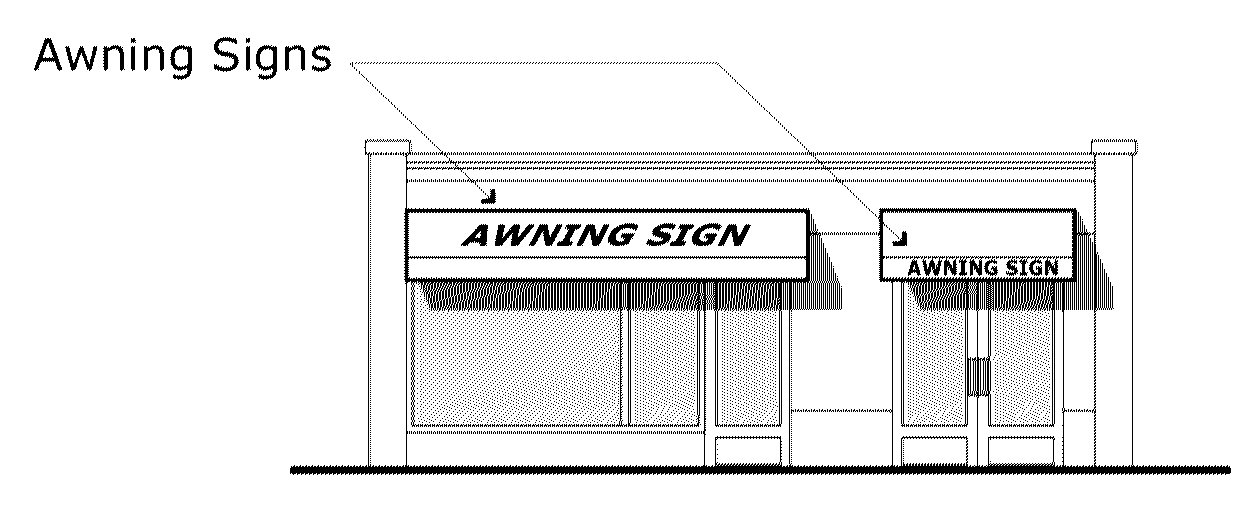
Awning sign. Awning signs are permitted pursuant to Section 30-743 and Section 30-744 and the following regulations:
(1)
Location. Awnings that display signage shall be limited to building frontages on the ground floor of buildings.
Figure No. 30-746.1.
(2)
Combined sign area. Combinations of signs on awnings, canopies, and walls are permitted but shall not exceed the maximum allowable sign area for wall signs per business frontage or building frontage. Awning signs may count as a primary wall sign or secondary wall sign.
Downtown core: Awning signs within the downtown core are exempt from the maximum allowable sign area limitations that apply to wall signs.
(3)
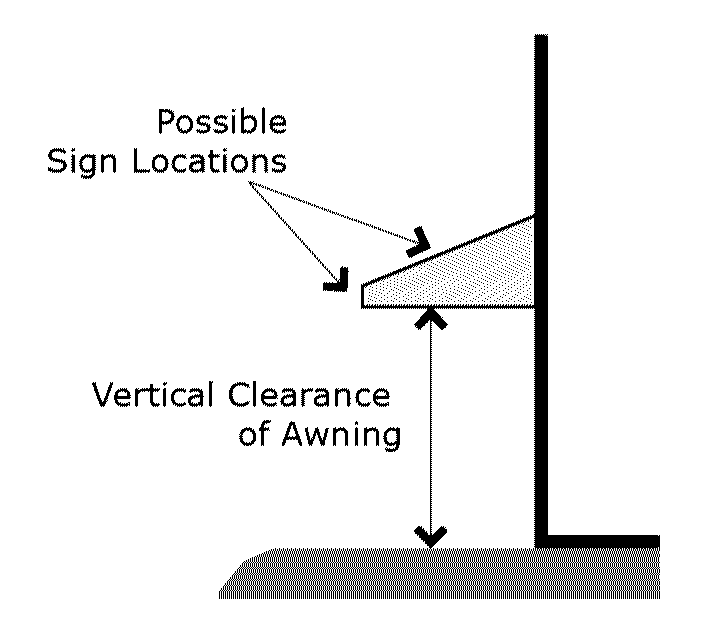
Vertical clearance. A minimum vertical clearance of at least eight feet from bottom of the awning, including valance, to highest finished grade shall be maintained.
Figure No. 30-746.2.
(4)
Setback and projection into public right-of-way. A minimum of two feet between the edge of the awning and the outer curb face shall be maintained. Any encroachment into City right-of-way is subject to City Engineer approval and requires an encroachment permit.
(b)
Canopy sign. Canopy signs are permitted pursuant to Section 30-743 and Section 30-744 and the following regulations:
(1)
Location. Canopies that display signage shall be limited to building frontages on the ground floor of buildings.
(2)
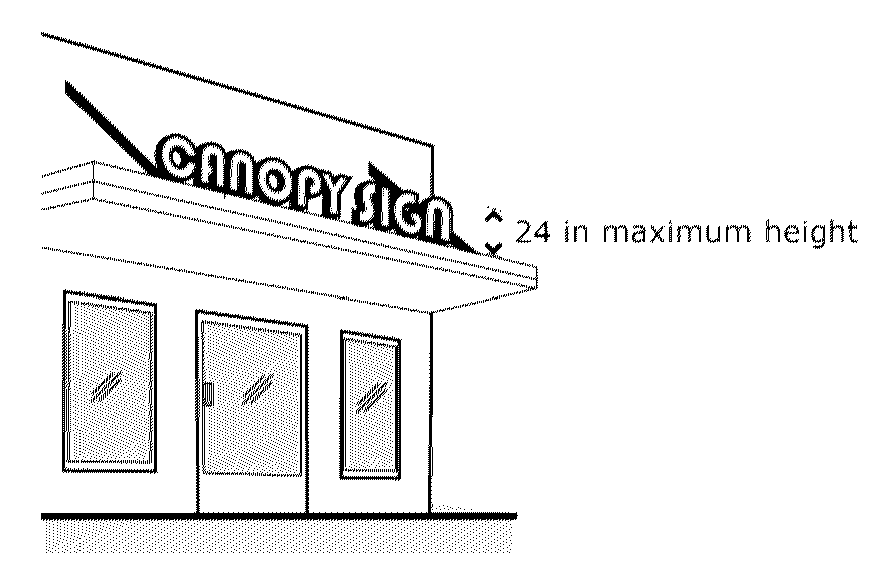
Height. Canopy signs shall not project more than 24 inches above the highest point of any canopy, except for fueling station canopies pursuant to subsection 30-747(c).
Downtown core: Signage located beneath a canopy is permitted, provided a minimum vertical clearance of eight feet is maintained from the bottom of the sign to the highest finished grade. The maximum height of such signage shall not exceed 24 inches.
Figure No. 30-746.3.
(3)
Combined sign area. Combinations of signs on awnings, canopies, and walls are permitted but shall not exceed the maximum allowable sign area for wall signs per business frontage or building frontage (does not apply to the downtown core). Canopy signs may count as a primary wall sign or secondary wall sign.
(4)
Canopy signs prohibited in combination with projecting signs. Canopy signs shall not be permitted on street frontages with projecting signs, except for the downtown core.
(5)
Setback and projection into public right-of-way. A minimum of two feet between the edge of the canopy and the outer curb face shall be maintained. Any encroachment into City right-of-way is subject to City Engineer approval and requires an encroachment permit.
(c)
Freeway sign. Freeway signs are permitted pursuant to Section 30-743 and Section 30-744 and the following regulations:
(1)
Applicability. A minimum 800 linear feet of freeway frontage is required. For parcels with no direct freeway frontage but that are separated from the freeway only by a railroad right-of-way, the railroad right-of-way frontage shall be considered freeway frontage for the purposes of determining applicability.
(2)
Location. Freeway signs shall be placed within 400 feet of freeway right-of-way.
(3)
Design review required. A freeway sign requires a design review freeway sign approval by the Planning Commission. The following findings must be made for approval of a freeway sign:
a.
The elevation of the freeway in relation to the elevation of the abutting properties justifies the height requested and is the minimum necessary;
b.
The number and spacing of freeway signs will not cause unnecessary confusion, clutter, or other unsightliness in the general location;
c.
The use identified—as well as its type, size, and intensity—justifies the size, design, and location of the sign; and
d.
The needs of the traveling public and the use justify the sign.
(4)
Orientation. Freeway signs shall be oriented toward the freeway. A freeway sign shall be considered oriented to a freeway where the sign face makes an interior angle of more than 30 degrees to the freeway.
(5)
Height exception. Freeway sign height may be allowed to exceed the height limit (Section 30-743 and Section 30-744) if a flag test approved by the City determines that a sign of lower height would be partially or wholly obscured, but in no case shall sign height exceed 75 feet above freeway grade.
(6)
Setback. Freeway signs shall be set back at least five feet from any property line.
(7)
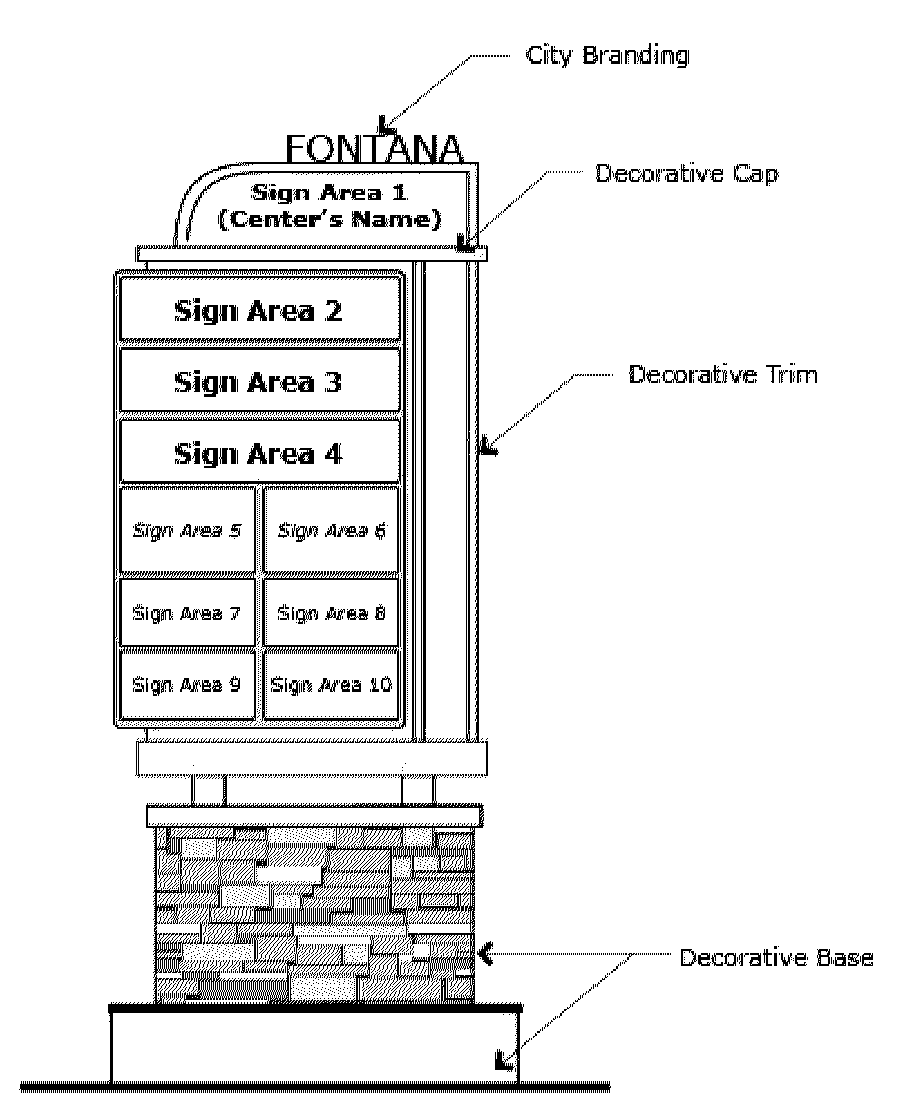
Multiple tenant sites. Freeway signs for multiple tenant sites shall have no more than ten unique sign areas.
Figure No. 30-746.4.
(8)
City logo. Freeway signs that include the official City logo, as approved by the Director of Community Development, shall be granted a sign area bonus of ten percent. The official City logo shall be a minimum of 24 square feet and a minimum of six feet in height, shall be located within the top 20 percent of the sign, and shall not count toward the sign height or sign area calculations. A modification permitted by this subsection shall not be additive to any modification allowance permitted by this article.
(9)
Electronic message signs on freeway signs.
a.
Where a freeway sign includes an electronic message sign, the minimum radial distance to any other electronic message sign shall be 1,000 feet.
b.
Electronic message sign copy is permitted to occupy up to 75 percent of the maximum allowable freeway sign area.
c.
The Planning Commission shall require a percentage of the electronic message sign copy time be devoted to public messages.
(10)
Decorative features required. Freeway signs shall include decorative features, including a decorative cap and decorative trim in proportion to the sign. Decorative features shall not be included in any calculation of sign area, as long as letters and/or graphics do not appear on the decorative features. Decorative features shall be constructed of a decorative masonry material, including, but not limited to, stucco, rock, or veneer.
(11)
Landscaping required. Freeway signs shall be located within the required landscaped setback or a landscaped planting bed of sufficient area, shape and design that will provide a compatible setting and ground definition to the signs, as determined by the Director of Community Development. This requirement may be waived if the base of the sign structure is not visible from the adjacent right-of-way at grade.
(12)
General advertising prohibited. Freeway signs shall not be used as general advertising signs (billboards); freeway signs are intended to advertise businesses, products, services, industries, or other activities that are sold, offered, or conducted on the premises upon which the sign is located.
(13)
California Department of Transportation (Caltrans) Compliance. All freeway signs shall comply with the California Outdoor Advertising Act, Business and Professions Code Section 5200, or as subsequently revised, and shall be referred to Caltrans as appropriate for comment prior to Planning Commission review of the application for design review freeway sign.
(d)
Monument sign. Monument signs are permitted pursuant Section 30-742, Section 30-743, Section 30-744, and Section 30-745 and the following regulations:
(1)
Location. Monument signs shall be placed:
a.
A minimum of 100 feet of distance from any other monument sign or pylon sign on the subject property;
b.
A minimum of 50 feet of distance from any other monument sign on an adjacent property; and
c.
As near to the middle of the street frontage as practical or at a major driveway entrance to the commercial or industrial complex from the street frontage.
(2)
Setback. Monument signs shall be set back a minimum of five feet from any property line.
(3)
Sign copy. Monument sign copy shall be internally illuminated and shall be:
a.
Illuminated channel copy;
b.
Push-through copy; or
c.
Routed aluminum panel faces backed with Plexiglas.
(4)
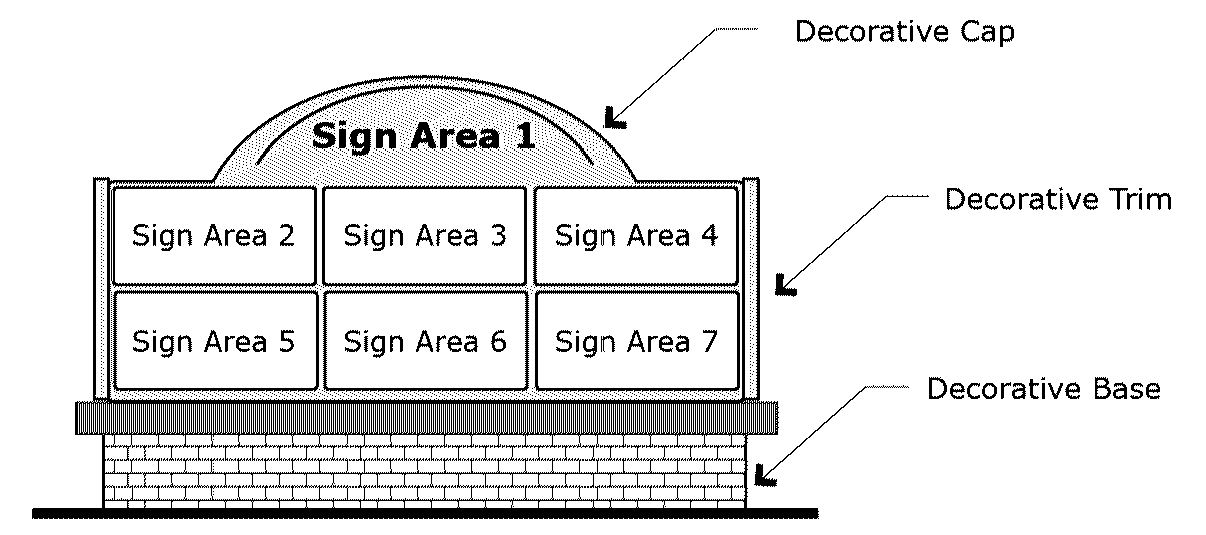
Multiple tenant sites. Monument signs for multiple tenant sites shall have no more than seven separate and distinct sign areas.
Figure No. 30-746.5.
(5)
Sign area bonus. Monument signs that include the official City logo or Route 66 iconography for properties adjacent to Foothill Boulevard, as approved by the Director of Community Development, shall be granted a sign area bonus of ten percent. The official City logo or Route 66 iconography shall be a minimum of four square feet, shall be located within the top 20 percent of the sign, and shall not count toward the sign height or sign area calculations. A modification permitted by this subsection shall not be additive to any modification allowance permitted by this article.
(6)
Decorative features required. Monument signs shall include decorative features, including a decorative cap, decorative base, and decorative trim in proportion to the sign. Decorative features shall not be included in any calculation of sign area, as long as letters and/or graphics do not appear on the decorative features. Decorative features shall be constructed of a decorative masonry material, including, but not limited to, stucco, rock, or veneer.
(7)
Landscaping required. Monument signs shall be located in a planted, landscaped area which is of a shape, design, and size that will provide a compatible setting and ground definition to the sign, as determined by the Director of Community Development. This requirement may be waived if the base of the sign structure is not visible from the adjacent right-of-way at grade.
(e)
Pylon sign. Pylon signs are permitted pursuant to Section 30-743 and Section 30-744 and the following regulations:
(1)
Location. Pylon signs must be placed:
a.
A minimum 100 feet of distance from any other monument sign or pylon sign on the subject property;
b.
A minimum 50 feet of distance from any other pylon sign on an adjacent property; and
c.
As near to the middle of the street frontage as practical or at a major driveway entrance to the commercial or industrial complex from the street frontage.
(2)
Setback. Pylon signs shall be set back a minimum of five feet from any property line. No portion of the sign shall project over any adjacent property or public right-of-way.
(3)
Sign copy. Except for electronic message signs on pylon signs, pylon sign copy shall be internally illuminated and shall be:
a.
Illuminated channel copy;
b.
Push-through copy; or
c.
Routed aluminum panel faces backed with Plexiglas.
(4)
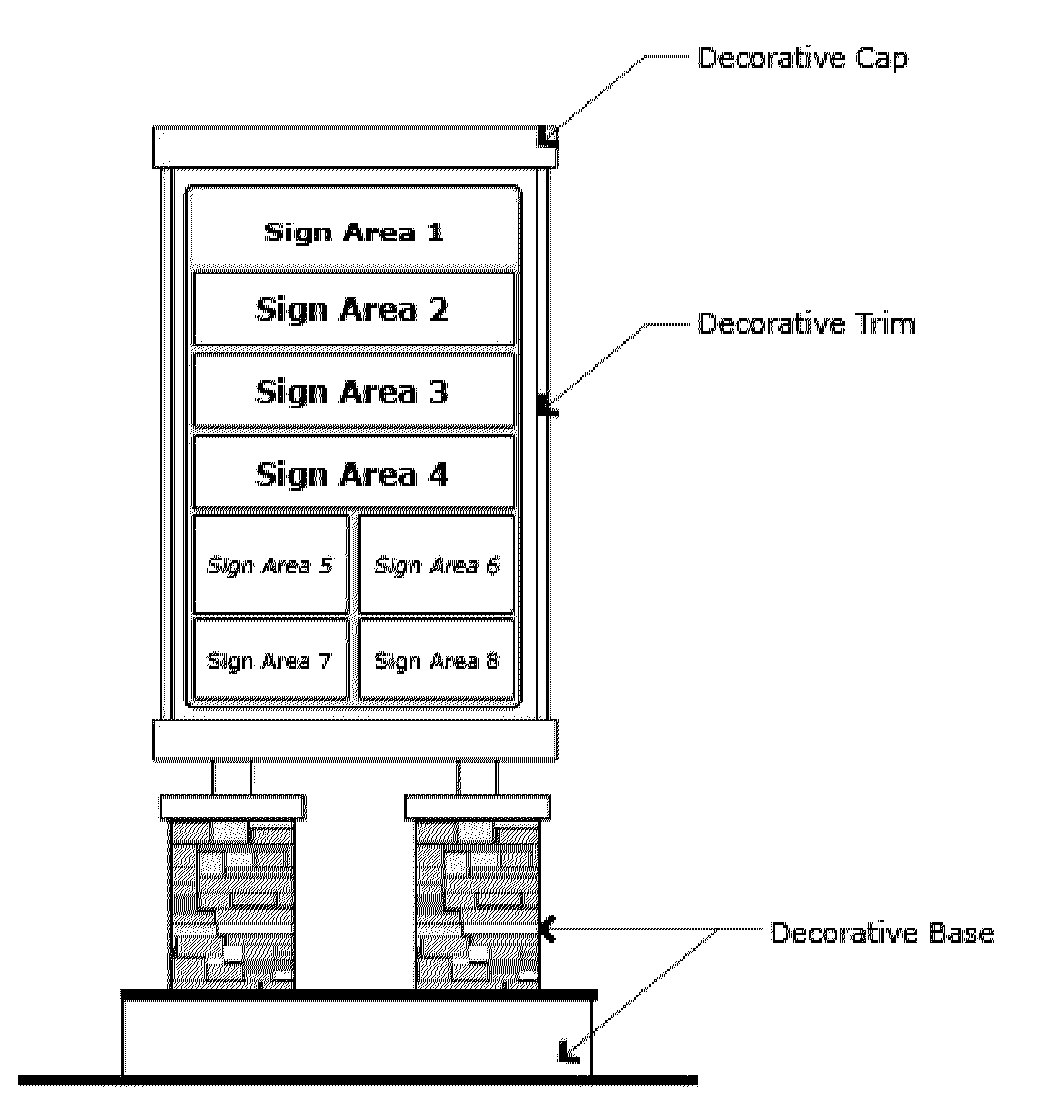
Multiple tenant sites. Pylon signs for multiple tenant sites shall have no more than eight separate and distinct sign areas.
Figure No. 30-746.6.
(5)
Sign area bonus. Pylon signs that include the official City logo or Route 66 iconography for properties adjacent to Foothill Boulevard, as approved by the Director of Community Development, shall be granted a sign area bonus of ten percent. The official City logo or Route 66 iconography shall be a minimum of six square feet, shall be located within the top 20 percent of the sign, and shall not count towards the sign height or sign area calculations. A modification permitted by this subsection shall not be additive to any modification allowance permitted by this article.
(6)
Electronic message signs on pylon signs.
a.
Where a pylon sign includes an electronic message sign, the minimum radial distance to any other electronic message sign shall be 600 feet.
b.
Electronic message sign copy is permitted to occupy up to 50 percent of the maximum allowable pylon sign area.
(7)
Decorative features required. Pylon signs shall include decorative features, including a decorative cap, decorative base, and decorative trim in proportion to the sign. Decorative features shall not be included in any calculation of sign area, as long as letters and/or graphics do not appear on the decorative features. Decorative features shall be constructed of a decorative masonry material, including, but not limited to, stucco, rock, or veneer.
(8)
Landscaping required. Pylon signs shall be located in a planted, landscaped area which is of a shape, design, and size that will provide a compatible setting and ground definition to the sign, as determined by the Director of Community Development. This requirement may be waived if the base of the sign structure is not visible from the adjacent right-of-way at grade.
(9)
Vertical clearance. A minimum vertical clearance of 14 feet is required for pylon signs projecting over vehicular passageways, where permitted. A minimum vertical clearance of eight feet is required for pylon signs projecting over pedestrian passageways, where permitted.
(f)
Wall sign. Wall signs are permitted pursuant to Section 30-742, Section 30-743, Section 30-744, and Section 30-745 and the following regulations:
(1)
Location.
a.
No wall sign shall cover, wholly or partially, any wall opening.
b.
Wall signs shall be placed flat against the wall of the structure and shall not project from the wall more than 12 inches.
(2)
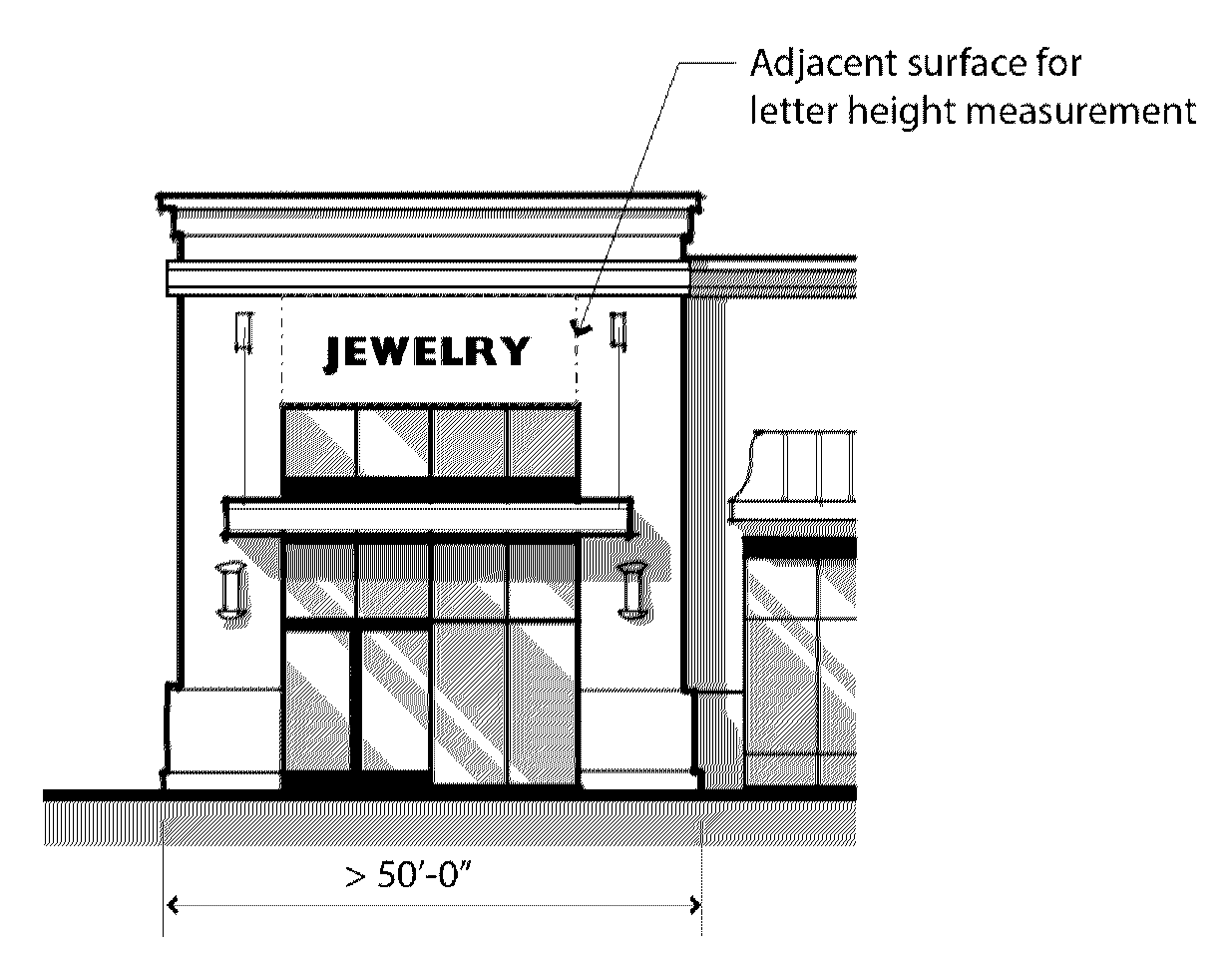
Letter height. Within multiple tenant commercial complexes, for tenants with less than 50 feet of business frontage, letter height shall be limited to 24 inches or 70 percent of the adjacent surface height, whichever is greater.
Figure No. 30-746.7.
(3)
Roofs signs in lieu of primary wall signs. Where a roof sign is permitted due to a lack of available building mansard for a sign, such roof sign's allowable area shall be equivalent to the allowed sign area for wall signs. Roof signs shall count as primary wall signs.
(4)
Exposed raceways. Exposed raceways for wall signs shall only be permitted by the Director of Community Development under the following circumstances:
a.
The architecture of a building prevents the enclosure of a raceway within a wall (e.g., sign located on a pitched roof below the roofline of a building). In these cases, the area behind the sign shall not be visible to the public; or
b.
Older complexes that extensively use cabinet signs may utilize exposed raceways, if the applicant can demonstrate that an enclosed raceway will require extensive structural changes to the exterior of a wall.
(5)
Downtown core. The area the wall sign is being constructed on (including the immediate adjacent area and plane surface area of the sign) may be modified when such changes enhance the visual quality of the sign. These modifications must be architecturally compatible with or enhance the aesthetic design of the attached building, including the materials, shapes and colors.
(Ord. No. 1868, § 9(Att. 2), 5-25-21; Ord. No. 1974, § 4(Exh. A), 9-9-25)
Sec. 30-747. - Permanent signs for specific uses.
This section establishes additional sign types and standards for specific uses.
(1)
Drive-through establishments. In addition to the signs permitted pursuant to Section 30-743, Section 30-744, and Section 30-745, businesses with drive-through(s) shall be allowed the following sign types and sign areas, subject to design review sign approval.
a.
Freestanding menu board signs.
1.
Number of signs and sign area. Two freestanding menu board signs are permitted for each establishment with a drive-through, each not exceeding 40 square feet (or not to exceed a combined 80 square feet).
2.
Height. Freestanding menu board signs shall not exceed eight feet in height. The freestanding menu board sign structure may extend above the sign height limit if:
i.
The sign structure is separately constructed from the cabinet or face of the sign;
ii.
The portion above the cabinet or face does not contain any copy; and
iii.
The extension adds architectural embellishments to the sign.
3.
Changeable copy. Menu board signs shall be permitted to use changeable copy (electronic message or manual).
4.
Screening. Menu board signs shall be screened from view from public rights-of-way and abutting properties.
b.
Porte-cochère signs.
1.
Number of signs and location. At drive-through establishments, a maximum of two porte-cochère signs shall be permitted on the porte-cochère façades oriented towards a parking lot, street, or driveway, with only one porte-cochère sign permitted on each porte-cochère façade.
2.
Sign area. Porte-cochère signs shall not exceed 12 square feet or 75 percent of the surface area of the porte-cochère façade on which it is located, whichever is less.
3.
Sign height. Porte-cochère signs shall not extend above 24 inches of the porte-cochère façade for which it is located, as measured from the lowest point on the sign.
4.
Vertical clearance. A minimum vertical clearance of 14 feet is required for porte-cochère signs projecting over vehicular passageways. A minimum vertical clearance of eight feet is required for porte-cochère signs projecting over pedestrian passageways.
(2)
New and used automobile and/or truck dealerships—Monument sign height. For new and used automobile and/or truck dealerships of five acres or more, the maximum sign height of monument signs shall be ten feet.
(3)
Fueling stations. See also Sections 13470 and 13530 of the Business and Professional Code. In addition to the signs permitted pursuant to Section 30-743, Section 30-744, and Section 30-745, fueling stations shall be allowed the following sign area and sign types subject to design review sign approval and the following regulations:
a.
Monument/pylon sign—Location. For fueling stations on corner properties, the 100-foot distancing requirement (subsection 30-746(d)(1)a and subsection 30-746(e)(1)a) shall not apply.
b.
Fueling island signs. Fueling island signs are allowed up to a maximum of two per each fueling island, with each such sign not exceeding four square feet.
c.
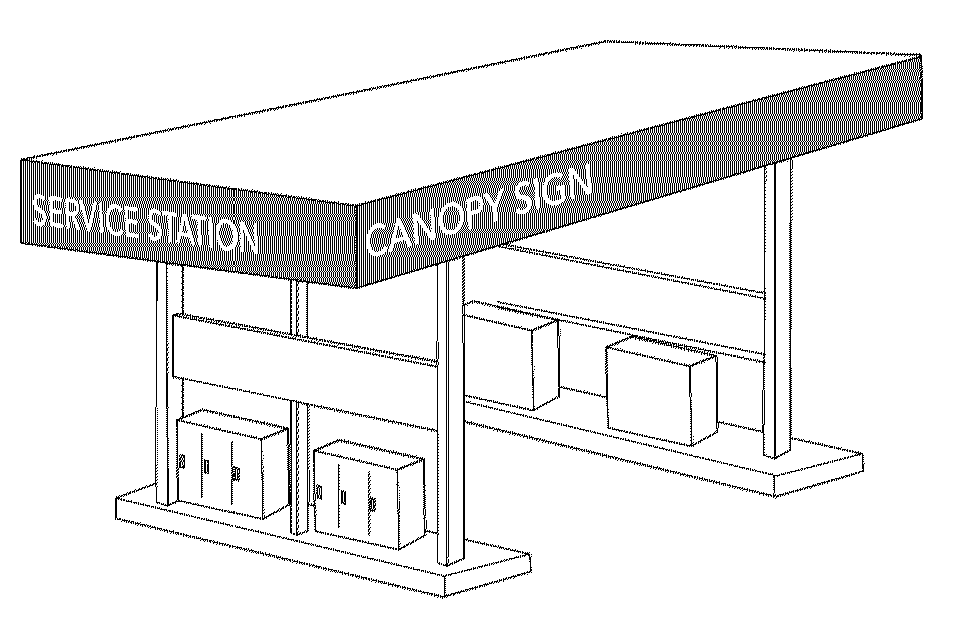
Fueling station canopy signs—Number and location. Three fueling station canopy signs are permitted on fueling station canopy façades oriented towards a parking lot, street, or driveway with only one fueling station canopy sign permitted on each façade. Fueling station canopy signs shall not extend above the eave line of the fueling station canopy. Digital signs are not permitted.
d.
Fueling station canopy signs—Sign area. Fueling station canopy signs shall not exceed 25 percent of the surface area of the canopy façade on which it is located.
Figure No. 30-747.1.
(4)
Theaters. In addition to the signs permitted pursuant to Section 30-743, Section 30-744, and Section 30-745, theaters shall be allowed theater marquee signs subject to design review sign approval and the following regulations:
a.
Number of signs. Theaters shall be permitted one theater marquee sign per street frontage, exclusive of freeways.
b.
Location.
1.
No theater marquee sign shall cover, wholly or partially, any wall opening.
2.
Theater marquee signs may extend above the eave line.
3.
Theater marquee signs shall project no more than seven feet from the face of the building wall upon which the sign is mounted.
4.
A minimum vertical clearance of at least eight feet from bottom of a theater marquee sign to highest finished grade shall be maintained.
5.
Any encroachment into City right-of-way is subject to City Engineer approval and requires an encroachment permit.
c.
Sign Area. Theater marquee signs shall not exceed 100 square feet in sign area.
d.
Height. Theater marquee signs shall not exceed 25 feet in height.
e.
Illumination. Internal and/or external illumination shall be approved by the Director of Community Development.
f.
Changeable copy. Theater marquee signs shall be permitted to use changeable copy (electronic message or manual).
(5)
Nonresidential uses within the downtown boundary. In addition to the signs permitted pursuant to Section 30-743, nonresidential uses within the downtown boundary shall be allowed additional sign area according to Table No. 30.747.A and subject to design review sign approval.
Table No. 30-747.A.
Nonresidential Uses within the Downtown Boundary
(Ord. No. 1868, § 9(Att. 2), 5-25-21; Ord. No. 1974, § 4(Exh. A), 9-9-25)
Sec. 30-748. - Purpose.
In addition to Division 1 of this article, the purpose of this division is to ensure that temporary signs do not create a distraction to the traveling public by limiting the proliferation of temporary signs and eliminating aesthetic blight and litter that are detrimental to the public's health, safety, and welfare.
(Ord. No. 1868, § 9(Att. 2), 5-25-21)
Sec. 30-749. - General standards for all temporary signs.
(a)
Temporary sign content neutrality. All regulations and standards in this division are to be exercised in light of the City's content neutrality policy. These provisions are not intended to limit, censor, or restrict free speech.
(b)
Sign area. The number and area of temporary signs shall not be included in the calculation of permanent sign area.
(c)
Duration and removal of temporary signs. Temporary signs may be posted for no more than 60 days, unless otherwise specified in this article. Temporary signs and their components shall be promptly removed at the expiration of the design review temporary sign approval.
(d)
Materials maintenance. Temporary signs shall be well maintained pursuant to Section 30-737.
(e)
Illumination prohibited. Temporary signs shall not be illuminated.
(f)
Sign placement.
(1)
Temporary signs are allowed on private property only subject to permission of the property owner.
(2)
Temporary signs shall not be placed in any public right-of-way except in compliance with Division 9.
(Ord. No. 1868, § 9(Att. 2), 5-25-21)
Sec. 30-750. - Temporary sign standards for residential zoning districts.
See Section 30-721 for permitted temporary sign types and standards in residential zoning districts, including residential activities such as yard sales, new construction, and advertisement for a property that is for sale, rent, or lease.
(Ord. No. 1868, § 9(Att. 2), 5-25-21)
Sec. 30-751. - Temporary sign standards for nonresidential zoning districts.
Temporary signs shall comply with the standards set forth in this division. Table No. 30-751.A identifies the sign type, number, location, area, and height allowed within nonresidential zoning districts, along with any applicable additional regulations. The standards contained in Table No. 30-751.A are maximums, unless otherwise stated. The signs in Table No. 30-751.A are allowed in any combination unless otherwise noted in this division.
Table No. 30-751.A.
Nonresidential Zoning Districts
(Ord. No. 1868, § 9(Att. 2), 5-25-21; Ord. No. 1974, § 4(Exh. A), 9-9-25)
Sec. 30-752. - Standards by temporary sign type.
(a)
Temporary banner sign. Businesses and institutions may exhibit banner signs advertising an activity or event having a specific duration, or the end of which is related to a specific action.
(1)
Installation. Banner signs shall be affixed to a permanent structure. Banner signs shall be securely affixed at all corners and other points as necessary.
(2)
Projection. Banner signs shall not project above the edge of the roof of a structure.
(3)
Materials and maintenance. Banner signs shall be professionally crafted and well maintained (i.e., not torn, bent, faded, or dirty). Acceptable materials for banner signs include vinyl, nylon reinforced vinyl, mesh, PVC film, polypropylene, polyethylene or polyester-like materials, or similar materials.
(b)
Temporary feather sign. Businesses and institutions may exhibit feather signs related to an activity or event having a specific duration, or the end of which is related to a specific action.
(1)
Location and setback. Feather signs shall not interfere with either pedestrian or vehicular sight distance, any view corridor, or obstruct views to any existing business or existing permanent sign. Feather signs shall be set back a minimum of five feet from any property line and located within a landscaped setback.
(2)
Duration. Feather signs are permitted during the hours a business is open for business and one-half hour before opening and one-half hour after closing. Feather signs shall be removed during hours when the establishment is not open to the public.
(3)
Materials and maintenance. Feather signs shall be professionally crafted and well maintained (i.e., not torn, bent, faded, or dirty). Acceptable materials for feather signs include vinyl, nylon reinforced vinyl, polyethylene or polyester-like materials, durable fabric, or similar materials.
(c)
Temporary yard sign. Businesses and institutions may exhibit yard signs related to an activity or event having a specific duration, or the end of which is related to a specific action.
(1)
Location and setback. Yard signs shall be located outside of public rights-of-way. Yard signs shall be set back at least one foot from any property line and located within the landscaped setback.
(2)
Installation. Yard signs shall be installed securely in the ground.
(Ord. No. 1868, § 9(Att. 2), 5-25-21)
Sec. 30-753. - Purpose.
The purpose of a general advertising sign (billboard) relocation agreement is to reduce the number of general advertising signs (billboards) in the City by removing existing general advertising signs in exchange for allowing relocation of general advertising signs to more suitable locations, and to provide more attractive, aesthetically pleasing general advertising sign (billboard) designs and/or electronic message displays. This purpose realizes a goal which is consistent with a 2004 study supported and adopted by the City Council in 2006, and prepared by the County of San Bernardino in collaboration with the cities of Colton, Fontana, Ontario, and Rialto together with the California Department of Transportation and San Bernardino County Transportation Authority, entitled "I-10 Corridor Analysis." The study identified the desire to appropriately manage the signage found in the corridor, with a particular emphasis on off-site advertising signs.
A further purpose is to reduce or eliminate the City's obligation to expend public funds for the removal of legal nonconforming general advertising signs. General advertising sign relocation agreements are part of the demonstrated commitment of the City to improve the aesthetic appearance of the City.
(Ord. No. 1868, § 9(Att. 2), 5-25-21)
Sec. 30-754. - Authority.
Notwithstanding any other provision of this article, and consistent with the California Business and Professions Code Outdoor Advertising provisions, existing general advertising signs may be removed, relocated, replaced and/or reconstructed as part of a general advertising sign relocation agreement between the City and a general advertising sign owner and/or property owner. A permit application shall be submitted on the appropriate forms provided by the Community Development Department accompanied by the processing fee established by resolution of the City Council. In all cases, the City Council shall retain the sole and exclusive right to determine whether to execute such an agreement. Nothing in this article shall be construed as allowing construction of a new general advertising sign which is not part of the relocation and/or consolidation of existing general advertising signs.
(Ord. No. 1868, § 9(Att. 2), 5-25-21)
Sec. 30-755. - Net reduction of existing general advertising signs; revenue sharing.
Any legal, nonconforming general advertising sign located within the City may be considered a candidate for removal and relocation pursuant to an agreement as provided in this division. In order to be eligible to relocate an existing general advertising sign structure, the general advertising sign owner must commit to at least one of the following:
(1)
The permanent removal of three general advertising sign structures, located in the City of Fontana, each containing the same or greater number of advertising displays, and each of which are the same size or larger (in square feet) than those proposed for the relocated general advertising sign; or
(2)
The permanent removal of any number or size of existing static general advertising sign structures, totaling at least 4,032 square feet. However, the general advertising sign structures to be removed shall be those within the discretion of the City Council, of which first priority shall be existing general advertising sign structures located on the I-10 Freeway and second priority shall be general advertising sign structures located on the non-freeway arterial streets within the City.
This net reduction requirement applies where the relocated general advertising sign incorporates either static or electronic message advertising displays. In addition, a general advertising sign relocation agreement may include provisions for the sharing of revenue, as such sharing may be negotiated in the agreement.
(Ord. No. 1868, § 9(Att. 2), 5-25-21)
Sec. 30-756. - Relocated general advertising signs accommodating a public need.
Where removal of an existing general advertising sign is required to accommodate a public improvement or acquisition of public right-of-way, the City may enter into a general advertising sign (billboard)relocation agreement with the general advertising sign owner to facilitate relocation of that general advertising sign to alleviate the expenditure of public funds. General advertising signs relocated pursuant to this section do not need to be accompanied by a net reduction in existing general advertising sign area. The relocated general advertising sign shall have the same method of advertising and sign display dimensions. Electronic message advertising display(s) are not permitted unless the general advertising sign being relocated has electronic message advertising display(s), or the general advertising sign relocation agreement otherwise complies with the requirements of Section 30-755.
(Ord. No. 1868, § 9(Att. 2), 5-25-21)
Sec. 30-757. - Status of existing general advertising signs.
Except as provided in Section 30-758 below, only general advertising signs that are legal nonconforming general advertising signs as of the date of adoption of this article are eligible to be relocated pursuant to a general advertising sign relocation agreement.
(Ord. No. 1868, § 9(Att. 2), 5-25-21)
Sec. 30-758. - Previously removed general advertising sign structures.
General advertising sign structures permanently removed within 12 months prior to the effective date of this article can be considered toward fulfillment of the net reduction requirements included in Section 30-755 where the applicant provides, at the City's request, additional consideration in the general advertising sign relocation agreement. The additional consideration is in addition to the required net reduction and may include, but shall not be limited to, providing the City advertising space on the relocated general advertising sign or additional general advertising sign removals. The exact type of additional consideration shall be open to negotiation on a case-by-case basis.
(Ord. No. 1868, § 9(Att. 2), 5-25-21)
Sec. 30-759. - Relocation sites.
Property owned by the City shall be given preference in such relocation agreements.
(Ord. No. 1868, § 9(Att. 2), 5-25-21)
Sec. 30-760. - General advertising sign relocation agreement—Content.
Each general advertising sign relocation agreement shall contain, at a minimum, the following information:
(1)
The existing location, height, sign face square footage, construction style, and remaining unamortized term of the general advertising sign structure(s) to be relocated and proof satisfactory to the City that it was legally erected (e.g., permits);
(2)
The proposed (new) location and size of the general advertising sign structure(s) to be relocated;
(3)
The date that the existing general advertising sign structure(s) are to be permanently removed;
(4)
Design drawings for the relocated general advertising sign(s);
(5)
Requirements for maintenance and repair;
(6)
Operational and content requirements, including any restrictions on sign content and compliance with the Outdoor Advertising Association of America's Code of Industry Principles;
(7)
Lease terms if the general advertising sign structure is to be relocated to a City-owned property; and
(8)
Provisions requiring indemnification of the City, its officials, and employees.
(Ord. No. 1868, § 9(Att. 2), 5-25-21)
Sec. 30-761. - General advertising sign relocation agreement—Review process.
(a)
All general advertising sign relocation agreements shall be reviewed and approved by the City Council.
(b)
An application for a design review and conditional use permit shall be reviewed and approved by the Planning Commission.
(Ord. No. 1868, § 9(Att. 2), 5-25-21)
Sec. 30-762. - General advertising sign relocation agreement—Design criteria.
Typical general advertising sign design with a large sign area mounted on a pole is not permitted. Pylon signs which are structural elements with decorative features are required. Suitable design shall be based on the following considerations:
(1)
The design and size shall be integrated into the design scheme of the surrounding area and/or building;
(2)
The design shall provide architectural interest for the structure;
(3)
The design shall incorporate decorative features around the general advertising sign structure in proportion to the sign;
(4)
The height of the structure shall be determined by a flag test mutually acceptable to the City and applicant; and
(5)
The applicant shall provide information to the City regarding luminosity or brightness of the proposed electronic message signs.
(Ord. No. 1868, § 9(Att. 2), 5-25-21)
Sec. 30-763. - General advertising sign relocation agreement—Findings.
The following findings must be made by the City Council in order to approve a general advertising sign relocation agreement:
(1)
The proposed relocation agreement is consistent with the goals, objectives, purposes, and provisions of the general plan, zoning and development code, and/or any applicable specific plan(s), and the County of San Bernardino I-10 Corridor Analysis (2004);
(2)
The proposed relocation agreement contributes to the reduction of visual clutter in the City, or for relocations to accommodate a public project, and the proposed relocation agreement serves the public interest by eliminating the need for public fund expenditures;
(3)
The area does not have excessive visual clutter and the design and size of the proposed general advertising sign will be compatible with the surrounding area;
(4)
The proposed general advertising sign would not create traffic or safety hazards with regard to on-site access circulation or visibility;
(5)
The proposed general advertising sign would not interfere with on-site parking or landscaping required by City ordinance or permit;
(6)
The proposed relocation agreement proposes a net decrease in existing general advertising signs, resulting in a reduction in advertising square footage within the City; and
(7)
The proposed general advertising sign would not otherwise result in a threat to the general health, safety, and welfare of City residents.
These findings are to also serve as general guidelines for use by applicants and the City in the identification of potential suitable relocation sites. Specific sites within suitable areas will be negotiated through the relocation agreement process.
(Ord. No. 1868, § 9(Att. 2), 5-25-21)
Sec. 30-764. - Design review general advertising sign applications.
Subsequent to the approval of a relocation agreement by the City Council, the general advertising sign and/or property owner shall file a design review sign application to relocate or reconstruct the general advertising sign (billboard) structures as authorized by the general advertising sign (billboard) relocation agreement, pursuant to the provisions of Division 4. A design review sign application shall be submitted on the appropriate forms provided by the Community Development Department accompanied by the processing fee established by resolution of the City Council. The Director of Community Development shall approve the design review general advertising sign applications if the design and the location of the proposed relocated general advertising sign is consistent with the relocated general advertising sign design and location approved as part of the relocation agreement and the design review and conditional use permit approved by the Planning Commission.
(Ord. No. 1868, § 9(Att. 2), 5-25-21)
Sec. 30-765. - Nonconforming general advertising signs.
Any nonconforming general advertising sign relocated or reconstructed pursuant to an approved relocation agreement shall no longer be considered nonconforming for purposes of this article.
(Ord. No. 1868, § 9(Att. 2), 5-25-21)
Sec. 30-766. - Intent as to public forum.
As it relates to the placing of signage on public property, the City declares its intent that all public property in the City shall not function as a designated public forum, unless some specific portion of public property is designated herein as a public forum of one particular type. In such case, the declaration as to public forum type shall apply strictly and only to the specified area and the specified time period, if any.
(Ord. No. 1868, § 9(Att. 2), 5-25-21)
Sec. 30-767. - Private party signs generally banned.
Except as expressly allowed by a provision of this article, or another provision of law, private parties may not display or post signs on public property or in the public right-of-way.
(Ord. No. 1868, § 9(Att. 2), 5-25-21)
Sec. 30-768. - Signs that are exempt from the general ban.
The following signs are exempted from the general ban:
(1)
Traffic control and traffic directional signs erected by a governmental unit.
(2)
Official notices required by law.
(3)
Signs placed by the City.
(4)
Signs that have received an encroachment permit from the City of Fontana.
(Ord. No. 1868, § 9(Att. 2), 5-25-21)
Sec. 30-769. - Authorized signs on public properties and structures.
Private advertising signs may be placed on structures in the public right-of-way, such as bus shelters, if there is a licensing agreement approved by the City Council authorizing such general advertising signs on public property. A design review sign application must be approved prior to the construction of general advertising signs on public property, and the applicant and the owner of the sign shall comply with the provisions of Section 30-736 and Section 30-737.
(Ord. No. 1868, § 9(Att. 2), 5-25-21)
Sec. 30-771. - Enforcement.
Any sign posted on public property or the public right-of-way in violation of the provisions of this article is declared to be a trespass and a public nuisance, may be summarily removed by the City without notice, and the persons or parties responsible for such unauthorized posting may be charged with the City's actual costs of removal. In addition, any violation of this article may be enforced or punished in any manner prescribed by law.
(Ord. No. 1868, § 9(Att. 2), 5-25-21)
Sec. 30-772. - Encroachment.
Any sign proposed to project into the public right-of-way, or into public property, shall require an encroachment permit.
(Ord. No. 1868, § 9(Att. 2), 5-25-21)
Sec. 30-774. - Applicability.
This division applies to any permanent or temporary sign, including its physical structure and supporting elements, which was lawfully erected and maintained in compliance with all applicable laws in effect at the time of original installation, but which does not currently comply with the provisions of this article. This division shall not apply to any legal signs made nonconforming by action of the City to widen a right-of-way.
(Ord. No. 1868, § 9(Att. 2), 5-25-21)
Sec. 30-775. - Permitted modifications and maintenance to nonconforming signs.
The following modifications and maintenance to nonconforming signs are allowed:
(1)
A nonconforming sign may be continued and shall be maintained in good condition as required by this article, unless provided otherwise in this division.
(2)
Sign copy and face changes, nonstructural modifications, and nonstructural maintenance (e.g., painting and rust removal) are allowed.
(3)
Nonconforming signs may be altered or reconstructed so as to decrease the discrepancy between existing conditions and current standards for sign area, height, setback, or other standards, provided such alteration or reconstruction does not increase the sign area or height or encroach into a required sign setback area.
(4)
A nonconforming sign may be restored to its original condition if 50 percent or less of the replacement value of the sign is damaged due to force majeure, fire, or vandalism, or an accident; provided that the restoration is started within 90 days of the damage occurring and is diligently pursued to completion. A nonconforming sign is deemed to be more than 50 percent damaged if the estimated cost of reconstruction or repair exceeds 50 percent of the replacement cost as determined by the Building Official.
(Ord. No. 1868, § 9(Att. 2), 5-25-21)
Sec. 30-776. - Prohibited modifications to nonconforming signs.
A nonconforming sign shall not be:
(1)
Changed to another nonconforming sign;
(2)
Altered unless required by law or unless the alteration results in the reduction or elimination of the nonconformity;
(3)
Enlarged; or
(4)
Moved or replaced, unless required to accommodate street widening or other City projects.
(Ord. No. 1868, § 9(Att. 2), 5-25-21)
Sec. 30-777. - Nonconforming sign removal.
A nonconforming sign shall be removed or modified to comply with this article if the following occurs:
(1)
Any modifications prohibited by Section 30-776 are made to the sign;
(2)
The sign is temporary;
(3)
The sign is or may become a danger to the public or is unsafe;
(4)
The sign constitutes a traffic hazard not created by the relocation of streets or by acts of the City;
(5)
The building on which the nonconforming sign is located is demolished; or
(6)
The nonconforming sign has been abandoned or the use of the property on which the nonconforming sign is located has been discontinued for a continuous period of 12 months.
(Ord. No. 1868, § 9(Att. 2), 5-25-21)
Sec. 30-778. - Exception.
This division shall not apply to any sign that may not be removed pursuant to the provisions of Business and Professions Code Section 5412.5 but only during the period of time that Business and Professions Code Section 5412.5 remains in force and effect.
(Ord. No. 1868, § 9(Att. 2), 5-25-21)
Sec. 30-779. - Director of Community Development responsibilities.
It shall be the duty of the Director of Community Development to enforce all of the provisions of this article.
(Ord. No. 1868, § 9(Att. 2), 5-25-21)
Sec. 30-780. - Violations.
(a)
Penalties and abatement of nuisances. It is illegal to use, occupy, or maintain property in violation of this article. Any violation or failure to comply with the provisions of this article shall render a person guilty of a misdemeanor, and such person shall be punished in accordance with the provisions of Section 1-7. In addition to any administrative, criminal, nuisance, or other enforcement procedure, the City may withhold the issuance of business licenses, building permits, grading permits, certificates of occupancy, and other land use entitlements and may issue stop work orders for a development project failing to comply with the provisions of this article.
(b)
Procedure for notification of violation. When a sign has been found to have been erected, installed, painted, constructed or altered in violation of the provisions of this article, a notice of violation shall be given as specified in Chapters 1 and 18 of the Municipal Code.
(c)
Removal of signs to correct violations. If the option of removing signs in violation is exercised, the signs shall be completely removed, including all poles, structures, electrical equipment, cabinets, and sign faces. Building walls, grounds, or other items on which such signs have been placed shall be restored to good repair and appearance.
(Ord. No. 1868, § 9(Att. 2), 5-25-21)
Sec. 30-781. - Sign variances.
(a)
Purpose. The purpose of a sign variance is to provide for deviations from the literal provisions of this article in instances where their strict enforcement would cause practical difficulties because of circumstances unique to the individual sign under consideration, and to grant such variances only when it is demonstrated that such actions align with the applicability and the findings of this section.
(b)
Authority. The Planning Commission is authorized to approve or deny sign variance applications.
(c)
Application.
(1)
Applications for a sign variance shall be filed with the Planning Division on forms, and accompanied by data, information, and fees as required by the Planning Department. No application shall be considered by the Planning Commission until the application is determined to be complete and all required fees have been paid to the City.
(2)
At a minimum, the application shall include:
a.
A statement that the applicant is the owner of the subject property or an agent thereof;
b.
The legal description of the property involved, the proposed use, and site plans;
c.
A reference to the specific provisions of this article that are applicable to the requested sign variance; and
d.
The specific use and standard for which the sign variance is being requested shall be described in detail.
(d)
Limitation on variances. In no case shall any sign variance be granted that would result in a sign that exceeds the height, size, or setback provisions of this article by 25 percent or that would increase the number of signs permitted by this article by more than 25 percent.
(e)
Findings. The following findings are required to be made by the Planning Commission for approval of a sign variance application, with or without conditions:
(1)
Variances from the terms of this article shall be granted only when, because of special circumstances applicable to the property, including size, shape, topography, location or surroundings, the strict application of the article deprives such property of privileges enjoyed by other property in the vicinity and under identical zoning classification. Any variance granted shall be subject to such conditions as will assure that the adjustment thereby authorized shall not constitute a grant of special privileges inconsistent with the limitations upon other properties in the vicinity and zone in which such property is situated. A variance shall not be granted for a parcel of property which authorizes a use or activity which is not otherwise expressly authorized by the zone regulation governing the parcel of property. The provisions of this section shall not apply to conditional use permits.
(2)
The characteristics that make compliance with the requirements of this article difficult must be related to the premises for which the sign variance is sought, not some other location;
(3)
The characteristics that make compliance with the requirements of this article difficult must not have been created by the owner of the premises, a previous owner, or the applicant; and
(4)
The proposed sign variance will not be harmful or alter the essential character of the area in which the property is located, will not impair an adequate supply of light and air to adjacent property, or unreasonably increase congestion in public streets, or increase the danger of fire or endanger public safety, or unreasonably diminish or impair established property values within the surrounding area, or in any other respect impair the public health, safety, comfort, morals, or welfare of the inhabitants of the City.
(f)
Consistency. Any sign variance granted shall be subject to such conditions as will ensure that the adjustment thereby authorized shall not constitute a grant of a special privilege inconsistent with the limitations upon other properties.
(g)
Noticing. Notice of hearings for sign variances shall be as set forth in Chapter 30, Article II, Division 4.
(h)
Hearing. Upon receipt of a complete application for a sign variance, a time and place for the hearing before the Planning Commission shall be set.
(i)
Appeal. The decision of the Planning Commission shall be final unless an appeal is filed. An appeal could be made as set forth in Chapter 30, Article II, Division 5.
(j)
Time limitations. Each sign variance granted under the provisions of this article shall become null and void two years after the date of the action approving the sign variance unless:
(1)
The construction authorized by the sign variance or permit has been commenced within two years after the granting of the sign variance and diligently advanced to completion;
(2)
The decision approving a sign variance contains in its findings and conditions specific authority for extending the time limit defined; or
(3)
The Director of Planning finds that circumstances beyond the control of the applicant have caused delays which do not permit compliance with the time limits established.
(Ord. No. 1868, § 9(Att. 2), 5-25-21; Ord. No. 1906, § 71, 10-25-22)
Sec. 30-782. - Appeal process.
All appeals shall be subject to the requirements of this chapter.
(Ord. No. 1868, § 9(Att. 2), 5-25-21)
Sec. 30-783. - Definitions.
For purposes of this article, the following definitions shall apply:
A-frame sign. See "portable (a-frame) sign."
Abandoned sign means any lawfully erected sign, sign structure, advertising structure, or display that is not operated or maintained for a period of one year or longer. The following conditions shall be considered as the failure to operate or maintain a sign: (a) the sign displays advertising for a product of service that is no longer available; (b) the sign displays advertising for a business that is no longer licensed; (c) the sign advertises a business that is no longer doing business on the parcel where the sign is located; (d) the sign has a purpose for which the purpose has lapsed; or (e) the sign is blank.
Alter; alteration means any change in the weight, depth, height, area, thickness, materials, location, or type of display of an existing sign but shall not be construed to prevent normal or periodic maintenance, upkeep, or repair of a sign or change of copy (e.g., repainting).
Animated sign means a sign, other than an electronic message sign, whereby the sign itself or the information conveyed incorporates or involves action, motion, or the appearance of action or motion, such as flashing lights, color changes, moving parts, reflective materials, traveling, tracing, or scrolling messages, rotating images, or video-like features.
Awning sign means any sign that is painted or applied to the face, valance, or side panel of a projecting structure consisting of a frame and a material covering, attached to and wholly supported by a building wall and installed over and partially in front of doors, windows, or other openings in a building.
Balloon. See "inflatable sign."
Banner sign or banner means a temporary sign composed of cloth, canvas, plastic, fabric, or similar lightweight, non-rigid material that can be mounted to a structure with screws, cord, rope, cable, or a similar method. This sign type does not include flags (see "flags").
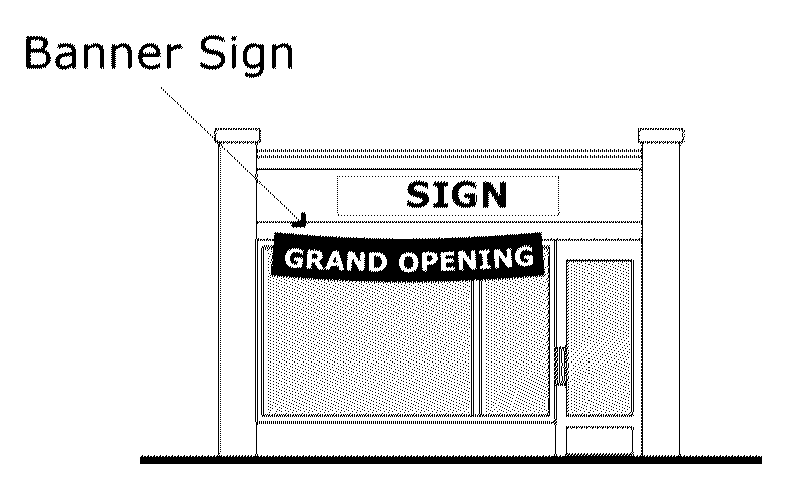
Billboard. See "general advertising sign (billboard)."
Blade sign. See "projecting sign."
Building means any structure built for the support, shelter, or enclosure of persons, animals, fowls, chattels, or personal property of any kind.
Building frontage. See "frontage, building."
Business frontage. See "frontage, business."
Cabinet, cabinet sign means a type of sign that contains all the text and/or logo symbols within a single enclosed frame with flat or shaped panels that is mounted to a wall or other surface (cabinet). Such sign structures typically use slide-in panels to display the message to the public.
Canopy means a permanent roof-like structure of rigid materials extending from the main entrance of a structure and is typically supported by posts at the corners farthest from where the canopy attaches to the structure.
Canopy, fueling station means a roof-like structure, typically consisting of supporting columns, at a fueling station that covers the fueling islands and surrounding fueling area.
Canopy sign means a sign that meets any one or more of these criteria: (a) a sign mounted on a permanent canopy; (b) a traditional industry term for the variable message portion of a canopy sign; and/or (c) an integral sign and permanent canopy.
Change of copy means changing of the face or letters on a sign.
Changeable copy means sign copy designed to be used with removable graphics which will allow changing of copy.
City Council means the City Council of the City of Fontana.
Commemorative sign means signs generally highlighting dates of construction, historic accomplishments, personal accolades, and the like when carved in stone, concrete, or similar material or made of bronze, aluminum, or other similar permanent material.
Commercial message means message concerning primarily a proposed economic transaction or the economic interests of the sign sponsor or audience.
Commercial mural. See "mural, commercial."
Complex, commercial or industrial means any group of two or more principal uses on a parcel or combination of parcels, which are generally served either by common access or common parking. Accessory uses shall not be considered in the calculation of the number of uses on a parcel or combination of parcels. Complexes may include commercial strip or commercial in-line development.
Conforming sign means a sign that is legally installed in accordance with federal, state, and local permit requirements and laws.
Content-neutral; time, place, and manner regulations means consistently applicable, nondiscriminatory sign regulations that specify—without reference to the content of the message—when, how, and where a sign can be displayed, with physical standards such as but not limited to height, size, and location, that allow the sign to be readable.
Contour sign means a cabinet sign where the outline of the cabinet follows the outline of the letters.
Contrast means the difference or degree of difference between things having similar or comparable natures, such as light and dark areas, colors, or typefaces.
Copy means the message or content of a sign, which may include letters, numbers, figures, and/or images.
Creative sign means a two- or three-dimensional representation of a unique sign that exhibits a high degree of thoughtfulness, imagination, and inventiveness and provides aesthetic enjoyment for the viewer while still conveying the name of the business or a commercial message about the products or services offered on the property upon which the creative sign is displayed.
Creative sign examples:
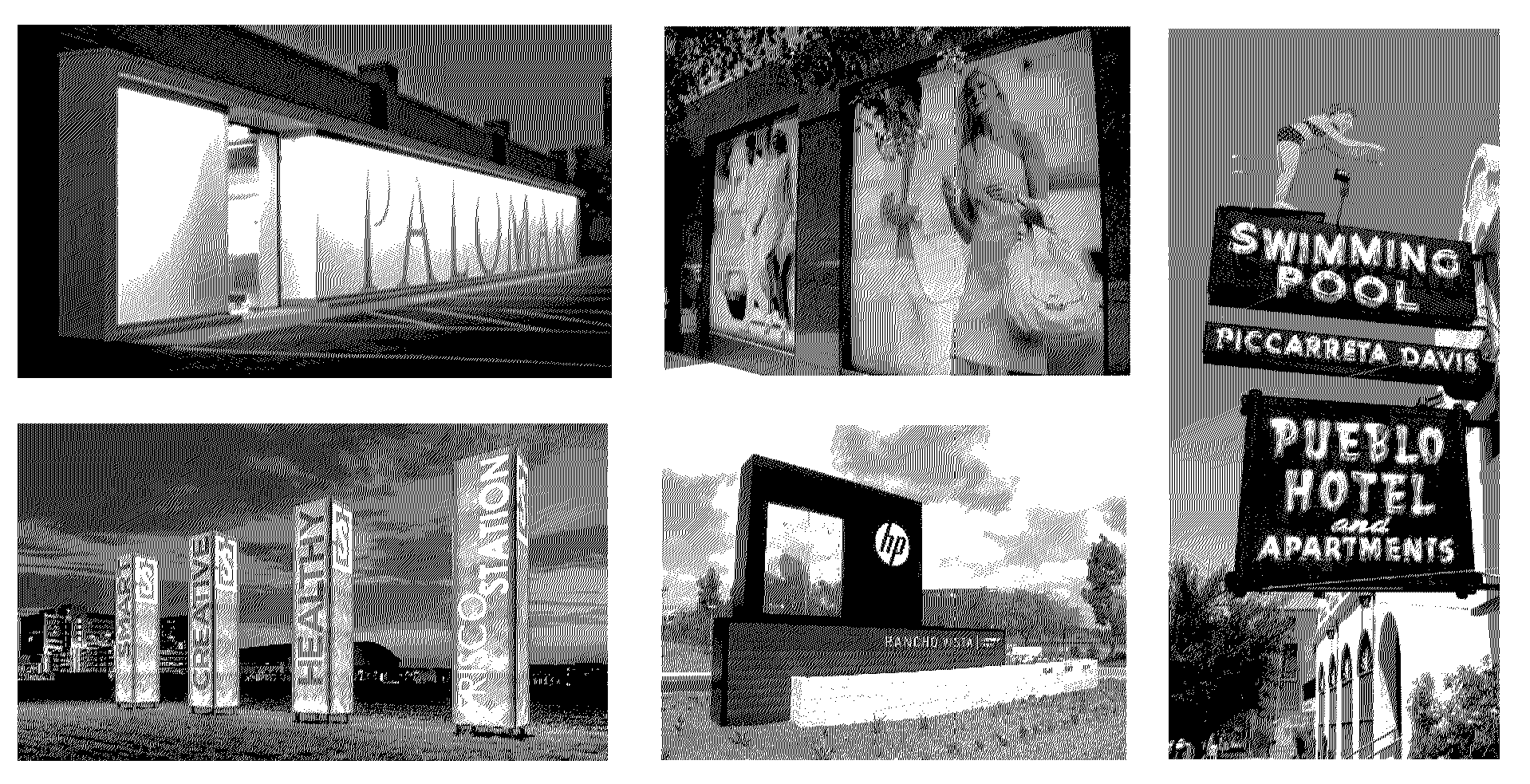
Decorative feature means the ornamental embellishments, adornments, and elements intended to enhance architectural compatibility and character of the sign with the surrounding built environment. Decorative features help to beautify the support structures and make the sign more aesthetically pleasing. Sign area calculations shall not include decorative features, so long as letters and/or graphics do not appear on the decorative features. However, sign height calculations shall include decorative features.
Decorative feature, base means a decorative masonry or natural stone base used to mount monument signs and pylon signs. Where a monument sign or pylon sign is to be constructed for a nonresidential use located within a brick or decorative masonry building, the decorative base shall be constructed of a decorative masonry material.
Decorative feature, cap means a decorative masonry or natural stone cap used to decorate the top of freestanding signs. Where a freestanding sign is to be constructed for a nonresidential use located within a brick or decorative masonry building, the decorative cap shall be constructed of a decorative masonry material.
Decorative feature, trim means a decorative masonry or natural stone trim used to decorate the sides of freestanding signs.
Digital sign. See "electronic message sign."
Director of Community Development means the Director of Community Development of the City of Fontana, which shall include his or her designee.
Display area. See "sign area."
Double-sided sign means a sign constructed to display its message on two parallel opposing (back-to-back) faces.
Driveway/on-site traffic directional sign means a sign located adjacent to a pedestrian or vehicle travel way that is internal to a site or complex, intended to provide orientation and safety assistance.
Eave line means the bottom of the roof eave or parapet.
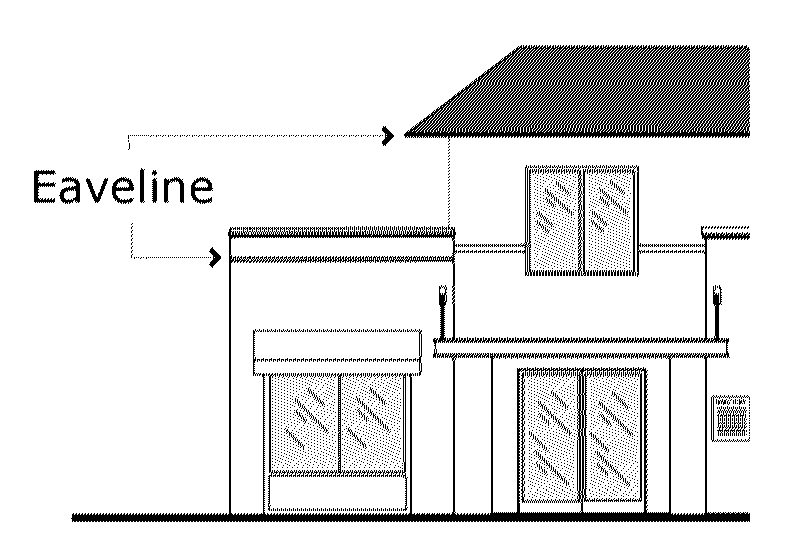
Electronic message sign means a variable message sign that utilizes computer-generated messages or some other electronic means of changing copy. These signs generally include displays using LEDs (light emitting diodes), CCDs (charge coupled devices), plasma, or functionally equivalent technologies to display a series of still images or full motion, usually remotely programmable and changeable, and are sometimes referred to as "digital signs" and "LED signs."
Exposed raceways means an enclosed channel of metal or nonmetallic materials designed expressly for holding wires, cables, or busbars. Raceways include, but are not limited to, rigid metal conduit, rigid nonmetallic conduit, intermediate metal conduit, liquid tight flexible conduit, flexible metallic tubing, flexible metal conduit, electrical nonmetallic tubing, electrical metallic tubing, underfloor raceways, cellular concrete floor raceways, cellular metal floor raceways, surface raceways, wireways, and busways.
Externally illuminated sign means a sign that is illuminated by a light source that is located on the exterior of the sign or nearby and directed toward, and shines on the face of a sign.
Façade, building means an exterior side of a building, generally set facing a parking lot, street, or driveway. Refers to the side of a building to which a sign is attached.
Façade, porte-cochère means an exterior side of a porte-cochère, generally set facing a parking lot, street, or driveway. Refers to the side of a porte-cochère to which a porte-cochère sign is attached.
Face means the surface area on a sign where advertising copy is displayed.
Feather sign means a temporary sign constructed of cloth, canvas, plastic fabric, or similar lightweight, non-rigid material, typically taller than it is longer, and supported by a single vertical pole mounted into the ground or on a portable structure. This sign type does not include flags (see "flags").
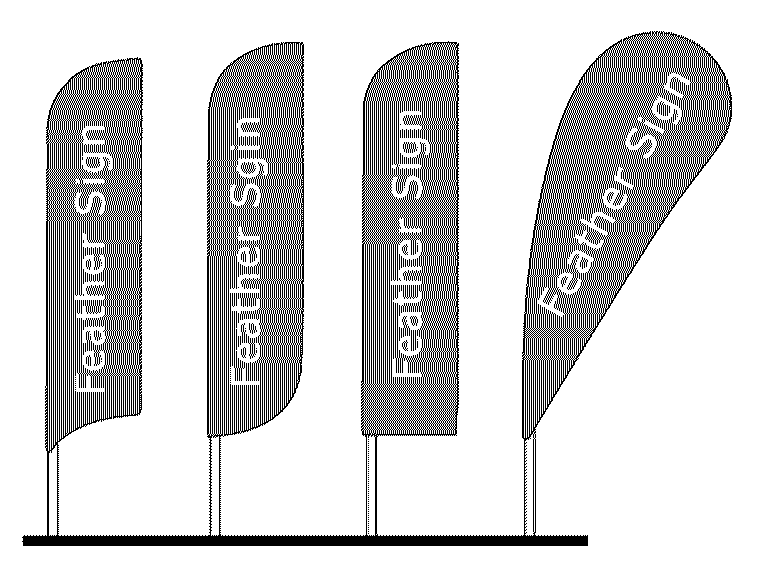
Flag means a fabric, cloth, plastic, vinyl, canvas, leather, or other similar material sheet of square, rectangular, or triangular shape that is attached to a staff cord and mounted on a pole. This sign type includes official flags of national, state, or local governments. This sign type does not include feather signs (see "feather sign"), banners (see "banners"), or pennants (see "pennants").
Flashing sign means a sign that contains an intermittent or sequential flashing light source. Generally, the sign's message is constantly repeated, and the sign is most often used as a primary attention-getting device.
Floor inlay sign means signs that are embedded into the walkway or sidewalk outside the entryway to a building.
Freestanding sign means a sign that is supported by one or more uprights, braces, poles, or other similar structural components that is not attached to a building or buildings.
Freeway means the Interstate 10 (I-10), Interstate 15 (I-15), and State Route 210 (SR-210) rights-of-way within the boundaries of the City of Fontana.
Freeway sign means a freestanding sign with high overall height oriented towards a freeway. Moreover, a freeway sign includes a decorative cap and trim. See "freestanding sign."
Frontage, building means the building façade width that directly abuts a public street, private street, parking lot, or parking space. The building frontage shall not include alleys, porte-cochères, and other drive-through structures.
Frontage, business means the width of a building occupied by a business tenant that fronts on a public street or faces a plaza, courtyard, pedestrian corridor or walkway, or parking lot, where customer access to the building is available. Width is measured as the widest point on an architectural elevation.
Frontage, parking lot means the portion of the building or property which faces or abuts a parking lot(s).
Frontage, street means the portion of the building or property which faces or abuts a street(s).
General advertising means the enterprise of advertising or promoting other businesses or causes, in contrast to self-promotion or on-site advertising; also known as "advertising for hire." See "general advertising sign."
General advertising sign (billboard) means a permanent sign in a fixed position that meets any one or more of these criteria: (a) the sign is routinely used for general advertising for hire; (b) the sign is used to display commercial advertising for a business not located on the same premises as the sign; (c) the sign is a separate economic unit, not an accessory or auxiliary use serving the principal use on the land; and/or (d) the message display area is made available to message sponsors other than the owner. "General advertising sign" does not include "freeway signs." "General advertising sign" may also be referred to as "billboard" or "outdoor advertising sign" in other sections of the Municipal Code.
General advertising sign, mobile. See "vehicle sign."
Graffiti means any unauthorized inscription, word, figure, mark, or design that is written, marked, etched, scratched, drawn, inscribed, or painted on any public or private real or personal property without the consent or permission of the owner thereof.
Graphic projection sign means a sign that uses a template that light shines through to project an image onto a surface.
Height, freestanding sign means the greatest vertical distance measured from the highest elevation of the adjoining finished grade at the mid-point of the freestanding sign support(s) that intersect the ground to the highest element of the freestanding sign as described in Section 30-735, unless otherwise specified in this article.
Height, wall sign means the greatest vertical distance measured from the highest point of the wall sign to the lowest point of the wall sign.
Iconography means the traditional or conventional images or symbols associated with a subject.
Illegal sign means a sign that meets any one or more of these criteria: (a) a sign erected without first complying with all ordinances and regulations in effect at the time of its construction and erection or use; (b) a sign which is a danger to the public or is unsafe; (c) a sign which is a traffic hazard not created by relocation of streets or highways or by acts of the City or county; and/or (d) a sign that is a public nuisance as defined under Article .
Illuminated means signs or individual letters in which an artificial source of light is used to make the message readable and includes both internally and externally lit signs.
Inflatable sign means a sign that is an air-inflated object such as a balloon, which may be of various shapes, made of flexible fabric, resting on the ground or a structure, and either filled with or helium gas or equipped with a portable blower motor that provides a constant flow of air into the device.
Internally illuminated sign means a sign that is illuminated by a light source contained inside the sign.
LED means light emitting diode.
Legal nonconforming sign means a legally established sign which fails to conform to the regulations of this chapter.
Legibility means the characteristics of letters, numbers, graphics, or symbols that make it possible to differentiate one from the other.
Logo means an established identifying symbol or mark associated with a business or business entity.
Luminance means the perceived brightness of an illuminated sign, measured in foot-candles above the ambient light level.
Major neighborhood entrance means an area proximate to the intersection of two streets, which creates the primary entryway(s) into a neighborhood officially recognized by the City of Fontana.
Mansard roof means a decorative fascia used to hide equipment or articles on the roof or to enhance the storefront appearance.
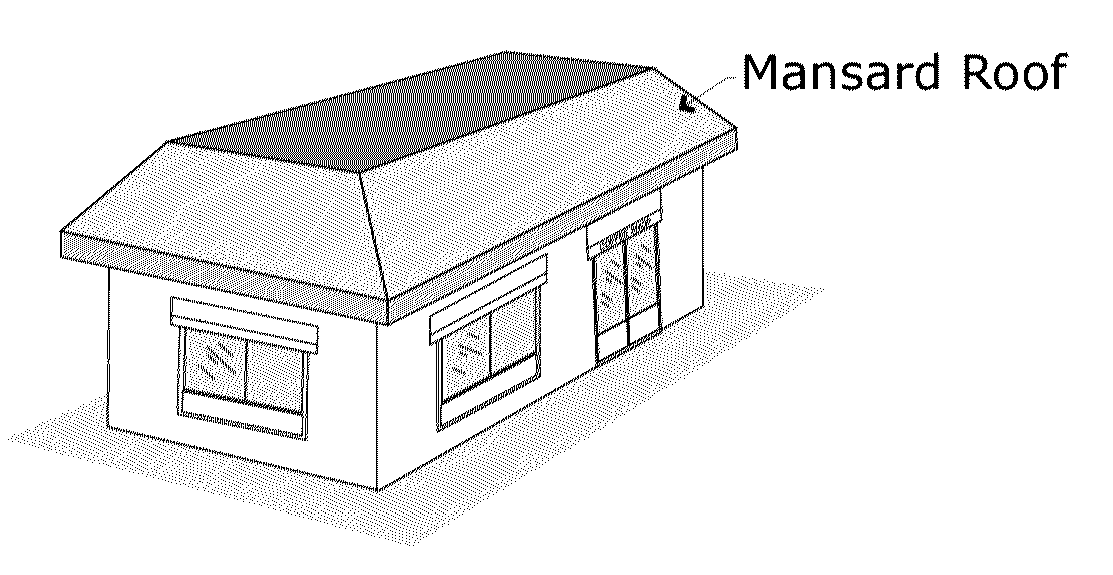
Marquee means a permanent roofed structure attached to and supported by the building and projecting from the building face and generally used to post or otherwise display copy associated with the on-site business. See also "canopy."
Marquee sign means a sign attached to a marquee.
Menu board means a permanently installed sign with changeable copy (electronic message or manual) for the purpose of providing product and/or service information for drive-through service at a business where customers remain seated in a vehicle occupying a drive-through service lane.
Message. See "copy."
Monument sign means a freestanding ground sign with low overall height and the appearance of having a solid base. Moreover, a monument sign includes a decorative base, cap, and trim. See "freestanding sign."

Multi-faced sign means a sign constructed to display its message on three or more connected faces.
Multiple tenant site. See "complex, commercial or industrial."
Mural, commercial means the graphic artwork applied to and made an integral part of an exterior wall of a structure, public or private, that is professionally applied by a sign manufacturer, artist, or similarly qualified entity or person, contains a commercial message (e.g., business logo or images of items for sale), and does not have any electrical or mechanical components. A mural is distinguishable from graffiti based on the property owner's permission to paint or affix the mural onto the property.
Mural, noncommercial means the graphic artwork applied to and made an integral part of an exterior wall of a structure, public or private, does not contain a commercial message (e.g., business logo or images of items for sale), and does not have any electrical or mechanical components. A mural is distinguishable from graffiti based on the property owner's permission to paint or affix the mural onto the property.
Neon sign means a sign illuminated by or utilizing neon tubing, and/or related inert gases, or products that produce the same or similar effect as neon, such as flexible light-emitting diode (LED) neon-like tubing which is visible to the viewer.
Noncommercial message means debate or commentary on topics of public concern, for example, politics, religion, philosophy, science, or art.
Noncommercial mural. See "mural, noncommercial."
Nonconforming sign means any permanent sign or temporary sign, including its physical structure and supporting elements, which was lawfully erected and maintained in compliance with all applicable laws in effect at the time of original installation, but which does not now comply with the provisions of this article.
Nonresidential zoning districts means zoning districts in Fontana that allow nonresidential uses, including commercial, industrial, and mixed-use zoning districts. This definition specifically excludes the following zoning districts: R-E, R-1, R-2, R-3, R-4, R-5, R-PC, and neighborhood and multiple-family zoning districts within the FBC.
Off-premises sign means any sign which advertises or informs in any manner businesses, services, or events at some location other than that upon which the sign is located. See also "general advertising sign."
On-premises sign means a communication device whose message and design relates to a business, an event, goods, profession, or service being conducted, sold, or offered at the location where the sign is erected. All noncommercial signs are considered on-premises signs.
Painted sign means a sign erected by means of painting the copy and all related material directly upon any portion of a building or other structure. This definition includes commercial murals.
Parapet means a wall-like barrier at the edge of a roof or structure.
Pennant means a triangular or irregular piece of fabric or other material, whether or not containing a message of any kind, commonly attached by strings or strands intended to flap in the wind. This sign type does not include flags (see "flag").
Permanent sign means a sign constructed of durable materials and attached to a building, structure, or the ground in a manner that will resist environmental loads such as wind, and precludes ready removal or movement of the sign, and intended to exist for the duration of time that the use or occupant is located on the premises.
Placed means erected, constructed, posted, painted, printed, tacked, glued, carved, or otherwise fastened, affixed, or made visible in any manner.
Planning Commission means the Planning Commission of the City of Fontana.
Pole sign means an elevated freestanding sign that is supported by one or more exposed poles that are permanently attached directly into or upon the ground.
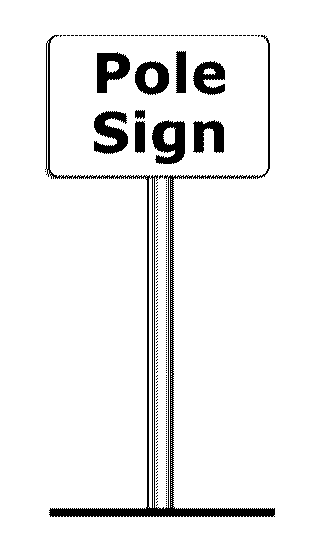
Portable (A-frame) sign means a sign that is not permanently affixed to a structure or the ground. Portable (A-frame) signs generally include A-frame structures or similar low-profile signs, and are usually hinged at the top, or attached in a similar manner, and widened at the bottom to form a shape similar to the letter "A." Portable (A-frame) signs may also be referred to as a sandwich board sign. Other variations of such signs may also be in the shape of the letter "T" (inverted) or the letter "H." This definition does not include feather signs.
Porte-cochère means a permanent roof-like structure of rigid materials attached to a drive-through establishment and typically supported by posts or pillars at the corners farthest from where the porte-cochère attaches to a drive-through establishment. Porte-cochères are large enough for vehicles to pass through and/or underneath.
Porte-cochère sign means any sign placed on a porte-cochère façade.
Porte-cochère sign examples:
Primary wall sign. See "wall sign, primary."
Projecting sign means a building-mounted sign with faces projecting from and perpendicular to the building fascia.
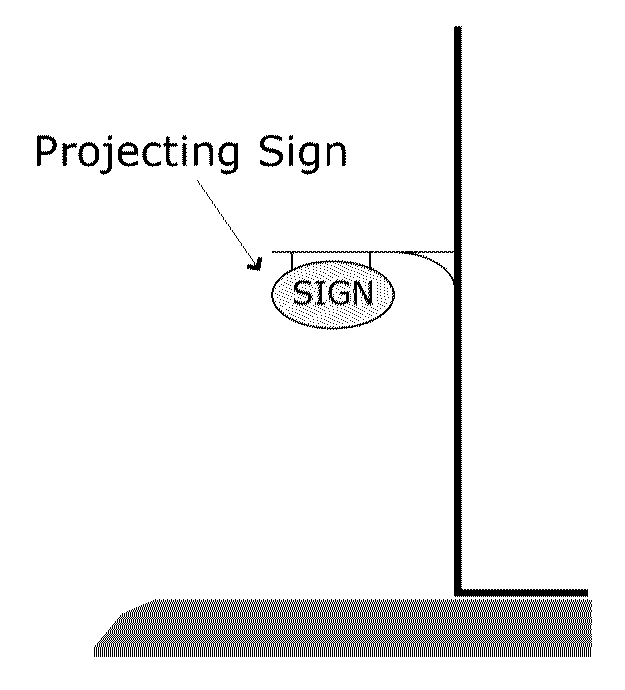
Public property means an area that is accessible to any member of the public. Includes land or other property in which the City of Fontana holds a present right of possession and control, City road easements, and all public rights-of-way, regardless of ownership.
Public nuisance means a sign, sign structure, or advertising structure that meets any one or more of these criteria: 1) a nuisance as defined in the Municipal Code; 2) an abandoned sign as defined in this section; and/or 3) an illegal sign as defined in this section.
Pylon sign means a freestanding sign that is supported and in direct contact with the ground or one or more solid, monumental structures or pylons and which typically has a sign face with a vertical dimension that is greater than its horizontal dimension. Moreover, a pylon sign includes a decorative base, cap, and trim. See "freestanding sign."
Responsible party means the person liable for placement of a sign. The following is a nonexclusive list of facts which when found to exist, shall constitute prima facie evidence that a person is a responsible party:
(1)
Based on information contained on the sign, and information from other sources, the person is identified as the owner or lessee of property used for the activity or event, and/or is the sponsor or promoter of the activity or event described on the sign.
(2)
Based on information that appears on the sign, and information from other sources, including, but not limited to, information establishing the individual or corporate identity of the owner of the sign, it is found that the person placed the sign or caused the sign to be placed.
Reviewing Body means the individual or official City body (e.g., Director of Community Development, Planning Commission, City Council) identified by this article as having the responsibility and authority to review, approve, and deny a permit application. May also be referred to as "responsible Reviewing Body."
Roof sign means a sign erected, constructed, or placed upon or over a roof of a building, including a mansard roof, and which is wholly or partly supported by such buildings.
Screening means fencing, landscaping, berms, walls, hedges, or a combination of techniques used to obscure the view from one site to another or from one site to any public right-of-way or publicly accessible area to a reasonable extent.
Secondary wall sign. See "wall sign, secondary."
Shopping center. See "complex, commercial or industrial."
Sign means a structure, device, figure, display, message placard, or other contrivance, or any part thereof, situated outdoors or indoors, which is designed, constructed, intended, or used to advertise, provide information in the nature of advertising, provide historical, cultural, archaeological, or social information, or direct or attract attention to an object, person, institution, business, product, service, event, policy, or location by any means, including words, letters, figures, designs, symbols, fixtures, colors, illumination, or projected images. The following do not fall within the definition of a sign for the purposes of this article.
(1)
Architectural or decorative features of buildings (not including lettering, trademarks, or moving parts).
(2)
Graphic images that are visible only from above, such as those visible only from airplanes or helicopters, but only if not visible from the street surface or public right-of-way.
(3)
Gravestones and grave markers.
(4)
Holiday and cultural observance decorations that are on display for not more than 60 calendar days per year (per parcel or use) and which do not include commercial advertising messages.
(5)
Manufacturers' marks on tangible products that identify the maker, seller, provider, or product and which customarily remain attached to the product even after sale.
(6)
Murals, painted or otherwise attached or adhered, with images or representation on the exterior of a structure that are visible from a public right-of-way or neighboring property; do not contain commercial advertisement (is noncommercial in nature); and are designed in a manner so as to serve as public art, enhance public space, and provide inspiration.
(7)
Colored or illuminated elements that contain no lettering, numbers, trademarks, or logos, and are located on a wall or canopy.
(8)
News racks and newsstands.
(9)
Merchandise on display and available for immediate purchase.
(10)
Shopping carts.
(11)
Symbols embedded in architecture such as symbols of noncommercial organizations or concepts including, but not limited to, religious or political symbols, when such are permanently integrated into the structure of a building; the definition also includes foundation stones and cornerstones.
(12)
Vehicle and vessel insignia as shown on street-legal vehicles and properly licensed watercraft including, but not limited to, license plates, license plate frames, registration insignia, noncommercial messages, messages relating to the business of which the vehicle or vessel is an instrument or tool (not including general advertising for hire), and messages relating to the proposed sale, lease, or exchange of the vehicle or vessel.
(13)
Vending machines that do not display off-site commercial messages or general advertising messages.
Sign area. See subsection 30-735(d) for specific rules for measuring the area of different sign types.
Sign band means a horizontal area above the entrances to a multiple tenant building, architecturally designed to accommodate signage in a sign-centric manner.
Sign copy means all portions of a sign displaying a message, including text, symbols, emblems, logos, or representations, but not including the supporting structures, decorative features, or base of a sign.
Sign copy, channel means sign copy with three-dimensional individual letters, symbols, emblems, logos, or representations, with an open back or front, illuminated or not illuminated, that are affixed to a building or to a freestanding sign structure with translucent faces, reverse lit channel letters, or push-through acrylic panels.
Sign copy, illuminated channel means channel sign copy with either an internal light source with an opaque face or an internal light source with a translucent face. The background illumination portion of illuminated channel sign copy is commonly referred to as halo lighting.
Sign copy, push-through means sign copy routed out of aluminum or other sign material and then pushed through the routed area to provide depth.
Sign face means the area of a sign on which copy is intended to be placed.
Sign structure, supporting structure means the structural portion of a sign securing the sign to the ground, a building, or to another structure including, but not limited to, columns, crossbeams, and braces.
Single face sign means a sign with only one face plane.
Sign, fueling island means a sign permanently affixed to pump islands of a fueling station or convenience store with gas pumps.
Structure means anything constructed or built. An edifice or building of any kind, or any piece of work artificially built up or composed of parts joined together in some definite manner. A building is a type of structure.
Suspended sign means a sign that is suspended from the underside of an eave, canopy, awning, arcade, or other covered walkway.
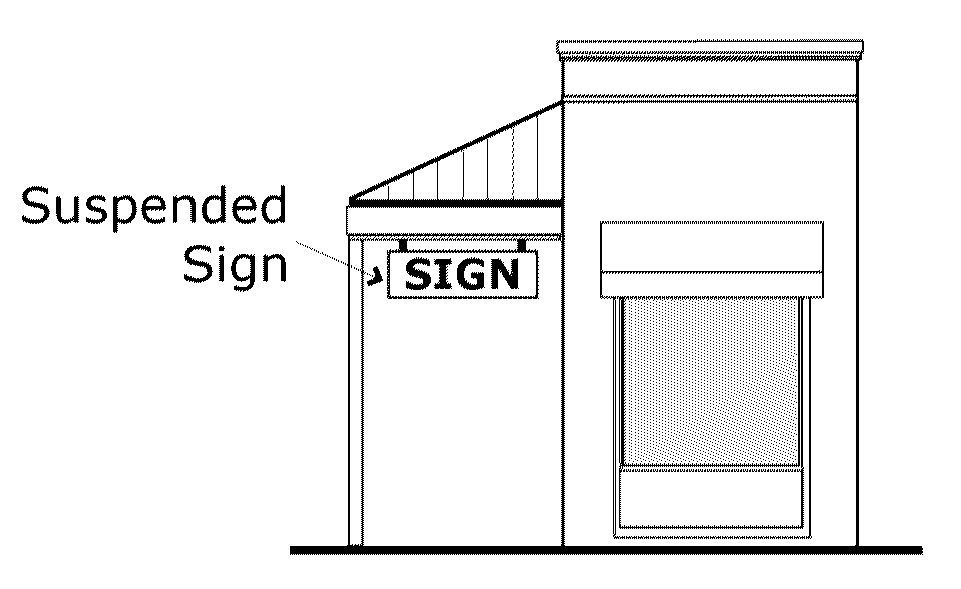
Temporary sign means a sign that is intended to be displayed for a definite and limited period of time and which is not permanently installed, affixed, or maintained on a building or structure.
Three-dimensional sign means any sign which is a three-dimensional, sculptured, or molded representation of an animate or inanimate object that identifies, advertises, or otherwise directs attention to a product or business.
Trademark means a word or name which, with a distinctive type or letter style, is associated with a business or business entity in the conduct of business.
Vehicle sign means any sign or device placed on, mounted on, or affixed to a motor vehicle, freight, flatbed or storage trailer, or other conveyance. Vehicle signs shall not include signs wrapped on a vehicle actively being used to load, transport, or unload persons, goods, or services in the normal course of business.
Visibility means the quality of a letter, number, graphic, or symbol which enables the observer to distinguish it from its surrounds or background.
Wall sign means any sign attached to, or erected against the wall, parapet, or mansard roof of a structure, with the exposed face of the sign in a line approximately parallel to the plane of the building or structure wall. This definition includes painted signs, including commercial murals, individual letters or logos, primary wall signs, and secondary wall signs.
Wall sign, primary means of multiple wall signs, the wall sign with the largest sign area per building frontage.
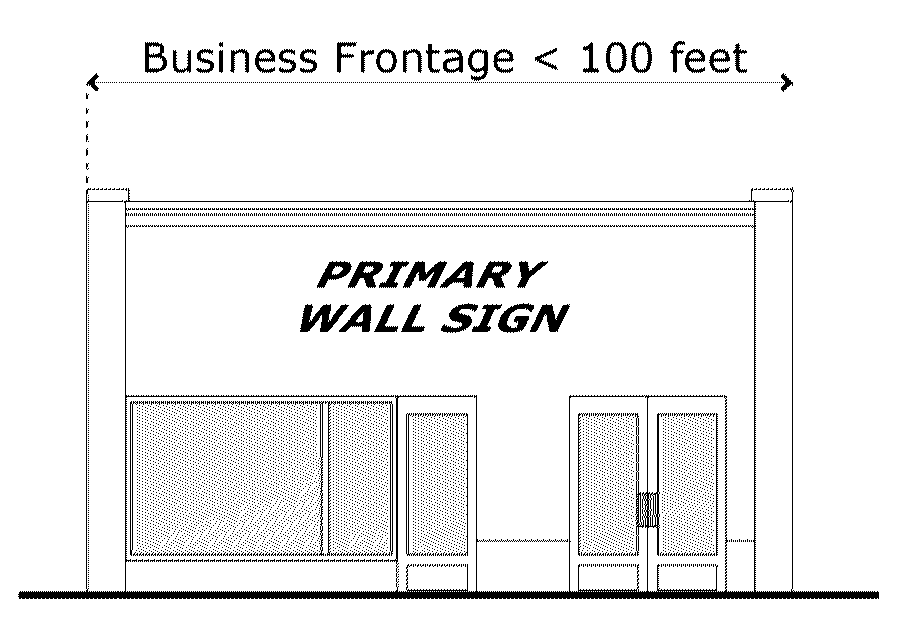
Wall sign, secondary means of multiple wall signs, the wall sign with a smaller sign area than the primary wall sign per building frontage.
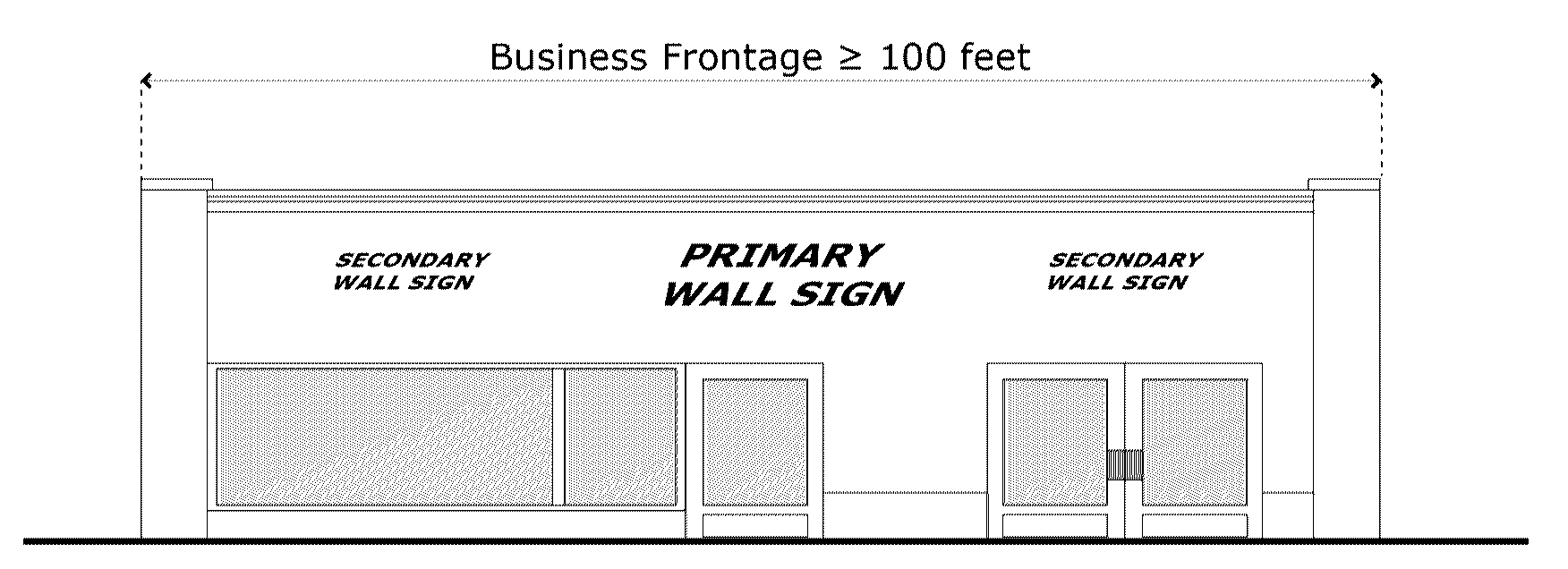
Width means the measurement of a sign, base of a sign, building, or façade at its full extent from side to side.
Window glass area means the area within the perimeter window frames and glass doors located on a business frontage or street frontage.
Window sign means any sign that is applied or attached to a window or located in such a manner that it can be seen from the exterior of the structure.
Yard sign means any temporary sign placed in the ground or attached to a supporting structure, posts, or poles, that is not attached to any building, not including banners.
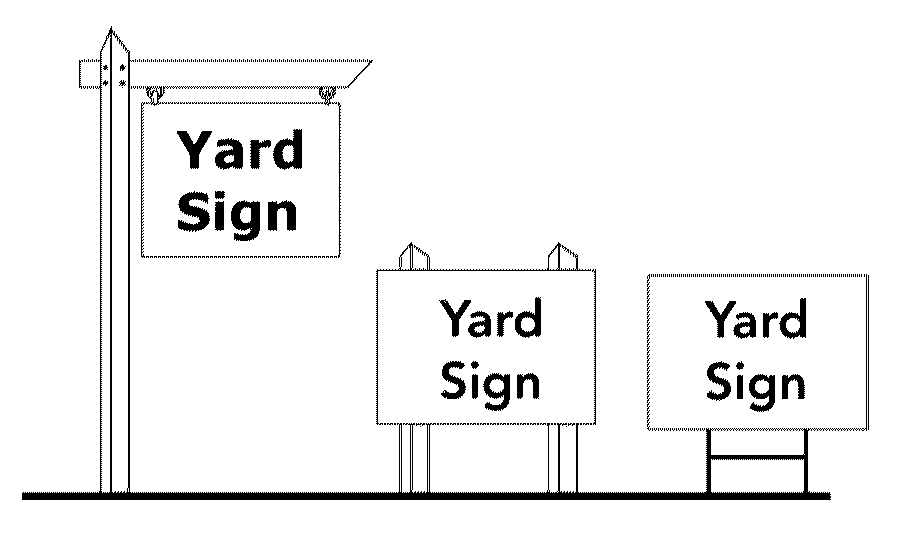
(Ord. No. 1868, § 9(Att. 2), 5-25-21)

