
Fontana City Zoning Code
ARTICLE V
- RESIDENTIAL ZONING DISTRICTS
Sec. 30-421. - Purpose.
The intent of this article is to create, preserve, and enhance residential neighborhoods suited for a range of development types and lifestyles. Consistent with general plan land use policy, this article establishes design guidelines and development standards intended to:
(1)
Encourage superior architectural, landscape, and other design treatment in all types of residential structures.
(2)
Provide flexibility in overall project design.
(3)
Protect residential neighborhoods from incompatible land uses.
(4)
Ensure that all residential development is sensitive to environmental constraints and responsive to environmental resources.
Sec. 30-422. - How to use this article.
Subsequent sections of this article describe permitted land uses in residential zoning districts and the development standards and design guidelines applicable to these uses. All uses must comply with the development policies, use regulations, development standards, performance standards and design guidelines established by this article.
The development standards contained in this article serve only as minimum standards for development on a lot. All permitted uses must also adhere to the provisions of the other sections.
Sec. 30-423. - Residential zoning districts.
Seven residential zoning districts are established as follows:
(1)
Residential estates (R-E). A single-family zoning district that permits low density residential uses, as well as accessory agricultural uses. This district applies primarily to outlying rural areas.
(2)
Single-family residential (R-1). The typical single-family zoning district that permits detached residences on individual lots within defined neighborhoods.
(3)
Medium-density residential (R-2). A medium intensity, multiple-family zoning district that permits the development of attached and detached single-family, duplex and multiple-family dwellings, as well as condominiums.
(4)
Multiple-family residential (R-3). This multiple-family residential zoning district permits development such as garden apartments, condominiums and townhouses.
(5)
Multiple-family medium/high density residential (R-4). This multiple-family residential zoning district provides space for multiple family residential developments commonly found in a dense urban environment within close proximately to public transit stations. Permitted uses include apartments, stacked condominiums, and studios. Mixed-use developments are permitted within this zone.
(6)
Multiple-family high density residential (R-5). This is the most intense multiple-family residential zoning district and it provides space for high density residential transit-oriented development commonly found in an urban environment, especially along existing and/or anticipated future bus routes. Permitted uses include multi-story apartments and mixed-use developments.
(7)
Residential planned community (R-PC). A zoning district that provides for managed growth and as the underline zoning required for master-planned communities offering a mix of residential housing types and amenities with an approved specific plan or low density residential uses similar to R-E above without a specific plan. New specific plans are no longer permitted.
Sec. 30-424. - Purpose.
This section establishes general development policies for all residential development. These policies are derived from the general plan and serve the following purposes:
(1)
To ensure residential development is consistent with all elements of the general plan and other adopted plans.
(2)
To ensure development is adequately served by public services and facilities.
(3)
To ensure public health and safety concerns are addressed in the development process.
(4)
To ensure that residential development approvals are not predicated upon prevailing or predicted economic conditions or factors.
The policies are to be used in conjunction with the development standards specified in Division 4, Division 5 and Division 8 and the design guidelines outlined in Division 7. No project may be approved unless it conforms to the requirements of this section.
Sec. 30-425. - Plan consistency.
All projects must be consistent with the following plans:
(1)
All elements of the general plan.
(2)
Applicable specific plans. (All existing residential specific plans adopted shall meet or exceed the minimum parking standards contained herein.)
Sec. 30-426. - Land use compatibility.
The site and design of a project shall recognize that conflicts between abutting or nearby land uses can arise due to such factors as the operating characteristics of an existing use, hazards posed by a use, or the physical orientation of a building. On a citywide scale, the general plan land use map establishes a pattern of land use designed to minimize land uses conflicts. At the project level, the features described in this section should be incorporated into a project as appropriate to ensure the compatibility of different land uses.
(1)
Open space buffer. Landscaped parkways, parks, and similar open space areas will be used as appropriate to separate residential uses from potentially incompatible uses. The width and treatment of the open space buffer will vary depending upon the types of potential conflicts to be resolved. To soften visual impacts, the open space buffer shall include landscaping.
(2)
Topography. Grading plans will incorporate natural earth forms and graded earthen berms as appropriate to create visual screens and to buffer noise.
(3)
Streets. Street design and site access will be configured to discourage through, nonresidential traffic in residential neighborhoods. Features, such as raised medians that restrict turning movements, cul-de-sacs, and curvilinear street patterns can discourage such through traffic.
(4)
Landscaping. Landscaping shall be used alone or in conjunction with other features (e.g. open space buffer, topography) to reduce potential visual, light and glare conflicts.
(5)
Physical barriers. Physical barriers such as block walls and fences shall be provided as specified in these regulations to reduce noise, visual, light and glare impacts. These barriers may also be used to restrict unwanted access between abutting land uses.
(6)
Building orientation. All buildings shall be sited and oriented to ensure mutual privacy and safety, and to reduce noise, light and glare, visual, and other conflicts.
(7)
Infill development. Infill as defined in this chapter shall be especially sensitive to compatibility concerns and shall be developed in a manner sensitive to existing uses in terms of density, scale, aesthetics, and design theme. Infill developments shall meet or exceed the development standards and shall incorporate the general architectural theme of existing development adjacent to the proposed project. Further, the planning commission may require any proponent of a proposed infill development project to provide illustrations and site redesigns showing the proposed project in relation to the surrounding developments.
(8)
Community design. Design of residential communities will reduce and/or prevent land use conflicts by considering the constraints and opportunities of adjacent existing neighborhoods and by establishing design themes that ensure some variation of individual units in large developments.
Sec. 30-427. - Infrastructure.
The following shall apply to all projects:
(1)
Streets. All new development and expansion of existing development shall provide public street and/or private street improvements consistent with the community, mobility, and circulation element of the general plan. Additional improvements and dedications shall be provided as determined through the design review process.
(2)
Water and sewer. All projects must verify that adequate water and sewer facilities are or will be available to serve the planned use. In the case of subdivision maps, the proof shall consist of written communication from affected water and sewer agencies.
(3)
Storm drains and basins. All projects shall provide storm drain and other flood control and drainage facilities consistent with the San Bernardino County Flood Control District's comprehensive drainage plan. All facilities shall comply with the provisions of the National Pollutant Discharge Elimination System (NPDES). All improvements shall be performed in accordance with the provisions of Chapter 12 and Chapter 26 of the Municipal Code, and to the satisfaction of the City Engineer.
(4)
Logical extension of facilities. Development shall be phased in accordance with the logical, incremental extension of necessary infrastructure.
(5)
Developer impact fees. Public improvement costs related to extension or expansion of infrastructure necessary to serve a particular development will be the responsibility of the project developer.
(6)
Completion of infrastructure. Prior to the issuance of a certificate of occupancy, all required infrastructure shall be completed and finalized by all the required divisions and or departments of the city.
Sec. 30-428. - Public facilities and services.
The following shall apply to all projects:
(1)
Schools. All projects must have proof that adequate school facilities are or will be available to accommodate the students generated by the project in accordance with state law. In the case of subdivision maps, the proof shall consist of written communication from the affected school districts. In the case of other residential projects, the proof shall consist of the issuance of relevant permits or approvals or written substantiation from the affected school district.
(2)
Public transportation. New development shall provide public transit facilities such as bus stops, bus shelters, or transit turnouts as recommended in cooperation with the appropriate transit authority.
(3)
Trails. Public trails shall be provided consistent with the conservation, open space, parks and trails element of the general plan.
(4)
Developer impact fees. Public improvement costs related to the expansion of public facilities or services necessary to serve a development shall be the responsibility of the developer.
Sec. 30-429. - Public safety.
The following shall apply to all projects:
(1)
Emergency access. Access for emergency vehicles shall be incorporated into the project design. Paved fire access roads shall be provided between residential development and wild land fire areas subject to approval by the local fire authority.
(2)
Dedicated access. There shall be two separate means of dedicated access to a public road. Access shall be from either a primary, secondary or collector road. If it cannot be achieved, an alternate design may be approved by the Planning Commission subject to concurrence by the fire agency.
(3)
Fire hazards.
a.
Wild land fires. Projects constructed within or adjacent to areas identified in the general plan safety element within the "fire hazard overlay district" shall incorporate fire breaks into site design. Fire management plans will also be required in fire prone areas.
b.
Response time. Every attempt shall be made to design all projects so that they are within a five-minute response time of a fire protection facility. If a project does not meet this standard, agreement must be reached with the local fire authority as to how adequate fire protection can be achieved.
(4)
Geologic hazards.
a.
Faulting. Geologic reports shall be required for development on properties lying within an Alquist-Priolo Special Studies Zone. The development must incorporate site and design features recommended in the geologic study.
b.
Slopes. In the San Gabriel Mountains and Jurupa Hills, no grading shall be permitted on hill slopes in excess of 15 percent. On all other slopes in excess of 15 percent, no grading shall be permitted unless detailed geologic studies are prepared to show that hill slopes can be stabilized and further provided that the grading does not occur on significant topographic features.
c.
Ingress and egress. Ingress and egress to collector roads and arterial highways from all development projects shall be approved by the City Engineer.
Sec. 30-430. - Uses permitted.
(a)
Uses by zoning district. Table No. 30-430 lists the uses permitted in each of the residential zoning districts. A "P" indicates a use is permitted by right, a "C" indicates the use requires the granting of a conditional use permit, and "—" means the use is not permitted in that zoning district.
(b)
Uses subject to specific requirements. Permitted uses marked with an asterisk "*" indicate that the use is subject to special use regulations in Section 30-432. Conditional uses are subject to the provisions in Section 30-433.
a — Only one single-family dwelling is permitted per legal parcel. An accessory dwelling unit (ADU) may also be permitted if all requirements of the Municipal Code are met. Subdivisions of property for the purpose of single-family development requires approval of a tentative tract map or parcel map.
(Ord. No. 1830, § 8(Exh. A), 6-9-20; Ord. No. 1936, § 4(Exh. A), 12-12-23; Ord. No. 1961, § 4(Exh. A), 1-28-25)
Sec. 30-431. - Prohibited uses.
Any use not specifically permitted by Table No. 30-430 shall be prohibited, unless the Director of Community Development determines, pursuant to the provisions of Section 30-323 of this chapter, the use to be similar to or have substantially the same operating characteristics as a permitted use and issues a written determination to that effect.
Sec. 30-432. - Special use regulations.
This section establishes special regulations for certain uses permitted by right, as indicated by an asterisk "*" in Table No. 30-430. The use specified is permitted provided that the use conforms to the following regulations:
(1)
Agricultural uses (retail and wholesale uses).
a.
Crops and orchards. Farms or ranches for orchards, tree crops, field crops, berry or bush crops, flower gardening, and the like are permitted if a residential lot has a net area equal to or greater than 20,000 square feet. The following regulations apply:
1.
Retail sale of agricultural goods grown on the premises is permitted.
2.
No commercial nurseries shall be permitted.
(2)
Animals—Keeping and raising.
a.
Small animals. The raising of chickens, rabbits, or other similar fowl or small animals is permitted subject to the following:
1.
The number of animals shall be prescribed in Table No. 30-432.
2.
All animals shall be corralled, penned or caged, as defined below in "Animals: keeping and raising."
3.
The operator shall comply with all other regulations established by city and county health ordinances.
4.
Animal slaughtering for production of marketable products or for private consumption shall be prohibited in all zoning districts.
b.
Table No. 30-432. summarizes the number of animals that may be kept on any property.
c.
Location of animals.
1.
Areas containing generally accepted household pets other than dogs or cats, such as passerine or exotic birds, hamsters, garter snakes, lizards, frogs, and fish are not subject to these regulations.
2.
All animals shall be corralled, penned or caged at least 40 feet from any dwelling on the property (including contiguous parcels under one ownership used as one property) containing the corral, pen or cage and 20 feet from any property line.
3.
Grazing shall not be permitted within any public right-of-way, front setback, or street side setback at any time.
4.
Animal slaughtering for production of marketable products or for private consumption shall be prohibited in all zoning districts.
i.
No more than one per multiple-family dwelling unit.
ii.
No more than three per single-family dwelling unit.
(3)
Construction trailer/sales office. A trailer used for construction offices, sales and rental, or watchman's quarters is permitted at a construction site with the approval of a temporary use permit as required in Article II provided:
a.
The trailer is located on the same or adjacent premises as the construction project.
b.
The trailer is used only during the period of construction. All trailers shall be removed prior to final project inspection.
c.
Not more than one person per shift resides in the trailer if used for watchman's quarters.
d.
Shall comply with the provisions set forth for temporary uses as defined in Article II.
(4)
Garage, carports, and driveways—Private.
a.
Each parking stall within an enclosed garage or carport area shall have a minimum clear unobstructed area of ten feet in width by 20 feet in length. An encroachment into this clear space of up to 24 inches may be permitted on the wall opposite the garage vehicle entrance, provided a minimum ground clearance of at least four feet is maintained.
b.
For single-family residences, in addition to a direct pedestrian door way and door from the garage into the house, each garage shall also have a minimum of at least one direct pedestrian doorway and door, at least 32 inches wide, to the rear or side setback with a paved sidewalk leading to the driveway or sidewalk.
(5)
Private swimming pool. The requirements of Section 30-466 shall apply to all private swimming pools, spas, and hot tubs.
(6)
Oversized vehicle parking. Recreational house trailers, motor homes, campers, boats, and similar recreational vehicles may be parked on any residential property that is developed with a primary residence provided that the vehicle conforms to the following regulations:
The vehicle, when parked, shall not extend into any public right-of-way, including sidewalks, into any private access easement or area, or into or on the front setback area, excluding approved driveways (refer to Chapter 17, Section 162 of the Municipal Code).
The vehicle, when parked, shall not be lived in or occupied at any time. The vehicle, when parked, shall be registered to the property owner.
(7)
Stable; private. Private stables are permitted subject to the regulations for the keeping of animals specified in Table No. 30-432.A. Also, private stables shall not be located in any required front setback area.
(8)
Home occupations. Home occupation uses, including cottage food operations, are permitted provided a valid home occupation permit has been obtained pursuant to the provisions of Article II, Division 19 of this chapter.
Sec. 30-433. - Conditional use permit regulations.
All uses marked with a "C" in Table No. 30-430.A must comply with the conditional use permit procedural requirements outlined in Article II, Division 12 of this chapter. In addition, certain conditional uses must comply with the specific development and operational standards outlined below.
(1)
Places of assembly. Places where people assemble for meetings, events, religious services, cultural activities and similar events are subject to the provisions of this subsection.
a.
The minimum site area shall be one acre and shall have frontage on a secondary, primary, or major highway.
b.
The width of the frontage of the site shall be not less than 120 feet.
c.
Front setbacks shall be required for the zoning district in which the use is located except that if the entrance to the main building faces the street, the minimum front setback shall be 40-foot.
d.
Main buildings and structures on the site shall not be closer than 25-foot to any property line that is a common property line with "R" zoned property, except that accessory buildings and structures (no more than 640 square feet in area) shall maintain a side setback of ten-foot with five-foot added at ground level for each additional story over the first. Any detached single-family dwelling on such site shall conform to the setback requirements and required distance between buildings as required for the zoning district in which the dwelling is located.
e.
The required front setback for any on-site parking area shall be no less than that required for the zoning district in which the parking area is located.
f.
On interior lots, the required side setback area shall not be used to provide on-site parking areas, and on corner lots, the interior side setback shall not be similarly used. Under no circumstances may the required side setback on the street side be used for off-street parking.
g.
A solid decorative masonry wall of 42 inches in height or a landscaped berm, pursuant to Section 30-700, shall be provided between the parking area and the front setback, and the required side setback on the street side to screen the parking area from view.
h.
Limitations on lot coverage by buildings shall not apply.
i.
A solid wall not less than six feet in height shall be constructed and maintained on any property lines adjoining residential zoned property, provided such wall shall not extend into any required front setback.
j.
All lights provided to illuminate any parking area or building on the site shall be so arranged as to direct the light away from any adjoining premises.
k.
The use shall comply with the noise standards in Table 30-469.
l.
The conditional use permit may impose restrictions upon the hours of operation to ensure the health and safety of the community and to ensure compatibility with the surrounding land uses for uses located outside activity areas.
(2)
Parolee homes.
a.
Any use that engages in the operation of a parolee home shall be subject to the approval of a conditional use permit. A new conditional use permit shall be required for the following actions:
1.
Commence operation of a parolee home.
2.
Existing parolee homes, unless it was lawfully established prior to the effective date of the ordinance.
3.
Any changes in operating conditions from what was originally imposed by the city, including, but not limited to, number of parolees or modifications to the conditions of approval.
4.
Any changes in the operating conditions of existing parolee homes lawfully established prior to the effective date of the ordinance.
5.
Sale, transfer, or new lease agreement of a parolee home to another individual, entity, etc.
6.
An existing parolee home discontinued for a consecutive period of 30 days is deemed abandoned and shall be required to obtain a new conditional use permit.
b.
Location requirements.
1.
In judging requests for parolee homes, particular attention will be directed to the physical relationship and proximity of the proposed use to similar uses on the same or surrounding sites, the compatibility of the proposed use with neighboring uses (i.e., schools, parks, and other similar uses), and ensuring that no adverse effects on the public health, safety, or welfare will be created by the proposed use.
2.
When a conditional use permit for a parolee home is requested, other than for a renewal or ownership transfer, it should be a minimum of 660 feet away from an existing or proposed school, park, religious institution, hospital, youth facility, or other similar uses.
3.
When a conditional use permit for a parolee home is requested, other than for a renewal or ownership transfer, it should be a minimum of 1,320 feet away from an existing parolee home or other similar uses.
c.
In addition to any other conditions imposed by the Planning Commission pursuant to Article II Division 12, of this Code to safeguard the public health, safety, and welfare, a conditional use permit for a parolee home shall meet the following conditions:
1.
Each parolee home or "parolee home" unit is limited to a maximum number of six parolees with each bedroom not exceeding two parolees.
2.
Multi-family residential projects with less than 25 units shall be limited to one "parolee home" unit.
3.
Multi-family residential projects with 25 or more units shall be limited to two "parolee home" units.
4.
City staff may prepare an annual status report on the parolee home for the planning commission's review and consideration.
5.
The property owner or a designated on-site manager must live on the site of the parolee home.
6.
The police department shall be provided a weekly update by the applicant of the parolees living at the parolee home.
d.
Revocation. Pursuant to Section 30-155 of this Code, the Planning Commission may revoke a conditional use permit. The revocation hearing must be noticed at a public hearing as required in Article II, Division 4 of this Code and the Planning Commission must make the necessary findings to revoke the conditional use permit as set forth in Section 30-155 of this Code.
Sec. 30-434. - Residential development standards in R-E, R-1, R-2, R-3, and R-PC.
Residential development standards are basic standards designed to create quality residential developments. The residential development standards indicated in Table No. 30-434, (residential development standards) and Table No. 30-437, (density bonus residential development standards) serve as the minimum standards controlling development.
See Section 30-444 for additional requirements pertaining to properties in the R-2 and R-3 zoning districts.
N/A = Not Applicable.
Notes:
(a)
Developments with detached units utilizing a condominium map for subdivision shall not be subject the minimum lot size, dimensions and interior property line setbacks.
(b)
Additional standards pertaining to development in the R-2 and R-3 zoning districts:
(1)
Minimum width of cul-de-sac lots and " knuckles" shall be 42 linear feet as measured at the property line. The Planning Commission may reduce this minimum requirement provided the applicant submits the tentative tract map and design review concurrently along with a plotting exhibit (showing the footprint and driveway of each dwelling unit located on a cul-de-sac or knuckle) demonstrating parking compliance to the satisfaction of the Director of Planning.
(2)
For single-family residential lots, the Planning Commission may vary the minimum lot width or depth by ten percent for particular lots, due to unique or special circumstances, and/or parcel of unusual configuration. For lots located on a cul-de-sac or knuckle, the lot depth can be calculated by averaging both side property lines provided the average is not less than the specified lot depth for that zoning district.
(3)
Side setbacks for patios in the R-1, R-2 and R-PC shall be consistent (equal to or greater) with the side setback for any existing dwelling unit.
(4)
Each dwelling unit built within any residential zoning district shall provide a minimum one-half bath ("powder room"), consisting of at least a water closet (toilet) and sink, on the first or ground floor when such first or ground floor contains habitable living space.
(5)
In hillside areas, structure heights shall be limited to 25 feet as specified in Section 30-630 (hillside overlay).
(6)
For lots located on a cul-de-sac or knuckle, the rear setback can be calculated by averaging both rear corners of dwelling provided the average is not less than the specified setback for that zoning district.
(7)
Where any door (excluding a service door to an attached garage) opens onto a side setback area from habitable living space, that side setback area shall be increased to ten feet.
(8)
Any garage which fronts on, or opens onto, a street shall be setback at least 22 feet.
(9)
For one-story open sided detached patio covers of 200 square feet or less in R-1, R-2, and R-PC, the setback shall be no less than three feet to the rear property line and no less than three feet to the interior side property line.
(10)
For allowed projections into required setback area, see Section 30-441, projections into setbacks.
(11)
For setbacks pertaining to accessory buildings and structures see Section 30-461 (accessory buildings and structures).
(12)
The habitable living space of a building may be allowed to encroach into the required front setback in compliance with the plotting and design criteria; in no case, however, shall the garage portion of a building encroach into the required front setback, except as provided for by [subsection (13)].
(13)
Side-on garages may be allowed to encroach into the required front setback up to a maximum of six feet.
(14)
For the purposes of this section, subterranean or partial subterranean parking shall not be considered a floor/story for the purpose of determining building setbacks.
(15)
"Alternative" minimum standards may be established with an approved conditional use permit pursuant to Article II, Division 24, (planned unit development regulations).
(16)
For existing legal lots smaller than this minimum see Section 30-414 (lot size conformance).
(17)
Corner lots shall have a width of not less than 65 feet (see Section 26-180(1), area and width of lots).
(18)
The 15-foot aggregate pertains to new single-family residential development only.
(19)
All setbacks shall be measured from the main structure, not the overhang.
(20)
Two-story multi-family units shall be required to provide a minimum of 100 square feet of private open space, either on the first or second floor. Multi-family units located above the ground floor shall be required to provide a minimum of 75 square feet.
(21)
Existing legal lots of record located in any residential zoning district may be developed pursuant to the required development standards identified in the applicable zoning district.
(Ord. No. 1823, § 8(Exh. A), 2-25-20; Ord. No. 1898, § 10, 7-26-22; Ord. No. 1936, § 4(Exh. A), 12-12-23)
Sec. 30-434.1. - Two-unit projects.
(a)
Purpose. The purpose of this section is to allow and appropriately regulate two-unit projects in accordance with Government Code § 65852.21.
(b)
Definition. A "two-unit project" means the development of two primary dwelling units or, if there is already a primary dwelling unit on the lot, the development of a second primary dwelling unit on a legally subdivided lot in accordance with the requirements of this section.
(c)
Application.
(1)
Only individual property owners may apply for a two-unit project. "Individual property owner" means a natural person holding fee title individually or jointly in the person's own name or a beneficiary of a trust that holds fee title. "Individual property owner" does not include any corporation or corporate person of any kind (partnership, LP, LLC, C Corp, S Corp, etc.) except for a community land trust (as defined by Revenue and Taxation Code § 402.1 (a)(11)(C)(ii)) or a qualified nonprofit corporation (as defined by Revenue and Taxation Code § 214.15).
(2)
An application for a two-unit project must be submitted on the City's approved form.
(3)
The applicant must obtain a certificate of compliance with the Subdivision Map Act for the lot and provide the certificate with the application.
(4)
Only a complete application will be considered. The City will inform the applicant in writing of any incompleteness within 30 days after the application is submitted.
(5)
The City may establish a fee to recover its costs for adopting, implementing, and enforcing this section of the Code, in accordance with applicable law. The City Council may establish and change the fee by resolution. The fee must be paid with the application.
(d)
Approval.
(1)
An application for a two-unit project is approved or denied ministerially, by the Planning Director, without discretionary review.
(2)
The ministerial approval of a two-unit project does not take effect until the City has confirmed that the required documents have been recorded, such as the deed restriction and easements.
(3)
The approval must require the owner and applicant to hold the City harmless from all claims and damages related to the approval and its subject matter.
(4)
The approval must require the owner and applicant to reimburse the City for all costs of enforcement, including attorneys' fees and costs associated with enforcing the requirements of this Code.
(e)
Requirements. A two-unit project must satisfy each of the following requirements:
(1)
Map Act compliance. The lot must have been legally subdivided.
(2)
Zone. The lot is in a single-family residential zone. For purposes of this section, a single-family residential zone is a zone where the only residential use that is allowed as a primary use is a single residential dwelling on a lot.
(3)
Lot location.
a.
The lot is not located on a site that is any of the following:
1.
Prime farmland, farmland of statewide importance, or land that is zoned or designated for agricultural protection or preservation by the voters.
2.
A wetland.
3.
Within a very high fire hazard severity zone, unless the site complies with all fire-hazard mitigation measures required by existing building standards.
4.
A hazardous waste site that has not been cleared for residential use.
5.
Within a delineated earthquake fault zone, unless all development on the site complies with applicable seismic protection building code standards.
6.
Within a 100-year flood hazard area, unless the site has either:
i.
Been subject to a letter of map revision prepared by the Federal Emergency Management Agency and issued to the local jurisdiction, or
ii.
Meets Federal Emergency Management Agency requirements necessary to meet minimum flood plain management criteria of the National Flood Insurance Program.
7.
Within a regulatory floodway unless all development on the site has received a no-rise certification.
8.
Land identified for conservation in an adopted natural community conservation plan, habitat conservation plan, or other adopted natural resource protection plan.
9.
Habitat for protected species.
10.
Land under conservation easement.
b.
The purpose of subpart (e)(3)a above is merely to summarize the requirements of Government Code § 65913.4(a)(6)(B)—(K). (See Government Code § 66411.7(a)(3)(C).)
(4)
Not historic. The lot must not be a historic property or within a historic district that is included on the state historic resources inventory. Nor may the lot be or be within a site that is designated by ordinance as a City or county landmark or as a historic property or district.
(5)
No impact on protected housing. The two-unit project must not require or include the demolition or alteration of any of the following types of housing:
a.
Housing that is income-restricted for households of moderate, low, or very low income.
b.
Housing that is subject to any form of rent or price control through a public entity's valid exercise of its policy power.
c.
Housing, or a lot that used to have housing, that has been withdrawn from rental or lease under the Ellis Act (Government Code §§ 7060—7060.7) at any time in the 15 years prior to submission of the urban lot split application.
d.
Housing that has been occupied by a tenant in the last three years.
(6)
Unit standards.
a.
Quantity.
1.
No more than two dwelling units of any kind may be built on a lot that results from an urban lot split. For purposes of this paragraph, "unit" means any dwelling unit, including, but not limited to, a primary dwelling unit, a unit created under this section of this Code, an ADU, or a JADU.
2.
A lot that is not created by an urban lot split may have a two-unit project under this section, plus any ADU or JADU that must be allowed under state law and the City's ADU ordinance.
b.
Unit size.
1.
The total floor area of each primary dwelling built that is developed under this section must be:
i.
Less than or equal to 800 square feet and
ii.
More than 500 square feet.
2.
A primary dwelling that was legally established on the lot prior to the two-unit project and that is larger than 800 square feet is limited to the lawful floor area at the time of the two-unit project. The unit may not be expanded.
3.
A primary dwelling that was legally established prior to the two-unit project and that is smaller than 800 square feet may be expanded to 800 square feet after or as part of the two-unit project.
c.
Height restrictions.
1.
On a lot that is larger than 2,000 square feet, no new primary dwelling unit may exceed a single story or 16 feet in height, measured from grade to peak of the structure.
2.
On a lot that is smaller than 2,000 square feet, no new primary dwelling unit may exceed two stories or 22 feet in height, measured from grade to peak of the structure. Any portion of a new primary dwelling that exceeds one story must be stepped back by an additional five feet from the ground floor; no balcony deck or other portion of the second story may project into the stepback.
3.
No rooftop deck is permitted on any new or remodeled dwelling or structure on a lot with a two-unit project.
d.
Demo cap. The two-unit project may not involve the demolition of more than 25 percent of the existing exterior walls of an existing dwelling unless the site has not been occupied by a tenant in the last three years.
e.
Lot coverage. [Include a lot coverage standard here if desired.] This lot coverage standard is only enforced to the extent that it does not prevent two primary dwelling units on the lot at 800 square feet each.
f.
Open space. [Include an open space standard here if desired.] This open space standard is only enforced to the extent that it does not prevent two primary dwelling units on the lot at 800 square feet each.
g.
Setbacks.
1.
Generally. All setbacks must conform to those objective setbacks that are imposed through the underlying zone.
2.
Exceptions. Notwithstanding subpart (e)(6)g above:
i.
Existing structures. No setback is required for an existing legally established structure or for a new structure that is constructed in the same location and to the same dimensions as an existing legally established structure.
ii.
Eight hundred square feet; four-foot side and rear. The setbacks imposed by the underlying zone must yield to the degree necessary to avoid physically precluding the construction of up to two units on the lot or either of the two units from being at least 800 square feet in floor area; but in no event may any structure be less than four feet from a side or rear property line.
3.
Front setback area. Notwithstanding any other part of this Code, dwellings that are constructed under this section must conform to the front yard setback imposed by the underlying zoning. The front setback area must:
i.
Be kept free from all structures greater than three feet high;
ii.
Be at least 50 percent landscaped with drought-tolerant plants, with vegetation and irrigation plans approved by a licensed landscape architect;
iii.
Allow for vehicular and fire-safety access to the front structure.
h.
Parking. Each new primary dwelling unit must have at least one off-street parking space per unit unless one of the following applies:
1.
The lot is located within one-half mile walking distance of either:
i.
A corridor with fixed route bus service with service intervals no longer than 15 minutes during peak commute hours or
ii.
A site that contains:
(A)
An existing rail or bus rapid transit station,
(B)
A ferry terminal served by either a bus or rail transit service, or
(C)
The intersection of two or more major bus routes with a frequency of service interval of 15 minutes or less during the morning and afternoon peak commute periods.
2.
The site is located within one block of a car-share vehicle location.
i.
Architecture.
1.
If there is a legal primary dwelling on the lot that was established before the two-unit project, any new primary dwelling unit must match the existing primary dwelling unit in exterior materials, color, and dominant roof pitch. The dominant roof slope is the slope shared by the largest portion of the roof.
2.
If there is no legal primary dwelling on the lot before the two-unit project, and if two primary dwellings are developed on the lot, the dwellings must match each other in exterior materials, color, and dominant roof pitch. The dominant roof slope is the slope shared by the largest portion of the roof.
3.
[OPTIONAL: Provide a custom set of objective standards to define an architectural style, or styles, that the City deems to be appropriate and is willing to allow.]
4.
All exterior lighting must be limited to down-lights.
5.
No window or door of a dwelling that is constructed on the lot may have a direct line of sight to an adjoining residential property. Fencing, landscaping, or privacy glass may be used to provide screening and prevent a direct line of sight.
6.
If any portion of a dwelling is less than 30 feet from a property line that is not a public right-of-way line, then all windows and doors in that portion must either be (for windows) clerestory with the bottom of the glass at least six feet above the finished floor, or (for windows and for doors) utilize frosted or obscure glass.
j.
Landscaping. Evergreen landscape screening must be planted and maintained between each dwelling and adjacent lots (but not rights-of-way) as follows:
1.
At least one 15-gallon size plant shall be provided for every five linear feet of exterior wall. Alternatively, at least one 24-inch box size plant shall be provided for every ten linear feet of exterior wall.
2.
Plant specimens must be at least six feet tall when installed. As an alternative, a solid fence of at least six feet in height may be installed.
3.
All landscaping must be drought-tolerant.
k.
Nonconforming conditions. A two-unit project may only be approved if all nonconforming zoning conditions are corrected.
l.
Utilities.
1.
Each primary dwelling unit on the lot must have its own direct utility connection to the utility service provider.
2.
Each primary dwelling unit on the lot that is or that is proposed to be connected to an onsite wastewater treatment system must first have a percolation test completed within the last five years or, if the percolation test has been recertified, within the last ten years.
m.
Building and safety. All structures built on the lot must comply with all current local building standards. A project under this section is a change of use and subjects the whole of the lot, and all structures, to the City's current Code.
(7)
Fire-hazard mitigation measures. A lot in a very high fire hazard severity zone must comply with each of the following fire-hazard mitigation measures:
a.
It must have direct access to a public right-of-way with a paved street and the ability to withstand 75,000 pounds of vehicle weight, with a width of at least 40 feet. The public right-of-way must have at least two independent points of access for fire and life safety to access and for residents to evacuate.
b.
All dwellings on the site must comply with current fire code requirements for dwellings in a very high fire hazard severity zone.
c.
All enclosed structures on the site must have fire sprinklers.
d.
All sides of all dwellings on the site must be within a 150-foot hose pull distance from either the public right-of-way or of an onsite fire hydrant or standpipe.
e.
If the lot does not have a swimming pool, the lot must have a water reservoir of at least 5,000 gallons per dwelling, with fire-authority approved hookups compatible with fire-authority standard pump and hose equipment.
(8)
Separate conveyance.
a.
Primary dwelling units on the lot may not be owned or conveyed separately from each other.
b.
Condominium airspace divisions and common interest developments are not permitted within the lot.
c.
All fee interest in the lot and all the dwellings must be held equally and undivided by all individual property owners.
(9)
Regulation of uses.
a.
Residential-only. No non-residential use is permitted on the lot.
b.
No STRs. No dwelling unit on the lot may be rented for a period of less than 30 days.
c.
Owner occupancy. Unless the lot was formed by an urban lot split, the individual property owners of a lot with a two-unit project must occupy one of the dwellings on the lot as the owners' principal residence and legal domicile.
(10)
Notice of construction.
a.
At least 30 business days before starting any construction of a two-unit project, the property owner must give written notice to all the owners of record of each of the adjacent residential parcels, which notice must include the following information:
1.
Notice that construction has been authorized,
2.
The anticipated start and end dates for construction,
3.
The hours of construction,
4.
Contact information for the project manager (for construction-related complaints), and
5.
Contact information for the building and safety department.
b.
This notice requirement does not confer a right on the noticed persons or on anyone else to comment on the project before permits are issued. Approval is ministerial. Under state law, the City has no discretion in approving or denying a particular project under this section. This notice requirement is purely to promote neighborhood awareness and expectation.
(11)
Deed restriction. The owner must record a deed restriction, acceptable to the City, that does each of the following:
a.
Expressly prohibits any rental of any dwelling on the property for a period of less than 30 days.
b.
Expressly prohibits any non-residential use of the lot.
c.
Expressly prohibits any separate conveyance of a primary dwelling on the property, any separate fee interest, and any common interest development within the lot.
d.
If the lot is not created by an urban lot split: Expressly requires the individual property owners to live in one of the dwelling units on the lot as the owners' primary residence and legal domicile.
e.
States that the property is formed by an urban lot split and is therefore subject to the city's urban lot split regulations, including all applicable limits on dwelling size and development.
(f)
Specific adverse impacts.
(1)
Notwithstanding anything else in this section, the City may deny an application for a two-unit project if the building official makes a written finding, based on a preponderance of the evidence, that the project would have a "specific, adverse impact" on either public health and safety or on the physical environment and for which there is no feasible method to satisfactorily mitigate or avoid the specific adverse impact.
(2)
"Specific adverse impact" has the same meaning as in Government Code § 65589.5(d)(2): "a significant, quantifiable, direct, and unavoidable impact, based on objective, identified written public health or safety standards, policies, or conditions as they existed on the date the application was deemed complete" and does not include (1) inconsistency with the zoning ordinance or general plan land use designation or (2) the eligibility to claim a welfare exemption under Revenue and Taxation Code § 214(g).
(3)
The building official may consult with and be assisted by planning staff and others as necessary in making a finding of specific, adverse impact.
(g)
Remedies. If a two-unit project violates any part of this Code or any other legal requirement:
(1)
The buyer, grantee, or lessee of any part of the property has an action for damages or to void the deed, sale, or contract.
(2)
The City may:
a.
Bring an action to enjoin any attempt to sell, lease, or finance the property.
b.
Bring an action for other legal, equitable, or summary remedy, such as declaratory and injunctive relief.
c.
Pursue criminal prosecution, punishable by imprisonment in county jail or state prison for up to one year, by a fine of up to $10,000.00, or both; or a misdemeanor.
d.
Record a notice of violation.
e.
Withhold any or all future permits and approvals.
f.
Pursue all other administrative, legal, or equitable remedies that are allowed by law or the City's Code.
(Ord. No. 1877, § 3(Exh. A), 12-14-21; Ord. No. 1885, § 3(Exh. A), 2-8-22)
Sec. 30-435. - Plotting and design criteria.
The following shall comply with new design reviews. Variations and possible additional criteria may be added by the Planning Commission to individual design reviews based upon Planning Commission consideration of individual circumstances:
(1)
No two adjacent homes using the same floor plan shall have the same exterior color scheme/treatment.
(2)
Adjacent homes shall have varying setbacks. Minimum variation shall be four feet unless located on a curvilinear street, which provides a varied street scene, and then the variation shall be three feet. When one-story and two-story homes are adjacent, the two-story home shall have the larger front setback.
(3)
Window mullions shall be provided on first, second, and third story windows of all elevation seen from public view, as approved by the Planning Commission. The mullions shall be provided in a variety of shapes.
(4)
Trim with a stucco covering may be painted in a contrasting color. The contrasting color should be color compatible with the trim color.
(5)
Homes with a trim (band) feature, which distinguishes the first and second floors, should have the band on the front, side, and rear elevation of the homes.
(6)
A variety of designs shall be used on car garage doors, with no two adjacent homes that have the same floor plan and elevation shall use the same garage door pattern. In no case shall more than three homes of any floor plan or elevation have the same garage door pattern in a row. The applicant shall provide a color board indicating proposed garage door colors and patterns for Planning Commission approval.
(7)
Wall-mounted decorative lighting fixtures at a minimum of 18 inches in height shall be provided at the front porch and on each side of the garage door. A sample of lighting types shall be provided for Planning Commission review and approval.
(8)
All front doors shall provide decorative treatment. A sample of door treatments shall be provided for Planning Commission review and approval.
(9)
All utility boxes shall be landscaping with shrubs or other low-profile landscaping. A sample of landscaping/landscaping treatments shall be provided for Planning Commission review and approval.
(10)
The Director of Planning, or his/her designee, shall have the authority for minor architectural changes focusing around items such as window treatments, color combinations, facade treatments, and architectural relief. Questions on the interpretation of this provision or changes not clearly within the scope of this provision shall be submitted to the Planning Commission for consideration under a revision to the design review.
(11)
All lots shall provide decorative hardscape within the concrete walkways leading to the front door of the house in order to complement the home's exterior architectural elements. (Example: If the home uses rock, brick, or other similar material on the exterior of the house, these materials shall be incorporated into the walkways along with decorative trowled bands; decorative patterned scoring; exposed aggregate finishes; stamped concrete, etc. This requirement shall be identified on the phasing site plan that is submitted to the Building and Safety Division for plan check. A detail of the types of hardscape to be used on the walkways shall also be shown on the phasing site plan.)
(12)
Steel gates with privacy screening (defined as material used on the steel gate to obscure the view of the back yard from the street) shall be required for side yards. A sample of gate privacy screening treatment shall be provided for Planning Commission review and approval.
(Ord. No. 1823, § 8(Exh. A), 2-25-20; Ord. No. 1936, § 4(Exh. A), 12-12-23)
Sec. 30-436. - Senior housing development standards.
The following development standards apply to senior housing development projects:
Notes:
* For existing legal lots smaller than this minimum, see Section 30-414 (lot size conformance).
Sec. 30-437. - Density bonus development standards.
(a)
Affordable housing. Density bonus standards allow for more intense residential development for the production of lower income housing units provided a project meets the provisions of Government Code § 65915 of the State of California. Maximum permitted densities are indicated in Table 30-437.
(b)
High-amenity projects. Development standards allowing for more intense residential development, pursuant to Section 30-437, may be approved under certain conditions if amenity features are provided as indicated in Table No. 30-437.
Notes:
(1)
Density may be increased up to 30 units per adjusted gross acre if at least four of the features listed in Section 30-444, not including the ten percent affordable housing feature, are provided. The Planning Commission shall determine the adequacy of the features. If at least four features are not provided, the maximum density is 15.1 units per adjusted gross acre.
(2)
Each dwelling unit built within any residential zoning district shall provide a minimum one-quarter bath ("powder room"), consisting of at least a water closet (toilet) and sink, on the first or ground floor when such first or ground floor contains habitable living space.
(3)
Any garage that fronts on, opens onto, a street shall be setback at least 20-foot.
(4)
Staggered setbacks shall be provided per the plotting and design criteria.
(5)
Minimum rear setback shall be 20 percent of the depth but need not exceed 25-foot.
(6)
The rear setback for an open (lattice) patio cover shall be no less than ten feet.
(7)
If doors open onto the side setback from major living spaces, the setback area shall be increased to ten feet, except garage main doors.
(8)
For multi-family dwelling units see Table No. 30-466 (residential development standards).
(9)
The habitable living space of a building may be allowed to encroach into the required front setback in compliance with the plotting and design criteria; in no case, however, shall the garage portion of a building encroach into the required front setback, except as provided for by [subsection] (10).
(10)
Side-on garages may be allowed to encroach into the required front setback up to a maximum of six feet.
(11)
Development standards apply to attached or multi-family projects of 7.7 to 12 du/ac.
Sec. 30-438. - Staggered front setbacks.
Front setbacks shall comply with minimum required front setback for all front-on garages as determined by each zoning district. Front setbacks for the habitable space shall be staggered at the discretion of the Planning Commission by four foot in front of or behind the required setback.
Sec. 30-439. - Parking area setbacks.
Parking areas serving more than one dwelling unit shall be setback from public right-of-way as specified in Table No. 30-444. The setback shall be landscaped as required by the landscaping provisions of this article. No more than 50 percent of the front setback shall be paved.
Sec. 30-440. - Parking requirements.
Off-street parking shall be provided as required by Article XI of this chapter.
Sec. 30-441. - Projections into setbacks.
Projections into side setbacks for single-family residential projects shall not reduce the minimum five-foot setback requirement by more than 18 inches. The following projections into required setback areas are permitted subject to these regulations:
(1)
Balcony. A balcony may project up to six feet into any required setback facing a street.
(2)
Chimneys. Chimneys may be located in any required setback, provided they do not reduce the required setback more than 18 inches nor create any setback less than 42 inches.
(3)
Fire escape. A fire escape not withstanding other codes, laws or ordinances or unenclosed stairway may project up to four feet into any required setback facing a street.
(4)
Planter boxes. Planter boxes may extend up to three feet into any required setback area.
(5)
Porches. A covered or uncovered porch or platform that does not extend vertically beyond the first floor of a building may extend up to six feet into any required setback area. Open work railing may be installed provided such railing is no higher than 30 inches above the porch or platform, or as required by the Uniform Building Code.
(6)
Roof lines. Roof projections may extend into required setbacks as follows, if not otherwise regulated by the Uniform Building Code.
(7)
Decorative architectural projections. Any feature of a building structure that protrudes from the main building wall(s) and functions to enhance the visual attractiveness of said structure by breaking up the flat, monotonous relief of a flat wall. Decorative architectural projections include, but are not limited to, pilasters, window surrounds, shadow lines, decorative bands, and bias reliefs.
(8)
Utilities. Utilities, mechanical equipment, and accessories may be located in any required setback, provided they do not reduce the required side setback more than 18 inches nor create any setback less than 42 inches.
Sec. 30-442. - Signs.
On-site signs are permitted as provided for in Chapter 3 of the Municipal Code.
Sec. 30-443. - Unobstructed corner cut-off required.
No structure, accessory structure, feature, wall, fence, roadside hardware, trees, landscaping, hedge or the terrain itself may exceed a height of 30 inches above street level or create a visual obstruction to the clear line-of-sight for motorist and/or pedestrian, if located within the street sight triangle and corner cut-off area of a property. A street corner cut off safety area is described in the adopted "CalTrans Design Standards" and has been adopted as the City's minimum standards for safe stopping distances as intersections to accommodate entry monumentation and full height landscaping in front of the block walls, there shall be a minimum of eight feet of additional right-of-way dedication behind the required sight lines along all street frontages for roadway classifications of collector and above. This requirement shall be demonstrated at the time of tentative map submittal to the satisfaction of the City Engineer.
Within all residential zones, no structure, accessory structure, feature, wall, fence or landscaping feature, trees shall be located within the "driveway corner cut-off" area which shall be a safety area, and shall have a clear line-of-sight for a motorist and/or pedestrian clear of any visual obstructions measuring over 30 inches from street level.
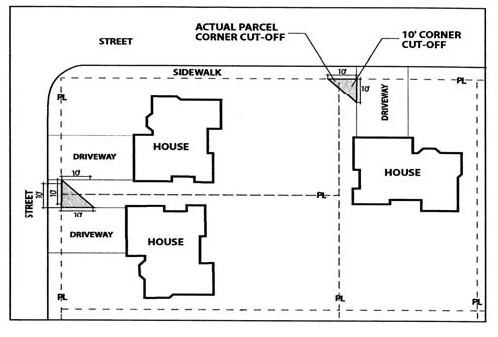
Unobstructed Corner Cut-Off Required
(Ord. No. 1865, § 8(Att. 2), 3-23-21)
Sec. 30-444. - Additional development standards in R-2 and R-3 zoning districts.
Residential development standards are basic standards designed to create quality residential developments. The residential development standards indicated in Table No. 30-434 (residential development standards) and Table No. 30-437 (density bonus residential development standards) serve as the minimum standards controlling development. In addition to the applicable standards indicated in Table No. 30-434 and Table No. 30-437, the following standards shall be required of all multiple-family residential developments in the R-2 and R-3 zoning districts.
(1)
Building separation. Table No. 30-444 sets forth specific standards for minimum building setbacks as follows:
[Notes:} Additional standards pertaining to the R-2 and R-3 zoning districts:
(a)
For the purpose of this table, accessory structure means a subordinate structure which is incidental and not attached to a building but is on the same lot. If an accessory structure is attached to the building, or if the roof is a continuation of the building roof, the accessory structure shall be considered an addition to the building.
(b)
Building shall mean dwelling units. For purpose of this table, building setback standards shall be for two-story development, setback standards may be modified by other lettered notes herein.
(c)
Subtract ten feet for a single-story dwelling unit or a multi-story dwelling unit having a single-story element with a depth of at least ten feet.
(d)
"Front" is defined as that face of the building or unit with a major glass area and/or major private recreation area and may include access to that private recreation area. This access may or may not relate to the primary entrance to the building that faces the street or drive; therefore, some buildings may have more than one "front" under this definition.
(e)
The "rear" of a building is defined as the point or area farthest from the front. Where a building is identified to have two fronts the building may be considered not to have a rear facing. For the purpose of this table, zoning districts are not considered adjacent if separated by a dedicated public right-of-way of more than 50 feet in width.
(f)
Balconies, patios (uncovered and covered), patio fences/walls, porches, and similar liked structures may project into the setback area up to a maximum of six feet, providing, however, that such structures shall never be separated by less than 15 feet (horizontal).
(g)
Buildings may be staggered to encroach into the required setback up to a maximum of five feet, provided there is an equal or greater setback at the opposite/other face of the building. Such staggered encroachment shall be averaged so that for each building which encroaches into the setback, another building will offset such encroachment by an equal number of feet along the same frontage.
(h)
Where there is a grade differential between properties of greater than ten feet (as determined by the precise grading plan), the setback requirement may be modified as follows: when the building is at the lower grade, the required setback may be reduced by one linear foot for each three vertical feet of difference. Where the building is at the higher grade, the required setback shall be increased by one linear foot for each three vertical feet of difference. Such modification to the required setback shall be limited to a maximum of ten feet.
(i)
The pedestrian walkway may project into the setback area provided a minimum ten-foot area is maintained free and clear for landscaping.
(2)
Separation of accessory buildings, parking areas, and vehicular access ways.
a.
Distance between an accessory building and side and rear property lines shall be no less than ten feet. Where the adjacent zoning district is nonresidential or for safety, as determined by the Police Department, garages and carports may encroach a maximum of 50 percent into the required width of the side or rear setback.
b.
Distance between two accessory buildings shall be no less than ten feet.
c.
Distance between an accessory building and any dwelling unit shall be no less than 15 feet.
d.
Distance between open, guest parking areas and any dwelling unit shall be no less than ten feet.
e.
Distance between vehicular access way and any dwelling unit shall be no less than ten feet.
f.
If a carport is located no less than ten feet from a side or rear property line, the rear wall of the carport may have openings to allow view and accessibility to an adjacent landscaped area, as illustrated in the design guidelines.
g.
Detached assigned and/or required parking stalls, carports and enclosed garages shall be located no more than 150 feet from the dwelling unit they serve, unless otherwise approved by the Director of Planning.
(3)
Minimum driveway access width. Minimum access way width of 26 feet is required for all access drives serving multiple-family developments. A minimum access way width of 30 feet is required for all access drives serving multi-family developments of three stories or more.
(4)
Water heaters. Each dwelling unit shall have a separate hot water heater or may be provided with a centralized circulation water heating system sufficient to serve all dwelling units on the property.
(5)
Laundry facilities. All multiple-family residential units shall be provided washer and dryer hookups and laundry space with the unit or garage. The laundry area shall not infringe upon garage parking area. In the case of apartments, common laundry facilities may be included in addition to the individual unit hookups.
(6)
Storage facilities. A separate area having a minimum of 125 cubic feet of private and secure storage space shall be provided for each unit.
a.
Said storage area may be located within an attached garage, provided it does not interfere with garage use for automobile parking.
b.
Normal closet and cupboard space within the dwelling unit shall not count toward meeting this requirement.
c.
Storage in carport areas shall be over hood or overhead. Over hood storage shall provide a minimum of four feet of clearance and overhead storage shall provide eight feet of clearance.
d.
Enclosed garages are required to provide 125 cubic feet of storage cabinet space, or 125 cubic feet of storage space may be provided elsewhere on the site.
(7)
Garage doors. All garages shall be provided with sectional garage doors and automatic garage door openers.
(8)
Dwelling entries.
a.
All units shall be provided with standard door locks and dead bolts.
b.
No dwelling entry shall be located with direct, uninterrupted, unimpeded access to a primary or secondary arterial street.
(9)
Refuse storage areas. Individual trash receptacles for each unit shall only be permitted with an approved site layout of refuse pick-up by the City and the authorized refuse hauler. Projects that do not have an approved plan shall provide standard refuse storage facilities for the containment of standard receptacles based on the following requirements:
a.
Number of receptacles.
b.
All refuse storage areas shall be readily accessible to the users they serve as well as for collection operations and shall be enclosed by a solid decorative masonry or concrete block wall at least 60 inches in height that shall be designed in a manner architecturally compatible with the overall design of the project's buildings.
1.
The site area shall have a concrete pad at least four inches in thickness.
2.
The storage area shall be designed with a lattice or metal solid cover matching the exterior building material and color with a solid gate or with mesh.
3.
The refuse storage area shall be located within 150 feet walking distance of the unit it services.
(10)
Recreational facilities. The developer shall provide recreational facilities in conjunction with common open space as a minimum requirement for all projects in the R-2 and R-3 zones. Recreational facilities shall not be required for projects utilizing a minor planned unit development (minor PUD) for development.
a.
Development consisting of 30 units or fewer shall provide three of the following recreational facilities:
1.
Large open lawn area, minimum dimensions shall be 50 feet by 20 feet.
2.
Tot-lot with multiple play equipment.
3.
Spa and/or pool.
4.
Barbecue facility equipped with grill, picnic benches, etc.
b.
Development consisting of 31 units to 100 units shall provide an additional recreational facility as in (a) above, or equivalent, as approved by the Planning Commission.
c.
Development consisting of 101 units to 200 units shall provide five of the following recreational facilities, or equivalent, as approved by the Planning Commission:
1.
Large open lawn area, minimum dimensions shall be 100 feet by 50 feet.
2.
Multiple tot-lots with multiple play equipment. The tot-lots shall be conveniently located throughout the site and separated with a low decorative wall or tubular steel fence from any drive aisle.
3.
Pool and spa.
4.
Community multi-purpose room equipped with kitchen, defined areas for games, exercises, etc.
5.
Barbecue facilities equipped with multiple built in gas grills with shelving, picnic benches and shade structures. The barbecue facilities shall be conveniently located throughout the site.
6.
Court facilities (e.g. tennis, volleyball, basketball, etc.).
7.
Jogging/walking trails with exercise stations.
d.
For each 100 units above the first 200 units, another recreational facility as described in Section 30-451, or equivalent, shall be provided for approval by the Planning Commission.
e.
Other recreational facilities not listed above may be considered subject to the Planning Commission review and approval.
f.
Related recreational activities may be grouped together and located at any one area of the common open space.
g.
Recreational facilities shall be dispersed throughout the site.
h.
All recreational areas or facilities required by this section shall be maintained by private homeowner's associations, property owners, or private assessment districts.
(11)
Circulation, pedestrian and vehicular parking.
a.
Pedestrian circulation. Every multiple-family residential development shall be designed in such a manner that adequate walkways are provided convenient to the needs of the residents and guests and the services of public agencies. Pedestrian access to the unifying elements of any development should be separate from and free of conflict with vehicular access ways. All developments consisting of six units or more shall provide directories placed in a convenient location at the development entry.
b.
Vehicular circulation. Every multiple-family residential development shall be designed with an internal street and parking system adequate to handle the need for vehicular circulation. Said system shall be in compliance with all applicable standards of this chapter.
(Ord. No. 1865, § 8(Att. 2), 3-23-21; Ord. No. 1936, § 4(Exh. A), 12-12-23)
Sec. 30-445. - Residential development standards in R-4 and R-5 zoning districts.
The standards of this section provide for high-density residential (R-4 or R-5), mixed-use developments, public, and semi-public uses in close proximity to light rail/commuter rail stations, and future bus rapid transit (BRT) stations, encouraging transit usage in conjunction with a safe and pleasant pedestrian-oriented environment. These standards emphasize the intensification of development and encourages reduced reliance on motor vehicles.
These standards shall apply to new development projects located within 2,640 feet (one-half mile) of light-rail/commuter rail stations, future bus rapid transit stations and/or on a corridor with an operating Omnitrans bus route.
Sec. 30-446. - Multiple-family medium/high density residential (R-4) and multiple-family high density residential (R-5) development projects.
(a)
Uses permitted in the multiple family medium/high density residential (R-4) zoning district, and in the multiple family high density residential (R-5) zoning district without a commercial component. A "P" indicates the use is permitted by right, a "C" indicates the use requires the granting of a conditional use permit, and "—" means the use is not permitted in that zoning district.
(b)
Conditional uses are subject to the provisions in Section 30-433 of this Code.
Table No. 30-446
Uses permitted
* Existing single-family residences in this zone are permitted and subject to the single-family residential (R-1) development standards. New single-family construction is not permitted nor is a subdivision for the purpose of development of single-family residential lots.
(Ord. No. 1830, § 8(Exh. A), 6-9-20)
Sec. 30-447. - Residential development standards.
The following development standards apply to multifamily residential development projects without a commercial component, which are proposed at minimum density of 24.1 to 39 dwelling units per acre within the multiple-family medium/high density residential (R-4) zoning district, and 39.1 to 50 dwelling units per acre in the multiple-family high density residential (R-5) zoning district.
Table No. 30-447
Residential Development Standards
Notes:
(1)
For existing legal lots smaller than this minimum, see Section 30-414 (lot size conformance).
(2)
For the purpose of this section, subterranean or partial subterranean parking shall not be considered a floor/story for the purpose of determining building setbacks.
(Ord. No. 1973, § 4(Exh. A), 10-28-25)
Sec. 30-448. - Multiple-family building separation requirement.
Table No. 30-448
Building Setback and Separation (in feet)
Notes:
(1)
Building shall mean a structure containing dwelling units. For purpose of this table, building setback standards shall be for any building exceeding a single-story. Setback standards may be modified by other lettered notes herein.
(2)
Subtract ten feet for a single-story dwelling unit or a multi-story dwelling unit having a single-story element with a depth of at least ten feet.
(3)
All primary ground-floor common entries and individual dwelling unit entries fronting Foothill Blvd, Orange Way, Cypress Avenue or Valencia Avenue shall be oriented to the street, not the interior of the development or parking lot.
(4)
On a case by case basis, the Community Development Director may require up to ten feet of additional building setback from all property lines to accommodate entrance stops, porches, patios and other architecture features, as well as landscaping areas.
(5)
For the purpose of this table, accessory structure means a subordinate structure which is incidental to and is detached from the main building but is on the same lot and supports the primary use on-site. If an accessory structure is attached to the building by way of a continuation of the building roof, the accessory structure shall be considered an addition to the building.
(6)
"Front" is defined as that face of the building or unit with a major glass area and/or major private recreation area and may include access to that private recreation area. This access may or may not relate to the primary entrance to the building that faces the public right-of-way or private drive aisle; therefore, some buildings may have more than one "front" under this definition.
(7)
For the purpose of this table, zoning districts are not considered adjacent if separated by a dedicated public right-of-way or utility easement of more than 50 feet in width.
(8)
Setback measured from building to property line.
(9)
"Oblique alignment" is defined as the intersection of the parallel face of one building by the corner angle of a second building where said angle is greater than 25 percent. The corner angle of the intersecting building may encroach into the setback of the other building by up to five feet provided there is an equal or greater setback at the other end of the intersecting building. Such encroachment shall also be averaged so that for each building that is allowed to encroach into the setback, another building will offset such encroachment by an equal number of feet. (Where two buildings meet at corner angles, the side-to-front setback criteria shall be used.)
(10)
Balconies, patios (uncovered and covered), patio fences/walls, porches, and similar like structures (as determined by the Director of Community Development) may project into the setback area up to a maximum of six feet, providing, however, that such structures shall never be separated by less than 15 feet (horizontal).
(11)
The "rear" of a building is defined as the point or area farthest from the front. Where a building is identified to have two fronts the building may be considered not to have a rear facing.
(12)
Setback from underdeveloped property in the R-2 zone shall be determined at the R-1 single-family zones development standard of 25 feet.
(13)
Where a new building is to be constructed on a corner lot or intersection, a wraparound building design with an angled corner shall be utilized in order to maximize and encourage pedestrian activity.
(14)
Parking setback may be decreased to zero for subterranean parking structures.
(15)
The minimum building setback to the R-1 zoning district may be reduced to ten feet for development within the R-4 overlay for projects developed consistent with the density requirements of the R-4 overlay and where the adjacent parcel is vacant and undeveloped.
(Ord. No. 1920, § 4(Exh. A), 4-11-23; Ord. No. 1973, § 4(Exh. A), 10-28-25)
Sec. 30-449. - (R-4 and R-5) Separation of accessory building/structures, parking areas, and vehicular access ways.
(a)
Distance between an accessory building and side and rear property lines shall be no less than ten feet. Where the adjacent zoning district is non-residential, garages and carports may encroach a maximum of 25 percent into the required width of the side or rear setback.
(b)
Distance between two accessory buildings shall be no less than ten feet.
(c)
Distance between an accessory building and any dwelling unit shall be no less than six feet.
(d)
Distance between open, quest parking areas and any dwelling unit shall be no less than ten feet.
(e)
Distance between vehicular access way and any dwelling unit shall be no less than ten feet.
(f)
If a carport is located no less than ten feet from a side or rear property line, the rear wall of the carport shall have openings to allow view and accessibility to an adjacent landscaped area.
(g)
Detached assigned and/or required parking stalls, carports and enclosed garages shall be located no more than 150 feet from the dwelling unit they serve, unless otherwise approved by the Director of Community Development.
(Ord. No. 1823, § 8(Exh. A), 2-25-20)
Sec. 30-450. - (R-4 and R-5) Ancillary services.
(a)
Minimum driveway access width. Minimum access way width of 26 feet is required for all access drives serving multiple-family developments. A minimum access way width of 30 feet is required for all access drives serving multi-family developments of three stories or more.
(b)
Water heaters. Each dwelling unit shall have a separate hot water heater or may be provided with a centralized circulation water heating system sufficient to serve all dwelling units on the property.
(c)
Laundry facilities. All multiple-family residential units shall be provided washer and dryer hookups and laundry space within the unit or garage. The laundry area shall not infringe upon garage parking area. In the case of apartments, common laundry facilities may be included in addition to the individual unit hookups.
(d)
Storage facilities. A separate area having a minimum of 125 cubic feet of private and secure storage space shall be provided for each unit.
(1)
Said storage area may be located within the garage, provided it does not interfere with garage use for automobile parking.
(2)
Normal closet and cupboard space within the dwelling unit shall not count toward meeting this requirement.
(3)
No storage shall be in the carport area.
(4)
Enclosed garages are required to provide 125 cubic feet of storage cabinet space, or 125 cubic feet of storage space may be provided elsewhere on the site.
(e)
Garage doors. All garages shall be sectional garage doors with an automatic garage door openers.
(f)
Dwelling entries.
(1)
All units shall be provided with standard door locks and dead bolts.
(2)
No dwelling entry shall be located with direct, uninterrupted, unimpeded access to a primary or secondary arterial street.
(g)
Refuse and recycle storage areas. The applicant shall provide an appropriate number refuse and recycle bins located within an architecturally compatible enclosure.
(1)
Number of receptacles.
(2)
All refuse/recycle storage areas shall be readily accessible to the users they serve as well as for collection operations and shall be enclosed by a solid decorative masonry or concrete block wall at least 60 inches in height that shall be designed in a manner that is architecturally compatible with the overall design of the project's buildings.
(3)
The site area shall have a concrete pad at least four inches in thickness.
(4)
The storage area shall be designed with a metal lattice cover matching the exterior building material and color and has a gate with view obscuring slats or other opaque material.
(5)
The refuse/recycle storage and recycling bins area shall be located within 150 feet walking distance of the unit it services.
(Ord. No. 1823, § 8(Exh. A), 2-25-20)
Sec. 30-451. - (R-4 and R-5) Recreational facilities.
On-site amenities shall be considered in the context of existing off-site amenities and their spatial relationships (distance, ease of access and safety) to active retail services, bicycle lanes, walking trail, and mass transit such as commuter/light rail or bus rapid transit (BRT) service.
In addition to the off-site amenities mentioned above, the developer shall provide on-site recreational facilities in conjunction with common open space as a minimum requirement for all multi-family projects in the R-4 zone and the R-5 zone:
(1)
Development consisting of 50 units to 79 units shall provide three of the following recreational facilities:
a.
Indoor gym/fitness facility (minimum 500 square feet).
b.
Tot-lot with multiple play equipment.
c.
Spa and pool (min 25 yard by 15 yards).
d.
Barbecue facility equipped with grill, picnic benches, etc. (min of five areas).
(2)
Development consisting of 80 units to 200 units shall provide all recreational facilities as listed in Section 30-451 above. Other recreational facilities or community benefits not listed above may be considered subject to the Planning Commission review and approval.
(3)
Development consisting of 201 units to 400 units shall provide all recreational facilities as listed in Section 30-451 and a minimum of one of the following additional recreational facilities, or equivalent, as approved by the Planning Commission:
a.
Large open lawn area, minimum dimensions shall be 100 feet by 50 feet (e.g. rooftop garden).
b.
Multiple tot-lots with multiple play equipment. The tot-lots shall be conveniently located throughout the site. The number of tot-lots and their location shall be subject to Planning Commission review and approval.
c.
Lap pool and spa (e.g. rooftop, min 25 yard by 25 yards).
d.
Community multi-purpose room equipped with kitchen, defined areas for games, exercises, etc.
e.
Barbecue facilities equipped with multiple grills, picnic benches and shade structures. The barbecue facilities shall be conveniently located throughout the site. The number of barbeque facilities and their location shall be subject to Planning Commission review and approval.
f.
Court facilities (e.g. tennis, volleyball, basketball, etc.).
g.
Jogging/walking trails with exercise stations.
h.
Other recreational facilities not listed above may be considered subject to the Planning Commission review and approval.
Related recreational activities may be grouped together and located at any one area of the common open space. Where multiple recreational facilities are provided such facilities shall be required to be dispersed throughout the site. All recreational areas or facilities required by this section shall be maintained by private homeowner's associations, property owners, or private assessment districts.
(4)
Circulation, pedestrian, and vehicular parking. Pedestrian circulation. Each multiple-family residential development shall be designed with adequate walkways to provide convenience to the needs of the residents, guests, and the service providers of public agencies. Pedestrian access to the unifying elements of any development shall be separate from, and free of, conflict with vehicular access ways. All developments consisting of six units or more shall provide directories placed in a convenient location at the development entry.
(Ord. No. 1823, § 8(Exh. A), 2-25-20; Ord. No. 1936, § 4(Exh. A), 12-12-23)
Sec. 30-452. - Mixed use development projects.
(a)
The following requirements apply to mixed-use development projects, which are described as:
(1)
Vertical mixed-use. The combination of retail commercial and residential uses where the residential component is located above the retail commercial component in the same structure; or,
(2)
Horizontal mixed-use. The combination of commercial and residential uses where the residential component is located in a separate detached structure(s) behind the commercial component.
The above development combinations shall apply to multi-family residential projects proposing at least 24.1 to 39 dwelling units per acre within the R-4 zoning district, or 39.1 to 50 dwelling units per acre within the R-5 zoning district. The residential component of a mixed-use development shall meet the requirements of Section 30-452 through Section 30-454 of this Code. In addition to the recreational amenities listed in Section 30-451, the multi-family component of the development will be designed to provide access to other pedestrian oriented uses such as shops, plaza areas with restaurants, and cafés with outdoor seating areas.
(b)
Conditional use permit requirements. A conditional use permit (CUP) shall be required for all mixed-use projects containing retail commercial and a residential component in the R-4 and R-5 districts. A limited amount of business and professional office uses may be allowed and shall not exceed ten percent of the total commercial square footage. In reviewing the CUP, substantiated written findings shall be made that the site design and use or combination of uses is compatible with mass transit.
(c)
Required findings. Conditional use permit approval shall require that the reviewing body first make the following findings in addition to the findings required by Section 30-150:
(1)
The project consists of a use, or mix of uses, encouraging transit use and is demonstrably oriented toward transit users.
(2)
The project is designed to enhance pedestrian access and/or other non-motor vehicle modes of transportation to public transit.
(3)
The project encourages pedestrian activity and/or other non-motor vehicle modes of transportation and reduces dependency on motor vehicles.
Sec. 30-453. - Uses permitted within mixed use development projects.
(a)
A "P" indicates the use is permitted by right; however, the project requires the granting of a design review approved by the Planning Commission. Design reviews are subject to the provisions in Article II, Division 11 of this Code.
(b)
A "C" indicates the use requires the granting of a conditional use permit approved by the Planning Commission. Conditional uses are subject to the provisions in Article II, Division 12 of this Code.,
(c)
A "M" indicates the use requires the granting of a minor use permit approved by the Community Development Director. Minor uses are subject to the provisions in Article II, Division 13 of this Code.
(d)
And "—" means the use is not permitted in that zoning district.
Notes:
(1)
Existing single-family residences in this zone are permitted and subject to the single-family residential (R-1) development standards. New single-family construction is not permitted nor is subdivision for the purpose of development of single-family residential lots.
(2)
Administrative and professional office uses shall not exceed ten percent of the total square footage allocated for the commercial component of the development.
(Ord. No. 1899, § 7, 7-26-22; Ord. No. 1906, § 74, 10-25-22)
Sec. 30-454. - Mixed use development standards.
Notes:
(1)
For existing legal lots smaller than this minimum, see Section 30-414 (lot size conformance).
(2)
A limited amount of parking may be allowed provided that the visual presence of parked cars be minimal and entrances not interrupt pedestrian and retail continuity.
(3)
All primary ground-floor store front entries fronting Foothill Blvd., Orange Way, Cypress Avenue or Valencia Avenue shall be oriented to the street, not the interior of the development or parking lot. Buildings may be setback an additional eight feet to accommodate outdoor seating areas.
(4)
Where a new building is to be constructed on a corner lot or intersection, a wraparound building design with an angled corner shall be utilized in order to maximize and encourage pedestrian activity.
(5)
Setback may be increased to incorporate building design elements such as planter's outdoor seating areas, and street furniture to a maximum of ten feet.
(6)
Parking setback may be decrease to zero for subterranean parking structures.
(7)
Subtract ten feet for a single-story dwelling unit or a multi-story dwelling unit having a single-story element with a depth of at least ten feet.
(8)
Setback from underdeveloped property in the R-2 zone shall be determined at the R-1 single-family zones development standard of 25 feet.
Sec. 30-455. - Required number of parking spaces.
Note:
(1)
Parking standards may be furthered reduced upon the approval of a parking demand study.
a.
Exceeding allowable parking requirements. A project site may exceed the maximum allowable parking requirements in compliance with the following conditions.
b.
Shared parking. A site may exceed the maximum allowable number of parking spaces if the parking is approved to serve as shared parking in compliance with an adjacent/contiguous commercial mixed-use or multi-family project proposing 25 to 39 du/ac (R-4) or 40 to 50 du/ac (R-5).
c.
Joint parking. A site may exceed the maximum allowed number of parking spaces if the parking is approved to serve as joint parking.
1.
Joint parking is a type of parking that is designed to serve uses on at least two different sites.
2.
The joint parking provided shall not exceed the maximum required parking for the combined total parking requirements of the different individual sites.
d.
Parking location. The mixed-use project may have parking located below grade/subterranean, at grade level behind the ground floor commercial/residential uses and or on the corner side street frontage.
e.
All other off-street parking and loading requirements not specifically identified above shall be as provided for in Article XI.
Sec. 30-456. - Design guidelines for high density residential and mixed-use projects (for R-4 and R-5 zones).
The residential and mixed-use guidelines provide specific and broad recommendations to create high quality buildings and site plans that will result in attractive, livable, and pedestrian-friendly mixed-use project areas within the high density residential (R-4 and R-5) zoning districts. The aim is to be prescriptive enough to create a framework for design, but flexible enough to allow for creativity and innovation in design and planning.
(1)
Location of commercial and residential uses.
a.
Locate active commercial uses on the ground floor adjacent to the sidewalk, including retail, restaurant, and personal service uses. This ensures that the ground floor commercial uses create an active pedestrian realm that is an engaging and well-populated environment with a variety of uses and activities.
b.
Provide continuous storefront windows, open air store frontages, and frequent, highly visible entrances for ground floor commercial uses adjacent to the street and sidewalk.
c.
Locate buildings at or near the property line. Ground floor street frontage space is to be predominantly for active, pedestrian-oriented uses.
d.
The residential component of mixed-use development adjacent to residential property shall be located to be functionally a part of the residential area. For example, primary access to the residential units shall be from the residential street, and residential units shall have view access to the adjacent residential neighborhood.
e.
Locate and orient buildings to respect the need for privacy, light, and air of surrounding structures, especially adjoining lower density residential development.
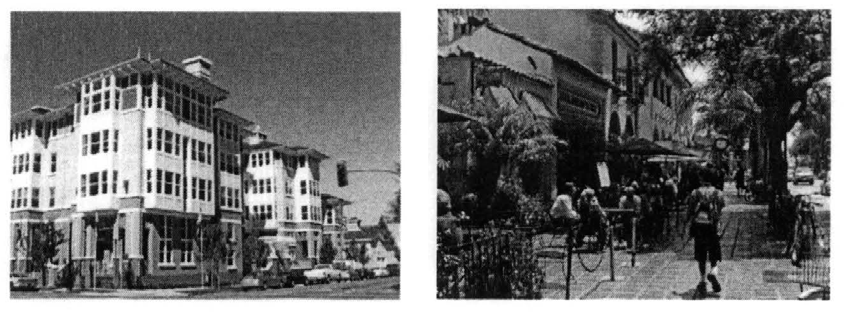
(2)
Building height and form.
a.
Incorporate crime prevention through environmental design (CPTED) concepts into the project design in order to create a safe built environment.
b.
Ensure that the scale of buildings is compatible and that taller buildings are not located so as to overwhelm smaller scale buildings or block access to light and sun.
c.
Locate the taller portions of residential projects away from adjoining residential properties, in order to provide height transitions between taller and lower buildings, and to maximize light, air, and privacy for units.
d.
For projects adjacent to lower density residential zones, reduce the visual and shadow impact of upper stories by using one or more of the following design strategies:
1.
Locate upper floors in the center of the property at least 30 feet away from adjacent properties.
2.
Step back the top one or two stories from the stories below.
3.
Tuck the top story inside a pitched roof.
4.
Use pitched roofs with dormer windows for top story rooms.
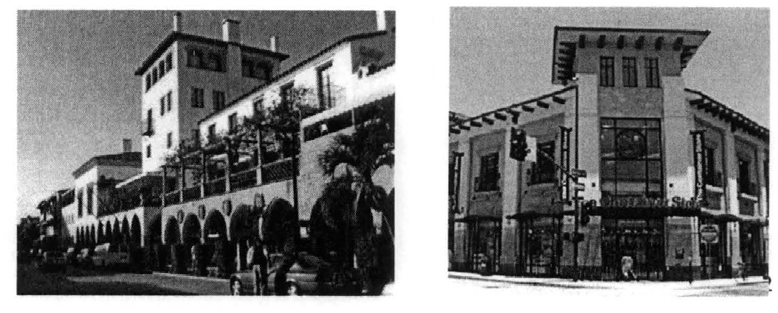
e.
These guidelines ensure that continuous buildings with attached or stacked units on deep narrow lots do not end up being overly long and bulky, creating an incompatible institutional character within residential neighborhoods.
f.
Design residential projects to avoid large box-like forms with continuous unrelieved surfaces.
g.
Include articulation in the project, such that the bulk as seen from existing neighbors is reduced.
h.
Minimize the bulk of the buildings by limiting building length, or designing buildings with two or more of the following special features to break up building bulk, including:
1.
Horizontal and vertical setbacks and stepbacks (instead of a long flat wall);
2.
Changes in roof form and height;
3.
Major full-height recesses (typically at least ten feet deep) along the length of the building that successfully break the building into smaller discrete masses.
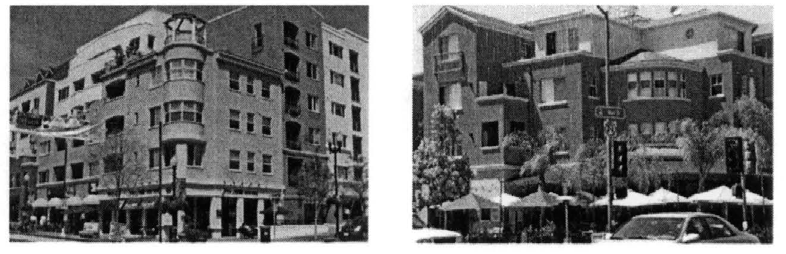
i.
Ground level parking podiums and lobbies can be continuous without a break if the above guidelines are met.
j.
Provide visual orientation from the major commercial arterials through graduated heights and/or varied setbacks or architectural elements such as towers to mark entries or corners to reduce the scale of larger buildings and to provide visual orientation from the major commercial arterials.
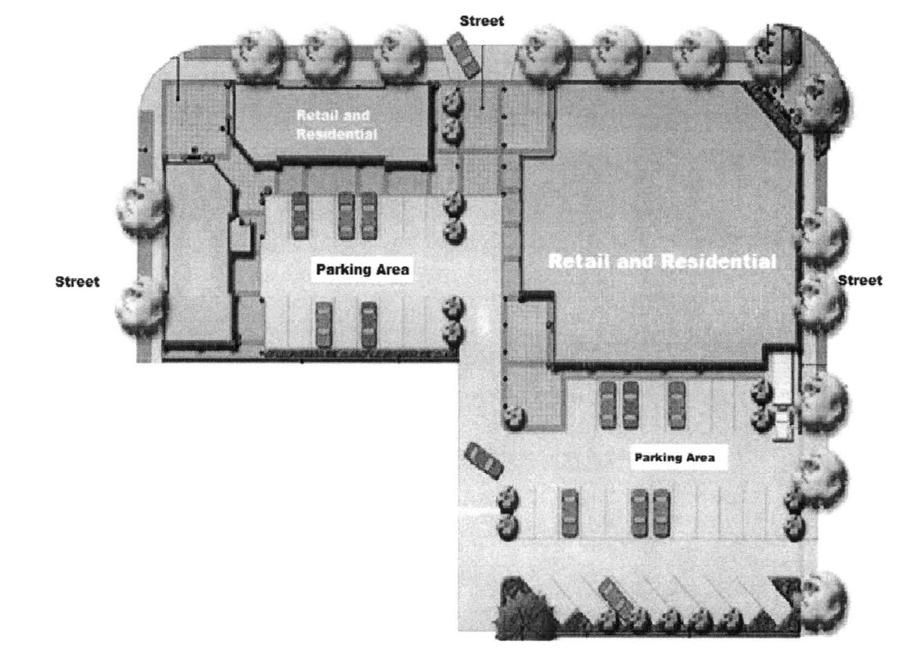
(3)
Building relationship to the street.
a.
Locate active uses on the ground floor, and provide continuous storefront windows and frequent, highly-visible entries.
b.
Locate buildings close to the sidewalk to enclose the public realm of the street and sidewalk, and locate shops and restaurants next to the pedestrian sidewalk. Wider setbacks are appropriate to allow for the following:
1.
Outdoor seating and display;
2.
Building entrances and facade articulation;
3.
Outdoor cafes;
4.
Plazas or other high activity public areas.
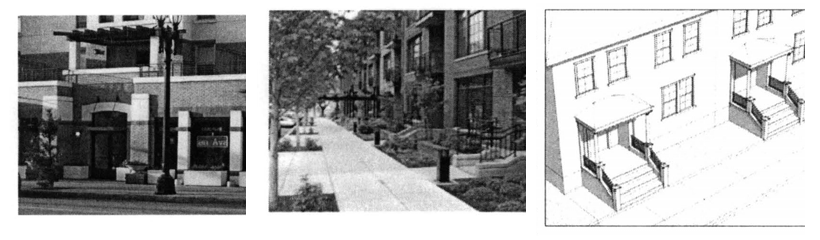
c.
Design setback areas to be used for public entry, gathering and outdoor commercial activity. Design them predominantly with hardscape, and provide shade and places to sit. They also may be appropriate places to locate pedestrian conveniences such as public telephones, trash receptacles, bicycle racks and newspaper dispensers.
d.
Minimize the visibility of parking from the street and sidewalk, especially at corners. Locate parking to the side or rear of buildings, or underground.
e.
Emphasize building entrances with special architectural and landscape treatments.
f.
Locate all customer entries and entryways to be directly visible from the public sidewalk, and accessible from public and private walkways. Corner buildings are encouraged to have corner entries.
g.
Provide a pedestrian walkway from the public sidewalk to the entry frontage of buildings set back from the street edge.
h.
Design public street facing residential facades with individual entries, such as steps, porches, entrance stoops and paths from living units to the street help to break down the scale of multi-unit buildings.
i.
Provide attractive rear and side access to businesses where there is parking at the rear or side of the site, but in all cases, there must be a principal entry that is strong and visible from the public sidewalk.
(4)
Building design.
a.
Design projects with a consistent design integrity, exhibited by all building components including, but not limited to, building mass and articulation, roof forms, windows (proportion and design), building materials, facade details (doors and entrances), fencing, and landscaping.
b.
Design commercial building facades fronting on sidewalks to consist of storefronts that include clear glass display windows and entry doors that provide visibility into the ground floor lease space.
1.
In some circumstances, such as when building security would be placed at risk or when a side or rear wall of a building is adjacent to or near the street, shallow display windows, containing merchandise or artworks, are encouraged.
2.
Ground floor office uses are discouraged; however, where present, must be designed and maintained as storefront spaces.
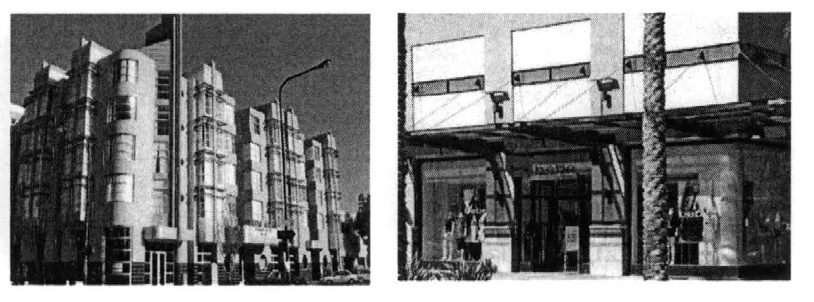
c.
Organize facade areas to provide:
1.
Horizontal emphasis through recesses, ornamentation and other types of decorative detail;
2.
Pedestrian orientation through overhangs, eaves, awnings, display windows and architectural ornamentation; and,
3.
Harmonious composition through use of complementary combinations of materials and colors.
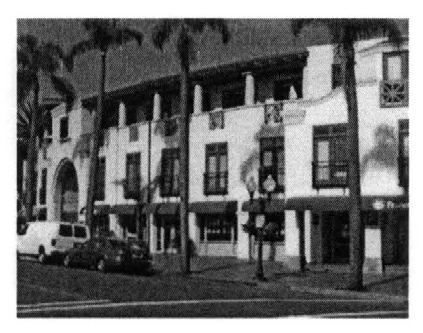
d.
Include architectural elements providing shade and weather protection for pedestrians, such as overhangs and arcades.
e.
Use building materials that convey a sense of durability and permanence. Use high quality materials that will last for the life of the building. Install materials so that building facades do not stain or deteriorate quickly.
f.
Use the highest quality and most durable materials at the ground floor of buildings, because those can be most impacted by landscaping, people, and automobiles. Ground floor exterior materials must be tile, stone, brick, glass, concrete, and other highly durable materials.
g.
Use exterior siding materials such as stucco, wood siding, masonry, tile, wood shingles, metal panels, and glass panels. Do not use scored plywood, aluminum siding, or shake or wood shingles.
h.
Use a complementary palette of materials on all four sides of buildings. Use building materials of similar durability and quality throughout the project.
i.
Locate material changes at interior corners as a return at least six feet from the external corners or other logical terminations and not at external corners.
j.
Use secondary materials (such as ceramic tile, terra cotta, or wood millwork) applied to the primary finish material that are complementary to the primary material and compatible with the overall building design. Do not use false stone, plastic, aluminum, or plywood.
k.
Finish any blank building walls adjacent to and visible from residential properties with quality materials and maintain them free of any signs or graffiti.
l.
Where they are visible from the street or adjacent to pedestrian walkways, design the blank sides and backs of buildings to provide visual interest by making use of such elements as recesses, bays, covered walkways, or shallow display windows. Highly textured materials that provide contrasts of shade and light or murals are other appropriate design solutions for otherwise blank walls that are visible to adjacent uses.
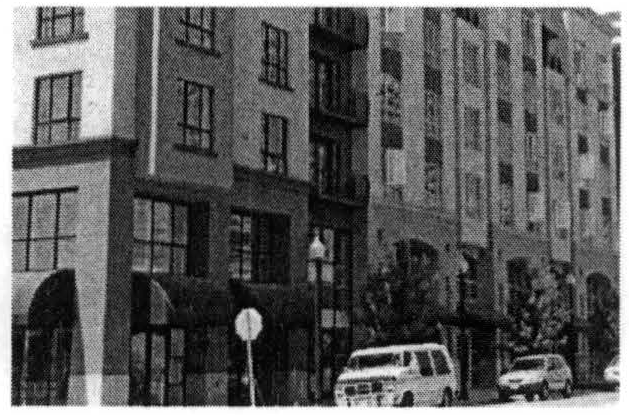
m.
Select a coordinated palette of complimentary colors, rather than a patchwork of competing colors.
n.
Use bright colors only as accent colors.
o.
Do not use fluorescent or neon colors.
p.
Integral color exterior building materials are preferred, whenever possible, for new buildings or for exterior remodellings, and such materials should not be painted, with the exception of integral color stucco or comparable materials, which may require long term repaintings. Wood siding is a traditional exterior building material, which does require painting for weather protection, as do certain other materials over time.
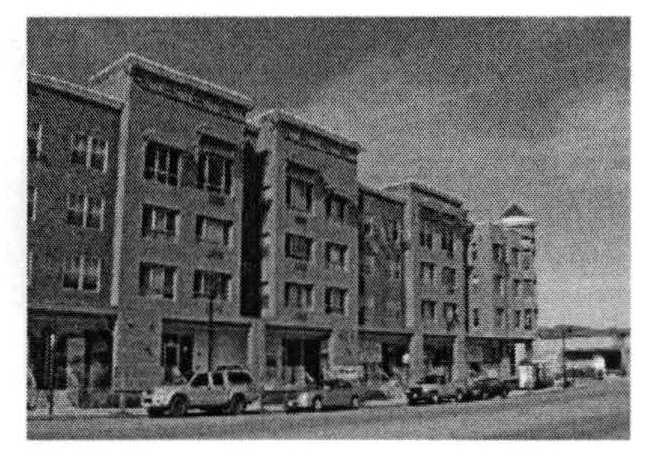
q.
Use predominant building colors that are generally light in tone (this does not restrict the color palette to any one color range, such as earth tones). Avoid corporate colors not consistent with these guidelines on color. Darker colors may be used for trim.
r.
Use muted colors for large areas such as building walls.
s.
Wood siding and trim may be left natural and stained to be light in tone.
t.
Use a consistent color scheme for a building's entire facade and all visible sides.
u.
Wherever possible, limit the number of colors appearing on the building exterior to no more than three colors or tones of the same color, including trim and accent colors.
v.
Use architectural detailing, including the use of color, that complements and embellishes principal design features, materials and colors of a building facade
w.
Design window recesses, window trim, doorways, columns, overhangs and other architectural elements to be substantial in depth, in order to create shadow and architectural relief. Incorporate at least three and typically four of the following features that provide articulation and design interest, on all sides of buildings:
1.
Decorative trim elements that add detail and articulation, such as window and door surrounds with at least a two-inch depth; or deeply recessed windows (more than two inches). They must be designed as an integral part of the design, and not appear "tacked-on;"
2.
Pitched/variegated roof forms;
3.
Roof overhangs at least 18 inches deep;
4.
Variety in use of materials, especially at ground level stories, for detailing at building entrances or other special parts of the building;
5.
Building base (typically bottom three feet) that is faced with a stone or brick material, or is delineated with a channel or projection; and/or
6.
Railings with a design pattern in wood, metal, or stone.
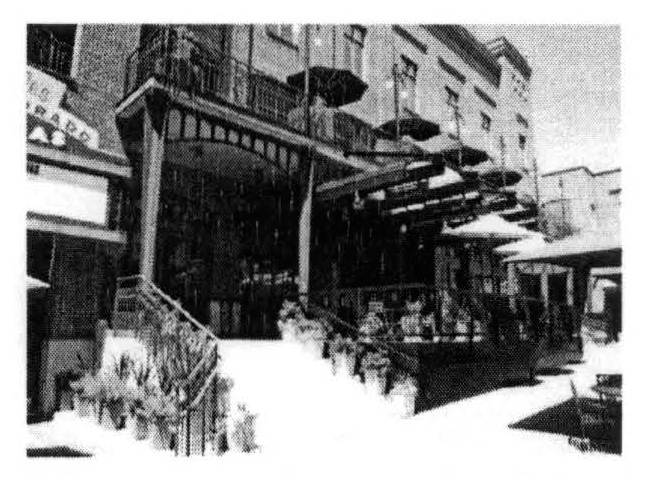
x.
Incorporate variable roof forms into the building designs, to the extent necessary to avoid a boxy appearance of buildings. This may be accomplished by changes in roof height, offsets, change in direction of roof slope, dormers, parapets, etc.
y.
Design roof forms such that no more than two side-by-side units are covered by one unarticulated roof. Articulation may be accomplished by changing roof height, offsets, and direction of slope, and by introducing elements such as dormers, towers, or parapets. Other alternative design approaches that achieve the same goal of breaking down building masses into small individual units may also be acceptable, for example shifting the units in section and varying the design treatment for individual units.
z.
Design roof elements to have a functional integrity that is part of the overall building design. Do not use false roof forms, such as those used for purely decorative or advertising purposes. Do not use mansard roofs on any building with a height less than four stories.
aa.
Call visual attention to corners and entries using architectural features such as tower elements.
bb.
Incorporate projections and recesses throughout the facade design to add architectural interest and a visual play of light and shadow. Examples include: bay windows, chimneys, front porches, balconies, overhangs, brackets, and cornices.
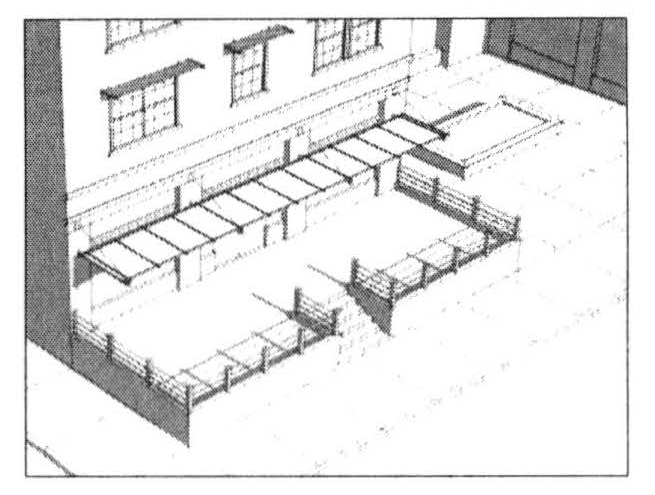
cc.
Incorporate building projections that enhance the design and articulation of the building. These may project into required front, side, and rear setback up to the limits allowed in the development standards.
dd.
Design window patterns and proportions to enhance all facades of the building and add architectural interest. Differentiate window designs (size, proportion) to reflect the different components of residential units, for example entrances, living areas, stairways, and bedrooms, while ensuring harmony within that variety.
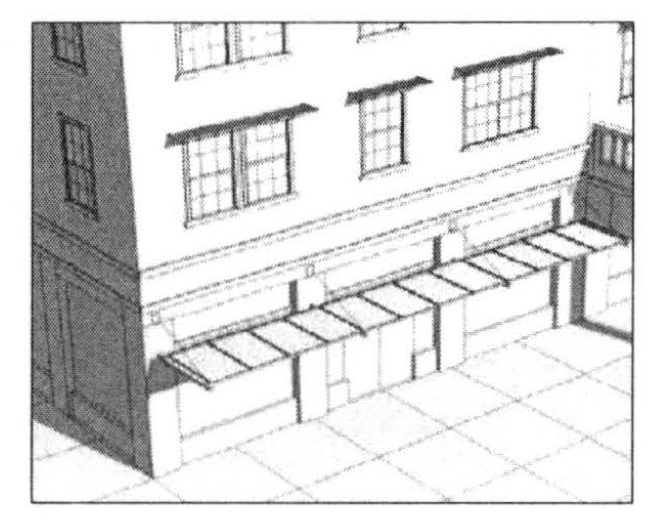
ee.
Design the locations and proportions of all window openings with consideration for the overall composition of the building facade.
ff.
Design remodels and additions to conserve the design integrity and character of the existing building.
gg.
Do not close, move or enlarge exterior openings for doors and windows without consideration for the overall composition of the building, including all other remaining exterior openings.
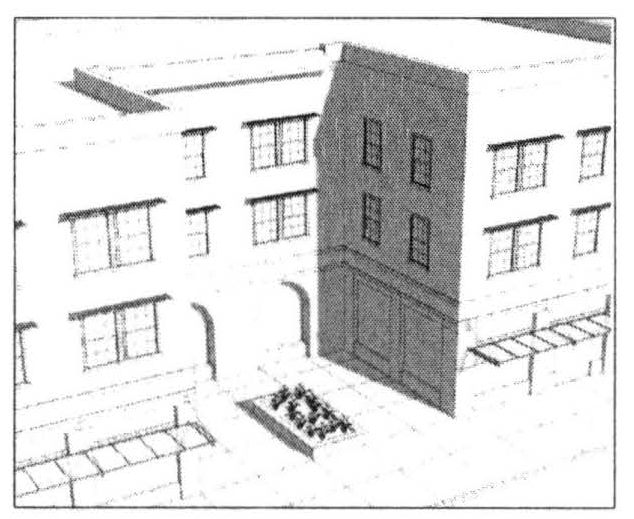
hh.
Design additions to existing buildings with consideration for the overall form of the resulting building or complex buildings; additions must not mix styles or introduce incongruous design motifs to an existing building or building complex.
ii.
Do not remove or cover high quality original finish materials and ornamentation integral to the design integrity of the building with new incompatible materials.
jj.
Use materials to fill openings or to repair damage to the existing building that match existing exterior materials.
kk.
Design new windows and doors to match existing window, door and hardware materials, except when the existing materials are of low quality, in which case they all shall be replaced with wood or high-quality metal materials.
ll.
Design elements added to the exterior of buildings, including windows and doors, security hardware, fire escapes, utility boxes, and screens of any kind, to be compatible with the existing design detail and composition of the building facade.
(5)
Building setbacks for light, air, and privacy.
a.
Provide adequate light, air, and privacy for residential units in the project, as well as for residential units on adjoining properties.
b.
Provide distance between buildings on the same project site that is adequate to ensure light, air and privacy for adjacent residential units and to minimize shadows on open space.
c.
Use design strategies to protect privacy, such as: offsetting windows of adjacent units; locating minor windows above eye level, and using opaque glass for minor windows.
(6)
Auto circulation: Site access and driveways.
a.
Minimize the number of entrances and exits to parking areas, in order to minimize conflicts with pedestrians, reduce congestion at street intersections, and preserve existing on-street parking.
b.
Locate entries and exits to allow direct, through movement among individual parking areas where possible.
c.
Provide access to rear parking areas predominantly from side and rear streets.
d.
Minimize the number of entrances and exits to parking areas in order to minimize conflicts with pedestrians and reduce congestion at street intersections.
e.
Share parking areas and/or parking entrances/exits between adjacent properties to the maximum extent feasible. Place covenants on deeds to ensure continued shared use.
f.
Design vehicular circulation to allow through movement between adjacent parking areas.
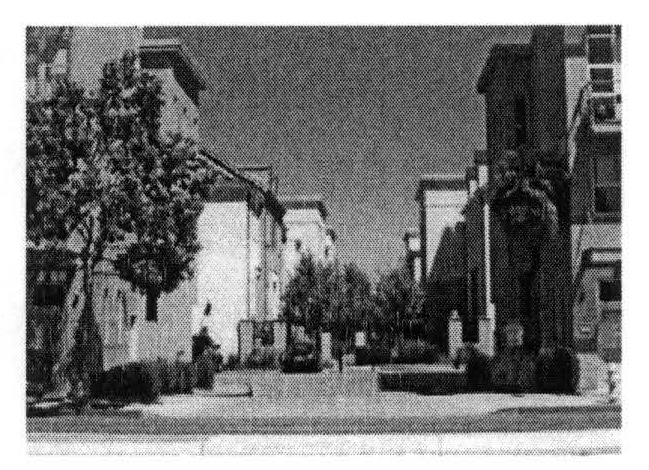
(7)
Parking location and design.
a.
Locate parking to the rear or side of buildings, underneath buildings, or underground and avoid land intensive surface parking lots. Recommended parking locations include the following:
1.
Interior side parking
2.
Rear parking
3.
Partial below grade parking
4.
Below grade parking
b.
Disperse contiguously paved areas throughout the project in smaller segmented parking areas rather than creating land intensive surface parking lots.
c.
Do not locate parking between buildings and the street.
• Parking areas between the building edge and the sidewalk are not allowed. Buildings may be located behind other buildings that are located at the street edge, with on-site parking provided between the two sets of buildings.
d.
Locate garage entrances and driveways to the side of the property instead of at the center.
e.
Screen parking areas from view from the pedestrian sidewalk.
(8)
Facilities, pedestrian circulation, bicycles, and transit.
a.
Provide new or repaired improvements in the public right-of-way along the lot frontage, including sidewalks, street trees, curbs, and gutters as per the City of Fontana's Municipal Code.
b.
Provide street trees along the street frontage that enhance the visual appearance of the street and provide shade for pedestrians, but do not block the visibility of commercial signs.
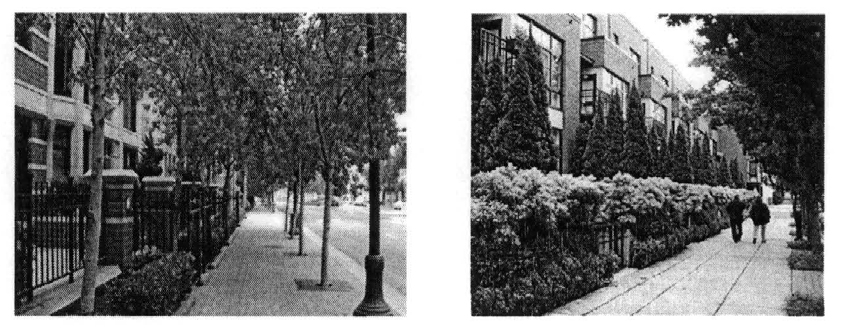
c.
Locate buildings to be contiguous wherever possible, and make accommodations for pedestrian circulation between adjacent businesses and sites.
d.
Where new parking areas are to be located adjacent to existing parking areas on an adjoining site or sites, provide pedestrian walkways that connect the two areas.
e.
Provide sidewalks within residential projects, connecting from the street or driveway to unit entrances.
f.
Provide pedestrian walkways with landscape amenities from within parking areas to permit and encourage direct access to shop entries, and to other pedestrian oriented uses and destinations.
g.
Incorporate decorative pervious paving into paved and landscaped areas in order to enhance the appearance of the project, reduce the visual impact of paved surfaces and act as a traffic calming measure. Decorative paving includes: brick, patterned colored concrete (stamped, not just scored), stone blocks or pavers, interlocking colored pavers, grasscrete, and other comparable materials.
h.
Locate decorative paving in the following priority locations:
1.
The first 20 feet of the driveway closest to the street(s);
2.
Parking areas;
3.
Parking areas or fire turnarounds that can also occasionally function as outdoor courtyards.
i.
Provide short-term bike parking in parking areas and other locations near commercial-type uses entrances.
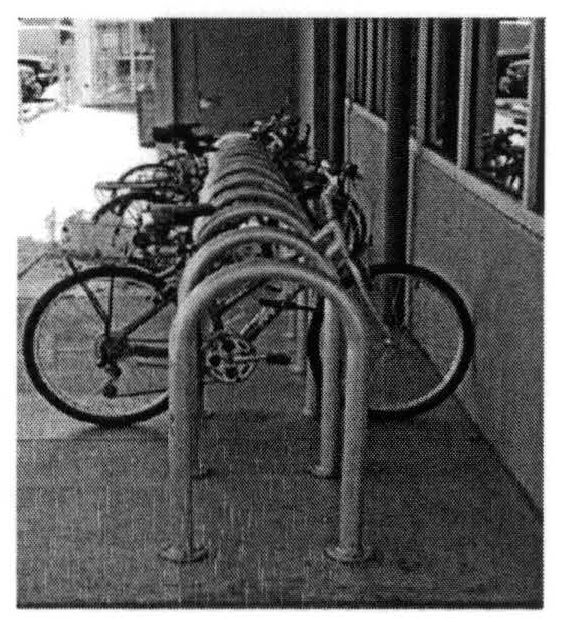
j.
If the provision of a transit shelter is required, provide transit shelter that enhances the streetscape and that offers adequate seating and shade.
(9)
Site landscaping.
a.
Incorporate landscaping in order to create an attractive visual outlook for residential units, create usable open space, maximize stormwater infiltration, and provide privacy for adjacent residential units.
b.
Design site landscape treatments to be attractive, with consistent design integrity throughout the project.
c.
Provide site landscaping in the following priority areas:
1.
In areas that are visible from the primary living areas of residential units
2.
Within common open space areas
3.
Along the edge of driveways
4.
Along the property perimeter
5.
Between buildings and driveways
6.
Between buildings and parking
7.
Between commercial-type uses and residential uses in mixed-use projects
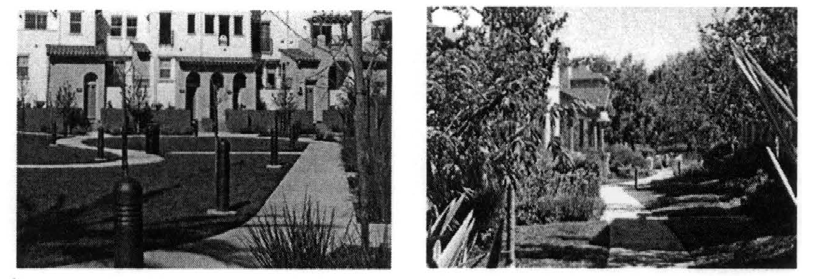
d.
Landscape parking lots, driveways, and other auto circulation areas in order to improve the visual appearance of circulation and parking areas from residential units, from the common areas of the project, and from adjacent properties.
e.
Incorporate trees, landscape islands, shrubs, and groundcover throughout parking areas, consistent with required standards.
f.
Shade paved surfaces to the maximum extent possible in order to reduce heat gain and other environmental effects.
g.
Design landscaped areas to serve as stormwater management areas as well as visual amenities.
h.
Integrate stormwater management facilities into the site landscaping. Innovative stormwater management practices are encouraged.
i.
Provide landscaping to comply with the City's Landscaping and Water Conservation Ordinance. More specifically, wherever possible, incorporate a drought tolerant plant palette.
j.
Select landscaping materials that meet the following criteria:
1.
Drought tolerant plants
2.
Low-water use plants
3.
Sturdy enough to withstand close contact with pedestrians and vehicles
k.
Landscape areas requiring higher water usage for maintenance shall be restricted to small courtyards and other kinds of intensively used areas.
l.
Use fast growing, long lived species that will achieve the desired size and form at maturity without extensive pruning or training once they have been established.
m.
Use accent landscaping and special landscape elements, such as feature planting, including freestanding columns or trellises with vines for vertical accent, to give visual expression to site circulation, especially at entrances and exits.
(10)
Usable open space.
a.
Design common open space as a space where people can interact, host guests, and enjoy some time in the open air.
b.
Design private open space for the exclusive use of household members to eat outside, garden, enjoy the open air, and grill outdoors.
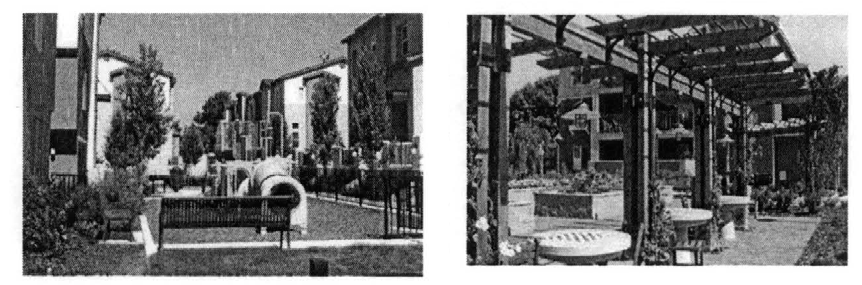
c.
Provide usable open space that may have a dual function for stormwater treatment and incorporates strategies such as grassy swales, vegetated swales, flow through planters, rain gardens, etc.
d.
Design common open space(s) to be a shared open space for use by all residents.
e.
Locate common open space(s) in a central location that serves all the units, not at the edge of the property. Common open space can be on the ground, or in courtyards above the ground level.
f.
Include seating areas and other passive recreation facilities.
g.
Include landscaping with trees, shrubs, and groundcover. If the space is not located on the ground, include extensive pots and planter boxes that accommodate trees, shrubs, and groundcover.
h.
Include children's play areas in the common open spaces.
i.
Design private open space to be used exclusively by a single unit.
j.
Locate private open space in patios, balconies, decks, or other outdoor spaces attached to individual units.
k.
Dimension private open space so there is room for a table and chairs where residents can sit outside.
(11)
Fences and walls.
a.
Design fences and walls to be an attractive part of the project, with materials and designs that are compatible with the exterior building materials and demonstrate design integrity with the project as a whole.
b.
Locate fences or walls on the property to define private open space and common open space areas, protect privacy, and buffer residents from noise sources.
c.
Use masonry materials for sound reduction purposes.
d.
Build fences and walls using masonry materials that include a top or cap.
e.
Wood fencing, chain link, or chain link with slats is prohibited.
(12)
Services.
a.
Locate ancillary facilities within buildings, not along the street facing facade, to the maximum extent feasible. Where ancillary facilities such as trash receptacles and utility meters absolutely cannot be incorporated into a building, locate them at the rear of the site in freestanding, completely enclosed structures designed to be compatible with the architecture of the rest of the development.
b.
Design streets and driveways to accommodate vehicles commonly used for loading and unloading.
c.
Minimize the visibility of loading areas in mixed use residential complexes, and screen them with screen walls, landscaping, and other devices.
d.
Provide on-site facilities for trash storage and for recyclable materials.
e.
Provide trash areas within buildings, or centralized garbage dumpsters inside trash enclosures.
f.
Build covered trash enclosures with durable materials such as stone, concrete block, steel, and heavy timber.
g.
Locate electrical panels to minimize their visibility from the street, in locations such as side walls, and/or behind landscaped areas. Integrate them into the design of residential buildings to the maximum extent feasible.
h.
Minimize the visibility of utilities connections from the public street.
Sec. 30-457. - Conversion of multiple-family residential units.
(a)
Purpose. The purpose of this section shall be to establish criteria for regulation of the conversion of existing multiple residential rental units and divisions of land that accommodate any conversion of rental units to ownership units. The intent of this section with respect to conversion projects shall be to:
(1)
Increase the opportunity for qualifying low- and moderate-income households, especially those of conversion project residents to acquire and reside in ownership housing.
(2)
Assist the City to meet its stated commitment to low- and moderate-income housing goals as set forth in the housing assistance plan and the housing element of the general plan.
(3)
Reduce the impact of conversion on residents in rental housing who may be required to relocate.
(4)
Ensure that purchasers of converted housing have been properly informed as to the conditions of the unit purchase.
(5)
Ensure that converted housing achieves high quality appearance and safety and is consistent with the goals and objectives of the general plan and applicable building codes.
(b)
Exception to conversion. The project creating a condominium or stock cooperative and involving only one existing dwelling unit shall not be considered a conversion. For the purposes of this exclusion, the number of existing dwelling unit(s) shall be determined on the date of application for the permit, if the project calls for destruction of the structures housing the dwelling unit(s), those units shall not be counted as existing unit(s).
(c)
Minimum conditions and requirements. The following conditions and requirements must exist at the date of application for conversion of real units to condominium, stock cooperative or community apartment ownership units. All buildings must be in compliance with:
(1)
The minimum standards of the most recently adopted uniform codes of the State of California as adopted by the City.
(2)
The general plan of the City or be legally nonconforming to the general plan.
(3)
The zoning ordinance or be legally nonconforming.
(4)
The subdivision ordinance of the City and the Subdivision Map Act of the State of California.
(d)
Development standards. The following minimum standards shall apply to all conversion projects:
(1)
Unit size. The enclosed living or habitable area shall not be less than that which was applicable under the ordinance the project was developed under. On recommendation of the Planning Commission, the Commission or City Council may determine at the time of approval that the project amenities compensate for the minimum required enclosed area and thereby reduce the required minimum unit size. Compensating amenities may include but are not limited to the following:
a.
Private enclosed space.
b.
Enclosed developed facilities within the common area.
c.
Compatibility of the density of the total project in relation to the project's amenities and surrounding neighborhood.
(2)
Utility metering.
a.
The consumption of gas and electricity within each unit shall be separately metered so that the unit owner can be separately billed for each utility. A water shut-off valve shall be provided for each unit and for each plumbing fixture. Each unit shall have access to its own meter(s) and heater(s) and air conditioning units that shall not require entry through another unit. This requirement shall not be construed to restrict use of solar space or water heaters.
b.
Each unit shall have its own panel for all electrical circuits that serve the unit or shall have access to such a panel.
(3)
Condition of equipment and appliances.
a.
The applicant shall provide written certification to the buyer of each unit on the initial sale after conversion that any dishwasher, garbage disposal, stove, refrigerator, hot water tank and air conditioner are new and in working condition as of the close of escrow.
b.
At such time as the cooperative or homeowner's association of the maintenance organization takes over management of the development, the applicant shall provide written certification to the association that any pool and pool equipment and any appliances and mechanical equipment to be owned in common by the association are in working condition.
c.
The applicant shall establish a replacement reserve fund equal to ten percent of the estimated replacement value of all association owned appurtenant equipment and appliances. Such estimated replacement value shall be included in the physical elements report and be utilized as the basis for computing the replacement reserve fund. At the time of activation of the association, the replacement reserve established shall be given by applicant to the association. Written receipt of this action shall be submitted by association or applicant.
(4)
Underground utilities. Overhead utility distribution lines within the boundaries of the project shall be fully converted to underground.
(5)
Refurbishing and restoration. All main buildings, structures, fences, patio enclosures, carports, accessory buildings, sidewalks, driveways, landscaped areas, refuse storage areas, irrigation systems, storm drainage facilities, appurtenances and related items as required by the Community Development Department and the City Building Official shall be modified, replaced or refurbished and restored as necessary to achieve high quality appearance and to protect the health, safety and public welfare of future site occupants and adjacent properties. Normal building permit requirements and procedures shall be required where applicable. Improvement elements may include but not be limited to:
a.
Repainting.
b.
Re-plastering, stuccoing, or additional architectural treatment.
c.
Replacement of landscaping, walls, fences or accessory structures.
d.
Replacement or resurfacing of driveways and parking areas.
e.
Drainage plan.
f.
Addition of improvements to meet minimum conditions and standards, including, but not limited to, replacement of fixtures and appliances.
g.
Others as deemed necessary by the Community Development Department, the Building Official, Planning Commission, or City Council.
(6)
Physical elements useful life. Any physical element identified in the physical elements report described herein having a useful life of less than three years, as determined by the Building Official shall be replaced, except for equipment and appliances that are covered in this title.
(e)
Application procedures. An application for a cooperative, condominium or community apartment conversion project must include the following to be accepted for processing.
(1)
Applicant shall be required to submit a design review application and tentative tract map as set forth in Article III.
(2)
A physical elements report that shall include but not be limited to:
a.
A report prepared, at applicant's expense, by the Building Official or his designee, detailing the condition and estimating the remaining useful life of each element of the project proposed for conversion; roofs; foundations; exterior paint; paved surfaces; mechanical systems; electrical systems; plumbing systems; including sewage systems, swimming pools, sprinkler systems for landscaping; utility delivery systems; central or community heating and air conditioning systems; fire protection systems, including automatic sprinkler systems; alarm systems, or stand pipe systems; and structural elements.
b.
A replacement cost estimate shall be provided for an element whose useful life is less than five years. Estimate for equipment, structures and appurtenances to be deeded to the association as defined herein shall be required.
c.
A structural pest control report prepared specifically for the conversion application. Such report shall be prepared by a licensed structural pest control operator.
d.
A building history report including: the date of construction of all existing physical elements of the project; a statement of the major uses of the project since construction; the date and description of each major repair or renovation of any structure or structural element since the date of construction for which an expenditure of more than $1,000.00 was made or for which a building permit was issued; a statement regarding current title holders and lien holders of all land and improvement.
e.
A copy of the proposed covenants, conditions, and restrictions that would be applied on behalf of any and all owners of condominium units within the project shall be submitted to the staff. With regard to stock cooperatives, this submission shall consist of a summary of proposed management, occupancy and maintenance policies.
f.
Specific information concerning the characteristics of the project including, but not limited to, the following:
1.
Square footage and number of rooms in each unit.
2.
Rental rate history for each type of unit for previous two years.
3.
Monthly vacancy rate for each month during preceding two years.
4.
Survey of makeup of existing tenant households, including family size, length of residence, age of tenants and whether receiving federal or state rent subsidies, welfare or other public assistance payments.
5.
Proposed sale price of unit.
6.
Proposed initial homeowner's association fee, financing available.
7.
Names and addresses of all current tenants. When the applicant can demonstrate that such information is not available, these requirements may be modified by the Community Development Department.
(3)
The applicant shall submit evidence that certified letter of notification of intent to convert was sent to each tenant. Such certified letter shall be sent to each tenant within ten days following the acceptance of a project for processing.
(4)
The application shall certify in writing that he has not engaged in coercive or retaliatory action regarding the tenants after the submittal the first application for City review through the date of approval. In making this finding, consideration shall be given to:
a.
Rent increases at a rate greater than the rate of increase in the Consumer Price Index (all items), unless provided for in leases or contracts in existence prior to the submittal of the first application for City review; or
b.
Any other action by applicant that is taken against tenants to coerce them to refrain from opposing the project. An agreement with tenants that provides for benefits to the tenants after the approval shall not be considered a coercive or retaliatory action.
c.
Any other information that, in the opinion of the Community Development Department, Building Official or City Engineer, will assist in determining whether the proposed project will be consistent with the purposes of this section.
(f)
Required findings. The Planning Commission's approval of an application for conversion requires that:
(1)
All provisions of the purpose and intent of this chapter are individually and affirmatively addressed, and a determination is made that the project will not be detrimental to the health, safety and general welfare of the community.
(2)
Vacancies in the project have not been increased for the purpose of preparing the project for conversion. In evaluation of the current vacancy level under this subsection, the increase in rental rates for each unit over the preceding two years and the average monthly vacancy rate for the project over the proceeding one year shall be considered.
(g)
Planning commission recommendation. The recommendation of the Planning Commission shall be transmitted to the City Council within 90 days of the date of the public hearing closure. The City Council shall set the matter for public hearing with required public notice. The decision of the City Council upon completion of the public hearing and deliberation is final.
(h)
Tenant provisions.
(1)
Preliminary notice of intent. A preliminary notice of intent to convert shall be sent by certified mail, return receipt requested, to each tenant within 60 days after acceptance of the application for processing. The notice of intent shall include:
a.
Name and address of current owner.
b.
Name and address of applicant/sub-divider.
c.
Schedule of hearing dates before Planning Commission.
d.
Other data as required by the Community Development Department.
(2)
Official notice of intent. An official notice of intent to convert shall be delivered to each tenant's dwelling unit within 30 days after approval by the City Council of the tentative tract map. Evidence of delivery shall be submitted to the Community Development Department prior to consideration of the application by the planning coordinating committee. The form of the notice shall be as provided by the Community Development Department and shall contain not less than the following:
a.
Name and address of current owner.
b.
Name and address of proposed sub-divider.
c.
Approximate date on which the tentative map will be or was approved.
d.
Approximate date on which the final map is to be filed.
e.
Approximate date on which the unit is to be vacated by non-purchasing tenants.
f.
Tenant's right to purchase.
g.
Tenant's right of notification to vacate.
h.
Tenant's right of termination of lease.
i.
Statement of limitations on rent increase.
j.
Provision for special cases.
k.
Provision of moving expenses.
l.
Provision of relocation assistance.
m.
Other information as may be deemed necessary by the Community Development Department.
(3)
Tenant's right to purchase. As provided in Government Code § 66427.1(d) any present tenant or tenants of any unit shall be given a nontransferable right of first refusal to purchase the unit occupied a minimum of 90 days from the date of issuance of the subdivision public report, or commencement of sales, whichever date is later.
(4)
Vacation of units. Each non-purchasing tenant, not in default under the obligations of the rental agreement or lease under which he occupies his unit, shall have not less than 180 days from the date of receipt of notification from the applicant of his intent to covert or from the filing date of the final subdivision map, whichever date is later, to find substitute housing and to relocate with assistance from the applicant. All rental deposits paid by the renter shall be returned.
(5)
Increase in rents. From the date of approval of the tentative subdivision map until the date of conversion, no tenant's rent shall be increased more frequently than once every six months and at a rate grater than the rate of increase in the Consumer Price Index, on an annualized basis, for the same period. This limitation shall not apply if rent increases are provided for in leases or contracts in existence prior to the filing date of the tentative map.
(6)
Relocation services and moving expenses required. The applicant shall provide relocation counseling and financial assistance at a rate which shall be set forth in a resolution of the City Council for those tenants who have lived in the apartment complex for a period of ten years.
(7)
Procedure to ensure relocation assistance. A bond, surety or cash deposit in the amount of the relocation assistance for all units in the development as approved by the City Attorney shall be provided to the City by the developer to ensure that the provisions for tenant assistance are complied with. Said bond, surety, or cash deposit shall be returned to the developer upon written verification that all tenants have received the appropriate amount of financial assistance, as determined by the City Building Official. The bond, surety or cash deposit shall be provided to the City prior to release of the final tract map.
(8)
Final map approval. Each tenant shall be sent a written notice within ten days of approval of a final map.
(i)
Notice to new tenants. After submittal of the application to convert, any prospective new tenants shall be notified in writing of the intent to convert prior to leasing or renting any unit and shall not be subject to the provisions of this section.
Sec. 30-458. - Mobile home parks.
It is the purpose of this section to provide regulations for the location, design and improvements of mobile home parks that equal or exceed all applicable state laws.
(1)
Compliance to standards. Any person desiring to enlarge or establish a mobile home park shall meet or exceed the design standards set forth in this section.
(2)
Minimum areas. Mobile home parks shall be developed on a parcel of land at least ten adjusted gross acres in area.
(3)
Lot areas. Each mobile home space shall contain a minimum area to accommodate either double wide or triple wide mobile homes.
(4)
Clearances. Mobile homes shall be located so they are at least ten feet apart from side to side, eight feet apart from side to rear, six feet apart from rear to rear, and ten feet from any building.
(5)
Minimum side and rear lot clearances. There shall be minimum side lot clearances totaling ten feet in width; provided, however, that no mobile home shall be closer than three feet to any side or rear lot line. Where lots abut side or rear setbacks as defined in subsection 88.0315(j), said setback areas may be included as part of this requirement.
(6)
Occupied area. The occupied area of each mobile home space shall not exceed 75 percent of the total area of such mobile home lot. The area shall be deemed to be occupied when covered or occupied by a trailer coach, cabana, vehicle, ramada, awning, closet, cupboard or any other structures.
(7)
Setbacks. The following setbacks shall be maintained on each mobile home park:
a.
Front setback of at least 25 feet in depth, along the public street upon which the mobile home park fronts. This setback shall extend across the entire width of the park.
b.
Side setbacks of not less than ten feet in width along each side boundary line of the mobile home park.
c.
A rear setback of not less than ten feet in depth along the rear boundary line of the mobile home park.
d.
Setbacks may be required where, in the opinion of the approval body, such setbacks are necessary due to topographic conditions, grading, drainage or protection of adjacent property.
e.
No part of any mobile home shall be located within any required setback area.
(8)
Roads within mobile home parks. Roads within mobile home parks shall be designed to provide reasonable and convenient traffic circulation and shall meet the following standards:
a.
No road shall be less than 34 feet in width if car parking is permitted on one side of the road and not less than 42 feet in width if car parking is permitted on both sides.
b.
Road widths to provide for parking on one side shall be deemed necessary when lots abut the road on one side only. Road widths to provide for parking on both sides shall be deemed necessary when lots abut the road on both sides.
c.
The entire width of the roads within mobile home parks shall be surfaced with a minimum of two-inch thick asphalt, concrete, plant mix or other approved material.
(9)
Parking. There shall be provided two parking spaces on each lot. There shall also be established and maintained within each mobile home park automobile parking area for use of guests. The number of such spaces shall be equal to one for every ten mobile home spaces for fraction thereof within the mobile home park.
(10)
Walkways. Walkways shall be provided to permit reasonably direct access to all lots, service buildings and other areas or buildings used by occupants of the trailers. Collector walkways serving utility buildings, playgrounds and other general areas shall be four feet in width or more and individual entrance walks to each mobile homes site shall be at least two feet in width. All walkways shall be constructed of asphalt, concrete, plant mix or other approved materials that will permit all-weather pedestrian movement.
(11)
Enclosures of mobile home park. A wall of decorative masonry six feet in height shall be erected and maintained along each side and rear boundary of a mobile home park.
(12)
Vehicle storage. Common storage areas shall be provided with an enclosed fenced area for the residents of the mobile home park for the storage of recreational vehicles, trailers, travel trailers, and other licensed or unlicensed vehicles. This area shall total not less than 50 square feet for each mobile home lot. All storage on a mobile home lot shall be in accordance with the provisions of the California Administrative Code, title 25.
(13)
Modifications in design. Where mobile home parks are submitted for approval which, although not complying with the requirements of design as stated herein, is consistent with the general intent and purpose of this chapter, the Planning Commission may approve such parks and conditions and restrictions which ensure that the general purposes are satisfied. Park designs utilizing duplex or cell-type groupings of mobile home lots or other modified designs may be approved under the provisions of this section.
(14)
Recreational facilities.
a.
Each mobile home park shall have an outdoor recreational facility that contains one or more of the following elements: swimming pool, spa, playground, basketball courts, and tennis courts.
b.
In addition to these outdoor recreational areas all mobile home parks shall have an enclosed recreation/activity room.
Sec. 30-459. - Senior housing.
(a)
Senior housing shall be permitted in any residential and commercial zoning district subject to review and approval of a conditional use permit. Design standards and density shall be compliant with the general plan and reviewed by the Planning Commission during the review of the conditional use permit and design review.
(1)
For tenants, residents, or occupants who are married to each other, either spouse shall be 55 years of age or older or 100 percent disabled.
(2)
For individuals who are not married, each individual shall be 55 years of age or older or 100 percent disabled.
(3)
Land uses in the immediate and surrounding area, current and projected, must be compatible with the living environment required by senior citizens and must be free of health, safety, or noise problems (i.e., area generally quiet).
(4)
Area infrastructure must be in place or constructed as part of the project and capable of serving the proposed project including:
a.
Streets.
b.
Sidewalks.
c.
Traffic/pedestrian signals.
(5)
Proposed site topography must be fairly level and easily traversed by persons of limited mobility.
(6)
Senior complexes with 60 or more units shall provide daily shuttle transportation commercial/medical centers.
(7)
Proposed site must demonstrate proximity to commercial establishments, service providers, and other amenities including:
a.
Food shopping.
b.
Drug stores.
c.
Banks.
d.
Medical and dental facilities.
e.
Public transit (main or frequently served routes).
f.
Open space/recreational facilities.
g.
Van transportation available to seniors on a daily basis.
(8)
Development incentives granted by the City to a developer constructing senior housing are predicated upon the long-term availability and affordability of the units for the target population previously defined. In order to ensure that the units remain available and affordable to this group, the developer will be required to enter into a development agreement with the City per Government Code §§ 65864 through 65869.5.
(b)
Recreational facilities.
(1)
The developer shall provide recreational facilities in conjunction with common open space as a minimum requirement for all senior housing complexes. The recreational facilities shall be conveniently located throughout the site.
(2)
Related recreational activities may be grouped together and located at any one area of the common open space. Where multiple recreational facilities are provided such facilities shall be required to be dispersed throughout the site. Developments consisting of 50 units or fewer shall provide three of the following recreational facilities from the list below or equivalent, as approved by the Planning Commission:
a.
Barbecue facility equipped with grill, one picnic area and trellis.
b.
Large open lawn area, minimum dimensions shall be 20-foot by 50-foot.
c.
Spa and/or pool.
d.
Age appropriate court facility.
e.
Fitness room.
f.
Community garden.
g.
Game room/entertainment lounge.
h.
Library.
i.
Walking path through the complex with rest areas, etc.
(3)
Development consisting of 50 units to 79 units shall provide a minimum of four recreational facilities. Developments shall provide these two amenities or equivalent, as approved by the Planning Commission and two others from list (b)(2) above.
a.
Barbecue facility equipped with grill, two picnic areas.
b.
Large open lawn area, minimum dimensions shall be 20-foot by 50-foot.
(4)
Development consisting of 80 units to 200 units shall provide a minimum of five recreational facilities. Developments shall provide these three amenities or equivalent, as approved by the Planning Commission and two others from list (b)(2) above.
a.
Indoor gym/fitness facility (minimum 500 square feet).
b.
Large open lawn area, minimum dimensions shall be 50-foot by 100-foot.
c.
Barbecue facilities equipped with multiple grills, picnic benches, and shade structures.
(5)
Development consisting of 201 units to 400 units shall provide all recreational facilities listed below or equivalent, as approved by the Planning Commission:
a.
Indoor gym/fitness facility (minimum 500 square feet).
b.
Community garden and open lawn area, minimum dimensions shall be 50-foot by 100-foot.
c.
Barbecue facilities equipped with multiple grills, picnic benches, and shade structures. The barbecue facilities shall be conveniently located throughout the site.
d.
Court facilities (e.g. tennis, shuffle board, etc.).
e.
Spa and/or pool (min 25 yards by 15 yards).
f.
Jogging/walking trails with exercise stations.
g.
Community multi-purpose room equipped with kitchen, defined areas for games, exercises, etc.
(Ord. No. 1830, § 8(Exh. A), 6-9-20)
Sec. 30-460. - Manufactured homes.
Manufactured homes may be located on individual lots in all residentially zoned property lots and shall comply with all development standards of the zoning district in which it is located. In addition, the manufactured home shall be subject to the following requirements:
(1)
Shall be on a permanent foundation.
(2)
Shall have a two-car enclosed garage.
(3)
Shall have a roof overhang not to exceed 16 inches.
(4)
Shall be fire sprinklered.
(5)
Shall be architecturally compatible or superior to the existing homes in the surrounding neighborhood.
Sec. 30-461. - Accessory buildings, structures, and sheds.
All accessory buildings, structures and sheds, with the exception of pools, spas and hot tubs (see Section 30-467 for applicable regulations), are subject to the following requirements.
(1)
Private garages and carports, attached.
a.
On lots of less than one net acre, the total area is not to exceed 1,000 square feet or 25 percent of the living area of the principal residence, whichever is greater.
b.
On lots of one net acre or larger but less than two acres, the area shall not exceed 1,500 square feet or 25 percent of the living area of the principal residence, whichever is greater.
c.
On lots of two acres or larger, the area shall not exceed 2,000 square feet or 25 percent of the living area of the principal residence, whichever is greater.
(2)
Detached carports, storage buildings, workshops, hobby shops, recreation rooms, ground mounted solar panels, and other similar uses.
a.
On lots of less than one net acres, the combined area of all such structures shall not exceed 1,000 square feet or 25 percent of the living area of the principal residence, however, whichever is greater.
b.
On lots of one net acre or larger but less than two net acres, the combined area shall not exceed 1,500 square feet or 25 percent of the living area of the principal residence, whichever is greater.
c.
On lots of two net acres or larger, the combined area shall not exceed 2,000 square feet or 25 percent of the living area of the principal residence, whichever is greater.
d.
Detached garages are not included in the accessory structure square footage but are subject to overall lot coverage percentage. Lot coverages not specifically identified in zoning districts shall have a maximum lot coverage of 50 percent.
(3)
Accessory buildings or structures shall be architecturally compatible with or superior to the primary dwelling unit; metal and aluminum sided and roofed buildings are prohibited.
(4)
The following setbacks shall be maintained:
a.
Reversed corner lot. On reverse corner lots, accessory buildings and structures shall not extend beyond the required front setback of the abutting key lot and shall maintain a distance of five-foot from the side property line of the abutting key lot.
b.
Two-story buildings. Two-story accessory buildings are not permitted within any part of a required rear setback. The following setbacks shall be maintained:
c.
Distance from alley centerline. All accessory buildings and structures shall be located a minimum distance of 20-foot from the centerline of an alley.
d.
Distance from primary structure. All accessory buildings shall be located a minimum distance of six feet from the primary structure. If the two structures are connected by a breezeway, the minimum distance shall also be six feet.
(5)
Sheds.
a.
Location. All sheds shall be permitted, provided that:
1.
The shed does not exceed eight feet in height.
2.
The size of the shed does not exceed 120 square feet in floor area.
3.
There shall be no more than one shed for each 7,200 square feet of lot area.
4.
Architectural compatibility with the primary structure is encouraged; metal, aluminum and vinyl sheds are permitted provided the regulations of this section are met.
5.
The following setbacks shall be maintained:
b.
Corner lot. On corner lots, sheds shall not be visible from the public right-of-way.
(6)
Temporary shade awnings and easy-ups. Temporary shade awnings and easy-ups are prohibited within the setback area between the front or side of a dwelling or garage and any public right-of-way.
(Ord. No. 1865, § 8(Att. 2), 3-23-21)
Sec. 30-462. - Additions/existing single-family zoning districts.
(a)
Single-story additions. Single-story additions, including screened and/or enclosed patio structures, may be permitted on the lot in accordance with all development standards.
(1)
Side and rear setbacks for additions shall be equal to or greater than the existing side setback of the main structure.
(2)
The architecture of the proposed addition shall be compatible in design with the main structure. The roofing shall be of the same style and material as the main structure, with the exception of open and enclosed patio covers.
(b)
Two-story additions. Two-story additions in single-family zoning districts. All plans for second-story additions shall be reviewed for approval by the Community Development Department. Approval by the City shall be based on the following findings. Wherein any of these findings cannot be made the addition will be denied.
(1)
All zoning requirements of the single-family zone are complied with; however, side setbacks for additions shall be equal to or greater than the existing side setback of the main structure.
(2)
The architectural style and materials of the addition is compatible with the existing dwelling unit.
(3)
All of the following privacy provisions are complied with:
a.
Windows on second story additions shall be situated so that they are not directly opposite those windows of adjacent residential dwelling units.
b.
Window locations shall take into account adjacent properties, recreation areas and amenities (pools, spas, etc.).
c.
Where conflicts between proposed window locations occur, visual intrusion mitigation measure(s) shall be provided, such as, the use of high windows, wing walls, view obscuring window treatment, window alignment, etc.
Sec. 30-463. - Antenna, radio, television, satellite dishes, and wireless telecommunications.
Refer to Chapter 32 of the Municipal Code.
Sec. 30-464. - Hedges, walls, and fences.
The following provisions regarding hedges, walls and fences shall apply to all projects:
(1)
Type of walls and fences allowed within all zoning districts is as follows:
a.
Block walls. Block walls (or equal) or solid concrete wall that is architecturally compatible with the primary building.
1.
Block walls that are seen by the public shall be constructed of a decorative type block (or equal) or stuccoed and painted to match the color of the primary building. There walls shall be constructed with a decorative prefabricated block cap.
2.
Block walls not seen by the public may be constructed of basic concrete masonry units (CMU) block (or equal). There walls may be constructed with a rounded mortar/concrete cap.
3.
Lots with a depth of over 150 feet will not be required to construct interior walls past this depth. Six-foot high fencing shall be used to secure the remaining portion of the property.
4.
All new perimeter walls with a length of 100 feet or more, shall have decorative pilasters every 50 feet.
b.
Tubular steel/wrought iron.
c.
Vinyl.
d.
Wood. Wood fences shall only be constructed when replacing an existing/approved wood fence.
(2)
Front setback. Hedges, walls, and fences of solid construction (including vinyl), located in the required front setback along either the front or side property line, shall not exceed three and one-half feet in height and shall be of a decorative material. The following also apply:
a.
Wrought iron and/or tubular steel decorative fencing, with or without solid pilasters, at a maximum height of five feet measured at the adjacent sidewalk elevation, may be permitted if the following criteria are met:
1.
Pilasters, if used, shall be spaced a minimum of ten feet on center with a maximum width of 18 inches.
2.
Prior to installation, the applicant and/or owner of the property shall verify in writing that the fencing meets the sight distance required for safe ingress and egress from the property and shall be in compliance with all applicable standards of this chapter.
3.
Fencing for new multi-family developments shall be placed behind the landscape setback.
b.
Wrought iron and/or tubular steel fencing with pilasters, in combination with a solid, decorative masonry wall "filler," with a maximum height of five feet measured at the side-walk elevation to the highest point of the fence, including any decorative fixture or treatment, may be permitted if the following criteria are met:
1.
The block wall "filler" shall not exceed three and one-half feet in height measured at the adjacent sidewalk elevation.
2.
Prior to installation, the applicant and/or owner of the property shall verify in writing that the fencing meets the sight distance required for safe ingress and egress from the property and shall be in compliance with all applicable standards of this chapter.
3.
Vinyl fencing, open or privacy, shall not exceed three and one-half feet (42 inches) as measured from the adjacent sidewalk.
4.
The height limits noted within this section shall not apply to hedges, trees, or other landscaping located along any interior property line, within the area between the front of the home on either property and the public right-of-way, and which landscaping is no closer than 20 feet from any driveway and which does not constitute a visibility hazard as determined by the Director of Community Development on a case-by-case basis.
(3)
Side and rear setbacks. Side and rear hedges, walls, and fences (including vinyl), located in required side or rear setbacks shall not exceed six feet in height. The following exceptions apply:
a.
No fence, hedge or wall may exceed a height of 30 inches if located within the corner cutoff of a property. On corner or reversed corner lots there shall be no visual obstruction at the intersection caused by fences, hedges, shrubs, trees, walls, etc., create a visual obstruction for traffic and/or pedestrian, within an area defined by a corner cutoff line between two points each measured 30 feet horizontally from the point of intersection of the property lines at the street corner.
b.
The maximum height of six feet can be increased to a maximum of eight feet in height when adjacent properties differ in elevation or other special circumstances exist as determined by the Director of Community Development. Such increase in height shall not interfere with site distance and/or create a visual obstruction for traffic and/or pedestrian and shall be in compliance with all applicable standards of this chapter.
c.
When a retaining wall is necessary to attain proper site drainage to a public right-of-way, combined retaining walls and hedge(s), wall(s) or fence(s) shall be permitted, however, no combination of retaining wall and hedges, walls, or fences shall exceed a combined total height of nine feet as measured from the exterior, future adjoining grade. Combined retaining and hedge(s), walls(s) or fence(s) shall not be permitted to exceed six feet in height along the street side setback of a reverse corner lot. These height limitations may be exceeded with the approval of an administrative variance.
d.
The height limits noted within this section shall not apply to hedges, trees, or other landscaping located along any interior property line and which landscaping is no closer than 20 feet from any driveway and which does not constitute a visibility hazard as determined by the Director of Community Development on a case-by-case basis.
(4)
All new single-family construction, regardless of the number of units, shall construct solid masonry walls or equivalent of a minimum of six feet in height as measured from the finished grade. The walls shall be required at all interior, rear, and side property lines. Additionally, all perimeter walls visible from the public right-of-way or adjacent to an easement, letter lots, commercial projects or industrial projects of the project shall, be between six-foot to eight-foot constructed with a decorative type wall such as splitface block, slumpstone, or stucco subject to review and approval by the appropriate approving body.
(5)
Lots with a depth of over 150 feet will not be required to construct interior walls past this depth. Six-foot high vinyl fencing may be used to secure the remaining side and rear lot.
(6)
All new perimeter walls with a length of 100 feet or more, shall have decorative pilasters every 50 feet.
(7)
Temporary fencing.
a.
Vacant land. An open chain link type fence limited to eight feet in height may be located around the perimeter of a vacant parcel of land (at property line) until such time as the subject parcel is developed.
b.
Abandoned buildings. An open chain link type fence limited to eight feet in height may be located around a parcel of land (at property line) that contains an abandoned building(s) until such time as the subject parcel is developed.
(8)
Gates.
a.
Manual or automatically opening gates across a driveway and located within the required front setback area shall not exceed the maximum height as referenced in Section 30-464. Where gates are provided, said gates shall be installed and maintained in working order at all times. At no time shall said gate(s) open into the public right-of-way.
b.
Side gates shall be constructed of wrought iron/tubular steel.
(Ord. No. 1865, § 8(Att. 2), 3-23-21)
Sec. 30-465. - Garages—private.
The following shall apply to all projects:
(1)
Detached garages. Detached garages shall conform to the development standards established for detached accessory structures in Section 30-465.
(2)
Attached garages.
a.
Standard lot. Attached garages on standard lots shall conform to the development standards established for primary structures in Table 30-434. (residential development standards) and Table No. 30-437 (density bonus residential development standards).
b.
Corner lot. Attached garages located on corner lots may extend into the required rear setback area provided the garage is set back a minimum of five feet from the rear property line. Side and front setback setbacks shall be as established in Table No. 30-434 and Table No. 30-437 for primary structures.
c.
Reversed corner lot. Attached garages on reversed corner lots may extend into the required rear setback area provided the garage is set back a minimum of five feet from the rear property line and further provided that the garage does not project beyond the front setback of the abutting key lot.
Sec. 30-466. - Swimming pools, spas and hot tubs.
(a)
Applicability. The provisions of this section apply to all new construction of swimming pools, spas, hot tubs or any body of water in excess of 18 inches in depth, on land within the City by any person in possession of such land, either as owner, purchaser under contract or lessee.
(b)
Location.
(1)
Swimming pools, spas and hot tubs shall not be placed within the setback area between the front of a home and any public right-of-way unless completely screened from view from that public right-of-way, and such screening shall be in compliance with the pool barrier requirements of this Code section. Further, no swimming pool, slide, water fall, spa or hot tub shall be located within the ten-foot street side setback area, or within five feet of an interior or rear property line, except when the lot is less than 5,000 square feet in area, a swimming pool, spa or hot tub may be located a minimum of five feet from the street side property line and a minimum of three feet of an interior or rear property line.
(2)
Pool equipment setbacks shall be as follows:
(3)
Pool equipment may be placed adjacent to exterior air conditioning equipment, provided the pool equipment is not located adjacent to or below a first-story bedroom window of the home.
(4)
Swimming pools shall not be placed in such a manner that required swimming pool barrier fencing cannot be properly installed to meet the provisions as noted within this section and in conformance to the City's latest adopted Pool Fencing Ordinance.
(Ord. No. 1865, § 8(Att. 2), 3-23-21)
Sec. 30-467. - Accessory dwelling units and junior accessory dwelling units.
(a)
Purpose; application.
(1)
Purpose. The purpose of this section is to allow and regulate accessory dwelling units (ADUs) and junior accessory dwelling units (JADUs) in compliance with Chapter 13 of Division 1 of Title 7 of the California Government Code.
(2)
Application. This section applies to all ADUs and JADUs for which a complete application is submitted on or after January 1, 2025. If a complete ADU or JADU application is submitted prior to that date, the applicant may elect in writing to proceed under the City's ADU regulations that were in effect at submittal; otherwise, this section governs. For purposes of this paragraph, a complete application includes an application that is deemed complete under state law.
(b)
Effect of conforming. An ADU or JADU that conforms to the standards in this section will not be:
(1)
Deemed to be inconsistent with the City's general plan and zoning designation for the lot on which the ADU or JADU is located.
(2)
Deemed to exceed the allowable density for the lot on which the ADU or JADU is located.
(3)
Considered in the application of any local ordinance, policy, or program to limit residential growth.
(4)
Required to correct a nonconforming zoning condition, as defined in subsection (c)(8) below. This does not prevent the City from enforcing compliance with applicable building standards in accordance with Health and Safety Code § 17980.12.
(c)
Definitions. As used in this section, terms are defined as follows:
(1)
Accessory dwelling unit or ADU means an attached or a detached residential dwelling unit that provides complete independent living facilities for one or more persons and is located on a lot with a proposed or existing primary residence. An accessory dwelling unit also includes the following:
a.
An efficiency unit, as defined by California Health and Safety Code § 17958.1; and
b.
A manufactured home, as defined by California Health and Safety Code § 18007.
(2)
Accessory structure means a structure that is accessory and incidental to a dwelling located on the same lot.
(3)
Reserved.
(4)
Complete independent living facilities means permanent provisions for living, sleeping, eating, cooking, and sanitation on the same parcel as the single-family or multifamily dwelling is or will be situated.
(5)
Efficiency kitchen means a kitchen that includes all of the following:
a.
A cooking facility with appliances.
b.
A food preparation counter and storage cabinets that are of a reasonable size in relation to the size of the JADU.
(6)
Junior accessory dwelling unit or JADU means a residential unit that satisfies all of the following:
a.
It is no more than 500 square feet of interior livable space in size.
b.
It is contained entirely within an existing or proposed single-family structure. An enclosed use within the residence, such as an attached garage, is considered to be a part of and contained within the single-family structure.
c.
It includes its own separate sanitation facilities or shares sanitation facilities with the existing or proposed single-family structure.
d.
If the unit does not include its own separate bathroom, then it contains an interior entrance to the main living area of the existing or proposed single-family structure in addition to an exterior entrance that is separate from the main entrance to the primary dwelling.
e.
It includes an efficiency kitchen, as defined in subsection (c)(5) above.
(7)
Livable space means a space in a dwelling intended for human habitation, including living, sleeping, eating, cooking, or sanitation.
(8)
Living area means the interior habitable area of a dwelling unit, including basements and attics, but does not include a garage or any accessory structure.
(9)
Nonconforming zoning condition means a physical improvement on a property that does not conform with current zoning standards.
(10)
Passageway means a pathway that is unobstructed clear to the sky and extends from a street to one entrance of the ADU or JADU.
(11)
Proposed dwelling means a dwelling that is the subject of a permit application and that meets the requirements for permitting.
(12)
Public transit means a location, including, but not limited to, a bus stop or train station, where the public may access buses, trains, subways, and other forms of transportation that charge set fares, run on fixed routes, and are available to the public.
(13)
Tandem parking means that two or more automobiles are parked on a driveway or in any other location on a lot, lined up behind one another.
(d)
Approvals. The following approvals apply to ADUs and JADUs under this section:
(1)
Ministerial ADU and building permits required. Every ADU and JADU requires and ADU permit and a building permit. The City will review and approve permit applications in accordance with subsection (d)(3) below.
(2)
Processing fee. The City may charge a fee to reimburse it for costs incurred in processing ADU permits, including the costs of adopting or amending the City's ADU ordinance. The ADU permit processing fee is determined by the Director of Planning and approved by the City Council by resolution.
(3)
Process and timing.
a.
No discretion or hearing. An ADU permit is considered and approved ministerially, without discretionary review or a hearing.
b.
Completeness.
1.
Determination in 15 days. The City will determine whether an application to create or serve an ADU or JADU is complete and will provide written notice of the determination to the applicant within 15 business days after the City receives the application submittal.
2.
Incomplete items. If the City's determination under subsection (d)(3)(b)(1) above is that the application is incomplete, the City's notice must list the incomplete items and describe how the application can be made complete.
3.
Cure. After receiving a notice that the application is incomplete, the applicant may cure and address the items that were deemed by the City to be incomplete.
4.
Subsequent submittals. If the applicant submits additional information to address incomplete items, within 15 business days of the subsequent submittal the City will determine in writing whether the additional information remedies all the incomplete items that the City identified in its original notice. The City may not require the application to include an item that was not included in the original notice.
5.
Deemed complete. If the City does not make a timely determination as required by this subsection, the application or resubmitted application is deemed complete for the purposes of subsection (d)(3)(c) below.
6.
Appeal of incompleteness. An applicant may appeal the City's determination that the application is incomplete by submitting a written appeal to the City Clerk. The planning commission will review the written appeal and affirm or reverse the completeness determination and provide a final written determination to the applicant within 60 business days after receipt of the appeal.
c.
Deadline to approve or deny ministerial approvals. The City must approve or deny an application to create an ADU or JADU within 60 days from the date that the City receives a completed application. If the City has not approved or denied the completed application within 60 days, the application is deemed approved unless either:
1.
The applicant requests a delay, in which case the 60-day time period is tolled for the period of the requested delay, or
2.
When an application to create an ADU or JADU is submitted with a permit application to create a new single-family or multifamily dwelling on the lot, the City may delay acting on the permit application for the ADU or JADU until the City acts on the permit application to create the new single-family or multifamily dwelling, but the application to create the ADU or JADU will still be considered ministerially without discretionary review or a hearing.
d.
Denial. If the City denies an application to create an ADU or JADU, the City must provide the applicant with comments that include, among other things, a list of all the defective or deficient items and a description of how the application may be remedied by the applicant. Notice of the denial and corresponding comments must be provided to the applicant within the 60-day time period established by subsection (d)(3)(c) above.
e.
Appeal of denial. An applicant may appeal the City's denial of the application by submitting a written appeal to the City Clerk. The planning commission will review the written appeal and affirm or reverse the denial and provide a final written determination to the applicant within 60 business days after receipt of the appeal.
f.
A demolition permit for a detached garage that is to be replaced with an ADU is reviewed with the application for the ADU and issued at the same time.
(e)
(1)
Class 1: Statutorily regulated. Class 1 ADUs and JADUs are approved under Government Code § 66323. If an ADU or JADU complies with each of the general requirements in subsection (f) below, it is allowed in each of the scenarios provided in this subsection (e)(1). An ADU and JADU approved under subsection (e)(1)(a) may be combined with an ADU approved under subsection (e)(1)(b), and ADUs approved under subsection (e)(1)(c) may be combined with ADUs approved under subsection (e)(1)(d).
a.
Converted on lot with single-family. One ADU as described in this subsection (e)(1)(a) and one JADU on a lot with a proposed or existing single-family dwelling on it, where the ADU or JADU:
1.
Is either: within the space of a proposed single-family dwelling; within the existing space of an existing single-family dwelling; or (in the case of an ADU only) within the existing space of an accessory structure, plus up to 150 additional square feet if the expansion is limited to accommodating ingress and egress; and
2.
Has exterior access that is independent of that for the single-family dwelling; and
3.
Has side and rear setbacks sufficient for fire and safety, as dictated by applicable building and fire codes.
4.
The JADU complies with the requirements of Government Code §§ 66333 through 66339.
b.
Limited detached on lot with single-family. One detached, new-construction ADU on a lot with a proposed or existing single-family dwelling, if the detached ADU satisfies each of the following limitations:
1.
The side- and rear-yard setbacks are at least four feet.
2.
The total floor area is 800 square feet of livable space or smaller.
3.
The peak height above grade does not exceed the applicable height limit in subsection (f)(2) below.
c.
Converted on lot with multifamily. One or more ADUs within portions of existing multifamily dwelling structures that are not used as livable space, including, but not limited to storage rooms, boiler rooms, passageways, attics, basements, or garages, if each converted ADU complies with state building standards for dwellings. Under this subsection (e)(1)(c), at least one converted ADU is allowed within an existing multifamily dwelling, up to a quantity equal to 25 percent of the existing multifamily dwelling units.
d.
Limited detached on lot with multifamily. No more than two detached ADUs on a lot with a proposed multifamily dwelling, or up to eight detached ADUs on a lot with an existing multifamily dwelling, if each detached ADU satisfies all of the following:
1.
The side- and rear-yard setbacks are at least four feet. If the existing multifamily dwelling has a rear or side yard setback of less than four feet, the City will not require any modification to the multifamily dwelling as a condition of approving the ADU.
2.
The peak height above grade does not exceed the applicable height limit provided in subsection (f)(2) below.
3.
If the lot has an existing multifamily dwelling, the quantity of detached ADUs does not exceed the number of primary dwelling units on the lot.
(2)
Class 2: Locally regulated. Class 2 ADUs are approved under Government Code §§ 66314 through 66322. Except for Class 1 ADUs approved under subsection (e)(1) above, all ADUs are subject to the standards set forth in subsections (f) and (g) below.
(f)
General requirements. The following requirements apply to all ADUs and JADUs that are approved under subsection (d)(1) or (d)(2) above:
(1)
Zoning.
a.
A Class 1 ADU approved under subsection (e)(1) may be created on a lot in a residential or mixed-use zone.
b.
A Class 2 ADU approved under subsection (e)(2) above may be created on a lot that is zoned to allow single-family dwelling residential use or multi-family dwelling residential use.
c.
In accordance with Government Code § 66333(a), a JADU may only be created on a lot zoned for single-family residences.
(2)
Height.
a.
Except as otherwise provided by subsections (f)(2)(b) and (f)(2)(c) below, a detached ADU created on a lot with an existing or proposed single-family or multi-family dwelling unit may not exceed 16 feet in height.
b.
A detached ADU may be up to 18 feet in height if it is created on a lot with an existing or proposed single-family or multi-family dwelling unit that is located within one-half mile walking distance of a major transit stop or a high quality transit corridor, as those terms are defined in Public Resources Code § 21155, and the ADU may be up to two additional feet in height (for a maximum of 20 feet) if necessary to accommodate a roof pitch on the ADU that is aligned with the roof pitch of the primary dwelling unit.
c.
A detached ADU created on a lot with an existing or proposed multi-family dwelling that has more than one story above grade may not exceed 18 feet in height.
d.
An ADU that is attached to the primary dwelling may not exceed 25 feet in height or the height limitation imposed by the underlying zone that applies to the primary dwelling, whichever is lower. Notwithstanding the foregoing, ADUs subject to this subsection (f)(2)(d) may not exceed two stories.
e.
For purposes of this subsection (f)(2), height is measured from existing legal grade to the peak of the structure.
(3)
Fire sprinklers.
a.
Fire sprinklers are required in an ADU if sprinklers are required in the primary residence.
b.
The construction of an ADU does not trigger a requirement for fire sprinklers to be installed in the existing primary dwelling.
(4)
Rental term. No ADU or JADU may be rented for a term that is shorter than 30 days. This prohibition applies regardless of when the ADU or JADU was created.
(5)
No separate conveyance. An ADU or JADU may be rented but, except as otherwise provided in Government Code § 65852.26, no ADU or JADU may be sold or otherwise conveyed separately from the lot and the primary dwelling (in the case of a single-family lot) or from the lot and all of the dwellings (in the case of a multifamily lot).
(6)
Septic system. If the ADU or JADU will connect to an onsite wastewater-treatment system, include with the application a percolation test completed within the last five years or, if the percolation test has been recertified, within the last ten years.
(7)
Owner occupancy.
a.
ADUs. ADUs created under this section on or after January 1, 2020, are not subject to an owner occupancy requirement.
b.
JADUs. As required by state law, JADUs are subject to an owner-occupancy requirement when sanitation facilities are shared with the primary dwelling on the site. JADUs with independent sanitation facilities are not subject to an owner-occupancy requirement. A natural person with legal or equitable title to the property must reside on the property. In either the primary dwelling or JADU, as the person's legal domicile and permanent residence. However, the owner-occupancy requirement in this subsection (f)(7)(b) does not apply if the property is entirely owned by another governmental agency, land trust, or housing organization.
(8)
Deed restriction. Prior to issuance of a building permit for a JADU, a deed restriction must be recorded against the title of the property in the county recorder's office and a copy filed with the planning department. The deed restriction must run with the land and bind all future owners. The form of the deed restriction will be provided by the City and must provide that:
a.
Except as otherwise provided in Government Code § 66341, the JADU may not be sold separately from the primary dwelling.
b.
The JADU is restricted to the approved size and to other attributes allowed by this section.
c.
The deed restriction runs with the land and may be enforced against future property owners.
d.
The deed restriction may be removed if the owner eliminates the JADU, as evidenced by, for example, removal of the kitchen facilities. To remove the deed restriction, an owner may make a written request of the director, providing evidence that the JADU has in fact been eliminated. The director may then determine whether the evidence supports the claim that the JADU has been eliminated. Appeal may be taken from the director's determination consistent with other provisions of this Code. If the JADU is not entirely physically removed but is only eliminated by virtue of having a necessary component of a JADU removed, the remaining structure and improvements must otherwise comply with applicable provisions of this Code.
e.
The deed restriction is enforceable by the Director or his or her designee for the benefit of the City. Failure of the property owner to comply with the deed restriction may result in legal action against the property owner, and the City is authorized to obtain any remedy available to it at law or equity, including, but not limited to, obtaining an injunction enjoining the use of the JADU in violation of the recorded restrictions or abatement of the illegal unit.
(9)
Reserved.
(10)
Building and safety.
a.
Must comply with building code. Subject to subsection (f)(10)(b) below, all ADUs and JADUs must comply with all local building code requirements.
b.
No change of occupancy. Construction of an ADU does not constitute a Group R occupancy change under the local building code, as described in California Building Code § 310, unless the building official or code compliance department makes a written finding based on substantial evidence in the record that the construction of the ADU could have a specific, adverse impact on public health and safety. Nothing in this subsection (f)(10)(b) prevents the City from changing the occupancy code of a space that was uninhabitable space or that was only permitted for nonresidential use and was subsequently converted for residential use in accordance with this section.
(11)
Certificate of occupancy timing.
a.
Generally. No certificate of occupancy for an ADU or JADU may be issued before the certificate of occupancy is issued for the primary dwelling unit.
b.
Limited exception for state-declared emergencies. Notwithstanding subsection (f)(10)(a) above, a certificate of occupancy for an ADU may be issued before a certificate of occupancy for the primary dwelling if each of the following requirements are met:
1.
The county is subject to a proclamation of a state of emergency made by the California Governor on or after February 1, 2025.
2.
The primary dwelling was substantially damaged or destroyed by an event referenced in the Governor's state of emergency proclamation.
3.
The ADU has been issued construction permits and has passed all required inspections.
4.
The ADU is not attached to the primary dwelling.
(g)
Specific ADU requirements. The following requirements apply only to ADUs that require an ADU permit under subsection (d)(2) above.
(1)
Maximum size.
a.
The maximum size of a detached or attached ADU subject to this subsection is 1,200 square feet.
b.
An attached ADU that is created on a lot with an existing primary dwelling is further limited to 50 percent of the floor area of the existing primary dwelling.
c.
Application of other development standards in this subsection, such as lot coverage, might further limit the size of the ADU, but no application of the percent-based size limit in subsection (g)(1)(b) above or of an FAR, front setback, lot coverage limit, or open-space requirement may require the ADU to be less than 800 square feet.
(2)
Setbacks.
a.
An ADU that is subject to this subsection must conform to an 18-foot front-yard setback, subject to subsection (g)(1)(c) above.
b.
An ADU that is subject to this subsection must conform to four-foot side- and rear-yard setbacks.
c.
No setback is required for an ADU that is subject to this subsection if the ADU is constructed in the same location and to the same dimensions as a legal existing structure.
(3)
Lot coverage. No ADU subject to this subsection may cause the total lot coverage of the lot to exceed 50 percent, subject to subsection (g)(1)(c) above.
(4)
Passageway. No passageway, as defined by subsection (c)(9) above, is required for an ADU.
(5)
Parking.
a.
Generally. One off-street parking space is required for each ADU. The parking space may be provided in setback areas or as tandem parking, as defined by subsection (c)(12) above.
b.
Exceptions. No parking under subsection (g)(4)(a) is required in the following situations:
1.
The ADU is located within one-half mile walking distance of public transit, as defined in subsection (c)(11) above.
2.
The ADU is located within an architecturally and historically significant historic district.
3.
The ADU is part of the proposed or existing primary residence or an accessory structure under subsection (d)(1)(a) above.
4.
When on-street parking permits are required but not offered to the occupant of the ADU.
5.
When there is an established car share vehicle stop located within one block of the ADU.
6.
When the permit application to create an ADU is submitted with an application to create a new single-family or new multi-family dwelling on the same lot, provided that the ADU or the lot satisfies any other criteria listed in subsections (g)(4)(b)(1) through (5) above.
c.
No replacement. When a garage, carport, covered parking structure, or uncovered parking space is demolished in conjunction with the construction of an ADU or converted to an ADU, those off-street parking spaces are not required to be replaced.
(6)
Architectural requirements.
a.
The materials and colors of the exterior walls, roof, and windows and doors must match the appearance and architectural design of those of the primary dwelling.
b.
The roof slope must match that of the dominant roof slope of the primary dwelling. The dominant roof slope is the slope shared by the largest portion of the roof.
c.
The exterior lighting must be limited to down-lights or as otherwise required by the building or fire code.
d.
The ADU must have an independent exterior entrance, apart from that of the primary dwelling.
e.
The interior horizontal dimensions of an ADU must be at least ten feet wide in every direction, with a minimum interior wall height of seven feet.
f.
Windows and doors of the ADU may not have a direct line of sight to an adjoining residential property. Fencing, landscaping, or privacy glass may be used to provide screening and prevent a direct line of sight.
g.
All windows and doors in an ADU are less than 30 feet from a property line that is not a public right-of-way line must either be (for windows) clerestory with the bottom of the glass at least six feet above the finished floor, or (for windows and for doors) utilize frosted or obscure glass.
(7)
Historical protections. An ADU that is on or within 600 feet of real property that is listed in the California Register of Historic Resources must be located so as to not be visible from any public right-of-way.
(8)
Allowed stories. No ADU subject to this subsection may have more than one story, except that an ADU that is attached to the primary dwelling may have the stories allowed under subparagraph (f)(2)(d) of this section.
(h)
Fees. The following requirements apply to all ADUs that are approved under subsections (d)(1) or (d)(2) above.
(1)
Impact fees.
a.
No impact fee is required for an ADU that is less than 750 square feet in size. For purposes of this subsection (h)(1), "impact fee" means a "fee" under the Mitigation Fee Act (Government Code § 66000(b)) and a fee under the Quimby Act (Government Code § 66477). "Impact fee" here does not include any connection fee or capacity charge for water or sewer service.
b.
Any impact fee that is required for an ADU that is 750 square feet or larger in size must be charged proportionately in relation to the square footage of the primary dwelling unit. (E.g., the floor area of the ADU, divided by the floor area of the primary dwelling, times the typical fee amount charged for a new dwelling.)
(2)
Utility fees.
a.
If an ADU is constructed with a new single-family home, a separate utility connection directly between the ADU and the utility and payment of the normal connection fee and capacity charge for a new dwelling are required.
b.
Except as described in subsection (h)(2)(a), converted ADUs on a single-family lot that are created under subsection (d)(1)(a) above are not required to have a new or separate utility connection directly between the ADU and the utility. Nor is a connection fee or capacity charge required.
c.
Except as described in subsection (h)(2)(a), all ADUs that are not covered by subsection (h)(2)(b) require a new, separate utility connection directly between the ADU and the utility for any utility that is provided by the City. All utilities that are not provided by the City are subject to the connection and fee requirements of the utility provider.
1.
The connection is subject to a connection fee or capacity charge that is proportionate to the burden created by the ADU based on either the floor area or the number of drainage-fixture units (DFU) values, as defined by the Uniform Plumbing Code, upon the water or sewer system.
2.
The portion of the fee or charge that is charged by the City may not exceed the reasonable cost of providing this service.
(i)
Nonconforming zoning code conditions, building code violations, and unpermitted structures.
(1)
Generally. The City will not deny an ADU or JADU application due to a nonconforming zoning condition, building code violation, or unpermitted structure on the lot that does not present a threat to the public health and safety and that is not affected by the construction of the ADU or JADU.
(2)
Unpermitted ADUs and JADUs constructed before 2020.
a.
Permit to legalize. As required by state law, the City may not deny a permit to legalize an existing, but unpermitted ADU or JADU that was constructed before January 1, 2020, if denial is based on either of the following grounds:
1.
The ADU or JADU violates applicable building standards, or
2.
The ADU or JADU does not comply with the state ADU or JADU law or this ADU ordinance (Section 30-467).
b.
Exceptions.
1.
Notwithstanding subsection (i)(2)(a) above, the City may deny a permit to legalize an existing, but unpermitted ADU or JADU that was constructed before January 1, 2020, if the City makes a finding that correcting a violation is necessary to comply with the standards specified in Health and Safety Code § 17920.3.
2.
Subsection (i)(2)(a) above does not apply to a building that is deemed to be substandard in accordance with California Health and Safety Code § 17920.3.
(Ord. No. 1830, § 8(Exh. A), 6-9-20; Ord. No. 1910, § 3(Exh. A), 12-13-22; Ord. No. 1951, § 4(Exh. A), 5-28-24; Ord. No. 1959, § 3(Exh. A), 12-12-24; Ord. No. 1966, § 4(Exh. A), 4-22-25; Ord. No. 1976, § 4(Exh. A), 12-9-25; Ord. No. 1983, § 4(Exh. A), 2-24-26)
Sec. 30-468. - Purpose.
This section establishes standards for conducting activities in residential zoning districts. The standards are designed to protect residents from annoying or potentially harmful environmental conditions.
Sec. 30-469. - Noise.
No use shall create or cause to be created any sound that exceeds the ambient noise standards outlined in Table 30-469.
No use shall create or cause creation of noise from a portable electronic device such as a car stereo, portable radio and/or cassette/compact disc player or similar device which exceeds the ambient noise standards outlined in Table 30-469.
Table 30-469
Noise Standards
Sec. 30-470. - Vibration.
No use shall create or cause to be created any activity that causes a vibration that can be felt beyond the property line with or without the aid of an instrument.
Sec. 30-471. - Light and glare.
All lights shall be directed and/or shielded to prevent the light from adversely affecting adjacent properties. No structure or feature shall be permitted which creates adverse glare effects.
Sec. 30-472. - Odors.
All uses shall be operated in a manner such that no offensive odor is perceptible at or beyond the property line of that use.
Sec. 30-473. - Electromagnetic interference.
No use, activity or process shall be conducted which produces electromagnetic interference with normal radio and television receptions beyond the property line.
Sec. 30-474. - Purpose.
These guidelines are established to promote good design and to ensure residential development conforms to the community design goals set forth in the general plan. The guidelines are to be used in concert with the development policies and standards contained in this article to create integrated neighborhoods that are visually and functionally compatible with surrounding uses.
Sec. 30-475. - Applicability.
These guidelines apply to all new residential development, as well as to additions, remodeling, and relocation of existing structures. These guidelines supplement the plotting and design criteria.
Sec. 30-476. - Subdivision and site plan design.
(a)
General. All new development shall consider and be sensitive to natural features and existing development surrounding the development site. With regard to natural features, significant view sheds shall be preserved and not obscured by buildings or landscaping. With regard to the built environment, new development shall be consistent in scale and massing of buildings on adjacent properties; scale extremes shall be avoided.
(b)
Grading.
(1)
Graded slopes shall meet the latest Universal Building Code and the City Engineer's standards.
(2)
Grading for new residential projects shall result in a harmonious transition from the man-made grade to the natural terrain. Finished grades shall not adversely affect adjacent lands, shall avoid high retaining walls on property lines, shall provide for the disposal of water, and shall ensure the privacy of existing adjacent homes.
(3)
Where cut-and-fill slopes are unavoidable, such slopes shall be sculpted to blend with the adjacent terrain. Rounding the tops and toes of all slopes shall be required.
(4)
Grading shall not occur within the drip line of a tree (with a caliper size greater than ten inches at chest height) that merits preservation or within ten feet of the bank of a riparian corridor unless such grading is approved by a landscape architect and the City of Fontana.
(5)
Development on slopes equal to or greater than two to one (2:1) is not allowed unless specifically approved by the Planning Commission. The application for approval shall be accompanied by an erosion control management plan. The plan shall address soil contamination, erosion control, drainage, irrigation system design and plant materials and the maintenance thereof.
(6)
The minimum building pad establishes the minimum, nominally flat land area on which a building and associated useable setback areas can be placed. The minimum building area equals minimum building pad less setbacks.
(c)
Drainage.
(1)
Natural drainage ways shall be preserved whenever possible. Grading activity shall minimize alterations to natural drainage ways and shall prevent soil erosion. Developed drainage ways, if lined, are encouraged to use rock from the site or native to the area.
(2)
All proposed on-site drainage shall comply with the drainage standards administered by the City of Fontana.
(d)
Building orientation.
(1)
Buildings shall be designed and cited to minimize the impact of built forms on the natural landscape. Roof lines shall keep a low profile so as to not dominate the horizon line and shall not pitch or step in opposite directions to the slope of the land.
(2)
The orientation of a building and its parts shall be related to the nature and the elements: sun, wind and rain. The design and placements of windows and doors shall be considered with exposure to natural elements in mind.
(3)
A majority of the primary living spaces within a residential building should receive direct sunlight for the daylight hours. In new projects, buildings shall be positioned to minimize the impact of shadows on adjacent properties. Landscaping and building architecture shall be design to provide shade in the summer and sunlight in the winter.
(e)
Staggered setbacks. In single-family residential subdivisions, the front setback of individual units shall be varied from lot to lot to create a varied streetscape.
(f)
View protection.
(1)
Specific selected views to be maintained should be identified prior to a detailed landscaping plan being approved for any project. General landscaping guidelines which incorporate tree types and views shall be part of planned development approvals in residential areas where views are an important consideration.
(2)
Subdivision design shall protect and enhance an open, spacious, north-south view corridor through the City. Emphasis should be placed on distant views of the mountains to the north and the inland valley to the south.
(3)
Residences shall be cited to take advantage of views. For example, split-level dwellings may be used to facilitate views from one house over another.
(g)
Access/circulation.
(1)
Pedestrian.
a.
Guest parking areas shall be provided with a walkway system to the main entrances of dwelling units. Walk widths will vary depending on the anticipated use and location.
b.
Walkways between dwellings in a multifamily project shall be expanded in select locations to provide for occasional sitting areas.
c.
On-site pedestrian circulation systems shall be provided to meet the movement needs of on-site users. Such systems shall provide safe, all-weather surfaces and aesthetically pleasing means of on-site foot travel. Pedestrian walkways shall be an integrated part of the overall architecture and site design concept.
d.
Pedestrian and bicycle access shall be conveniently provided to connect neighborhoods to schools, parks, and commercial uses.
e.
A concrete paved sidewalk leading from the garage man-door to the driveway or sidewalk shall be provided for all two car garages.
(2)
Vehicular.
a.
Streets, as opposed to parking drives, shall be the preferred means of vehicular access to dwelling units and parking areas.
b.
New project streets shall connect with adjacent public streets to form a continuous community network of streets.
c.
Access drives on collector and local roads shall be coordinated with median openings, and where median openings are not available, designed for efficient "right-turn only" ingress and egress.
d.
Frontage roads at the perimeter of a project shall be separated from adjacent public streets by a landscaped island or median.
e.
Private streets shall be used infrequently and will only be approved with planned development zonings. Private streets shall be distinguishable visually from public streets, but shall include all of the elements of a public street under comparable circumstances. These elements include sufficient roadway for vehicular travel lanes and may also include on-street parking, sidewalks, and planting strips or other provisions for street trees.
f.
Driveways are intended to be used primarily for vehicular circulation and access and should be visually distinct from the streets.
g.
At least part of the common open space within a project shall be accessible and visible from a driveway and entry drive.
h.
Townhouses and cluster housing projects are required to have entry drives. These shall be long enough to provide a definite sense of arrival at the entry of the residential community. Sidewalks shall be provided on at least one side of the entry drive.
(3)
Open space areas.
a.
Residents shall have access to useable open space, whether public or private, for recreation and social activities. The design and orientation of these areas shall take advantage of available sunlight and shall be sheltered from the noise and traffic of adjacent streets or other incompatible uses.
b.
In projects where common open space is required, the space shall be located conveniently for the majority of units.
c.
Private open space areas shall be contiguous to the units they serve, screened from public view and be of a useable size (for example, big enough to accommodate a patio table and four chairs or a patio and gardening area).
d.
Children's play areas shall be visible from dwelling units.
e.
Scenic open space adjacent to a project or to a street shall be integrated into the landscape concept.
(4)
Landscaping.
a.
Landscaping of planted areas shall be used to frame, soften and enhance the quality of the environment, to buffer units from noise or undesirable views and to break up large expanses of parking. Active uses such as tot-lots, picnic areas or other uses which would attract activity are not allowed in required landscape setbacks for any district. Trees and shrubs as well as turf and groundcovers shall be utilized in all planting areas.
b.
Landscaping shall be provided by the developer in all required front setbacks, on corner lots including street parkway areas, as required by the landscape development section.
c.
All parking areas in multi-family residential projects shall be designed and landscaped so as to break up the monotony of a large single paved area.
(5)
Lighting.
a.
All exterior lighting shall be adequately controlled and shielded to prevent glare and undesirable illumination to adjacent properties or streets.
b.
The use of energy-conserving fixtures or lighting systems shall be given primary consideration.
c.
Security lighting shall be utilized in all parking areas and pedestrian walkways within all multi-family residential projects.
d.
Decorative lights utilized on the front elevations of homes shall be a minimum of 18 inches in height.
(6)
Utilities.
a.
Temporary overhead power and telephone facilities are permitted only during construction.
b.
Placement, location and screening of utilities of any kind which cannot be installed underground and must be placed above ground for function and safety reasons require written approval by the Director of Planning.
c.
All utilities including, but not limited to, drainage systems, sewers, gas lines, water lines, and electrical up to 35 KV, telephone, underground cable television, and communications wires and equipment shall be installed and maintained underground. Placement, location and screening of utilities of any kind which cannot be installed underground and must be placed above ground for function and safety reasons require written approval by the Director of Community Development prior to any administrative or discretionary approval.
d.
All utility easements shall be landscaped and shall be maintained as provided in the easement document.
(7)
Public safety.
a.
Entrances to buildings shall be well lighted and void of any large shrubbery or obstructions.
b.
Adequate emergency access routes shall be required for all projects. Where space for a separate vehicle access road is difficult, a segment of a greenbelt or open space area shall be line with "turf block" to allow heavy equipment to access structures.
c.
A fuel modification zone shall be required in areas threatened by fire hazard.
d.
"Defensible space" design shall be incorporated into all projects to minimize any crime threats. Examples may include:
1.
Interior stairwells in multi-family project shall access several units. The physical configuration of the stairs and lobby areas provides an opportunity for inhabitants to develop a territorial concern for these spaces while creating a small network of social groups.
2.
The positioning of dwelling unit front entrances along a street provides an opportunity for continuous supervision by passers-by.
e.
Mailboxes (gang boxes) shall be constructed of a solid metal material with a decorative cover and located within 10 feet of a streetlight. The mailboxes shall be centrally located next to a street or drive aisle out of the line-of-site.
(Ord. No. 1970, § 4(Exh. A), 6-10-25)
Editor's note— Ord. No. 1970, § 4(Exh. A), adopted June 10, 2025, set out provisions intended to amend § 30-477(6). For purposes of clarity, and at the editor's discretion, these provisions were used to amend § 30-476(g)(6).
Sec. 30-477. - Building design.
In addition to the City's plotting and design criteria, the following shall apply to all projects:
(1)
Design theme. In order to establish and reinforce a neighborhood identity, new residential projects are encouraged to develop a central design theme around which the following architectural elements can be designed: building form, signage, light fixtures, walls and fences, landscaping and other site furnishings.
(2)
Scale.
a.
Building heights shall be varied by a combination of single-level and two-story units where proposed.
b.
The design of residential development shall be compatible with the surrounding neighborhood.
(3)
Architecture.
a.
Residential building construction shall not be required to follow a specific theme or style; innovative architectural concepts are encouraged.
b.
When parking is not attached to or part of the building, structures that enclose parking shall incorporate simple jogs so that long plain roofs and long wall elevations can be avoided.
c.
Architectural variety along residential streets shall be fostered by differing setbacks and combinations of different prototypes.
d.
Side entry garages shall be provided to promote varying design in auto courts and driveways to garages.
e.
In higher density housing developments of attached dwelling units, individual residences shall be turned and oriented in a variety of ways to avoid the monotony of long corridors of garage doors.
f.
Building elevations visible from public view shall be broken with reveals, recesses, plant-ons, trim elements, and other architectural features designed to provide variety and visual interest to the streetscape.
g.
Developments of five lots or more shall have a minimum of 15 percent of single-story homes. When corner lots are developed, a single-story home shall be built encouraged on this lot.
(4)
Materials and colors.
a.
The total building and its related parts shall be visually unified to display order and coherence, not only with the project, but also with the surrounding environment.
b.
Generally acceptable materials shall include stucco, vinyl and wood siding, native rock and stone, split face, concrete and brick.
c.
The following materials are prohibited: aluminum or plastic siding; or corrugated fiberglass.
d.
Generally acceptable colors shall include muted natural colors, earth tones, pastel colors, natural stains and accent colors to contrast eaves, trims, moldings and doors.
e.
Prohibited colors shall include bright or assertive colors as primary wall colors.
f.
Any foam treatment used for architecture treatments and/or projections located on the first floor shall be covered with concrete or similar durable material a minimum of one-half-inch thick, or as determined by the Director of Community Development.
(5)
Screening of exterior equipment.
a.
All mechanical equipment, ground mounted equipment, utilities, storage, shall be screened from adjoining properties and public streets by a visual barrier such as a wall, a fence, or landscape material. Where landscaping only is used for screening, it shall be planted with five-gallon (minimum size) shrubs spaced to provide a dense screen.
b.
All transformer equipment shall be screened from the street by a decretive screen wall not less than the height of the equipment being screened in conjunction with landscaping. The decretive screen shall be located between the street and the mechanical equipment not less than six-foot and not more than ten-foot away from the equipment. The decretive screen wall shall be well incorporated into the design of the building. The side of the equipment, perpendicular to the screen wall, shall be screened with landscaping not less than ten-gallon shrub or approved landscaping. No transformer equipment shall be located within any street setback.
c.
Roof mounted mechanical equipment shall be hidden from view by building parapets of equal height. If building parapets do not provide adequate screening when observed from adjacent buildings, mechanical equipment shall be screened by designing the parapet so that it appears as an integrated part of the roof and overall architectural design.
d.
No exterior components of plumbing, processing, heating, cooling, and ventilating systems shall be mounted on any building wall unless they are an integrated architectural design feature.
(6)
Signs. Refer to Chapter 3 of the Municipal Code.
(7)
Central air conditioning or cooling system required.
a.
All new residential structures shall be equipped with a central air conditioning or cooling system.
b.
For the purposes of this section, a "central air conditioning or cooling system" shall be defined as all that equipment, including associated refrigeration, intended or installed for the purpose of cooling air by mechanical means and discharging such air into a residential structure used for living purposes. A central air conditioning or cooling system shall not include portable cooling units, absorption units or evaporative coolers.
(8)
[Gas line equipped.] All new residential structures shall be equipped with a gas line stub-out for a barbeque located at the rear of the structure.
Sec. 30-478. - Applicability.
The R-PC zoning district is intended to facilitate the development of large parcels in an integrated and innovative manner that results in the formation of residential neighborhoods with local-serving neighborhood.

