
Fruita City Zoning Code
CHAPTER 17
37 - PARKING STANDARDS
17.37.010 - OFF-STREET PARKING STANDARDS; GENERAL PROVISIONS.
The purpose of this chapter is to ensure that sufficient parking is provided to serve the needs of all land uses in the City while encouraging appropriate, demand-based provision of parking infrastructure and facilitating travel choices beyond the personal vehicle. Additional spaces above the total minimum number required may be provided up to one hundred fifty (150) percent of the total requirement for a given development.
(Ord. 2004-19; Ord. 2009-02; Ord. 2021-10 [17.39], Ord 2021-21)
17.37.020 - OFF-STREET PARKING STANDARDS; APPLICABILITY.
A.
Except as provided herein, the provisions of this chapter shall apply to all uses established or commenced on or after the effective date of this title.
B.
For uses existing on the effective date of this title, the number or dimensions of parking spaces shall not be diminished to less than that required for such use under this chapter, unless a reduction or waiver is approved pursuant to the guidelines set forth in this chapter.
C.
When an existing use or building is expanded, off-street parking, loading areas and landscaping shall be provided as required for the added floor area, whether or not they were provided for the existing use or building, unless a reduction or waiver is approved pursuant to the guidelines set forth in this chapter.
D.
When the use of an existing building or land is changed and requires more off-street parking than the existing use, off-street parking, loading areas and landscaping shall be provided as required for the new use, whether or not they were provided for the existing use, unless a reduction or waiver is approved pursuant to the guidelines set forth in this chapter.
(Ord. 2004-19; Ord. 2009-02; Ord. 2021-10 [17.39], Ord 2021-21)
17.37.030 - NUMBER OF OFF-STREET PARKING SPACES REQUIRED.
A.
Off-street parking spaces shall be provided according to the following schedule, and when computations result in a fraction, the nearest whole number shall apply. When parking is required for more than one (1) use, the sum of the requirements for all uses shall apply.
B.
For all uses requiring a Conditional Use Permit, the Community Development Department Director may require a parking demand and supply analysis prepared by a qualified firm or party.
C.
Other Uses. For uses not specifically listed above the Community Development Department Director may require a parking demand and supply analysis prepared by a qualified firm or party.
D.
Reduction and Waiver Opportunities.
1.
Alternative Requirements. Alternative requirements to those set forth in Section 17.37.030 are available for uses that advance the City's Comprehensive Plan.
2.
Standard Reductions. Standard reductions are available for amenities that advance the City's Comprehensive Plan. Standard reductions can be deducted automatically from the applicable minimum parking requirement pursuant to Section 17.37.030 if the stated criteria is met, as determined by the Community Development Department Director.
3.
Demand Analysis. An applicant may propose parking in amounts less than listed in Table 17.37.030 by submitting a parking demand analysis prepared by a qualified third-party firm or professional to the Community Development Director for review and approval. The Community Development Director may, at his or her discretion, request the applicant submits supplemental information prepared by a qualified professional, which may include but is not limited to examples from similar uses in other comparable communities. The analysis shall be reviewed concurrently with other pending proposed land use application(s), if any.
4.
Off-Site Parking. Applicants may provide parking off-site within a one thousand-foot ADA-accessible walking distance from the entrance to the proposed development. Parking at the off-site location can be reserved or shared if a parking study prepared by a qualified third party demonstrating the ability to accommodate shared parking is provided. An applicant requesting the joint use of parking spaces shall submit the final, executed written agreement between the property owners, and a copy of such agreement, once executed, shall be recorded with the Mesa County Clerk and Recorder's Office. If the agreement is terminated at any time, the applicant must fulfill their parking needs at an alternative location and submit the new agreement or proposal to the City.
5.
Shared Community Parking (Applicable only in the DMU Zone). Commercial buildings (or commercial portions of mixed-use buildings) in the DMU Zone are eligible for a waiver of parking requirements with the submission of a parking demand and supply analysis demonstrating the ability of surrounding publicly-available parking to accommodate projected demand. Publicly-available parking surveyed must be within a one thousand-foot ADA-accessible walking distance from the proposed development entrance.
(Ord. 2004-19; Ord. 2009-02; Ord. 2018-23; Ord. 2021-10 [17.39], Ord 2021-21)
17.37.040 - LOCATION OF PARKING SPACES.
A.
Off-street parking shall be located only on portions of a lot improved for parking purposes, consistent with City standards and as approved by the City decision-making body. Enclosed underground parking spaces may be located anywhere on the lot.
B.
Parking areas shall not be located closer than five (5) feet to any public sidewalk (see also Section 17.37.070.G.2.a).
C.
Non-residential parking areas containing more than five (5) parking spaces shall not be located closer than ten (10) feet to any residential zone or residential land use. This requirement does not apply in the DMU zone or commercial portions of a C-1 or C-2 zone.
D.
Bicycle parking spaces shall be located as close as possible to the entrance to the building or land use and shall not interfere with motorized or pedestrian traffic.
(Ord. 2004-19; Ord. 2009-02; Ord. 2021-10 [17.39], Ord 2021-21)
17.37.050 - LOADING AREAS.
For those uses requiring deliveries or service by truck and which are not contiguous to an alley, an off-street delivery truck berth at least fourteen (14) feet wide and thirty (30) feet long shall be provided in addition to the required parking area. Where the property or use is served or designed to be served by tractor-trailer delivery vehicles, the off-street loading berth shall be designed so that delivery vehicles using the loading area do not obstruct traffic movements in the parking area or in the public rights-of-way.
(Ord. 2004-19; Ord. 2009-02; Ord. 2021-10 [17.39], Ord 2021-21)
17.37.060 - PARKING AREA SURFACING.
All parking areas including bicycle parking areas shall be surfaced with asphalt, concrete or brick, except the Rural Estate zones. All parking areas and driving aisles which are not paved shall provide a dust-free surface whether the parking area and driving aisles are required by this title or not. This includes parking for heavy equipment and overflow parking areas.
(Ord. 2004-19; Ord. 2009-02; Ord. 2021-10 [17.39], Ord 2021-21)
17.37.070 - DESIGN OF PARKING AREAS.
The following design standards shall be met for all parking areas, whether or not the parking area is required.
A.
Access. Except single and two-family residential dwellings, each access way between a public street and the parking area shall be not less than fifteen (15) feet or more than thirty-two (32) feet wide at the intersection of the access way with the public street, and a divider stop at least six (6) feet long shall be installed if the access way exceeds twenty-five (25) feet in width. Each access way shall be clearly and permanently marked and defined through the use of landscaping, rails, fences, walls or other barriers or markers. Said marking and defining may be augmented by painting or striping.
B.
Stacking Spaces. For any drive-in or drive-through retail use (such as fast food or pharmacy), four (4) stacking spaces shall be provided for each window, or counter on the entrance side, and one (1) such space on the exit side. For service uses (such as gas stations, quick lube and car washes), two (2) stacking spaces shall be provided for each bay on the entrance side and one (1) such space on the exit side. Stacking spaces shall not interfere with other required parking areas. Stacking spaces must measure at least twenty-two (22) feet long by ten (10) feet wide.
C.
Parking for the Disabled. Parking shall be provided pursuant to the Americans with Disabilities Act guidelines and standards. In the event the Americans with Disabilities Act, as amended, or the City's building codes adopted pursuant to Title 15 of the Fruita Municipal Code contain additional requirements, the strictest standard shall apply.
* Vans and cars may share access aisles
** One (1) out of every eight (8) accessible spaces
*** Seven (7) out of every eight (8) accessible parking spaces
D.
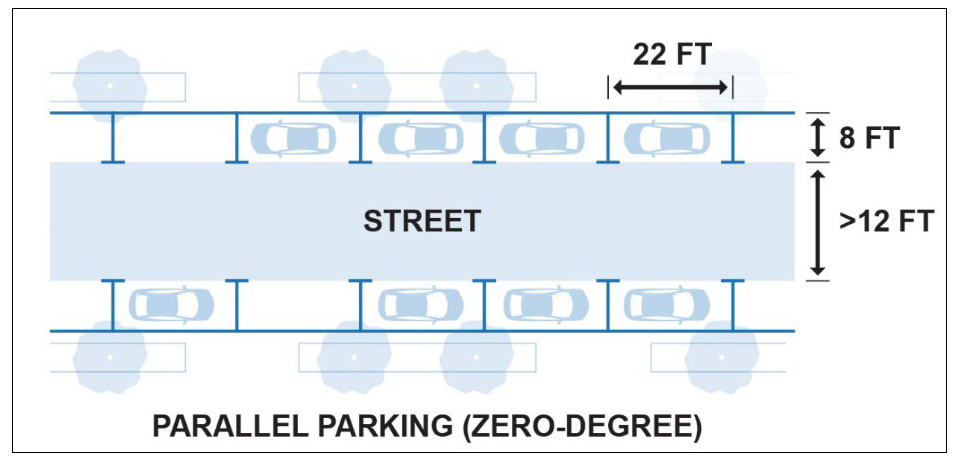
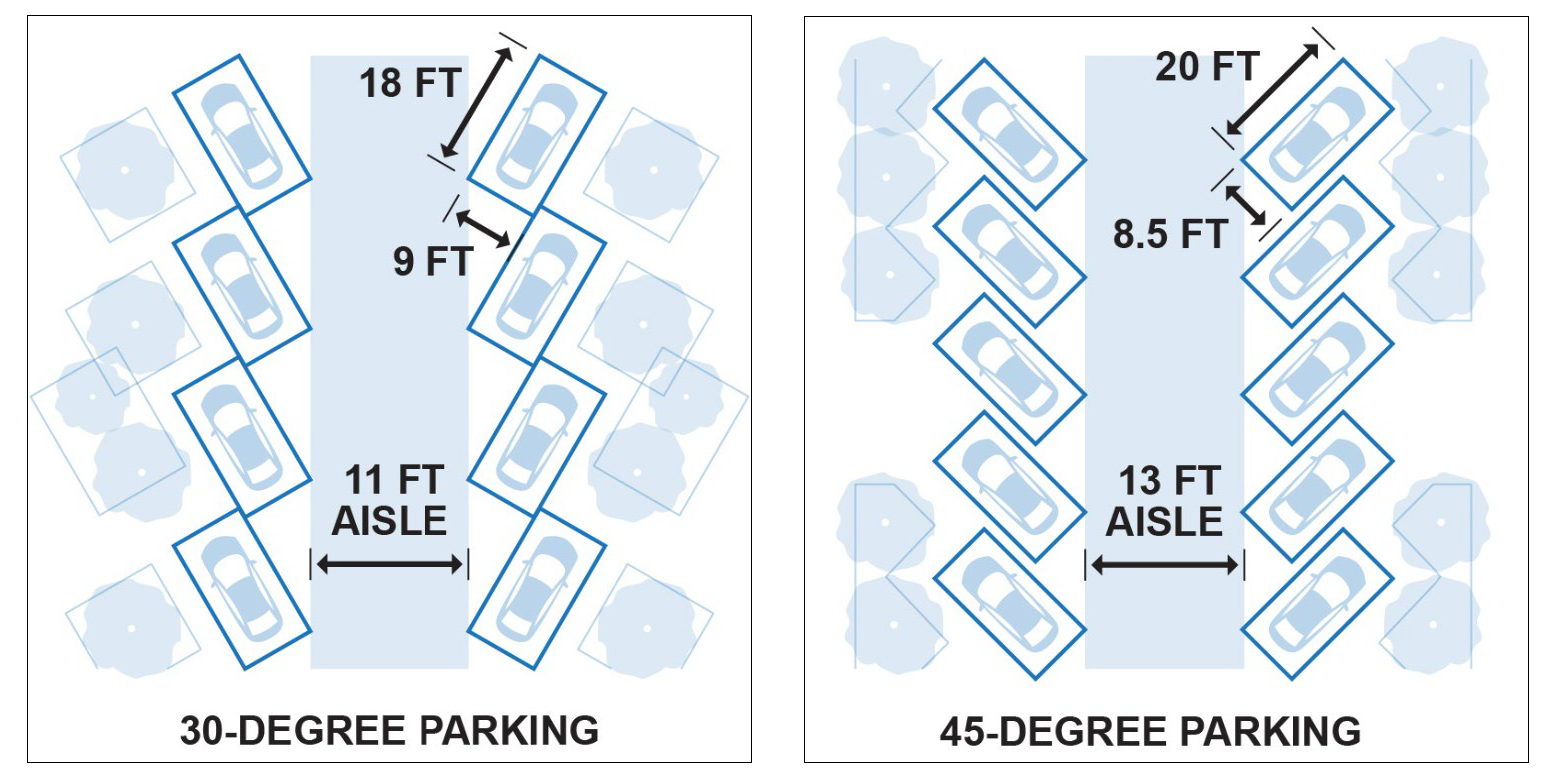
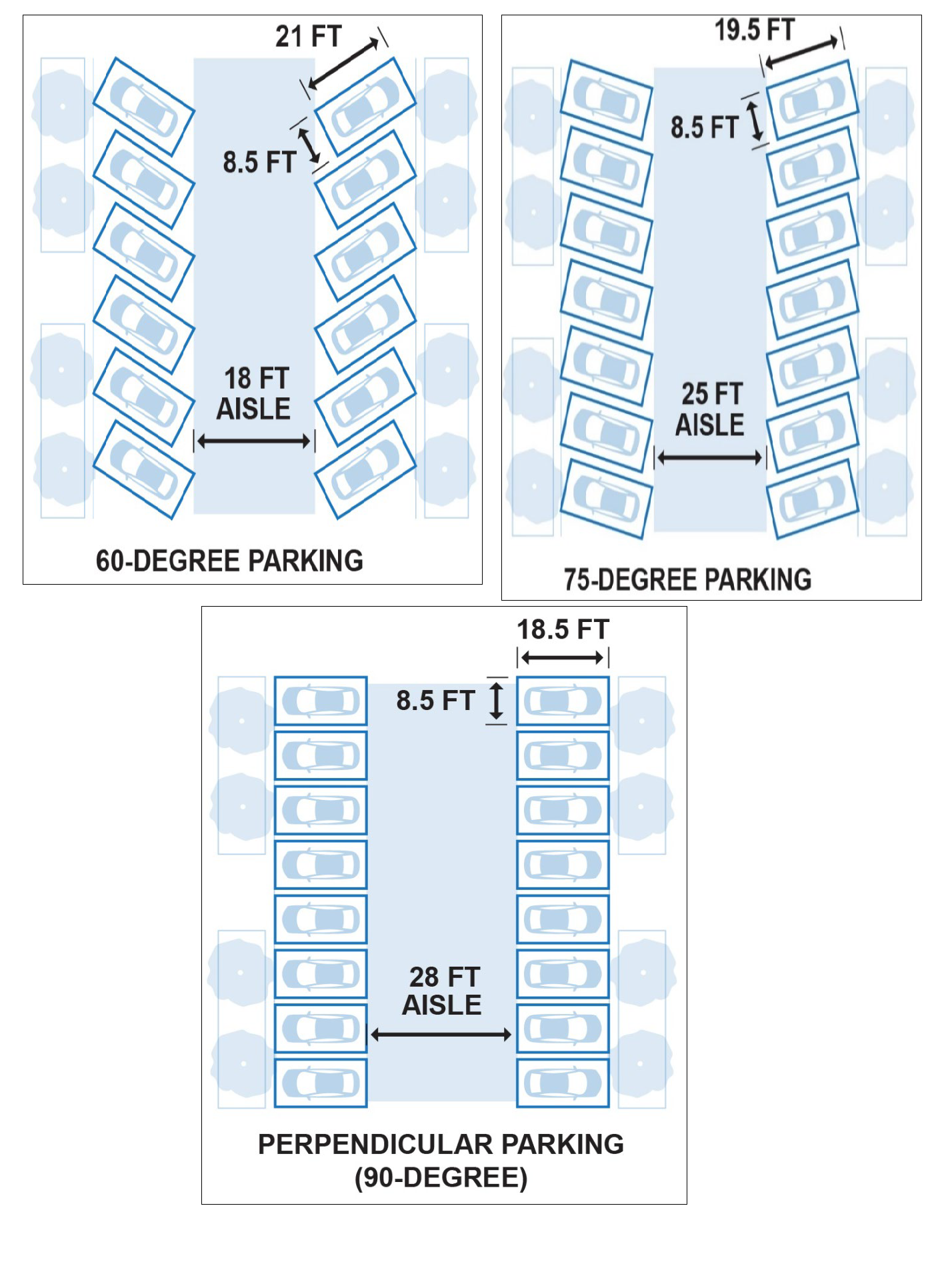
Parking Area Layout. The dimensions of required off-street parking areas shall comply with the standards shown in the following parking dimensions table.
E.
Grade of Parking. Outdoor parking areas shall not exceed a four (4) percent grade and shall be not less than one (1) percent grade. The grade of access-ways shall not exceed four (4) percent within one hundred (100) feet of the intersection with a public street.
F.
Bicycle Parking Design. Bicycle parking devices shall be designed to allow one tire and the frame of the bicycle to be locked to the parking device with a standard U-lock and shall support the bicycle by the frame and not the tire.
G.
Landscaping of Parking Areas.
1.
Parking Areas. For parking lots containing more than fifteen (15) parking spaces, a minimum ten (10) percent of the total surface area of all parking areas, as measured around the perimeter of all parking spaces and maneuvering areas, shall be landscaped in addition to landscape requirements contained in other areas of this Code. Such landscaping shall consist of evenly distributed shade trees with shrubs and/or ground cover. "Evenly distributed" means that the trees and other plants are distributed around the parking lot perimeter and between parking bays to provide a partial shade canopy during summer months. At a minimum, one (1) tree per seven (7) parking spaces shall be planted to create a partial tree canopy over and around the parking area. All parking areas with more than twenty (20) spaces shall include landscape islands with trees to break up the parking area into rows of not more than twelve (12) contiguous (side-by-side) parking spaces. All parking area landscapes shall have dimensions of not less than twenty-four (24) square feet of area, or not less than four (4) feet in width by six (6) feet in length, to ensure adequate soil, water, and space for healthy plant growth. Such areas shall have irrigation.
2.
Buffering and Screening Required. Buffering and screening are required under the following circumstances:
a.
Parking/Maneuvering Area Adjacent to Streets and Walkways. Where a parking or vehicle maneuvering area is within twenty (20) feet of a public street, sidewalk or walkway, an evergreen plant screen (e.g., ground covers and hedge) or decorative masonry wall, arcade, trellis, or similar partially opaque structure at least three (3) feet in width and three (3) feet in height shall be established between the parking/vehicle maneuvering area and public street, sidewalk or walkway as applicable. The required screening shall have breaks or portals to allow visibility (natural surveillance) into the site and to allow pedestrian access to any adjoining walkways. Hedges used to comply with this standard shall be a minimum of thirty-six (36) inches, and not more than forty-eight (48) inches, in height at maturity, and shall be of such species, number, and spacing to provide year-round screening within one (1) year after planting. Landscaping must consist of desert landscaping or drought tolerant plant species as identified by the Colorado State University Tri-River Extension Service.
b.
Parking/Maneuvering Area Adjacent to Building or Private Street, Sidewalk or Walkway. Where a parking or maneuvering area or driveway is adjacent to a building or private street, sidewalk or walkway, the area shall be separated from the building private street, sidewalk or walkway by a curb or wheel stops and a raised walkway, plaza, or landscaped buffer. Raised curbs, bollards, wheel stops, or other design features shall be used to protect pedestrians, landscaping, and buildings from being damaged by vehicles. Where parking areas are located adjacent to residential ground-floor living space, a five-foot wide landscape buffer with a curbed edge may fulfill this requirement.
(Ord. 2004-19; Ord. 2009-02; Ord. 2021-10 [17.39], Ord 2021-21)

