
Fruita City Zoning Code
CHAPTER 17
13 - DESIGN STANDARDS
17.13.010 - PURPOSE.
The standards of this section are intended to promote high-quality development that is compatible with Fruita's unique character, protects and promotes property values, and supports Fruita as a stand-alone community.
The 2020 Community Plan strives to promote high quality growth that preserves Fruita's character and increases economic sustainability. The Plan goes on to call for the creation of vibrant neighborhoods with a diversity of housing options that allow Fruita residents to live, work, and play in their community. As such, the design standards in this chapter are proposed to meet these goal statements combining the needs for strong livable neighborhoods and long-term economic development. These standards are intended to set the course to meet the desired character of the community.
Because not all development opportunities can be predicted, Section 17.13.020.B is included with this chapter in order to provide developers flexibility when applying the regulations and requirements in this chapter. This chapter is intended to help guide and provide direction for an applicant and will encourage any high-quality project that meets community goals and objectives. All interpretations of the requirements of this chapter shall meet this purpose.
(Ord. 2009-02; Ord. 2021-09 [17.11]; Ord. 2021-21)
17.13.020 - APPLICABILITY AND ADJUSTMENTS.
A.
Applicability. This chapter applies to all developments, except individual single-family and duplex developments on lots larger than seven thousand (7,000) square feet in size, that are located in the following zones: Downtown Mixed-Use Core (DM-C); Downtown Mixed Use Outer (DM-O); Commercial 1 (C1); and Commercial 2 (C2). These design standards also are applicable to new lots in new subdivisions (subdivisions approved after April 3, 2009) that include attached single-family residential units; single-family detached residential lots measuring less than seven thousand (7,000) square feet in size, residential lots measuring less than sixty (60) feet in width and only those parts of new subdivisions containing these types of residential units regardless of the zone in which it is located. The design standards of this chapter are applicable to:
1.
Properties undergoing changes in land use,
2.
New buildings,
3.
Building additions where additional building square footage or development ground cover exceeds thirty (30) percent of the total existing square footage (or ground cover) of the existing structure, and
4.
Substantial exterior remodels where more than fifty (50) percent of the exterior facades are undergoing reconstruction.
Design standard applicability for various development types within each of Fruita's zone district is identified in the table below.
UC: Urban Center design standards
CA: Commercial Area design standards
RS: Residential and subdivision design standards
B.
Adjustments. The provisions of this chapter may be adjusted at the discretion of the City decision-making body, as applicable, without the need for a variance, where the City decision-making body finds that an applicant's proposed alternative design meets the intent of the regulations which are to be adjusted, and the proposed design provides compatibility between the proposed development and uses adjacent to the subject site. Where this chapter provides "Guiding Principles," those principles are to be used in evaluating adjustment requests.
(Ord. 2009-02; Ord. 2021-09 [17.11]; Ord. 2021-21)
17.13.030 - STANDARDS AND GUIDELINES DEFINITIONS.
This chapter contains both standards and guidelines.
A.
Standards. Standards are rules, principles, or measures and are mandatory for all developments, unless expressly adjusted through Section 17.13.020.B, above. The terms "shall" and "must" indicate a code standard.
B.
Guidelines. Guidelines are policy preferences that further the City's land use policies and goals. Statements of "intent" and code provisions using the word "should" or "encourage" are guidelines. "Guiding Principles" are guidelines. Guidelines are represented in this chapter in [brackets] and are italicized. While guidelines are discretionary in nature, they must be addressed by the applicant, and the City decision-making body may apply them as mandatory requirements in situations where the applicant has requested code adjustments.
(Ord. 2021-09 [17.11]; Ord. 2021-21)
17.13.040 - DESIGN PRINCIPLES.
The following guiding principles apply to all new development and redevelopment in Fruita.
A.
[Urban Center Design Principles.]
1.
[New development and redevelopment should support a walkable and attractive area with shopping, restaurants, residences, parks, and civic, office and other employment centers.]
2.
[Building height and articulated facades should create a sense of street enclosure at a human scale.]
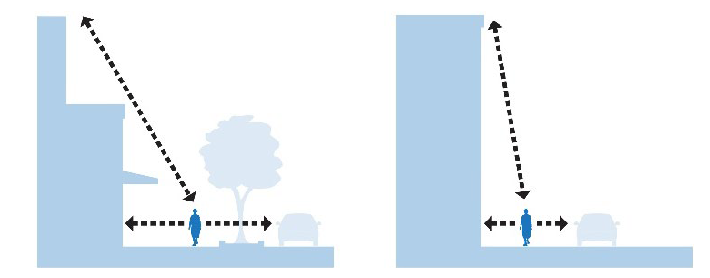
Urban Design Principle #2
3.
[Building heights should help to transition (step down) between the Mixed Use zones and the adjacent residential neighborhoods.]
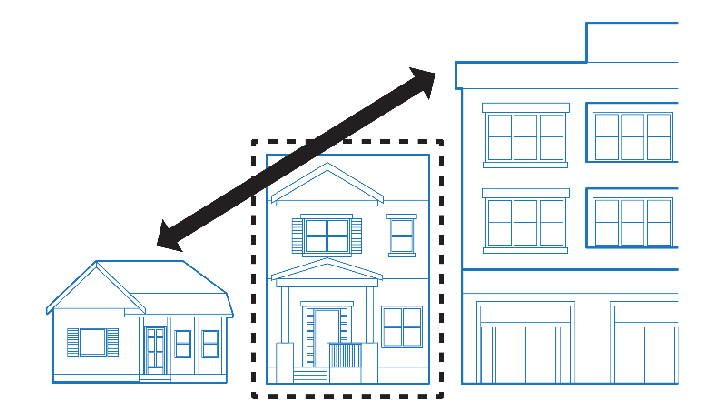
Urban Design Principle #3
4.
[The use of contextually appropriate materials, textures and colors is encouraged.]
5.
[Storefront character (windows, pedestrian shelter, furnishings, etc.) within planned commercial centers is encouraged.]
6.
[A diversity of building facades and rooflines that fall into a consistent rhythm are encouraged.]
7.
[Corner lots should be appointed as focal points with furnishings and public art.]
8.
[New buildings, and exterior remodels in the downtown area are expected to honor the historical development pattern and character of downtown Fruita.]
B.
[Commercial Area Design Principles.]
1.
[Create distinct commercial centers.]
2.
[Define the edges of commercial areas with attractive landscape buffers and transitions between commercial uses and the roadway and/or non-commercial areas.]
3.
[Orient buildings to streets and create a storefront character where possible to create a sense of enclosure and human scale (or, where buildings are to be setback from Highway 6 & 50 or Highway 340, require entrances to be oriented to pedestrian ways and require appropriate landscaping between parking lots and the highway).]
4.
[Improve on-street parking opportunities where practical.]
5.
[Articulate building facades to break up large volumes and promote human scale.]
6.
[Use materials and colors that blend with the desert landscape.]
7.
[Use desert landscaping or drought tolerant landscaping for context-appropriate design and to conserve water.]
8.
[Maintain views of Colorado National Monument, Book Cliffs, Big Salt Wash, and other natural features, where practical.]
9.
[Facilitate the development of a continuous pedestrian network and bicycle ways connecting with adjacent neighborhoods.]
10.
[Reduce reliance on the highway for local vehicle trips (e.g., from one store to another store in the same vicinity).]
11.
[Develop an interconnected system of driveways or alleys with shared access to minimize traffic conflicts.]
C.
[Residential and Subdivision Design Principles.]
1.
[New buildings and exterior remodels should honor traditional neighborhood development principles, consistent with the desired character and form of Fruita, as expressed by the community plan.]
2.
[Promote neighborhood circulation with convenient connections via streets and pedestrian and bicycle ways to parks, schools, churches, neighborhood commercial uses (where applicable) and other neighborhood-oriented services and amenities.]
3.
[Enhance the safety, appearance, and overall quality of Fruita's neighborhood streets by providing options and incentives for alleys and/or shared driveways serving small lot developments and multifamily projects where garages and other parking areas are setback and oriented away from neighborhood streets.]
4.
[Promote the creative design and use of a wide variety of parks and open spaces.]
5.
[Development that is compatible with the natural features of Fruita landscape and promotes Fruita's traditional neighborhood development patterns.]
(Ord. 2021-09 [17.11]; Ord. 2021-21)
17.13.050 - URBAN CENTER DESIGN STANDARDS.
The following architectural and site design standards are applicable to all commercial, mixed-use, and multifamily development in the Downtown Mixed Use (DMU) and Commercial-1 (C-1) zone districts, and within the Neighborhood Commercial Overlay, with the following exceptions:
•
All properties touching Grand Avenue between Highway 6 & 50 and Sycamore Street,
•
All properties touching Highway 6 & 50 between Pine Street and Plum Street,
•
All properties west of Apple Street, south of Cleveland Street, and north of Highway 6 & 50,
•
All property between the west end of Pabor Way and Little Salt Wash.
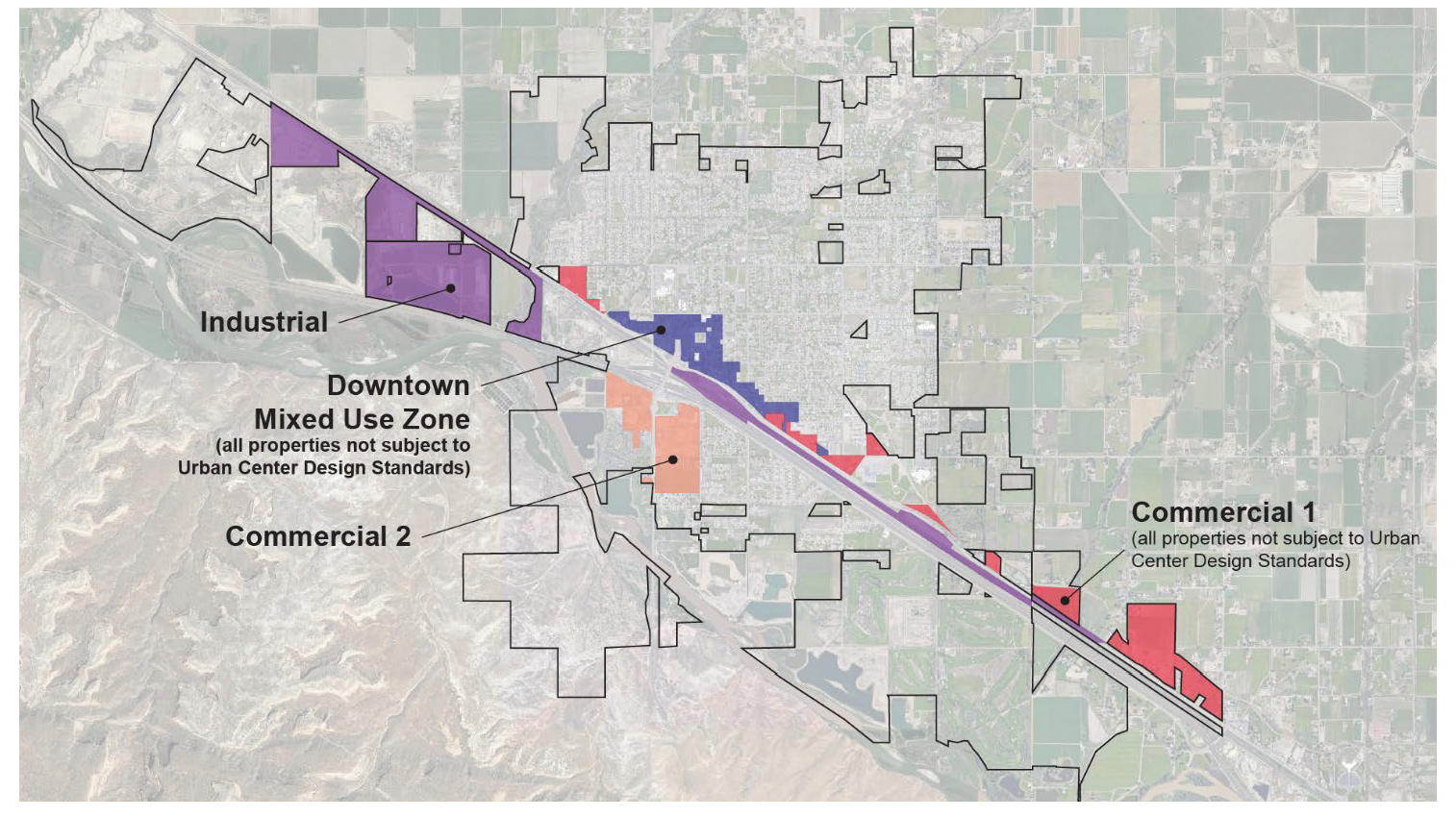
The zone districts subject to the Urban Center design standards are also illustrated in the map below.
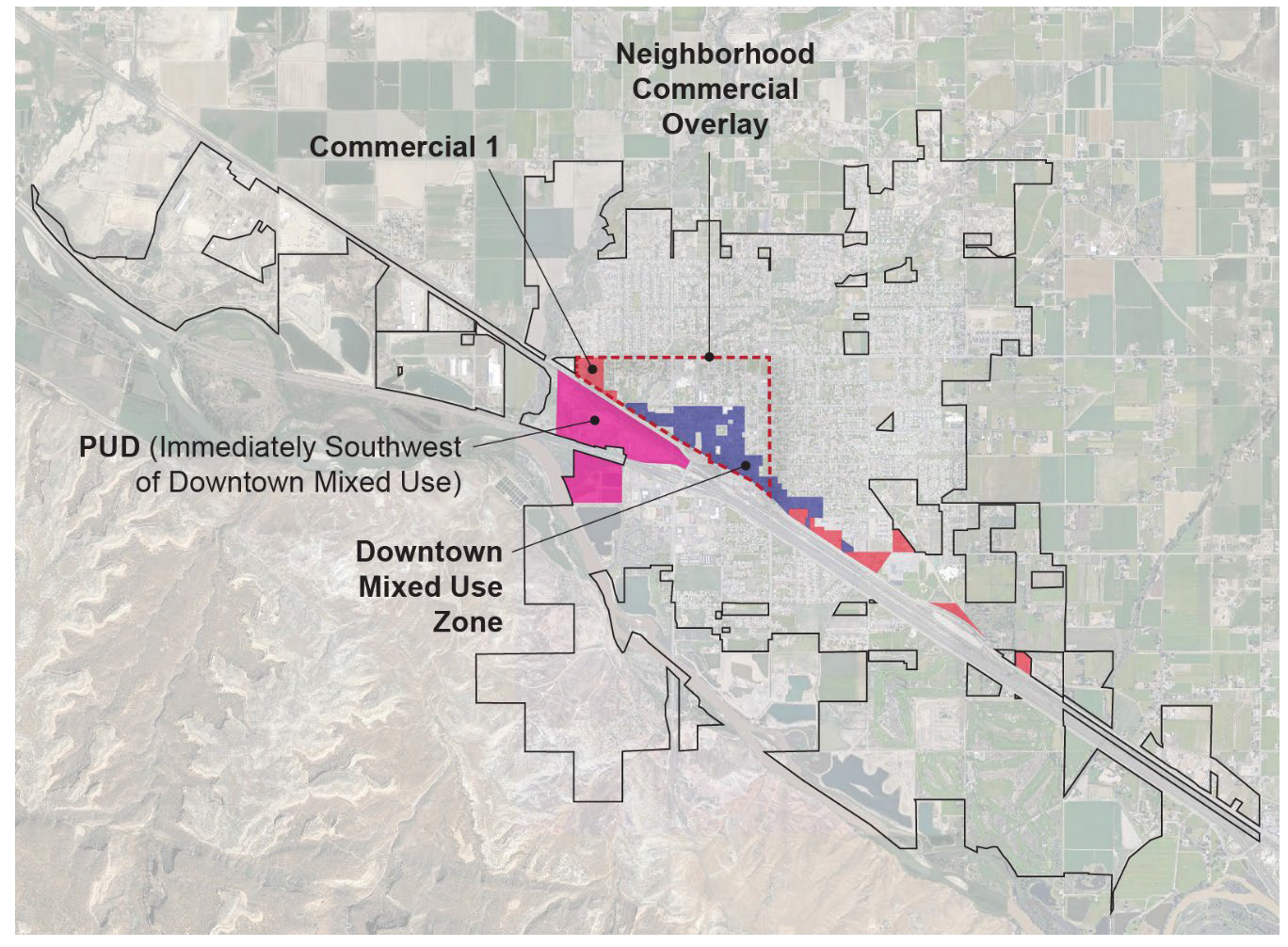
A.
Site Design Standards.
1.
Open Space and Civic Space. At least three (3) percent of every development site shall be designated and improved as civic space (plaza, landscaped courtyard, or similar space), with the highest priority locations being those areas with the highest pedestrian activity (e.g., street corners and pedestrian access ways), as generally designated in the examples accompanying this subsection. Improvements shall conform to the subsection below.
a.
Dimensions. All civic spaces shall have dimensions of not less than eight (8) feet wide and deep and have a surface area of not less than forty-eight (48) square feet.
b.
Public Access. Such areas shall abut a public right-of-way or otherwise be connected to and visible from a public right-of-way by a sidewalk or pedestrian access way; access ways shall be identifiable with a change in paving materials (e.g., pavers inlaid in concrete or a change in pavement scoring patterns and/or texture). Where a right-of-way connection is not possible, the owner shall be required to provide a public access way easement to the civic space.
c.
Pedestrian Amenities Required. Where civic space is required, it shall contain pedestrian amenities such as plaza space, extra-wide sidewalks (i.e., outdoor cafe space), benches, public art, pedestrian-scale lighting, shade structures, way finding signs, as approved by the City decision-making body, or similar pedestrian areas. [Where a civic space adjoins a building entrance it should incorporate a weather protection canopy, awning, pergola, or similar feature.]
i.
Exception: Building additions and remodels that are exempt under subsection A.1 above, are not required to provide pedestrian amenities, though they are encouraged to do so. In such cases, the City may consider the voluntary provision of pedestrian amenities in approving adjustments to other applicable standards required under this chapter.
d.
Exceptions. Certain exemptions from the Open Space and Civic Space requirements exist, as outlined below.
i.
Exceptions for Minor Projects: Building additions and remodels are not required to provide civic space when proposed building material costs are estimated to be less than fifty (50) percent of the existing Assessor's actual value of improvements on the subject site. Assessor's actual value shall be the value of record at the Mesa County Assessor's Office.
ii.
Exceptions for In Lieu Fee: The City may find that the creation of civic space is not practical based on the project location or other relevant factors. In such cases, the City may accept an in-lieu fee which shall be calculated in accordance with Chapter 17.19.
2.
Access and Circulation. Access in the Downtown Mixed-Use and Commercial zones and within the Neighborhood Commercial Overlay is to be provided as follows:
a.
Pedestrian Access. Walkways linking the pedestrian system of the block to every building entrance and civic space on a proposed development site are required. Walkways shall be constructed of scored concrete or pavers and have a width of not less than four (4) feet; additional width may be required where necessary due to projected use of the walkway.
b.
Vehicle Access and Driveways. New vehicle access onto Aspen Avenue is not allowed; when new vehicle access is required, it shall be taken from streets other than Aspen Avenue. Where an existing driveway or alley provides adequate access to a site, such access must be utilized before any new street access is created.
c.
Drive-up and Drive-Through Uses. New drive-up/drive-through facilities (e.g., windows, ATMs, etc.) are not permitted in the Downtown Core within forty (40) feet of Aspen Avenue.
d.
Off-Street Parking and Loading. Except as approved for parking structures (e.g., garages or under-ground parking), parking is to be provided primarily in on-street parking spaces and in shared parking areas internal to each block, either beside or behind buildings. Parking shall conform to the minimum parking standards of Chapter 17.39. (Note reduced parking standards within the Downtown Core.) Parking and vehicle circulation areas abutting a sidewalk, public right-of-way, or pedestrian access way shall provide a landscape screen of not less than four (4) feet in width and three (3) feet in height, or a decorative wall, landscape wall, or other buffer. Loading docks and trash storage areas in parking lots shall be located to the side or rear of buildings and screened from public view.
3.
Landscaping.
a.
Plant Material. Landscaping must consist of plant material covering not less than fifty (50) percent of the non-developed areas within three (3) years of planting. Use of desert landscaping or low water usage plant species as identified by the Colorado State University Tri-River Extension Service is required.
i.
Exception: The required plant material coverage may be reduced to twenty (20) percent of all non-developed surfaces where a proposed building incorporates a green (landscaped) roof.
b.
Parking Areas. Parking area(s) shall be landscaped, as required by Section 17.37.070.G. Landscaping must consist of desert landscaping or drought tolerant plant species as identified by the Colorado State University Tri-River Extension Service.
B.
Building Design Standards.
1.
Heights.
a.
Maximum Height. Buildings shall comply with the height requirements of the underlying zone district, unless otherwise amended through a PUD. The maximum height of all portions of a building that are within one hundred (100) feet of a single-family dwelling shall step-down in roof elevation to provide a more sympathetic scale with adjacent single-family dwellings.
b.
Minimum Height. New buildings constructed within the Downtown Core and abutting Aspen Avenue shall be built to a height of not less than twenty-two (22) feet to maintain an intimate, pedestrian scale relative to the street, and a sense of street enclosure. Single story buildings in the Downtown and Commercial zones shall incorporate parapets that reach the minimum required height.
2.
Setbacks.
a.
Zero Front Setback. All non-residential buildings, including mixed use buildings containing residential and non-residential uses, shall maintain a zero setback from a street property line. This standard is met when at least fifty (50) percent of the abutting street frontage has a building placed at the street property line.
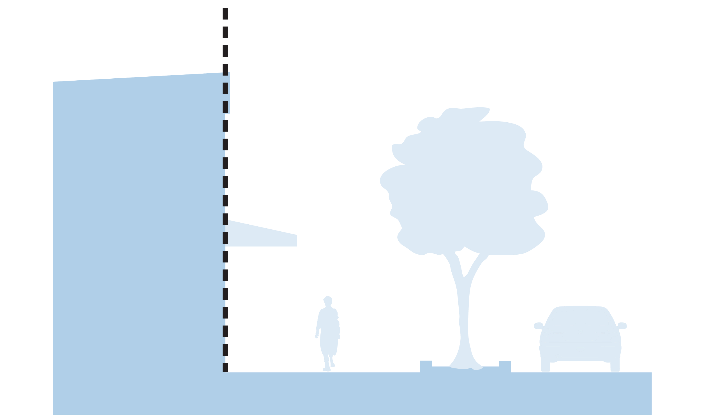
Zero Front Setback
i.
Exceptions: An exception to the zero-setback regulation may be approved or required in the following situations:
a)
Where a proposed building is adjacent to a single-family dwelling.
b)
Where the sidewalk width is extended for public use, or a public plaza is proposed to be placed between the building and public right-of-way. Exceptions may also be made for planter boxes incorporated into the building wall, provided the planter box does not exceed a height of thirty (30) inches above sidewalk grade.
c)
Where a public utility easement or similar restricting legal condition makes conformance with the zero setback impractical, the building shall instead be placed as close to the street as possible given the legal constraint, and pedestrian amenities (e.g., plaza, courtyard, landscaping, outdoor seating area, etc.) shall be provided within the street setback in said location.
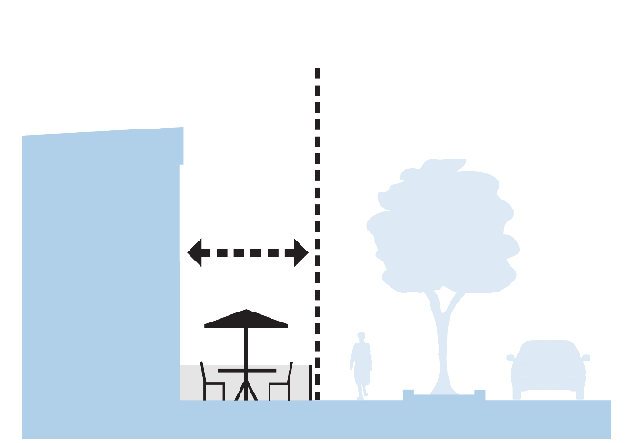
Zero Front Setback Exception for Seating, Plaza, or Planters
b.
Side and Rear Yards. Side or rear yard setbacks shall conform to applicable building codes. The City decision-making body may require additional setbacks where necessary for storm water drainage, vision clearance at intersections, access to utilities, or similar purposes.
c.
Right-of-Way. The City may allow the placement of pedestrian amenities; such as, street furnishings, canopies, awnings, signs and similar features in the sidewalk right-of-way, subject to Site Design Review or a Temporary Encroachment Agreement.
3.
Building Form.
a.
Overall Form. Architectural designs shall address all facades of a building visible from the frontage street in the Downtown Mixed-Use and Commercial zones and in the Neighborhood Commercial Overlay. The predominant form in the Downtown Core is a generally "flat" elevation with any recesses, projections, or rounded corners ("articulations") appearing subordinate to the dominant rectangular form.
b.
[The predominant form in the Downtown Mixed-Use zone parcels outside the Downtown Core may be similar to the Core, or it may be more residential in character and contain pitched roofs, porches, bay windows and similar features. New buildings should reflect the predominant form, while expressing individuality.]
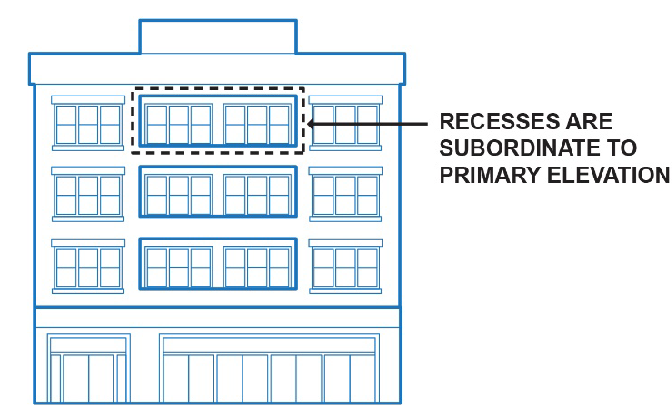
Overall Downtown Architectural Form & Openings
4.
Storefront Character.
a.
Door and Window Openings. Except as approved for parking structures or accessory structures, buildings shall provide display windows and windowed doors to express a store front character. The ground floor, street-facing elevation(s) of all buildings shall comprise at least sixty (60) percent transparent windows, measured as a section extending the width of the street-facing elevation between the building base (or thirty (30) inches above the sidewalk grade, whichever is less) and a plane seventy-two (72) inches above the sidewalk grade.
b.
[Upper floors may have less window area, but should follow the vertical lines of the lower level piers and the horizontal definition of spandrels and any cornices.]
c.
Buildings without a street-facing elevation, such as those that are setback behind another building and those that are oriented to a civic space (e.g., internal plaza or court), shall meet the sixty (60) percent transparency standard on all elevations abutting publicly-accessible spaces(s) and elevations containing a primary entrance.
d.
All side and rear elevations, except for zero lot line/common wall elevations (where windows are not required), shall provide no less than thirty (30) percent transparency.
e.
Where an exception to the window transparency requirement is made for parking garages or similar structures, the building design must incorporate openings or other detailing that evokes window patterns in rhythm and scale.
f.
Storefronts that resemble suburban strip malls (e.g., picture windows extending to near grade level) and those that use reflective glass, clerestory windows and/or similar non-traditional features are not permitted.
g.
Street Level Entrance. All primary building entrances shall open to the sidewalk and be ADA accessible. Primary entrances above or below grade may be allowed where ADA accessibility is provided.
h.
Street Level/Upper Floor. Building elevations shall contain detailing that visually defines street level building spaces (storefronts). The distinction between street level and upper floors shall be established, for example, through the use of awnings, canopies, belt course, or similar detailing, materials and/or fenestration.
5.
Building Mass.
a.
The third story, and/or any portion of a building exceeding twenty-eight (28) feet in height, shall step-back at least six (6) feet from the outer plane of the building. The purpose of the height step back is to maintain a small-town appearance and scale as viewed from the street and to provide for solar gain and light filtering down to the street. See also, subsection B.1 Height, above.
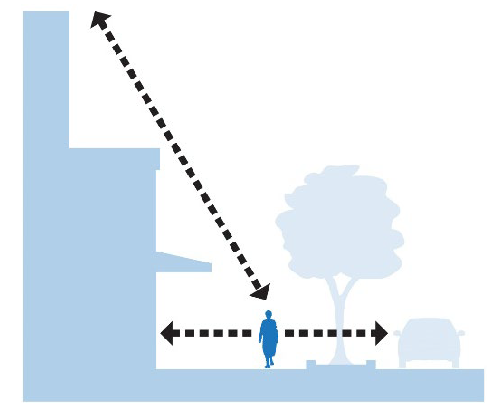
Step Back
6.
Openings.
a.
Ground Floor Windows. Ground floor elevations shall conform to subsection B.4.a, above, and must contain windows that are framed, for example, by piers or pilasters (sides); awnings, canopies or trim/hoods (tops); and kick plates or bulkheads (base). [Decorative detailing and ornamentation around windows (e.g., corbels, medallions, pediments, or similar features) is encouraged.]
b.
Upper Floor Windows. Upper floor window orientation shall primarily be vertical, or have a width that is no greater than height, consistent with the Western vernacular. Paired or grouped windows that, together, are wider than they are tall, shall be visually divided to express the vertical orientation of individual windows.
c.
Pedestrian Entrances. Ground level entrances shall be at least partly transparent to encourage an inviting and successful business environment. This standard may be met by providing a door with a window(s), a transom window above the door, or sidelights beside the door. Where ATMs or other kiosks are proposed on any street-facing elevation, they shall be visible from the street for security and have a canopy, awning, or other weather protection shelter.
d.
Corner Entrances. Buildings on corner lots shall have corner entrances, or the building plan shall provide for a corner plaza consistent with Section 17.13.060.A.1.c, below, or the building shall provide architectural features (e.g., alcove with seating or artwork) at the corner that emphasizes the corner as a civic space.
7.
Horizontal Rhythms.
a.
Traditional Lot and Building Pattern. Buildings must respect the traditional lot pattern and building rhythm of the downtown and/or adjacent residential neighborhood, as applicable, by incorporating rhythmic divisions in all elevations. [As a general guideline, front elevations should be articulated not less than once every twenty-five (25) feet. Articulation should be subtle. For example, slight offsets in a building elevation, roofline and/or the rhythmic placement of windows, pilasters, awnings, trim, art/medallions, or other detailing and ornamentation are preferred. Abrupt divisions, such as clashing paint colors, should be avoided. Side and rear elevations may be articulated less frequently but should complement the overall building design. The City may require detailing on a zero-lot line elevation to reduce the apparent scale and avoid blank walls (i.e., until an abutting property develops).]
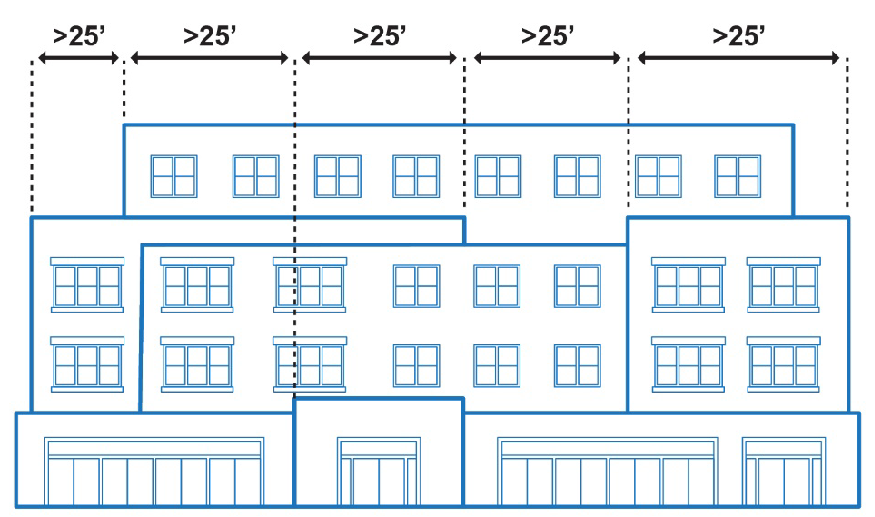
Architectural Articulation
b.
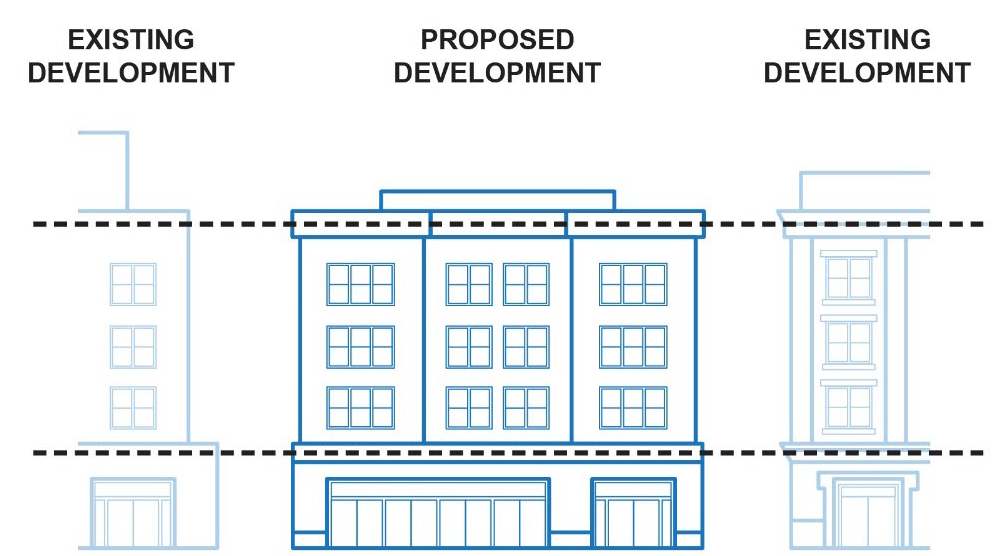
Horizontal Lines. New buildings and exterior remodels shall follow prominent horizontal lines existing on adjacent buildings at similar levels along the street frontage. Examples of such horizontal lines include: the base below a series of storefront windows; an existing awning or canopy line, or belt course between building stories; and/or an existing cornice or parapet line.
Exceptions: Where existing buildings do not meet the City's current architectural standards, a new building may establish new horizontal lines.
c.
Ground Floor/Upper Floor Division. A clear visual division shall be maintained between the ground level floor and upper floors, for example, through the use of a belt course, transom, awnings or canopies.
8.
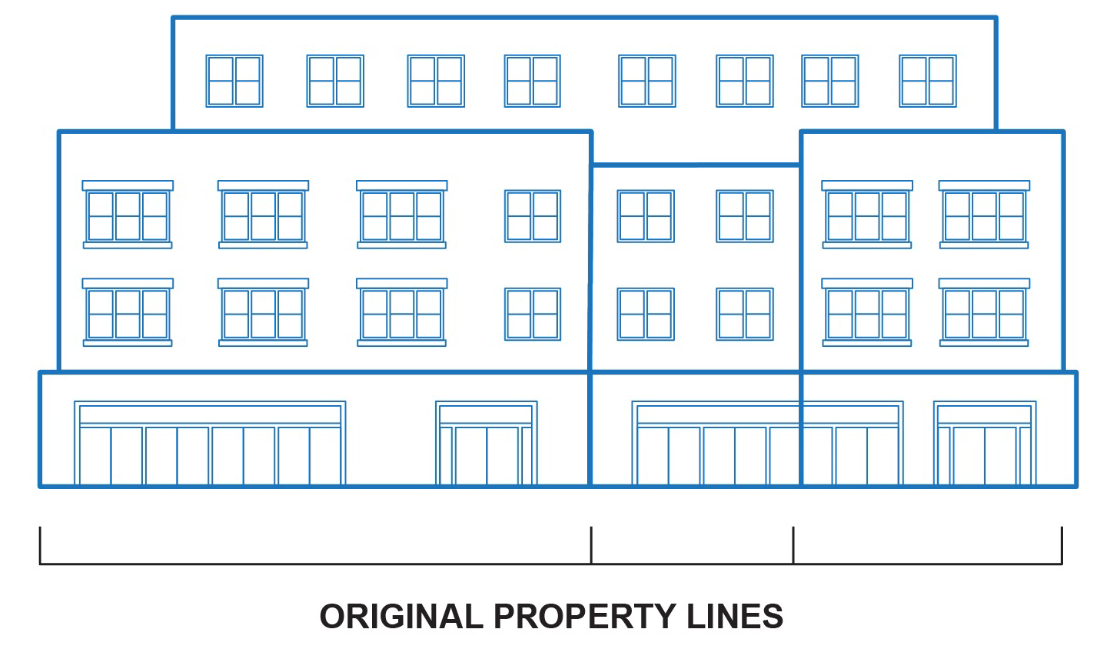
Vertical Rhythms. New construction or front elevation remodels shall reflect a vertical orientation, either through breaks in volume or the use of surface details, to divide large walls, so as to reflect the underlying historic property lines, as applicable.
9.
Materials and Color.
a.
Primary Building Materials. Exterior building materials shall predominately consist of those materials traditionally found in Fruita's downtown or others indigenous to the intermountain West, including brick, stone (e.g., limestone, rhyolite, granite, etc.), adobe, adobe brick, slump block, stucco, split block, and painted or natural wood. Pitched roof materials shall be wood or asphalt shingles, or standing rib seam sheet metal-matte finish.
b.
Window and Door Materials. All windows and doors must have trim that is at least four (4) inches deep. Rough-hewn wood, timbers and metals may be used as accents but not as the primary exterior cladding. Substitute materials that are equal in appearance and durability may be approved.
c.
Change in Materials. Elevations shall incorporate changes in material that define a building's base, middle and top and create visual interest and relief. Side and rear elevations that do not face a street, pedestrian access way or plaza may utilize changes in texture and/or color of materials in the interest of affordability, provided that the design is consistent with the overall composition of the building.
d.
Secondary Materials. Any of the materials listed above may also be used as secondary materials or accents. Metals; such as, copper, steel, iron, bronze and similar appearance metals may be used as trims or accents (e.g., flashing, weather protection features, ornamentation, etc.) when non-reflective and compatible with the overall building design.
e.
Color.
i.
Roof colors must be warm earth-tones such as ash, light charcoal, light red (sandstone) or olive green, except flat roofs may be any non-reflective color and finish.
ii.
[Building color schemes should be simple and coordinated over the entire building to establish a sense of overall composition. Color schemes should tie together signs, ornamentation, awnings, canopies and entrances.]
iii.
There shall be no more than one (1) base color for each twenty-five (25) feet of the front elevation; one (1) base color for the entire front elevation is preferred.
iv.
[Using only one (1) or two (2) accent colors is also preferred, except where precedent exists for using more than two (2) colors with some architectural styles. Natural wood finishes are appropriate for doors, window sashes and trim, signs, canopies and other architectural accents.]
v.
Reflective, luminescent, sparkling, and "day-glow" colors and finishes are not permitted. Metals shall be finished in mute, earth-tones or otherwise burnished to minimize glare.
f.
[Restoration and Rehabilitation. Restoration and rehabilitation of historically significant structures should incorporate original materials and design elements (e.g., previously covered over), to the extent practical, and in compliance with Chapter 17.37.]
10.
Pedestrian Shelters.
a.
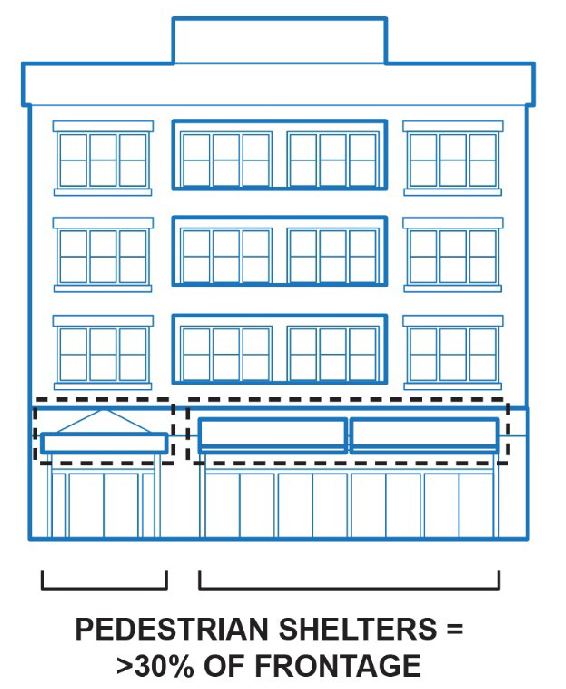
Awnings, canopies, recesses or similar pedestrian shelters shall be provided along at least thirty (30) percent of a building's ground floor elevation(s) where the building abuts a sidewalk, civic space (e.g., plaza), pedestrian access way, or outdoor seating area. Pedestrian shelters used to meet the above standard shall extend at least five (5) feet over the pedestrian area, be proportionate to the building in its dimensions, and not obscure the building's architectural details. Pedestrian shelters shall align with one another to the extent practical. [Use of colored canvas (not plastic) awnings and wood canopies, consistent with historical styles, is encouraged, though metal and plexi-glass canopies may be considered.]
i.
Exception: The City may reduce the minimum shelter depth upon finding that existing right-of-way dimensions or building code requirements preclude a larger shelter.
11.
Mechanical Equipment.
a.
Building Walls. When mechanical equipment, such as utility vaults, air compressors, generators, antennae, satellite dishes, or similar equipment, must be installed on a building wall, it shall be oriented away from all streets. Where such equipment is installed on a side or rear building elevation and is adjacent to an alley, access way, or civic space, its appearance shall be minimized using materials and/or colors that are similar to those used on the subject building. Standpipes, meters, vaults and similar equipment shall not be placed on a front elevation when other practical alternatives exist; such equipment shall be placed low on a side or rear elevation to the extent practical.
b.
Rooftops. Rooftop mechanical units shall not be visible from the street, pedestrian access way or civic space. Such units should be screened behind a parapet wall.
c.
Ground-Mounted Mechanical Equipment. Ground-mounted equipment (e.g., generators and air compressors) shall be limited to side or rear yards and screened with fences or walls constructed of materials similar to those on adjacent buildings. These pieces of equipment are discouraged in all street-facing yards. [Hedges may also be used as screens where there is adequate sunlight and irrigation to ensure their successful growth.] The City may require additional setbacks and/or noise attenuating equipment to promote compatibility with adjacent residential uses.
d.
Civic Spaces. Mechanical equipment and garbage storage areas are not permitted within the civic space(s) required under subsection C.1. The City may require that such facilities be screened completely from view and set back from a civic space for aesthetic reasons and to minimize odors or noise.
12.
Historic Preservation.
a.
[Additions and Rehabilitation. Additions and rehabilitations should match the original materials, windows, doors, trim, and colors. If the addition is a wing, it should be subordinated to the original building in design, i.e. the roof should be lower and the mass and bulk of the new addition should be less. If the addition is an extension or lengthening of the original building, introduce a setback to preserve the corner of the original and hence the design arrangement and balance of the original facade should be provided.]
b.
Cornices and Decorative Elements.[Original members, brackets, molding, etc. should be preserved if at all possible. Replacement of missing parts should be exact copies of the original. Avoid mixing new and old original members on one (1) facade unless the match is perfect.] Aluminum and plastic awnings and door hoods are not allowed. Canvas awnings in appropriate colors are allowed.
c.
[False Fronts and Applied Facades. Avoid fake modernization or concealment of the original facade. When an existing building has a well-developed facade and is the product of good workmanship, efforts should be made to retain as much of the original materials and detailing as possible or restore them to maintain the building's integrity.]
(Ord. 2021-09 [17.11]; Ord. 2021-21)
17.13.060 - BUSINESS DESIGN STANDARDS.
The following architectural and design standards apply to all commercial, mixed-use, and multifamily residential development in the Commercial-2 (C-2) zone and all properties zoned DMU and C-1 which are not subject to Urban Center Design Standards (Section 17.13.040).
The zone districts subject to the Business Design Standards are also illustrated in the map below.
A.
Site Design.
1.
Primary Entrances.
a.
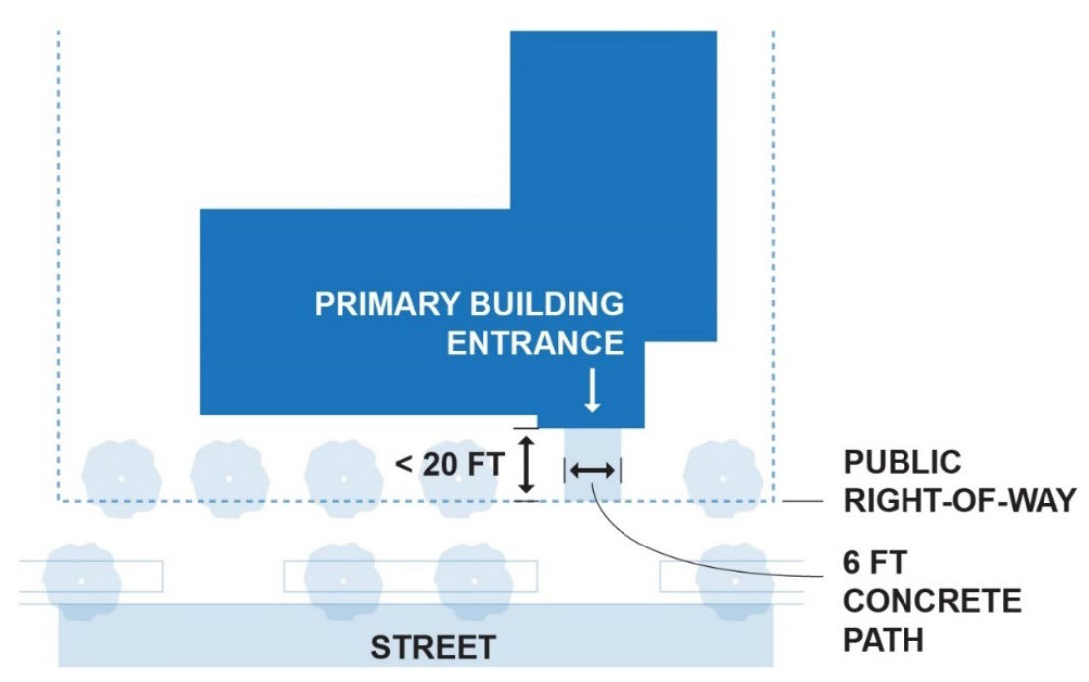
Primary building entrances shall be oriented to the public street right-of-way and/or public sidewalk and shall be connected to the public street right-of-way and/or public sidewalk by a concrete walkway not less than six (6) feet in width. Primary building entrances shall be within twenty (20) feet of the public street right-of-way and/or public sidewalk.
b.
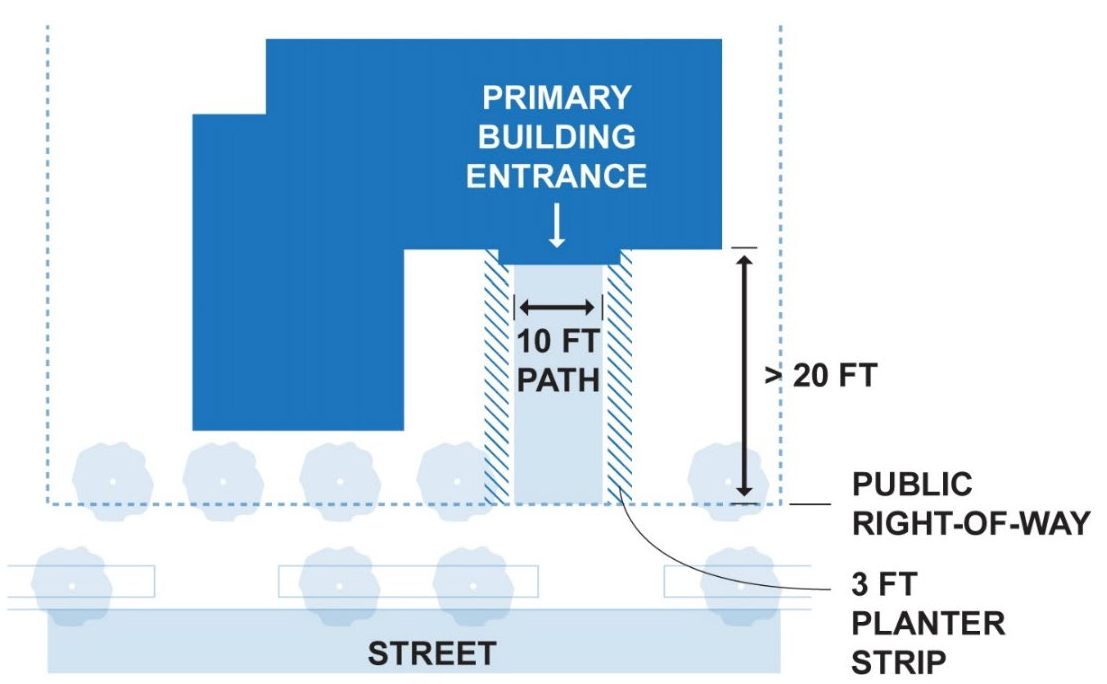
Where it is not practical to locate primary building entrances within twenty (20) feet of the public street right-of-way or public sidewalk, the concrete walkway connecting primary building entrances to the public sidewalk or public street right-of-way shall be no less than ten (10) feet in width. This concrete walkway must have three (3) foot wide planter strips on each side and raised or textured paving at all driveway crossings.
c.
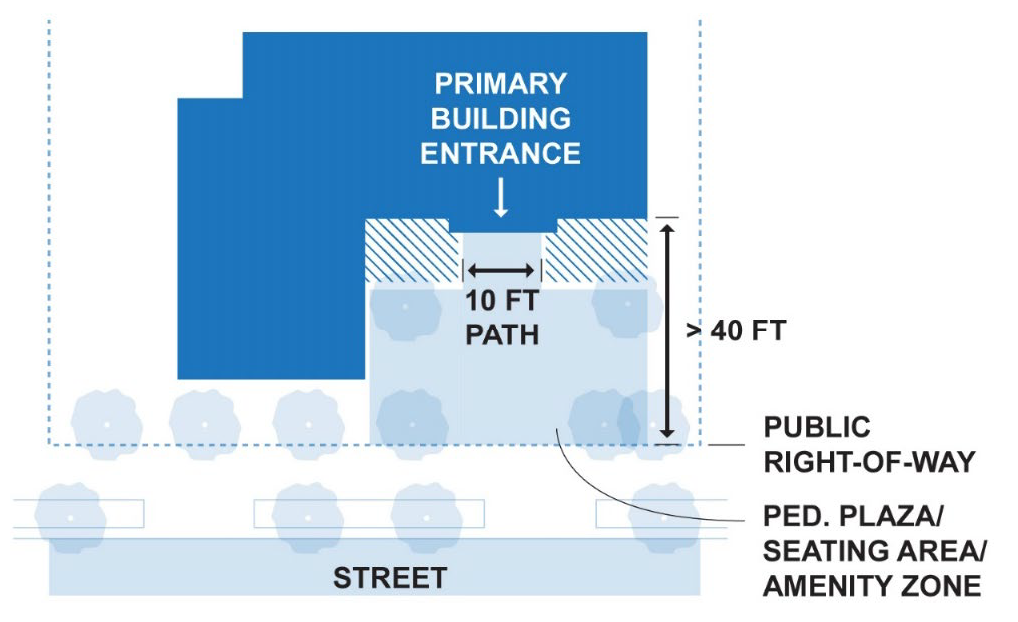
Primary building entrances located more than forty (40) feet from the public street right-of-way or public sidewalk will require a pedestrian plaza/outdoor seating area, courtyard, or other civic amenity is provided between the building and street.
d.
Where a primary building entrance is located more than twenty (20) feet from a public street right-of-way and/or public sidewalk, or where parking and/or driving aisles are provided between the primary building entrance and public street right-of-way and/or public sidewalk, a fifteen (15) foot wide minimum landscape screen shall separate all off-street parking areas from adjacent public street rights-of-way or public sidewalks.
2.
Blank Wall Prevention.
a.
Buildings shall meet transparency and weather protection standards (Subsection B, Building Design below) along all street-facing elevations and any elevations containing a primary building entrance. A landscape screen at least five (5) feet wide shall cover any blank building walls (i.e., lacking windows and weather protection) and contain materials of sufficient size/species to screen the blank wall.
b.
[Public art and murals may be used to minimize the visual impacts of a blank facade.]
B.
Building Design.
1.
Overall Design.
a.
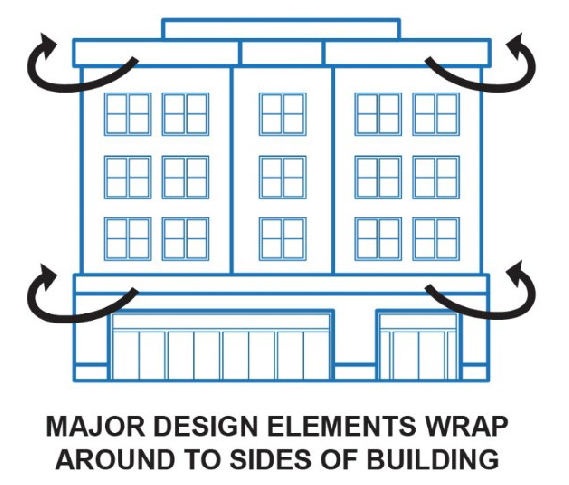
Architectural designs shall address all facades of a building visible from the street with materials, detailing, and color. Architectural elements should wrap around building corners. Where a proposed design is based on the applicant's corporate style guide, as in formula retail stores, restaurants, discount outlets, or similar proposals where a similar building design has been used previously, the applicant must demonstrate that the design has been adapted to fit Fruita's unique location/historical context (Colorado National Monument/Grand Valley) and desert environment.
2.
[Stepped Rooflines.]
a.
[Height should vary from building to building to avoid a homogenous appearance. This standard is met by using stepped parapets, gables, or slightly dissimilar height from building-to-building.]
3.
Window Transparency.
a.
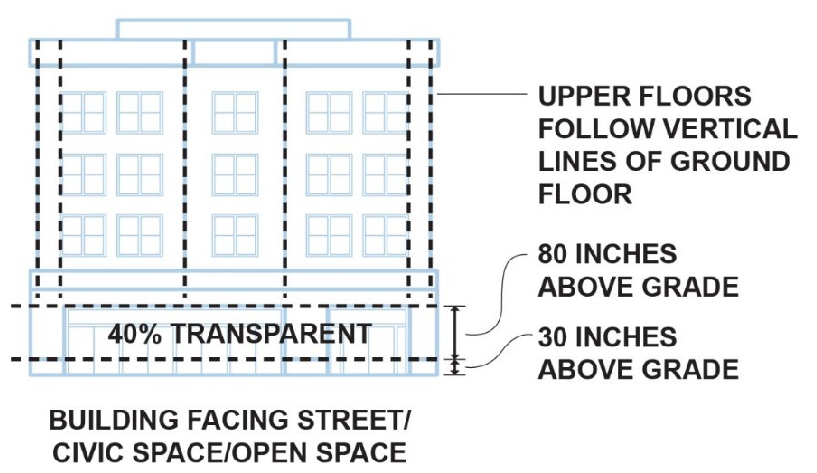
Building elevations that face a street, parking area, civic space, or open space shall comprise at least forty (40) percent transparent windows, measured as a section extending the width of the street-facing elevation between the building base (or thirty (30) inches above the sidewalk grade, whichever is less) and a plane eighty (80) inches above the sidewalk grade. Upper floors may have less window area, but should follow the vertical lines of the lower level piers and the horizontal definition of spandrels and any cornices.
b.
Where the Community Development Director determines, based on physical site constraints or the functional requirements of a non-residential building, that providing window transparency is not practical or does not further intent of these standards as stated above, other alternative means of breaking up large elevations (e.g., columns, belt course, and upper story panels/transom, with landscaping) shall be employed.
4.
Primary Entrances. Buildings shall have clearly defined primary entrances that provide a weather-protection shelter for a depth of not less than five (5) feet (e.g., either by recess, overhang, canopy, portico and/or awning) extending from the building entry.
5.
Building Mass.
a.
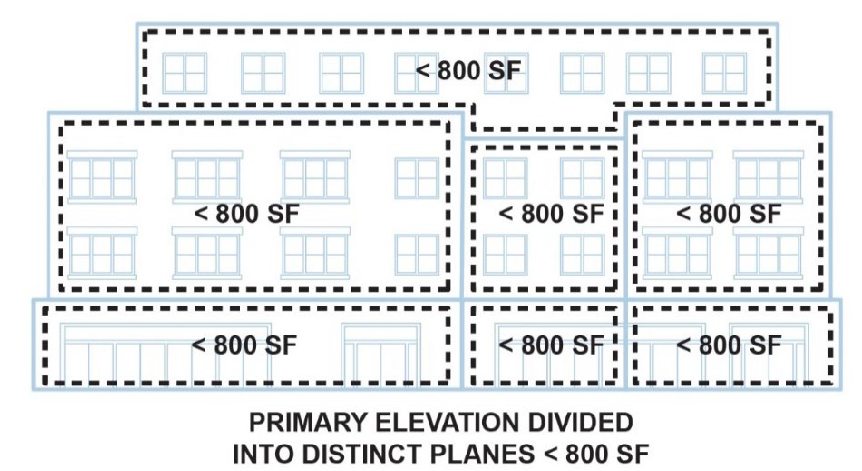
Building elevations shall incorporate offsets or divisions to reduce the apparent building scale and to improve aesthetics. Elevations of a structure shall be divided into smaller areas or planes to minimize the appearance of bulk as viewed from any street, civic space or adjacent property.
b.
When an elevation of a primary structure is more than eight hundred (800) square feet in area, the elevation must be divided into distinct planes of not more than eight hundred (800) square feet. For the purpose of this standard, areas of wall planes that are entirely separated from other wall planes are those that result in a change in plane such as a recessed or projecting section of the structure that projects or recedes at least one (1) foot from the adjacent plane, for a length of at least six (6) feet.
c.
[Changes in plane may include but are not limited to recessed entries, bays, stepped parapets, secondary roof forms (e.g., gables, lower roof sheds, dormers and towers), building bases, canopies, awnings, projections, recesses, alcoves, pergolas, porticos, roof overhangs, columns, or other features that are consistent with the overall composition of the building.]
d.
The distinction between street level and upper floors shall be established, for example, through the use of awnings, canopies, belt course, or similar detailing, materials and/or fenestration.
6.
Materials and Colors.
a.
Exterior materials shall consist of brick, stone, adobe, wood shingle or imitation wood shingle walls, slump block, adobe brick or suitable split block or brick.
b.
[Wood timbers and metal (brushed steel, iron, copper, or similar architectural-grade metals) may be used on canopies, arbors, trellises, pergolas, porticos, brackets, fasteners, lighting, signage, and other detailing, as appropriate, to provide visual interest and contrast. In general, color selection should complement, not compete with, the surrounding desert landscape. Warm earth tone colors (e.g., sandstone reds, desert greens and browns) are generally preferred over cool colors, such as blue and white/off-white. Substitute materials that are equal in appearance and durability may be approved.]
7.
ATMs and Service Windows.
a.
Where walkup ATMs or service windows are proposed on any street-facing elevation, they shall be visible from the street for security and have a canopy, awning, or other weather protection shelter. Where drive-up windows or similar facilities are provided the drive-up window and associated vehicle queuing area shall be setback at least twenty (20) feet from all adjacent rights-of-way. The applicant may be required to install textured pavement (e.g., pavers or stamped concrete) for pedestrian crossings of any drive aisle.
(Ord. 2021-09 [17.11]; Ord. 2021-21)
17.13.070 - RESIDENTIAL AND SUBDIVISION DESIGN STANDARDS.
The architectural and site design standards in this section are applicable where Chapters 17.13.050 and 17.13.060 do not apply.
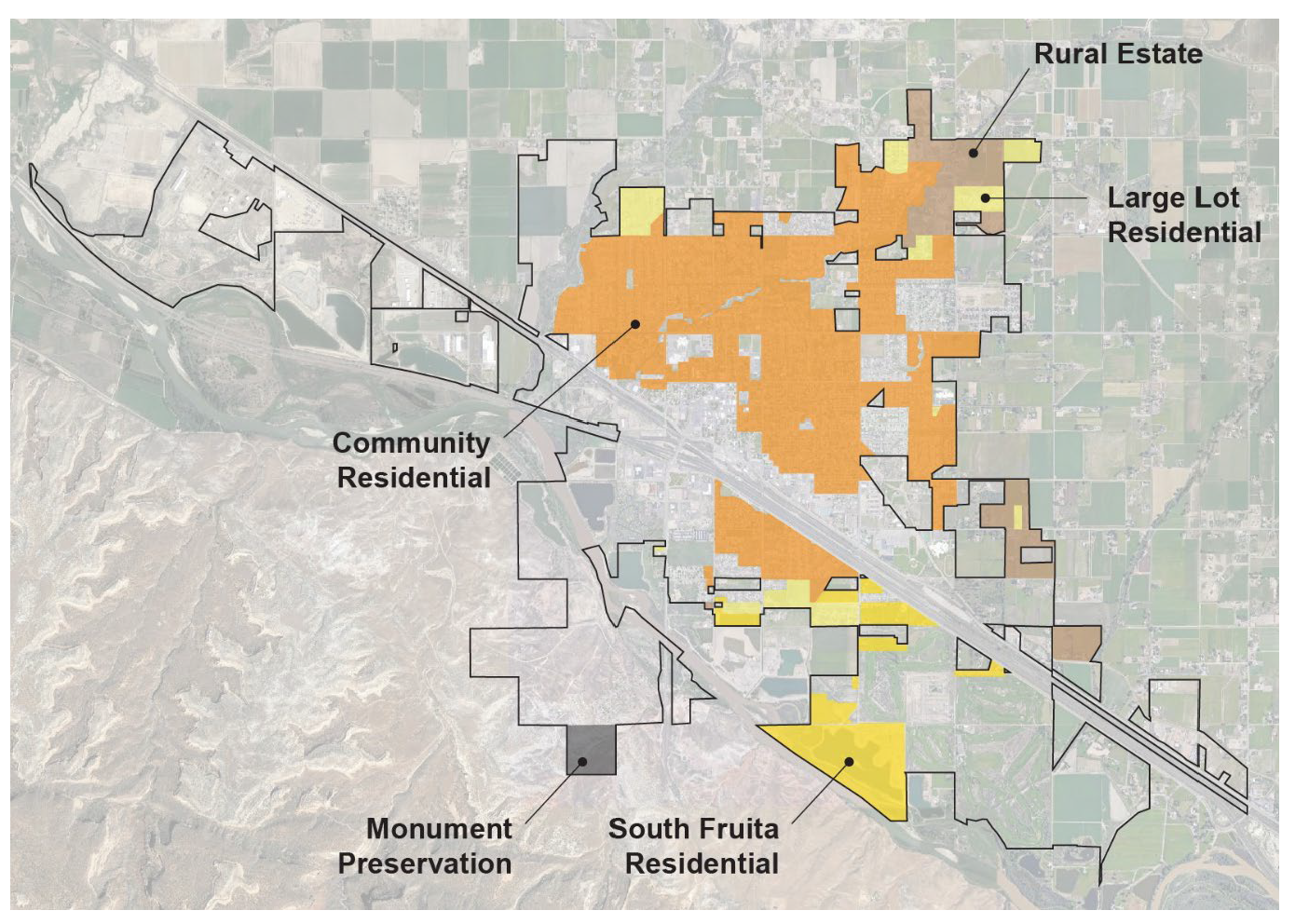
While many communities attempt to "create" traditional neighborhoods, Fruita already has traditional neighborhoods. The original town plat contains a variety of housing types in both historic and contemporary structures, many with front porches. Fruita's historic neighborhoods contain both small and large lots, some with alley access and street tree planter strips, and most within walking distance of centrally located open spaces, schools, churches and other community services. However, some areas outside the historic town plat have developed in a manner that is inconsistent with the above traditional neighborhood design principles. The design standards in this section are intended to guide compatible infill development and promote the creation of new, traditional neighborhoods where new subdivisions are proposed. It is not the intent of the City of Fruita Code to create an architectural theme or to freeze time, but rather to ensure that new buildings and remodels fit within the context of their historic surroundings, as applicable, and support the development of new compact, walkable neighborhoods with a variety of housing.
The zone districts subject to the Residential and Subdivision design standards are also illustrated in the map below.
A.
Site Design.
1.
Site Circulation. Streets, bicycle ways and walkways or trails, as applicable, shall, to the maximum extent practical, create a unifying circulation network that provides convenient routes to destinations without needlessly forcing trips onto the surrounding collector or arterial streets.
a.
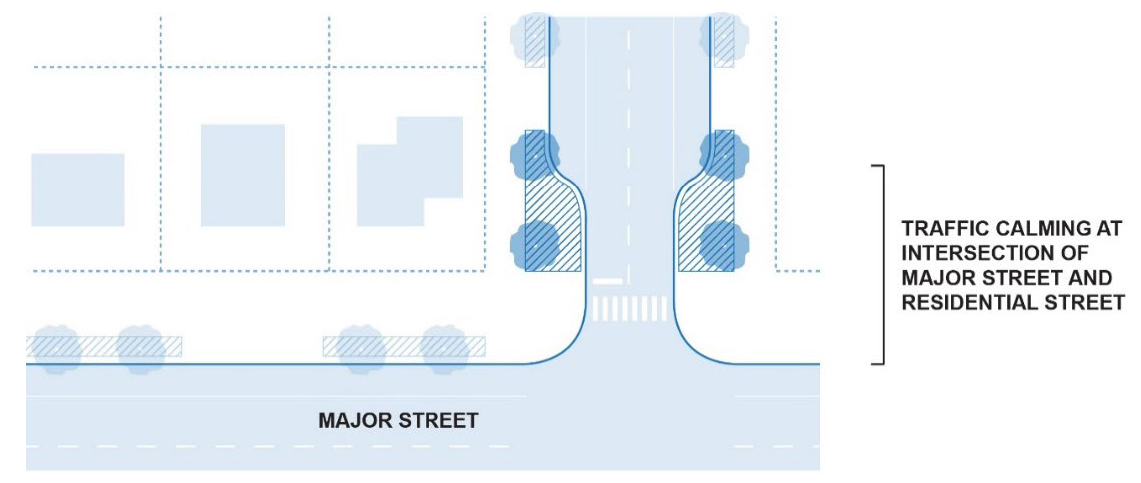
Street Design. Street and alley networks, as applicable, shall, to the maximum extent practical, be configured to minimize cut-through traffic on local residential streets without relying upon the use of culs-de-sac; where cut-through traffic is unavoidable, street design shall incorporate neighborhood traffic calming features, such as curb extensions (reduced width at intersections), roundabouts at major intersections, traffic circles, or other features, consistent with the City of Fruita Street System Design Criteria and the City of Fruita Traffic Calming, Pedestrian and Bicycle Plan.
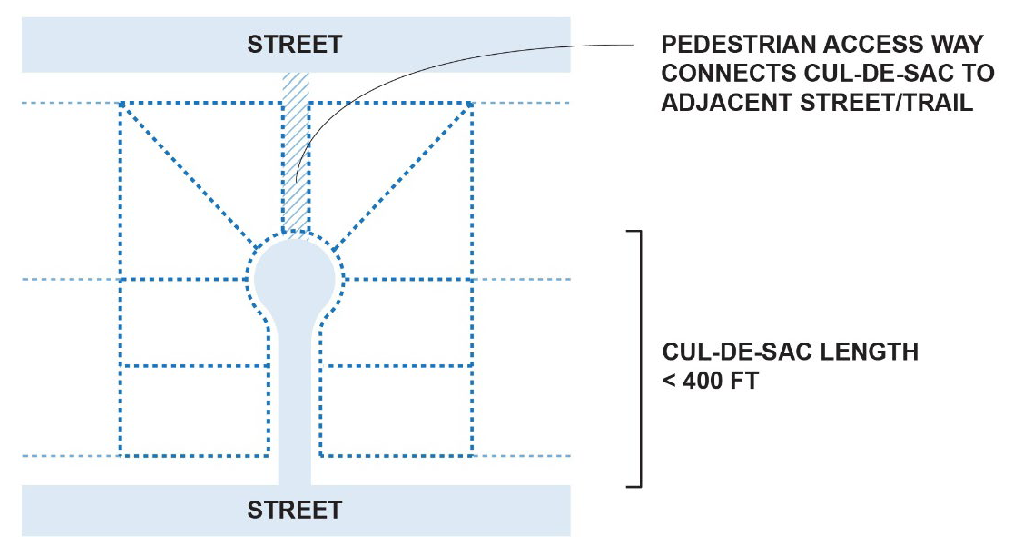
Culs-de-sac, where allowed, are limited to a maximum length of four hundred (400) feet. A pedestrian access way or trail will be required to connect the end of any cul-de-sac to an adjacent street or trail right-of-way to minimize out-of-direction travel by pedestrians and bicyclists. The City decision-making body may also require the use of pervious paving (e.g., pavers) or stamped concrete on culs-de-sac to minimize stormwater runoff (impervious surfaces) or to identify culs-de-sac as community spaces where children play (e.g., basketball hoops, street hockey, etc.).
b.
Street Orientation.[Streets, pedestrian ways and trails should focus on important vistas; for example, by aligning street axis to provide for views of community buildings, mountains, trees or open spaces. Streets, blocks, open space areas and trails should be oriented and designed in response to Fruita's location in the Grand Valley.] View corridors to the mountains, washes, open space areas, and canals shall be incorporated into project designs, and lot orientation should allow solar access to individual home sites, to the greatest extent practical.
c.
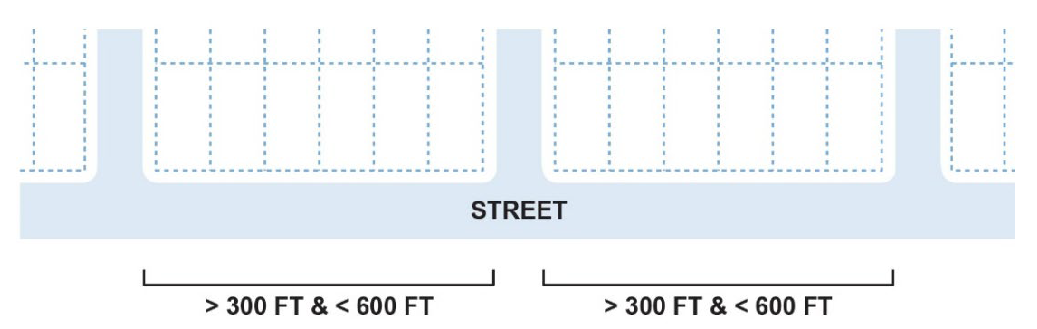
Block Lengths. Block lengths shall provide for at least one street connection for every three to six hundred (300 to 600) feet maximum in block length, except where topographic or access restrictions (e.g., arterial intersection spacing) preclude such connections. Where street connections are not feasible, pedestrian and bicycle pathway/trail connections shall be used to make walking and bicycling within and between developments convenient.
2.
Alleys and Shared Driveways.[Alleys or shared driveways are encouraged in new subdivisions and in redevelopment projects where the subject block has, or historically had, an alley.] Alleys and shared driveways allow homes to front onto parks and open space areas without a road separating the homes from such features. Alleys can also provide additional off-street parking where needed. Finally, alleys can provide effective land use and density transitions in the middle of a block instead of along street frontages, where it is more desirable to have similar building types face one another.
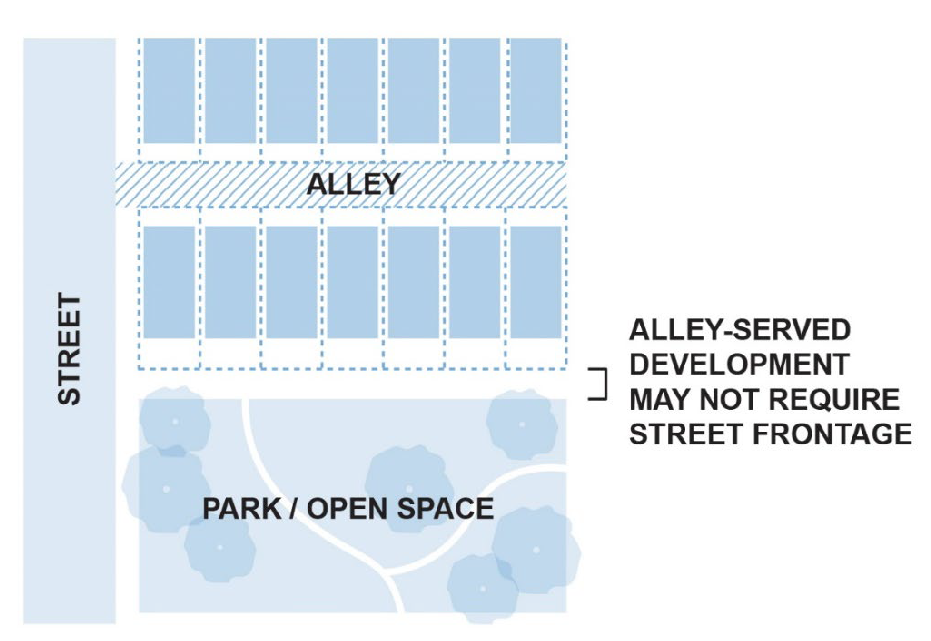
The following provisions are intended to reduce or eliminate traffic conflicts and aesthetic problems associated with frequent garage openings and driveway approaches abutting neighborhood streets.
a.
Alleys or shared driveways may be allowed where developments face major streets to which individual driveway access is not allowed but houses are oriented to the street (e.g., with deep front yard setbacks) is desired.
b.
The City decision-making body may require alleys or shared driveways to be incorporated into a subdivision design where lot sizes are less than seven thousand (7,000) square feet.
c.
[Alleys and shared driveways should align so that drivers entering an alley or shared driveway can see any oncoming vehicles.]
d.
Dead-end alleys and shared driveways shall be less than one hundred fifty (150) feet long, except as allowed with an approved emergency vehicle turnaround.
e.
Where an alley or shared driveway also serves as a required emergency apparatus (fire) lane, it shall conform to the applicable design criteria and standards for such lanes.
3.
Topography. Development shall conform to the natural topography of the site by minimizing cuts and fills. Except as necessary for underground utilities, individual cuts and fills (i.e., for streets and foundations) are limited to no more than eight (8) feet each and no retaining wall shall exceed a height of eight (8) feet without a variance. Terracing may be allowed by the City decision-making body, as necessary, due to existing topography.
4.
Adjacency to Unique Natural Features and Historic Landmarks.
a.
Little Salt Wash, Big Salt Wash, and the Colorado National Monument. Developments adjacent to the Little Salt Wash or Big Salt Wash, and those in the foothills of the Colorado National Monument, McInnis Canyon National Conservation Area or near the Colorado River, shall be designed to respond to the topographic and natural resource values of those areas by limiting grading, incorporating required setbacks and buffering, providing trail connections, and clustering development densities in less environmentally sensitive areas. Development in areas prone to flooding is subject applicable building codes and may be prohibited where an applicant has requested a density bonus under Chapter 17.09.050 or planned unit development approval under Chapter 17.19 (i.e., development density shall be transferred from the floodplain to more suitable upland areas).
b.
Historic Landmarks. Developments subject to the requirements of this Section and proposed within one hundred (100) feet of a designated historic landmark are required to demonstrate compatibility with the adjacent landmark in terms of building height, setbacks, building form, architectural detailing, materials, and site design (parking, circulation and landscaping). The City decision-making body shall approve, approve with conditions, or deny a proposed development under this subsection based on its finding of compatibility as described above and also as described in Section 17.13.080, Land Use Compatibility Criteria.
5.
[Parks and Open Space.]
a.
[Parks and open spaces should be used to form neighborhood edges and transitions where higher density development is proposed adjacent to lower density development, and where development abuts watercourses, washes, and other natural features.]
b.
[Parks and open spaces should be collocated with existing or planned school sites, as applicable.]
c.
[Where a new park of two (2) acres or more in size is proposed, it should be located, configured and designed to maximize pedestrian access from the greatest number of residents in the adjacent neighborhood(s).]
d.
[Where mixed-use projects are planned, with residential and commercial uses proposed, the City decision-making body may require open space areas or parks that serve as central gathering places for residents and employees.]
e.
[Where a proposed subdivision is adjacent to an existing park, open space or natural area (e.g., wash), the City decision-making body may require the applicant to connect to and/or augment the existing park, open space or natural area with required land dedication, trails, and/or other related improvements, consistent with the provisions of Chapter 17.21 and Chapter 17.23.]
(Ord. 2021-09 [17.11]; Ord. 2021-21)

