
Fruita City Zoning Code
APPENDIX
LANDSCAPING STANDARDS
UPDATED MARCH 16, 2010
CITY OF FRUITA LANDSCAPING SPECIFICATIONS
DEVELOPED AND COMPILED BY THE CITY OF FRUITA COMMUNITY DEVELOPMENT DEPARTMENT USING THE TRI RIVER AREA COLORADO STATE UNIVERSITY EXTENSION OFFICE PUBLICATIONS ON RECOMMENDED PLANT SPECIES.
TABLE OF CONTENTS
I.
Recommended Tree Planting List
II.
Recommended Shrub/Ground Cover Planting List
III.
Choosing a Soil Amendment (Details &specifications)
IV.
Tree Staking Detail
V.
The Science of Planting Trees-Attachment (15 pages)
THE CITY OF FRUITA IS LOCATED IN USDA HARDINESS ZONE: 6—7
LANDSCAPE PLANTS SUITABLE FOR THE CITY OF FRUITA
Compiled using the CSU Extension Office recommended landscape and planting publications
PLANT TYPE:
GC=Ground Cover; ET=Evergreen Tree; OG=Ornamental Grass;
P=Perennial; S=Shrub; T=Tree; V=Vine
PLANT SIZE:
S=Small; M=Medium; L=Large
If the xeriscape cell is selected, plant/tree/shrub is considered suitable for a xeriscaping landscape. Tree size at time of planting not to exceed three-inch caliper. (Trunk measured at six (6) inches above finished grade) Staking and guying of trees shall be completed immediately upon planting and stay for one (1) to two (2) years.
| TREES | |||||
|---|---|---|---|---|---|
| Botanical Name | Common Name | Min. Size Required | Plant Type | Plant Size | Xeriscape |
| Acer Campestre | Maple, Hedge | 1-inch caliper | T | S | |
| Acer Freemanii Jeffersred | Maple, Autumn Blaze | 1-inch caliper | T | L | |
| Acer Ginnala | Maple, Amur | 1-inch caliper | T | S | |
| Acer Platanoides | Maple, Norway | 1-inch caliper | T | L | |
| Acer Platanoides Emerald Queen | Maple, Emerald Queen | 1-inch caliper | T | L | |
| Acer Tataricum | Maple, Tatarian | 1-inch caliper | T | S | |
| Betula Nigra | Birch, River | 1-inch caliper | T | L | |
| Catalpa Speciosa | Catalpa, Western | 1-inch caliper | T | L | ✓ |
| Celtis Occidentalis | Hackberry, Western | 1-inch caliper | T | S | ✓ |
| Cercis Canadensis | Redbud, Eastern | 1-inch caliper | T | S | |
| Crataegus Crus-Galli Inermis | Hawthorn, Thornless Cockspur | 1-inch caliper | T | S | |
| Crataegus Laevigata Pauls Scarlet | Hawthorn, Pauls Scarlet | 1-inch caliper | T | S | |
| Crataegus Phaenopyrum | Hawthorn, Washington | 1-inch caliper | T | S | |
| Crataegus Viridis | Hawthorn, Winter Kind | 1-inch caliper | T | M | |
| Corylus Colurna | Filbert, Turkish | 1-inch caliper | T | L | |
| Fraxinus Americana Autumn Purple | Ash, Autumn Purple | 1-inch caliper | T | L | |
| Fraxinus Pennsylvanica | Ash, Green | 1-inch caliper | T | L | ✓ |
| Fraxinus Pennsylvanica Marshall | Ash, Marshalls Seedless | 1-inch caliper | T | L | ✓ |
| Ginko Biloba | Maidenhair Tree | 1-inch caliper | T | L | |
| Gleditsia Triancanthos Inermis | Honeylocust, Thornless | 1-inch caliper | T | L | ✓ |
| Gymnocladus Dioica | Kentucky Coffeetree | 1-inch caliper | T | L | ✓ |
| Juniperus Scopulorum | Juniper, Rocky Mountain | 1-inch caliper | ET | M | ✓ |
| Koelreuteria Paniculata | Golden Rain Tree | 1-inch caliper | T | S | ✓ |
| Liriodendron Tulipifera | Tulip Tree | 1-inch caliper | T | L | |
| Malus Spp. | Crabapple (Spring Snow, Adams, Radiant) | 1-inch caliper | T | S | |
| Morus Alba Pendula | Mulberry, Weeping | 1-inch caliper | T | S | |
| Morus Alba Stribling | Mulberry, Fruitless | 1-inch caliper | T | L | |
| Picea Glauca Conica | Spruce, Dwarf Alberta | 1-inch caliper | ET | M | |
| Picea Pungens | Spruce, Colorado | 1-inch caliper | ET | L | |
| Pinus Aristata | Pine, Bristlecone | 1-inch caliper | ET | S | ✓ |
| Pinus Cembroides Edulis | Pine, Pinyon | 1-inch caliper | ET | M | ✓ |
| Pinus Nigra | Pine, Austrian | 1-inch caliper | ET | L | |
| Pinus Strobiformis | Pine, Southwestern White | 1-inch caliper | ET | L | |
| Pinus Sylvestris | Pine, Scotch | 1-inch caliper | ET | L | |
| Platanus Acerifolia | Planetree, London | 1-inch caliper | T | L | |
| Populus Angustifolia | Cottonwood, Narrowleaf | 1-inch caliper | T | L | |
| Populus Fremontii | Cottonwood, Fremont | 1-inch caliper | T | L | |
| Prunus Cerasifera | Plum, Cherry | 1-inch caliper | T | S | |
| Prunus Cerasifera Newport | Plum, Newport Purple-Leaf | 1-inch caliper | T | S | |
| Prunus Cerasifera Thundercloud | Plum, Thundercloud Purple-Leaf | 1-inch caliper | T | S | |
| Prunus Cerasifera Mt. St. Helens | Plum, Mt. St. Helens Cherry | 1-inch caliper | T | S | |
| Prunus Maackii | Chokecherry, Amur | 1-inch caliper | T | S | |
| Prunus Virginiana | Chokecherry | 1-inch caliper | T | M | |
| Pseudotsuga Menziesii | Fir, Douglas | 1-inch caliper | ET | L | |
| Pyrus Calleryana | Pear, Ornamental (Aristocrat, Autumn Blaze, Redspire, Bradford) | 1-inch caliper | T | S | |
| Quercus Bicolor | Oak, Swamp White | 1-inch caliper | T | L | |
| Quercus Marcocarpa | Oak, Bur | 1-inch caliper | T | L | ✓ |
| Quercus Shumardii | Oak, Shumard | 1-inch caliper | T | L | |
| Robinia Ambigua Idahoensis | Locust, Idaho | 1-inch caliper | T | M | |
| Sophora Japonica | Japanese Pagoda Tree | 1-inch caliper | T | L | |
| Thuja Occidentalis | Arborvitae, American | 1-inch caliper | ET | M | |
| Tilia Americana | Linden, American | 1-inch caliper | T | L | |
| Ulmus Parvifolia | Elm, Lacebark | 1-inch caliper | T | L | |
LANDSCAPE PLANTS SUITABLE FOR THE CITY OF FRUITA
Compiled using the CSU Extension Office recommended landscape and planting publications
PLANT TYPE:
GC=Ground Cover; ET=Evergreen Tree; OG=Ornamental Grass;
P=Perennial; S=Shrub; T=Tree; V=Vine
PLANT SIZE:
S=Small; M=Medium; L=Large
#5=5 Gallon, #1=1 Gallon
In some instances, perennials and ornamental grasses may be substituted in place of a shrub.
Perennials listed below are recommendations.
If the xeriscape cell is selected, plant/tree/shrub is considered suitable for a xeriscaping landscape.
| SHRUBS, GROUNDCOVER, GRASSES, PERENNIALS & VINES | |||||
|---|---|---|---|---|---|
| Botanical Name | Common Name | Min. Size Required | Plant Type | Plant Size | Xeriscape |
| Achillea Hybrids | Yarrow | #1 | P | S | ✓ |
| Agastache Cana | Hyssop, Wild | #1 | P | S | ✓ |
| Agastache Rupestris | Hyssop, Sunset | #1 | P | S | ✓ |
| Alcea Rosea | Hollyhock | #1 | P | M | ✓ |
| Alyssum Saxatile Compactum | Basket of Gold | #1 | P | S | |
| Andropogon Gerardii | Big Bluestem | #1 | OG | L | ✓ |
| Aegopodium Podagraria Variegatum | Variegated Bishops Weed | #1 | GC | M | ✓ |
| Amelanchier Alnifolia | Serviceberry | #5 | S | L | |
| Aquilegia Hybrids | Columbine | #1 | P | S | ✓ |
| Arctostophylos X Coloradensis | Manzanita, Colorado | #5 | S/GC | S | |
| Artemisia Filifolia | Sage, Sand | #5 | S | S | ✓ |
| Artemisia Powis Castle | Sage, Silver | #1 | P | S | |
| Artemisia Schmidtiana | Sage, Silver Mound | #1 | GC | S | ✓ |
| Artemisia Tridentata | Sage, Basin | #5 | S | M | ✓ |
| Aster Spp. | Aster | #1 | P | S-M | |
| Berberis Thunbergii Crimson Pygmy | Barberry, Crimson Pygmy | #5 | S | S | ✓ |
| Berberis Thunbergii Rosy Glow | Barberry, Rosy Glow | #5 | S | M | ✓ |
| Buddleia Davidii | Butterfly Bush | #5 | S | M | |
| Buxus Microphylla Wintergreen | Boxwood, Wintergreen | #5 | S | S | |
| Calamagrostis X Acutiflora Karl Foerster | Reed Grass, Karl Foerster | #5 | OG | M | |
| Calamagrostis X Acutiflora Overdam | Reed Grass, Overdam Feather | #5 | OG | M | |
| Callirhoe Involucrata | Poppy Mallow | #1 | P | S | |
| Campanula Persificifolia | Bellflower, Peachleaf | #1 | P | S | |
| Campsis Radicans | Trumpet Vine | #5 | V | L | |
| Caragana Arborescens | Siberian Peashrub | #5 | S | L | |
| Carex Buchananii | Japanese Red Sedge | #1 | OG | S | |
| Caryopteris Incana | Spirea, Bluemist | #5 | S | S | |
| Centaurea Montana | Bachelor Button | #1 | GC | S | ✓ |
| Cerastium Tomentosum | Snow-in-Summer | #1 | GC | S | ✓ |
| Chaenomeles Speciosa | Flowering Quince | #5 | S | M | |
| Chrysothamnus Nauseosus | Rabbitbrush | #5 | S | M | ✓ |
| Coreopsis Grandiflora Sunray | Coreopsis, Sunray | #1 | P | S | ✓ |
| Coreopsis Verticillata Moonbeam | Coreopsis, Moonbeam | #1 | P | S | ✓ |
| Cornus Sericea | Dogwood, Redtwig | #5 | S | L | |
| Cornus Sericea Kelseyi | Dogwood, Kelsey Redtwig | #5 | S | S | |
| Cortaderia Selloana Pumila | Dwarf Pampas Grass | #1 | OG | M | |
| Cotinus Coggygria Purple Robe | Smoketree, Purple | #5 | S | L | |
| Cotoneaster Apiculatus | Cotoneaster, Cranberry | #5 | S | S | |
| Cotoneaster Horizontalis | Cotoneaster, Rock | #5 | S | M | ✓ |
| Cotoneaster Acutifolia | Cotoneaster, Peking | #5 | S | L | ✓ |
| Dalea Purpurea | Purple Prairie Clover | #1 | P | S | |
| Delphinium Elatum Magic Mountain Mix | Delphinium, Dwarf | #1 | P | S | |
| Delosperma Nubigenum | Iceplant, Hardy Yellow | #1 | GC | S | ✓ |
| Dianthus Brilliancy | Dianthus, Pinks | #1 | P | S | |
| Dianthus Barbatus | Sweet William, Mixed | #1 | P | S | |
| Echinacea Purpurea | Coneflower, Purple | #1 | P | S | ✓ |
| Erianthus Ravennae | Pampas Grass | #5 | OG | L | |
| Erigeron Hybrids | Daisy, Fleabane | #1 | P | S | ✓ |
| Euonymus Alatus | Burning Bush | #5 | S | L | |
| Euonymus Alatus Compacta | Dwarf Burning Bush | #5 | S | M | |
| Euonymus Fortunei Emerald Gaiety | Euonymus, Emerald Gaiety | #5 | S | M | |
| Euonymus Fortunei Emerald n Gold | Euonymus, Emerald n Gold | #5 | S | M | |
| Euonymus Fortunei Moonshadow | Euonymus, Moonshadow | #5 | S/GC | S | |
| Euonymus Kiautschovicus Manhattan | Euonymus, Manhattan | #5 | S | M-L | |
| Euphorbia Marginata | Snow-on-the-Mountain | #1 | GC | M | ✓ |
| Fallugia Paradoxa | Apache Plume | #5 | S | M | ✓ |
| Festuca Ovina Glauca | Fescue, Blue | #1 | OG/GC | S | ✓ |
| Festuca Idahoensis | Fescue, Idaho | OG | S | ✓ | |
| Forestiera Neomexicana | Privet, New Mexican | #5 | S | L | ✓ |
| Forsythia Spp. | Forsythia | #5 | S | L | |
| Gaillardia X Grandiflora Dazzler | Dazzler Blanketflower | #1 | P | S | ✓ |
| Gaillardia X Grandiflora Goblin | Goblin Flower | #1 | P | S | ✓ |
| Guarda Lindheimeri | Whirling Butterflies | #1 | P | S | ✓ |
| Geranium Sanguineum | Bloody Cranesbill | #1 | P | S | |
| Geum Hybrids | Geum | #1 | P | S | |
| Helianthemum Nummularium | Yellow Sunrose | #1 | P | S | ✓ |
| Helictotrichon Sempervirens | Blue Oat Grass | #1 | OG | S | ✓ |
| Heliopsis Helianthoides Summer Sun | False Sunflower | #1 | P | M | |
| Hemerocallis Spp. | Daylily | #1 | P | S | ✓ |
| Heuchera Sanguinea | Coral Bells | #1 | P | S | |
| Hibiscus Syriacus | Rose-of-Sharon | #5 | S | L | |
| Holodiscus Dumosus | Rock Spirea | #5 | S | M | ✓ |
| Hydrangea Arborescens Annabelle | Hydrangea, Annabelle | #5 | S | S | |
| Iberis Sempervirens | Candytuft | #1 | P | S | ✓ |
| Imperata Cylindrica Rubra | Japanese Blood Grass | #1 | OG | S | |
| Iris Hybrids | Bearded Iris | #1 | P | S | ✓ |
| Juniperus Blue Star | Juniper, Blue Star | #5 | S | S | |
| Juniperus Calgary Carpet | Juniper, Calgary Carpet | #1 | GC | M | ✓ |
| Juniperus Chinensis Armstrong | Juniper, Armstrong | #5 | S | M | ✓ |
| Juniperus Chinensis Blue Point | Juniper, Upright | #5 | S | M | |
| Juniperus Chinensis Old Gold | Juniper, Old Gold | #5 | S | M | ✓ |
| Juniperus Hetzii | Juniper, Hetzi | #5 | S | L | ✓ |
| Juniperus Horizontalis Blue Chip | Juniper, Blue Chip | #1 | GC | M | ✓ |
| Juniperus Horizontalis Hughes | Juniper, Hughes | #1 | GC | M | ✓ |
| Juniperus Horizontalis Prince of Wales | Juniper, Prince of Wales | #1 | GC | M | ✓ |
| Juniperus Scopularum Gray Gleam | Juniper, Gray Gleam | #5 | S | L | ✓ |
| Kniphofia Uvaria | Red Hot Poker | #1 | P | S | ✓ |
| Lavandula Angustifolia | Lavender | #1 | P | S | ✓ |
| Leucanthemum X Superbum | Daisy, Shasta | #1 | P | S | |
| Liatrus Spicata Kobold | Blazing Star | #1 | P | S | ✓ |
| Ligustrum X Vicaryi | Privet, Golden Vicary | #5 | S | M | |
| Lilium Asiatica | Lily, Asiatic | #1 | P | S | |
| Lilium Orientalis | Lily, Oriental | #1 | P | S | |
| Lonicera Japonica Halliana | Halls Japanese Honeysuckle | #1 | V/GC | L | ✓ |
| Mahonia Aquifolium | Oregon Grapeholly | #5 | S | M | |
| Miscanthus Sinensis Gracillimus | Maiden Grass | #5 | OG | L | |
| Miscanthus Sinensis Silberfeder | Variegated Silver Maiden Grass | #5 | OG | L | |
| Miscanthus Sinensis Zebrinus | Zebra Grass | #5 | OG | L | |
| Oenothera Speciosa | Primrose, Mexican Evening | #1 | P | S | ✓ |
| Paeonia Hybrids | Peonies | #1 | P | S | |
| Panicum Virgatum | Switch Grass | #1 | OG | L | |
| Papaver Orientale | Poppy, Oriental | #1 | P | S | |
| Parthenocissus Quinquefolia | Virginia Creeper | #1 | V | L | |
| Parthenocissus Tricuspidata | Boston Ivy | #1 | V | L | |
| Pennisetum Alopecuroides | Fountain Grass | #5 | OG | M | |
| Pennisetum Alopecuroides Hamelin | Dwarf Fountain Grass | 5 | OG | S | |
| Penstemon Caespitosus | Penstemon, Mat | #1 | GC | S | ✓ |
| Penstemon Strictus | Penstemon, Rocky Mountain | #1 | P | S | |
| Perovskia Atriplicifolia | Russian Sage | #5 | S | M | |
| Phalaris Arundinacea Picta | Ribbon Grass | #1 | OG | M | |
| Philadelphus X Virginalis | Mockorange | #5 | S | L | |
| Phlox Subulata | Phlox, Creeping | #1 | GC | S | ✓ |
| Physocarpus Opulifolius | Common Ninebark | #5 | S | L | |
| Picea Glauca Conica | Spruce, Dwarf Alberta | #5 | S | M | |
| Pinus Mugo | Pine, Mugo | #5 | S | S?L | |
| Pinus Mugo Slowmound | Pine, Dwarf Mugo | #5 | S | S | |
| Platycodon Grandiflora | Balloonflower | #1 | P | S | |
| Polygonum Aubertii | Silver Lace Vine | #1 | V | M | |
| Potentilla Fruticosa | Cinquefoil | #5 | S | S | ✓ |
| Potentilla Verna | Creeping Potentilla | #1 | GC | S | ✓ |
| Prunus X Cistena | Plum, Cistena | #5 | S | M | |
| Prunus Tomentosa | Cherry, Nanking (Manchu) | #5 | S | L | |
| Prunus Virginiana | Chokecherry | #5 | S | L | |
| Prunus Virginiana Shubert | Chokecherry, Shubert | #5 | S | L | |
| Rhamnus Frangula Columnaris | Columnar Buckthorn | #5 | S | L | |
| Rhus Trilobata | Sumac, Three-Leaf | #5 | S | M | ✓ |
| Rhus Aromatica Grow?Low | Sumac, Grow Low | #5 | S | S | |
| Ribes Alpinum | Currant, Alpine | #5 | S | S | |
| Ribes Aureum | Currant, Golden | #5 | S | M | |
| Rosa Spp. (Climbing) | Climbing Roses | #5 | S | M?L | |
| Rosa Spp. Meidiland or Other | Shrub Roses | #5 | S | S?L | |
| Rosa Hybrid (Florabunda) | Florabunda Roses | #5 | S | M | |
| Rosa Hybrid (Hybrid?Tea) | Hybrid?Tea Roses | #5 | S | M | |
| Rudbeckia Fulgida | Black?Eyed Susan | #1 | P | S | ✓ |
| Salix Purpurea Nana | Willow, Dwarf Arctic | #5 | S | M | |
| Salvia Nemorosa May Night | Salvia, May Night | #1 | P | S | |
| Sambucus Canadensis Aurea | Elderberry, Golden | #5 | S | L | |
| Santolina Chamaecyparissus | Gray Santolina | #1 | GC | S | ✓ |
| Scabiosa Caucasica | Pincushion Flower | #1 | P | S | |
| Schizachyrium Scoparium | Little Bluestem | #1 | OG | M | ✓ |
| Sedum Autumn Joy | Stonecrop | #1 | P | S | ✓ |
| Sedum Dragon's Blood | Stonecrop, Dragon's Blood | #1 | GC | S | ✓ |
| Sedum Pinifolium | Blue Spruce Sedum | #1 | GC | S | ✓ |
| Sorbaria Sorbifolia | Spirea, Ash?Leaf | #5 | S | L | |
| Spiraea X Bumalda Anthony Waterer | Spirea, Anthony Waterer | #5 | S | S | |
| Spiraea X Bumalda Froebelii | Spirea, Froebel | #5 | S | S | |
| Spiraea X Bumalda Goldflame | Spirea, Goldflame | #5 | S | S | |
| Spiraea X Vanhouttei | Spirea, Vanhoutte | #5 | S | M | |
| Symphoricarpos Albus | Snowberry | #5 | S | M | |
| Symphoricarpos X Chenaultii Hancock | Hancock Coralberry | #5 | S | S | |
| Syringa Patula Miss Kim | Lilac, Miss Kim | #5 | S | M | |
| Syringa Vulgaris | Lilac | #5 | S | L | |
| Tanacetum Niveum | Daisy, Snow | #1 | P | S | |
| Tanacetum X Coccineum | Daisy, Painted | #1 | P | S | |
| Thuja Occidentalis | Arborvitae, American | #5 | S | L | |
| Thymus Pseudolangunosa | Thyme, Wooly | #1 | GC | S | ✓ |
| Thymus Serpyllum | Thyme, Wild | #1 | GC | S | ✓ |
| Veronica Pectinata | Speedwell, Blue Woolly | #1 | GC | S | ✓ |
| Veronica Prostrata | Speedwell, Prostrate | #1 | GC | S | ✓ |
| Veronica Spicata | Blue Spike Speedwell | #1 | P | S | |
| Viburnum Opulus | Cranberry Bush, European (Snowball bush) | #5 | S | L | |
| Viburnum Opulus Compactum | Cranberry Bush, Compact European (Snowball bush) | #5 | S | M | |
| Viburnum Trilobum Compactum | Cranberry Bush, Compact American | #5 | S | M | |
| Vinca Minor | Periwinkle | GC | S | ✓ | |
| Weigela Florida Java Red | Weigela, Java Red | #5 | S | M | |
| Weigela Florida Variegata | Weigela, Variegated | #5 | S | M | |
| Yucca Baccata | Yucca, Banana | #5 | S | M | ✓ |
| Yucca Filamentosa Golden Sword | Yucca, Golden Sword | #5 | S | S | ✓ |
| Yucca Harrimaniae | Yucca, Harrimans | #5 | S | S | ✓ |
| Zinnia grandiflora | Zinnia, Rocky Mountain | #1 | P | S | ✓ |
Choosing a Soil AmendmentNo. 7.235
By J.G. Davis and C.R. Wilson 1 (5/05)
Quick Facts...
•
Soil amendments improve the physical properties of soils.
•
Amendments are mixed into the soil. Mulches are placed on the soil surface.
•
The best soil amendments increase water- and nutrient-holding capacity and improve aeration and water infiltration.
•
Wood products can tie up nitrogen in the soil.
•
Sphagnum peat is superior to Colorado mountain peat.
•
When using biosolids, choose Grade 1 biosolids.
A soil amendment is any material added to a soil to improve its physical properties, such as water retention, permeability, water infiltration, drainage, aeration and structure. The goal is to provide a better environment for roots.
To do its work, an amendment must be thoroughly mixed into the soil. If it is merely buried, its effectiveness is reduced, and it will interfere with water and air movement and root growth.
Amending a soil is not the same thing as mulching, although many mulches also are used as amendments. Mulch is left on the soil surface. Its purpose is to reduce evaporation and runoff, inhibit weed growth, and create an attractive appearance. Mulches also moderate soil temperature, helping to warm soils in the spring and cool them in the summer. Mulches may be incorporated into the soil as amendments after they have decomposed to the point that they no longer serve their purpose.
Organic vs. Inorganic Amendments
There are two broad categories of soil amendments: organic and inorganic. Organic amendments come from something that is or was alive. Inorganic amendments, on the other hand, are either mined or man-made. Organic amendments include sphagnum peat, wood chips, grass clippings, straw, compost, manure, biosolids, sawdust and wood ash. Inorganic amendments include vermiculite, perlite, tire chunks, pea gravel and sand.
Not all of the above are recommended by Colorado State University. These are merely examples. Wood ash, an organic amendment, is high in both pH and salt. It can magnify common Colorado soil problems and should not be used as a soil amendment. Don't add sand to clay soil — this creates a soil structure similar to concrete.
Organic amendments increase soil organic matter content and offer many benefits. Organic matter improves soil aeration, water infiltration, and both water- and nutrient-holding capacity. Many organic amendments contain plant nutrients and act as organic fertilizers.
Organic matter also is an important energy source for bacteria, fungi and earthworms that live in the soil.
Application Rates
If your soil has less than 3 percent organic matter, then apply 3 cubic yards of your chosen organic amendment per 1,000 square feet. To avoid salt buildup, do not apply more than this. Retest your soil before deciding whether to add more soil amendment.
Wood Products
Wood products can tie up nitrogen in the soil and cause nitrogen deficiency in plants. Microorganisms in the soil use nitrogen to break down the wood. Within a few months, the nitrogen is released and again becomes available to plants. This hazard is greatest with sawdust, because it has a greater surface area than woodchips.
If you plan to apply wood chips or sawdust, you may need to apply nitrogen fertilizer at the same time to avoid nitrogen deficiency.
Sphagnum Peat vs. Mountain Peat
Sphagnum peat is an excellent soil amendment, especially for sandy soils, which will retain more water after sphagnum peat application. Sphagnum peat is generally acid (i.e., low pH) and can help Gardeners grow plants that require a more acidic soil. Colorado mountain peat is not as good a soil amendment. It often is too fine in texture and generally has a higher pH.
Mountain peat is mined from high-altitude wetlands that will take hundreds of years to rejuvenate, if ever. This mining is extremely disruptive to hydrologic cycles and mountain ecosystems. Sphagnum peat is harvested from bogs in Canada and the northern United States. The bogs can be revegetated after harvest and grow back relatively quickly in this moist environment.
Are Biosolids Safe?
Biosolids are byproducts of sewage treatment. They may be found alone or composted with leaves or other organic materials. The primary concerns about biosolids are heavy metal content, pathogen levels and salts. To avoid excessive levels of heavy metals and to ensure that pathogens have been killed, always choose a Grade 1 biosolid. While Grade 1 biosolids are acceptable for food Gardens, do not use them on root Crops because they will come in direct contact with the edible portion of the plant. Do not use biosolids below Grade 1.
Manure vs. Compost
Fresh manure can harm plants due to elevated ammonia levels. To avoid this problem, use only aged manure (at least six months old). Pathogens are another potential problem with fresh manure, especially on vegetable Gardens. Compost manure for at least two heating cycles at 130 to 140 degrees F to kill any pathogens before applying the manure to vegetable Gardens. Most home composting systems do not sustain temperatures at this level. Home-composted products containing manure are best used in flower Gardens, shrub borders and other nonfood Gardens. See fact sheets 9.369, Preventing E. coli From Garden to Plate, and 7.212, Composting Yard Waste.
During composting, ammonia gas is lost from the manure. Therefore, nitrogen levels may be lower in composted manure than in raw manure. On the other hand, the phosphorus and potassium concentrations will be higher in composted manure. Modify fertilizer practices accordingly. Salt levels also will be higher in composted manure than in raw manure. If salt levels are already high in your Garden soil, do not apply manures.
Other composts are available that are made primarily from leaf or wood products alone or in combination with manures or biosolids.
Factors to Consider When Choosing an Amendment
There are at least four factors to consider in selecting a soil amendment:
•
How long the amendment will last in the soil,
•
Soil texture,
•
Soil salinity and plant sensitivities to salts, and
•
Salt content and pH of the amendment.
Laboratory tests can determine the salt content, pH and organic matter of organic amendments. The quality of bulk organic amendments for large-scale landscape uses can then be determined.
Longevity of the Amendment
The amendment you choose depends on your goals.
•
Are you trying to improve soil physical properties quickly? Choose an amendment that decomposes rapidly.
•
Do you want a long-lasting improvement to your soil? Choose an amendment that decomposes slowly.
•
Do you want a quick improvement that lasts a long time? Choose a combination of amendments.
| Table 1: Decomposition Rate of Various Amendments. | |
|---|---|
| Amendment | Decomposition Rate |
| Grass Clippings, Manures | Rapid decomposition (Days to Weeks) |
| Composts | Moderate Decomposition (About Six [6] Months) |
| Wood chips (Redwood, Cedar), Hardwood Bark, Peat | Slow Decomposition (Possibly Years) |
Soil Texture
Soil texture, or the way a soil feels, reflects the size of the soil particles. Sandy soils have large soil particles and feel gritty. Clay soils have small soil particles and feel sticky. Both sandy soils and clay soils are a challenge for Gardeners. Loam soils have the ideal mixture of different size soil particles.
When amending sandy soils, the goal is to increase the soil's ability to hold moisture and store nutrients. To achieve this, use organic amendments that are well decomposed, like composts or aged manures.
With clay soils, the goal is to improve soil aggregation, increase porosity and permeability, and improve aeration and drainage. Fibrous amendments like peat, wood chips, tree bark or straw are most effective in this situation.
Use Tables 2 and 3 for more specific recommendations. Because sandy soils have low water retention, choose an amendment with high water retention, like peat, compost or vermiculite. Clay soils have low permeability, so choose an amendment with high permeability, like wood chips, hardwood bark or perlite. Vermiculite is not a good choice for clay soils because of its high water retention.
| Table 2: Permeability and water retention of various soil types. | ||
|---|---|---|
| Soil Texture | Permeability | Water Retention |
| Sand | High | Low |
| Loam | Medium | Medium |
| Silt | Low | High |
| Clay | Low | High |
| Table 3: Permeability and water retention of various soil amendments. | ||
|---|---|---|
| Amendment | Permeability | Water Retention |
| Fibrous Peat Wood Chips Hardwood bark | low-medium high high | very high low-medium low-medium |
| Humus Compost Aged manure | low-medium low-medium | medium-high medium |
| Inorganic Vermiculite Perlite | high high | high low |
Soil Salinity and Plant Sensitivity to Salts
Some forms of compost and manures can be high in salts. Avoid these amendments in soils that are already high in salts (above 3 mmhos/cm) or when growing plants that are sensitive to salts. Raspberry, strawberry, bean, carrot, onion, Kentucky bluegrass, maple, pine, viburnum and many other landscape plants are salt sensitive. In such cases, choose sphagnum peat or ground leaves instead of compost or manures.
Salt Content and pH of the Amendment
Always beware of salts in soil amendments. High salt content and high pH are common problems in Colorado soils. Therefore, avoid amendments that are high in salts or that have a high pH. Amendments high in salts and/or pH include wood ash, Colorado mountain peat and composted manures. An amendment with up to 10 mmhos/cm total salts is acceptable if well mixed into low-salt soils (less than 1 mmhos/cm). Amendments with a salt content greater than 10 mmhos/cm are questionable. Choose a low-salt amendment for soils testing high in salts.
Sphagnum peat and compost made from purely plant sources are low in salts and are good choices for amending Colorado soils. Ask for an analysis of the organic amendments that you are considering, and choose your amendments wisely. If no analysis is available, test a small amount of the amendment before purchasing a large quantity.
J.G. Davis, Colorado State University Extension soil specialist and associate professor, soil and crop sciences; and C.R. Wilson, Extension horticulture agent, Denver County. 6/00. Reviewed 5/05
EXAMPLE OF TYPICAL STAKING/GUYING OF TREE DETAIL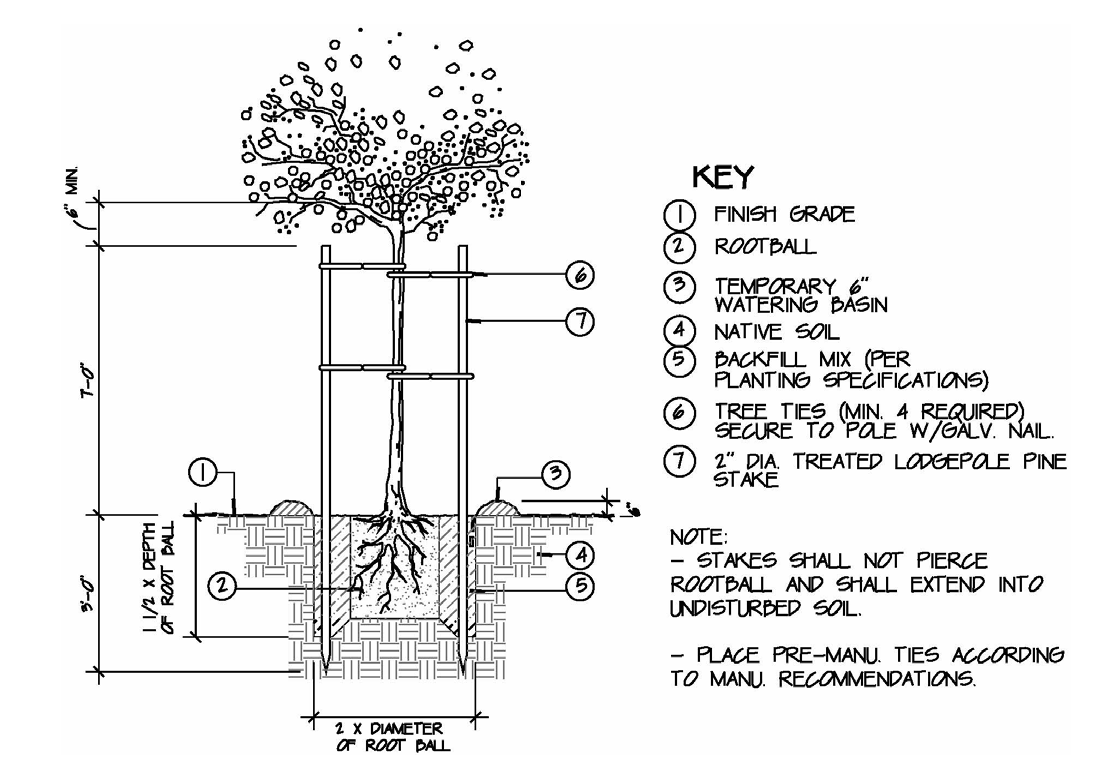
(Ord. 2010-10, S4; Ord. 2021-21)

