
Fruita City Zoning Code
CHAPTER 17
15 - SIGN CODE
17.15.010 - PURPOSE.
The standards and requirements contained in this chapter are intended to coordinate the use, placement, physical dimensions, and design of all signs within the City. The purposes of these standards are to:
A.
Recognize that signs are a necessary means of visual communication for the convenience of the public and for the benefit of businesses, and
B.
Provide a reasonable balance between the right of an individual to identify his or her business and the right of the public to be protected against the visual discord resulting from the unrestricted proliferation of signs and similar devices, and
C.
Protect the public from damage or injury caused by signs that are structurally unsafe or obscure vision of motorists, bicyclists or pedestrians or conflict with traffic signals or signs, and
D.
Provide flexibility within the sign review/approval process to allow for unique circumstances and creativity.
(Ord. 2009-02; Ord. 2009-10 [17.41]; Ord. 2021-21)
17.15.020 - SIGN PERMITS AND ADMINISTRATION.
Any sign authorized by this chapter may contain non-commercial copy in lieu of any other copy.
A.
Sign Permit Required. To ensure compliance with the regulations of this chapter, a sign permit shall be required in order to erect, move, alter, reconstruct or repair any permanent or temporary sign, except signs that are exempt from permits in compliance with Section 17.15.040 (Exempt Signs). Changing or replacing the copy on an existing lawful sign shall not require a permit, provided the copy change does not change the nature of the sign or render the sign in violation of this chapter.
B.
Application for a Sign Permit.
1.
Sign Permit Application Requirements. Applications for sign permits shall be made in writing on forms furnished by the Community Development Department
2.
Staff Review and Approval. When the Community Development Department staff has determined the application to be complete, the Community Development Department shall review the sign permit in accordance with requirements of this Code and approve, approve with conditions or deny the sign permit.
C.
Appeal of Sign Permit Decision. Any appeal of the Community Development Department's decision on a sign permit shall be made to the City Council as provided in Chapter 17.25 of this title.
D.
Sign Variances.
1.
Applicability. A sign variance is an exception from the numerical requirements of this chapter.
2.
Procedure. Sign variances are reviewed and acted upon at a public hearing before the City Council.
3.
Approval Criteria. The City Council may approve a sign variance request upon finding that the sign variance application meets or can meet the following approval criteria:
a.
That the sign variance granted is without substantial detriment to the public good and does not impair the intent and purposes of this title and the Comprehensive Plan, including the specific regulation in question,
b.
By reason of exceptional narrowness, shallowness, depth, or shape of a legal lot of record at the time of enactment of this title, or by reason of exceptional topographic conditions or other extraordinary and exceptional situation or condition of such property, the strict application of the subject regulation would result in peculiar and exceptional practical difficulties to, or exceptional and undue hardship upon the owner of such property,
c.
A sign variance from such strict application is reasonable and necessary so as to relieve such difficulties or hardships, and the sign variance will not injure the land value or use of, or prevent the access of light and air to, the adjacent properties or to the area in general or will not be detrimental to the health, safety and welfare of the public,
d.
That the circumstances found to constitute a hardship are not due to the result or general conditions throughout the zone, was not induced by any action of the applicant, and cannot be practically corrected, and
e.
That the sign variance granted is the minimum necessary to alleviate the exceptional difficulty or hardship.
4.
Final Decision. Any decision of the City Council shall be final, from which an appeal may be taken to a court of competent jurisdiction, as provided in accordance with C.R.S. 31-23-307.
(Ord. 2009-02; Ord. 2009-10; Ord. 2016-01 [17.41]; Ord. 2018-29; Ord. 2021-21)
17.15.030 - ENFORCEMENT AND PENALTIES.
A.
Penalties. Violations of this chapter shall be subject to the administrative and civil remedies and criminal penalties set forth in the Fruita Municipal Code, including Section 17.01.100.
B.
Removal of Illegal Signs in the Public Right-of-Way. The City may cause the removal of any sign within the public right-of-way or on property that is otherwise abandoned that has been placed there without first complying with the requirements of this chapter.
C.
Storage of Removed Signs. Signs removed in compliance with this section shall be stored by the City for thirty (30) days, during which they may be recovered by the owner only upon payment to the City for costs of removal and storage. If not recovered within the thirty (30) day period, the sign and supporting structure shall be declared abandoned and Title shall vest with the City. The costs of removal and storage, up to thirty (30) days, may be billed to the owner. If not paid, the applicable costs shall constitute a lien against the property and may be certified to the County Treasurer for collection in the same manner as delinquent ad valorem taxes, as authorized by law.
(Ord. 2009-02; Ord. 2009-10 [17.41]; Ord. 2021-21)
17.15.040 - EXEMPT SIGNS.
The following types of signs are exempt from the permit requirements of this chapter and may be placed in any zone subject to the provisions of this chapter. Such signs shall otherwise be in conformance with all applicable requirements contained in this title. Signs shall not interfere with traffic signs or the sight distance triangle at intersections.
Evidence of the property owner's permission to install a sign may be required. All other signs shall be allowed only with a permit and upon proof of compliance with this chapter. These exempt signs are permitted in addition to other signs permitted by this chapter.
A.
Signs in the public right-of-way unless permitted by this title and specifically permitted by the governmental entity controlling the right-of-way (City of Fruita, Colorado Department of Transportation, etc.)
B.
Signs that are not visible beyond the boundaries of the lot or parcel upon which they are located and/or from any public thoroughfare or right-of-way shall be exempt from the provisions of this chapter, except that such signs shall be subject to the safety regulations of the City's building codes adopted pursuant to Title 15 of the Fruita Municipal Code.
C.
Architectural Features. Integral decorative or architectural features of buildings so long as such features do not contain letters, trademarks, moving parts or lights.
D.
Art. Integral decorative or architectural features of buildings and works of art so long as such features or works do not contain letters, trademarks, moving parts or lights.
E.
Building Identification, Historical Markers. Non-illuminated signs which are permanently affixed to buildings or structures for the purpose of identifying the name of a building, date of erection or other historical information.
F.
Construction. Temporary construction signs advertising the development or improvement of a property by a builder, contractor or other person furnishing service, materials, or labor to the premise during the period of construction, development or lot sales shall be allowed provided that:
1.
Signs in conjunction with any single-family residential use shall not exceed eight (8) square feet each,
2.
Signs in conjunction with all other uses shall have a maximum area of thirty-two (32) square feet each,
3.
Only one (1) such sign oriented per street front per premises shall be erected. Any two (2) such signs located on the same premises shall be located at least one hundred (100) feet apart as measured by using a straight line,
4.
Such signs shall not be illuminated,
5.
Such signs shall only appear at the construction site,
6.
Such signs shall be removed within seven (7) days after completion of the project, and
7.
Such signs shall be erected only after submittal of a land development application for the subject property.
G.
Courtesy. Signs which identify, as a courtesy to customers, items such as credit cards accepted, redemption stamps offered, menus or hours of operation; limited to one (1) such sign for each business or use, not to exceed four (4) square feet per face or eight (8) square feet in total area. One (1) flashing or blinking sign of this type may be permitted to be displayed in a window on the ground floor provided the sign is no larger than four (4) square feet in area.
H.
Decorations (Holiday). Temporary decorations or displays, when such are clearly incidental to and are customarily and commonly associated with any national, State, local or religious holiday or celebration, provided that such signs shall be displayed for not more than sixty (60) days in any one (1) year.
I.
Directional. On-premises directional and instructional signs not exceeding six (6) square feet in area each.
J.
Doors. Signs affixed to door which identify the name and/or address of an establishment limited to four (4) square feet.
K.
Flags.
L.
Hazards Signs. Temporary or permanent signs erected by the City of Fruita, public utility companies, oil and gas companies, or construction companies to warn of danger or hazardous conditions, including signs indicating the presence of underground cables, gas lines and similar devices.
M.
Identification/Address. Non-illuminated signs not to exceed two (2) square feet in area which identify the address and/or occupants of a dwelling unit or of an establishment. An Identification/Address sign that contains only the address number(s) of the property may be larger than two (2) square feet only if necessary for the numbers to be visible from the public right-of-way.
N.
Memorial. Memorial signs, plaques or grave markers which are non-commercial in nature.
O.
Merchandise. Merchandise, pictures or models of products or services which are incorporated as an integral part of a window display. This is different from a Window Sign which requires a sign permit.
P.
Reserved.
Q.
Public Information Signs. Signs which identify restrooms, public telephones, or provide instructions as required by law or necessity, provided the sign does not exceed two (2) square feet in area and is non-illuminated. (This category shall be interpreted to include such signs as "restrooms," "self-service," and similar informational signs.)
R.
Religious Symbols.
S.
Regulatory Signs. Regulatory signs erected on private property identifying regulations specific to that property, such as "no trespassing" or "no smoking" signs, which do not exceed two (2) square feet per face or four (4) square feet in total surface area, limited to four (4) such signs per use or per building, whichever is the greater number.
T.
Real Estate Sale, Lease, Rent Signs. Temporary signs used to offer for sale, lease or rent land or buildings provided that such signs shall be no taller than six (6) feet, shall not be illuminated and shall be removed within seven (7) days after the real estate closing or lease transaction and:
1.
One (1) on-premises sign per street frontage advertising real estate ("For Sale," "For Rent," "For Lease" or "For Development") not greater than eight (8) square feet in area in a residential zone and thirty-two (32) square feet in area in non-residential zones may be located on the property being advertised. If the property so advertised lies on a corner lot or double frontage lot, then a second sign may be oriented along the second street so long as the two (2) signs are at least one hundred (100) feet apart as measured by the shortest straight line,
2.
In addition to the on-premises real estate sign(s), a maximum of three (3) directional signs, each not exceeding four (4) square feet in area, shall be permitted off the subject premises. The message of said signs shall be limited to the name of the property or development being advertised, an address, a telephone number, a directional arrow, mileage to the subject property, and the terms "Lot/Home For Sale," "For Rent," "For Lease," "For Development," etc.,
3.
In addition to the signs identified in subsections 1 and 2 above, land containing not less than five (5) lots or one acre shall be allowed one sign per street entrance advertising the subdivision. Such signs may have a maximum sign area of thirty-two (32) square feet.
U.
Scoreboards. Scoreboards for athletic fields.
V.
Strings of Light Bulbs. Displays of string lights, provided:
1.
They are decorative displays which only outline or highlight landscaping or architectural features of a building,
2.
They are steady burning lights. No blinking, flashing, intermittent changes in intensity or rotating shall be permitted,
3.
They are no greater in intensity than five (5) watts,
4.
They shall not be placed on or used to outline signs, sign supports,
5.
They shall not be assembled or arranged to convey messages, words, commercial advertisements, slogans and/or logos, and
6.
They shall not create a safety hazard with respect to placement, location of electrical cords or connection to power supply.
W.
Temporary, On-Premises. Two (2) temporary signs (either attached or freestanding) are permitted per business (including institutional businesses and temporary uses such as garage sales and fruit stands) as long as the signs are brought indoors at the end of each business day. There are no size or height limits associated with these types of temporary signs.
X.
Temporary Yard Signs. Yard signs are allowed without a sign permit pursuant to the following:
1.
In Residential Zoning Districts:
a.
Total square footage of all yard signs shall not exceed twenty-four (24) square feet total on any property;
b.
Shall not exceed a height of forty-two (42) inches; and
c.
Shall not be located in the public right-of-way.
2.
In All Other Zoning Districts:
a.
Total square footage of all yard signs shall not exceed twenty-four (24) square feet total on any property;
b.
Shall not exceed a height of six (6) feet, or forty-two (42) inches if placed within a sight distance triangle; and
c.
Shall not be located in the public right-of-way.
Y.
Time and Temperature. Signs displaying time and temperature devices provided they are not related to a product and do not exceed sixteen (16) square feet in sign area and do not exceed eight (8) feet in height when freestanding.
Z.
Traffic Control. Signs for the control of traffic or other regulatory purposes including signs for the control of parking on private property, and official messages erected by, or on the authority of, a public officer in the performance of his/her duty.
AA.
Vacancy and No Vacancy. The sign area of "vacancy" and "no vacancy" signs, cannot exceed three (3) square feet per face. Also, signs designed to indicate vacancy such as "yes," "no" or "sorry" shall also be exempt under the provisions of this subsection if they meet the area requirement.
BB.
Vehicular for Sale Signs. Motor vehicle for sale signs provided there is only one (1) sign per vehicle, the sign does not exceed two (2) square feet.
CC.
Vehicular Signs. Signs displayed on trucks, buses, trailers or other vehicles which are being operated or stored in the normal course of a business, such as signs indicating the name of the owner or business which are located on moving vans, delivery trucks, rental trucks and trailers and the like, shall be exempt from the provisions of this chapter, provided that the primary purpose of such vehicles is not for the display of signs, and provided that they are parked or stored in areas appropriate to their use as vehicles.
DD.
Vending Machine Signs. Vending machine signs provided that the advertisement upon the vending machine sign is limited to the product vended.
(Ord. 2009-02; Ord. 2009-10; Ord. 2016-01; Ord. 2016-10 [17.41]; Ord. 2018-15; Ord. 2021-21; Ord. No. 2024-17, S5, 10-1-2024)
17.15.050 - PROHIBITED SIGNS.
The following signs are inconsistent with the purposes and standards in this chapter and are prohibited in all zones:
A.
Flashing, rotating, blinking or moving signs, animated signs, signs with moving, rotating or flashing lights or signs that create the illusion of movement.
B.
Any sign that is erected in such a location as to cause visual obstruction or interference with motor vehicle traffic, or traffic-control devices including any sign that obstructs clear vision in any direction from any street intersection or driveway.
C.
Mechanical or electrical appurtenances, such as "revolving beacons," that are designed to compel attention.
D.
Off-premises advertising signs except as specifically permitted by this chapter.
E.
Any sign which interferes with free passage from or obstructs any fire escape, downspout, window, door, stairway, ladder or opening intended as a means of ingress or egress or providing light or air.
F.
Any sign located in such a way as to intentionally deny an adjoining property owner visual access to an existing sign.
G.
Vehicle-mounted signs, including but not limited to, signs painted on or attached to semi-trailers or cargo containers when exhibited on private property adjacent to public right-of-way for the purpose of advertising the business or services offered on the property.
H.
No single sign may measure more than three hundred (300) square feet regardless of size calculations otherwise contained in this chapter.
I.
Searchlights.
J.
Signs with optical illusion of movement by means of a design which presents a pattern capable of reversible perspective, giving the illusion of motion or changing of copy.
K.
Wind signs.
L.
Any sign (together with its supporting structure) now or hereafter existing which, ninety (90) days or more after the premises have been vacated, advertises an activity, business, product or service no longer produced or conducted upon the premises upon which such sign is located. If the sign or sign structure is covered or the identifying symbols or letters removed, an extension of time may be granted by the Community Development Department Director upon good cause for such extension being shown. (This provision shall not apply to permanent signs accessory to businesses which are open only on a seasonal basis, provided that there is clear intent to continue operation of the business).
M.
Any sign or sign structure which:
1.
Is structurally unsafe,
2.
Constitutes a hazard to safety or health by reason of inadequate maintenance or dilapidation,
3.
Is not kept in good repair, or
4.
Is capable of causing electrical shocks to persons likely to come in contact with it.
N.
Any sign or sign structure which:
1.
In any other way obstructs the view of, may be confused with or purports to be an official traffic sign, signal or device or any other official sign,
2.
Uses any words, phrases, symbols or characters implying the existence of danger or the need for stopping or maneuvering a motor vehicle,
3.
Creates in any other Wayan unsafe distraction for motor vehicle operators, or
4.
Obstructs the view of motor vehicle operators entering a public street from any parking area, service drive, private driveway, alley or other thoroughfare.
(Ord. 2009-02; Ord. 2009-10; Ord. 2016-01, [17.41]; Ord. 2021-21)
17.15.060 - MEASUREMENT OF SIGN AREA, HEIGHT AND CONSTRUCTION.
A.
Sign Surface Area. The area of a geometric shape enclosing any message, logo, symbol, name, photograph or display face shall be measured using standard mathematical formulas.
B.
Sign Support. Supporting framework or bracing that is clearly incidental to the display itself shall not be computed as sign area.
C.
Back-to-Back (Double-Faced) Signs. Back-to-back signs shall be regarded as a single sign only if mounted on a single structure, and the distance between each sign face does not exceed two (2) feet at any point.
D.
Three-Dimensional Signs. Where a sign consists of one (1) or more three-dimensional objects (i.e. balls, cubes, clusters of objects, sculpture), the sign area shall be measured as their maximum projection upon a vertical plane. Signs with three (3) dimensional objects that exceed a projection of six (6) inches from the sign face may be approved in compliance with Section 17.15.110, Creative Signs.
E.
Sign Height. The height of a sign shall be measured from the highest point of a sign to the natural ground surface beneath it.
F.
Wind Load. All exterior signs shall be engineered to withstand a minimum wind load of thirty (30) pounds per square foot.
(Ord. 2009-02; Ord. 2009-10 [17.41]; Ord. 2021-21)
17.15.070 - SIGN ILLUMINATION.
A.
Signs within five hundred (500) feet and in the direct line of sight of an existing residential structure or signs over ten (10) feet tall which are within five hundred (500) feet of and in the direct line of sight of the Fruita State Park are required to minimize light pollution impacts to the Fruita State Park and/or existing residential structures. A residence shall be deemed "existing" for purposes of this subsection if it has a valid building permit in effect for construction of said structure or if construction of said structure was complete on or prior to the effective date of this chapter.
B.
All lighted signs shall have their lighting directed in such a manner as to illuminate only the face of the sign. When external light sources are directed at the sign surface, the light source must be concealed from pedestrians' and motorists' "lines of sight."
C.
Signs must be illuminated in a way that does not cause glare onto the street and adjacent properties. Signs shall be lighted only to the minimum level for nighttime readability.
D.
All lighted signs shall meet all applicable electrical codes and the electrical components used shall bear the label of an approval agency. Additionally, electrical permits shall be obtained for electric signs. When electrical service is provided to freestanding signs, all such electrical service shall be underground.
E.
Flashing, moving, blinking, chasing or other animation effects are prohibited on all signs except time and temperature signs and courtesy signs four (4) square feet or less in area when displayed in a window.
F.
Neon tubing is an acceptable method of sign illumination.
G.
Electronic message boards are permitted but the message can change only once every five (5) minutes and only one (1) color light may be used at a time. Time and temperature signs and courtesy signs four (4) square feet or less in area when displayed in a window are exempt from this regulation. Electronic message boards using plasma technology are prohibited.
(Ord. 2009-02; Ord. 2009-10 [17.41]; Ord. 2021-21)
17.15.080 - SIGN INSTALLATION AND MAINTENANCE.
A.
Owners of projecting signs extending over public right-of-way shall be required to maintain public liability insurance in an amount to be determined appropriate by the City of Fruita, in which the City of Fruita is named as an "additional insured."
B.
The owner of a sign and the owner of the premises on which a sign is located shall be jointly and severally liable to maintain such sign, including any illumination sources in a neat and orderly condition, and in good working order at all times, and to prevent the development of any rust, corrosion, rotting or other deterioration in the physical appearance or safety of such sign. The sign must also be in compliance with all building and electrical codes adopted by the City and the State.
C.
The City may inspect any sign governed by this chapter and shall have the authority to order the repair, or removal of a sign which constitutes a hazard to safety, health or public welfare by reason of inadequate maintenance, dilapidation or obsolescence.
(Ord. 2009-02; Ord. 2009-10 [17.41]; Ord. 2021-21)
17.15.090 - STANDARDS FOR SPECIFIC TYPES OF SIGNS.
Any sign authorized by this chapter may contain non-commercial copy in lieu of any other copy.
A.
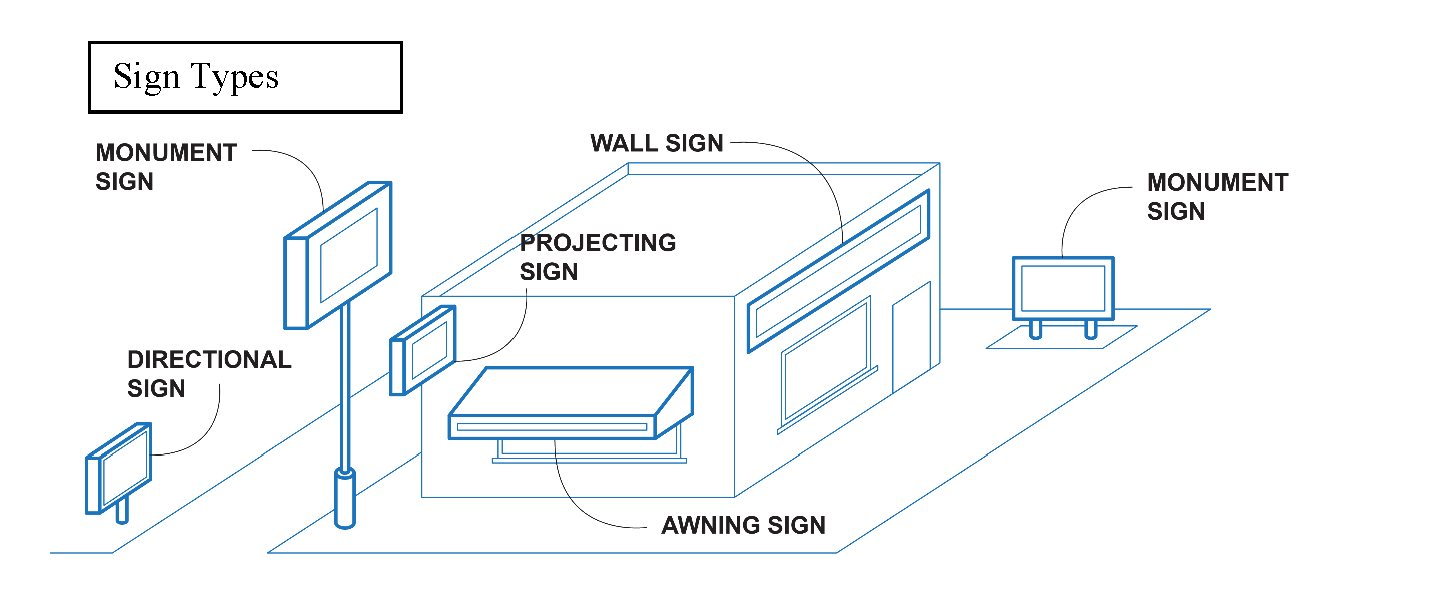
Attached sign types. The sum of all attached signs cannot exceed ten (10) percent of wall area to which the sign(s) is attached. Each building facade shall have its own separate and distinct sign allowance. The sign allowance per facade can only be used on that facade and shall not be transferred to any other facade.
1.
Wall Signs. The sign shall not be placed to obstruct any portion of a window, doorway or other architectural detail. Wall signs shall not extend more than four (4) feet above the roof line of the portion of the building to which it is attached but in no case is the wall sign permitted to be above thirty-five (35) feet in height regardless of building height.
2.
Awning or Canopy Signs.
a.
Location. Signs may be placed only on awnings or canopies that are located on first or second story of a building. No awning or canopy sign shall project beyond, above or below the face of an awning or canopy.
b.
Maximum Area and Height. Sign area shall comply with the requirements established by Section 17.15.100, Sign Standards by Zone District. No structural element of an awning or canopy shall be located less than eight (8) feet above finished grade.
3.
Window Signs. When a sign is painted on, applied or attached to or displayed in a window and is visible beyond the boundaries of the lot upon which the sign is displayed, the total area of such sign shall not exceed:
a.
Fifty (50) percent of the window or door area at the ground floor level, and
b.
Fifty (50) percent of the total allowable sign area for the premises.
4.
Projecting Signs.
a.
Maximum Area and Height. Projecting signs shall not be higher than the wall from which the sign projects. Projecting signs must have eight (8) feet clearance from the ground below and may not extend more than six (6) feet from the building wall. The size of projecting signs is limited to sixteen (16) square feet.
b.
Sign Structure. Sign supports and brackets shall be compatible with the design and scale of the sign.
c.
Quantity. The number of projecting signs is limited to one per business.
B.
Freestanding Signs.
1.
Location. No freestanding sign in any zone can be erected closer than eight (8) feet to any curb line in the public right-of-way, nor closer than four (4) feet to any building. With the exception of the DMU zone, no freestanding signs for non-residential land uses must not be located less than twenty-five (25) feet from any property line abutting a residential land use.
2.
Maximum Area and Height. The sign shall comply with the height and area requirements established in Section 17.15.100, Sign Standards by Zone.
C.
Off-Premises Signs. Other than the off-premises signs permitted as identified in Section 17.15.040 regarding Exempt Signs, the only other off-premises signs permitted are Business District Identification signs. One Business District Identification sign (whether freestanding or attached) is permitted at each major entry point to a Business District for those businesses that do not have frontage on a State Highway. For the purposes of Business District Identification Signs, Business Districts and major entrance points to Business Districts are identified by Resolution of the City Council. This type of sign is permitted in addition to all other signs permitted on the property on which the sign is located.
1.
Freestanding: Limited to thirty-five (35) feet in height and three hundred (300) square feet in size.
2.
Attached: Limited to three hundred (300) square feet in size.
(Ord. 2009-02; Ord. 2009-10; Ord. 2016-01, [17.41]; Ord. 2021-21)
17.15.100 - SIGN STANDARDS BY ZONE.
A.
Signs in the Monument Preservation (MP), Community Residential (CR), Large Lot Residential (LLR), South Fruita Residential (SFR), Community Services and Recreation (CSR) zones and residential land use portions of the Downtown Mixed Use (DMU) zones shall be limited to:
B.
Signs in the Commercial-1 (C-1) zone, Commercial-2 (C-2) zone, Industrial (I) zone, and non-residential land use portions of the Downtown Mixed Use (DMU) zone shall be limited to all signs permitted in subsection A above and also the following:
* For parcels or lots with buildings that abut the entire street side property line, freestanding signs shall not be permitted along that street side. This currently includes most of the lots fronting Circle Park and Aspen Avenue from Circle Park to Peach Street.
** One (1) freestanding sign per lot or parcel up to thirty-five (35) feet in height is permitted for properties touching the right-of-way for Highway 6 & 50 or Highway 340 which are zoned C-2, or DMU, or properties zoned DMU and touching the right-of-way for Plum Street between Highway 6 & 50 and Aspen Avenue. Maximum size for freestanding signs taller than ten (10) feet is limited to two hundred (200) square feet.
C.
Signs in the Rural Estate (RE) Zone Districts shall be limited to:
1.
All signs permitted in subsection A above, and,
2.
One (1) identification sign for agricultural land uses limited to:
a.
Forty-eight (48) square feet in size whether attached or freestanding,
b.
Freestanding sign limited to eight (8) feet in height with the setback from property lines equal to the height of the sign.
D.
Planned Unit Development and Conditional Use Signs. Planned unit developments and conditional use permits shall have proposed signs reviewed and approved as part of the planned unit development or conditional use permit review process.
(Ord. 2009-02; Ord. 2009-10; Ord. 2016-01, [17.41]; Ord. 2021-21)
17.15.110 - CREATIVE SIGNS.
A.
Purpose. This section establishes standards and procedures for the design, review and approval of creative signs. The purposes of this creative sign program are to:
1.
Encourage signs of unique design, and that exhibit a high degree of thoughtfulness, imagination, inventiveness, and spirit; and
2.
Provide a process for the application of sign regulations in ways that will allow creatively designed signs that make a positive visual contribution to the overall image of the City of Fruita, while mitigating the impacts of large or unusually designed signs.
B.
Applicability. An applicant may request approval of a sign permit under the creative sign program to authorize on-site signs that employ standards that differ from the other provisions of this chapter but comply with the provisions of this section.
C.
Approval Authority. A sign permit application for a creative sign shall be subject to approval by the City Council after a recommendation from the Planning Commission.
D.
Application Requirements. A sign permit application for a creative sign shall include all information and materials required by the City, and the permit fee as determined by resolution of the City Council.
E.
Design Criteria. In approving an application for a creative sign, the Planning Commission shall ensure that a proposed sign meets the following design criteria:
1.
Design Quality. The sign shall:
a.
Constitute a substantial aesthetic improvement to the site and shall have a positive visual impact on the surrounding area;
b.
Be of unique design, and exhibit a high degree of thoughtfulness, imagination, inventiveness, and spirit; and
c.
Provide strong graphic character through the imaginative use of graphics, color, texture, quality materials, scale, and proportion.
2.
Contextual Criteria. The sign shall contain at least one (1) of the following elements:
a.
Classic historic design style,
b.
Creative image reflecting current or historic character of the City,
c.
Symbols or imagery relating to the entertainment or design industry, or
d.
Inventive representation of the use, name or logo of the structure or business.
3.
Architectural Criteria. The sign shall:
a.
Utilize and/or enhance the architectural elements of the building; and
b.
Be placed in a logical location in relation to the overall composition of the building's facade and not cover any key architectural features/details of the facade.
(Ord. 2009-02; Ord. 2009-10; Ord. 2016-01, [17.41]; Ord. 2021-21)
17.15.120 - BUS SHELTER AND BENCH ADVERTISING.
A.
Advertising—Bus Shelters. Advertising on or incorporated within County or City approved transit shelters is permitted as long as the following requirements are met:
1.
There is a written agreement between the bus shelter provider and all of the required permits have been obtained from the City and Mesa County.
2.
The bus shelters are located only at designated bus stops on designated bus routes. As routes or stops change, bus shelters that are no longer on a designated route or bus stop must be removed within thirty (30) days following notice by the County and/or the City requesting removal.
3.
Bus shelters are also subject to the following requirements:
a.
Advertising shall be limited to two (2) side panels on the bus shelter, each not more than forty-eight (48) inches wide and seventy-two (72) inches high; the advertising panels may be illuminated by "backlighting."
b.
A third advertising panel may be provided along the rear of the bus shelter for public service messages or other public purposes, as specified in the written agreement with the County and the City.
c.
A proposed maintenance schedule shall be included in the written agreement between the bus shelter provider and the County and the City. The permittee shall be responsible for all maintenance of the shelter including general repair, painting, removal of graffiti, and maintenance of lawn or landscaping around the shelter area. Failure to properly maintain the shelter or shelter area is cause for removal.
d.
All bus shelters shall be located on and anchored to a concrete pad or equivalent.
e.
Shelters should be located in the public right-of-way; in situations where the shelter is required to be located outside the public right-of-way, the Community Development Department may allow such location, provided written authorization of the owner of the private land has been obtained and any costs associated with obtaining the authorization has been paid.
f.
A planning clearance for a building permit shall be obtained for each bus shelter. All requirements of the Americans with Disabilities Act must be met.
g.
Where curb and gutter are present and the posted speed limit is thirty-five (35) miles per hour or less, the front of the shelter shall be set back a minimum of five (5) feet from the curb, unless otherwise authorized by the County and City's Community Development Department; in no case shall the setback be less than three and one-half (3½) feet from the curb.
h.
Where there is no curb and gutter or the posted speed limit is greater than thirty-five (35) miles per hour the front of the shelter shall be set back a minimum of ten (10) feet from the edge of pavement, unless otherwise authorized by the City's Community Development Department; in no case shall the setback be less than five (5) feet from the edge of pavement.
i.
The shelter shall not be located in a way which impedes pedestrian, bicycle, wheelchair, or motor vehicle travel, including the limitation of vehicular sight distance; vertical supports for the shelter shall be located no closer than one (1) foot from any sidewalk.
j.
Bus shelters with advertising are limited to the Commercial-1 (C-1), Commercial-2 (C-2), Downtown Mixed Use (DMU) and Industrial (I) zones and are allowed only on major collector, minor arterial, and major arterial streets and roads, as designated in City of Fruita Street Classification and Traffic Control Plan, with the exception that such advertising bus shelters and benches shall not be allowed on the lots fronting on Circle Park and East Aspen Ave. from Circle Park on the west to Elm Street on the east, Mesa County School District No. 51 property, and on property operated by the Museum of Western Colorado; and
k.
Shelters located in the Downtown Mixed Use (DMU) and Commercial-1 (C-1), Commercial-2 (C-2) zones are subject to the design standards of such zone. See Chapter 17.13.
B.
Advertising—Bus Benches. Advertising on bus benches is permitted as long as the following requirements are met:
1.
There is a written agreement between the bus bench provider and the County and the City and all of the required permits have been obtained from the County and City.
2.
A single bench may be located only at designated bus stops along a designated bus route, subsequent to issuance of a permit by the County and the City's Community Development Department. A second bench may be allowed based on ridership data which demonstrates such a need. As routes or stops change, bus benches that are no longer along a designated route or bus stop must be removed within thirty (30) days following notice by the County and City.
3.
Benches are also subject to the following conditions:
a.
A site plan of the bench location, meeting the requirements of this section, shall be submitted to the County and the City's Community Development Department for review and approval of planning clearance prior to placement of any bench. Additionally, all requests to locate a bench on State highways shall also be submitted to the Colorado Department of Transportation (C.D.O.T.) for review and approval.
b.
Benches should be located within the public right-of-way; in situations where the bench is required to be located outside the public right-of-way the County and City's Community Development Department may allow such encroachment if it is the minimum amount necessary to site the bench, written authorization from the owner of the private land has been provided, and any costs associated with obtaining the authorization has been paid.
c.
The bench may be oriented towards approaching traffic at an angle not to exceed thirty (30) degrees from parallel to the street frontage.
d.
Where curb and gutter are present and the posted speed limit is thirty-five (35) miles per hour or less, the front of the bench shall be set back a minimum distance of five (5) feet from the curb. The five-feet minimum distance may not be reduced.
e.
Where no curb and gutter is present or the posted speed limit exceeds thirty-five (35) miles per hour, the bench may be located at a distance no closer than ten (10) feet from the edge of pavement, unless otherwise authorized by the County and the City's Community Development Department; in no case shall the distance be reduced to less than five (5) feet from the street pavement. Bus benches must be located within twenty (20) feet of a bus stop. To the greatest extent possible, benches should not be located within the parkway between the road pavement/curb and sidewalk.
f.
The advertising panel shall be limited to a single face that must be oriented to the street. The sign face shall not exceed twelve (12) square feet in size with a maximum sign height of two (2) feet; the sign shall be non-illuminated and non-reflective.
g.
The bench may not be located in a manner which impedes pedestrian, bicycle, wheelchair, or vehicle travel including the limitation of vehicular sight distance. The bench shall be set back a minimum distance of one (1) foot from an adjacent sidewalk at its nearest point.
h.
The permittee shall be responsible for all maintenance of the bench including general repair, painting, removal of graffiti, and maintenance of lawn or landscaping around the bench area. Failure to properly maintain the bench or bench area is cause for removal.
i.
Benches containing advertising are limited to major collector, minor arterials, and major arterials, as designated in the City's Street Classification and Traffic Control Plan.
j.
The design of benches obtained by the provider subsequent to the adoption of this chapter shall be approved by the City.
k.
Bus benches with advertising are limited to Commercial-1 (C-1), Commercial-2 (C-2), Downtown Mixed Use (DMU) and Industrial (I) zones and are allowed only on major collector, minor arterial, and major arterial streets and roads, as designated on the City's Street Classification and Traffic Control Plan, with the exception that such advertising benches shall not be allowed in the lots fronting on Circle Park and East Aspen Ave. from Circle Park on the west to Elm Street on the east, Mesa County School District No. 51 property, and on property operated by the Museum of Western Colorado; and
l.
The City's Community Development Department may add additional requirements for design and placement of benches as necessary based on the site location including, but not limited to the following:
i.
Construction of a concrete pad sufficient in size to accommodate the bench supports and two (2) feet of foot space along the front of the bench; and
ii.
Securing the bench to concrete pads utilizing a "break-away" anchor design.
(Ord. 2009-02; Ord. 2009-10; Ord. 2016-01, [17.41]; Ord. 2021-21)

