
Fruita City Zoning Code
CHAPTER 17
05 - LAND USE REGULATIONS
17.05.010 - PURPOSE.
The purpose of this chapter is to identify the land uses allowed in the City and to establish standards that apply to certain uses with unique characteristics or impacts. This chapter classifies land uses and activities into use categories on the basis of common functional, product, or physical characteristics. All uses are subject to the dimensional standards in each zone district, any regulations established by the zone district, and regulations applicable to the use, and the development standards.
(Ord. 2004-19, Ord 2009-02 [17.04]; Ord. 2021-21)
17.05.020 - LAND USE CATEGORIES.
A.
Categorization. Uses are assigned to the category whose description most closely describes the nature of the primary use. The "characteristics" subsection of each use category describes the characteristics of each use category. Developments may have more than one (1) primary use. Developments may also have one (1) or more accessory uses. It is the intent of this chapter to group similar or compatible land uses into specific land use categories.
B.
Interpretation. When a use's category is not clearly identifiable, the Community Development Director may determine the applicable use category or refer the question to the Planning Commission for a public hearing and determination following the procedure under Section 17.05.080.B. The following is considered to determine what use category the use is in, and whether the activities constitute primary uses or accessory uses:
1.
The description of the activity(ies) in relationship to the function and characteristics of each use category,
2.
The building or structure type associated with each use category, and the relative amount of site or floor space and equipment devoted to the activity,
3.
Relative amounts of sales from each activity,
4.
The customer type for each activity,
5.
The relative number of employees in each activity,
6.
Hours of operation,
7.
Building and site arrangement,
8.
Vehicles used with the activity,
9.
The relative number of vehicle trips generated by the activity,
10.
Signs,
11.
How the use advertises itself, and
12.
Whether the activity would function independently of the other activities on the site.
C.
Developments with Multiple Primary Uses. When all of the primary uses of a development fall within one (1) use category, then the development is assigned to that use category. For example, a development that contains a retail bakery and a cafe would be classified in the retail sales and service category because all the primary uses are in that category. When the primary uses of a development fall within different use categories, each primary use is classified in the applicable category and is subject to the applicable regulations for that category.
D.
Accessory Uses. Accessory uses are allowed by right, in conjunction with, the use unless stated otherwise in the regulations. Also, unless otherwise stated, they are subject to the same regulations as the primary use. Typical accessory uses are listed as examples with the categories.
E.
Use of Examples. The "examples" subsection of each use category provides a list of examples of uses that are included in the use category. The names of uses on the lists are generic. They are based on the common meaning of the terms and not on what a specific use may call itself. For example, a use whose business name is "Wholesale Liquidation" but that sells mostly to consumers, would be included in the retail sales and service category rather than the wholesale sales category. This is because the actual activity on the site matches the description of the retail sales and service category. If the use cannot be located within one (1) of the categories provided by this section, the City may at its discretion refer to appropriate outside sources, such as the Land-Based Classification Standards (LBCS) of the American Planning Association or the North American Industry Classification System (NAICS); however, the City is not obligated to consider these sources and is not liable for any damages resulting from such use, or resulting from future amendments to the LBCS or NAICS.
(Ord. 2004-19, Ord 2009-02 [17.04]; Ord. 2021-21)
17.05.030 - RESIDENTIAL USE CATEGORIES.
A.
Group Living.
1.
Characteristics. Group living is characterized by the residential occupancy of a structure by a group of people who do not meet the definition of household living. The size or composition of the group is different than that of a household. Tenancy is arranged on a month-to-month basis, or for a longer period. Uses where tenancy may be arranged for a shorter period are not considered residential. They are considered to be a form of transient lodging (see the retail sales and service and community service categories). Generally, group living structures typically have a common eating area for residents, though individual units may have a kitchen. The residents may or may not receive any combination of care, training, or treatment, as long as they also reside at the site.
2.
Accessory Uses. Accessory uses commonly found are recreational facilities, parking of autos for the occupants and staff, and parking of vehicles for the facility.
3.
Examples. Examples include dormitories; fraternities and sororities; monasteries and convents; nursing and convalescent homes; assisted living and similar retirement facilities where some level of daily care is provided by on-site staff; some group homes for the physically disabled, mentally retarded, or emotionally disturbed; some residential programs for drug and alcohol treatment; and alternative or post incarceration facilities. Group living includes large and small group homes.
4.
Exceptions.
a.
Lodging where tenancy may be arranged for periods less than one (1) month is considered a hotel or motel use (or hospital) and is classified in the retail sales and service or other category. However, in certain situations, lodging where tenancy may be arranged for periods less than one (1) month may be classified as a community service use such as publicly assisted, short term housing.
b.
Lodging where the residents meet the definition of household, and where tenancy is arranged on a month-to-month basis, or for a longer period is classified as household living.
c.
Facilities for people who are under judicial detainment and are under the supervision of sworn officers are included in the detention facilities category.
d.
Bed and breakfast.
B.
Household Living.
1.
Characteristics. Household living is characterized by the residential occupancy of a dwelling unit by a household. Where units are rented, tenancy is arranged on a month-to-month basis, or for a longer period. Uses where tenancy may be arranged for a shorter period are not considered residential. They are considered to be a form of transient lodging (see the retail sales and service and community service categories). Apartment complexes that have accessory services such as food service, dining rooms, and housekeeping are included as household living. Single room occupancy (SRO) housing, that do not have totally self-contained dwelling units (i.e., with kitchen and wash room facilities) are also included if at least two-thirds of the units are rented on a monthly basis. SROs may have a common food preparation area, but meals are prepared individually by the residents. In addition, temporary medical hardship dwellings, and residential homes as defined by the State of Colorado, are included in the household living category.
2.
Accessory Uses. Accessory uses commonly found are private yards and gardens, private recreational activities, raising of pets, hobbies, home occupations (subject to Code requirements), and parking of the occupants' vehicles, but not including residential occupancy of any vehicle. Home occupations, accessory dwelling units, short-term rentals, and bed and breakfast facilities are accessory uses that are subject to additional regulations.
3.
Examples. Uses include living in houses, duplexes, apartments, condominiums, retirement center apartments (not otherwise categorized as group living), manufactured housing, and other structures with self-contained and permitted dwelling units. Examples also include living in single room occupancy housing if the provisions are met regarding length of stay and separate meal preparation.
4.
Exceptions.
a.
For purposes of this Code, a recreational vehicle is not considered a dwelling.
b.
Lodging in a dwelling unit or single room occupancy hotel (SRO) where less than two-thirds of the units are rented on a monthly basis or longer is considered a hotel or motel use and is classified in the retail sales and service category. SROs which include common dining are classified as group living.
c.
Guest houses that contain kitchen facilities are not accessory to household living uses; such houses may be allowed as accessory dwellings or as part of a multifamily development, subject to applicable code requirements.
d.
In certain situations, lodging where tenancy may be arranged for periods less than one (1) month may be classified as a community service use, such as publicly assisted, short term housing or mass shelter in the event of an emergency declared by a government agency.
(Ord. 2004-19, Ord 2009-02 [17.04], Ord 2011-14-S2; Ord. 2021-11, S3; [17.04]; Ord. 2021-21)
17.05.040 - COMMERCIAL USE CATEGORIES.
A.
Commercial Outdoor Recreation.
1.
Characteristics. Commercial outdoor recreation uses are large, generally commercial uses that provide continuous or temporary recreation or entertainment-oriented activities. They generally take place outdoors. They may take place in a number of structures, which are arranged together in an outdoor setting. Temporary uses are subject to Section 17.05.100.
2.
Accessory Uses. Accessory uses may include concessions, restaurants, parking, caretaker's quarters, and maintenance facilities.
3.
Examples. Examples include amusement parks, theme parks, golf driving ranges, farmer's market, flea market, arts and crafts fair, miniature golf facilities, and similar commercial venues.
4.
Exceptions.
a.
Golf courses, including up to two thousand (2,000) square feet of accessory commercial floor area (e.g., clubhouse, restaurant, equipment sales and rental) are classified as parks and open space. Golf courses with a commercial component exceeding two thousand (2,000) square feet commercial floor area are considered retail sales and service.
b.
Uses that draw large numbers of people to periodic events, rather than on a continuous basis, are classified as major entertainment event.
B.
Commercial Parking.
1.
Characteristics. Commercial parking facilities provide parking that is not accessory to a specific use. A fee may or may not be charged. A facility that provides both accessory parking for a specific use and regular fee parking for people not connected to the use is also classified as a commercial parking facility.
2.
Accessory Uses. In a parking structure only, accessory uses may include car washing, and vehicle repair activities.
3.
Examples. Examples include short- and long-term fee parking facilities available to the public for a fee. Parking facilities constructed all or in part to fulfill parking requirements or parking needs for a specific use are not applicable.
4.
Exceptions.
a.
Parking facilities that are accessory to a use, but which charge the public to park for occasional events nearby, are not considered commercial parking facilities.
b.
Parking facilities that are accessory to a primary use are not considered commercial parking uses, even if the operator leases the facility to the primary use or charges a fee to the individuals who park in the facility.
C.
Quick Vehicle Servicing.
1.
Characteristics. Quick vehicle servicing uses provide direct services for motor vehicles where the driver generally waits in the car before and while the service is performed. The development will include a drive-through facility, the area where the service is performed vehicle fueling stations are always classified as a primary use (quick vehicle servicing), rather than an accessory use, even when the fueling component comprises less land than other uses of the site.
2.
Accessory Uses. Accessory uses may include auto repair and tire sales, mini mart or similar convenience retail uses.
3.
Examples. Examples include full-serve and mini-serve gas stations, unattended card key stations, car washes, and quick lubrication services where service is typically provided in less than one (1) hour.
4.
Exceptions.
a.
Refueling facilities for the vehicles that belong to a specific use (fleet vehicles) which are on the site where the vehicles are kept, are accessory to the use.
D.
Major Entertainment Event.
1.
Characteristics. Major entertainment event uses are characterized by activities and structures that draw large numbers of people to specific events or shows. Activities are generally of a spectator nature.
2.
Accessory Uses. Accessory uses may include restaurants, bars, concessions, parking, and maintenance facilities.
3.
Examples. Examples include sports arenas, racetracks (auto, horse, dog, etc.), auditoriums, exhibition and meeting areas, concert halls, outdoor amphitheaters, and fairgrounds.
4.
Exceptions.
a.
Exhibition and meeting areas with less than ten thousand (10,000) square feet of total event area are classified as retail sales and service.
b.
Banquet halls that are part of hotels or restaurants are accessory to those uses, which are included in the retail sales and service category.
c.
Theaters, including drive-in theaters, are classified as recreation and entertainment.
E.
Vocational and Trade Schools.
1.
Characteristics. vocational and trade schools uses are characterized by activities conducted in an office setting and generally focusing on serving students with vocational education, or supplemental academic education, enrichment, and/or tutoring.
2.
Accessory Uses. Accessory uses may include incidental retail (e.g., sale of instructional materials), parking, or other amenities primarily for the use of customers and employees.
3.
Examples. Examples include vocational schools, tutoring centers, computer classes, after school learning centers for grades K—12, and arts and crafts classes.
F.
Office.
1.
Characteristics. Office uses are characterized by activities conducted in an office setting and generally focusing on business, government, professional, medical, or financial services.
2.
Accessory Uses. Accessory uses may include cafeterias, health facilities, parking, or other amenities primarily for the use of employees in the firm or building.
3.
Examples. Examples include professional services such as lawyers, accountants, engineers, or architects; financial businesses such as lenders, brokerage houses, bank headquarters, or real estate agents; data processing; sales offices; government offices and public utility offices; TV and radio studios; medical and dental clinics, and medical and dental labs.
4.
Exceptions.
a.
Offices that are part of and are located with a firm in another category may be considered accessory to the firm's primary activity. Headquarters offices, when in conjunction with or adjacent to a primary use in another category, are considered part of the other category.
b.
Contractors and others who perform construction or similar services off-site are included in the Office category if equipment and materials are not stored on the site and fabrication, services, or similar work is not carried on at the site.
c.
Governmental offices may be classified as office, community service, or other use based on the use's predominate function.
G.
Retail Sales and Service.
1.
Characteristics. Retail sales and service firms are involved in the sale, lease or rent of new or used products to the general public. They may also provide personal services or provide product repair or services for consumer and business goods.
2.
Accessory Uses. Accessory uses may include offices, storage of goods, manufacture or repackaging of goods for on-site sale, and parking, subject to applicable Code requirements.
3.
Examples. Examples include uses from the four (4) subgroups listed below:
a.
Sales-Oriented: Stores selling, leasing, or renting consumer, home, and business goods including art, art supplies, bicycles, clothing, dry goods, electronic equipment, fabric, furniture, garden supplies, gifts, groceries, hardware, home improvements, household products, jewelry, pets, pet food, pharmaceuticals, plants, printed material, stationery, and videos; food sales, and sales or leasing of consumer vehicles including passenger vehicles, motorcycles, light and medium trucks, and other recreational vehicles.
b.
Personal Service-Oriented: Branch banks; urgency medical care; laundromats; photographic studios; photocopy and blueprint services; hair, tanning, and personal care services; tax preparers, accountants, real estate, legal, financial services; business, martial arts, and other trade schools; dance or music classes; taxidermists; mortuaries; veterinarians; kennels limited to boarding, with no breeding; and animal grooming.
c.
Repair-Oriented: Repair of TVs, bicycles, clocks, watches, shoes, guns, appliances and office equipment; photo or laundry drop off; quick printing; recycling drop-off; tailor; locksmith; and upholsterer.
4.
Exceptions.
a.
Lumber yards and other building material sales that sell to contractors and not retail customers are classified as wholesale sales.
b.
Indoor or outdoor continuous entertainment activities such as bowling alleys, ice rinks, and game arcades; pool halls; indoor firing ranges; theaters, health clubs, gyms, membership clubs, and lodges; hotels, motels, recreational vehicle parks, and other temporary lodging with an average length of stay of less than thirty (30) days are classified as recreation and entertainment.
c.
Repair and service of consumer motor vehicles, motorcycles, light and medium trucks and small personal transportation devices (e.g., electric carts) and garden tractors, is classified as vehicle repair. Repair and service of industrial vehicles and equipment, including farm, construction and other heavy equipment, and heavy trucks is classified as vehicle repair.
d.
Hotels, restaurants, and other services that are part of a truck stop are considered accessory to the truck stop which is classified as commercial vehicle servicing.
e.
In certain situations, hotels and motels may be classified as a community service use, such as publicly assisted, short term housing or mass shelter in the event of an emergency declared by a government agency. See community services.
H.
Self-Service Storage.
1.
Characteristics. Self-service storage uses provide separate storage areas for individual or business uses. The storage areas are designed to allow private access by the tenant for storing personal property.
2.
Accessory Uses. Accessory uses may include security and leasing offices. Living quarters for one (1) resident manager per site are allowed. Other living quarters are subject to the regulations for residential uses. Use of the storage areas for sales, service and repair operations, or manufacturing is not considered accessory to the self-service storage use. The rental of trucks or equipment is also not considered accessory to a self-service storage use.
3.
Examples. Examples include single story and multistory facilities that provide individual storage areas for rent; these uses are also called mini warehouses. Secured yards providing storage areas for recreational vehicles.
4.
Exceptions. A transfer and storage business where any individual storage areas are incidental to transfer and storage operations, or where employees are the primary movers of the goods to be stored or transferred, is in the warehouse and freight movement category.
I.
Vehicle Repair.
1.
Characteristics. Firms servicing passenger vehicles, light and medium trucks and other consumer motor vehicles such as motorcycles, boats and recreational vehicles. Generally, the customer does not wait at the site while the service or repair is being performed. (Different than quick vehicle services category.)
2.
Accessory Uses. Accessory uses may include offices, sales of parts, and vehicle storage.
3.
Examples. Examples include vehicle repair, transmission or muffler shop, auto body shop, alignment shop, auto upholstery shop, auto detailing, and tire sales and mounting.
4.
Exceptions. Repair and service of industrial vehicles and equipment, and of heavy trucks; and towing and vehicle storage including heavy vehicle storage are classified as industrial service.
J.
Food and Beverage.
1.
Characteristics. Food and beverage uses are those involved in the sale of food and beverage to the general public. They may also offer entertainment services to the public in addition to food and/or beverage sales.
2.
Accessory Uses. Accessory uses may include offices, storage of goods, manufacture or repackaging of goods for on-site sale, and parking, subject to applicable Code requirements.
3.
Examples. Examples include restaurants, cafes, delicatessens, taverns, bars, breweries, distilleries, and coffee shops.
4.
Exceptions.
a.
Indoor or outdoor continuous entertainment activities such as bowling alleys, ice rinks, and game arcades; pool halls; indoor firing ranges; theaters, health clubs, gyms, membership clubs, and lodges; hotels, motels, recreational vehicle parks, and other temporary lodging with an average length of stay of less than thirty (30) days are classified as recreation and entertainment.
b.
Hotels, restaurants, and other services that are part of a truck stop are considered accessory to the truck stop which is classified as commercial vehicle servicing.
(Ord. 2004-19, Ord 2009-02 [17.04]; Ord. 2021-21)
17.05.050 - INDUSTRIAL USE CATEGORIES.
A.
Industrial Service.
1.
Characteristics. Industrial service firms are engaged in the repair or servicing of industrial, business or consumer machinery, equipment, products or by-products. Firms that service consumer goods do so by mainly providing centralized services for separate retail outlets. Contractors and building maintenance services and similar uses perform services off-site. Few customers, especially the general public, come to the site.
2.
Accessory Uses. Accessory uses may include offices, parking, storage, rail spur or lead lines, and docks.
3.
Examples. Examples include welding shops; machine shops; tool repair; electric motor repair; repair of scientific or professional instruments; sales, repair, or storage of heavy machinery, metal, and building materials; towing and vehicle storage; heavy truck servicing and repair; building, heating, plumbing or electrical contractors; printing, publishing and lithography; exterminators; recycling operations; janitorial and building maintenance services; fuel oil distributors; solid fuel yards; research and development laboratories; dry-docks and the repair or dismantling of ships and barges; laundry, dry-cleaning, and carpet cleaning plants; and photofinishing laboratories.
4.
Exceptions.
a.
Contractors and others who perform industrial services off-site are included in the office category, if equipment and materials are not stored at the site, and fabrication, or similar work is not carried on at the site.
b.
Hotels, restaurants, and other services that are part of a truck stop are considered accessory to the truck stop.
B.
Manufacturing and Production.
1.
Characteristics. Manufacturing and production firms are involved in the manufacturing, processing, fabrication, packaging, or assembly of goods. Natural, man-made, raw, secondary, or partially completed materials may be used. Products may be finished or semi-finished and are generally made for the wholesale market, for transfer to other plants, or to order for firms or consumers. Goods are generally not displayed or sold on site, but if so, they are a subordinate part of sales. Relatively few customers come to the manufacturing site, as distinguished from retail sales and services where customers routinely come to the business.
2.
Accessory Uses. Accessory uses may include offices, cafeterias, parking, employee recreational facilities, warehouses, storage yards, rail spur or lead lines, docks, repair facilities, or truck fleets. Living quarters for one (1) caretaker per site are allowed. Other living quarters are subject to the regulations for residential uses.
3.
Examples. Examples include processing of food and related products; catering establishments; breweries, distilleries, and wineries; slaughter houses, and meat packing; feed lots and animal dipping; weaving or production of textiles or apparel; lumber mills, pulp and paper mills, and other wood products manufacturing; woodworking, including cabinet makers; production of chemical, rubber, leather, clay, bone, plastic, stone, or glass materials or products; movie production facilities; ship and barge building; concrete batching and asphalt mixing; production or fabrication of metals or metal products including enameling and galvanizing; manufacture or assembly of machinery, equipment, instruments, including musical instruments, vehicles, appliances, precision items, and other electrical items; production of artwork and toys; sign making; production of prefabricated structures, including mobile homes; and the production of energy.
4.
Exceptions.
a.
Manufacturing of goods to be sold primarily on-site and to the general public is classified as retail sales and service; where the majority of traffic to the business is for retail sales and the manufacturing use is entirely indoors, the use will be categorized as retail sales and service.
b.
Manufacture and production of goods from composting organic material is classified as waste-related uses.
C.
Warehouse, Freight Movement and Distribution.
1.
Characteristics. Warehouse, freight movement, and distribution involves the storage, or movement of goods for the subject firm or other firms, including goods that are generally delivered to the final consumer. There is little on-site sales activity with the customer present, except for some will-call pickups.
2.
Accessory Uses. Accessory uses may include offices, truck fleet parking and maintenance areas, rail spur or lead lines, docks, repackaging of goods, and will-call pickups.
3.
Examples. Examples include separate or off-site warehouses used by retail stores such as furniture and appliance stores; household moving and general freight storage; cold storage plants, including frozen food lockers; storage of weapons and ammunition; major wholesale distribution centers; truck, marine, or air freight terminals; bus barns; parcel services; major post offices; grain terminals; and the stockpiling of sand, gravel, or other aggregate materials.
4.
Exceptions.
a.
Uses that involve the transfer or storage of solid or liquid wastes are classified as waste-related uses.
b.
Mini-warehouses are classified as self-service storage uses.
D.
Waste-related and Recycling Facilities.
1.
Characteristics. Waste-related uses are characterized by uses that receive solid or liquid wastes from others for disposal on the site or for transfer to another location, uses that collect sanitary wastes, or uses that manufacture or produce goods or energy from the biological decomposition of organic material. Waste-related uses also include commercial or industrial uses that receive, store, sort, and distribute post-consumer recyclable materials; and those that receive hazardous wastes from others and are subject to the regulations of OAR 340. 100-110, Hazardous Waste Management.
2.
Accessory Uses. Accessory uses may include offices, repackaging and transshipment of by-products, and recycling of materials.
3.
Examples. Examples include sanitary landfills, limited use landfills, waste composting, energy recovery plants, sewer treatment plants, portable sanitary collection equipment storage and pumping, recycling centers, and hazardous-waste-collection sites.
4.
Exceptions.
a.
Disposal of clean fill, as defined in OAR 340-093-0030, is considered a fill, not a waste-related use.
b.
Sewer pipes that serve a development are considered a basic utility.
c.
Excavation is considered development or mining, as applicable.
E.
Wholesale Sales.
1.
Characteristics. Wholesale sales firms are involved in the sale, lease, or rent of products primarily intended for industrial, institutional, or commercial businesses. The uses emphasize on-site sales or order taking and often include display areas. Businesses may or may not be open to the general public, but sales to the general public are limited as a result of the way in which the firm operates. Products may be picked up on site or delivered to the customer.
2.
Accessory Uses. Accessory uses may include offices, product repair, warehouses, parking, minor fabrication services, and repackaging of goods.
3.
Examples. Examples include sale or rental of machinery, equipment, heavy trucks, building materials, special trade tools, welding supplies, machine parts, electrical supplies, janitorial supplies, restaurant equipment, and store fixtures; mail order houses; and wholesalers of food, clothing, auto parts, building hardware, and office supplies.
4.
Exceptions.
a.
Firms that engage primarily in sales to the general public are classified as retail sales and service.
b.
Firms that engage in sales on a membership basis are classified as either retail sales and service or wholesale sales, based on a consideration of characteristics of the use and the customer traffic generated.
c.
Firms that are primarily storing goods with little on-site business activity are classified as warehouse, freight movement, and distribution.
(Ord. 2004-19, Ord 2009-02, Ord 2011-14-S2. [17.04]; Ord. 2021-21)
17.05.060 - INSTITUTIONAL AND CIVIC USE CATEGORIES.
A.
Basic Utilities, Private or Public.
1.
Characteristics. Basic utilities are infrastructure services which need to be located in or near the area where the service is provided. Basic utility uses generally do not have regular employees at the site. Services may be public or privately provided. All public safety facilities are basic utilities.
2.
Accessory Uses. Accessory uses may include parking; control, monitoring, data or transmission equipment.
3.
Examples. Examples include water and sewer pump stations; sewage disposal and conveyance systems; electrical substations; water towers and reservoirs; water quality and flow control facilities; water conveyance systems; stormwater facilities and conveyance systems; telephone exchanges; bus stops or turnarounds, suspended cable transportation systems, and public safety facilities, and emergency communication broadcast facilities when not accessory to a different primary use; except fire and police stations and holding cells within a police standard are community services or offices.
4.
Exceptions.
a.
Services where people are generally present, other than bus stops or turnarounds, and public safety facilities, are classified as community services or offices.
b.
Utility offices where employees or customers are generally present are classified as offices.
c.
Bus barns and similar facilities are classified as warehouse and freight movement.
d.
Public or private passageways, including easements, for the express purpose of transmitting or transporting electricity, gas, oil, water, sewage, communication signals, or other similar services on a regional level are classified as rail lines and utility corridors.
B.
Community Services; Government Offices.
1.
Characteristics. Community services are uses of a public, nonprofit, or charitable nature generally providing a local service to people of the community, except for schools which are categorized separately. Generally, they provide the service on the site or have employees at the site on a regular basis. The service is ongoing, not just for special events. Private lodges, clubs, and non-profit athletic or health clubs that have membership provisions are open to the general public to join at any time may be considered a community service. Uses providing mass shelter or short-term housing where tenancy may be arranged for periods of less than one (1) month when operated by a public or non-profit agency may also be considered a community service. The use may also provide special counseling, education, or training of a public, nonprofit or charitable nature.
2.
Accessory Uses. Accessory uses may include offices; meeting areas; food preparation areas; parking, health and therapy areas; daycare uses; and athletic facilities.
3.
Examples. Examples include City hall, county government and administrative offices, fire and police stations, libraries, museums, senior centers, community centers, publicly owned swimming pools, youth club facilities, hospices, ambulance stations, drug and alcohol centers, social service facilities, mass shelters or short-term housing when operated by a public or non-profit agency, vocational training for the physically or mentally disabled, soup kitchens, and surplus food distribution centers.
4.
Exceptions.
a.
Private commercial athletic clubs, golf clubs (e.g., clubhouse or restaurant exceeding two thousand (2,000) square feet of floor area), and private museums and similar commercial uses are classified as retail sales and services.
b.
Parks are in parks and open areas.
c.
Uses where tenancy is arranged on a month-to-month basis, or for a longer period are residential, and are classified as household or group living.
d.
Public safety facilities are classified as basic utilities.
C.
Daycare/child care center.
1.
Characteristics. Daycare and child care center uses include day or evening care of two (2)or more children or adults outside of their primary place of residence. See also, daycare home which is a different use category.
2.
Accessory Uses. Accessory uses include: offices, play areas, and parking.
3.
Examples. Examples include preschools, nursery schools, latch key programs, and adult daycare programs.
4.
Exceptions. Daycare and child care center uses do not include care given by the parents, guardians, or relatives of the children or adults, or by babysitters. Daycare use also does not include care given by a "family daycare" provider as defined by State law if the care is given to eight (8) or fewer children or adults at any one (1) time not including the children of the provider. Daycare does not include public or private schools or facilities operated in connection with an employment use, shopping center or other principal use, where children are cared for while parents or guardians are occupied on the premises or in the immediate vicinity.
D.
Medical Centers.
1.
Characteristics. Medical centers includes uses providing medical or surgical care to patients and may offer overnight care.
2.
Accessory Uses. Accessory uses include out-patient clinics, offices, laboratories, teaching facilities, meeting areas, cafeterias, parking, maintenance facilities, and housing facilities for staff or trainees.
3.
Examples. Examples include hospitals and medical complexes that include hospitals. Medical clinics (medical, dental, vision, and similar clinics) that provide care where patients are generally not kept overnight and urgency medical care clinics not otherwise part of a medical center also are included as examples.
4.
Exceptions. Uses that provide exclusive care and planned treatment or training for psychiatric, alcohol, or drug problems, where patients are residents of the program, are classified in the group living category.
E.
Parks and Open Space Areas.
1.
Characteristics. Parks and open space areas are uses of land focusing on natural areas, public or private parks consisting mostly of playfields, playgrounds, turf or similar facilities for outdoor recreation, community gardens, trails, or public squares. Parks and open space areas tend to have few structures and structures are accessory to the primary park, trail, or outdoor recreation use.
2.
Accessory Uses. Accessory uses may include club houses, maintenance facilities, concessions (as with athletic fields), caretaker's quarters, and parking.
3.
Examples. Examples include parks, golf courses, cemeteries, public squares, plazas, recreational trails, community garden plots, botanical gardens, boat launching areas, nature preserves, and open space that is approved through design review and is not part of an agricultural use.
F.
Religious Institutions and Places of Worship.
1.
Characteristics. Religious institutions are intended to primarily provide meeting areas for religious activities.
2.
Accessory Uses. Accessory uses include Sunday school facilities, parking, caretaker's housing, one (1) transitional housing unit, and group living facilities such as convents. A transitional housing unit is a housing unit for one (1) household where the average length of stay is less than sixty (60) days. Religious schools, when accessory to a religious institution, are different than a school as a primary use. Additional housing may be permitted as a primary use on the same site as a religious institution or place of worship subject to applicable Code requirements.
3.
Examples. Examples include churches, temples, synagogues, and mosques.
G.
Schools.
1.
Characteristics. This category includes public and private schools, secular or parochial, at the primary, elementary, middle, junior high, or high school level that provide state mandated basic education.
2.
Accessory Uses. Accessory uses include play areas, cafeterias, recreational and sport facilities, auditoriums, and before-or after-school daycare.
3.
Examples. Examples include public and private daytime schools, boarding schools and military and similar academies.
4.
Exceptions.
a.
Preschools are classified as child care uses.
b.
Business and trade schools are classified as vocational schools.
H.
Detention Facilities.
1.
Characteristics. This category includes law enforcement incarceration facilities that are not accessory to a police station or law enforcement office.
2.
Accessory Uses. Accessory uses include visitor areas, cafeterias, recreational and sport facilities, and educational facilities.
3.
Examples. Examples include short- and long-term City, county, state, or federal law enforcement facilities, at any designated level of security.
4.
Exceptions. Does not include police station holding cells and similar temporary incarceration facilities.
(Ord. 2004-19; Ord. 2009-02; Ord. 2021-21)
17.05.070 - OTHER USE CATEGORIES.
A.
Agriculture.
1.
Characteristics. Agriculture includes activities that raise, produce or keep plants or animals.
2.
Accessory Uses. Accessory uses include dwellings for proprietors and employees of the use, and animal training and veterinary services.
3.
Examples. Examples include breeding or raising of fowl or other animals; dairy farms; stables; riding academies; kennels or other animal boarding places; veterinary services; farming, truck gardening, horticulture and wholesale plant nurseries.
4.
Exceptions.
a.
Processing of animal or plant products, including milk, and feed lots, are classified as manufacturing and production.
b.
Livestock auctions are classified as wholesale sales.
c.
Plant nurseries that are oriented to retail sales are classified as retail sales and service.
d.
When kennels are limited to boarding, with no breeding, or small animal veterinary services are provided without exterior holding pens, the City may determine the use category is agriculture or retail sales and service.
B.
Mining and Similar Extractive Industries.
1.
Characteristics. Mining includes mining or extraction of mineral or aggregate resources from the ground for off-site use.
2.
Accessory Uses. Accessory uses include storage, sorting, stockpiling, or transfer off-site of the mined material.
3.
Examples. Examples include quarrying or dredging for sand, gravel or other aggregate materials; mining; and oil, gas, or geothermal drilling. Note: Planning clearance is required prior to any grading or clearing of vegetation from a site, even if the intended use is not mining. In such case, the land use designation is the same as that for which the clearing or grading is proposed. Other permit requirements may also apply.
C.
Radio Frequency Transmitting Facilities.
1.
Characteristics. Radio frequency transmission facilities includes all devices, equipment, machinery, structures or supporting elements necessary to produce non-ionizing electromagnetic radiation within the range of frequencies from one hundred (100) KHz to three hundred (300) GHz and operating as a discrete unit to produce a signal or message. Towers may be self supporting, guyed, or mounted on poles or buildings.
2.
Accessory Uses. Accessory use may include transmitter facility buildings.
3.
Examples. Examples include broadcast towers, communication/cell towers, and point-to-point microwave towers.
4.
Exceptions.
a.
Receive-only antennae are not included in this category.
b.
Radio and television studios are classified in the office category.
c.
Radio frequency transmission facilities that are public safety facilities are classified as basic utilities.
D.
Utility Corridors.
1.
Characteristics. The category includes public or private passageways, including easements, for the express purpose of transmitting or transporting electricity, gas, oil, water, sewage, communication signals, natural gas, or other similar services on a regional level.
2.
Examples. Examples include regional electrical transmission lines; and regional gas and oil pipelines.
3.
Exceptions. Utilities exclusively serving the City (e.g., utilities placed within a street or trail right-of-way or easement in conjunction with an approved subdivision) are not classified as utility corridors.
(Ord. 2004-19, Ord 2009-02 [17.04]; Ord. 2021-21)
17.05.080 - ALLOWED AND CONDITIONAL USES.
A.
All combinations of allowed uses and development standards may not be appropriate at a particular location within a zone, even if a use is designated as an allowed use in this section. Any proposed land use must be compatible with the uses and site design of surrounding properties and meet the design standards set forth in this title.
B.
Unlisted Uses. The list of permitted uses is broad and comprehensive. However, it is impossible to contemplate every possible use or new use that may exist in the future. To ensure the fair administration of this chapter as it relates to uses that are not listed in the use table, this subsection outlines the procedure to determine if the use is permitted, requires a conditional use approval, or is not allowed. When a use is not listed in the use table or the use table does not reflect recent changes, the Director shall determine if the proposed use is permitted, conditional, or not allowed. The Director may use a nationally accepted land use classification manual, such as the North American Industry Classification System ("NCAIS"), American Planning Association or Land-Based Classification Standards LBCS Tables. Any appeal of the Director's determination of a zone district boundary shall be heard by the City Council per Chapter 17.25.
The use may be deemed an allowed use or a conditional use upon the finding of the following:
1.
Such use is appropriate to the physiographic and general environmental character of the zone to which it is added,
2.
Such use does not create any more hazards to, or alteration of, the natural environment than the minimum amount normally resulting from the other permitted uses, or uses conditionally allowed, in the zone to which it is added, as applicable,
3.
Such use does not create any more offensive noise, vibration, dust, heat, smoke, odor, glare, or other objectionable influences or more traffic hazards than the minimum amount normally resulting from the other uses permitted in the zone to which it is added,
4.
Such use is generally consistent with the uses existing and permitted in the zone to which it is added, and
5.
Such use is in conformance with the goals, policies and Comprehensive Plan of the City and the purposes of this title.
C.
Land Use Compatibility Criteria. The City seeks to provide a fair and consistent manner in which to consider compatibility within the overall context of the Fruita Comprehensive Plan, existing adjacent land uses, applicable zoning district requirements, and other City codes and regulations. Nothing in this section shall prevent the City from denying a land use application based on relevant Code requirements or taking enforcement action against a property owner where a nuisance or other Code violation occurs.
1.
For all land uses, "compatibility" is provided when a proposed land use can coexist with other existing uses in the vicinity without one (1) use having a disproportionate or severe impact on the other use(s). The applicable City decision-making body may consider other uses existing and approved and may consider all potential impacts relative to what customarily occurs in the applicable zone and those which are foreseeable, given the range of land uses allowed in the zone. The review authority may require conditions of approval to promote compatibility between uses.
D.
Schedule of Allowed and Conditional Uses. The land use/zone table in Section 17.05.090 indicates allowed uses and conditional uses. Tables specifying allowable development densities and the requirements for minimum lot area, minimum setbacks, maximum building height and maximum lot coverage in each of the zones is listed in the individual zone district tables in Chapter 17.03.
E.
Key to Allowed and Conditional Uses. Uses may be allowed outright, allowed conditionally, or allowed subject to special use standards, as listed below. The "A" or "C" designation in the table of allowed uses (17.05.090) does not constitute an authorization or assurance that such use will be permitted. Each is subject to other applicable review, as outlined in the definitions below.
"*" means not allowed
"A" means allowed outright in the indicated zone, subject to compatibility with surrounding properties, pursuant to Section 17.05.080.C, and any applicable special and supplementary zoning regulations and standards.
"C" means allowed by conditional use permit only, pursuant to conditional use permit Section 17.05.030.
F.
Key to Zones:
(Ord. 2016-04-S1; Ord. 2018-11-S2; Ord. 2021-06, [17.07]; Ord. 2021-21)
17.05.090 - LAND USE TABLE.
(Ord. 1996-30 S5; Ord. 2002-27; Ord. 2003-13, S8; Ord. 2004-19; Ord. 2009-23, S2; Ord. 2011-08 S2; Ord. 2016-04-S1; Ord. 2018-11-S2; Ord. 2021-06, [17.07]; Ord. 2021-21; Ord. No. 2024-17, S2, 10-1-2024)
17.05.100 - SUPPLEMENTAL LAND USE STANDARDS.
In addition to regulations contained elsewhere in this title, the use of land and buildings in all zones shall be governed by the following:
A.
Bed and Breakfast. Where bed and breakfast uses are allowed, they must meet the following conditions and standards:
1.
Where the applicable zoning district allows bed and breakfast uses as a conditional use, the use must be a residential dwelling that contains no more than four (4) guest bedrooms where overnight lodging, with or without meals, is provided for compensation. Bed and breakfast uses with more than four (4) guest bedrooms are considered hotels or motels;
2.
Kitchen and dining facilities in bed and breakfast dwellings may serve only residents and guests and shall not be operated or used for any commercial activity other than that necessary for bed and breakfast purposes;
3.
The bed and breakfast use shall not change the residential character of the dwelling if located in a residential zone or area;
4.
In residential zones (including residential developments in the DMU zone), there shall be no advertising display or other indication of the bed and breakfast use on the premises other than a sign that is in compliance with the provisions of Chapter 17.15;
5.
A minimum of one parking space per guest bedroom and resident bedroom shall be required. Screening may also be required;
6.
The bed and breakfast facility shall comply with all building codes adopted by the City;
7.
It shall be the responsibility of the applicant to demonstrate that any declarations, covenants, conditions or restrictions on the property allow for a bed and breakfast use; and
8.
Where a bed and breakfast use is subject to conditional use permit approval, any existing or proposed uses in addition to that of a dwelling unit (e.g. home occupation, accessory dwelling unit, etc.) are considered as part of the conditional use review.
9.
Bed and breakfasts shall not operate as short-term rentals.
B.
Home Occupations. A home occupation is a commercial or business use within a dwelling unit by the residents thereof, which is incidental or secondary to the principle use of the dwelling for residential purposes. The purpose of this section is to allow commercial ventures, which by the nature of the venture are appropriate in scale and intensity of use to be operated within a dwelling. Short-term rentals are not considered home occupations. Home occupations require a City business license and any other local, state or federal permits that may be required. Two (2) types of home occupations are authorized by this Code: 1) Home occupations meeting the standards of this section, as provided below, are permitted outright; and 2) Home occupations exceeding the criteria or standards of this section may be permitted subject to approval of a conditional use permit.
1.
Outdoor Storage and Display:
a.
All materials, vehicles, inventory, products, equipment, fixtures, and activities associated with the home occupation (i.e., that exceed what is customary for a single-family residence) shall be fully enclosed in a structure that complies with applicable building and land use codes. The owner is responsible for verifying building code compliance when no planning clearance is required. Oversized vehicles or equipment on properties over two (2) acres in size are exempt from this requirement but must meet the requirements of Section 17.11.060.
b.
On-site storage of hazardous materials (including toxic, explosive, noxious, combustible or flammable materials) beyond those normally incidental to residential use is prohibited.
2.
Vehicles, Parking and Traffic:
a.
The home occupation site shall not be used as a dispatch for employees or vehicles to other locations beyond that which is customary for a residential use.
b.
There shall be no commercial vehicle deliveries to the home occupation during the hours of 9:00 p.m. to 7:00 a.m.
c.
There shall be no more than one (1) client or customer vehicle at any one (1) time and no more than eight (8) per day at the home occupation site.
d.
The home occupation shall not adversely affect traffic flow and parking in the neighborhood.
3.
Business Hours. There shall be no restriction on business hours, except that clients or customers are permitted at the home occupation from 7:00 a.m. to 9:00 p.m. only, Monday through Friday.
4.
Prohibited Home Occupation Uses:
a.
There shall be no advertising display, signage, or other indication of the home occupation on the premises other than that which is allowed by the applicable zone for residential uses as provided for in the sign code in Chapter 17.08.
b.
Any activity that produces radio, TV, or other electronic interference, noise, glare, vibration, smoke, or odor beyond allowable levels as determined by local, state or federal standards, or that can be detected beyond the property line is prohibited.
c.
Any activity involving on-site retail sales, including garage sales exceeding the thresholds of a temporary use, is prohibited; except that the sale of items that are incidental to a permitted home occupation is allowed. For example, the sale of lesson books or sheet music from music teachers, art or craft supplies from arts or crafts instructors, computer software from computer consultants, produce or crafts produced on-site, and similar incidental items for sale by home business is allowed pursuant to this section.
d.
Any activity that may produce wastes not typically associated with residential use of the property.
e.
The following uses are specifically excluded as permitted home occupations: sexually oriented businesses; car, truck or heavy equipment repair; medical, dental, tattoo, body piercing, or other similar personal service that creates biohazard wastes as a typical part of the service provided.
5.
Enforcement. The Community Development Director or designee may visit and inspect the site of a home occupation in accordance with this chapter periodically to ensure compliance with all applicable regulations, during normal business hours, and with reasonable notice.
C.
Accessory Dwelling Units. Accessory dwelling units are permitted on all lots containing a single-family detached dwelling unit in: the Rural Estate (RE), Large Lot Residential (LLR), Community Residential (CR), South Fruita Residential (SFR), Monument Preservation (MP), Neighborhood Commercial Overlay, and in the Downtown Mixed Use (DMU), and Commercial-1 (C-1) zones.
Accessory dwelling units must be located on a lot that contains a principle single-family dwelling unit and cannot exceed one thousand (1,000) square feet of heated floor area, or fifty (50) percent of the size of the principle single-family dwelling; whichever is greater. Accessory dwelling units can be attached or detached from the principal dwelling. If the unit is attached, it must be able to function separately from the principal home. Only one (1)accessory dwelling unit is permitted per lot or parcel. The Community Development Director may grant an administrative square foot adjustment of up to ten (10) percent at planning clearance. On-site improvements shall be evaluated on a case-by-case basis based on the site's conditions as part of the planning clearance.
D.
Accessory Buildings (Except Accessory Dwelling Units). An accessory building shall not protrude beyond the front plane of the principal building. Shipping containers shall not be permitted as accessory buildings in any residential zone district.
E.
Temporary Uses. Temporary uses are characterized by their short term or seasonal nature and by the fact that permanent improvements are not made to the site. A land use that occurs on a specific property for more than six (6) months in a calendar year is not permitted as a temporary use. Short-Term Rentals are not permitted as a temporary use. Temporary uses include, but are not limited to: construction trailers, leasing offices, garage sales, temporary carnivals and fairs, parking lot or sidewalk sales, mobile food vendors, seasonal sales such as Christmas tree sales, produce stands, and similar uses. Special events such as City-wide festivals or carnivals conducted on school sites are exempt from these provisions (but a special event permit may be required). Temporary uses must comply with the criteria listed below. The City may require a temporary use to cease at any time, if it is found to be in violation of any of these criteria.
1.
The following criteria and standards apply to all temporary uses:
a.
The applicant has the property owner's permission to place the use on the specified property.
b.
Permanent changes to the site are prohibited.
c.
The temporary use regulations do not exempt an applicant or operator from any other required permits; such as, health department permits.
d.
The use does not interfere with travel on public ways (including pedestrian and vehicle travel) and does not interfere with access to another property.
e.
Ingress and egress are safe and adequate when combined with the other uses of the property.
f.
Temporary use sign(s) shall be permitted in compliance with the requirements of Chapter 41.
g.
All businesses are required to have a current City business license.
h.
A temporary use permit is required for any use that exceeds three (3) consecutive days, occurs more than four (4) times in a calendar year, or occupies more than 10,000 square feet of land. The temporary use permit application will be required to address the following additional requirements at a minimum:
i.
The proposed site is adequate in size, shape and location to accommodate the temporary use;
ii.
Adequate parking is available to accommodate the traffic expected to be generated by the temporary use;
iii.
The temporary use will not jeopardize, endanger or otherwise constitute a menace to the public health, safety, or general welfare;
iv.
Adequate sanitation facilities and solid waste collection facilities are provided as necessary; and
v.
Adequate on-site security measures are provided as necessary.
F.
Temporary Uses for a Period Greater Than Ninety (90) Days. For uses that occur for a period longer than ninety (90) days in a calendar year, all of the following criteria must be met. Uses occurring for longer periods of time are considered permanent uses and must follow all requirements regarding permanent uses.
1.
The criteria for all temporary uses identified in subsection E above are met.
a.
The proposed temporary use is permitted as an allowed use in the zone designated for the subject property according to the land use table in Section 17.05.090 and does not violate any conditions of approval for the existing use of the subject property. If the principal use of a property is classified as a conditional use by the zone, and a proposed temporary use is not designated as allowed outright in the zone or is not specified as a permitted use by the existing conditional use permit, an amended conditional use permit is required. The use does not require use of more than ten (10) percent of the off-street parking needed to comply with the minimum parking requirement under Chapter 17.37 for an existing, permanent use of the property.
b.
The use complies with the applicable setback requirements and other standards of the zone in which it is located.
c.
The use does not create adverse off-site impacts, including vehicle traffic, noise, odors, vibrations, glare or lights, over and above the impacts that might be created by other uses permitted outright in the applicable zone.
d.
The use is adequately served by public facilities or provides acceptable temporary/portable facilities, as approved by the City.
e.
Conditions may be imposed regarding temporary utility connections, sanitary facilities, security and other requirements as necessary to protect public health, safety, or welfare.
G.
Temporary Sales Office, Construction Office or Model House. A temporary sales office, temporary construction office or model house may be allowed in any zone based on compliance with the following criteria:
1.
The temporary sales office, construction office, or model house shall be located within the boundaries of the subdivision or parcel of land in which the real property is to be sold and comply with applicable regulations;
2.
The property to be used for a temporary sales office or construction office shall not be permanently improved for that purpose;
3.
Conditions may be imposed regarding temporary utility connections, as necessary to protect public health, safety, or welfare; and
4.
A temporary sales office, construction office, or model house may not be used as a dwelling unit. A model house may be used as a dwelling unit when the development in which it is located is permitted to obtain Planning Clearances for dwelling unit construction.
5.
A temporary sales office, construction office or model house cannot be established before approval to begin site work has been obtained. A temporary sales office or a model house use must be removed within one week after the sale of the last unit in the development. A temporary construction office must be removed within one week of issuance of a certificate of occupancy or certificate of completion for the construction, or acceptance of the public improvements in a subdivision.
(Ord. 2003-13, S10 S11 S12; Ord. 2004-19; Ord. 2016-04-S1; Ord. 2016-06; Ord. 2021-06, [17.07]; Ord. 2021-21)
17.05.110 - MEDICAL MARIJUANA.
A.
Definitions. Definitions of terms specifically related to medical marijuana are contained in Chapter 5.15 of the Fruita Municipal Code.
B.
Cultivation of Medical Marijuana by Patients and Primary Caregivers in Residential Dwelling Units. The cultivation, production, or possession of marijuana plants for medical use by a patient or primary caregiver, as such terms are defined by Article XVIII, Section 14 of the Colorado Constitution, shall be allowed in residential dwelling units subject to the following conditions:
1.
The cultivation, production or possession of marijuana plants shall be in full compliance with all applicable provisions of Article XVIII, Section 14 of the Colorado Constitution, the Colorado Medical Marijuana Code, C.R.S. 12-43.3-101 et seq., and the Medical Marijuana Program, C.R.S. 25-1.5-106.
2.
Marijuana plants that are cultivated, produced or possessed shall not exceed the presumptive limits of no more than four (4) ounces of a useable form of marijuana unless otherwise permitted under Article XVIII, Section 14 of the Colorado Constitution and no more than twelve (12) marijuana plants, with six (6) or fewer being mature, flowering plants that are producing a useable form of marijuana shall be cultivated or permitted within a primary residence by a patient or a primary caregiver.
3.
Cultivation of medical marijuana in a residential unit that is not a primary residence is not permitted.
4.
For the purposes of this subsection, the term "primary residence" means the place that a person, by custom and practice, makes his or her principal domicile and address to which the person intends to return, following any temporary absence, such as a vacation. Residence is evidenced by actual daily physical presence, use and occupancy of the primary residence and the use of the residential address for domestic purposes, such as, but not limited to, slumber, preparation of and partaking in meals, vehicle and voter registration, or credit, water and utility billing. A person may only have one (1) primary residence. A primary residence shall not include accessory buildings.
5.
Such cultivation, production or possession of marijuana plants shall be limited to the following space limitations within a residential unit:
a.
Within a single-family dwelling unit (Group R-3 as defined by the International Building Code, as adopted in Chapter 15.04 of the Fruita Municipal Code) a secure defined, contiguous area not exceeding one hundred fifty (150) square feet within the residence of the patient or primary caregiver.
b.
Within a multi-family dwelling unit (Group R-2 as defined by the International Building Code, as adopted in Chapter 15.04 of the Fruita Municipal Code) a secure, defined, contiguous area not exceeding one hundred (100) square feet within the residence of the patient or primary caregiver.
6.
For the purpose of this subsection, a "secure" area means an area within the primary residence accessible only to the patient or primary caregiver. Secure premises shall be locked or partitioned off to prevent access by children, visitors, or anyone not licensed and authorized to possess medical marijuana.
7.
Marijuana plants shall not be grown in the common area of a multi-family residential structure.
8.
If a patient or primary caregiver elects to cultivate quantities of marijuana in excess of the amounts permitted under this chapter, as permitted in Article XVIII, Section 14(4)(b) of the Colorado Constitution, such patient must be in full compliance with the Colorado Medical Marijuana Program as provided in C.R.S. 25-1.5-106(10), and may grow medical marijuana for personal use as a patient or as a primary caregiver for patients as a conditional use within non-residential units or structures in the Commercial-1 (C-1), Commercial-2 (C-2), and the Industrial (I) zones only.
9.
The cultivation of medical marijuana plants in a primary residence shall meet the requirements of all adopted City building, electrical, mechanical and safety codes. Any patient or primary caregiver cultivating medical marijuana in a primary residence shall have an initial building and safety inspection conducted by the City, shall comply with any conditions of said inspection, and shall submit to an annual building and safety code inspection thereafter.
10.
The cultivation of medical marijuana plants shall not be permitted on the exterior portions of a residential dwelling unit. The cultivation, production or possession of marijuana plants in a residential unit must not be perceptible from the exterior of the residential dwelling unit and shall comply with the following:
a.
Any form of signage shall be prohibited; unusual odors, smells, fragrances or other olfactory stimulants shall be prohibited; light pollution, glare, or brightness resulting from grow lamps that disturbs adjacent residents shall be prohibited; and excessive noise from ventilation fans shall be prohibited.
b.
Marijuana plants shall be used or consumed exclusively by a patient for the patient's personal use and solely to address a debilitating medical condition.
11.
Any primary caregiver cultivating medical marijuana for patients and providing said marijuana to patients for consideration such as a monetary sum shall obtain a business license from the City pursuant to Chapter 5.04 of the Fruita Municipal Code. Any primary caregiver transferring medical marijuana to a patient for consideration shall also obtain a sales tax license and shall comply with the requirements of Chapter 3.12 of the Fruita Municipal Code concerning collection and payment of municipal sales tax. Any patient obtaining medical marijuana from a primary caregiver for consideration shall pay a medical marijuana excise tax in accordance with Chapter 3.19 of the Fruita Municipal Code which shall be collected by the primary caregiver and remitted to the City.
C.
Cultivation of Medical Marijuana by Patients and Primary Caregivers in Non-Residential Zones. The cultivation, production, or possession of marijuana plants for medical use by a patient or primary caregiver, as such terms are defined by Article XVIII, Section 14 of the Colorado Constitution, may be allowed as a conditional use in non-residential buildings in the Commercial-1 (C-1), Commercial-2 (C-2), and the Industrial (I) zones only subject to the following conditions:
1.
The cultivation, production or possession of marijuana plants shall be in full compliance with all applicable provisions of Article XVIII, Section 14 of the Colorado Constitution, the Colorado Medical Marijuana Code, C.R.S. 12-43.3-101 et seq., and the Medical Marijuana Program, C.R.S. 25-1.5-106.
2.
Marijuana plants that are cultivated, produced or possessed shall not exceed the presumptive limits of no more than two (2) ounces of a useable form of marijuana per patient and no more than six (6) marijuana plants, with three (3) or fewer being mature, flowering plants that are producing a useable form of marijuana per patient, unless otherwise permitted under Article XVIII, Section 14 of the Colorado Constitution, shall be cultivated. A caregiver may cultivate medical marijuana for no more than five (5) licensed patients. Two (2) or more primary caregivers shall not join together for the purpose of cultivating medical marijuana within any non-residential unit located in the Commercial-1 (C-1), Commercial-2 (C-2) and the Industrial (I) zones.
3.
Marijuana plants shall not be grown in the common area of any commercial or industrial building.
4.
The cultivation of medical marijuana plants in any building shall meet the requirements of all adopted City building, electrical, mechanical and safety codes. Any patient or primary caregiver cultivating medical marijuana shall have an initial building and safety inspection conducted by the City, shall comply with any conditions of said inspection, and shall submit to an annual building and safety code inspection thereafter.
5.
The cultivation of medical marijuana plants shall not be permitted on exterior portions of a building. The cultivation, production or possession of marijuana plants within a building or unit must not be perceptible from the exterior of the building or unit.
6.
Any form of signage, except for identification signs and courtesy signs, shall be prohibited; unusual odors, smells, fragrances or other olfactory stimulants shall be prohibited; light pollution, glare or brightness resulting from grow lamps that disturbs adjacent property shall be prohibited; and excessive noise from ventilation fans shall be prohibited.
7.
Any primary caregiver cultivating medical marijuana for patients and providing said marijuana to patients for consideration such as a monetary sum shall obtain a business license from the City pursuant to Chapter 5.04 of the Fruita Municipal Code. Any primary caregiver transferring medical marijuana to a patient for consideration shall also obtain a sales tax license and shall comply with the requirements of Chapter 3.12 of the Fruita Municipal Code concerning the collection and payment of municipal sales taxes. Any patient obtaining medical marijuana from a primary caregiver for consideration shall pay a medical marijuana excise tax in accordance with Chapter 3.19 of the Fruita Municipal Code which shall be collected by the primary caregiver and remitted to the City.
D.
Medical Marijuana Businesses. The cultivation, production or possession of marijuana plants by a medical marijuana center and a medical marijuana optional premises cultivation operation is prohibited. In the event that the voter approved ban on medical marijuana businesses as set forth in Section 5.15.025 of this Code is overturned or declared unconstitutional by legislative action, future voter approval or by applicable court rulings, the City desires to keep in place legislation regarding the regulation and licensing of said medical marijuana businesses. To that end, the following provisions are applicable in the event said ban is overturned.
The cultivation, production or possession of marijuana plants by a medical marijuana center and a medical marijuana optional premises cultivation operation may be allowed as a conditional use in non-residential buildings in the Commercial-1 (C-1), Commercial- 2 (C-2), and the Industrial (I) zones only subject to the requirements contained in Chapter 5.15 of the Fruita Municipal Code and the following provisions;
1.
If the City's population is less than twenty thousand (20,000) persons, only one (1) medical marijuana center and one (1) optional premises cultivation operation related to a medical marijuana center shall be approved as a conditional use. If the City's population is between twenty thousand (20,000) persons and thirty thousand (30,000) persons, the City of Fruita may grant two (2) conditional use permits for medical marijuana centers and two (2) conditional use permits for optional premises cultivation operations related to medical marijuana centers. Populations shall be determined by the most recent data available from the U.S. Census Bureau and the State of Colorado Demography office. In the event more than one (1) application for a conditional use permit for a medical marijuana business of the same classification are submitted to the City within a period of thirty (30) days, the applications comply with all the requirements of the Fruita Land Use Code, Chapter 5.15 of the Fruita Municipal Code and the Colorado Medical Marijuana Code, but the City is not permitted to approve all of the applications because of the limitations set forth in this subsection, the City shall approve the application that the City Council finds and determines will best promote the intent and purposes of the Fruita Land Use Code, Chapter 5.15 of the Fruita Municipal Code and the Colorado Medical Marijuana Code.
2.
The City shall not receive or act upon an application for a conditional use permit if the building in which the medical marijuana business is to be located is within one thousand (1,000) feet of the following:
a.
A State-licensed public or primary preschool or a State-licensed public or private elementary school, middle, junior high or high school;
b.
A State-licensed residential childcare facility;
c.
An alcohol or drug treatment facility; or
d.
A principal campus of a college, university, or seminary.
The distance shall be computed by direct measurement from the nearest property line of the land used for the above uses to the nearest portion of the building in which the medical marijuana business is to be located.
3.
The City shall not receive or act upon an application for the issuance of a conditional use permit if the building in which the medical marijuana business is to be located is within five hundred (500) feet of the following:
a.
Any residential land use;
b.
Any public park or other publicly owned or maintained building open for use by the general public; or
c.
Any religious institution or place of worship.
The distance shall be computed by direct measurement from the nearest property line of the land used for the above uses to the nearest portion of the building in which the medical marijuana business is to be located.
4.
The City shall not receive or act upon an application for the issuance of a conditional use permit if the application concerns a particular location that is the same as or within one thousand (1,000) feet of a location for which, within the two (2) years immediately preceding the date of the application, the City denied an application for a special use permit for a medical marijuana business due the nature of the use or other concerns related to the specific location.
5.
Marijuana plants, products, accessories, and associated paraphernalia contained in a medical marijuana business shall not be visible to members of the public from a public sidewalk, public street or right-of-way, any other public place, or any portions of the building in which the medical marijuana business is located not restricted to access by patients and employees only.
6.
All signage related to a medical marijuana business shall meet the standards established in the Fruita Land Use Code. In addition, signs shall be restricted to a total of sixteen (16) square feet, including all temporary signs. No signs associated with a medical marijuana business shall use the words "marijuana", "cannabis", or other any word or phrase commonly understood to refer to marijuana unless such word or phrase is immediately preceded by the word "medical" or the message of such sign includes the words "for medical use" or "for medicinal purposes" in letters that are no smaller than the largest letter on the sign. No depiction of marijuana plants or leaves shall appear on any exterior sign of a medical marijuana business.
7.
Parking requirements for a medical marijuana center shall be based on parking requirements for high volume retail sales.
8.
The medical marijuana business shall be operated in a manner that does not cause any substantial harm to the public health, safety and welfare.
9.
Any conditional use permit granted for a medical marijuana business confers only a limited and conditional privilege subject to the requirements, conditions and limitations of Chapter 5.15 of the Fruita Municipal Code and State law. Any license granted for a medical marijuana business pursuant to Chapter 5.15 may be further regulated, limited or completely extinguished at the discretion of the City Council or the electors of the City, without any compensation to the licensee.
10.
A conditional use permit for a medical marijuana business may be subject to conditions that are reasonably necessary to protect the public health, safety or welfare, including but not limited to the following:
a.
Limits and requirements on parking and traffic flows;
b.
Limits on noise inside the medical marijuana business or on adjacent grounds;
c.
Prohibitions on certain conduct in the medical marijuana business;
d.
A limitation on the square footage that can be utilized by the medical marijuana business; and
e.
Any other conditions reasonably necessary to protect the public health, safety and welfare and fulfill the intent and purposes of the Fruita Land Use Code and Chapter 5.15 of the Fruita Municipal Code.
(Ord. 2004-19; Ord. 2009-23; Ord. 2011-08 S4; Ord. 2016-04-S1; Ord. 2016-06; Ord. 2021-06, [17.07]; Ord. 2021-21)
17.05.120 - SEXUALLY ORIENTED BUSINESSES.
A.
Purpose. The purpose of this chapter is to allow the reasonable location of sexually oriented businesses within the City in a manner which will protect property values, neighborhoods and residents from the potential adverse secondary effects of sexually oriented businesses, while providing to those who desire to patronize sexually oriented businesses such opportunity in appropriate areas within the City. It is not the intent of this chapter to suppress any speech activities protected by the First Amendment to the United States Constitution but to impose content neutral regulations which address the adverse secondary effects that sexually oriented businesses may have on adjoining properties.
It has been determined and reflected in the land use studies of various U.S. cities, that businesses which have as their primary purpose the selling, renting or showing of sexually explicit materials have negative secondary impacts upon surrounding businesses and residences. The experience in other U.S. cities is that the location of sexually oriented businesses significantly increases the incidence of crimes, especially sex offenses, including sexual assault, indecent exposure, lewd and lascivious behavior, and child molestation.
It has been determined and reflected in the land use studies of various U.S. cities, that sexually oriented businesses in business districts which are immediately adjacent to and which serve residential neighborhoods have a deleterious effect on both the business and the residential segments of the neighborhood, causing blight and downgrading of property values.
It is the intent of these regulations to allow sexually oriented businesses to exist within the City in various dispersed locations rather than to allow them to concentrate in any one (1) business area. It is further the purpose of these regulations to require separation requirements between sexually oriented businesses and residential uses, churches, parks, and educational institutions in an effort to buffer these uses from the secondary impacts created by sexually oriented business activity.
B.
Definitions.
1.
Unless otherwise defined below, terms used in this chapter pertaining to sexually oriented businesses shall be as defined in Section 5.40.020 of the Fruita Municipal Code.
2.
Business. A sexually oriented business as defined in subsection 5.40.020(N) of Title 5 of the Fruita Municipal Code.
C.
Conditional Use Review Required. A conditional use permit is required for the operation of a sexually oriented business in the Commercial-1 (C-1), Commercial-2 (C-2) or Industrial (I) zone districts, pursuant to Section 17.09.030. Applicants for a conditional use permit for a sexually oriented business shall submit a completed conditional use application form which contains the information required by Section 17.07.040, and, in addition, distances to other sexually oriented businesses, residentially zoned or used property, churches, day care centers, and park or educational institutions.
D.
Criteria for Conditional Use Approval. It shall be unlawful for any person to conduct or establish any sexually oriented business activity or enterprise until a conditional use permit for a sexually oriented business has been approved by the City Council. In addition to the requirement applicable to all conditional uses, the following criteria shall be met:
1.
The subject property is zoned Commercial-1 (C-1), Commercial-2 (C-2) or Industrial (I);
2.
The subject property meets the one thousand (1,000) foot separation requirements as set forth in Subsection 17.05.120.E.1 or a waiver has been granted pursuant to Subsection 2 of the same section;
3.
The subject property contains off-street parking in accordance with the requirements of Chapter 17.37; and
4.
The building where the proposed sexually oriented business is located has a certificate of occupancy.
E.
Separation Requirements. No sexually oriented business shall be located within one thousand (1,000) feet of another sexually oriented business, residentially zoned or used property, church, day care center, park or educational institution (whether within or without the City). A waiver of the foregoing restrictions may be applied for in accordance with subsection 2 of this Subsection E.
1.
Method of Measurement. The one thousand (1,000) feet separation measurement shall be made in a straight line without regard to intervening structures or objects from the nearest property line of the proposed sexually oriented business to the nearest property line of another sexually oriented business, residentially zoned or used property, church, park, day care center or educational institution.
a.
Illustration
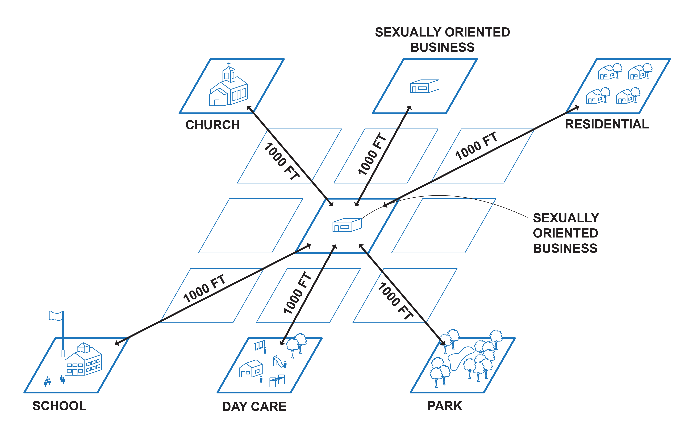
2.
Waiver Criteria. In establishing the provisions of this section, the City Council hereby finds and determines that there may be exceptional or extraordinary circumstances or conditions which are applicable to properties within the City or to the intended uses of properties within the City that do not generally apply to the property or class of uses in the same zone, and such that denial of an application for relief would result in an inability to reasonably utilize property. Therefore, it is necessary to provide for such extraordinary relief in the form of a waiver. In reviewing such applications for waivers, the burden shall be upon the applicant to meet the criteria set forth in this section.
a.
A waiver to the separation requirements set forth in this section may be granted as a part of the conditional use review process if the presumptions in Section 17.05.120.A of this chapter are overcome by proof that the establishment of a sexually oriented business within one thousand (1,000) feet of another sexually oriented business establishment or establishment of a sexually oriented business within one thousand (1,000) feet of any residential zone, residential use, park, church or educational institution as applicable, will not have a deleterious effect on surrounding residential and business areas by creating blight, downgrading of property values or tending to cause an increase in crime.
b.
In granting a waiver to the separation requirements the Planning Commission or City Council may impose reasonable conditions relating to hours of operation, screening, buffering and signage as long as the conditions imposed are not designed to prohibit the dissemination of protected materials under the First Amendment to the United States Constitution.
(Ord. 2003-13, S24; Ord. 2004-19; Ord. 2009-02 [17.35]; Ord. 2021-21)

