
Fruita City Zoning Code
CHAPTER 17
09 - SPECIFIC REVIEW PROCEDURES
17.09.010 - PURPOSE.
The purpose of this chapter is to outline specific review procedures applicable to development in the City.
(Ord. 2021-21; Ord. 2023-11, S4)
17.09.020 - SITE DESIGN REVIEW.
A.
Applicability. Site design review is required for the following developments with the exception of subdivisions, detached single-family residential, and duplex residential land uses:
1.
Changes in land use or remodels that result in an increase in floor area, lot coverage, or parking spaces by more than forty (40) percent; or
2.
Any change in land use or remodel that requires an adjustment; or
3.
Any development that requires construction of public improvements.
B.
Procedure. Two types of site design review are authorized, administrative site design review and site design review with adjustment, as follows:
1.
Administrative Site Design Review. Developments subject to site design review that do not require an adjustment to any regulation under this title by more than ten (10) percent (dimensional standards only) are reviewed and acted upon by the Community Development Director.
2.
Site Design Review with Adjustment. Developments subject to site design review that require an adjustment to one or more regulations under this title by more than ten (10) percent are reviewed through the public hearing process in accordance with Section 17.07.040.
C.
Approval Criteria. The City decision-making body may approve a site design review application only upon finding that it meets the applicable requirements of this title and other applicable regulations.
(Ord. 2004-19; Ord. 2009-02 [17.13]; Ord. 2021-21; Ord. 2023-11, S4)
17.09.030 - CONDITIONAL USES.
A.
Applicability. A conditional use permit is required for any use identified as a conditional use on the land use table in Section 17.05.090 of this title.
B.
Procedure. Conditional use permit applications shall be processed and reviewed through the public hearing process in accordance with Section 17.07.040.
C.
Approval Criteria for Conditional Use Permits. A conditional use permit may be granted for a conditional use in a particular zone provided the City Council finds as follows:
1.
The proposed use is consistent with the provisions and purposes of this title, with the purposes of the zone in which it is located, and with the City's Comprehensive Plan,
2.
The proposed use is compatible with existing and allowed uses surrounding or affected by the proposed use, pursuant to the criteria in Section 17.05.080.C,
3.
The proposed use will not materially endanger the public health or safety, and
4.
Public services and facilities including, but not limited to, transportation systems, wastewater disposal and treatment, domestic water, fire protection, police protection, and storm drainage facilities are adequate to serve the proposed use.
D.
Expiration. A use requiring a conditional use permit must commence within three (3)years of approval or the conditional use permit approval will expire. Conditional uses that have ceased for more than one (1) year cannot be re-established without re-approval of the conditional use permit.
(Ord. 2004-19; Ord. 2009-02 [17.13]; Ord. 2021-21; Ord. 2023-11, S4)
17.09.040 - CHANGE IN USE.
A.
Applicability. A change in use occurs when there is any change in the occupancy of a building that would change the code requirements that apply to the site, or the land use category as outlined in Chapter 17.05. These changes must be reviewed to ensure that the site can accommodate the type of use that is proposed and that the building meets all requirements for public safety.
1.
If there is a change from one principal use of a building or land to another principal use of a building or land, but there is no increase in the size of the existing building or extent of the use of the land and none of the above factors outlined below apply, a change of use shall not have occurred
B.
Procedure. Change in use applications shall be processed and reviewed administratively in accordance with Section 17.07.040. The Community Development Director may choose to refer the application to City Council for decision.
C.
Approval Criteria for Change in Use Applications. A change in use application may be granted for a use in a particular zone provided the following factors are present and confirmed for the new use:
1.
The new use has an off-street parking requirement under this title which is greater than parking available and necessary for the previous use; or
2.
The number of vehicle trips generated by the new use is or will be greater than the number of vehicle trips generated by the previous use as determined by the Institute of Transportation Engineers Trip Generation, latest edition; or
3.
The amount of stormwater runoff or impervious (to drainage) surface area will be increased with the new use.
4.
The amount of wastewater generated by the use will be greater than the previous use.
(Ord. 2021-21; Ord. 2023-11, S4)
17.09.050 - DENSITY BONUSES.
A.
Generally. The purpose of this section is to help implement portions of the Fruita community plan by providing for residential density bonuses in designated zones tied to the provision of community benefits. This chapter is intended to promote compatibility between land uses, as well as predictability and fairness in the approvals process, consistent with the Fruita Comprehensive Plan. This section provides opportunities for development incentives in response to applicants providing community benefits beyond those described herein as baseline standards, encouraging applicants to deliver those amenities without incurring unreasonable economic costs, or driving up housing or consumer costs.
B.
Applicability. The provisions of this section apply to development in the CR, and SFR zone districts, as well as to any PUD. Projects utilizing the provisions of this chapter are not necessarily required to be processed as a planned unit development. All densities are based on dwelling units per gross acre, as defined in Chapter 17.03.
C.
Process. Density bonus applications shall be processed at the same time and using the same procedure as required for a subdivision, planned unit development, or site design review, as applicable. The Community Development Director/City Council may preliminarily approve a density bonus, with final approval contingent upon the owner and City executing an annexation agreement, development agreement, PUD guide and/or other binding agreement as necessary to ensure compliance with this title and other City requirements (in accordance with the review procedures described in Section 17.07.040). The Community Development Director may approve, deny, or approve with conditions, density bonus applications filed in accordance with this title subject to applicable review procedures contained in this title.
D.
Criteria. The Community Development Director is authorized to grant density bonuses up to the maximum dwelling units per acre in accordance with the following:
1.
A minimum of twenty (20) percent of the project designated as parks, trails, open space or common area. The open space or common area must be easily accessible to a minimum of fifty (50) percent of the lots, by being located within a one-quarter-mile walking shed, and providing a safe sidewalk or trail connection to the space. A conservation easement, or other form acceptable to the City Attorney, shall be required with the first phase or first filling of the subdivision to ensure the space is permanently designated as an open area.
a.
Open space and common areas shall be a functional part of the project design rather than residual land that is "left over" with no recreational, aesthetic or design importance.
b.
Narrow (less than thirty-five (35) feet in width) linear strips of land should not be counted toward the open space or common area requirement.
c.
Open space or common areas may be developed or undeveloped, active or passive. Areas may include stormwater detention and retention basins if the design of the basin is integral to the open space or common area, is separately managed by the association, and is at a grade of fifteen (15) percent or less. In addition, washes, streams or other natural features should be included and incorporated into open space or common area.
d.
Open space or common areas shall be visible from the street and add to the quality of the neighborhood and shall be accessible to all dwelling units within the development. Open space and common area surrounded by dwelling units with no access to an adjacent street is prohibited.
e.
Open space or common areas may contain private recreation amenities including but not limited to: plazas, courtyards, community garden, basketball/ tennis/pickleball courts, clubhouses or community greenhouses.
f.
Open space or common areas shall be grouped contiguously with open space or common areas from adjacent developments, where possible.
2.
The project includes an internal trail network, a continuation of an existing trail network, or the continuation of a bike lane system internal to the project and along adjoining rights-of-way. The bike and trail amenities must be at least five hundred (500) feet of linear length to qualify for this bonus. On-site trails and/or sidewalks shall be extended to existing off-site trails, sidewalks or parks if the extension is less than two hundred (200) feet in length. An easement, or other form acceptable to the City Attorney, shall be required with the first phase or first filling of the subdivision to ensure the space is permanently designated as a trail.
a.
Walkways, trails and other forms of pedestrian access shall form an interconnected system serving as access to open space, common area and other pedestrian destinations.
3.
Access to required parking and/or garages of a minimum of eighty (80) percent of the proposed dwelling units is by alley or shared drive. For purposes of this Section, a shared drive must serve a minimum of four (4) dwelling units.
4.
A mix of housing types are proposed with a minimum of twenty (20) percent of the dwelling units being single-family attached, duplexes and/or multi-family units. The unit types shall be dispersed within the development, and a site plan shall be recorded to ensure that the final buildout reflects representations in the density bonus review.
(Ord. 2009-02; Ord. 2017-21; Ord. 2017-22; Ord. 2018-11, [17.13]; Ord. 2021-08 [17.08]; Ord. 2021-21; Ord. 2023-11, S4)
17.09.060 - SHORT-TERM RENTALS.
A.
Purpose. The purpose of this section is to establish procedures and standards to allow short-term rentals in certain zone districts in the City pursuant to a permit and to provide regulations to assist in protecting the health, safety, and welfare of property owners, neighbors, and occupants. It is the City's intent to establish short-term rental regulations that promote opportunities to support the local economy and protect the long term residential character of Fruita's neighborhoods.
B.
Applicability and Prohibitions.
1.
A short-term rental application is required for any short-term rental located in the City, as permitted based on the land use/zoning table in Section 17.05.090 of this title. A short-term rental permit is required for each individual dwelling unit.
2.
Private covenants running with the land may restrict or prohibit short-term rentals or similar types of uses. It is the responsibility of the property owner, not the City, to ensure compliance with restrictive covenants.
3.
It shall be unlawful for any person, whether a principal or agent, clerk or employee, either for him or herself, or for any other person for anybody, corporation or otherwise, to lease or operate a short-term rental without first obtaining a short term rental permit in accordance with the provisions and procedures of this Section.
4.
Short-term rentals are not allowed in bed and breakfasts, hotels or lodges or motels as defined in the Fruita Municipal Code, as amended.
C.
Short-Term Rental Permit Required.
1.
The Community Development Department shall issue permits in accordance with the provisions of this chapter.
2.
No person or entity shall sell lodging to temporary occupant(s) of a dwelling unit for fewer than thirty (30) consecutive days without first having obtained a short-term rental permit issued by the City and complying with any conditions or restrictions thereof. A separate short-term rental permit is required for each short-term rental unit. A short-term rental permit may be issued only to the owner of the property used for short-term rental.
3.
A short-term rental permit attaches only to the property for which it is issued and the property owner to which it is issued. The permit is nontransferable upon sale or other transfer of ownership of the property. Upon such transfer of ownership, the new owner of the property shall apply for a new short-term rental permit if it wishes to continue the use of the property as a vacation rental.
D.
Local Point of Contact.
1.
The property owner shall designate one (1) or more person(s) who will be the local point of contact and will be available and responsible for immediately responding to complaints within a reasonable amount of time about or violations of any permit terms or any public nuisance regulations.
2.
The term local as used herein means having a permanent address within a twenty-five-mile radius from the short-term rental. The local point of contact may be the property owner only if the local criteria is met.
3.
The local point of contact must be authorized by the property owner to permit inspection of the premises by the City and/or its agent or employee to ensure compliance with applicable fire and building codes and with the requirements for and/or of the short-term rental permit. Additionally, the local contact must have physical access to the property and shall be authorized to make decisions regarding the vacation rental property on behalf of the owner.
E.
General Requirements. Prior to a short-term rental permit being issued pursuant to Section C herein, the property owner of the proposed short-term rental shall:
1.
Obtain a sales and lodgers tax license as well as a business license and comply with all applicable local, State and federal taxes;
2.
Demonstrate and certify that the unit contains the following on the premises at all times:
a.
A smoke detector in good working order.
b.
A carbon monoxide detector in good working order.
c.
Adequate and functional building egress from each sleeping room in the dwelling unit.
d.
Posted notice in the short-term rental for guests providing, in detail, the following information in a highly visible location and readily accessible form:
i.
Location of building exits and fire extinguishers.
ii.
Contact information for the local point of contact.
iii.
Short-term rental application number.
iv.
Noise restrictions and quiet hours.
v.
Parking restrictions.
vi.
Trash disposal, storage and collection schedule.
vii.
Relevant water restrictions.
3.
Provide with the application a sketch or drawing of the unit that depicts all rooms, doors and windows, including dimensions, and shows on-site areas available for guest parking.
4.
If the short-term rental unit is accessed by a shared driveway, provide the City with a copy of a written instrument authorizing use of the driveway for short-term rental purposes,
5.
Permit inspection of the premises by the city or its agent or employee during the pendency of the permit application, and thereafter upon reasonable notice,
6.
Provide the name, address and phone number of the local point of contact to the City, and update such information within ten (10) days with the City whenever it changes,
7.
Register annually with the City, certifying that the permit terms and requirements are still being met and updating any material changes to the unit or property.
8.
Kitchen facilities may only serve the property owner and the guests,
9.
Short-term rentals are required to be rented for a minimum of forty-five (45) days in a calendar year. Failure to rent the property will cause the property to be ineligible for renewal in the subsequent year,
10.
Signs advertising short-term rentals, whether on or off premise are prohibited.
11.
Advertisement shall include the short-term rental application number assigned by the planning clearance. The failure to prominently display the planning clearance number in any advertisement of accommodation shall be a violation of this chapter. Advertising shall include any written, oral or video communication or publication disseminated by signage, mailing, print, internet listing, e-mail publication, social media, other electronic means, telephone or other means which is intended to directly or indirectly induce a person to use or possess the accommodation for consideration.
F.
Revocation, Suspension, Expiration and Appeal.
1.
A short-term rental permit may be suspended or revoked for any of the following reasons:
a.
The owner or designated responsible party has failed to comply with any requirement of Section 17.09.060 of this title.
b.
The owner or designated responsible party has failed to comply with a condition of or restriction set forth in the short-term rental permit.
c.
The owner has failed to collect or remit lodging or sales taxes or otherwise comply with local, state and/or federal tax requirements.
d.
Materially false or misleading information has been provided to the City by the applicant, owner or designated responsible party on an application.
e.
The City has received excessive and substantial complaints by neighbors or affected persons, which complaints were not adequately and timely addressed by the owner or local point of contact as determined solely by the City.
2.
Notice of revocation shall be provided to the owner, who shall then be given an opportunity to respond within ten (10) days. The Community Development Director shall issue any decision to revoke or suspend a permit within ten (10) days of the response date.
3.
Any aggrieved person may appeal the issuance, denial, suspension, or revocation of a short-term rental permit to the Fruita City Council within ten (10) days of the issuance of the decision.
G.
Violations.
1.
Violations of this chapter shall be enforced pursuant to Chapter 1.28 of the Fruita Municipal Code.
2.
A violation of this chapter may also be punishable by denial of a license for a short-term rental permit for the property or property owner that has offended such limitation for a period of two (2) years from the City's date of revocation.
3.
All amounts due and owing to the City in connection with any violation of this chapter shall constitute a first priority lien on the short-term rental property and may be collected by any means provided under the Code.
H.
Issuance; Renewal.
1.
After considering the criteria set forth in this chapter, and within sixty (60) days of receiving a complete application and application fee, the Community Development Director may issue a short-term rental permit to the property owner. Such permit may contain conditions and restrictions.
2.
A permit shall not be issued or renewed until the short-term rental permit fee has been paid by the property owner. Such fee shall be set by the Fruita Council annually.
3.
Permits shall be valid for a single calendar year, and shall expire on December 31 of each year, unless a request for renewal is made. Each permit is only good for a single calendar year, regardless of when it was originally approved. For instance, a permit that is issued in July shall expire on December 31 of that calendar year. Subject to the requirements of this chapter, a permit shall be renewed annually, extending the term for one (1) additional calendar year. All permits in compliance with this title may apply for renewal and are not subject to the random drawing provisions contained herein.
4.
A renewal application shall be submitted by December 1 of each year.
5.
After considering the criteria set forth in this chapter, and prior to the expiration of the then-existing short-term rental permit, the Community Development Director may issue renewal short-term rental permit to the property owner. Such renewed permit may contain new or modified conditions and restrictions.
I.
Limitation on Issuances of Short-Term Rental Permit.
1.
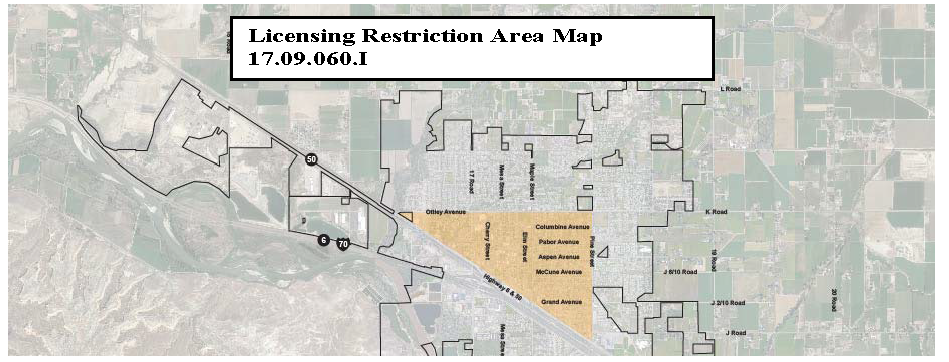
Notwithstanding anything in this chapter, there shall not be more than sixty-five (65) active and valid short term rental permits within the licensing restriction area map 17.09.060.I shown below (the "licensing restriction"). Once the licensing restriction has been reached, the City shall continue to accept applications for short term rentals which shall be approved or denied in the order received by the City if the licensing restriction has been increased or eliminated. In calculating the licensing restriction, the City shall include conditional use permits for bed and breakfasts issued prior to the enactment of this section; provided, however, the licensing restriction shall not include accessory dwelling units or units currently occupied by the property owner.
(Ord. 2021-11, S4 [17.13]; Ord. 2021-21; Ord. 2022-13 S2; Ord. 2023-11, S4)
17.09.070 - AMENDMENT TO OFFICIAL ZONING MAP (REZONING).
A.
Applicability and Procedures. The City Council may amend the number, shape, or boundaries of any zone, removing any property from one zone and adding it to another zone, only after recommendation of the Planning Commission. An amendment to the official zoning map may be initiated by the owner of any property for which a rezoning is sought, or upon application of City Council.
B.
Approval Criteria. The official zoning map may be amended when the following findings are made:
1.
The proposed rezone is compatible with surrounding land uses, pursuant to Section 17.05.080.C, and is consistent with the City's goals, policies and Comprehensive Plan; and
2.
The land to be rezoned was previously zoned in error or the existing zoning is inconsistent with the City's goals, policies and Comprehensive Plan; or
3.
The area for which the rezone is requested has changed substantially such that the proposed zoning better meets the needs of the community; or
4.
The rezone is incidental to a comprehensive revision of the City's official zoning map which recognizes a change in conditions; or
5.
The rezone is incidental to the annexation of the subject property.
C.
Additional Requirements. In addition to the procedures for public hearings under Section 17.07.040, if the zoning amendment is approved by the City Council, it shall enact an ordinance to such effect and the amendment to the Official Zoning Map shall become effective thirty (30) days after publication of said ordinance.
(Ord. 2004-19; Ord. 2009-02; Ord. 2009-10, [17.13]; Ord. 2021-21; Ord. 2023-11, S4)
17.09.080 - AMENDMENT TO THE LAND USE CODE.
A.
Applicability and Procedures. City Council may, after the recommendation of the Planning Commission, amend language in this title, which amendment may be initiated by any citizen or group of citizens, firm or corporation residing or owning property within the City, or by the Community Development Director, or by the Planning Commission, or by the City Council.
B.
Approval Criteria. Amendment to this title may be made upon a finding that the amendment is consistent with the City's goals, policies and Comprehensive Plan.
(Ord. 2004-19; Ord. 2009-02 [17.13]; Ord. 2021-21; Ord. 2023-11, S4)
17.09.090 - VACATION OF PUBLIC RIGHT-OF-WAY.
A.
The Community Development Director may approve the vacation of a public right-of-way, upon finding that the vacation will not:
1.
Create any landlocked parcels;
2.
Negatively impact adjacent properties;
3.
Reduce the quality of public services to any parcel of land; and
4.
Be inconsistent with the City's Comprehensive Plan.
B.
A right-of-way vacation may be approved through the subdivision platting process as long as the above criteria are met in addition to the following:
1.
The right-of-way to be vacated was previously dedicated to the public;
2.
The right-of-way to be vacated is entirely within the plat being created; and
3.
Existing and proposed utilities are accommodated with sufficient easements.
(Ord. 2004-19; Ord. 2009-02 [17.13]; Ord. 2021-21; Ord. 2023-11, S4)
17.09.100 - VACATION OF PUBLIC EASEMENT.
The City Council may approve the vacation of a public easement, after recommendation from the Planning Commission, upon finding that there is no longer a public interest in retaining said easement and no utility provider objects to the easement vacation.
(Ord. 2009-02 [17.13]; Ord. 2021-21; Ord. 2023-11, S4)
17.09.110 - MOBILE FOOD VENDOR AND MOBILE VENDOR COURT.
A.
Purpose. The purpose of this regulation is to allow mobile vendors to operate on private property in certain zone districts in the City.
B.
Applicability. These regulations apply to all mobile food vendors and mobile vendor courts operating on private property, except when a mobile food vendor or mobile vendor is operating as a temporary use under the provisions of Section 17.05.100.E.
C.
Signage. The total allowable square footage of signage for a mobile vendor shall be thirty-two (32) square feet, excluding signage fixed to an operable motor vehicle.
D.
Landscaping, Screening and Buffering. Mobile food vendors operating as a temporary use are exempt from the landscaping requirements of the land use code. Mobile vendor courts are subject to the landscaping, screening and buffering provisions of Section 17.13 of the Land Use Code.
E.
Parking. Off-street parking shall be provided according to the provisions of Section 17.37 of the Land Use Code. Alternatively, required parking may be met through the provision of a written parking agreement with the owner of a property within five-hundred (500) feet of the mobile vendor, as measured from the line of the property whereon the mobile vendor is located to the line of the property whereon parking is located. Mobile food vendors operating as temporary uses under the standards of Section 17.05.100.E shall be exempt from this requirement.
F.
Sanitary Facilities. Any mobile food vendor or mobile vendor court shall provide and maintain a sanitary facility on site or shall provide and maintain a written agreement with a property and/or business owner allowing mobile vendor employees and customers to share the use of that property's existing sanitary facilities. The structure containing shared sanitary facilities must be located within seven hundred fifty (750) feet from location of the mobile vendor as identified on the approved site sketch. No shared sanitary facility may be shared with a residential land use. Mobile food vendors operating as temporary uses under the standards of Section 17.05.100.E shall be exempt from this requirement.
G.
Utilities. Permanent hookups to utilities shall not be provided for mobile vendors which are operating as a temporary use under the standards of Section 17.05.100.E but may be provided for mobile vendor courts.
H.
Wastewater Discharge. Wastewater produced by mobile vendors shall be discharged only at a facility with an approved industrial pretreatment system or by a licensed waste hauler.
(Ord. 2022-10 S4; Ord. 2023-11, S4)

