
Georgetown City Zoning Code
CHAPTER 9
OFF-STREET PARKING AND LOADING
SECTION 9.05. - OFF-STREET LOADING
A.
No Use of Public Right-of-Way.
At no time shall goods be loaded or unloaded from the right-of-way of a collector or arterial street. No part of any vehicle shall be allowed to extend into the right-of-way of a collector or arterial street while being loaded or unloaded.
B.
Location.
Plans for location, design, and layout of all loading spaces shall be indicated on required Site Plans.
C.
Space Size.
Off-street loading spaces, excluding maneuvering areas, shall be at least 12 feet wide and 20 feet long unless off-street loading will involve the use of semi-tractor trailer combinations or other vehicles in excess of 25 feet in length, in which case the minimum size of a space shall be 12 feet by 54 feet.
Sec. 9.01.010. - Authority.
The provisions of this chapter are adopted pursuant to Texas Local Government Code Ch. 211 and the City Charter.
Sec. 9.01.020. - Purpose.
Off-street parking and loading requirements are established to ensure that all developments within the City provide adequate and reasonable parking necessary to serve the development or use.
Sec. 9.01.030. - Applicability.
Off-street parking and loading standards required by this Chapter apply within Georgetown's city limits in the following circumstances, in addition to any additional standards or requirements provided for this Code:
A.
New Development.
The off-street parking and loading standards apply to any new building constructed and to any new use established.
B.
Expansions and Alterations.
The off-street parking and loading standards may be required for compliance when an existing structure or use is expanded or enlarged, as provided in Chapter 14 of this Code.
C.
Change in Use.
The off-street parking and loading standards may be required for compliance if a use changes, as provided in Chapter 14 of this Code.
(Ord. No. 2017-15, § 2, 2-28-2017)
Sec. 9.01.040. - Timing of Installation.
Required parking spaces and drives will be ready for use and approved by the Director prior to issuance of a Certificate Of Occupancy.
Sec. 9.02.010. - Minimum Requirements.
Existing parking and loading spaces may not be reduced below the requirements established in this section without approval of an Alternative Parking Plan by the Director. Any change in use that increases applicable off-street parking or loading requirements shall use the provisions in Chapter 14, Non-Conformities to determine the necessary improvements.
Sec. 9.02.020. - Parking Exceeding Minimum Requirements.
All off-street parking spaces shall be constructed of a Paved Surface, as defined in this Code, whether meeting or exceeding the minimum requirements. Pursuant to Subsection 8.04.040.B.2, each parking stall in excess of the required shall be calculated as one and one-half stalls for purposes of the required shade trees.
(Ord. No. 2017-15, § 2, 2-28-2017)
Sec. 9.02.030. - Off-Street Parking Requirements.
A.
Off-Street Parking Requirements Table.
The following table lists minimum off-street parking requirements by land use category.
Table 9.02.030.A: Off-Street Parking Requirements*
* The required number of parking spaces for uses not listed in the above table will be determined by the Director. Alternative parking plans may be requested in accordance with Section 9.02.050.
† Retail and Restaurant Uses do not require off-street parking when a shared public parking lot is within two blocks of the proposed use.
(Ord. No. 2015-34, § 2(Exh. A), 5-12-2015; Ord. No. 2025-08, § 2(Exh. A), 3-11-2025)
Sec. 9.02.040. - Rules for Computing Requirements.
The following rules apply when computing off-street parking and loading requirements:
A.
Multiple Uses.
Lots containing more than one use must provide parking and loading in an amount equal to the total of the requirements for all uses.
B.
Fractions.
When measurements of the number of required spaces result in a fractional number, any fraction of one-half or less will be rounded down to the next lower whole number and any fraction of more than one-half will be rounded up to the next higher whole number.
C.
Area Measurements.
Unless otherwise expressly stated, all square-footage-based parking and loading standards must be computed on the basis of gross floor area, which for purposes of computing off-street parking requirements, shall mean the gross floor area of the building measured from the exterior faces of the exterior walls or from the centerline of walls separating two buildings and shall include the following areas:
1.
The area of each floor of the structure.
2.
All attic space used for active commercial space.
D.
Occupancy-Based Standards.
For the purpose of computing parking requirements based on employees, students, residents, or occupants, calculations shall be based on the largest number of persons working on any single shift, the maximum enrollment or the maximum fire-rated capacity, whichever is applicable, and whichever results in the greater number of spaces.
E.
Unlisted Uses.
Upon receiving a development permit application for a use not specifically listed in the Off-Street Parking Requirements Table, the Director shall apply the off-street parking standard specified for the listed use that is deemed most similar to the proposed use or require a parking study in accordance with an Alternative Parking Plan.
Secs. 9.02.050, 9.02.060. - Reserved.
Editor's note— The provisions of the former Sections 9.02.050 and 9.02.060 have been redesignated as Section 9.06, §§ 9.06.010 and 9.06.020.
Sec. 9.03.010. - Location of Required Parking.
Except as expressly stated in this Section or in an approved Alternative Parking Plan, all required off-street parking spaces must be located on the same lot as the principal use. In Housing Diversity Developments, where two spaces or more are required per unit, one space shall be located on the same lot and the remaining spaces within 200 feet of the lot.
(Ord. No. 2017-15, § 2, 2-28-2017)
Sec. 9.03.020. - Parking Space and Parking Lot Design.
A.
Parking Space Dimensions.
1.
Parking spaces shall have minimum dimensions of nine feet in width by 18 feet in length, unless otherwise indicated within this Section. When located adjacent to a public sidewalk, off-street or on-street head-in or angled parking shall require curb stops so as not to impede the pedestrian walkway.
2.
Subject to approval by the Director, parking areas with 20 or more parking spaces, may allocate up to ten percent (10%) of the minimum number of required parking spaces to reduced size vehicles, including compact cars and motorcycles, if designed to the following standards:
a.
A compact car space shall not be less than eight feet in width and 16 feet in length;
b.
A motorcycle space shall not be less than four and one-half feet in width and eight feet in length;
c.
Reduced size spaces shall be laid out in a group and appropriately identified as intended for exclusive use by the specified vehicle;
d.
Tandem parking spaces may be utilized only for multi-family, not to exceed ten percent (10%) of the required total off-street parking spaces and only within an enclosed garage structure. Tandem spaces shall not count towards the required off-street parking spaces for single- and two-family dwellings. In the Downtown Overlay, tandem spaces for any use may considered with an Alternative Parking Plan, per Section 9.02.060.
e.
Other parking space designs may be considered and shall be submitted to the Director for review.
3.
Parallel parking spaces shall not be less than eight and one-half feet in width and 22 feet in length.
4.
Parking spaces designated as Handicapped shall comply with the design and location requirements of the American National Standards Institute (A117.1) and the Texas Department of Licensing and Regulation.
5.
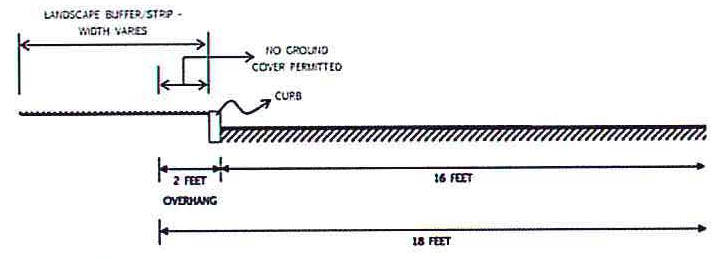
Parking spaces internal to the site may be reduced to 16 feet in length with a two-foot overhang onto grass or other flat surface. This reduction shall not apply to a bufferyard, screening area or sidewalk.
B.
Aisle Widths.
The minimum two-way drive aisle width shall be 24 feet when there is not parking on either side of the drive aisle. One-way and two-way drive aisle widths adjoining off-street parking spaces must comply with the following standards:
Table 9.03.020B: Minimum Aisle Width for Specified Parking
C.
Markings.
1.
Each required off-street parking space and off-street parking area shall be identified by surface markings at least four inches in width. Markings shall be visible at all times. Such markings shall be arranged to provide for orderly and safe loading, unloading, parking, and storage of vehicles.
2.
One-way and two-way accesses into required parking facilities shall be identified by directional arrows on the pavement.
D.
Surfacing and Maintenance.
1.
All parking, driveways, drive aisles, and driveway approaches shall be constructed and maintained with a Paved Surface, as defined in this Code. Exceptions to the Paved Surface material requirements may be considered administratively by the Urban Forester and Development Engineer in order to protect critical root zone for Heritage Trees.
2.
All designated fire lanes shall be paved according to the typical street cross sections for local street design in the City of Georgetown Construction Specifications and Details, and kept in a dust-free condition at all times.
3.
In a Residential Estate subdivision or rural lot, residential driveways may be constructed of a non-Paved Surface material if outside of the right-of-way and not in an area designated for required off-street parking.
E.
Access. Required off-street parking spaces shall not have direct access to a public street, with access provided by on-site driveways. Off-street parking spaces shall be accessible without backing into or otherwise reentering a public right-of-way. In unique circumstances on local streets, the Director may consider, through an Alternative Parking Plan, parking spaces with direct access from the street if there is determined to be little or no negative impact on surrounding properties or the function of the public street.
(Ord. No. 2015-48, § 2(Exh. A), 9-22-2015; Ord. No. 2017-15, § 2, 2-28-2017)
Sec. 9.04.010. - Minimum Number of Spaces.
Off-street stacking spaces shall be provided as indicated in the following table. Off-street stacking spaces shall be in addition to any required parking and loading spaces.
Table 9.04.010: Minimum Off-Street Stacking Spaces
(Ord. No. 2017-15, § 2, 2-28-2017)
Sec. 9.04.020. - Design and Layout.
Required stacking spaces are subject to the following design and layout standards:
A.
Size.
Stacking spaces must be a minimum of ten feet by 20 feet in size.
B.
Location.
Stacking spaces may not impede on-or off-site traffic movements or movements into or out of off-street parking spaces.
C.
Design.
Stacking spaces must be separated from other internal driveways by raised medians if deemed necessary by the Director for traffic movement and safety. Turnaround space shall be provided between the Key Code Box and gate for any gate-restricted entrance to safely allow a vehicle to exit the entrance queue.
(Ord. No. 2017-15, § 2, 2-28-2017)
Sec. 9.06.010. - Alternative Plans.
An Alternative Parking Plan, processed through an Administrative Exception in accordance with Section 3.16 of this Code, may be considered by the Director for alternatives to the parking, stacking, or loading standards of this Chapter. An alternative plan also may be approved by the Director for specific developments or uses that are deemed to require a different amount of parking than the standards shown in the Off-Street Parking Requirements Table. The Director shall establish conditions necessary to assure the adequacy of future on-site parking when approving an alternate standard. Potential alternative parking plan approaches and specific regulations are described below.
A.
Parking Study Option.
Parking studies may be required for specific uses that have characteristics that reduce the accuracy of standard requirements. Additionally, as an alternative, applicants for uses that appear on the requirements Table may choose to conduct a parking study to determine appropriate parking requirements. Many uses have widely varying parking demand characteristics, making it impossible to specify a single off-street parking standard. This option is intended to allow development to meet vehicle parking and transportation access needs by means other than providing parking spaces on-site in accordance with the ratios established above.
1.
Parking Study.
Anyone proposing to develop or expand a use based on this parking study option must submit a parking study that provides justification for the number of off-street parking spaces proposed. A parking study must include estimates of parking demand based on recommendations of the Institute of Traffic Engineers (ITE) or other acceptable estimates as approved by the Director, and should include other reliable data collected from uses or combinations of uses that are the same as or comparable with the proposed use. Comparability will be determined by density, scale, bulk, area, type of activity, and location. The study must document the source of data used to develop the recommendations.
2.
Eligible Alternatives.
A number of specific parking and access alternatives may be considered, including off-site, shared, or valet parking. The Director shall be authorized to consider and approve any alternative to providing off-street parking spaces on the site of the subject development if the applicant demonstrates to the satisfaction of the Director that the proposed plan shall result in a better situation with respect to surrounding neighborhoods, City-wide traffic circulation, or urban design than would strict compliance with otherwise applicable off-street parking standards.
3.
Review by Director.
The Director shall review the parking study and any other traffic engineering and planning data relevant to the establishment of an appropriate off-street parking standard for the proposed use. After reviewing the parking study, the Director shall establish a minimum off-street parking standard for the proposed use.
B.
Off-Site Parking.
Off-street parking spaces may be located on a separate lot from the lot on which the principal use is located if approved by the Director and if the off-site parking complies with all of the following standards.
1.
Ineligible Activities.
Off-site parking may not be used to satisfy the off-street parking standards for residential uses (except for guest parking), restaurants (except in the Downtown Overlay District), convenience stores, or other convenience-oriented uses. Required parking spaces reserved for persons with disabilities shall not be located off-site.
2.
Location.
No off-site parking space may be located more than 600 feet from the primary entrance of the use served unless shuttle bus service is provided to the remote parking area. Off-site parking spaces may not be separated from the use that it serves by a street right-of-way with a width of more than 80 feet, unless a grade-separated pedestrian walkway is provided or other traffic control or shuttle bus service is provided to the remote parking area.
3.
Zoning Classification.
Off-site parking areas serving uses located in Non-Residential Zoning Districts must be located in Non-Residential Zoning Districts. Off-site parking areas serving uses located in Residential Zoning Districts may be located in Residential or Non-Residential Zoning Districts.
4.
Agreement for Off-Site Parking.
In the event that an off-site parking area is not under the same ownership as the principal use served, a written agreement will be required. An attested copy of the agreement between the owners of record must be submitted to the Director for recordation on forms made available by the Director. Recordation of the agreement with the County Clerk must take place before issuance of a Building Permit for any use to be served by the off-site parking area. An off-site parking agreement may be revoked only if all required off-street parking spaces will be provided in accordance with this section.
C.
Shared Parking.
It is the City's stated intention to encourage efficient use of land and resources by allowing users to share off-street parking facilities whenever feasible. Developments or uses with different operating hours or peak business periods may share off-street parking spaces if approved by the Director and if the shared parking complies with the all of following standards.
1.
Location.
Shared parking spaces must be located within 600 feet of the primary entrance of all uses served, unless remote parking shuttle bus service is provided.
2.
Zoning Classification.
Shared parking areas serving uses located in Non-Residential Zoning Districts must be located in Non-Residential Zoning Districts. Shared parking areas serving uses located in Residential Zoning Districts may be located in Residential or Non-Residential Zoning Districts. Shared parking areas shall require the same or a more intensive zoning classification than that required for the most intensive of the uses served by the shared parking area.
3.
Shared Parking Study.
Those wishing to use shared parking as a means of satisfying off-street parking requirements must submit a shared parking analysis to the Director that clearly demonstrates the feasibility of shared parking. The study must be provided in a form established by the Director and made available to the public. It must address, at a minimum, the size and type of the proposed development, the composition of tenants, the anticipated rate of parking turnover, and the anticipated peak parking and traffic loads for all uses that will be sharing off-street parking spaces.
4.
Agreement for Shared Parking.
A shared parking plan will be enforced through written agreement among all owners of record. An attested copy of the agreement between the owners of record must be submitted to the Director for recordation on forms made available by the Director. Recordation of the agreement with the Recorder of Deeds must take place before issuance of a Building Permit for any use to be served by the off-site parking area. A shared parking agreement may be revoked only if all required off-street parking spaces will be provided in accordance with this section.
5.
Revocation of Permits.
Failure to comply with the shared parking provisions of this section shall constitute a violation of this Code and shall specifically be cause for revocation of a Certificate Of Occupancy and/or Building Permit.
D.
Transportation Management Plan.
The Director may authorize a reduction in the number of required off-street parking spaces for developments or uses that institute and commit to maintain a transportation management program, in accordance with the standards of this section.
1.
Required Study.
The applicant shall submit a study to the Director that clearly indicates the types of transportation management activities and measures proposed. The study shall be provided in a form established by the Director and made available to the public.
2.
Transportation Management Activities.
There shall be no limitation on the types of transportation management activities for which reductions may be granted from otherwise required off-street parking ratios. The following measures shall serve as a guide to eligible transportation management activities.
3.
Transportation Coordinator.
The occupant of the development or use may appoint an employee to act as Transportation Coordinator with responsibility for disseminating information on ride-sharing. Other transportation options may be cause for a reduction in otherwise applicable off-street parking requirements. In addition to acting as liaisons, Transportation Coordinators must be available to attend meetings and training sessions with the City or transit providers.
4.
Off-Peak Work Hours.
Employers that institute off-peak work schedules, allowing employees to arrive at times other than the peak morning commute period may be eligible for a reduction in otherwise applicable off-street parking requirements. The peak morning commute period is defined as 7:00—9:00 a.m.
5.
Preferential Parking.
The provision of specially marked spaces for each registered car pool and van pool may be cause for a reduction in otherwise applicable off-street parking requirements.
6.
Financial Incentives.
The provision of cash or in-kind financial incentives for employees commuting by car pool, van pool, and transit may be cause for a reduction in otherwise applicable parking requirements.
(Ord. No. 2017-15, § 2, 2-28-2017)
Note— Former Section 9.02.050.
Sec. 9.06.020. - Alternative Parking Plans in a Historic Overlay District.
A.
General.
Within any Historic Overlay District, the Historic Preservation Officer, or designee, shall be authorized to approve alternatives to providing the number of off-street parking spaces required in accordance with this Section.
B.
Procedure.
Alternative Parking Plans shall be reviewed and approved by the Historic Preservation Officer, or designee following the procedures of the Administrative Exception process established in Section 3.16 of this Code.
C.
Recording of Approved Plans.
Where an Alternative Parking Plan requires use of property other than the subject property, an attested copy of an approved Alternative Parking Plan must be recorded with the County Clerk on forms made available in the Planning Department. An Alternative Parking Plan may be amended by following the same procedure required for the original approval. The applicant shall provide proof of recording prior to approval of the Certificate of Occupancy.
D.
On-Street Parking.
The Historic Preservation Officer, or designee, may approve counting on-street parking spaces to satisfy the requirements for off-street parking. Such on-street parking shall be located on public right-of-way immediately abutting the subject property and shall be reviewed by the Development Engineer for compliance with City's standards for use of rights-of-way.
E.
Off-Site Parking.
The Historic Preservation Officer, or designee, may approve the location of required off-street parking spaces on a separate lot from the lot on which the principal use is located if the off-site parking complies with all of the following standards.
1.
Location.
No off-site parking space may be located more than 900 feet from the primary entrance of the use served (measured along the shortest legal pedestrian route) unless remote parking shuttle service is provided. Off-site parking spaces may not be separated from the use served by a street right-of-way with a width of more than 80 feet, unless a grade-separated pedestrian walkway is provided or other traffic control or remote parking shuttle service is provided.
2.
Zoning Classification.
Off-site parking areas require the same or a more intensive zoning classification than required for the use served.
3.
Agreement for Off-Site Parking.
In the event that an off-site parking area is not under the same ownership as the principal use served, a written agreement between the record owners will be required. The agreement must be for a specified time, and guarantee the use of the off-site parking area for a minimum of five years. An attested copy of the agreement between the owners of record must be submitted to the Historic Preservation Officer, or designee, for recording in form established by the City Attorney. Recording of the agreement must take place before issuance of a Building Permit or Certificate of Occupancy for any use to be served by the off-site parking area. An off-site parking agreement may be terminated only if all required off-street parking spaces will be provided. No use shall be continued if the parking is removed unless substitute parking facilities are provided, and the Historic Preservation Officer, or designee, shall be notified at least 60 days prior to the termination of a lease for off-site parking.
F.
Shared Parking.
The Historic Preservation Officer, or designee, may approve shared parking facilities for developments or uses with different operating hours or different peak business periods if the shared parking complies with all of the following standards.
1.
Location.
Shared parking spaces must be located within 600 feet of the primary entrance of all uses served, unless remote parking shuttle bus service is provided.
2.
Zoning Classification.
Shared parking areas require the same or a more intensive zoning classification than required for the use served.
3.
Shared Parking Study.
Those wishing to use shared parking as a means of satisfying off-street parking requirements must submit a shared parking analysis to the City that clearly demonstrates the feasibility of shared parking. The study must be provided in a form established by the City and made available to the public. It must address, at a minimum, the size and type of the proposed development, the composition of tenants, the anticipated rate of parking turnover, and the anticipated peak parking and traffic loads for all uses that will be sharing off-street parking spaces.
4.
Agreement for Shared Parking.
A shared parking plan will be enforced through written agreement among all owners of record. An attested copy of the agreement between the owners of record must be submitted to the City for recording in a form established by the City Attorney. Recording of the agreement must take place before issuance of a Building Permit for any use to be served by the off-site parking area. A shared parking agreement may be terminated only if all required off-street parking spaces will be provided.
G.
Fee-In Lieu of Parking.
The Historic Preservation Officer, or designee, may approve the acceptance of a fee-in-lieu of required parking in extreme cases where none of the alternatives above, alone or in combination, provide for the requisite number of spaces. Such fee shall be based on the cost of land acquisition, construction (including landscaping and lighting), and the estimated cost of maintenance for a period of ten years. Such fee shall be placed in a dedicated fund to provide parking solutions in the affected portion of the Downtown area or other affected project area where the project is not within the Downtown.
H.
Other Eligible Alternatives.
The Historic Preservation Officer, or designee, may approve any other alternative to providing off-street parking spaces on the site of the subject development if the applicant demonstrates to the satisfaction of the City that the proposed plan will function equally well in protecting surrounding neighborhoods, maintaining traffic circulation patterns, and promoting quality urban design than would strict compliance with otherwise applicable off-street parking standards. Such alternatives may include, but are not limited to, the use of tandem parking spaces.
(Ord. No. 2015-34, § 2(Exh. A), 5-12-2015; Ord. No. 2017-15, § 2, 2-28-2017)
Note— Former Section 9.02.060.

