
Georgetown City Zoning Code
CHAPTER 13
INFRASTRUCTURE AND PUBLIC IMPROVEMENTS
SECTION 13.01.- GENERAL
The purpose of this Chapter is to ensure the orderly continuation of public improvements for development in Georgetown, through the planning, design, and construction thereof. The intent of this Chapter is to ensure, as part of the development process, the construction of adequate public improvements in a safe, equitable, and efficient manner.
(Ord. No. 2017-15, § 2, 2-28-2017)
SECTION 13.03. - UTILITY EASEMENTS
A.
Uniform and continuous public utility easements (P.U.E.) shall be provided along all street lot lines at a minimum of ten feet. If not dedicated by plat, the easement shall be granted at the time of Site Development Plan or by separate instrument, at the discretion of the Development Engineer. The City may consider approval of an alternative easement location other than along the street lot line.
B.
Alongside major collectors, arterials, and highways, the P.U.E. shall be a minimum of 15 feet. Shade Trees shall not be planted within these easements, unless approved by the Development Engineer. In any P.U.E. with existing overhead electric lines, Shade Trees are prohibited. Ornamental Trees are allowed within all P.U.E.s.
C.
Utility easements may be required across parts of lots other than as described above, at the discretion of the Development Engineer. If situated between lots, easements for water, wastewater and storm sewer lines shall be at least 20 feet in width. Where the proposed development adjoins an unplatted area, up to a 20-foot easement may be required along the rear of lots adjoining the unplatted area.
D.
Where utility easements are not straight due to curved streets, a larger easement shall be provided where needed for overhead electric, at the discretion of the Development Engineer.
E.
Utility easements may be fenced if unlocked gates are provided to allow free movement of excavating machines, maintenance equipment, and personnel throughout the full length of the easement.
(Ord. No. 2017-15, § 2, 2-28-2017)
SECTION 13.04. - PUBLIC WATER STANDARDS
All development shall be served with an adequate water supply and distribution systems for fire protection and domestic use, unless otherwise specified. The developer shall be responsible for providing infrastructure to an approved public water supply system, including but not limited to, water distribution lines, fire hydrants, valves, elevated metering transmission structures, and water towers, consistent with the City's Comprehensive Plan. All improvements shall be designed and constructed according to the City's Construction Manual.
A.
Where an approved public water collection main or outfall line is less than one-half mile from the property boundary, connection to the public water system shall be required and public water shall be installed throughout the development.
B.
Extension of water utilities shall conform to the City's adopted Utility Extension and Improvement Policy, as amended.
C.
The developer shall be responsible for the cost of extension and connection to the existing public water system.
D.
The water main pipe size for water distribution system improvements and extensions shall be a minimum diameter of eight inches. Water infrastructure shall be of sufficient size to furnish adequate domestic water supply for fire protection in conformance with the City's adopted Fire Code, as amended. Fire hydrants shall be provided in accordance with the Construction Manual. Properties in the ETJ that desire or require fire flow service from the City of Georgetown shall first submit a petition for voluntary annexation, in accordance with Section 3.25 of this Code.
E.
The design and construction of the components of the public water system shall comply with regulations covering extension of public water systems adopted by the Texas Commission on Environmental Quality (TCEQ). For development that is not served by a public water supply, proof of a safe and adequate water supply shall be provided to the Development Engineer.
F.
Where an approved public water collection main or outfall line is more than one-half mile away from the property boundary, on-site wells may be utilized; however, if the City's Capital Improvement Plan has scheduled the extension of a water collection main or outfall line to be completed to a location point within one-half mile away from the property boundary within five years from the date of the Preliminary Plat submittal, connection to the public water system is required. In such instance, the subdivider shall be required to install a public water system and shall bear the cost of connecting the subdivision to such existing water system. A subdivider may request an exception or alternative to this requirement, which shall be considered by the Development Engineer or their designee. An appeal of the decision made by the Development Engineer in this regard shall be heard by the City Council.
G.
Improvements required through the Water Services Master Plan shall be designed and installed in accordance with Section 13.08 of this Code.
(Ord. No. 2017-15, § 2, 2-28-2017)
SECTION 13.05. - PUBLIC WASTEWATER STANDARDS
All development, where desired or required, shall be served with an approved public wastewater system, including but not limited to, wastewater lines, manholes, force mains, and lift stations, consistent with the Comprehensive Plan. Properties in the ETJ that desire or require wastewater service from the City of Georgetown shall first submit a petition for voluntary annexation, in accordance with Section 3.25 of this Code. All improvements shall be designed and constructed according to the City's Construction Manual.
A.
Where an approved public wastewater collection main or outfall line is less than one-half mile from the property boundary, connection to the public wastewater system shall be required and a public wastewater collection system shall be installed throughout the development.
B.
Extension of wastewater utilities shall conform to the City's adopted Utility Extension and Improvement Policy, as amended.
C.
The developer shall be responsible for the cost of extension and connection to the existing wastewater collection system.
D.
The wastewater gravity main pipe size for wastewater improvements shall be a minimum diameter of eight inches.
E.
The design and construction of all wastewater systems shall comply with regulations covering extension of public sanitary wastewater systems adopted by the Texas Commission on Environmental Quality.
F.
All wastewater systems shall be designed and constructed to operate on a gravity flow basis. In extraordinary circumstances and with the approval of the Development Engineer, lots one acre and greater may design a low-pressure, vacuum, or gravity flow system to minimize the need for lift stations.
G.
Where an approved wastewater collection main or outfall line is more than one-half mile away from the property boundary, on-site septic system(s) may be utilized; however, if the City's Capital Improvement Plan has scheduled the extension of a wastewater collection main or outfall line to be completed to a location point within one-half mile away from the property boundary within five years from the date of the Preliminary Plat submittal, connection to the public wastewater system is required. In such instance, the subdivider shall be required to install a public wastewater collection system and shall bear the cost of connecting to such existing wastewater collection system. A subdivider may request an exception or alternative to this requirement, which shall be considered by the Development Engineer or their designee. An appeal of the decision made by the Development Engineer in this regard shall be heard by the City Council.
H.
Improvements required through the Water Services Master Plan shall be designed and installed in accordance with Section 13.08 of this Code.
(Ord. No. 2017-15, § 2, 2-28-2017)
SECTION 13.06. - ELECTRIC AND COMMUNICATION STANDARDS
The City's Electrical Engineer shall design the electrical system for all development, unless otherwise authorized. Where permanent electric service is desired and/or improvements required, the electric improvements shall be installed and maintained in accordance with the following standards:
A.
For residential subdivisions, all electric distribution lines and individual service lines shall be installed underground. If overhead lines existed prior to underground installation, such poles, guy wires, and related structures shall be removed following construction of the underground infrastructure.
B.
For non-residential and multi-family development where no existing overhead infrastructure exists, underground electric utility lines shall be required along the street and within the site. Where existing overhead infrastructure is to be relocated, it shall be re-installed underground and the existing facilities shall be removed at the discretion of the Development Engineer. Development occurring in the Downtown Overlay District should be highly encouraged to locate overhead electric underground with the site work.
C.
Underground electric and communication service lines shall be located and installed according to the Construction Manual.
D.
Electric transformers and related equipment shall be mounted on pads at ground level. For non-residential development, such equipment shall be located outside of the street yard where practical and preferably located behind the front façade of the primary building structure. Such equipment shall be reasonably separated from pedestrian or vehicular access ways, shall have approved driveway or all-weather vehicular accessibility, shall not conflict with roadway sight visibility, and shall be located outside of future right-of-way.
E.
Screening of pad-mounted transformers for non-residential development shall consist of barrier fencing or shrub plantings located no closer than three feet from the transformer, except for the entry side of the transformer, which shall have a minimum of ten feet of unobstructed clearance. The entry side of the transformer shall not face a public street unless located behind the front façade of the primary building structure. The transformer pad shall be located with adequate room for the required landscape screening to be installed consistent with these provisions. Transformers in the Downtown Overlay District are exempt from these requirements.
F.
Once utility service lines have been installed underground, the installation of new above-ground lines in that location is prohibited.
G.
The installation of public street lights, and connection of electric service thereto, shall be the responsibility of the developer as provided in Chapter 12 of this Code.
H.
Installed overhead and underground electric service shall take into account Heritage and Protected Trees when locating new service lines.
I.
Exceptions or alternatives to the requirements of this Section may be considered by the Development Engineer or their designee. An appeal of the decision made by the Development Engineer in this regard shall be heard by the City Council.
(Ord. No. 2017-15, § 2, 2-28-2017)
SECTION 13.07. - MASTER PLAN INFRASTRUCTURE
The City's Comprehensive Plan includes utility master plans for the water distribution, wastewater collection and electric utility. Each master plan identifies future system improvements that are necessary to meet or exceed treatment and transport requirements for the specific utility. The planning horizon for the plan is up to 20 years in the future.
A.
Construction of Master Plan Infrastructure.
When a master plan requires the installation of regional infrastructure on a property, the developer shall extend and construct such facilities at their own expense. When these facilities exceed the utility needs for the specific development beyond the utility minimum size, the facility shall be considered oversized. All necessary easements and/or rights-of-way for such infrastructure shall be dedicated at no cost to the City.
B.
Oversizing Cost Participation.
1.
The City may, at its sole discretion, participate with a developer in the cost of oversized facilities based upon, but not limited to the following factors:
a)
The approved utility budget for the current year;
b)
The ability of the specific utility to fund any future costs;
c)
The degree to which the project conforms to and accomplishes the five-year CIP priorities;
d)
The degree to which the project accomplishes the utility Master Plan; and
e)
The impact to system operations. Any cost participation contract shall be approved by the City Council prior to approval of the Final Plat.
2.
Cost participation shall be based upon the cost differential between the master plan line size and the minimum line size required to serve the development, for eligible construction costs.
3.
When a line extension is included in the current five-year CIP, the approved cost participation contract shall provide for the payment to be scheduled during the same fiscal year as the CIP project that would have accomplished the line extension, and after the date of notice of acceptance by the City.
4.
The fees shall be calculated by the City based on information from the developer's engineer, using a methodology that apportions the development's projected usage (based upon the minimum pipe size) to the available usage due to oversizing. The developer's engineer shall use the City's approved water or wastewater master plan as a basis for calculating residential flow per dwelling unit. Calculations for non-residential units shall be calculated using the latest edition of the "Design Criteria for Sewage Systems," as produced by the Texas Commission on Environmental Quality.
5.
The calculation of cost participation shall be based on construction costs in effect at the time the connection to the system (the "tap") is made. All calculations shall be submitted to the City for appropriate review, verification, and approval.
6.
A cost participation contract is not a guarantee of capacity. Guarantee of capacity is achieved through payment of impact fees.
C.
Impact Fee Credits.
When a line extension is included in the ten-year Capital Improvement Plan (CIP), an Impact Fee credit may be eligible on the fee assessment for each lot in the subdivision. Impact Fee credit shall be calculated based upon the number and size of service connections and the allocation of costs in the Impact Fee calculation, as amended.
(Ord. No. 2017-15, § 2, 2-28-2017)
SECTION 13.08. - PARKLAND[2]
Editor's note— Ord. No. 2019-37, § 2(Exh. G), adopted June 11, 2019, amended Section 13.08 in its entirety to read as herein set out. Formerly, Section 13.08, §§ 13.08.010—13.08.040 pertained to similar subject matter, and derived from Ord. No. 2017-15, § 2, adopted February 28, 2017.
SECTION 13.09. - SUBDIVISION IMPROVEMENT GUARANTEE
In lieu of full construction of all public improvements prior to Final Plat recordation, a plat may be recorded without acceptance of the required public improvements through the posting of fiscal surety. Fiscal surety shall be provided in an amount of at least one hundred twenty-five percent (125%) of the cost of the required public improvements, as estimated by a licensed engineer and approved by the Development Engineer. The Development Engineer has the discretion to reduce the percentage of the fiscal surety instrument based on the amount of the construction completed.
The financial instrument shall state the name of the development or subdivision, and shall list the required improvements and estimate costs thereof. A plat shall not be recorded until financial security is delivered to the City in a form provided by the City and approved as to form and legality by the City Attorney. No release of any security shall occur until the City has formally accepted the improvement that is the subject of such security.
(Ord. No. 2017-15, § 2, 2-28-2017)
SECTION 13.10. - CREATION OF SPECIAL PURPOSE DISTRICTS[3]
Editor's note— Ord. No. 2019-01, § 2(Exh. A), adopted January 8, 2019, amended Section 13.10 in its entirety to read as herein set out. Formerly, Section 13.10, §§ 13.10.010—13.10.060 pertained to the creation of special districts, and derived from Ord. No. 2017-15, § 2, adopted February 28, 2017.
Sec. 13.01.010. - Applicability.
The provisions of this Chapter are adopted pursuant to Texas Local Government Code chs. 211 and 212, and the City Charter.
(Ord. No. 2017-15, § 2, 2-28-2017)
Sec. 13.01.020. - Public Improvements.
Land proposed for development in the City's corporate limits and extra-territorial jurisdiction (ETJ) shall be adequately served by essential public facilities and services, including but not limited to water distribution, wastewater collection and treatment, roadways, pedestrian circulation, storm drainage conveyance, and park and recreational facilities. Development seeking or requiring connection to a public utility system shall design and install public improvements in accordance with the Comprehensive Plan, and shall meet the minimum requirements established by this Code, the City's Construction Standards and Specification Manual ("Construction Manual") and any other adopted City design or technical criteria.
Public improvements required for development under the provisions of this Code include, but are not limited to:
A.
Stormwater drainage system, including but not limited to drainage easements, channels, storm sewer lines and inlets, in accordance with the provisions of Chapter 11 of this Code.
B.
Streets, including but not limited to sidewalks, alleys, bridges, and street lighting, in accordance with the provisions of Chapter 12 of this Code.
C.
Utility system, including but not limited to water, wastewater, and electric infrastructure, in accordance with the provisions of this Chapter.
D.
Utility services for communications, gas, other electric providers, or other approved service shall be installed in accordance with the approved utility assignment locations and associated franchise agreements.
(Ord. No. 2017-15, § 2, 2-28-2017)
Sec. 13.01.030. - Public Improvement Exemptions.
A.
Eighty Percent (80%) Rule.
Residential subdivisions processed as either a Minor Plat or a Resubdivision where four or fewer new lots are being created may provide certain public improvements to the same or similar level, as determined by the Development Engineer, as the existing improvements serving eighty percent (80%) of adjacent properties that contain a residential or agricultural use. For purposes of this Section, "adjacent properties" include properties directly across a street right-of-way from the subject property.
The Eighty Percent (80%) Rule exemption applies to the public improvements required in this Code, except as follows:
1.
Chapter 11, Stormwater.
2.
Section 12.02, Comprehensive Plan roadway right-of-way dedication.
3.
Section 12.08, Sidewalks, in the city limits only. Sidewalks in the ETJ are exempt.
4.
Section 13.03, Public Utility Easements.
5.
Section 13.04, Fire Flow, unless granted an exception as authorized by Sections B.103 and B.105 of the International Fire Code, considering density, on-site storage, sprinkler system, and any other authorized modifications; and
6.
Section 13.07, Utility Master Plan infrastructure.
B.
Residential Rural/Estate Subdivisions.
Single-family development within the Agriculture (AG) and Residential Estate (RE) Districts, or in the City's extraterritorial jurisdiction ("Residential Rural/Estate Subdivisions") qualify for certain modified standards throughout this Chapter and other chapters of this Code, where specified. It is the intent that these modified standards be used to create a rural-type atmosphere for a development without sacrificing the integrity of current or future infrastructure systems. The resubdivision of a Residential Rural/Estate Subdivision to a density which does not meet the rural exemption shall be upgraded in conformance with this Code.
(Ord. No. 2017-15, § 2, 2-28-2017)
Sec. 13.02.010. - Developer Responsibilities.
The developer is responsible for payment of all costs of materials and installation of all infrastructure and public improvements required by this Code, unless otherwise specified.
(Ord. No. 2017-15, § 2, 2-28-2017)
Sec. 13.02.020. - Continuity of Improvements.
All public improvements shall be designed and installed to provide for a logical system of utilities, drainage and streets, and to create continuity of improvements for the development of adjacent properties. All required public improvements shall be extended along the boundary and/or through the subject property to the perimeter of the subject property. Utility assignments are depicted in the Construction Manual.
(Ord. No. 2017-15, § 2, 2-28-2017)
Sec. 13.02.030. - Inspection of Improvements.
A.
During the course of installation and construction of the required improvements, the Development Engineer or designee shall make periodic inspections of the construction to ensure that all improvements comply with the provisions of this Code. Construction that fails to comply with the standards and specifications contained or referred to herein shall not be accepted.
B.
The City will charge engineering inspection fees during construction and for final inspection. The City will not provide layout work or daily inspection.
C.
Compaction tests on embankments and flexible bases, depth tests on flexible bases and pavement, and pressure tests on piping systems are required prior to final approval.
(Ord. No. 2017-15, § 2, 2-28-2017)
Sec. 13.02.050. - Acceptance and Maintenance of Improvements.
A.
Upon completion of all required public improvements, the City may consider acceptance of the constructed public improvements only after record as-built drawings have been submitted to the City, which shall include a statement signed by a registered Professional Engineer that all improvements have been installed and constructed in accordance with this Code.
B.
A written guarantee that all workmanship and materials associated with public improvements shall be free of defects for a period of two years from the date of acceptance by the Development Engineer shall be provided to the City. A two-year maintenance bond in the amount of ten percent (10%) of the total construction cost of all workmanship and materials shall be submitted to the City per the approved City form.
C.
The City shall not repair, maintain, install, or provide any streets, public utilities or services in any subdivision for which a Final Plat has not been approved and recorded, nor in which the standards contained herein or referred to herein have not been complied with in full.
D.
Public improvements constructed to a standard varying from City specifications but approved by the City shall be accompanied by a maintenance agreement with a Property Owner's Association (or similar organization) for the proper and continuous operation, maintenance, and supervision of such facilities. A copy of the agreement(s) providing for such shall be presented to the Development Engineer and approved as to form by the City Attorney prior to recordation of a Final Plat and shall be filed of record with the plat thereof.
(Ord. No. 2017-15, § 2, 2-28-2017)
Sec. 13.02.060. - Provision of Utilities.
A.
The City shall not supply water, wastewater, or electricity according to the standards of this Chapter for any tract of land that is not a legal lot, nor shall the City have any obligation to extend utility service to any parcel created in violation of the requirements of this Code.
B.
A connection to or tap into the City water system, electric system, or wastewater system shall not be made without a permit or express prior written approval. The developer or builder shall make available all necessary materials to make the final tap or connection.
C.
Temporary utility service may be provided according to the standards and procedures of the utility provider and are not subject to the requirements of this Chapter.
(Ord. No. 2017-15, § 2, 2-28-2017)
Sec. 13.08.010. - Purpose.
The purpose of this Section is to provide parks, open spaces, and trails that implement the Georgetown Parks, Recreation and Trails Master Plan. The Georgetown City Council has determined that parks, open spaces and trails are necessary and in the public welfare, and that the adequate procedure to provide for same is by integrating standards into the procedures for planning and developing property.
(Ord. No. 2019-37, § 2(Exh. G), 6-11-2019)
Sec. 13.08.020. - Applicability.
The provisions of this Section shall apply to the development of a tract of land for any residential use of five or more lots or dwelling units within the City limits and the extraterritorial jurisdiction (ETJ). For the purposes of this Section, lots and dwelling units are interchangeable for determining the Parkland dedication requirements.
(Ord. No. 2019-37, § 2(Exh. G), 6-11-2019)
Sec. 13.08.030. - Requirements for Parkland Dedication.
A.
Dedication of Public Parkland Required.
1.
A developer of a tract of land for residential use of five or more lots shall set aside and dedicate to the public sufficient and suitable land for the purpose of public Parkland.
2.
The minimum acreage of Public Parkland required shall be as follows:
a.
For development with one or two dwelling units on a lot: one acre for each 80 dwelling units, or fraction thereof.
b.
For development with three or more dwelling units on a lot: one acre for each 110 dwelling units, or fraction thereof.
3.
The land to be dedicated shall form a single lot with a minimum area of three acres.
4.
Exemptions.
a.
When two or more, but less than three, acres of land would be required to satisfy the Public Parkland dedication requirements, the Parks and Recreation Director may approve parkland less than three acres if it is determined that it would be in the public interest, and/or accept a financial contribution in lieu of dedication of public Parkland to meet the dedication requirements of this Section.
b.
A developer shall make a financial contribution in lieu of dedication of public Parkland when:
i.
No portion of the tract of land is located within the City limits.
ii.
A developer proposes to develop 100 or fewer lots and where no future phasing is proposed.
iii.
Less than two acres of land would be required to satisfy the Parkland dedication requirements.
c.
The rate required for the financial contribution shall be in accordance with the adopted fee schedule. The fee shall be reviewed on annual basis to ensure accuracy and value.
B.
Park Development Fee.
1.
In addition to the dedication of Public Parkland or fee-in-lieu, a developer shall pay a Park Development Fee to ensure that the public Parkland will be sufficiently developed for park use.
2.
The amount for the Park Development Fee shall be in accordance with the adopted fee schedule and based on the level of service for the public Parkland.
3.
Alternative Standards.
a.
When two or more acres of land are proposed to satisfy the Parkland dedication requirements, the Parks and Recreation Director may consider a proposal from an applicant to construct park improvements on Public Parkland in lieu of paying, in whole or in part, the Park Development Fee.
b.
Park improvements shall include the minimum number of facilities listed in Table 13.08.030.C.3.b:
Table 13.08.030.C.3.b
c.
Park improvement facilities shall be selected from those listed below:
i.
Age appropriate playground equipment with adequate safety surfacing around the playground.
ii.
Unlighted practice fields for baseball, softball, soccer, and football.
iii.
Unlighted tennis courts.
iv.
Lighted or unlighted multi-purpose courts for basketball and volleyball.
v.
Improved multiuse green space.
vi.
Picnic areas with benches, picnic tables and cooking grills.
vii.
Shaded pavilions and gazebos.
viii.
Jogging and exercise trails.
ix.
Other facilities as approved by the Parks and Recreation Director.
d.
When construction of park improvements is proposed, all park improvements shall comply with the Parks Master Plan, Section 13.08.040 of this Code, and applicable City regulations.
C.
Credit for Private Parks.
1.
Where privately-owned and maintained parks or other recreational facilities with non-exclusive private amenities are proposed for a single-family, two-family, townhome, or detached multi-family residential development, the Parks and Recreation Director, after recommendation from the Parks and Recreation Board, may grant a credit of up to fifty percent (50%) of the required Public Parkland dedication and Park Development Fee.
2.
Privately-owned and maintained parks or other recreational facilities shall meet the following minimum standards:
a.
The park or recreational facility shall have a minimum lot area of two acres; and
b.
The park or recreational facility shall include the minimum number and type of facilities outlined in Subsection 13.08.030.B.3; and
c.
The park or recreational facility shall comply with the Parks Master Plan, Subsection 13.08.040, and other applicable City regulations.
3.
Privately-owned and maintained parks or other recreational facilities for a single-family, two-family, townhome, or detached multi-family subdivision shall be identified on the Subdivision Plat as a private open space lot.
4.
Privately-owned and maintained parks or other recreational facilities shall be owned and managed by a mandatory Homeowners Association (HOA), or similar permanent agency, and subject to restrictive covenants that state the following:
a.
The land shall be utilized for Parkland or open space in perpetuity.
b.
Each property owner within the subdivision encumbered by the restrictive covenants shall be required to pay dues and/or special assessments for the maintenance of the private park or recreational facility.
c.
If the responsible agency dissolves, cannot fulfill its obligations or elects to sell, transfer or otherwise divest itself of the land, the City shall have the right of first refusal on acquiring the property. If the City elects to acquire the land, said land shall be transferred at no cost to the City and in accordance with Section 13.08.050, Method of Dedicating Parkland.
d.
The cessation of the privately-owned and maintained park or other recreational facility shall be prohibited until such time as the declarant cedes control of the responsible agency to purchasers of properties within the subdivision, and then only upon amendment to the restrictive covenants approved by three-fourths of the members of the responsible agency.
D.
Credit for Heritage Tree Preservation.
1.
The parkland dedication requirement may be reduced if a Heritage Tree is saved within the dedicated Parkland lot; however, the required Parkland lot shall not be less than three acres, unless the Parks and Recreation Director determines it to be in the public interest.
2.
The Parkland dedication credit shall be a 15-dwelling unit reduction in the number of units used to calculate the Parkland dedication requirement for each Heritage Tree preserved within the Parkland lot.
3.
Heritage trees counted towards this credit shall have their entire critical root zone (CRZ) located within the Parkland lot.
4.
Heritage trees within the 100-year FEMA or calculated floodplain shall not count towards this credit.
(Ord. No. 2019-37, § 2(Exh. G), 6-11-2019)
Sec. 13.08.040. - Location, Site and Development Standards for Public Parkland.
A.
Any land to be dedicated to meet the requirements of this Section shall be suitable for public parks and recreational activities as determined by the Parks and Recreation Director, and comply the following standards and requirements:
1.
The Parkland lot shall be centrally located within the development, when practicable. Where existing or accepted public Parkland is located adjacent to the development, the Parkland lot may abut the existing or accepted public Parkland provided it results in the creation of a larger park as approved by the Parks and Recreation Director.
2.
In unique circumstances, as approved by the Parks and Recreation Director, a developer may propose dedication of land located outside the development boundary to meet the provisions of this Section. In this event, the land proposed to be dedicated shall be located within the same Benefit Zone as the development, and the value of the land shall be equal to the land or fee-in-lieu of land that would be dedicated within the development.
3.
Where a residential subdivision is proposed to be developed in phases, the Parkland lot shall be located within the first phase of the development. If the required public Parkland is proposed to be outside of the first phase, the first phase may be approved provided that fee-in-lieu of dedication is paid for the number of lots within that phase. In this event, the fee paid may be credited towards the required Park Development Fee for the subsequent phase(s) of the development.
4.
The Parkland lot shall have a minimum lot width and street frontage of 200 feet. When practicable, the Parkland lot shall be a corner or multi-frontage lot with a minimum street frontage of 200 feet on two streets.
5.
The Parkland lot shall only be located along street(s) where on-street parking may be accommodated on both sides of the street.
6.
A minimum of fifty percent (50%) of the Parkland lot shall not exceed a twenty percent (20%) grade. A slope analysis exhibit shall be provided to the Parks and Recreation Director.
7.
Areas within the FEMA or calculated 100-year floodplain may be dedicated in partial fulfillment of the dedication requirement not to exceed fifty percent (50%). When area within the floodplain is proposed to be dedicated, a minimum of two acres of land, with a minimum width of 100 feet, shall be located outside the floodplain to satisfy the Parkland dedication requirements.
8.
Parkland lots with the following conditions shall not be accepted unless approved by the Parks and Recreation Board:
a.
The lot is primarily accessed by a cul-de-sac.
b.
The lot is hindered by utility easements or similar encumbrances that make development of the land unfeasible. This does not include required public utility easements pursuant to Section 13.03 of this Code.
c.
The lot is encumbered by sensitive environmental species or habitat areas.
d.
The lot contains stormwater facilities. Where stormwater facilities are proposed, stormwater facilities must be designed as a park amenity.
9.
A minimum of two-inch water service line and six-inch gravity wastewater service line shall be provided at one of the property lines in a location approved by the Parks and Recreation Director.
10.
Sidewalks in accordance with Section 12.07 of this Code shall be provided along all street frontages.
B.
Alternative Site and Development Standards.
1.
Alternative design standards for public Parkland may be proposed and submitted to the Parks and Recreation Director, provided the intent of the requirements of this Section are met.
2.
Prior to submitting an application for development, the Applicant shall complete the following:
a.
Provide a letter to the Parks and Recreation Director that details the alternative design for Parkland dedication and why it is equal to or better than the minimum standards; and
b.
Conduct a site visit with the Parks and Recreation Director to review the proposal.
3.
The Parks and Recreation Director shall review the alternative design based on Section 13.08.030, Requirements for Parkland Dedication, and Section 13.08.040, Design Standards for Parkland, of this Code and present the proposed alternative design to the Parks and Recreation Board for a recommendation to the Parks and Recreation Director.
4.
The Parks and Recreation Director shall approve, approve with conditions, or disapprove the request.
(Ord. No. 2019-37, § 2(Exh. G), 6-11-2019)
Sec. 13.08.050. - Method of Dedicating Parkland.
A.
Land to be dedicated for public Parkland shall be identified on the Preliminary Plat, Final Plat, and Subdivision Construction Plans. When construction of park improvements and/or private parks is proposed, all amenities shall be identified on the Subdivision Construction Plan or Site Development Plan, as applicable. Fiscal surety in the amount equal to the Park Improvement Fee shall be provided prior to approval of Subdivision Construction Plan or Site Development Plan, as applicable, for the park improvements on public Parkland.
B.
Prior to acceptance of the public Parkland, the following conditions shall be met:
1.
Land shall be in good condition, including the removal of all debris and dead plant materials, and utility services, sidewalks and other public improvements installed. Any land disturbed by activities not related to park development shall be restored and the soil stabilized in a method approved by the Parks and Recreation Director in accordance with the requirements of this Code.
2.
Parkland Development Fee shall be paid. When construction of improvements on the public parkland is approved, park improvements shall be constructed and accepted by the City at the time of acceptance of all other public improvements, when required, or final site inspection.
C.
Prior to recordation of the Final Plat, the following conditions shall be met:
1.
Land accepted for dedication under the requirements of this Section shall be conveyed by warranty deed, transferring the property in fee simple to the City of Georgetown, Texas, and shall be free and clear of any mortgages or liens at the time of such conveyance.
2.
A copy of the warranty deed and other Parkland dedication documents as outlined in the Development Manual shall be provided to the Parks and Recreation Director.
D.
When financial contribution in lieu of dedication of public Parkland is approved as meeting the requirements of this Section, no Final Plat may be recorded or Site Development Plan approved, as applicable, until payment has been accepted by the City.
(Ord. No. 2019-37, § 2(Exh. G), 6-11-2019)
Sec. 13.08.060. - Park Fund Established.
A.
A separate fund entitled "Park Fund" has been created to hold in trust money paid to be used solely and exclusively for the purpose of purchasing and/or improving public parks and recreational lands, and shall not be used for maintaining or operating park facilities or for any other purpose.
B.
Where financial contribution is received in lieu of land dedication, the financial contribution and Park Development Fee shall be expended on a neighborhood park located in the Benefit Zone where the development is located. In the event there is not a suitable neighborhood park within the benefit zone, the amount collected shall be expended on the closest community park or regional park.
C.
The City Council, based upon the recommendations of the Parks and Recreation Board, shall determine whether there are sufficient funds to acquire public Parkland and/or construct improvements. In making a determination for the acquisition of land, the conditions of Section 13.08.040 shall be taken into consideration.
D.
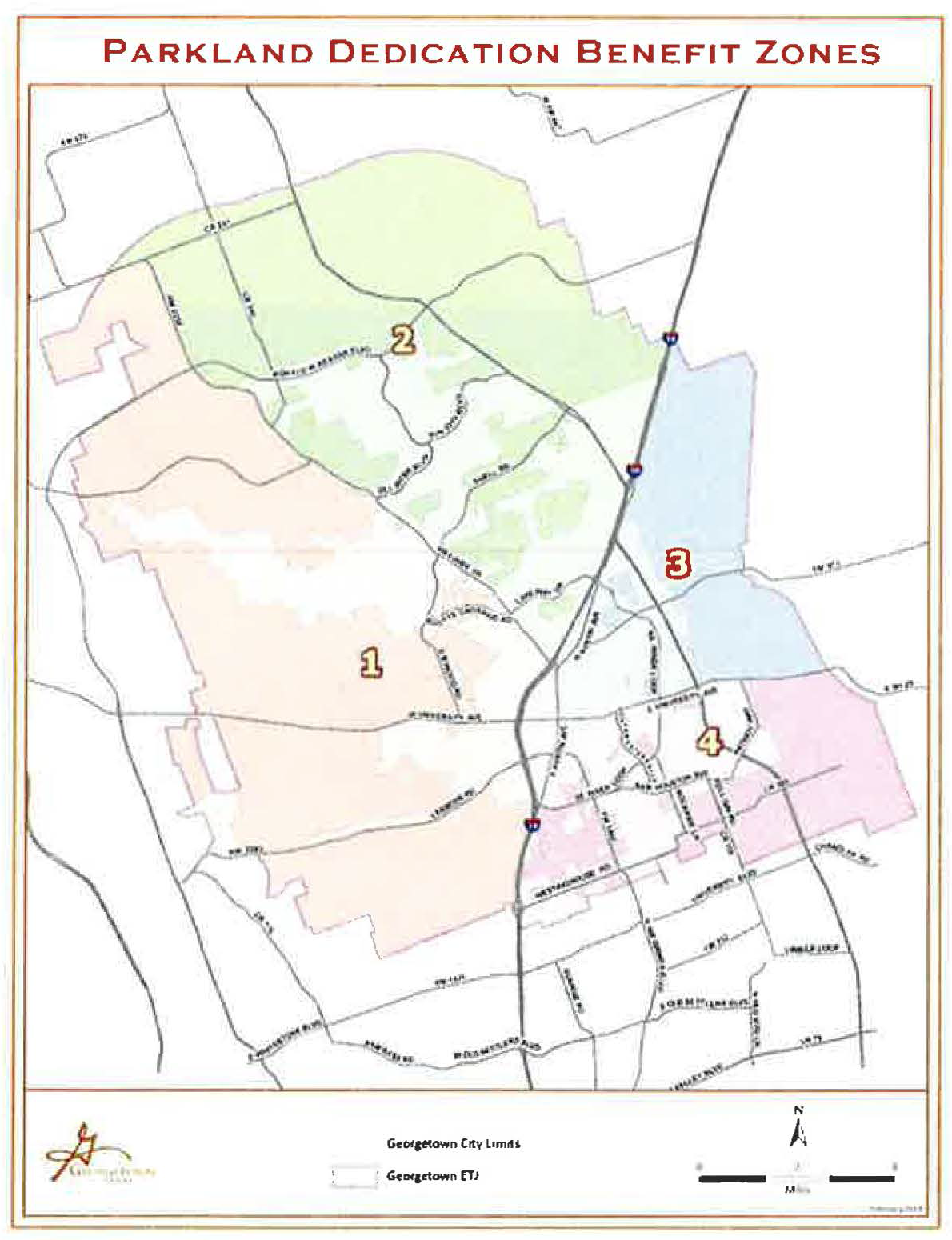
Benefit Zones. Funds shall be expended within the eligible Benefit Zones as shown in Figure 13.08.060.D.
E.
Any financial contribution paid in-lieu of the Parkland dedication requirements must be expended by the City within ten years from the date received. If the City does not expend the financial contribution by the required deadline, the owners of the property may request a refund in the following manner:
1.
The owners of such property must request in writing to the City such refund within one year of the entitlement or such right shall be waived. Refunds shall be paid by the City within 90 days of the filing of the request.
2.
A refund may only be provided for the unbuilt lots for which a fee-in-lieu of dedication was paid.
(Ord. No. 2019-37, § 2(Exh. G), 6-11-2019)
Sec. 13.10.010. - Municipal Utility District (MUD), Water Control and Improvement District (WCID) or Fresh Water Supply District (FWSD).
A.
Purpose.
To provide for the prudent use of a Municipal Utility District ("MUD"), Water Control and Improvement District ("WCID"), Fresh Water Supply District ("FWSD"), or similar political subdivision created pursuant to Article III, Section 52, and/or Article XVI, Section 59, of the Texas Constitution and that are authorized by law to provide water, wastewater, stormwater, and other services ("Districts"), in order to allow development within the City's corporate boundaries and extraterritorial jurisdiction that is generally consistent with the City's Comprehensive Plan.
The standards established in this Section are intended to carry out the following purposes:
• Encourage quality development;
• Protect the water quality within all watersheds of the City;
• Protect the water quality of the City's drinking water sources;
• Allow the City to enforce land use and development regulations consistent with the City's comprehensive plan;
• Promote enhanced parks, trails, and recreational amenities for the enjoyment of public;
• Provide for construction of infrastructure consistent with City standards and City inspection of such infrastructure;
• Provide notice to residents of the District that the City may annex the District at some future time;
• Facilitate cost-effective construction of infrastructure to serve the area within the District, including police and fire stations, that is consistent with City standards and plans, so that the potential financial burden on the citizens of Georgetown will be reduced, in the event of annexation of such land by the City;
• Provide for extension of water and wastewater lines that will serve future growth in the City and its extraterritorial jurisdiction consistent with the City's regional utility planning;
• Establish guidelines for reasonable conditions to be placed on;
• Issuance of bonds by the District;
• The City's consent to creation of the District, including conditions consistent with the City's water and wastewater bond ordinances regarding creation of Districts that might otherwise detrimentally compete with the City's utility systems;
• Establish guidelines for other mutually beneficial agreements by the City and the District;
• Provide a procedural framework for responding to an application seeking the City's consent to the creation of a District; and
• Assist in closing the financial gap when a unique development is seeking to exceed minimum standards, provide a robust program of amenities, and where substantial off-site infrastructure improvements are required that would serve the proposed District and surrounding properties.
B.
Applicability.
This Section is to be equitably applied to the creation of, inclusion of land within, and operation of all proposed Districts, while allowing flexibility necessary to address unique factors that may arise with respect to each proposed District.
Prior to considering whether to consent to or support the creation of a District, the City will consider whether the City is able to provide water and/or wastewater service to the area proposed to be included in the District.
C.
Conditions to City's Consent to Creation of a District.
If the City Council elects to consent to the creation of or inclusion of land within a District, then it shall impose the following requirements as conditions of the City's consent, and such requirements shall be stipulated in the consent resolution and/or other ancillary agreement, unless the City Council determines that requirements are not appropriate with regard to a specific District.
1.
All parks, trails, recreation amenities, water, wastewater, drainage, and road infrastructure and facilities as well as any other infrastructure or facilities to be reimbursed or paid for by the issuance of District bonds, shall be designed and constructed to City standards, including without limitation fire flow standards and utility and road design, construction and installation standards, in accordance with plans and specifications that have been approved by the City. In the event of a conflict between City water and wastewater standards and standards imposed by the Certificate of Convenience and Necessity (CCN) holder for the proposed District, City standards shall prevail, unless otherwise agreed by the City.
2.
The City shall be the exclusive provider of water, wastewater, and electric utilities where it is located within the City's single or municipal certificated service area. Further, the District or applicant shall agree that the City is the exclusive provider of solid waste when in the City.
3.
The City shall have the right to inspect all facilities being constructed by or on behalf of the District and to charge inspection fees consistent with the City's inspection fee schedule, as amended from time to time.
4.
Bonds, including refunding bonds issued by the District, shall, unless otherwise agreed to by the City, comply with the following requirements, provided such requirements do not generally render the bonds unmarketable:
a.
Interest rate that does not exceed two percent (2%) above the highest average interest rate reported by the Daily Bond Buyer in its weekly "20 Bond Index" during the one month period preceding the date notice of the sale of such bonds is given;
b.
The bonds shall expressly provide that the District shall reserve the right to redeem bonds at any time subsequent to the tenth (10th) anniversary of the date of issuance, without premium. No variable rate bonds shall be issued by a District without City Council approval; and
c.
Any refunding bonds of the District must provide for a minimum of three percent (3%) present value savings and that the latest maturity of the refunding bonds may not extend beyond the latest maturity of the refunded bonds unless approved by the City Council.
5.
The City shall require the following information with respect to bond issuance:
a.
At least 60 days before issuance of bonds, except refunding bonds, the District's financial advisor shall certify in writing that the bonds are being issued within the existing water, wastewater, or drainage facilities in the county in which the District is located and shall deliver the certification to the City Secretary, and the City.
b.
At least 60 days before the issuance of bonds, the District shall deliver to the City Secretary, and the City Manager notice as to:
i.
The amount of bonds being proposed for issuance;
ii.
The projects to be funded by such bonds; and
iii.
The proposed debt service tax rate after issuance of the bonds.
iv.
If the District is not required to obtain TCEQ approval of the issuance of the bonds (other than refunding bonds), the District shall deliver such notice to the City Secretary, and the City Manager at least 60 days prior to issuing such bonds. Within 30 days after the District closes the sale of a series of bonds, the District shall deliver to the City Secretary and the City Manager a copy of the final official statement for such series of bonds. If the City requests additional information regarding such issuance of bonds, the District shall promptly provide such information at no cost to City.
6.
The purposes for which a District may issue bonds shall be restricted to the construction, acquisition, repair, extension and improvement of land, easements, works, improvements, facilities, plants, equipment, and appliances necessary to:
a.
Provide a water supply for the District for municipal uses, domestic uses, and commercial purposes;
b.
Collect, transport, process, dispose of and control all domestic, industrial or communal wastes from the District whether in fluid, solid, or composite state;
c.
Gather, conduct, divert, and control local stormwater or other local harmful excesses of water in the District; and
d.
Pay organization and administrative expenses, operation expenses during construction, cost of issuance, interest during construction, and capitalized interest.
e.
If appropriate in a particular District, the City may consent to issuance of bonds for construction, acquisition, repair, extension, or improvement of fire stations, roads, parks, trails, recreational amenities, and/or other capital improvements that are mutually agreed upon by the City Council and the applicant.
7.
The District shall contain sufficient acreage to assure the economic viability of the District but no more acreage than can feasibly be annexed at one time.
8.
Development within the District shall be consistent with the City's Comprehensive Plan.
9.
No District shall include land in more than one City's Extraterritorial Jurisdiction.
10.
The City and the owners of all land in the proposed District shall reach agreement on the terms of a development agreement pursuant to Texas Local Government Code §§ 212.171 et seq. to extend the City's planning authority over land included in the District by providing for approval of a development plan, authorizing enforcement by the City of land use and development regulations, and including other lawful terms and considerations the parties consider appropriate. The development agreement shall include provisions relating to the following matters:
a.
Land use plan reflecting all approved land uses and residential densities;
b.
Compliance with City construction Codes, including permit requirements;
c.
Compliance with City and other applicable stormwater and water quality regulations;
d.
Development standards comparable to City zoning regulations; and
e.
Dedication and development of park land, open space, and trails.
f.
The above list is not intended to be exhaustive. It is expected that the parties will cooperate to identify those matters unique to the District that may be addressed in a consent or development agreement.
11.
At least 60 days before issuance of bonds, the District shall certify in writing that the District is in full compliance with the consent resolution approved by the City Council and, to the extent such agreements impose requirements on the District, with the consent agreement, strategic partnership agreement and all other agreements executed by the City and the District, and shall deliver the certification to the City Secretary, and the City Manager.
12.
No land within the District shall be allowed, at any time in the future, to incorporate, join in an incorporation, or be annexed into any incorporated city other than the City of Georgetown.
13.
No land shall be annexed by the District without prior City Council approval.
14.
The District shall not construct or install infrastructure or facilities to serve areas outside the District or sell or deliver services to areas outside the District without prior City Council approval.
15.
After creation of the District, and unless otherwise expressly authorized by the consent agreement or development agreement, no District shall be converted into another type of District, consolidated with another District, divided into two or more new Districts or seek additional governmental powers that were beyond its statutory authority at the time the District was created, without prior City Council approval.
16.
If allowed by law, the City may annex any commercial development within the District for limited purposes pursuant to Texas Local Government Code § 43.0751, and may impose a sales and use tax within the area annexed for limited purposes. If limited purpose annexation is not allowed by law, then the City may not consent to inclusion of commercial retail areas within the District. The City may consider sharing tax receipts with the District, provided the District's share is used to finance infrastructure, retire bond debt or for other purposes acceptable to the City.
17.
The District shall not issue any bonds other than those authorized by the consent agreement without City Council approval.
18.
The District shall file a notice in the real property records of all counties in which the District is located stating that the City has authority to annex the District. The parties may attach a form of such notice to the consent agreement or development agreement.
19.
The District shall send a copy of the order or other action setting an ad valorem tax rate to the City Secretary, and the City Manager within 30 days after District adoption of the rate.
20.
The District shall, send a copy of its annual audit to the City Secretary, and the City Manager within 30 days after approval.
21.
The District shall maintain a debt service structure that will ensure that the District's taxes are maintained at a rate at least equal to the City's tax rate, to the extent feasible.
22.
The District shall provide copies of any material event notices filed under applicable federal securities laws or regulations to the City Secretary, and the City Manager within 30 days after filing such notices with the applicable federal agency.
23.
Construction of capital improvements or fee-in-lieu for facilities such as fire stations and recreational amenities shall be provided.
24.
Sharing of fire stations, recreational amenities, and other capital improvements by the City and the District shall be provided. Land shall be dedicated, when deemed necessary, to enhance public safety and optimize locations for service delivery.
25.
If construction or expansion of a wastewater treatment facility is proposed to serve the District, the plant design shall conform to all applicable state and federal permitting and design standards. In addition, any wastewater discharge shall be permitted to meet effluent limitations no less stringent than 5-5-2-1 (five parts per million ("ppm") biochemical oxygen demand; five ppm total suspended solids; two ppm nitrogen; and one ppm phosphorus) or the current limits in permit(s) held by the City, whichever is strictest. The City reserves the right to protest any wastewater treatment facility permit application or amendment.
26.
The board of directors of the District and landowners within the District shall assist the City in annexing one or more areas as reasonably necessary for the City to connect areas to the City that are outside the District and that the City intends to annex in the foreseeable future.
27.
Upon the recommendation of the Development Engineer or designee the City may require the District to complete a traffic impact analysis pursuant to Section 12.09 of this Code.
28.
The City may agree not to annex and dissolve the District any earlier than the first to occur of: (i) extension of water, wastewater, and drainage facilities to serve ninety percent (90%) of the land within the District; or (ii) 15 years after creation of the District. The contract between the City and the District may provide that the City may set rates for water and/or wastewater services for property that was within the District that vary from those for other properties within the City in order to compensate the City for assumption of District obligations upon annexation, in compliance with any statutory requirements applicable to such an agreement.
29.
The consent agreement and ancillary documents shall include terms providing for the District to be fully developed and ready for full purpose annexation by the City within a reasonable time period.
30.
The applicant shall reimburse the City for expenses incurred by the City in connection with the City's consent to formation of the District, including but not limited to professional fees incurred in connection with negotiation and preparation of the consent resolution, consent agreement, development agreement, strategic partnership agreement, and related documents.
D.
City Operations Compensation Fee.
A fee shall be assessed for each residential unit within the District equal to the proportion of City operations attributed to serving residents of an ETJ District. The fee shall be calculated as outlined in the Municipal Utility District (MUD) Policy.
(Ord. No. 2019-01, § 2(Exh. A), 1-8-2019)
Sec. 13.10.020. - Public Improvement District (PID)—Reserved.
(Ord. No. 2019-01, § 2(Exh. A), 1-8-2019)

