
Gonzales City Zoning Code
Sec. 22-3
Use provisions.
(22-3)(a)
Allowed uses.
(22-3)(a)(1)
General provisions.
a.
Use categories.
1.
Use categories provide a systematic basis for assigning land uses to appropriate categories with other, similar uses.
2.
Use categories classify land uses and activities based on common functional, product, or physical characteristics. Characteristics include the type and amount of activity, the hours of operation, the type of customers or residents, how goods or services are sold or delivered, likely impact on surrounding properties, and site conditions.
b.
Principal uses. Allowed principal uses by district are listed in the Allowed Use Table in section 22-3(a)(3), allowed use table. Principal uses are grouped into use categories outlined in section 22-3(b), use categories. The uses listed are not an exhaustive list. When a proposed use is not identified on the allowed use table or in section 22-3(b), use categories, the administrator may determine that the proposed use is sufficiently similar to an identified use.
c.
Accessory uses. Accessory uses are allowed in conjunction with an allowed principal use as set forth in section 22-3(h), accessory uses.
d.
Temporary uses. Temporary uses are allowed as set forth in section 22-3(i), temporary uses.
(22-3)(a)(2)
Uses not listed.
a.
The administrator is responsible for categorizing all uses. If a proposed use is not listed in a use category, but is similar to a listed use, the administrator may place the proposed use under that use category.
b.
When determining whether a proposed use is similar to a listed use in section 22-3(b), use categories, the administrator will consider the following criteria:
1.
The actual or projected characteristics of the proposed use;
2.
The relative amount of site area or floor area and equipment devoted to the proposed use;
3.
Relative amounts of sales;
4.
The customer type;
5.
The relative number of employees;
6.
Hours of operation;
7.
Building and site arrangement;
8.
Types of vehicles used and their parking requirements;
9.
The number of vehicle trips generated;
10.
Signs;
11.
How the proposed use is advertised;
12.
The likely impact on surrounding properties; and
13.
Whether the activity is likely to be independent of the other activities on the site.
(22-3)(a)(3)
Allowed use table. The allowed use table establishes the uses allowed within each district and any conditions or use standards associated with each use. The allowed use table key is set forth below.
a.
Allowed by right (■). Use is allowed by right in the respective district subject to any use standard. Such use is also subject to all other applicable requirements of this zoning code.
b.
Special use permit (□). Indicates a use may be permitted in the respective district only where approved by the city council in accordance with section 22-6(b)(6) Special use permit. Special use permits are subject to all other applicable requirements of this zoning code, including all applicable use standards.
c.
Approved concept plan (*). Indicates a use may be allowed in the respective district only where approved by the city council as part of an approved concept plan in accordance with section 22-6(b)(8) Traditional neighborhood development (TND). Unless otherwise modified by the city council, uses allowed as part of an approved concept plan are subject to all other applicable requirements of this zoning code, including all applicable use standards.
d.
Blank cell. A blank cell indicates that a use is not allowed in the respective district.
e.
Use standard. A cross-reference to any associated use standard established in section 22-3(c), standards for residential uses through section 22-3(g), open use standards. Where no cross-reference is shown, no additional use standard applies.
(22-3)(b)
Use categories.
(22-3)(b)(1)
Residential use categories.
a.
Household living. Residential occupancy of a dwelling unit by a household on a monthly or longer basis in structures with self-contained dwelling units, including kitchens.
Example uses:
1.
Detached living.
2.
Attached living.
3.
Multifamily living.
4.
Upper story residential.
5.
Manufactured home parks.
6.
Camps.
b.
Group living. Residential occupancy of a structure by a group of people that does not meet the definition of household living. Tenancy is usually arranged on a monthly or longer basis. Generally, group living facilities have a common eating area for residents, and residents may receive care or training.
Example uses:
1.
Assisted living facility.
2.
Boarding house, rooming house, lodging house.
3.
Congregate care facility.
4.
Fraternity, sorority, dormitory.
5.
Group residential facility for more than eight (8) mentally handicapped dependent persons.
6.
Hospice.
7.
Monastery, convent.
8.
Nursing or care home.
9.
Single room occupancy.
c.
Social service. Uses that primarily provide treatment of those with psychiatric, alcohol, or drug problems, and transient housing related to social service programs.
Example uses:
1.
Adult rehabilitation center.
2.
Group shelter.
3.
Overnight general purpose shelter.
4.
Rehabilitative clinic.
5.
Social service facility, soup kitchen, transient lodging, homeless shelter.
6.
Transitional home, halfway house.
(22-3)(b)(2)
Public use categories.
a.
Civic. Places of public assembly that provide ongoing life safety, educational and cultural services to the general public, as well as meeting areas for religious practice.
Example Uses:
1.
College, community college, university.
2.
Convention center.
3.
Museum, library.
4.
Places of worship including church, mosque, synagogue, temple.
5.
Police, fire, EMS station, substation.
6.
Post office.
7.
Public or private (K-12) school.
8.
Neighborhood arts center.
b.
Parks and open space. Uses focusing on public gathering areas for passive or active outdoor recreation, and having few structures.
Example uses:
1.
Botanical garden, nature preserve, recreational trail.
2.
Cemetery, mausoleum, columbarium, memorial park.
3.
Square, green, plaza, neighborhood park, tot lot, community garden, farmers market, neighborhood recreational fields, skate park.
c.
Utilities. Public or private infrastructure serving a limited area with no on-site personnel (minor utility) or serving the general community with on-site personnel (major utility).
Example uses:
1.
Minor utilities, including on-site stormwater retention or detention facility, neighborhood-serving telephone exchange/switching center, gas/electric/telephone/cable transmission lines, stealth wireless communication device, water and wastewater pump station or lift station, gas gates, reservoir, control structure, drainage well, water supply water well.
2.
Major utilities, including aeration facility, electrical substation, electric or gas generation plant, filter bed, railroad right-of-way, non-stealth wireless communication towers and facilities, transmission towers, waste treatment plant, water pumping facility, water tower or tank.
(22-3)(b)(3)
Commerce use categories.
a.
Commercial parking. Facilities that provide parking not accessory to a principal use, for which a fee may or may not be charged.
Example uses:
1.
Short- and long-term fee parking facility.
2.
Park-and-ride facility.
3.
Motor vehicle parking lot.
4.
Surface parking lot.
b.
Day care. Uses providing care, protection, and supervision of children or adults on a regular basis away from their primary residence. Care is typically provided to a given individual for fewer than eighteen (18) hours each day, although the facility may be open twenty-four (24) hours each day.
Example uses:
1.
Adult day care center.
2.
Day care center for children.
3.
Nursery school, preschool.
4.
Recreational program, before- and after-school.
5.
Small group child care center.
c.
Indoor recreation. Generally commercial uses, varying in size, providing daily or regularly scheduled recreation-oriented activities in an indoor setting.
Example uses:
1.
Amusement center, game arcade, children's amusement center.
2.
Amusement arcade.
3.
Athletic, tennis, swim or health club, exercise salon.
4.
Billiard hall, pool hall.
5.
Bingo parlor.
6.
Bowling alley.
7.
Club or lodge, membership club.
8.
Dance hall.
9.
Dance, martial arts, music studio or classroom.
10.
Gymnastic facility, indoor sports academy.
11.
Motor track.
12.
Movie or other theater.
13.
Skating rink.
d.
Medical. Uses providing medical or surgical care to patients. Some uses may offer overnight care.
Example uses:
1.
Ambulatory surgical center.
2.
Blood plasma donation center, medical or dental laboratory.
3.
Hospital, urgent care or emergency medical office.
4.
Medical, dental office or chiropractor, medical practitioner.
5.
Medical clinic.
6.
Medical day care.
e.
Office. Activities conducted in an office setting and generally focusing on business, professional or financial services.
Example uses:
1.
Offices including advertising, business management consulting, data processing, collection agency, real estate or insurance agent, professional service such as lawyer, accountant, bookkeeper, engineer, architect, sales office, travel agency.
2.
Financial services such as lender, investment or brokerage house, bank, call center, bail bonds.
3.
Counseling in an office setting.
4.
City, county, state, government office.
5.
Radio, TV or recording studio, utility office.
6.
Trade, vocational, business school.
f.
Outdoor recreation. Generally commercial uses, varying in size, providing daily or regularly scheduled recreation-oriented activities. Such activities may take place wholly outdoors or within a number of outdoor structures.
Example uses:
1.
Drive-in theater.
2.
Campground, travel trailer park, recreational vehicle park.
3.
Executive par three golf course.
4.
Extreme sports such as paintball, BMX or skateboarding facility.
5.
Golf course, country club, clubhouse.
6.
Outdoor entertainment activity such as batting cage, golf driving range, mini-amusement park, miniature golf facility, water park.
7.
Hunting and fishing preserve.
8.
Horse stable, riding academy, equestrian center.
9.
Outdoor shooting range.
10.
Retreat center.
11.
Sports academy for active recreational or competitive sports.
12.
Stadium, arena, commercial amphitheater.
g.
Overnight lodging. Accommodations arranged for short term stays of less than thirty (30) days for rent or lease.
Example uses:
1.
Apartment hotel.
2.
Hotel, motel, inn, extended-stay facility, bed and breakfast, youth hostel.
3.
Tourist home.
h.
Passenger terminal. Public or commercial facilities for the takeoff and landing of airplanes and helicopters, and facilities for bus, taxi or limo service.
Example uses:
1.
Airport, heliport.
2.
Bus passenger terminal, multi-modal facility.
3.
Rail station or stop.
4.
Taxi dispatch center, limousine service.
i.
Personal service. Facilities involved in providing personal services or repair services to the general public.
Example uses:
1.
Animal care (animal grooming, animal hospital, veterinary clinic, pet clinic, animal boarding place, animal shelter, kennel, doggy day care).
2.
Laundromat.
3.
Funeral home, funeral parlor, mortuary, undertaking establishment, commercial wedding chapel.
4.
Hair, nail, tanning, massage therapy and personal care service, barber, beauty shop.
5.
Photocopy, blueprint, package shipping and quick-sign service, printing and publishing, security service.
6.
Tattoo/body piercing shop, palmist, psychic, medium, fortune telling, massage therapy.
7.
Appliance, bicycle, canvas product, clock, computer, jewelry, musical instrument, office equipment, radio, shoe, television or watch repair.
8.
Taxidermist, tailor, milliner, upholsterer, locksmith.
j.
Restaurant/bar. Establishments that prepare and sell food or drink for on- or off-premises consumption. In accordance with R.S. Title 26, Alcoholic Beverages, to be considered a restaurant, a business's average monthly revenue from food and non-alcoholic beverages must exceed fifty (50) percent of its total average monthly revenue from the sale of food, non-alcoholic beverages, and alcoholic beverages.
Example uses:
1.
Bar, tavern, cocktail lounge, nightclub, brew pub.
2.
Eating and drinking establishment.
3.
Pizza delivery facility.
4.
Restaurant, fast food restaurant, take-out, yogurt or ice cream shop.
k.
Retail sales. Facilities involved in the sale, lease, or rental of new or used products.
Example uses:
1.
Sale, lease or rental of alcoholic beverages, antiques, appliances, art supplies, baked goods, bicycles, books, building supplies, cameras, carpet and floor coverings, crafts, clothing, computers, convenience goods, dry goods, electronic equipment, fabric, flowers, fuel (including gasoline and diesel fuel), furniture, garden supplies, gifts or novelties, groceries, hardware, home improvement, household products, jewelry, medical supplies, music, musical instruments, office supplies, package shipping, pets, pet supplies, pharmaceuticals, photo finishing, picture frames, plants, printed materials, produce, souvenirs, sporting goods, stationery, tobacco, used or secondhand goods, vehicle parts and accessories, videos, and related products.
2.
Art studio, gallery.
3.
Check cashing.
4.
Drop-in child care center.
5.
Pawnshop.
6.
Seafood market, farm stand.
7.
Convenience store (with gas).
8.
Convenience store (without gas).
9.
Dry cleaning or laundry drop-off facility.
l.
Vehicle sales. Direct sales, rental or leasing of passenger vehicles, light and medium trucks, and other consumer motor vehicles such as motorcycles, boats, and recreational vehicles.
Example uses:
1.
Boats and other recreational vehicle sales.
2.
Vehicle sales, rental, or leasing.
m.
Water-oriented. Uses that require direct access to navigable waters.
Example uses:
1.
Boat livery.
2.
Dock or pier (commercial).
3.
Dry storage of boats.
4.
Ferry/water taxi.
5.
Marina.
6.
Wet storage of boats (commercial).
(22-3)(b)(4)
Employment use categories.
a.
Industrial. Firms involved in research and development activities without light fabrication and assembly operations, as well as limited industrial/manufacturing activities. The uses emphasize industrial businesses, and sale of heavier equipment. Factory production and industrial yards are located here. Sales to the general public are limited.
Example uses:
1.
Animal processing, packing, treating, and storage, livestock or poultry slaughtering, concentrate plant, processing of food and related products, production of lumber, tobacco, rubber, leather, clay, bone, plastic, stone, or glass materials or products, commercial feed lot.
2.
Bulk storage of flammable liquids, chemical, cosmetics, drugs, soap, paints, fertilizers and abrasive products.
3.
Earth moving, heavy construction equipment, transportation equipment.
4.
Detention center, jail, prison.
5.
Fabricated metal products and machinery.
6.
Impound lot, wrecker service, includes vehicle wreckers, auto storage.
7.
Labor hall, leather and leather products, includes tanning and finishing.
8.
Manufactured or modular housing sales.
9.
Scrap metal processors, sawmill, secondary materials dealers.
10.
Trailer leasing, auction vehicle, broker vehicle, pawn shop vehicle.
11.
Tire recapping, tobacco products, transportation equipment.
b.
Heavy commercial. Manufacturing, assembly, repair or servicing of industrial, business, or consumer machinery, equipment, products, or by-products mainly by providing centralized services for separate retail outlets. Contractors and building maintenance services and similar uses perform services off-site. Few customers, especially the general public, come to the facility.
Example uses:
1.
Brewery, winery.
2.
Bus or rail transit vehicle maintenance or storage facility.
3.
Contractors' storage, including janitorial and building maintenance service, exterminator, or other maintenance yard or facility, building, heating, plumbing, landscaping or electrical contractor and others who perform services off-site, but store equipment and materials or perform fabrication or similar work on-site.
4.
Crematorium, pet crematorium.
5.
Electronics service center.
6.
Food beverage products except animal slaughter, stockyards.
7.
Lawn, tree or garden service.
8.
Laundry, dry cleaning, and carpet cleaning plants.
9.
Leather and leather products except tanning and finishing.
10.
Lumberyard and wood products, sheet metal shop, soft drink bottling.
11.
Stone, clay, glass, and concrete products.
12.
Bulk mailing service.
13.
Clothing, textile apparel manufacturing.
14.
Office showroom/warehouse.
15.
Printing, publishing, and lithography.
16.
Production of artwork and toys, sign-making, movie production facility, photo-finishing laboratory.
17.
Repair of scientific or professional instruments and electric motors.
18.
Sheet metal, welding, machine, tool repair shop or studio.
19.
Woodworking, including cabinet makers and furniture manufacturing.
c.
Research and development. A facility focused primarily on the research and development of new products.
Example uses:
1.
Laboratories, offices, and other facilities used for research and development by or for any individual, organization, or concern, whether public or private; prototype production facilities that manufacture a limited amount of a product in order to fully investigate the merits of such a product; pilot plants used to test manufacturing processes planned for use in production elsewhere; production facilities and operations with a high degree of scientific input; facilities and operations in which the input of science, technology, research, and other forms of concepts or ideas constitute a major element of the value added by manufacture per unit of product.
d.
Self-service storage. Facilities providing separate storage areas for personal or business use designed to allow private access by the tenant for storing or removing personal property.
Example uses:
1.
Warehouse, self-service, fully enclosed indoor multi-story storage, mini-warehouse.
e.
Vehicle service. Repair and service to passenger vehicles, light and medium trucks, and other consumer motor vehicles such as motorcycles, boats, and recreational vehicles.
Example uses:
1.
Audio and alarm system installation, custom accessories, quick lubrication facilities, auto detailing, minor scratch and dent repair, bedliner installation, glass repair/replacement, tire sales and mounting, full- or self-service vehicle wash.
2.
Alignment shop, body shop, engine replacement or overhaul, repair of cars, trucks, RVs and boats, repair or replacement of brakes, shocks, mufflers and transmissions.
3.
Service station.
4.
Towing service, truck service, vehicle towing station.
f.
Warehouse and distribution. Facilities involved in the storage or movement of goods for themselves or other firms. Goods are generally delivered to other firms or the final consumer with little on-site sales activity to customers.
Example uses:
1.
Bulk storage, including nonflammable liquids, cold storage plants, including frozen food lockers, household moving and general freight storage, separate warehouse used by retail store such as furniture or appliance store.
2.
Bus barn.
3.
Commercial packing for fruits and vegetables.
4.
Distribution facility, central postal facility.
5.
Freight, service facility.
6.
Outdoor storage yard.
7.
Parcel services.
8.
Railroad switching yard, freight terminal, piggyback yard.
9.
Transfer and storage business where there are no individual storage areas or where employees are the primary movers of the goods to be stored or transferred.
10.
Temporary trailer storage or drop-off lot.
11.
Truck or motor freight terminal, service facility.
12.
Trucking operation.
13.
Warehouse.
g.
Waste-related service. Characterized by uses that receive solid or liquid wastes from others for transfer to another location and uses that collect sanitary wastes or that manufacture or produce goods or energy from the composting of organic material.
Example uses:
1.
Animal waste processing.
2.
Garbage or refuse collection service (office and truck fleet).
3.
Manufacture and production of goods from composting organic material.
4.
Recycling facility including recyclable material storage, recycling drop-off facility, recycling buy-back center, recycling collection center.
5.
Solid or liquid waste transfer station, waste incineration.
h.
Wholesale trade. Facilities involved in the sale, lease, or rent of products to industrial, institutional or commercial businesses only. The use emphasizes on-site sales or order-taking and often includes display areas. Businesses may or may not be open to the general public, limited sales to the general public is allowed. Products may be picked up on-site or delivered to the customer.
Example uses:
1.
Mail-order house.
2.
Sale or rental of machinery, equipment, heavy equipment, building materials, special trade tools, welding supplies, machine parts, electrical supplies, plumbing supplies, janitorial supplies, restaurant equipment, and store fixtures.
3.
Wholesale sales of food, clothing, auto parts, building hardware and similar products.
(22-3)(b)(5)
Open use categories.
a.
Agriculture. Characterized by uses that create or preserve areas intended primarily for the raising of animals and crops, conservation, and the secondary industries associated with agricultural production.
Example uses:
1.
Agricultural airstrip.
2.
Animal raising, including horses, hogs, cows, sheep, goats, and swine, poultry, rabbits, and other small animals, apiculture, aquaculture, dairying, personal or commercial animal breeding and development.
3.
Crop production, soil preparation, agricultural services, large animal and veterinary services, farm labor and management services.
4.
Floriculture, horticulture, pasturage, row and field crops, viticulture, tree or sod farm, silviculture, sale of agriculture products.
5.
Fish hatcheries and preserves.
6.
Grain, fruit, field crop and vegetable cultivation and storage.
7.
Hunting, trapping and game propagation.
8.
Livestock, horse, dairy, poultry and egg products.
9.
Livestock auction.
10.
Milk processing plant.
11.
Packing house for fruits or vegetables.
12.
Plant nursery, plant nursery with landscape supply.
13.
Poultry slaughtering and dressing.
14.
Timber tracts, forest nursery gathering of forest products.
b.
Resource extraction. Characterized by uses that extract minerals and other solids and liquids from land.
Example uses:
1.
Dredging, earth extraction, clearing or grading (timber cutting).
2.
Extraction of phosphate or minerals.
3.
Extraction of sand or gravel, borrow pit, metal, sand stone, gravel clay, mining and other related processing.
4.
Stockpiling of sand, gravel, or other aggregate materials.
(22-3)(c)
Standards for residential uses.
(22-3)(c)(1)
All residential uses.
a.
Foundations.
1.
General foundation treatments required.
i.
All residential buildings must be built upon a permanent foundation.
ii.
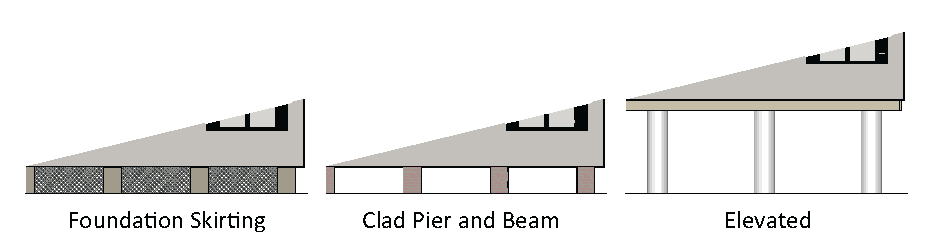
One of the following foundation treatments must be applied to new residential buildings not built on a slab foundation.
A.
Foundation skirting. A curtain skirting wall constructed of brick, stone, lattice or a siding material consistent with the siding material used on the primary building. Additional materials may be approved by the administrator.
B.
Clad pier and beam. Traditional pier and beam treatment, provided that the piers are clad in brick or other material approved by the administrator.
C.
Elevated. In the event that the ground story elevation of the residential building type is in a flood prone area and is more than sixty (60) inches above the natural grade; the foundation may be treated with either one of the above mentioned methods or may be left without skirting.
iii.
All foundation treatments shall be in accordance with applicable building code regulations.
iv.
All skirting shall be installed under the perimeter of the home and shall be uninterrupted except for required ventilation and access. If required due to flood regulations, skirting must be designed to breakaway during a flood event to allow water to freely move underneath the home.
b.
Garage and carport placement.
1.
In addition to the standards provided below, attached garages and carports are considered part of the principal structure and must meet all applicable requirements for the principal structure.
2.
Garages for detached and attached living.
i.
Street facing garages and carports are not permitted on lots forty (40) feet or less in width.
ii.
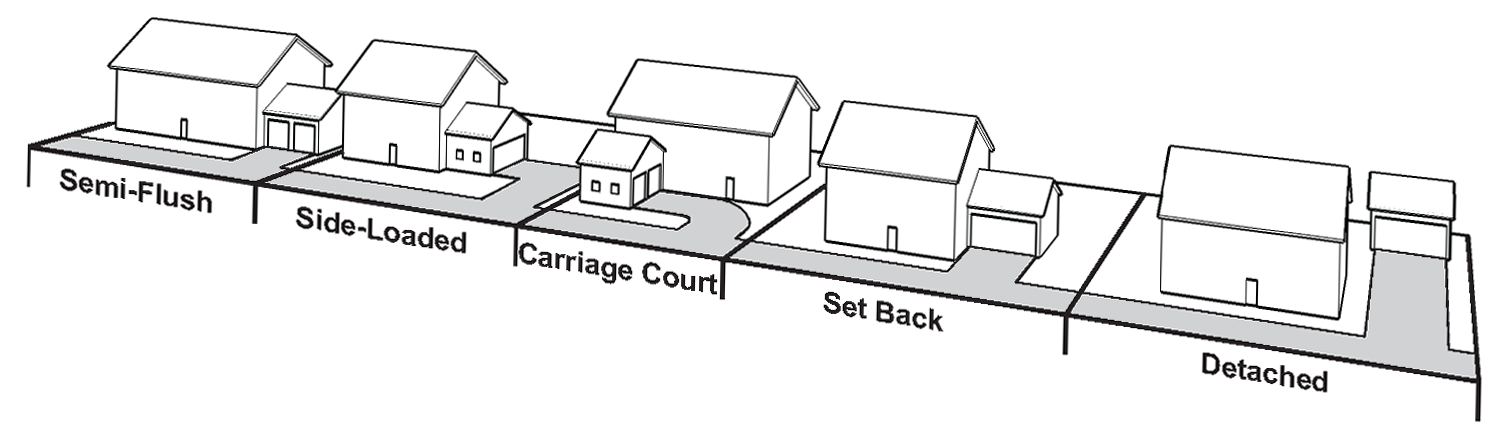
Street-facing garages and carports must be positioned as described below; however, carports are not permitted in the carriage court form.
A.
Semi-flush. Garage or carport is positioned between three (3) feet and ten (10) feet behind the front wall plane, extending no more than thirty (30) percent of the width of the building. Garages may extend up to fifty-five (55) percent of the width of the building if at least two (2) of the following architectural features are provided as part of the garage:
(1)
Single carriage house style garage doors.
(2)
Ornamental light fixtures flanking garage doors.
(3)
Arbor or trellis.
(4)
Columns or pilasters flanking garage doors.
(5)
Portico framing garage entrance.
(6)
Roof line changes or variation in eave height above garage.
B.
Flush or protruding garages. Flush or protruding garages are allowed only on lots less than seventy (70) feet wide. Garage or carport is positioned either flush or up to three (3) feet in front of the front wall plane, extending no more than thirty (30) percent of the width of the building. Garages may extend up to fifty-five (55) percent of the width of the building if at least two (2) of the following architectural features are provided as part of the garage:
(1)
Single carriage house style garage doors.
(2)
Ornamental light fixtures flanking garage doors.
(3)
Arbor or trellis.
(4)
Columns or pilasters flanking garage doors.
(5)
Portico framing garage entrance.
(6)
Roof line changes or variation in eave height above garage.
C.
Side-loaded. Garage or carport face is oriented perpendicular to the street and at least three (3) feet behind the front wall plane. Windows must cover a minimum of fifteen (15) percent of the street-facing garage façade.
D.
Carriage court. Carriage courts are allowed only on lots at least seventy (70) feet wide. Garage is oriented perpendicular to the street. Windows must cover a minimum of fifteen (15) percent of the street-facing garage façade.
E.
Setback. Garage or carport is positioned more than ten (10) feet behind the front wall plane of the building.
F.
Detached. Garage or carport is positioned to the rear of the principal building.
3.
Rear loaded garages for attached living.
i.
Rear loaded tuck-under parking is desired.
(22-3)(c)(2)
Detached living.
a.
Infill standards.
1.
Intent. The following standards are intended to accommodate infill development in a residential district consisting predominantly of single-family houses. They have been crafted to allow an applicant and the administrator to look to the surrounding character for guidance. These standards are intended to encourage reinvestment in existing neighborhoods and reinforce the traditional character of established residential neighborhoods.
2.
Applicability. The infill development standards shall be applied to any residential project that is less than two (2) acres in size and is located within a residential district consisting predominantly of single-family houses legally established before 1950.
3.
Residential projects two (2) acres or more in size or in areas constructed after 1950 shall follow the applicable district standards.
4.
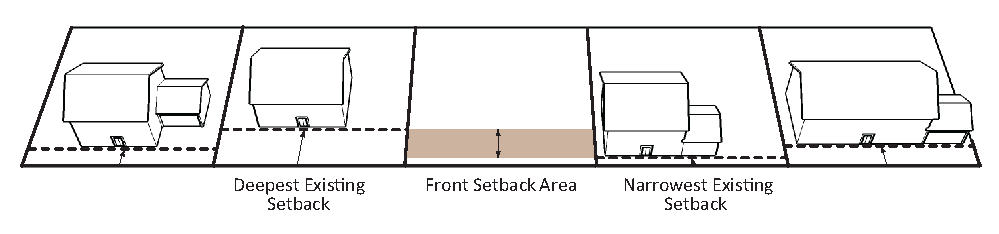
Front setbacks. Structures shall be located within the range of front setbacks on the street. This range of setbacks is measured on the basis of the four (4) lots surrounding the project site (the two (2) closest lots in either direction along the street).The new structure shall be located within the range of setbacks (no closer than the narrowest setback, no further than the deepest setback). Where a setback in these four (4) lots is significantly out of the range of setbacks along the street, it may be eliminated from the range. Where the calculation of a range of setbacks is not practicable, the structure shall meet the district standards.
5.
Height. The maximum building height shall be 1.5 times the average building height of the four (4) lots surrounding the project site (the two (2) closest lots in either direction along the same side of the street). In no case shall the infill development be restricted to less than two (2) stories or an additional twelve (12) feet taller than the calculated average.
6.
Garages and carports. Street-facing garages and carports may be allowed where an alley is not present and street-facing garages or carports are part of the dominant character of properties fronting on the same block face. Any new garage or carport shall meet the standards of section 22-3(c)(1)b., Garage and carport placement.
7.
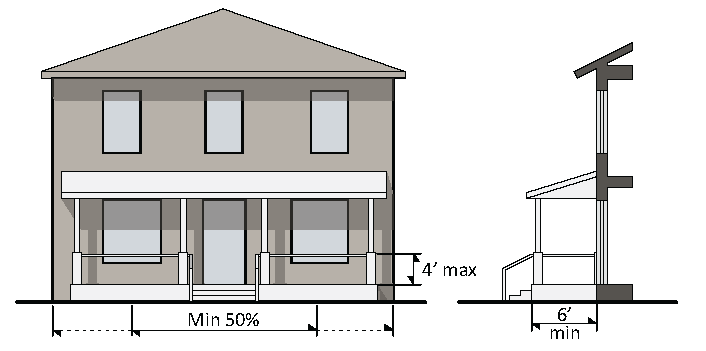
Front porches. A front porch is required where front porches are part of the dominant character of properties fronting on the same block face.
i.
A porch must be a minimum of six (6) feet deep (not including the steps).
b.
A porch must extend across not less than fifty (50) percent of the building façade from which it projects.
iii.
A porch may be roofed, but not enclosed.
iv.
Partial walls on a porch can be no higher than four (4) feet.
v.
A porch may encroach into a required setback in accordance with the terms of section 22-4(a)(4), Setbacks.
8.
Ground floor elevation. Raised ground floors shall be required where raised ground floors are part of the dominant character of properties fronting on the same block face. Any project that requires a raised ground floor must have a foundation height of at least eighteen (18) inches measured from top of grade to the first finished floor. In the event of a demonstrated disability-related hardship, the administrator may approve an alternative zero-step entry design.
b.
Cottage homes. Allowed by right in duplex and zero lot line districts, by SUP in R-6 and R-TH districts.
1.
Site standards.
i.
Required frontage on public open space: Seventy-five (75) percent of cottages shall abut public open space.
ii.
Public open space: Public open space shall have cottages abutting on at least two (2) sides.
iii.
Cottage orientation: Cottages adjacent to common open space shall be oriented around and have the main entry from the common open space.
iv.
Maximum distances from public open space: Each cottage shall be within sixty (60) feet walking distance of public open space.
v.
Minimum public open space: Four hundred (400) square feet per cottage.
vi.
Minimum private open space: Two hundred (200) square feet per cottage.
vii.
Clustering required: Minimum of four (4) and a maximum of twelve (12) cottages per cluster; a development site may contain more than one (1) cluster.
viii.
Parking location: Must be on the same property and located to the side or rear of cottage clusters and not between the street and cottages. Parking is prohibited within front and side setback areas.
ix.
Screening required: Parking and vehicular areas shall be screened from public street and adjacent residential uses by landscaping or architectural screens. For parking lots adjacent to the street, a minimum ten-foot landscape buffer shall be provided between the sidewalk and the parking area. For parking lots along adjacent residential uses, minimum five-foot landscape buffer shall be required. The administrator will consider alternative landscaping techniques provided they effectively mitigate views into the parking area from the street or adjacent residential uses and enhance the visual setting for the development.
x.
Parking configuration: Parking shall be located in clusters of not more than five (5) adjoining uncovered spaces (except where adjacent to an alley). Exceptions will be considered by the administrator provided alternative configurations improve the visual setting for development.
xi.
Private enclosed garages allowed: Garages may be attached to individual cottages provided all other standards herein are met and the footprint of the ground floor, including garage, does not exceed one thousand five hundred (1,500) square feet. Such garages shall be located away from the common open spaces.
xii.
Maximum number of driveways: No more than one (1) driveway per cottage cluster shall be permitted, except where clusters front onto more than one (1) street.
2.
Building standards.
i.
Maximum building height: Twenty-two (22) feet.
ii.
Bulk: Second floor can be no larger than fifty (50) percent of the first floor.
iii.
Minimum front porch: Eighty (80) square feet, with a minimum dimension of eight (8) feet in any direction.
iv.
Additional design standards for cottages facing a public street: Alternative design treatments may be considered by the administrator provided the design treatments provide visual interest to the pedestrian.
A.
Minimum covered entry feature: Six (6) feet by six (6) feet visible from the street.
B.
Minimum landscaped open space: Ten (10) feet between cottage and street.
C.
At least two (2) architectural details required: Decorative lighting; decorative trim; trellis or decorative building element; and/or bay window.
v.
Character standards for each cottage cluster: Cottages and accessory buildings within a particular cluster shall be designed within the same "family" of architectural styles. Examples elements include:
A.
Similar building/roof form and pitch;
B.
Similar siding materials;
C.
Similar porch detailing; and/or
D.
Similar window trim;
E.
A diversity of cottages shall be achieved within a "family" of styles by:
(1)
Alternating porch styles (such as roof forms);
(2)
Alternating siding details on façades and/or roof gables; or
(3)
Different siding color.
(22-3)(c)(3)
Multifamily living.
a.
Standards for increasing density. These standards are required for multifamily living development, whether part of a mixed use project or not, exceeding eleven (11) dwelling units per acre. These standards ensure that medium to high density multifamily housing is attractive, innovative, and high quality, while promoting livability, public safety and a sense of community throughout the city. The regulations identify characteristics of good site and building design, which contribute to livability, safety, and sustainability, help create a stronger community and foster a quality environment for people utilizing the development and surrounding neighborhood.
1.
Site standards.
i.
Site amenity options. Each multifamily development site shall include four (4) of the following seven (7) options:
A.
Clubhouse;
B.
Swimming pool;
C.
Dog park;
D.
Playground;
E.
Splash park;
F.
Walking/multi-use path; and
G.
Car wash station.
2.
Street and sidewalk standards.
i.
Enhanced perimeter landscaping.
A.
A minimum of twenty (20) percent of the net site shall be landscaped. Required buffer landscaping shall be credited toward the minimum standard. A paved pedestrian walk, when integrated within the landscaped area, may satisfy up to five (5) percent of this requirement. All landscaped setback areas, landscaped common open spaces, eco-roofs, preserved natural areas and planter areas can be credited toward the minimum landscape standard.
B.
At least twenty (20) percent of the landscape area shall be planted with drought resistant canopy trees, shrubs, groundcovers, perennials and grasses.
C.
Landscaping shall be included that provides interest by including a minimum of two (2) of the following:
(1)
Variety in scale;
(2)
Variety in color; and
(3)
The use of canopy trees, shrubs, perennial grasses, groundcovers and annuals.
D.
In front of all ground floor units, a minimum of sixty (60) percent of the street-facing front yard shall be landscaped.
E.
All yard setbacks shall be landscaped and shall have at least five (5) canopy trees per one hundred (100) linear feet. Such trees shall be capable of at least twenty-five (25) feet in height and spread at maturity and be not less than ten (10) feet in height and two and one-half (2.5) inches in caliper size at the time of planting.
F.
Landscaping must be maintained in a healthy growing condition. Any plant material required to meet these standards that dies, must be replaced.
3.
Building standards.
i.
Building amenity options. Each multifamily development site shall include three (3) of the following four (4) options:
A.
Dog wash station;
B.
Exercise room;
C.
Bike rental/storage/repair;
D.
Business center.
ii.
Interior corridors required. Access to individual units above street level that are part of a multifamily development shall be from an interior-facing corridor. Corridors may be air-conditioned or open air breezeways.
iii.
Private balconies. Dwelling units above ground level shall have attached a directly accessible outdoor private space of not less than eighty (80) square feet in area.
(22-3)(c)(4)
Manufactured home park. All manufactured home parks shall be subject to the following standards:
a.
All manufactured homes shall be installed in a manner consistent with R.S. 51:912.22.
b.
No manufactured home park may be located on a site less than ten (10) acres.
c.
Site amenity options. Each manufactured home park development site shall include four (4) of the following six (6) options:
1.
Clubhouse;
2.
Swimming pool;
3.
Dog park;
4.
Playground;
5.
Splash park;
6.
Walking/multi-use path.
d.
When located within six hundred (600) feet of a residential use, a buffer as established in section 22-4(f)(2), site and landscape requirements, shall be installed around the property. An equivalent alternative buffer may be approved through the site plan review process established in section 22-6(b)(5), site plan review.
e.
For the purpose of this section, measurement shall be made in a straight line, without regard to intervening structures or objects, from the nearest property line of the mobile home park, to the nearest property line of the premises where the ground floor residential use is occurring.
f.
All structures, including but not limited to buildings, parking pads and parking spaces shall be set back a minimum of seventy-five (75) feet from all property lines.
(22-3)(c)(5)
Group living.
a.
No group living facility shall be located within one thousand five hundred (1,500) feet of any other group living facility.
b.
For the purpose of this section, measurement shall be made in a straight line, without regard to intervening structures or objects, from the nearest property line of the premises where the group living facility is located, to the nearest property line of the premises of any other group living facility.
(22-3)(d)
Standards for public uses.
(22-3)(d)(1)
Civic.
a.
Police, fire, EMS station and sub-station. A buffer as established in section 22-4(f)(2), site and landscape requirements, shall be installed along any common property line adjacent to a residential use. An equivalent alternative buffer may be approved through the site plan review process established in section 22-6(b)(5), site plan review.
b.
Places of worship.
1.
When located in any residential district a place of worship shall be located on a corner lot no smaller than twenty thousand (20,000) square feet.
2.
When located in any residential district, all parking shall be located on the same site, a contiguous site, or in a district that allows commercial parking as principal use.
(22-3)(d)(2)
Parks and open space.
a.
Cemetery and mausoleum.
1.
A cemetery shall be located on a site of at least three (3) acres.
2.
A mausoleum which is not located in a cemetery shall be located on a site of at least one (1) acre.
3.
All structures six (6) feet in height or over, including, but not limited to, mausoleums, monuments and buildings, shall be set back at least twenty (20) feet from all property lines.
4.
All graves or burial lots shall be set back at least twenty (20) feet from all property lines.
5.
A buffer as established in section 22-4(f)(2), site and landscape requirements, shall be installed along any common property line adjacent to a residential use. An equivalent alternative buffer may be approved through the site plan review process established in section 22-6(b)(5), site plan review.
b.
Neighborhood recreational fields. Neighborhood recreational fields for active recreation and athletics equipped with outdoor lighting shall be subject to the following standards.
1.
Neighborhood recreational fields may be no larger than four (4) acres.
2.
A buffer as established in section 22-4(f)(2), site and landscape requirements, shall be installed along any common property line adjacent to a ground floor residential use. An equivalent alternative buffer may be approved through the site plan review process established in section 22-6(b)(5), site plan review.
(22-3)(d)(3)
Minor utilities.
a.
Stealth wireless communication devices. Stealth wireless communication devices may be permitted when attached to any existing structure subject to the following standards.
1.
Height. The top of the stealth wireless communication device may not be more than twelve (12) feet above the facility to which it is attached.
2.
Setbacks. The facility to which the stealth wireless communication device will be attached shall maintain the required setbacks for the respective building type.
3.
Aesthetics. Any stealth wireless communication device, including feed lines and antennae, shall be designed so as to be compatible with the façade, roof, wall or facility on which it is affixing so that it matches the existing structural design, color and texture.
b.
Electric, telephone and cable lines.
1.
Where functionally feasible, all new electric services in the R-15, R-10, R-8, R-6, R-3-D, R-3-Z, R-TH, R-3-M, R-3-E, R-3-M25, R-3-MU, C-MS districts shall be placed underground. Temporary construction service may be permitted above ground.
2.
All other utilities, including but not limited to telephone and cable, shall be located underground.
3.
The applicant shall make the necessary arrangements, including the provision of any easements to or any construction or installation charges with each of the serving utilities for the installation of such facilities, and shall be subject to all applicable laws and regulations for their construction.
4.
Transformers, switching boxes, terminal boxes, meter cabinets, pedestals, ducts, and other facilities necessarily appurtenant to such underground utilities may be placed above the ground in a screened location approved by the City of Gonzales provided they remain clear of any sidewalk, bicycle or pedestrian way.
(22-3)(d)(4)
Major utilities.
a.
Wireless communication tower. All proposed wireless communication towers and facilities shall comply with the following standards.
1.
Location. The location, size and design of all wireless communication towers and facilities shall be such that minimal negative impacts results from the facility. A new wireless communication tower may not be approved nor shall any zoning or building permit for a new wireless communication tower be issued unless the applicant certifies that the wireless communication tower equipment planned for the proposed tower cannot be accommodated on any existing or approved tower or other structure due to one (1) or more of the following reasons:
i.
The planned equipment would exceed the structural capacity of existing or approved structure and those structures cannot be reinforced to accommodate planned or equivalent equipment at a reasonable cost.
ii.
The planned equipment would result in technical or physical interference with or from other existing or planned equipment and the interference cannot be prevented at a reasonable cost.
iii.
There is no appropriate existing or pending structure to accommodate the planned equipment.
iv.
Other technical reasons that make it impractical to place equipment planned by the applicant on existing or approved structures.
2.
Height. Building type height restrictions do not apply to wireless communication towers. Wireless communication tower height may not exceed the standards established in the table below. Any tower greater in height than permitted in the table below shall require a special use permit.
3.
Setbacks. The minimum setback requirement for support structures, including associated attachments, shall correspond to the open lot building type for each context area, except that a minimum buffer equal to the height of the tower shall be maintained between any support structure and any lot line within a residential district.
4.
Distance and spacing. All wireless communication towers and facilities shall be separated by a minimum distance of one-quarter (¼) mile as measured from property line to property line.
5.
Co-location.
i.
All proposed wireless communication towers and facilities shall be structurally designed to accommodate additional wireless communication tower sectorized antennas consistent with the following table.
ii.
All co-located wireless communication tower antennas shall be placed on a structure in such a manner as to avoid interference with or impairment of operations of existing antennas or other uses.
6.
Screening and fencing.
i.
Existing on-site vegetation shall be preserved to the maximum extent practicable and shall be supplemented as required by the City of Gonzales.
ii.
Where the site is within or abuts a residential district, public park, or street, a buffer as established in section 22-4(f)(2), site and landscape requirements, shall be installed along the side of the abutting property.
iii.
Security fencing shall be required around the base and guy anchors of any tower.
7.
Lighting. Towers shall not be artificially lighted unless required by the Federal Aviation Administration (FAA) or other governmental authority. Any lighting required by the FAA shall be of the minimum intensity and the number of flashes per minute (i.e., the longest duration between flashes) allowed by the FAA. Dual lighting standards shall be required and strobe lighting standards prohibited unless required by the FAA. The lights shall be oriented so as not to project directly onto surrounding residential property, consistent with FAA requirements.
8.
Submittal requirements. All applicants for a wireless communication tower and facility shall submit the following documents to the administrator:
i.
A site plan showing property boundaries, tower, guy wire anchors, existing structures, proposed transmission buildings and other accessory uses, access, parking, fences, a landscaping plan and existing abutting land uses around the site;
ii.
A study from a professional engineer which specifies the tower height and design including a cross-section of the structure, demonstrates the tower's compliance with applicable structural standards, including a certification that the tower will withstand at a minimum sustained winds in accordance with the appropriate building code, and a description of the tower's capacity, including the number and type of antennas which it can accommodate;
iii.
Written statements that the proposed tower will comply with regulations administered by the Federal Aviation Administration, Federal Communications Commission, and all applicable governmental bodies or that the tower is exempt from those regulations; and
iv.
A letter of intent committing the tower owner and his or her successors to allow shared use of the tower if capacity exists based on existing and planned use, and if a future applicant agrees in writing to pay any reasonable charge of shared use, the potential use is technically compatible and the future applicant is in good standing.
9.
Exemptions. The following shall not be subject to the requirements of this paragraph:
i.
Regular maintenance or upgrade of antenna elements of any existing wireless communications facility that does not include the addition of any new antenna elements, feed lines, or associated support equipment on the facility or the placement of any new wireless communications facility.
ii.
Any government-owned wireless communications facility, upon the declaration of a state of emergency by federal, state, or local government, and a written determination of public necessity by the City of Gonzales designee; except that such facility must comply with all federal and state requirements. No wireless communications facility shall be exempt from the provisions of this section beyond the duration of the state of emergency.
iii.
Antenna-supporting structures, antennae and/or antenna arrays for AM/FM/TV/HDTV broadcasting transmission facilities that are licensed by the Federal Communications Commission.
(22-3)(e)
Standards for commerce uses.
(22-3)(e)(1)
Commercial parking.
a.
Restrictions in B-1 districts. No above-grade parking structures are permitted in B-1 districts.
(22-3)(e)(2)
Day care.
a.
General.
1.
A day care facility located in the R-15, R-10, R-8, R-6, R-3-D, R-3-Z, or R-3-TH districts may only be located in a single-family house.
2.
The minimum site for a day care center located on a single-family lot shall be twenty thousand (20,000) square feet.
3.
A buffer as established in section 22-4(f)(2), site and landscape requirements, shall be installed along any common property line adjacent to a ground floor residential use. An equivalent alternative buffer may be approved through the site plan review process established in section 22-6(b)(5), site plan review.
4.
Sufficient off-street passenger drop-off and loading area shall be provided on-site.
b.
Adult day care center.
1.
No adult day care center proposed to be located in the R-15, R-10, R-8, R-6, R-3-D, R-3-Z, or R-3-TH districts may be located within one thousand five hundred (1,500) feet of any other adult day care center.
2.
For the purpose of this section, measurement shall be made in a straight line, without regard to intervening structures or objects, from the nearest property line of the premises where the adult day care center is located, to the nearest property line of the premises of any other adult day care center.
c.
Day care center for children.
1.
These standards apply to Class A child day care centers as defined by Louisiana Administrative Code Title 48, Chapter 53. Home occupation day care centers shall comply with section 22-3(h)(2), Home occupations.
2.
The maximum number of children to be accommodated on-site shall be specified. Children who are related to the child care provider by blood or marriage and are kept at the facility shall be counted for purposes of determining enrollment and facility compliance with these standards.
3.
Enrollment shall mean the total number of children on-site at any one time.
4.
No playground equipment shall be permitted within the front building setback.
(22-3)(e)(3)
Indoor recreation.
a.
Adult oriented establishment. The city council finds that adult oriented establishments have a negative secondary effect on both commercial and residential properties, resulting in blight and the downgrading of property values, increased criminal activity, and an adverse health impact. The following standards shall apply to all adult oriented establishments.
1.
It shall be a violation of this zoning code for a person, corporation, or other legal entity to operate or cause to be operated any adult oriented establishment within one thousand five hundred (1,500) feet of:
A.
A duly organized and recognized place of worship;
B.
A public or private elementary or secondary school;
C.
A public or private day care facility for children or kindergarten;
D.
A residential use;
E.
A public park; or
F.
Any other adult oriented establishment.
2.
For the purpose of this section, measurement shall be made in a straight line, without regard to intervening structures or objects, from the nearest property line of the premises where the adult oriented establishment is located, to the nearest property line of the premises of a place of worship, public or private elementary or secondary school, public or private day care facility for children or kindergarten, residential use, public park or any other adult oriented establishment.
(22-3)(e)(4)
Outdoor recreation.
a.
Generally. All outdoor recreational uses located in the R-AG-5, R-3-NC, B-1, C-1, or C-2 districts that are equipped with outdoor lighting shall be subject to the following standards:
1.
When located within two hundred fifty (250) feet of a residential use, a buffer as established in section 22-4(f)(2), site and landscape requirements, shall be installed around the property. An equivalent alternative buffer may be approved through the site plan review process established in section 22-6(b)(5), site plan review.
2.
For the purpose of this section, measurement shall be made in a straight line, without regard to intervening structures or objects, from the nearest property line of the outdoor recreational use, to the nearest property line of the premises where the residential use is occurring.
b.
Campground, travel trailer park, and RV park.
1.
No campground, travel trailer park or RV park may be located on a site less than ten (10) acres.
2.
When located within six hundred (600) feet of a ground floor residential use, a buffer as established in section 22-4(f)(2), site and landscape requirements, shall be installed around the property. An equivalent alternative buffer may be approved through the site plan review process established in section 22-6(b)(5), site plan review.
3.
For the purpose of this section, measurement shall be made in a straight line, without regard to intervening structures or objects, from the nearest property line of the campground, travel trailer park or RV park use, to the nearest property line of the premises where the residential use is occurring.
4.
All structures, including but not limited to buildings, camp sites, parking pads, and parking spaces shall be set back a minimum of seventy-five (75) feet from all property lines.
c.
Horse stable, riding academy, equestrian center. The following standards apply to all horse stables, riding academies, or equestrian centers in the N-CON, R-AG-5, or R-3-NC districts:
1.
No horse stable, riding academy or equestrian center may be located on a site less than ten (10) acres.
2.
All stables, rings, or other accessory structures shall be located a minimum of one hundred (100) feet from any property line.
3.
The buildings located on the site may not cover more than five (5) percent of the site.
d.
Hunting and fishing preserve. The following standards apply to all hunting and fishing preserves in the N-CON, R-AG-5, or R-3-NC districts:
1.
No hunting or fishing preserve may be located on a site less than forty (40) acres.
2.
The buildings located on the site may not cover more than five (5) percent of the site.
3.
No single building on the site may be larger than ten thousand (10,000) square feet.
e.
Retreat center. The following standards apply to all retreat centers in the N-CON, R-AG-5, or R-3-NC:
1.
No retreat center may be located on a site less than forty (40) acres.
2.
The buildings located on the site may not cover more than two (2) percent of the site.
3.
No single building on the site may be larger than thirty thousand (30,000) square feet.
(22-3)(e)(5)
Personal service.
a.
Animal care.
1.
Outdoor runs shall only be permitted in the R-AG-5, C-1, C-2, E-1, and I-1 districts.
2.
Outdoor runs shall only be permitted on sites larger than two (2) acres in size.
3.
When located within two hundred fifty (250) feet of a residential use, animal care facilities with outdoor runs in them shall install a buffer as established in section 22-4(f)(2), site and landscape requirements. An equivalent alternative buffer may be approved through the site plan review process established in section 22-6(b)(5), site plan review.
4.
For the purpose of this section, measurement shall be made in a straight line, without regard to intervening structures or objects, from the nearest property line of the animal care facility, to the nearest property line of the premises where the residential use is occurring.
5.
All overnight care of animals in the B-1, C-1, C-2, E-1, or I-1 districts must occur indoors and all pens, kennels and runs must be located within an enclosed building.
(22-3)(e)(6)
Restaurant/bar.
a.
In general.
1.
It shall be a violation of this zoning code for a person, corporation, or other legal entity to operate or cause to be operated any bar within three hundred (300) feet of a public playground, or of building used exclusively as a church or synagogue, public library, school, full-time day care center or correctional facility housing inmates, including but not limited to a halfway house.
2.
For the purpose of this section, measurement shall be made in a straight line, without regard to intervening structures or objects, from the nearest property line of the premises where the bar is located, to the nearest property line of the premises of a public playground, or of building used exclusively as a church or synagogue, public library, school, full-time day care center or correctional facility housing inmates, including but not limited to a halfway house.
b.
Restaurant/bar adjacent to residential uses.
1.
A buffer as established in section 22-4(f)(2), site and landscape requirements, shall be installed along the common property line adjacent to a residential use. An equivalent alternative buffer may be approved through the site plan review process established in section 22-6(b)(5), site plan review.
2.
Neither drive-through nor pick-up windows are allowed.
3.
No outdoor speakers are permitted.
c.
Restaurant/bar in the residential multifamily districts. The following standards shall apply to restaurants or bars allowed by special use permit:
1.
Part of the contiguous use shall be within one hundred (100) feet of the right-of-way of a street intersection.
2.
The use shall be located on the first floor of a two-story or greater building.
3.
Maximum floor area of each individual use may not exceed four thousand (4,000) square feet.
4.
Parking on the lot shall be located at the side or rear of a building and not between the building and the street.
5.
Neither drive-through nor pick-up windows are allowed.
d.
Restaurant/bar in the R-3-MU district. The following standards shall apply to restaurants or bars allowed in the R-3-MU district:
1.
Parking on the lot shall be located at the side or rear of a building and not between the building and the street.
2.
Neither drive-through nor pick-up windows are allowed.
e.
Restaurant/bar in the C-MS district. The following additional standards shall apply to restaurants or bars allowed in the C-MS district:
1.
Parking on the lot shall be located at the side or rear of a building and not between the building and the street.
2.
Neither drive-through nor pick-up windows are allowed.
(22-3)(e)(7)
Retail sales.
a.
Art studio/gallery. The following standards apply to art or photography studios or galleries permitted in the R-3-M, R-3-E, or R-3-M25 districts:
1.
Part of the contiguous use shall be within one hundred (100) feet of the right-of-way of a street intersection.
2.
The use shall be located on the first floor of a two-story or greater building.
3.
Maximum floor area of each individual user may not exceed four thousand (4,000) square feet.
4.
Parking on the lot shall be located at the side or rear of a building and not between the building and the street.
b.
Convenience store with gas pumps, gas station.
1.
General standards.
i.
The primary building, including the full canopy, shall conform to all building envelope standards.
ii.
Gasoline pumps, tanks, vents and pump islands shall be located no closer than twenty (20) feet to any side or rear property line or right-of-way.
iii.
No sign of any type or any gasoline pump or tank shall be located within twenty (20) feet of a residential use.
iv.
A buffer as established in section 22-4(f)(2), site and landscape requirements, shall be installed along any common property line adjacent to a residential use. An equivalent alternative buffer may be approved through the site plan review process established in section 22-6(b)(5), site plan review.
2.
Fuel canopies.
i.
Fuel canopies shall not be located closer than fifteen (15) feet to any side or rear property line or right-of-way.
ii.
No fuel canopy shall exceed a height of twenty (20) feet.
iii.
Fuel canopies shall be integrated architecturally with the design of the principal building and shall be complementary to the overall color scheme of the building façade from which it projects.
iv.
Fuel canopy lighting shall not extend beyond the area beneath the canopy and all fixtures shall be recessed, including any lens.
3.
Single-bay automatic car wash. An accessory single-bay automatic (not self-service) car wash completely enclosed except for openings necessary to allow entry and exit of vehicles may be permitted subject to the following:
i.
The car wash structure shall be located no closer than fifty (50) feet to any side or property line adjacent to a residential use.
ii.
The car wash structure shall be constructed of building materials consistent with that of the principal building, including the roof.
iii.
When located adjacent to a residential use, the car wash facility shall not operate before 6:00 a.m. or after 10:00 p.m.
c.
Convenience store without gas pumps. The following standards apply to convenience stores without gas pumps permitted in the R-3-M, R-3-E, or R-3-M25 districts.
1.
Part of the contiguous use shall be within one hundred (100) feet of the right-of-way of a street intersection.
2.
The use shall be located on the first floor of a two-story or greater building.
3.
Maximum floor area of each individual user may not exceed four thousand (4,000) square feet.
4.
Parking on the lot shall be located at the side or rear of a building and not between the building and the street.
d.
Dry cleaning pick-up station. The following standards apply to dry cleaning pick-up stations permitted in the R-3-M, R-3-E, or R-3-M25 districts.
1.
Part of the contiguous use shall be within one hundred (100) feet of the right-of-way of a street intersection.
2.
The use shall be located on the first floor of a two-story or greater building.
3.
Maximum floor area of each individual user may not exceed four thousand (4,000) square feet.
4.
Parking on the lot shall be located at the side or rear of a building and not between the building and the street.
(22-3)(e)(8)
Vehicle sales.
a.
General.
1.
A buffer as established in section 22-4(f)(2), site and landscape requirements, shall be installed along any common property line adjacent to a residential use. An equivalent alternative buffer may be approved through the site plan review process established in section 22-6(b)(5), site plan review.
2.
All outdoor lighting shall be directed downward and shall not glare onto any property occupied by a residential building type.
3.
Vehicle display may not be artificially elevated above the general topography of the site.
4.
No outside speaker system shall be allowed.
b.
Main street districts. The following additional standards shall apply to all vehicle sales facilities in the C-MS district:
1.
The sales and leasing of motor vehicles for display shall be conducted within a fully-enclosed building. The outdoor display and storage of vehicles for sale or rental or shall not be permitted.
2.
A maximum of two (2) service bay doors no more than twenty-four (24) feet in width each shall be allowed. No more than one (1) bay door shall be allowed on each side of the building.
(22-3)(f)
Standards for employment uses.
(22-3)(f)(1)
Heavy commercial.
a.
Limited uses in C-2 districts. Heavy commercial uses are limited to indoor only in C-2 districts.
(22-3)(f)(2)
Self-service storage.
a.
General.
1.
With the exception of lighting fixtures and climate controls, no electrical power supply may be accessible to the renter/lessee of the storage unit.
2.
The following activities shall be prohibited on the premises:
i.
Servicing, repair, or fabrication or motor vehicles, boats, trailers, lawn mowers, appliances, or other similar equipment.
ii.
Operation of a transfer-and-storage business.
iii.
Operation of power tools, spray painting equipment, table saws, lathes, compressors, welding equipment, kilns, or other similar equipment except when needed for maintenance of the use.
iv.
Any activity that is noxious or offensive because of odors, dust, noise, fumes, or vibrations.
v.
Storage of hazardous chemicals, flammable liquids, or combustible and explosive materials.
vi.
Habitation of storage units by humans or animals.
b.
Warehouse, self-service, mini-warehouse.
1.
All storage shall be contained within a fully-enclosed building. However, the outdoor storage of boats, RVs or other similar vehicles may be permitted through the site plan review process. See section 22-6(b)(5), site plan review.
2.
A buffer as established in section 22-4(f)(2), site and landscape requirements, shall be installed along any common property line adjacent to a residential use. An equivalent alternative buffer may be approved through the site plan review process established in section 22-6(b)(5), site plan review.
3.
Where the end wall of a self-service storage building is visible from a public right-of-way, the wall shall be buffered by a hedge that has a mature height of at least six (6) feet.
c.
Warehouse, self-service, indoor multi-story.
1.
All warehouse storage on the property shall be in a minimum single-enclosed two-story building.
2.
All storage units shall be accessed internally.
3.
External doors to individual units shall not be permitted.
4.
One (1) consolidated loading area is permitted to the rear or side of the building.
5.
All storage of boats, RVs or other similar vehicles shall be in the enclosed building.
(22-3)(f)(3)
Vehicle service.
a.
General.
1.
A buffer as established in section 22-4(f)(2), site and landscape requirements, shall be installed around the property. An equivalent alternative buffer may be approved through the site plan review process established in section 22-6(b)(5), site plan review.
2.
All outdoor lighting shall be directed downward and shall not glare onto any property occupied by a residential use.
3.
No outside speaker system shall be allowed.
4.
Vehicle storage is prohibited, except for vehicles currently being serviced at the facility.
b.
Main street districts. The following additional standards shall apply to all vehicle service facilities in the C-MS district:
1.
The service and repair of all motor vehicles shall be conducted within a fully-enclosed building. The outdoor display and storage of vehicles shall not be permitted.
2.
A maximum of two (2) service bay doors no more than twenty-four (24) feet in width each shall be allowed. No more than one (1) bay door shall be allowed on each side of the building.
(22-3)(f)(4)
Warehouse and distribution.
a.
Size limitations in C-2 district. Warehouse and distribution uses exceeding ten thousand (10,000) square feet of floor area require an SUP in C-2 district.
b.
Outdoor storage yards in C-2 district. Outdoor storage yards require an SUP in C-2 district.
c.
Screening of outdoor storage yards in C-2 and E-1 districts. All outdoor storage yards in C-2 and E-1 districts shall be screened from view of the street and adjacent properties with a minimum six-foot screening fence or wall.
(22-3)(g)
Open use standards.
(22-3)(g)(1)
Agriculture. With the exception of fences, all structures for keeping and raising livestock shall be at least one hundred (100) feet from property lines abutting a residential use.
(22-3)(h)
Accessory uses.
(22-3)(h)(1)
General.
a.
Unless otherwise expressly stated, accessory uses are permitted in conjunction with allowed principal uses. Accessory uses must be clearly incidental and subordinate to a permitted principal use.
b.
No accessory use may be established on a lot prior to the establishment of a permitted principal use.
c.
The administrator is authorized to determine when a structure or use meets the definition of an accessory use. In order to classify a structure or use as accessory, the administrator must determine that the use:
1.
Is subordinate to the principal use in terms of area, extent and purpose;
2.
Contributes to the comfort, convenience or necessity of occupants of the principal use served;
3.
Is located on the same lot as the principal structure or use, or on a contiguous lot in the same ownership;
4.
Does not involve operations not in keeping with the character of the principal use served; and
5.
Is not of a nature likely to attract visitors in larger numbers than would normally be expected.
(22-3)(h)(2)
Home occupations.
a.
Prohibited home occupations. The following uses are not permitted as home occupations. There shall be no group instruction of more than two (2) people in connection with a home occupation:
1.
Vehicle or body and fender repair.
2.
Outdoor repair.
3.
Food handling, processing or packing, other than services that use standard home kitchen equipment.
4.
Medical or dental lab.
5.
Restaurant.
6.
Bulk storage of flammable liquids.
7.
Funeral homes and mortuaries.
8.
Animal hospitals and kennels.
9.
Commercial parking.
10.
Retail sales.
b.
Allowed home occupations. Allowed home occupations permit very limited activities in a residential dwelling, provided such activities do not impact or detract from the residential character of the neighborhood. A home occupation is deemed an accessory use and no further approval is required, provided the use meets the following:
1.
The use of the dwelling unit for the home occupation must be clearly incidental and subordinate to its use for residential purposes by its occupants, and must under no circumstances change the residential character of the structure.
2.
There must be no change in the outside appearance of the building or premises, or other visible evidence of the conduct of a home occupation.
3.
No business, storage or warehousing of material, supplies or equipment is permitted outside of the primary dwelling unit.
4.
No equipment or process may be used that creates excessive noise, vibration, glare, fumes, odors, or electrical interference.
5.
No display of products are visible from the street.
6.
A home occupation is subject to all applicable licenses and business taxes.
7.
With the exception of one (1) employee, no persons other than members of the family residing on the premises may be engaged in the home occupation.
8.
Storage space and the operation of the business inside the dwelling unit may not exceed twenty-five (25) percent of the floor area of the residence.
9.
No signage is permitted.
(22-3)(h)(3)
Accessory dwelling units.
a.
SUP required. An accessory dwelling unit (subject to the standards listed below) may be permitted by the city council as a special use permit under section 22-6(b)(6), Special use permit.
b.
Standards.
1.
The living area of the accessory dwelling unit may not exceed the living area of the principal structure. In no case shall the total floor area of the accessory dwelling unit exceed one thousand (1,000) square feet.
2.
One (1) additional parking space on the same premises is required for the accessory dwelling unit.
3.
The accessory dwelling unit shall be of complimentary design and constructed of building materials consistent with that of the principal building. The administrator may require elevation drawings to evaluate compliance with this standard.
(22-3)(h)(4)
Drive-through facilities.
a.
A drive-through is permitted in conjunction with a permitted ground floor nonresidential use, except where expressly prohibited elsewhere in this zoning code.
b.
The drive-through facility must orient to an alley, driveway, or interior parking area, and not a street.
c.
None of the drive-through facilities (e.g., driveway queuing areas, windows, teller machines, service windows, kiosks, drop-boxes, or similar facilities) may be located within twenty (20) feet of a street and may not be oriented to a street corner.
d.
The minimum spacing of drive-through facilities receiving access onto the same street is four hundred (400) linear feet, measured along that street's block face (same side of street).
e.
Outside speakers are not permitted within fifty (50) feet of another lot in a residential district. Outside speakers, when permitted, must face away from adjacent properties.
(22-3)(i)
Temporary uses. Certain uses are temporary in character. They vary in type and degree, as well as length of time involved. Such uses may have little impact on surrounding and nearby properties or they may present questions involving potential incompatibility of the temporary use with existing uses. Unless otherwise specified in this zoning code, the following regulations govern temporary uses:
(22-3)(i)(1)
Temporary uses exempt from zoning permit. The following temporary uses do not need to obtain a zoning permit:
a.
Garage or yard sales.
1.
As used in this [subsection], the term "garage sales" shall mean any sale of what is held out to be or is commonly known as a garage, porch, rummage, backyard, yard, patio sales, moving sale, or flea market or any other type of general sale conducted from or on any premises not located in a zoning district which permits such sales, where goods or articles of any type are held out for sale to the public. This definition shall not include a situation where specific items are held out for sale and all advertisement of such sale specifically names the items to be sold.
2.
Frequency of sales.
i.
No person shall hold, conduct, engage in or participate in any manner or allow a garage sale to be held or conducted on premises under his/her control or ownership more than one (1) time in any three-month period, nor more than three (3) times in any calendar year, and said sale shall not be continued for a period of more than three (3) consecutive days.
ii.
Garage sales shall be supervised and are the responsibility of the occupant or the tenant who occupies the dwelling unit. This person shall not permit vehicles to impede the passage of traffic on any roads or streets in the area of the person's property.
3.
Signs.
i.
No person shall place any cards or placards advertising a garage sale on any property other than property owned by the person conducting the sale without the consent of the owner. Said signs shall not be posted more than forty-eight (48) hours prior to the sale and shall be removed within twelve (12) hours after the close of the sale.
ii.
The display surface of a sign or device shall not exceed four (4) square feet on each side.
iii.
No signs may be posted on any utility pole or in any public right-of-way.
4.
Permit required.
i.
No person shall hold, conduct, engage in, or participate, in any manner, in a garage sale without a permit. A separate permit shall be required for each location at which a garage sale is to be held under the provisions of the article.
ii.
An applicant for a permit required by the provisions of this [section] shall furnish the city with the following information:
A.
Full name and address of applicant.
B.
The location at which the proposed garage sale is to be held.
C.
The date or dates upon which the sale shall be held.
D.
An affidavit from the applicant to the effect that all goods to be sold at the residential sale are owned by the applicant or that the applicant has written authority from the owner of said goods to sell same at the sale for the owner and have not been obtained for the purpose of reselling them at the sales as a business venture.
E.
A statement from the applicant that there will be no more than five (5) families participating in or at said garage sale.
iii.
A permit shall be issued for a garage sale for a period not to exceed three (3) consecutive days to any person applying who otherwise complies with the requirements of this Code. The following exception will be allowed:
A.
If the sale cannot be held because of inclement weather or other emergency causes, and upon the submittal of an affidavit stating the particular reasons why the sale was not held, the city may issue another permit to the applicant for a garage sale to be conducted at the same location within thirty (30) days from the date when the first sale was to be held.
iv.
No fee will be required for this permit.
v.
Nonprofit organizations are exempt from the provisions of this [subsection].
b.
Storage containers.
1.
One (1) storage container for off-site storage of household or other goods located in any setback is permitted for a maximum of thirty (30) consecutive days in R-3-NC through R-TH districts, and a maximum of ninety (90) consecutive days in other districts.
2.
The storage container must be placed completely on-site (and is not permitted to be placed in any type of public right-of-way).
3.
The storage must be placed on a paved surface.
c.
Construction dumpsters. One (1) construction dumpster is permitted on on-site in association with a valid building permit. The use of such a dumpster is strictly limited to the period of construction. In no event can the use of dumpster continue past expiration of the building permit.
(22-3)(i)(2)
Temporary use zoning permit required. The following temporary uses are allowed subject to approval of a zoning permit in the frequency stated below except that no property may have more than four (4) of the events listed below in one (1) calendar year. See section 22-6(b)(2), zoning permit.
a.
Commercial circuses, carnivals or fairs. Commercial circuses, carnivals or fairs, for not more than two (2) consecutive weeks in any calendar year.
b.
Temporary religious or revival activities. Temporary religious or revival activities in tents in association with a place of worship, for not more than two (2) consecutive weeks in any calendar year.
c.
Special events. Special events occurring no longer than seven (7) consecutive days once every three (3) months.
d.
Grand opening sales. Grand opening sales, including outside food and beverage vending, for three (3) consecutive days, once per zoning permit.
e.
Other temporary uses. Other temporary uses similar in nature to the ones listed above, with corresponding limitations, as determined by the administrator.
(22-3)(i)(3)
Mobile home or trailer for temporary use.
a.
After approval by the administrator, a mobile home or trailer may be used as a temporary office, security shelter, or shelter for materials or tools (but not for residential purposes or sales offices) incidental to construction on or development of the premises upon which the mobile home or trailer is located.
b.
Such use is strictly limited to the period when construction or development is actively underway. In no event may the use continue more than six (6) months without the further approval of the administrator.
(22-3)(i)(4)
Real estate development projects.
a.
A developer may request a temporary use zoning permit for necessary commercial promotional, storage or fabrication activities at a development site that occur during construction of that developer's project. See section 22-6(b)(2), zoning permit.
b.
When the request is for a temporary sales office, model home or apartment, the application must list the lots, apartment units or dwelling units to be initially sold.
c.
The temporary use zoning permit will be restricted to only those activities and properties listed on the petition. Such activities may not include any sale of properties outside the development site or any resale of properties.
d.
The following uses in connection with such a project require a temporary use zoning permit:
1.
Offices for sale of real estate or for persons engaged in the development.
2.
Construction materials storage, general contractor's business office, processing, or fabrication.
3.
Equipment storage.
4.
Model homes or sample apartments.
(Ord. No. 3084, Att., 4-25-16; Ord. No. 4028, 6-26-17)

