
Gonzales City Zoning Code
Sec. 22-4
Rules and development standards.
(22-4)(a)
Measurement and exceptions.
(22-4)(a)(1)
Building coverage.
a.
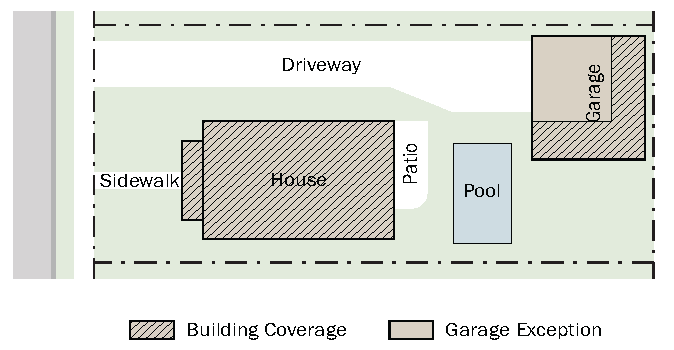
The maximum area of the lot that is permitted to be covered by buildings, including both principal structures, structured parking and roofed accessory structures.
b.
Building coverage does not include paved areas such as driveways, uncovered porches or patios, decks, swimming pools, porte cochere, or roof overhangs of two (2) feet or less.
c.
A detached residential garage up to four hundred fifty (450) square feet associated with a single-family house, attached house, or rowhouse is not included the calculation of lot coverage.
(22-4)(a)(2)
Primary, side and service street frontage. A site's primary, side and service street frontages shall be designated by the administrator. See section 22-6(b)(5), site plan review. In making a determination the administrator shall consider the following standards:
a.
When a site abuts only one (1) street, that street is the primary street frontage.
b.
On corner sites, one (1) street is a primary street frontage and the other street or streets may be designated a primary street or a side street frontage. In determining the required primary street frontage, the administrator shall consider the following conditions:
1.
The street with the highest street classification;
2.
The established orientation of the block;
3.
The street abutting the longest face of the block; and
4.
The street parallel to an alley within the block.
c.
When a site runs from one (1) street to another and has a double frontage, one (1) street may be designated a service street frontage provided the following standards are met:
1.
The applicant controls the land along an entire block face;
2.
A site with a service street must have at least two (2) street frontages and one (1) street frontage must be a primary street; and
3.
Only one (1) service street frontage may be designated abutting any block.
d.
When a site abuts four (4) or more streets, two (2) service street frontages may be designated provided that two (2) or more primary street frontages are also designated.
(22-4)(a)(3)
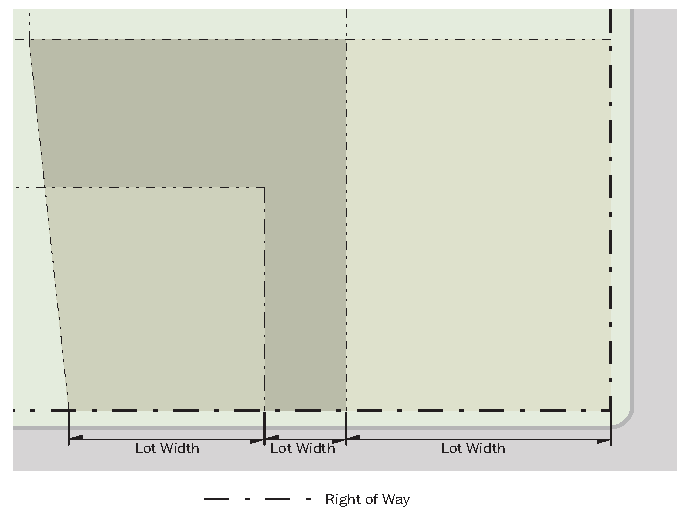
Lot width. The minimum lot width of all lots shall be measured from side property line to side property line along the right-of-way of the primary street providing access to the lot.
(22-4)(a)(4)
Setbacks.
a.
General.
1.
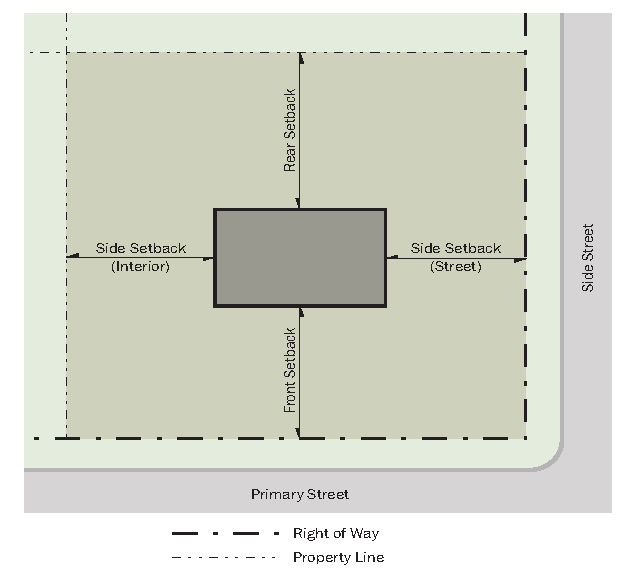
No part of a setback or other open space required for any structure or use for the purpose of complying with the provisions of this development code may be included as a part of a setback or other open space similarly required for another structure or use.
2.
Front, side street, and parking setbacks are measured from the front lot line or the required right-of-way as determined by the master street plan, whichever creates the greater setback. When the city council by ordinance establishes a specific right-of-way line for a street, the front yard setback is measured from that right-of-way line. Interior side setbacks are measured from the side property line. Rear setbacks are measured from the rear property line or the edge of the right-of-way if there is an alley.
b.
Build-to area.
1.
The build-to area is the portion of the lot that must be occupied with a building façade. The primary street and side street build-to areas are measured as a minimum and maximum setback range from the edge of the right of way.
2.
The minimum percentage specifies the minimum linear extent of build-to area that must be occupied with a building façade.
3.
On corner lots, a building façade must be placed within the build-to area for the first thirty (30) feet along the street extending from the block corner.
4.
Garage setbacks. Front facing garages shall be setback twenty-five (25) feet from the internal edge of the sidewalk. Side facing garages may be built to the regular building setback line.
c.
Parking setback.
1.
On-site surface parking must be located behind the parking setback line, if one is established.
d.
Encroachments. The following allowed encroachments apply to all required setbacks unless otherwise stated, so long as they do not extend into any easements that prohibit such encroachments. Structures below and covered by the ground may extend into any required setback.
1.
Building features.
i.
Chimneys, flues or smokestacks may encroach a maximum of two (2) feet.
ii.
Building eaves or roof overhangs may extend up to two (2) feet; provided that such extension is at least two (2) feet from the property line, its lower edge is at least seven and one-half (7½) feet above the ground, and it is located at least five (5) feet from any other building or eave.
iii.
Bay windows, entrances and similar features that are less than ten (10) feet wide may extend up to three and one-half (3½) feet into the setback but must remain at least five (5) feet from the property line.
iv.
Cornices, belt courses, sills, buttresses, or other similar architectural features may project within two (2) feet of a lot line.
v.
Unenclosed fire escapes or stairways may project up to four (4) feet.
vi.
Unenclosed patios, decks, and terraces may extend up to four (4) feet into a required side setback, or up to eight (8) feet into a required rear setback but may not project within two (2) feet of a common lot line.
2.
Building elements.
i.
Porches may extend up to eight (8) feet into a required setback but may not project within two (2) feet of a common lot line. A porch may not encroach into the public right-of-way without a license for the use of public right-of-way.
ii.
Stoops may extend a maximum of five (5) feet into a required setback but may not project within two (2) feet of a common lot line. A stoop may not encroach into the public right-of-way without a license for the use of public right-of-way.
iii.
Balconies may extend up to six (6) feet into a required setback but may not project within five (5) feet of a common lot line. A balcony may not encroach into the public right-of-way without a license for the use of public right-of-way.
iv.
Awnings, light shelves, galleries and arcades may extend into a required front setback. Awnings, light shelves, galleries and arcades may not encroach into the public right-of-way without a license for the use of public right-of-way.
3.
Mechanical equipment and utilities lines.
i.
Mechanical equipment associated with residential uses, such as HVAC units and security lighting, may extend into a required rear or side setback but must remain at least four (4) feet from a common lot line.
ii.
Solar and wind energy systems may extend into a required rear or side setback, but must remain at least three (3) feet from a common lot line.
iii.
Minor structures accessory to utility lines (such as hydrants, manholes, stormwater inlets, and transformers and other cabinet structures) may extend into any required setback.
4.
Other encroachments.
i.
The following encroachments may extend into any required setback:
A.
Outdoor dining.
B.
Fence and walls as set forth in section 22-4(f)(3), screening.
C.
Benches, trash receptacles, public art, water features, bicycle racks, bollards, planters and other street furniture.
D.
Pedestrian lighting.
E.
Landscaping, sidewalk, trees, tree grates and planters.
F.
Non combustible, non-permanent structures, such as metal sheds and RV covers.
ii.
Pedestrian amenities such as benches, trash receptacles, galleries, arcades, awnings, and outdoor seating may be allowed in the right-of-way subject to approval by the administrator.
(22-4)(a)(5)
Height.
a.
Structure height.
1.
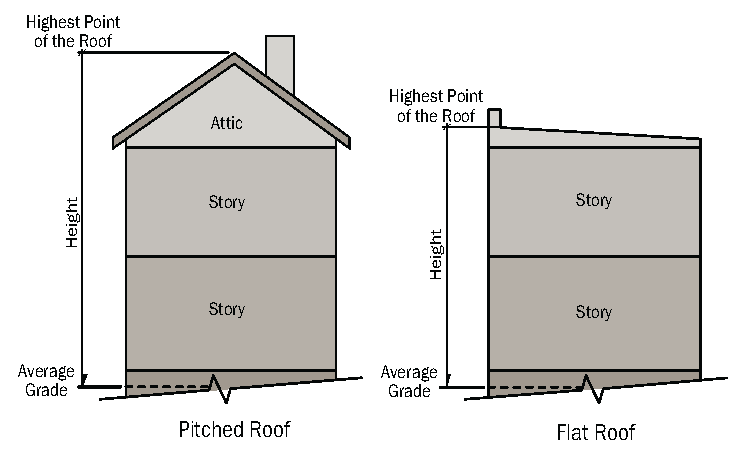
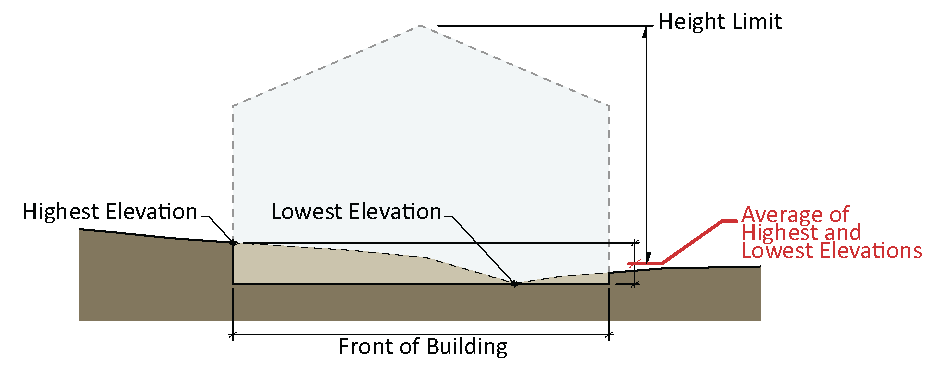
Structure height is measured in both number of stories and feet from the average grade to the top of the highest point of the roof.
2.
Average grade is determined by calculating the average of the highest and lowest elevation along natural or improved grade (whichever is more restrictive) along the front of the building parallel to the setback line.
3.
A basement with fifty (50) percent or more of its perimeter wall area surrounded by natural grade is not considered a story.
4.
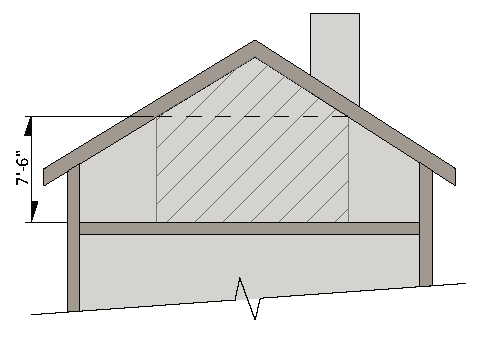
An attic is not a story where fifty (50) percent or more of the attic floor area has a clear height of less than seven and one-half (7½) feet; measured from the finished floor to the finished ceiling.
b.
Ground story height and elevation.
1.
Ground story height is measured from the finished floor to the ceiling above.
2.
Ground story elevation is measured from natural or improved grade (whichever is more restrictive) to the finished floor of the ground floor. Grade is measured continuously across a lot.
c.
Height exceptions. The following accessory structures may exceed the established height limits, provided they do not exceed the maximum building height by more than twelve (12) feet:
1.
Cooling tower;
2.
Clerestory;
3.
Chimney and vent stack;
4.
Elevator penthouse or bulkhead;
5.
Flagpole;
6.
Mechanical equipment room;
7.
Ornamental cupola or dome;
8.
Parapet wall, limited to a height of four (4) feet;
9.
Roof top deck;
10.
Skylights;
11.
Solar panels;
12.
Spire, belfry;
13.
Stairway access to roof;
14.
Tank designed to hold liquids;
15.
Visual screens surrounding roof-mounted mechanical equipment; and
16.
Wind turbines and other integrated renewable energy systems.
d.
Additional height. Additional height for principal or accessory structures may be granted through the process under section 22-6(b)(6), Special use permit.
e.
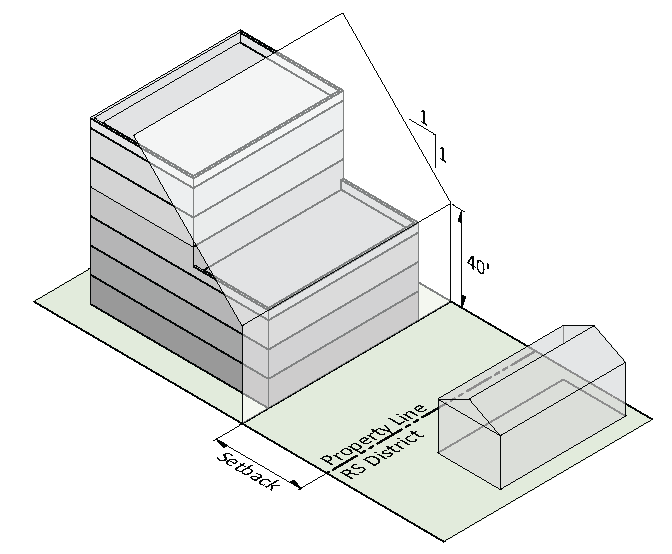
Bulk plane. For buildings whose height is limited by a bulk plane as required in section 22-2, zoning districts, no structure shall exceed a bulk plane starting at forty (40) feet in height at the side or rear setback line, and extending upward one (1) foot for every additional foot into the site from the setback line.
(22-4)(a)(6)
Transparency.
a.
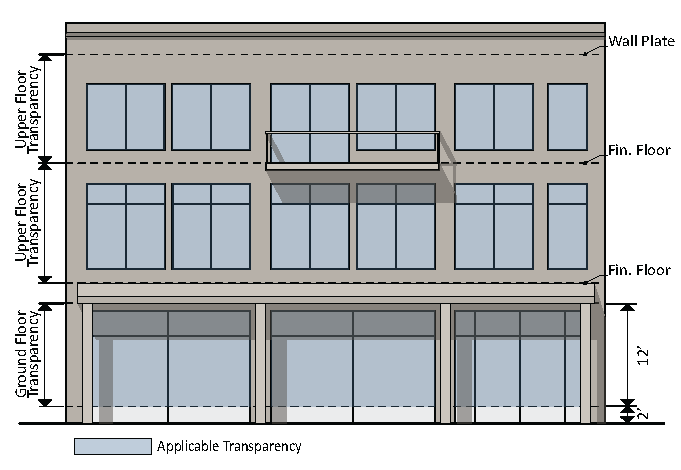
Ground floor transparency (windows and doors) is measured between two (2) and twelve (12) feet above the adjacent sidewalk or street.
b.
Upper floor transparency is measured from between the finished floor of the second story to the top wall plate.
c.
Windows shall not be mirrored or have glass tinted darker than forty (40) percent in order to meet this requirement.
(22-4)(a)(7)
Blank wall area.
a.
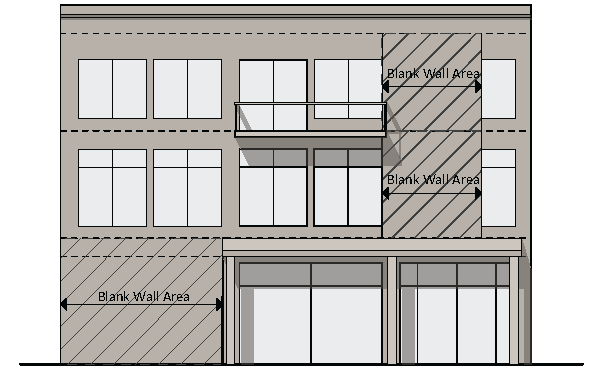
Blank wall area is the portion of the exterior façade of a floor of a building, measured parallel to the street, that does not include a substantial material change; windows or doors, display windows, art installations, columns, pilasters or other articulation greater than twelve (12) inches in depth.
b.
Blank wall area applies individually to both ground and upper story street-facing floors from the finished floor to the eave.
(22-4)(b)
Principal buildings per lot.
(22-4)(b)(1)
One (1) principal building per tract or lot. Unless otherwise permitted in section 22-4(b)(2), multiple principal buildings on a lot, no more than one (1) principal building may be erected on a single lot. Wireless communication towers and facilities, or power lines on a site shall not constitute an additional principal building.
(22-4)(b)(2)
Multiple principal buildings on a lot.
a.
Defined. A group of two (2) or more rowhouses, cottage homes, apartments and/or mixed use buildings, on a single lot operating under a common legal relationship. The provisions of this section do not apply to a permanent off-premises advertising sign on an individual tract or lot where only one (1) such sign is permitted on an individual tract or lot.
b.
General. If multiple principal buildings are established on a single lot, the following requirements shall be met:
1.
Multiple principal buildings in the form of rowhouses, cottage homes, apartments and/or mixed use buildings shall meet all applicable development standards as set forth in this zoning code.
2.
Uses shall be limited to those permitted within the district in which the development is located.
3.
Each building shall meet the setback requirements of the district in which the development is located.
(22-4)(c)
Accessory structures.
(22-4)(c)(1)
General.
a.
Accessory structures shall be clearly incidental and subordinate to a permitted principal structure.
b.
Accessory structures shall be located on the same lot as the principal structure, or on a contiguous lot in the same ownership.
c.
No accessory structure may extend forward of the front building façade of the primary structure.
(22-4)(c)(2)
Accessory structure separation. Except in the C-MS [district], accessory structures shall be separated from all principal structures by a minimum of ten (10) feet.
(22-4)(d)
Building standards for all buildings.
(22-4)(d)(1)
General.
a.
Purpose and intent. To provide a range of development standards that promote and encourage consistency in the quality of design and encourage design innovation that provides for a building stock that contributes to the overall quality of life.
b.
Relationship to other regulations. In the event of a conflict between this section and other sections of this zoning code, the more restrictive shall apply.
(22-4)(d)(2)
Building materials.
a.
Building materials.
1.
The following primary building materials shall be utilized on a minimum of sixty-five (65) percent of the street-facing building façade or greater:
i.
Brick;
ii.
Stone;
iii.
Stucco;
iv.
Wood siding and wood simulation materials;
v.
Metal panels, including recycled panels and blocks;
vi.
Fiber reinforced cement siding or panels;
vii.
Ceramic tile; and
viii.
Other as approved by the administrator.
2.
The following building materials are prohibited as primary cladding on new street-facing building façades and shall not be allowed on more than thirty-five (35) percent of each individual building façade:
i.
Corrugated metal;
ii.
Plain concrete block;
iii.
Plain concrete;
iv.
Spandrel glass; and
v.
Sheet pressboard.
3.
The following building materials are permitted as accent materials on no greater than five (5) percent of each individual building façade (e.g., flashing, projecting features, ornamentation, etc.):
i.
Split-faced block (for piers and foundation walls); and
ii.
Gypsum reinforced fiber concrete (for trim elements).
4.
The following building materials are prohibited:
i.
T-111 plywood; and
ii.
Exterior insulation finishing system (EIFS).
22-4(d)(3)
Roofs and roofing. All single family residential units shall have architectural grade overlap shingles, tile or standing seam metal. Roofs shall have a minimum roof pitch of 6:12.
(22-4)(e)
Parking standards.
(22-4)(e)(1)
Applicability.
a.
Unless specifically exempted in this zoning code, all existing and proposed development shall provide parking facilities and manage access in accordance with this zoning code. No certificate of occupancy may be issued until these standards have been met.
b.
With the exception of restriping a parking area or other vehicular use area which does not result in a reconfiguration of the parking spaces, any modification to existing parking facilities shall conform to the requirements of this zoning code.
c.
Buildings and uses lawfully existing as of October 17, 1977, may be renovated or repaired without providing additional parking facilities, provided there is no increase in gross floor area or change in use of existing floor area that would increase parking demand. In order to encourage the reuse of existing buildings, any building constructed prior to October 17, 1977, having fewer spaces than required shall be credited with one (1) parking space for each two hundred fifty (250) square feet of gross area inside the building without regard to the number of parking spaces, if any, that actually exist on the site.
d.
Where a building or use existed as of October 17, 1977, and the building or use is enlarged in gross floor area or impervious area by ten (10) percent or two thousand (2,000) square feet, whichever is less, parking as specified in this zoning code shall be required for the enlarged area. The addition of an accessory building or structure shall be considered an enlargement of the building or use.
e.
A change in use of a building or use existing as of the effective date of this zoning code shall require additional parking facilities to comply with the requirements of this zoning code for the new use unless:
1.
The building is less than two thousand (2,000) square feet in floor area; or
2.
The new use has the same parking requirement or a lesser requirement than the previous one.
(22-4)(e)(2)
General provisions.
a.
Parking required. No use shall provide less than the minimum number of parking spaces required under this zoning code. At the discretion of the property owner or occupier, a fee may be charged for required parking.
b.
Location of parking spaces. Unless otherwise approved in an alternative parking plan under section 22-4(e)(5), Alternative minimum parking, parking spaces shall be located within a district which permits the use that such parking serves, or in a district that permits parking as a principal use.
c.
Clear sight distance. No parking lot or vehicular use area shall interfere with a clear sight distance as set forth in section 22-4(f), site and landscaping standards.
d.
Use of parking spaces. Except as provided in section 22-3(i), temporary uses, required parking spaces shall not be used for the storage or sale of merchandise, vehicles for sale, or vehicle repair.
(22-4)(e)(3)
Parking ratios.
a.
Calculation of ratios.
1.
Standard requirements.
i.
Every use shall include the number of parking spaces indicated under the classifications and formulas set forth in this section.
ii.
Parking calculations shall include the floor area of all structures and includes outdoor seating areas. Storage areas, halls and bathrooms are excluded from floor area calculations.
2.
Mixed uses. Developments containing more than one (1) use shall provide parking spaces in an amount equal to the total of the requirements for all uses, including any adjustments made under an approved alternative parking plan under section 22-4(e)(5), Alternative minimum parking.
3.
Fractional measurements. Where fractional spaces result, the parking spaces required shall be rounded to the nearest whole number.
b.
Minimum. The following minimum parking ratios apply to all zoning districts. Where in the opinion of the applicant, a listed ratio requires too much or too little parking, the applicant may provide an alternative parking plan with data submitted in support of higher or lower ratios.
c.
Required parking ratios. Unless specifically reduced in section 22-4(e)(4), parking reductions, the following parking ratios shall apply to all development:
d.
Handicapped accessible parking. Every use shall include the number of handicapped accessible parking spaces set forth below. The location and design of such spaces shall conform to the requirements of the Americans with Disabilities Act.
e.
Unlisted uses. The parking space requirements for a use not specifically listed in the table shall be the same as for the listed use deemed most similar to the proposed use by the administrator.
f.
Administrative modification. The administrator may reduce the required number of spaces by up to five (5) percent for reasons of topography, tree protection or other natural conditions specific to the site.
g.
Credit for on-street spaces. On-street parking spaces located immediately abutting the subject parcel, lying entirely within the extension of the side lot lines into the roadway and not within any required clear sight distance, may be counted toward meeting these parking requirements.
(22-4)(e)(4)
Parking reductions. Parking may be reduced according to the following standards:
a.
Bus transit availability. Locations within a 660-foot walking distance of an improved bus stop providing both shade and seating may reduce the total number of required parking spaces by fifteen (15) percent. Walking distance is measured from the primary entrance of the use to the bus boarding location.
b.
Provision of structured parking. Where parking is provided in a structure, the required total number of spaces may be reduced by ten (10) percent.
c.
Access to car-sharing program. A residential project or a mixed use project with a residential component providing an active car-share program may reduce the total number of required parking spaces. The reduction shall equal five (5) spaces per car-share vehicle available on-site to residents of the project.
d.
Tree preservation. The administrator may approve a reduction in the total number of required parking spaces by one (1) space for every tree over twenty-four (24) inches in diameter at breast height preserved within the parking area. The maximum reduction allowed for tree preservation is five (5) percent of the total required parking spaces.
(22-4)(e)(5)
Alternative minimum parking. The administrator may modify the parking requirements in section 22-4(e)(3), parking ratios when an applicant submits parking data illustrating that the standards do not accurately apply to a specific development. The data submitted for an alternative parking plan shall include, at a minimum, the size and type of the proposed development, and the anticipated peak and average parking loads of all uses. The administrator may approve a parking requirement that is based on:
a.
An analysis conducted using the Urban Land Institute's data and methodology as described in the most recent version of the publication Shared Parking; or
b.
The data and methodology as described in the latest version of the Institute of Transportation Engineers publication Parking Generation; or
c.
An alternative analysis that the administrator deems to have met the requirements of this section.
(22-4)(e)(6)
Parking area design standards.
a.
Parking space layout.
1.
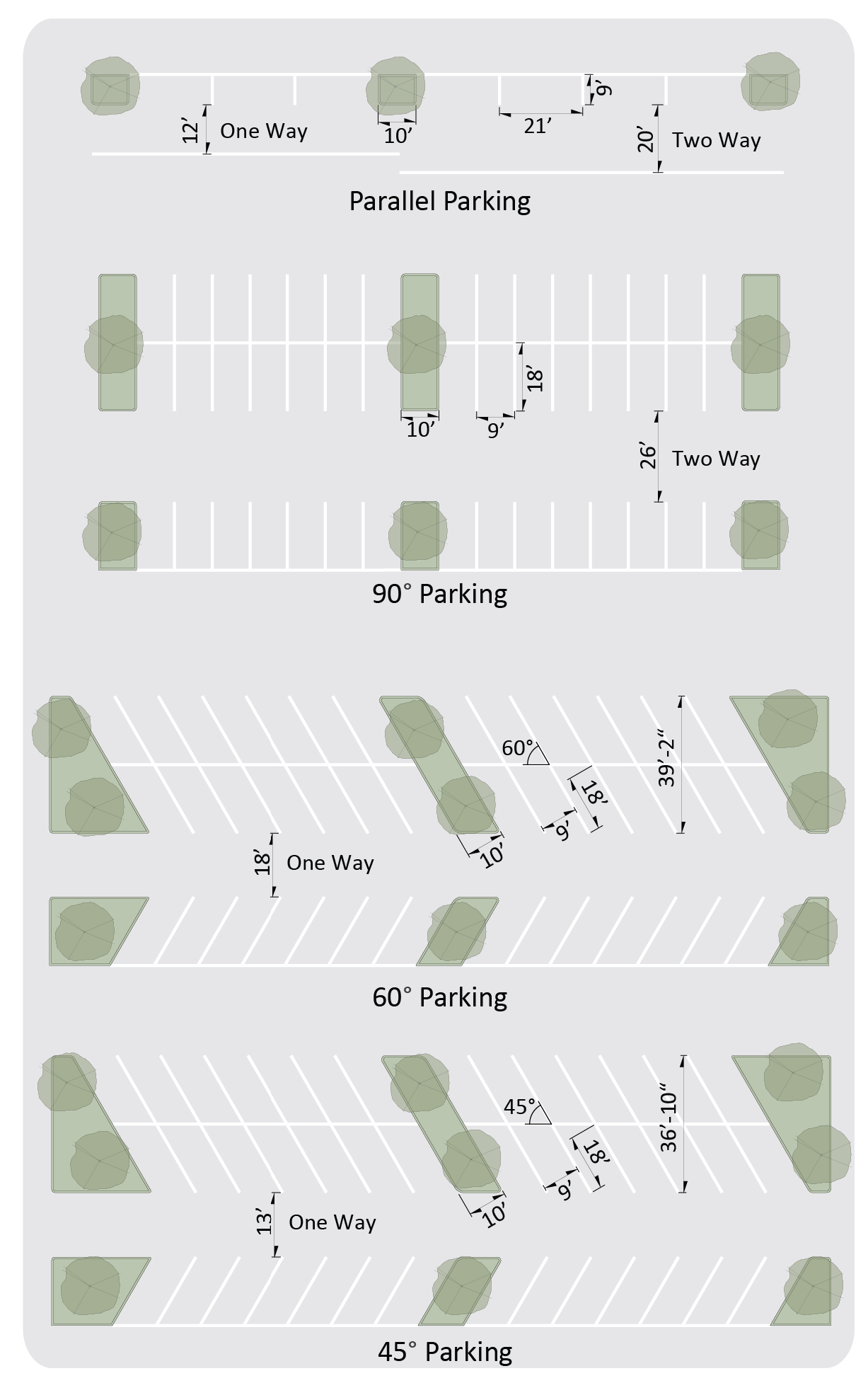
Nonresidential parking spaces shall meet the following:
2.
Residential parking spaces shall be a minimum of nine (9) feet by twenty (20) feet.
3.
Parking spaces using geometric standards other than those specified above may be approved if developed and sealed by a registered engineer with expertise in parking facility design, subject to a determination by the administrator that the proposed facility will satisfy these parking requirements as well as would a facility using the dimensions specified above.
4.
The minimum dimensional requirements of parking spaces in a structured parking facility shall be shown on a parking plan designed and sealed by a professional engineer and shall be established by the administrator.
b.
Location standards. Parking and maneuvering areas shall not be located in any required buffer.
c.
Landscaping and screening. Landscaping and screening of parking areas shall be provided in accordance with the requirements of section 22-4(f), site and landscaping standards.
d.
Surfacing.
1.
Surfacing required. Except as provided below, where parking facilities or any other vehicular use area are provided, they shall be surfaced with asphalt bituminous, concrete or dustless material approved by the administrator, and shall be maintained in a smooth, well-graded condition.
2.
Pervious parking surfaces.
i.
All parking spaces may be surfaced with pervious parking surface that is engineered for parking or driveways.
ii.
Where an existing tree is adjacent to parking, paver bricks or other pervious surface shall be used within the dripline of the tree. No parking shall be located closer than five (5) feet from the trunk of an existing tree.
iii.
Where provided, pervious parking surfaces shall be maintained in a smooth, well-graded condition.
e.
Setback.
1.
All off-street parking must observe the required parking setback for the appropriate zoning district.
2.
In the event any parking abuts a walkway, sidewalk or street, the parking shall [be] separated by curbing or other protective device with a minimum distance of five (5) feet between the protective device and the edge of the walkway, sidewalk or street.
3.
All parking shall be separated from buildings by a minimum distance of three (3) feet.
f.
Striping. All parking areas over two thousand (2,000) square feet or containing more than five (5) individual off-street parking spaces, shall stripe their required parking spaces.
(22-4)(e)(7)
Bicycle parking. Minimum bicycle parking requirements in R-3-MU, C-MS, and TND districts:
a.
Parking spaces. Except where indicated otherwise in this zoning code, every use shall provide one (1) bicycle parking space for every twenty (20) parking spaces provided to a maximum of fifty (50) bicycle parking spaces. The administrator may approve a reduction in the amount of bicycle parking per section 22-4(e)(5), Alternative minimum parking.
b.
Exemptions. No bicycle parking spaces shall be required for any of the following:
1.
Any single-family dwelling, two-family dwelling, or group home.
2.
Any industrial use.
(22-4)(e)(8)
Stacking. The following stacking standards shall apply unless otherwise expressly approved by the administrator. The administrator may require additional stacking spaces where trip generation rates suggest that additional spaces will be needed:
a.
Minimum number of spaces. Off-street stacking spaces shall be provided as follows:
b.
Design and layout. Required stacking spaces are subject to the following design and layout standards:
1.
Dimensions. Stacking spaces shall be a minimum of nine (9) feet by twenty (20) feet in size.
2.
Location. Stacking spaces shall not impede on- or off-site traffic movements or movements into or out of parking spaces.
3.
Design. Stacking spaces shall be separated from other internal driveways by raised medians if deemed necessary by the administrator for traffic movement and safety.
(22-4)(e)(9)
Off-street loading.
a.
General requirements.
1.
Location of loading areas and docks.
i.
All required loading areas and docks shall be located on the same lot as the use served unless a central loading facility is incorporated as part of a single development.
ii.
All loading docks that abut a residential zoning district or are visible from a public right-of-way shall be completely screened by building walls, a solid concrete or masonry wall, or a door designed to be compatible with the principal building that it serves. The screening wall shall not be less than six (6) nor more than eight (8) feet in height.
iii.
No loading dock shall be located within thirty (30) feet of the nearest point of intersection of any two (2) streets.
iv.
No loading areas or docks shall be located in a required front or side yard abutting a residential zoning district.
2.
Dimensions of loading docks.
i.
Unless otherwise specified, a required loading dock shall be at least twelve (12) feet in width by at least thirty-five (35) feet in length exclusive of aisle and maneuvering space, and shall have a vertical clearance of at least nineteen (19) feet.
ii.
Maneuvering aprons for docks shall be at least sixty (60) feet in length.
iii.
Access lanes for docks shall be fourteen (14) feet in width for one-way lanes and twenty-four (24) feet in width for two-way lanes. Space dedicated for access lanes may also be considered as space for the maneuvering apron.
3.
Access. Each required loading area or dock shall be designed with appropriate means of vehicular access to a street or alley in a manner which will least interfere with traffic movement, shall be separated from required customer and employee parking, and shall be subject to approval by the administrator.
b.
Required loading areas. Except where indicated otherwise in this zoning code, every use listed in the table below shall provide the identified number of loading areas or docks with each facility being at least twelve (12) feet wide and thirty-five (35) feet deep with a vertical clearance of thirty-five (35) feet.
c.
Receiving areas. Uses that require loading facilities that are located in buildings with less floor area than the minimum described in the table below shall provide adequate receiving facilities accessible by motor vehicles off any adjacent alley, service drive, or open space on the same zoning lot.
(22-4)(f)
Site and landscaping standards.
(22-4)(f)(1)
Applicability. These landscape standards shall apply to all developments that meet any of the following categories, with exceptions granted to agricultural uses.
a.
Residential.
1.
Building a structure that contains three (3) or more dwelling units.
2.
Developing a new parking lot that contains ten (10) or more spaces.
b.
Nonresidential.
1.
Building a structure of greater than one thousand (1,000) gross square feet.
2.
Converting a residential structure to nonresidential use.
3.
Developing a new parking lot that contains ten (10) or more spaces.
c.
Expansions/renovations.
1.
Multi-family expansion of ten (10) percent of the number of units or ten (10) units, whichever is less.
2.
Cumulative nonresidential expansion of a building by more than two thousand five hundred (2,500) square feet or forty (40) percent of the original building's square footage, whichever is less.
3.
Reconstruction after any voluntary demolition.
4.
Parking lot expansion (excluding re-striping and re-surfacing) of ten (10) spaces or more.
(22-4)(f)(2)
Site and landscape requirements.
a.
Preparation of landscape plan.
1.
Landscape plans shall be prepared by a professional landscape architect licensed in the State of Louisiana and shall bear the Landscape Architect's seal and signature.
2.
All landscape plans shall contain a statement, signed and dated by the preparer, certifying that the landscape architect will inspect the landscaping following installation to certify that the landscaping was installed in compliance with the approved plan.
b.
Street yard.
1.
Except in C-MS districts, a minimum ten-foot landscape strip and a five-foot sidewalk is required along the entire public street frontage, except for driveways providing access to the property.
2.
In C-MS districts, a minimum five-foot landscape strip and a five-foot sidewalk is required along the entire public street frontage, except for driveways providing access to the property.
3.
One (1) tree shall be planted for every forty (40) linear feet, or part thereof, and may be grouped or spaced at irregular intervals.
4.
The landscape strip shall be covered in sod or ground cover.
5.
When a parking lot is adjacent to the street, a continuous three-foot screen is required the length of the parking lot, consisting of:
i.
Continuous evergreen shrubs; or
ii.
A wall, fence, or berm.
6.
In C-MS, R-3-MU, and TND districts:
i.
Sidewalk lighting. Pedestrian lighting is required to maintain a minimum 0.5 foot-candles with an average of 1.5 foot-candles measured three (3) feet above the pavement surface. Lighting may be attached to buildings or freestanding.
ii.
Pedestrian and sidewalk amenities. The following pedestrian amenities are required:
A.
Benches at one (1) per three hundred (300) feet of frontage on at least one (1) primary street.
B.
Trash receptacles at one (1) per three hundred (300) feet of frontage on at least one (1) primary street.
C.
Bicycle parking at one (1) five-bicycle rack per three hundred (300) feet of frontage on at least one (1) primary street.
iii.
Driveway access and design.
A.
Vehicular access to parking may not be from the primary street, unless access is not available from secondary streets or commercial alleys.
B.
Where vehicular access to parking must occur from primary street, driveways shall be designed to maintain continuous pedestrian flow across the driveway by maintain grade and materiality of pedestrian surface in order to indicate primacy of pedestrian traffic. Maximum driveway width is eighteen (18) feet for two (2) access and ten (10) feet for one-way.
c.
Required buffers.
1.
Generally.
i.
Buffers are required as specified in section 22-3, use provisions.
ii.
Properties zoned mixed use or main street are not required to construct buffers internal to the development.
iii.
The required buffer shall be measured from the property line and may be located wholly or partially within a required setback.
iv.
It is the responsibility of the more intensive use to construct the buffer.
v.
Design variations may be permitted by the administrator.
2.
Buffer standards.
i.
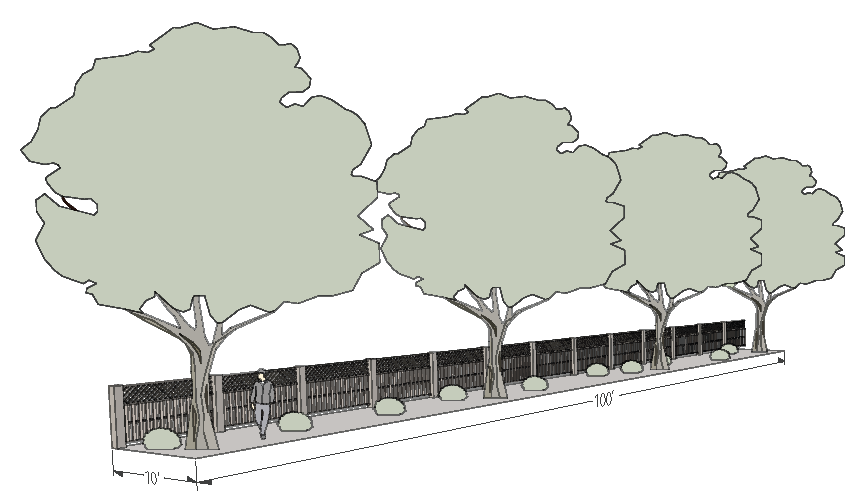
Width. The buffer shall be an average of ten (10) feet wide.
ii.
Screen. The required screen shall be a minimum of six (6) feet and maximum of eight (8) feet in height and composed of:
A.
A fence constructed of materials, such as treated wood or other material approved by the administrator; or
B.
Continuous evergreen shrubs.
iii.
Trees. One (1) tree shall be planted for every forty (40) linear feet, or part thereof and may be grouped or spaced at irregular intervals.
(22-4)(f)(3)
Screening.
a.
Fences and walls in general.
1.
Fences and walls, other than those required for screening, shall be constructed of wood, decorative metal, or masonry (other than unfinished or painted concrete block). The structural support members of wooden perimeter fences shall be located on the interior of the fence and shall not be visible from adjacent properties.
2.
Fences located in front yards may not be higher than four (4) feet in height unless they are constructed to permit fifty (50) percent visibility into the yard or are required for screening.
b.
Loading areas. Loading docks shall be fully screened from the street or from adjacent residential property with screening a minimum of six (6) feet in height and complementary to the principal building architecture.
c.
Mechanical equipment and dumpsters.
1.
All roof, ground and wall-mounted mechanical equipment (e.g. air handling equipment, compressors, duct work, transformers and elevator equipment), and dumpsters shall be screened from ground level view from public rights-of-way and adjacent properties.
2.
Roof-mounted mechanical equipment screening shall consist of materials consistent with the primary building materials, and may include metal screening or louvers painted to blend with the primary structure.
3.
Wall or ground-mounted equipment and dumpster screening shall be constructed of:
i.
Planted vegetative screens;
ii.
Brick, stone, reinforced concrete or other similar masonry materials; or
iii.
Redwood, cedar, pressure-treated wood or other similar materials.
d.
Utilities. With the exception to those located in the right-of-way, all above-ground utilities and appurtenances to underground utilities which require above-ground installation shall be screened by a continuous planting of shrubs, with a minimum mature height equal to that of the utility structure or with screening made materials the same or complimentary color and/or style as the building. Required access points to these utilities are exempt from screening.
(22-4)(f)(4)
Design and installation.
a.
Plant material.
1.
General.
i.
Plant materials shall be cold hardy for the specific location where they are to be planted.
ii.
Trees and shrubs shall be drought-tolerant and able to survive on natural rainfall once established with no loss of health.
iii.
All plant heights shall be measured from the top of the root ball to the tip of the highest branch.
2.
Required trees.
i.
All trees shall have a minimum two-inch caliper and must measure a minimum of eight (8) feet tall at time of planting.
ii.
Trees shall be of a species that normally grows to an overall height of at least fifty (50) feet, usually with one (1) main stem or trunk and many branches.
iii.
Trees planted under existing power lines may be of a species that normally grows to an overall height of at least twenty-five (25) feet, with either one (1) main stem or trunk with many branches, or several stems or trunks.
3.
Required shrubs.
i.
All required shrubs shall be a minimum of twenty (20) inches in height in a minimum three-gallon container.
ii.
Shrubs shall be of a species that under average conditions will reach a minimum height of twenty-four (24) inches within twelve (12) months.
iii.
When planted as a hedge to screen parking, the maximum spacing for 20-inch high shrubs shall be thirty-six (36) inches on center. Spacing for other size shrubs shall be determined by the administrator.
4.
Ground cover. Ground cover shall be of a type that will provide eighty (80) percent coverage within five (5) years of planting.
b.
Credit for existing plant material.
1.
Required landscaped areas shall incorporate existing natural vegetation to the maximum extent feasible. Prior to disturbance of a required planting area, approval shall be obtained from the administrator. Where existing vegetation is inadequate to meet the required landscaping standards, additional plant material shall be required.
2.
Existing native habitat or vegetation located within planting areas and meeting the requirements of this zoning code may be counted.
3.
In the event that the existing vegetation has been credited and is subsequently removed or dies, it shall be replaced with the appropriate planting material.
4.
Credit may also be permitted for existing plant material, fences and walls on abutting property, provided such items are in a permanently protected area, including, but not limited to:
i.
A conservation easement or preserve area on adjacent property; or
ii.
An existing utility or drainage easement exceeding one hundred (100) feet in width.
c.
Sight distance planting. A clear sight triangle shall be established at the intersection of a driveway and a street measuring ten (10) feet from the back of the right-of-way and extending seventy (70) feet from the edge of each side of the driveway and on all corner lots (the intersection of two (2) streets) measuring twenty-five (25) feet from the corner of both sides of the intersecting streets at the back of the right-of-way.
d.
Soils. Planting areas shall have un-compacted coarse loam that is a minimum of twelve (12) inches deep. Soils shall be appreciably free of gravel, stones, rubble or trash. All compacted soil, contaminated soil or road base fill shall be removed.
e.
Irrigation. A water source shall be supplied within two hundred (200) feet of any planting requiring watering to become established. Where non-native or non-drought tolerant native vegetation is incorporated, an irrigation system shall be required.
f.
Tree protection during construction.
1.
Existing trees to remain on the site as required landscaping shall be protected from vehicular movement and material storage over their root spaces during construction. An undisturbed area with a porous surface shall be reserved below the dripline of each tree or group of trees.
2.
Trees designated for protection must be completely enclosed by a fence. Fencing must be in place prior to any clearing or site work. Fencing must remain in place until all construction has been completed or a certificate of occupancy has been issued, whichever is latest.
g.
Issuance of certificate of occupancy.
1.
The administrator shall not issue a permanent certificate of occupancy until all seeding, trees and plant material have been placed in accordance with the requirements of this zoning code.
2.
A temporary certificate of occupancy may be issued for a period of thirty (30) days under circumstances that would affect the seeding and planting of the site, or until the proper planting season is reached to complete the landscaping requirements, and may be extended up to ninety (90) days upon request.
h.
Constrained sites. Alternative landscaping may be approved by the administrator only where the required landscaping in this zoning code cannot be physically met on the site for one (1) of the following reasons:
1.
Redevelopment of an existing site requires landscaping to be added, but a building, pavement or stormwater facility already exists; or
2.
The site has lost area from existing landscaping due to adjacent road widening.
(22-4)(f)(5)
Maintenance.
a.
Responsibility.
1.
The responsibility for maintenance of required landscaping shall remain with the owner, his or her successors, heirs, assignees or any consenting grantee.
2.
The responsibility for maintenance of landscaping within the adjacent rights-of-way shall remain with the owner, his or her successors, heirs, assignees or any consenting grantee.
b.
Maintenance.
1.
All plant materials shall be maintained in an attractive and healthy condition.
2.
Dead or diseased plant materials shall be removed. Replacement plant materials shall be provided for any required plants that die or are removed for any reason.
3.
Landscape structural features such as walls, fences, berms or water features shall be maintained in a structurally safe and attractive condition.
4.
All landscape areas shall be kept free of refuse and debris.
c.
Failure to maintain.
1.
In the event that any owner of a landscaped area fails to maintain the area according to the standards of this paragraph, the City of Gonzales shall have the right to recover the cost of enforcement, including reasonable attorney fees.
2.
The City of Gonzales may also, following reasonable notice and a demand that deficiency of maintenance be corrected, enter the landscaped area to take maintenance action. The cost of such maintenance shall be charged to the party having the primary responsibility for maintenance of the landscaped area.
(Ord. No. 3084, Att., 4-25-16; Ord. No. 4014, 4-24-17; Ord. 4187, 6-27-22; Ord. No. 4199, 1-9-23; Ord. No. 4209, 4-24-23)

