
Gonzales City Zoning Code
APPENDIX B
PLANNED UNIT DEVELOPMENT PUD CODE2
Editor's note—Ord. No. 4158, adopted May 24, 2021, added a new Appendix B to Chapter 22 as Art. I, §§ 1—9; Art. II, §§ 1—8; Art. III, §§ 1 and 2; and Art. IV. To maintain the style of the Code and prevent duplication of section numbers, and at the editor's discretion, these provisions have been renumbered as §§ 22-100—22-108; 22-200—22-207; 22-300, 22-301; and Art. IV.
Sec. 22-100. - General Character.
A.
Purpose. It is the intent of this section to, and the following objectives shall be achieved, where applicable, through the use of the planned unit development process:
1.
Encourage the development of large tracts of land as planned neighborhoods, communities and/or developments.
2.
Encourage flexible and creative concepts in site planning.
3.
Preserve the natural amenities of the land by encouraging scenic and open areas, and create a method for the permanent preservation of common open space, natural vegetation, topographic and geological features, and environmentally appropriate features for the continued use and enjoyment of the residents of the development.
4.
Accomplish a more desirable environment than would be possible through the strict application of minimum requirements of the current development code, and permit a maximum choice in the types of environment available to the public by allowing a development that would not be possible under the strict application of the other sections of this ordinance.
5.
Provide an efficient use of land, which could result in smaller networks of utilities and streets, and promote a creative approach to the use of land and related physical facilities that result in better design and development, with the inclusion of aesthetic amenities including an increased amount of landscaping.
6.
Provide an environment of stable character compatible with surrounding area, and combine and coordinate architectural styles, building forms, and building relationships with a possible mixing of different urban uses in an innovative design.
7.
Provide an environment that encourages non-vehicular circulation.
8.
Provide for the prevention and/or control of soil erosion, surface flooding, and the preservation of subsurface water.
9.
Provide for more usable and suitably located recreation facilities, schools, and other public and private facilities.
10.
Create a method for the permanent preservation of architectural and/or historic landmarks.
11.
Promote a land use which promotes the public health, safety and welfare.
B.
Within the planned area, a variety of land use types should be designed, in an orderly relation to one another and to existing land uses, and with due regard to comprehensive planning.
C.
Such development may consist of conventionally subdivided lots to be sold, unsubdivided single ownership, separate condominium ownership of structures, or other ownership methods and shall provide for development by means of a planned unit development plat which establishes the location and extent of the features of the planned unit development in keeping with its purpose.
D.
The unique and substantially different character of planned unit developments require their administrative processing as a "special rezoning" in this ordinance. Planned unit developments are more complex and of a different character than other zoning classifications, requiring the establishment herein of specific and additional procedures, standards, requirements and exceptions to govern the recommendations of the planning commission and zoning commission and the action of the city council.
E.
Interpretation.
1.
The subdivision, development and use of land as an integral unit which may provide for single-family residential, multiple-family residential, educational, business, commercial, recreational, park and common open areas, is described as a planned unit development.
2.
In its establishment and authorization as a special zoning classification, the planned unit development may be excepted from the provisions of the Subdivision and site plan regulations and of the zoning ordinance of the City of Gonzales to the extent specified in this ordinance and in the final authorization of the planned unit development as specified in an ordinance approved by the city council.
(Ord. No. 4158, Art. I, § 1, 5-24-21)
Sec. 22-101. - Relation to Zoning Districts.
An approved planned unit development shall be considered to be a separate zoning district in which the development plan, as approved, establishes the restrictions and regulations according to which development shall occur, and may depart from the normal procedures, standards, and other requirements of the other sections of the zoning ordinance and subdivision regulations to the extent provided herein. Upon approval, the official zoning map will be changed to indicate the area as planned unit development concept (or "PUD CONCEPT"), or if final approval granted then as planned unit development (or "PUD"). Every approval of a planned unit development shall be considered an amendment to the zoning ordinance.
(Ord. No. 4158, Art. I, § 2, 5-24-21)
Sec. 22-102. - Review and Approval Procedures; General.
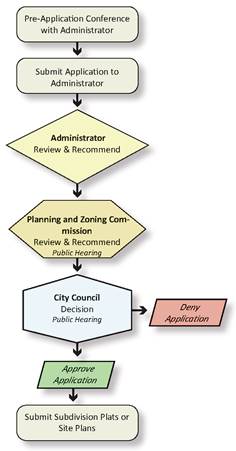
The planned unit development approval process shall consist of the following four (4) components:
A.
Pre-application conference.
B.
Recommendation of concept plan by the commissions and approval of the city council for the entire planned unit development.
C.
Approval of a preliminary plat and drainage impact study by the planning commission and city council.
D.
Approval of a final development plat by the administrator.
E.
Approval of a final plat by the administrator.
F.
If the planned unit development includes the division of property into lots, the final development plan shall be approved concurrently with a preliminary plat.
G.
Subdivisions of property within a planned unit development after concept plan approval, but prior to final development plan approval, shall meet the zoning requirements of the most restrictive zoning district allowed for each designated use for that portion of the concept plan. Development or building permit will not be issued until a final development plan is approved.
H.
Where the planned unit development is to be developed in phases, the concept plan that is presented for review and approval shall be the concept plan for the entire planned unit development and shall identify the proposed phasing. Each phase of a planned unit development shall have an individual final development plan and final plat if lots are created.
I.
Independent consultants may be retained by the commissions and/or the city council to seek assistance to properly review the concept plans and final development plans. The reasonable cost of such review shall be reimbursed by the applicant. The applicant shall be advised of the estimated fees and costs and may withdraw their request from consideration at that time. All required fees must be paid regardless of whether the proposed plans are approved, amended, rejected or withdrawn.
(Ord. No. 4158, Art. I, § 3, 5-24-21)
Sec. 22-103. - Pre-application Conference.
A.
The pre-application conference shall be held with the administrator for the purpose of exchanging information, providing guidance to the applicant and determining the eligibility of the request for consideration as a planned unit development.
B.
A request for a pre-application conference shall be made to the administrator. As part of the pre-application conference, the applicant shall submit five (5) copies and email a digital copy to the administrator of a conceptual plan, prior to the pre-application conference, which shows the property location, boundaries, significant natural features, vehicular and pedestrian circulation, land use(s) for the entire site, and a statement indicating financial responsibility sufficient to complete the public improvements shown on the conceptual plan.
C.
The administrator shall advise the applicant of the conformance of the planned unit development concept with the intent and objectives of a planned unit development, whether it appears to qualify under the minimum requirements of Article I, Section 22-100(A) and Article II, Section 22-202, and whether the general concept appears to be substantially consistent with the Gonzales Comprehensive Plan. No formal action will be taken at a pre-application conference, nor will statements made at the pre-application conference be considered legally binding commitments.
(Ord. No. 4158, Art. I, § 4, 5-24-21)
Sec. 22-104. - Concept Plan.
Following the pre-application conference, an applicant shall submit a completed application (concept plan) to the administrator. When the administrator determines the application to be complete, the application shall be sent to the commissions for a public workshop session if deemed necessary by the administrator, followed at a later date by a public hearing. The concept plan shall contain all information required in the concept plan checklist.
A.
Procedures for planned unit development concept plan approval. All applications for planned unit developments shall be processed in the following manner:
1.
The Concept plan shall follow the procedures for approval of planning items before the planning commission and zoning cases before the zoning commission and the city council which are not in conflict with this Code.
2.
At least fourteen (14) days prior to review and determination by the commissions, all abutting property owners shall be notified by regular mail of the planned unit development and given an opportunity to submit written comments. Notice shall also be published in the Parish's official journal at least ten (10) days prior to the review.
3.
Following required public notice, the commissions shall hold a public hearing on the proposed planned unit development. Following the hearing, the commissions shall review the planned unit development request and concept plan and any comments submitted by any adjoining property owners and shall make a recommendation to the city council to approve, approve with conditions, or deny the planned unit development rezoning request. In their recommendation to the city council, the commissions shall include the reasons for such recommendation.
B.
Approval of planned unit development concept plan. After receiving the recommendation of the commissions, the city council shall review the application, including the concept plan, the record of the commissions proceedings and the recommendation, and shall approve, approve with conditions, or deny the application in accordance with the standards and purposes set forth in Article I, Section 22-100(A) and Article II, Section 22-202. An approval with conditions shall not be considered final (and the rezoning is not final until such time) until the applicant submits a written acceptance of the conditions and all necessary revisions to the concept plan to the city council.
1.
If approved by the city council, the concept plan and all other information and material formally submitted with the application shall be adopted as an amendment to this development code and shall become the standards of development for the planned unit development. All future Development shall conform to the standards adopted for the planned unit development regardless of changes in ownership.
2.
Upon approval of the concept plan, the property shall be designated "PUD CONCEPT" on the official zoning map.
C.
Development agreement. All PUD concept zoning shall be subject to a city/applicant agreement prior to or contemporaneous with PUD concept approval. Prior to final approval, the applicant shall be required to enter into a city/applicant agreement with the city. This agreement is designed and intended to reflect the agreement of the city and the applicant as to the phasing of construction to insure the timely and adequate provisions of public works facilities and public type improvements. This city/applicant agreement is also intended to ensure balanced intensity of development to avoid overloading existing public facilities during the construction phase. This city/applicant agreement will be individually negotiated for each project, but should address the following issues:
1.
Any agreement on cost sharing for the installation or over-sizing of major utility systems, lines or facilities.
2.
Any agreement on cost sharing for the installation of interior or perimeter roadways, thoroughfares, or street systems.
3.
Any agreement as to a mandatory construction or dedication schedule for common open space area or improvements, school site(s), landscaping or greenbelt development or other comparable items to be dedicated or constructed for each acre of property within the planned unit development released for construction by final development plan approval. This requirement is intended to allow the city to ensure that pre-planned public type facilities, improvements or amenities are installed concurrently with other development on the basis of a negotiated formula.
4.
Any agreement as to the establishment of a maximum residential density or commercial intensity of use during the construction process. This requirement is intended to allow the city to establish a maximum development intensity that cannot be exceeded while each phase of the project is being completed. Under this provision, the city may establish a maximum overall density for each phase of the project to be applicable only during the construction phase of the planned unit development. This restriction would require concurrent development of lower density or intensity of use activities with higher density or intensity of use activities.
5.
Any agreement by the applicant or association to maintain all common open space at no cost to the city.
6.
Procedures for preliminary plats or major site plans will follow the procedures in Chapter 22 of the City of Gonzales Code of Ordinances.
(Ord. No. 4158, Art. I, § 5, 5-24-21)
Sec. 22-105. - Final Development Plan and Final Plat.
A.
Submittal. Within thirty-six (36) months of the city council's approval of the concept plan, and except as permitted under concept plan approval, the applicant shall submit a final development plan to the administrator prior to commencing construction on property zoned "PUD CONCEPT". The applicant may request an extension of up to twelve (12) additional months from the city council if the final development plan has not been approved. If the applicant fails to timely submit a final development plan, then the concept plan (not the rezoning) shall be determined to be invalid. If the planned unit development is to be developed in phases, the applicant must submit a final development plan for the first phase within thirty-six (36) months of the city council's approval of the concept plan, and within consecutive twelve (12) month periods thereafter for each subsequent phase. If the applicant fails to timely submit a final development plan, then the concept plan incorporating all phases not already approved as a final development plan shall be determined to be invalid. The final development plan shall contain all information required in the final development plan checklist.
B.
Certification. The appropriate design professionals shall certify direct involvement in the preparation of the final development plan (such as a Louisiana licensed arborist), but in all cases the final development plan shall be certified by a:
1.
Architect or civil engineer; and
2.
Landscape architect.
C.
Final plat. A Final Plat shall be submitted with the final development plan, drawn in ink to a standard engineering scale one (1) or more sheets whose dimensions do not exceed twenty-four (24") inches by thirty-six (36") inches, and contain the information required by the subdivision ordinance under the development code.
1.
The title of the final plat shall read "final plat of [name of planned unit development], [section, township, and range"].
2.
Where the planned unit development is of unusual size or shape, the planning commission may permit a variation in the scale or size of the final plat.
D.
Landscape plan. A suitable landscape plan is required for all planned unit development final development plans.
E.
Substantial compliance of final development plan. The final development plan shall be in substantial compliance with the concept plan. It is not intended that the planned unit development so approved shall be inflexibly applied, but rather, the planned unit development shall be in conformance with the concept plan subject to modification due to changed economic, social, market or demographic conditions. The burden shall be upon the applicant to show the administrator good cause for major change (as defined below) between the concept plan and the final development plan as submitted for final approval. If the final development plan, as submitted, contains substantial variations from the concept plan, or major changes as defined in Article I, Section 22-106, the planning commission may, after a meeting with the applicant, within five (5) days of such meeting, advise the applicant in writing why said variations are not in the public interest, and deny the proposed variations. Nothing contained herein shall prohibit an applicant from requesting a change to an approved planned unit development as set forth in Article I, Section 22-106.
F.
Procedure for approval. The final development plan and final plat shall follow the procedure for planning items going to the administrator. Procedure for approval of a final development plan and final plat for a planned unit development shall be processed in the following manner:
1.
The administration of the city shall review and approve the construction plans for any public improvements shown on the final development plan prior to any construction. Improvements may be completed or bonded for final approval in the same manner as required under the Chapter 22 of the City of Gonzales Code of Ordinances.
2.
Upon such approval and subsequent amendment of the final development plan, construction may proceed for public and/or approved private roads, utility installations, common open space, recreational facilities, governmental structures, and similar uses provided that a preliminary subdivision plat has also been approved for the development in accordance with the development code.
3.
Any other proposed modifications, including yard variances and/or setback waivers, affecting the planned unit development's legal description shall require a review and approval of the planned unit development final development plan and/or the final plat by the administrator. The burden shall be upon the applicant to demonstrate to administrator justification for any variation from the approved final development plan.
4.
Upon approval of a final development plan and the final plat, the property shall be re-designated from "PUD CONCEPT" to "PUD" on the official zoning map.
(Ord. No. 4158, Art. I, § 6, 5-24-21)
Sec. 22-106. - Changes to an Approved Planned Unit Development.
A.
Types of changes. There are three (3) types of changes; major use change, major site change and minor change. A major use change and a major site change are collectively referred to herein as a "major change".
B.
Major use change. A major use change ("major use change") is one that will have significant impacts on the approved uses within the planned unit development, or on the site surrounding the planned unit development. Major use changes include, but are not limited to:
1.
An increase in the development site area of more than five (5) percent;
2.
An increase in density of any permitted land use, including the number of housing units, by more than five (5) percent;
3.
In residential areas, a change in the mix of single-dwelling and multi-dwelling structures by more than five (5) percent;
4.
An increase in the amount of land in nonresidential uses by more than five (5) percent;
5.
Involve any land use not specified on the approved concept plan or the list of permitted uses;
6.
Substantial and material reduction in the amenities proffered by the applicant; and/or
7.
Material changes in the permitted land use authorized in the planned unit development which in the opinion of the administrator will have a material adverse change with the planned unit development or on the site surrounding the planned unit development.
C.
Major site change. A major site change ("major site change") is a major change (other than a major use change) that will have significant impact on the site and layout of the development in the planned unit development which is not a major use change, or on the site surrounding the planned unit development. Major site changes include, but are not limited to:
1.
Changes that vary the individual lot area requirement as submitted in the concept plan by more than ten (10) percent;
2.
Changes in non-residential floor areas by more than five (5) percent of the total floor area within a component of the planned unit development;
3.
Deleting or changing the purpose of flood hazard servitudes or easements;
4.
Changes to the vehicular system which result in a significant adverse change in the amount or location of streets and shared driveways, common parking areas, circulation patterns, and access to the planned unit development;
5.
Changes in the allocation of prescribed land uses such that it would result in an increase in the number of vehicle trips generated in excess of ten (10) percent;
6.
Changes which are material in the typical sections of street design;
7.
Changes in the designation of streets between private and public; and/or
8.
Material changes in the approved overall layout of the site plan and/or matters related to onsite and/or offsite infrastructure requirements authorized in the planned unit development which in the opinion of the administrator will have a material adverse change with the planned unit development or on the site surrounding the planned unit development.
D.
Minor change. A minor change ("minor change") is a change that will not alter the basic design and character of the planned unit development, nor any specified conditions imposed as part of the original approval. Minor changes include, but are not limited to:
1.
Reduction of the size of any building;
2.
Movement of buildings and/or signs by no more than ten (10') feet, but in no event in required buffers and/or setbacks;
3.
Landscaping approved in the final development plan that is replaced by similar landscaping to an equal or greater extent;
4.
Changes in non-residential floor plans, of up to five (5) percent of the total floor area, which do not alter the character of the use or increase the amount of required parking;
5.
Internal rearrangement of a parking lot that does not affect the number of parking spaces or alter access locations or design;
6.
Changes required or requested by the city and other state or federal authorities in order to conform to other laws or regulations;
7.
On balance, compared to the approved planned unit development, the change will equally or better meet the purposes and approval criteria set forth in Article I, Section 22-100 and Article II, Section 22-202. above in the opinion of the Administrator; and/or
8.
Any adverse impacts caused by the change are mitigated to the satisfaction of the administrator.
E.
Review procedures. Requests for changes to an approved planned unit development are processed as follows:
1.
Major use changes.
a.
Application for major use changes. The owner(s) of record of the property shall file an application with the administrator, upon a form prescribed therefore, which shall contain the reason for the classification of the change as a major use change, as described in Article I, Section 22-106(B), and the resulting impacts from the major use change on the development.
b.
Public hearing. Upon receipt and verification of the completion of the application by the administrator, the administrator shall forward the application to the commissions. The commissions shall issue a notice of public hearing by posting the affected site in a conspicuous place at least ten (10) days prior to the hearing date. A record of information and materials presented at the public hearing shall be kept and maintained by the commissions as part of the applicant's permanent record.
c.
Findings and recommendations. The commissions shall make their findings on the major use change based on the information set forth in the application and the approval criteria set forth in Article I, Section 22-106(B), and submit recommendations to the city council. The commissions shall forward a copy of their findings and recommendations to the applicant.
d.
Adoption of major use change. The city council shall adopt or reject the proposed major use change within a reasonable time. The city council shall submit reasons for its decision to the applicant.
2.
Major site changes.
a.
Application for major site changes. The owner(s) of record of the property shall file an application with the administrator, upon a form prescribed therefore, which shall contain the reason for the classification of the change as a major site change, as described in Article I, Section 22-106(C), and the resulting impacts from the major site change on the development.
b.
Public hearing. Upon receipt and verification of the completion of the application by the administrator, the administrator shall forward the application to the planning commission. The planning commission shall issue a notice of public hearing by posting the affected site in a conspicuous place at least ten (10) days prior to the hearing date. A record of information and materials presented at the public hearing shall be kept and maintained by the planning commission as part of the applicant's permanent record.
c.
Findings and recommendations. The planning commission shall make its findings on the major site change based on the information set forth in the application and the approval criteria set forth in Article I, Section 22-106(C), the planning commission shall forward a copy of its findings and recommendations to the applicant.
d.
Appeal. The applicant may appeal the decision by the planning commission pursuant to Article III, Section 22-301.
3.
Minor changes.
a.
Application. The owner(s) of record of the property shall file an application with the administrator, upon a form prescribed therefore, which shall contain the reason for the classification of the change as a minor change, as described in Article I, Section 22-106(D), and the resulting immaterial impacts from the change on the development, if any.
b.
Findings and recommendations. Upon receipt and verification of the completion of the application by the administrator, the administrator shall make its findings based on the information set forth in the application and the approval criteria set forth in Article I, Section 22-106(D), and notify the applicant of its decision. If the administrator determines the change to be a minor change, the administrator's decision shall be final and no appeal shall be available.
4.
Appeal of classification as major use change or major site change. If the administrator determines the change to be a major use change or a major site change, the applicant may appeal the decision by the administrator pursuant to Article III, Section 22-301.
(Ord. No. 4158, Art. I, § 7, 5-24-21)
Sec. 22-107. - Maintaining a Final Development Plan.
A.
Construction. Construction may take place only within such portion(s) of a planned unit development for which a current final development plan is in effect.
B.
Development schedule. The development schedule shall contain the following information:
1.
The order of construction of the proposed stages delineated in the final development plan.
2.
The proposed date for the beginning of construction of each stage.
3.
The proposed date for the completion of construction of each stage.
4.
The proposed schedule for the construction and improvement of common area within each stage including any accessory buildings.
C.
Enforcement of the development schedule. The construction and provision of all common open spaces and public facilities and infrastructure which are shown on the final development plan must proceed at no slower a rate than the construction of dwelling units or other structures of a commercial nature. The administrator may, at any time, compare the actual development accomplished with the approved development schedule. If the administrator finds that the rate of construction of dwelling units or other commercial structures is substantially greater than the rate at which common open spaces and public facilities and infrastructure have been constructed and provided, then either or both of the following actions may be taken:
1.
The administrator shall cease to approve any additional final development plans for subsequent phases; and/or
2.
The building official shall discontinue issuance of building permits.
3.
In any instance where the above actions are taken, the planning commission shall gain assurance that the relationship between the construction of dwellings or other structures of a commercial nature and the provision of common open spaces and public facilities and infrastructure are brought into adequate balance prior to the continuance of construction.
D.
Permits. No building permit for a structure other than a temporary contractor's office or temporary storage building shall be issued for a lot or parcel within an approved planned unit development prior to a determination by the fire marshal or designee that adequate fire protection and access for construction needs exists. No occupancy permit for a structure other than a temporary contractor's office or other approved temporary building shall be issued for a structure on a lot or parcel within an approved planned unit development prior to final inspection and approval of all required improvements which will serve such lot or parcel to the satisfaction of the director of the department of public works and the building official.
(Ord. No. 4158, Art. I, § 8, 5-24-21)
Sec. 22-108. - Filing and Distribution of Final Development Plan Final Plat.
A.
The applicant shall have a total of three (3) black-line prints of the approved final plat to be disbursed as required by the commission's staff.
(Ord. No. 4158, Art. I, § 9, 5-24-21)
Sec. 22-200. - Code Modifications Permitted.
A.
All PUDs shall strictly adhere to all requirements throughout the Unified Land Development Code (LDC) unless the development standards for the proposed PUD were specifically requested, approved, and adopted as part of the PUD special zoning district, the concept plan and final development plan specifications. The PUD shall include a detail list of all requested modifications to the LDC. At a minimum, the list of modifications to the standards for the PUD must include the following:
1.
A detail list of each requested and approved modification referencing the specific section, subsection, and paragraph of the code or regulation;
2.
Statement of justification for each modification;
3.
The new standard for the approved PUD; and
4.
A statement confirming compliance with all other applicable provisions of the development code and subdivision regulations. The final development plan shall incorporate all approved modifications as adopted by the city council.
B.
The following table of minimum development standards and review criteria shall apply to all planned unit developments and shall constitute minimum planned unit development requirements the city council may allow.
(Ord. No. 4158, Art. II, § 1, 5-24-21)
Sec. 22-201. - Additional Regulations for Phased Developments.
A planned unit development may be developed in phases or stages in accordance with the following requirements.
A.
Boundaries. The boundaries of all proposed planned unit development phases shall be shown on the concept plan.
B.
Data. All data required for the project, as a whole, shall be given for each phase shown on the concept plan.
C.
Improvements. The phasing plan shall be consistent with the traffic circulation, drainage, common open space, and utilities plans for the entire planned unit development. Planned unit developments that are to be developed in phases or stages shall be required to provide public improvements, common open space, and other amenities attributed to such phase at the same time as or before the construction of principal buildings and structures associated with individual phases. The nature, type, and amount of public improvements, common open space, and other project amenities provided during an individual phase of the project shall be commensurate with and proportionate to the overall development of the phase.
(Ord. No. 4158, Art. II, § 2, 5-24-21)
Sec. 22-202. - General Review Criteria.
A.
General. Approval and recommendation of the commissions shall be accompanied by a written report stating the reasons for approval of the application, and specific evidence and facts showing that the proposed planned unit development will not adversely affect the immediate vicinity. The Commissions in their review of proposed planned unit development plans shall consider, where applicable:
1.
The relation between the proposed development and surrounding uses, and the effect of the proposed planned unit development plan upon comprehensive planning.
2.
The adequacy of existing and proposed streets, utilities, and other public services to serve the development; and the location with respect to the interstate, major highways and major arterial streets so as not to create adverse major shifts of traffic generation to intermediate collectors and/or minor streets; and access of every dwelling unit or other uses within the planned unit development to a public and/or private street via pedestrian ways, courts or other access related servitudes or easements.
3.
The character, design, and appropriateness of the proposed land uses and their adequacy to encourage desirable living conditions, to provide separation and screening between uses where desirable, to preserve the natural amenities of streams, wooded areas, and similar natural features where possible, to provide adequate, and to encourage, pedestrian circulation and access to mass transit if available. Land uses by net acre is required.
4.
The proposed location, arrangement Density/intensity, and Height of land Uses shall be compatible to existing or proposed Dwellings within the vicinity of the Planned Unit Development or to the Development of the neighborhoods. The number of dwelling units by building type and density is required. Provide the square footage of non-residential uses.
5.
The suitability of the site for development in the manner proposed without hazard to persons or property adjacent to the site, the use of flood hazard areas if present for recreational areas, and no contribution to erosion or other soil related damage. Soil conditions, drainage, vegetation cover and topography shall be maximally utilized to fit the intended design of the development.
6.
The requirement of common open spaces within the planned unit development and the devotion of the development to active and passive recreational purposes. Net acreage devoted to common space and to each use is required.
7.
The protection and preservation of any existing historic and archaeological features into the design of the planned unit development.
8.
The greater protection and preservation of environmentally sensitive and natural amenities areas within the planned unit development, if any, including, but not limited to, wetlands, problem soils, streams, creeks, wooded areas, and areas containing protected species.
9.
The internal compatibility of the land uses within the plan.
10.
The external compatibility of the arrangement of the land uses within the planning unit development.
11.
The proposed planned unit development is consistent with the spirit and intent of this PUD ordinance and represents an opportunity for improved or innovative development for the community that could not be achieved through conventional zoning.
12.
The promotion of the purposes set forth in Article I, Section 22-100(A).
13.
The proposed uses within the planned unit development will not possess conditions or effects that would be injurious to the public health, safety, or welfare of the community.
14.
Provide a specific list of any deviations from city Code and this Code.
(Ord. No. 4158, Art. II, § 1, 5-24-21)
Sec. 22-203. - Common Open Space Requirements.
A.
Subject to satisfaction of subsection "C" below, the following uses may account for common open space with the stated limitations:
1.
Parks, and other open greenbelt areas within in, whether publicly or privately owned, which are readily accessible must account for not less than fifty (50) percent of the common open space.
2.
Street trees located within designated landscape common areas or landscape servitude and located within a street right-of-way may not exceed twenty-five (25) percent of the common open space. However, common open space within vehicle use areas or any noncontiguous green area of less than one thousand (1,000) square feet may not be included.
3.
Lake and ponds, including storm water wet detention basins provided that they are designed so that they are designed so that a minimum of twenty (20) percent of the abutting shoreline is made accessible for the common use of the development, but in no event less than three hundred (300) feet of frontage.
4.
Storm water dry detention basins of not less than one (1) Acre; but may not exceed twenty-five (25%) percent of the Common Open Space and must be designed to provide for acceptable maintenance and upkeep of the detention basin to be maintained by the developer.
5.
Golf courses may account for up to fifty (50) percent of the common open space.
6.
Wetlands.
7.
Hard surface recreation areas such as recreational courts and pedestrian plazas may account for up to twenty-five (25) percent of the common open space.
8.
Servitudes with existing below ground utilities and/or facilities with a width of not less than thirty (30) feet.
9.
Electrical transmission line servitudes with a width of not less than one hundred fifty (150) feet.
10.
School sites, excluding the area devoted to buildings.
11.
An existing building or buildings that have historical or cultural significance may be located in a common area space; however, the enclosed building area may not be included in the common open space requirement.
12.
Common open space for the use by the general public, if agreed to by the appropriate governmental authority, in each case in an amount to be determined by the commissions.
B.
Common open space shall not include:
1.
Required;
a.
Yards which are not accessible for the common use of the development;
b.
Parking areas;
c.
Drives;
d.
Utility with above ground improvements or road easements/servitudes.
2.
Structures (unless a part of the open space such as gazebos);
3.
Drainage ditches or canals; and
4.
Areas reserved for the exclusive use and benefit of an individual tenant or owner.
C.
Common open space shall be permanently set aside for the sole benefit, use, and enjoyment of present and future occupants of the planned unit development through covenant, deed restriction, open space servitude, or similar legal instrument; or, if agreed to by governmental agency, the open space may be conveyed to a governmental agency for the use of the general public.
D.
The commissions may consider a planned unit development with a lesser amount of common open space if it is clear that the proposed planned unit development substantially provides for the intent of a planned unit development. It is noted that common open space is a very important element of a planned unit development and reductions to the common open space provision should be granted only as a result of specific, clearly documented reasons (i.e. the planned unit development may be located on a relatively small site in an area where a respective fifteen (15) percent or twenty (20) percent provision would detract from building continuity or historic preservation efforts).
E.
In the event land shown on a final development plan (as hereinafter defined) as common open space is dedicated to the city, the city council may, but shall not be required to, accept the open space provided: (x) such land is accessible to the residents of the city; (y) there is no cost of acquisition other than the costs incidental to the transfer of ownership; and (z) the city agrees to and has access to maintain such lands.
(Ord. No. 4158, Art. II, § 4, 5-24-21)
Sec. 22-204. - Association.
The common open space and associated facilities may be owned by an association or maintenance association. The association shall be formed and operated under the following provisions:
A.
The applicant shall provide the articles and bylaws of the association and the methods for maintaining the common open space.
B.
The association shall be organized by the applicant and shall be operated with a financial subsidy from the applicant before the sale of any lots within the planned unit development.
C.
Membership in the association is mandatory for all purchasers of property therein and their successors in title. The conditions and timing of transferring control of the association from the applicant to the property owners shall be identified.
D.
The association shall be responsible for maintenance of insurance and taxes on all common open space, enforceable by liens placed on the association by the Parish. The association may place liens on the property of its members who fail to pay their association dues in a timely manner, as provided in the association bylaws. Shares shall be defined in the bylaws.
E.
The association shall, at all times, cause the property owners to have access to the common open space within the planned unit development.
F.
The association shall be able to adjust the assessments to meet changing needs.
(Ord. No. 4158, Art. II, § 5, 5-24-21)
Sec. 22-205. - Landscaping and Screening Standards.
A.
Overall composition and location of landscaping shall complement the scale of the development and its surroundings. In general, larger, well-placed contiguous planting areas shall be preferred to smaller, disconnected areas.
B.
A street yard 1,000 square feet or less in size is not required to be landscaped.
(Ord. No. 4158, Art. II, § 6, 5-24-21)
Sec. 22-206. - Environmental Standards.
A.
All uses in the planned unit development shall conform to all applicable federal, state and local laws and regulations regarding the environment such as laws and regulations concerning noise, air quality, water quality, radiation, and radioactivity.
(Ord. No. 4158, Art. II, § 7, 5-24-21)
Sec. 22-207. - Ownership and Control.
All land included for purpose of development within a planned unit development shall be owned by or be under the control of the applicant for such zoning designation (including without limitation a purchase agreement, option agreement, and/or development agreement), whether that applicant be an individual, partnership, corporation (limited liability company, limited liability partnership, trust), or groups of individuals, partnerships, or corporations (limited liability company, limited liability partnerships and/or trusts). The applicant shall present proof of the unified control of the entire area within the planned unit development and shall agree that if applicant proceeds with the planned unit development applicant will:
A.
Do so in accordance with:
1.
The concept plan of development officially adopted for planned unit developments;
2.
Regulations existing when the amendment granting the planned unit development was adopted; and
3.
Such other conditions or modifications as may be attached to the rezoning of the land to the planned unit development.
B.
Secure written consents and agreements satisfactory to the commissions from all property owners of record within the planned unit development boundaries that have not joined in the planned unit development application that there is no objection to including their property in the planned unit development site plan and overall planned unit development planning process.
(Ord. No. 4158, Art. II, § 8, 5-24-21)

