
Gonzales City Zoning Code
Sec. 22-6
Administration.
(22-6)(a)
Review bodies.
(22-6)(a)(1)
City council.
a.
Authority for final action. The city council is responsible for final action regarding:
1.
Special use permits;
2.
Zoning map amendments;
3.
Traditional neighborhood development (TND);
4.
Text amendments;
(22-6)(a)(2)
Planning and zoning commission.
a.
Establishment. A planning and zoning commission is established, which shall consist of five (5) members to be appointed by the mayor with the advice and consent of the city council. Members must be qualified voters of the City of Gonzales, but not employees or elected officials. All members serve without compensation. This zoning code grants the planning and zoning commission powers and duties in accordance with R.S. 33:101 et seq. and R.S. 33:4726.
b.
Terms. The members of the planning and zoning commission shall be appointed for terms of five (5) years each. The terms of members shall be staggered, so that the term of one (1) member expires each year.
c.
Removal and vacancy.
1.
The mayor, with the advice and consent of the city council, may remove any member of the planning and zoning commission who has missed three (3) consecutive meetings without proper excuse as deemed by the mayor.
2.
The mayor, with the advice and consent of the city council, may remove any member of the planning and zoning commission, after public hearing, for inefficiency, neglect of duty, or malfeasance in office.
3.
The mayor, with the advice and consent of the city council, is authorized to fill any vacancy for an unexpired term on the planning and zoning commission caused by death, resignation or otherwise.
d.
Chair. The planning and zoning commission shall elect its own chair who shall serve for one (1) year.
e.
Secretary. The City of Gonzales shall provide a secretary for the planning and zoning commission. The secretary shall not be considered a voting member of the planning and zoning commission. It shall be the duty of the secretary to keep a true and correct record of all proceedings, resolutions, transactions, findings, and determinations of the planning and zoning commission, which shall be a public record.
f.
Rules. The planning and zoning commission shall adopt rules necessary to the conduct of its affairs and in keeping with the provisions of this zoning code.
g.
Staff and finances.
1.
At the request of the planning and zoning commission, the city council may appoint employees necessary to complete the work of the planning and zoning commission. The employees' appointment, promotion, demotion, and removal shall be subject to the same provisions of law as govern other employees of the City of Gonzales.
2.
The City of Gonzales may contract with planning experts, engineers, architects and other consultants for such services as it may require.
3.
Members of the planning and zoning commission, when duly authorized by the planning and zoning commission, may attend planning conferences or meetings of planning institutes or hearings on pending planning legislation, and the planning and zoning commission may pay the reasonable traveling expenses related to such attendance.
4.
The expenditures of a commission, exclusive of those made from funds received by gift, shall be within the amounts appropriated for the purpose by the city council.
h.
Meetings. The planning and zoning commission shall hold at least one (1) regular meeting in each month. Additional meetings may be held at the call of the chair and at such other times as the planning and zoning commission may determine. All meetings shall be open to the public.
i.
Quorum. A quorum consisting of a majority of the members of the planning and zoning commission must be present to conduct any business of the planning and zoning commission.
j.
Voting. The concurring vote of a majority of the planning and zoning commission members present shall be required for any decision.
k.
Conflict of interest. In the event that a planning and zoning commission member has any financial, ownership, or employment interest in the subject of a vote by the planning and zoning commission, such member shall disclose such interest and recuse themselves before the vote so that it appears in the official record.
l.
Training. All appointed members of the planning and zoning commission shall receive at least four (4) hours annually of training in the duties, responsibilities, ethics, and substance of the positions held or to be held, either prior to taking office or no later than one (1) year after office is assumed. All training shall be approved by the planning and zoning commission.
m.
Authority for final action. The planning and zoning commission is responsible for final action regarding:
1.
Preparation and adoption of a comprehensive plan;
2.
Preliminary plats and drainage impact studies; and
3.
Major site plans.
n.
Review authority. The planning and zoning commission is responsible for review and recommendations regarding:
1.
Zoning map amendments; and
2.
Traditional neighborhood development (TND).
(22-6)(a)(3)
Administrator.
a.
General authority. Unless and until the city council states otherwise, the administrator shall be the planning and development director. The administrator is responsible for:
1.
Maintaining a map showing the current zoning classification of all land in City of Gonzales;
2.
Maintaining written records of all actions taken under this zoning code; and
3.
Making interpretations of this zoning code.
b.
Authority for final action. The administrator is responsible for final action regarding:
1.
Zoning permits;
2.
Administrative adjustments;
3.
Minor plats; and
4.
Minor site plans.
c.
Review authority. The administrator is responsible for review and recommendations regarding:
1.
Preliminary plats and drainage impact studies;
2.
Major site plans;
3.
Special use permits;
4.
Zoning map amendments;
5.
Traditional neighborhood development (TND);
6.
Text amendments; and
7.
Development agreements.
d.
Delegation of authority. The administrator may designate any staff member to represent the administrator in any function assigned by this zoning code. The administrator remains responsible for any final action.
(22-6)(b)
Procedures.
(22-6)(b)(1)
Common review procedures.
a.
General. The following requirements are common to many of the following procedures, and apply to applications submitted under this [section]. Additional details may be included in the specific procedure.
b.
Pre-application conference.
1.
Optional. Before submitting an application for development approval, an applicant may schedule a pre-application conference with the administrator to discuss the procedures, standards and regulations required for approval. A pre-application conference is optional, except for the procedures listed below.
2.
Mandatory. Before submitting an application for the following types of review, an applicant must schedule a pre-application conference with the administrator to discuss the procedures, standards and regulations required for approval in accordance with this [section].
i.
Major subdivision;
ii.
Major site plan review;
iii.
Special use permit;
iv.
Zoning map amendment;
v.
Traditional neighborhood development (TND); and
vi.
Text amendment.
c.
Application.
1.
Initiation. Parties allowed to file an application are summarized below. More detailed information may be included with each specific procedure.
2.
Application forms. Applications, containing all information requested on the application, must be submitted on such forms, in such numbers, and in such a manner as required by the administrator.
3.
Fees. Filing fees are established from time to time by the city council in an ordinance or resolution designed to defray the cost of processing the application. Prior to review of an application, all associated fees must be paid in full. Where the city council or planning and zoning commission initiates an application, no fees shall be required.
4.
Complete applications.
i.
All applications shall be complete and sufficient for processing before the administrator is required to review the application.
ii.
An application is complete when it contains all of the information necessary to decide whether or not the development as proposed will comply with all of the requirements of this zoning code.
iii.
The presumption is that all of the information required in the application forms is necessary to satisfy the requirements of this zoning code. However, it is recognized that each application is unique, and more or less information may be required according to the needs of the particular case. The applicant may rely on the determination of the administrator as to whether more or less information may be submitted.
5.
Concurrent applications.
i.
Applications may be filed and reviewed concurrently, at the option of the applicant.
ii.
Applications submitted concurrently are subject to approval of all other related applications; denial of any concurrently submitted application shall stop consideration of any related applications until the denied application is resolved.
6.
Modification of application. An application may be modified at the applicant's request following approval of the administrator. Modifications to the application by the applicant, planning and zoning commission, or city council that result in a more intense or less restrictive zoning change than the initial application shall require a new hearing and associated notice. The planning and zoning commission and/or city council may recommend and/or approve a zoning change that is less intense or more restrictive than the original application without requiring additional notice.
d.
Public notice and hearings.
1.
Public notice required. Required public notices are summarized below. More detailed information may be included with each specific procedure.
2.
Written notice of public hearing. At least ten (10) days prior to the hearing, a good faith attempt to notify the owner of record of all adjacent property shall be made by sending an official notice by regular U.S. mail of the time, place and subject matter of the hearing. Where more than ten (10) parcels are to be initially zoned or rezoned, no written notice is required.
3.
Posted notice of public hearing. Notice shall be posted for at least fifteen (15) days prior to the hearing. A posted notice shall be in number, size, location and content as prescribed by the administrator and shall indicate the time and place of the public hearing and any other information prescribed by the administrator. Posted notices shall be removed by the applicant from the subject area within fifteen (15) days after the public hearing has been held.
4.
Published notice of public hearing. Notice of the time and place of a public hearing shall be published once a week in three (3) different weeks in the official journal, if designated, or a newspaper of general circulation in the area. The first notice shall be published at least fifteen (15) days prior to the hearing.
5.
Notice to military installations.
i.
When considering any action to be taken on an application for a zoning request affecting property within three thousand (3,000) feet of the boundary of a military installation, notification to the commander of the installation shall be provided at least thirty (30) days in advance of taking such action.
ii.
As used here, "military installation" shall include any base, military airport, camp, post, station, yard, center, home port facility for a ship, or any other military activity center that is under the jurisdiction of the United States Department of Defense.
6.
Specific notice requirements for preliminary plats.
i.
Notice of the time and place of the public hearing shall be sent to the applicant by certified mail not less than five (5) days before the date of the hearing if the hearing is not scheduled for a regular meeting date of the planning commission.
ii.
The planning and zoning commission shall give notice of preliminary plat hearings, including the purpose, time, and place, by at least one (1) publication in a newspaper of general circulation in the area surrounding the proposed subdivision, not less than five (5) days prior to the hearing date.;ol1; (22-6)(b)(2) ..... Zoning permit.
a.
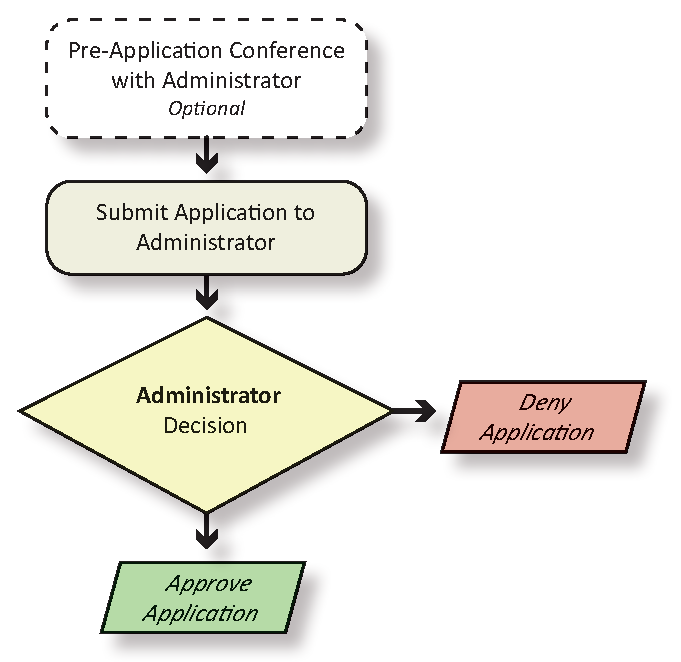
When required.
1.
A zoning permit is issued to show that a proposed use, placement, and design of a property and its structures are in accordance with the city's zoning code. A zoning permit is required for the following:
i.
Change in use.
ii.
Building permits that do not require site plan review.
iii.
Temporary uses.
iv.
Sign permits.
2.
It shall be unlawful to begin moving, constructing, altering or repairing (except ordinary repairs) any building or other structure on a site, including an accessory structure, until a zoning permit has been issued.
3.
It shall be unlawful to change the use of land or the occupancy of any building until a zoning permit has been issued for the intended use.
4.
No certificate of occupancy may be issued without a properly issued zoning permit.
b.
Application and fees.
1.
A pre-application conference is optional.
2.
All applications for zoning permit review shall be filed in writing with the administrator. See section 22-6(b)(1), common review procedures.
3.
Application shall be made prior to or concurrent with the application for a building permit.
c.
Decision by administrator.
1.
The administrator may refer the application to other affected or interested agencies for review and comment.
2.
In deciding to approve, approve with conditions or deny the proposed zoning permit, the administrator shall consider relevant comments of all interested parties and the review criteria below.
3.
The decision of the administrator must be consistent with prior decisions.
4.
The administrator may attach any condition to the permit necessary to ensure compliance with the standards of this zoning code.
d.
Review criteria. The administrator shall consider the following criteria in approving or denying a zoning permit:
1.
The proposed development is consistent with the pertinent elements of the City of Gonzales Comprehensive Plan and any other adopted plans;
2.
The proposed development meets the requirements of this zoning code; and
3.
The proposed development is in compliance with any prior approvals.
e.
Appeal. A final decision by the administrator on a zoning permit may be appealed to the city council. See section 22-6(b)(4), appeal of administrative decision.
f.
Expiration. A zoning permit expires after six (6) months if a building permit application has not been filed.
(22-6)(b)(3)
Administrative adjustment.
a.
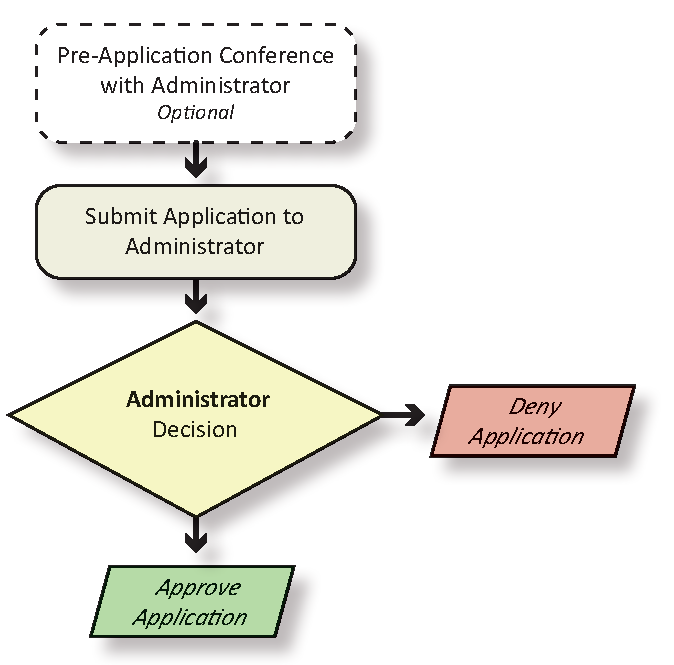
When allowed. The administrative adjustment procedure allows the administrator to approve modest variations from the standards of this zoning code. Administrative adjustment is allowed for the following:
1.
Reduction of any required setback by up to fifteen (15) percent.
2.
Increase or reduce any build-to area by up to ten (10) percent.
3.
Reduce the percent of lot width or depth that the building façade must occupy by up to five (5) percent.
4.
Increase in the maximum height of any building by the lesser of five (5) feet or five (5) percent.
5.
An increase in lot coverage by no more than five (5) percent.
6.
Any other administrative adjustment authorized by a specific section of this zoning code.
b.
Application and fees.
1.
A pre-application conference is optional.
2.
All applications for an administrative adjustment shall be filed in writing with the administrator. See section 22-6(b)(1), common review procedures.
c.
Decision by administrator.
1.
The administrator may refer the application to other affected or interested agencies for review and comment.
2.
In deciding to approve, approve with conditions or deny the proposed administrative adjustment, the administrator shall consider relevant comments of all interested parties.
3.
The administrator may attach any condition to the adjustment necessary to protect the health, safety and welfare of City of Gonzales and minimize adverse impacts on adjacent properties.
d.
Review criteria. The administrator shall consider the following criteria in approving or denying an administrative adjustment:
1.
The proposed adjustment is consistent with the pertinent elements of the City of Gonzales Comprehensive Plan and any other adopted plans;
2.
The proposed development meets the requirements of this zoning code;
3.
The proposed development is in compliance with any prior approvals.
e.
Appeal. A final decision by the administrator on an administrative adjustment may be appealed to the city council. See section 22-6(b)(4), appeal of administrative decision.
f.
Expiration. An administrative adjustment expires after six (6) months if a building permit application has not been filed.
(22-6)(b)(4)
Appeal of administrative decision.
a.
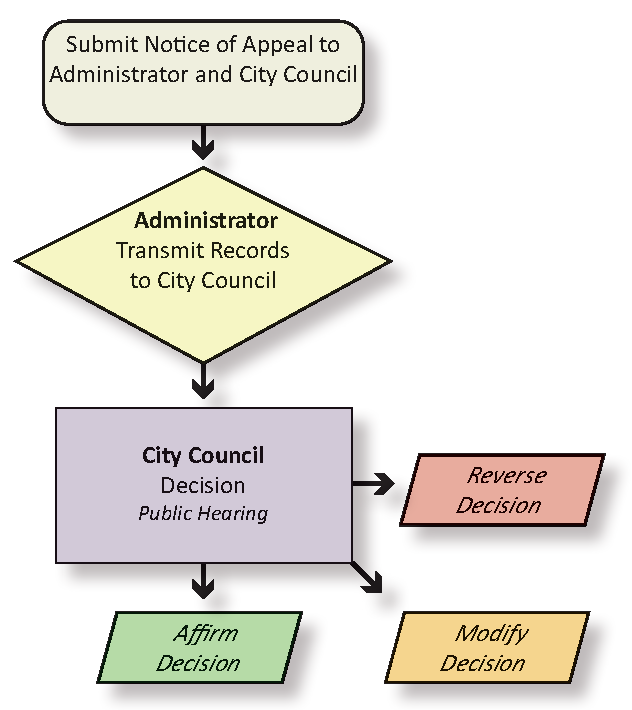
When allowed. Appeals to the city council may be taken by any person aggrieved or by any officer, department, administrative board, or bureau of the City of Gonzales affected by any decision of the administrator. Appeals shall be taken within thirty (30) days of the decision.
b.
Application and fees.
1.
No pre-application conference is necessary.
2.
An application and notice of appeal for administrative review shall be filed in writing with the administrator and with the city council. See section 22-6(b)(1), common review procedures.
3.
The appellant shall provide a written notice of appeal citing the decision that is being appealed, and any reasons why the appeal should be granted.
c.
Action by administrator. The administrator shall transmit to the city council all the papers constituting the record upon which the action appealed from was taken, after all transcript costs and all other costs of appeal are paid by the person or entity taking the appeal.
d.
Stay of proceedings. An appeal stays all proceedings in furtherance of the action appealed from, unless the administrator certifies to the city council after the notice of appeal has been filed that, by reason of facts stated in the certificate, a stay would, in the administrator's opinion, cause imminent peril of life or property. In such case proceedings shall not be stayed except by a restraining order that may be granted by the city council or by a court of record on application or notice to the administrator and on due cause shown.
e.
Public hearing and decision by city council.
1.
Following notice and a public hearing as required in section 22-6(b)(1), common review procedures, the city council shall hear and decide appeals where it is alleged there is error in any order, requirement, decision, or determination made by the administrator.
2.
The council may reverse or affirm, wholly or partly, or may modify the order, requirement, decision or determination appealed from and may make such order, requirement, decision or determination as ought to be made, and to that end shall have the powers of the administrator.
3.
Any party may appear at the hearing in person or by agent or by attorney.
f.
Testimony and evidence. The city council shall limit testimony and other evidence to that contained in the record at the time the administrator took final action.
g.
Review criteria. The city council shall consider the following criteria in deciding an appeal:
1.
Whether the decision by the administrator was in accordance with the intent and requirements of this zoning code.
2.
Whether the administrator made erroneous findings based on the evidence and testimony on the record, or failed to fully consider mitigating measures or revisions offered by the applicant that would have brought the proposed project into compliance; or
3.
Whether the administrator acted arbitrarily or capriciously.
h.
Appeal. A final decision by the city council on an administrative appeal may be appealed to district court.
(22-6)(b)(4.5)
Subdivision.
a.
When required. No person may subdivide land except in accordance with the procedure and standards of this subdivision code.
1.
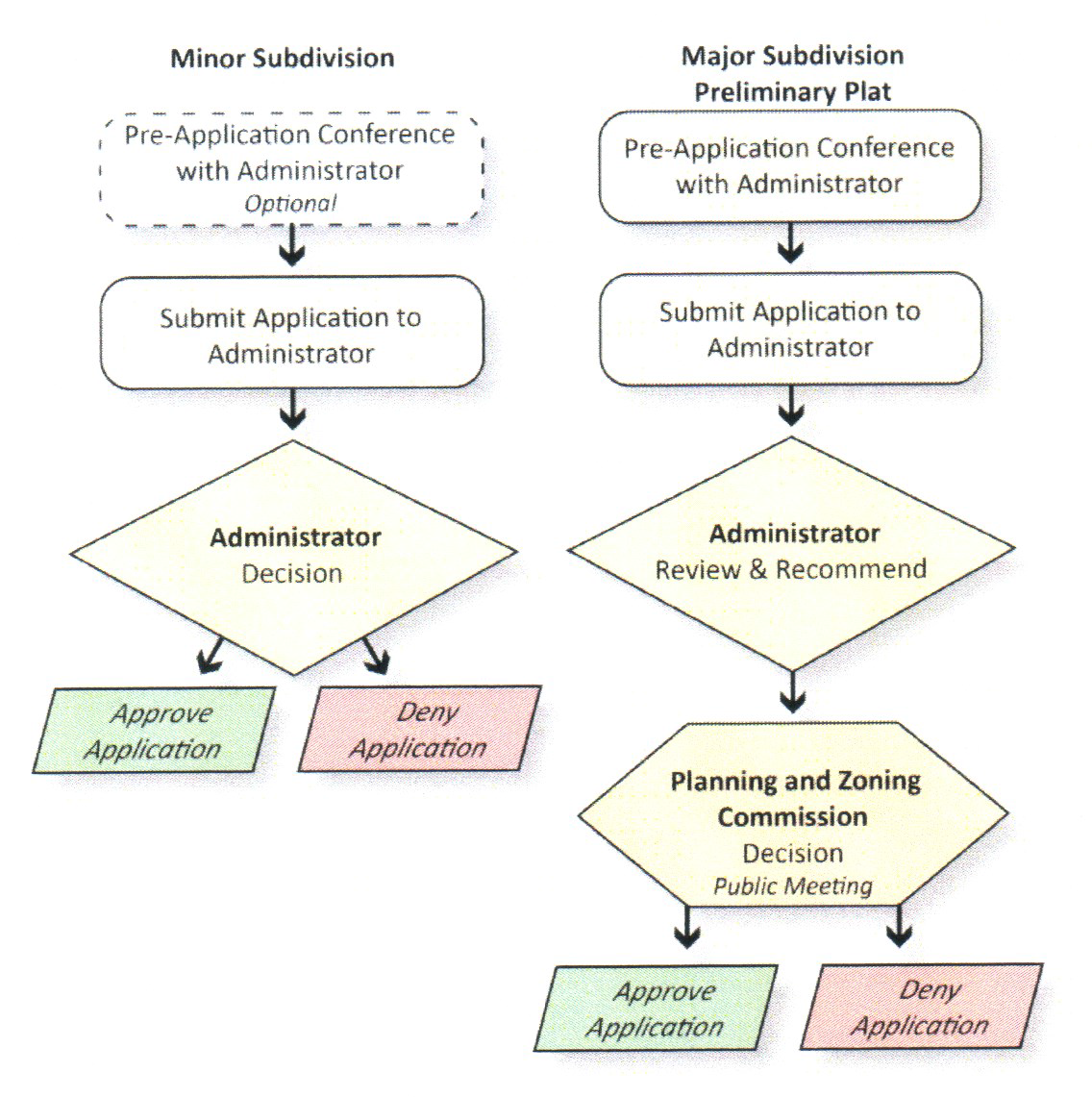
Major subdivision. Major subdivision approval is required for:
i.
Any subdivision of land not considered a minor subdivision or exempted below.
ii.
The creation of any number of lots where:
A.
New public or private streets are created;
B.
A private drive or private street provides access to more than three lots;
C.
Water or wastewater lines are extended;
D.
Drainage improvements through one or more lots must be installed; or
E.
A waiver of any subdivision standard is desired.
2.
Minor subdivision. Minor subdivision approval is required for:
i.
The realignment or shifting of lot boundary lines, including removal, addition, alignment, or shifting of interior lot boundary lines, or the redesignation of lot numbers, provided the application meets the following requirements:
A.
Does not involve the creation of any new street or other public improvement except as otherwise provided in this section;
B.
Does not involve more than nine lots of record;
C.
Does not reduce a lot size below the minimum area or frontage requirements established by this subdivision code; and
D.
Otherwise meets all the requirements of this development code.
E.
Parcels of land where a portion has been expropriated or has been dedicated, sold, or otherwise transferred to the city, thereby leaving a severed portion of the original property which requires a redesignation of lot number and establishment of new lot boundary lines.
3.
No subdivision review required. No subdivision review is required for the following:
i.
The public acquisition of land for roads, water or wastewater infrastructure.
ii.
Any parcel of land, wherever located, upon which a servitude of passage is created for ingress or egress which does not create a through passage and is used exclusively as a driveway need not meet any street planning dimensions, except said servitude must be adequate in dimensions to provide for ingress and egress by service and emergency vehicles.
b.
Components of subdivision (plat) approval.
1.
Major subdivision. Major subdivision requires three (3) steps:
i.
Approval of preliminary plat and drainage impact study.
A.
Recommendation of approval, approval with conditions, or denial by the administrator of the preliminary plat and drainage impact study;
B.
Approval, approval with conditions, or denial of the planning commission of the preliminary plat and drainage impact study.
ii.
Construction drawing approval. All construction drawings for public improvements required under section 22-5.5(b) subdivision standards must be approved by the city engineer and accepted by the city council.
iii.
Approval of final plat. Approval, approval with conditions, or denial of the final plat by the administrator.
2.
Minor subdivision. Minor subdivision approval requires only the approval, or approval with conditions of a final plat by the administrator and/or designees.
c.
Application and fees.
1.
A pre-application conference is optional for minor subdivisions and mandatory for major subdivisions.
2.
All applications for subdivision review shall be filed in writing with the administrator. See section 22-6(b)(1) common review procedures.
3.
All major subdivision applications shall be prepared and sealed by a land surveyor or professional engineer licensed in the State of Louisiana.
4.
Preliminary plat application requirements.
i.
The plat shall show the proposed subdivision and any other adjacent land owned by the subdivider that may affect the design of the subdivision;
ii.
The subdivision name, the names and addresses of the owners or authorized representatives, and of the designer of the plat, who shall be a registered engineer, architect, landscape architect or land surveyor in the state, or a city planner who is a member of the American Institute of Planners;
iii.
Date, approximate North point, and a graphic scale;
iv.
The location of existing and platted property lines, streets, buildings, watercourses, railroads, sewers, bridges, culverts, drainpipes, water mains, and any public utility or other easements, both on the land subdivided and on the adjoining land, the names of adjacent subdivisions and the names and addresses of record owners of adjoining parcels of unsubdivided land as they appear on the current tax records;
v.
The street layout for the entire area shown in the preliminary plat. The names, locations, widths, and other dimensions of proposed streets, sidewalks, alleys, easements, parks, and other open spaces, reservations, lot lines, building lines for the proposed subdivision, and an addressing system approved by the city engineer identifying each lot;
vi.
Statement of proposed street improvements, including contour map where terrain might affect the location of streets.
vii.
Preliminary sketch plans or proposed utility layouts (sewer, water, and electricity) showing feasible connections, where possible, to existing and proposed utility systems, and having a dedicated minimum utility servitude of fifteen (15) feet;
viii.
All drainage structures in the subdivision shall be designed in accordance with the city design standards manual, considering all the area shown on the preliminary plat and any other areas that have a natural drainage into the subdivision. Drainage structures shall be either subsurface drainage or hard surface open channel, and shall be approved by the city engineer.
ix.
A preliminary plat check list summary required of the subdivider is hereby provided as follows:
A.
Subdivision name;
B.
Description of property;
C.
Owner's or subdivider's name;
D.
Engineer's name;
E.
Existing property lines;
F.
Date, approximate North point and scale;
G.
Section and township lines;
H.
Zoning district;
I.
Streets—names and width, preceded by directional abbreviations;
J.
Existing buildings;
K.
Building lines;
L.
Existing drainage ditches and canals;
M.
Existing lakes or ponds;
N.
Ownership of adjoining properties;
O.
Names of adjoining subdivisions;
P.
Lots, numbers and dimensions;
Q.
Servitudes and rights-of-way with minimum dimensions of fifteen (15) feet;
R.
Existing bridges and culverts;
S.
Contours;
T.
Method of sewage disposal;
U.
Type of street improvements;
V.
Preliminary sketch of utility layouts;
W.
Fire protection system (hydrants and mains);
x.
All utility infrastructure, including electrical utilities, shall be located underground.
5.
Final plat application requirements.
i.
The final plat shall be on sheets not larger than thirty-six (36) inches by forty-eight (48) inches, and shall be at a legible scale. Where necessary, the plat may be on several sheets accompanied by an index sheet showing the entire subdivision.
ii.
Township, range and section in which the subdivision is located. If section corner, township line or range line falls within the subdivision, it shall be shown;
iii.
Primary control points, or descriptions and ties to such control points, to which all dimensions, angles, bearings, and similar data on the plat shall be referred;
iv.
Tract boundary lines, right-of-way lines of streets, easements and other rights-of-way, and property lines of residential lots and other sites, with accurate dimensions, bearings or deflection angles, and radii, arcs, and central angles of all curves;
v.
Name and right-of-way width of each street or other right-of-way;
vi.
Location, dimensions and purpose of any easements;
vii.
Number to identify each lot or site;
viii.
Purpose for which sites, other than residential lots, are dedicated or reserved;
ix.
Minimum building setback line on all lots and other sites;
x.
Location and description of monuments;
xi.
Names of [record owners of adjoining unplatted land;]
xii.
Reference to recorded subdivision plats of adjoining platted land;
xiii.
Certification of recognized land surveyor or engineer certifying to accuracy or survey and plat;
xiv.
Statement by owner dedicating streets, right-of-way and any sites for public uses;
xv.
Title, scale, North point and date;
xvi.
Certificate of approval by the city council;
xvii.
The flood zone designation of all land located within the subdivision as defined by FEMA flood insurance rate maps (FIRM), including the community-panel number of the [FIRM from which the data was obtained;]
xviii.
Location and dimensions of sidewalks.
d.
Preliminary plat review by administrator.
1.
The administrator may refer the preliminary plat and application to other affected or interested agencies for review and comment.
2.
The administrator shall recommend approval, approval with conditions, or denial of the preliminary plat and application.
3.
The administrator may attach conditions required to make the preliminary plat and application comply with this subdivision code.
4.
The administrator shall provide notice as set out in section 22-6(b)(1) common review procedures.
e.
Preliminary plat decision by planning commission.
1.
Following notice and a public hearing as required in section 22-6(b)(1) common review procedures, the planning commission shall approve, approve with conditions, or deny the preliminary plat and drainage impact study for a major subdivision.
2.
The preliminary plat shall be approved or denied within sixty (60) days of filing of a complete application, except where such time period is extended by the applicant.
3.
The act of approving or denying a preliminary plat is a legislative function involving the exercise of legislative discretion by the planning commission, based upon data presented to it.
4.
In deciding, the planning commission shall consider the recommendation of the administrator, relevant comments of all interested parties and the review criteria below.
5.
The planning commission may attach any reasonable conditions necessary to make the subdivision comply with this subdivision code, or to protect the health, safety and welfare of the city and minimize adverse impacts on adjacent properties.
6.
Where the planning commission finds that unnecessary hardship results from strict compliance with this development code, a waiver may be granted. The planning commission shall find that due to the particular physical surroundings, shape or topographical conditions of the property, a particular hardship would result, as distinguished from a mere inconvenience. The granting of the waiver must not be detrimental to the public safety, health or welfare or injurious to other property or improvements. No waiver shall be granted based strictly upon financial considerations.
7.
The planning commission shall consider the following criteria in approving or denying a subdivision:
i.
The proposed development is consistent with the pertinent elements of the city's comprehensive plan and any other adopted plans.
ii.
The proposed development will reinforce the existing or planned character of the neighborhood.
iii.
The capacity of public facilities and services including schools, roads, recreation facilities, wastewater treatment, water supply and stormwater facilities, police, fire and emergency medical services.
iv.
Adequate market demand for the number and size of lots in the proposed subdivision.
v.
The subdivision demonstrates:
A.
Compliance with city regulations set forth in the city design standards manual and adopted ordinances;
B.
Compliance with any prior approvals;
C.
Subdivision design appropriate for and tailored to the unique natural characteristics of the site;
D.
Adequate, safe and convenient arrangement of access, pedestrian circulation facilities, bicycle facilities, roadways, driveways, and off-street parking, stacking and loading space;
E.
Adequate design of grades, paving, gutters, drainage and treatment of turf to handle stormwater; and
F.
Adequate access for disabled or handicapped residents through the provision of special parking spaces, accessible routes between parking areas and buildings, passenger loading zones and access to other facilities.
vi.
Any adverse impacts on adjacent properties have been minimized or mitigated.
8.
In the event that the planning commission denies any preliminary plat and application, the grounds for such denial shall be stated in the records of the planning commission.
f.
Minor subdivision decision by administrator.
1.
In deciding to approve, approve with conditions or deny the proposed minor subdivision, the administrator shall consider relevant comments of all interested parties and the review criteria below.
2.
The administrator may attach conditions required to make the plat and application comply with this subdivision code.
3.
A minor subdivision shall be approved in accordance with the requirements, including the review criteria, for a final plat below.
g.
Final plat decision by administrator.
1.
The administrator may approve or deny the final plat.
2.
The final plat shall be approved or denied within sixty (60) days of filing, except where such time period is extended by the applicant.
3.
If the final plat is denied, the administrator shall specify in writing the provisions with which the plat does not comply.
4.
The final plat shall be approved where it is:
i.
Consistent with the pertinent elements of the city's comprehensive plan and any other adopted plans;
ii.
Meets the requirements of this development code;
iii.
Complies with any prior approvals, including specifically the preliminary plat and any conditions.
5.
The approval of a final plat shall not be deemed to constitute the acceptance of the dedication of any street or other land, public utility or facility shown on the face of the plat. However, the city council may, by resolution, accept any dedication for streets, parks, public utility lines or facilities, or other public purposes.
h.
Approval by the city required. No plat shall be filed or recorded in the office of the clerk of court, and no subdivider may proceed with improvement or sale of lots in a subdivision until the final plat has been approved by the city and approval has been entered in writing on the plat by the administrator.
1.
Any sales or contract of sale or agreement to purchase any lot or division of land either by lot description or by metes and bounds shall constitute a subdivision of land and require, prior to any sale or contract of sale or agreement to purchase and before the delivery of a deed, the submission of a plat to the city.
i.
Building permit. No building permit shall be issued for development requiring subdivision approval until the final plat has been approved.
j.
Dedication and improvements.
1.
In developing property requiring subdivision approval under this development code, the applicant must dedicate any additional right-of-way necessary to the width required by the city for streets adjoining the property, install curbs and gutters and pave all streets adjoining the property, and install sidewalks and street trees, all based on the standards of this development code.
2.
The applicant shall bear the costs of installation of any on-site or off-site improvements required by this development code, including provisions for stormwater management, paving and utilities.
3.
The city is not required to accept any dedication or improvements that do not meet local standards.
k.
Construction drawings. Prior to construction of any improvement intended for public dedication, cost estimate and construction drawings that meet local standards for the specified improvements must be approved by the city engineer.
l.
Improvement guarantee.
1.
Prior to issuance of any building permit, the applicant shall either have installed improvements specified in this subdivision code as shown on approved construction drawings or guaranteed the installation of improvements specified under this subdivision code by a bond with surety accepted by the city council.
2.
The applicant shall submit a cost estimate and time schedule for installation of each phase of subdivision improvements.
3.
If the applicant is guaranteeing public improvements, a bond with surety shall be required guaranteeing all on-site and off-site improvements. The bond shall be in an amount equal to one hundred twenty-five (125) percent of the improvement cost estimate, and in a form approved by the city attorney.
4.
As each phase of improvements is installed and inspected by the city, the bond may be reduced by the cost of the installed improvements.
5.
As each phase of improvements is installed and inspected by the city, the letter of credit or bond may be reduced by the cost of the installed improvements.
6.
Bonds shall be with a reputable and solvent corporate surety licensed to write insurance in the State of Louisiana, in favor of the City of Gonzales.
7.
Letters of credit shall be issued by a financial institution having a rating equivalent to the minimum acceptable rating established by the city.
m.
Inspection of improvements.
1.
The applicant shall grant the city the authority to inspect all construction of required improvements. Such right of inspection shall not constitute a duty to inspect, nor shall it guarantee final acceptance of the required improvements.
2.
Failure to perform the work to the city's standards shall free the city to liquidate the improvement guarantee in order to finance necessary repairs.
n.
Maintenance bond or letter of credit required. The city may require a post-acceptance maintenance bond or letter of credit in a form approved by the city attorney for a coverage period determined by the city. The letter of credit or maintenance bond shall protect the city from any necessary repairs arising from defective workmanship or materials used on any improvement constructed by a developer and dedicated to the city. No final plat approval will be granted until the original letter of credit or maintenance bond has been received and approved by the city.
1.
Maintenance bonds shall be with a reputable and solvent corporate surety licensed to write insurance in the State of Louisiana, in favor of the City of Gonzales.
2.
Letters of credit shall be issued by a financial institution having a rating equivalent to the minimum acceptable rating established by the city at the time the initial fiscal deposit is issued.
o.
Recording of final plat. Any final plat shall be recorded in the office of the parish clerk of courts where the property is situated and copied into the conveyance record book of the parish.
p.
Modification of approved subdivision. The administrator is authorized to approve minor modifications to an approved subdivision. All modifications not listed as minor below shall be considered by the body that approved the original subdivision. The following modifications shall be considered minor:
1.
Additional or wider easements that do not affect the general placement of buildings or general location of roadways;
2.
Reduction in the number of lots;
3.
Reduction of length of streets; or
4.
Modification of public utility service.
q.
Appeal.
1.
A final decision by the administrator on a minor subdivision may be appealed to the planning commission. The planning commission shall review the subdivision as a major subdivision.
2.
A final decision by the planning commission on a major subdivision may be appealed to district court.
r.
Expiration. A preliminary plat expires after one year where a final plat application has not been filed. Each final plat for a phase of the preliminary plat extends the preliminary plat for an additional year. A final plat, once officially recorded, does not expire.
(22-6)(b)(5)
Site plan review.
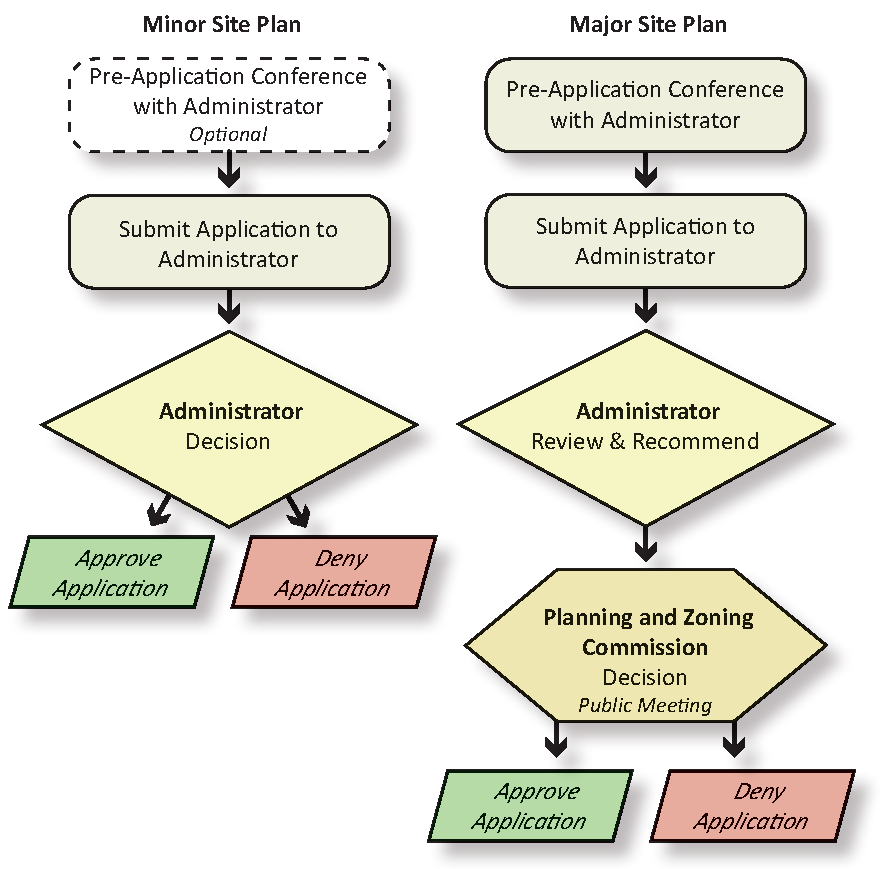
a.
When required.
1.
Major site plan. Major site plan review by the planning and zoning commission is required for:
i.
Construction of ten (10) or more residential units on a platted lot of record.
2.
Minor site plan. Minor site plan review by the administrator is required for:
i.
Construction of more than two (2), but less than ten (10), residential units on a platted lot of record.
ii.
Creation of more than one thousand (1,000) square feet of additional impervious surface (paving).
iii.
Construction of accessory structures in nonresidential districts.
3.
No site plan required. No site plan review is required for the following:
i.
Construction or expansion of one (1) or two (2) units in a single structure on a platted lot of record.
ii.
Creation of up to one thousand (1,000) square feet of additional impervious surface (paving).
iii.
Construction of accessory structures in residential districts.
b.
Application and fees.
1.
A pre-application conference is optional for a minor site plan and mandatory for a major site plan.
2.
All applications for site plan review shall be filed in writing with the administrator. See section 22-6(b)(1), common review procedures.
c.
Review by administrator.
1.
The administrator may refer the application to other affected or interested agencies for review and comment.
2.
The administrator shall provide notice as set out in section 22-6(b)(1), common review procedures.
3.
The administrator shall recommend approval, approval with conditions, or denial of a major site plan.
d.
Minor site plan decision by administrator.
1.
In deciding to approve, approve with conditions or deny the proposed site plan, the administrator shall consider relevant comments of all interested parties and the review criteria below.
2.
The administrator may attach any condition to the site plan necessary to ensure the site plan meets the requirements of the zoning code.
e.
Major site plan decision by planning and zoning commission.
1.
The planning and zoning commission shall approve or deny the major site plan.
2.
In deciding, the planning and zoning commission shall consider the recommendation of the administrator, relevant comments of all interested parties and the review criteria below.
3.
The planning and zoning commission may attach any condition to the site plan necessary to ensure the site plan meets the requirements of the zoning code.
f.
Review criteria. The administrator and planning and zoning commission shall consider the following criteria in approving or denying a site plan:
1.
The proposed development is consistent with the pertinent elements of the City of Gonzales Comprehensive Plan and any other adopted plans.
2.
The proposed development meets the requirements of this zoning code;
3.
The site plan demonstrates compliance with any prior approvals.
g.
Building permit. No building permit shall be issued for development requiring a site plan until the site plan has been approved.
h.
Dedication and improvements.
1.
In developing property requiring a site plan under this zoning code, the applicant must follow all dedication and improvement regulations specified in chapter 17, Subdivision of Land.
2.
The applicant shall bear the costs of installation of any on-site or off-site improvements required by this zoning code, including provisions for stormwater management, paving and utilities.
i.
Improvement guarantee.
1.
Prior to the approval of any site plan, the applicant shall submit a cost estimate and time schedule for installation of each phase of site improvements.
2.
A nonnegotiable letter of credit posted by the applicant in favor of the city shall be required guaranteeing all on-site and off-site improvements. The letter of credit shall be in an amount equal to one hundred twenty-five (125) percent of the improvement cost estimate, as determined by the City of Gonzales engineer, and in a form approved by the City of Gonzales attorney.
3.
As each phase of improvements is installed and inspected by City of Gonzales, the letter of credit may be reduced by the cost of the installed improvements.
j.
Modification of approved site plan. The administrator is authorized to approve minor modifications to an approved site plan. All modifications not listed as minor below shall be considered by the body that approved original site plan. The following modifications shall be considered minor:
1.
Up to a ten (10) percent increase or any decrease in gross floor area of a single building;
2.
Up to a ten (10) percent reduction or any increase in the approved setbacks from exterior property lines; and
3.
Relocation of parking areas, internal streets or structures where such relocation occurs more than one hundred (100) feet from exterior property lines.
k.
Appeal.
1.
A final decision by the administrator on a minor site plan may be appealed to the city council. See section 22-6(b)(4), appeal of administrative decision.
2.
A final decision by the planning and zoning commission on a major site plan may be appealed to district court.
l.
Expiration. A site plan expires after one (1) year if a building permit application has not been filed.
(22-6)(b)(6)
Special use permit.
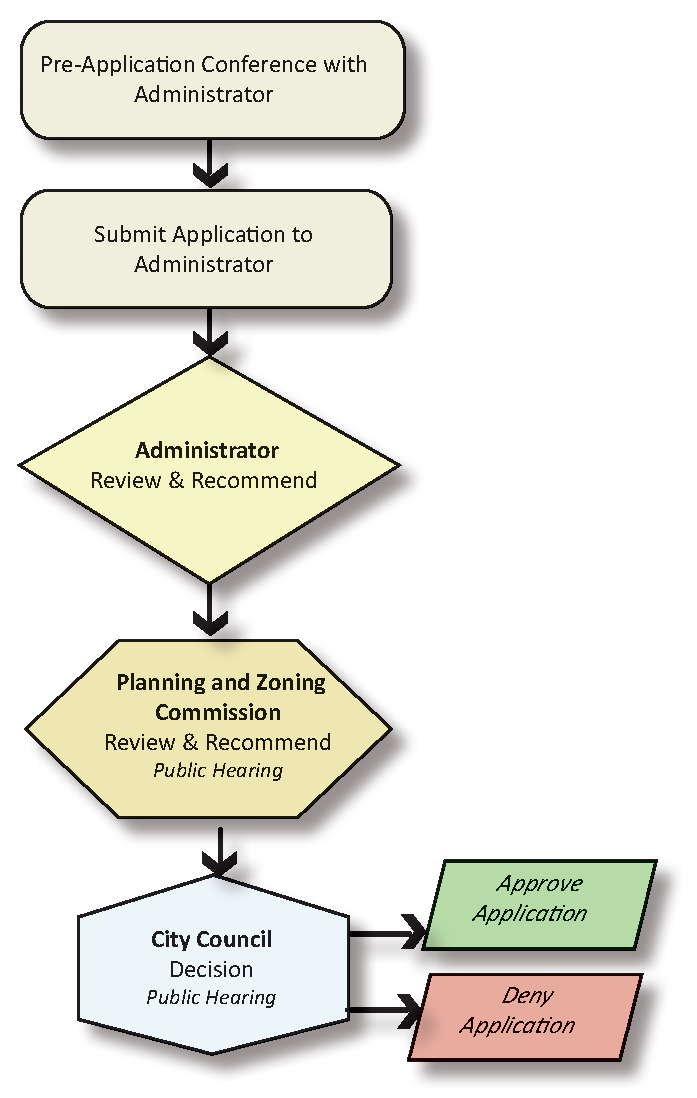
a.
When required. A special use permit is required for any use or building type identified with a hollow box on any applicable building type or permitted use table.
b.
Application and fees.
1.
A pre-application conference with the administrator is required.
2.
All applications for a special use permit shall be filed in writing with the administrator. See section 22-6(b)(1), common review procedures.
c.
Review by administrator.
1.
The administrator may refer the application to other affected or interested agencies for review and comment.
2.
The administrator shall provide notice as set out in section 22-6(b)(1), common review procedures.
3.
The administrator shall recommend approval, approval with conditions, or denial of the special use permit.
d.
Public hearing and decision by city council.
1.
Following notice and a public hearing as required in section 22-6(b)(1), common review procedures, the city council shall approve, approve with conditions or deny the special use permit.
2.
In deciding, the city council shall consider the recommendation of the administrator, relevant comments of all interested parties and the review criteria below.
3.
The city council may attach any condition to the site plan necessary to protect the health, safety and welfare of City of Gonzales and minimize adverse impacts on adjacent properties. Such conditions may include, but are not limited to: additional screening or buffering, or limitation in scale, intensity or hours of operation.
e.
Review criteria. The city council shall consider the following criteria in approving or denying a special use permit:
1.
The proposed special use permit is consistent with the pertinent elements of the City of Gonzales Comprehensive Plan and any other adopted plans;
2.
The proposed development meets the requirements of this zoning code;
3.
The proposed special use permit will reinforce the existing or planned character of the neighborhood;
4.
The special use permit complies with any specific use standards or limitations in section 22-3, use provisions; and
5.
The special use permit will not substantially or permanently injure the appropriate use of adjacent conforming properties.
f.
Effect of denial. The denial of a special use permit application shall ban the subsequent application for the same or similar use for a period of twelve (12) months.
g.
Expiration. A special use permit shall expire after one (1) year if a building permit application has not been filed. Once the use is constructed, the special use permit runs with the land and does not expire.
h.
Revocation of special use permit. If any conditions of a special use permit or other requirements of this zoning code are violated, the special use permit may be revoked by the city council.
(22-6)(b)(7)
Zoning map amendment.
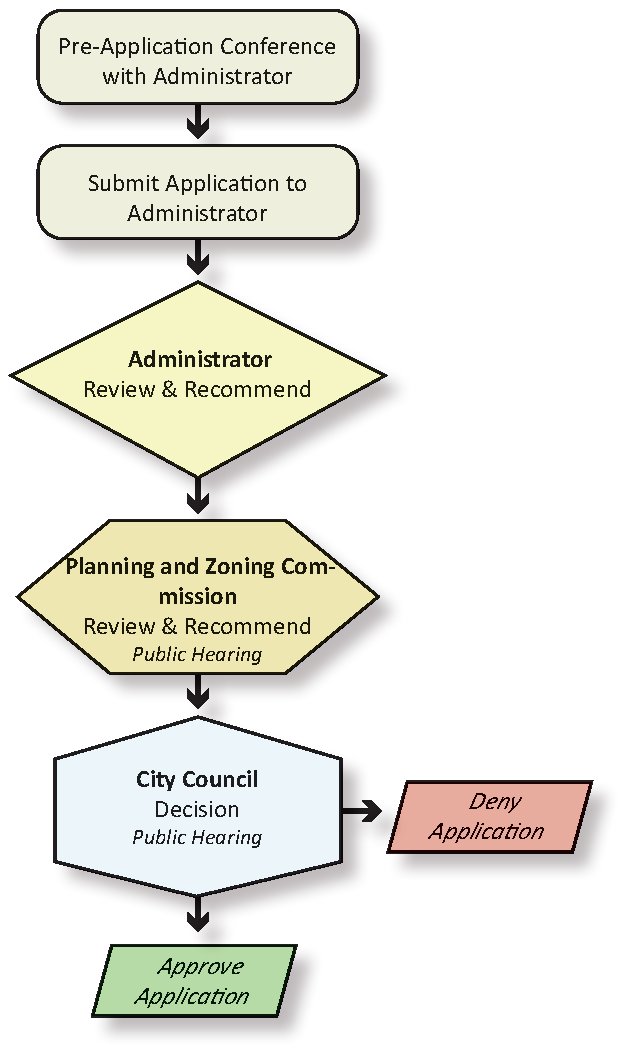
a.
When allowed. The boundaries of zoning districts as shown on the zoning map may, from time to time, be amended or modified by ordinance, as determined by the city council. The city council or planning and zoning commission may from time to time, on its own motion or on petition, after public notice and hearing, initiate amendments to the official zoning map established by the zoning code.
b.
Application and fees.
1.
A pre-application conference with the administrator is required.
2.
All applications for a zoning map amendment shall be filed in writing with the administrator. See section 22-6(b)(1), common review procedures.
c.
Review by administrator.
1.
The administrator may refer the application to other affected or interested agencies for review and comment.
2.
The administrator shall provide notice as set out in section 22-6(b)(1), common review procedures.
3.
The administrator shall recommend approval, or denial of the zoning map amendment.
d.
Review by planning and zoning commission.
1.
Following notice and a public hearing as required in section 22-6(b)(1), common review procedures, the planning and zoning commission shall recommend approval or denial of the zoning map amendment.
2.
In recommending, the planning and zoning commission shall consider the recommendation of the administrator, relevant comments of all interested parties and the review criteria below.
e.
Public hearing and decision by city council.
1.
Following notice and a public hearing as required in section 22-6(b)(1), common review procedures, the city council shall approve or deny the zoning map amendment.
2.
In deciding, the city council shall consider the recommendations of the administrator and planning and zoning commission, relevant comments of all interested parties and the review criteria below.
3.
In case of a protest duly signed and acknowledged by the owners of twenty (20) percent or more either of the areas of land (exclusive of streets and alleys) included in a proposed change or within an area determined by lines drawn parallel to and two hundred (200) feet distant from the boundaries of the district proposed to be changed, the amendment shall not become effective except by the favorable vote of a majority of the members of the entire city council.
f.
Review criteria. The city council shall consider the following criteria in approving or denying a zoning map amendment:
1.
The proposed zoning map amendment is consistent with the pertinent elements of the City of Gonzales Comprehensive Plan and any other adopted plans;
2.
The proposed zoning map amendment is consistent with the areas designated context;
3.
The proposed zoning map amendment will reinforce the existing or planned character of the neighborhood;
4.
The site is appropriate for the development allowed in the proposed district;
5.
There are substantial reasons why the property cannot be used according to the existing zoning;
6.
Public facilities and services including but not limited to schools, roads, recreation facilities, wastewater treatment, water supply and stormwater facilities, police, fire and emergency medical services are adequate for the development allowed in the proposed district; and
7.
The zoning map amendment will not substantially or permanently injure the appropriate use of adjacent conforming properties.
g.
Effect of denial. The denial of a zoning map amendment application shall ban the subsequent application for the same or similar district for a period of twelve (12) months.
h.
Expiration. A zoning map amendment does not expire.
(22-6)(b)(8)
Traditional neighborhood development (TND).
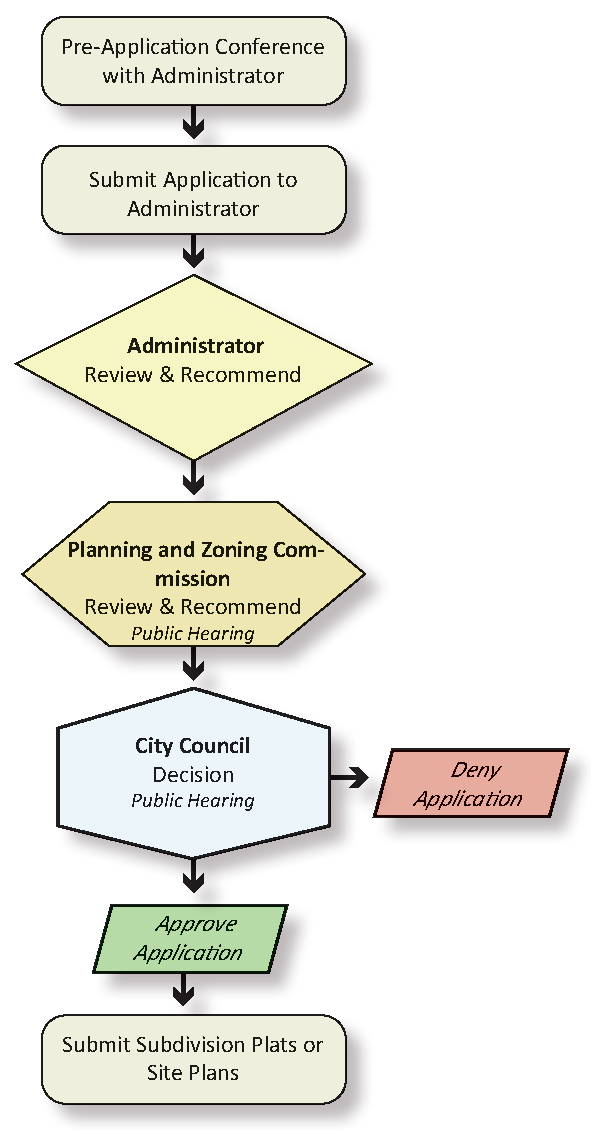
a.
Purpose of a TND. A TND allows an applicant to build quality neighborhoods that provide a desirable mix of uses and building types, a more connected and walkable development pattern, and reduce the impact on surrounding properties and infrastructure by promoting an alternative to conventional residential development patterns.
b.
Components of a TND approval. A TND approval consists of two (2) separate steps:
1.
Approval of a concept plan and rezoning, by the city council; and
2.
The subsequent approval of a preliminary subdivision plat and site plan consistent with the TND concept plan approved by the planning and zoning commission.
c.
When allowed. A TND is allowed on any tract of land that is larger than twenty (20) acres and less than two hundred (200) acres. Tracts larger than two hundred (200) acres will be required to submit applications for separate planned TNDs.
d.
Application and fees.
1.
A pre-application conference with the administrator is required.
2.
All applications for a TND shall be filed in writing with the administrator. See section 22-6(b)(1), common review procedures.
3.
The application shall include the following additional materials:
i.
A narrative explaining and tabulating the land uses by net acre, number of dwelling units by building type, residential density and square footage of nonresidential uses per net acre, open space acreage, the relationship of the proposed development to existing development in the area and other related development features.
ii.
A neighborhood concept plan establishing the following aspects of the proposed TND:
A.
The location of at least three (3) context areas to be applied within the proposed TND;
B.
The location of all zoning districts requested to be applied within the proposed TND;
C.
The location of all street and alley types, major utilities, access to existing streets, and conceptual drainage plan;
D.
The perimeter and block face length of all blocks;
E.
The layout and size of all lots with anticipated land use and building types; and
F.
The location and type of any open space.
iii.
A specific list of all requested deviations and whether they are classified under this zoning code as:
A.
Administrative adjustment; or
B.
Waiver of a subdivision standard.
4.
The applicant may provide concurrent applications for site plan or subdivision review.
e.
Rezoning and concept plan review by administrator.
1.
The administrator may refer the application to other affected or interested agencies for review and comment.
2.
The administrator shall provide notice as set out in section 22-6(b)(1), common review procedures.
3.
The administrator shall recommend approval, approval with conditions, or denial of the TND rezoning and concept plan.
f.
Rezoning and concept plan review by planning and zoning commission.
1.
Following notice and a public hearing as required in section 22-6(b)(1), common review procedures, the planning and zoning commission shall recommend approval, approval with conditions, or denial of the TND rezoning and concept plan.
2.
In recommending, the planning and zoning commission shall consider the recommendation of the administrator, relevant comments of all interested parties and the review criteria below.
g.
Public hearing and decision by the city council.
1.
Following notice and a public hearing as required in section 22-6(b)(1), common review procedures, the city council shall approve, approve with conditions, or deny the TND rezoning and concept plan.
2.
In deciding, the city council shall consider the recommendations of the administrator and planning and zoning commission, relevant comments of all interested parties and the review criteria below.
3.
In case of a protest duly signed and acknowledged by the owners of twenty (20) percent or more either of the areas of land (exclusive of streets and alleys) included in a proposed change or within an area determined by lines drawn parallel to and two hundred (200) feet distant from the boundaries of the tract proposed to be changed, the amendment shall not become effective except by the favorable vote of a majority of the members of the entire city council.
h.
Review criteria. The city council shall consider the following criteria in approving or denying a TND rezoning and concept plan:
1.
The proposed TND is consistent with the pertinent elements of the City of Gonzales Comprehensive Plan and any other adopted plans;
2.
The proposed TND meets the requirements of this zoning code or is granted a specific deviation consistent with an administrative adjustment, or waiver of subdivision standard by the city council;
3.
The proposed TND contains a neighborhood center with either formalized open space or a vertically mixed use node and an identifiable edge to the neighborhood;
4.
The proposed TND contains a mix of uses and a mix of at least four (4) building types;
5.
The proposed TND has an average maximum block perimeter of two thousand four hundred (2,400) feet;
6.
The proposed TND contains at least three (3) different context areas with no single context occupying more than seventy (70) percent of the TND tract;
7.
The tract is appropriate for the development allowed in the proposed TND;
8.
The proposed TND will complement and reinforce the existing or planned character of the area;
9.
The TND will not substantially or permanently injure the appropriate use of adjacent conforming properties;
10.
Public facilities and services including schools, roads, recreation facilities, wastewater treatment, water supply and stormwater facilities are adequate and will not be negatively impacted by the proposed TND;
11.
The TND demonstrates a higher quality of site design that is more sensitive to the surrounding lands, both built and natural, than is possible under any single zoning district.
i.
Action following approval. Approval of a TND neighborhood plan and package rezoning authorizes the submission of subdivision plats consistent with the TND approval.
j.
Modification of adopted concept plan. The administrator is authorized to approve minor modifications to an approved concept plan. All modifications not listed as minor below shall be considered by the city council consistent with the original approval of the TND. The following modifications shall be considered minor:
1.
Up to a ten (10) percent increase or any decrease in gross floor area of a single building;
2.
Up to a ten (10) percent reduction or any increase in the approved setbacks from exterior property lines; and
3.
Relocation of parking areas, internal streets or structures where such relocation occurs more than one hundred (100) feet from exterior property lines.
k.
Effect of denial. The denial of a TND application shall ban the subsequent application for the same or similar TND for a period of twelve (12) months.
l.
Expiration. A TND rezoning does not expire. A TND concept plan expires after two (2) years if no preliminary plat, site plan or building permit has been filed. A two-year extension may be granted by the city council.
(22-6)(b)(9)
Text amendment.
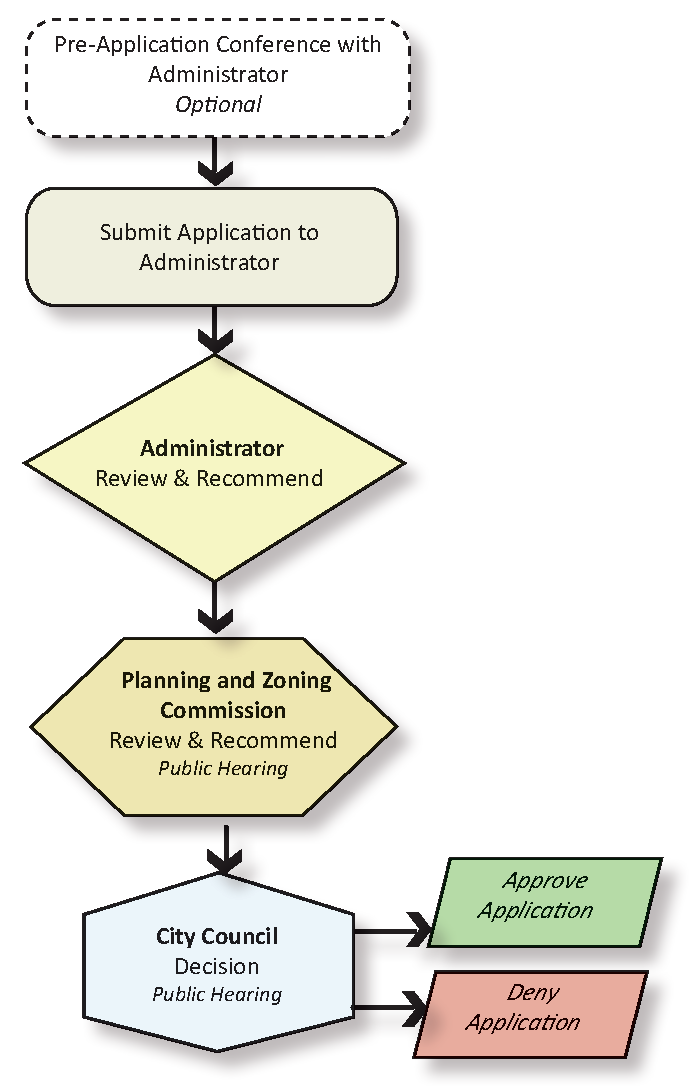
a.
When allowed. The regulations of this zoning code may, from time to time, be amended, supplemented, changed, modified or repealed by ordinance, as determined by the city council. The city council or planning and zoning commission may from time to time, on its own motion or on petition, after public notice and hearing, initiate amendments to regulations in this zoning code.
b.
Application and fees.
1.
A pre-application conference is optional.
2.
All applications for a text amendment shall be filed in writing with the administrator. See section 22-6(b)(1), common review procedures.
c.
Review by administrator.
1.
The administrator may refer the application to other affected or interested agencies for review and comment.
2.
The administrator shall provide notice as set out in section 22-6(b)(1), common review procedures.
d.
Public hearing and decision by city council.
1.
Following notice and a public hearing as required in section 22-6(b)(1), common review procedures, the city council shall approve or deny the text amendment.
2.
In deciding, the city council shall consider the recommendations of the administrator, relevant comments of all interested parties and the review criteria below.
e.
Review criteria. The city council shall consider the following criteria in approving or denying a text amendment:
1.
The proposed text amendment is consistent with the pertinent elements of the City of Gonzales Comprehensive Plan and any other adopted plans;
2.
The extent to which the text amendment is consistent with the remainder of this zoning code;
3.
The extent to which the text amendment represents a new idea not considered in the existing code, or represents revisions necessitated by changing conditions over time; whether or not the text amendment corrects an error in this zoning code; and
4.
Whether or not the text amendment revises this zoning code to comply with state or federal statutes or case law.
f.
Expiration. A text amendment does not expire.
(22-6)(b)(10)
Development agreements.
a.
When allowed. The City of Gonzales may enter into a development agreement in accordance with this section.
b.
Contents. A development agreement shall specify the duration of the agreement, the permitted uses of the property, the density or intensity of use, the maximum height and size of proposed buildings, and provisions for reservation or dedication of land for public purposes. The development agreement may include conditions, terms, restrictions, and requirements for subsequent discretionary actions, provided that such conditions, terms, restrictions, and requirements for subsequent discretionary actions shall not prevent development of the land for the uses and to the density or intensity of development set forth in the agreement. The agreement may provide that construction shall be commenced within a specified time and that the project or any phase be completed within a specified time. The agreement may also include terms and conditions relating to financing of necessary public facilities by the applicant and subsequent reimbursement of the applicant over time.
c.
Rules, regulations and official policies. Unless otherwise provided by the development agreement, the rules, regulations and official policies governing permitted uses of the land, density, and design, improvement, and construction standards and specifications applicable to development of the property subject to a development agreement shall be those rules, regulations, and official policies in force at the time of execution of the agreement. A development agreement shall not prevent the City of Gonzales, in subsequent actions applicable to the property, from applying new rules, regulations, and policies which do not conflict with those rules, regulations, and policies applicable to the property as set forth herein, nor shall a development agreement prevent the City of Gonzales from denying or conditionally approving any subsequent development project application on the basis of such existing or new rules, regulations, and policies.
d.
Reserved.
e.
Approval by administrator and mayor. A development agreement shall be approved by the administrator and the mayor upon review and recommendation by the city engineer, and city attorney.
f.
Amendment or cancellation; notice of intent. A development agreement may be amended or canceled in whole or in part by mutual consent of the parties to the agreement or their successors in interest. Notice of intention to amend or cancel any portion of the agreement shall be given in the manner provided by section 22-6(b)(1), Common review procedures.
g.
Recording copy of agreement; effect. No later than ten (10) days after City of Gonzales enters into a development agreement, the clerk shall record in the parish a copy of the agreement, which shall describe the land subject to the agreement. From and after the time of such recordation, the agreement shall impart such notice to all persons as is afforded by the recording laws of the state. The burdens of the agreement shall be binding upon and the benefits of the agreement shall inure to all successors in interest to the parties to the agreement.
h.
Modification or suspension. In the event that state or federal laws or regulations, enacted after a development agreement has been entered into, prevent or preclude compliance with one (1) or more provisions of the development agreement, such provisions of the agreement shall be modified or suspended as may be necessary to comply with such state or federal laws or regulations.
i.
Periodic review; termination or modification. Any development agreement shall provide for periodic review at least every twelve (12) months, at which time the applicant or his successor in interest shall be required to demonstrate good faith compliance with the terms of the agreement. If, as a result of such periodic review, the city council finds and determines, on the basis of substantial evidence, that the applicant or successor in interest has not complied in good faith with terms or conditions of the agreement, the city council may terminate or modify the agreement.
j.
Enforcement. Unless amended, canceled, modified or suspended, a development agreement shall be enforceable by any party to the agreement notwithstanding any change in any applicable general or specific plan, zoning, subdivision, or building regulation adopted by the City of Gonzales entering the agreement which alters or amends the rules, regulations, or policies specified in this zoning code.
k.
Restrictions on authority. Nothing in this procedure shall be construed to authorize property use contrary to existing zoning classifications or to authorize the reclassification of such zones.
(22-6)(c)
Nonconformities.
(22-6)(c)(1)
In general.
a.
Continuation. A nonconformity may be continued in accordance with this section.
b.
Types of nonconformity. There are several types of nonconformities that may exist, as follows:
1.
Nonconforming uses (see section 22-6(c)(2), nonconforming uses).
2.
Nonconforming structures (see section 22-6(c)(3), nonconforming structures).
3.
Nonconforming sites (see section 22-6(c)(4), nonconforming sites).
4.
Nonconforming lots of record (see section 22-6(c)(5), nonconforming lots of record).
c.
Evidence of status. Evidence of the status of a nonconforming use shall be supplied by the owner of the property upon request of the administrator.
d.
Time extensions. The city council may permit one (1) extension of up to twelve (12) additional months to the time periods for abandonment, obtaining a building permit or completing construction, provided the applicant can demonstrate circumstances out of his or her control have prevented a good faith attempt to reestablish or rebuild the nonconformity. Such circumstances may include the health of the applicant, court proceedings, failure to reach an insurance settlement, acts of God, or similar hardships.
(22-6)(c)(2)
Nonconforming uses.
a.
Continuation. A lawful use made nonconforming by the adoption of this zoning code or other ordinances may continue only for so long as such use is not expanded, increased or changed.
b.
Change of use. No use shall be changed to a conforming use until the administrator has determined that the requirements of the applicable district will be met. The city council may approve a different nonconforming use, provided such use is deemed by the city council to be less intense than the existing use. No change to a more intense nonconforming use is allowed.
c.
Abandonment. A nonconforming use that has been discontinued for any 12-month period for whatever reason shall be considered to be abandoned and shall not be reestablished. Any use on the property after that time shall conform with all provisions of this zoning code. Evidence of intent to abandon the use is not required.
d.
Destruction. A nonconforming use that is damaged may be rebuilt following approval by the city council in accordance with the following:
1.
A nonconforming use may only be reestablished within a conforming structure.
2.
All restorative and other work must be within adopted building codes.
3.
A building permit must be issued within one (1) year from the date of the damage.
4.
The certificate of occupancy (or other final inspection) must be issued as provided by adopted codes.
e.
Special standards for residential uses. As used in this paragraph, a "nonconforming residential use" is a structure which contains more dwellings than allowed by the district or a dwelling located in a district that does not permit residential uses.
1.
Abandonment.
i.
A nonconforming residential use other than a single-family dwelling that has not been occupied for a continuous period of twelve (12) months, for whatever reason, shall be considered to be abandoned and shall not be reoccupied except in conformance with all applicable provisions of this zoning code. Evidence of intent to abandon the nonconforming use is not required.
ii.
A nonconforming single-family dwelling that has not been occupied for a continuous period of twelve (12) months or longer shall not be considered to be abandoned and may be reoccupied at any time, provided the structure has not been changed, legally or illegally, to a nonresidential use or multiple-unit residential use.
iii.
Removal of a nonconforming mobile home or manufactured home, not in a mobile home park, from its foundation or pad for a continuous period of twelve (12) months shall constitute abandonment of the use and placement of a new unit must comply with the provisions of this zoning code. Evidence of intent to abandon the nonconforming mobile home or manufactured home use is not required.
2.
Destruction. Nonconforming residential uses that are damaged may be rebuilt in accordance with the following:
i.
All portions of the structure being restored are not and were not on or over a property line;
ii.
The number of dwelling units does not increase;
iii.
All construction is in compliance with current construction codes, such as the fire and building codes;
iv.
A building permit is obtained within one (1) year from the date of the damage; and
v.
The certificate of occupancy (or other final inspection) is issued within two (2) years of the issuance of the building permit.
(22-6)(c)(3)
Nonconforming structures.
a.
Continuation. A lawful structure existing as of the effective date of this zoning code or any amendment to this zoning code may continue to be used for any purposes permitted in the district provided it is in conformance with the provisions of this section.
b.
Maintenance and restoration. A nonconforming structure may be maintained or restored provided no expansion of the nonconformity occurs.
c.
Expansion. A nonconforming structure may be expanded, provided that no increase in the nonconformity occurs.
d.
Change of use. Changes of use that require an increase in the number of parking spaces shall be required to provide the difference between the required parking for the prior use and that required for the proposed use in accordance with section 22-4(e), Parking standards. Where this calculation results in the addition of less than five (5) spaces, no additional spaces shall be required. Any additional parking area shall comply with all associated landscaping and drainage requirements of section 22-4(e)(6), Parking area design standards.
e.
Destruction.
1.
A nonconforming residential structure which is damaged may be restored within the existing footprint provided that all portions of the structure being restored are not and were not on or over a property line; all construction is in compliance with current construction codes, such as the Fire and Building Codes; a building permit is obtained within one (1) year from the date of the damage; and the certificate of occupancy (or other final inspection) is issued within two (2) years of the issuance of the building permit.
2.
A nonconforming nonresidential structure which is damaged to fifty (50) percent or less of its fair market value, based on a market appraisal performed by a certified appraiser, may be restored within the existing footprint provided that all portions of the structure being restored are not and were not on or over a property line; all construction is in compliance with current construction codes, such as the Fire and Building Codes; a building permit is obtained within one (1) year from the date of the damage; and the certificate of occupancy (or other final inspection) is issued within two (2) years of the issuance of the building permit. If damage exceeds fifty (50) percent or more, restoration or improvement shall not be permitted unless the restoration results in a structure and site conforming to all applicable requirements of this zoning code.
(22-6)(c)(4)
Nonconforming sites.
a.
Continuation. A site existing as of the effective date of this zoning code that is nonconforming due solely to failure to meet the site development standards of this zoning code may be used for any purposes permitted in the district provided the use is in conformance with the provisions of this section.
b.
Maintenance and restoration. A nonconforming site may be maintained or restored provided no expansion of the nonconformity occurs.
c.
Expansion. Additions to structures, additional paving, or parking on nonconforming sites shall require correction of existing nonconforming parking, landscaping and screening.
1.
Complete redevelopment or expansions that result in a twenty-five (25) percent or greater increase of the gross square footage of the existing structure require the entire property to meet all of the landscaping and screening requirements of this zoning code.
2.
Expansions that result in less than a twenty-five (25) percent increase of the gross square footage of the existing structure require a corresponding percentage increase in compliance for landscaping and screening requirements of this zoning code until the site achieves one hundred (100) percent compliance.
3.
Expansions that require an increase in the number of parking spaces shall be required to provide one hundred (100) percent of the required parking spaces for the additional floor area in accordance with this zoning code. The additional parking area shall comply with all associated landscaping and drainage requirements of this zoning code.
4.
Properties that are physically constrained from complying with these provisions shall comply to the maximum extent practicable as determined by the administrator.
d.
Change of use. Changes of use that require an increase in the number of parking spaces shall be required to provide the difference between the required parking for the prior use and that required for the proposed use in accordance with section 22-4(e), Parking standards. Where this calculation results in the addition of less than five (5) spaces, no additional spaces shall be required. Any additional parking area shall comply with all associated landscaping and drainage requirements of section 22-4(e)(6), Parking area design standards.
e.
Destruction.
1.
A nonconforming residential structure which is damaged may be restored within the existing footprint provided that all portions of the structure being restored are not and were not on or over a property line; all construction is in compliance with current construction codes, such as the Fire and Building Codes; a building permit is obtained within one (1) year from the date of the damage; and the certificate of occupancy (or other final inspection) is issued within two (2) years of the issuance of the building permit.
2.
A nonconforming nonresidential structure which is damaged to fifty (50) percent or less of its fair market value, based on a market appraisal performed by a certified appraiser, may be restored within the existing footprint provided that all portions of the structure being restored are not and were not on or over a property line; all construction is in compliance with current construction codes, such as the fire and building codes; a building permit is obtained within one (1) year from the date of the damage; and the certificate of occupancy (or other final inspection) is issued within two (2) years of the issuance of the building permit. If damage exceeds fifty (50) percent or more, restoration or improvement shall not be permitted unless the restoration results in a structure and site conforming to all applicable requirements of this zoning code.
(22-6)(c)(5)
Nonconforming lots of record.
a.
Residential lots of record.
1.
All undeveloped lots of record in an agricultural or residential district that were recorded prior to the effective date of this zoning code that do not meet the minimum zoning district lot standards shall be allowed one (1) single-family house.
2.
The building type standards of the closest applicable zoning district as determined by the administrator shall be applied to qualifying lots.
b.
Other lots of record. All undeveloped lots of record in a nonresidential district that were recorded prior to the effective date of this zoning code that do not meet the minimum zoning district lot standards as to width or area may be used for any purpose permitted in the district provided the use meets all other regulations prescribed for the district.
(22-6)(d)
Enforcement.
(22-6)(d)(1)
Violations. In case any building or structure is erected, structurally altered, or maintained, or any building, structure or land is used in violation of this zoning code, the proper local authorities of the municipality, in addition to other remedies, may institute any appropriate action or proceedings to prevent such unlawful erection, structural alteration, maintenance, or use, to restrain, correct, or abate such violation, to prevent the occupancy of the building, structure, or land, or to prevent any illegal act, conduct, business, or use in or about such premises.
(22-6)(d)(2)
Enforcement powers. This zoning code shall be enforced by the administrator, who is empowered to:
a.
Cause any building, structure, place or premises to be inspected and examined; and
b.
Order in writing the remedying of any condition found to exist in violation of any provision of this zoning code.
(22-6)(d)(3)
Notice of violation. If the administrator finds that any of the provisions of this zoning code are being violated, the administrator shall notify in writing the person responsible for such violations, indicating the nature of the violation and ordering the action necessary to correct it.
(22-6)(d)(4)
Enforcement actions. The administrator shall order discontinuance of illegal use of land, buildings or structures; removal of illegal buildings or structures or of illegal additions, alterations or structural changes; discontinuance of any illegal work being done; or shall take any other action authorized by this statute to ensure compliance with or to prevent violation of its provisions.
(22-6)(d)(5)
Penalties. Whenever in this zoning code or in any ordinance or resolution of City of Gonzales any act or omission is prohibited or is made or declared to be unlawful or a misdemeanor, or whenever in such code or ordinance the doing of any act or the failure to do any act is declared to be unlawful or a misdemeanor or is prohibited, and no specific penalty is provided therefor, and state law does not provide otherwise or for a greater penalty, the violation of any such provision of this zoning code or any ordinance shall be a misdemeanor punishable by a term of imprisonment of up to thirty (30) days in the Parish jail or a fine of up to five hundred dollars ($500.00), or both. Unless specifically provided otherwise, or the context thereof so dictates, each day any violation of any provision of this zoning code or any ordinance shall continue shall constitute a separate offense.
(Ord. No. 3084, Att., 4-25-16; Ord. No. 4003, 12-12-16; Ord. No. 4004, 12-12-16; Ord. No. 4005, 12-12-16; Ord. No. 4073, 9-10-18; Ord. No. 4119, 9-28-20; Ord. No. 4121, 9-28-20; Ord. No. 4122, 9-28-20; Ord. No. 4134, 11-23-20; Ord. No. 4135, 11-23-20; Ord. No. 4136, 11-23-20; Ord. No. 4137, 11-23-20; Ord. No. 4138, 11-23-20; Ord. No. 4144, 4-26-21; Ord. No. 4244, 8-26-24)

