


Granville County Unincorporated
City Zoning Code
City Zoning Code
ARTICLE XIX
DEFINITIONS
Sec. 32-1261. - Purpose.
This article defines words, terms and phrases found in this chapter.
(Ord. of 7-12-1999, div. 23.000)
Sec. 32-1281. - Definitions.
This article's provisions and rules shall be observed and applied when interpreting this chapter, except when the context clearly requires otherwise:
(1)
Words used or defined in one tense or form shall include other tenses or forms.
(2)
Words in the singular number shall include the plural number. Words in the plural number shall include the singular number.
(3)
The masculine gender shall include the feminine. The feminine gender shall include the masculine.
(4)
The term "shall" is mandatory.
(5)
The term "may" is permissive.
(6)
The term "person" includes individuals, partnerships, firms, corporations, associations, trusts, and any other similar entities or combination of individuals.
(7)
The term "attorney" means the county attorney.
(8)
The term "board of commissioners" means the county board of commissioners.
(9)
The term "land development administrator" means the person appointed by the board of commissioners to enforce the provisions of this chapter.
(10)
The term "building code" means the current county building code.
(11)
The term "county" means Granville County, North Carolina.
(12)
The term "comprehensive plan" means the comprehensive plan of the county. It includes all maps, charts and explanatory materials adopted on October 15, 2018 and subsequent amendments.
(13)
The term "planning board" means the county planning board.
(14)
The term "board of adjustment" means the county board of adjustment.
(15)
The term "zoning map," "zoning map atlas" or "official county zoning map" means the map of the county.
(16)
The term "recorder of deeds" means the county office of recorder of deeds.
(17)
The term "registered engineer" means an engineer registered in the state.
(18)
The term "director" means the county planning director.
(19)
The term "state" means the State of North Carolina.
(Ord. of 7-12-1999, div. 23.100; Amend. of 4-19-2021(2), § 1)
Sec. 32-1282. - Abbreviations.
The following abbreviations are used in this chapter:
(Ord. of 7-12-1999, § 23.110)
Sec. 32-1301. - Generally.
The uses found in table 03.110 are defined in this division. Specific uses may be further defined in division 4 of this article. If a use is not enumerated in either of these divisions, see section 32-1138 for interpretations. Any use not specifically listed in table 03.110 and defined in this article is expressly prohibited unless the interpretation is that the use is similar to a permitted use. The 1997 North American Industrial Classification System (NAICS) codes are used to define many uses.
(Ord. of 7-12-1999, div. 23.200)
Sec. 32-1302. - Agricultural uses.
(a)
(1)
Bona fide farm purposes (NAICS 111, 112, part and 11142). Bona fide farm uses include crop production and animal production, and agritourism defined by G.S. 160D-903. Following shall constitute sufficient evidence for classification as a bona fide farm:
a.
A farm sales tax exemption certificate issued by the department of revenue.
b.
A copy of the property tax listing showing that the property is eligible for participation in the present use value program pursuant to G.S. 105-277.3.
c.
A copy of the farm owner's or operator's Schedule F from the owner's or operator's most recent federal income tax return.
d.
A forest management plan.
(2)
These uses also include:
a.
Orchards, aquaculture and truck farming.
b.
The raising or breeding of livestock, cattle, horses, poultry and bees.
c.
Nurseries and greenhouses that sell only products grown on the premises. Tree farms, forestry and nurseries selling gardening or other supplies are not considered bona fide farms under this subsection (NAICS 11142).
(b)
Boarding stables means a place where a property owner may allow others to board their horses, mules, donkeys or ponies. Those stabling their animals may ride their animals at the location. No equestrian events of any kind may be held at boarding stables unless otherwise authorized by this chapter.
(c)
Farmstead means a residential-agricultural unit in which the land is used for agriculture and residential purposes by the owner/operator of the agricultural operation.
(d)
Agricultural processing facility means a facility utilized for the processing and packaging of produce and/or other commodities for transport to off-site wholesale or retail establishments. Facilities may be utilized by farm-based producers, restaurateurs, caterers, food entrepreneurs, and the like. Activities shall include, but may not be limited to, canning, dehydrations, washing, cutting or basic preparation of raw produce prior to shipment but does not include processing of live animals. May include accessory retail sales of products processed on site.
(e)
Agricultural processing facility, community means a facility utilized for the processing of produce and/or other commodities produced by no more than five cooperative farm partners for the consumption of others (e.g., small canning operation). Activities shall include, but may not be limited to, canning, dehydrations, washing, cutting or basic preparation of raw produce but does not include processing of live animals. May include accessory retail sales of products processed on site.
(f)
Cold storage facility means a facility used to warehouse perishable foods and products prior to transport.
(g)
Community farmers' market means an enclosed or open-air facility for the retail sale of locally produced vegetables, flowers, meats, commodities, plants, crafts, etc. For the purpose of this definition, "local" means Granville County and counties that share a border with Granville County.
(h)
Stockyard/livestock market means a facility where livestock are kept temporarily awaiting purchase and/or transport; such facilities may include enclosed pavilions, grandstands, paddocks, and stalls.
(Ord. of 7-12-1999, § 23.210; Amend. of 4-4-2011, §§ 2, 6; Amend. of 1-5-2015(2), § 4; Amd. of 11-18-2019(1), § 10; Amend. of 4-19-2021(2), § 1)
Sec. 32-1303. - Residential uses.
(a)
Single-family detached means all detached dwelling units constructed on lots and intended for only one family.
(b)
Mobile home means a manufactured home constructed prior to June 15, 1976, that does not meet the standards promulgated by the U.S. Department of Housing and Urban Development (24 CFR 3287.7(a)) at the time of construction. See "Manufactured home," section 32-1331.
(c)
Manufactured home, post-1976, means all manufactured homes constructed after June 15, 1976, that meet or exceed the standards promulgated by the U.S. Department of Housing and Urban Development (24 CFR 3287.7(a)) or its successor that were in effect at the time of construction. See "Manufactured home," section 32-1331.
(d)
Planned unit development describes a development that consists of one or more of the following housing types: single-family, single-family lot line, village houses, duplexes, townhouses, multiplexes and apartments. Such developments shall be planned as a unit and shall meet all the standards in table 04.110 and section 32-195.
(e)
Manufactured home parks. A parcel of land divided into two or more manufactured home lots for lease.
(f)
Group home means a building that would otherwise be categorized as a single-family home, except for the fact that the number of unrelated individuals living in the unit does not qualify under the definition of family. The operation of a group home shall be a family living environment, not an institutional environment where staff manages the living and controls activities. If the unit would otherwise qualify as other types of dwelling units defined in this chapter, such as apartment or attached housing, the use shall be treated as such. Co-ops, nursing homes, other institutional residential, and boardinghouse type of operations are expressly excluded since these are institutional or commercial lodging uses. Family care homes and home care units which care for a maximum of six individuals are included under this definition.
(Ord. of 7-12-1999, § 23.220; Amend. (2) of 7-10-2006, § 2)
Sec. 32-1304. - Home uses.
(a)
Cottage industry means:
(1)
An industrial or intensive use conducted on a lot with a residential dwelling unit. Up to six employees may be employed in addition to family members. Farm workers are not included.
(2)
This use includes but is not limited to all uses permitted as a home occupation or home business and business related to agriculture, truck operations involving no more than two designated trucks shall be stored in a building, septic system service, well service, carpentry, upholstery, woodworking, potteries, glassworks, blacksmiths and other similar uses. It includes screened outdoor storage areas.
(b)
Home business means a business operated out of homes that permits the employment of up to four unrelated individuals in the home. Uses shall be limited to office or service businesses and any use permitted as a home occupation. Wholesale or retail sales is prohibited except as provided for home occupations.
(c)
Family child care home means family homes which receive up to a maximum of eight children for less than 24 hours per day. The number counted includes the family's natural or adopted children and all other persons under the age of 12.
(d)
Home occupation refers to any service, professional or art occupation which is customarily operated out of the home that permits the employment of up to two unrelated individuals in the home. Sales, wholesale or retail, shall be prohibited except for sales distributors who fill orders for catalog type products and make deliveries to the customer's house, as opposed to customers coming to the place of business.
(Ord. of 7-12-1999, § 23.230)
Sec. 32-1305. - Institutional uses.
(a)
Assembly and worship includes museums, aquariums, cultural or arts centers, conference centers (with no lodging), and churches with schools as part of the complex (NAICS 6111, 8131, 8134).
(b)
Childcare center means any use of a building that provides child care services (day, nursery, or preschools NAICS 6244) for three or more children not in a person's residence that is or will be licensed by the state, also is not associated with an assembly and worship facility. Child care services associated with assembly and worship facilities on the same parcel of such facility is an accessory use to the principal use. Child care services associated with an assembly and worship facilities on a separate parcel of such facility shall be treated the same as a child care center use that may be exempted to licensing by the state.
(c)
College means colleges, universities and professional schools (NAICS 6113); other advanced education (NAICS 6112).
(d)
Institutional means libraries, public or private, elementary, middle and high schools without residential living facilities (NAICS 61111), senior citizens' center (NAICS 624120), churches, cemeteries, and all other public or private indoor institutional uses.
(e)
Institutional, residential include:
(1)
Convents or monasteries, and nursing homes.
(2)
Sheltered care facilities or group living facilities where the residents live in an institutional environment and are generally under the care or control of staff. All sheltered care, group care, group homes, and residential substance abuse facilities where total occupancy is more than six shall be considered institutional residential use. The residents would be members of an institution, or would have institutional care, or would be treated by staff in an institutional setting rather than living independently. Drug and alcoholism hospitals and rehabilitation (NAICS 623, 62422, 62423).
(3)
Institutional housing where there is commercial rental or condominium ownership combined with any of the following: common food service, nursing or health care. (NAICS 623311, 6239, 624229)
(4)
Dormitories, fraternities, sororities or co-ops.
(5)
Public or private elementary, middle, and high schools with live-in facilities on site (NAICS 61111).
(f)
Protective care means housing where the residents are assigned to the facility and are under the protective care of the county, state or federal government (NAICS 92214). This use includes jails, prisons, work release, other similar facilities, and psychiatric hospitals (NAICS 6222).
(g)
Public service includes emergency service, buildings, or garages (e.g., ambulance, fire, police, rescue), conservation agencies, and postal service buildings except major distribution centers (NAICS 62191, 92212, 92216) where vehicles are stored and dispatched (office uses are under section 32-1306).
(h)
Utilities, local (NAICS 221122, 22121) means utility substations or transmission and local distribution facilities, including telephone, and all government-owned utilities. Generation, storage of combustibles, and regional facilities and landfills or mining facilities are not included here; see section 32-1308.
(Ord. of 7-12-1999, § 23.240; Ord. of 2-4-2002, § 3; Amend. of 10-16-2017, § 1; Amd. of 6-3-2019(1), § 1)
Sec. 32-1306. - Commercial uses.
(a)
Agricultural support and services include farm supply services and grain storage, but exclude agricultural equipment dealers (NAICS 1151, 1152, 49313, 4225, 54194).
(b)
Bed and breakfast/country inn (NAICS 721191) is any place of lodging that provides five or fewer rooms for rent, is the owner's personal residence, and is occupied by the owner at the time of rental.
(c)
Commercial lodging (NAICS 7211, 7213) includes hotels, motels, boardinghouses and roominghouses, or a building or group of buildings offering transient lodging accommodations on a daily rate to the general public. Additional services to be provided may include a restaurant, meeting rooms and recreational facilities.
(d)
Commercial and retail uses include the following, provided no general storage or sales occur on the exterior on a regular basis. Furthermore, no regular outdoor sales can exceed five percent of the interior floor area:
Art gallery.
Artisan's workshop or artist studio that is not a home use, as defined in section 32-1304.
Clothing and accessory stores (NAICS 448).
Consumer rental (NAICS 5322, 5323).
Electronics and appliances (NAICS 443).
Florists (NAICS 453110).
Food and beverage stores except liquor sales (NAICS 445).
Furniture and home furnishings stores (NAICS 442).
Furniture stores (NAICS 442).
Garden centers (NAICS 44422).
General merchandise stores (NAICS 452).
Gift, novelty, and souvenir stores (NAICS 453220).
Household appliances (NAICS 443).
Miscellaneous retail, including art, gifts, sporting goods, drug stores, liquor, books, toys, camera stores (NAICS 451, 452).
Office supplies and stationery stores (NAICS 453210).
Paint, glass, wallpaper, hardware (NAICS 44412, 44413).
Pet and pet supplies stores (NAICS 453910).
Used merchandise stores (NAICS 453310).
(e)
Drive-in facility includes all drive-in establishments providing service to customers in vehicles: drive-in restaurants, banking facilities; other uses with drive-up windows where the drive-up facility is the principal use and not an accessory use.
(f)
Heavy retail and service means retail and/or service activities that have regular exterior service or storage areas or partially enclosed structures as listed below:
Any commercial retail use (subsection (d) of this section) having exterior activities.
Automotive parts and tire dealers (NAICS 4413).
Farm and garden machinery and equipment merchant (NAICS 423820—Retail or wholesale).
Fuel dealers (NAICS 45431).
Equipment rental and leasing (NAICS 5324).
Home centers (NAICS 44411).
Lumber and other building materials (NAICS 4213, 44419, 44911).
Mini warehouses, not with outside storage (NAICS 53113).
Outdoor power equipment stores (NAICS 44421).
Recreational equipment rental (NAICS 532292).
Repair shops and related services (NAICS 811).
Special trade contractors (NAICS 238) (except storage of any equipment that is more than 12 feet in height).
Truck, recreational vehicle and mobile home sales (NAICS 441222, 44121, 45393).
Utility trailer dealers (1997 NAICS 441229).
Vehicle repair services, towing and parking (NAICS 8111 except light auto services subsection (i)).
(g)
Hospitals means hospitals and medical laboratories (NAICS 339116, 62151, 62211, 62221, 62231), including general medical and surgical hospitals, specialty hospitals, and alcoholism, drug rehabilitation (NAICS 6222).
(h)
Kennels means the boarding, breeding, training or selling of domestic dogs or cats. This shall include the keeping of more than four dogs or six cats over the age of four months, or the keeping of a total of more than five dogs and cats (NAICS 812910).
(i)
Light automobile service includes:
(1)
Gasoline service stations, gas-convenience marts, and quick-service oil, tuneup, brake and muffler shops where repairs are made in fully enclosed bays, the repairs are completed in less than two hours, and no vehicles are stored overnight (NAICS 811191, 811192). A single-bay car wash associated with a gas convenience mart is permitted.
(2)
Auto service centers with a number of the uses as listed in this chapter contained in a single building. When the total floor area is greater than 30,000 square feet, car washes shall be permitted as part of the center. (NAICS 4411, 4413, and 811191, 81119)
(j)
Alcohol sales includes ABC stores, liquor stores, uses selling beer or wine except where that area is less than five percent of the store floor area, breweries (NAICS 312120), wineries (NAICS 312130) or restaurants serving liquor.
(k)
Office uses include:
Agricultural support and services (offices only) (NAICS 115).
Business services (NAICS 55, 5611—5616, 5619, 8139).
Civic and social organizations (NAICS 8132—34).
Educational services, such as business schools (NAICS 6114), technological, and trade schools (excluding public and private schools defined as institutional).
Finance, banks, trusts, lending (NAICS 521, 522, 525, 533).
Governmental offices (NAICS 92 excluding public service).
Health services (NAICS 621).
Insurance carriers, agents, brokers, and service (NAICS 524).
Miscellaneous services (NAICS 523910 and 523999).
Professional and technical services (NAICS 5411—5419).
Real estate (NAICS 531).
Security, commodity brokers and services (NAICS 523).
Social services (NAICS 624) (except care facilities).
(l)
Restaurants (NAICS 722). See subsection (e) for restaurants with drive-in facilities and subsection (j) for microbreweries serving food.
(m)
Service uses include a wide variety of personal and commercial services. This category does not include those services for customers in vehicles, such as a drive-in banking facility.
Educational services (NAICS 611 except 611512, 61162).
Funeral homes (NAICS 81221).
Health, exercise and fitness clubs; dance studios (NAICS 71394, 71399).
Laundry services (NAICS 8123).
Miscellaneous repair services and shops (NAICS 44311, 8112, 8113, 8114).
Personal services (NAICS 8121, 812921, 812922, and 812990).
Postal service buildings, except regional distribution centers, couriers and messengers (NAICS 491, 492).
Social assistance (NAICS 624).
Veterinary uses (NAICS 54194).
(n)
Shopping center means a group of commercial retail, service and other commercial uses, located in a single planned unit and having minimal exterior activities.
(o)
Vehicular sales, rental and service means automobile, boat, motorcycle, recreational vehicle dealers, and auto repair (NAICS 4411, 441221, 441222, 53211, also see subsection (f)).
(p)
Cattle merchant wholesalers (1997 NAICS 422520).
(Ord. of 7-12-1999, § 23.250; Ord. of 8-21-2000, § 1; Amend. of 10-15-2007, § 1; Amend. of 4-4-2011, § 3; Amend. of 1-22-2013, § 1; Amd. of 8-6-2018, § 1; Amd. of 11-18-2019(1), § 10)
Sec. 32-1307. - Recreation and amusement uses.
(a)
Campground is a form of commercial lodging where guests bring tents, travel trailers, campers or other similar forms of shelter. The campground rents pads to the guests.
(b)
Commercial amusement, indoor, (NAICS 512131, 7111, 7112 part, 7113, 712 part, 713 part) includes but is not limited to all indoor commercial amusement facilities such as bowling alleys, indoor sports arenas, movie theaters, indoor skating rinks (ice or roller), video arcades, pool halls and shooting arcades.
(c)
Commercial amusement, outdoor, (NAICS 512132, 71311, 71212, 71213) includes but is not limited to fairgrounds, outdoor stadiums, racing facilities, rodeos, music arenas, theme parks, amusement parks, miniature golf establishments, water slides, batting cages and shooting ranges.
(d)
Indoor recreation includes:
(1)
Recreational uses that are public (open to community or development residents), including community recreation centers, gymnasiums, indoor swimming pools, or tennis, racquetball, or handball courts (NAICS 71394 part).
(2)
Specifically excluded are commercial and nonprofit membership health and exercise clubs and uses listed as commercial amusement uses (see section 32-1306).
(e)
Outdoor recreation includes:
(1)
Public areas (open to community residents) for active recreational activities, including but not limited to jogging, cycling, tot-lots, playing fields, playgrounds, outdoor swimming pools and tennis courts (NAICS 7113); golf courses (full-sized, nine holes, regulation length), regardless of ownership and membership golf and country clubs, par-3 golf courses, and golf driving ranges (NAICS 71391, 71393, 71394).
(2)
Passive recreational uses, including but not limited to arboretums, wildlife sanctuaries, forests, areas for hiking, nature areas, and other passive recreation-oriented parks.
(3)
Picnic areas, garden plots and beaches.
(f)
Riding stables/Riding academy (NAICS 713990).
(g)
Horse shows (NAICS 711310).
(h)
Guest ranch means a rural lodge providing overnight accommodations for transient guests seeking a vacation experience characteristic to that of a rural ranch; onsite facilities may include lodge or cabin accommodations, dining facilities, barns, dance hall and recreational facilities, including but not limited to riding rings, trails, fishing holes and swimming facilities.
(i)
Children's recreational camp with accommodation facilities (NAICS 721214) means an establishment that offers trail riding, hiking and similar activities. These establishments may provide accommodation facilities, such as cabins, lodges, and fixed campsites for campers, campers' families, and staff. These establishments also may include other amenities, such as food services, recreational facilities and equipment, gymnasiums, and organized recreational activities. These establishments may provide sports and recreation instruction. Athletic research also may be conducted as an accessory use to this land use provided such activities shall be conducted in structures which maintain a camp or lodge type external appearance.
(Ord. of 7-12-1999, § 23.260; Amend. of 4-4-2011, §§ 7, 8; Amend. of 1-5-2015(2), § 5; Amend. of 12-7-2015(1), § 2; Amd. of 11-18-2019(1), § 10)
Sec. 32-1308. - Industrial uses.
(a)
Disposal includes disposal uses such as sanitary landfills, sludge disposal or storage; resource recovery facilities; energy recovery or generating from waste material; and any other form of waste management facilities (NAICS 5622 excluding disposal of radioactive waste materials [NAICS 562211], all of which are prohibited). Sewer facilities are regulated as utilities.
(b)
Extraction includes extraction uses such as mining and quarrying and any other extraction use (NAICS 21).
(c)
Heavy industry includes construction, mining, manufacturing, transportation and public utilities due to the land use intensity impacts typically associated with large industrial uses, their accessory outdoor storage uses, and large building areas. The following uses are permitted:
Alcoholic beverages (NAICS 31214).
All other miscellaneous wood product manufacturing (NAICS 321999).
Asphalt shingle and coating materials manufacturing (NAICS 324122).
Cut stock, resawing lumber and planing (NAICS 321912).
Hardwood veneer and plywood manufacturing (NAICS 321211).
Softwood veneer and plywood manufacturing (NAICS 321212).
Engineered wood manufacturing (NAICS 321213).
Heavy construction contractors (NAICS 234).
Industrial equipment leasing (NAICS 5324).
Manufactured home (mobile home) manufacturing (NAICS 321991).
Meat products manufacturing (NAICS 3116).
Metal window and door manufacturing (NAICS 332321).
Other millwork (including flooring) (NAICS 321918).
Prefabricated wood building manufacturing (NAICS 321992).
Reconstituted wood product manufacturing (NAICS 321219).
Sawmills (NAICS 321113).
Seafood product preparation and packaging (NAICS 3117).
Stone, clay and glass products (NAICS 327); see subsection (d) of this section.
Tire retreading (NAICS 326212).
Tobacco manufacturing (NAICS 312230).
Tobacco stemming and redrying (NAICS 312210).
Toilet preparation manufacturing (NAICS 325620).
Transportation equipment manufacturing (NAICS 336).
Truss manufacturing (NAICS 321214).
Utility production or processing facilities, but not office or transmission or distribution (NAICS 22).
Wood containers and pallet manufacturing (NAICS 321920).
Wood window and door manufacturing (NAICS 321911).
See subsection (d) for high-tech heavy industry.
(d)
Light industry includes manufacturing, transportation and wholesale use. This includes the following uses:
Biological product manufacturing (NAICS 325414).
Breakfast cereal manufacturing (NAICS 311230).
Building, development and general contracting (NAICS 236).
Communications (NAICS 515).
Electric and electronic equipment (NAICS 335) except electronic distribution and electrical industrial (NAICS 3353, 3359; not including NAICS 335312 Motor and generator manufacturing which is allowed).
Envelopes (NAICS 322232).
Fabricated metal product manufacturing (NAICS 332999).
Fats and oils refining and blending (NAICS 311225).
Flour milling (NAICS 311211).
Folding paperboard box manufacturing (NAICS 322212).
Food products (NAICS 311 including 311230, 312,) (except NAICS 3112, 3116, 3117, 3122).
Furniture and fixtures (NAICS 337).
High-tech heavy industry (NAICS 327, 335, 8112, 443), where the business is less than 20,000 square feet and receives and ships all its packages via courier service.
In-vitro diagnostic substance (NAICS 325413).
Instruments and related products (NAICS 334, 339).
Malt manufacturing (NAICS 311213).
Medicinal and botanical manufacturing (NAICS 325411).
Metal coating (NAICS 332813).
Mini-warehouses (NAICS 53113).
Motor and generator manufacturing (NAICS 335312).
Office and computing machines (NAICS 334).
Other oilseed processing (NAICS 311223).
Pharmaceutical preparation manufacturing (NAICS 325412).
Plastics bottle manufacturing (NAICS 326160).
Plastics pipe and pipe fitting manufacturing (NAICS 326122).
Printing and publishing (NAICS 511, 512, 323).
Regional utility substation or distribution station (NAICS 221, 486) on at least two acres.
Rice milling (NAICS 311212).
Setup paperboard box manufacturing (NAICS 322219).
Soybean processing (NAICS 311222).
Special trade contractors (NAICS 238) (except storage of any equipment that is more than 12 feet in height).
Stationary and tablets manufacturing (NAICS 322233).
Textiles and apparel (NAICS 313, 314, 315).
Transportation services (NAICS 488).
Truck, recreational vehicle and mobile home sales (NAICS 441222, 441229, 44121, 45393).
Truck rental (NAICS 53212).
Wet corn milling (NAICS 311221).
Wholesale trade, durable and nondurable (NAICS 423, 424) except farm products (NAICS 424510, 424520 and 424590).
(e)
Recycling or storage includes any land or structure consisting of at least 600 cubic feet used for salvaging, recycling, junkyards or storing of wastepaper, rags, scrap metal and discarded materials or the collection, dismantlement, storage and salvage of six or more inoperative vehicles, automobiles, boats, trucks, or farm vehicles or equipment, or other types of machinery. This establishment stores or keeps materials for a period of 15 days or more. Where there is no exterior storage, and all the material is stored inside buildings with impervious floors, the use shall be considered light industry.
(f)
Utilities, community region. This use includes natural gas fuel power generation, storage of combustibles, and regional facilities, such as regional switching stations or regional power substations, pump storage, and other facilities not housed inside normal buildings (NAICS 22).
(g)
Warehousing. This category includes all warehouse construction (identified in NAICS 236220 except mini or self storage warehouses) that is not incidental to a manufacturing facility. This category also includes trucking terminals and trucking and warehousing (NAICS 484).
(h)
Convenience centers means a county/county contractor-maintained site for the location of waste collection dumpsters and recycling bins.
(Ord. of 7-12-1999, § 23.270; Ord. of 11-5-2001, § 1; Amend. of 8-4-2003(3), § 1(23.270C.) ; Ord. of 10-4-2004, §§ 1, 2; Ord. of 4-18-2005, §§ 1—4; Amend. of 9-6-2011, § 1; Amd. of 11-18-2019(1), § 10)
Sec. 32-1309. - Special uses.
(a)
General aviation airports include all airports (NAICS 481, 488) and flight training schools (NAICS 611512), including those used by ultralight aircraft.
(b)
Event center means a venue which hosts weddings, receptions, birthday parties, fundraising events for non-profits, family or class reunions, and church gatherings and is situated upon a parcel of land upon which bona fide farming activities are taking place (not including agritourism as defined by G.S. 160D-903).
(c)
Designed group development includes any development that is not a conditional use or special use for that district that is intended, designed or contains any one or more of the following situations:
(1)
More than one nonresidential principal structure on the same lot of record.
(2)
A structure divided by three or more divided walls which separate nonresidential uses.
(3)
Any nonresidential structure of 20,000 square feet or more to be used for other than industrial or warehousing uses.
(d)
Adult establishments. An establishment that includes one of the following businesses: adult bookstores or adult video store; adult live entertainment business; or, adult motion picture theater.
(e)
Electronic gaming operation means any business enterprise, whether as a principal use or accessory use, where persons utilize electronic machines owned, operated, or kept by the business enterprise, including but not limited to computers and gaming terminals, to conduct games of chance, including sweepstakes, and where cash, merchandise or other items of value are redeemed or otherwise distributed, whether or not the value of such distribution is determined by electronic games played or by predetermined odds. Electronic gaming operations may include, but are not limited to, internet sweepstakes, electronic gaming machines/operations and internet cafes and cybercafes where internet sweepstakes and electronic gaming operations are offered by the proprietor in a manner not accessible to the general public from a home computer. This does not include any lottery approved by the State of North Carolina. No electronic gaming operation shall be allowed as any home use defined in this chapter.
(f)
Private landing strips means runways or landing strips intended for the private use of an individual engaged in the operation of aircraft for personal pleasure and are not used for commercial purposes.
(Ord. of 7-12-1999, § 23.280; Ord. of 8-21-2000, § 3; Ord. of 8-4-2003, § 3-23.280.C.; Amend. of 6-7-2010, § 3; Amend. of 6-16-2014, § 4; Amend. of 9-8-2015(1), § 2; Amend. of 9-6-2016(1), § 3; Amd. of 11-18-2019(1), § 10; Amend. of 4-19-2021(2), § 1)
Sec. 32-1310. - Temporary uses.
(a)
Commercial temporary outdoor sales means outdoor sales of merchandise, by either a store owner or occupant, outside the store in question on either the public sidewalk, a private sidewalk or pedestrian area. This use excludes sales associated with a public interest or special event.
(b)
Concrete/asphalt batch plant means a concrete or asphalt batch plant assembled on a site for the construction of a particular road improvement, located no more than one mile from the site. This facility shall be removed within one year.
(c)
Contractor's office, including watchman's trailers, construction equipment sheds, contractor's trailers and similar uses incidental to a construction project. Sleeping and/or cooking facilities may also be permitted.
(d)
Farmstand means a temporary or permanent structure or vehicle used in the sale of agricultural produce, in season, at least 50 percent of which is grown by the seller. More than one farm may sell at a single stand.
(e)
Mobile home for temporary use as office and/or exhibition means a modular unit used solely as offices for purposes of exhibition, or for a caretaker or night watchman, to be temporarily parked, maintained and/or occupied.
(f)
Hardship mobile home means a mobile home to be placed on an occupied lot with an existing residential dwelling on a temporary basis.
(g)
Public interest event means outdoor gatherings, auctions, art sales and bake sales for the benefit of the community or community service or nonprofit organizations.
(h)
Special events include but are not limited to outdoor concerts, auctions, equestrian events, carnivals, circuses, outdoor religious meetings, and special entertainment at commercial properties. Such uses often travel to various communities or involve noisy events regardless of purpose.
(i)
Temporary miscellaneous sales include those activities which bring goods to a retail use in trucks and sell that merchandise from the trucks or a temporary outdoor or tented sales area.
(j)
Dog agility competition means a competition where dogs compete to establish times through an agility course.
(Ord. of 7-12-1999, § 23.290; Amend. of 4-4-2011, § 9; Amend. of 7-6-2015(1), § 3)
Sec. 32-1331. - Definitions.
The following words, terms and phrases, when used in this chapter, shall have the meanings ascribed to them in this section, except where the context clearly indicates a different meaning:
Abandonment means that the use, structure or sign is not used, occupied or otherwise operating for the intended nonconforming activity for the period specified in section 32-451. Periods of active remodeling during which the use is closed for repairs should not be considered in determining abandonment, provided the remodeling is completed within a reasonable time period as indicated on the zoning permit issued for remodeling nonconforming use. Abandonment of signs shall mean having electricity disconnected for lighted signs, no message, or the failure to repair damaged signs.
Abutting means two lots sharing the same or common property lines, including lots separated by an alley. See figure 23.301.
FIGURE 23.301
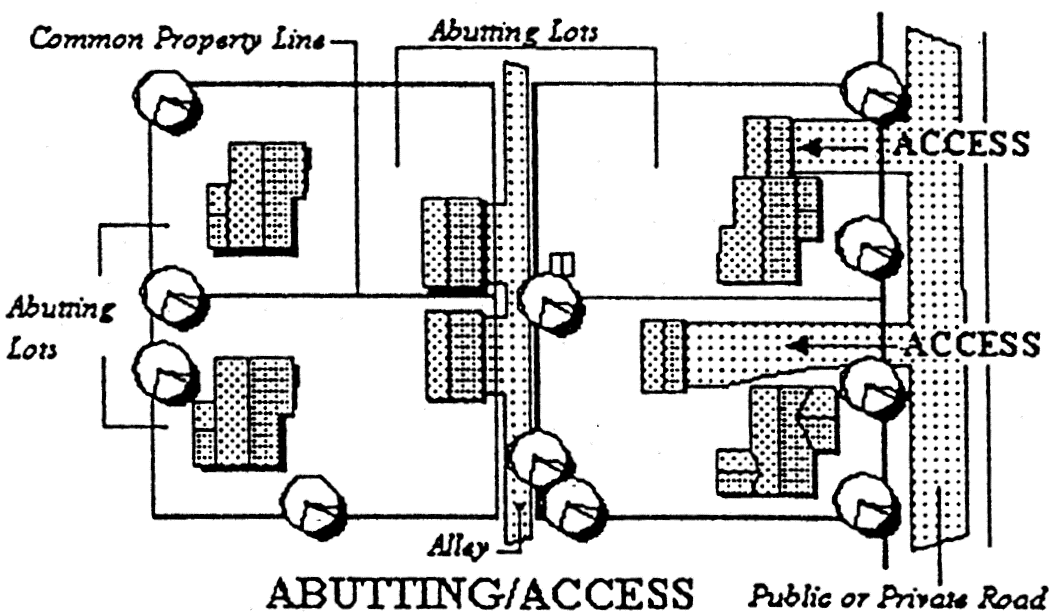
Access means an area designated as a way for vehicles to enter or leave a property or lot to a public or private street or alley. Access is intended to permit residents to bring their vehicles onto the property, customers or tenants to park, and to provide for public access in emergencies. See figure 23.301.
Access easement means that portion of a lot used for ingress/egress to an abutting lot and shown on a final plat by a recorded easement declaration. In no case shall a street right-of-way be construed to mean an easement.
Accessory building means a detached subordinate structure located on the same property as a principal structure which is incidental to that principal structure.
Accessory use means a use located on the same property as a principal use which is incidental to that principal use.
Addition means any construction which adds or enlarges the size of an existing building. Additions also include any extension or increase in floor area, or height of a building or structure. Examples of an addition are a porch, carport, new room, roof configuration, etc. Also see "Conversion, building or use" and "Structural alteration."
Administrative decision means decisions made in the implementation, administration, or enforcement of development regulations that involve the determination of facts and the application of objective standards set forth in this chapter or local government development regulations. These are sometimes referred to as ministerial decisions or administrative determinations.
Administrative hearing means a proceeding to gather facts needed to make an administrative decision.
Adult arcade (also known as "peep show"), means any place to which the public is permitted or invited wherein coin-operated or token-operated or electronically, electrically, or mechanically controlled still or motion picture machines, projectors, or other image-producing devices are maintained to show images to persons in booths or viewing rooms where the images so displayed depict or describe "specified sexual activities and/or "specified anatomical areas."
Adult bookstore or adult video store, means a commercial establishment:
(1)
Which receives a majority of its gross income during any calendar month from the sale or rental of publications (including books, magazines, other periodicals, videotapes, compact discs, other photographic, electronic, magnetic, digital, or other imaging medium) which are distinguished or characterized by their emphasis on matter depicting, describing, or relating to "specified sexual activities" or "specified anatomical areas," as defined by this article; or
(2)
Have as a preponderance (either in terms of the weight and importance of the material or in terms of greater volume of materials) of its publications (including books, magazines, other periodicals, videotapes, compact discs, other photographic, electronic, magnetic, digital, or other imaging medium) which are distinguished or characterized by their emphasis on matter depicting, describing, or relating to "specified sexual activities" or "specified anatomical areas," as defined by this article.
Adult carwash, means carwash that employs personnel who exhibit "specified anatomical areas."
Adult establishments, means an establishment that includes one of the following businesses: adult arcade; adult bookstores or adult video store; adult carwash; adult live entertainment business; adult massage; adult motel; adult motion picture theatre; adult retail establishment. An adult arcade; adult carwash; adult massage parlor; adult motel; and, adult retail/wholesale establishment are prohibited from the zoning jurisdiction of Granville County.
Adult live entertainment, means any performance of or involving the actual presence or real people which exhibits "specified sexual activities" or "specified anatomical areas," as defined by this article.
Adult live entertainment business, means any establishment or business wherein adult live entertainment is shown for observation by patrons.
Adult massage parlor, means a commercial establishment where, for any form of consideration massage, alcohol rub, fomentation, electric or magnetic, treatment, or similar treatment or manipulation of the human body is administered, unless such treatment or manipulation is administered by a medical practitioner, chiropractor, acupuncturist, physical therapist, or similar professional person licensed by the state. This definition does not include an athletic club, physical fitness center, school, gymnasium, reducing salon, or similar establishment where massage or similar manipulation of the human body is offered as an incidental or accessory service.
Adult motel means a hotel, motel, or similar commercial establishment that:
(1)
Offers accommodations to the public, for any form of consideration, and provides patrons with closed-circuit television transmissions, films, motion pictures, video cassettes, slides, or other photographic reproductions that depict or describe "specified sexual activities" and/or "specified anatomical areas" as one of its principal business purposes; or
(2)
Offers a sleeping room for rent for a period of time that is less than ten hours; or
(3)
Allows a tenant or occupant of a sleeping room to sub rent the room for a period of time that is less than ten hours.
Adult motion picture theatre means an enclosed building or premises used for presenting motion pictures, a preponderance of which are distinguished or characterized by an emphasis on matter depicting, describing, or relating to "specified sexual activities' or "specified anatomical areas," as defined by this article, for observation by patrons therein.
Adult retail/wholesale establishment means a commercial establishment which as one of its principal business purposes offers for sale or rental, for any form of consideration, instruments, devices, or paraphernalia that are designed for use in connection with "specified sexual activities."
Alley means a minor right-of-way privately or publicly owned, primarily for service access to the rear or side of properties which have principal frontage on some other street.
Alter and alteration mean a change in the appearance of a building, structure, site or object which is not otherwise covered by the definition of demolition, or any other change for which a permit is required pursuant to this chapter.
Alternative antenna structure means a structure which is not primarily constructed for the purpose of holding antennas, but on which one or more antennas may be mounted. Alternative structures include but are not limited to manmade trees, clock towers, buildings, silos, water tanks, pole signs, lighting standards, steeples, and electric distribution or transmissions towers.
Ancillary uses means uses subordinate to the principal use being conducted on a lot located either on the same lot as the proposed use or on a separate lot, but which provide services convenient to the operation of the principal use.
Antenna means any exterior transmitting or receiving device mounted on a tower, building or structure and used in communications that radiate or capture electromagnetic waves, digital signals, analog signals, radio frequencies (excluding radar signals), wireless telecommunications signals or other communication signals.
Apartment means a multifamily dwelling unit contained in a building comprised of three or more dwelling units, each having an entrance to a hallway, stairway or balcony in common with at least one other dwelling unit. See figure 04.110.
Appeal means a way to obtain review of a decision, determination, order or act of an administrative agency pursuant to the terms of this chapter.
Applicant means a person who executes the necessary forms to obtain approval or a permit for any zoning, subdivision, land development, building, land disturbance, or other activity regulated by this chapter.
Approval means final action granting the application given by that body specified in article XVI or XVII of this chapter as having final approval responsibility.
Art gallery means an establishment engaged in the sale, loan or display of art, books, paintings, sculpture, pottery, hand-woven articles, hand made or blown glass or other works of artistic items.
Arterial street means the same as "Street, arterial."
Artisan's workshop means an establishment that is not a home use as provided in section 32-1304, for the creation, preparation, display, and sale of individual artwork, jewelry, furniture, sculpture, pottery, leathercraft, stained glass, blown glass, hand-woven articles and related artistic items.
Artist studio means establishment that is not a home use, as defined in section 32-1304, that contains work space for artists or artisans, including individuals practicing one of the fine arts or skilled in applied art or craft.
Attic means the area between roof framing and the ceiling of the rooms below, and that is not habitable, but may be reached by ladder and used for storage or mechanical equipment. Improvement to habitable status shall make it a story.
Automobile wash or automatic car wash means as regulated in section 32-1306.
Awning and canopy mean a structure partially attached or entirely supported by a wall, and which is covered by canvas, cloth, plastic other similar material, used as a protective cover for a door, entrance, window, walkway or service area.
Basement means that lowest level or story which has its floor subgrade on all sides. See "Story, first."
Bed and breakfast means as regulated in section 32-1306.
Best management practices means structural or nonstructural management-based practices used singularly or in combination to reduce non-point-source inputs to receiving waters in order to achieve water quality protection goals.
Bikeway means a bicycle lane or path.
Biodiesel means a renewable fuel manufactured from methanol and vegetable oil, animal fats, and recycled cooking fats, comes in many forms, usually B100 or B20.
B20 means a form of biodiesel that is comprised of 20 percent biodiesel and 80 percent diesel.
B100 means a form of biodiesel that is comprised of 100 percentage of biodiesel.
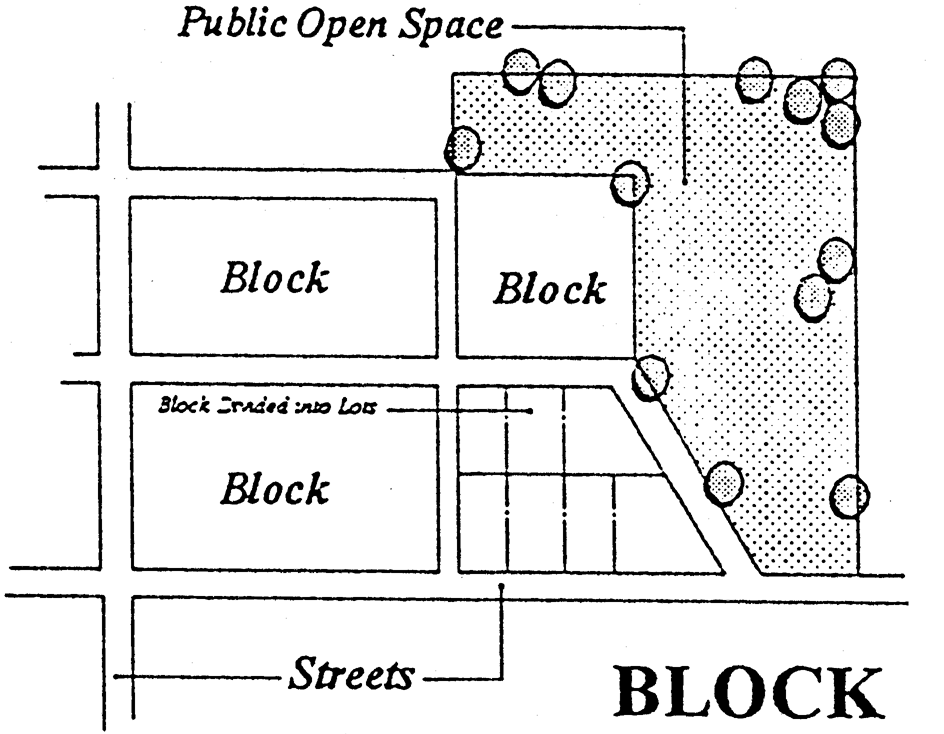
Block means a tract of land bordered by streets, or by a combination of streets and public parks, cemeteries, railroad rights-of-way, shorelines of watercourses or boundary lines of municipalities. Blocks are normally divided into lots. See figure 23.302.
FIGURE 23.302
Bond means any form of security, including a cash deposit, surety bond, collateral, property or instrument of credit in an amount satisfactory to the county.
Boulevards means a facility with a functional purpose of moderate mobility and low to moderate access. The facility has limited or partial control of access, traffic signals, and a minimum of two travel lanes with a median. Connections are provided primarily at at-grade intersections for major and minor cross streets.
Breakaway wall means a wall that is not part of the structural support of the building and is intended through its design and construction to collapse under specific lateral loading forces without causing damage to the elevated portion of the building or the supporting foundation system. A breakaway wall shall have a design safe loading resistance of not less than ten and no more than 20 pounds per square foot. A wall with loading resistance of more than 20 pounds per square foot requires a professional engineer or architect's certificate.
Buffer means an area of natural or planted vegetation through which stormwater runoff flows in a diffuse manner so that the runoff does not become channelized, and which provides for infiltration of the runoff and filtering of pollutants. The buffer is measured landward from the normal pool elevation of impounded structures and from the bank of each side of streams or rivers.
Build-to line means a line at which construction of a building façade is to occur on a lot, running parallel to the front property line without setback, and thus ensuring a uniform (or more or less even) building façade line on the street. The build-to line is the opposite of the setback line. A setback line establishes the minimum front yard. The build-to line indicates that building may not be located further back from that line.
Building means any structure, either temporary or permanent, having a roof or covering supported by columns, posts or by walls, and intended for shelter, housing or enclosure of persons, animals or property. The connection of two buildings by means of a porch, breezeway, passageway, carport or other such structure, with or without a roof, shall not be deemed to make them one building. The word "building" shall be construed as if followed by the words "or part or parts thereof and all equipment therein."
Building code means as regulated in article XIX, division 2.
Building, detached, means a building having no party or common wall with another building except an accessory building.
Building front means that exterior wall of a building which faces the front lot line.
Building height means the same as "Height, building."
Building inspector means the person designated by the county to enforce the building codes within its territorial jurisdiction.
Building setback line means a line located a minimum horizontal distance from the right-of-way line of a street or property line, or future right-of-way preservation line required by section 32-681, parallel thereto between which no building or parts of a building may be erected, altered or maintained except as otherwise provided in this chapter. See also "buildable area."
Building, site, means any lot or portion of a parcel of land upon which a building may be erected in conformance with the provisions contained in this chapter.
Built-upon area means that portion of a development project that is covered by impervious or partially impervious cover, including buildings, structures, pavement, concrete, gravel roads, vehicle parking areas and travelways, compacted soils, sidewalks, recreational facilities (e.g., tennis courts), etc. (Note: Wooden-slatted decks and the water area of swimming pools and water bodies are considered pervious.)
Capital improvements program means a proposed schedule of all future projects in order of priority which are proposed to be constructed by the county.
Certificate of occupancy means a statement signed by the land development administrator setting forth that the building, structure or use complies with this chapter and any applicable construction codes, and means may be used for the purposes stated in this chapter.
Child care means any use of a building that provides care services for three or more unrelated children under the age of 13 years who receive care from a nonrelative on a regular basis, of at least once a week for more than four hours but less than 24 hours per day.
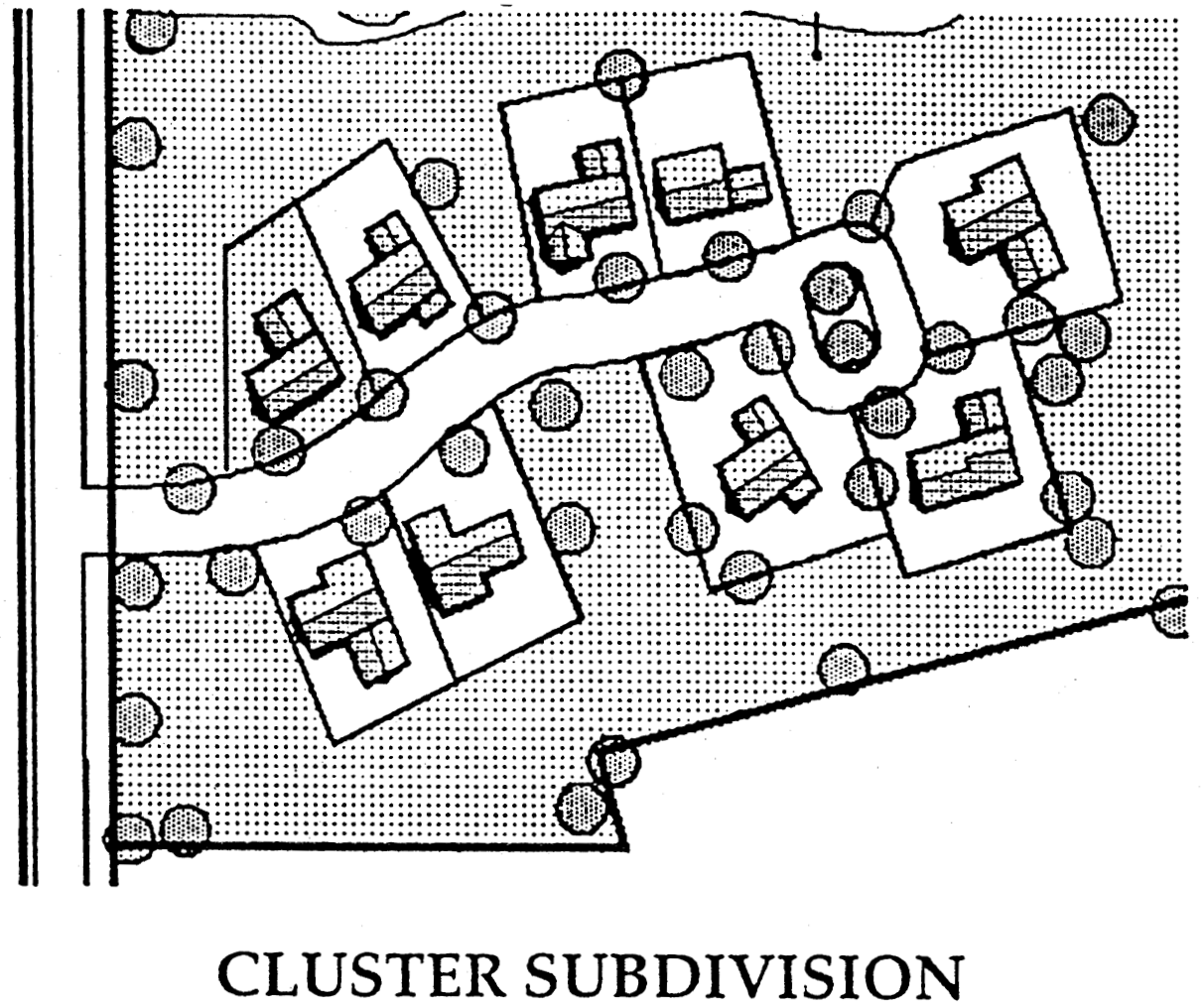
Cluster means a development pattern or design technique in which lots are grouped together rather than spread evenly throughout a parcel as in conventional subdivision development. Cluster development allows the remaining land to be used for recreation, open space and the preservation of natural resources. See section 32-1303 and figure 23.303.
FIGURE 23.303
Collector street means the same as "Street, collector."
Collocation means the placement of additional antennas or antenna arrays on an existing or approved telecommunications tower or alternative antenna structure, the sharing of an antenna or antenna array, or otherwise sharing a common location by two or more FCC licensed providers of personal wireless services. Collocation includes antennas, transmitters, receivers, and related electronic equipment, cabling, wiring, equipment buildings or enclosures, and other support equipment or improvements located on a tower site.
Commercial wireless service providers means persons who operate radio systems requiring an FCC license and who employ those facilities to provide fixed wireless (including microwave) or mobile wireless communication services to third parties for compensation. Commercial wireless service providers include but are not limited to cellular, personal communication services (PCS), specialized mobile radio (SMR), enhanced specialized mobile radio (ESMR), paging and competitive local exchange carriers (CLEC) utilizing point-to-multipoint microwave.
Comprehensive amendment or rezoning means any text amendment affecting all land in a district, or any change in a map (rezoning) affecting more than 50 lots or properties and 50 landowners.
Comprehensive plan means a comprehensive plan that has been officially adopted by the governing board pursuant to G.S. 160D-501.
Comprehensive transportation plan (CTP) means a mutually adopted, multimodal transportation planning set of vision maps (highway, public transportation and rail, bicycle, and pedestrian) that serves present and anticipated travel demand in a safe and effective manner. North Carolina General Statute § 136-66.2 requires the development of a comprehensive transportation plan serving present and anticipated travel demand for a particular area. North Carolina General Statute § 136-66.2 requires that the plan shall be based on the best information available including, but not limited to, population growth, economic conditions and prospects, and patterns of land development in and around the county, and shall provide for the safe and effective use of the transportation system. North Carolina General Statute § 136-66.2 further requires that consideration shall be given to all transportation modes including, but not limited to, the street system, transit alternatives, bicycle, pedestrian, and operating strategies in the development plan.
Conditional zoning means a legislative zoning map amendment with site-specific conditions incorporated into the zoning map amendment.
Conservation means the planned management of a natural feature to prevent its exploitation, destruction or neglect.
Conservation easement means a portion of a lot that is covered by an easement, running in favor of the county, or a nonprofit agency providing that such land shall be left in a natural state or open space, such other restrictions as to use or development that are set forth in the easement. The area of the lot, exclusive of the easement, shall meet the minimum lot area requirements of article IV of this chapter.
Construct and construction mean the erection of a new building, structure or object upon a site.
Construction permit means a permit issued by the land development administrator authorizing a mobile home parks developer to construct a mobile home park in accordance with a park plan approved by the county planning board, the county health department and the county electrical inspector.
Construction plan means the maps or drawings accompanying a subdivision plat, depicting the specific location and design of improvements to be installed in the subdivision.
Contiguous means land that abuts other lands, that are separated only by streets, ways, pipelines, electric power lines, conduits or rights-of-way, owned in fee or less than fee, by third parties.
Conversion, building or use, means the process by which the original use of a building or land is changed to a different use. See also "Addition" and "Structural alteration."
Corridor means a broad geographical land area that is linear, connects major sources of trips, and may contain a number of streets, highways, transit lines, and routes; generally follows an interstate, greenway, or major roadway.
County means the County of Granville, North Carolina.
Critical area means the area adjacent to a water supply intake or reservoir where risk associated with pollution is greater than from the remaining portions of the watershed. The critical area is generally defined as extending either one-half mile from the normal pool elevation of the reservoir in which the intake is located or to the ridge line of the watershed (whichever comes first); or one-half mile upstream from the intake located directly in the stream or river (run-of-the-river), or the ridge line of the watershed (whichever comes first). The critical area may, in some cases, be less than or extend farther than one-half mile to allow major landmarks such as highways or property lines to be used to delineate the outer boundary of the critical area if these landmarks are immediately adjacent to the appropriate outer boundary of one-half mile.
Cross-section means A basic description of type of roadway. Includes at a minimum the number of lanes and whether the roadway has a median or two-way left turn lane. Cross-section for the purposes of this chapter shall mean a view cutting through the roadway at right angles to the centerline showing the relationship of the various components of the roadway, including, but not limited to, the number of lanes, the amount of right-of-way, and whether the roadway has a median or turn lanes.
Cul-de-sac means a local street with only one outlet and having an appropriate terminal for the safe and convenient reversal of traffic movement.
Day-night level (DNL) means a measure of noise that is an outdoor, day-night average A-weighted sound level.
Days means working days.
Decision-making board means a governing board, planning board, board of adjustment, historic district board, or other board assigned to make quasi-judicial decisions under this chapter.
Dedication means the transfer of private property to public or common ownership for a public purpose. The transfer may be in fee simple interest or less than fee simple interest, including easements. Dedication requires the acceptance of the interest to be complete.
Demolish or demolition means the razing or destruction, whether entirely or in significant part, of a building, structure, site or object. Demolition includes the removal of a building, structure or object from its site, the removal or destruction of the facade or surface, or the alteration to such an extent that repair is not feasible or is so costly so as to be prohibitive, rendering the property unfit for use. Demolition shall also include demolition by neglect.
Density means the average number of dwelling units allowed on an acre of land. It may also measure the families, housing units, rental rooms or persons. For example, figure 23.304A shows two types of land uses on an acre of land. The first shows a density of three homes per acre. The second shows a density of 20 apartment units per acre.
FIGURE 23.304A
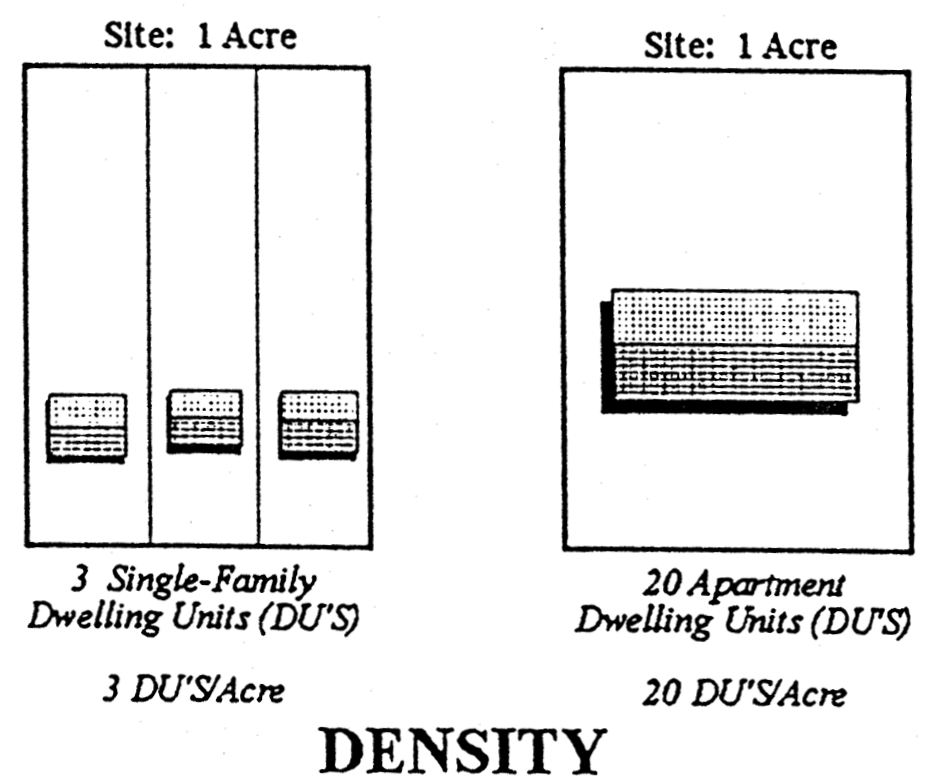
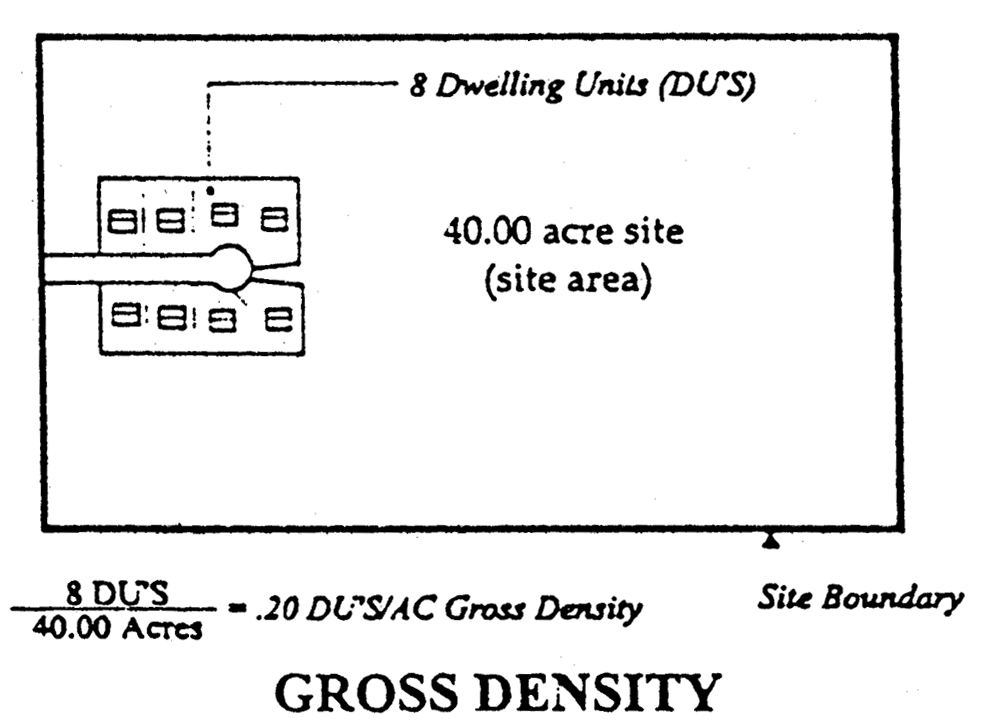
Density, gross (GD), means the total number of dwelling units on a site divided by the site area, figure 23.304B. Note: This includes lots and road right-of-way.
FIGURE 23.304B
Detention means the surface collection, storage and distribution of stormwater runoff for the purpose of compensating for increased runoff volume and decreased travel time associated with an increase in impervious surfaces, and to allow for the settling-out of pollutants borne by the runoff.
Determination means a written, final, and binding order, requirement, or determination regarding an administrative decision.
Developer means a person, including a governmental agency or redevelopment authority, who undertakes any development and who is the landowner of the property to be developed or who has been authorized by the landowner to undertake development on that property.
Development means unless the context clearly indicates otherwise, the term means any of the following:
(1)
The construction, erection, alteration, enlargement, renovation, substantial repair, movement to another site, or demolition of any structure.
(2)
The excavation, grading, filling, clearing, or alteration of land.
(3)
The subdivision of land as defined in G.S. 160D-802.
(4)
The initiation or substantial change in the use of land or the intensity of use of land.
This definition does not alter the scope of regulatory authority granted by this chapter.
Development approval means an administrative or quasi-judicial approval made pursuant to this chapter that is written and that is required prior to commencing development or undertaking a specific activity, project, or development proposal. Development approvals include, but are not limited to, zoning permits, site plan approvals, special use permits, variances, and certificates of appropriateness. The term also includes all other regulatory approvals required by regulations adopted pursuant to this chapter, including plat approvals, permits issued, development agreements entered into, and building permits issued.
Development regulation means a unified development ordinance, zoning regulation, subdivision regulation, erosion and sedimentation control regulation, floodplain or flood damage prevention regulation, mountain ridge protection regulation, stormwater control regulation, wireless telecommunication facility regulation, historic preservation or landmark regulation, housing code, state building code enforcement, or any other regulation adopted pursuant to this chapter, or a local act or charter that regulates land use or development.
Diesel means a petroleum fuel used in trucks, trains, boats, buses, planes, heavy machinery and off-road vehicles.
Discharging landfill means a facility with liners, monitoring equipment and other measures to detect and/or prevent leachate from entering the environment and in which the leachate is treated on-site and discharged to a receiving stream.
Disposal field means a system of open jointed or perforated pipes laid in the upper strata of the soil to distribute sewage effluent into the soil for absorption and vaporization.
Dormitory means a building with many rooms providing sleeping and living accommodations for a number of usually unrelated persons; usually associated with an educational institution. See section 32-1305.
Drainage means the process by which surface water (usually from rainfall) moves across the land surface. See "Stormwater management."
Drainage areas means the delineated areas that currently contribute or are proposed to contribute runoff to a specific location or point.
Drainage facility means any system of artificially constructed drains, including open channels and separate stormwater sewers, used to convey stormwater, surface water or groundwater, either continuously or intermittently, to natural watercourses.
Drive-in (eating or drinking facility) means as regulated in section 32-1306.
Driveway means a private accessway, primarily for vehicles, leading from a street to a parking or loading area.
Duplex means a form of multifamily dwelling with no more than two units per structure, located one over the other.
Dwelling means any building, structure, manufactured home, or mobile home, or part thereof, used and occupied for human habitation or intended to be so used, and includes any outhouses and appurtenances belonging thereto or usually enjoyed therewith. For the purposes of G.S. art. 12 of ch. 160D, the term does not include any manufactured home, mobile home, or recreational vehicle, if used solely for a seasonal vacation purpose.
Dwelling, attached means two or more dwelling units in a single structure or attached structures, each of which could have a single lot, which are separated from each other by a dividing wall. Such units may be side-by-side, back-to-back or both. This includes two-family dwellings.
Dwelling, multifamily means a building used or designed as a residence for more than two families living independently of each other.
Dwelling, single-family detached means a dwelling unit, designed for and occupied by not more than one family and having no roof, wall or floor in common with any other dwelling unit.
Dwelling, two-family means a detached building either designed for or occupied by two families living independently of each other.
Dwelling unit means one or more rooms physically arranged so as to create an independent housekeeping establishment for occupancy by one family with separate facilities for all of the following: sanitation, living, sleeping, cooking and eating.
Easements means any portion of a parcel subject to an agreement between the property owner and another party which grants the other party the right to make limited use of that portion of the property for a specified purpose. See "Conservation easement."
Electric distribution tower means metal or wooden towers and poles used to suspend wire transporting electricity between substations at the terminus of transmission lines and individual customer premises.
Electric transmission towers means metal or wooden towers and poles used to suspend wire transporting electricity between generating plant and substations supplying electricity to distribution and feeder lines.
Endorsement means the signature of the land development administrator appended to the final plat to signify approval of the plat.
Engineer, professional means an individual technically and legally qualified to practice the profession of civil engineering and who is registered to do so in the state.
Equipment enclosure means a building, cabinet or shelter used to house transmitters, receivers and other electronic equipment and accessories at a wireless telecommunication facility.
Erosion means the wearing away of soil or rock fragments by water, rain, wind or earth gravity.
Evidentiary hearing means a hearing to gather competent, material, and substantial evidence in order to make findings for a quasi-judicial decision required by a development regulation adopted under this chapter.
Existing development means those projects that are built or those projects that at a minimum have established a vested right under state zoning law as of September 15, 1999, based on at least one of the following criteria:
(1)
Substantial expenditures of resources (time, labor, money) based on a good-faith reliance upon having received a valid local government approval to proceed with the project;
(2)
Having an outstanding valid building permit as authorized by G.S. 153A-344.1 and G.S. 160A-385.1; or
(3)
Having an approved site-specific or phased development plan as authorized by G.S. 153A-344.1 and G.S. 160A-385.1.
Existing lot (lot of record) means a lot which was part of a subdivision of land for which a plat has been legally recorded in the office of the register of deeds prior to July 12, 1999, or a lot for which a deed describing a piece of property by metes and bounds was legally recorded based on county ordinances prior to July 12, 1999.
Expressway means a limited-access highway designed to carry regional traffic. All intersections shall be grade separated.
Expressways means a facility with functional purpose of high mobility and low to moderate access. The facility has limited or partial control of access, no traffic signals, and a minimum of four travel lanes with a median. Connections are provided only at interchanges for major cross streets and at-grade intersections for minor cross streets.
Exterior storage means outdoor storage of fuel, raw materials, products, equipment and other materials used in commercial, office or industrial activities. Exterior storage includes all building materials or waste or scrap materials stored outdoors. Truck trailers held on the site for more than one night storing materials or awaiting pickup shall be considered exterior storage. In the case of truck terminals, exterior storage includes all trucks, truck beds and truck trailers that are not involved in active loading.
FAA means Federal Aviation Administration.
FCC means Federal Communications Commission.
Facade means the same as "Building front."
Fall zone means an area around the base of a tower required to be kept clear of buildings, other than equipment enclosures, associated with the wireless telecommunication facility, to contain debris in the event of a tower structural failure.
Family means one or more persons occupying a single dwelling unit; provided that unless all members are related by blood or marriage or adoption, no such family shall contain over five persons; but further provided that domestic servants employed or living on the premises may be housed on the premises without being counted as a family.
Family care home means a facility designed to care for a maximum of six handicapped persons, plus support and supervisory personnel, as defined in G.S. 168-21.
Family child care home means family homes in which a resident of that home provides child care services for three to five preschool children and/or up to three school age children that is or will be licensed by the state.
Family subdivision means a minor subdivision of land where lots are intended to be conveyed to or developed for building purposes for members of the lineal family. Lineal family shall include only direct lineal descendants (children, grandchildren, great-grandchildren), direct lineal ascendants (father, mother, grandfather, grandmother), siblings (brother or sister from a common parent), and spouses. A family subdivision shall not exceed five lots for the same applicant and their spouses.
Fascia means a band located at the top edge of a building but below the actual roofline and above the building wall. Fascia material is often of a different type than either the actual roof or the building wall.
Filling means the depositing on land, whether submerged or not, of sand, gravel, earth or other materials. Biodegradable materials and other materials subject to decomposition or significant settling (such as garbage and other organic matter) shall not be considered filling.
Filling station means as regulated in section 32-1306.
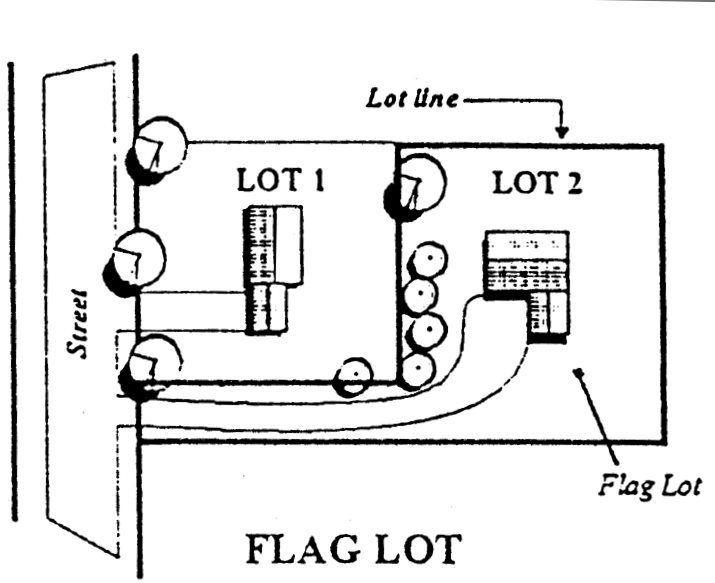
Flag lot means a lot of 40,000 square feet or more which has an access strip from the road to the main portion of the lot which is less than the frontage required by this chapter, but which lot has sufficient width at the building setback line to meet the requirements of this chapter. See figure 23.305.
FIGURE 23.305
Floor means the top surface of an enclosed area in a building (including basements), i.e., top of a slab in concrete slab construction or top of wood flooring in wood frame construction. This term does not include the floor of a garage used solely for parking vehicles.
Floor area, gross, means the same as "Gross floor area."
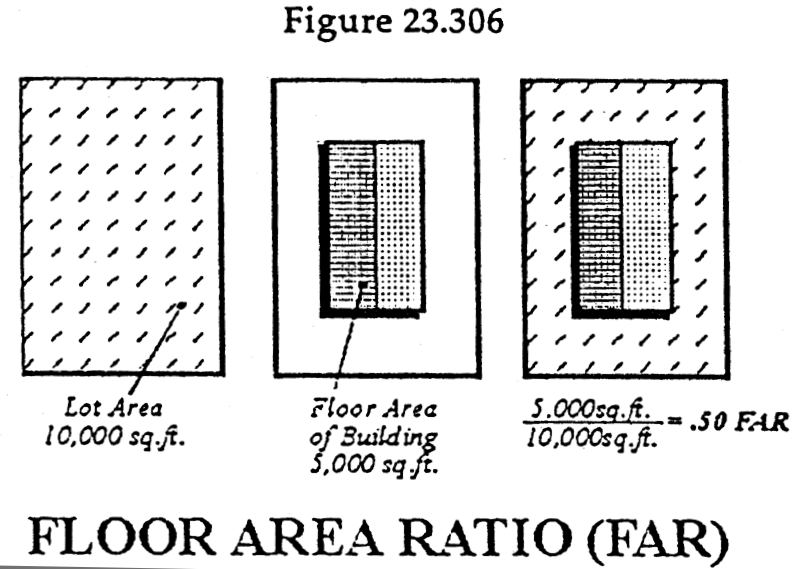
Floor area ratio (FAR) means a measure of the allowable size of floor area on a lot compared to the size of the lot. FAR gives developers flexibility in deciding whether to construct a low building covering most of the lot or a tall building covering only a small part of the lot, as long as the total allowable floor area coverage is not exceeded. See figure 23.306.
FIGURE 23.306
Floor area ratio, gross (GFAR) means the total floor area of a building or structure divided by the site or lot area.
Footcandle means a unit measuring the amount of illumination produced on a surface. One footcandle is the amount of illumination falling on all points which are one foot from a uniform point source of one candle.
Freeways means a facility with functional purpose of high mobility and low access. The facility has full control of access, no traffic signals, no driveways, and a minimum of four travel lanes with a median. Connections are provided only at interchanges for major cross streets. All cross streets are grade-separated.
Frontage means all property abutting one side of a street measured along the street line.
Front lot line means the same as "Lot line," subsection (1).
Functionally dependent facility means a facility that cannot be used for its intended purpose unless it is located or carried out in close proximity to water, such as a docking or port facility necessary for the loading and unloading of cargo or passengers, shipbuilding, ship repair or seafood processing facilities. The term does not include long-term storage, manufacture, sales or service facilities.
Garage, private, means a garage accessory to a principal building, used for storage purposes only, and in which no business, service or industry is conducted.
General watershed means the area adjoining an area upstream of the critical area of a watershed. The boundaries of the general watershed area are defined as within five miles of and draining to the normal pool elevation of the reservoir or to the ridgeline of the watershed, or within ten miles upstream and draining to the intake located directly in the stream or river or to the ridgeline of the watershed.
Governing board means the board of county commissioners.
Grade means the natural level of the ground adjoining the object whose height is to be measured. Where grade refers to a street or road, it is the existing grade at that point.
Grading means the excavating, filling (including hydraulic fill) or stockpiling of earth materials, in any combination, including the land in its excavated or filled condition.
Greenway means any trail or corridor of land or open space that is used for the purpose of recreation such as a bikeway, pedestrian walk-way or linear recreational facility, or for environmental protection as adopted and identified in the Granville County Comprehensive Land Use Plan and the Granville County Greenway Master Plan.
(1)
A greenway is a corridor of open space that can vary greatly in scale and purpose, from a narrow ribbon of green that runs through urban, suburban, and rural areas to a wide-open corridor that incorporates diverse natural, cultural, and scenic features.
(2)
Greenways can follow natural land or water features, like ridges or rivers, or human landscape features like abandoned railroad corridors or canals. They often link natural reserves, parks, cultural and historic sites with each other and, in some cases, with populated areas like towns, shopping centers, or residential developments. Greenways may include both land- or water-based areas, running along streams corridors, shorelines or wetlands, and they can incorporate both public and private property.
(3)
Greenways often provide for recreational opportunities, while others are established almost exclusively for environmental protection and are sometimes designed to limit human passage.
(4)
Greenways differ in their location and function, but overall, a greenway network will protect natural, cultural, and scenic resources, provide recreational benefits, enhance the natural beauty and the quality of life in neighborhoods and communities, and stimulate economic development opportunities.
(5)
Greenways allow people to enjoy walking, biking, skating, wheelchair cruising and running.
Gross area means the total land and water surface area contained within the boundaries of a lot or tract.
Gross floor area (GFA) means the sum of the total horizontal areas of every floor of every building on a lot. The measurement of gross floor area shall be computed by applying the following criteria:
(1)
The horizontal square footage is measured from the outside face of all exterior walls.
(2)
Cellars, basements, penthouses, attics, covered or uncovered porches, balconies and decks, enclosed storage or mechanical areas, mezzanines and similar structures shall be included as GFA wherever at least seven feet are provided between the finished floor and the ceiling. Garage floor areas shall not be included.
(3)
No deduction shall apply for horizontal areas void of actual floor space, for example, elevator shafts and stairwells. The protected upper floors of open atriums and foyers shall not be included.
Guy wire tower means a lattice-type structure with three or more sides of open-framed supports that is designed to be supported or anchored by use of guy wires to all sides of the tower.
Hazardous substance means any substance as found in the federal regulation 40 CFR 116, Designation of Hazardous Substances.
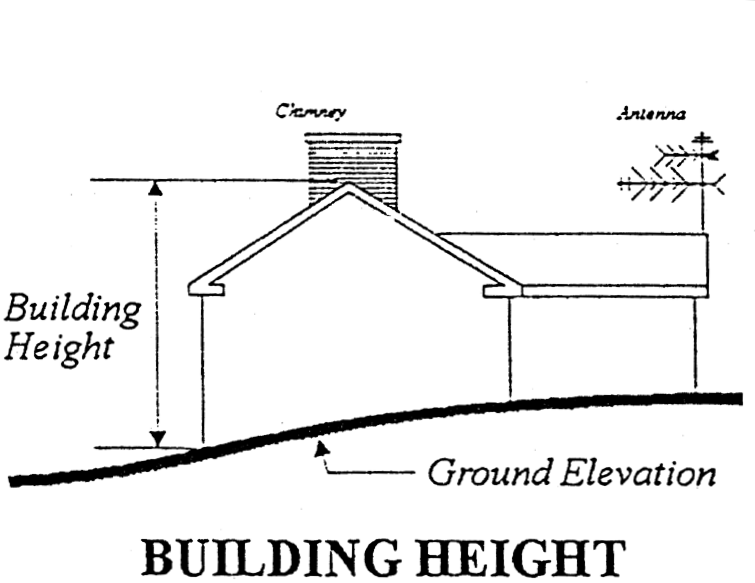
Height, building, means the maximum height of a building permitted on a lot. Building height is determined from the vertical distance as measured from the lowest ground elevation on the building to the highest point on the building, excluding chimneys and antenna. See figure 23.307 and section 32-263.
FIGURE 23.307
Height, sign, means the vertical distance measured from the highest of the adjacent sidewalk grade, adjacent street grade, or upper surface of the street curb to the highest point of the sign. Elevated roadways shall not be used to measure sign height.
Highway means any road thoroughfare, street, boulevard, lane, court, trailway, right-of-way or easement used for or laid out and intended for public passage of vehicles or persons.
Home care unit means a facility meeting all the requirements of the state for the boarding and care of not more than five persons who are not critically ill and do not need regular professional medical attention. See section 32-1303.
Home occupation means as regulated in section 32-1304.
Homeowner means and refers to those individuals who accept a deed to a lot or dwelling unit.
Hotel means as regulated in section 32-1306.
Impervious cover or surface means areas through which the natural infiltration of water is prevented by amenities located on the property; the same as "built-upon area" for the purposes of this chapter.
Individual sewage disposal system means a septic tank, seepage tile sewage disposal system or any other approved sewage treatment device.
Individual water system means the provision of a potable water system by means of an on-site well.
Industrial development means any nonresidential development that requires an NPDES permit for an industrial discharge and/or requires the use of storage of any hazardous material for the purpose of manufacturing, assembling, finishing, cleaning, or developing any product or commodity.
Institution means a public charitable, religious or educational organization or entity, which shall include such uses as any church, school, college, hospital, civic use, library, museum, park or playground.
Intermittent stream means a well-defined channel that contains water for only part of the year, typically during winter and spring when the aquatic bed is below the water table. The flow may be heavily supplemented by stormwater runoff. An intermittent stream often lacks the biological and hydrological characteristics commonly associated with the conveyance of water.
Intensity means the degree to which land is allowed to be used for development. See "Density" and "Floor area ratio."
Junk means pre-used or unusable metallic parts and other nonmetallic manufactured products that are worn, deteriorated or obsolete, making them unusable in their existing condition, but are subject to be dismantled and salvaged.
Junkyard means the use of more than 600 square feet of any lot for the storage of junk, including scrap metals, or other scrap materials, or for the dismantling or abandonment of automobiles or other vehicles or machinery. Such establishments store materials for a period of 15 days or more. See section 32-1308.
Kennel means as regulated in section 32-1306.
Landfill means a facility for the disposal of solid waste on land in a sanitary manner in accordance with G.S. ch. 130A, art. 9. This term does not include composting facilities. See section 32-1308.
Landowner means the holder of the title in fee simple. Absent evidence to the contrary, a local government may rely on the county tax records to determine who is a landowner. The landowner may authorize a person holding a valid option, lease, or contract to purchase to act as his or her agent or representative for the purpose of making applications for development approvals.
Land development administrator means as stated in division 2 of this article.
Land grading means the same as "Grading."
Land improved means vacant land which has been provided with power, water, sewerage, streets and sidewalks, and other infrastructure.
Landowner means the same as "Owner."
Landscape architect means an individual registered by the state to practice the profession of landscape architecture.
Landscape plan means a plan associated with a subdivision, land development or parking facility plan indicating the placement of trees, shrubs, ground cover and affiliated structures and improvements, including specifications, species, quantities and installation as prepared by a state registered landscape architect.
Landscape surface area means surface area of land not covered by any buildings, storage areas or impervious surface. These areas shall be maintained as lawn or a natural area and may be left undisturbed. See figure 23.308.
FIGURE 23.308
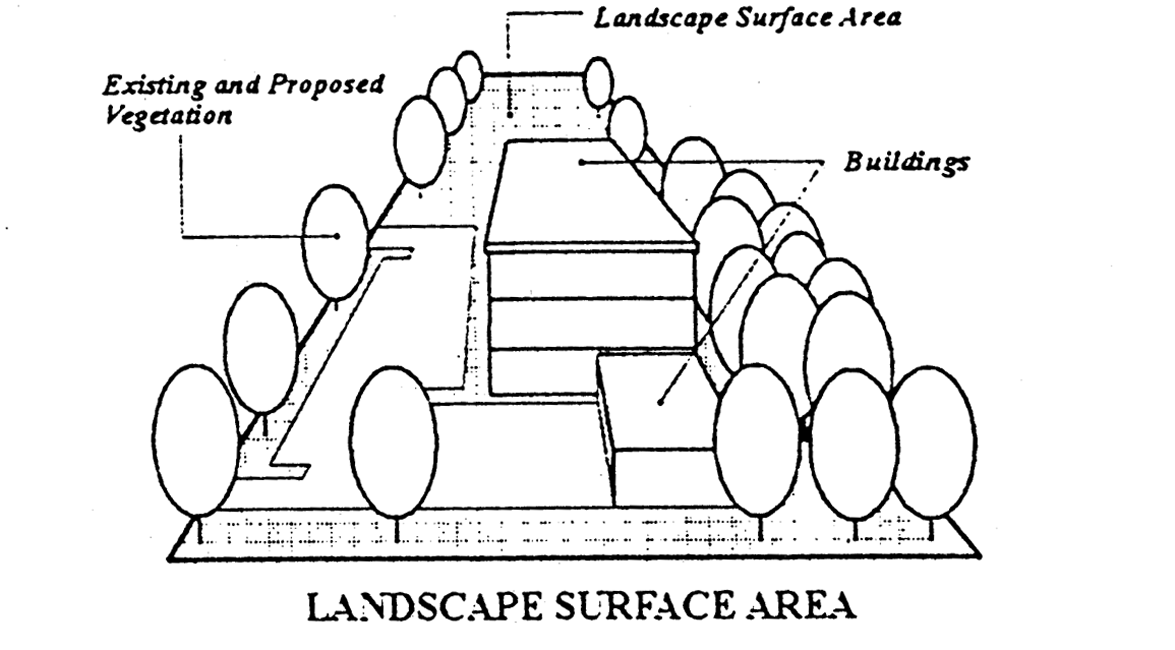
Landscape surface ratio (LSR) means the area of landscaped surface divided by the base site area.
Landscaping means the design and installation of plant material such as lawns, groundcover, trees, bushes, etc., in formal, informal or natural arrangements.
Lattice tower means a structure with three or more sides of open-framed supports that is designed to be self-supported without the aid of guy wires.
Legislative decision means the adoption, amendment, or repeal of a regulation under this chapter or an applicable local act. The term also includes the decision to approve, amend, or rescind a development agreement consistent with the provisions of G.S. art. 10 of ch. 160D.
Legislative hearing means a hearing to solicit public comment on a proposed legislative decision.
Lessee means any person who leases all or a portion of premises on a day-to-day, week-to-week or month-to-month basis.
Loading space means a durably paved, properly designed for drainage, off-street space used for the loading and unloading of vehicles, except passenger vehicles in connection with the use of the property on which such space is located.
Local act means as defined in G.S. 160A-1(5).
Local government means a city or county.
Local street means the same as "Street, local."
Lot means land area which is composed of a single parcel or contiguous parcel of land under individual or common ownership which is recorded as such in the office of the county register of deeds.
Lot, approved, means a lot that was approved after April 3, 1989, under the subdivision and zoning ordinances which preceded this chapter, or a lot approved under this chapter.
Lot area means the parcel of land enclosed within the boundaries formed by the property lines plus half of any alley abutting the lot between the boundaries of the lot, if extended.
Lot, corner, means any parcel of land having frontage on more than one street (road) which abuts an intersection of those streets (road).
Lot coverage means that portion of the lot area covered by buildings.
Lot depth means the average depth measured in the mean direction of the side lot lines from the front street line to the rear lot line. The rear line shall be deemed to be not farther back than a line drawn parallel with the front street line, entirely on the lot, and not less than ten feet long.
Lot, double-frontage, means a continuous lot of the same depth as the width of a block accessible from both rights-of-way upon which it fronts.
Lot, flag, means the same as "Flag lot."
Lot improvement means any building, structure, place, work of art, or other object, or improvement of the land on which the improvements are situated which contributes a physical betterment of real property or any part of such betterment.
Lot line means a line, including property line or a lease line, dividing one lot from another or from a street or other public place. There are basically four types of lot lines—front, rear, side, and street. See figure 23.309.
(1)
Front lot line means the street lot line from which the unit takes access, or where more than one street yard could safely provide this access, the street serving the smallest traffic volume.
(2)
Rear lot line means the lot line opposite the front lot line.
(3)
Side lot line means the lot line that runs generally perpendicular or at angles to the street or any line that is not a front, street or rear lot line.
(4)
Street lot line means any lot line that is also a street right-of-way line.
FIGURE 23.309
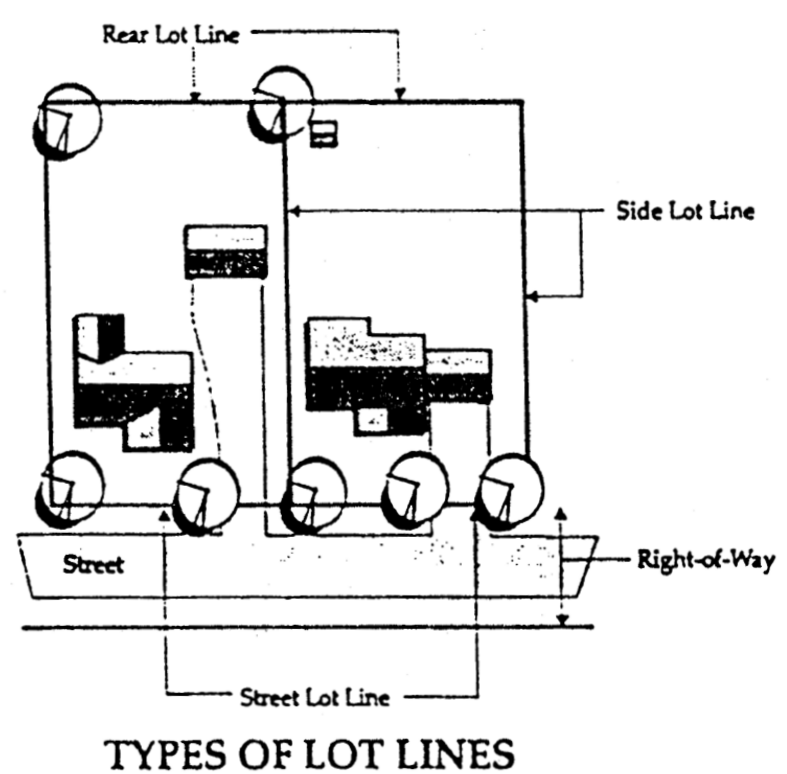
Lot line house means a dwelling type consisting of a single-family, fully detached residence located on an individual lot with only one side yard. See figure 4.110. No windows are permitted on the zero lot line wall of the house. The zero lot line may be achieved by:
(1)
Placing the house on a side lot line and providing a maintenance easement six feet wide on the adjoining lot; or
(2)
Locating the house so as to provide two side yards, one of which shall be a six-foot side yard with a use easement for the neighboring property.
Lot of record means a lot which has been recorded in the office of the register of deeds of the county, or a lot described by metes and bounds, the description of which has been recorded in the office.
Lot size means the size of a parcel of land enclosed within boundaries formed by the property lines and not including any areas within rights-of-way, access easements, the first 50 feet of the buffer strip required by section 32-742 along US and NC highways identified to be widened in the most recent officially adopted thoroughfare plan for the county, or the land preserved for future right-of-way as required in section 32-681.
Lot width shall be measured as follows:
(1)
Residential zoning districts. In all residential zoning districts (AR-80, AR-40, R-25, MHPD) lot width shall be the horizontal distance between the side lot lines measured along the right-of-way (public or private) or, in the case of a division of land resulting in more than one tract of land each of which is more than ten acres, along an access easement. Any lot created using the family subdivision procedure (see section 32-604) shall be exempt from the lot width requirement (including the parent tract) if a right-of-way is delineated on the plat creating the family subdivision; provided, however, no lots created by a family subdivision may be further subdivided unless such further subdivision complies with all of the requirements of this [chapter] and a road is actually constructed on the right-of-way so delineated according to the standards of the North Carolina Department of Transportation and as otherwise required by this [chapter].
(2)
All other zoning districts. In all other zoning districts, lot width shall be the horizontal distance between the side lot lines measured along the front building line as specified by the applicable front setback in this chapter. See figure 23.310.
Lowest floor means the lowest habitable floor of the lowest enclosed area, including basement intended for human occupancy, excluding storage, mechanical and parking, provided that such an enclosure is not built to render the structure in violation of the applicable nonelevation design requirements of this chapter.
Major change means a change to the plan that increases density or floor area, decreases open space, buffer yards, or parking, or which alters the alignment or layout of streets by more than five feet. For conditional approvals granted prior to July 12, 1999, any use proposed not contained in the original advertisement shall be considered a major change.
Major special use permit means a permit issued to authorize development or land uses in a particular zoning district upon presentation of competent, material, and substantial evidence establishing compliance with one or more general standards requiring that judgment and discretion be exercised as well as compliance with specific standards. The term includes permits previously referred to as a special use permit.
Major subdivision means all subdivisions containing ten or more lots or a subdivision other than a minor subdivision, exception or family subdivision.
Major variance means a variance from the minimum statewide watershed protection rules that results in the relaxation, by a factor greater than ten percent, of any management requirement.
Manufactured home means a structure as defined by G.S. 143-145(7). Travel trailers and campers shall not be considered manufactured homes.
Manufactured home park means a parcel (or contiguous parcels) of land divided into two or more manufactured home lots for lease.
Manufactured home space means any parcel of ground within a manufactured home park, designated for the exclusive use of one manufactured home.
Massage means the manipulation of body muscle or tissue by rubbing, stroking, kneading, or tapping, by hand or mechanical device.
Metropolitan planning organization (MPO) means a federally mandated transportation policymaking entity made up of representatives from local government and transportation authorities for urban areas with populations greater than 50,000. MPO's are responsible for developing long-range transportation plans and transportation improvement plans (TIP) for their respective regions, while ensuring transportation projects and programs are based on a comprehensive, cooperative, and continuing (3-C) planning process.
Minor change means a change to the plan that does not increase density or floor area; does not decrease open space, buffer yards or parking; or does not alter the alignment or layout of streets by more than five feet.
Minor special use permit means a permit issued to authorize development or land uses in a particular zoning district upon presentation of competent, material, and substantial evidence establishing compliance with one or more general standards requiring that judgment and discretion be exercised as well as compliance with specific standards. The term includes permits previously referred to as a conditional use permit.
Minor subdivision means all subdivisions of land involving nine or fewer lots.
Minor variance means a variance from the minimum statewide watershed protection rules that results in a relaxation, by a factor of up to ten percent, of any management requirement.
Mobile home park means the same as "Manufactured home park."
Monopole tower means a single, self-supporting pole type structure of concrete, steel or similar materials having a solid appearance and no guy wires.
Monument means a stone or concrete boundary marker, as required by this chapter, intended to fix the physical location of property lines.
Motel means as regulated in section 32-1306.
Multiphase development means a development containing 100 acres or more that: (i) is submitted for site plan approval for construction to occur in more than one phase; and (ii) is subject to a master development plan with committed elements, including a requirement to offer land for public use as a condition of its master development plan approval.
Multiplex means a multiple-family building type. Units may have either private or shared access. The units may be arranged in a variety of configurations, including back-to-back, side-to-side or vertical. However, no fewer than two and no more than eight units shall be attached in any single building. A multiplex is permitted only in planned developments as provided in articles III and IV of this chapter. See figure 04.110.
National Geodetic Vertical Datum (NGVD) means elevations referenced to mean sea level datum of the 1929 or 1988 U.S. Geological Survey.
New construction means structures for which the start of construction commenced on or after September 15, 1999, and includes any subsequent improvements to such structures.
Nonconforming building means a building, structure or parts lawfully existing at the time this chapter or a subsequent amendment to this chapter became effective which does not conform to the dimensional requirements of the district in which it is located.
Nonconforming lot means a lot, legally established prior to July 12, 1999, which does not meet the standards of the district in which it is located. This can involve minimum area, buildable area or dimensional requirements of the lot.
Nonconforming sign means any sign, legally established prior to July 12, 1999, which does not fully comply with the standards of this chapter.
Nonconforming use means a use of buildings or land that does not conform with the regulations of this chapter but is lawful until modified or changed due to establishment prior to July 12, 1999.
Nursing home means as regulated in section 32-1305.
Off-site means any premises not located within the area of the property to be subdivided, whether or not in the same ownership of the applicant requesting subdivision plat approval.
Official maps or plans means any maps or plans officially adopted by the board of commissioners as a guide to the development of the county. The land development plan and thoroughfare plan are two examples of an official map or plan.
Open space means land area to be left undeveloped as part of a natural resource preservation, recreation, buffer yards or other open space provision of this chapter. Open space excludes areas in lots, street rights-of-way or parking.
Open storage means goods, equipment or supplies held for safekeeping or eventual sale or distribution, not entirely within totally enclosed buildings. T-structures, lean-to-type structures or roofed-over, fenced-in areas shall not be considered totally enclosed buildings.
Operating permit means a permit issued by the land development administrator to a mobile home park owner or operator upon the completion of a mobile home park which conforms to the requirements of this chapter.
Overlay district means a district that is applied over other zoning districts and which may modify the permitted uses or intensity of use.
Owner means the same as "Landowner".
Parcel means the same as "Lot."
Park means an area open to the general public and reserved for recreational, educational or scenic purposes.
Parking space means an area of land designated for the parking of motor vehicles and connected to a street or private accessory. See article XII of this chapter.
Paved area means the same as "Impervious surfaces."
Peak hours or peak periods means, in general, periods from 7:00 a.m. to 9:00 a.m. and from 4:00 p.m. to 6:00 p.m. on weekdays. A peak hour is a 60-minute period occurring within a peak period. Different peak hours may be established by the land development administrator, based on type of development or traffic counts on a street.
Pedestrian means a person traveling on foot, whether walking or running.
Percolation test means an examination of subsoil used in determining the acceptability of the site and the design of the subsurface disposal field. The procedure of administering the test is set forth in section 1941 of the North Carolina Administrative Code, title 10 Department of Human Resources, chapter 10 Health Services; Sanitary Engineering subchapter 10A, Sanitation.
Perennial stream means a well-defined channel that contains water year round during a year of normal rainfall with the aquatic bed located below the water table for most of the year. Groundwater is the primary source of water for a perennial stream, but it also carries stormwater runoff. A perennial stream exhibits the typical biological, hydrological, and physical characteristics commonly associated with the continuous conveyance of water.
Performance guarantee means the same as "Bond."
Person means an individual, partnership, firm, association, joint venture, public or private corporation, trust, estate, commission, board, public or private institution, utility, cooperative, interstate body, the State of North Carolina and its agencies and political subdivisions, or other legal entity.
Pervious means a description of a surface that presents an opportunity for precipitation to infiltrate into the ground.
Plan, final, means a complete subdivision or land development plan, including all required supplementary data, which defines property lines, proposed streets and other improvements, and easements; or a plan of private streets to be dedicated to public use.
Plan, preliminary, means a plan of a subdivision or of a land development, including all required supplementary data, showing the approximate proposed street and lot or site layout, or a plan of existing private streets to be dedicated to public use, as a basis for consideration by the land development administrator and planning board prior to the preparation of a final plat.
Plan, sketch, means an informal plan indicating salient existing features of a tract and its surroundings, including the general layout of a proposed subdivision or land development.
Planned unit development means a residential, commercial or combination of residential and commercial projects located on land under unified control, planned as a whole, and developed as a single development or in a definitely programmed series of units or stages of development according to comprehensive and detailed plans, with a program for the provision, operation and maintenance of any areas, improvements and facilities provided for the common use of the occupants or users of the development. See section 32-1303.
Planning board means any board or commission established pursuant to G.S. 160D-301.
Plans, construction, means the architectural or engineering drawings showing the construction details and the types of material for the physical structures and facilities, excluding dwelling units, to be installed in conjunction with the development of the project.
Plat means a map or plan of a parcel of land which is to be or has been subdivided.
Plot means the same as "Parcel."
Principal building means the primary building located on a lot which is the base from which the principal use of the property emanates. See "Accessory building" or "Accessory use."
Principal use means the primary use located on a lot which customarily involves the principal structure. See "Accessory building" or "Accessory use."
Private road means an undedicated private right-of-way which affords access to abutting properties designed and constructed according to the standards of this chapter and requires a subdivision streets disclosure statement in accordance with the General Statutes.
Property means all real property subject to land-use regulation by a local government. The term includes any improvements or structures customarily regarded as a part of real property.
Property line means the same as "Lot line."
Public improvement means any drainage ditch, roadway, sidewalk, lot improvement or other facility for which the local government may ultimately assume the responsibility for maintenance and operation, or which may affect an improvement for which local government responsibility is established.
Public street means a dedicated and accepted public right-of-way which affords access to abutting property and meets the standards of this chapter and the most recent state department of transportation minimum construction standards for subdivision roads.
Quasi-judicial decision means a decision involving the finding of facts regarding a specific application of a development regulation and that requires the exercise of discretion when applying the standards of the regulation. The term includes, but is not limited to, decisions involving variances, special use permits, certificates of appropriateness, and appeals of administrative determinations. Decisions on the approval of subdivision plats and site plans are quasi-judicial in nature if the regulation authorizes a decision-making board to approve or deny the application based not only upon whether the application complies with the specific requirements set forth in the regulation, but also on whether the application complies with one or more generally stated standards requiring a discretionary decision on the findings to be made by the decision-making board.
Recreational vehicle means a vehicle that is built on a single chassis for use as temporary living quarters for recreational, camping, travel or seasonal use. It is designed to be self-propelled or permanently towable.
Remedy a violation means to bring the structure or other development into compliance with state or local floodplain management regulations or, if this is not possible, to reduce the impacts of its noncompliance. Ways that impacts may be reduced include protecting the structure or other affected development from flood damages, implementing the enforcement provisions of the article or otherwise deterring future similar violations, or reducing federal financial exposure with regard to the structure or other development.
Reserve strip means a parcel of ground in separate ownership separating a street from other adjacent properties or from another street.
Residuals means any solid or semisolid waste generated from a wastewater treatment plant, water treatment plant, or air pollution control facility permitted under the authority of the environmental management commission.
Retention means the surface collection, storage and reduction of stormwater runoff for the purpose of providing infiltration of runoff into the soil.
Right-of-way means an area of land not on a lot that is dedicated for public or private use to accommodate a transportation system. In no case shall a right-of-way be construed to mean an easement.
Road means the same as "Street."
Roadway means the portion of a highway, including the cartway and shoulders within a right-of-way.
Roofline means the top of a roof or building parapet, excluding any cupolas, pylons, chimneys or other minor projections.
Runoff means that portion of precipitation or snow melt that has not evaporated or infiltrated into the soil, but flows on the land surface.
Rural planning organization (RPO) means a voluntary transportation planning organization for rural areas made up of local officials and other representatives. Rural transportation planning is the process of examining travel and transportation issues and needs in nonmetropolitan areas. RPOs are responsible for assisting the state DOT with developing long-range local and regional multi-modal transportation plans, to provide a forum for public participation in the rural transportation planning process, to develop and prioritize suggestions for transportation projects to be included in the state transportation improvement program; and to provide transportation-related information to local governments and other interested organizations and persons.
Salvage operation means as regulated in section 32-1308.
Same ownership means ownership by the same person, corporation, firm, entity, partnership, or ownership by different corporations, firms, partnerships, entities or unincorporated associations where there is an agreement to develop under a unified plan.
Sanitary sewage means any liquid discharge from a structure or animal containment area, except roof drains.
Sanitary sewage disposal, community, means a sanitary sewage collection system in which sewage is carried from individual lots, by a system of pipes, to a temporary central treatment and disposal plant, generally serving a neighborhood area.
Sanitary sewage disposal, on-lot, means a system in which sanitary sewage and wastewater is collected from a single use or dwelling unit, by a system of pipes, and carried to a septic tank and tile disposal field located within the boundaries of an individual lot.
Sanitary sewage disposal, public, means a system in which sanitary sewage and wastewater is collected from multiple uses or dwelling units, by a system of pipes, and carried to a central disposal facility, generally serving a region.
Sanitary sewer line means a sanitary sewer collection system in which sewage is carried from individual lots, by a system of pipes, to a central treatment and disposal plant, or to other pipes, that run to a central treatment and disposal plant.
Sanitary sewer system means a central treatment and disposal plant and related systems and pipes, including but not limited to sanitary sewer lines.
Search area means a geographic area in which a commercial wireless service provider's antenna is intended to be located to serve the provider's coverage area.
Sediment means soils or other surface materials transported and/or deposited by the action of wind, water, ice or gravity as a product of erosion.
Septic tank means a multiple-compartment watertight receptacle which receives sewage from a building and is designed and constructed so as to permit settling of solids from the sewage, digestion of the organic matter and discharge of the liquid portion into a disposal area.
Septic system, individual, means the same as "Sanitary sewage disposal, on-lot."
Service station means as regulated in section 32-1306.
Setback means a minimum stated distance on a lot as measured from a lot line. See figure 23.311.
FIGURE 23.311
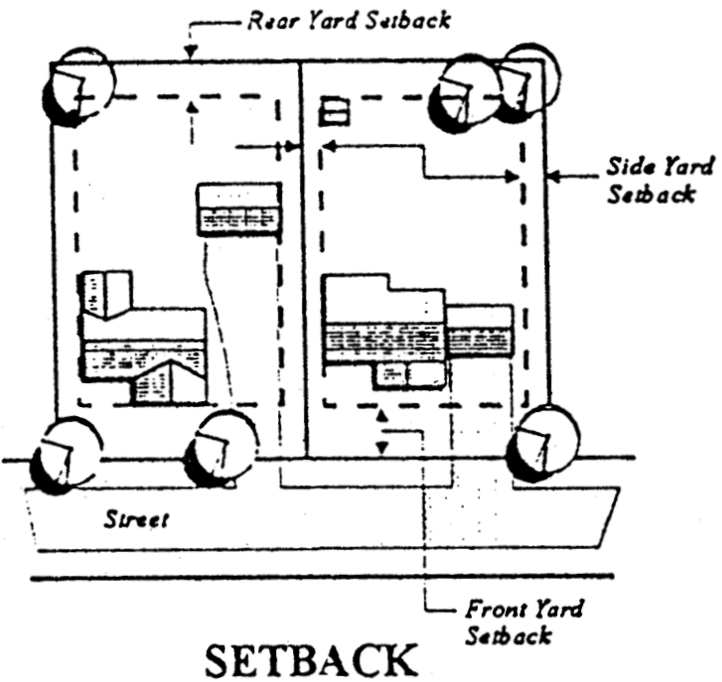
Shopping center means two or more commercial establishments planned and constructed as a single unit with off-street parking and loading facilities provided on the property.
Shoreline buffer means an area 50 feet in width around any perennial waters as indicated on the most recent version of the United States Geological Survey (USGS) 1:24,000 (7.5-minute) scale topographic maps.
Sidewalk means a pedestrian way extending along, parallel to and within an easement or the right-of-way of a public or private street.
Sign means any words, lettering, parts of letters, pictures, figures, numerals, phrases, sentences, emblems, devices, design, trade names or trademarks by which anything is made known such as the designation of an individual, firm, association, profession, business commodity or product which are visible from any public way and used to attract attention.
Sign, area of, means that area computed by the smallest square, triangle, rectangle, circle or combination which will encompass the entire sign, including lattice work, frame or supports incidental to its decoration. In computing the area, only one side of a double-face sign structure shall be considered.
Sign, business identification, means any sign which advertises an establishment, service, commodity or activity conducted upon the premises where such sign is located.
Sign, off-premises directional, means any off-premises sign indicating the location of, or directions to, an institutional land use defined by this chapter. The sign shall not include any information except the name of the institutional land use, and directions or symbols indicating directions.
Sign, outdoor advertising, means any sign which advertises an establishment, service, commodity, goods or entertainment sold or offered on premises other than that on which such sign is located.
Sign, portable, means any sign not exceeding 80 square feet in billboard area and constructed as a part of or attached to a trailer.
Site disturbance means the same as "Grading" and "Filling." See section 32-3.
Site plan means a scaled drawing and supporting text showing the relationship between lot lines and the existing or proposed uses, buildings, or structures on the lot. The site plan may include site-specific details such as building areas, building height and floor area, setbacks from lot lines and street rights-of-way, intensities, densities, utility lines and locations, parking, access points, roads, and stormwater control facilities that are depicted to show compliance with all legally required development regulations that are applicable to the project and the site plan review. A site plan approval based solely upon application of objective standards is an administrative decision and a site plan approval based in whole or in part upon the application of standards involving judgment and discretion is a quasi-judicial decision. A site plan may also be approved as part of a conditional zoning decision.
Solar.
Active solar system means a solar energy system that transforms solar energy into another form of energy or transfers heat from a collector to another medium using mechanical, electrical, or chemical means.
Building-integrated solar systems means an active solar system that is an integral part of a principal or accessory building, rather than a separate mechanical device, replacing or substituting for an architectural or structural component of the building. Building-integrated systems include but are not limited to photovoltaic or hot water solar systems that are contained within roofing materials, windows, skylights, and awnings.
Grid-intertie solar system means a photovoltaic solar system that is connected to an electric circuit served by an electric utility company.
Off-grid solar system means a photovoltaic solar system in which the circuits energized by the solar system are not electrically connected in any way to electric circuits that are served by an electric utility company.
Photovoltaic system means an active solar energy system that converts solar energy directly into electricity.
Roof pitch means the final exterior slope of a building roof calculated by the rise over the run, typically but not exclusively expressed in twelfths such as 3/12 , 9/12 , 12/12 .
Solar collector means a device, structure or a part of a device or structure for which the primary purpose is to transform solar radiant energy into thermal, mechanical, chemical, or electrical energy.
Solar collector surface means any part of a solar collector that absorbs solar energy for use in the collector's energy transformation process. Collector surface does not include frames, supports and mounting hardware.
Solar energy means radiant energy received from the sun that can be collected in the form of heat or light by a solar collector.
Solar energy system means a device or structural design feature, a substantial purpose of which is to provide daylight for interior lighting or provide for the collection, storage and distribution of solar energy for space heating or cooling, electricity generating, or water heating.
Solar farm means a use were a series of solar collectors are placed in a area for the purpose of generating photovoltaic power for an area greater than the principal use on the site. Also referred to as solar power plant and solar photovoltaic farm.
Solar mounting devices means devices that allow the mounting of a solar collector onto a roof surface or the ground.
Specified anatomical areas means by reference, the definition of "specified sexual activities" contained in G.S. § 14-202.10 is incorporated into this article and shall be defined as such.
Specified sexual activities means by reference, the definition of "specified sexual activities" contained in G.S. § 14-202.10 is incorporated into this article and shall be defined as such.
Stabilization means the prevention of soil erosion by surface runoff or wind through the establishment of vegetative or structural soil coverage measures. Examples include but are not limited to straw mulch with temporary or permanent vegetation, wood chips and stone or gravel ground cover.
Stormwater management means the mitigation of the hydrologic impacts of lost natural runoff storage by the use of constructed storage facilities:
(1)
For water quantity control, a system of vegetative, structural and other measures that may control the volume and rate of stormwater runoff which may be caused by land disturbing activities or activities upon the land; and
(2)
For water quality control, a system of vegetative, structural and other measures that control adverse effects on water quality that may be caused by land disturbing activities or activities upon the land.
Stormwater management plan means a plan for the control of soil erosion, sedimentation, stormwater quantity and water quality impacts resulting from any land disturbing activity.
Story, first, means the ground floor story of a building, provided its floor level is not more than four feet below the mean lot level adjacent to the foundation.
Story, half, means a story under a sloping roof at the top of the building, the floor of which is not more than two feet below the wall plate.
Stream buffer means a 50-foot vegetated buffer along both sides of all perennial streams as defined by the USGS as ones "which flow continuously" and are indicated by solid blue lines on 7.5-minute topographic maps.
Street means a public or private thoroughfare which affords access to abutting property and is recorded as such in the office of the county register of deeds. Particular kinds are as follows:
Street, arterial, means a street which serves or is designed to serve as a connection between uses which generate heavy traffic volumes, or between other arterial streets.
Street, collector means a street intended to move traffic from local streets to secondary arterials.
Street, dead-end means a street or portion of a street with only one vehicular traffic outlet.
Street, internal subdivision means any street or road that is created or exists within a major subdivision.
Street, local means a street that provides access to individual land uses.
Street, major thoroughfare means streets and highways primarily for through, fast or heavy traffic.
Street, marginal-access means a minor street which is parallel to and adjacent to major highways and which provides access to abutting properties and protection from through traffic.
Street, minor means streets which have been designed primarily to afford access to abutting properties.
Street, private means a street right-of-way in private ownership that is privately maintained, which affords access to abutting property and does not meet all the construction standards of the most recent state department of transportation minimum standards for subdivision roads, but the street construction standards outlined in article XI of this chapter.
Street, private, type I, type II, type III means a private street approved under the provisions of the county subdivision ordinance between June 17, 1991, and February 1, 1999.
Street right-of-way width means the distance between property lines measured at right angles to the centerline of the street.
Structure means anything constructed or erected, including but not limited to buildings, which requires location on the land or attachment to something having temporary or permanent location on the land.
Structure, permanent means a structure placed on or in the ground or attached to another structure in a fixed position.
Structure, temporary means a structure that is designed to be repeatedly erected or inflated, tents and inflatable structures, or buildings that are picked up and moved.
Subdivider means any person who subdivides or develops any land deemed to be a subdivision.
Subdivision means the division of land for the purpose of sale or development as specified in G.S. 160D-802.
Subdivision, major means the same as "Major subdivision."
Subdivision, minor means the same as "Minor subdivision."
Subdivision regulation means a subdivision regulation authorized by G.S. art. 8 of ch. 160D.
Surface water means all waters of the state as defined in G.S 143-212 except underground waters.
Surveyor means a land surveyor registered by and licensed to practice in the state.
Temporary antenna support facility means a facility that is designed and constructed to serve, on a temporary basis, as a means of supporting antennas and is used typically to provide emergency wireless communications service or to provide wireless communications service to special events.
Thoroughfare means a facility with a functional purpose of moderate to low mobility and high access. The facility has no control of access, traffic signals, driveways with full movements, and a minimum of two travel lanes without a median. Connections are provided primarily at at-grade intersections. Thoroughfares are generally categorized into two categories: major thoroughfares and minor thoroughfares.
Thoroughfare plan means a transportation plan serving present and anticipated travel demand for a particular area. The plan is based on, but is not limited to, population growth, economic conditions and prospects, and patterns of land development, and provides for the safe and effective use of the transportation system. The plan includes the existing and planned transportation infrastructure and needs for highway transportation. The thoroughfare plan offers insight into the future transportation system. The new comprehensive transportation plan described in G.S. § 136-66.2 has now replaced the previous thoroughfare plan.
Topography means the characteristics of a parcel of land with respect to elevation determined by field survey or aerial photography and field reference.
Tower means any structure that is designed and constructed primarily for the purpose of supporting one or more antennas for telephone, radio and television transmission, microwave transmission, common-carrier, cellular and digital telephone including personal communications services, and similar communication purposes. These antennas may be located on monopole towers, lattice towers, guy wire towers, and alternative tower structures, and the like. The term includes the structure and any support.
Townhouse means a single-family attached dwelling unit, with a single unit going from ground to roof, and with individual outside access. See figure 04.110.
Toxic substance means any substance or combination of substances (including disease-causing agents), which after discharge and upon exposure, ingestion, inhalation or assimilation into any organism, either directly from the environment or indirectly by ingestion through food chains, has the potential to cause death, disease, behavioral abnormalities, cancer, genetic mutations, physiological malfunctions (including malfunctions or suppression in reproduction or growth) or physical deformities in such organisms or their offspring or other adverse health effects.
Trails means marked routes on land or water, with protected status and public access for recreation or transportation. Trails can have many forms—Narrow, winding wilderness paths, primitive woods roads, converted rail and canal corridors, beach and other water-based trails along rivers, streams and coastlines. If they fall within protected corridors, trails are greenways. Trails provide access to and appreciation of the values to natural areas and green spaces, plus provide diverse resource based outdoor recreational opportunities.
Travel trailer means the same as "Recreational vehicle."
Twin house means a single-family dwelling that is attached by one common wall to one other dwelling unit. See figure 04.110.
Use means the purpose for which land or structures are designed, arranged, located or intended to be occupied or utilized, or for which it is occupied, maintained, rented or leased.
Variance means relief from the standards of this article. See article XVIII of this chapter.
Vegetative canopy means trees which create a roof-like layer of spreading branches.
Vested right means the right to undertake and complete the development and use of property under the terms and conditions of an approval secured as specified in G.S. 160D-108 or under common law.
Village house means a single-family residence which is detached from neighboring structures. A village house has very small front yards with special landscape requirements. Homes shall be built to the build-to line. A village house is permitted only in planned developments as provided in articles III and IV. See figure 04.110.
Visible means capable of being seen by the unaided eye in daylight.
Warehouse means as regulated in section 32-1308.
Water body means any watercourse or lake defined by a bank or shore in which water can be found.
Water quality means those characteristics of stormwater runoff, usually from a land disturbing activity that relate to the chemical, physical, biological or radiological integrity of water.
Watercourse means a stream channel (perennial, intermittent, mapped or unmapped) with banks and a bed within which concentrated water flows.
Water-dependent structure means any structure for which the use requires access to or proximity to or citing within surface waters to fulfill its basic purpose, such as boat ramps, boathouses, docks and bulkheads. Ancillary facilities such as restaurants, outlets for boat supplies, parking lots and commercial boat storage areas are not water-dependent structures.
Watershed means the entire land area contributing surface water drainage to a specific point (e.g., the water supply intake).
Watershed administrator means the land development administrator.
Watershed certificate of occupancy means a statement signed by the watershed administrator setting forth that the building, structure or use for which a watershed protection permit was issued complies with the issued permit and all aspects of this chapter and that final approval is granted for its operation and/or use.
Watershed map atlas means the set of maps, approved and signed by the board of commissioners, which details the location of the county water supply watershed areas and shall accompany this chapter and serves as the final authority regarding the watershed boundaries. The atlas shall remain on file in the county planning department.
Watershed protection permit means a permit issued by the watershed administrator or his designated agent that authorizes the owner and/or applicant to build, construct, locate or use a specific property for a specified project in accordance with this chapter and details any requirements, guidelines or limitations necessary to meet the requirements of this chapter. An approved site plan attached to the permit form shall serve as part of the permit.
Wetland means those areas inundated or saturated by surface water or groundwater at a frequency and duration sufficient to support, and that under normal circumstances do support, a prevalence of vegetation typically adapted for life in saturated soil conditions; or areas that are defined and delineated in accordance with the Federal Manual for Identifying and Delineating Jurisdictional Wetlands dated January 10, 1989, and as may be amended from time to time; or as further defined and delineated by the U.S. Army Corps of Engineers, the U.S. Environmental Protection Agency, or the state coastal resources commission.
Wind energy.
Wind energy facility means an electric generating facility, whose main purpose is to supply electricity, consisting of one or more wind turbines and other accessory structures and buildings, including substations, meteorological towers, electrical infrastructure, transmission lines, and other appurtenant structures and facilities.
Wind energy facility, large system means a wind energy conversion system consisting of one or more wind turbine(s), a tower (s), and associated control or conversion electronics, which has a rated capacity of not more than 999 kW.
Wind energy facility, small system means a single system designed to supplement other electricity sources as an accessory use to existing buildings or facilities, wherein the power generated is used primarily for onsite consumption. A small wind energy conversion system consisting of a single wind turbine, a tower, and associated control or conversion electronics, which has a rated capacity of not more than 25 kW.
Wind power means power is generated in the form of electricity by converting the rotation of turbine blades into electrical current by means of an electrical generator.
Wind turbine means a wind energy conversion system that converts wind energy into electricity through the use of a wind turbine generator, and may include a nacelle, rotor, tower, and pad transformer.
Wind turbine height means the distance measured from grade to the highest point of the turbine rotor or tip of the turbine blade when it reaches its highest elevation.
Yard means any open space on the same lot with a building and unoccupied from the ground upward except by trees, shrubbery or fences. See figure 23.312.
Yard, front means a yard across the full width of the lot, extending from the front line of the building to the front lot line. See figure 23.312.
Yard, rear means a yard across the full width of the lot, extending from the rear line of the building to the rear lot line. For a corner lot, the rear yard shall not extend beyond the building setback line on the side street. See figure 23.312. If the shape of the lot is such that there is deemed to be no property line, the rear yard setback shall be maintained from the point (apex) on the property's perimeter which is the furthest removed from the front lot line. The rear yard minimum building line shall be a line perpendicular to a straight line connecting the apex and the midpoint of the front lot line.
Yard, side means a yard between the building and side lot line, extending from the front building line to the rear building line. See figure 23.312.
FIGURE 23.312
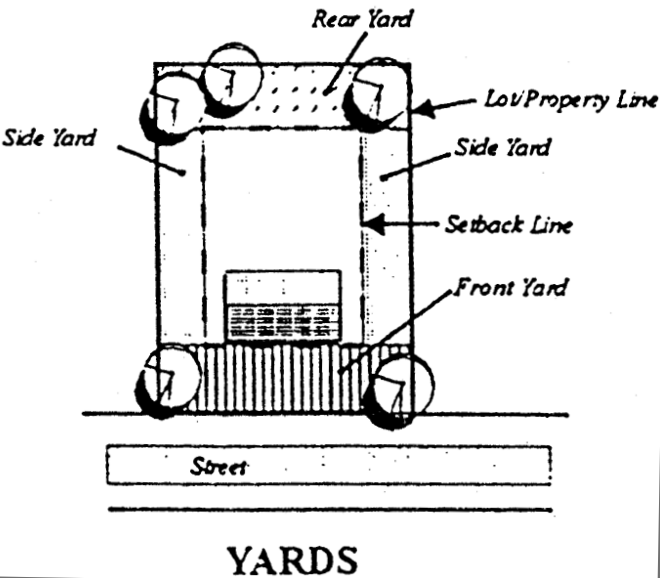
Zero lot line house means the same as "Lot line house."
Zoning district means a designation shown on the zoning map as being in a district enumerated in article II of this chapter in which a specific set of zoning standards apply. The term may refer to the standards or an area so mapped. The term is also analogous with zoning classification or designation.
Zoning map means the map showing the location and boundaries of the zoning districts established by this chapter. This map is entitled, "Official Zoning Map of Granville County."
Zoning map amendment or rezoning means an amendment to a zoning regulation for the purpose of changing the zoning district that is applied to a specified property or properties. The term also includes: (i) the initial application of zoning when land is added to the territorial jurisdiction of a local government that has previously adopted zoning regulations, and (ii) the application of an overlay zoning district or a conditional zoning district. The term does not include: (i) the initial adoption of a zoning map by a local government, (ii) the repeal of a zoning map and readoption of a new zoning map for the entire planning and development regulation jurisdiction, or (iii) updating the zoning map to incorporate amendments to the names of zoning districts made by zoning text amendments where there are no changes in the boundaries of the zoning district or land uses permitted in the district.
Zoning permit means a permit issued by the land development administrator or his authorized agents that permits the applicant to use or occupy a tract of land or a building or to erect, install or alter a structure, building or sign situated in the jurisdiction of the county that fully meets the requirements of this chapter.
Zoning regulation means a zoning regulation authorized by G.S. art. 7 of ch. 160D.
(Ord. of 7-12-1999, § 23.300; Ord. of 1-3-2000, § 5; Ord. of 4-3-2000, § 1; Ord. of 8-21-2000, § 2; Ord. of 2-4-2002, § 2; Ord. of 8-4-2003, § 4; Amend. (2) of 6-19-2006, § 2; Amend. (1) of 7-10-2006, §§ 3, 4; Amend. (2) of 7-10-2006, §§ 3, 4; Amend. of 12-4-2006(1), § 2; Amend. of 3-19-2007, § 5; Amend. of 4-16-2007, § 2; Amend. of 8-4-2008, §§ 2, 3; Amend. of 4-20-2009, § 2; Amend. of 8-3-2009, § 1; Amend. of 2-1-2010, § 3; Amend. of 4-4-2011, § 1; Amend. of 2-3-2014, § 3; Amd. of 11-18-2019(1), § 11; Amend. of 4-19-2021(2), § 1)