
Grovetown City Zoning Code
ARTICLE I
- GENERAL PROVISIONS
Sec. 1.000.- Jurisdiction.
The provisions of this ordinance shall apply to all land, buildings, and structures within the incorporated areas of Grovetown, Georgia.
Sec. 1.001. - Government property.
Property owned by the City of Grovetown, City Council, Columbia County, the county board of commissioners, the county school district, the county board of education, the state or the United States government, and used or held for use for governmental purposes, is not subject to the provisions of this ordinance.
Sec. 1.010. - Title.
This ordinance shall be known as and may be cited as the Comprehensive Zoning Ordinance, City of Grovetown, Georgia.
Sec. 1.020. - Zoning map.
The location and boundaries of the zoning districts established by this ordinance are bounded and defined as shown on the map entitled "Zoning Map of Grovetown, Georgia," and certified by the city clerk.
Sec. 1.030. - Zoning districts established.
For the purpose of this ordinance, the City of Grovetown is hereby divided into the following zoning districts:
Residential Districts:
R-1 Residential
R-2 Residential
R-3 Residential
R-C1
R-C2
R-HD Residential High Density
Commercial Districts:
NC - Neighborhood Commercial
GC - General Commercial
Industrial District:
M - Industrial
Special Districts:
PUD - Planned Unit Development
Table 1 below identifies former zoning districts and the transition into zoning districts defined in this UDO.
Sec. 1.040. - Interpretation of district boundaries.
Unless otherwise shown on the zoning map, the boundary lines of zoning districts are lot lines, the centerlines of streets or alleys, or such lines extended, railroad right-of-way lines, the centerlines of creeks and streams, or the corporate limit line as it existed at the time of the enactment of this ordinance.
Zoning district boundary lines not coinciding with lot lines, the centerlines of streets or alleys, or such lines extended, railroad right-of-way lines, the centerlines of creeks or streams, or the corporate line of the city, as it existed at the time of the enactment of this ordinance shall be determined by use of the scale on the zoning map, unless actual dimensions are noted.
The board of zoning appeals shall resolve any questions or controversy arising over the exact location of district boundary lines.
Sec. 1.050. - Definitions.
For the purposes of this ordinance and in order to carry out the provisions and intentions as set forth herein, certain words, terms, and phrases are to be used and interpreted as herein defined. Words used in the present tense shall include the future tenses; words in the singular number include the plural and words in the plural number include the singular; the word "person" includes a firm, partnership, or corporation as well as an individual; the term "shall" is always mandatory and not directory; and the word "may" is permissive. The word "used" or "occupied" as applied to any land or building shall be construed to include the words "intended, arranged, or designed" to be used or occupied.
The following words, terms, and phrases are hereby defined as follows and shall be interpreted as such throughout this ordinance. Terms not herein defined shall have the meaning customarily assigned to them.
Accessory use or structure: (See "Use").
Amend or amendment: Any repeal, modification, or addition to a regulation; and new regulation; any change in the numbers, shape, boundary, or area of a district or any repeal or abolition of any map, part thereof, or addition thereto.
Apartment house: (See "Dwelling, multiple-family").
Assembly: A facility that has organized services, meetings, or programs to benefit, educate, entertain, or promote discourse amongst the residents of the community in a public or private setting. Includes churches, chapels, temples, synagogues, mosques, places of worship, live theaters, fraternal organizations, and clubs & lodges.
Automobile garage, private: An accessory building, carport or similar structure, or portion of a main building designed, arranged, or used for the housing of private motor vehicles, only one of which may be a commercial vehicle.
Automobile parking lot or garage, commercial: A lot or building or portion thereof, other than an automobile sales lot, held out or used for the storage or parking of six (6) or more motor vehicles for a consideration where service or repair facilities are not permitted. Such parking lot or garage shall not be considered an accessory use; nor shall it be used for the storage of dismantled or wrecked motor vehicles, parts thereof, or junk.
Automobile repair and service garage: A building, lot, or both in which the business of general motor vehicle repair and service is conducted including automobile body repair services.
Automobile sales lot: A lot arranged, designed, or used for the storage and display for sale of any motor vehicle or any type of trailer provided the trailer is unoccupied, and where no repair work is done except minor incidental repair of automobiles or trailers displayed and sold on the premises.
Automobile service station: A building, lot, or both in or upon which gasoline, oil, grease, batteries, tires and automobile accessories may be supplied and dispensed at retail, and where, in addition, the following services may be rendered and sales made, and no other:
a.
Sale and servicing of spark plugs, batteries, and distributors and distributor parts.
b.
Tire servicing and repair, but not recapping or regrooving.
c.
Replacement of mufflers and tail pipes, water hose, fan belts, brake fluid, light bulbs, fuses, floor mats, windshield wipers and wiper blades, grease retainers, wheel bearings, mirrors, and the like.
d.
Radiator cleaning and flushing.
e.
Washing and polishing, and sale of automotive washing and polishing materials.
f.
Greasing and lubrication.
g.
Providing and repairing fuel pumps, oil pumps, and lines.
h.
Minor servicing and repair of carburetors.
i.
Emergency wiring repairs.
j.
Adjusting and repairing brakes.
k.
Minor motor adjustments not involving removal of the head or crankcase or racing the motor.
l.
Sale of cold drinks, packaged foods, tobacco, and similar convenience goods for service station customers as accessory and incidental to principal operation.
m.
Provision of road maps and other informational material to customers; provision of restroom facilities.
Uses permissible at a service station do not include major mechanical and body work, straightening of body parts, painting, welding, storage of automobiles not in operating condition, or other work involving noise, glare, fumes, smoke, or other characteristics to an extent greater than normally found in service stations. A service station is hereby declared not to be a repair and service garage nor a body shop.
Automobile wrecking: (See "Junkyard").
Bed and breakfast: A facility where overnight accommodations not exceeding six (6) rooms are provided for compensation, with or without a morning meal, and which may include an afternoon or evening meal for guests, and where the operators of the facility live on the premises. Bed and breakfast does not include retail uses, public bar, conference center or special event facilities.
Board of zoning appeals: The Grovetown Board of Zoning Appeals as established and appointed by the mayor and city council.
Broadcasting stations and towers: A place equipped and used to transmit radio or television programs, including tower structures.
Building: Any structure which:
a.
Is permanently affixed to the land; and
b.
Has one (1) or more floors and a roof; and
c.
Is bounded by either open area or the lot lines of a zoning lot.
A building shall not include such structures as mobile homes, trailers, billboards, signs, fences, or radio towers, or structures with interior surfaces not normally accessible for human use, such as gas holders, tanks, smoke stakes[stacks], grain elevators, coal bunkers, oil cracking towers, or similar structures.
Building, accessory: A building subordinate to, and located on the same zoning lot with a main building, the use of which is clearly incidental to that of the main building or to the principal use of the land, and which is not attached by any part of a common wall or a common roof to the main building.
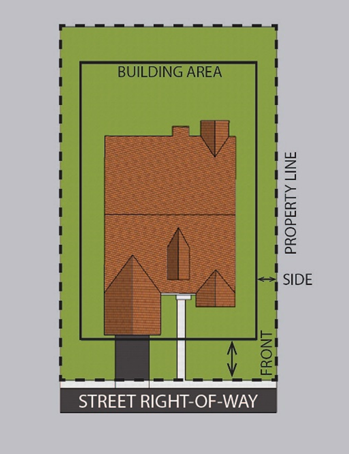
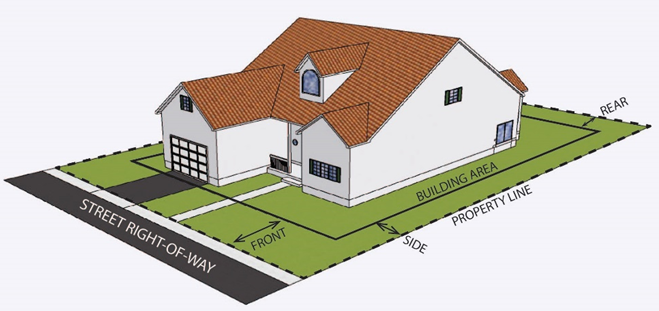
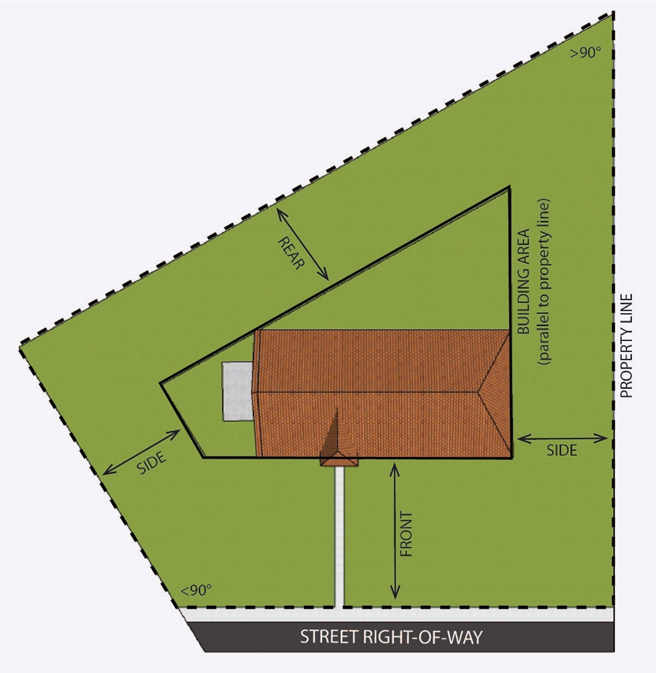
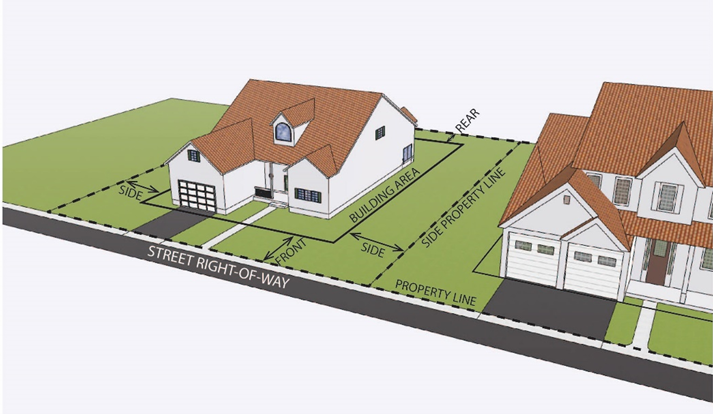
Building area: The maximum horizontal projected area of a building and its accessory buildings.
Building height: The vertical distance measured from the level of approved street grade opposite the middle of the front of the building to the highest point of roof surface of a flat roof; to the deck line of a mansard floor [roof]; and to the mean height level between eaves and ridge of a gable, hip or gambrel roof; except that, if a building is located on a terrace, the height above the street grade may be increased by the height of the terrace.
Building inspector: The building inspector of the City of Grovetown or his authorized representative.
Building line setback: A line delineating the minimum allowable distance between the property line and a building on a lot, within which no building or other structure shall be placed except as otherwise provided.
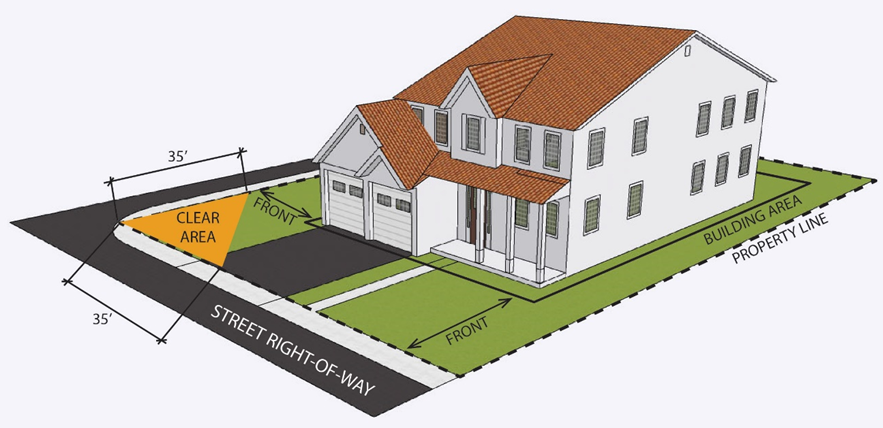
Building line setback, front: The minimum allowable distance between the street right-of-way, or an official future street right-of-way, and the front of a building or structure on a lot. The front setback distance applies to the full width of the lot and is parallel to or concentric with the street right-of-way.
Building line setback, rear: The minimum allowable distance between the rear property line and a building or structure on a lot. The rear setback applies to and extends the full width of the lot.
Building line setback, side: The minimum allowable distance between the side property line and building or structure on a lot. The side setback applies to the full depth of a lot.
Cemetery: A place used for the permanent interment of dead bodies or the cremated remain thereof. It may be either a burial park for earth interments, a mausoleum for vault or crypt interments, a columbarium for cinerary interments, or a combination thereof; may also be referred to as a graveyard.
Child care center: Day nursery, child boarding home, day camp, summer camp, foster family home, or other place for the reception, board or care, with or without compensation, of a child or children under sixteen (16) years of age. For the purpose of this ordinance, a facility providing day child care between the hours of 7:00 a.m. and 7:00 p.m. to not more than three (3) children shall not be considered a child care center. Further, the term shall not include any family type facility which provides child care to not more than five (5) children placed by order of any court of competent jurisdiction, by any public welfare department or other governmental agency having responsibility of placing children for care, or placed by a child-placing agency.
City: The term "the city" or "this city" means the City of Grovetown, Georgia.
Commercial district: The Neighborhood Commercial and/or General Commercial districts.
Commercial parking garage: (See "Automobile parking garage, commercial").
Commercial parking lot: (See "Automobile parking lot, commercial").
Commercial use: Any use involving in part or in whole the storage of merchandise, sale of merchandise, materials or services, but not including home occupations, as defined in this section.
Conforming use: Any use complying with the regulations of this ordinance.
Convenience store: Any retail establishment, with or without gasoline sales, offering for sale prepackaged food products, beverages, household items and other goods commonly associated with the same and having a gross floor area of less than five thousand (5,000) square feet.
Corner lot: Any lot bounding the intersection of two (2) streets, or upon the inside of a curve of a street where the corner interior angle is less than one hundred thirty-five (135) degrees.
Director: The director of planning and community development and/or his designee.
Divider median: A portion of the parking lot and/or facility designed to separate two (2) rows of parking aisles not separated by a drive aisle.
Depth of lot: The main horizontal distance between the front lot line and rear lot line of a zoning lot.
Drive-in restaurant or refreshment stand: Any place or premises used for sale, dispensing or serving food, refreshments, or beverages in automobiles, including those establishments where customers may serve themselves and may eat or drink the food, refreshments, or beverages on the premises.
Dwelling: A building designed for dwelling purposes. The term "dwelling" or any combination thereof shall not be deemed to include hotel, rooming house, motel, clubhouse, hospital or other accommodations used for transient occupancy.
Dwelling, multiple-family: A building or series of buildings on a single lot, containing three (3) or more dwelling units per individual building.
Dwelling, single-family: A building containing not more than one (1) dwelling unit and not occupied by more than one (1) family.
Dwelling, single-family attached: One of a series of three (3) or more, not to exceed six (6) attached one-family dwelling units on separate lots which:
a.
May or may not have a common roof;
b.
Shall not have a common exterior wall;
c.
Are separated from each other by fire restrictive party wall partitions extending at least from the lowest floor level to the roof.
Dwelling, two-family: A building located on one (1) zoning lot containing not more than two (2) dwelling units, arranged one above the other or side by side, and not occupied by more than two (2) families. This building type is commonly referred to as a duplex.
Dwelling unit: One (1) or more rooms in a residential building or in a mixed use building, which are arranged, designed, used or intended for use by one (1) or more persons living together and maintaining a common household, and which include lawful cooking space and lawful sanitary facilities reserved for the occupants thereof.
Easement: A right or privilege in the owner of one parcel of land by reasons of such ownership to use the land of another for a special purpose not inconsistent with a general property in the owner.
Enlargement, or to enlarge: An addition to the floor area of an existing building, an increase in the size of any other structure, or an increase in that portion of a tract of land occupied by an existing use. To "enlarge" is to make an enlargement.
Extension, or to extend: An increase in the amount of existing floor area used for an existing use within an existing building. The "extend" is to make an extension.
Floor area: The sum of the gross areas of the several floors of a building or buildings, measured from the exterior faces of exterior walls or from the center lines of walls or from the center lines of walls separating two (2) buildings.
Flag lot: A large lot not meeting minimum frontage requirements and where access to the public road is by a narrow, private right-of-way or driveway. See section 6.200, flag lot standards, for regulations and standards of flag lots.
Frontage: The length of the front lot line of a zoning lot abutting a public street, road, or highway, or rural right-of-way.
Garage: (All types) (See "Automobile garage").
Government buildings: Buildings used by the various departments of a governing authority in the performance of their respective public service functions.
Hospital: An institution receiving in-patients and rendering medical, surgical and/or obstetrical care to patients, and usually including research and training activities. This shall include general hospitals and institutions in which service is limited to special fields such as cardiac, eye, ear, nose and throat, pediatric, orthopedic, skin and cancer, tuberculosis, chronic disease and obstetrics. Hospital patients generally require intensive care for periods generally not exceeding several months.
Hotel: An establishment which is open to transient guests, in contradistinction to a boarding, rooming or lodging house; and which provides customary hotel services such as maid service, the furnishing and laundering of linen, telephone and secretarial or desk service, the use and upkeep of furniture, bellboy service and food service.
Industrial districts: Any district whose designation begins with the letter "M."
Interior island: An elevated section of landscaped area internal to a row of parking spaces used to guide vehicles and provide pedestrian refuge.
Impervious surface: Areas which prevent or impede the infiltration of stormwater into the soil in the manner in which it entered the soil, in natural conditions, prior to development. Common impervious surfaces include, but are not limited to, rooftops, sidewalks, walkways, patio areas, driveways, parking lots, storage areas, compacted gravel and soil surfaces, awnings and other fabric or plastic coverings, and other surfaces which prevent or impede the natural infiltration of stormwater runoff which existed prior to development.
Junkyard: The use of any space, whether inside or outside a building, for the abandonment, storage, keeping, collection, disassembling or bailing of paper, rags, scrap metals, or other scrap or discarded materials, or for the abandonment, demolition, dismantling, or salvaging of automobiles or other vehicles; or machinery or parts thereof; or appliances (gas or electric); provided, that this definition shall not apply to any such use conducted solely as an accessory use.
Kennel: Any zoning lot on which three (3) or more dogs six (6) months old or older are kept.
Lot: (See "Zoning lot").
Lot area: The area of a zoning lot.
Lot coverage: That portion of the lot area required for buildings and structures located on a zoning lot.
Lot line: The boundary dividing a given lot from the street or adjacent lots.
Lot line, front: A boundary line of a lot that corresponds with a public street right-of-way line or private street boundary line. A lot adjacent to more than one street will have more than one front lot line.
Lot line, rear: A boundary line of a lot that does not intersect with a public street right-of-way line or private street easement line, and is not a front lot line.
Lot line, side: A boundary line of a lot that intersects with a public street right-of-way line or private street easement line, and is not a front lot line.
Lot width: The horizontal distance between the side lot lines of a zoning lot at the building line.
Medical or dental clinics: Any building or group of buildings occupied by two (2) or more medical or dental practitioners for the purpose of providing health services to people on an out-patient basis.
Mental health facility: A hospital, inpatient unit, or other institution for the treatment of individuals with a disability including mental or emotional illness, development disability, or additive disease.
Mobile home: A structure or vehicle with the following characteristics:
a.
It is used, designed for use, or capable of being used as living quarters, and contains sleeping accommodations, a flush toilet, a tub or shower bath, kitchen facilities, and plumbing and electrical connections for attachment to outside systems.
b.
It is designed for transportation after fabrication on streets or highways on its own wheels.
c.
It arrives at the site where it is to be occupied complete and ready for occupancy except for minor and incidental unpacking and assembly operations, location on jacks or other temporary or permanent foundations, connections to utilities, and the like.
d.
It is at least eight (8) feet, but not greater than fourteen (14) feet, in body width exclusive of any acceptable incidental appurtenances such as windows, porches, etc.
Mobile home park: Any lot, parcel or tract of land together with open spaces required by this ordinance, used, designed, maintained, or held out to accommodate two (2) or more mobile homes, including all buildings, structures, tents, vehicles, accessories, or appurtenances used or intended as equipment of such mobile home park, whether or not a charge is made for sale of the park and/or its facilities. A mobile home park does not include automobile, mobile home, or trailer sales lot, on which unoccupied mobile homes or trailers are parked for inspection and sale.
Mobile office: A structure or vehicle with the following characteristics:
a.
It is used, designed for use, or capable of being used or occupied for the transaction of business of the rendering of a professional service.
b.
It is designed for transportation after fabrication on streets or highways on its own wheels.
c.
It arrives at the site where it is to be occupied complete and ready for occupancy except for minor incidental unpacking and assembly operations, location on jacks or other temporary or permanent foundations, connections to utilities, and the like.
Motel: A building or group of buildings which:
a.
Contain living or sleeping accommodations used primarily for transient occupancy, and
b.
Have individual entrances from outside the building to serve each such living or sleeping unit.
Nonconforming: Any lawful use, whether of a building or other structure or of a tract of land, which does not conform to the applicable use regulations of the district in which it is located, either on the effective date of this ordinance or as a result of any subsequent amendment thereto. A nonconforming use shall result from failure to conform to the applicable district regulations on either permitted uses or performance standards. However, no existing use shall be deemed nonconforming solely because of any of the following:
a.
The existence of less than the required accessory off-street parking spaces or loading berths, or
b.
The existence of nonconforming accessory signs.
Nursing home: Rest homes, convalescent homes and homes for the aged devoted primarily to the maintenance and operation of facilities for the treatment and care of any persons suffering from illnesses, diseases, deformities or injuries not requiring the intensive care that is normally provided by hospitals, but who do require care in excess of room and board and who need medical, nursing, convalescent, or chronic care. Institutions primarily for the treatment and care of mental patients, alcoholics or drug addicts shall not, for the purpose of this ordinance, be considered "nursing homes."
Open space: Lands set aside for a development for the preservation of natural features, not individually owned, designed for the common use or enjoyment, not including lands occupied by streets, rights-of-way, off-street parking, or other paved surfaces.
Parking space: An area, enclosed or unenclosed, sufficient in size to store one (1) automobile, together with a driveway connecting the parking space with a street or alley and permitting ingress and egress of an automobile.
Pervious surface: A material or surface that allows for the absorption of water into the ground or plant material, such as permeable pavers or a vegetated roof.
Planning commission: The Grovetown Planning Commission as established and appointed by the mayor and city council.
Principal building: A building in which conducted the principal use of the lot or tract of land on which such building is located.
Principal use: The specific, primary purpose for which land or a building is used.
Private park: An area of land owned or maintained by a private entity that is open to the general public for recreation and/or amusement.
Private recreation facilities: A facility such as a swimming pool, playground, soccer field, tennis court, community center, beach, boat dock or basketball court which is an accessory use located on residential zoning lots, the use of which is restricted to the occupants and guests of the residential development.
Public: Any land or building owned, used, or maintained by the federal, state, county, or local governments or their agencies.
Public sewerage: A sanitary sewerage system for the collection of water borne wastes complete with a sewerage treatment plant or stabilization pond. The entire system must be either operated by the city or have been approved by the city, in the case of a privately-owned system.
Public utility: A public utility is an activity, or a building housing such an activity, which operates to serve the community as a whole or a portion of the community, and which is publicly run or subject to special government controls.
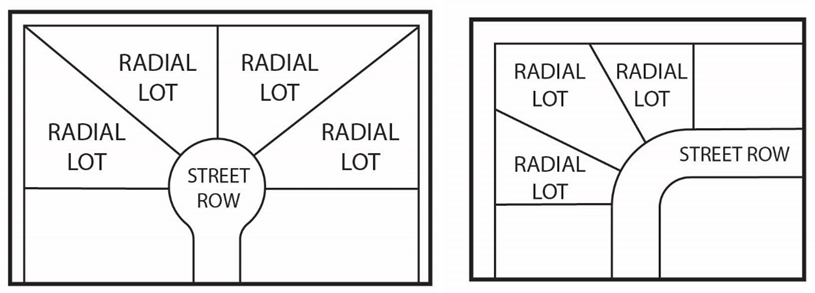
Radial lot: An irregular (pie-shaped) lot fronting on a curved street, and which is formed by its side lot line(s) being established along the course of a radius from the axis of the street curve. (See examples below).
Residence or residential: A building or part of a building containing dwelling units or rooming units, including single-family dwelling, two-family dwelling, multiple-family dwelling or rooming houses. Residences do not include:
a.
Such transient accommodations as hotels, motels, or tourist cabins.
b.
In a mixed building, that part of the building used for any nonresidential uses, except accessory to residential uses.
Residential district: Any district whose designation begins with the letter "R."
Riding stable: Any zoning lot used or designed for the boarding, breeding or care of horses or ponies, other than for farming or agricultural purposes, either with or without instruction in riding.
Rooming house: A dwelling in which, for compensation, lodging is furnished to three (3) or more, but not exceeding nine (9) guests. A rooming house shall not be deemed a home occupation.
School:
a.
An institution providing full-time day instruction and a course of study which meets the requirements of the Georgia Code, or
b.
A nursery school or kindergarten:
1.
Whose annual session does not exceed the school sessions for full-time day schools prescribed in the Georgia Code, and
2.
Which is operated by the county board of education, any established religious organization as part of an elementary school, or under a permit issued pursuant to the Georgia Code.
Service station: (See "Automobile service station").
Sign: Any writing, printing, lettering, painting, display, emblem, drawing or other attention-gaining device used to advertise products, goods, services or events, or to make anything known.
Story: That part of a building between the surface of a finished floor and the finished ceiling immediately above; however, a cellar is not a story.
Sight triangle: A triangle of land that has an unobstructed view from a curb line of a driveway, roadway or street intersection, also referred to as clear area. Intersections include all cases where two (2) streets intersect and locations where driveways intersect streets. See section 6.050.
Street: A way designed or intended for general public use to provide a principal means of approach for vehicles or pedestrians, and which performs the functions usually associated with a way. A driveway which serves only to give vehicular access to an accessory parking or loading facility, or to allow vehicles to take or discharge passengers at the entrance to a building shall not be considered a street.
Street line: A line defining the edge of a street right-of-way and separating the street from abutting property or lots. If, on the master plan of streets and highways duly adopted by the city, a street is scheduled for future widening, the proposed right-of-way line shown on the master plan shall be the street line.
Structure: Anything constructed or erected, the use of which requires permanent location on the ground or attached to something having a permanent location on the ground. A structure includes but is not limited to driveways and swimming pools.
Swimming pool, commercial: A swimming pool and/or wading pool, including buildings necessary or incidental thereto, open to the general public and operated for profit.
Swimming pool, community: A swimming pool and/or wading pool, including buildings necessary or incidental thereto, operated by members of more than two (2) families for the benefit of such group and not open to the general public, whether incorporated or unincorporated, whether organized as a club or cooperative or association, providing that it is not organized for profit and that the right to use said pool is restricted to such families and their guests. A swimming pool and/or wading pool operated as part of a multiple-family dwelling is also a community swimming pool, providing that it is not operated for profit, and that the right to use said pool is restricted to tenants of the multiple-family dwelling and their guests.
Swimming pool, private: (See "Private recreational facilities").
Tie down sets: (Mobile home or mobile office): A system for anchoring a mobile home or mobile office to the ground to prevent its being rolled or pushed off its blocks by the wind. The following number of frame and over-the-top tie down sets are required for each mobile home or mobile office.
a.
One (1) set of frame ties is required for each ten (10) feet of mobile home or office length. The frame ties are spaced an average of every ten (10) feet apart with end sets being not more than five (5) feet from the ends of the mobile home or office. The frame ties are secured to the anchors and the I-beam frame of the mobile home or office and tightened with a turn buckle or other tensioning device.
b.
Four (4) over-the-top ties are required for each mobile home or office. Over-the-top ties should be positioned at stud and rafter locations with buffers at the top corner to prevent rubbing and cutting. Over-the-top ties are connected to the same anchors as frame ties and are tightened with a turn buckle or other tensioning device.
The components of each tie down set include steel strapping or cable for ties; two (2) anchors, one for each side of the mobile home or mobile office; tensioning devices for drawing the sets tight; and proper blocking under each I-beam frame of the mobile home or office.
1.
Ties should be of galvanized steel strapping or cable. Galvanized steel strap 1.25 by .035 inches are commonly used and are sometimes built into the mobile home or office. Ties constructed of galvanized steel cable at least three-eighths (⅜) of an inch in diameter or "aircraft" cable at least one-fourth (¼) of an inch in diameter can also be used.
2.
The anchor rod must be of steel at least five-eighths of an inch in diameter and manufactured with either an approved tensioning head or a drop forged, closed eye for use with a turnbuckle. A concrete cylindrical section ten (10) inches in diameter and twenty-eight (28) inches deep is required around each anchor shaft not embedded in a concrete slab. Four (4) anchor types are acceptable:
(1)
A screw auger anchor is often used in sandy or loamy soil. The anchor should be embedded at least forty-eight (48) inches into the ground and should be installed vertically. The anchor head should rest near the ground and directly below or just inside the edge of the mobile home or office.
(2)
A drive anchor is used in rocky soil. The same depth and positioning measures as a screw auger anchor should be followed.
(3)
Anchor rods with hook ends can be embedded into a concrete slab while it is being poured. The anchor head should be at ground level directly below or just inside the edge of the mobile home or office.
(4)
An anchor rod can be inserted through a pre-drilled hole in an existing concrete slab and bolted to the underside of the slab.
3.
Tensioning heads are commercially available on anchors for steel straps. Anchors with tensioning heads for ties constructed of cable are also available. Drop forged turnbuckles at least one-half inch in diameter with drop forged closed eyes and U-bolt type jaws can also be used.
4.
The mobile home or office should be properly blocked. Piers should be centered under each I-beam frame of the home with a maximum spacing of ten (10) feet on centers. The end piers should be no further than five (5) feet from the ends of the mobile home or office.
Blocks can be of three (3) types:
(1)
Open celled concrete blocks with cells positioned vertically, perpendicular to the I-beam on a solid concrete footer, topped with a solid concrete cap and skimmed beneath the I-beam. Added stability can be gained by filling the open cells with concrete and inserting steel reinforcing rods.
(2)
Solid concrete blocks positioned perpendicular to the I-beam on a solid concrete footer and skimmed beneath the I-beam.
(3)
Solid cylinder jack piers bolted to the I-beam and into a reinforced concrete pad.
Travel trailer: A motorized camper, converted bus, tent trailer, or other similar vehicular or portable structure used or designed for temporary portable housing or occupancy while on vacation or other trip.
Use:
a.
Any purpose for which a building or other structure or a tract of land may be designed, arranged, intended, maintained, or occupied; or
b.
Any activity, occupation, business, or operation carried on, or intended to be carried on, in a building or other structure or on a tract of land.
Use or structure, accessory:
a.
A use conducted on the same zoning lot as the principal use to which it is related (whether located within the same of an accessory building or other structure, or as an accessory use of land), except that, where specifically provided in the applicable district regulations, accessory off-street parking or loading need not be located on the same zoning lot; and
b.
A use or structure which is clearly incidental to, and customarily found in connection with such principal use; and
c.
A use or structure subordinate in area, floor area, intensity, extent, height, and purpose to the principal use; and
d.
A use either in the same ownership as such principal use, or operated and maintained on the same zoning lot substantially for the benefit or convenience of the owners, occupants, employees, customers, or visitors of the principal use.
When "accessory" is used in the text, it shall have the same meaning as "accessory use" and/or "accessory structure", as applicable.
Use, conditional: Any use which is not generally considered compatible with the principal uses of the particular district in which it is proposed and therefore requires careful consideration and the imposing of conditions on development. Conditional uses are sometimes called "special exceptions," however the term "exception" is a misnomer. No exception is made to the provisions of the ordinance in permitting such uses; the permit granted is for a use specifically provided for in the ordinance in the case in which conditions, legislatively prescribed, are also found.
Use, permitted: The term "permitted use" or its equivalent shall not be deemed to include any nonconforming use. Any principal use which is allowed within a particular zoning district as a matter of right.
Zoning lot:
a.
A lot of record existing on the effective date of this ordinance or any applicable subsequent amendment thereto; or
b.
A tract of land, either unsubdivided or consisting of two (2) or more contiguous lots of record and not previously subdivided, located within a single block, which on the effective date of this ordinance or any applicable amendment thereto, was in single ownership; or
c.
A tract of land, located within a single block, which at the time of filing for a building permit (or, if no building permit is required, at the time of filing for a certificate of occupancy), is designated by its owner as a tract all of which is to be used, developed or built upon as a unit under single ownership;
d.
A zoning lot may be subdivided into two (2) or more zoning lots, provided that all resulting zoning lots and all buildings thereon which are constructed after the effective date of this ordinance or any applicable subsequent amendment thereto shall comply with all of the provisions of this ordinance. In such case, the designation of such zoning lots shall be made at the time of filing for a certificate of occupancy.
(Ord. No. 2023-09-01, § 1, 10-10-2023; Ord. No. 2025-11-01, § 1, 12-8-2025)
Sec. 1.060. - Standards governing the exercise of zoning power.
The exercise of the zoning power of the city shall constitute an effort to balance the interest of the community in promoting the public health, safety, morality and general welfare against the right of property owners to the unrestricted use of their property. The following factors shall be considered by the planning commission when reviewing and making its written recommendation and by the city council when making a decision whether to approve or deny a requested amendment. These factors are determined to be relevant in balancing the interest in promoting the public health, safety, morality and general welfare against the right to the unrestricted use of the property:
a.
Whether the proposed zoning would allow a use that is generally suitable for the property compared to other possible uses and the uses and zoning of adjacent and nearby properties;
b.
Whether the proposed zoning would adversely affect the economic value or the uses of adjacent and nearby properties;
c.
Whether the property to be affected by the proposed zoning can be used as currently zoned;
d.
Whether the proposed zoning, if adopted, would result in a use which would or could cause an excessive or burdensome use of existing streets, schools, sewers, water resources, police and fire protection or other utilities;
e.
Whether there are other conditions or transitional patterns affecting the use and development of the property sought to be rezoned, if applicable, which give ground for either approval or disapproval of the proposed amendment;
f.
Whether the proposed zoning is in conformance with the Comprehensive Plan insofar as the plan is current in its application to the specific property that is the subject of the zoning decision;
g.
Whether the proposed zoning or use will adversely affect a known archaeological, historical, cultural or environmental resource, such as water or air quality, ground water recharge areas, drainage areas, soil erosion and sedimentation and flooding;
h.
Whether the proposed zoning improves the overall zoning scheme and helps carry out the purposes of this ordinance.
Sec. 1.070. - Application processing cycles.
The director is authorized to promulgate reasonable application processing cycles and schedules for processing applications under this ordinance. Processing cycles may establish:
a.
Deadlines for receipt of complete applications;
b.
Timeframes for determination of application completeness;
c.
Dates of regular meetings;
d.
Timing of staff reviews and reports;
e.
Estimated timeframes for completion of reviews and decision-making;
f.
Timelines for consideration of Comprehensive Plan amendments (e.g. annual or semi-annual); and
g.
Other information regarding administrative practices and customs that will assist the general public.

