
Grovetown City Zoning Code
ARTICLE VI
SUPPLEMENTARY REGULATIONS
Sec. 6.000.- Automobile wrecking, junk and salvage yards.
The following regulations shall apply to all automobile wrecking, junk, and salvage yards:
a.
No automobile wrecking, junk or salvage yard shall be permitted closer than three hundred (300) feet from any residential district.
b.
All outdoor storage of salvage and wrecking operations shall be conducted entirely within an enclosed fence or wall or chain link fence, except driveway areas. Fences or walls shall be not less than eight (8) feet in height. Storage between such fence or wall and the street or property lines is expressly prohibited. Any fence or wall erected for screening purposes shall be properly painted or otherwise maintained in good condition.
c.
Wrecking, junk, and salvage yards are permitted only in certain industrial districts as provided for in this ordinance.
Sec. 6.010. - Building setbacks, modifications.
6.011.
Electrical transmission lines. Where easement widths are not definitely established, the minimum building setback distance from electric transmission lines shall be as follows:
6.012.
Front building setbacks. District requirements for front building line setbacks may be modified where the majority of the buildings fronting on the same street are developed with less than the required setback. In such case the required building setback shall be the average of existing setbacks, counting any undeveloped frontage as if it were developed at the required setback distance from the street. This modification shall not apply if it conflicts with proposed street improvements.
6.013.
Structural projections. The building line setback requirements of this ordinance shall not apply to:
a.
Bay windows, balconies, or fire escapes if extending not more than three (3) feet over a required building line setback.
b.
Chimneys, flues, belt courses, leaders, sills, pilasters, lintels, ornamental features, cornices, eaves, and gutters if extending not more than three (3) feet over a required building line setback.
c.
Decks, patios, and other features/structures less than 30-inches in height, provided they are at least one (1) foot from any property line.
d.
Landscaping areas, buffer plantings and buffer structures.
e.
Sidewalks and other pedestrian facilities, including benches.
f.
Stormwater drainage facilities, and public and private utility connections.
g.
Flagpoles, customary yard accessories, ornaments and furniture.
h.
Satellite dishes of one (1) meter in diameter or less, and television reception antennas.
6.014.
Modification of building setbacks.
a.
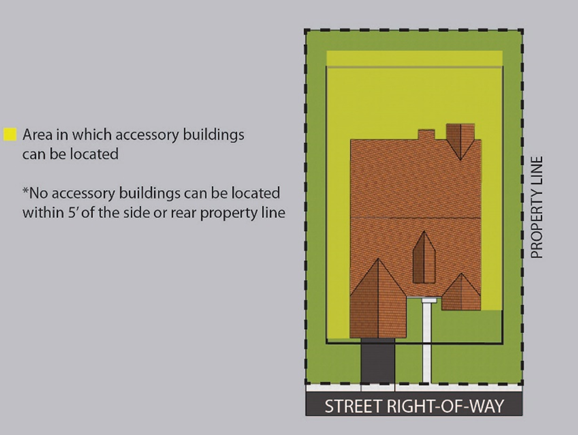
In residential districts, the side and rear building setbacks for accessory buildings not exceeding four hundred (400) square feet may be reduced to five (5) feet provided such buildings do not encroach on any drainage or utility easements.
b.
In commercial and industrial districts, the side and rear building setbacks along adjoining commercially or industrially zoned property may be reduced to three (3) feet.
c.
In industrial and commercial districts, the side and rear building setbacks along residentially zoned property shall be as specified in the lot requirements of the appropriate district or as required by the planning commission.
d.
Accessory structures, excluding buildings, but including parking garages, not otherwise set forth in this section, must be at least five (5) feet from any property line unless provided for otherwise herein. Accessory structures are not permitted between the principal structure and a street right-of-way unless provided for otherwise herein.
6.015.
Fences and freestanding walls. There shall be a minimum setback for fences and freestanding walls, other than specifically required by this subsection, of two (2) feet from any street right of way., and fences and freestanding walls may be erected along a side or rear property line, provided that any fence or freestanding wall shall not obstruct visibility at street intersections in accordance with the provisions of this ordinance, and shall conform to the following height restrictions:
a.
On residentially zoned lots and residential portions of PUDs, the following shall apply:
1.
A fence or freestanding wall placed along a collector or arterial street, or other placed for privacy or decorative purposes along a street that adjoins a subdivision, may not exceed eight (8) feet in height, and shall not be constructed of, wire or chain-link. Such fences and freestanding walls shall present a finished and decorative appearance to the adjoining street. Shrubs, groundcovers or other vegetation shall be provided between the fence or wall and the right-of-way line so as to provide a decorative effect, following professional landscaping standards for spacing, location and design.
2.
All other fences or freestanding walls that are closer to a street than the front building setback line located between the front exterior wall of the house and the road shall not exceed three (3) feet (thirty-six (36) inches) and shall not be constructed of wire or chain-link. The front exterior wall shall be determined based on the orientation of the house, independent of street frontages.
3.
On corner or double frontage lots, fences or freestanding walls located closer to a street than the front building setback line, between other than the front exterior wall of the house and the road, shall not exceed six (6) feet (seventy-two (72) inches), shall not be constructed of wire or chain-link, and shall not extend past the front exterior wall of the house. The front exterior wall shall be determined based on the orientation of the house, independent of street frontages.
4.
A fence or freestanding wall that is closer to a side or rear property line than the side or rear building setback line, may not exceed eight (8) feet (ninety-six (96) inches) in height.
b.
On lots zoned for nonresidential uses and commercial sections of PUDs, a fence or freestanding wall that is closer to a property line than the front, side or rear principal building setback line may not exceed eight (8) feet (ninety-six (96) inches) in height, with no more than an additional two (2) feet of security wire.
c.
All fences or freestanding walls shall be constructed with the finished side toward the neighboring property.
Sec. 6.020. - Flex facilities.
a.
Generally. Flex facilities are buildings that allow for a flexible range of uses including office, warehouse use, light manufacturing, research and development, and all laboratory uses. Flex facilities may also include technical schools or trade schools that include robotics, materials testing, and vocational facilities. Flex facilities allow for a combination of offices, wholesale, and light manufacturing with proportions of each use subject to the needs of a user. Flex facilities are permitted within the Industrial Zoning District and are permitted with conditions in the General Commercial Zoning District. Flex facilities are allowed within Commercial and Industrial districts as indicated in section 5.000, schedule of permitted, conditional, and accessory uses, provided:
1.
That the activities to be carried on in such usage does not endanger the public health, safety or general welfare in the immediate area as well as the community.
2.
That such establishment does not emit any obnoxious odors or fumes.
3.
That adequate steps are taken to prevent spillage or draining of contaminants, undilutable chemical or similar acids into the city sewerage systems or into any stream or river.
4.
That adequate steps are taken to dispose of solid wastes.
b.
Conditions of development. Flex facilities within the General Commercial Zoning District shall adhere to the following standards:
1.
Outdoor storage. There shall be no outdoor storage of merchandise and no outdoor processing in any commercial district unless authorized as a conditional use. All above ground structures accessory to any outdoor use shall be located at least fifty (50) feet from residential lot lines. Additional screening may be required.
2.
Commercial vehicles. Areas designated for the parking or storing of commercial vehicles shall be located to the rear of the building and screened from the public right-of-way.
3.
Vehicular access. Vehicular access to flex facilities is prohibited from local roadways.
Sec. 6.030. - Customary home occupations.
a.
Generally. A customary home occupation is a gainful occupation or profession conducted by members of a family residing on the premises and conducted entirely within the dwelling. Dwellings housing customary home occupation shall display no stock in trade outside the dwelling, and no alteration to any building shall indicate from the exterior that the building is being utilized in whole or in part for any purpose other than a residential unit, including permitted accessory buildings. Not more than one (1) person other than the immediate members of the family residing on the premises shall be employed at the premises at a time in the pursuit of the home occupation, and the total floor area used in conducting a home occupation shall not exceed twenty (20) percent of the total heated floor area of the dwelling. No signs shall be displayed. The following occupations, subject to the requirements of this paragraph, are permitted as customary home occupations:
1.
Barbershop and beauty shop operated by not more than two (2) members of the residence.
2.
Artist, dressmaker, seamstress, tailor, and interior decorator.
3.
Professional office of architect, accountant, lawyer, engineer, doctor or dentist provided not more than one (1) paid assistant is employed at the premises at a time.
4.
Teaching, including tutoring, musical instruction, or dancing, but limited to not more than three (3) pupils at a given time.
5.
Any similar use which the director deems to be a home occupation by reason or acceptance as a home occupation in the community.
b.
Applying for occupation/business tax license. All applicants for home based businesses shall apply for an occupation/business tax license with the director or the director's designee. The director shall have ten (10) business days from the date of the application to:
1.
Approve the request;
2.
Deny the request; or
3.
Approve the request subject to certain conditions/recommendations being met.
The approval, denial or approval subject to certain conditions shall be made in writing and shall state the basis for any denial or approval subject to certain conditions/recommendations being met.
c.
Approval of licenses by the director. Upon the approval by the director of the request, an occupation/business tax license shall be issued.
Upon the approval of the request subject to certain conditions/recommendations being met, a license shall be granted if the applicant is in agreement to fulfill the conditions/recommendations of the director.
d.
Denial of licenses by the director. In the event the application is denied by the director or the applicant refuses to meet the conditions/recommendations of the planning and zoning department, the applicant shall submit the matter to the board of zoning appeals within thirty (30) days of the decision. The board of zoning appeals shall then conduct a public hearing on the matter pursuant to the regulations of Article X of this ordinance.
In the event the board of zoning appeals grants the occupation/business license, then the applicant shall have thirty (30) days to tender suitable funds to the director and the planning and zoning department shall issue an occupation/business tax license. IN THE EVENT THE APPLICANT FAILS TO TENDER SUITABLE FUNDS WITHIN THIRTY (30) DAYS OF THE BOARD OF ZONING APPEALS GRANTING THE OCCUPATION/BUSINESS TAX LICENSE, THEN THE APPLICATION SHALL BE DEEMED TO BE ABANDONED AND NO LICENSE SHALL BE GRANTED. THE APPLICANT SHALL BE PERMITTED TO REAPPLY AND BEGIN THE APPLICATION PROCESS OVER AGAIN.
In the event the board of zoning appeals denies the application then the applicant shall have thirty (30) days from the written decision to appeal said decision to the Superior Court of Columbia County, Georgia.
In the event the director fails to approve, deny or approve the application subject to certain conditions within the ten (10) business day timeframe for the initial application, said matter shall be referred to the board of zoning appeals upon request of the applicant.
In the event the board of zoning appeals refuses to grant or deny the occupational/business tax license, upon the expiration of ninety (90) days after said matter having been first presented to the board of zoning appeals, the application shall be deemed to be denied and the applicant shall have the right to appeal this decision to the Superior Court of Columbia County within thirty (30) days of the expiration of the 90-day period.
(Ord. No. 2023-09-01, § 2, 10-10-2023)
Sec. 6.040. - Height restrictions, exemptions.
The following structures or parts thereof are hereby exempt from the height limitations as set forth in the zoning districts:
a.
Agricultural buildings, barns, silos, windmills, grain elevators, and other farm structures, but not including dwellings.
b.
Cooling towers, gas holders, or other industrial structures where required by the manufacturing process.
c.
Church spires, belfries, cupolas, domes, monuments, water towers, observation towers, transmission towers, windmills, chimneys, smokestacks, derricks, conveyors, flagpoles, radio towers, and aerials.
Sec. 6.050. - Intersection setbacks.
In all districts, all structures, shrubs, and outdoor uses in excess of thirty (30) inches in height (except non-vision-obstructive structural appurtenances) and of such character as to constitute a permanent, regular, or temporary obstruction to vision shall be set back at least fifteen (15) feet from the right-of-way line of each street at all intersections so as to constitute neither hazard nor nuisance to the general public.
Sec. 6.060. - Liquid and solid waste.
In all districts, no discharge at any point into any private sewage disposal system, into the ground, or into any stream of any materials of such nature or temperature as can contaminate any water supply or otherwise create a harmful effect on ground or surface waters except in accord with city and county health standards or applicable state stream pollution control standards. No garbage, rubbish, or other solid wastes shall be stored outdoors or allowed to accumulate on any lot or in streets or alleys adjoining the lot for periods in excess of the regular collection interval of public or contracted waste collection services. All solid wastes so stored outdoors shall be kept in tightly-covered metal containers located in suitably developed or screened areas.
Sec. 6.070. - Mobile homes on individual lots.
Mobile homes on separate, individual lots are permitted in zoning districts R-1 subject to the requirements of this section.
6.071.
On separate lot. Only one (1) mobile home shall be located on each individual lot, parcel, or tract except in an approved mobile home park. No mobile home shall be located permanently on any plot, parcel, or tract of land occupied by any other permanent dwelling or occupied building.
6.072.
Compliance with district zoning. Mobile homes on individual lots shall fully comply with zoning requirements for lot size, setbacks, and other restrictions for permanent single-family residential dwellings as well as the requirements of these regulations.
6.073.
Minimum site improvements. Mobile homes on separate, individual lots shall be provided with the following improvements to the mobile home and lot:
a.
The chassis of each mobile home shall be supported on piers or load-bearing supports or devices. These shall be designed and constructed to evenly distribute the loads. Piers shall be securely attached to the frame of the mobile home or shall extend at least six (6) inches from the centerline of the frame member. Manufactured load-bearing supports or devices shall be listed or approved for the use intended, or piers shall be constructed as follows:
(1)
Piers less than forty (40) inches in height shall be constructed of open or closed cell, eight-inch by eight-inch by 16-inch concrete blocks (with open cells vertically placed upon the footer). Single-stacked block piers shall be installed with the 16-inch dimension perpendicular to the main (I-beam) frame. The piers shall be covered with a two-inch by eight-inch by 16-inch wood or concrete cap.
(2)
Piers between forty (40) and eighty (80) inches in height and all corner piers over three (3) blocks high shall be double blocked with blocks interlocked and capped with a four-inch by 16-inch by 16-inch solid concrete block, or equivalent.
(3)
Piers over eighty (80) inches in height shall be constructed in accordance with paragraph 2 above and they shall be laid in concrete mortar and steel reinforcing bars inserted in block cells with the block cells filled with concrete.
(4)
All piers shall be placed on footings of solid concrete not less than sixteen (16) inches by sixteen (16) inches by four (4) inches.
b.
The base of the mobile home shall be fully skirted to screen the mobile home supports or wheels from view. Acceptable skirting shall be only those types and materials designed by the manufacturer expressly for such use or as required by the director.
c.
Each mobile home shall be served by an acceptable water supply and method of sewage disposal subject to the written approval of the county health officer having jurisdiction over such matters.
d.
Each mobile home shall have an individual connection to public electrical power.
e.
Each mobile home lot shall have a patio or porch located convenient to the entrance of the mobile home. Said patio or porch shall measure not less than eight (8) feet by twelve (12) feet.
f.
Each mobile home lot shall be provided with one (1), 30-gallon covered refuse container. Refuse shall be stored only in these containers and collected and disposed of regularly in an approved disposal facility.
g.
Each mobile home lot shall contain at least two (2) off-street parking spaces.
h.
Any accessory structures or additions to the mobile home or lot shall be of similar design and material as the mobile home unit, and shall not be used as complete, independent housing units with permanent provisions for sleeping, cooking, and sanitation.
Anyone seeking to locate a mobile home within the City of Grovetown must apply for a permit prior to erection of said home.
The application for the permit shall state the year, make and model of the mobile home and the owner shall furnish a copy of the bill of sale and or title for the mobile home.
The city shall only grant permits for mobile homes in areas that are zoned R-1. No permits for mobile homes shall be granted in any other residential districts. Nor shall they be granted in a planned stick-built residential subdivision even if the subdivision is designated R-1 zoning.
No permits shall be issued for a mobile home in the three (3) major corridors in the city that are defined by the comprehensive plan adopted by city council on February 12, 2007. They are as follows: Robinson Avenue, Katherine Street and Wrightsboro Road. Mobile homes in this section will be prohibited and not replaced once they are removed.
In the event an existing mobile home is removed from a nonconforming parcel of property within the city, the owner of the parcel of property shall have twelve (12) months to replace the structure unless it is located along one of the three major corridors defined above. The owner can request from the director a one (1) time 60-day extension if the owner can show that there is action being taken to replace the mobile home and that it can be completed within the 60-day extension. In the event the structure is not replaced within twelve (12) months and there has been a one (1) time 60-day extension given, the property owner shall not be permitted to replace the mobile home. Additionally, the new structure shall conform to all existing zoning codes at the time of the application for the new permit.
The city shall not grant any further conditional uses to establish mobile home parks. Mobile home parks in existence may continue to operate pursuant to grants under prior existing ordinances.
APPEALS:
(a)
Any person aggrieved by a decision of the director in the granting or denial of a permit for the establishment of a mobile home or in interpreting any other terms of this section, may appeal such decision by filing a written notice of appeal with the director within ten (10) working days of the issuance of such decision by the director.
(b)
After receiving the written notice of appeal, the director may then reverse his/her decision or forward the notice of appeal to the board of zoning appeals. A notice of appeal shall state the specific reasons why the decision of the director is alleged to be in error and the director shall, within twenty (20) working days of the receipt of the notice of appeal, prepare and send to the board of zoning appeals and appellant a written response to such notice of appeal.
(c)
All appeals shall be heard by the board of zoning appeals. The hearing shall be held within sixty (60) days after receipt of the notice of appeal or a date mutually agreed upon in writing by the appellant and the board of zoning appeals.
(d)
If either the appellant or director is dissatisfied with the board of zoning appeals decision, the aggrieved party may appeal such decision to the Superior Court of Columbia County within thirty (30) days of the board of zoning appeals' written decision.
(e)
In the event the director fails to send to the board of zoning appeals a written response to the request for an appeal within twenty (20) working days of the receipt of the request or the board of zoning appeals fails to hear the appeal, the permit shall be deemed granted unless a good cause is shown for extending the time limits in order to prevent a manifest injustice.
Manufactured housing includes all mobile homes or trailers that precede or meet the current definition of manufactured housing as defined by the National Manufactured Housing Construction and Safety Standards Act of 1974, as amended (42 USC § 5401—5426).
A.
Procedure for inspection of mobile homes.
1.
Definitions.
a.
Applicant: the individual requesting permission from the city to move a mobile home.
2.
Whenever an applicant seeks to move a mobile home into the city or seeks to move a mobile home currently located within the city from one location to another within the city (whether on the same parcel of property or on another parcel of property), the applicant and the director shall follow all procedures listed in all city ordinances, all applicable state laws, and the following procedures.
3.
Prior to applying for a permit to locate a mobile home within the city the applicant shall post a bond with the city in the form of cash or from an approved bonding company/surety in an amount of not less than five thousand dollars ($5,000.00). Said bond amount may be amended from time to time by the city council. Said bond shall be returned to the surety upon the mobile passing all inspections for habitability, having all proper permits, obtaining a certificate of occupancy, and tax stickers mandated by this ordinance or any other ordinance and all state laws. In the event a mobile home fails the inspection or fails to obtain all necessary permits, fails to secure a certificate of occupancy, or fails to obtain the appropriate tax sticker, the applicant shall be given sixty (60) days to remove the mobile home. Upon the mobile home being removed and the property cleaned up by the applicant, the bond shall be returned to the surety. In the event the mobile home is not removed or the property is not properly cleaned up within sixty (60) days, the bond posted shall be forfeited and used to fund the removal of the mobile home from the property and any necessary costs associated with cleaning up the property. Any funds remaining after the removal of the mobile home shall be returned to the applicant or other individual who posted the bond. In the event there are not sufficient funds to cover the costs of the removal and clean up, the applicant shall be responsible for any deficiency. In the event an applicant does not own the property upon which the mobile is to be located, the property owner must give express written consent to the city to allow for the removal of the mobile home and an acknowledgment of liability in the event the bond is insufficient to cover the costs for the removal of the mobile home and clean up.
4.
After applying for and receiving a permit to locate a mobile home within the city the applicant shall have all utilities connected for a limited period not to exceed sixty (60) days in order for the mobile to be inspected for habitability. During the inspection period of time, the mobile home shall not be occupied. Only upon the passing of the final inspection and the granting of a certificate of occupancy may a mobile home be occupied. All applicants shall sign an affidavit indicating that they understand that the applicant may only occupy a mobile that has passed final inspection, been issued a certificate of occupancy and that, in the event the mobile home fails to pass inspection, all utilities and any city services connected for the purpose of the inspection shall be disconnected upon the expiration of the sixty-day inspection/installation period.
5.
The director shall develop a list of standards to determine whether a structure is habitable. Said list shall be made available for public inspection and may be amended from time to time as necessary. The director shall maintain a list of individuals approved to perform inspections for habitability. All inspectors shall have a valid business license, shall be certified by the American Society of Home Inspectors (ASHI) or an equivalent national certification agency, and attest under oath that he or she has no financial interest in the outcome of the inspection. Upon completion of the inspection, the inspector shall indicate on the inspection form whether the structure passed or failed each item inspected, sign and date the form and file the form with the department of planning and zoning.
6.
In the event the inspector notes any areas that fail the inspection, the applicant shall have up to sixty (60) days to take any steps necessary to make the structure habitable. All repair work shall be performed by contractors that are properly licensed and bonded. Said contractors shall obtain permits where necessary. The city shall have the right to refuse to accept any work performed by any individual that is not properly licensed and bonded nor where a contractor fails to obtain a proper permit.
7.
The city shall not grant a certificate of occupancy unless and until the mobile home passes the habitability inspection and is in compliance with all existing ordinances and state laws.
8.
In the event the mobile home fails the final inspection or is not granted a certificate of occupancy, the city shall disconnect all utilities/services provided by the city upon the expiration of the 60-day inspection/installation period.
9.
All costs and fees for the inspection, permits, bonds, and repairs to mobile home shall be the sole responsibility of the applicant or the mobile homeowner. The city shall not bear any of these costs.
10.
Upon the final inspection being completed, the director shall have thirty (30) days to approve or deny the request for the mobile home permit. In the event the director fails to approve or deny the application for the mobile home permit within the specified time frame, the application shall be deemed to be approved and the permit shall be granted.
B.
Mobile home installers. The city shall only allow licensed mobile home installers to install mobile homes within the city. Any mobile home installer seeking to install a mobile home shall provide a copy of their state license and proof of a business license, general liability insurance for at least one hundred thousand dollars ($100,000.00) and bond, if applicable. The mobile installer shall also furnish a list of all employees that will work on the installation project and provide proof of worker's compensation insurance, if the mobile home installer employs more than two (2) individuals.
C.
Tax stickers. All mobile homes located in the city shall maintain a current tax sticker which shall be posted in such a manner as to be clearly visible from the nearest roadway or the driveway. Any mobile home that is sixty (60) days or more delinquent in posting the tax sticker shall be deemed to be an abandoned structure and subject to removal, pursuant to existing ordinances governing mobile homes and nuisances.
D.
Additional requirements for all mobile homes. Whenever a property owner or other individual seeks to move a mobile home into the city or seeks to move a mobile home currently located within the city from one location to another within the city (whether on the same parcel of property or on another parcel of property), the mobile home shall be underpinned with cement or masonry underpinnings.
E.
Appeals.
1.
In the event the application for the mobile home permit is denied by the director or the applicant refuses to meet the conditions/recommendations of the director, the applicant shall have thirty (30) days to request a hearing before the board of zoning appeals.
2.
In the event the board of zoning appeals grants the mobile home permit following the denial of the permit by the director, then the permit shall be issued by the board of zoning appeals and the director shall be absolved of any liability with respect to the issuing of the permit. Further, the director shall not be required to sign off on the permit.
3.
In the event the board of zoning appeals denies the application for the permit, then the applicant shall have thirty (30) days from the written decision to appeal said decision to the Superior Court of Columbia County, Georgia.
Sec. 6.080. - Mobile offices.
Mobile offices are permitted in zoning districts Neighborhood Commercial, General Commercial, and Industrial subject to the requirements of this article.
6.081.
Compliance with district zoning. Mobile offices shall fully comply with zoning requirements for lot size, setbacks, and other restrictions for permanent structures.
6.082.
Minimum site improvements. Mobile offices shall be provided with the following minimum improvements to the mobile office and lot:
a.
The chassis of each mobile office shall be supported on piers or load-bearing supports or devices. These shall be designed and constructed to evenly distribute the loads. Piers shall be securely attached to the frame of the mobile home or shall extend at least six (6) inches from the centerline of the frame member. Manufactured load bearing supports or devices shall be listed or approved for the use intended, or piers shall be constructed as follows:
(1)
Piers less than forty (40) inches in height shall be constructed of open or closed cell, eight-inch by eight-inch by 16-inch concrete blocks (with open cells vertically placed upon the footer). Single-stacked block piers shall be installed with the 16-inch dimension perpendicular to the main (I-beam) frame. The piers shall be covered with a two-inch by eight-inch by 16-inch wood or concrete cap.
(2)
Piers between forty (40) and eighty (80) inches in height and all corner piers over three (3) blocks high shall be double blocked with blocks interlocked and capped with a four-inch by 16-inch by 16-inch solid concrete block, or equivalent.
(3)
Piers over eighty (80) inches in height shall be constructed in accordance with paragraph (2) above and they shall be laid in concrete mortar and steel reinforcing bars inserted in block cells with the block cells filled with concrete.
(4)
All piers shall be placed on footings of solid concrete not less than sixteen (16) inches by sixteen (16) inches by four (4) inches.
b.
The base of the mobile office shall be fully skirted to screen the mobile home supports or wheels from view. Acceptable skirting shall be only those types and materials designed by the manufacturer expressly for such use or as required by the director.
c.
Each mobile office shall be served by an acceptable water supply and method of sewage disposal subject to the written approval of the county health officer having jurisdiction over such matters.
d.
Each mobile office shall have an individual connection to public electrical power.
e.
Each mobile office shall comply with the off-street parking requirements of the zoning district in which it is located.
Sec. 6.090. - Mobile office and mobile home, temporary use.
A mobile home or mobile office shall be permitted in any zoning district when the use of mobile home or mobile office is temporary and incidental to the preparation of a construction site or the completion of a construction project. These temporary uses may be permitted by the director for such periods as he may deem necessary and reasonable for the completion of the site preparation or construction project. Approval of these temporary uses shall be in writing and shall contain the following information:
a.
Name and address of applicant;
b.
Name and address of construction firm;
c.
Name and address of project;
d.
Expiration date of temporary use permit;
e.
Signature of director.
Such written permission shall not be transferrable and may be revoked by the director at any time he deems such use a public nuisance or otherwise contrary to the intent of this ordinance.
Sec. 6.100. - Off-street loading and unloading requirements.
In all districts and on the same premises with every building, structure, or part thereof, erected and occupied for manufacturing, storage, warehousing, retail selling, wholesaling, hospital, funeral home, or other uses which in the opinion of the director involve the receipt or distribution of vehicles, material, or merchandise, there shall be provided and maintained, on the lot adequate space for standing, loading, or unloading services adjacent to the space or opening used for loading and unloading in order to avoid undue interference with public use of the streets or alleys. Each loading space provided shall be an area twelve (12) feet by forty-five (45) feet with a fourteen-foot height clearance where uses require trailer-truck loading or ten (10) feet by twenty-five (25) feet with a height clearance of fourteen (14) feet for uses not requiring trailer-truck loading. All loading spaces shall be located so as to contain adequate maneuvering room to permit convenient access to the loading space. A sufficient number of loading spaces shall be provided as follows:
Sec. 6.110. - Off-street parking requirements.
In all districts at the time of the erection of any building, or at the time any principal building is enlarged or increased in capacity by adding dwelling units, guest rooms, seats and/or floor area, or before conversion from one type of use of occupancy to another, there shall be provided permanent off-street parking space in accordance with the following requirements. Where a proposed use is not identified in subsection 6.114 below, the director or designee may apply an alternative off-street parking standard based on the use determined to be the most similar to the proposed use. A parking study or similar analysis prepared by a professional engineer or certified land use planner with experience in parking studies may be provided to the director which can be used in applying an alternative parking standard:
6.111.
Shared parking. If a development qualifies for shared parking, this will reduce the overall required minimum off-street parking by up to fifteen (15) percent. Shared parking is permitted on contiguous and/or adjacent lots. An application for shared parking requires an analysis, provided to the director, to reduce the number of required off-street parking spaces. The shared parking analysis, at minimum, must include and comply with the following:
a.
Shared parking shall be provided on the same parcel and or project (master development), or contiguous parcels and not located off-site or separated by a major roadway (collector or greater).
b.
Identification of proposed uses within the development and location of parking facilities.
c.
Calculation of the shared parking reduction that will be applied, per proposed use.
d.
Proposed uses served by the shared parking arrangement must have different peak parking demands or operate in a manner that the uses sharing parking have access to the required minimum number of off-street parking spaces when in operation.
e.
Narrative and calculations must be provided as part of the shared parking analysis explaining the justification of the shared parking arrangement.
f.
Shared parking arrangements must be a formal legal instrument and be provided to the director and include cross access agreement(s) if required, for the principal property and adjacent properties to ensure shared parking can function.
g.
If a shared parking arrangement ceases, parking for the uses may be recognized as a nonconformity, as may be applicable.
Combination of required parking space. The required parking space for any number of separate uses may be combined in one (1) lot but the required space assigned to each use may not be assigned to another use, except where the parking space required for churches, or other assembly halls whose peak attendance will be at night, on Sunday, or otherwise does not coincide with an adjacent use, said required parking may be assigned to the adjacent use.
6.112.
Proximity of off-street parking spaces to use. All required parking for all uses shall be either on the same lot or within three hundred (300) feet of the building (or open use area) it is to serve; provided, however, that no required parking spaces may be located across any collector or higher classified road from the use it is intended to serve.
6.113.
Parking lot design requirements. All off-street parking areas developed or modified after the effective date of this ordinance shall conform to the following minimum standards of design:
a.
Except for parcels of land devoted to one- and two-family residential uses, all areas devoted to off-street parking shall be so designed and be of such size that no vehicle is required to back into a public street to obtain egress. Parking areas must be designed, maintained and regulated so that no parking or maneuvering incidental to parking will be on any public street, sidewalk, or alley.
b.
Consideration for parking lot or space utilization will be determined on an individual basis consistent with reasonableness as to lot size and structures located or to be located on the lot.
c.
Entrances and exits for all off-street parking areas shall be developed consistent with the minimum requirements for street access control as specified in this ordinance.
d.
For uses withing the Neighborhood Commercial Zoning District, no more than two (2) rows of parking spaces shall be located between the front lot line and the building.
e.
For uses within the General Commercial Zoning District, no more than forty (40) percent of the required parking spaces stalls shall be located between the front lot line and the building.
f.
Parking areas containing two hundred (200) or more spaces must provide improved pedestrian pathways of at least five (5) feet width, providing access from the parking area to an entrance of the principal use, protected by wheel stops, curb or similar.
g.
Parking spaces shall not encroach upon sidewalks or buffers.
h.
Parking spaces shall adhere to the dimensions provided below:
6.114.
Off-street parking requirements by use. The minimum number of off-street parking spaces required for each type use follows:
a.
Single-family dwellings: Two (2) spaces per residence.
b.
Multifamily dwellings, rooming houses: One and one-half (1½) spaces for each room to be rented or occupied.
c.
Tourist home, motel, hotel, motor court: One (1) space for each room to be rented, plus one (1) additional space for each three (3) employees.
d.
Medical and dental clinics: Six (6) spaces per doctor, plus one (1) additional space for each two (2) employees.
e.
Hospital: One (1) space for each two (2) beds intended for patients' use, exclusive of bassinets, plus one (1) space for each three (3) employees including doctors.
f.
School: One (1) space for each classroom and administrative office, plus one (1) additional space for each six (6) seats in the largest assembly area or room.
g.
Auditorium, theaters, churches, funeral homes, and similar places of public assembly: One (1) space for each four (4) seats, or twelve (12) feet of benches, or per thirty (30) square feet of usable floor area in the largest assembly room, plus one (1) space for each two hundred (200) square feet of floor or ground area used for amusement, entertainment, or assembly exclusive of the major assembly room.
h.
General and professional offices: One (1) space for each two hundred (200) square feet of gross floor area.
i.
Automobile repair and service garage: Five (5) spaces for each service bay, plus one (1) space for each two (2) employees.
j.
Automobile service station: Five (5) spaces for each service bay, plus one (1) space for each two (2) employees.
k.
Restaurants: One (1) space per one hundred fifty (150) square feet of usable floor area, plus one (1) space for each two (2) employees.
(For drive-in restaurants, one (1) space for each fifty (50) square feet of floor area.)
l.
Other retail uses: One (1) space for each two hundred (200) square feet of gross floor area.
m.
Wholesale uses: One (1) space for each employee on the largest shift, plus one (1) space for each two hundred (200) square feet of selling area.
n.
Warehouse and storage uses: One (1) space for each employee on the largest shift, plus one (1) space for each six hundred (600) square feet of storage or warehousing area.
o.
Industrial uses: One (1) space for each employee on the largest shift.
6.115.
Restriction of use of required parking. The required off-street parking shall be for employees, occupants, clients, and visitors and shall be limited in use to temporary storage of operable motor vehicles with current license plates. The storage of merchandise or motor vehicles for sale, the servicing or repairing of vehicles or equipment, and regular truck loading and unloading in off-street parking areas is prohibited.
Sec. 6.120. - Residential lots abutting major streets.
In all residential districts and where a lot abuts an arterial street, the following minimum requirements shall apply:
a.
The minimum lot frontage along abutting street rights-of-way shall be not less than one hundred (100) feet;
b.
The minimum lot depth shall be not less than one hundred fifty (150) feet;
c.
The minimum building line setback from abutting street rights-of-way shall be not less than fifty (50) feet;
d.
Where district regulations require a minimum lot frontage, lot depth, or setback greater than these modifications, the greatest requirement shall apply.
Sec. 6.140. - Street access control.
In order to promote the safety of the motorist and pedestrian and to minimize traffic congestion and conflict, the following regulations shall apply:
a.
Vehicular access from properties to streets shall not exceed thirty (30) feet in width.
b.
No more than two (2) points of vehicular ingress/egress from a property to each abutting public street shall be permitted for each four hundred (400) feet of lot frontage, or fraction thereof; provided, however, that lots with less than one hundred (100) feet of frontage shall have no more than one (1) point of ingress/egress to any one (1) public street.
c.
No point of ingress/egress shall be allowed within thirty-five (35) feet of the right-of-way line of any street intersection.
d.
No curbs on city streets or rights-of-way shall be cut or altered for ingress/egress without approval of the director.
e.
An ingress/egress driveway shall be located not closer than thirty (30) feet to another such driveway on the same street.
Sec. 6.150. - Street frontage.
No dwelling (mobile homes in approved parks excluded) shall be erected on a lot which does not abut on an accepted public street, for the minimum lot frontage in the zoning district in which it is located.
Sec. 6.160. - Minor waivers.
a.
The director may approve minor waivers when the request contains all of the following elements:
(1)
The request is for a maximum of ten (10) percent reduction of the required front, side and rear minimum building line or for a maximum of ten (10) percent increase in total impervious surface coverage.
(2)
No side or rear setback can be less than five (5) feet on any residential lot for detached homes.
(3)
All minimum building codes are met.
(4)
No utility services will be affected.
b.
The director shall issue approval or denial in writing within thirty (30) days of receipt of a written request for a minor waiver.
c.
To appeal, the applicant shall submit the matter to the board of zoning appeals within thirty (30) days of the director's decision. The board of zoning appeals shall then conduct a public hearing on the matter pursuant to the regulations of Article X of this ordinance. In the event the board of zoning appeals denies the application then the applicant shall have thirty (30) days from the written decision to appeal said decision to the Superior Court of Columbia County, Georgia.
Sec. 6.170. - Use determinations.
a.
When a proposed principal or accessory use is not specified as a permitted use or prohibited use in any zoning district, the director shall determine the appropriate zoning district in which such a use may be located.
b.
Any property owner aggrieved by such decision of the director may appeal the matter to the board of zoning appeals within thirty (30) days of the director's decision. The board of zoning appeals shall then conduct a public hearing on the matter pursuant to the regulations of Article X of this ordinance. The appellant shall have thirty (30) days from the written decision to appeal the decision of the board of zoning appeals to the Superior Court of Columbia County, Georgia.
Sec. 6.190. - Establishment of owner's association.
At the city's request, a homeowners' or property owners' association is required for all multi-owner developments with any private common elements, such as but not limited to streets, stormwater management systems, and open space. The following shall apply:
a.
Developer to association transfer. Transfer of responsibilities to the association shall occur once eighty (80) percent of lots or units sales have closed.
b.
Covenants and restrictions. Prior to the transfer of responsibilities to the owners' association, all prospective members shall be furnished a copy of the Declaration of Covenants and Restrictions.
c.
Declaration of covenants and restrictions. The complete set of covenants and restrictions shall be provided to the city for review during the site plan review. All declarations of covenants shall contain the following:
(1)
Provisions for the maintenance and protection of public, common, and private improvements, easements, open space, natural areas, and other improvements in accordance with city regulations.
(2)
Assurance that the declarations shall not be amended in any matter that would result in a violation of city regulations or would affect any of the city's rights.
(3)
All property owners and successive owners shall be members of the owners' association and shall be provided with the complete list of covenants and restrictions upon becoming a member.
(4)
Measures shall be established for collecting and assessing fees and expenses for the maintenance and preservation of common properties, improvements, payment of real estate taxes and other applicable taxes, and for the attachment of liens on the property of delinquent association members.
d.
Funding & maintaining common elements. If the owners' association will be the owner of, responsible for maintenance of, or responsible for providing funding for the maintenance, protection, or restoration of certain elements, the following shall be included in the declaration of covenants and be adhered to by the association:
(1)
No lots or units shall be sold prior to the city's review of the declarations of covenants and establishment of the association.
(2)
The association shall be responsible for casualty and liability insurance, taxes, and maintenance of or funding for the maintenance and protection of the private alleys and/or streets, stormwater management systems, and open space.
(3)
Each owner within the association shall pay his or her pro rata share of the cost of the association by means of an assessment to be levied by the association that meets the requirements for becoming a lien on the property, if payment is not received, in accordance with the laws of the State of Georgia.
(4)
The association shall have the right to adjust the assessment to meet changed needs.
(5)
The association shall have the right to perform any maintenance or repair work that any owner or association member has neglected to perform on their respective property, to levy an assessment against a member for the performance of any maintenance or repair work, and to cause a lien to be placed against the property of any such owner or member that fails to pay such an assessment. Membership vote required to authorize such assessments shall not be fixed at more than fifty-one (51) percent of the members voting on the issue. The city shall have the right, without obligation, to enforce all declarations, covenants, and restrictions.
(6)
The city shall have the right, without obligation, but only after ten (10) days written notice to the association, to do the following:
(a)
To perform any maintenance or repair work that the association has neglected to perform.
(b)
To assess the association for such work performed.
(c)
To cause a lien to be placed against the property of any member failing to pay such assessment. For this purpose alone, the city shall have all the rights and powers of the association and its governing body under the agreements and declarations creating the association.
(d)
In the case of emergencies, the city shall have the right, without obligation, to perform emergency repairs without ten (10) days written notice provided that the association is informed of the work within three (3) days or a reasonably practical period given the emergency circumstances.
Sec. 6.200. - Flag lot standards.
a.
Except where previously approved, flag lots shall not be permitted when their effect would be to increase the number of lots and or building sites with access to a roadway (public or private).
b.
To provide for proper site design and prevent the creation of irregularly shaped parcels, the depth of any lot or parcel shall not exceed 1:4.
Sec. 6.210. - Landscaping.
a.
Applicability.
(1)
New construction. Any new building or site improvement must comply with the landscaping and screening requirements of this section.
(2)
Exceptions. These regulations shall not apply to the construction or renovation of a single-family detached dwelling or two-family dwelling.
(3)
Maintenance and repair. An existing building or site may be repaired, maintained or modernized without providing additional landscaping or screening, provided there is no increase in gross floor area or improved site area.
(4)
Additions.
a.
When an existing use is increased in gross floor area or improved site area by up to twenty-five (25) percent cumulatively, landscaping and screening is required for the additional floor or site area only.
b.
When an existing use is increased in gross floor area or improved site area by more than twenty-five (25) percent cumulatively, both the existing building and site area and the additional floor or site area must conform to the landscaping and screening requirements of this section.
(5)
Change in use. A change in use only triggers the application of these requirements if a previously-developed site or building has been unused for one year or longer, or when there is a specific use standard requiring landscaping or screening for the new use.
b.
Landscape plan required.
(1)
Before any building permit is issued, the building, use, or site must be found by the director to be in compliance with all requirements of this section.
(2)
Landscape design and planning must be integrated with the overall design concept for any project; therefore, site plan approval will evaluate landscaping schemes as to their relationship to the existing natural landscape, developed, or proposed landscapes on adjacent properties and the public rights-of-way, and the building or buildings existing or proposed on the subject property and adjacent sites.
(3)
Landscape plans shall be prepared by a landscape architect, architect, or engineer legally registered under the laws of this state regulating the practice of landscape architecture, architecture, or engineering, and shall affix their seal to such plan. Landscape designers and installers may prepare landscape plans upon review and approval of the director.
c.
Alternative landscape plan.
(1)
At the discretion of the director, alternate landscaping plans, plant material, planting methods, or landscape design may be used where unreasonable or impractical situations would result from application of landscaping requirements, or where necessary to protect existing vegetation, or where a more creative plan is proposed which substantially complies with the intent of these requirements. Landscaping requirements may be reduced if existing trees or other types of existing vegetation are preserved. Alternative plans, materials, or methods may be justified from natural conditions such as streams, natural rock formations, topography, and other physical conditions related to the site. Lot configuration and the presence and location of utility easements may justify an alternative landscaping plan.
d.
Non-residential landscape buffer.
(1)
A fifteen (15) foot landscape buffer is required between any adjacent residential and non-residential use.
e.
Landscape strip.
(1)
Non-residential and multiple-family developments are required to maintain a minimum ten-foot wide landscape strip adjacent to any public or private street, or along any common driveway serving the purpose of a public or private street.
a.
For sites containing 50—100 parking spaces, the landscape strip must be twenty (20) feet wide.
b.
For sites containing 100—200 parking spaces, the landscape strip must be twenty-five (25) feet wide.
c.
For sites containing more than two hundred (200) parking spaces, the landscape strip must be thirty (30) feet wide.
(2)
The landscape strip shall be planted as follows:
a.
One shade tree for every forty (40) feet of frontage shall be provided. Trees shall be a minimum of two and one-half (2½) caliper inches at the time of planting, and must be selected from the list of approved tree species in section 6.230. When overhead powerlines are present, one small or medium tree may be planted for every thirty (30) feet of frontage.
b.
One (1) evergreen shrub for every four (4) feet of frontage shall be provided. Each shrub shall be a species native or suitable to the region.
c.
Plantings may be evenly spaced or grouped to achieve an attractive effect, as long as the minimum required plantings are met.
d.
The remainder of the landscape strip shall be sodded, planted with groundcover species, and/or mulched to ensure stabilization.
e.
Landscape strips wider than ten (10) feet shall be planted with tree and shrub quantities proportional to the width of the strip (e.g. a 20-foot wide landscape strip would require two (2) shade trees for every forty (40) feet of frontage and two (2) shrubs for every four (4) feet of frontage).
(3)
Parking spaces, driveway surfaces, and stormwater facilities may not encroach within the landscape strip. Driveway crossings and sidewalks may encroach at the most perpendicular angle as possible. Low-impact stormwater facilities such as bio-swales and rain gardens may encroach within the landscape strip upon the approval of the director.
f.
Street trees. Street trees may be provided as a substitute for a required landscape strip, upon approval by the director, and shall be maintained within, or adjacent to, all existing and proposed street rights-of-way in accordance with the following requirements:
(1)
Street trees shall be planted at a spacing of forty (40) feet on-center for shade trees or twenty (20) feet on-center for ornamental and understory trees along the entire length of the street frontage of the proposed development, or as approved by the director based on the development plans. Ornamental and understory trees shall be used as street trees only when there is an overhead obstacle which would preclude the use of taller-growing shade trees.
(2)
Street trees shall be planted in a minimum six-foot wide tree lawn between the curb and sidewalk, and shall be planted no closer than three (3) feet from the curb or sidewalk. The director may approve an alternate planting plan to avoid conflicts with utilities.
(3)
Street trees shall include only those trees listed in the approved list of tree species in section 6.230, unless use of an alternative species is approved by the director.
(4)
Street trees shall be located in a manner that minimizes conflicts with underground and above-ground utility lines.
(5)
A street tree planting plan shall be included with the development plan, and shall detail species, placement, size, number of trees, and the party responsible for perpetual maintenance.
(6)
Street trees shall be installed prior to the issuance of a certificate of occupancy for the building to which the street trees closest relate.
g.
Interior parking lot landscaping.
(1)
In addition to all other landscape requirements, all parking lots subject to this section shall provide and maintain landscaped planting areas within the interior of the parking lot. These standards shall not apply to parking structures. Each planting area shall consist of at least one hundred eighty (180) square feet, or as approved by the director.
(2)
In cases where the area required for the construction of the minimum parking spaces would cause the removal of a historic or heritage tree, the director may modify the landscaping requirements and/or the parking requirements in order to preserve the affected historic or heritage tree.
(3)
Interior planting areas shall be designed within parking areas as:
a.
Islands located at the end of parking bays;
b.
Islands located between parallel rows of cars, used to visually separate parking areas into pods;
c.
Islands located every ten (10) parking spaces;
d.
Divider medians, which shall have a minimum width of six (6) feet.
(4)
Each interior planting area shall contain approved shade trees and be planted at the following rates:
a.
One (1) shade tree and eight (8) shrubs for every two thousand (2,000) square feet, or portion thereof, of the total parking lot area, including drives and service areas.
b.
Not more than ten (10) continuous parking spaces shall be allowed in a row of parking without separation by a one hundred eighty (180) square foot median containing at least one shade tree.
(5)
Each parking space must be located within sixty (60) feet of a tree measured from the closest point of the parking space to the tree trunk.
(6)
Proposed shade trees being used to meet the interior parking lot landscaping requirements shall be located no further than ten (10) feet and no closer than four (4) feet, from the edge of pavement.
(7)
Existing shade trees may be used to meet the interior parking lot landscaping requirements at the discretion of the director if the tree(s) meet the intent of the interior parking lot landscaping requirements and the tree protection requirements.
(8)
Trees used to comply with interior parking lot requirements shall not count toward the number of trees required to meet the street tree requirements.
(9)
No more than twenty-five (25) percent of required shrubs may be deciduous.
(10)
Lighting may be installed in parking interior islands but shall be at least fifteen (15) feet from trees.
h.
Parking area lighting standards.
(1)
Lighting is required within parking areas. The height of light fixtures within a parking area shall comply with the following standards:
a.
Parking area lighting fixtures shall be required to stagger the heights of fixtures so that the tallest fixtures are in the center of the parking lot, and the lowest heights are at the perimeter of the parking lot;
b.
Light fixture height shall not exceed thirty (30) feet within the center of a parking area and shall decrease height to twelve (12) to fifteen (15) feet at the boundary of the parking area;
c.
To avoid conflict in layout, parking lot lighting must be coordinated with parking area landscaping;
d.
Lighting design shall be coordinated with the landscape plan to ensure that vegetation growth will not substantially impair the intended illumination.
Sec. 6.220. - Tree protection.
a.
Purpose and intent. The purposes and intent of the following tree protection requirements are to:
(1)
Provide standards for the preservation of trees as part of the land development process;
(2)
Protect trees during construction and land development whenever possible in order to enhance the aesthetic appeal and quality of life within the City of Grovetown;
(3)
Protect specimen trees while providing for reasonable use of land; and
(4)
Promote environmental quality.
b.
Applicability.
(1)
The tree protection requirements of this section apply to any activity that requires a development permit, except as specifically exempted in section 6.220(c).
(2)
The tree removal and maintenance requirements of this section apply to all properties within the city's jurisdiction, except as specifically exempted in section 6.220(c).
(3)
No land disturbance permit may be issued until it is determined that the proposed development conforms to the tree protection requirements of this section.
(4)
The minimum tree density requirements of sections 6.220(h) and (i) shall apply to new residential development, new non-residential construction and development, and expansion or renovation of existing non-residential development exceeding seventy-five (75) percent or greater of the market value of the site and improvements.
c.
Exemptions. The following activities are exempt from the provisions of this section:
(1)
The removal of trees from any lot which contains or is zoned and platted or to be platted for purposes of constructing an individual detached single-family dwelling.
(2)
The removal of trees from horticultural properties such as farms, nurseries, or orchards.
(3)
The removal of trees from a site maintained for ongoing timbering activity. A land disturbance permit will not be issued for a period of three (3) years following tree removal.
(4)
The removal of trees by a utility company within dedicated utility easements, where necessary to install, remove, repair, or maintain utilities within the easement.
(5)
The removal of trees on public rights-of-way by or on behalf of any federal, state, county, municipal, or other government agency with jurisdiction, where necessary to lawfully construct, maintain, repair, or improve public rights-of-way.
(6)
The removal of trees from stormwater detention ponds and drainage easements where necessary for the construction, maintenance, or operation of detention ponds or drainage improvements within drainage easements.
(7)
The removal of any tree which has become or threatens to become a danger to human life or property or is diseased and dying, as determined by a qualified tree inspector and approved by the director.
d.
Site grading. Clearance of trees and vegetation during the land development process shall be limited to areas necessary for and directly related to the construction of improvements, including buildings, roads, related structures, stockpile staging areas, and material storage areas, or other areas specifically authorized by the approved land disturbance permit.
e.
Tree protection survey and plan.
(1)
Tree survey required.
a.
Survey required. A tree survey must be submitted to the director before the commencement of any alteration, defoliation, or land disturbing activity that requires the issuance of a land disturbance permit or a preliminary plat.
b.
Survey requirements. The tree survey must be in the form of a map drawn to scale or a site plan prepared and sealed by a registered land surveyor, registered professional engineer, registered landscape architect, an arborist certified by the International Society of Arboriculture, or a registered forester.
c.
Natural features. Important natural features such as streams, stream buffers, and wetlands must be shown on the tree survey.
d.
Specimen trees. All specimen trees, defined as deciduous and evergreen hardwood trees sixteen (16) inch caliper and larger and all pine varieties twenty (20) inch caliper and larger, and their critical root zones and drip lines must be labeled and must be shown on the tree survey and inventoried by size and species. This includes specimen trees to be preserved as well as those proposed for removal.
e.
Other trees to be retained. All other trees to be counted toward meeting tree density unit requirements must be shown on the survey and inventoried by size and species. Only trees of three (3) inch caliper or greater are eligible for tree density unit compliance purposes. Trees to be retained must be designated as tree save areas, including their drip line and critical root zones.
f.
Trees to be removed. Trees other than specimen trees that are proposed to be removed are not required to be counted and shown individually on the tree survey. Such trees may be estimated in number, size, and species and quantified as part of the total site inventory of tree population.
g.
Sampling. Sampling methods may be used to determine tree densities for forested areas over two (2) acres.
h.
Tree-save areas. All tree-save areas must be delineated on the tree survey. All buffers with existing trees must be delineated as tree-save areas. Land disturbance within any buffer must be approved by the director.
i.
List and tree density unit calculations. The tree survey must provide an accurate list of trees to be saved and their tree density units.
(2)
Tree protection plan required. Before commencement of any alteration, defoliation, or land disturbing activity which requires the issuance of a land disturbance permit, a tree protection plan must be submitted to the city for approval.
(3)
Tree protection plan specifications. A tree protection plan is a detailed plan designed to protect and preserve trees before, during, and for a period of two (2) years after issuance of a final certificate of occupancy, including the following:
a.
Separate drawing. The tree protection plan must be submitted as a separate drawing unless the director approves a combination of tree protection plan with a tree replacement plan on a single drawing.
b.
Boundary survey. The tree protection plan must be submitted on a current boundary survey of the proposed site, drawn to scale, and must clearly show all required information.
c.
Tract identification. The plan must identify the tract of land involved by acreage and location.
d.
Owner and contact. The name, address, and phone number of the owner of the land and the name, address, and phone number of any tenant of the property, and 24-hour emergency contact phone number.
e.
Trees to be protected. The type, location, and size in caliper inches of all trees to be protected. Only trees designated on the approved tree protection plan will be counted toward meeting the minimum required tree density requirements.
f.
Specimen trees. Location, species, size, critical root zone, and drip line for specimen trees proposed to be protected or removed. Where a critical root zone or drip line for a tree on abutting property is proposed to be protected, it must be included in the tree protection plan.
g.
Tree save areas and clearing limits. All natural areas to be retained and buffers must be included in a tree save area.
h.
Tree protection methods. Methods of tree protection for all tree save areas, including tree fencing, erosion control, retaining walls, tunneling for utilities, aeration systems, transplanting, staking, signage, geoweb or similar material, permeable paving, bollards, and similar methods, must be included in the tree protection plan.
i.
Development characteristics. The plan must identify the location of roads, existing and proposed structures, paving, driveways, cut and fill areas, drainage before and after construction, including detention areas, and similar aspects of the proposed project that may affect tree protection.
j.
Utilities and easements. The plan must include the location of all existing and proposed utility lines or easements, including the location of any boring sites for underground utilities.
k.
Tree density units. Calculations showing the trees to be retained to meet minimum required tree density units must be included in the plan.
l.
Irrigation systems. The tree protection plan must indicate any irrigation systems.
m.
Additional information. Additional information may be required on a case-by-case basis by the director.
(4)
As part of a tree protection plan, the director of planning and community development may require relocation or replacement of trees as uniformly as possible throughout the site. The director of planning and community development may also require the use of active tree protection fencing for any or all tree save areas.
f.
Tree removal.
(1)
Applicability.
a.
The removal provisions apply to any person removing trees, as well as any person removing trees on behalf of any other person, including all tree removal companies, utility companies, or persons in the business of removing trees or construction.
b.
It is unlawful for any person or company to remove any tree or undertake any work for which a land disturbance permit is required unless a valid permit is in effect and displayed on the site.
c.
Utility companies may conduct emergency work without formal approval; provided, however, that emergency actions are reported in writing to the director within three (3) working days after completion of all emergency services. Further, the permit taken by any person, company, or utility may include defined areas of tree cutting and trimming under one permit.
(2)
Removal of specimen trees. No specimen tree may be removed unless in accordance with the following requirements.
a.
Justification for removal. Any applicant proposing to remove a specimen tree must apply for a tree removal permit. In addition to the requirements for tree removal permits, the applicant must provide a written explanation as to why the specimen tree cannot be retained on the site. This description must include a description of alternative site plans considered to avoid the removal of the specimen tree. The written explanation must at a minimum include the following:
1.
Consideration of whether any buildings or structures, parking areas, stormwater facilities, utilities, driveways, or other features of the proposed development can be relocated or designed to retain the specimen tree, and the additional costs of redesign, if any.
2.
Consideration of whether the land area consumed by the proposed development can be reduced via parking structures, reduction of the building footprint by increasing the building height, placement of stormwater facilities underground, and other appropriate means to retain the specimen tree, and the additional costs involved in the surface area modifications, if any.
b.
Director of planning and community development approval. The director will approve or deny the application to remove a specimen tree, after review and recommendation from a certified arborist. The director may issue a permit to remove one or more specimen trees after finding that one or more of the following conditions are met:
1.
The written analysis provides convincing evidence that alternative site and building designs have been considered by the applicant, but would not result in retention of the specimen tree.
2.
The additional cost associated with developing the site or constructing buildings as redesigned or reducing the site area consumed to retain one or more specimen trees would be disproportional to the value of the specimen tree retained, calculated at one hundred dollars ($100.00) per tree density unit.
3.
Where more than one specimen tree is proposed to be removed, the site design results in the minimum number of specimen trees removed that are necessary to accommodate the proposed development.
4.
The request to remove one or more specimen trees is reasonable considering the remaining specimen trees on the site that will be retained.
5.
A variance to the dimensional requirements of the zoning district may be an appropriate remedy to preserve a specimen tree. Where, in the opinion of the director, one or more variances would enable a site and building design to be accomplished while saving one or more specimen trees, and where the objectives of tree protection would outweigh the purposes of the dimensional requirements that would be varied, the director may suggest an applicant apply for variances instead of proposing to remove one or more specimen trees. A determination by the director that one or more variances to the dimensional requirements would not be appropriate may support a finding by the director in favor of granting approval to remove one or more specimen trees.
(3)
Removal of non-specimen trees.
a.
Removal of non-specimen trees from a site may be allowed at the discretion of the director when:
1.
The tree is located in an area where a structure or improvement will be placed, and the tree cannot by relocated on the site because of age, species, or size;
2.
The tree is in an irreversible state of decline, or is structurally unsound and has been rated as a high risk tree by a qualified tree risk assessor;
3.
The tree is injured or poses an imminent danger, or has been rated as a high risk tree by a qualified tree risk assessor;
4.
The tree interferes with existing utility service; or
5.
The tree creates an unsafe visual obstruction for vehicular movement.
(4)
Site clean-up required. All tree removal companies, utility companies, or persons in the business of construction or removing trees must remove from the site any trees, stumps, limbs, or debris caused by tree removal activities.
g.
Variances and appeals.
(1)
Applicants with a hardship imposed by the standards for tree protection may seek a variance from the standards pursuant to Article X.
(2)
Applicants dissatisfied with a staff decision regarding tree protection may appeal the decision to the board of zoning appeals pursuant to Article X.
h.
Minimum tree density.
(1)
Minimum. All sites subject to the tree protection requirements must maintain a minimum tree density, measured in units per acre. The term "unit" is an expression of basal area, and is not synonymous with "tree." The tree density requirement must be met whether or not a site has trees prior to development.
(2)
Required tree density units. Tree density units required vary based on the type of development. See table below.
(3)
Methods of achievement. The minimum required tree unit density may be achieved by protecting existing trees and by planting new trees on the site.
(4)
Calculation of existing tree density. Required tree density units are calculated on the basis of total (gross) area of the site or lot in question, excluding existing easements that are required to be cleared of trees. Only existing trees of not less than three (3) inches diameter at breast height (DBH) left in good growing condition and protected in tree save areas on the site count toward the minimum required tree density units. Protected trees are eligible for tree density credit based on the following table.
i.
Tree replacement.
(1)
Tree replacement plan. Trees must be relocated or replaced on site. As many trees as can reasonably be expected to survive must be planted on the site. This provision may require planting less trees of a larger caliper than the minimum required caliper. Tree selection and planting shall meet ANSI A300 and Z60.1 standards.
a.
Separate drawing. A separate tree replacement plan indicating the location of all proposed trees for revegetation is required. This plan must be submitted as a separate drawing, but with the director's approval, may be included as a part of the tree protection plan.
b.
Planting schedules and species names. The tree replacement plan must include planting schedules with proposed trees species names (botanical and common), quantity, size, spacing, and any special planting notes.
c.
Overstory/understory ratio. Replanting must be at a ratio of not less than one overstory tree for every three (3) understory trees. Tree density credit may be met by planting all overstory trees, but not by planting only understory trees.
d.
Diversity. No more than forty (40) percent of any one genus may be included in any replanting plan. Exceptions to this requirement may be authorized by the director.
e.
Approved trees. Unless otherwise approved by the director, trees selected for replanting must be on the tree species selection list in section 6.230. Invasive trees are not allowed under any circumstances. Trees selected must be free from injury, pests, disease, nutritional disorders, or root defects, and must be in good vigor in order to assure a reasonable expectation of survival. It is desirable that replanted trees be ecologically compatible with the site and neighboring sites. Accordingly, replanted trees must be of the same or similar species as those removed, when practical.
f.
Flowering ornamental trees. The use of flowering ornamental trees or plants classified as large shrubs may be included in the tree replacement plan, but may not be used for the purpose of meeting minimum tree density unit requirements for the site, unless approved by the director.
g.
Transplanting trees. Standards for transplanting must be in keeping with those established in the latest edition of ANSI A300 (Part 6), and described in the published Best Management Practices: Tree Planting, developed by the International Society of Arboriculture.
h.
Planting and staking details. Planting and staking details must be provided on the tree replacement plan using International Society of Arboriculture standards.
i.
Practices. The city encourages environmentally sustainable design practices such as drought-tolerant landscaping, keeping turf away from native trees, and planting trees strategically for energy conservation.
j.
Debris. All debris from trees cut or substantially damaged must be removed from the site or chipped in a timely fashion, including the removal or chipping of any portion of the tree stump above the original natural grade or elevation of land.
(2)
Calculation of replacement tree density. Newly planted trees are eligible for tree density credit based on the following table. Replacement trees may include street trees planted in public rights-of-way, either adjacent to or within the site.
a.
A seven-gallon container-grown pine tree is given replacement credit of 0.5 units.
b.
For tree relocation, replacement units will be granted to trees relocated on site. Tree relocation is subject to approval by the director.
(3)
Replacement tree size and height.
a.
All replanted overstory trees must be a minimum of eight (8) feet tall and have a trunk of not less than three (3) caliper inches.
b.
All replanted understory trees must be a minimum of six (6) feet tall and have a trunk of not less than two (2) caliper inches.
(4)
Minimum root zone.
a.
In order to provide sufficient growing area for planted trees, the following minimum criteria must be observed unless otherwise approved by the director:
1.
Overstory tree: Two hundred (200) square feet of pervious root zone.
2.
Understory tree: Seventy-five (75) square feet of pervious root zone.
b.
Impervious surface area may encroach into no more than thirty (30) percent of the pervious root zone of a tree to be protected or planted, with techniques approved by the director.
(5)
Permit. No land disturbance permit may be issued until the director has approved the tree replacement plan.
(6)
Maintenance. All replacement trees must be maintained properly to ensure their survival.
(7)
Cut or filled slopes. Cut or filled slopes within residential developments and outside of building lots shall be replanted with evergreen trees at a rate of twenty (20) tree density units per acre, independent of the tree density requirement for the overall development. Trees planted to meet this requirement may be counted toward the tree density requirement for the overall development.
j.
Tree protection during construction.
(1)
Materials prohibited in tree save areas. No structure, improvement, or other activity, including solvents, material, construction machinery, portable toilets, construction trailers, or temporary soil deposits may encroach or be placed within a drip line or within six (6) feet of the area immediately outside the drip line of any specimen tree or any tree within a tree save area.
(2)
Tree protection devices. Before land disturbance, the developer is required to erect suitable protective barriers pursuant to an approved tree protection plan, including tree fences, tree protection signs, and erosion barriers. City inspection of tree protection barriers is required prior to the commencement of any land disturbance or development. Tree protection measures must remain in functioning condition until completion of site landscaping, completion of the project, or until the certificate of occupancy is issued. Authorization to remove the protective devices must be evidenced by approval in writing by the director or issuance of a final certificate of occupancy.
(3)
Active tree protection devices. Materials for active tree protection must consist of chain link, wooden post and rail fencing, or other equivalent restraining material. In addition to fencing, where active tree protection is required, each tree to be saved must be marked at the base of the trunk with blue colored water-based paint.
(4)
Passive tree protection. Passive tree protection fencing is to be used only for areas remote from construction activity. Materials for passive tree protection must consist of orange laminated plastic or heavy plastic flagging, a minimum of four (4) inches wide with dark letters reading "Tree Protection Area—Do Not Enter" or equivalent signage on a continuous durable restraint.
(5)
Additional measures. The developer must take measures to ensure the health of protected trees during construction, including, but not limited to:
a.
Water, fertilize, and treat the trees for pests or disease, as needed, in accordance with standards of the International Society of Arboriculture.
b.
Where grading covers the trees with dust, hose them off.
c.
Do not prune branches so that equipment or structures "fit" within the trees' protected zone.
d.
Do not strip the topsoil or remove the natural leaf mulch or material from beneath a protected tree.
e.
Trees should be felled away from, rather than into, tree save areas.
f.
Provide adequate mulching and water for trees that will be retained.
(6)
Tree damage. Any tree designated on a tree protection plan to be saved that is damaged during construction or as a result of construction, must be treated according to accepted standards, or replaced with trees equal to the tree density unit value of the tree removed or damaged. Any specimen tree removed or damaged must be replaced with twice the tree density unit value of the tree removed or damaged. Where a damaged specimen tree must be removed, the area occupied by its drip line must remain in a pervious state. A replacement plan must be approved by the director.
k.
Tree maintenance.
(1)
To prevent long-term harm to the health of trees or their structure, all pruning of trees within the city must be done in accordance with ANSI A300 Tree, Shrub, and Other Woody Plant Management Standard Practices (Pruning).
(2)
On a single lot that contains or is zoned and platted for purposes of constructing a detached or attached house, tree maintenance requirements only apply to specimen trees.
(3)
"Topping," defined as reduction of tree size using intermodal cuts without regard to tree health or structural integrity, is prohibited.
(4)
Required tree density must be maintained on the site in perpetuity. Replacement of damaged or diseased trees shall meet the requirements of this section.
Sec. 6.230. - List of recommended trees.
a.
This section lists trees recommended for planting as part of the requirements of section 6.210 landscaping, section 6.220 tree protection, and other instances where trees must be planted as part of the development of land. The director may approve the use of additional species not listed below.
(1)
Small trees.
Flowering Apricot (prunus mume)
Flowering Crabapple (Malus sp.)
Flowering Cherry (prunus sp.)
Flowering Peach (prunus persica)
Hawthorn (Crataegus sp.)
Purpleleaf Plum (prunus cerasifera)
Redbud (Cercis canadensis or C. reniformis)
Serviceberry (Amelanchier sp.)
Dogwood (Cornus florida or C. kousa)
Soapberry (sapindus drummondii)
Crape Myrtles (Lagerstroemia indica, L. faurei or hybrids—varieties with mature height under twenty (20) feet)
(2)
Medium trees.
Littleleaf Linden (Tilia cordata)
Thornless Honeylocust (Gleditsia triacanthos "inerma")
Ginkgo (ginkgo biloba)
Persimmon (diospyros virginiana)
River Birch (Betula nigra)
Sassafras (sassafras albidum)
Pond Cypress (taxodium ascendens)
Eastern Red Cedar (juniperus virginiana)
Kentucky coffee tree (Gymnocladus dioicus)
Chalk Maple (Acer leucoderme)
Southern Sugar Maple (Acer barbatum)
Chinese pistache (Pistacia chinensis)
Persian Parrotia (parrotia persica)
Chinese elm (Ulmus parvifolia)
Sweetbay Magnolia (magnolia virginiana)
Tree Hollies (Ilex x attenuata)
Katsure Tree (Cercidiphyllum japonicum)
Crape myrtle (Lagerstroemia indica, L. faurei or hybrids—varieties with mature height over twenty (20) feet).
(3)
Large trees.
Oak (quercus sp.)
Basswood (tilia Americanum)
Blackgum or Tupelo (nyssa sylvatica)
Red Maple (acer rebrum)
Sugar Maple (acer saccharum)
Sycamore (platanus occidentalis)
Southern Magnolia (magnolia grandiflora)
Tulip Poplar (liriodendron tulipfera)
Pecan (carya illinoensis)
Beech (fagus grandifolia)
Deodar Cedar (cedrus deodara)
Japanese Cedar (cryptomeria japonica)
Bald Cypress (taxodium distichum)
b.
The following trees are prohibited for planting:
Callery pear (including 'Bradford' and other varieties of Pyrus calleriana)
Leyland Cypress (Cupressocyparis x leylandii)
Silver Maple (Acer saccharinum)
Goldenrain Tree (Koelreuteria paniculata)
Chinese Flametree (Koelreuteria bipinnata)
White Poplar (Populus alba)
White Mulberry (Morus alba)
Paper Mulberry (Broussonetiapapyrifera)
Mimosa (Albizia julibrissin)
Empress-tree (Paulownia sp.)
Ash (Fraxinus sp.)
Chinaberry (Melia azedarach)
Tree-of-heaven (Ailanthus altissima)
Tallowtree (Triadica sebifera)
Sec. 6.240. - Window transparency.
For all uses in all zoning districts, horizontal or vertical strip windows, tinted or reflective glass, and glass block are prohibited on street facades.
Sec. 6.250. - Material standards.
The following apply to all facades of all buildings in residential or commercial zones.
a.
Primary facade materials. Eighty (80) percent of each facade shall be constructed of primary materials.
1.
Permitted primary facade materials include high quality, durable, finish materials. The following are acceptable primary facade materials: stone, brick, cement-based stucco, wood lap siding and shingles; fiber cement siding or shingles (such as HardiePlank, HardieShingle, or HardiePanel vertical siding or similar).
2.
Other high quality synthetic materials may be approved by the director during the site plan process with an approved sample and examples of successful, high quality local installations.
3.
Exposed concrete, synthetic stucco, unfinished wood, concrete masonry units (CMU), glass block, and vinyl are not permitted as a primary facade material.
4.
Brick types larger than three (3) inches in height, such as economy bricks, are not permitted in any residential district.
b.
Secondary facade materials. Secondary materials are limited to trim, details, and accent areas that combine to less than twenty (20) percent of the facade surface.
1.
All primary materials may serve as secondary materials.
2.
Additional secondary materials include fiber cement and wood; metal for beams, lintels, trim, and ornamentation; burnished, glazed, or honed concrete masonry units (CMU) or block for trim and details, but not surfaces; split-face, honed, or glazed concrete masonry units with a height less than four and one-half (4.5) inches for surfaces less than ten (10) percent of the facade surface; cast stone concrete elements; and vinyl for trim and details.
3.
Synthetic stucco or exterior insulation and finishing systems (EIFS), such as dryvit, are permitted as a secondary material on upper floor facades only.
4.
Burnished, glazed, or honed concrete masonry units (CMU) or block are permitted as secondary materials in commercial districts, for trim and details, but not surfaces. Split-face, honed, or glazed concrete masonry units with a height less than four and one-half (4.5) inches are permitted as secondary materials in commercial districts for surfaces less than ten (10) percent of the facade surface. Scored concrete panels or block are not permitted.
c.
Roof materials. Acceptable roof materials include two hundred (200) pound or better, dimensional asphalt composite shingles, wood shingles and shakes, metal tiles or standing seam, slate, and ceramic tile. "Engineered" wood or slate may be approved during the site plan review process by the director with an approved sample and examples of successful, high quality local installations.
d.
Color. Main building colors shall utilize any historic palettes from any major paint manufacturer. Other colors may be utilized for details and accents, not to exceed a total area larger than ten (10) percent of the facade surface area.
(Ord. No. 2023-09-01, § 3, 10-10-2023)
Sec. 6.260. - Equipment screening.
a.
Ground mounted equipment is limited to the rear yard. Equipment may be located in the side yard if the equipment is screened from the street with an opaque wall, of the same or similar material of the street facade of the building.
b.
Large private mechanical equipment shall be fenced with opaque wood or brick-faced masonry on all sides facing right-of-way.
1.
Large private mechanical equipment is equal to or greater than four (4) feet in height.
c.
Small private mechanical equipment shall have landscape screening and a shrub bed containing shrubs spaced no more than thirty-six (36) inches on center.
1.
Small private mechanical equipment is smaller than four (4) feet in height.
d.
Alternative screening methods may be permitted by the director during the plan review process.
e.
No mechanical equipment on roof shall be visible from the right-of-way.
(Ord. No. 2023-09-01, § 4, 10-10-2023)

