
Grovetown City Zoning Code
ARTICLE VIII
PLANNED UNIT DEVELOPMENT
Sec. 8.000.- Definition.
For the purposes of this ordinance, planned unit development shall be considered its own zoning designation ("Planned unit development—PUD") and shall have the following characteristics:
a.
Land under unified control, planned and developed as a whole.
b.
In a single development operation or a definitely programmed series of development operations, including all lands and buildings.
c.
Principal and accessory structures and uses substantially related to the character of the district.
d.
Comprehensive and detailed plans which include not only streets, utilities, lots or building sites, and the like, but also site plans, floor plans, and elevations for all buildings as intended to be located, constructed, used, and related to each other, and detailed plans for other uses and improvements on the land as related to the buildings.
e.
A program for provision, operation, and maintenance of such areas, improvements, facilities, and services as will be for common use by some or all of the occupants of the district, but will not be provided, operated, or maintained at general expense.
Sec. 8.010. - Intent.
It is not the intention of these regulations to unduly restrict the development of planned projects, public or private, including, but not limited to, group housing projects, industrial parks, urban renewal projects, or subdivisions where public water and sewerage is provided for, where it is impracticable or unnecessary to strictly apply the requirements of this ordinance.
The planned unit development ("PUD") concept permits modifications to intensity of use, setback requirements of a zoning ordinance, provided the development is approved by city officials. The developer may have higher densities at selected points in return for the provision of common open space elsewhere in the project. The planned unit development is a method for achieving better site design and protecting natural site amenities.
Sec. 8.020. - Standards.
a.
Open space. Planned unit development shall designate at least thirty (30) percent of the site for contiguous open space as defined in Article I. The required open space shall not be fragmented. The calculation of contiguous open space shall not include strips of opens space less than fifty (50) feet wide. The locations of the open space shall be reviewed at the time of rezoning and be dependent upon the internal layout of the project and the adjacent uses. Where properties do not require rezoning, open space shall be reviewed as part of the subdivision preliminary plat. Internally located open space may be needed to compliment the overall project open space requirements, while perimeter open space may be needed to provide a transition or separation from an adjacent lower density residential or agricultural use.
b.
Building and design standards. The building and design standards for planned unit development are increased to ensure that planned unit developments align with the overall character of and vision for the city. Planned unit development shall comply with the following building and design standards:
(1)
Building elevations. Building elevations shall be provided for each housing type within the planned unit development. Elevations shall not repeat for every three (3) consecutive structures.
(2)
Exterior building materials. Exterior building materials shall consist of one of the following:
i.
Brick or brick veneer;
ii.
Stucco;
iii.
Fiber cement siding;
iv.
Other materials may be approved upon review and approval by the director or their designee.
(3)
Accent building materials. A minimum of two exterior accent materials are required for each structure.
c.
Connectivity. Neighborhoods are to be interconnected and connect to adjacent neighborhood. Flexibility for connections shall be provided to preserve on-site environmental resources and preservation areas. Internal connections shall occur through streets and multimodal connections.
d.
Mixture of dwelling (lot) types. Each planned unit development shall contain at least two (2) different dwelling types from Table 8.020.d. For planned unit developments that exceed ten (10) acres no less than twenty (20) percent and no more than sixty (60) percent should be provided of one housing type or lot size out of the dwelling types to be provided:
e.
Based on the development size, the following requirements apply to the PUD development:
f.
Buffering. A fifteen (15) foot perimeter buffer, shall be provided for planned unit developments. The perimeter buffer may be counted towards no more than fifty (50) percent of the required open space percentage. Perimeter buffers begin at the common property line, immediately abutting the adjacent property. Perimeter buffers shall not encroach upon the required setbacks nor shall buffers or required landscaping within buffers be within the boundary of a sight triangle along any right-of-way. The dimensions and other standards relating to sight triangles are within section 6.050. These buffers may also allow pedestrian paths and access points for utilities and vehicles within the buffers. All buffers shall be platted as separate tracts to be owned and maintained by the Homeowners' Association, Property Owners' Association, or similar entity. Perimeter buffers for planned unit developments shall comply with the following standards:
1.
Fifteen (15) foot width;
2.
Three (3) trees per every one hundred (100) linear feet;
3.
One (1) understory tree per one hundred (100) linear feet;
4.
Fifty (50) shrubs per every one hundred (100) linear feet;
5.
Six (6) foot fence.
Planned Unit Development Buffer Illustration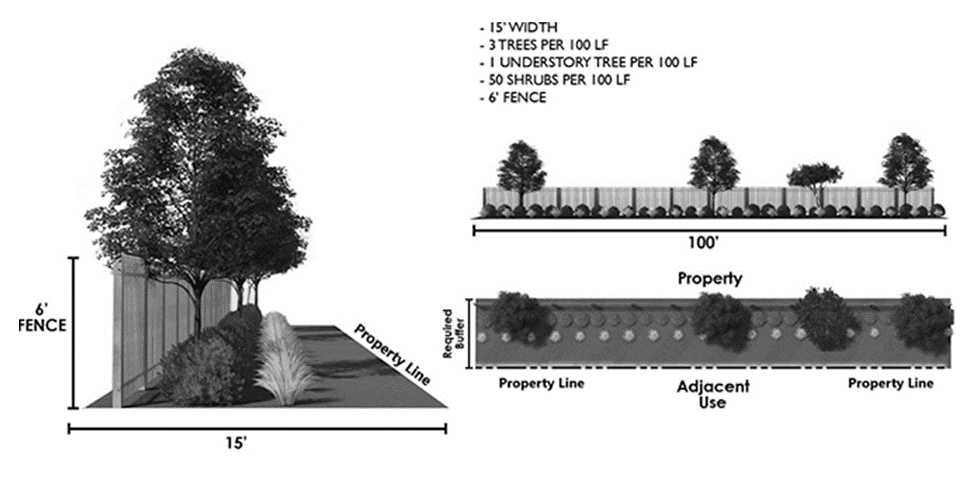
g.
Buffers at road intersections. To maintain a sight triangle as intersection not controlled by stop signs, perimeter buffers shall be designed to allow for view of oncoming traffic. See section 6.050 for intersection setback standards.
h.
Alternative buffer plan.
(1)
At the discretion of the planning commission, alternate buffering plans, plant material, planting methods, or landscape design may be used where unreasonable or impractical situations would result from application of buffering requirements, or where necessary to protect existing vegetation, or where a more creative plan is proposed which substantially complies with the intent of these requirements. Buffering requirements may be reduced if existing trees or other types of existing vegetation are preserved. Alternative plans, materials, or methods may be justified from natural conditions such as streams, natural rock formations, topography, and other physical conditions related to the site. Lot configuration and the presence and location of utility easements may justify an alternative buffering plan.
Sec. 8.030. - Permitted locations.
PUDs may be permitted in any district where tracts meet the following minimum requirements:
a.
Sites for PUDs shall contain at least five (5) acres of land.
b.
PUDs shall be so located with respect to major streets and highways as to provide direct access to the site without creating traffic along minor streets in residential neighborhoods in the vicinity of the site.
Sec. 8.040. - Application to planning commission.
An application for the review of a PUD shall be submitted to the planning commission and considered a rezoning application to PUD. An application for planning commission action on a PUD shall be accompanied by an overall development plan which shall include at least the following:
a.
A site plan map or maps drawn to an accurate scale showing:
1.
Proposed finished grades with contour intervals of two (2) feet.
2.
Proposed street system, including driveways, curb cuts and parking areas.
3.
Proposed location of buildings, fences, plantings, pedestrian walkways and open areas.
4.
Proposed location of any external lighting and signs.
5.
Location of essential services.
6.
Vicinity map showing the location of the PUD site in relation to the surrounding neighborhood, land uses, and zoning districts.
b.
Tabulations shown on the site plan or an attachment to the site map identifying:
1.
Total area of the site.
2.
Area of usable land.
3.
Area of land proposed for streets.
4.
Area of land per dwelling unit.
5.
Area of land devoted to open space.
6.
Area of land devoted to commercial and industrial uses.
c.
Architectural sketches at an accurate, appropriate scale showing buildings, proposed uses, landscaping, and other such design features of site improvements.
d.
A statement demonstrating the developer's financial capacity to undertake the PUD and to complete all planned activities within a reasonable time pending approval of the PUD.
Sec. 8.050. - Standards for review.
The planning commission shall review all plans and information submitted in conjunction with an application for a PUD according to the following standards:
a.
All plans and proposals must demonstrate that the proposed development will conform to all applicable zoning requirements, and that the PUD will at least meet the minimum requirements applicable to its development, including off-street parking and loading, tract size, setbacks, lot width, and all other general or special or general requirements of this ordinance.
b.
The overall PUD plan must make adequate provision for the safe and convenient movement of vehicular and pedestrian traffic both within the PUD and from adjacent streets.
c.
The plan must demonstrate adequate access to and the provision of necessary utilities for water, sewerage, stormwater drainage, and solid waste disposal.
d.
The plan must demonstrate that light, heat, glare, noise, or any other use of activity on the property as indicated by the PUD plan shall not deleteriously effect neighboring property nor limit or discourage the orderly development of adjacent properties as provided for and permitted in the zoning district or general area in which the PUD is to be located.
Sec. 8.060. - Approval.
a.
A public hearing shall be conducted by the planning commission on all PUD applications.
b.
The planning commission shall make a recommendation to the mayor and city council stating its approval or disapproval of PUD applications.
c.
The mayor and city council shall have final authority to approve or deny all PUD applications.
d.
If the PUD application is approved by the mayor and city council, building permits and certificates of occupancy may be issued even though the use of land, the height of buildings to be erected, and building line setbacks contemplated by the PUD do not conform in all respects to the district's regulations in which it is located. However, no permit shall be issued unless the proposed development conforms to the standards set forth in the approved PUD application.
Sec. 8.070. - Time limit on PUD projects.
If construction and development has not been substantially undertaken, in the opinion of the director, on an approved PUD project within one (1) year of the date of project approval, the planning commission shall review the circumstances and take the following action:
a.
Extend approval for another year as may be requested by the PUD developer.
b.
Require resubmission of the PUD application as described in section 8.040.

