
Hampton City Zoning Code
ARTICLE 2
- DEFINITIONS
Sec. 2-1.- Definitions.
For the purpose of this Zoning Ordinance, certain words and terms used herein shall be defined and interpreted as follows. All other terms not defined shall have their customary dictionary definitions.
For the purpose of this Zoning Ordinance, the following interpretations shall apply: All words used in the present tense include the future tense. All words in the plural number include the singular number, and all words in the singular number include the plural number, unless the natural construction of the wording indicates otherwise. The word "shall" is mandatory and not directory. The word "used" shall be deemed also to include "designed, intended, or arranged to be used."
Accessory apartment. A dwelling unit within, or on the same lot as, a single-family dwelling. It is an independent dwelling unit, but it may share an entrance, yard, and parking with the principal unit.
Accessory use. A use on the same lot as, and of a nature customarily incidental and subordinate to, the principal use.
Agriculture. Cultivating the soil, producing crops, raising of livestock or poultry, or farming, including associated activities, regardless of the quantity or value of production.
Alley. A privately owned access drive located in the rear of a single or multifamily residential unit that provides residents with vehicular access.
Amenities. The area(s) set aside for active and passive recreation for the residents of a development.
Arts related business. Arts related business and service establishments such as craft shops, set design and restoration of artwork, and galleries or studios, within which is conducted the preparation, display, or sale of art products such as antiques, collectibles, custom apparel, jewelry, paintings, photography, picture framing, pottery, sculpture, stained glass, and similar arts.
Automotive service, major. Repair services to motor vehicles which require substantial replacement and/or repair of major components. Examples of major automotive repair services include, but are not limited to, transmission repairs/replacement, paint and body work, engine overhaul, and radiator repair. Any repair services to construction equipment, agricultural equipment, or medium or heavy duty trucks, as well as wrecker services and associated storage yards shall be considered major automotive services.
Automotive services, minor. Repair and maintenance services which require only very brief adjustment and replacement of minor components. Examples of minor automotive services include, but are not limited to, tune-up, oil change, lubrication, brake repair, air conditioning system servicing, muffler replacement, and alignment.
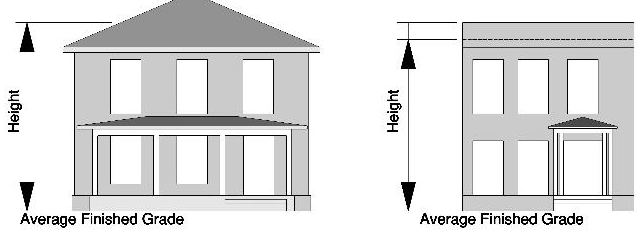
Average finished grade. The average final elevation and contour of the ground after cutting or filling and conforming to the proposed design. For the purpose of determining building height, average finished grade shall be the average of the highest and lowest point of the building footprint on a given elevation.
Bank, savings and loan, or credit union. A financial institution as defined by O.C.G.A. § 7-1-4 and regulated by the Georgia Department of Banking and Finance or Federal law as national banks, savings and loans, or credit unions.
Bar or drinking place. An establishment where alcoholic beverages are sold and consumed on the premises, and where the primary source of revenue is from alcoholic beverages rather than food or other goods.
Basement. The portion of a building having at least 50 percent of its floor to ceiling height below the average finished grade of the adjoining ground.
Bed and breakfast. An owner-occupied dwelling unit in which no more than six rooms are provided for sleeping accommodations for transient guests, for a daily fee and for no more than 14 consecutive days. Breakfast and refreshments are the only food typically served for guests staying at the bed and breakfast. A bed and breakfast is not a hotel or motel.
Boarding or rooming house. A dwelling in which meals and lodging or lodging only are provided for compensation to more than two, but not more than ten, non-transient persons on a weekly or monthly basis.
Buffer. A protective area of a lot established and maintained to create an open space between properties with different and possibly incompatible types of use. A buffer may consist of trees, shrubs, grass, fences, or some combination thereof.
Buildable area. The portion of a lot remaining after required yards have been provided.
Building. Any structure attached to the ground which has a roof and which is designed for the shelter, housing, or enclosure of persons, animals, or property of any kind.
Building, accessory. A building located on the same lot as and subordinate to the principal building on a lot and used for purposes incidental to the principal building.
Building Administrator. The official designated by the City Manager as being responsible for issuing building permits and certificates of occupancy.
Building Department. The city department or its legally authorized designee, responsible for the issuance of building permits and inspections of developments.
Building, principal. A building or structure in which is conducted the principal use of the lot on which said building is situated.
Canopy. A roof-like structure supported by columns or projecting from a building and open on at least three sides.
Carport. A covered structure used for housing vehicles, with no more than two walls.
Catering establishment. An establishment with a commercial kitchen used for preparing food for transportation to off-site events.
Certificate of occupancy. A document issued by the Building Administrator indicating that the use of a particular building or land conforms with the requirements of this Zoning Ordinance or that there has been a variance granted from these requirements.
Church. See place of worship.
City. The City of Hampton or its designee.
Clinic. An establishment where patients who are not lodged overnight are admitted for examination and treatment by one or more physicians or dentists.
Closed loop system. A system that constantly reuses and recycles an initial load of water within its operation, significantly reducing the draw on external water sources and minimizing wastewater discharge. A closed loop system shall not use evaporative cooling, and may consist of methods including, but not limited to, air-cooled (dry) cooling, rear-door heat exchanger cooling, hybrid dry economizer cooling, direct-to-chip cooling, or immersion cooling.
Club, association, or lodge. A facility owned or operated by and for special educational, social, or recreational purposes, but not primarily for profit or to render a service that is customarily carried on for gain.
Coin Operated Amusement Machine (COAM) as defined in O.C.G.A. § 50-27-70. "Bona fide coin operated amusement machine" means every machine of any kind or character used by the public to provide amusement or entertainment whose operation requires the payment of or the insertion of a coin, bill, other money, token, ticket, card, or similar object and the result of whose operation depends in whole or in part upon the skill of the player, whether or not it affords an award to a successful player pursuant to subsections (b) through (g) of O.C.G.A. § 16-12-35, and which can be legally shipped interstate according to federal law. The COAM types are as follows:
1.
"Class A machine" means a bona fide coin operated amusement machine that is not a Class B machine, does not allow a successful player to carry over points won on one play to a subsequent play or plays, and:
i.
Provides no reward to a successful player;
ii.
Rewards a successful player only with free replays or additional time to play;
iii.
Rewards a successful player with noncash merchandise, prizes, toys, gift certificates, or novelties in compliance with the provisions of subsection (c) or paragraph (1) of subsection (d) of O.C.G.A. § 16-12-35, or any reward redeemable as an item prohibited as a reward in the same subsection.
iv.
Rewards a successful player with points, tokens, tickets, or other evidence of winnings that may be exchanged only for noncash merchandise, prizes, toys, gift certificates, or novelties; or
v.
Rewards a successful player with any combination of items as listed in items ii, iii, iv, of this paragraph.
2.
"Class B machine" means a bona fide coin operated amusement machine that allows a successful player to accrue points on the machine and carry over points won on one play to a subsequent play or plays in accordance with paragraph (2) of subsection (d) of O.C.G.A. § 16-12-35 and:
i.
Rewards a successful player with points, tokens, tickets, or other evidence of winnings that may be exchanged only for noncash merchandise, prizes, toys, gift certificates, or novelties;
ii.
Does not reward a successful player with any item prohibited as a reward in subsection (i) of O.C.G.A. § 16-12-35.
Community Development Department. In every place that it shall appear, the term "Community Development Department" shall mean the City of Hampton's Community Development Department as that term is defined in the City of Hampton Code of Ordinances. It is the express intention of the Hampton City Council to have all City of Hampton zoning matters be studied and reviewed by the City of Hampton's Community Development Department and Director of the Community Development Department.
Comprehensive Plan. The official City of Hampton Comprehensive Plan (Comp Plan), as adopted by Hampton City Council, includes the official Future Land Use Plan (FLUM). The Comp Plan is a collection of planning goals, policies, and guidelines that provide guidance and structure for the execution of the community's vision. The FLUM illustrates the city's long-term vision for land use, development, and redevelopment. Land use categories are not zoning districts but rather guide policy decisions and appropriateness of zoning change within the city. The FLUM land use categories are as follows:
1.
Rural Residential (RR). RR includes farms, pastures, and forestry practices on large tracts of land; single-family residences associated with agricultural activities; and large-lot residential subdivisions up to one (1) dwelling unit per net acre. Compatible zoning districts include RA (Residential-Agricultural) and R-1 (Single-Family Residential).
2.
Low Density Residential (LDR). LDR consists of single-family homes on a single lot providing a density of one (1) to (2) dwelling units per net acre providing low-impact development (LID) and green infrastructure (GI) strategies as plausible. Compatible zoning districts include R-2 (Single-Family Residential), R-3 (Single-Family Residential), and RMH (Residential Manufactured Home).
3.
Medium Density Residential (MDR). MDR consists of single-family attached or single-family detached homes with public sewer and water service providing a density of two (2) to four (4) dwelling units per net acre. Compatible zoning districts include R-4 (Single-Family Residential), PD (Planned Development), RD (Residential Duplex) and DT-RC (Downtown Residential Character).
4.
High Density Residential (HDR). HDR consists of single-family cottages, attached townhouse developments, multistory condominiums, apartment developments, and the like with public water and sewer service up to eight (8) dwelling units per net acre. Compatible zoning districts include MR1 (Townhouse and Cottage Court), MR2 (Multifamily Residence), and DT-RC (Downtown Residential Character).
5.
Downtown Core (DC). DC consists of high density residential up to 12 dwelling units/net acre, urban green space, neighborhood-scale retail, commercial, and office use. DC compatible zoning districts include DT-MU (Downtown Mixed Use) and DT-RC (Downtown Residential Character).
6.
Urban Mixed-Use (UMU). UMU consists of industrial uses, institutional, neighborhood and regional retail and commercial service activities with residential up to 8 dwelling units/net acre integrated within the site. UMU compatible zoning district is MU (Downtown Mixed Use).
7.
Village Mixed-Use (VMU). VMU consists of vertical and horizontal mixed-use projects, public uses, commercial uses, single-family residential, and multi-family residential uses up to eight (8) dwelling units per net acre, with a focus on environmental sustainability in design and preservation of green space. VMU compatible zoning district is MU (Downtown Mixed Use).
8.
Commercial. This category includes neighborhood and regional retail and commercial service activities. Compatible zoning districts include C-1 (Neighborhood Commercial), C-2 (General Commercial), and C-3 (Heavy Commercial).
9.
Industrial. This category includes light manufacturing, warehousing, self-storage facilities, wholesale/distribution, and assembly. Compatible zoning districts include M-1 (Light Industrial), and M-2 (Heavy Industrial).
10.
Public/Institutional. This category includes land, buildings and facilities used by governments, schools, colleges, hospitals, cemeteries, and post offices. Compatible zoning district is 01 (Office-Institutional).
11.
Transportation, Utilities, Communications. This category includes uses such as landfills, water treatment plants, wastewater treatment plants, power substations, rail yards, mass transit facilities, airports, etc. Compatible in all zoning districts except DT-MU (Downtown Mixed-Use) and DT-RC (Downtown Residential Character).
12.
Parks, Recreation, Conservation. This category includes public parks, recreation areas, ball fields, playgrounds, and open spaces, as well as areas to be preserved for greenways, trails, and/or land conservation. Compatible in all zoning districts.
Conditional use. A use within certain zoning districts of this Zoning Ordinance which is not permitted as a matter of right, but may be permitted within these districts by the City Council. A conditional use is permanent in nature.
Congregate housing. Any public or private group dwelling or facility licensed by the state, which for gain or otherwise, regularly provides one or more persons with assisted living care. The term "assisted living care" means specialized care and services including the provision of personal services, the administration of medications by a certified medication aide, and the provision of assisted self-preservation. The term "personal services" includes, but is not limited to, individual assistance with or supervision of self-administered medication, assistance, essential activities of daily living such as eating, bathing, grooming, dressing, toileting, ambulation, and transfer. The term "assisted self-preservation" means the capacity of a resident to be evacuated from an assisted living facility to a designated point of safety and within an established period of time as determined by the Georgia Office of Insurance and Fire Safety Commissioner. Assisted self-preservation is a function of all of the following:
1.
The condition of the individual;
2.
The assistance that is available to be provided to the individual by the staff of the assisted living facility; and
3.
The construction of the building in which the assisted living facility is housed, including whether such building meets the state fire safety requirements applicable to an existing health care occupancy.
Copy/print shop. A retail location offering photocopying, small batch printing, office supplies, and similar goods and services to walk-in customers.
Cottage court. A group of detached single-family dwelling units organized around a shared internal courtyard.
Council. The Mayor and City Council of the City of Hampton, Georgia. The word "Council" is synonymous with "City Council."
County. Henry County or its designee.
Craft manufacturing. The use of hand-operated tools for the manufacturing of products or parts, including their design, processing, fabrication, assembly, treatment, and packaging. Craft manufacturing may also include the incidental storage, sale, and distribution of said products or parts. Craft manufacturing specifically includes, but is not limited to, the manufacturing of electronic goods, food and bakery products, alcoholic and non-alcoholic beverages, printmaking, household appliances, leather products, jewelry and clothing, metal work, furniture, glass or ceramics, and paper. No equipment or process may be used that creates, without limitation, noise, dust, vibration, glare, fumes, odors, or electrical interference detectable to the normal senses, off the premises.
Critical root zone. An area on the ground around a tree that is equal to the reach of the farthest branches. It is assumed that this critical root zone includes the majority of the tree's root mass, although research suggests that many roots extend beyond this zone.
Curb cut. An interruption of the line of a curb in order to provide vehicular access between a property and an abutting street.
Data center. A physical room, building, or facility that houses infrastructure for building, running, delivering, or transmitting technological applications and services, or for storing and managing the data associated with technological equipment, applications, systems, or services. Data center types include:
• Data center, accessory. An accessory data center shall only be permitted on parcels zoned Office-Institutional (O-I), and General Commercial (C-2) as an accessory use if under 2,000 square feet, located within the principal building and does not have a substation.
• Data center, campus. A data center campus is a geographically contiguous development of one or multiple buildings built across one or multiple phases totaling at least 500,000 square feet and has a substation on parcels zoned Light Industrial District (M-1) and Mixed-Use District (MU) with an approved Conditional Use, subject to the requirements of Appendix A, Article 3, Section 3-27.
• Data center, major. A major data center is a single principal building with an area greater than 10,000 square feet and not more than 275,000 square feet and may have a substation on parcels zoned Light Industrial District (M-1) with an approved Conditional Use, subject to the requirements of Appendix A, Article 3, Section 3-27.
• Data center, minor. A minor data center is a single principal building and has an area of less than 9,999 square feet permitted on parcels zoned Light Industrial (M-1), Heavy Commercial (C-3) and does not have a substation, subject to the requirements of Appendix A, Article 3, Section 3-27.
Day care center. A firm, partnership, corporation, individual, or other business entity, licensed by the State of Georgia as a day care facility, providing care for more than six children not related by blood or marriage or not the legal wards or foster children of the attendant adult or adults.
Drive-through. A facility at which the customer is served while sitting in a vehicle.
Dry cleaning establishment or laundromat. A retail location offering dry cleaning or laundering services to walk-in customers, or where washers and driers are provided for use by walk-in customers.
Dwelling unit. One or more rooms connected together and constituting a separate, independent housekeeping establishment designed for use by one family with provision for cooking, eating, sleeping, bathing, and personal sanitation, and physically set apart from any other rooms or dwelling units in the same structure or another structure.
Dwelling, duplex. A residential structure which contains a maximum of two dwelling units. The floor area of each unit must not be 20 percent more or less than the floor area of the other unit. Duplexes shall consist of two side-by-side or stacked dwelling units, both facing the street and sharing the same front setback, and both within a single building massing.
Dwelling, multi-family. A residential structure or portion thereof designed for three or more dwelling units, with the number of families in residence not exceeding the number of dwelling units provided.
Dwelling, quadruplex. Four attached dwellings in one building in which each unit shares one or two walls with an adjoining unit or units, separately metered for all utilities.
Dwelling, single-family detached. A detached residential structure with a permanent foundation, other than a manufactured home, hotel, or motel, and designed for one family.
Dwelling, townhouse. A dwelling unit in a row of at least three such units in which each unit has its own front and rear access to the outside, separately metered for all utilities, no unit is located over another unit, and each unit is separated from any other unit by one or more vertical common walls.
Dwelling, triplex. A building containing three dwelling units, separately metered for all utilities, each of which has direct access to the outside or to a common hall.
Environmental Sustainability Plan. The plan must include, at minimum, specific goals and policies and a set of actionable implementation measures to address those policies outlined in the city's Green Community Program.
Family. Any number of persons related by blood, adoption, guardianship, foster or other duly authorized custodial relationship, or marriage; or not more than three unrelated persons, living and cooking together as a single, nonprofit housekeeping unit; or two unrelated persons and any parents or children related to either.
Fitness facility or gym. A commercial establishment that provides services or facilities that assist patrons in improving their mental condition or physical condition or appearance.
Flood hazard area. The area possibly threatened by periodic flooding as determined by various data, e.g., maps provided by the United States Department of Housing and Urban Development, United States Soil Conservation Service, Army Corps of Engineers, Federal Emergency Management Agency, or hydrological studies utilizing generally accepted engineering practices. Flood hazard areas shall include all lands underneath a permanent body of water, e.g., a lake, pond, river, and stream, and all land within the limits of a flood hazard area having a 100-year return frequency.
Floor area, gross. The total number of square feet of floor area in a building determined by horizontal measurements between the exterior faces of walls, excluding unfinished basement areas, unfinished attics, porches, carports, and garages.
Food truck. A motorized vehicle or trailer drawn by a motorized vehicle used to prepare and sell food to the public directly from the vehicle or trailer. Food trucks are mobile food vendors and require licensing with the State Department of Environmental Health.
Food truck court. An area designated on a site for hosting food trucks, subject to the requirements of Appendix A, Article 4, Section 4-16 and the mobile food vendor requirements of Chapter 11, Article XV, Section 22.530.
Garage, residential parking. An enclosed structure attached to or accessory to a dwelling unit, used for storing a vehicle or vehicles used by the occupants of the dwelling unit.
Gas station. Buildings and premises wherein a primary use is the retail sales of vehicle fuels for personal vehicles, other than truck terminals, which are regulated as industrial uses. This may also collectively include retail sales of convenience items, restaurant sales, and a single bay vehicle wash, but does not permit overnight vehicle storage materials, such as tires, auto parts, etc.
General retail. A facility involved in the sale, lease, or rental of new or used products to the general public.
Government building. Any building owned by the City of Hampton, Henry County, any County or City, the State of Georgia, or the United States government.
Green Communities Program. An ARC Green Community is a community that is leading the way to sustainable living. ARC's Green Communities Program is designed to encourage local governments to demonstrate leadership on environmental sustainability. Local governments are asked to set an example for the community by conserving energy, investing in renewable energy, conserving water, conserving fuel, reducing waste, and protecting and restoring the community's natural resources.
Green Infrastructure (GI). Green infrastructure means the range of measures that use plant or soil systems, permeable pavement or other permeable surfaces or substrates, stormwater harvest and reuse, or landscaping to store, infiltrate, or evapotranspirate stormwater and reduce flows to sewer systems or to surface waters.
Greenhouse, nursery, or landscape service. An establishment with greenhouses or areas where plants are grown for sale or distribution, or where landscaping equipment is stored for use off site.
Guest quarters. A single noncommercial lodging unit, accessory to an owner-occupied single-family dwelling, either within or on the same lot as said dwelling.
Height of building. The vertical distance measured from the average finished grade to the highest point of the parapet of a low slope roof or the average height between the eaves and ridge of a pitched roof.
Home occupation. An occupation for gain or support conducted within a dwelling or accessory structure, clearly incidental to the residential use and conducted by a person or family residing on the premises.
Hospital. A facility providing health services and medical or surgical care to persons suffering from illness, disease, injury, deformity, and other abnormal physical or mental conditions, licensed by the State of Georgia, including facilities such as laboratories, outpatient facilities, or training facilities that are an integral part of the facility.
Hotel or motel. A building containing seven or more guest rooms in which temporary sleeping accommodations are provided for guests on a daily basis.
Impervious surface. Any road, driveway, parking area, building, swimming pool, concrete, pavement, rooftop landscape, or other impermeable material covering the natural land surface which impedes the free passage of water, air, or nutrients through the soil to the natural watershed, aquifer, or water zone below the surface. For an uncovered deck with drainage spaces between the deck boards and that is located over a pervious surface, 50 percent of the horizontal area of the deck is included in the measurement of impervious surface.
Junk/salvage yard. Any use involving the parking, storage, or disassembly of vehicles and/or machinery; the storage, sale, or resale of used auto parts, tires, scrap iron, or metal; used plumbing fixtures, old stoves, refrigerators, or other old household appliances; used brick, wood, or other building/structural materials; or used paper, rags, or other scrap materials. These uses shall be considered junk/salvage yards regardless of whether these operations are conducted inside a building, or in conjunction with or accessory to other uses on the premises.
Kennel, commercial. Any location which provides board and care for profit for domestic animals but not livestock.
Kennel, large noncommercial. Any location upon which more than six domestic animals but not livestock are kept as pets, or otherwise not for profit.
Kennel, small noncommercial. Any location upon which more than three but less than six domestic animals but not livestock are kept as pets, or otherwise not for profit.
Landscape plan. A detailed plan that accompanies site plans submitted for development approval and depicts proposed landscaping.
Large appliance repair. The repair of appliances such as HVAC systems, refrigerators, dishwashers, ovens, and similar items.
Leadership in Energy and Environmental Design (LEED). LEED is a green building certification program used worldwide. Developed by the nonprofit US Green Building Council (USGBC), it includes a set of rating systems for the design, construction, operation, and maintenance of green buildings, homes, and neighborhoods, which aims to help building owners and operators be environmentally responsible and use resources efficiently.
Load. The total power consumed by servers, storage, cooling, ventilation, generators, and other networking devices that operate within a data center.
Live/work. Nonresidential activity conducted wholly within a dwelling unit that allows employees, customers, clients, or patrons to visit.
Lot, corner. A lot situated at the intersection of two public streets, or bounded on two or more adjacent sides by public street lines.
Lot coverage. The area of a lot occupied by all impervious surface, expressed as a percentage of the gross area of the lot.
Lot frontage. That portion of a lot adjacent to a public street.
Lot line. A boundary of a lot. Lot line is synonymous with property line.
Lot of record. An individual lot or a lot which is a part of a subdivision, the map of which has been recorded in the office of the Clerk of Superior Court of Henry County, Georgia, or a parcel of land the deed of which has been recorded in the office of the Clerk of Superior Court of Henry County.
Lot, through. A lot, other than a corner lot, having frontage on more than one public street, or a corner lot having frontage on three or more public streets.
Lot width. The distance between the side lot lines, measured at the front yard setback as established by this Zoning Ordinance, or if no setback is established, the horizontal distance between the side lot lines measured along the public street.
Low Impact Development (LID). Low impact development is a site strategy with a goal of maintaining or replicating the pre-development hydrologic regime through the use of design techniques to create a functionally equivalent hydrologic landscape.
Manufactured home, Class I. A single family dwelling unit that is constructed in accordance with the National Manufactured Home Construction and Safety Standards and bears an insignia issued by the U.S. Department of Housing and Urban Development (HUD), or if constructed prior to applicability of such standards and insignia requirements, was constructed in conformity with the state standards in effect on the date of manufacture.
Manufactured home, Class II. A unit meeting the requirements of a class I manufactured home and, in addition, bearing an insignia of the Southern Standard Building Code Congress International (SBCCI) of Birmingham, Alabama.
Mass grading. Any excavation, filling, or a combination thereof that occurs on a large scale and involves the movement of large quantities of earth.
Megawatt (MW). The unit of measurement for electricity that is equivalent to one million watts. This is commonly used to measure the total power consumption of a data center.
Mobile Food Vendor. Any person or entity that prepares and sells food from a food truck in a designated food truck court or that otherwise operates a food truck.
Multi-use path. A continuous paved surface suitable for pedestrian and bicycle use which may include segments of boardwalk where sensitive environmental areas exist.
Net useable acres. The total acreage of any parcel or combined parcels of land to be developed as a single development, less the sum of the total number of acres contained in the 100-year flood hazard area, the total number of acres contained in rights-of-way for roads, and the total number of acres contained in detention or retention ponds to be constructed.
Nonconforming lot. A lot of record whose area, frontage, dimensions, or location were lawful prior to the adoption, revision, or amendment of this Ordinance, and which, by reason of such adoption, revision, or amendment, no longer meets or exceeds one or more such requirements of the applicable zoning district.
Nonconforming use. Any use within a building or on land lawful at the time of passage of the ordinance from which this Zoning Ordinance is derived, or at the time of passage of an amendment to this Zoning Ordinance, which does not conform with the current regulations of the district in which it is situated.
Outdoor recreation facility. A commercial facility providing regularly scheduled recreation activities that primarily take place outdoors or within outdoor structures. Includes the following: extreme sports facility (such as BMX, skateboarding, or roller blading), outdoor amusements (such as batting cage, golf driving range, miniature golf, or water park), outdoor sports field or court, and shooting range.
Parking space, off-street. A space adequate for parking an automobile with room for opening doors on both sides, together with properly related access to a public street or alley and maneuvering room.
Parking structure. A structure in which one or more vehicles are housed or kept, not including exhibition, show rooms, storage of cars, or cars for sale.
Pawn shop. A business involving in any part of the pledge, pawn, or exchange of any goods, wares, merchandise, or any kind of personal property or title as security for the repayment of money lent.
Place of worship. A facility that is primarily intended for conducting organized religious services. Associated accessory uses include, but are not limited to, schools, meeting halls, indoor and outdoor recreational facilities, rectories, day care centers, nursing homes, counseling centers, and commercial kitchens.
Porch. A raised and not fully enclosed structure that is attached to and forms a covered entrance to a building.
Pre-school. A state-approved institution for the education of preschool aged children.
Principal building. The building or structure containing or to contain the principal use of a lot.
Printing, publishing, and reproducing establishment. A business, not open to the public, for printing, publishing, and/or reproducing large batches of printed materials.
Produce stand. A roadside stand for sale of agricultural products grown on the premises, not to exceed 500 square feet in floor area.
Public street. A road, street, or other public right-of-way that is owned and/or maintained by the City or Henry County. The term "street" shall refer to the full width located between the limits of the right-of-way or easement, and not be limited to the roadway itself. Major arterials, minor arterials, and collector streets shall refer to the designations as shown in the Henry County Comprehensive Plan.
Public water facilities. Mains and service lines owned, maintained, and operated by the City or the Henry County Water Authority.
Quasi-judicial officers, boards, or agencies shall have the same meaning as defined in O.C.G.A. § 36-6-3.
Ranch Villas. A residential structure with a permanent foundation, designed as a single-story structure. Ranch Villas development shall include both single-family detached and attached duplex units.
Recreational vehicle (RV). A motorized vehicle, designed and/or maintained for use as a temporary dwelling or sleeping place exclusively for travel or recreation purposes, having no foundation other than wheels or jacks.
Recreational vehicle (RV) park. A parcel of land of at least five acres which is used solely for the rental or lease of lots or areas for recreational vehicles.
Renewable energy facility. A facility used for generating electricity from solar panels, wind turbines, and similar devices.
Repair of personal goods. An establishment where small personal goods are repaired on site. Personal goods include jewelry, clocks, small appliances, bicycles, computers, cellular telephones, electronics, canvas products, office equipment, musical instruments, radios, shoes, watches, televisions, or similar items.
Research and development. A facility focused primarily on the research and development of new products. Research and development includes laboratories, offices, and other facilities used for research and development; prototype production facilities that manufacture a limited amount of a product in order to fully investigate its merits; and pilot plants used to test manufacturing processes planned for use in production elsewhere.
Riding stable. A facility used primarily for the care, breeding, boarding, rental, riding, or training of horses or for the teaching of equestrian skills.
Seasonal activity or temporary event. An event open to the general public, including carnivals, temporary sales events, flea markets, races, parades, marches, rallies, assemblies, concerts, and festivals.
Self-service storage facility. A fully enclosed facility containing independent bays and/or self-contained units which are leased to or owned by individuals exclusively for dead storage of goods or personal property. Dead storage means the storage of goods not in use and not associated with any commercial or manufacturing business.
Setback. See yard.
Short-term rental. An accommodation for transient guests where, in exchange for compensation, an entire residential dwelling unit is provided for lodging for a period of time not to exceed thirty days in one year. For the purposes of this definition, a residential dwelling shall include all housing types and shall exclude congregate housing, bed and breakfasts, and hotels or motels.
Sign. See definitions contained in Article 11 of this Zoning Ordinance.
Site. The parcel of land being developed, or the portion thereof on which the land development project is located.
Square footage, data centers. The square footage of a data center shall include the total square footage of each floor in the data center development.
Stoop. A small, raised, covered platform that serves as an entrance to a building.
Structure. Anything constructed or erected with a fixed location on the ground or attached to something having a fixed location on the ground. Among other things, structures include, but are not limited to, site-built buildings, industrialized buildings, manufactured homes, gasoline pumps, walls, fences, billboards, signs, and antennas.
Subdivision. The division of a tract or parcel of land resulting in two or more new lots or building sites for the purpose, whether immediately or in the future, of sale, other transfer of ownership or land development or rearrangement of existing lot lines, and includes divisions of land resulting from or made in connection with the layout or development of a new street or roadway or a change in an existing street or roadway. A subdivision may include the construction, extension or relocation of public improvements including public streets, public rights-of-way, public water and sewer facilities, and other improvements for the purpose of creating building sites. The division of a parcel or tract of land into two lots which does not involve the construction, extension or relocation of public improvements shall not be considered a subdivision provided that the lot has not been divided or resulted from a lot division in the previous 24 months.
Substation. An electric utility facility that converts higher voltages to lower voltages within, or separate from, a data center to deliver sufficient power at maximum efficiency; may operate independently as a dedicated site once directly connected to a transmission line(s).
Television, radio, or film production facility. The use of land, building or structure or part thereof, used for multimedia production to include creation and production of motion pictures or audio or video recordings and the associated warehousing, construction and use of prop and set design and storage as well as digital media uses such as animation studio, and associated software development.
Temporary construction or sales office. A manufactured or other building which is used as an office for real estate sales, on-site construction management, and/or related functions in connection with a construction project or land subdivision development.
Temporary outdoor display. The temporary outdoor display of products actively available for sale. Outdoor display does not include the storage or sale of any items identified under commercial outside storage. Outdoor display also does not include the outdoor placement of propane gas storage racks, ice storage bins, and soft drink or similar vending machines.
Townhouse. An attached residential structure connected by a common wall, designed for one family.
Travel trailer. A non-motorized vehicle, pulled by an automobile or truck designed and/or maintained for use as a temporary dwelling or sleeping place exclusively for travel or recreation purposes.
Tree. Any living, self-supporting, woody perennial plant which normally attains a trunk caliper of 6 inches measured at any height and which normally attains a height of at least ten feet at maturity, usually with one main stem or trunk and many branches.
Tree caliper. The diameter or thickness of the trunk of a nursery-grown tree as measured at six inches above the top of the root mass.
Tree, dead. A tree that does not contain any live tissue, i.e., green leaves or live limbs.
Tree, deciduous. Any tree which naturally loses its leaves in the fall.
Tree, evergreen. Any tree that retains green leaves throughout the year. This includes but is not limited to magnolias and tree-type hollies, as well as pines and cedars.
Tree diameter at breast height (dbh). The widest cross sectional dimension of a tree trunk measured at 4 feet above the ground or at a point below 4 feet for multi-trunk species, but in no case less than six inches above the ground.
Tree, shade. Any tree, evergreen or deciduous, whose mature height can be expected to exceed 35 feet and whose crown spread can be expected to exceed 30 feet.
Tree, understory. A class of trees and large shrubs that do not attain the height of a shade tree, yet are large enough at maturity to provide shade for people, as well as many of the benefits of larger shade trees. Examples include but are not limited to dogwood, red bud, crabapple, crepe myrtle, wax myrtle, ornamental cherry, hawthorn, and tree-type hollies.
Use. The purpose or purposes for which land or a building is designed, arranged, intended, or for which said land or building is occupied, maintained, or leased.
Variance. A minimal variation of the terms of this Zoning Ordinance which permits construction in a manner otherwise prohibited by this Zoning Ordinance.
Vehicle, abandoned. Any wrecked, non-operable, or dismantled automobile, truck, or other vehicle which does not bear a current state license plate, unless said vehicle is stored within a completely enclosed building or on a bona fide sales lot and is in a satisfactory operating condition.
Wholesale store. A warehouse with at least one square foot of office, sales, or display space for every square foot of warehousing space, and so arranged as to encourage walk-in trade.
Yard. A required open space situated between a lot line and any principal or accessory structure from the ground upward, unoccupied and unobstructed except for trees, plant material, and fences.
Yard, front. That area of a lot situated between the front lot line and any principal or accessory structure extending the full width of the lot.
Yard, rear. That area of a lot situated between the rear lot line and any principal or accessory structure extending the full width of the lot.
Yard, side. That area of a lot situated between the side lot line and any principal or accessory structure on the lot extending from the required front yard to the required rear yard.
Zoning Administrator. The City Manager or their designee.
Zoning decision shall have the same meaning as defined in O.C.G.A. § 36-6-3.
Zoning district. Area of zoned property within the City of Hampton, Georgia, and shown on the Official Zoning Map which is part of this Zoning Ordinance.
Zoning ordinance. The zoning and land use regulations contained in this Zoning Ordinance and adopted for use within the City of Hampton that constitute a Zoning Ordinance within the meaning of O.C.G.A. § 36-66-1 et seq.
(Ord. No. 457, § 1, 8-14-18; Ord. No. 489, § 1, 10-8-19; Ord. No. 502, § 2, 2-11-20; Ord. No. 532, § 2, 12-8-20; Ord. No. 584, § 1, 10-11-22; Ord. No. 589, § 2, 1-10-23; Ord. No. 2023-07, § 1(Exh. A), 6-13-23; Ord. No. 2023-13, § 1(Att. A), 9-12-23; Ord. No. 2025-003, § 1(Exh. A), 3-25-25; Ord. No. 2026-06, § 1(Exh. A), 4-14-26)

