
Hampton City Zoning Code
ARTICLE 3
- GENERAL PROVISIONS
Sec. 3-1.- Design Standards.
A.
The purpose and intent of these standards is to:
1.
Promote high quality, long-lasting development and building materials.
2.
Enhance visual appeal and livability.
3.
Foster architectural diversity and interest, yet achieve a consistent, durable, and pleasing aesthetic.
4.
Ensure that large commercial/retail buildings incorporate designs that reduce their visual mass and create the impression of smaller buildings.
B.
These standards shall not apply to properties within any historic overlay district nor to any property within a residential subdivision in which one or more dwelling units received a building permit prior to August 14, 2018.
C.
Application requirements.
1.
Plans submitted for a building permit must include drawings that clearly indicate compliance with all the requirements of this section.
2.
Groups of buildings on the same site may be reviewed and permitted as a single application. This is encouraged to minimize the number of reviews required and to allow for originality and design flexibility.
3.
Prior to issuing a certificate of occupancy, the Building Administrator must confirm that all aspects of the design have been completed in conformance with the requirements of this section.
(Ord. No. 457, § 1, 8-14-18)
Sec. 3-2. - Residential Design Standards.
A.
All residential buildings (including all detached single-family dwellings, cottages, duplexes, townhouses, and multifamily buildings) in any zoning district shall be subject to the standards of this section, unless alternate standards are approved by City Council. In addition, all buildings of the commercial house type in the DT-RC district shall be subject to the standards of this section, unless alternate standards are approved by City Council. Accessory structures used as garages, accessory apartments, or guest quarters shall be subject to the standards of this section, but all other accessory structures shall be exempt from the standards of this section.
B.
Exterior walls. The following standards apply to all exterior walls.
1.
Exterior wall finish materials (excluding windows, doors, porches, balconies, foundations, or architectural details) are limited to the following:
i.
Brick, including full-depth and half-depth masonry brick, but not simulated brick veneers;
ii.
Stone, including unpainted natural stone, unpainted cast stone having the appearance of natural stone, and unpainted terra cotta;
iii.
Stucco, including true cement stucco but not EIFS;
iv.
Wood, including natural wood or cementitious siding; and
v.
Shingles, including wood or cementitious shakes and shingles.
2.
Where more than one exterior finish material is used, visually lighter materials must be used above visually heavier materials.
3.
No more than three different exterior finish materials, textures, colors, or combinations thereof may be used on a single building, excluding materials used on windows, doors, porches, balconies, foundations, or architectural details.
4.
Foundations, when visible, must be constructed as a distinct building element that is finished in a different material or color, or is set back from the exterior wall. Above-ground foundations must be coated or faced in cement, hard coat stucco, brick, natural stone, or cast stone to contrast with exterior wall materials.
5.
No more than three adjacent units or buildings may have identical facade designs. Differentiation between adjacent facades may be accomplished by a change in materials, building height, color, roof form, or setbacks.
C.
Windows and doors. The following standards apply to all street-facing exterior walls.
1.
The total area of all windows on an individual story must not be less than 10 percent, nor greater than 50 percent, of the total exterior wall area for that story. Total exterior wall area shall include the area of garages and other doors.
2.
Where used, shutters must match one half the width and shape of the window opening to which they are adjacent.
3.
Doors and windows that operate as sliders are prohibited.
4.
Individual windows must be vertically shaped, with a height greater than width.
5.
Windows must have true or simulated divided lites or be one-over-one lites.
6.
Transom windows are permitted, but do not need to be vertically shaped, have divided lites, or include a sill.
7.
Window panes must be recessed a minimum of 1 inch from the face of the exterior wall where no trim is provided, or a minimum of 1.5 inches from the face of the trim where trim is provided.
D.
Porches and stoops.
1.
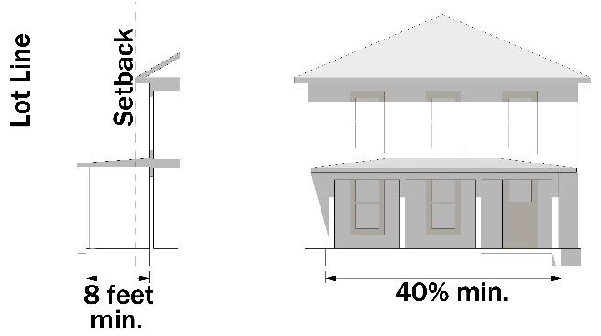
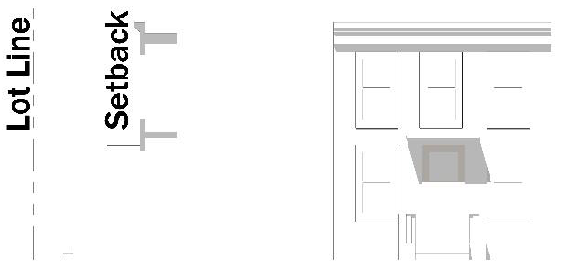
A front porch or stoop is required, except for multifamily buildings with more than 8 units.
2.
Stoops shall be at least 10 square feet in area.
3.
Front porches shall be at least 8 feet in depth.
4.
Covered porches (whether enclosed or not) and stoops shall be considered as a part of the building and shall not project into the required front, side, or rear yard setbacks).
E.
Roofs and chimneys.
1.
Pitched roofs, if provided, must be symmetrically sloped at no less than 5:12, except that roofs for front porches and attached sheds may be sloped at no less than 2:12.
2.
Flat roofs shall be enclosed by parapets a minimum of 42 inches high, or as required to conceal mechanical equipment.
3.
All roofs must have a minimum 25-year roof life and no visible roll roofing.
4.
Eaves and overhangs. Eaves and gables on pitched roofs must extend a minimum of 12 inches beyond the facade.
5.
Chimneys, where provided, must extend to the ground and must be faced in brick, stone, cast stone, or hard coat stucco. Chimneys must extend a minimum of 3 feet above the roof line.
F.
Garages and carports. The following standards shall apply to all residential types except for multifamily residential.
1.
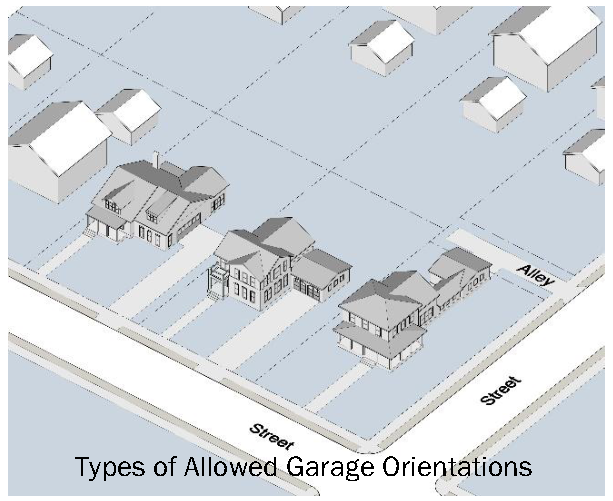
For lots with alley access, the garage or carport shall be placed to the rear of the dwelling unit or incorporated into the dwelling unit with the door or opening facing the alley.
2.
Where a garage faces a public or private street, the garage door must be recessed a minimum distance of 5 feet behind the front building facade.
3.
Individual garage doors that face a public or private street may not exceed 9 feet in width. Adjacent garage doors that face a street must be separated by at least 12 inches of material identical to the adjacent exterior wall material.
4.
Carports shall be designed according to the following minimum standards:
i.
If fully or partially enclosed, the floor shall be constructed of concrete. Concrete floors shall be reinforced, where appropriate, and a minimum of four inches in thickness with appropriate fill and base.
ii.
If unenclosed, the floor shall be constructed of concrete or asphalt. Asphalt floors shall be a minimum of two-inch type "E" or "F" asphalt topping, binder, and four inches of graded aggregate base.
5.
The floor of a residential garage shall be constructed of concrete. Concrete floors shall be reinforced where appropriate, and a minimum of four inches in thickness with appropriate fill and base.
G.
Additional standards for multifamily residential developments, excluding townhouse developments.
1.
All outdoor amenities and other landscaped areas shall be maintained by a professional landscaper.
2.
A minimum of 50 percent of dwelling units above the first floor shall have balconies with minimum dimensions of four feet by eight feet.
3.
Adequate provision for the disposal of refuse shall be made within each multifamily building, or such refuse shall be conveyed to a central point or points to facilitate collection.
4.
Each dwelling unit shall have central heating and cooling facilities.
5.
Adequate laundry facilities consisting of automatic washing and clothes-drying machines in a common laundry room shall be provided, or a washer and dryer hook-up shall be installed in each dwelling unit.
6.
A minimum of 300 cubic feet of separate contiguous storage space shall be provided for each dwelling unit.
7.
Interior floor to ceiling height for all floors shall be a minimum of 9 feet.
H.
No more than 8 townhouse units may be connected in a single structure.
(Ord. No. 457, § 1, 8-14-18; Ord. No. 484, § 1, 10-8-19)
Sec. 3-3. - Non-Residential Design Standards.
The intent of the following design standards is to encourage creative architecture that is responsive to local and regional context and contributes to the aesthetic identity of the community.
A.
All non-residential buildings shall be subject to the following standards.
B.
Exterior walls. The following standards apply to all exterior walls.
1.
Within M-1 and M-2 districts, exterior wall finish materials (excluding windows, doors, awnings, foundations, or architectural details) are limited to the following:
i.
Brick, including full-depth and half-depth masonry brick, but not simulated brick veneers;
ii.
Stone, including unpainted natural stone, unpainted cast stone having the appearance of natural stone, and unpainted terra cotta;
iii.
Stucco, including true cement stucco but not EIFS;
iv.
Concrete block, which must be painted;
v.
Split-face block and painted concrete masonry units (CMU);
vi.
Wood, including natural wood or cementitious siding;
vii.
Shingles, including wood or cementitious shakes and shingles; and
viii.
Glass.
2.
Within all other districts, exterior wall finish materials (excluding windows, doors, awnings, foundations, or architectural details) are limited to the following:
ix.
Brick, including full-depth and half-depth masonry brick, but not simulated brick veneers;
x.
Stone, including unpainted natural stone, unpainted cast stone having the appearance of natural stone, and unpainted terra cotta;
xi.
Stucco, including true cement stucco but not EIFS;
xii.
Wood, including natural wood or cementitious siding;
xiii.
Shingles, including wood or cementitious shakes and shingles; and
xiv.
Glass.
3.
Where more than one exterior finish material is used, visually lighter materials must be used above visually heavier materials.
4.
Building floors shall be delineated and shall be executed through windows, belt courses, cornice lines, or similar architectural detailing, so as to distinguish each floor.
5.
Buildings that derive their image solely from applied treatments that express corporate identity are discouraged.
6.
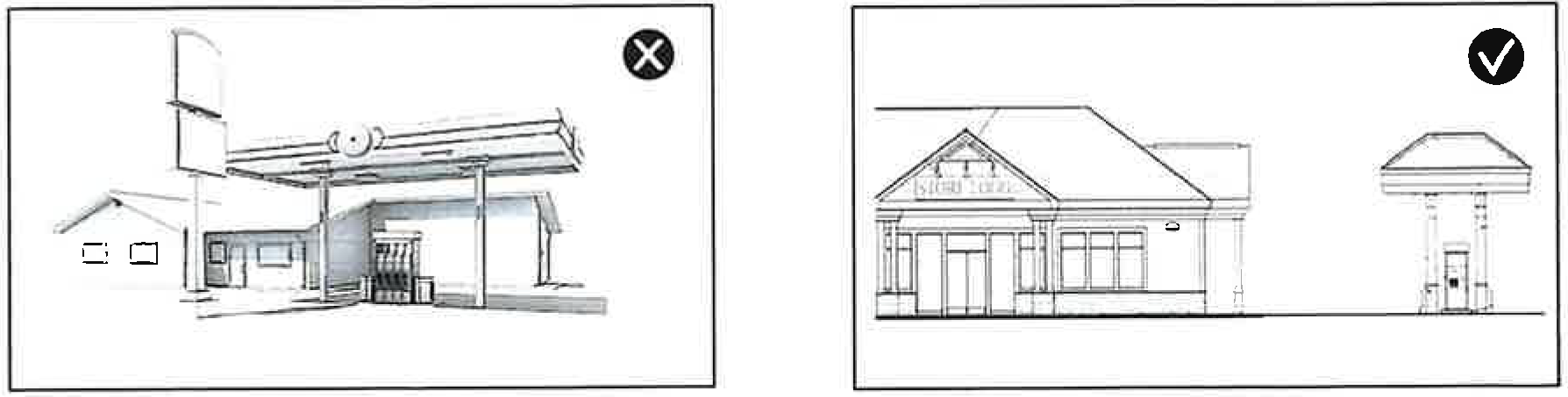
The design of stand-alone gas stations and convenience stores should conform to the dominant existing planned character of the surrounding neighborhood. This can be accomplished through the use of similar forms, materials, and colors.
7.
The design of a facility that occupies a pad or portion of a building within a larger commercial or mixed-use center should be designed to reflect the design elements of that development.
8.
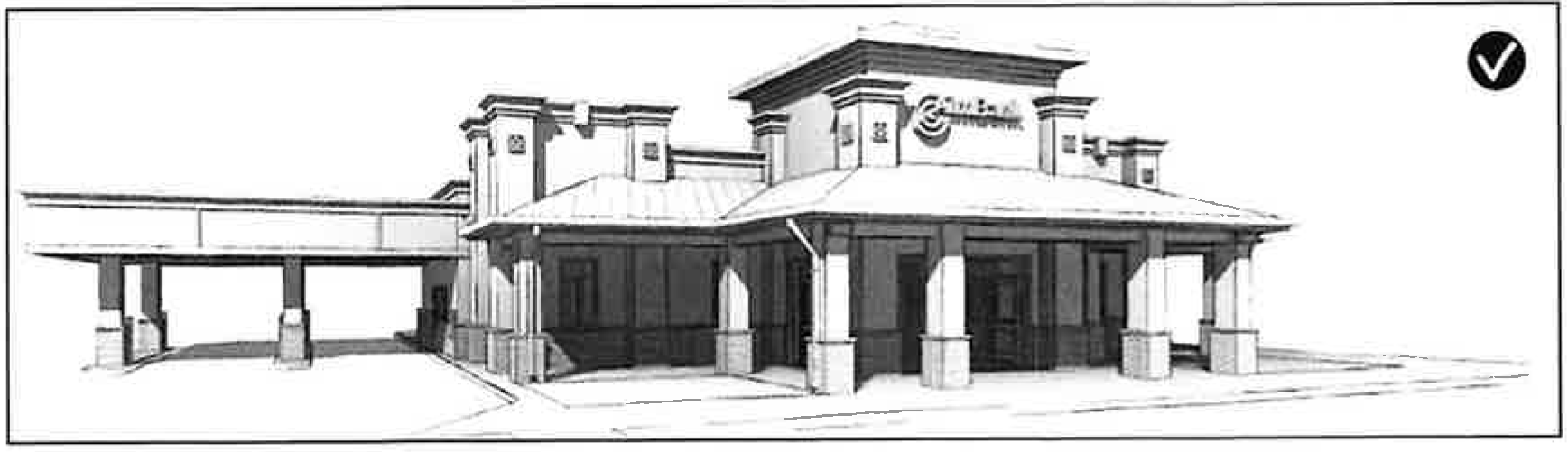
Drive through elements should be architecturally integrated into the building rather than appearing to be applied or "stuck on" to the building.
9.
All sides of a building should express consistent architectural detail and character. All site walls, screen walls, and pump island canopies and other outdoor covered areas should be architecturally integrated with the building by using similar material, color, and detailing.
C.
Windows and doors. The following standards apply to all street-facing exterior walls.
1.
The total area of all windows must not be less than 40 percent of the total exterior wall area of the ground floor, nor less than 30 percent of the total exterior wall area for each upper story. Total exterior wall area shall include the area of garages and other doors. Requirements shall be calculated separately for each wall and story.
2.
Window panes must be recessed a minimum of 1 inch from the face of the exterior wall where no trim is provided, or a minimum of 1.5 inches from the face of the trim where trim is provided.
D.
Building massing. Facades over 50 feet in length must incorporate wall projections or recesses a minimum of 12 inches in depth. The combined length of said recesses and projections must constitute at least 20 percent of the total facade length.
E.
Rooflines. Variation in the roofline of buildings and offsets in pitched roofs and gables are required. Parapets in individual facades exceeding 100 continuous linear feet must be varied in height and projection and must use decorative elements such as crown molding, dentals, brick soldier courses, or similar details.
F.
Interior floor to ceiling height for the ground floor shall be a minimum of 14 feet.
G.
Canopy:
1.
Integration of canopy to building and site walls is desirable. Multiple canopies or canopies that express differing architectural masses are encouraged.
2.
Canopy height, as measured from the finished grade to the lowest point on the canopy fascia, should not exceed 13'-9". The clearance height of canopies should be clearly indicated on the structure or through use of a headache bar. The overall height of canopies should not exceed 17'.
3.
Canopy ceiling should be textured or have a flat finish, glossy or highly reflective materials are not recommended.
4.
Lighted bands or tubes or applied bands of corporate color are discouraged.
5.
Canopy support columns shall be architecturally integrated by use of color, material, and architectural detailing.
(Ord. No. 457, § 1, 8-14-18; Ord. No. 2023-13, § 1(Att. A), 9-12-23)
Sec. 3-4. - Required Amenities for Residential Developments.
A.
All single-family and multifamily residential developments shall provide amenities as specified in this section. For residential developments in an MU Mixed-Use district, these requirements shall apply to the portion of the development that is residential.
B.
Cottage court developments shall be exempt from these requirements, but shall provide a landscaped courtyard of at least 40 feet in width and 3,000 square feet in total area for every 10 units or fraction thereof. No more than 10 dwelling units may face any courtyard. Portions of the courtyard located in a setback or buffer shall not count toward this requirement. The courtyard shall not be parked or driven on, except for emergency access and permitted temporary events.
C.
All amenities must be designed to be accessible to all residents of the development. The Zoning Administrator may allow other amenities to count toward these requirements where they are of equal or greater value to those listed below.
D.
Prior to the issuance of a certificate of occupancy for 50 percent of the units in a development, each development shall provide amenities as specified below.
1.
Required amenities for single-family developments.
i.
1-50 units: no amenities required.
ii.
51-100 units: one Type 1 amenity, or two Type 2 amenities, or three Type 3 amenities.
iii.
101-150 units: the requirement in 1(ii) above, plus two additional Type 3 amenities, or one additional Type 2 amenity, or one additional Type 1 amenity.
iv.
151+ units: the requirement in 1(ii) above, plus four additional Type 3 amenities, or two additional Type 2 amenities, or one additional Type 1 amenity.
2.
Required amenities for townhouse and multifamily developments.
i.
1-50 units: one Type 1 amenity, or two Type 2 amenities, or three Type 3 amenities.
ii.
51-100 units: the requirement in 2(i) above, plus two additional Type 3 amenities, or one additional Type 2 amenity, or one additional Type 1 amenity.
iii.
101-150 units: the requirement in 2(i) above, plus four additional Type 3 amenities, or two additional Type 2 amenities, or one additional Type 1 amenity.
iv.
151+ units: the requirement in 2(i) above, plus six additional Type 3 amenities, or four additional Type 2 amenities, or one additional Type 1 amenity.
E.
Type 1 amenities.
1.
Junior-size Olympic pool.
2.
Clubhouse or meeting facility (1,300 square feet minimum).
F.
Type 2 amenities for conservation subdivisions.
1.
Wading pool (minimum 200 square feet).
2.
Splash pad.
3.
Pond with fishing dock and boat access (minimum 1 acre).
4.
Multi-use path (minimum 1,000 feet in length, six feet in width).
5.
Baseball, softball, football, or soccer field (regulation size).
6.
Multi-use field (football and soccer or football and baseball).
7.
Tennis courts (lighted and enclosed, minimum of two courts).
8.
Basketball court (regulation size).
9.
Racquetball court (regulation size).
10.
Pickleball court.
11.
Amphitheater.
12.
Stormwater management facilities (must be designed by a registered landscape architect as formal or natural amenities, and may not be fenced or enclosed by walls over 30 inches in height).
G.
Type 2 amenities for all other residential developments.
1.
Wading pool (minimum 200 square feet).
2.
Splash pad.
3.
Pond with fishing dock and boat access (minimum 1 acre).
4.
Multi-use path (minimum 1,000 feet in length, six feet in width).
5.
Tennis courts (lighted and enclosed, minimum of two courts).
6.
Basketball court (regulation size).
7.
Racquetball court (regulation size).
8.
Pickleball court.
9.
Amphitheater.
10.
Stormwater management facilities (must be designed by a registered landscape architect as formal or natural amenities, and may not be fenced or enclosed by walls over 30 inches in height).
H.
Type 3 amenities.
1.
Dog park.
2.
Community garden.
3.
Community green.
4.
Public plaza.
5.
Indoor workout facility.
6.
Outdoor exercise stations.
7.
Preserved natural area (minimum 0.5 acre).
8.
Children's play area (0.25 acre minimum).
(Ord. No. 457, § 1, 8-14-18)
Sec. 3-5. - Sidewalk Standards.
A.
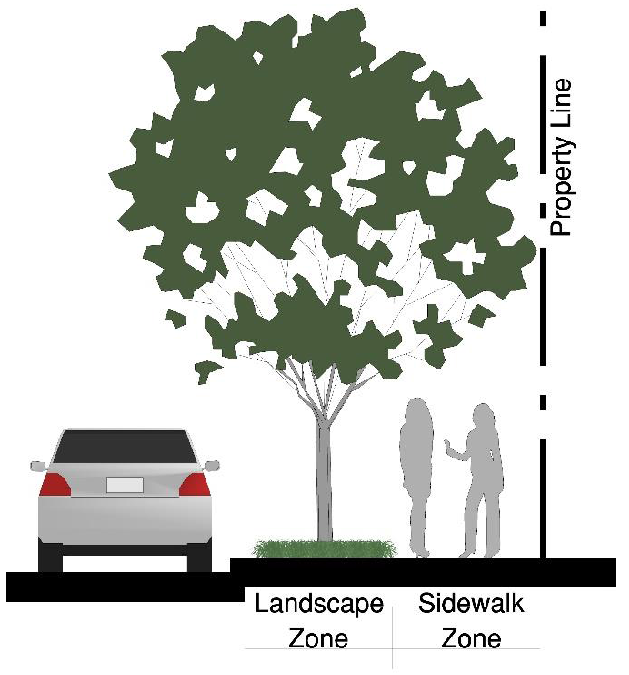
New sidewalks shall be constructed on all existing and new streets, except when the gross floor area of an existing building or improved site area is increased by less than 25 percent. Sidewalks shall consist of two zones: a landscape zone and a sidewalk zone. The following regulations shall apply:
1.
Landscape zone requirements: A landscape zone with a minimum width of 5 feet shall be located immediately adjacent to the curb and shall be continuous. In addition to the required planting of trees, this zone may also be used for utility and light poles, trash receptacles, fire hydrants, traffic signs, bicycle racks, and similar elements in a manner that does not obstruct pedestrian access or motorist visibility. In the DT-MU district, the landscape zone may be paved and tree grates may be provided.
2.
Sidewalk zone requirements: The sidewalk zone shall be located immediately contiguous to the landscape zone, shall be continuous, and shall be a minimum of 5 feet in width. Where allowed, awnings and canopies shall be located a minimum of 8 feet above the sidewalk and shall not encroach more than 5 feet over the sidewalk zone. Where an abutting property has an existing sidewalk of a different width, the sidewalk zone must taper as necessary to provide a smooth transition to the adjacent sidewalk.
3.
On existing streets with insufficient right-of-way width to accommodate the required sidewalk and landscape zone, the right-of-way needed to accommodate the required sidewalk and landscape zone may be expanded by mutual agreement between the owner of the abutting property and the entity controlling the subject right-of-way, or a public access easement may be provided to the City to accommodate the required sidewalk and landscape zone.
4.
The Zoning Administrator may grant administrative variances to these requirements where the required sidewalks would result in loss of existing trees, where an existing building location limits the space available for the required sidewalk, or where existing topography prevents the installation of the required sidewalk without requiring the construction of retaining walls three or more feet in height.
(Ord. No. 457, § 1, 8-14-18)
Sec. 3-6. - Site Lighting.
A.
Purpose and intent. The purpose and intent of this section is to permit reasonable uses of outdoor lighting for nighttime safety, utility, security, productivity, enjoyment, and commerce; curtail and reverse the degradation of the nighttime visual environment and the night sky; preserve the dark night sky for astronomy; minimize glare, obtrusive light, and artificial sky glow by limiting outdoor lighting that is misdirected, excessive, or unnecessary; conserve energy and resources; and help to protect the natural environment from the damaging effects of night lighting from man-made sources.
B.
Applicability. All outdoor lighting fixtures in all districts shall meet the requirements of this section.
C.
Exempt lighting. The following luminaires and lighting systems are exempt from these requirements:
1.
Interior lighting;
2.
Lighting for pools used at night;
3.
Underwater lighting used for the illumination of swimming pools and fountains;
4.
Temporary holiday lighting;
5.
Lighting required and regulated by the Federal Aviation Administration, or other federal or state agency;
6.
Emergency lighting used by police, fire, or medical personnel, or at their direction;
7.
All outdoor light fixtures producing light directly from the combustion of fossil fuels, such as natural gas; and
8.
Security lighting controlled and activated by a motion sensor device for a duration of 10 minutes or less.
D.
Prohibited lighting. The following lighting systems are prohibited:
1.
Aerial lasers;
2.
Searchlight style lights. (Temporary searchlights may be turned on for 8 hours within a 24-hour period and for no more than 3 consecutive days, once each calendar year.);
3.
Other very intense lighting, defined as having a light source exceeding 200,000 lumens, or intensity in any direction of 2 million candelas or more; and
4.
Mercury vapor lamps.
E.
Outdoor lighting standards. All nonexempt outdoor lighting fixtures shall meet the following criteria:
1.
Flood or spot lamps must be positioned no higher than 45 degrees above straight down (half way between the vertical and the horizontal) when the source is visible from any lot with an occupied dwelling unit or a public street.
2.
All light fixtures that are required to be shielded shall be installed and maintained in such a manner that the shielding is effective as described herein for fully shielded fixtures.
F.
Specific uses. All lighting not directly associated with the specific uses designated in this subsection must conform to the lighting standards described elsewhere in this section.
1.
Outdoor sports, recreation fields, or performance areas. Lighting of outdoor recreational facilities (public or private), such as, but not limited to, outdoor athletic fields, courts, tracks, special event or show areas shall meet the following requirements:
i.
Luminaires. Facilities shall utilize luminaires with minimal uplight consistent with the illumination constraints of the design. Where fully shielded fixtures are not used, acceptable luminaires shall include those which are provided with internal or external glare control louvers or lenses, are installed so as to minimize uplight and offsite light trespass and glare, and are installed and maintained so as to avoid aiming more than 2.5 times the mounting height.
ii.
Illuminance. All lighting installations shall be designed to achieve the illuminance levels for the activity as recommended by the Illuminating Engineering Society of North America (IESNA RP-6).
iii.
Off-site spill. The installation must also limit off-site spill (off the parcel containing the sports facility) to the maximum extent possible consistent with the illumination constraints of the design. Illumination levels must not exceed 1.5 foot-candles at any location along any non-residential property line, and 0.5 foot-candles at any location along the property line of any lot with an occupied dwelling unit.
iv.
Curfew. Field lighting for these outdoor athletic facilities shall be turned off within 30 minutes after the last event of the night.
v.
Setback. All light poles shall be set back the greater of 50 feet or one foot for every foot in height from any right-of-way or property line of any lot with an occupied dwelling unit.
2.
Gas station or drive-in establishment canopies and parking structures.
i.
All luminaires mounted on or recessed into the lower surface of canopies and parking structures must be fully shielded and use flat lenses.
ii.
The total light output of luminaires mounted on the lower surface, or recessed into the lower surface of the canopy, and any lighting within signage or illuminated panels must not exceed 50 foot-candles.
iii.
The total light output of illuminated areas other than as detailed in 2(ii) above shall not exceed 15 foot-candles.
iv.
Illuminance levels for the interior of parking structures, where interior lighting is visible from outside the structure, must conform to the IESNA recommendation (RP-20).
v.
Lights must not be mounted on the top or sides of a canopy and the sides of a canopy must not be illuminated.
3.
Security lighting. Security lighting is lighting that provides a level of illumination to clearly identify persons or objects and creates a psychological deterrent to unwanted or unsafe activity in the area being protected.
i.
Security lighting must be directed toward the targeted area, and not adjacent properties.
ii.
Sensor activated lighting must be located in such a manner as to prevent direct glare and lighting into properties of others or into a public right-of-way, and the light must not be triggered by activity off the property.
4.
Pedestrian path lighting. Lighting posts shall not exceed 16 feet in height above finished grade.
5.
Architectural accent lighting.
i.
Fixtures used to accent architectural features, materials, colors, style of buildings, landscaping, or art must be located, aimed and shielded so that light is directed only on those features. Such fixtures must be aimed or shielded to minimize light spill into the dark night sky in conformance with the luminaire standards.
ii.
Lighting fixtures must not generate glare or direct light beyond the facade onto a neighboring property, streets, or into the night sky.
6.
Commercial parking areas.
i.
All lighting fixtures servicing parking lots, except floodlights, must be cutoff fixtures, directed downward and not toward buildings or other areas.
ii.
The minimum illumination level for a parking lot is 0.4 foot-candles at grade level and the ratio of the average illumination to the minimum illumination must not exceed 4:1.
iii.
Floodlights must be aimed or shielded to minimize uplight.
iv.
Light poles used in parking lots must not exceed 35 feet in height.
G.
Variances. Any person may submit an application for a variance from the provisions of this section. The application should include, but not be limited to, evidence about the following. The application may include the recommended practices of the Illuminating Engineering Society of North America, a professional engineer, or other authority on outdoor lighting.
1.
How the proposed design and appearance of the luminaire are superior;
2.
How light trespass and glare will be limited;
3.
How the proposed solution will provide a benefit without negative impact on the health, safety, or welfare of the community.
(Ord. No. 457, § 1, 8-14-18)
Sec. 3-7. - Encroachment on Rights-of-Way.
No building, structure, fence, hedge, foliage, service area, parking lot, parking structure, or loading area except driveways shall be permitted to encroach on any public right-of-way. All permanent structures or inorganic objects which are placed near but not within the public right-of-way shall be located as not to obstruct, hinder or impede the view or movement of pedestrian and vehicular traffic, and/or as not to become a nuisance, danger or hazard to the general public.
(Ord. No. 457, § 1, 8-14-18)
Sec. 3-8. - Required Setbacks and Open Space.
Any building, structure, or use hereafter erected, altered or established shall comply with the setback requirements of the district in which it is located except as specified herein. The required setback for any building, structure, or use shall be contained on the same lot as the building, structure or use and such required setback shall fall entirely upon land in a district or districts in which the principal use is permitted.
No required setback shall be encroached upon or reduced in any manner except in conformity to the regulations required by this Appendix for the zoning district in which such building is located. Shrubbery, trees, driveways, retaining walls, fences, curbs, and planted buffers shall not be construed to be encroachments of yards. Open space areas as required by this Appendix shall be permanently maintained as open space and appropriately landscaped with trees, shrubs, flowers, grass, stones, or other landscaping materials.
No part of any setback, other open space, or off-street parking space required in connection with any building, structure, or use by this Appendix shall be considered to be part of a required yard, or other open space, or off-street parking space, for any other building, structure, or use except as otherwise provided herein.
If a building is constructed on a through lot having frontage on two roads not at an intersection, the front yard setback shall apply to each frontage.
(Ord. No. 457, § 1, 8-14-18)
Sec. 3-9. - Minimum Lot Size for Residences Using Septic Systems.
All residential buildings utilizing a septic tank shall be on a lot of not less than 30,000 square feet with a minimum lot width of 125 feet, regardless of any zoning classification which permits smaller lot sizes.
(Ord. No. 457, § 1, 8-14-18)
Sec. 3-10. - Exceptions to Setback Requirements.
A.
Within any nonresidential district, side yards and rear yards shall not be required adjacent to railroad rights-of-way.
B.
When a lot of record has a width less than the frontage required in the district in which it is located and said lot cannot be increased in width as provided herein, then the Zoning Administrator shall be authorized to reduce the side setback requirements for such lot; provided, however, that the side setback shall not be reduced to less than eight feet.
C.
Where 40 percent or more of the lots in the same block and on the same side of a street are developed with buildings that have (with a variation of 5 feet or less) a front setback less than what is required, new buildings shall not be erected closer to the street than the average front yard established by the existing buildings.
D.
Where 40 percent or more of the lots in the same block and on the same side of a street are developed with buildings that do not have a front yard as described above, then:
1.
Where a building is to be erected on a parcel of land that is within 100 feet of existing buildings on both sides, the minimum front setback shall be a line drawn between the two closest front corners of the adjacent buildings.
2.
Where a building is to be erected on a parcel of land that is within 100 feet of an existing building on one side only, the building may be erected as close to the street as the existing adjacent building.
E.
Architectural features such as cornices, eaves, steps, gutters, chimneys, and fire escapes may project up to three feet into a required setback, except where such projections would obstruct driveways which may be used for service access or emergency vehicles; provided, however, that in the case of gas stations, motels, and similar uses that serve automobiles, canopies shall be allowed over a driveway or walkway, but must be set back at least 15 feet from the property line.
F.
Accessory buildings, not including accessory apartments, guest quarters, or garages, may encroach into the required rear yard but shall not be located less than 3 feet from the rear property line. Accessory apartments, guest quarters, and garages must comply with the setback requirements of the district in which they are located.
G.
Fences may be located anywhere in required yards.
H.
The setback requirements of this Appendix as indicated by specific zoning district regulations, shall not prohibit or restrict any necessary retaining wall, below-grade foundation, fence, or structure which shall be necessary for the proper development of a site as required by the City. Said wall, fence, or structure shall be constructed and placed so as not to obstruct, hinder, or impede the view and movement of pedestrian and vehicular traffic so as to become a nuisance, danger, or hazard to the general public.
(Ord. No. 457, § 1, 8-14-18)
Sec. 3-11. - Visibility at Intersections.
On corner lots within all zoning districts, no fence, shrubbery, or other obstruction to the view of pedestrian and vehicular traffic shall exceed a height of 2½ feet within a triangular area formed by the right-of-way lines and a diagonal line which intersects the right-of-way lines at two points, each 20-feet distant from the intersection of the right-of-way lines, or in the case of a rounded corner, from the point of intersection of their tangents; provided, however, that signs, lights, or similar objects which are completely located at least 10 feet above finished grade shall be permitted. This requirement shall not apply to the intersection of any alley with a public street, or the intersection of any alley with another alley.
(Ord. No. 457, § 1, 8-14-18)
Sec. 3-12. - Drive-Throughs or Drive-in Establishments.
A.
Purpose and intent. The City of Hampton has many desirable aesthetic qualities setting it apart from many other communities. The city intends to guide development and ensure design excellence. The intent of this section is to mitigate potential negative impacts of drive-through and drive-in establishments site activities.
B.
Public access to the site shall comply with the driveway spacing standards of Section 4-2 but, in no case, be located closer than 125 feet to any intersection or other driveway on the same side of the street, as measured from the nearest edge of pavement to the nearest edge of pavement.
C.
Internal circulation and access to/egress from the site shall not impair the movement of other modes of transportation, such as bicycles and pedestrians, to and through the site.
D.
For all drive-throughs, the service window must be located completely off any public streets. Provision must be made to accommodate a minimum of four (4) waiting vehicles per service window.
E.
Position drive-through windows, menu boards, and associated stacking lanes away from residential areas.
F.
Position auto repair bay openings and car-wash vehicular openings away from residential areas and public view.
G.
Service areas, storage areas, and refuse enclosures should be screened from public view and adjacent sites.
H.
ATMs may be located within the primary retail drive-through or drive-in establishment but not located as freestanding and/or exterior wall mounted ATMs.
(Ord. No. 2023-13, § 1(Att. A), 9-12-23)
Editor's note— Ord. No. 2023-13, § 1(Att. A), adopted Sept. 12, 2023, repealed the former § 3-12, and enacted a new § 3-12 as set out herein. The former § 3-12 pertained to drive-throughs and derived from Ord. No. 457, § 1, adopted Aug. 14, 2018.
Sec. 3-13. - Vehicle Cross-Access.
A.
For all parcels used for non-residential uses along state highways, internal vehicular circulation areas must be designed and installed to allow for cross-access between abutting parcels.
B.
Vehicle cross-access may not be gated.
C.
When an abutting parcel is vacant or already developed, a stub for a future cross-access connection must be provided at the point where the connection to the abutting parcel is expected to occur in the future.
D.
If a cross-access driveway stub exists on an abutting parcel, the internal vehicular circulation area must connect to the stub to form a cross-access connection.
E.
When cross-access for vehicles is deemed impractical by the Zoning Administrator on the basis of topography, the presence of natural features, or vehicular safety factors, relief from the requirement for cross access may be granted by administrative variance. Bicycle and pedestrian connections must be provided between abutting parcels when cross-access relief is granted.
F.
Property owners who establish cross-access easements must:
1.
Allow pedestrian and vehicular access to all properties on the same block face as the property owner establishing the cross-access. Pedestrian and vehicular access is contingent upon the granting of reciprocal vehicular, bicycle, and pedestrian access rights to the granting property;
2.
Record an easement allowing cross-access to and from properties served by the cross-access easement;
3.
Record a joint maintenance agreement requiring each property owner to maintain the vehicular, bicycle, and pedestrian access areas on their lot;
4.
Contain a provision prohibiting the erection of fences, walls, and other obstructions that prevent the use of vehicular, bicycle, and pedestrian access ways;
5.
Include a statement that the cross-access agreement is conveyed with the land, is binding on all successors, heirs and assigns and that the easement rights are perpetual; and
6.
Ensure that all of the owners of the granting property sign the cross access agreement.
(Ord. No. 457, § 1, 8-14-18)
Sec. 3-14. - Fencing and Walls.
A.
Heights of fences shall be measured from ground level at the base of such fences to the top thereof.
B.
No fence or wall in excess of six feet in height shall be erected in the front setback of any lot zoned RA Residential-Agricultural. No fence or wall in excess of 42 inches in height shall be erected in the front setback of any lot zoned R-1, R-2, R-3, R-4, RD, RMH, or MR-1. No fence or wall in excess of eight feet in height shall be erected in the side or rear setbacks of any lot in a single-family residential or multifamily residential district.
C.
No fence or wall in excess of eight feet in height shall be erected in the front, side or rear yards of any lot in an MR-2, business, or mixed use district, except where greater height is required by other provisions of this Appendix.
D.
All fencing facing a public or private street, public space, or public right-of-way shall be limited to decorative fencing. Chain link, barbed wire, electrified, and similar non-decorative fencing shall be prohibited.
(Ord. No. 457, § 1, 8-14-18)
Sec. 3-15. - Screening Requirements.
A.
Dumpsters and trash receptacles shall be located behind the building they serve or, for dumpsters and trash receptacles that serve multiple buildings, in the least visible location, but in no case between any building and a public street without an intervening building.
B.
Dumpsters shall be screened to a height of 8 feet on three sides with an opaque screen made of a permitted facade material that is also compatible with the facade material on the primary building on the parcel. The fourth side must be screened with an opaque gate of wood or metal, but not chain link fence. For industrial, distribution, or warehouse buildings exceeding 25,000 gross square feet, no screening of dumpsters or trash receptacles is required.
C.
All ground mounted mechanical, HVAC, and similar systems shall be screened from public street view (within 300 feet) by an opaque wall or fence of a material compatible with the primary building on the parcel, or by landscaping.
D.
For all commercial buildings, roof-mounted mechanical, HVAC, and similar systems shall be screened from public street view (within 300 feet) on all sides.
E.
Junk or salvage yard operations and other commercial and industrial operations requiring the storage of inoperative equipment or vehicles for prolonged periods of time present unsightly views or health hazards. To preclude this from occurring, such uses must completely enclose their operations by a fence which completely obscures views of the property from adjacent sidewalks and public streets, built to a height greater than that of the height of the highest piece of equipment or vehicle stored on the property, provided that no fence shall be less than eight feet nor more than 15 feet in height when measured from the crown of the adjacent public street(s). Chain link fencing with metal or plastic inserts as screening shall be prohibited. Fencing along public street frontages shall be located not closer than 90 feet from the centerline of the adjacent public street.
(Ord. No. 457, § 1, 8-14-18)
Sec. 3-16. - Planted Buffer Requirements.
A.
It is recognized that the adjacent location of certain land uses may create an incompatible situation that can be mitigated by the installation of a planted buffer.
B.
No buffers shall be required within the Downtown Mixed Use district (DT-MU).
C.
The required buffer shall provide necessary visual privacy for the conduct of residential lifestyles in an undisturbed environment, and shall provide for the protection and preservation of property values in residential districts.
D.
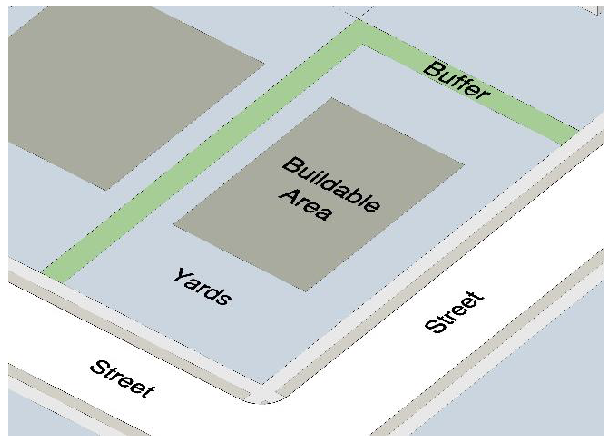
Where a buffer is required, all setbacks shall be measured from the interior edge of the required buffer and shall be in addition to the required setback.
E.
Planted buffers shall be established and maintained by the owner of the property containing the incompatible land use. The determination of incompatibility shall be based upon the existing character of the area in which the proposed action takes place. For example, proposed development or modification of commercial or industrial land use adjacent to an area developed as residential shall require the owner of the commercial or industrial property to install and maintain the planted buffer. If however, non-residentially zoned land is rezoned for development of residences and this property is located adjacent to land developed as, or zoned for nonresidential use, the owner of the property to be rezoned for residences shall be required to install and maintain the buffer.
F.
The requirements for planted buffers are as follows:
1.
Adjacent to any single-family zoning district, an y non-single-family residential use must provide a planted buffer of 20 feet, and any non-residential use must provide a planted buffer of 40 feet.
2.
Adjacent to any townhouse or multifamily residential zoning district, any non-residential use must provide a planted buffer of 30 feet.
3.
All uses in the M-2 Heavy Industrial district must provide a planted buffer of 50 feet on all sides.
G.
In those instances where the natural vegetation and topography are not sufficient to achieve the desired level of screening as determined by the City, existing vegetation must be supplemented to provide an acoustical and visual screen.
H.
The following are minimum specifications for required planted buffers. Buffers shall:
1.
Be depicted in detail on each site plan or plat prior to approval. The type and location of natural and planted vegetation are to be clearly illustrated.
2.
Not be disturbed by grading, property improvements or construction activities, except where necessary to prevent a nuisance, or to thin such natural growth, where too dense to permit normal growth, or to remove diseased, deceased, infested, misshapen, or dying trees. Formal approval must be secured from the City for any disturbance within required buffer areas prior to initiating activity.
3.
Utilize existing vegetation in an undisturbed state where it has been determined that existing vegetation is appropriate for inclusion within the buffer.
4.
Retain the natural topography of the land, except when a portion must be cleared and graded to prevent soil erosion or sedimentation.
5.
Be completely installed in accordance with the approved plan prior to issuance of the certificate of occupancy.
6.
Not be used for temporary or permanent parking or loading or for a structure other than fence.
7.
Attain a minimum height of six feet within three years of the planting date.
8.
Include a minimum of one tree for each 25 linear feet of required buffer, or majority portion thereof, with a minimum of 50 percent of said trees being shade trees. Trees shall be spaced so as to allow mature growth of shade trees. Retention of existing trees on site in order to meet this requirement is encouraged.
I.
The following plants are approved for use as part of the screening buffer:
1.
Trees:
i.
Yaupon holly;
ii.
American holly;
iii.
Eastern red cedar;
iv.
Laurel cherry;
v.
Arizona cypress;
vi.
Virginia pine;
vii.
Magnolia grandiflora.
2.
Shrubs:
i.
Cleyera;
ii.
Southern wax myrtle;
iii.
Northern bayberry;
iv.
Pittosporum;
v.
Japan yew;
vi.
Red tip.
3.
Ground Cover:
i.
Short juniper;
ii.
Lippia;
iii.
Evergreen candytuft;
iv.
Other evergreen plant materials having the same growth characteristics as the aforementioned may be substituted, subject to approval by the planning staff prior to installation.
J.
Maintenance. The buffer area installed as required by this Appendix shall be guaranteed for the duration of the incompatible land use, or until such use changes to a compatible type. Necessary trimming and maintenance shall be performed to maintain the health of the plant materials, to provide an aesthetically pleasing appearance, and to assure that the buffer serves the purpose for which it was intended.
(Ord. No. 457, § 1, 8-14-18)
Sec. 3-17. - Landscaping Requirements.
A.
Applicability. The following shall be exempt from the requirements of this section:
1.
Single-family lots in single-family zoning districts that are not part of a subdivision.
2.
Uses in single-family zoning districts that require a conditional use permit.
3.
Any property in the Downtown Mixed Use DT-MU district north of Rosenwald Drive.
B.
The purpose of this section is to provide landscaping requirements in order to enrich the urbanized and natural environment. It is the intent and purpose of this section to reduce the adverse visual, environmental, and aesthetic effects of parking lots, drives, loading areas, and other development through the introduction of trees and other plant materials in order to:
1.
Minimize the rate of stormwater runoff;
2.
Maximize the capability of groundwater recharge in urban or suburban areas;
3.
Increase air filtration and the removal of particulate and gaseous pollutants through plant materials;
4.
Provide shade and noise attenuation;
5.
Filter and reduce the glare of headlights and reflected sunlight from parked automobiles onto public street rights-of-way;
6.
Improve the appearance of parking areas and vehicular surface areas; and
7.
Minimize the visual blight created by large expanses of paved surface area.
C.
A minimum of 12 percent of the total developed area in any parcel shall be devoted to landscape development.
D.
Landscaped area requirements are in addition to required buffer areas.
E.
Within the front and side yard setback, a minimum of one tree for every 25 linear feet of public street frontage or major portion thereof shall be required, with no less than 50 percent of said trees being shade trees. If the required number of trees is not achievable, developer/owner must provide a detailed justification based on setbacks, lot width, minimum required spacing between trees, and minimum required spacing between trees and structures prepared by a registered landscape architect.
F.
A minimum of 80 percent of the total pervious area on a lot must be planted with approved grass or approved ground cover. Any remaining area must be covered with mulch, pine straw, or other similar material.
G.
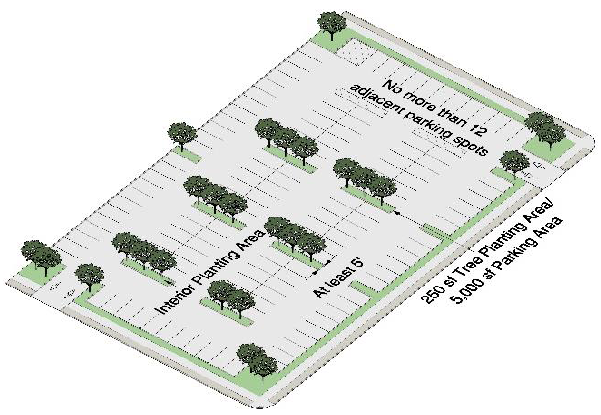
Within each parking lot, 250 square feet of planting area shall be required for each 5,000 square feet or portion thereof of parking area. Interior landscaped areas such as islands, peninsulas, and medians must be installed so that no more than 12 adjacent parking spaces exist without a landscaped separation of at least five feet in width. Interior planting areas shall be located to most effectively relieve the monotony of large expanses of paving and contribute to orderly circulation of vehicular and pedestrian traffic. A minimum of 1 shade tree or medium tree shall be required for every 8 parking spaces. Each landscaped island, peninsula, or median shall include at least 1 shade tree.
H.
A landscape plan shall be required for all development or building permits. The landscape plan shall be included as a separate plan sheet when an application is made for a development permit and shall include sufficient information to determine whether the proposed improvements are in conformity with this section, including the following:
1.
Identification of all trees, natural features and manmade structures that will be retained upon the site;
2.
A description of proposed landscaping improvements and plantings, including the species, size, quantity, and location of trees, shrubs, and other landscaping materials;
3.
Identification of all proposed structures, vehicle use areas, sidewalks, wheel stops or curbs, walls and fences; and
4.
A depiction of adjoining public streets and parcels sufficient to identify the same and to demonstrate the relationship between the development and the same.
I.
The following shade trees (mature height: 35 feet or greater) are approved for landscaping requirements:
1.
Willow oak;
2.
Sugar maple;
3.
Scarlet oak;
4.
Red maple;
5.
English oak;
6.
Bald cypress;
7.
Schumard oak;
8.
Dawn redwood;
9.
White oak;
10.
Chinese elm;
11.
Darlington oak;
12.
Littleleaf linden;
13.
Gingko (male only);
14.
Japanese cedar;
15.
Tulip poplar;
16.
Japanese katsura tree;
17.
London plane-tree (Sycamore);
18.
Japanese pagoda;
19.
American beech;
20.
Japanese zelkova;
21.
Southern magnolia;
22.
Deodar cedar;
23.
Sequoia;
24.
Loblolly pine.
J.
The following medium trees (mature height: 25 feet to 35 feet) are approved for landscaping requirements:
1.
Mountain silverbell;
2.
Saucer magnolia;
3.
Sourwood;
4.
Weeping cherry;
5.
Leyland cypress;
6.
Yoshino cherry;
7.
Golden rain tree;
8.
Kwansan cherry;
9.
Mountain ash;
10.
Redmond linden;
11.
Yellowwood;
12.
American holly;
13.
Pistachio;
14.
Japanese black pine.
K.
The following small trees (mature height: less than 25 feet) are approved for landscaping requirements:
1.
Japanese maple;
2.
Star magnolia;
3.
Japanese dogwood;
4.
Golden chain tree;
5.
Flowering dogwood;
6.
Crape myrtle;
7.
Eastern redbud;
8.
Wax myrtle;
9.
Amur maple;
10.
Yaupon holly;
11.
Crabapple.
L.
The following large screening shrubs are approved for landscaping requirements:
1.
American holly;
2.
Japanese black pine;
3.
Burford holly;
4.
Osmanthus;
5.
Nellie R. Stevens holly;
6.
Savannah holly;
7.
Leyland cypress;
8.
Hetz juniper;
9.
Ligustrum;
10.
Arborvitae;
11.
Eastern red cedar.
M.
The following interior shrubs (mature height: approximately 36 inches) are approved for landscaping requirements:
1.
Evergreen:
i.
Dwarf burford holly;
ii.
Dwarf Chinese holly;
iii.
Japanese holly;
iv.
Dwarf yaupon holly;
v.
Mugo pine;
vi.
Juniper;
vii.
Gardenia;
viii.
Oregon holly grape;
ix.
Leatherleaf viburnum;
x.
Winter honeysuckle.
2.
Deciduous:
i.
Forsythia;
ii.
Spirea (all varieties);
iii.
Viburnum;
iv.
Oakleaf hydrangea;
v.
Japanese flowering quince;
vi.
Weigela;
vii.
Azalea;
viii.
Flowering jasmine;
ix.
Winter jasmine;
x.
Chinese witch hazel.
N.
The following ground cover (planting areas, berms, wall planters) are approved for landscaping requirements:
1.
Shore juniper;
2.
English ivy (shade);
3.
Purpleleaf winter creeper;
4.
Dwarf roses;
5.
Aaronsbeard St. Johnswort;
6.
Evergreen candytuft (border);
7.
Rockyspray cotoneaster;
8.
Lily-turf (non-creeping);
9.
Willowleaf cotoneaster;
10.
Pachysandra (shade);
11.
Hybrid daylily;
12.
Ornamental grasses.
O.
The following grasses are approved for landscaping requirements. Grasses may be sodded, sprigged, plugged or seeded, except that solid sod shall be used in drainage swales or other areas subject to erosion. Lawn grasses shall be planted so as to achieve complete coverage within two calendar years from the time of planting.
1.
Fescue;
2.
Bermuda;
3.
Centipede;
4.
Zoysia.
P.
Other plant materials with similar growth characteristics may be substituted upon approval by the City.
Q.
The owner of each parcel subject to the requirements of this section shall be responsible for the perpetual maintenance and protection of required plantings. The City may require that diseased, infested, dying, dead, or damaged landscaping be replaced.
(Ord. No. 457, § 1, 8-14-18; Ord. No. 485, § 1, 10-8-19)
Sec. 3-18. - Tree Protection and Planting.
A.
Purpose and intent: The purpose of this section is to provide for the protection, conservation, and replacement of trees and landscaping in order to improve the urbanized and natural environment. It is the policy of the City to minimize the removal of trees on development sites and, upon proper site completion, achieve replacement of trees by uniform standards set forth in this section.
B.
Findings: Growth and development exist and will continue in the City of Hampton and, as a result, there is and will continue to be a loss of trees throughout the City. Tree roots hold soil in place and tree photosynthesis converts carbon dioxide to oxygen. Trees also provide habitat for wildlife that is essential for their survival. Tree loss contributes to dramatic increases in soil erosion and sedimentation. High growth areas where natural green spaces are diminishing have fewer trees to transform carbon dioxide into oxygen. Hampton City Council finds that:
1.
Integrated forest canopies reduce the costs of maintenance of other parts of the urban infrastructure.
2.
Well managed forest resources increase in value and provide benefits to all citizens with respect to air quality, water quality, stormwater management, temperature reduction, and general quality of life.
3.
These benefits are crucial to the long-term health, safety, and welfare of Hampton's citizens.
4.
The removal of forest canopy and replacement with more intensive land uses exacts real costs upon the infrastructure which must be borne by all citizens of the City.
C.
Exemptions:
1.
All properties which are ten acres or less in size and not part of a platted residential subdivision.
2.
Individual homeowners within platted subdivisions upon occupancy of the property owner's individual home, except where buffers are required.
3.
All properties for which an agricultural or conservation covenant is in effect pursuant to O.C.G.A. § 48-5-7.1 or 48-5-7.4.
4.
The removal of diseased, deceased, infested, or dying trees, or living pine trees or other trees which may pose a danger to an existing or proposed home, other structure, driveway, sidewalk, utility, detention pond, septic system, road, deck, or patio.
5.
All properties which are cleared solely for timber harvesting as specified in subsection (G).
6.
All properties which are less than ten acres in size and are cleared for conversion to crop land, pasture land, or other bona fide agricultural purposes. Such land shall not be developed for a period of two years after such clearing or conversion.
D.
Applicability: No person, corporation, or association shall remove or destroy any tree on public or private property with a diameter at breast height (DBH) of 8 inches or greater without first obtaining a tree removal permit from the Community Development Department. A tree plan approved as a part of an approved land disturbance permit shall constitute a tree removal permit. Any activity which requires the issuance of a land disturbance permit shall be subject to the terms and provisions of this section. No land disturbance permit shall be issued unless the proposed activity is in compliance with the provisions of this section.
E.
Single-family residential requirements. Properties in single-family residential zoning districts which are ten acres in size or larger or which are platted lots within a subdivision, regardless of the lot size, shall be subject to the following requirements.
1.
The mass grading of properties which are ten acres in size or larger for residential development is strictly prohibited. Only so much land area shall be cleared as is necessary for each development and construction of roadways, utilities, and amenity areas.
2.
The mass grading of any lot in a residential subdivision is prohibited. On such lots, land area shall be cleared only as is necessary for purposes of the proper development of said lot, including proper drainage and the placement of the individual home, driveways, sidewalks, utilities, detention ponds, septic systems, roads, decks, and patios.
3.
Prior to the issuance of a certificate of occupancy, any parcel of land for which a building permit has been requested shall have preserved or planted the following number of trees, at a minimum caliper of 2 inches for new trees or diameter at breast height of 2 inches for preserved trees, upon the parcel where land disturbance has occurred:
i.
RA and R-1 lots: a minimum of ten trees for the first acre or fraction thereof, plus two trees for every additional one-quarter acre.
ii.
R-2, R-3, and R-4 lots: a minimum of five trees.
F.
Requirements for all other districts. Properties within all zoning districts except single-family districts shall be subject to the following requirements:
1.
Prior to the issuance of a certificate of occupancy, any parcel of land for which a building permit has been requested shall have preserved or planted the following number of trees, at a minimum caliper of 2 inches for new trees or diameter at breast height of 2 inches for preserved trees, upon the parcel where land disturbance has occurred: a minimum of ten trees for the first acre or fraction thereof, plus two trees for every additional one-quarter acre.
G.
Timber harvesting. All properties cleared for the sole purpose of timber harvesting must comply with the following conditions, per O.C.G.A § 12-6-24. The limitations of this section shall apply only to timber harvesting operations which qualify as forestry land management practices or agricultural operations under O.C.G.A. § 12-7-17.
1.
All persons or firms harvesting standing timber not in conjunction with development in the City of Hampton for delivery as pulpwood, logs, poles, or wood chips to any wood yard or processing plant located inside or outside this state shall provide 24-hour written notice for each separate tract of land where harvesting operations will occur to the City prior to entering onto the property. Written notice of cessation of cutting shall also be delivered to the City within 24 hours after the job is completed.
2.
Written notice of timber harvesting operations may be provided on the Georgia Forestry Commission Notice of Timber Harvesting Activity form, but any notice must include:
i.
A map of the area which identifies the location of the tract to be harvested and, as to those trucks which will be traveling to and from such tract for purposes of picking up and hauling loads of cut forest products, the main point of ingress to such tract from a public road and, if different, the main point of egress from such tract to a public road.
ii.
A statement as to whether the timber will be removed pursuant to a lump sum sale, per unit sale, or owner harvest for purposes of ad valorem taxation under O.C.G.A. § 48-5-7.5.
iii.
The name, address, and daytime telephone number of the timber seller if the harvest is pursuant to a lump sum or per unit sale or of the timber owner if the harvest is an owner harvest.
iv.
The name, business address, business telephone number, and nighttime or emergency telephone number of the person or firm harvesting such timber.
3.
Notice must be submitted in person to City Hall, by regular mail, or by electronic mail to the City Clerk and is effective upon receipt by the City.
4.
Those persons or firms subject to such notice requirement above must deliver a bond or letter of credit, in which case notice shall not be or remain effective for such harvesting operations unless and until the person or firm providing such notice has delivered to the City a valid surety bond, executed by a surety corporation authorized to transact business in this state, protecting the City of Hampton against any damage caused by such person or firm in an amount not exceeding $5,000.00 or, at the option of the person or firm harvesting timber, a valid irrevocable letter of credit issued by a bank or savings and loan association, as defined in O.C.G.A. § 7-1-4, in the amount of and in lieu of such bond. Only one bond from each person or firm harvesting timber is required regardless of the number of tracts harvested in the City by each such person or firm so long as the bond remains in effect. Once the bond is no longer in effect, a valid replacement bond must be obtained and delivered to the City no later than the close of business on the fifth business day following the day that the City files a claim to recover damages against the then-existing bond. Upon filing such claim, the City shall immediately provide notice thereof, including the date such claim was filed, to the person or firm causing the damage. Such notice may be given in person, by transmission of an electronic record by fax or e-mail. For purposes of this paragraph, any such surety bond or letter of credit shall be valid only for the calendar year in which delivered.
5.
In accordance with O.C.G.A. § 12-6-24(e), a notice of or plan or security, a permit, or a fee shall not be required for any timber harvesting operations which qualify as forestry land management practices or agricultural operations.
6.
Any subsequent change in the facts required to be provided shall be reported to the City within three business days after such change.
7.
The City shall provide a copy of any notices received regarding timber harvesting operations to Henry County.
8.
Any site subject to the notice provisions of this section shall not be developed until at least two years after the forest has been clear cut or two years after 95 percent of the trees have been removed, whichever is sooner.
9.
Violation of the notice requirements shall be punishable by a fine not exceeding $500.00.
10.
The City shall have the right to impose further city erosion control measures on the property or property owner(s) after receipt of the written notice of timber harvesting. Necessary steps shall be taken to ensure the protection of soil and water resources, with special attention given to avoiding the sedimentation (silting) of streams and other waterways. Georgia Forestry Commission's "Best Management Practices" (BMPs) provide excellent guidelines for the protection of water quality, wildlife habitat and vegetative cover. The provisions of these BMPs shall be requisite conditions and shall be followed in order to ensure proper environmental protection.
H.
Miscellaneous provisions.
1.
A pre-application conference is encouraged with the applicant(s) and the Community Development Department, to discuss tree requirements as they relate to the applicant's property, clarify the provisions and procedures of this section, and review applicable standards and guidelines.
2.
Nothing in this section shall be construed to allow the removal of any tree or vegetation in a required stream buffer, or undisturbed/planted buffer, except where buffer improvements have been authorized by the City.
3.
Newly planted trees must be ecologically compatible with existing site conditions, such as water bodies and sun access, and must be on the list of approved trees provided in Section 3-17 I, J, and K. Seventy-five percent of all planted trees shall be hardwood.
4.
Newly planted trees shall be planted in a manner that will provide adequate space for nourishment, light, and maturation.
5.
Trees calculated in the preservation and/or planting requirements of this section shall not be located in a required planted buffer zone or stream buffer.
6.
Topographical difficulties and/or the installation of utilities shall be considered at the time of development. Each parcel shall be considered on a case-by-case basis as to the removal of trees where topography and/or utility installation is a factor. Special consideration should be given to maintaining the natural topography of the land, and to apply existing trees to the development of a site.
7.
Developers shall coordinate the location of all utilities with all utility companies in order to prevent root damage within the critical root zones of preserved trees.
8.
Only those areas which have or shall be disturbed due to the development of a parcel of land shall be subject to the requirements for preservation and/or planting of trees.
I.
Protection of trees during construction. Methods and standards for tree protection shall be established in administrative guidelines as follows:
1.
Trees identified to be preserved and/or planted, and being counted as credit for meeting the requirements of this section, shall have a valid, recognizable tree protection marking or delineation installed at the critical root zones.
2.
No person engaged in the construction of any structure(s) or improvement(s) shall encroach on a designated tree protection/critical root zone area with any machinery or the storage of any materials.
J.
Enforcement. The Zoning Administrator shall, at any time, order the ceasing of all work on a site if any aspects of this section are violated. Issuance of a certificate of occupancy shall be conditioned on compliance with this section at the time that a final inspection is requested.
K.
Appeals. Any decision made relating to the requirements of this section made be appealed via the procedures established for administrative appeals in Section 12-9.
L.
Fines and penalties. Violations of the provisions of this section shall result in a fine as follows. In lieu of fine(s), a court with appropriate jurisdiction may require that the defendant abate or cause to be cured any other violation of this section.
1.
Leaving fewer than the minimum number of trees on a lot: $1,000.00 per tree below the minimum required number of trees.
2.
Removing or destroying trees eight inches in caliper or larger: $1,000.00 per tree.
3.
Other violations of this section shall result in a fine of $1,000.00 per occurrence. Each tree shall be considered a separate occurrence.
(Ord. No. 457, § 1, 8-14-18; Ord. No. 488, § 1, 10-8-19)
Sec. 3-19. - Parking Requirements.
A.
General provisions.
1.
It is the intent of this Appendix that all buildings, structures, and uses of land shall provide off-street parking space in an amount sufficient to meet the needs caused by the building or use of land and that such parking spaces be so oriented that they are in fact readily usable for such purposes.
2.
Except as provided in this article, no application for a building permit shall be approved unless there is included with the plan for such building, improvements, or use, a site plan showing the required space reserved for off-street parking. Occupancy shall not be allowed unless the required off-street parking has been provided as shown on the approved plan.
3.
Each use of land and each building or structure hereafter constructed or established, and each addition to a structure shall provide off-street parking according to the standards set forth herein. When an addition is made to a building containing less than the required parking requirements, a conforming amount of parking shall be supplied based upon the size of the addition. Off-street parking spaces shall not be reduced below the minimum required number for the use or facility to which they are assigned.
4.
Two or more neighboring uses of the same or different types and located on separate lots, may provide joint facilities, provided that the number of off-street parking spaces are not less than the sum of the individual requirements, unless a shared parking analysis is approved per subsection (C).
5.
No addition to an existing building shall be constructed which reduces the number of spaces, area or usability of existing parking space unless such building and its addition conform with the regulations for parking contained herein.
6.
When multiple uses occupy a building, the parking requirement shall be met by determining the percentage of the total building area devoted to each type of use and then applying the appropriate requirements by use, unless a shared parking analysis is approved per subsection (C).
7.
Up to 20 percent of the total parking spaces required may be used for the parking of the compact cars, provided that all such spaces are labeled as such on the ground.
8.
Residential driveways shall not count as parking spaces in satisfaction of these requirements.
9.
Required off-street parking spaces for multifamily residential buildings shall be no greater than 400 feet away, as measured along a pedestrian walkway, from the door of the unit they serve.
10.
Within Hampton's Historic Downtown Commercial District, delivery/service trucks/vans and truck/vans displaying advertising of a business located on the property must be parked within the side or rear yard and may not be parked within the front yard, except vehicles parked temporarily while making a delivery, providing a service, or purchasing goods or services. Should there be no parking areas in the side or rear of the building, the vehicle may be parked in the front. Passenger cars (as classified by Federal Highway Administration FHWA) displaying advertising may be parked in the front yard; however, under no circumstances may a vehicle with advertising park in a parking space adjacent to an exterior road.
B.
Exemptions. There shall be no minimum parking requirements for any use in DT-MU or DT-RC districts north of Rosenwald Drive, except that for new residential developments with 5 or more units, one parking space per dwelling shall be required. For DT-MU and DT-RC districts south of Rosenwald Drive, the requirements in the table below shall apply.
C.
Shared parking.
1.
Applicants wishing to use shared parking as a means of reducing the total number of required spaces may submit a shared parking analysis using the Urban Land Institute (ULI) Shared Parking Model (latest edition).
2.
The study must be provided in a form established by the Zoning Administrator.
3.
Reductions in the total number of required spaces for shared parking are not permitted unless the Zoning Administrator determines a reduction is appropriate on a case-by-case basis through the use of the ULI Shared Parking Model (latest edition).
4.
Uses providing shared parking must have either mutually exclusive or compatibly overlapping normal hours of operation. The Zoning Administrator will determine whether hours of operation are compatibly overlapping on a case-by-case basis through the use of the ULI Shared Parking Model (latest edition).
D.
Reduction in parking requirements for on-street parking. A reduction in the number of required off-street parking spaces shall be allowed in all zoning districts as follows:
1.
Where on-street parking spaces exist in a public right-of-way, one on-street parking space may be substituted for every required off-street parking space, provided the on-street space immediately abuts the subject property.
2.
Each on-street parking space shall only be counted for one property. Where a space straddles a property line (as projected into the right-of-way), the space shall only be counted by the owner whose property more than 50 percent of the on-street parking space.
3.
The Director of Public Works may determine that to ensure future road capacity, the on-street parking reduction may not be available.
E.
Parking spaces required. The following table depicts the minimum number of off-street parking spaces required by type of permitted use.
For any uses not listed, the Zoning Administrator shall determine the proper requirement by classifying the proposed use among the uses specified herein as to assure equal treatment. In making any such determination, the Zoning Administrator shall follow the principles set forth in the statement of purpose at the beginning of this article.
F.
Design criteria and standards. Off-street parking areas, spaces and stalls are to be designed to conform to the following criteria and standards:
1.
All driveways, including those serving single-family residences, shall be paved with concrete, asphalt, or pavers. Single-family residences in RA Residential-Agricultural districts that are not part of a subdivision shall be exempt from this requirement.
2.
All multifamily, commercial and industrial uses shall provide a paved, dust-free surface. The use of approved "porous pavement" is encouraged, provided such paving is approved for use by the City Engineer. If these facilities are to be used at night, proper illumination shall be provided for the safety of pedestrians, vehicles and for security purposes.
3.
Each off-street parking space shall be clearly marked, and directional arrows or signs shall be provided wherever necessary. Markers, directional arrows, and signs shall be properly maintained so as to ensure their maximum efficiency.
4.
All off-street parking and service areas shall be drained so as to prevent damage to abutting properties and/or public streets and shall be constructed of materials which will assure a surface resistant to erosion. All such areas shall be at all times maintained at the expense of the owners thereof in a clean, orderly, and dust-free condition to the extent that it does not create a nuisance.
5.
All off-street parking and service areas shall be separated from walkways, sidewalks, and public streets by curbing or other suitable protective device. No portion of any vehicle shall overhang any walkway, sidewalk, or public street.
6.
Each full-size automobile parking space shall not be less than 8½ feet wide and 18 feet deep. Compact car spaces shall not be less than eight feet wide and 17 feet deep. Parallel spaces for the handicapped adjacent to a walk shall be a minimum of 12 feet six inches in width by 24 feet in length. If a walk is at an elevation of the parking space a 1:6 ramp shall be provided up to the walk. For 90-degree or angled spaces the minimum width of a handicapped stall shall be nine feet. An aisle, having a width of not less than three feet six inches, shall be provided between each stall.
7.
Accessible parking spaces must be provided in accordance with the requirements of the Americans with Disabilities Act (ADA) (Public Law 101-136), the State Building Code, and the American National Standards Institute. Accessible spaces shall be marked on the pavement and by appropriate signage. Accessible spaces shall be located in closest proximity to major building entrances, but in no event shall such spaces be more than 100 feet from an entrance.
8.
There shall be provided adequate interior driveways to connect each parking space with a public street. Interior driveways shall be at least 24 feet wide where used with 90-degree angle parking, at least 18 feet wide where used with 60-degree angle parking, at least 12 feet wide where used with 45-degree angle parking, and at least 12 feet wide where used with parallel parking, or where there is no parking, interior driveways shall be at least 12 feet wide for one-way traffic movement and at least 24 feet wide for two-way traffic movement.
(Ord. No. 457, § 1, 8-14-18; Ord. No. 529, § 2, 12-8-20)
Sec. 3-20. - Curb Cut and Design Standards.
Within any zoning district where the lowering or cutting away of any curbs for purposes of ingress and egress is required, such curb cut shall be subject to the following provisions:
A.
For any lot with less than 100 feet of frontage on a public street, only one combined entrance-exit shall be permitted per lot. For lots with more than 100 and less than 300 feet of frontage, no more than two combined entrances and exits shall be allowed. For lots with greater than 300 feet of frontage, additional entrances or exits may be permitted by the Zoning Administrator where necessary.
B.
At public street intersections, no curb cut shall be located within 50 feet of the intersections of two curb lines or such lines extended, or within 15 feet of the intersection of two property lines extended, whichever is least restrictive. When a culvert is required it must be approved by the Henry County DOT.
C.
The distance between any two curb cuts on the same side of the public street and located on one property shall be not less than ten feet. Said distance shall be measured between the points of tangency of the curb return radii and the established curb line of the abutting public street.
D.
All driveways shall be constructed so as to be at least two feet from any property line.
E.
The maximum width of any driveway shall not exceed 24 feet measured at the right-of-way line, except where wider driveways are permitted by the Zoning Administrator to accommodate vehicles larger than a passenger vehicle, and except where stricter standards apply in mixed-use districts.
F.
The curb radii for any curb cut shall not exceed 8 feet.
(Ord. No. 457, § 1, 8-14-18)
Sec. 3-21. - Accessory Uses and Structures.
Accessory structures and uses shall be on the same lot and subordinate to the principal use or structure as follows:
A.
Shall be permitted only in side or rear yard, unless otherwise stated.
B.
Accessory structures in subdivisions with recorded easements for drainage, sanitary sewer, and utilities shall not be permitted within the easement.
C.
Shall not be erected on a lot prior to the time of construction of the principal structure to which it is accessory.
D.
Accessory structures in residential districts shall not be used for any type of commercial operation, except in conjunction with a home occupation when approved by conditional use permit as authorized in this Appendix.
E.
Accessory apartments shall not exceed 750 square feet in floor area except where limited by subsection (J) or where increased as a conditional use, subject to the requirements of Section 12-5. The property owner must occupy either the principal dwelling unit or the accessory apartment as their permanent residence for at least 8 months out of each year, and at no time shall receive rent for the owner-occupied unit.
F.
Guest quarters must be located either within or on the same lot as a principal dwelling unit occupied by the property owner for at least 8 months out of each year. Guest quarters shall not exceed 750 square feet in floor area except where limited by subjection (J) or where increased as a conditional use, subject to the requirements of Section 12-5. Guests of guest quarters may stay a maximum of 90 days within a 365 day period.
G.
Accessory structures in a subdivision shall not exceed 15 feet in height, except within mixed-use districts.
H.
Accessory buildings located on lots in residential districts shall not exceed the height of the principal building.
I.
Accessory structures shall be located at least 12 feet from the principal structure on a lot.
J.
Total square footage of accessory structures in R-1, R-2, R-3, and R-4 districts shall not exceed 50 percent of the minimum required floor area for the principal structure or 750 square feet, whichever is less. This minimum floor area may be increased as a conditional use, subject to the requirements of Section 12-5.
K.
Accessory structures in an RA zoning district on lots of one acre or larger and not in a subdivision will not be restricted in size.
L.
Satellite dish antennas shall be permitted as accessory structures only in rear yards, unless it can be documented that reception is impaired by such a location. In this case, an antenna may be permitted in a side or front yard. If located within a front yard, it cannot be within the required setback. Satellite dish antennas over 36 inches in diameter shall not be located on the roof of a single-family structure.
M.
Swimming pools shall be considered accessory uses and shall comply with minimum side and rear yard requirements of the applicable zoning district. Setbacks shall be measured from the decking or enclosed part of the pool structure.
(Ord. No. 457, § 1, 8-14-18)
Sec. 3-22. - Temporary Structures.
A.
Temporary structures used for construction or sales offices, ticket booths, security guard shelters, storage structures in association with construction, and other similar uses may be permitted by the Zoning Administrator in any zoning district.
B.
Temporary structures shall be located outside of any required buffer or setback.
C.
Temporary structures must be removed prior to the issuance of a certificate of occupancy or within five days of completion of the temporary event for which the structure was approved.
D.
The structure shall be hidden from primary view or as approved by the Zoning Administrator so as not to negatively impact the view from the road or adjoining properties.
(Ord. No. 457, § 1, 8-14-18)
Sec. 3-23. - Height Exception.
Any structure hereafter erected or altered shall comply with the height limitations of the district in which it is located except as specified herein. The height limitations of this Appendix shall not apply to church spires, belfries, monuments, cupolas, domes, ornamental towers, nor to observation towers not intended for human occupancy, water towers, transmission towers, radio or television towers, or aerials. These exclusions shall not apply in the vicinity of properties near airports that are regulated by the Federal Aviation Administration.
(Ord. No. 457, § 1, 8-14-18)
Sec. 3-24. - Parking or Storage of Vehicles.
For purposes of this Appendix, major recreational equipment is defined as including boats and boat trailers, travel trailers, pickup campers, or coaches (designed to be mounted on automotive vehicles), recreational vehicles, motor coaches, tent trailers, and cases or boxes used for transporting recreational equipment, whether occupied by such equipment or not. The parking or storage of major recreational equipment for more than 24 hours is allowed only in C-2, C-3, M-1, and M-2 districts, or in any other district only if such equipment is located in side or rear yards, or in a carport or enclosed building. In the case of a corner lot, no vehicles may be parked or stored in the side yard on the public street side of the lot. No such equipment shall be used for living, sleeping, or housekeeping purposes when parked or stored on a lot in any zoning district except in accordance with an approved Emergency RV Permit Application issued by the City of Hampton Community Development Department.
A.
Parking or storage of a recreational vehicle for use as temporary living quarters is allowed only in RA and R-1 districts with evidence to support:
1.
A catastrophic event natural or man-made which requires temporary housing to facilitate repair or replacement of damaged structure.
2.
The need for a temporary dwelling when a primary structure is being built or modified on the same property consisting of a minimum 5-acres with a valid residential permit for construction.
3.
Provisions for Emergency RV Permit include:
i.
Applicants for Emergency RV Permit must have a valid building permit to reconstruct, restore, or build a permanent dwelling structure. A copy of the building permit must be included with the Emergency RV Permit application.
ii.
The RV shall only be occupied by the property owner and/or family as defined by Article 2, Section 2-1 Definitions. No contractors shall be allowed to reside in the RV.
iii.
RVs should not be placed on the existing slab for the primary dwelling. The on-site location for the RV must be approved by the Community Development Department. Change of permitted RV location must be approved by the Community Development Department prior to any action required to reposition the RV from its approved permitted location.
iv.
Emergency RV Permit shall be subject to RV parking regulations contained within Section 3-24.
v.
No more than one (1) recreational vehicle is allowed to be occupied on site at any one time.
vi.
No separate permanent utility hook-ups or fixtures may be installed at any time.
vii.
Services required to facilitate temporary habitation, included, but not limited to, liquid waste containment and disposal, solid waste disposal (e.g., dumpsters, trash cans), potable water, power, etc., shall be approved by Community Development Department.
viii.
Emergency RV Permit is valid for a period not to exceed 30 consecutive days with approval from public works, public safety, and community development. The permittee, due to unforeseen hardship, may request an extension of no more than 30 additional days provided that the extension request is made with the Community Development Department within 10 days prior to the Emergency RV Permit original expiration date. The extension request shall be in writing and include documentation of the unforeseen hardship. Hardships may include issues related to property owner's health, unprecedented building material shortages, unique natural features of the site, or acts of God, such as lighting, fire, and flooding. Public works, public safety, and community development shall deny or approve the extension request and provide decision in writing within 72 hours of receipt.
ix.
When a decision relating to provisions of Emergency RV Permit and/or extension request of said permit, aggrieves any person, an appeal may be filed with the city manager. Said appeal must be made in writing within five days of the decision by public works, public safety, and community development. The city manager will review the appeal on the basis of the request complying with the intent of applicable Emergency RV Permit provisions. The city manager is authorized to approve or deny the Emergency RV Permit and/or extension request and shall provide the decision in writing within 72 hours of receiving appeal. An appeal of the city manager's decision may be filed in accordance with Article 12, Section 12-9 for City Council review.
B.
Parking, storing, or maintaining any commercial vehicle is allowed only in C-2, C-3, M-1, and M-2 districts. Commercial vehicle is defined as any vehicle whose gross vehicle weight rating (GVWR) is over 26,000 pounds, or a trailer with a GVWR of over 10,000 pounds, including commercial tractor-trailers, dump trucks, wreckers, and earth-moving equipment. Agricultural vehicles and equipment and school buses shall be excluded from this definition.
C.
Parking or storing abandoned vehicles, power-driven construction equipment, lumber, metal, or any other miscellaneous scrap or salvageable material is allowed only in C-2, C-3, M-1, and M-2 districts.
(Ord. No. 457, § 1, 8-14-18; Ord. No. 552, § 2, 8-17-21)
Sec. 3-25. - Address Numbers.
Public street numbers for dwelling units and places of business on all public streets, and public street and/or building numbers for dwelling units and places of business within multifamily residential developments and nonresidential developments located on private streets shall be assigned by the Zoning Administrator in accordance with administrative procedures.
A street address number shall be posted and maintained on the property of every dwelling unit and place of business so as to be visible from the public street. Three inch high light-reflective numbers and contrasting backgrounds shall be used.
(Ord. No. 457, § 1, 8-14-18)
Sec. 3-26. - Converting Garages or Carports.
Residential garages and carports shall not be converted to occupiable space without first obtaining an administrative variance from the Zoning Administrator and meeting the following requirements:
A.
Where applicable, applicants shall obtain written approval from their homeowner's association, certifying that the conversion complies with all terms, conditions, and restrictions contained in their neighborhood covenants.
B.
The applicant shall submit plans and pictures to the City illustrating the proposed conversion.
C.
The Zoning Administrator shall confirm that any loss of parking due to the enclosure will not cause the property to have fewer parking spaces than required for their zoning district and use.
D.
All newly created occupiable space shall confirm to the applicable building codes.
(Ord. No. 457, § 1, 8-14-18)
Sec. 3-27. - Data Center Requirements.
A.
Purpose and Intent. The purpose and intent of this section regarding data center development is to ensure that the development is conducted in a manner that protects the environment, public health, and safety.
B.
Applicability. The standards contained in this section shall not apply to all Data Center Types which obtained a land disturbance permit, building permit, and/or legislative approval prior to the adoption of this code.
C.
Permitted locations.
1.
Accessory data centers shall only be permitted on parcels zoned Office-Institutional (O-I) and General Commercial (C-2), located within the principal building.
2.
Data center, campus is multiple buildings permitted on parcels zoned Light Industrial District (M-1) and Mixed-Use District (MU) with an approved Conditional Use.
3.
Data center, major is a single principal building on a parcel zoned Light Industrial District (M-1) with an approved Conditional Use.
4.
Data center, minor is a single principal building permitted on a parcel zoned Light Industrial (M-1) and Heavy Commercial (C-3).
D.
Application requirements for all data centers.
1.
All zoning applications, and/or building or trade permits for any new data centers, shall, in addition to any other application requirements of the City of Hampton Code, provide the following information:
a)
The Applicant shall provide an Environmental Sustainability Plan in accordance with the city's Green Community Program for new data center project facilitated through any type of city permit process.
b)
Prior to Conditional Use application, the applicant shall provide the city with an executed agreement of intent and availability to serve a letter from the applicable utility service provider. Prior to the development plan submittal the applicant shall provide written confirmation that the applicable utility service (power) provider has agreed to provide the service, in accordance with all applicable local, state, and federal laws, regulations, and ordinances pertaining to its activities at the site.
c)
A Noise Impact Assessment (NIA) shall be required as part of the permitting process for any proposed data center. The NIA shall define the scope of the assessment, including the geographic area, the noise sources to be studied, associated noise levels generated by each source, and provide specific mitigation strategies to reduce noise. The applicant shall host a minimum of one (1) community meeting to inform adjacent property owners and explain measures that will be implemented to mitigate noise issues in accordance with the project's Environmental Sustainability Plan. The data center shall perform bi-annual noise assessments that shall be submitted to the city for public record. As needed, the data center shall mitigate and reduce noise levels to the original NIA level submitted at the time of permitting. NIA study shall be prepared by a consultant that is either an accredited Acoustic expert or qualified licensed Professional Engineer.
d)
Data center development permitted as Conditional Use shall provide not less than five hundred (500) feet year-round opaque vegetative buffer between the boundary of residential uses and any data center structure, exterior equipment, such as substations, electrical and mechanical yards, and all other exposed equipment, located within the data center property. The year-round opaque buffer may be reduced to two hundred (200) feet with the use of noise cancelling measures that maintain or reduce the ambient noise level at the residential property boundary which was present prior to the data center development. Vegetation that fails to provide year-round opaque buffering shall be revegetated with Georgia native plant species to ensure minimum depth and opaqueness is maintained.
e)
Loud or unusual noises as defined in City of Hampton Code of Ordinances, Chapter 54. Section 54-9 et seq., which are detrimental or annoying to the public, including without limitation, unusual loud disturbances above ambient levels greater than seventy (70) decibels (dB) during the daytime (7:00 a.m. to 11:00 p.m.) and sixty (60) decibels (dB) during the nighttime (11:00 p.m. to 7:00 a.m.) as measured from all property lines.
f)
Substations, electrical yards, mechanical yards, and any other exposed equipment shall be screened from all adjacent public streets, private streets, and parks.
g)
All cooling and ventilation equipment shall operate on a closed-loop system or equivalent system which shall minimize potable water consumption.
h)
Environmental Sustainability Plan shall address:
i.
Water consumption.
i)
Conservation and scarcity, outlining the total water requirement of the data center, including cooling needs, and any strategies to reduce or mitigate excessive water usage. The Plan shall demonstrate that water usage will not significantly strain the City of Hampton's water supply.
ii)
The vulnerability of the project and project site to water scarcity and drought.
iii)
Identify any drought monitoring and forecasting systems that exist in the project area. Mitigate Habitat degradation, utilize native tree revegetation practices.
iv)
Proposed water scarcity/drought management measures to alleviate risk, including water storage, alternative sources, and reduced use of resources.
v)
The adoption of advanced low-water or water-free cooling systems that align with the regional drought and water-scarcity planning of the Metropolitan North Georgia Water Planning District.
vi)
Anticipated disturbance of public services, including but not limited to transport, communication, sanitation, fresh water, and electricity supply.
vii)
Disclosure Water Usage Effectiveness (WUE) target or performance metric.
ii.
Energy.
i)
Energy load analysis before construction of the data center and the projected daily operational load once constructed. This assessment shall demonstrate estimates of peak electricity demand and strategies for mitigating strain on local power infrastructure. May include energy market analysis for viable electric, natural gas, and renewable energy markets and/or policy design evaluating carbon pricing, subsidies for clean energy, and regulations to reduce emissions.
ii)
The transmission line impact assessment shall identify the need for new or upgraded transmission lines to meet the data center's electricity requirements. This assessment shall include the potential environmental impact on public land, including tree removal from city-owned land and rights-of-way. This plan shall also include information on any planned substation's location and shall show the screening mechanism(s), which shall include a minimum of an eight (8) foot tall decorative brick-faced wall if potentially visible from a public or private right-of-way. Screening shall comply with Article 3. Section 3-15.
iii)
A decommissioning plan for unsold or surplus data infrastructure, for recycling all on-site electronic infrastructure through certified recyclers that follow Responsible Recycling (R2) Standard for Electronics Recyclers and/or e-Stewards® Standard for Responsible Recycling and Reuse of Electronic Equipment.
iv)
Substations associated with the operation of a data center shall only be permitted in the M-1 and MU zoning districts.
v)
Substations shall be at least one hundred (100) feet from any public right-of-way.
vi)
Substations shall be screened from any adjoining property or public or private street with a minimum eight (8) foot tall decorative brick-faced wall.
vii)
Vehicle storage and service equipment may not be collocated with the substation.
viii)
Vehicle access to the substation shall be accessed from an interior drive or road which services the data center development. Access to the substation shall be screened from the public right-of-way and not provide a direct line of sight into the substation area.
iii.
Building Design and Construction. LEED Certification that addresses a minimum of one of the following stages; whole building (LEED BD+C), core and shell (BD+C), fully operational and occupied center (O+M). Subject to the requirements of Appendix A, Article 3, Section 3-3. Non-Residential Design Standards.
iv.
Lighting Plan. A lighting plan shall show compliance with "Dark Sky design" principles, demonstrating that there will be no spillover onto surrounding properties. A conceptual lighting plan shall be submitted with the initial application. A complete lighting plan shall be submitted as part of a Development Plan Review application.
v.
Implementation of Green infrastructure (GI) measures within the development stormwater management plan.
vi.
Sewer infrastructure plan to include:
i)
Actual and expected daily sewer flow.
ii)
Identify potential or planned sanitary sewer capacity projects.
iii)
An on-site treatment plan, including any necessary equipment to conduct trace analyses and consistent monitoring of chemical use for on-site water preparation and treatment.
iv)
An analysis of the city's wastewater master plan and existing treatment system, to determine whether there is adequate capacity to serve the forecasted growth or has planned improvements to add capacity to accommodate the forecasted growth.
v)
Clear indication of pipe size, material type, percent grade, and length of all pipes.
vi)
A utility plan with direction of sewer flow.
vii)
Disclose pretreatment or discharge permit request if any effluent leaves the closed loop system to sanitary or storm sewers for the City of Hampton Watershed Management Industrial Pretreatment Program Review.
viii)
Submit a Closure and Disposal Plan at decommissioning covering treatment systems, chemical waste, and related infrastructure.
ix)
Wastewater permit from EPA Biocides-Chemicals to control microbial growth and ensure water quality.
E.
Data Center Annual Reporting. The owner and/or operator shall submit an annual compliance report that details any changes to, and continuation of all, assessments submitted with an application and demonstrating compliance and monitoring of all application requirements and conditions of zoning to the Director of the Community Development Department, or their designee no later than the first of January of each year.
(Ord. No. 2026-06, § 1(Exh. A), 4-14-26)

