NEIGHBORHOOD COMMERCIAL DISTRICT CN11
Note— Section 10-1.815a.(5) amended by Ordinance 04-19, adopted December 21, 2004. Section 10-1.820a. amended by Ordinance 01-01, adopted January 16, 2001. Section 10-1.820b. amended by Ordinance 99-18, adopted October 12, 1999; Ordinance 04-19, adopted December 21, 2004; Section 10-1.845w. added by Ordinance 01-08, adopted July 17, 2001; Section 10-1.845 amended by Ordinance 07-16, adopted November 6, 2007. Section 10-1.800 amended by Ordinance 13-12, adopted November 19, 2013.
The CN District shall be subject to the following specific regulations in addition to the general regulations hereinafter contained, in order to make provision for a number of areas throughout the City carefully located in relationship to other Commercial Districts and to the Residential Districts served. The products and services intended are those primarily represented by convenience goods and services purchased frequently.
Any combining B or SD District (See Sections 10-1.2400 and 10-1.2600).
a.
Primary Uses. The following uses, or uses determined to be similar by the Planning Director, are permitted in the CN District as primary uses:
(1)
Administrative and Professional Offices/Services.
(a)
Accounting and financial offices (not including check-cashing business).
(b)
Architectural and engineering offices.
(c)
Banks and financial institutions.
(d)
Chiropractic and acupuncture offices.
(e)
Insurance and real estate offices.
(f)
Law offices.
(g)
Medical and dental offices.
(h)
Travel and airline agency offices.
(2)
Automobile Related Uses.
Automobile parts store.
(3)
Personal Services.
(a)
Barber or beauty shop.
(b)
Dance studio.
(c)
Dry cleaner/laundry.
(d)
Martial arts studio.
(e)
Music studio.
(f)
Nail salon.
(g)
Palm reading service.
(h)
Photography studio.
(i)
Physical fitness studio.
(j)
Shoe repair shop.
(k)
Tailor/seamstress shop.
(4)
Residential Uses.
(a)
Residential dwelling unit(s). (Above first floor commercial uses only.)
(b)
Residential development as provided in Government Code Sections 65852.24, 65913.4 and 65912.100, as amended from time to time.
(5)
Retail Commercial Uses.
(a)
Antique store.
(b)
Appliance store.
(c)
Art and art supplies store.
(d)
Bakery.
(e)
Bicycle shop.
(f)
Bookstore.
(g)
Camera store.
(h)
Card shop.
(i)
Carpet/drapery store.
(j)
Clothing store.
(k)
Consignment store.
(l)
Coffee/espresso shop.
(m)
Delicatessen.
(n)
Fabric store.
(o)
Floral shop.
(p)
Furniture store.
(q)
Garden supplies store.
(r)
Gift shop.
(s)
Hardware store.
(t)
Jewelry store.
(u)
Locksmith shop.
(v)
Music store.
(w)
Nursery (plant).
(x)
Paint/wallpaper store.
(y)
Pet grooming shop.
(z)
Pet store.
(aa)
Plumbing and heating store.
(bb)
Restaurant. (Where not abutting a residential district or property and no bar)
(cc)
Sporting goods store.
(dd)
Stationary store.
(ee)
Supermarket.
(ff)
Theater. (Small Motion Picture or Live Performance only.)
(gg)
Thrift store.
(hh)
Toy store.
(ii)
Variety store.
(jj)
Video sales and rental store.
(6)
Service Commercial Uses.
(a)
Copying or reproduction facility.
(b)
Mailing or facsimile service.
(c)
Reverse vending machine(s). (When located within a convenience zone.)
(7)
Other Uses.
(a)
Banquet hall. (Where not abutting a residential district or property and where no alcohol is served.)
(b)
Catering facility.
(c)
Christmas tree or pumpkin patch lot. (See Section 10-1.2735c. for standards.)
(d)
Day care home. (State-licensed, less than 24-hour care for children or adults, 14 or fewer persons, excluding staff. See definitions)
(e)
Educational facility. Small, generally less than 2,000 square feet, designed to augment the learning process of elementary and secondary students.
(f)
Public agency facilities.
(g)
Emergency Shelter. (Limited to parcels abutting Mission Boulevard and Foothill Boulevard. See Section 10-1.2736(a) for criteria and standards.)
(h)
Low Barrier Navigation Center. (See Section 10-1.2736(b) for criteria and standards.)
b.
Secondary Uses. The following uses are permitted as secondary or subordinate uses to the uses permitted in the CN District:
(1)
Accessory buildings and uses. (See Section 10.1.845)
(2)
Garage sales. (4 per year per dwelling. See General Regulations Section 10-1.2735d.)
(3)
Home Occupation. (See definitions)
(4)
Household pets.
(5)
Accessory Dwelling Unit(s). (Where primary use is residential. See Section 10-1.2740 for criteria and standards.)
(Amended by Ordinance 24-01, adopted Jan. 23, 2024; Amended by Ordinance 25-02, § 1(Exh. A), adopted January 21, 2025)
a.
Administrative Uses. The following uses are permitted in the OS District subject to approval of an administrative use permit:
(1)
Administrative and Professional Offices/Services.
Medical/dental laboratory.
(2)
Automobile Related Uses.
(a)
Parking lot.
(b)
Car Rental Agency.
(3)
Personal Services.
(a)
Health Club.
(b)
Massage. (When ancillary to an established primary use such as a beauty salon.)
(c)
Suntan parlor.
(4)
Residential Uses.
None.
(5)
Retail Commercial Uses.
(a)
Restaurant. (Where abutting a residential district or property)
(b)
Convenience market.
(6)
Service Commercial Uses.
(a)
Appliance service and repair shop. (Not ancillary to a primary use)
(b)
Recycling collection area. (When located within a convenience zone)
(7)
Other Uses.
(a)
Animal hospital.
(b)
Animal grooming service.
(c)
Ambulance service.
(d)
Carnival.
(e)
Cultural facility.
(f)
Day Care Center. (State-licensed, less than 24-hour care for children or adults, 15 or more persons, excluding staff.)
(g)
Educational facility. Where not exempted, under Section 10-1.815a.(7)(f).
(h)
Outdoor gathering. (Refer to General Regulations Section 10-1.2735g.)
(i)
Recreational facility.
(j)
Religious facility.
(k)
Temporary use. (i.e., Parking lot or tent sale)
b.
Conditional Uses. The following uses, or uses determined to be similar by the Planning Director, are permitted in the CN District, subject to approval of a conditional use permit:
(1)
Administrative and Professional Offices/Services.
(a)
Check cashing store.
(b)
Payday loan facilities.
(2)
Automobile Related Uses. (See Section 10-1.845 for special requirements)
(a)
Automobile repair - minor.
(b)
Automobile service station.
(c)
Car wash.
(d)
Drive-in establishments.
(3)
Personal Services.
(a)
Massage parlor. When not located within an established beauty salon.
(b)
Tattoo parlor.
(4)
Residential Uses.
None.
(5)
Retail Commercial Uses.
(a)
Bar, Cocktail lounge, alcohol). (See General Regulations Section 10-1.2750 et seq. for regulations of alcohol.)
(b)
Dance or night club. (See General Regulations Section 10-1.2750 et seq. for regulations of alcohol.)
(c)
Liquor store. (See General Regulations Section 10-1.2750 et seq. for regulations of alcohol.)
(d)
Theater, Large Motion Picture. (See Section 10-1.1045 for special requirements.)
(6)
Service Commercial Uses.
None.
(7)
Other Uses.
Banquet hall. (When abutting a residential district or property. See Section 10-1.2750 et seq. for regulations of alcohol)
a.
Minimum Lot Size: 6,000 square feet.
b.
Minimum Lot Area per Dwelling Unit: As permitted in RM or RH Districts, whichever is consistent with the General Policies Plan Map and Neighborhood Plan.
c.
Minimum Lot Frontage: 60 feet.
d.
Minimum Average Lot Width: 60 feet.
e.
Maximum Lot Coverage: 90 percent.
f.
Minimum Lot Depth: 100 feet.
g.
Special Lot Requirements and Exceptions: See General Regulations Section 10-1.2720.
a.
Minimum Front Yard: 10 feet.
b.
Minimum Side Yard: None.
c.
Minimum Side Street Yard: 10 feet.
d.
Minimum Rear Yard: None.
e.
Special Side and Rear Yard Provision: The side or rear yard for any primary structure in a CN District shall be the same as the abutting District; where abutting any R, A, MH, OS, or residential PD district, the side yard shall be a minimum of 10 feet.
f.
Special Yard Requirements and Exceptions: See General Regulations Section 10-1.2725.
a.
Maximum Building Height: 40 feet.
b.
Maximum Accessory Building Height: 14 feet and one story.
c.
Maximum Height for Fences/hedges/walls:
(1)
Front and Side Street Yard: 4 feet.
(2)
Side and Rear Yard: 6 feet.
(Also see Section 10-1.845k. for additional standards).
d.
Special Height Requirements and Exceptions: See General Regulations Section 10-1.2730.
Site Plan Review approval is required before issuance of any building or construction permit or construction of a fence within this district only if the Planning Director determines that a project materially alters the appearance and character of the property or area or may be incompatible with City policies, standards and guidelines. This may include fences (i.e., such as anodized gray chain link fences) in certain circumstances.
The City recognizes that high-quality design of commercial structures can contribute to a positive appearance of commercial districts and neighborhoods and improve the overall character of the community. This Section establishes design and performance standards that shall apply to the construction of residential and commercial buildings and certain commercial uses in the CN District, including but not limited to cultural, educational, religious or recreational facilities. The development of CN-zoned properties in the South of Route 92 planning area is also subject to the provisions of the South of Route 92/Oliver and Weber Properties Specific Plan and the Development Guidelines for the South of Route 92 Oliver/Weber Properties.
Commercial Buildings and Uses.
For commercial buildings (including second story residential uses) refer to the design criteria contained in the City of Hayward Design Guidelines, the Hillside Design and Urban/Wildland Interface Guidelines and the following specific criteria and standards.
a.
Accessory Buildings, Detached. Detached accessory buildings, including but not limited to carports, garages, greenhouses, patio covers, sheds, etc., shall meet the following criteria:
(1)
Shall not exceed one story or 14 feet in height.
(2)
Shall use exterior building materials and colors which either match or are compatible with the primary building. Special design consideration should be given to structures visible from a public street.
(3)
Shall not be located in a required front yard or side street yard.
(4)
Shall be setback a minimum of 5 feet from a side or rear property line.
(5)
Shall not be located in front of a primary building, unless no other practical alternative exists.
(6)
Shall be setback a minimum of 10 feet from a primary building and any other accessory building.
(7)
The area of all accessory buildings, either individually or cumulatively shall not exceed 50 percent of the ground floor area of the primary building.
b.
Accessory Structures, Decorative. Detached decorative accessory structures used in conjunction with car washes and similar activities as determined by the Planning Director, including but not limited to arbors, trellises, shade covers, etc., shall meet the following criteria:
(1)
Shall not exceed one story or 14 feet in height.
(2)
Shall use exterior materials and colors which either match or are compatible with the primary building. Canvas, plastic and similar materials shall not be used. Special design consideration should be given to structures visible from a public street.
(3)
Shall not be located in a required front yard or side street yard.
c.
Accessory Promotional Tents. Detached accessory promotional tents shall only be permitted in conjunction with the four promotional events permitted per year in the Sign Regulations.
d.
Additions and Accessory Structures Attached to Primary Building. Additions and accessory structures attached to the primary building shall meet all the development standards required of the primary building, including the City of Hayward Design Guidelines and Hillside Design and Urban/Wildland Interface Guidelines.
e.
Adult Entertainment Activity. Refer to General Regulations Section 10-1.2735.a. for Adult Entertainment Activity Regulations.
f.
Alcoholic Beverage Outlets. Refer to General Regulations Section 10-1.2750 et seq. for Alcoholic Beverage Outlet Regulations.
g.
Antennas and Satellite Dishes and Telecommunications Devices. Refer to Chapter 10, Article 13 of the Hayward Municipal Code, the Antenna and Telecommunications Facilities Ordinance, for regulations of antennas, satellite dishes and telecommunications devices.
h.
Architectural Projections into Yards. Architectural features such as bay windows, cornices and eaves may extend 2 feet into any required yard.
i.
Decks and Ramps.
(1)
Decks and ramps 12 inches or less in height may be located in any yard.
(2)
Decks and ramps between 12 to 30 inches in height may be located in any rear or side yard but no closer than three feet to the rear or side property line.
(3)
Decks 30 inches or more in height shall conform to the minimum yard setback requirements of the primary building.
(4)
Decks located in hillside areas shall conform to the Hillside Design and Urban/Wildland Interface Guidelines.
j.
Drive-in Establishments - Special Standards and Conditions.
(1)
Location and Design Criteria. In addition to the minimum Commercial Development Standards, the following requirements shall apply:
(a)
Use permit applications for drive-in establishments in addition to standard requirements shall include the following information: a map and brief description of similar uses within a one-mile radius of the site; number and location of similar uses, indicating the location of all uses under the same brand name or franchise.
(b)
Drive-in uses shall not be located across a street from residential zoning districts, unless at least one street abutting the site is an arterial or major street and pedestrian safety measures are provided as determined necessary. This provision does not apply to commercial off-street parking lots.
(c)
Access to drive-in uses shall not be located next to the access to schools, parks, playgrounds, libraries, churches and other public and semi-public uses if pedestrian safety hazards would result.
(d)
Exterior storage and display of goods for sale or rent is not allowed.
(e)
All required yard areas abutting streets and not used for vehicle maneuvering or parking shall be landscaped. In all zoning districts a planter at least 10 feet wide shall be installed parallel to the street right-of-way or precise plan line except where the use is a drive-in restaurant, then a 15-foot-wide landscaped setback is required.
(f)
A minimum of 20 percent of the total site area shall be landscaped.
(g)
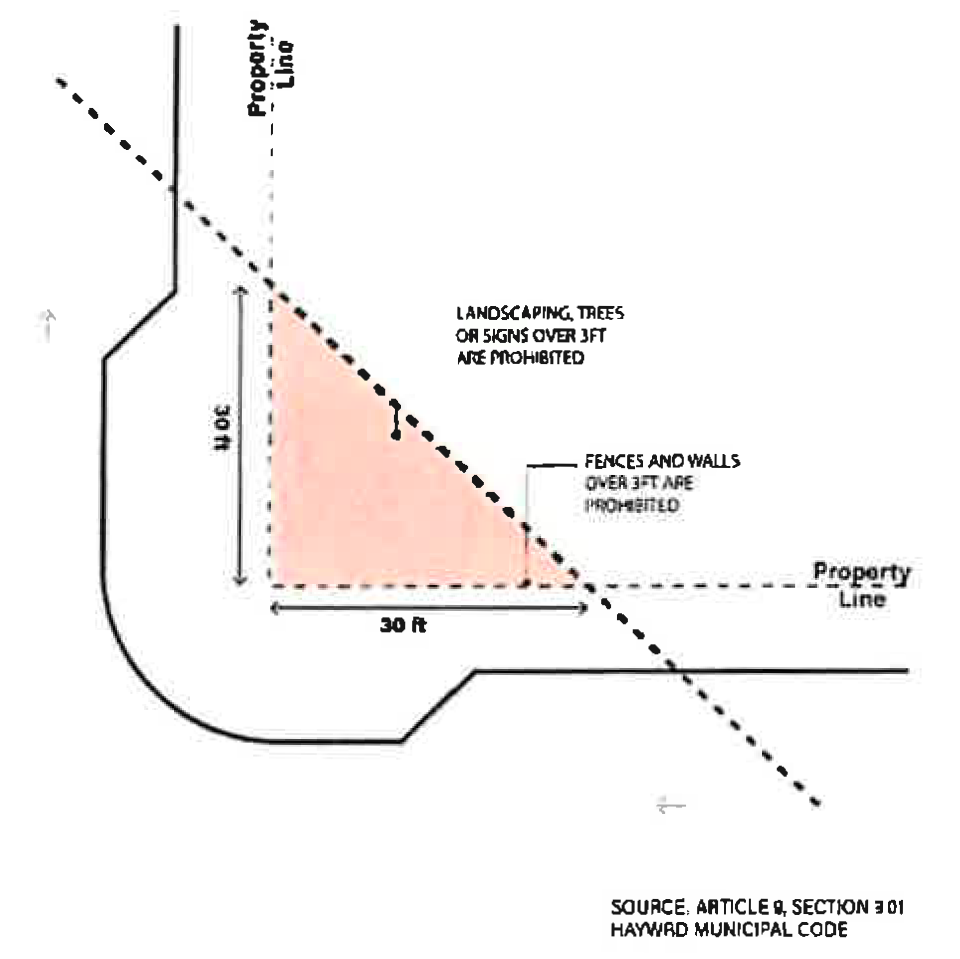
Except for driveways, corner lots shall have a landscaped triangular area formed by the street right-of-way lines and a line connecting them at points 30 feet from the rear or projected point of intersection of the street right-of-way line. (See Article 9, Hayward Traffic Code for visibility requirements.)
(h)
Fencing and Screening - Except for areas used for traffic circulation, or except where the drive-in functions as part of a larger development, for example, a shopping center where there is shared parking or access, a uniformly painted fence or masonry wall shall be maintained along all interior lot lines. Where any interior lot line abuts an R, A, MH, OS, or residential PD District, or a lot with residential uses, a masonry wall shall be constructed. The wall shall be at least 6 feet high but not exceed 8 feet, except within the required yard area abutting a right-of-way or precise plan line, in which case it shall not exceed four feet in height at grade measured on either side of the fence.
(i)
Where a drive-through aisle is located between the right-of-way and the primary structure, low shrubs and/or berms shall be installed within the landscape setback for visual buffering.
(2)
Requirements for Existing Drive-In Uses. An operator of an existing drive-in use who applies for a new use permit or modifications to an existing use permit shall conform to as many of the design and site plan standards for new uses as possible within the limits of the existing site layout and structural location.
(3)
Performance Standards for Drive-In Uses. Drive-in uses shall be operated in a manner which does not interfere with the normal use of adjoining properties. If in the opinion of the Planning Director the provisions of this paragraph are being violated, the violations shall be grounds for reopening use permit hearings and adding conditions to control the violation. Performance standards include, but are not limited to, the following considerations, which, where appropriate, shall be incorporated as conditions of approval in all use permits as determined by the Planning Commission:
(a)
Noise levels measured at the property line shall not exceed the level of background noise normally found in the area or 65 decibels, whichever is greater. Loud speakers shall not be audible from residentially zoned and developed properties.
(b)
The premises shall be kept clean, and the operator shall make all reasonable efforts to see that no trash or litter originating from the use is deposited on adjacent properties. For drive-in restaurants or other uses which typically generate trash or litter, adequate trash containers, as determined by the Planning Director, shall be required and employees shall be required daily to pick up trash or litter originating from the site upon the site and within 300 feet of the perimeter of the property.
(c)
Hours of operation, including deliveries to the site, shall be compatible with the needs and character of the surrounding neighborhood. For purposes of this section, the usual operating hours shall be considered to be between 6.30 a.m. and 11.00 p.m. on weekdays and 7:00 a.m. to 1:00 a.m. on weekends.
(d)
No undesirable odors shall be generated on the site.
(e)
The on-site manager of the use shall take whatever steps are deemed necessary to assure the orderly conduct of employees, patrons, and visitors on the premises.
(f)
A copy of these performance standards and all conditional use permit conditions of approval shall be posted along side the necessary business licenses and be visible at all times to employees.
(4)
Automobile Service Stations - Additional Design Criteria.
(a)
The following operations are prohibited in conjunction with the operation of an automobile service station: auto body repair, major mechanical repair, and outside display of new or used vehicles or parts for sale.
(b)
Exterior display of goods for sale or rent is not permitted, except the following uses which are subject to design and location approval:
(i)
Vending machines.
(ii)
Oil display cabinets.
(iii)
Tire displays.
(c)
Entry to lubrication bays and/or service areas shall be designed to minimize the impact on adjacent residential uses.
(d)
Minimum facilities required:
(i)
Two restrooms open to the public, one for each sex;
(ii)
Equipment and storage area adequate to provide for operation and maintenance of station;
(iii)
Minimum of one air and water outlet and window washing equipment and towels.
(e)
Minimum Site Requirements:
(i)
Building site: 20,000 square feet.
(ii)
Frontage on one street: 140 feet. In the case of corner lots, frontage will be measured to the extension of the intersecting property lines.
(iii)
Setback for fuel pump islands: a distance equal to 15 percent of the depth of the lot, or 20 feet, whichever is less, measured from the street right-of-way or precise plan line.
(f)
Automobile service stations engaged in the concurrent sale of fuel and alcoholic beverages shall be permitted only with approval of a Conditional Use Permit, and shall comply with the following standards:
(i)
There shall be no display of alcoholic beverages within five feet of the cash register unless in a permanently affixed cooler.
(ii)
Advertising of alcoholic beverages at motor vehicle fuel island is prohibited.
(iii)
There shall be no sale of alcoholic beverages from a drive-in window.
(iv)
Alcoholic beverages shall not be displayed or sold from an ice tub.
(v)
Advertising of liquor on motor fuel island is prohibited.
(vi)
Self-illuminated advertising for liquor on buildings or windows is prohibited.
(vii)
Employees on duty between the hours of 10:00 p.m. and 2:00 a.m. shall be at least 21 years of age to sell alcoholic beverages.
(5)
Drive-Through Restaurants.
(a)
Drive-in or drive-through restaurants shall be prohibited within ½-mile radius of one another as measured from the building walls of existing or proposed buildings, unless all the following required findings are met:
i.
The drive-in or drive-through restaurants are located within one-half mile from the Interstate 880 (Nimitz Freeway) or State Route 92 (Jackson Freeway) rights-of-way as measured by the existing roadway network, or on any parcel located within the AT-C zoning subdistrict;
ii.
The location of the drive-in or drive-through restaurants will not have a substantial adverse effect on vehicular (including bicycle), pedestrian circulation and safety, or transit accessibility;
iii.
The drive-in or drive-through restaurants will not conflict with City adopted goals and policies including, but not limited to, the General Plan and Bicycle Master Plan; and
iv.
The site is suitable and adequate for the proposed use because the drive-in or drive-through restaurant lanes and service windows will be located at least seventy-five (75) feet away from residential uses and residentially zoned properties.
(b)
For each drive-in restaurant a bicycle rack shall be installed with a capacity for at least five bicycles.
(c)
Drive-through lanes installed in connection with drive-in restaurants shall have a capacity for at least eight vehicles, at 20 feet per vehicle, unless adequate access and circulation is provided to minimize spillover onto public property.
(d)
Pedestrian circulation areas located within drive-in restaurant developments with drive-up windows shall consist of decorative paving such as brick, paving stones, or Bomanite.
(e)
Access to bathroom facilities located within drive-in restaurant developments shall be from within the structure, with no direct access from the parking area.
(f)
Roof lights, refrigeration units or other extraneous features which are not integral parts of the main structure, inflexible building prototypes which result in an ability to meet setback and compatibility requirements, and unattractive building elevations visible to customers or passersby are prohibited.
(g)
Identification signs for drive-in restaurants (excluding directional signs and the menu board) shall be limited to one monument sign not to exceed 10 feet in height and 36 square feet per face and two wall signs with letters not to exceed 18 inches in height. Total area for wall signs may include logos not to exceed 24 inches in height.
(h)
All required yard areas abutting streets and not used for vehicle maneuvering or parking shall be landscaped. In all zoning districts a landscaped setback at least 15 feet wide shall be installed parallel to the street right(s)-of-way or precise plan line(s) and on interior property lines where drive-through aisles abut residential zoning districts.
(i)
Minimum building site (lot area or lease area) shall be 25,000 square feet in area, unless adequate access and cross-parking is provided.
(j)
Drive-through aisles shall not be located between the building and the right-of-way and pick-up windows shall not face the right-of-way unless their visibility is minimized through the use of innovative building architecture and mounded or bermed landscaping to minimize their visual impact from the street. Menu board shall be placed so as to not be visible from the street.
(k)
Drive-through restaurants shall have an architectural theme that is unique for a given area as specified by City standards and policies or as determined by the Planning Director; franchise architecture shall be avoided where possible.
(6)
Drive-Through Coffee/Espresso Shops.
(a)
Drive-through coffee/espresso shops shall be prohibited within one-half-mile radius of one another as measured from the building walls of existing or proposed buildings, unless all the following required findings are met:
i.
The drive-through coffee/expresso shops located within one-half mile from the Interstate 880 (Nimitz Freeway) or State Route 92 (Jackson Freeway) rights-of-way as measured by the existing roadway network, or on any parcel located within the AT-C zoning subdistrict;
ii.
The location of the drive-through coffee/espresso shops will not have a substantial adverse effect on vehicular (including bicycle), pedestrian circulation and safety, or transit accessibility;
iii.
The drive-through coffee/espresso shops will not conflict with City adopted goals and policies including, but not limited to, the General Plan and the Bicycle Master Plan; and
iv.
The site is suitable and adequate for the proposed use because the drive-through coffee/espresso shop lanes and service windows will be located at least seventy-five (75) feet away from residential uses and residentially zoned properties.
(b)
Drive-through coffee/espresso shop buildings shall not exceed 2,500 square feet in area.
(c)
Drive-through lanes for drive-up windows shall have a capacity for at least two vehicles, at 20 feet per vehicle, unless adequate access and circulation is provided to minimize spillover onto public property.
(d)
Drive-through lanes shall consist of decorative paving such as brick, paving stones, or Bomanite.
(e)
Public bathroom facilities shall be provided inside the drive-through building, unless public bathroom facilities are located within 200 feet on the same property and are accessible during coffee shop business hours.
(f)
Roof lights, refrigeration units or other extraneous features which are not integral parts of the main structure, inflexible building prototypes which result in an ability to meet setback and compatibility requirements, and unattractive building elevations visible to customers or passersby are prohibited.
(g)
Identification signs for drive-through coffee/espresso shops shall comply with the Hayward Sign Ordinance and shall be limited to one monument sign not to exceed 6 feet in height and two wall signs with letters not to exceed 18 inches in height. Total area for wall signs may include logos not to exceed 24 inches in height.
(h)
All required yard areas abutting streets and not used for vehicle maneuvering or parking shall be landscaped. In all zoning districts a landscaped setback at least 10 feet wide shall be installed parallel to the street right-of-way or precise plan line and on interior property lines where drive-through aisles abut residential zoning districts.
(i)
Minimum building site (lot area or lease area) shall be sufficient to accommodate the building and required circulation, maneuvering and parking.
(j)
Drive-through aisles and pick-up windows may be located between the building and the right-of-way, but their visibility should be minimized through the use of innovative building architecture and mounded or bermed landscaping to minimize their visual impact from the street. Menu board(s) shall be placed so as to not be visible from the street.
(k)
Drive-through coffee/espresso shops shall have an architectural theme that is unique for a given area as specified by City standards and policies or as determined by the Planning Director; franchise architecture shall be avoided where possible.
k.
Fences, Hedges, Walls.
(1)
Fences are discouraged within front and side street yards of commercial establishments.
(2)
Fences, hedges and walls shall require approval by Planning Director or other approving authority, as determined by the Planning Director.
(3)
Fence, hedges and walls shall not exceed a height of 4 feet in a required front yard, side street yard or rear yard abutting a street.
(4)
A masonry wall not less than 6 feet in height, shall be required where any commercial district abuts any R, A, MH, OS, residential PD District, or other district where there is conforming residential development on the first floor (except adjacent to a required front or side street yard or abutting a street right-of-way). The masonry wall shall be constructed and maintained along the interior lot lines of such district abutted unless waived or another material is approved by the approving authority because the abutting activity or use is nonconforming, or the commercial activity or use is of low intensity and any impact can be otherwise mitigated.
(5)
For fences limited to a maximum of 4 feet in height, the height limit shall not be exceeded at grade measured on either side of the fence. For fences and walls required to be at least 6 feet high or greater, the height shall be at least the required on both sides of the fence or wall; barb or razor wire or similar security fencing is prohibited.
(6)
Where a lot is situated at the intersection of two or more streets, fences, hedges and walls shall not be erected, placed, planted, or allowed to grow in such a manner as to obstruct intersection visibility, as contained in Ordinance No. 100 C.S., as amended, Hayward Traffic Code, Sections 9.01 through 9.05, relating to Obstructions to Visibility at Intersections Prohibited, as the same are now in effect or which may hereafter be amended or replaced.
l.
Grading. All grading activity shall follow the grading and terrain design standards of the City of Hayward Subdivision Ordinance, Design Guidelines and Hillside Design and Urban/Wildland Interface Guidelines.
m.
Landscaping.
(1)
Landscape Areas.
(a)
Required front, side, side street, and rear yard areas shall be landscaped except for permitted driveways, and walkways. All other areas not utilized for structures or paving shall be landscaped unless otherwise authorized by the Planning Director or other approving authority because of site constraints, existing or adjacent site conditions, or phased development.
(b)
Parking is prohibited within required front and side street yards. Where no front or side street yards are required:
(i)
A landscape strip at least 10 feet wide, unless a wider strip is otherwise required by the approving authority, shall be installed between accessory parking areas and all existing or future street rights-of-way; and
(ii)
The area between all buildings and existing or future street rights-of-way shall be landscaped unless waived by the approving authority.
(c)
Required landscaped areas shall be planted with water-conserving trees, shrubs, turf grass, ground cover, or a combination thereof. The sole use of bark, decorative paving, or decorative rock shall not be allowed in required landscape areas.
(d)
Where any landscaped area adjoins driveways or parking areas, Class B Portland Cement concrete curbs shall be constructed to a height of 6 inches above the finished pavement.
(2)
Buffer Trees/Landscaping.
(a)
A minimum of one 15-gallon buffer tree shall be planted for every 20 lineal feet of property line, where a required side or rear yard abuts an A, R, MH, OS, or residential PD District.
(b)
Masonry walls, solid building walls, trash enclosures, and/or fences facing a street or driveway shall be buffered with continuous shrubs or vines.
(3)
Parking Lot Trees/Planters.
(a)
Parking areas shall include a minimum of one 15-gallon parking lot tree for every six parking stalls, except where restricted because of design constraints.
(b)
Parking lot trees shall be planted in tree wells or landscape medians located within the parking area, unless an alternative location is approved by the Planning Director. Required street and buffer trees shall not qualify as parking lot trees.
(c)
The minimum dimension of any tree well or landscape median shall be 5 feet, measured from back of curb.
(d)
The end of parking rows shall be capped with landscape medians, except where space is restricted because of existing site conditions.
(e)
Parking and loading areas shall be buffered from the street with shrubs, walls, or earth berms, as determined by the Planning Director. Where shrubs are used for buffering, the type and spacing of shrubs shall create a continuous 30-inch-high screen within 2 years.
(4)
Street Trees. Street trees shall be planted along all street frontages at a minimum of one 24-inch box or larger tree per 20 to 40 lineal feet of frontage or fraction thereof, except where space is restricted due to existing structures or site conditions.
(5)
Landscaping Near BART.
(a)
Parcels abutting, or within 500 feet and in direct view from the BART right-of-way shall include a minimum 10-foot-wide landscape strip along the property line(s) abutting or in view from the BART right-of-way.
(b)
A minimum of one 15-gallon buffer tree shall be planted for every 20 lineal feet of property line. The approving authority may waive the requirement if it would not accomplish the intent of City policies as they relate to landscaping due to existing structures or other obstructions to viewing landscaping.
(6)
Irrigation. Within all required landscaped areas, an automatic water efficient irrigation system shall be installed upon initial construction of any building or substantial alteration to any building or site.
(7)
Tree Preservation.
(a)
Trees shall be preserved in accordance with the Tree Preservation Ordinance with measures included for tree protection during the construction period.
(b)
A tree removal permit is required prior to removing any tree 30 inches or larger in trunk circumference (or approximately 10 inches or larger in trunk diameter), measured two feet above the ground.
(8)
Maintenance.
(a)
After initial installation, all plantings shall be maintained in a reasonably weed-free and litter-free condition, including replacement where necessary as determined by the Planning Director.
(b)
Required street, parking lot, and buffer trees shall not be severely pruned, topped, or pollarded (cut back to the trunk).
n.
Lighting, Exterior. Exterior lighting and parking lot lighting shall be provided in accordance with the Security Standards Ordinance (No. 90-26 C.S.) and be designed by a qualified lighting designer and erected and maintained so that light is confined to the property and will not cast direct light or glare upon adjacent properties or public rights-of-way. Such lighting shall also be designed such that it is decorative and in keeping with the design of the development.
o.
Mixed-Use Development. Mixed-use development shall be subject to the following requirements:
(1)
Shall provide separate entrances, isolation of noise and smell generating activities, and other compatibility features shall be addressed.
(2)
Special attention shall be given to architectural and landscape continuity, vehicular access and attractive pedestrian orientation. Where at all possible, parking in front of the building shall be avoided.
(3)
A minimum of 150 square feet of usable open space per residential dwelling unit shall be provided.
(4)
Studio apartments shall be required to have only one covered off-street parking place per dwelling unit.
p.
Outdoor Storage. All uses shall be conducted wholly within enclosed buildings. Minor open storage is a secondary use and is permitted, provided the materials, products, or equipment stored are necessary to the operation of a use being conducted on the site; storage is not placed within required yard or parking areas, and the storage is compatible with adjoining uses, as determined by the Planning Director (for example, adequately screened, set back or not too high, and not visually unpleasant as with outside storage of appliances in conjunction with appliance sales/service).
q.
Parking, Driveways and Paving. Parking, driveways and paving for commercial uses shall be provided in accordance with the City of Hayward Off-Street Parking Regulations, Standard Details, and the following criteria:
(1)
Parking Spaces Required. Refer to the specific parking space requirements contained in the Off-Street Parking Regulations.
(2)
Parking Space Dimensions.
(a)
Standard car parking spaces shall be a minimum of 9 feet wide by 19 feet long.
(b)
Compact car parking spaces shall be a minimum of 9 feet wide by 15 feet long.
(c)
Covered or uncovered parking spaces located adjacent to walls or support columns shall be increased in width by at least one foot on the effected side(s), to accommodate door swing.
(d)
Covered parking spaces shall provide a minimum unobstructed vertical clearance of 7 feet. Parking space areas shall be unobstructed by stairs, cabinets, utilities, etc.
(3)
Parking Space Locations.
(a)
Parking spaces shall not be located within the required front yard or side street yard setback.
(b)
Parking spaces and driveways, not located under a building may be located in a required side and rear yard, but shall not be located within 5 feet of any side or rear yard property line or building. Unless wheel-stops are used, curbing for standard car or compact car parking spaces shall be setback 7 feet 6 inches and 7 feet, respectively, from a property line or building if a vehicular overhang is used.
(c)
For lots less than 51 feet in width, parking and vehicular circulation may be located to within three feet of a side property line.
(4)
Driveways and Paving.
(a)
The minimum driveway width shall be 20 feet for a two-way driveway and 12 feet for a one-way driveway.
(b)
In no case should a driveway exceed one-third of the width of the property frontage width or 35 feet.
(c)
Parking and driveway surfaces shall be paved with asphaltic surface or comparable all-weather dustless material(s), such as bricks or pavers, as approved by Planning Director.
(5)
Driveway Aisle Dimensions. The minimum parking lot driveway aisle width shall be 26 feet for a two-way standard car aisle and 20 feet for a compact car aisle, or as allowed per the City's Off-Street Parking Regulations.
(6)
Driveway Turnaround Requirement. All commercial property shall provide a sufficient paved driveway turnaround to allow vehicles to exit property in a forward direction.
(7)
Driveway Security Gates. Refer to Chapter 10, Article 14 of the Hayward Municipal Code.
(8)
Emergency Vehicle Turn-Around Requirement. Where the farthest point of a structure(s) is located 150 feet or more from the point of street access, a turn-around area shall be provided which will accommodate the turning around of fire protection vehicles, unless otherwise approved by the Fire Prevention Bureau. (For further details or alternative design considerations contact the Fire Prevention Bureau.)
r.
Retaining Walls.
(1)
Retaining walls which are not a part of walls of buildings shall not exceed 6 feet in height as measured from finished grade elevation to top of wall.
(2)
A maximum of two successive, approximately parallel retaining walls is permitted when they are separated by a minimum horizontal distance of 6 feet as measured between centerline of the walls.
(3)
Any additional successive walls shall require a minimum of 15 feet separation provided the required grading is in conformance with City standards and guidelines.
(4)
The sides of exposed exterior retaining walls shall be architecturally treated as approved by the Planning Director.
(5)
The Planning Director may administratively alter or waive any wall requirement, if, in the Planning Director's opinion, no practical alternative exists, the purpose of the regulation will not be compromised, and no detrimental impact will result.
s.
Roof-Mounted Equipment. Roof-mounted equipment, antennas, satellite dishes, support structures and similar devices shall be screened from public view as required by the Planning Director or other approval authority.
t.
Signs. Signs shall be of a design in harmony with the environment, shall not constitute excessive visual impact, shall not be hazardous to vehicular traffic, and shall be of a quality conducive to the development of commerce. (See the Sign Ordinance for specific regulations.)
u.
Surfacing. All open areas not landscaped shall be treated or paved with an all-weather, dustless material, such as an asphaltic surface, as approved by the Planning Director. Surfacing shall be permanently maintained, including replacement where necessary.
v.
Trash and Recycling Facilities.
(1)
Trash and recycling facilities shall be adequately screened from view, utilizing a decorative wood or masonry wall or combination thereof compatible with the design of the primary building on the site.
(2)
Shall be located no further than 100 feet from the use it is designed to serve, unless the site topography is such that adhering to this standard would interfere with the collection of trash.
w.
Window Coverage. Transparent windows and doors of buildings occupied by businesses engaging in retail sales, all or a portion of which are within 5 vertical feet of the floor and which are visible from public rights-of-way or pedestrian walkways or are otherwise visible by the general public from the exterior, shall remain free of coverings and materials that prevent views into or out of the stores. Retail goods intended or sale, or goods being stored, or other coverings or materials shall be located no closer than 5 feet from a transparent window or door, unless they are located beneath or above a window and are not visible from public right-of-way or pedestrian walkways or are otherwise visible by the general public. This section shall not apply to signs or retail goods that are presented within or adjacent to a window and that are a part of a decorative window display, as determined by the Planning Director.
(Amended by Ordinance 18-11, adopted Sept. 18, 2018; Amended by Ordinance 25-07, adopted June 17, 2025)
NEIGHBORHOOD COMMERCIAL DISTRICT CN11
Note— Section 10-1.815a.(5) amended by Ordinance 04-19, adopted December 21, 2004. Section 10-1.820a. amended by Ordinance 01-01, adopted January 16, 2001. Section 10-1.820b. amended by Ordinance 99-18, adopted October 12, 1999; Ordinance 04-19, adopted December 21, 2004; Section 10-1.845w. added by Ordinance 01-08, adopted July 17, 2001; Section 10-1.845 amended by Ordinance 07-16, adopted November 6, 2007. Section 10-1.800 amended by Ordinance 13-12, adopted November 19, 2013.
The CN District shall be subject to the following specific regulations in addition to the general regulations hereinafter contained, in order to make provision for a number of areas throughout the City carefully located in relationship to other Commercial Districts and to the Residential Districts served. The products and services intended are those primarily represented by convenience goods and services purchased frequently.
Any combining B or SD District (See Sections 10-1.2400 and 10-1.2600).
a.
Primary Uses. The following uses, or uses determined to be similar by the Planning Director, are permitted in the CN District as primary uses:
(1)
Administrative and Professional Offices/Services.
(a)
Accounting and financial offices (not including check-cashing business).
(b)
Architectural and engineering offices.
(c)
Banks and financial institutions.
(d)
Chiropractic and acupuncture offices.
(e)
Insurance and real estate offices.
(f)
Law offices.
(g)
Medical and dental offices.
(h)
Travel and airline agency offices.
(2)
Automobile Related Uses.
Automobile parts store.
(3)
Personal Services.
(a)
Barber or beauty shop.
(b)
Dance studio.
(c)
Dry cleaner/laundry.
(d)
Martial arts studio.
(e)
Music studio.
(f)
Nail salon.
(g)
Palm reading service.
(h)
Photography studio.
(i)
Physical fitness studio.
(j)
Shoe repair shop.
(k)
Tailor/seamstress shop.
(4)
Residential Uses.
(a)
Residential dwelling unit(s). (Above first floor commercial uses only.)
(b)
Residential development as provided in Government Code Sections 65852.24, 65913.4 and 65912.100, as amended from time to time.
(5)
Retail Commercial Uses.
(a)
Antique store.
(b)
Appliance store.
(c)
Art and art supplies store.
(d)
Bakery.
(e)
Bicycle shop.
(f)
Bookstore.
(g)
Camera store.
(h)
Card shop.
(i)
Carpet/drapery store.
(j)
Clothing store.
(k)
Consignment store.
(l)
Coffee/espresso shop.
(m)
Delicatessen.
(n)
Fabric store.
(o)
Floral shop.
(p)
Furniture store.
(q)
Garden supplies store.
(r)
Gift shop.
(s)
Hardware store.
(t)
Jewelry store.
(u)
Locksmith shop.
(v)
Music store.
(w)
Nursery (plant).
(x)
Paint/wallpaper store.
(y)
Pet grooming shop.
(z)
Pet store.
(aa)
Plumbing and heating store.
(bb)
Restaurant. (Where not abutting a residential district or property and no bar)
(cc)
Sporting goods store.
(dd)
Stationary store.
(ee)
Supermarket.
(ff)
Theater. (Small Motion Picture or Live Performance only.)
(gg)
Thrift store.
(hh)
Toy store.
(ii)
Variety store.
(jj)
Video sales and rental store.
(6)
Service Commercial Uses.
(a)
Copying or reproduction facility.
(b)
Mailing or facsimile service.
(c)
Reverse vending machine(s). (When located within a convenience zone.)
(7)
Other Uses.
(a)
Banquet hall. (Where not abutting a residential district or property and where no alcohol is served.)
(b)
Catering facility.
(c)
Christmas tree or pumpkin patch lot. (See Section 10-1.2735c. for standards.)
(d)
Day care home. (State-licensed, less than 24-hour care for children or adults, 14 or fewer persons, excluding staff. See definitions)
(e)
Educational facility. Small, generally less than 2,000 square feet, designed to augment the learning process of elementary and secondary students.
(f)
Public agency facilities.
(g)
Emergency Shelter. (Limited to parcels abutting Mission Boulevard and Foothill Boulevard. See Section 10-1.2736(a) for criteria and standards.)
(h)
Low Barrier Navigation Center. (See Section 10-1.2736(b) for criteria and standards.)
b.
Secondary Uses. The following uses are permitted as secondary or subordinate uses to the uses permitted in the CN District:
(1)
Accessory buildings and uses. (See Section 10.1.845)
(2)
Garage sales. (4 per year per dwelling. See General Regulations Section 10-1.2735d.)
(3)
Home Occupation. (See definitions)
(4)
Household pets.
(5)
Accessory Dwelling Unit(s). (Where primary use is residential. See Section 10-1.2740 for criteria and standards.)
(Amended by Ordinance 24-01, adopted Jan. 23, 2024; Amended by Ordinance 25-02, § 1(Exh. A), adopted January 21, 2025)
a.
Administrative Uses. The following uses are permitted in the OS District subject to approval of an administrative use permit:
(1)
Administrative and Professional Offices/Services.
Medical/dental laboratory.
(2)
Automobile Related Uses.
(a)
Parking lot.
(b)
Car Rental Agency.
(3)
Personal Services.
(a)
Health Club.
(b)
Massage. (When ancillary to an established primary use such as a beauty salon.)
(c)
Suntan parlor.
(4)
Residential Uses.
None.
(5)
Retail Commercial Uses.
(a)
Restaurant. (Where abutting a residential district or property)
(b)
Convenience market.
(6)
Service Commercial Uses.
(a)
Appliance service and repair shop. (Not ancillary to a primary use)
(b)
Recycling collection area. (When located within a convenience zone)
(7)
Other Uses.
(a)
Animal hospital.
(b)
Animal grooming service.
(c)
Ambulance service.
(d)
Carnival.
(e)
Cultural facility.
(f)
Day Care Center. (State-licensed, less than 24-hour care for children or adults, 15 or more persons, excluding staff.)
(g)
Educational facility. Where not exempted, under Section 10-1.815a.(7)(f).
(h)
Outdoor gathering. (Refer to General Regulations Section 10-1.2735g.)
(i)
Recreational facility.
(j)
Religious facility.
(k)
Temporary use. (i.e., Parking lot or tent sale)
b.
Conditional Uses. The following uses, or uses determined to be similar by the Planning Director, are permitted in the CN District, subject to approval of a conditional use permit:
(1)
Administrative and Professional Offices/Services.
(a)
Check cashing store.
(b)
Payday loan facilities.
(2)
Automobile Related Uses. (See Section 10-1.845 for special requirements)
(a)
Automobile repair - minor.
(b)
Automobile service station.
(c)
Car wash.
(d)
Drive-in establishments.
(3)
Personal Services.
(a)
Massage parlor. When not located within an established beauty salon.
(b)
Tattoo parlor.
(4)
Residential Uses.
None.
(5)
Retail Commercial Uses.
(a)
Bar, Cocktail lounge, alcohol). (See General Regulations Section 10-1.2750 et seq. for regulations of alcohol.)
(b)
Dance or night club. (See General Regulations Section 10-1.2750 et seq. for regulations of alcohol.)
(c)
Liquor store. (See General Regulations Section 10-1.2750 et seq. for regulations of alcohol.)
(d)
Theater, Large Motion Picture. (See Section 10-1.1045 for special requirements.)
(6)
Service Commercial Uses.
None.
(7)
Other Uses.
Banquet hall. (When abutting a residential district or property. See Section 10-1.2750 et seq. for regulations of alcohol)
a.
Minimum Lot Size: 6,000 square feet.
b.
Minimum Lot Area per Dwelling Unit: As permitted in RM or RH Districts, whichever is consistent with the General Policies Plan Map and Neighborhood Plan.
c.
Minimum Lot Frontage: 60 feet.
d.
Minimum Average Lot Width: 60 feet.
e.
Maximum Lot Coverage: 90 percent.
f.
Minimum Lot Depth: 100 feet.
g.
Special Lot Requirements and Exceptions: See General Regulations Section 10-1.2720.
a.
Minimum Front Yard: 10 feet.
b.
Minimum Side Yard: None.
c.
Minimum Side Street Yard: 10 feet.
d.
Minimum Rear Yard: None.
e.
Special Side and Rear Yard Provision: The side or rear yard for any primary structure in a CN District shall be the same as the abutting District; where abutting any R, A, MH, OS, or residential PD district, the side yard shall be a minimum of 10 feet.
f.
Special Yard Requirements and Exceptions: See General Regulations Section 10-1.2725.
a.
Maximum Building Height: 40 feet.
b.
Maximum Accessory Building Height: 14 feet and one story.
c.
Maximum Height for Fences/hedges/walls:
(1)
Front and Side Street Yard: 4 feet.
(2)
Side and Rear Yard: 6 feet.
(Also see Section 10-1.845k. for additional standards).
d.
Special Height Requirements and Exceptions: See General Regulations Section 10-1.2730.
Site Plan Review approval is required before issuance of any building or construction permit or construction of a fence within this district only if the Planning Director determines that a project materially alters the appearance and character of the property or area or may be incompatible with City policies, standards and guidelines. This may include fences (i.e., such as anodized gray chain link fences) in certain circumstances.
The City recognizes that high-quality design of commercial structures can contribute to a positive appearance of commercial districts and neighborhoods and improve the overall character of the community. This Section establishes design and performance standards that shall apply to the construction of residential and commercial buildings and certain commercial uses in the CN District, including but not limited to cultural, educational, religious or recreational facilities. The development of CN-zoned properties in the South of Route 92 planning area is also subject to the provisions of the South of Route 92/Oliver and Weber Properties Specific Plan and the Development Guidelines for the South of Route 92 Oliver/Weber Properties.
Commercial Buildings and Uses.
For commercial buildings (including second story residential uses) refer to the design criteria contained in the City of Hayward Design Guidelines, the Hillside Design and Urban/Wildland Interface Guidelines and the following specific criteria and standards.
a.
Accessory Buildings, Detached. Detached accessory buildings, including but not limited to carports, garages, greenhouses, patio covers, sheds, etc., shall meet the following criteria:
(1)
Shall not exceed one story or 14 feet in height.
(2)
Shall use exterior building materials and colors which either match or are compatible with the primary building. Special design consideration should be given to structures visible from a public street.
(3)
Shall not be located in a required front yard or side street yard.
(4)
Shall be setback a minimum of 5 feet from a side or rear property line.
(5)
Shall not be located in front of a primary building, unless no other practical alternative exists.
(6)
Shall be setback a minimum of 10 feet from a primary building and any other accessory building.
(7)
The area of all accessory buildings, either individually or cumulatively shall not exceed 50 percent of the ground floor area of the primary building.
b.
Accessory Structures, Decorative. Detached decorative accessory structures used in conjunction with car washes and similar activities as determined by the Planning Director, including but not limited to arbors, trellises, shade covers, etc., shall meet the following criteria:
(1)
Shall not exceed one story or 14 feet in height.
(2)
Shall use exterior materials and colors which either match or are compatible with the primary building. Canvas, plastic and similar materials shall not be used. Special design consideration should be given to structures visible from a public street.
(3)
Shall not be located in a required front yard or side street yard.
c.
Accessory Promotional Tents. Detached accessory promotional tents shall only be permitted in conjunction with the four promotional events permitted per year in the Sign Regulations.
d.
Additions and Accessory Structures Attached to Primary Building. Additions and accessory structures attached to the primary building shall meet all the development standards required of the primary building, including the City of Hayward Design Guidelines and Hillside Design and Urban/Wildland Interface Guidelines.
e.
Adult Entertainment Activity. Refer to General Regulations Section 10-1.2735.a. for Adult Entertainment Activity Regulations.
f.
Alcoholic Beverage Outlets. Refer to General Regulations Section 10-1.2750 et seq. for Alcoholic Beverage Outlet Regulations.
g.
Antennas and Satellite Dishes and Telecommunications Devices. Refer to Chapter 10, Article 13 of the Hayward Municipal Code, the Antenna and Telecommunications Facilities Ordinance, for regulations of antennas, satellite dishes and telecommunications devices.
h.
Architectural Projections into Yards. Architectural features such as bay windows, cornices and eaves may extend 2 feet into any required yard.
i.
Decks and Ramps.
(1)
Decks and ramps 12 inches or less in height may be located in any yard.
(2)
Decks and ramps between 12 to 30 inches in height may be located in any rear or side yard but no closer than three feet to the rear or side property line.
(3)
Decks 30 inches or more in height shall conform to the minimum yard setback requirements of the primary building.
(4)
Decks located in hillside areas shall conform to the Hillside Design and Urban/Wildland Interface Guidelines.
j.
Drive-in Establishments - Special Standards and Conditions.
(1)
Location and Design Criteria. In addition to the minimum Commercial Development Standards, the following requirements shall apply:
(a)
Use permit applications for drive-in establishments in addition to standard requirements shall include the following information: a map and brief description of similar uses within a one-mile radius of the site; number and location of similar uses, indicating the location of all uses under the same brand name or franchise.
(b)
Drive-in uses shall not be located across a street from residential zoning districts, unless at least one street abutting the site is an arterial or major street and pedestrian safety measures are provided as determined necessary. This provision does not apply to commercial off-street parking lots.
(c)
Access to drive-in uses shall not be located next to the access to schools, parks, playgrounds, libraries, churches and other public and semi-public uses if pedestrian safety hazards would result.
(d)
Exterior storage and display of goods for sale or rent is not allowed.
(e)
All required yard areas abutting streets and not used for vehicle maneuvering or parking shall be landscaped. In all zoning districts a planter at least 10 feet wide shall be installed parallel to the street right-of-way or precise plan line except where the use is a drive-in restaurant, then a 15-foot-wide landscaped setback is required.
(f)
A minimum of 20 percent of the total site area shall be landscaped.
(g)
Except for driveways, corner lots shall have a landscaped triangular area formed by the street right-of-way lines and a line connecting them at points 30 feet from the rear or projected point of intersection of the street right-of-way line. (See Article 9, Hayward Traffic Code for visibility requirements.)
(h)
Fencing and Screening - Except for areas used for traffic circulation, or except where the drive-in functions as part of a larger development, for example, a shopping center where there is shared parking or access, a uniformly painted fence or masonry wall shall be maintained along all interior lot lines. Where any interior lot line abuts an R, A, MH, OS, or residential PD District, or a lot with residential uses, a masonry wall shall be constructed. The wall shall be at least 6 feet high but not exceed 8 feet, except within the required yard area abutting a right-of-way or precise plan line, in which case it shall not exceed four feet in height at grade measured on either side of the fence.
(i)
Where a drive-through aisle is located between the right-of-way and the primary structure, low shrubs and/or berms shall be installed within the landscape setback for visual buffering.
(2)
Requirements for Existing Drive-In Uses. An operator of an existing drive-in use who applies for a new use permit or modifications to an existing use permit shall conform to as many of the design and site plan standards for new uses as possible within the limits of the existing site layout and structural location.
(3)
Performance Standards for Drive-In Uses. Drive-in uses shall be operated in a manner which does not interfere with the normal use of adjoining properties. If in the opinion of the Planning Director the provisions of this paragraph are being violated, the violations shall be grounds for reopening use permit hearings and adding conditions to control the violation. Performance standards include, but are not limited to, the following considerations, which, where appropriate, shall be incorporated as conditions of approval in all use permits as determined by the Planning Commission:
(a)
Noise levels measured at the property line shall not exceed the level of background noise normally found in the area or 65 decibels, whichever is greater. Loud speakers shall not be audible from residentially zoned and developed properties.
(b)
The premises shall be kept clean, and the operator shall make all reasonable efforts to see that no trash or litter originating from the use is deposited on adjacent properties. For drive-in restaurants or other uses which typically generate trash or litter, adequate trash containers, as determined by the Planning Director, shall be required and employees shall be required daily to pick up trash or litter originating from the site upon the site and within 300 feet of the perimeter of the property.
(c)
Hours of operation, including deliveries to the site, shall be compatible with the needs and character of the surrounding neighborhood. For purposes of this section, the usual operating hours shall be considered to be between 6.30 a.m. and 11.00 p.m. on weekdays and 7:00 a.m. to 1:00 a.m. on weekends.
(d)
No undesirable odors shall be generated on the site.
(e)
The on-site manager of the use shall take whatever steps are deemed necessary to assure the orderly conduct of employees, patrons, and visitors on the premises.
(f)
A copy of these performance standards and all conditional use permit conditions of approval shall be posted along side the necessary business licenses and be visible at all times to employees.
(4)
Automobile Service Stations - Additional Design Criteria.
(a)
The following operations are prohibited in conjunction with the operation of an automobile service station: auto body repair, major mechanical repair, and outside display of new or used vehicles or parts for sale.
(b)
Exterior display of goods for sale or rent is not permitted, except the following uses which are subject to design and location approval:
(i)
Vending machines.
(ii)
Oil display cabinets.
(iii)
Tire displays.
(c)
Entry to lubrication bays and/or service areas shall be designed to minimize the impact on adjacent residential uses.
(d)
Minimum facilities required:
(i)
Two restrooms open to the public, one for each sex;
(ii)
Equipment and storage area adequate to provide for operation and maintenance of station;
(iii)
Minimum of one air and water outlet and window washing equipment and towels.
(e)
Minimum Site Requirements:
(i)
Building site: 20,000 square feet.
(ii)
Frontage on one street: 140 feet. In the case of corner lots, frontage will be measured to the extension of the intersecting property lines.
(iii)
Setback for fuel pump islands: a distance equal to 15 percent of the depth of the lot, or 20 feet, whichever is less, measured from the street right-of-way or precise plan line.
(f)
Automobile service stations engaged in the concurrent sale of fuel and alcoholic beverages shall be permitted only with approval of a Conditional Use Permit, and shall comply with the following standards:
(i)
There shall be no display of alcoholic beverages within five feet of the cash register unless in a permanently affixed cooler.
(ii)
Advertising of alcoholic beverages at motor vehicle fuel island is prohibited.
(iii)
There shall be no sale of alcoholic beverages from a drive-in window.
(iv)
Alcoholic beverages shall not be displayed or sold from an ice tub.
(v)
Advertising of liquor on motor fuel island is prohibited.
(vi)
Self-illuminated advertising for liquor on buildings or windows is prohibited.
(vii)
Employees on duty between the hours of 10:00 p.m. and 2:00 a.m. shall be at least 21 years of age to sell alcoholic beverages.
(5)
Drive-Through Restaurants.
(a)
Drive-in or drive-through restaurants shall be prohibited within ½-mile radius of one another as measured from the building walls of existing or proposed buildings, unless all the following required findings are met:
i.
The drive-in or drive-through restaurants are located within one-half mile from the Interstate 880 (Nimitz Freeway) or State Route 92 (Jackson Freeway) rights-of-way as measured by the existing roadway network, or on any parcel located within the AT-C zoning subdistrict;
ii.
The location of the drive-in or drive-through restaurants will not have a substantial adverse effect on vehicular (including bicycle), pedestrian circulation and safety, or transit accessibility;
iii.
The drive-in or drive-through restaurants will not conflict with City adopted goals and policies including, but not limited to, the General Plan and Bicycle Master Plan; and
iv.
The site is suitable and adequate for the proposed use because the drive-in or drive-through restaurant lanes and service windows will be located at least seventy-five (75) feet away from residential uses and residentially zoned properties.
(b)
For each drive-in restaurant a bicycle rack shall be installed with a capacity for at least five bicycles.
(c)
Drive-through lanes installed in connection with drive-in restaurants shall have a capacity for at least eight vehicles, at 20 feet per vehicle, unless adequate access and circulation is provided to minimize spillover onto public property.
(d)
Pedestrian circulation areas located within drive-in restaurant developments with drive-up windows shall consist of decorative paving such as brick, paving stones, or Bomanite.
(e)
Access to bathroom facilities located within drive-in restaurant developments shall be from within the structure, with no direct access from the parking area.
(f)
Roof lights, refrigeration units or other extraneous features which are not integral parts of the main structure, inflexible building prototypes which result in an ability to meet setback and compatibility requirements, and unattractive building elevations visible to customers or passersby are prohibited.
(g)
Identification signs for drive-in restaurants (excluding directional signs and the menu board) shall be limited to one monument sign not to exceed 10 feet in height and 36 square feet per face and two wall signs with letters not to exceed 18 inches in height. Total area for wall signs may include logos not to exceed 24 inches in height.
(h)
All required yard areas abutting streets and not used for vehicle maneuvering or parking shall be landscaped. In all zoning districts a landscaped setback at least 15 feet wide shall be installed parallel to the street right(s)-of-way or precise plan line(s) and on interior property lines where drive-through aisles abut residential zoning districts.
(i)
Minimum building site (lot area or lease area) shall be 25,000 square feet in area, unless adequate access and cross-parking is provided.
(j)
Drive-through aisles shall not be located between the building and the right-of-way and pick-up windows shall not face the right-of-way unless their visibility is minimized through the use of innovative building architecture and mounded or bermed landscaping to minimize their visual impact from the street. Menu board shall be placed so as to not be visible from the street.
(k)
Drive-through restaurants shall have an architectural theme that is unique for a given area as specified by City standards and policies or as determined by the Planning Director; franchise architecture shall be avoided where possible.
(6)
Drive-Through Coffee/Espresso Shops.
(a)
Drive-through coffee/espresso shops shall be prohibited within one-half-mile radius of one another as measured from the building walls of existing or proposed buildings, unless all the following required findings are met:
i.
The drive-through coffee/expresso shops located within one-half mile from the Interstate 880 (Nimitz Freeway) or State Route 92 (Jackson Freeway) rights-of-way as measured by the existing roadway network, or on any parcel located within the AT-C zoning subdistrict;
ii.
The location of the drive-through coffee/espresso shops will not have a substantial adverse effect on vehicular (including bicycle), pedestrian circulation and safety, or transit accessibility;
iii.
The drive-through coffee/espresso shops will not conflict with City adopted goals and policies including, but not limited to, the General Plan and the Bicycle Master Plan; and
iv.
The site is suitable and adequate for the proposed use because the drive-through coffee/espresso shop lanes and service windows will be located at least seventy-five (75) feet away from residential uses and residentially zoned properties.
(b)
Drive-through coffee/espresso shop buildings shall not exceed 2,500 square feet in area.
(c)
Drive-through lanes for drive-up windows shall have a capacity for at least two vehicles, at 20 feet per vehicle, unless adequate access and circulation is provided to minimize spillover onto public property.
(d)
Drive-through lanes shall consist of decorative paving such as brick, paving stones, or Bomanite.
(e)
Public bathroom facilities shall be provided inside the drive-through building, unless public bathroom facilities are located within 200 feet on the same property and are accessible during coffee shop business hours.
(f)
Roof lights, refrigeration units or other extraneous features which are not integral parts of the main structure, inflexible building prototypes which result in an ability to meet setback and compatibility requirements, and unattractive building elevations visible to customers or passersby are prohibited.
(g)
Identification signs for drive-through coffee/espresso shops shall comply with the Hayward Sign Ordinance and shall be limited to one monument sign not to exceed 6 feet in height and two wall signs with letters not to exceed 18 inches in height. Total area for wall signs may include logos not to exceed 24 inches in height.
(h)
All required yard areas abutting streets and not used for vehicle maneuvering or parking shall be landscaped. In all zoning districts a landscaped setback at least 10 feet wide shall be installed parallel to the street right-of-way or precise plan line and on interior property lines where drive-through aisles abut residential zoning districts.
(i)
Minimum building site (lot area or lease area) shall be sufficient to accommodate the building and required circulation, maneuvering and parking.
(j)
Drive-through aisles and pick-up windows may be located between the building and the right-of-way, but their visibility should be minimized through the use of innovative building architecture and mounded or bermed landscaping to minimize their visual impact from the street. Menu board(s) shall be placed so as to not be visible from the street.
(k)
Drive-through coffee/espresso shops shall have an architectural theme that is unique for a given area as specified by City standards and policies or as determined by the Planning Director; franchise architecture shall be avoided where possible.
k.
Fences, Hedges, Walls.
(1)
Fences are discouraged within front and side street yards of commercial establishments.
(2)
Fences, hedges and walls shall require approval by Planning Director or other approving authority, as determined by the Planning Director.
(3)
Fence, hedges and walls shall not exceed a height of 4 feet in a required front yard, side street yard or rear yard abutting a street.
(4)
A masonry wall not less than 6 feet in height, shall be required where any commercial district abuts any R, A, MH, OS, residential PD District, or other district where there is conforming residential development on the first floor (except adjacent to a required front or side street yard or abutting a street right-of-way). The masonry wall shall be constructed and maintained along the interior lot lines of such district abutted unless waived or another material is approved by the approving authority because the abutting activity or use is nonconforming, or the commercial activity or use is of low intensity and any impact can be otherwise mitigated.
(5)
For fences limited to a maximum of 4 feet in height, the height limit shall not be exceeded at grade measured on either side of the fence. For fences and walls required to be at least 6 feet high or greater, the height shall be at least the required on both sides of the fence or wall; barb or razor wire or similar security fencing is prohibited.
(6)
Where a lot is situated at the intersection of two or more streets, fences, hedges and walls shall not be erected, placed, planted, or allowed to grow in such a manner as to obstruct intersection visibility, as contained in Ordinance No. 100 C.S., as amended, Hayward Traffic Code, Sections 9.01 through 9.05, relating to Obstructions to Visibility at Intersections Prohibited, as the same are now in effect or which may hereafter be amended or replaced.
l.
Grading. All grading activity shall follow the grading and terrain design standards of the City of Hayward Subdivision Ordinance, Design Guidelines and Hillside Design and Urban/Wildland Interface Guidelines.
m.
Landscaping.
(1)
Landscape Areas.
(a)
Required front, side, side street, and rear yard areas shall be landscaped except for permitted driveways, and walkways. All other areas not utilized for structures or paving shall be landscaped unless otherwise authorized by the Planning Director or other approving authority because of site constraints, existing or adjacent site conditions, or phased development.
(b)
Parking is prohibited within required front and side street yards. Where no front or side street yards are required:
(i)
A landscape strip at least 10 feet wide, unless a wider strip is otherwise required by the approving authority, shall be installed between accessory parking areas and all existing or future street rights-of-way; and
(ii)
The area between all buildings and existing or future street rights-of-way shall be landscaped unless waived by the approving authority.
(c)
Required landscaped areas shall be planted with water-conserving trees, shrubs, turf grass, ground cover, or a combination thereof. The sole use of bark, decorative paving, or decorative rock shall not be allowed in required landscape areas.
(d)
Where any landscaped area adjoins driveways or parking areas, Class B Portland Cement concrete curbs shall be constructed to a height of 6 inches above the finished pavement.
(2)
Buffer Trees/Landscaping.
(a)
A minimum of one 15-gallon buffer tree shall be planted for every 20 lineal feet of property line, where a required side or rear yard abuts an A, R, MH, OS, or residential PD District.
(b)
Masonry walls, solid building walls, trash enclosures, and/or fences facing a street or driveway shall be buffered with continuous shrubs or vines.
(3)
Parking Lot Trees/Planters.
(a)
Parking areas shall include a minimum of one 15-gallon parking lot tree for every six parking stalls, except where restricted because of design constraints.
(b)
Parking lot trees shall be planted in tree wells or landscape medians located within the parking area, unless an alternative location is approved by the Planning Director. Required street and buffer trees shall not qualify as parking lot trees.
(c)
The minimum dimension of any tree well or landscape median shall be 5 feet, measured from back of curb.
(d)
The end of parking rows shall be capped with landscape medians, except where space is restricted because of existing site conditions.
(e)
Parking and loading areas shall be buffered from the street with shrubs, walls, or earth berms, as determined by the Planning Director. Where shrubs are used for buffering, the type and spacing of shrubs shall create a continuous 30-inch-high screen within 2 years.
(4)
Street Trees. Street trees shall be planted along all street frontages at a minimum of one 24-inch box or larger tree per 20 to 40 lineal feet of frontage or fraction thereof, except where space is restricted due to existing structures or site conditions.
(5)
Landscaping Near BART.
(a)
Parcels abutting, or within 500 feet and in direct view from the BART right-of-way shall include a minimum 10-foot-wide landscape strip along the property line(s) abutting or in view from the BART right-of-way.
(b)
A minimum of one 15-gallon buffer tree shall be planted for every 20 lineal feet of property line. The approving authority may waive the requirement if it would not accomplish the intent of City policies as they relate to landscaping due to existing structures or other obstructions to viewing landscaping.
(6)
Irrigation. Within all required landscaped areas, an automatic water efficient irrigation system shall be installed upon initial construction of any building or substantial alteration to any building or site.
(7)
Tree Preservation.
(a)
Trees shall be preserved in accordance with the Tree Preservation Ordinance with measures included for tree protection during the construction period.
(b)
A tree removal permit is required prior to removing any tree 30 inches or larger in trunk circumference (or approximately 10 inches or larger in trunk diameter), measured two feet above the ground.
(8)
Maintenance.
(a)
After initial installation, all plantings shall be maintained in a reasonably weed-free and litter-free condition, including replacement where necessary as determined by the Planning Director.
(b)
Required street, parking lot, and buffer trees shall not be severely pruned, topped, or pollarded (cut back to the trunk).
n.
Lighting, Exterior. Exterior lighting and parking lot lighting shall be provided in accordance with the Security Standards Ordinance (No. 90-26 C.S.) and be designed by a qualified lighting designer and erected and maintained so that light is confined to the property and will not cast direct light or glare upon adjacent properties or public rights-of-way. Such lighting shall also be designed such that it is decorative and in keeping with the design of the development.
o.
Mixed-Use Development. Mixed-use development shall be subject to the following requirements:
(1)
Shall provide separate entrances, isolation of noise and smell generating activities, and other compatibility features shall be addressed.
(2)
Special attention shall be given to architectural and landscape continuity, vehicular access and attractive pedestrian orientation. Where at all possible, parking in front of the building shall be avoided.
(3)
A minimum of 150 square feet of usable open space per residential dwelling unit shall be provided.
(4)
Studio apartments shall be required to have only one covered off-street parking place per dwelling unit.
p.
Outdoor Storage. All uses shall be conducted wholly within enclosed buildings. Minor open storage is a secondary use and is permitted, provided the materials, products, or equipment stored are necessary to the operation of a use being conducted on the site; storage is not placed within required yard or parking areas, and the storage is compatible with adjoining uses, as determined by the Planning Director (for example, adequately screened, set back or not too high, and not visually unpleasant as with outside storage of appliances in conjunction with appliance sales/service).
q.
Parking, Driveways and Paving. Parking, driveways and paving for commercial uses shall be provided in accordance with the City of Hayward Off-Street Parking Regulations, Standard Details, and the following criteria:
(1)
Parking Spaces Required. Refer to the specific parking space requirements contained in the Off-Street Parking Regulations.
(2)
Parking Space Dimensions.
(a)
Standard car parking spaces shall be a minimum of 9 feet wide by 19 feet long.
(b)
Compact car parking spaces shall be a minimum of 9 feet wide by 15 feet long.
(c)
Covered or uncovered parking spaces located adjacent to walls or support columns shall be increased in width by at least one foot on the effected side(s), to accommodate door swing.
(d)
Covered parking spaces shall provide a minimum unobstructed vertical clearance of 7 feet. Parking space areas shall be unobstructed by stairs, cabinets, utilities, etc.
(3)
Parking Space Locations.
(a)
Parking spaces shall not be located within the required front yard or side street yard setback.
(b)
Parking spaces and driveways, not located under a building may be located in a required side and rear yard, but shall not be located within 5 feet of any side or rear yard property line or building. Unless wheel-stops are used, curbing for standard car or compact car parking spaces shall be setback 7 feet 6 inches and 7 feet, respectively, from a property line or building if a vehicular overhang is used.
(c)
For lots less than 51 feet in width, parking and vehicular circulation may be located to within three feet of a side property line.
(4)
Driveways and Paving.
(a)
The minimum driveway width shall be 20 feet for a two-way driveway and 12 feet for a one-way driveway.
(b)
In no case should a driveway exceed one-third of the width of the property frontage width or 35 feet.
(c)
Parking and driveway surfaces shall be paved with asphaltic surface or comparable all-weather dustless material(s), such as bricks or pavers, as approved by Planning Director.
(5)
Driveway Aisle Dimensions. The minimum parking lot driveway aisle width shall be 26 feet for a two-way standard car aisle and 20 feet for a compact car aisle, or as allowed per the City's Off-Street Parking Regulations.
(6)
Driveway Turnaround Requirement. All commercial property shall provide a sufficient paved driveway turnaround to allow vehicles to exit property in a forward direction.
(7)
Driveway Security Gates. Refer to Chapter 10, Article 14 of the Hayward Municipal Code.
(8)
Emergency Vehicle Turn-Around Requirement. Where the farthest point of a structure(s) is located 150 feet or more from the point of street access, a turn-around area shall be provided which will accommodate the turning around of fire protection vehicles, unless otherwise approved by the Fire Prevention Bureau. (For further details or alternative design considerations contact the Fire Prevention Bureau.)
r.
Retaining Walls.
(1)
Retaining walls which are not a part of walls of buildings shall not exceed 6 feet in height as measured from finished grade elevation to top of wall.
(2)
A maximum of two successive, approximately parallel retaining walls is permitted when they are separated by a minimum horizontal distance of 6 feet as measured between centerline of the walls.
(3)
Any additional successive walls shall require a minimum of 15 feet separation provided the required grading is in conformance with City standards and guidelines.
(4)
The sides of exposed exterior retaining walls shall be architecturally treated as approved by the Planning Director.
(5)
The Planning Director may administratively alter or waive any wall requirement, if, in the Planning Director's opinion, no practical alternative exists, the purpose of the regulation will not be compromised, and no detrimental impact will result.
s.
Roof-Mounted Equipment. Roof-mounted equipment, antennas, satellite dishes, support structures and similar devices shall be screened from public view as required by the Planning Director or other approval authority.
t.
Signs. Signs shall be of a design in harmony with the environment, shall not constitute excessive visual impact, shall not be hazardous to vehicular traffic, and shall be of a quality conducive to the development of commerce. (See the Sign Ordinance for specific regulations.)
u.
Surfacing. All open areas not landscaped shall be treated or paved with an all-weather, dustless material, such as an asphaltic surface, as approved by the Planning Director. Surfacing shall be permanently maintained, including replacement where necessary.
v.
Trash and Recycling Facilities.
(1)
Trash and recycling facilities shall be adequately screened from view, utilizing a decorative wood or masonry wall or combination thereof compatible with the design of the primary building on the site.
(2)
Shall be located no further than 100 feet from the use it is designed to serve, unless the site topography is such that adhering to this standard would interfere with the collection of trash.
w.
Window Coverage. Transparent windows and doors of buildings occupied by businesses engaging in retail sales, all or a portion of which are within 5 vertical feet of the floor and which are visible from public rights-of-way or pedestrian walkways or are otherwise visible by the general public from the exterior, shall remain free of coverings and materials that prevent views into or out of the stores. Retail goods intended or sale, or goods being stored, or other coverings or materials shall be located no closer than 5 feet from a transparent window or door, unless they are located beneath or above a window and are not visible from public right-of-way or pedestrian walkways or are otherwise visible by the general public. This section shall not apply to signs or retail goods that are presented within or adjacent to a window and that are a part of a decorative window display, as determined by the Planning Director.
(Amended by Ordinance 18-11, adopted Sept. 18, 2018; Amended by Ordinance 25-07, adopted June 17, 2025)