
Hayward City Zoning Code
SEC. 10-1.200
RESIDENTIAL DISTRICTS2
Editor's note— Ord. No. 24-01, § 3(Exh. A), adopted January 23, 2024, repealed the former Sec. 10-1.200, §§ 10-1.205—10-1.245, and enacted a new Sec. 10-1.200 as set out herein. The former Sec. 10-1.200 pertained to Single-Family Residential District (RS) and derived from Ordinance 13-12, 11-19-2013; Ordinance 16-02, 1-19-2016.
SEC. 10-1.201 - PURPOSE.
a.
Low Density Residential District (RL). The Single-Family Residential District (RS) shall now be known as the Low Density Residential District (RL). All references throughout the Hayward Municipal Code to the Single-Family Residential District (RS) shall be treated as a reference to the Low Density Residential District (RL). The RL District shall be subject to the following specific regulations in addition to the general regulations hereinafter contained in order to promote and encourage a suitable environment for households of all types and sizes. The RL District is suitable for detached residential units, duplexes, triplexes, and the community services appurtenant thereto as permitted by this Zoning Ordinance.
b.
Residential Natural Preservation District (RNP). The purpose of the Residential Natural Preservation (RNP) District is to allow for the development of areas where topographic configuration is a major consideration in determining the most appropriate physical development of the land, and to allow such development only where it is subservient to and compatible with the preservation of major natural features of the land such as preserving the tree line in this zoning district. It is the intention of the regulations for this district that it be served by limited circulation facilities, and that it be utilized where large open spaces, individual privacy, and semi-agricultural pursuits are suited to the land.
c.
Medium Density Residential District (RM). The RM District shall be subject to the following specific regulations in addition to the general regulations hereinafter contained in order to promote and encourage a suitable environment for households of all types and sizes through a mingling of different housing types and densities and compatible community services.
d.
High Density Residential District (RH). The RH District shall be subject to the following specific regulations in addition to the general regulations hereinafter contained in order to promote and encourage a suitable high density residential environment through the development of multi-unit buildings and compatible community services.
(Amended by Ordinance 24-01, adopted 1-23-2024)
SEC. 10-1.202 - USE REGULATIONS—RESIDENTIAL DISTRICTS.
Table 10-1.202, Land Use Regulations-Residential Districts, sets the land use regulations for the RNP, RL, RM, and RH Districts by letter designation as follows, unless a use or activity is prohibited or subject to a higher level of permit pursuant to other parts of this Section, other requirements of the Hayward Municipal Code, or other applicable regulations:
"P" designates permitted uses.
"A" designates uses that are permitted after review and approval of an Administrative Use Permit.
"C" designates uses that are permitted after review and approval of a Conditional Use Permit.
"-" designates uses that are not allowed.
A project which includes two or more categories of land use in the same building or on the same site is subject to the highest permit level required for any individual use or single component of the project.
Section numbers in the right-hand column refer to other sections of the Zoning Ordinance, other limitations, and applicable subsections following the Table.
Land uses are defined in Article 1, Section 10-1.3500, Definitions. In cases where a specific land use or activity is not defined, the Planning Director or other approving authority shall assign the land use or activity to a classification that is substantially similar in character. Land uses defined in the Hayward Municipal Code and not listed in the Table or not found to be substantially similar to the uses below are prohibited. Unless otherwise explicitly stated, all uses shall be conducted indoors.
(Amended by Ordinance 24-01, adopted 1-23-2024; Amended by Ordinance 25-02, § 1(Exh. A), adopted January 21, 2025)
SEC. 10-1.203 - DEVELOPMENT STANDARDS.
Table 10-1.203, Development Standards-Residential Districts, prescribes the development standards for the RNP, RL, RM, and RH Districts.
(Amended by Ordinance 24-01, adopted 1-23-2024)
SEC. 10-1.204 - MINIMUM DESIGN STANDARDS APPLICABLE TO ALL DISTRICTS.
a.
Accessory Buildings, Detached. Detached accessory buildings, including but not limited to carports, garages, greenhouses, freestanding patio covers, and sheds shall meet the following criteria. Does not include Accessory Dwelling Unit(s) - see Section 10-1.2740.
(1)
Metal or plywood structures shall be painted.
(2)
Shall not be located in a required front yard or side street yard.
(3)
Shall not be located in front of a primary building, with the exception of detached carports or garages.
(4)
Accessory buildings less than or equal to 120 square feet in area shall be setback a minimum of 3 feet from a side and rear property line.
(5)
Accessory buildings exceeding 120 square feet in area shall be setback a minimum of 5 feet from a side and rear property line.
(6)
Shall be setback a minimum of 5 feet from any structure.
(7)
The total area of all accessory buildings shall not exceed 50 percent of the ground floor area of the primary building(s).
(8)
Accessory buildings may include a bathroom but shall not include a kitchen or bedroom.
b.
Additions to Primary Building(s).
(1)
At the time that cumulative additions to a residence increase the original gross floor area by more than 50 percent or increase the number of bedrooms, the residence shall be required to provide all required off-street parking (per Section 10-2.200 of the Off-Street Parking Regulations).
(2)
All additions to existing residential development shall comply with applicable upper floor massing requirements specified in Section 10-1.205(a) and Section 10-1.206(a)(1). Facade materials on the addition shall be the same as one or more of the primary facade materials used on the rest of the residential development. Primary facade materials are materials that cover at least 25 percent of all building facades.
(3)
All additions to existing residential development that increase the original gross floor area (excluding accessory structures) by at least 80 percent shall comply with all applicable requirements specified in Section 10-1.205 and Section 10-1.206.
c.
Building Entrances. At least one residential building shall have a primary entrance facing and visible from a street. If this is not possible due to site conditions or constraints, the primary entrance shall face the primary access driveway. The entrances of other residential buildings on site shall face and be visible from either a street, driveway, or a pedestrian walkway.
d.
Decks and Ramps.
(1)
Decks and ramps 12 inches or less in height (excluding railings) may be located in any required yard area.
(2)
Ramps required for persons with physical disabilities may be located in any required yard area.
(3)
Decks and ramps between 12 to 30 inches in height (excluding railings) may be located in any rear or side yard but no closer than 3 feet to the rear or side property line.
(4)
Decks 30 inches or more in height (excluding railings) shall conform to the minimum yard setback requirements of the primary building.
e.
Density.
(1)
Allowable density shall be determined by the applicable General Plan land use designation and net acreage.
(2)
Net acreage excludes land required for public and private streets, parks, and other public facilities.
f.
Fences, Hedges and Walls. (See also Section 10-1.2725(g).)
(1)
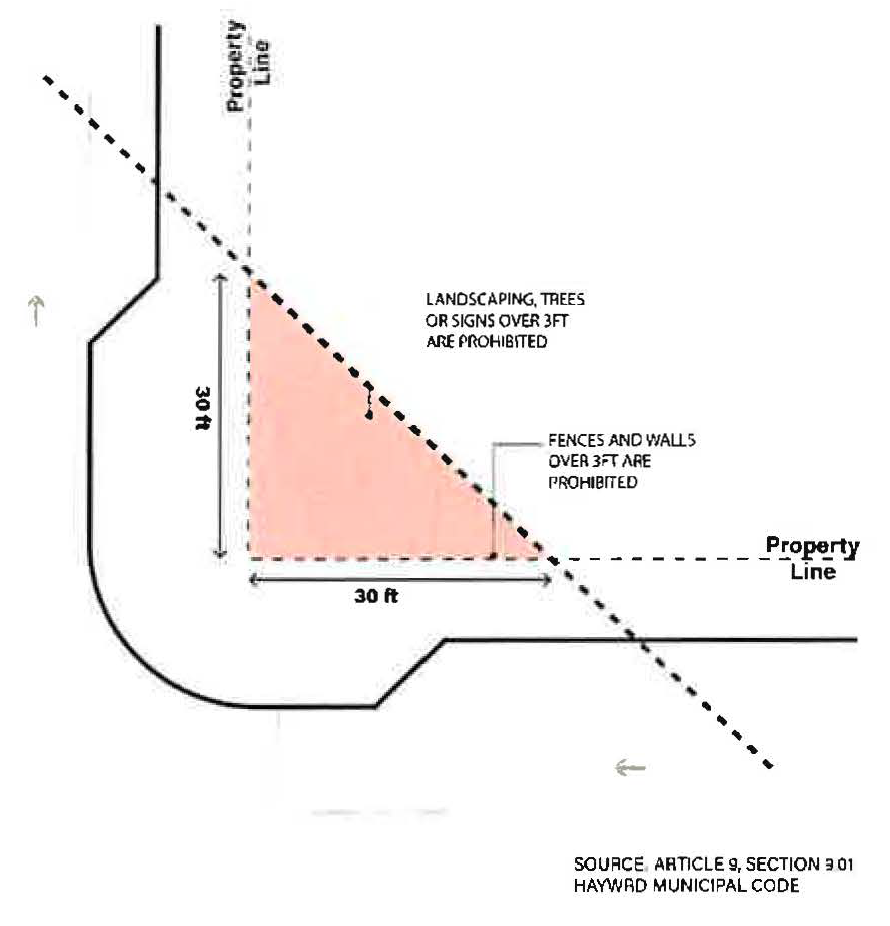
Where a lot is situated at the intersection of two or more streets, fences, hedges and walls exceeding 3 feet shall not be permitted within the triangle of visibility.
(2)
Barbed wire, razor, or electrified fences are prohibited.
(3)
Retaining Walls.
a)
Retaining walls which are not a part of building walls shall not exceed 6 feet in height as measured from finished grade elevation to top of wall.
b)
A maximum of two successive, approximately parallel retaining walls are permitted when they are separated by a minimum horizontal distance of 6 feet as measured between centerline of the walls.
c)
Any additional successive walls shall require a minimum of 15 feet separation.
d)
The sides of exposed exterior retaining walls that are visible from the public right-of-way, private streets and driveways, and private and public common open space shall be architecturally treated with colored concrete, plaster, stone veneer, brick, tile, natural stone, cultured stone, the same material as the primary residential building or an acceptable alternative as approved by the Planning Director. Alternatively, the exposed exterior retaining wall may be screened by landscaping that blocks 50 percent of the visible wall area at maturity.
e)
The Planning Director may administratively alter or waive any retaining wall requirement if there is evidence that no practical alternative exists, the purpose of these regulations will not be compromised, and no detrimental impact will result.
g.
Hillside Standards. Applicable to parcels located in the Hayward Hills, defined as east of Mission Boulevard and south of "D" Street. See Section 10-1.3500 for slope calculation formula. See Section 10-8.23 for additional requirements for development on slopes that exceed 20 percent.
(1)
Setbacks Abutting Permanent Open Space. All structures, including decks that exceed 12 inches in height, shall be setback a minimum of 30 feet from any rear property line and 10 feet from any side property line that abuts permanent open space, defined as land identified within a Habitat Conservation Plan or Natural Community Conservation Plan, land with a conservation easement, and/or regional park land.
(2)
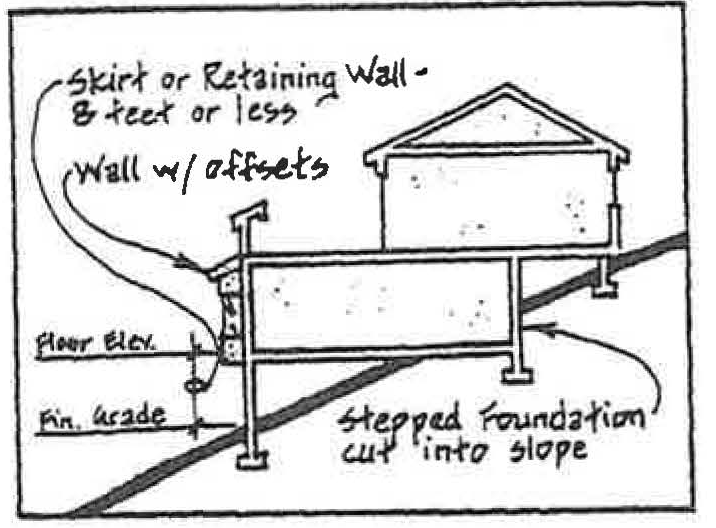
Slopes Equal to or Exceeding 15 Percent: Where the existing slope is equal to or exceeds 15 percent, dwellings shall exhibit a stepped design that preserves the natural slope by adhering to the following standards:
a)
At each point, the lowest floor of the structure shall not exceed eight feet above the adjacent exterior finished grade.
b)
Grading of areas to the side and rear of the building to create flat open spaces is not permitted on lots with an existing slope exceeding 25 percent.
h.
Landscaping.
(1)
Applicable to All Districts.
a)
Landscape Buffers. New development with building facades that are at least 15 feet taller than the tallest existing buildings on immediately abutting parcels, shall include a landscape buffer at least 12 feet wide between the new and existing buildings. The landscape buffer shall include 15-gallon evergreen trees that create a continuous tree canopy at maturity as defined by the Sunset Western Garden Book.
b)
Required front and street side yards shall be landscaped except for permitted driveways and walkways. At least 75 percent of the designated landscape areas shall be covered with live plants at maturity as defined by the Sunset Western Garden Book.
c)
Ground covering mulch shall not include gravel, decorative rock, decomposed granite or non-biodegradable materials.
d)
Edible fruit bearing or invasive root-system trees as defined by the Invasive Plant Council are prohibited in front or street side yards.
(2)
Applicable to RL and RNP Districts.
a)
A minimum of one 15-gallon-size tree shall be planted within the required front yard and side street yard of each lot.
b)
For a lot with more than 50 feet of street frontage, one tree shall be planted for every 50 feet or fraction thereof of frontage.
(3)
Applicable to RM and RH Districts.
a)
Street Trees. Street trees shall be planted along all street frontages at a minimum of one 24-inch box tree per 30 lineal feet of frontage or fraction thereof unless otherwise approved by the City Landscape Architect.
(4)
Landscaping Near BART or Railroad Track.
a)
Parcels abutting and in direct view from the BART or railroad track right-of-way shall include a minimum 10-foot wide landscape strip along the property line(s) abutting or in view from the BART or railroad track right-of-way.
b)
A minimum of one 15-gallon buffer tree shall be planted for every 20 lineal feet of property line.
i.
Lighting, Exterior. Exterior lighting shall be provided so that light is confined to the property and will not cast direct light or glare upon adjacent properties or public rights-of-way.
j.
Mailboxes. All residential developments shall locate mailboxes within one or more secured area(s) that cannot be accessed by the public, unless otherwise specified by the United States Postal Service. Detached residential subdivisions are excluded from this standard.
k.
Mechanical Equipment. All exterior mechanical and electrical equipment shall be screened or incorporated into the design of buildings so as not to be visible from public rights-of-way. Equipment to be screened includes, but is not limited to, all roof-mounted equipment, air conditioners and related equipment, emergency generators, utility meters, cable equipment, backflow preventers, irrigation control valves, electrical transformers, pull boxes, and ducting. Screening materials shall be consistent with the exterior colors and materials of the building.
(1)
All mechanical equipment shall be located outside the required front yard and at least 3 feet from all other property lines.
(2)
The Planning Director or other approving authority may waive this requirement where infeasible due to existing development or health and safety or utility requirements.
l.
Open Space. For developments with four or more residential units, a minimum of 150 square feet of open space is required per dwelling unit. Common use and/or private open space can be used to satisfy this requirement. Detached residential subdivisions with less than four units on each parcel are excluded from this requirement.
(1)
For a development with 21 or more units, 50 percent of the required open space shall be outdoors.
(2)
Required open space shall not include the required front or side street yard or exceed 5 percent slope.
(3)
Common use open space shall be available to all residents.
(4)
Private open space which is directly available to individual units shall adhere to the following requirements:
a)
Shall be at least 50 square feet in size and shall have no dimension less than 5 feet.
b)
Grade-level open space shall be screened from view by fencing or landscaping.
(5)
All new developments shall achieve the following point values for residential amenities, based on the total number of dwelling units in the project:
a)
Points for open space amenities shall be awarded in the following amounts. No partial points will be awarded for a partial amenity. Unless otherwise specified, points for each amenity type shall only be awarded once. If there are any outdoor amenities located on a rooftop, an additional 20 points shall be added to the total.
For amenities not listed, the Planning Director may assign point values based on similarities to listed amenities. The residential amenities may be used to satisfy the open space area requirement specified above.
m.
Projections into Yards.
(1)
Architectural features such as bay windows, chimneys, cornices, eaves, open or covered porches and entries, may extend 2 feet into any required side yard and 5 feet into any required front or rear yard.
(2)
Uncovered first floor landing places and outside open stairways may project 3 feet into any required yard, provided they do not exceed 6 feet in height (excluding railings) above ground level.
(3)
Uncovered second or third floor landing places and outside open stairways may project 3 feet into a required rear yard, but no closer than 5 feet to a side property line.
(4)
Balconies may extend 5 feet into any required front or rear yard.
n.
Separation Between Residential Units. If there are multiple detached residential units located on the same property, each unit shall be setback at least 10 feet from each other. The separation for ADUs may be reduced to 5 feet.
o.
Swimming Pools or Hot Tubs. May not be located in the required front or street side yard. All wall lines of a swimming pool or hot tub shall be setback 5 feet from any structure and from the side and rear property lines.
p.
Trash and Recycling Facilities.
(1)
Outdoor trash and recycling facilities shall be screened from view, utilizing a wood, metal, masonry, or landscape screening except where not visible to other residential units or from the street.
(2)
Shall be a maximum of 300 feet away from any residential building entrance, as measured by path of travel.
(3)
Trash and recycling facilities shall have covered roofs.
(Amended by Ordinance 24-01, adopted Jan. 23, 2024)
SEC. 10-1.205 - DETACHED RESIDENTIAL, DUPLEX, AND TRIPLEX MINIMUM DESIGN STANDARDS.
a.
Building Massing.
(1)
In the RNP and RL Districts.
a)
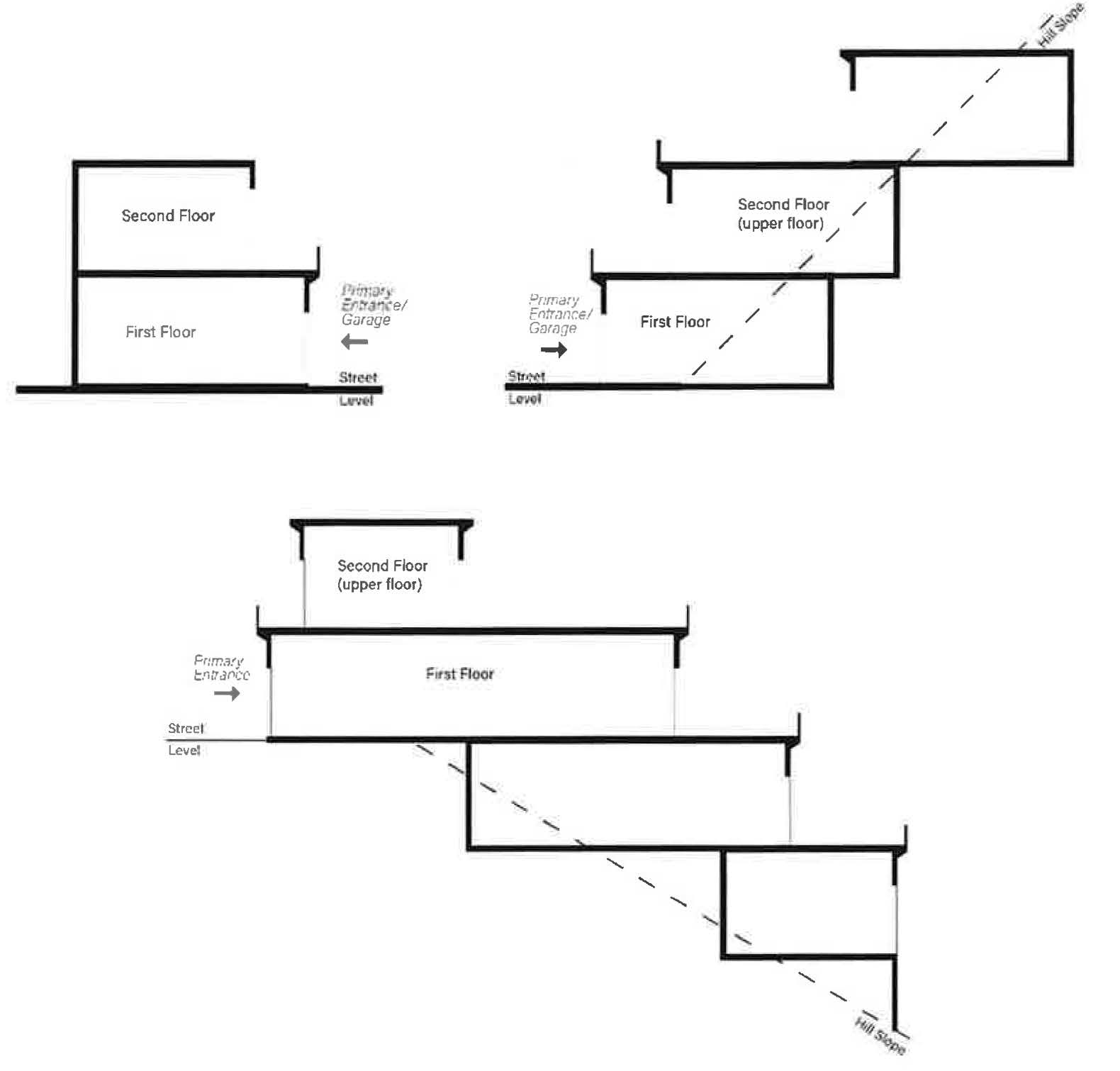
If the building is less than or equal to 3,000 gross square feet, the floor area of the second floor shall not exceed 80 percent of the gross floor area of the first floor.
b)
If the building is greater than 3,000 gross square feet, the floor area of the second floor shall not exceed 75 percent of the gross floor area of the first floor.
(2)
In the RM and RH Districts, the floor area of the third floor shall not exceed 80 percent of the gross floor area of the first floor.
(3)
For the purposes of this standard, the first floor shall be considered the floor where the garage is located. If the garage is detached from the primary structure or if there is no garage, the first floor shall be considered the floor where the primary entrance is located. The second and third floors shall be considered the floors above the first floor.
b.
Façade Design. All buildings, excluding accessory structures, shall incorporate a combination of any of the following design elements to achieve a minimum of 50 points. Partial points will not be awarded for partial design elements.
(Amended by Ordinance 24-01, adopted Jan. 23, 2024)
SEC. 10-1.206 - MULTI-UNIT RESIDENTIAL (4+ UNITS) MINIMUM DESIGN STANDARDS.
a.
Building Massing.
(1)
Floor area of the fourth and fifth stories each shall not exceed 85 percent of the gross floor area of the first floor. For the purposes of this standard, the first floor shall be considered the floor where the primary entrance is located. The upper floors (second, third, fourth, fifth) shall be considered the floors above the first floor.
(2)
Facades between 75 and 125 feet long shall have vertical breaks using recesses or projections of the facade plane that are at least 8 feet wide and 2 feet deep for the height of the structure at least once every 75 feet.
(3)
Facades that equal to or greater than 125 feet long shall have vertical breaks using recesses or projections that are at least 15 feet wide and 10 feet deep for the height of the structure at least once every 125 feet.
b.
Facade Design. All buildings, excluding accessory structures, shall incorporate a combination of any of the following design elements to achieve a minimum of 100 points for developments up to 10 dwelling units or a minimum of 125 points for developments with 11 or more dwelling units. Partial points will not be awarded to partial design elements.
(Amended by Ordinance 24-01, adopted Jan. 23, 2024)
SEC. 10-1.207 - NON-RESIDENTIAL DEVELOPMENT MINIMUM DESIGN AND PERFORMANCE STANDARDS.
For non-residential development refer to the Development Standards, Section 10-1.203 and the Minimum Design and Performance Standards contained in the Neighborhood Commercial District, Section 10-1.845. All non-residential development shall comply with the Hillside Design Guidelines.
(Amended by Ordinance 24-01, adopted Jan. 23, 2024)
SEC. 10-1.208 - PERFORMANCE STANDARDS APPLICABLE TO ALL DISTRICTS.
a.
Entrance Lighting. All building entrances shall be lit from dawn to dusk for high visibility of the building entrance and safety.
b.
Landscaping Maintenance.
(1)
After initial installation, all plantings shall be maintained in a reasonably weed-free and litter-free condition, including replacement where necessary, as determined by the Planning Director.
(2)
Required parking lot, buffer, front, and street side trees shall not be severely pruned, topped, pollarded, disfigured, or removed without issuance of a Tree Permit, as defined in the Tree Preservation Ordinance.
(Amended by Ordinance 24-01, adopted Jan. 23, 2024)
SEC. 10-1.209 - SITE PLAN REVIEW REQUIRED.
Site Plan Review approval shall be required before issuance of any building or construction permit only if the Planning Director determines that a project materially alters the appearance and character of the property or area, or may be incompatible with City policies, standards, and guidelines.
(Amended by Ordinance 24-01, adopted Jan. 23, 2024)

