
Hayward City Zoning Code
SEC. 10-1.3500
DEFINITIONS40
Note— Section 10-1.3510 amended by Ordinance 11-12, adopted October 11, 2011. Section 10-1.3500 amended by Ordinance 13-13, adopted November 19, 2013. Section 10-1.3500 amended by Ordinance 13-18, adopted December 17, 2013. Section 10-1.3500 amended by Ordinance 14-06, adopted February 4, 2014. Section 10-1.3510 amended by Ordinance 15-23, adopted October 13, 2015. Section 10-1.3510 amended by Ordinance 15-31, adopted December 1, 2015. Section 10-1.3500 amended by Ordinance 16-05, adopted January 19, 2016.
SEC. 10-1.3505 - GENERAL.
For the purposes hereof certain words and phrases are defined and certain provisions shall be construed as herein set out unless it shall be apparent from their context that a different meaning is intended.
SEC. 10-1.3510 - USES AND ACTIVITIES DEFINED.
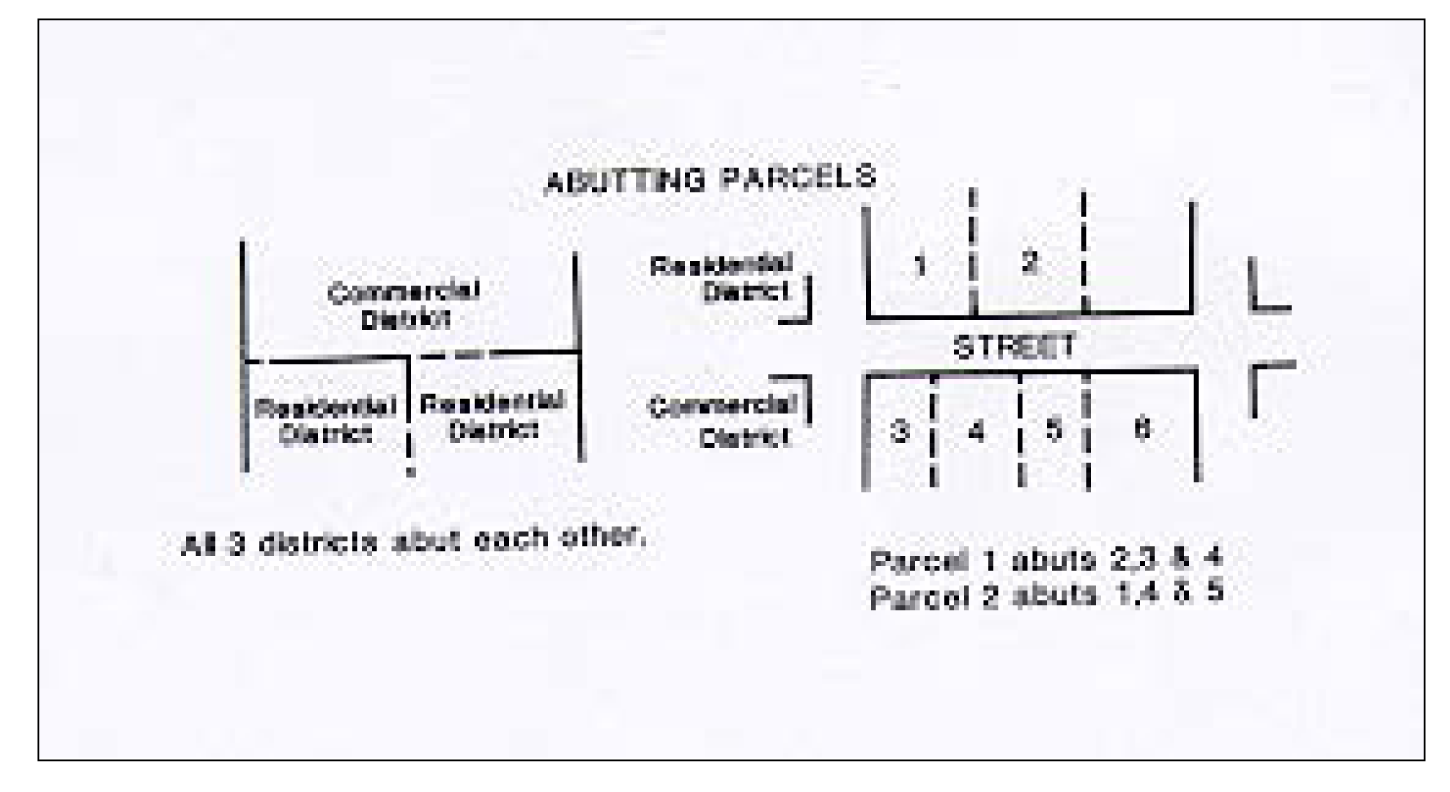
ABUTS, ABUTTING, ADJACENT. Having a common property line or district line or separated only by a private or public street, alley or easement.
ACCESS. Safe, adequate, usable, and legal ingress or egress to a property or use.
ACCESSORY BUILDING. A detached, subordinate building or structure, the use of which is subordinate, and incidental to a lawfully permitted principal use or main building on the same lot and not used for sleeping quarters.
ACCESSORY COMMERCIAL UNIT (ACU). A commercial use that is subordinate and incidental to a lawfully permitted principal use and contained within, detached from, or attached to a residential structure that is located on the same lot.
ACCESSORY USE. A use which is subordinate and incidental in height, bulk, volume and/or use to the lawfully permitted principal use on the same lot, and which does not alter the essential characteristics of said principal use and is in keeping with other uses permitted in the same district. Examples include:
a.
A garage, carport, shed, or building for domestic storage;
b.
A children's playhouse, gazebo, greenhouse, pool or recreation building;
c.
Storage of merchandise normally carried in stock on the same lot with any retail service or business use;
d.
Storage of goods used in or produced by manufacturing activities, on the same lot or parcel of ground with such activities; and
e.
Off-street parking.
AGRICULTURAL DISTRICT (A). A land use zoning district which preserves agricultural areas until such time as a change in zoning and land use designation occurs and orderly urban development may take place.
AGRICULTURE. The tilling of soil, horticulture, floriculture, viticulture, raising crops, livestock, farming, dairying, animal husbandry, including all uses customarily accessory and incidental thereto; but excluding slaughter houses, fertilizer works, bone yards, commercial feeding of garbage or offal to swine or other animals, or plants for the reduction of animal matter.
AIR TERMINAL DISTRICT (AT). A land use zoning district within which land uses may develop which provide commercial, industrial, and public land uses that are aviation-oriented. See Section 10-1.1900. This District includes the following Subdistricts:
a.
Air Terminal—Operations (AT-O)
b.
Air Terminal—Industrial Park (AT-IP)
c.
Air Terminal—Aviation Commercial (AT-AC)
d.
Air Terminal—Commercial (AT-C)
e.
Air Terminal—Recreational (AT-R)
f.
Air Terminal—Medium Density Residential (AT-RM)
ALLEY. A public way, less than 16 feet in width, but not less than 10 feet in width, which has been dedicated for public use.
ALTERATION. Any construction or physical change in the internal arrangement of rooms or the supporting members of a building or structure, or change in the appearance of any building or structure.
AMBULANCE SERVICE. Any business which provides a facility for emergency medical team staff members (EMTs), and which dispatches ambulances for emergency response. Usually located on major arterial streets where there is no detrimental impact to residential areas due to noise and parking.
AMUSEMENT FACILITY. See "RECREATIONAL FACILITY" or "COMMERCIAL AMUSEMENT FACILITY."
ANIMAL, EXOTIC. The words "exotic animal" shall mean any animals which are not customarily confined or maintained for domestic or commercial purposes and sometimes are kept as a pet or for display, including pot belly pigs, snakes, reptiles, emus, ostriches, or similar animals, as determined by the Planning Director based on criteria established by the State Department of Fish and Game.
ANIMAL, LIVESTOCK. See "LIVESTOCK."
ANIMAL, POULTRY. The word "poultry" shall mean domesticated birds customarily kept for eggs or meat, including chickens, turkeys, ducks, geese, or similar animals, as determined by the Planning Director.
ANIMAL FANCIER. A person or persons which use a lot, building, structure, enclosure or other premises to house and maintain more than four livestock animals (i.e., horses, goats), or more than four household pets (i.e., dogs or cats) up to 12 maximum, each of which is over the age of four months, for the following purposes:
a.
For showing in recognized shows (i.e., horse shows, dog shows, County Fair exhibits), or applicable obedience or field trials.
b.
For working or hunting.
c.
For improving the variety or breed with a view to exhibition in shows and trials.
d.
For household pets.
e.
Such activity requires an "Animal Fancier's Permit" from the City Animal Services Bureau. For the purposes hereof, the breeding and sale of a litter of animals kept and maintained as household pets and/or maintained by an animal fancier, shall not be deemed and considered a commercial kennel, provided they are less than one litter per year and litters do not occur every year.
ANIMAL HOSPITAL. Any buildings or portion thereof designed or used for the care, observation or treatment of cats, dogs or other household pets, with incidental boarding. (Also referred to as Veterinary Hospital)
ANIMAL, EXOTIC. Any animal, pure or hybrid, which is generally considered a non-domestic pet or livestock, that is poisonous; must be permitted by the State of California; has the propensity to be dangerous or aggressive to humans or other animals, is required to have an "Animal Fancier's Permit" from the City Animal Services Bureau.
ANTENNA. A device for transmitting or receiving radio, television, telecommunication, or any other transmitted signal. Usually mounted on a tower and/or rooftop. (Refer to Article 13, of Chapter 10 of the Hayward Municipal Code, the Antenna and Telecommunications Facilities Ordinance, for regulations of antennas, satellite dishes and telecommunications devices.)
ANTIQUE STORE. A store engaged in the retail sales of goods, primarily works of art, furniture, or decorative objects, having the qualities of age or long existence or indicative of a specific period of craftsmanship and design. An antique store may include the retail sales of "collectible" items, which are goods typically associated with a hobby (for example, stamps, Kewpie dolls, Roy Rogers memorabilia).
APIARY. The word "apiary" shall mean any premises where bees, hives, and related appliances are located. See General Regulations Section 10-1.2735.j. "Livestock, Apiaries, and Household Pets" for regulations.
APPLIANCE REPAIR SHOP. An establishment engaged in the servicing and repair of home appliances (washers, dryers, etc.), including electronic appliances (televisions, video cam recorders, stereos, computers, etc.), with all materials and goods maintained within a building.
APPLIANCE STORE. An establishment engaged in the retail sales of home appliances and electronic appliances. These may include but not be limited to washers, dryers, refrigerators, microwave ovens, stoves, televisions, video cam recorders, stereos, cellular phones, beepers, and computers. May include ancillary repair.
ARCHITECTURAL FEATURES. Architectural features include prominent elements on a building such as columns, beams, windows, doors, chimneys, cornices, arches, balconies, etc.
ARCHITECTURAL SERVICE. An office that is occupied by an architect and their support staff and services (i.e., blueprint machine, computers, etc.) Also refer to "ENGINEERING SERVICE" and DRAFTING SERVICE."
ART AND ART SUPPLIES STORE. An establishment engaged in the display and retail sales of art (i.e., paintings, sculpture) and art supplies (canvases, paints, easels, frames, etc.).
ARTISAN/CRAFT PRODUCTION. A manufacturer and/or assembler of small products primarily by hand or using low power machinery, including but not limited to clothing, furniture, jewelry, pottery and other ceramics, as well as small glass and metal art and craft products.
AUCTION. An establishment engaged in the public sale of commodities and/or property, excluding automobiles, to the highest bidder.
AUTOMOBILE BROKERAGE OFFICE. The business of engaging in, for a commission or fee, bargaining or negotiating between a potential purchaser of a vehicle(s) and another automobile sales establishment(s) for wholesale purchase of a vehicle(s). For purposes of this ordinance, an automobile brokerage office consists of an office with no display or storage of vehicles for sale other than a maximum of two spaces which may serve to temporarily store the vehicle(s) which has been already secured for the purchaser of the vehicle(s). May include motorcycles, mopeds or other similar vehicles.
AUTOMOBILE DISMANTLING FACILITY. An establishment engaged in taking apart vehicles for storage, retail, recycling, or wholesale purposes.
AUTOMOBILE PARTS STORE. An establishment engaged in the retail sales of a variety of parts for vehicles of any kind.
AUTOMOBILE RENTAL. An establishment engaged in the rental and leasing of new and used automobiles, trucks, trailers, motorcycles, mopeds, and recreation vehicles and supplies, including storage of said vehicles.
AUTOMOBILE REPAIR:
a.
Automobile Repair - Minor. Minor automotive servicing and replacement of parts for passenger automobiles and/or motorcycles, usually in the same day. Services include, but are not limited to, engine tune-up, lubrication, and tire, muffler, brake, and electrical. Subject to Outdoor Storage limitations and performance standards within applicable Zoning District.
b.
Automobile Repair - Major. Repair garages and specialty establishments for motorcycles, and passenger automobiles and trucks of all sizes, such as machine, tire, body and fender, auto glass, radiator, transmission, motor tune-up, vehicle upholstery, and muffler shops. May also include repair of machinery and equipment. Subject to Outdoor Storage limitations and performance standards within applicable Zoning District.
c.
Home repair - minor adjustments or the replacement of vehicle parts where such adjustments or replacement may reasonably be expected to be accomplished within a forty-eight (48) hour period. No permit is required for such minor adjustments or replacement. Also see Section 10-1.2735.q. "Vehicle Parking, Repair, Display and Storage Requirements."
AUTOMOBILE SALES. An establishment engaged in the retail sales and services of new and used automobiles, trucks, trailers, motorcycles, mopeds, and recreation vehicles and supplies. See INDUSTRIAL EQUIPMENT SALES AND RENTAL for farm or industrial equipment, machinery, and supplies.
AUTOMOBILE SERVICE STATION. A structure or area primarily designed and used for the retail sale of motor vehicle fuel and lubricants to the public by direct delivery into the user's vehicle and may include incidental motor vehicular services such as tire repair, battery charging, brake adjustment, motor tune-up and washing where no conveyor, blower or steam cleaning device is used. Sale of food, beverages and related items as determined by the Planning Director is permitted in conjunction with an automobile service station within commercial zoning districts.
AUTOMOBILE STORAGE FACILITY. An establishment engaged in the storage of passenger cars, trucks of all sizes, motorcycles, and/or similar vehicles inside a building. This definition does not include storage of used, inoperative, junked or other vehicles stored for salvage purposes and shall not include the wrecking, dismantling, or repairing of vehicles which is defined as AUTOMOBILE DISMANTLING FACILITY. See also AUTOMOBILE STORAGE YARD for automobile storage outside of a building.
AUTOMOBILE STORAGE YARD. Storage of passenger cars, trucks of all sizes, motorcycles, and/or similar vehicles outside of a building. Does not include towing yards. Such use shall not include the wrecking, dismantling, or repairing of vehicles which is defined as "AUTOMOBILE DISMANTLING FACILITY."
AUTOMOBILE TOWING YARD. An establishment engaged in towing motor vehicles, both local and long distance, and storage of such vehicles inside or outside of a building subject to applicable standards. for indeterminate periods of time. Such use shall not include the wrecking, dismantling, or repairing of vehicles which is defined as "AUTOMOBILE DISMANTLING FACILITY."
AUTOMOBILE WHOLESALE. A vehicle dealer who is exclusively involved in the sales of vehicles between licensed dealers and does not have any vehicles on-site. If a wholesale dealer does have vehicles on-site, see AUTOMOBILE STORAGE FACILITY if storing vehicles inside of a building or AUTOMOBILE STORAGE YARD if storing vehicles outside of a building.
BANK. See "FINANCIAL INSTITUTION."
BANQUET HALL. An establishment engaged in periodic events such as weddings, dances, and potlucks. Typically, it is rented out to private parties and/or special interest groups. Usually includes food preparation and/or serving, and live entertainment or recorded music.
BAR, COCKTAIL LOUNGE. Any on-sale alcohol-related establishment that engages primarily in the sale of alcoholic beverages and where food service, if any, is subordinate or incidental to the sale of alcoholic beverages. Bars include night clubs, taverns, pubs, cocktail lounges and similar establishments. Please see Section 10-1.2750 "Alcoholic Beverage Outlets" for regulations.
BARBER, BEAUTY SHOP. An establishment where hair is washed, cut, dyed, and/or styled. May include ancillary services such as manicures or pedicures. Does not include massage or tanning services.
BATCH PLANTS. Any operation that involves sorting, crushing, reducing, refining, mixing, packaging or other processing of minerals for intermediate or final consumption.
BED AND BREAKFAST. The use of an owner-occupied single-family residence for commercial lodging purposes.
BEDROOM. An enclosed space in a structure which is designed such that it could be used for sleeping purposes as determined by the Planning Director. A bedroom typically meets the room dimension requirements of the most recent edition of the Uniform Building Code, is not accessed directly from the garage, and has one or more windows.
BICYCLE SHOP. An establishment engaged in the retail sales and/or repair of bicycles. Does not include motorcycles or mopeds.
BOOKSTORE. An establishment engaged in the retail sales of books, either used and/or new. May include a small area for coffee and bakery items (10 percent or less of floor area).
BREWERY/WINERY/CIDERY. An establishment where malt liquors (beers), wines, alcoholic ciders, and/or kombuchas are manufactured and/or served. Please see Section 10-1.2750 "Alcoholic Beverage Outlets" for regulations regarding alcohol.
BROADCASTING STUDIO. An establishment where sound or images are transmitted by radio or television to the public.
BUILDABLE AREA. The space remaining on a zoning plot within which a building may be erected after the minimum lot and yard requirements of this Ordinance have been satisfied, notwithstanding all other applicable guidelines and Subdivision Map Act requirements of steeply sloped or unstable areas.
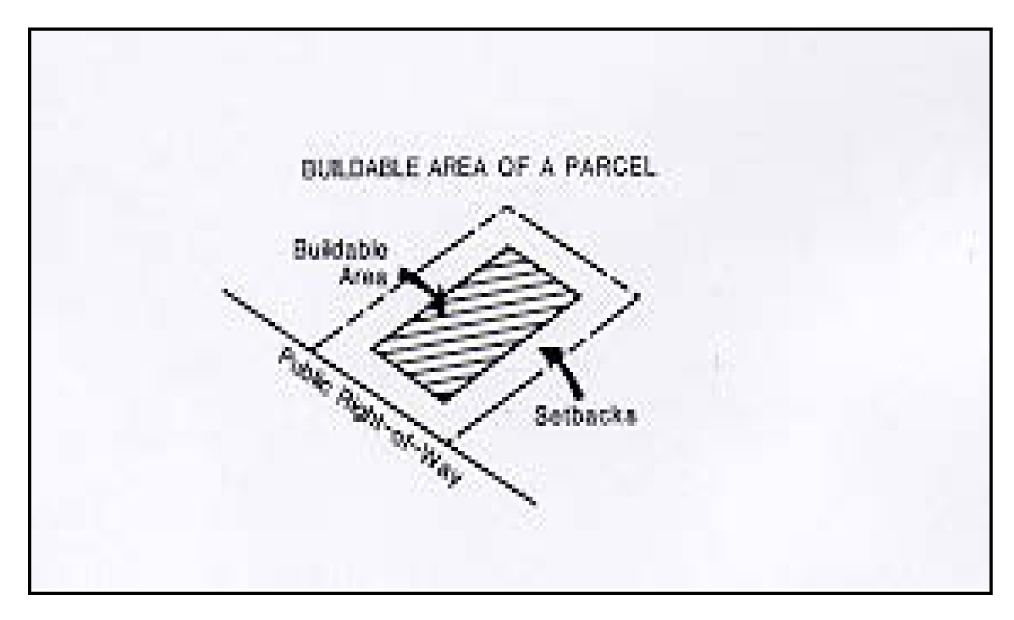
BUILDING. Any structure with substantial walls and roof securely affixed to the land and entirely separated on all sides from any other structure by space or by walls in which there are no communicating doors, windows or opening, and which is designed or intended for the shelter, enclosure or protection of persons, animals or property of any kind. Also defined as follows:
a.
"Completely enclosed building" means a building separated on all sides from the adjacent open space, or from other buildings or other structures, by a permanent roof and by exterior walls or party walls, pierced only by windows and normal entrance or exit doors.
b.
"Detached or accessory building" means a building separated by at least six feet of space open to the sky from any other building on the same zoning plot.
c.
"Existing building" means a building erected prior to the effective date of this title, or one for which a legal building permit has been issued.
d.
"Primary building" means a building in which is conducted the primary use of the lot on which it is situated.
e.
"Public building" means a building principally occupied by the federal, state, county, or city government, or any political subdivision agency, or instrumentally thereof.
f.
"Temporary building" means a building not permanently attached to the ground by fixed foundation, piers or substructure.
BUILDING HEIGHT. The vertical distance at any point from the finished grade or existing grade, whichever is lower, to the highest point of the coping of a flat roof, to the top roof line of a mansard roof, or to the midpoint of the highest gable of a pitched or hip roof. Where unusual deviations occur on the existing grade, such as a small swale, the Planning Director may make minor adjustments in the building height envelope to permit reasonable building design consistent with the intent and purpose of the building height standard. Graded area entirely under a building and not visible from the exterior of the building, such as underground garages and basements, shall not be included for purposes of calculating height.
BUILDING MATERIALS (SALES). An establishment engaged in the retail and wholesale sales and storage of building materials such as lumber, masonry products, rock, soil, tile, and other similar materials needed to construct a structure and/or accessory structures and uses (fences, paved areas, retaining walls).
CABARET. Any establishment, event or place where live entertainment is provided for a minimum of one hundred patrons or guests, including but not limited to: live music performances, acting, performing comedy or other acts or performances, either as the main purpose for such gathering or as an ancillary activity to some other purpose. Refer to Chapter 6, Article 2 of this Code for regulations regarding cabarets and to Section 10-1.2750 "Alcoholic Beverage Outlets" for regulations regarding alcohol.
CAMERA STORE. An establishment engaged in the retail sales of cameras and photographic supplies. May include ancillary repair.
CANNABIS. All parts of the plant Cannabis sativa Linnaeus, Cannabis indica, or Cannabis ruderalis, or any other strain or varietal of the genus Cannabis that may exist or hereafter be discovered or developed that has psychoactive or medicinal properties, whether growing or not, including the seeds thereof. "Cannabis" also means marijuana as defined by Section 11018 of the Health and Safety Code as enacted by Chapter 1407 of the Statutes of 1972, and amended by the California Control, Regulate and Tax Adult Use of Marijuana Initiative, and as defined by other applicable state law. "Cannabis" does not mean "industrial hemp" as defined by Section 11018.5 of the Health and Safety Code. Cannabis is classified as an agricultural product separately from other agricultural crops.
CANNABIS DELIVERY. The commercial transfer of cannabis or cannabis products to a customer, including medical cannabis or cannabis products, to a primary caregiver or qualified patient as defined in Section 11362.7 of the Health and Safety Code. "Delivery" also includes the use of any technology platform owned and controlled by a Cannabis Business Operator that enables clients or patients to arrange for or facilitate the commercial transfer by a permitted commercial cannabis retail dispensary.
CANOPY. The designated area(s) at a cannabis business, except nurseries and processors, that will contain mature plants at any point in time, as follows. For indoor cultivation, canopy is calculated in square feet and measured using the room boundaries, walls, or ceiling-to-floor partitions of each enclosed area that will contain mature plants at any point in time. If mature plants are being cultivated using a shelving system, the surface area of each level is included in the total canopy calculation.
CARD CLUB. Any building or structure, or any portion of a building or structure, wherein any person or persons are permitted to play a card game in return for a fee, charge, or other compensation. Refer to Chapter 4, Article 3 of the Hayward Municipal Code for regulations.
CARETAKERS QUARTERS. A dwelling unit located on an industrial or commercial property to be used exclusively as living quarters for the caretaker(s) of the subject property.
CARNIVAL. An establishment providing one or more non-coin-operated powered amusement rides, or providing two or more uses such as a tent, a feat of daring, or an exhibition of two or more wild animals except within a public park or zoo, or providing other similar uses.
CARPET/DRAPERY STORE. An establishment engaged in the retail or wholesale sales of carpets and drapes. Does not include on-site manufacturing.
CARPORT. A permanent roofed structure not completely enclosed on the sides and used for vehicle parking.
CAR WASH. An establishment engaged in the washing of passenger vehicles for a fee.
CATERING FACILITY. An establishment engaged in the preparation of food to be served at an event held off-site, usually at a banquet hall or private facility, and establishments primarily engaged in the preparation of prepared food items in individual servings for off-premise consumption and/or sale by others. Typical uses include caterers, wholesale bakeries, commissary kitchens, and specialty food packaging and/or processing shops.
CENTRAL BUSINESS DISTRICT (CB). A land use zoning district within which commercial and retail land uses may develop which provide a secondary commercial area of regional importance. See Section 10-1.800.
CENTRAL CITY DISTRICT (CC). A land use zoning district in the center of the City, within which land uses may develop which promote the development of the downtown. These land uses include business, government, cultural, financial, residential, office, and entertainment uses. See Section 10-1.1500. This District includes the following Subdistricts:
a.
Central City—Commercial (CC-C).
b.
Central City—Residential (CC-R).
c.
Central City—Plaza (CC-P).
CHECK CASHING STORE. An establishment primarily engaged in the cashing of checks for customers who usually do not have a checking account at a bank or other financial institution. Is commonly found in areas with easy access and high visibility.
CHRISTMAS TREE AND PUMPKIN PATCH LOTS. Seasonal establishments engaged in the retail sales of Christmas trees and pumpkins. See Section 10-1.2735.n. for standards.
CITY COUNCIL. The City Council of the City of Hayward, California.
CLOTHING STORE ("APPAREL"). An establishment engaged in the retail sales of new clothing, such as shoes, hats, dresses, shirts, etc. For used clothing, see "THRIFT STORE."
COMMERCIAL AMUSEMENT FACILITY. A facility offering entertainment open to the public for a fee or by membership subscription, for example, ticket, door charge, amusement device fee. Said facility shall include, but not be limited to, internet access usage, theaters, arcades (place of business containing five or more amusement devices), billiard parlors, golf courses (including miniature golf), water slides, indoor soccer, batting cages, and bowling facilities. Four (4) or less manually or coin- or token- or slug-operated viewing or electronic or video game machines or other amusement devices (excluding jukeboxes) located in association with other permitted uses and activities such as, but not limited to, taverns, restaurants, book stores, grocery stores, motels, hobby shops or toy stores, music or stereo stores, laundromats, barber or beauty shops, or computer stores shall be considered accessory to the permitted use. Under no circumstance, as a primary, permitted or accessory use, shall any Commercial Amusement Facility be allowed to operate Simulated Gambling Devices as defined in the City's Municipal Code. (See HMC Chapter 4, Article 16.)
COMMERCIAL CANNABIS BUSINESS. An entity engaged in the cultivation, possession, manufacture, distribution, processing, storing, laboratory testing, packaging, labeling, transportation, delivery or sale of cannabis and cannabis products for commercial purposes.
COMMERCIAL CANNABIS CULTIVATION. Any activity involving the planting, growing, harvesting, drying, curing, grading, or trimming of cannabis.
COMMERCIAL CANNABIS DISTRIBUTION. The procurement, sale, and transport of medical and non-medical adult recreational use cannabis and medical and non-medical adult recreational use cannabis products between commercial cannabis businesses.
COMMERCIAL CANNABIS MANUFACTURING. The production, preparation, propagation, or compounding of cannabis or cannabis products either directly or indirectly or by extraction methods, or independently by mean of chemical synthesis, or by a combination of extraction and chemical synthesis at a fixed location that packages or repackages cannabis or cannabis products or labels or relabels its container.
COMMERCIAL CANNABIS MANUFACTURING - LEVEL 1. The manufacturing of cannabis products primarily using nonvolatile solvents, or no solvents.
COMMERCIAL CANNABIS MANUFACTURING - LEVEL 2. The manufacturing of cannabis products using volatile solvents For purposes of this section, "volatile solvents" shall include all solvents described in paragraph (3) of subdivision (d) of Section 11362.3 of the Health and Safety Code, as such section may be amended.
COMMERCIAL CANNABIS MICROBUSINESS. A commercial cannabis business holding a license issued by the State Bureau of Cannabis Control for the cultivation of cannabis on an area less than 10,000 square feet and to act as a licensed distributor, Level 1 manufacturer, and retailer pursuant to Business and Professions Code sections 26050 and 26070. In order to be defined as a microbusiness, an operator must engage in three of the four listed activities.
COMMERCIAL CANNABIS OPERATOR or OPERATOR. The person or entity that is engaged in the conduct of any commercial medical or non-medical adult recreational cannabis use.
COMMERCIAL CANNABIS RETAIL DISPENSARY. A facility where commercial cannabis or commercial cannabis products are offered, either individually or in any combination, for retail sale, including an establishment that delivers medical and non-medical adult recreational use cannabis or medical and non-medical adult recreational use cannabis products as part of a retail sale.
COMMERCIAL CANNABIS TESTING LABORATORY. A laboratory, facility, or entity in the state that offers or performs tests of medical cannabis or medical cannabis products and that is both of the following:
(1)
Accredited by an accrediting body that is independent from all other persons involved in commercial cannabis activity in the state.
(2)
Licensed by the Bureau of Cannabis Control.
COMMERCIAL OFFICE (CO). A land use zoning district within which administrative, professional, businesses and financial office land uses may exist, yet which are not detrimental to the residential use of adjacent properties. See Section 10-1.800.
CONCESSION STAND. A small, ancillary retail use that provides food and beverages to a primary land use. May include light cooking and heating of food commodities.
CONSIGNMENT STORE. A retail establishment that sells good quality merchandise (for example, clean, not damaged, stained or frayed) that has been provided to the proprietor on a consignment basis as well as new merchandise. Sale of donated or otherwise second-hand merchandise is prohibited.
CONSTRUCTION TRAILER. A temporary trailer used as an office, or an office/quarters combination with quarters for one security guard in connection with ongoing construction work associated with new construction of industrial, commercial, or multi-family development. See Section 10-1.2735.
CONTRACTOR SERVICES. An establishment providing general contracting and/or building construction services for other uses. This use classification includes general building, plumbing, electrical, air conditioning, carpentry, and other trade contractors.
CONVALESCENT FACILITY. A State-licensed facility in which nursing, dietary and other personal services are furnished to children, adolescents, adults or elderly persons who are unable to care for themselves. The use may include day programs up to 24-hour care including residential services. Uses may include nursing homes and intermediate care facilities. Does not include Hospitals, Group Homes, Transitional or Supportive Housing which are defined separately.
CONVENIENCE MARKET. A retail food market which is typically less than 2,500 square feet in gross floor area and which caters to customers who buy a small number of items, is typically part of a larger chain or franchise system, often with long hours of operation, and as determined by the Planning Director.
COPYING OR REPRODUCTION FACILITY. An establishment which provides printing services to customers. Typically includes blueprint machines, reproduction machines, paper goods, and binding services (spiral binding, glue binding, stapling, etc.), and may include as an ancillary use, access to the internet. Under no circumstance, as a primary, permitted or accessory use, shall any Copy or Reproduction Service be allowed to operate Simulated Gambling Devices as defined in the City's Municipal Code. (See HMC Chapter 4, Article 16.)
COURTYARD. The word "courtyard" shall mean an open unoccupied space bounded on two or more sides by the walls of a building. An inner courtyard is a court entirely within the exterior walls of a building. All other courts are outer courts.
CULTURAL FACILITY. Facilities maintained to develop, promote, or foster the arts, literature, and/or community building. This includes clubhouses, lodge halls, society meeting places, community centers and similar facilities as determined by the Planning Director. These facilities may be rented out for events from time to time as an ancillary activity, but these events must end by 11:00 p.m. Otherwise, refer to "BANQUET HALL".
DANCE STUDIO. Refer to "RECREATIONAL FACILITY".
DATA CENTER. A facility containing one or more large-scale computer systems used for data storage and processing for off-site users. Typical supporting equipment includes back-up batteries and power generators, cooling units, fire suppression systems, and enhanced security features.
DAY CARE CENTER. A facility which provides non-medical care to 15 or more children and/or adults in need of personal services, supervision, or assistance essential for sustaining the activities of daily living or for the protection of the individual on less than a 24-hour basis. May include pre-schools, infant centers, and extended day care facilities.
DAY CARE HOME. A residence which is occupied and used as such and provides non-medical day care on less than a 24-hour basis to no more than 14 children and/or adults, including any children under the age of 10 years who reside at the home. Day care home must be State-licensed.
DISTILLERY. An alcoholic beverage sales establishment where distilled spirits are made. Tasting distilled spirits may be included as an accessory use, but the distillery cannot operate as a bar. Please see Section 10-1.2750 "Alcoholic Beverage Outlets" for regulations regarding alcohol.
DISTRICT. A zoning district established under the provisions of the Zoning Ordinance.
DORMITORY. A residence hall providing sleeping units, bathrooms, study and recreation rooms and a common kitchen only for students of a primary school, secondary school or college.
DRAFTING SERVICE. An establishment which performs drafting services such as drawing of site plans or construction drawings of buildings. Is usually accompanied by drafting tables and blueprinting machines. Also refer to "ARCHITECTURAL SERVICE" and "ENGINEERING SERVICE."
DRIVE-IN ESTABLISHMENT. An establishment which accommodates the patrons' and their motor vehicles from which the occupants may watch, purchase or receive goods or services (i.e., a drive-through restaurant, drive-through coffee shop, drive-in theater, drive-up photo finishing, car wash, gas station, mini-mart with gas, automobile lubrication facility, etc.).
DRY CLEANER/LAUNDRY. A dry cleaner/laundry is open to the general public for dry cleaning/laundry purposes. For purposes of this ordinance, a dry cleaner/laundry excludes a dry cleaning/laundry plant which serves solely to dry clean clothing processed for other dry cleaners and not open to the general public.
DWELLING UNIT/RESIDENTIAL UNIT. One or more rooms with a single kitchen, arranged, designed, used, or intended to be used exclusively for permanent living and sleeping purposes. Includes Supportive and Transitional Housing as defined in Section 50675.2 (h-i) of California Health and Safety Code, as amended. Other definitions include the following:
a.
Accessory Dwelling Unit: An attached or a detached residential dwelling unit that provides complete independent living facilities for one or more persons and is located on a lot with a proposed or existing primary residence. It shall include permanent provisions for living, sleeping, eating, cooking, and sanitation on the same parcel as the single-family or multifamily dwelling is or will be situated.
b.
Detached Residential Unit: A detached building containing only one dwelling unit. See Section 10-1.200 for requirements.
c.
Duplex: A residential building with two attached dwelling units. See Section 10-1.200 for requirements.
d.
Multi-Unit Residential (4+ attached units): A residential building with four or more attached dwelling units. See Section 10-1.200 for requirements.
e.
Townhouse: A Duplex, Triplex, or Multi-Unit Residential (4+ attached units) building for which there is a subdivision map. Townhouse ownership includes the building, the land beneath the building and typically a patio or small yard adjacent to the structure. The remaining land within the development is under common ownership. See Section 10-1.2400 for requirements.
f.
Triplex: A residential building with three attached dwelling units. See Section 10-1.200 for requirements.
g.
Supportive Housing: Housing with no limit on length of stay, that is occupied by the target population, and that is linked to onsite or offsite services that assist the supportive housing resident in retaining the housing, improving their health status, and maximizing their ability to live and, when possible, work in the community.
h.
Transitional Housing: Buildings configured as rental housing developments but operated under program requirements that call for the termination of assistance and recirculation of the assisted unit to another eligible program recipient at some predetermined future point in time, which shall be no less than six months.
EDIBLE CANNABIS PRODUCT. A cannabis product that is intended to be used, in whole or in part, for human consumption, including, but not limited to, chewing gum, but excluding products set forth in Division 15 (commencing with Section 32501) of the Food and Agricultural Code. An edible cannabis product is not considered food, as defined by Section 109935 of the Health and Safety Code, or a drug, as defined by Section 109925 of the Health and Safety Code.
EDUCATIONAL FACILITY. Facilities maintained to provide instruction to students for the purpose of developing their faculties and powers, and ancillary activities as determined by the Planning Director, and whose other functions are not indicated elsewhere in this ordinance as administrative or conditional uses. May include trade schools, a beauty college, or business college.
ELECTRIC VEHICLE (EV) CHARGING STATION. A structure or area that provides electricity to recharge the batteries of electric vehicles as a primary use. Sale of food, beverages and related items as determined by the Planning Director is permitted. Overnight lodging is not permitted.
EMERGENCY SHELTER. An institution that provides shelter for individuals and families experiencing homelessness with no limitation on the length of stay. Such use may also provide meals and supportive social services.
ENGINEERING SERVICES. An establishment which provides engineering services (i.e., structural calculations, construction drawings, consultation, etc.). Usually includes office and drafting equipment, including blueprint machines. Also refer to "ARCHITECTURAL SERVICES" and "DRAFTING SERVICES."
ENTERTAINMENT, LIVE. An activity, event or presentation that is incidental to the principal use of a site, and designed to amuse or attract the attention of patrons or guests observing the presentation or activity. Refer to Section 10-1.2735(i) for regulations regarding Limited Entertainment Permits and Section 6-2.10 et al for regulations regarding Cabaret.
ENTERTAINMENT FACILITY. A facility offering entertainment open to the public for a fee or by membership subscription including, but not limited to, theaters, live performance venues, and music venues.
ENVIRONMENTAL DOCUMENT. Information within a written document which evaluates the environmental effects of a proposed project as required by the current City of Hayward and the California Environmental Quality Act (CEQA) environmental review guidelines.
ESTABLISHMENT. A separate place of business having the following characteristics:
a.
The ownership and management of all operations conducted within such establishment is separate and distinct from the ownership and management of operations conducted within other establishment(s) on the same or adjacent site;
b.
Direct public access is separate and distinct from direct access to any other business establishment;
c.
There is no direct public access from within such establishment to any other such establishment.
EQUIPMENT RENTAL SERVICE. An establishment which rents non-industrial machinery and equipment for a fee. May also include minor repair of equipment. See also INDUSTRIAL EQUIPMENT SALES AND RENTAL.
EXTRACTION. A process by which cannabinoids are separated from cannabis plant material through chemical, physical, or any other means.
FABRIC STORE. An establishment which offers such commodities as fabrics, threads, and other sewing notions for sale at retail. Usually includes retail sales of sewing machines and craft items (silk-screening equipment, fabric paint, needlepoint materials, ribbons, etc.) and may include classes associated with the use of these commodities.
FACADE. The exterior wall of a building along with its associated windows, entryways, and projections.
FARMER'S MARKET. A periodic event where fresh produce, flowers, and handmade craft items are sold at retail. Typically held in a downtown area, outside.
FENCE. A linear structure constructed or erected to a maximum height of 6 feet unless otherwise provided herein, and which requires permanent location on the ground or is attached to something having location on the ground. Building materials used for a fence may include but are not limited to boards, bricks, wrought iron, chain link, or blocks, and do not include landscaping, such as hedges, bamboo sticks or bushes, and trees.
FENCE, HEIGHT OF. A height measured from ground level (or top of retaining wall) to top of fence. On sloping sites with a stepped fence, height may be measured at the midpoint of each fence section.
FINANCIAL INSTITUTION. An establishment which provides services to meet the financial needs of its customers (i.e., checking account services, mortgage broker services, etc.). Also refer to "CHECK CASHING STORE."
FIREARMS SALES. A person or entity engaged in the business of selling, transferring, or leasing; or advertising for sale, transfer, or lease, or offering or exposing for sale, transfer, or lease, any firearm and/or ammunition, either directly or indirectly; and/or engaged in the retail sale of ammunition, as defined in Hayward Municipal Code Section 6-11.01(d).
FLEA MARKET. One or more vendors selling new or used merchandise at retail, within a structure or open air setting where no individual building walls separate uses, or where sales areas are within stalls which are smaller in size than typical retail spaces, and that the character of the business is that typically associated with a flea market, and as determined by the Planning Director.
FLOOD PLAN (FP). A land use zoning district within which land is subject to tidal or flood water inundation. See Section 10-1.2100.
FLOOR AREA, GROSS. The area included within the surrounding walls of a building or portion thereof, exclusive of vent shaft, eaves, overhangs, atriums, covered entries and courts and any portion of a structure above ground used for parking, parking aisles or loading areas. For residential development, interior parking garages, parking aisles, and loading areas are included in the gross floor area calculation.
FLORAL SHOP. An establishment which provides flowers and floral arrangements at retail. Usually includes refrigeration units to keep flowers fresh, and delivery vans.
FOOD VENDOR. The vending of food or beverages from a movable cart-type stand or vehicle which is located on the same lot as a permitted use in a zone that allows for such operation, and subject to the standards and process set forth in HMC Section 10-2700, General Regulations.
FRONTAGE. See "LOT FRONTAGE."
FURNITURE STORE. An establishment engaged in the retail sales furnishings. These usually include chairs, tables, couches, beds, and accessories for the home. All activities occur within an enclosed structure.
GARAGE. A fully enclosed and covered attached or detached structure accessory to a residential use intended for storage of one or more motor vehicles used by the occupants of the premises; which does not have any permanent obstructions that would prevent vehicles parking within; which has garage doors that are operable; and which does not have rugs, linoleum or other non-fire-resistant coverings on the floor. For purposes of determining the existence of a one or two car garage, the minimum dimensions of an existing single-car garage wherein no permanent obstructions may occur is 10' wide × 19' deep, and the minimum dimensions of an existing double-car garage in wherein no permanent obstructions may occur is 18' wide by 19' deep. For purposes of this ordinance a garage of any dimension shall not be used as a habitable space. Construction of new garages shall have minimum interior dimensions of 11' wide × 19' deep for single-car garages and 20' wide × 19' deep for double-car garages.
GARDEN SUPPLIES STORE. An establishment which provides supplies for gardening at retail. This usually includes flower and vegetable seeds, fresh flowers and vegetable plants, grass sod, soil, and tools, and typically includes a screened-in outdoor display and servicing area.
GENERAL COMMERCIAL DISTRICT (CG). A land use zoning district within which general commercial and retail land uses may develop. See Section 10-1.800.
GOLF COURSE. A publicly or privately owned area of land laid out for the game of golf with a series of 9 or 18 holes each. Usually includes a club house and maintenance building. May include retail sales relating to golf (pro-shop) and a restaurant/bar.
GRADE. The degree of rise or descent of a sloping surface (also see "SLOPE").
a.
Finished Grade. The final elevation of the ground surface after completion of all site preparation work or after development.
b.
Existing grade. The ground elevation prior to grading for construction. Where walls are parallel to and within five feet of a sidewalk, the above-ground level grade shall be measured at the sidewalk.
GRANNY OR IN-LAW UNIT. See "SECOND DWELLING, ATTACHED."
GREENHOUSE. A permanent enclosed structure for the propagation and growing of plants, constructed with a translucent roof and/or walls.
GROUP HOME. The use of any single-family residence or other dwelling unit on a single lot for a group residence where residents pay a fee or other consideration to the Group Home operator in return for residential accommodations. A Group Home includes a boarding home, a rooming house, as well as a group residence for the elderly, or mentally or physically disabled or handicapped persons, or other persons in need of care and supervision.
a.
Licensed Group Home. A licensed Group Home is any group home subject to State licensing requirements pursuant to the California Health and Safety Code (HSC), implementing State regulations, and amendments thereto. Group Homes subject to State licensing requirements including a Residential Community Care Facility (HSC section 1502), a Residential Care Facility for the Elderly (HSC section 1569.2) and an alcoholism or drug abuse recovery or treatment facility (HSC section 11834.02) as amended. Congregate Living Health Facility (HSC section 1250(i)), an Intermediate Care Facility/Developmentally Disabled Habilitative (HSC section 1250(e), an Intermediate Care Facility/Developmentally Disabled (HSC section 1250(g)), and an Intermediate Care Facility/Developmentally Disabled-Nursing (HSC section 1250(h)) as amended.
(1)
Small Licensed Group Home. A licensed group home for up to 8 residents, excluding staff.
(2)
Medium Licensed Group Home. A licensed group home for at least 9 but no more than 14 residents, excluding staff.
(3)
Large Licensed Group Home. A licensed home for 15 or more residents, excluding staff.
b.
Unlicensed Group Home. An unlicensed Group Home is any group home not subject to State Licensing requirements and regulations. Any Group Home which is subject to State licensing requirements shall be treated as an unlicensed Group Home if the facility's license has expired or such license has been suspended, revoked or terminated.
(1)
Small Unlicensed Group Home. An unlicensed group home for up to 6 residents, excluding staff.
(2)
Large Unlicensed Group Home. An unlicensed group home for 7 or more residents, excluding staff.
GUN SHOP. See "FIREARMS SALES."
HARDWARE STORE. An establishment which provides a variety of supplies and materials used for small construction or repair projects, at retail.
HAZARDOUS MATERIAL. A gas, material, or substance capable of posing a risk to health, safety, or property; provided, however, use of hazardous materials contained in consumer-sized containers purchased solely for on-site maintenance activities shall not be considered a hazardous materials use for the purpose of these regulations. The Fire Chief or his or her designee has the exclusive authority to develop and apply regulations which determine which, if any of the Group A, B, or C and included categories utilized in the Industrial District regulations is applicable to a user of any hazardous materials; such regulations may include reference to federal and state law, standards, and regulations applicable to hazardous materials. The Fire Chief or his or her designee also has the exclusive authority in conjunction with the Planning Division to exclude or reduce the category of prescribed Conditional or Administrative Uses in the Zoning Ordinance when it is found that the quantities are minor or additional mitigations are found to be acceptable.
Hazardous materials which belong to more than one group or category shall be subject to the most stringent regulations. In addition to the following classifications please refer to specific Zoning Districts for hazardous materials land use requirements.
a.
Group A. Hazardous materials which include any of the following:
(1)
Explosives and blasting agents;
(2)
Reactive materials;
(3)
Unstable materials;
(4)
Radioactive materials;
(5)
Class 3 and 4 oxidizing materials;
(6)
Poisonous or highly toxic materials;
(7)
Corrosive, poisonous, or unstable gases;
(8)
State of California restricted hazardous wastes, including substances classified as extremely hazardous wastes.
b.
Group B. Hazardous materials which include any of the following:
(1)
Flammable liquids, namely liquids that have a flashpoint below 100° Fahrenheit;
(2)
Flammable solids;
(3)
Class 1 and 2 oxidizing materials;
(4)
Flammable or oxidizing gases;
(5)
Corrosive materials.
c.
Group C. Hazardous materials which include any of the following:
(1)
Combustible liquids, namely liquids that have a flashpoint at or above 100° Fahrenheit.
(2)
Inert gases.
(3)
Other regulated materials referred to in the following sources except Group A or B hazardous materials:
i)
California Fire Code as adopted by the City of Hayward;
ii)
49 Code of Federal Regulations section 173.500, including amendments or successors thereto; and
iii)
Hayward Municipal Code Section 3-8.06 except those materials exempted by Hayward Municipal Code Section 3-8.07, including amendments or successors to such provisions.
HEALTH CLUB. An establishment which provides physical fitness equipment, classes, and facilities such as racquetball and tennis courts and/or swimming pools for patrons to use for a fee. (Also see "PHYSICAL FITNESS STUDIO" for a smaller version of this type of facility.)
HIGH DENSITY RESIDENTIAL DISTRICT (RH). A land use zoning district which allows the development of multiple-family dwellings at a high density. See Section 10-1.200.
HOME OCCUPATION. Any occupation conducted within the living area of a dwelling unit by persons residing therein, which use is clearly incidental and secondary to the use of the dwelling for dwelling purposes and does not change the residential character thereof. For purposes of this ordinance, a licensed Group Home shall not be considered a "home occupation." A home occupation shall comply with the following standards:
a.
Does not use any yard space, or conduct activity outside of the dwelling unit;
b.
Does not generate a character and volume of vehicular traffic not normally associated with residential use;
c.
Does not involve the use of more than 10 percent or more than 200 square feet of floor area of the dwelling unit, whichever is less;
d.
Does not display signs, other than on a non-commercial vehicle, or other matter which would indicate a business is operating within the home;
e.
Does not allow for more than two customers/clients to visit the home each day and customers/clients are limited to visiting the house between the hours of 8:00 a.m. and 9:00 p.m.; and
f.
Where no employees, other than residents of the home, come to or work from the home.
HOME OCCUPATION - EXPANDED. An expansion of the provisions of or variance to a home occupation as defined above regarding numbers of customers, hours of operation, sale of commodities produced on the premises (excluding sale of guns), and minor repair only.
HOMELESS. An individual that meets the definition of homeless as defined by United States Code of Federal Regulations Title 24 Section 578.3, as amended.
HOSPITAL. An institution devoted primarily to the maintenance and operation of facilities for the medical or surgical care of patients for twenty-four hours or more. The term "hospital," as used in this title, does not apply to institutions operating solely for the treatment of mentally ill persons, drug addicts, liquor addicts, or other types of cases necessitating confinement of patients, and the term "hospital" shall not be used for convalescent, nursing, shelter or boarding homes.
HOTEL. A building where lodging with or without meals is provided to the general public for compensation typically on a nightly basis, and where no provision is made for cooking in any individual guest room or suite, and where a maximum continuous length of stay is no longer then that established for transiency pursuant to Chapter 8, Article 4 (Transient Occupancy Tax) of the City of Hayward Municipal Code, but shall not include institutions where human being are detained under legal restraint.
Extended Lodging Facilities, where kitchens, kitchenettes or other cooking facilities may be permitted within individual guest rooms, are allowed in any Zoning District where Hotels are permitted, subject to the following standards:
a.
Each guestroom shall be provided with voicemail, dataports, desk, color television, alarm clock or wake up service. Irons and ironing boards must also be made available to guests upon request.
b.
Self-service laundry facilities shall be accessible to all guests.
c.
Recreational facilities such as pool, whirlpool/spa/ and/or fitness room shall be provided.
d.
A 24-hour per day on-site supervisor shall be provided.
e.
Housekeeping services including cleaning and linen service shall be offered on a regular basis to every guestroom.
f.
Extended Lodging Facilities cannot be used for long term occupancy (i.e. apartments, care facilities, boarding houses, etc.). Leases of any duration are prohibited.
g.
Extended Lodging Facilities may have a maximum continuous length of stay no longer than that established for transiency pursuant to Chapter 8, Article 4 (Transient Occupancy Tax) of the City of Hayward Municipal Code.
HOUSEHOLD PETS. See "PETS, HOUSEHOLD."
HOUSING FOR INDIVIDUALS WITH DISABILITIES. Any housing intended to benefit, in whole or in part, persons identified as having functional needs relating to any of the following:
a.
Mental health.
b.
Physical disabilities.
c.
Developmental disabilities, including, but not limited to, intellectual disability, cerebral palsy, epilepsy, and autism.
INDUSTRIAL EQUIPMENT SALES RENTAL AND SERVICE. An establishment which provides industrial equipment and related commodities to the public for sale or rental, and servicing of that equipment. Such equipment may include large scale vehicles, large truck and trailer rigs, fork lifts, conveyor belts, and loading dock facilities.
INDUSTRIAL HEMP or HEMP. An agricultural product, whether growing or not, that is limited to types of the plant Cannabis sativa L. and any part of that plant, including the seeds of the plant and all derivatives, extracts, the resin extracted from any part of the plant, cannabinoids, isomers, acids, salts, and salts of isomers, with a delta-9 tetrahydrocannabinol concentration of no more than 0.3 percent on a dry weight basis.
INDUSTRIAL/VOCATIONAL TRADE SCHOOL. A trade school that provides specialized training of skilled labor including plumbing, carpentry, truck driving, mechanics, machine operations, computer repair, tool and dye, and similar technical schools. This definition excludes beauty/barber schools, business schools, or degree programs.
JEWELRY STORE. An establishment which provides jewelry, watches, gemstones, and other related commodities to the public for sale at retail. Typically includes jewelry and/or watch repair and cleaning services.
KENNEL. A lot, building, structure, enclosure or premises where one or more dogs, cats, or other household pets are kept for commercial purposes, including boarding, breeding of more than one litter per year and/or a litter every year, sale of goods or animals, or the rendering of services for profit. For the purposes hereof, the breeding and sale of the litter of animals kept and maintained as household pets and/or maintained by an animal fancier, shall not be deemed and considered a commercial kennel, provided they are less than one litter per year and litters do not occur every year.
KITCHEN. A definable area or room for food preparation, typically consisting of a permanent cooking appliance for use in food preparation, a refrigerator, cabinets, and a sink, usually in close proximity to one another.
LANDSCAPING. An area devoted to or developed and maintained predominantly with native or exotic plant materials including lawn, groundcover, trees, shrubs, and other plant materials; and also including accessory decorative outdoor landscape elements such as pools, fountains, paved or decorated surfaces (excluding driveways, parking, loading, or storage areas), and sculptural elements.
LIQUOR STORE. "Liquor store" shall mean any alcoholic beverage sales establishment primarily involving the sale of alcohol where beer, wine or distilled spirits are sold for off-sale consumption and where more than five (5) percent of the floor area of the establishment is devoted to the sale, display or storage of beer, wine or distilled spirits. Please see Section 10-1.2750 "Alcoholic Beverage Outlets" for regulations regarding alcohol.
LIVESTOCK. Domesticated farm animals kept for use or profit (See Section 10-1.2735.j. for regulations of livestock) and further defined as follows:
a.
Large Livestock. Horses, cattle, llamas, or similar large animals, as determined by the Planning Director.
b.
Medium Livestock. Sheep, goats, and pigs, or similar medium animals, as determined by the Planning Director.
c.
Small Livestock. Hens, ducks, pigeons, rabbits and other similar small animals, as determined by the Planning Director, totaling five (5) or more such animals on a property.
LIVE/WORK. An integrated housing unit and working space occupied and used by a single household in a structure that has been designed or structurally modified to accommodate joint residential occupancy and work activity, and which includes complete kitchen space and sanitary facilities in compliance with the Building Code; and working space reserved for and regularly used by one or more occupants of the unit.
LOT. A recorded parcel of land established by plat, subdivision, or as otherwise permitted by law, to be used, developed or built upon. The classification of lots are as follows:
a.
Average Lot Width. The mean horizontal distance between the longest lot lines of lots having regular geometric design, such as rectangular and parallelogram lots, and in the case of lots of irregular design, shall mean the diameter of the largest horizontal circle inscribable completely within lot boundaries.
b.
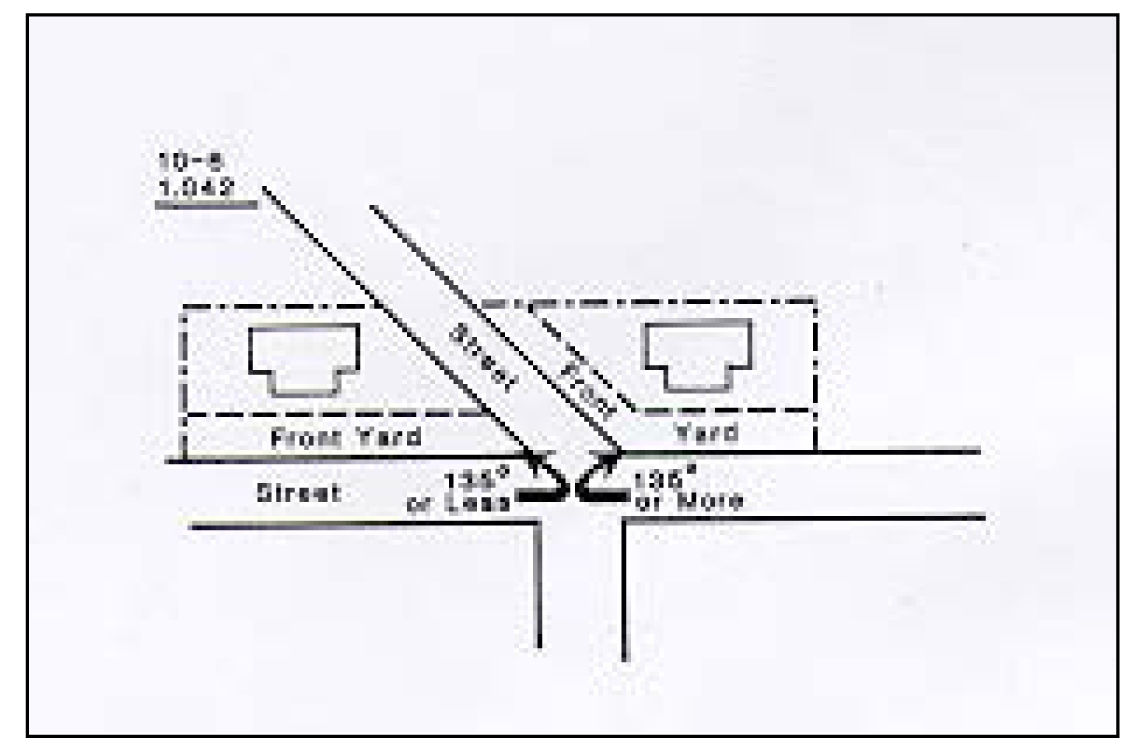
Corner Lot. A lot at the intersection of two or more streets which has an angle of intersection of 135° or less. Where the angle of intersection exceeds 135°, the area abutting the two streets shall be a front yard.
c.
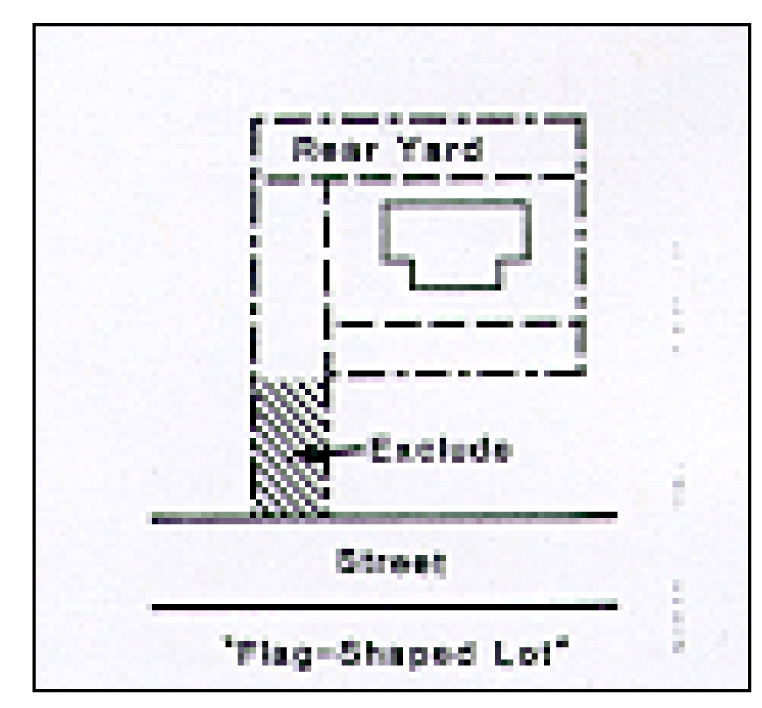
Flag Lot. A parcel of land where the buildable portion of the lot is via a narrow extension of the lot (access strip) to a public or approved private street, utilizing a private or privately shared travelway. The area within an access strip shall not be counted as part of the lot area of either the front or rear lot for purposes of complying with minimum lot area requirements.
d.
Interior Lot. A lot other than a corner lot.
e.
Lot Coverage. The area of a lot enclosed by exterior walls or similar roof-supporting devices of all structures, including accessory structures and patio covers.
f.
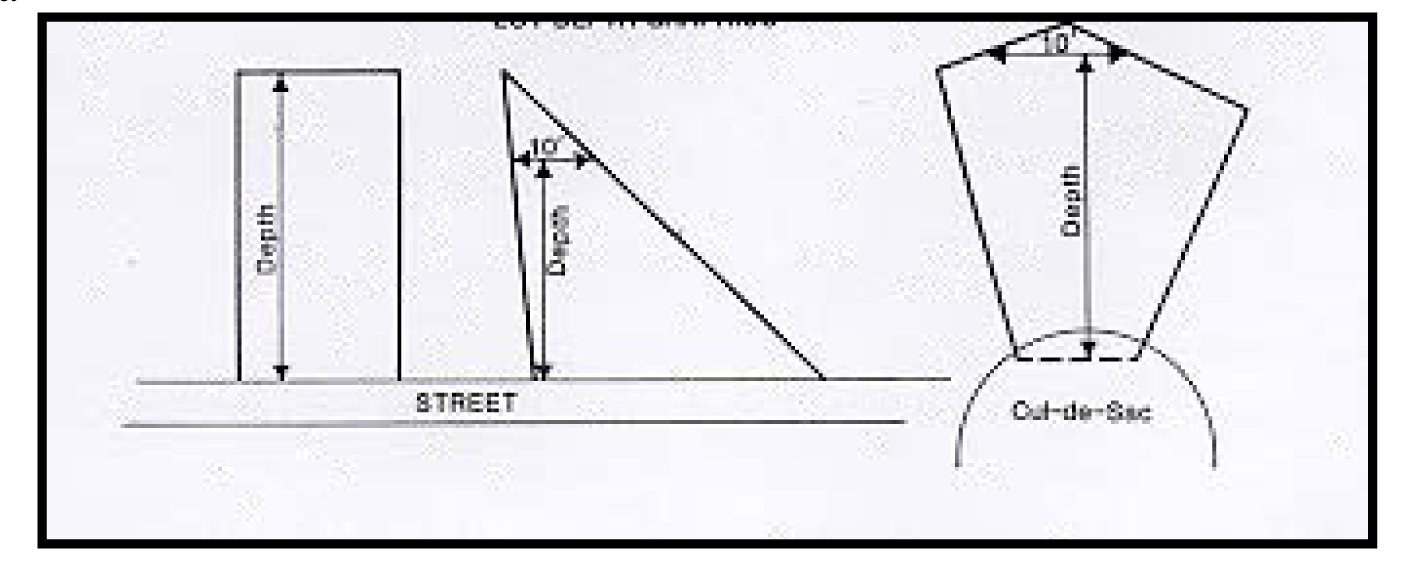
Lot Depth. The average distance between the front and rear lot lines or between the front line and the intersection of the two side lines, if there is no rear line. In instances of a cul-de-sac where the front lot line is curved, the lot depth shall be measured off a drawn line which connects the two side lot lines that intersect the cul-de-sac.
g.
Lot Frontage. The common property line of a lot and the right-of-way line of a street.
h.
Lot Line. Any boundary of a lot. The classifications of lot lines are:
(1)
Front. A line separating the lot from the street right-of-way. In the case of a corner lot, the owner may designate the front lot line of said lot at the time of initial construction of the primary use.
(2)
Rear. The lot line which is opposite and most distant from the front lot line; and in the case of an irregularly shaped lot, a line 10 feet in length within the lot, and any line closest to being parallel to and at the maximum distance from the front lot line. In the case of a corner lot, the rear lot line is opposite the front property line unless the Planning Director determines otherwise where there is a reasonable alternative.
(3)
Side. Any lot line not a front lot line or a rear lot line.
i.
Lot Size (or lot area). The total horizontal area within the lot lines of a lot, with the exception of flag-shaped lots where the lot area shall be calculated excluding the stem of the lot.
j.
Rear Lot Coverage. The area of a required rear yard enclosed by exterior walls or similar roof-supporting devices of all structures, including accessory structures and patio covers.
k.
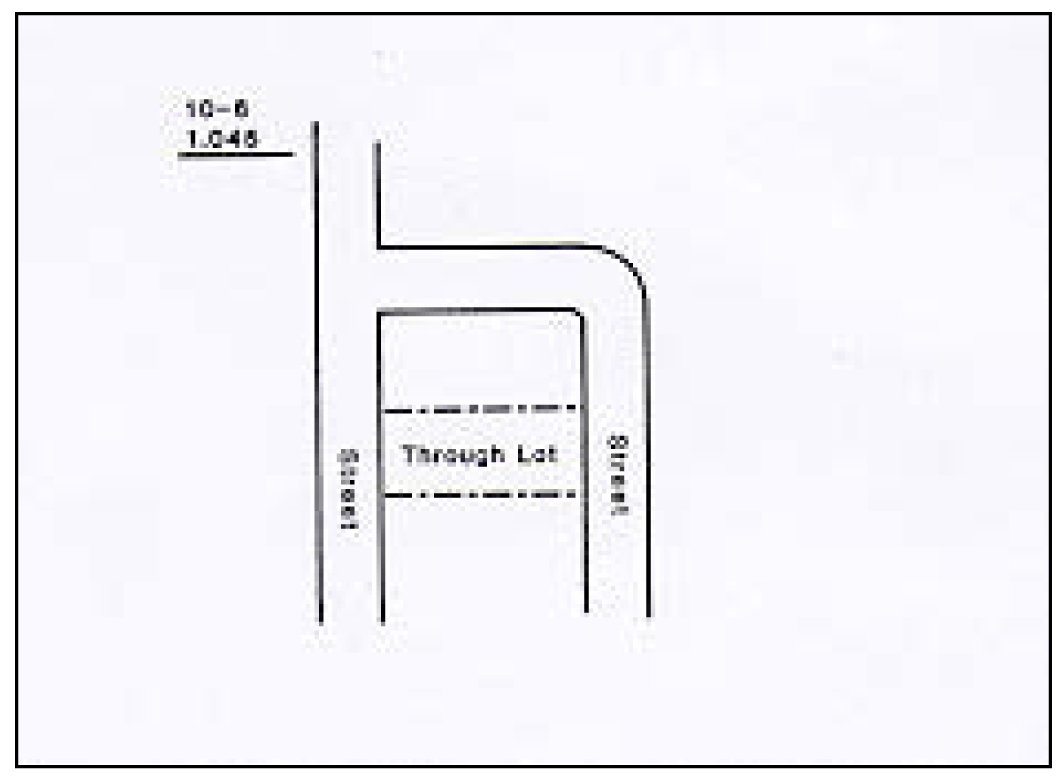
Through Lot. A lot having frontage on two approximately parallel streets.
l.
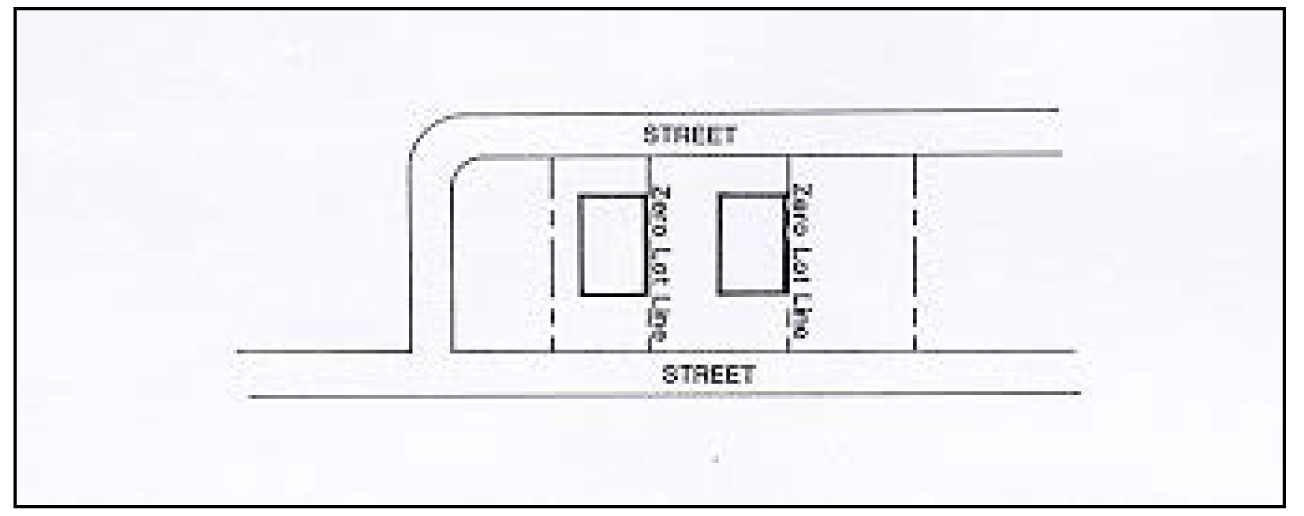
Zero Lot Line. The location of a structure on a lot in such a manner that one or more of the structure's sides rest directly on a lot line.
LOW BARRIER NAVIGATION CENTER. A Housing First, low-barrier, service-enriched shelter focused on moving people into permanent housing that provides temporary living facilities while case managers connect individuals experiencing homelessness to income, public benefits, health services, shelter, and housing. "Low Barrier" means best practices to reduce barriers to entry, and may include, but is not limited to, the following:
a.
The presence of partners if it is not a population-specific site, such as for survivors of domestic violence or sexual assault, women, or youth.
b.
Pets.
c.
The storage of possessions.
d.
Privacy, such as partitions around beds in a dormitory setting or in larger rooms containing more than two beds, or private rooms.
MAILING OR FACSIMILE SERVICE. An establishment which provides postal services and a facsimile machine available to the public for a fee. Typically includes packaging and weighing facilities and may include related copy work or wrapping paper and greeting cards for sale at retail as an ancillary use, as well as internet access as an ancillary use. Under no circumstance, as a primary, permitted or accessory use, shall any Mailing or Facsimile Service be allowed to operate Simulated Gambling Devices as defined in the City's Municipal Code. (See HMC Chapter 4, Article 16.)
MANUFACTURED HOME. A factory built or manufactured home including mobile homes, as permitted by State of California and Federal laws. A manufactured home is synonymous with the definition of a "single family dwelling."
MANUFACTURING. Establishments involved in the manufacturing, processing, fabrication, packaging, or assembly of goods. Natural, human-made, raw, secondary, or partially completed materials may be used. Products may be finished or semi-finished and are generally made for the wholesale market, for transfer to other plants, or to order for firms or consumers. Instruction, direct sales, or on-site consumption are incidental to the manufacturing operation. Toxic, hazardous, or explosive materials produced or used in conjunction with the manufacturing process are subject to use permits based on type and quantity of hazardous materials storied, utilized or generated by the manufacturing process (see "HAZARDOUS MATERIALS"). All impacts generated by manufacturing activities related to noise, gas, odor, dust, or vibration shall conform to the performance standards contained within the Industrial District regulations and other applicable local, state and federal regulations.
a.
Custom Manufacturing. Establishments engaged in the on-site assembly of hand-fabricated parts or engaged in the on-site hand manufacture or hand fabrication of custom or craft goods. Goods are predominantly manufactured and fabricated involving the use of hand tools or domestic-scaled mechanical equipment and kilns not exceeding 20 square feet in size. Typical uses include ceramic studios, fabrics, inlays, weaving, leather work, woodwork, metal or glass work, candle making, small batch food manufacturing, or custom jewelry. See also ARTISAN/CRAFT PRODUCTION. For beer and alcohol production, see BREWERY/MICRO-BREWERY and DISTILLERY.
b.
General Manufacturing. Establishments engaged in manufacturing of products from extracted or raw materials or recycled or secondary materials, or bulk storage and handling of such products and materials. Production typically involves some transformation by way of heating, chilling, combining, or through a chemical or biochemical reaction or alteration. This classification includes manufacturing for biomass energy conversion, cosmetics and perfumes, electrical appliances and explosives, film and photographic processing plants, apparel and textile mills, leather and allied products manufacturing, wood/paper products, glass products, chemical products, medical/pharmaceutical products, refining, plastics and rubber products, nonmetallic minerals, primary and fabricated metal products, and automotive and heavy equipment.
c.
Light Manufacturing. Establishments engaged in food manufacturing and manufacturing of products and finished parts primarily from prestructured materials or components by means of physical assembly or reshaping and does not produce or utilize in large quantities as an integral part of the manufacturing process, toxic, hazardous, or explosive materials. Because of the nature of its operation and products, little or no noise, odor, vibration, glare, and/or air or water pollution is produced.
MARIJUANA. See "CANNABIS".
MARKET. See "SUPERMARKET."
MARTIAL ARTS STUDIO. An establishment where martial arts classes, private lessons, and demonstrations are provided to the public for a fee. See RECREATIONAL FACILITY.
MASSAGE PARLOR. An establishment where body massage is provided to members of the public for a fee. Refer to Chapter 6, Article 10 of the Hayward Municipal Code for regulations.
MEDIA PRODUCTION. Facilities for motion picture, television, music, and other large scale media production. Use includes incidental rehearsal and broadcasting uses; however, use does not include transmission towers. This classification may also include incidental office use, retail sales, and indoor storage of equipment related to the recording uses. Does not include small scale media production, such as podcasting or social media content production.
MEDICAL CANNABIS or MEDICAL CANNABIS PRODUCT. Cannabis or a cannabis product, respectfully, intended to be sold for use pursuant to the Compassionate Use Act of 1996 (Proposition 215), found at Section 11362.5 of the Health and Safety Code, by a medical cannabis patient in California who possesses a physician's recommendation.
MEDICAL MARIJUANA. See "MEDICAL CANNABIS".
MEDICAL/DENTAL LABORATORY. A facility which custom manufactures and distributes false teeth, dental crowns, braces, and other related dental equipment to dentists.
MEDIUM DENSITY RESIDENTIAL (RM). A land use zoning district which primarily allows the development of multiple-family dwellings at a set density and in a suitable environment for family life in areas where a compatible mingling of single-family and multiple-family dwellings is possible. See Section 10-1.200.
MICRO-BREWERY. A retail establishment where alcoholic beverages are produced and sold for consumption either on or off premises. Tasting alcoholic beverages may be included as an accessory use, but the micro-brewery cannot operate as a bar. Refer to Section 10-1.2750 "Alcoholic Beverage Outlets" for regulations.
MICROBUSINESS. A commercial cannabis business holding a license issued by the State Bureau of Cannabis Control for the cultivation of cannabis on an area less than 10,000 square feet and to act as a licensed distributor, Level 1 manufacturer, and retailer pursuant to Business and Professions Code Sections 26050 and 26070.
MISSION BOULEVARD RESIDENTIAL DISTRICT (MBR).
Note— Repealed by Ordinance 11-12, Adopted October 11, 2011.
MOBILE HOME. Same as "Manufactured Home," but subject to the National Manufactured Housing Construction and Safety Act of 1974.
MOBILE HOME PARK (MH). A land use zoning district designed for, used or intended to be used for the parking and occupancy of two or more mobile homes for dwelling or sleeping purposes. See Section 10-1.700.
MORTUARY. An establishment engaged in the preparation of human bodies and the arrangement and holding of funeral services prior to burial or final disposition. For the purposes of this Ordinance, a mortuary may include a crematory.
MOTEL. A group of attached or detached buildings containing individual sleeping or living units designed for or used temporarily by automobile tourists or transients, with garage attached or parking space conveniently located to each unit where a maximum continuous length of stay is no longer than that established for transiency pursuant to Chapter 8, Article 4 (Transient Occupancy Tax) of the City of Hayward Municipal Code.
MULTIPLE-FAMILY DWELLING. See "DWELLING, MULTIPLE-FAMILY."
MUSIC STORE. An establishment which sells musical instruments, sheet music, and related commodities to the public at retail. Typically includes repair of musical instruments.
MUSIC STUDIO. An establishment which provides music classes and private music lessons to the public for a fee. Typically involves piano lessons and/or guitar lessons, both acoustical and amplified, and includes occasional music recitals by the studio students. See RECREATIONAL FACILITY.
NAIL SALON. An establishment which provides nail manicures and pedicures to the public at retail for a fee. Does not include massage or tanning services.
NEIGHBORHOOD COMMERCIAL DISTRICT (CN). A land use zoning district in which general commercial and retail uses provide convenience goods and services purchased frequently, serving nearby residences. See Section 10-1.800.
NEIGHBORHOOD COMMERCIAL - RESIDENTIAL DISTRICT (CN-R). A land use zoning district with a mix of neighborhood serving businesses and residences along portions of certain arterials in order to provide options for housing with ready access to shops and transit. See Section 10-1.800.
NIGHT CLUB. Refer to "BAR". Any establishment that permits dancing on a regular basis after the hours of 10:00 p.m. Refer to Section 10-1.2750 "Alcoholic Beverage Outlets" for regulations regarding alcohol.
NONCONFORMING, ILLEGAL. A structure, lot, or use which did not conform to applicable laws when constructed or initiated and does not conform to the provisions of this Ordinance.
NONCONFORMING LOT. A lot, the area, frontage or dimensions of which do not conform to the provisions of this Ordinance.
NONCONFORMING STRUCTURE. A structure which conformed to applicable laws when constructed but does not conform to the provisions of this Ordinance.
NONCONFORMING USE. A use complying with applicable laws when established but does not conform to the provisions of this Ordinance.
NUISANCE. An activity or land use which is determined to be detrimental or incompatible with adjacent properties, adjacent property owners or users, or the general public. Refer to Section 10-1.150.
NURSERY, PLANT. An establishment which grows flowers, shrubs, and trees and provides them for sale at retail to the public. Typically includes related items such as seeds, bulbs, pots, potting soil, etc. Majority of product may be displayed and stored outdoors.
OFFICE. An establishment where services are performed for predominately administrative, professional, medical, dental or clerical operations that function as a place of business for any of the following: accountants, architects, attorneys, bookkeeping services, brokers, corporate offices, drafting services, dentists, doctors, financial institutions, development companies, engineers, surveyors and planners, insurance agencies, interior decorators and designers, landscape architects, psychiatrists, psychologists, notaries, typing and secretarial services, therapists, and other similar businesses and professions, not otherwise specifically defined in this Code. Under no circumstance, as a primary, permitted or accessory use, shall any Office be allowed to operate Simulated Gambling Devices as defined in the City's Municipal Code. (See HMC Chapter 4, Article 16.)
OPEN SPACE. Open space areas and recreational amenities providing gathering space or opportunities for active or passive recreation. This is further defined as follows:
a.
Common Use Open Space. An on-site, indoor or outdoor recreational area accessible to all residents. The space shall not include the required front or side street yard, off-street parking areas, driveways, service areas, or areas of more than 5 percent slope. (Refer to appropriate sections of this ordinance for specific requirements.) For residential or mixed-use buildings, open space can be provided at grade, on podium or rooftop, or indoors.
b.
Private Open Space. An on-site recreational area directly accessible only to one residential unit from a living and non-service area, which is not more than four feet above or below the floor level. The space shall not include the required front or street side yard, areas devoted to off-street parking, driveways, or service, or areas of more than 5 percent slope. (Refer to appropriate sections of this ordinance for specific requirements.)
OPEN SPACE/PARKS AND RECREATION DISTRICT (OS). A land use zoning district intended to promote and encourage a suitable environment devoted to parks, recreation, floodplain or passive or active open space uses for the enjoyment of all members of the community. The OS District may be used to preserve and protect land areas of special or unusual ecological or geographic interest. See Section 10-1.2200.
PAINT/WALLPAPER STORE. An establishment which provides paint, wallpaper, and related commodities to the public for a fee. Typically includes installation services.
PALM READING SERVICE. An establishment which provides psychic services, such as palm reading and fortune telling, to the public for a fee.
PARCEL. A parcel of land under one ownership that has been legally subdivided or combined and is shown as a single parcel on the latest equalized assessment roll.
PARKING. A parking area which provides the required parking for a use in accordance with the City of Hayward Off-Street Parking Regulations (Chapter 10, Article 2, Hayward Municipal Code). The following definitions relating to parking are also provided:
a.
Covered Parking. Parking space(s) which are contained within a carport or garage.
b.
Parking Lot. An off-street area, whether open or enclosed, other than a showroom or sales lot, used to store motor vehicles on a daily basis, but not including the storage of dismantled or wrecked motor vehicles or parts thereof. A parking lot may be commercial, public, or private.
c.
Off-Street Parking. Parking stalls provided beyond the right-of-way of a street or highway.
d.
Off-Street Parking Space. Refer to the definition contained in the City of Hayward Off-Street Parking Regulations (Chapter 10, Article 2, Hayward Municipal Code).
e.
On-Street Parking. Parking stalls provided within the right-of-way of a street or highway.
f.
Open or Uncovered Parking. Parking space(s) which are not contained within a carport or garage.
g.
Parking Structure. Facilities for the temporary parking of motor vehicles within a privately or publicly owned off-street parking facility. This use includes commercial parking garages.
PASSENGER TRANSPORTATION TERMINAL. A facility which provides a loading, transfer, or drop-off point for public transportation (i.e., Amtrak, BART, Greyhound, and airport.) For single passenger pick-up and drop-off, refer to "Taxi Company."
PAWN SHOP. An establishment which provides monetary exchange for collateral, typically personal items such as watches, jewelry, musical instruments, weapons, etc., after which the collateral item is returned to its owner after the money is repaid. Typically includes a fee and retail sales of unclaimed items.
PAYDAY LOAN FACILITIES. An establishment primarily engaged in the business of advancing funds to customers in situations where the customer uses his or her entitlement to a future paycheck from some other source as collateral for the loan, and for which the customer pays a fee (percentage or otherwise) for the advancement. Includes bail bond agencies and similar uses.
PERMITTED USE. A specified use allowed in a land use zoning district and subject to the provisions applicable to that district. For all residential uses, this shall mean the same as "Use by Right" as defined in Government Code Section 65583.2(i), as amended.
PERSON. Any individual, business, company, corporation, both public and private, association, political or governmental subdivision or unit, or other group acting as a unit or entity.
PERSONAL SERVICES. An establishment that provides non-medical services to an individual as a primary use. Examples of these uses include but are not limited to barber shops, beauty salons including microblading and permanent makeup, dog grooming, nail salons, dry cleaning pick up stores with limited equipment, locksmiths, shoe repair, and tailors.
PET GROOMING SHOP. An establishment which provides a grooming service of household pets to the public for a fee. Typically includes washing, hair trimming, and temporary boarding of animals being groomed (i.e., less than 24 hours).
PET STORE. An establishment which provides pets and pet supplies to the public for sale at retail. Pets for sale typically include dogs, cats, fish, reptiles, hamsters, birds, etc., and may include exotic pets, such as parrots, pot bellied pigs, and iguanas. Pet supplies usually include food, cages, leashes, etc. May include ancillary pet grooming.
PETS, HOUSEHOLD. Small animals ordinarily and customarily domesticated and permitted in a dwelling and kept for company or pleasure and not for profit, including the following subcategories:
a.
Traditional Household Pets. Dogs, cats, canaries, parakeets, fish, domestic mice, rats, guinea pigs, potbelly pigs, up to four (4) rabbits, or similar animals, as determined by the Planning Director. The keeping of more than four cats or dogs requires an "Animal Fancier's Permit" from the City Animal Control Officer.
b.
Other Household Pets. Hens, ducks, pigeons and other similar small animals, as determined by the Planning Director, where the total number on a property does not exceed four (4) of such animals. Other Household Pets are subject to approval of a Zoning Conformance Permit based on consistency with the standards prescribed in Section 10-1.2735 of the Hayward Municipal Code.
PHOTOGRAPHIC SUPPLY STORE. See "CAMERA STORE."
PHOTOGRAPHY STUDIO. An establishment where a professional photographer takes posed pictures of people for a fee at retail. Does not include retail sales of photographic supplies, except for picture frames and picture albums.
PHYSICAL FITNESS STUDIO. An establishment which provides physical exercise classes and/or personal one-on-one physical fitness training. Typically includes a weight room and/or an aerobics dance class room. Does not include facilities typically of the large health clubs, such as showers, a pool, racquetball or tennis courts.
PLANNED DEVELOPMENT DISTRICT (PD). A land use zoning district which permit a combination of land uses planned for a single tract of land to be developed as a unit according to a specific development plan approved by the City which result in efficient and attractive utilization of land in order to preserve open space areas, topographical features, ridge tops, and tree clusters. This district also permits the creation of a site-specific project which provides a mix of housing types as well as nonresidential development. See Section 10-1.2500.
PLANNING COMMISSION. The Planning Commission of the City of Hayward, California.
PLANNING DIRECTOR. The Director of the Community and Economic Development Department of the City of Hayward, California. This includes his or her staff members as appointed to represent him or her.
POINT OF BUSINESS SALE. An establishment which provides retail sales of commodities via internet, telephone, facsimile, and/or mail, with less than 10 percent of gross annual sales attributable to direct and physical customer contact on-site.
PREMISES. A continuous area of land and any structures thereon all under a single ownership or operation under a single direction, which premises may include one or more adjacent lots, or fractions of lots.
PREMISES. The designated structure or structures and land specified in the application that is owned, leased, or otherwise held under the control of the applicant or licensee where the commercial cannabis activity will be or is conducted. The premises shall be a contiguous area and shall only be occupied by one licensee.
PRIMARY USE. The principal or predominant use of any lot, building or structure.
PSYCHIATRIC AND REHABILITATION CARE FACILITY. Mental health programs providing 24-hour psychiatric and rehabilitation care including Mental Health Rehabilitation Centers (MHRCs), Psychiatric Health Facilities (PHFs) and Psychiatric Residential Treatment Facilities (PRTFs) that are licensed by the Mental Health Licensing Branch of the California Department of Health Care Services.
PUBLIC AGENCY FACILITIES. Facilities, structures and accessory uses which house public agencies such as federal, state, or local government, and other agencies such as utility and telephone companies governed by the Public Utilities Commission.
PUBLIC PARK/PUBLIC GATHERING. A park, playground, swimming pool, reservoir, golf course, or athletic field within the City which is under the control, operation or management of the City of Hayward, Hayward Area Recreation District, Alameda County, the East Bay Regional Park District, the State of California or Federal Government. For private golf course, see "GOLF COURSE, COUNTRY CLUB."
PUBLIC FACILITIES DISTRICT (PF). A land use zoning district within which typical land uses include public government buildings, public libraries, public community centers, and public parking lots, whether a fee is charged or not. See Section 10-1.2300.
QUARRY. Any premises from which any rock, sand, gravel, earth, or mineral is removed or excavated for the purpose of disposition away from the immediate premises, whether the disposition is immediate or in the future, and excepting excavations within public roads and highway rights-of-way.
RADIO TRANSMISSION TOWER. See "ANTENNA."
RAILROAD YARD. A facility where railroad cars and engines are stored, repaired, and transferred to different trains. Also includes a freight station where items carried by train are transported onto and/or from trucks for transport. Also see "PASSENGER TRANSPORTATION TERMINAL."
RECREATIONAL FACILITY. A facility maintained to provide a pastime, sport, or exercise and ancillary activities as determined by the Director. The use may be a commercial or non-commercial facility. Under no circumstance, as a primary, permitted or accessory use, may any Recreational Facility be allowed to operate simulated gambling devices as defined in Article 4-16 (Prohibition of Simulated Gambling Devices) of the Hayward Code.
a.
Indoor Recreation. Includes, but is not limited to, athletic health clubs/fitness studios, gymnasiums, bowling alleys, ice and roller-skating rinks, pool/billiard parlors, art/dance/music studios, and electronic video arcades.
b.
Outdoor Recreation. Includes, but is not limited to, sport fields or courts, driving ranges, batting cages, skate parks, and golf courses.
RECREATIONAL VEHICLE. A vehicle primarily designed as temporary living quarters for recreational, camping, or travel use.
RECREATIONAL VEHICLE (RV) STORAGE FACILITY. A parcel or group of contiguous parcels upon which two or more recreational vehicles, camper trailers and boats may be stored for a fee when not in use.
RECYCLING FACILITIES.
a.
Small Recycling Collection Facilities/Recycling Collection Area. Small recycling facilities shall be incidental to a primary use on the site (i.e. shopping center). Accepts recyclable non-hazardous materials directly from the public by donation, redemption, or purchase at facilities no greater than five hundred (500) square feet in area and that generally do not use power-driven processing equipment. May include mobile recycling units, bulk reverse vending machines, kiosk type units, and/or unattended containers placed for the donation of recyclable materials (such as aluminum, glass, plastic, and bimetal for recycling). Small Recycling collection facilities may not process material except for limited bailing, batching, and sorting of materials.
b.
Large Recycling Collection Facilities. A facility accepting recyclable non-hazardous materials by donation, redemption, or purchase at facilities occupying an area greater than five hundred (500) square feet and that is not incidental to a primary use. Large Recycling Collection Facilities may use power driven equipment to sort and condense material for shipment to an intermediate processor or other user. Processing of materials is limited to sorting, bailing or similar activities and shall occur within an enclosed building. Storage of materials shall occur within an enclosed building or in sealed and covered containers outside of a building, subject to the Outdoor Storage screening requirements.
c.
Recycling Processing Facilities. A facility that operates within an enclosed building used for the collection, processing and storage of recyclable materials. "Processing" means the preparation of material for efficient shipment, or to an end-user's specifications, by such means as briquetting, compacting, flattening, grinding, crushing, mechanical sorting, shredding, cleaning, composting and remanufacturing. Processing outside of a building is prohibited.
RECYCLABLE MATERIALS. "Recyclable materials" or "recyclables" are discarded materials that are collected, separated, composted, and processed and that can be used as raw materials in the manufacture of new products and/or materials used as alternative daily cover as defined and permitted by the State of California. Recyclable materials are collected and treated in a manner different from Refuse.
REFUSE. Waste material intended for disposal and including: (1) non-putrescible wastes, whether in solid or liquid form, except liquid-carried industrial wastes or sewage hauled as an incidental part of septic tank or cesspool-cleaning service; and (2) rubbish (such as non-recyclable materials).
RELIGIOUS FACILITY. Those facilities maintained by a tax-exempt religious institution, a government agency, or other non-profit organization exempt from taxation under the Internal Revenue laws as an organized system of belief in or the worship of God or gods or an institutionalized system of religious attitudes, beliefs and practices, and ancillary activities as determined by the Planning Director, and whose other functions are not indicated elsewhere in this ordinance as administrative or conditional uses.
RENEWABLE ELECTRIC POWER GENERATION, TRANSMISSION, AND DISTRIBUTION. Facilities engaged in generating electric power from renewable resources or operating power transmission systems for renewable energy, including electrical lines, transformer stations, and meters. This definition does not include ancillary renewable energy systems associated with a primary industrial use. See also WIND ENERGY CONVERSION SYSTEM.
RESEARCH AND DEVELOPMENT. A facility engaged in conducting research and development to gain or apply scientific knowledge for product/process creation. Includes commercial testing and experimental laboratory environments. Subject to Hazardous Materials Use and Storage limitations.
RESIDENTIAL NATURAL PRESERVATION DISTRICT (RNP). A land use zoning district within which topographic configuration is a major consideration in determining the most appropriate physical development of the land. This district primarily allows the development of single-family homes only where they are subservient to and compatible with the preservation of major natural features of the land. See Section 10-1.200.
RESIDENTIAL-OFFICE (RO). A land use zoning district which allows the mix of office land uses with residential, the scale and form of which does not detract from adjacent residential land use in the same zone. See Section 10-1.800.
RESTAURANT. Any establishment, other than a boarding house or dormitory, where food and beverages are provided for consumption on-premises or off-premises, and where typically, but not necessarily, there are tables, counters, benches, or other public seating facilities provided, or where food is taken off-premises, disposal containers are provided. Examples include a sit-down dining facility, fast-food restaurant (no drive-through window), donut shop, pizza shop, cafe, bakery, cafeteria, coffee shop, lunchroom, delicatessen, and ice cream parlor. The serving of alcoholic beverages is subject to the regulations in the "Alcohol Beverage Outlets" regulations, Section 10-1.2750 of this Ordinance.
RESTAURANT—DRIVE-THROUGH. Any high-volume establishment serving food or beverages which utilizes a building design, site layout, or operating procedure whereby customers can drive onto the premises and remain in their vehicles while food or beverages are sold or dispensed. For regulations of drive-through restaurants see the "Drive-in Establishments-Special Standards and Conditions" contained in the Design and Performance Standards of various Sections of this Ordinance, including Sections 10-1.800 and 10-1.1000.
RETAIL. The sale of commodities or goods to ultimate consumers. This definition does not include AUTOMOBILE SALES for new and used vehicles.
REVERSE VENDING MACHINES. A mechanical device which accepts one or more types of empty beverage containers, including aluminum cans, glass and plastic bottles, and cartons, and issues a cash refund or a redeemable credit slip. "Bulk reverse vending machines" are those machines which exceed 50 cubic feet in size or exceed 8 feet in height. See Section 10-1.2735.m. "RECYCLING FACILITIES."
RIDING STABLE OR ACADEMY. A facility where individuals board their horse(s) and or where horseback riding classes are taught. Typically includes public demonstrations, such as dressage or other equestrian events. Does not include any contest(s) resembling a rodeo (i.e., bronco riding, calf roping, and/or steer wrestling).
RIGHT-OF-WAY. A strip of land used acquired by reservation, dedication, prescription or condemnation and intended to be used or occupied by a road, trail, water line, sanitary sewer and/or other public utility services and uses, or any combination thereof, and includes all and any part of the entire width or other area of designated right-of-way, whether or not such entire width or area is actually used. Right-of-way includes access, pedestrian, equestrian and utility easements. The following sub-definitions are provided:
a.
Public right-of-way. A right-of-way owned by the City or any other public entity or public utility.
b.
Private right-of-way. A right-of-way owned by and for the benefit of one or more persons, including a right-of-way offered for dedication to the City or to any other public entity which has not been accepted and which no improvements or maintenance has regularly been performed by the city or other public entity.
c.
Railroad right-of-way. A strip of land on which railroad tracks, spur tracks, sidings, switching equipment and signals are located, and includes the entire width or other area of the designated right-of-way, whether or not the entire width or area is actually used for such railroad facilities.
ROOF STYLE.
a.
Flat: A roof that is almost level, with no significant slope (pitch) in any direction. Most flat roofs have a very gentle slope for rainwater run-off.
b.
Gable: A gable roof is one where only two opposite sides (usually the longer sides) slope, with walls that extend all the way to the top of the roof ridge in a triangular shape.
c.
Gambrel: A gambrel roof is a symmetrical two-sided roof with the longer sides having two segments at different pitches.
d.
Hip: A hip roof (or hipped roof) is one where all four sides slope.
SAFE PARKING. A parking program managed and operated on an existing parking lot which provides individuals and families with vehicles a safe place to park and sleep in their vehicles overnight. See "VEHICLE."
SETBACK. The required distance that a building, structure, parking or other designated item must be located from a lot line.
SHOE REPAIR SHOP. An establishment which repairs, shines, and polishes shoes. Typically includes machinery necessary to repair shoes, and may include retail sales of shoes.
SHOPPING CENTER. A continuous area of land under single ownership or operated under a single direction, developed for retail and general commercial purposes, and typically has at least one major tenant and several smaller shops. Typically has driveways and parking facilities which are shared between tenants.
SIGN SHOP. An establishment which produces general advertising signs of various shapes and sizes for sale at retail.
SINGLE ROOM OCCUPANCY (SRO). A building consisting of sleeping units that are the primary residence of its occupants.
SLEEPING UNIT. A single unit that provides rooms or spaces for one or more persons, includes permanent provision for sleeping and can include provisions for living, eating and sanitation. Such rooms and spaces that are also part of a dwelling unit are not sleeping units.
SLOPE. The formula for calculating slope shall be as follows:
S = (I × L × 100)/A
S = Average existing slope in percent for the portion of the site or lot to be developed.
I = Contour interval in feet.
L = The combined length in feet of all contour lines within the portion of the site or lot to be developed.
A = Total area in square feet of the portion of the site or lot to be developed.
The total area within a site or lot that is proposed to be graded and/or covered with structures shall be included in the slope calculation. Areas proposed to be left undisturbed shall not be included.
SPECIAL DESIGN OVERLAY DISTRICT (SD). A zoning overlay which promotes the conservation and compatibility of development in areas of historic or architectural character and has specific architectural requirements for new development which enhances these resources. This District is comprised of the following Subdistricts:
a.
"B" Street Special Design Streetcar District (SD-1).
b.
Mission Corridor Special Design District (SD-2).
c.
Cottage Special Design District (SD-3).
SPECIAL LOT STANDARDS COMBINING DISTRICT (B). An overlay zone which depicts specific development standards for the zoning district it is combined with. See Section 10-1.2400.
SPORTING GOODS STORE. An establishment which sells sporting goods to the public at retail. Typically includes sports equipment (i.e., balls, bats, tennis rackets, golf clubs, skis and ski poles), and may include related clothing (i.e., tennis shoes for running, walking, basketball, etc., and sweat pants, shorts, shirts, and hats.) May also include the ancillary sale of used sporting goods.
STATION AREA RESIDENTIAL DISTRICT (SAR).
Note— Repealed by Ordinance 11-12, adopted October 11, 2011.
STATIONARY STORE. An establishment which sells office-related products to the public at retail. Products typically includes paper products, calendars, pens and pencils, and may include small office equipment, such as filing cabinets, briefcases, and calculators. Usually includes the sale of greeting cards, wrapping paper, photo albums, picture frames, globes, maps, and other related products.
STORAGE. A space or place where goods, materials and/or personal property is put for more than 24 hours. The following subdefinitions are provided:
a.
Minor Open Storage. Outside storage that is accessory or ancillary to the primary or conditional use conducted on the site, which shall not exceed 25 percent of an open yard area, excluding any required yard or parking area.
b.
Public Storage Facility. A space or place within an enclosed building where goods, materials, and/or personal property may be put for more than 24 hours for a fee. Typically includes a manager's dwelling unit and customer parking.
c.
Recreational Vehicle Storage Facility. See definition for "Recreational Vehicle (RV) Storage Facility."
STORAGE YARD. Outdoor storage of goods, materials, equipment as well as storage of operating equipment for warehouses such as forklifts, pallets and racks outside of a building for more than 24 hours as a primary use. This classification excludes auto-related outdoor storage uses otherwise defined in this section such as AUTOMOBILE STORAGE YARD, AUTOMOBILE DISMANTLING FACILITY and TOWING YARD.
STORY. The portion of a building included between the upper surface of any floor and the upper surface of the floor next above, except that the topmost story shall be that portion of a building included between the upper surface of the topmost floor and the ceiling or roof above. If the finished floor level directly above a basement or unused underfloor space is more than six feet above grade as defined herein for more than 50 percent of the total perimeter or is more than 12 feet above grade as defined herein at any point, such basement or unused underfloor space shall be considered as a story. A mezzanine or loft that covers a portion of the floor below still constitutes a story.
STREET. A publicly maintained right-of-way for use as a public thoroughfare by the public at large, or a private street, provided said private street has been approved by the City Council.
STREET TREE. A tree located within the right-of-way, often within a sidewalk well.
STRUCTURAL ALTERATIONS. Any change which would prolong the life of the supporting members of a building or structure, such as bearing walls, columns, beams, or girders.
STRUCTURE. Anything constructed or erected, except fences not exceeding seven feet in height, which requires permanent location on the ground or is attached to something having location on the ground.
SUBDIVISION. The division of land as regulated by the Subdivision Ordinance, Article 3, Chapter 10, of the Hayward Municipal Code.
SUBDISTRICT. A subcategory of a primary zoning district.
SUNTAN PARLOR. An establishment which provides tanning facilities for use by the public for a fee.
SUPERMARKET. An establishment which does retail sales of food, beverages, drugs, variety items, and similar goods. May include an automated teller machine or related financial facility.
TAILOR/SEAMSTRESS SHOP. An establishment which sews, alters, and/or mends clothing and costumes for the public for a fee. Typically includes sewing machines and sewing notions for use by the proprietor.
TANNING SALON. See "SUNTAN PARLOR."
TATTOO PARLOR. An establishment which provides a tattooing service to customers. May include body piercing as an ancillary use.
TAVERN. See "BAR, COCKTAIL LOUNGE."
TAXI COMPANY. An establishment which provides vehicle rides to the public for a fee. Typically includes automobile and/or van rides, for single passenger pick-ups and drop-offs. Minor automobile repair of vehicles used by the proprietor is permitted on-site (i.e., oil change, tune-ups).
TEMPORARY USE. Short-term activities that are non-permanent, intermittent, or seasonal in nature. May not be located within public-right-of-way. Refer to Section 10-1.2735 for regulations on Temporary Uses.
THEATER. A building or outdoor structure where films, motion pictures, video cassettes, slide or similar photographic reproductions are regularly shown, or an establishment regularly featuring live performance of dramatic productions, for any form of consideration.
a.
SMALL MOTION PICTURE THEATER. An establishment having two (2) or fewer screens or less than two hundred (200) seats.
b.
LARGE MOTION PICTURE THEATER. An establishment having three (3) or more screens or two hundred (200) or more seats and showing first run films. Large Motion Picture Theaters are also referred to as multi-plex or multi-screen theaters.
c.
LIVE PERFORMANCE THEATER. An establishment having one or more stages and featuring live or dramatic productions.
THRIFT STORE. An establishment engaged in the retail sales of used or donated goods (including clothing, furniture, appliances, etc.).
TOY STORE. An establishment which sells toys and games to the public at retail.
TRAILER. A vehicle without motor power used or adaptable for living, sleeping, business or storage purposes, having no function other than wheels, blocks, skids, jacks, horses, or skirting, which does not meet building requirements and has been or reasonably may be equipped with wheels or other devices for transporting the structure from place to place. A permanent foundation shall not change its character unless the entire structure is erected and maintained in accordance with prevailing laws.
TRAVEL AGENCY. See "OFFICE."
TREE LINE. An intact assemblage of trees connected to a larger forested area as defined on a property survey prepared by a Licensed Land Surveyor. This does not include small groupings or individual trees that are not connected to the larger forested area.
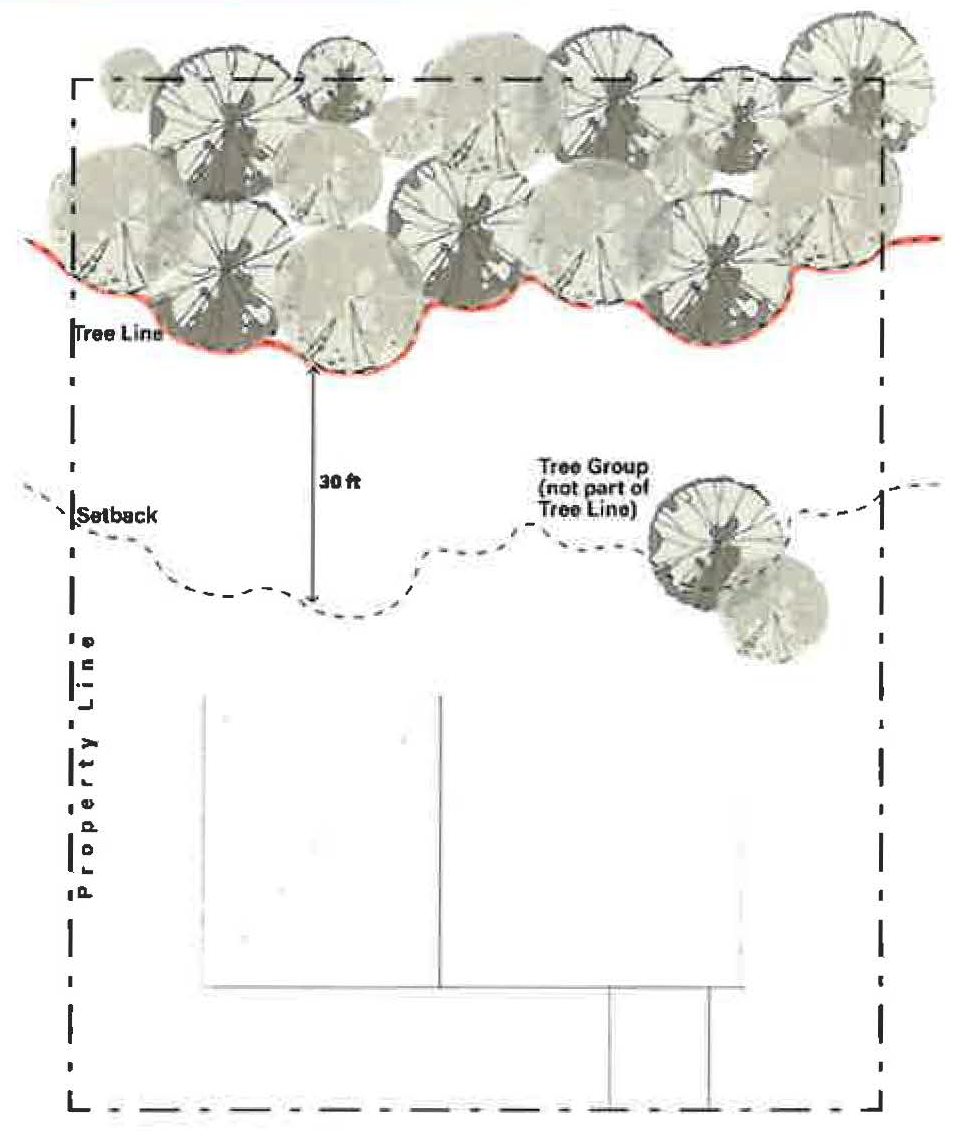
TRIANGLE OF VISIBILITY. The area formed at a corner intersection of two property lines whose two sides are 30 feet measured along the property lines and whose third side is a line connecting the two sides, as illustrated below. See also Hayward Traffic Code, Sections 9.01 through 9.05, as amended from time to time.
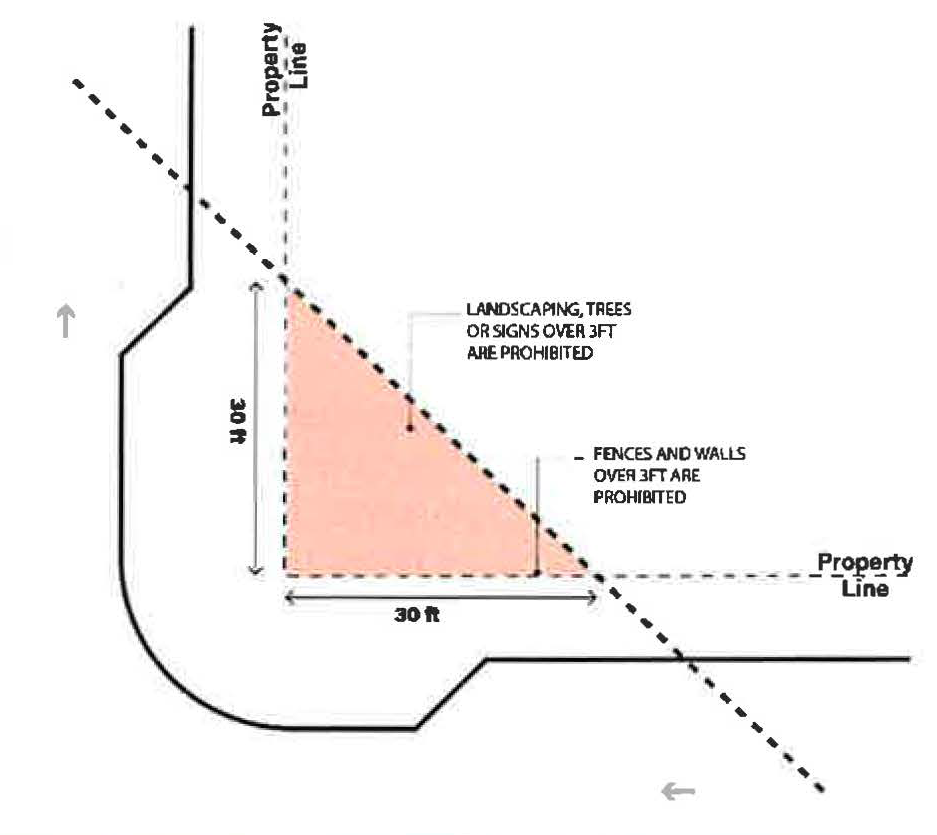
TRUCK TERMINAL. A facility which provides a transfer, loading, and unloading point for trucks and automobiles carrying goods and products. Typically includes fuel and food facilities.
UNATTENDED COLLECTION BOXES. Unattended collection box shall mean any unattended container, receptacle or similar device that is located on any lot within the city that is used for soliciting and collecting donations of clothing and other salvageable personal property. See General Regulations "Recycling Facilities" for specific regulations.
UPHOLSTERY SHOP. A facility which re-upholsters household furnishings of all types (i.e., couches, chairs, footstools, pillows, etc.), for a fee (does not include automobile upholstering).
USE. The purpose or activity for which the land, or building thereon, is designed, arranged or intended, or for which it is occupied or maintained.
USE PERMIT. A land use permit termed a "discretionary entitlement" to operate a specified land use on a given parcel. Usually an activity or business. The following subcategories of use permit are provided:
a.
Administrative Use Permit. A Use Permit issued administratively by the Planning Director or his or her appointee. An Administrative Use Permit is typically subject to exactions and conditions of approval.
b.
Conditional Use Permit. A Use Permit issued by the Planning Commission or City Council through a public hearing process. A Conditional Use Permit is typically subject to exactions and conditions of approval.
VACANT BUILDING/SITE. A building, structure or real property that is undeveloped, unoccupied or occupied by a person without a legal right to occupy for at least 30 days. In determining whether a building or site is vacant, the Planning Director or designee may consider these factors among others:
a.
A building at which lawful residential or business activity has ceased.
b.
The building or site is substantially devoid of contents.
c.
The building or site lacks legally connected utility services, including but not limited to water, sewer, electrical or natural gas.
d.
This definition does not include building, structures or sites that are undergoing construction or renovation and which are in compliance with all applicable ordinances, codes, legislation, and regulations, and for which construction, renovation or rehabilitation is proceeding diligently to completion.
VARIANCE. A discretionary entitlement which permits the departure from the strict application of the development standards contained in this Zoning Ordinance.
VARIETY STORE. An establishment which provides a variety of goods to the public for sale at retail. Typically includes hair care products, a pharmacy, non-prescription drugs and hygiene products, cleaning supplies, toys, games, small household appliances, dishes, make-up, candy, etc.
VEHICLE. The term "vehicle" as used in this section shall include an automobile or truck (excluding truck tractor or any vehicle exceeding a maximum gross weight limit of 6,000 pounds of gross vehicle weight) recreational vehicle, trailer, boat mounted on trailer, or other vehicle referenced in California Vehicle Code section 5051, and other vehicles of similar kind and use. In all zoning districts, use of any kind of vehicle as defined herein for sleeping purposes shall be prohibited except within an approved mobile home park and for safe parking operation as described in Section 10-1.2736(c).
VEHICLE RENTAL. See "AUTOMOBILE RENTAL."
VEHICLE REPAIR. See "AUTOMOBILE REPAIR."
VEHICLE SALES. See "AUTOMOBILE SALES."
VEHICLE SERVICING. For vehicle servicing such as same-day lube, oil, and filter, see "AUTOMOBILE REPAIR - MINOR." For major vehicle repairs such as engine overhauls, vehicle upholstery, auto glass, mufflers, etc., see "AUTOMOBILE REPAIR - MAJOR."
VIDEO SALES AND RENTAL STORE. An establishment which sells at retail and/or rents video tapes to the public.
WAREHOUSE AND DISTRIBUTION FACILITY. Establishments primarily engaged in the sale, storage, and distribution of goods and materials in large quantity to retailers or other businesses for resale to individual or business customers. Activities may include physically assembling, sorting, and grading goods into large lots and breaking bulk for distribution in smaller lots. Does not include public storage facilities.
WASTE TRANSFER/HANDLING FACILITY. A facility that transports or handles hazardous waste, medical wastes or other wastes from offsite sources. Subject to Outdoor Storage limitations.
WASTE TREATMENT FACILITY. A facility that treats hazardous waste, medical waste or other waste from offsite sources. Subject to Outdoor Storage limitations.
WHOLESALE ESTABLISHMENT. The sale of commodities and goods to an establishment for resale to the consumer.
WIND ENERGY CONVERSION SYSTEM. A machine that converts the kinetic energy in the wind into a usable form. A wind energy conversion system is commonly known as a windmill or wind turbine and includes all parts of the system including the tower and the transmission equipment.
WINE SHOP. "Wine Shop" shall mean an alcoholic beverage sales establishment, managed by a certified sommelier or oenologist, primarily for the retail sales of wine from multiple wineries and distributors that involves no sales of liquor or distilled spirits. Wine tasting may be included as an accessory use, but the wine shop cannot operate as a bar.
YARD. The word "yard" shall mean an open space other than a court, on a lot, unoccupied and unobstructed from the ground upward except as otherwise provided herein. A yard extends along a lot line or official plan line to a depth or width specified in the yard regulations for the District in which such lot is located.
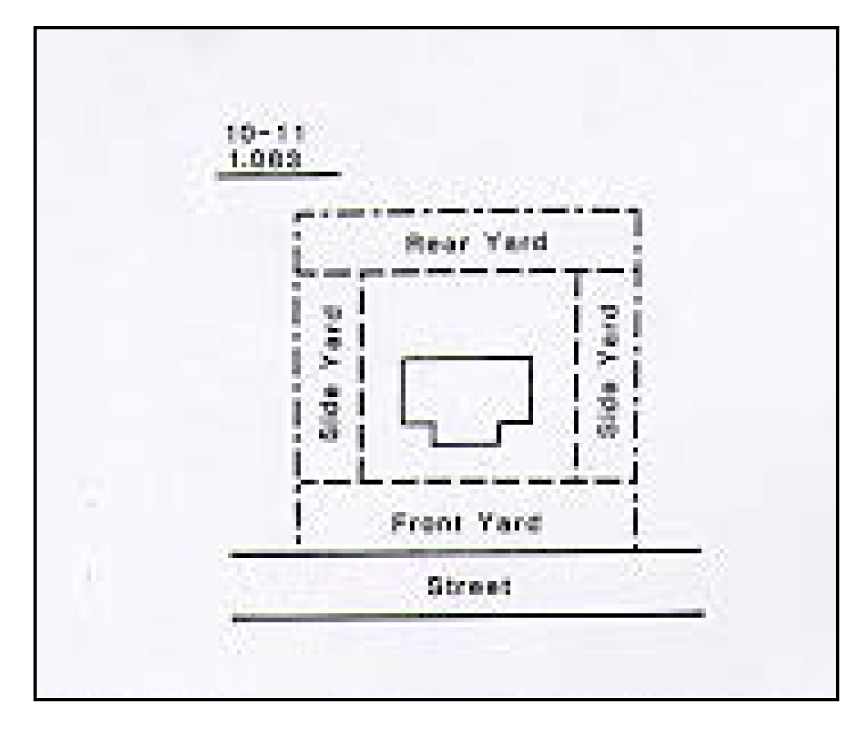
a.
Front Yard. A yard extending along the full length of the front lot line between the side lot lines, except for flag-shaped lots where yard areas shall be calculated excluding the stem of the lot, and the front yard shall be parallel to the right-of-way unless determined otherwise by the Planning Director. The developer of a corner parcel may select as the front yard property facing either of the two rights-of-way at the time of initial development of the property.
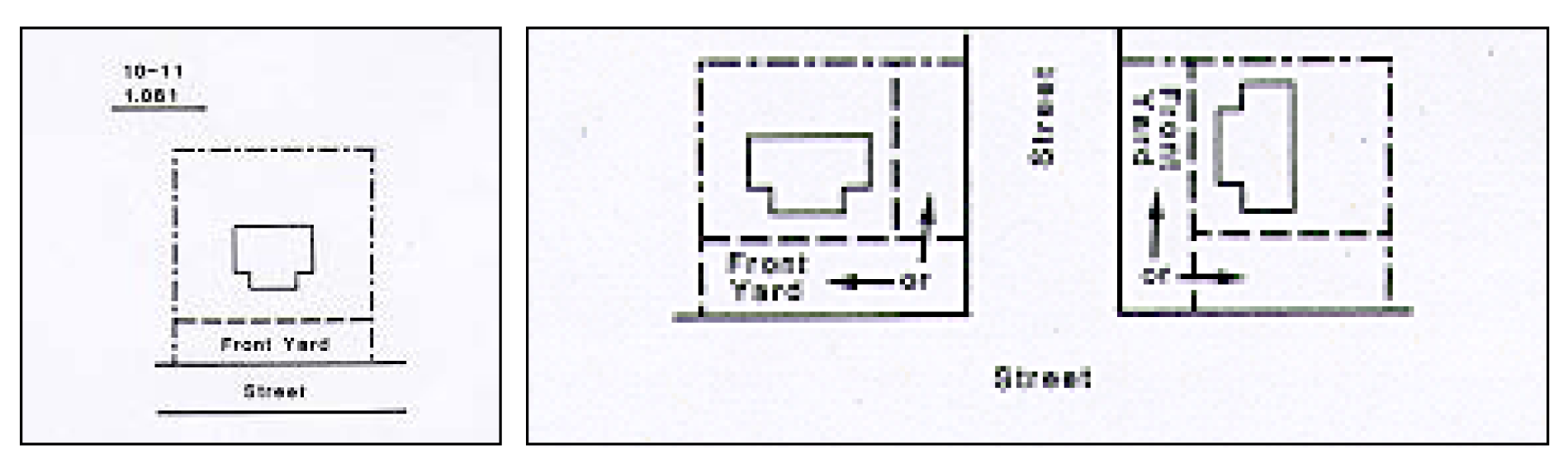
b.
Rear Yard. A yard extending along the full length of the rear lot line between the side lot lines of an interior lot. The rear yard of a corner parcel shall be determined by the Planning Director and shall be opposite either of the two rights-of-way.
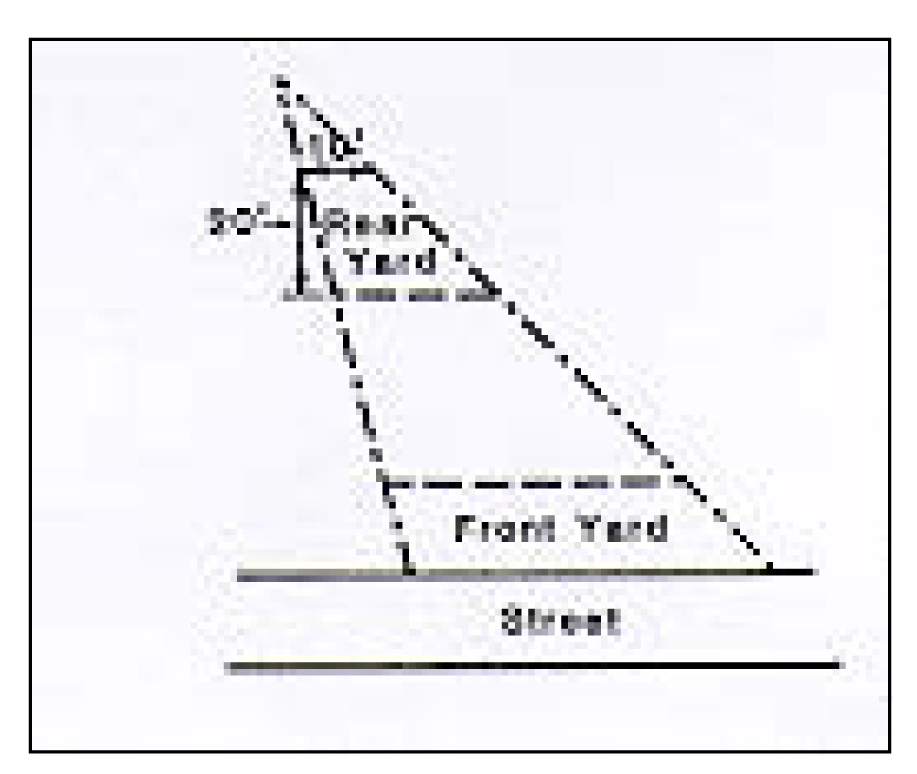
c.
Side Yard. A yard extending along a side lot line from the front yard to the rear yard, or from the front lot line to the rear yard where no front yard is required. In determining side yards based on a percentage of lot width where the lot is irregular in shape, the width shall be determined by calculating the lot width at a point of 20 feet from the front property line.
d.
Side Street Yard. A yard extending along a lot line, other than a front, rear, or interior side line, between the front yard and a side or rear lot line. The developer of a corner parcel may select the side street yard from property facing either of the two rights-of-way.
(Section 10-1.3510 amended by Ordinance 99-18, adopted October 12, 1999; Ordinance 02-08, adopted July 16, 2002; Ordinance 03-08, adopted May 27, 2003; Ordinance 04-13, adopted September 28, 2004; Ordinance 04-19, adopted December 21, 2004, amended by Ordinance 06-11, adopted July 11, 2006, amended by Ordinance 06-14, adopted July 11, 2006; amended by Ordinance 17-09, adopted June 20, 2017; amended by Ordinance 17-16, adopted Nov. 7, 2017; amended by Ordinance 17-15, adopted Nov. 28, 2017; amended by Ordinance 19-10, adopted June 4, 2019; Amended by Ordinance 21-05, § 5, adopted July 20, 2021; Amended by Ordinance 24-01, adopted Jan. 23, 2024; Amended by Ordinance 25-02, § 1(Exh. A), adopted January 21, 2025; Amended by Ordinance 26-06, § 1(Att. IV(Exh. G), adopted May 5, 2026)

