
Highlands City Zoning Code
PARKING AND
LOADING
Sec. 9.1 - Off-Street Parking Requirements and Standards
9.1.1 General
Private off-street automobile storage or parking and loading areas shall be provided on every parcel on which any of the following uses are hereafter established. All automobile parking spaces and parking lots required by this Ordinance shall conform to these standards as well as those details and standards required in the Public Works Specifications Manual. See also Sec. 10.4, Driveway Entrances.
A.
Applicability. The minimum requirements for off-street parking and loading are set forth in this Article 9, Parking and Loading. These requirements shall apply to all new buildings and uses and to additions to existing buildings and uses in the R-1 Residential, R-2 Residential, R-3 Residential, B-2 Business, B-3 Business, B-4 Business, and GI Governmental/Institutional Districts.
B.
Exceptions
1.
However, no uses within the B-1 Business District, including those Special Uses identified in Article 6, Use Regulations, shall be subject to the off-street parking and loading requirements, except for single-family dwellings.
2.
Within the B-1 Business District, no parking is required for up to two (2) incidental apartments located in the same building. For each subsequent incidental apartment, two (2) parking spaces are required per apartment.
3.
The parking requirement for places of assembly or recreation, or entertainment with fixed seats shall not apply to churches located on Main Street.
4.
A reduction of up to twenty percent (20%) of required parking in applicable districts as defined in Item A above may be considered by the Town of Highlands due to specific site conditions, such as historical trees, significant rock or other special terrain, under the following conditions:
A.
The person requesting the reduction shall submit a letter and site plan to the Planning and Development Director; and
B.
Additional information shall be provided as requested by the Planning and Development Director as necessary to render an opinion.
(Amend. of 11-17-16(6))
9.1.2 Off-Street Storage of Commercial Trailers
Commercial trailers may be parked on private property only in the following cases:
A.
When the trailer is being temporarily used in connection with an on-going construction project; or
B.
When the trailer is being loaded, unloaded, or temporarily used for storing materials for a business, and is also located in the rear of the principal building (that is, at the opposite side of the main entrance) in which the business is located. If located other than in the rear of the building, the trailer may not be parked on said premises for a period of time longer than forty-eight (48) hours.
9.1.3 Ingress and Egress
Each parcel abutting a thoroughfare maintained by the North Carolina Department of Transportation shall be provided with adequate space for turning so that no vehicle shall be required to exit from the premises by backing into the thoroughfare. See also Article 8, Dimensional and Density Standards, and Sec. 10.4, Driveway Entrances.
9.1.4 Dimensions and Location
A.
All off-street parking spaces required by this Ordinance shall be provided on the same parcel of property on which the principal use is conducted, except as permitted under Sec. 9.2, Shared Parking for Restaurants.
B.
Any required nonresidential parking spaces may extend up to one hundred twenty (120) feet into a residential district, provided that they:
1.
Adjoin a commercial or other nonresidential district;
2.
Have their only access to or front upon the same street as the parcel in the commercial or other nonresidential district for which the parking is being provided; and
3.
Meet all landscape and buffer requirements as outlined in Article 11, Landscape, Screening and Buffers.
C.
Dimensions. The dimensions of all parking spaces and access aisles provided under this Ordinance shall comply with the specifications set forth in Figure 1 and the Table below.
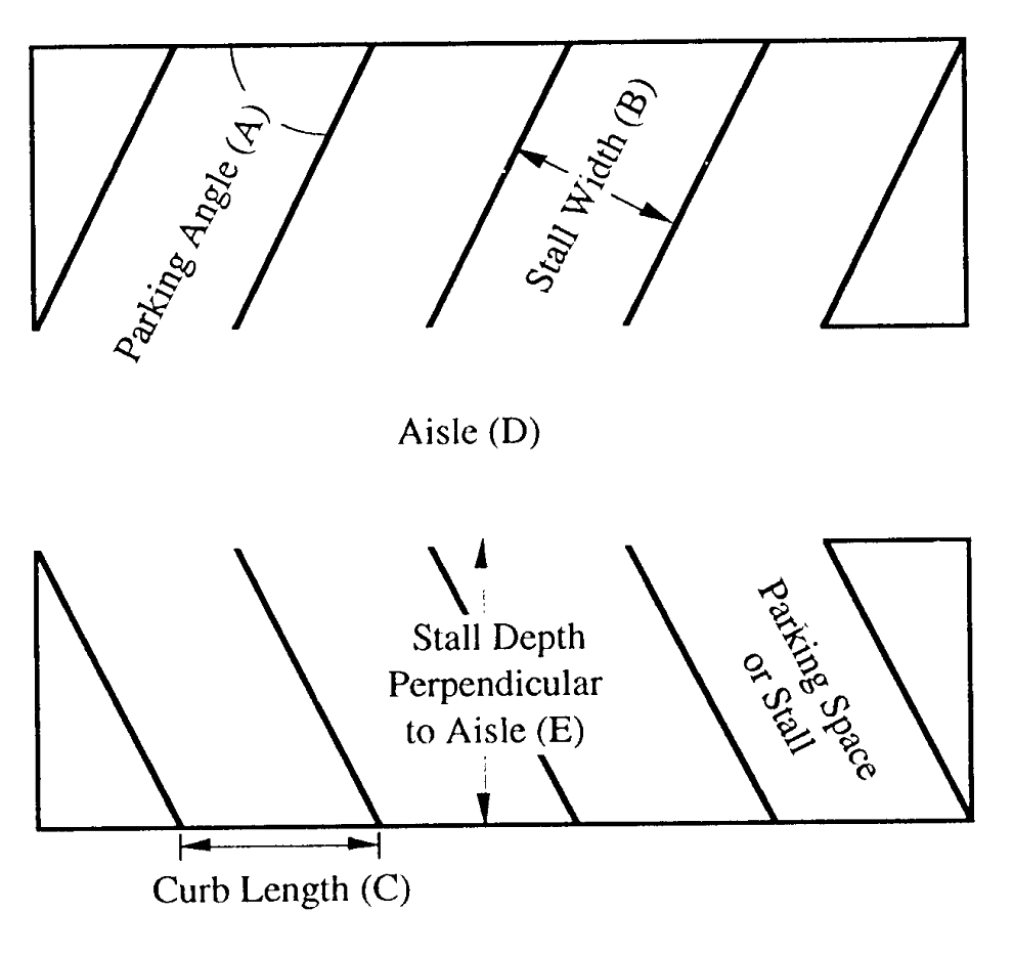
Figure 1
Alternative patterns of an equivalent area may be approved by the Planning and Development Director where site conditions necessitate.
D.
Handicapped Spaces. Such spaces shall be located adjacent to a curb cut and near the main public entrance of the building served by the parking lot, and shall in all other respects conform to Volume 1-C of the North Carolina State Building Code.
9.1.5 Paving, Striping and Signage
A.
Hard Surface. All new parking areas for commercial buildings provided under Article 6, Use Regulations, shall be paved with a typical hard surface such as asphalt, concrete, or paving brick unless:
1.
An alternative surface is approved as outlined in Item C, Alternative Surface below; or
2.
Tourist Homes, as allowed under Sec. 6.5.10, Tourist Homes, are exempt from requirements of Item A, Hard Surface, above.
B.
Delineation of Spaces. Parking spaces shall be clearly marked by a single stripe four to six (4 to 6) inches wide, except for approved alternative materials allowed in parking areas.
C.
Alternative Surface. In order to recharge groundwater and reduce stormwater runoff, the Town of Highlands encourages the use of alternative paving materials that might have some pervious qualities where site conditions permit. However, for the purposes of defining Built-upon Area and Stormwater Management if required, these alternative materials shall still be considered impervious. Upon review and approval by the Planning and Development Director, alternative surfaces other than the hard surfaces defined above shall be permitted, except for required handicapped spaces, under the following conditions:
1.
The person requesting the alternative surface shall submit a letter and site plan to the Planning and Development Director. Additional information shall be provided as requested by the Planning and Development Director as necessary to render an opinion;
2.
The alternative surface shall be constructed of a uniform surface of gravel or other pervious paving materials, such as turf block, pervious pavers or other decorative stone or pavers;
3.
Parking stalls in alternative surface parking areas shall be delineated with concrete curb stops, railroad ties, or other suitable means approved by the Planning and Development Director;
4.
The final design of the parking area, including base course, sub-soil type and any required stormwater drains shall be reviewed and approved by the Town Engineer; and
5.
No portion of an unpaved parking area shall exceed a grade of seven percent (7%).
D.
Signage
1.
Handicapped Spaces shall be clearly marked with a type R7-8 sign.
2.
See Sec. 10.4.1, Driveway Entrance Requirements, for additional signage requirements at nonresidential driveways.
9.1.6 Responsibility for Maintenance
A.
Paving. Standard hard surface or approved alternate surface paving, shall be kept in good repair, and reasonably free from potholes or other deterioration of the surface. The finish surface of approved gravel surfaces shall at all times be kept free from ruts, potholes, or other irregularities by periodic scraping and addition of gravel when necessary.
B.
Striping
1.
Stripes shall be replaced within a reasonable time whenever they become so faded that they become difficult to see, or whenever the parking lot is re-surfaced.
2.
Re-painting of parking lots approved under this Ordinance where the parking lot has been re-surfaced, or re-configured, or where the original stripes can no longer be seen shall only be permitted upon issuance of a Zoning Certificate.
9.1.7 Parking Schedule
See also Sec. 9.1.1, General, Item B, Exceptions.
A.
Standard Calculations. The number of off-street parking spaces provided shall be at least as great as the number specified in the formula below for various uses. When application of the formula results in a fractional space requirement, the next larger space requirement shall prevail.
B.
Handicapped Space Calculations. In each new parking lot, at least one (1) parking space, and not less than one (1) space per twenty-five (25) spaces, shall be provided for the handicapped.
C.
Uses Not Specifically Listed. See Sec. 6.1.1, General, Item C, Principal Use Not Specifically Listed, for procedures to establish use regulations when a proposed use is not specifically listed.
Sec. 9.2 - Shared Parking for Restaurants
9.2.1 Purpose
The Town of Highlands finds that the shared use of public on-street parking and dual-use off-street parking by restaurants in the B-2 and B-3 zoning districts is an efficient method of meeting the unique parking needs of the Town's restaurants. The Town of Highlands further finds that the regulation of such parking as set forth in this Section will promote the public, health, safety and welfare of all of the people of the Town of Highlands.
A.
Applicability
1.
Public Parking Spaces and Dual-Use Parking Spaces may be used to increase the number of seats allowed for restaurants only in the B-2 and B-3 zoning districts, and only upon full compliance with the provisions of this Ordinance.
2.
Upon approval of the application required under this Section, restaurants shall be allowed to increase seating as set forth in this Section.
3.
No vested rights shall be acquired by any restaurant under this Section.
B.
General Limitations
1.
Restaurants shall be limited to the use of a combined total of twelve (12) parking spaces, in any combination, of Public Parking Spaces and Dual-Use Parking Spaces, for the purposes set forth in this Section.
2.
A maximum of three (3) additional seats will be allowed for each Public Parking Space and each Dual-Use Parking Space.
3.
This Section shall not be construed to increase the maximum number of seats allowed for any restaurant under applicable building and fire safety codes.
4.
Public Parking Spaces shall be located within three hundred (300) feet from the restaurant's main entrance, as measured by the shortest walking distance along existing sidewalks and designated crosswalks.
5.
Dual-Use Parking Spaces shall be located no more than five hundred (500) feet from the restaurant's main entrance, as measured by the shortest walking distance along existing sidewalks and designated crosswalks, and which is not separated from the restaurant by N.C. 106 or U.S. 64, unless a marked and signalized crosswalk is provided for safe pedestrian access.
C.
General Requirements
1.
Before any restaurant is allowed additional seats under this Section, it shall first submit an application in a format specified by Article 4, Applications and Permits, and receive written approval of such application by the Planning and Development Director.
2.
Along with the applications required pursuant to this Section, each restaurant shall submit an application for an amended Special Use Permit under Sec. 6.5.12, Restaurants. No application under this Section shall be granted unless and until the restaurant applies for and obtains an amended Special Use Permit.
(Amend. of 8-18-16(5))
9.2.2 Use of Public On-Street Parking
A.
Public Parking Spaces shall continue to be available for unrestricted use by the public unrelated to restaurant purposes and no restaurant shall be allowed to limit or attempt to limit the use of any Public Parking Space to its customers, employees, visitors, or vendors.
B.
The Town reserves the right to move, eliminate and alter, at its sole discretion, any Public Parking Spaces, regardless of the existence of any pending or approved applications under this Section. If any Public Parking Space previously designated under this Section becomes unavailable to a restaurant, the allowable seating in the restaurant shall be reduced at the ratio of three (3) seats for every one (1) Public Parking Space lost.
9.2.3 Use of Dual-Use Off-Street Parking
A.
The restaurant is required to acquire a written lease, for a term of at least ten (10) years, between the owner of the real property where the restaurant is located and the owner of the property where the proposed Dual-Use Parking Space is located, allowing for parking under the provisions of this Section, and providing for termination upon changes in schedules of use (by lessor or lessee) such that there is substantial conflicting or overlapping usage.
B.
In the event of a termination, for any reason, of the lease required for herein, the approval of the restaurant's application shall be suspended, and the restaurant shall be required to show, within thirty (30) days, that it has, under this Section or otherwise, parking spaces sufficient for the number of seats under the generally applicable parking regulations. This showing can be made by the restaurant's reduction in the number of seats. Failure of the restaurant to make such showing shall result in a revocation of the restaurant's zoning certificate.
C.
All Dual-Use Parking Spaces will be clearly marked with appropriate signage to indicate the times that parking is allowed for the restaurant.
Sec. 9.3 - Off-Street Loading Requirements and Standards
9.3.1 Dimensions and Locations
Every parcel on which a sales business, trade, or industrial use is hereafter established shall provide an area for the loading and unloading of vehicles off the street. The area shall have access to an alley or, if there is no alley, to a street, and shall have minimum dimensions of twelve (12) feet by forty (40) feet. Such area may be located within an access aisle or other off-street area, provided it is accessible to delivery vehicles.
9.3.2 Schedule
The number of off-street loading and unloading areas required on any parcel shall be determined according to the use for which the parcel is to be placed, all pursuant to the following schedule:

