
Highlands City Zoning Code
INFRASTRUCTURE
Sec. 10.1 - Improvement Requirements
10.1.1 General
Where land to be subdivided or developed is found to be subject to the conditions of flooding, improper drainage, severe erosion, slides, or to have other characteristics which pose an ascertainable danger to health, safety, or property, the subdivider, owner, or developer shall take measures necessary to correct said conditions and to eliminate said dangers. Proposed streets shall be adjusted to the contours of the land so as to produce accessible lots and streets of gradient as allowed by the applicable review authority.
A.
See also Article 4, Applications and Permits, Article 12, Natural Resources and Environmental Protection, for other infrastructure requirements related to Erosion Control and Stormwater Management, and Article 15, Inspections, Violations and Enforcement.
B.
Where the terms "subdivider", "owner" or "developer" are used in this Section, they shall refer to the person(s) or entity financially responsible for the construction and installation of the applicable infrastructure.
C.
The word "street" includes "road".
10.1.2 Infrastructure Review Authority
See also Article 3, Administration and Review Authority, and Article 4, Applications and Permits, for additional information.
A.
The minimum design, construction, and installation criteria for Utility and Infrastructure specific to Public Water and Sewer Systems, Electrical Service, Public Streets maintained by the Town of Highlands or Private Streets, Sidewalks, Trails and other Infrastructure such as Bridges and Roadway Dams shall be found in the Town of Highlands Public Works Specifications Manual.
B.
Streets which are subject to NCDOT review authority, as established by this Ordinance, shall be designed and constructed in accordance with the requirements and standards set forth in the NCDOT Minimum Construction Standards for Subdivision Roads, dated January 7, 1977 as amended. Should the policies and standards governing acceptance of subdivision streets by NCDOT into the State Highway System be altered, amended, reviewed, etc., such changes shall by reference be automatically incorporated into the provisions of this Ordinance.
C.
Where individual systems for water and sewerage are to be used, a written statement or letter of approval, or other documentation then currently in effect, from the Macon County and/or Jackson County Health Department shall be submitted with the preliminary plat, indicating that each lot has adequate land area and soil conditions suitable to accommodate the proposed methods of water supply and sewage disposal for at least some habitable dwelling otherwise permitted on said lot. The statement from the Health Department shall be based upon a field investigation, and such statement shall be submitted prior to preliminary plat approval.
10.1.3 Surveying and Placement of Monuments
"The Manual of Practice for Land Surveying," as adopted by the North Carolina Board of Registration for Professional Engineers and Land Surveyors, under provisions of G.S. ch. 89C, shall apply when conducting surveys.
10.1.4 Required Easements
A.
All easements shall be shown on the preliminary and final plats, site specific plans and master development plans.
B.
All site plans and plats shall exhibit standard easement notes stating the type and purpose of the easement along with a list of prohibited uses/activities within the easement.
C.
An easement not less than ten (10) feet in width may be required in all subdivisions, specific sites or master developments, where deemed necessary in order to provide for public service poles, wires, or conduits; storm or sanitary sewers; gas, heat, or water mains; or other utility lines. The subdivider, owner, or developer will provide a letter from the public service or utility provider with the preliminary plat submittal, noting the required easement width.
D.
Where easements for utilities, drainage, or other are required outside of public rights-of-way, such easements should preferably be centered on rear or side lot lines.
E.
Easements for other purposes, including but not limited to, trails and greenways, shared driveways, and/or encroachment access for maintenance of items such as subdivision short islands or medians, shall be designed for reservation or dedication as appropriate. See also Sec. 12.3.3, Riparian Buffer Zones and Measurement, for riparian buffer easements and Sec. 12.7.8, Stormwater Quantity Design Standards, for stormwater management easements that may be required.
10.1.5 Effect of Plat Approval on Dedications
Pursuant to G.S. 160D-806, the approval of a plat does not constitute or effect the acceptance by the Town or the public of the dedication of any street, public utility line, or other land or facility shown on the plat, and shall not be construed to do so. The Board of Commissioners may, however, in its discretion, and by separate resolution, explicitly accept any such dedication, and may also accept the responsibility to open, operate, repair, or maintain such street, public utility line, or other land or facility, provided the improvements have been installed in accordance with this Ordinance or other applicable Town of Highlands Standards and Ordinances.
Sec. 10.2 - Ingress and Egress Designation
All streets provided under this Ordinance shall be designated "public" or "private," in accordance with the approved final plat.
10.2.1 Dedicated and Publicly Maintained Streets
Designation as "public" shall be conclusively presumed an offer of dedication of a street to the public. However, in accordance with Sec. 10.1.5, Effect of Plat Approval on Dedications, final approval of a plat does not constitute or effect the acceptance by the Town or the public of the dedication of any street. See also Sec. 10.6, Improvements and Installations.
A.
Public Streets Inside the Corporate Limits. If located within the corporate limits, "public" may mean either the State of North Carolina or the Town of Highlands.
B.
Public Streets Outside the Corporate Limits. If located outside the corporate limits of the Town of Highlands, "public" means the State of North Carolina subject to G.S. 136-102.6.
10.2.2 Private Streets or Roads
A.
Private Streets or Roads. "Private" shall mean any street that is either designated as a "Private Street" on the final plat or a street designated as "Public" on the final plan where such street is not accepted by the public authority.
B.
Access Other Than Streets
1.
Alleys. Alleys shall be provided to the rear of all lots used for other than residential purposes. Alleys are prohibited in residential blocks, unless such are approved by the Board of Commissioners. All dead-end alleys shall be provided with a turn-around. Alleys shall be constructed in accordance with specifications issued by the Town and shall have a minimum right-of-way width of twenty (20) feet.
2.
Driveways. See Sec. 10.4, Driveway Entrances.
10.2.3 Responsibility for Maintenance
A.
Public Streets Not Yet Accepted
1.
Unless or until such roads designated "Public Streets" are explicitly accepted by the Town or the State for maintenance, the subdivider or property owner's association is required to maintain the street, drainage facilities and right-of-way of all public streets designated within a subdivision.
2.
Prior to acceptance by the public authority, any street designated as "Public" shall be reviewed for construction and maintenance to the applicable public authority's standards. Any street in noncompliance shall be improved to meet the standards. See also Sec. 10.6, Improvements and Installation.
B.
Private Streets as Designated on Final Plat
1.
An agreement shall be prepared, and recorded with the final plat, providing for perpetual ownership and maintenance of any and all private streets designated within a subdivision by a homeowner or property owners' association.
2.
Alternatively, the subdivider may provide for maintenance of such streets by other method or means approved by resolution of the Board of Commissioners.
Sec. 10.3 - Streets
10.3.1 Street Layout
A.
Relationship to Other Plans. The location and width of all proposed streets shall be in conformity with official plans and maps of the Town of Highlands, and with existing or amended plans of the Planning Board.
B.
Future Streets. Where land is subdivided into larger parcels than ordinary building lots such parcels shall be arranged so as to allow for the opening of future streets and logical further re-subdivision. For the purposes of this Section "ordinary building lots" shall be defined as: 1) the minimum lot size for single-family residence; or 2) a planned cluster development.
C.
Continuation of Adjoining Street System. The proposed street layout and design shall be coordinated with existing and planned streets of the surrounding area with respect to location, alignment and cross-section. Where possible, existing principal streets shall be extended at least at the same width.
10.3.2 Street Classifications
Plans for all proposed streets, whether designated "public" or "private," shall be prepared in accordance with the applicable Specifications based on the following classifications of streets:
A.
Local Subdivision Roads. Such roads include the following:
1.
Culs-De-Sac. Both permanent and temporary dead-end streets shall be provided with a turn-around. For the purposes of this Section, a dead-end road is any road less than two thousand five hundred (2,500) feet in length;
2.
Short Connecting Roads. One (1) block long or that extend on a block-by-block basis;
3.
Loop Roads. Less than one (1) mile in length; and/or
4.
Other roads that do not connect thoroughfares or serve major traffic generators. These roads do not have "collector" characteristics.
5.
If public street lighting is desired and proposed for any new streets and is shown on an approved Subdivision Plan, this Section shall apply. The owner, developer, or subdivider of property shall install street lighting via underground distribution along all proposed public streets and along all adjoining existing public streets in accordance with the following:
a)
All underground and other electrical distribution systems for street lighting within the corporate limits of the Town of Highlands shall be installed in conformance with the standards adopted by the Town of Highlands.
b)
The placement of street lighting fixtures in residential areas shall be at one hundred sixty- to two hundred-foot intervals and at each intersection unless:
1.
The roadway length is less than two hundred (200) feet, a street light is placed at the intersection, and no natural features create a problem, in which case a street light will not be required at the end of the street; or
2.
The vertical and horizontal street alignment or natural features necessitate shorter spacing intervals.
c)
The Town will accept responsibility of the lights at the time streets are accepted for maintenance and all fees have been paid to the Town or power provider.
B.
Collector Roads. Such roads include the following:
1.
Culs-De-Sac. Both permanent and temporary dead-end streets shall be provided with a turn-around. For the purposes of this Section, a dead-end road is any road less than two thousand five hundred (2,500) feet in length;
2.
Connecting Roads. Connecting roads between the local subdivision roads and the thoroughfare system; and/or
3.
Loop Roads. More than one (1) mile in length.
C.
Access or Complex Roads. The minimum design standards for access roads or roads for centers and complexes will be reviewed individually on a site specific basis. Such roads are found within the boundaries of site specific or master development plan and may include the following:
1.
Public and Civic Access Roads;
2.
Commercial Complex or Access Roads;
3.
Professional Office or Studio Complex or Access Roads;
4.
Industrial Access Roads; and/or
5.
Multi-Family or Apartment Complexes.
10.3.3 Related Road Infrastructure
The Town of Highlands discourages the location of roadways on dams. The location of any bridges or roadway dams, whether private or public, must be shown on the preliminary plat and shall be approved by the Town Engineer per the process described in Sec. 10.2.1, Dedicated and Publicly Maintained Streets.
A.
Private Bridges or Roadway Dams. Bridges or Roadway Dams to be privately maintained shall meet all applicable State of North Carolina Codes and requirements.
B.
Public Bridges or Roadway Dams
1.
Bridges or Roadway Dams to be built by private interest for future acceptance by the NCDOT State-Maintained System shall be permitted as allowed by the codes and requirements of applicable State of North Carolina departments and reviewed and constructed per NCDOT and NCDENR specifications.
2.
Bridges or Roadway Dams to be built by private interest for future acceptance by the Town of Highlands shall be permitted as allowed by the codes and requirements of applicable State of North Carolina departments and reviewed and constructed per the Town of Highlands Public Works Specifications Manual. This shall also include a review of proposed bridge materials for appearance and aesthetics only by the Town Engineer or if he so authorizes, by the Planning Board.
10.3.4 Street Right-of-Way
A.
A proposed public street intended for inclusion in the NCDOT State-Maintained System must meet NCDOT Minimum Construction Standards for Subdivision Roads.
B.
All other proposed streets whether designated a Town of Highlands Public Street or Private Street shall allow for a right-of-way width of at least forty (40) feet, and must allow a width of at least twenty (20) feet on each side of the centerline.
C.
When an existing street is intended to be used as access to lots in a subdivision, in cases where such streets do not currently have a right-of-way, such right-of-way must be provided if possible from the parcel being subdivided; if the land lying directly across the street from the subdivision is of such size that it could be subdivided in the future, then the right-of-way thus provided shall be not more than twenty (20) feet from the centerline of the street.
10.3.5 Street Intersections
A.
Ingress and Egress. No street providing access to a property shall be located along the public streets or State roads unless permitted in writing by the Town of Highlands. Street access along State roads must also be permitted in writing by NCDOT.
B.
The most desirable intersections are those with angles of seventy-five to ninety (75 to 90) degrees. Intersections with angles from sixty to seventy-five (60 to 75) degrees are acceptable under extreme conditions.
C.
Minimum sight distance for stop condition when connecting to existing public maintained roads is seventy (70) feet along the existing road right-of-way and ten (10) feet along the new road right-of-way as illustrated by Figure 1. If the right-of-way is not defined then measurement shall be fifteen feet (15) from edge of pavement or twenty-five (25) feet from centerline of road.
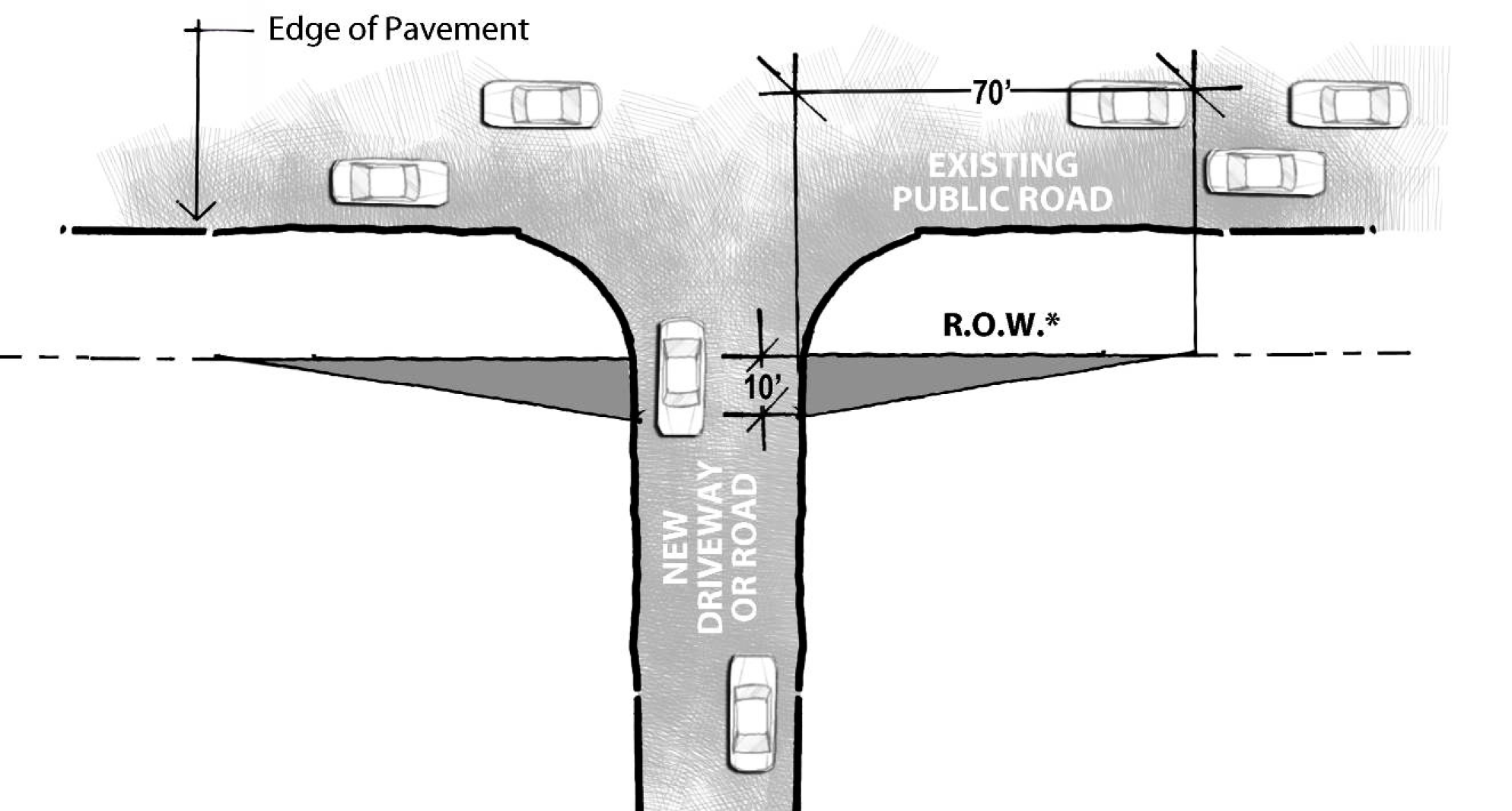
Figure 1
D.
All internal intersections shall have a minimum twenty-foot radius.
E.
Unusual designs such as "Bubble Type" configurations to allow for more lots will not be allowed.
F.
See also related Article 13, Sign Standards, and Sec. 10.4, Driveway Entrances.
10.3.6 Street Paving
A.
Public Streets. All streets designated "public" shall be paved in accordance with the applicable review authority standards and specifications.
B.
Private Streets. All streets designated "private" shall be paved in accordance with the applicable review authority standards and specifications.
(Amend. of 5-21-20(1); Amend. of 3-21-24(2))
10.3.7 Street Names
Proposed streets, which are obviously in alignment with others existing and named, shall bear the assigned name of the existing streets. In no case shall the name of the proposed streets duplicate or be phonetically similar to existing street names, irrespective of the use of the suffix (such as street, avenue, boulevard, drive, place, court, etc.). Street names shall be reviewed and approved by Macon County or Jackson County, depending on jurisdictional location. A copy of the approved street names shall be provided to the Planning and Development Director as part of any required submittal.
10.3.8 Islands or Short Medians at Subdivision Entrances
The Town of Highlands will review requests for the allowance of islands or short medians desired for aesthetics at the entrance to a subdivision on an individual basis. Approval will be with the following requirements:
A.
The person requesting the island or short median shall submit a letter and site plan to the Planning and Development Director. Additional information shall be provided as requested by the Planning and Development Director as necessary to render a recommendation to the Board of Commissioners.
B.
If the subdivision street is intended to be public maintained by the NCDOT State-Maintained System, the person requesting the island or short median shall submit a letter showing NCDOT has granted approval for the request.
C.
The homeowner or property owners association will maintain the island or the median section whether street is designated Public or Private. An agreement shall be prepared, and recorded with the final plat, providing for perpetual maintenance by a homeowner or property owners' association of any and all islands or short medians designated within a subdivision.
1.
Alternatively, the subdivider may provide for maintenance of such streets by other method or means approved by resolution of the Board of Commissioners; and
2.
An encroachment agreement for maintenance access will be required per the requirements of Sec. 10.1.4, Required Easements.
D.
The island or the median section will be removed by the Town of Highlands if not properly maintained by someone involved with the subdivision, i.e., developer, homeowners, etc. The homeowners or property owners association will pay for the removal and any related street repairs.
E.
The location will be outside the line of sight at the entrance intersection.
F.
The minimum lane width at the entrances, excluding curb and gutter will be fourteen (14) feet.
G.
All other applicable standards of this or other Town Ordinances, including but not limited to, roadway, landscape, lighting, and signage, will apply.
10.3.9 On-Street Parking
On-Street Parking is prohibited in the Town of Highlands except for the following locations (see also Article 9, Parking and Loading):
A.
Existing on-street parking located in the B-1 Business District.
B.
On-street parking approved by Special Use Permit for Planned Cluster Developments.
Sec. 10.4 - Driveway Entrances
The following apply to all driveway entrances within the Town of Highlands, except that residential driveways to single-family lots are exempted from the paving and signage requirements, however, they shall in all other respects meet the requirements of Town Ordinances.
10.4.1 Driveway Entrance Requirements
All lots to be platted within the jurisdiction of the Town of Highlands shall have access to a street by a driveway. See also Article 8, Dimensional and Density Standards, and Article 9, Parking and Loading. See also additional requirements for driveways under Sec. 12.5, Steep Slope Protection.
A.
Driveway Ingress and Egress. No driveways providing access to the property shall be located along the public streets or State roads unless permitted in writing by the Town of Highlands. Driveway access along State roads must also be permitted in writing by NCDOT. See also Sec. 10.3.5, Street Intersections.
B.
Shared Driveways. A driveway serving two (2) or less lots shall not be considered a street but must be approved by the Planning and Development Director, under the following conditions:
1.
The person(s) requesting the shared driveway shall submit a letter and site plan to the Planning and Development Director. Additional information shall be provided as requested by the Planning and Development Director as necessary to render an opinion; and
2.
The shared driveway must be provided for through proper easements or title documents as appropriate.
3.
All other driveway requirements in this section must be met.
C.
Driveway Intersections. Driveways serving parking areas or providing access to lots shall be so located so that drivers of exiting vehicles can see far enough in both directions to be able to safely enter the highway. No obstruction to vision—such as a fence, wall, shrub, or sign—shall be permitted within ten (10) feet of the driveway, nor shall a driveway be permitted within twenty (20) feet of an intersection. See also Sec. 10.3.5, Street Intersections.
D.
Driveway Design Standards. Driveways shall not exceed fourteen (14) degrees in slope, and shall be at least twelve (12) feet in width for one-way driveways and twenty (20) feet in width for two-way driveways as illustrated in Figure 2.
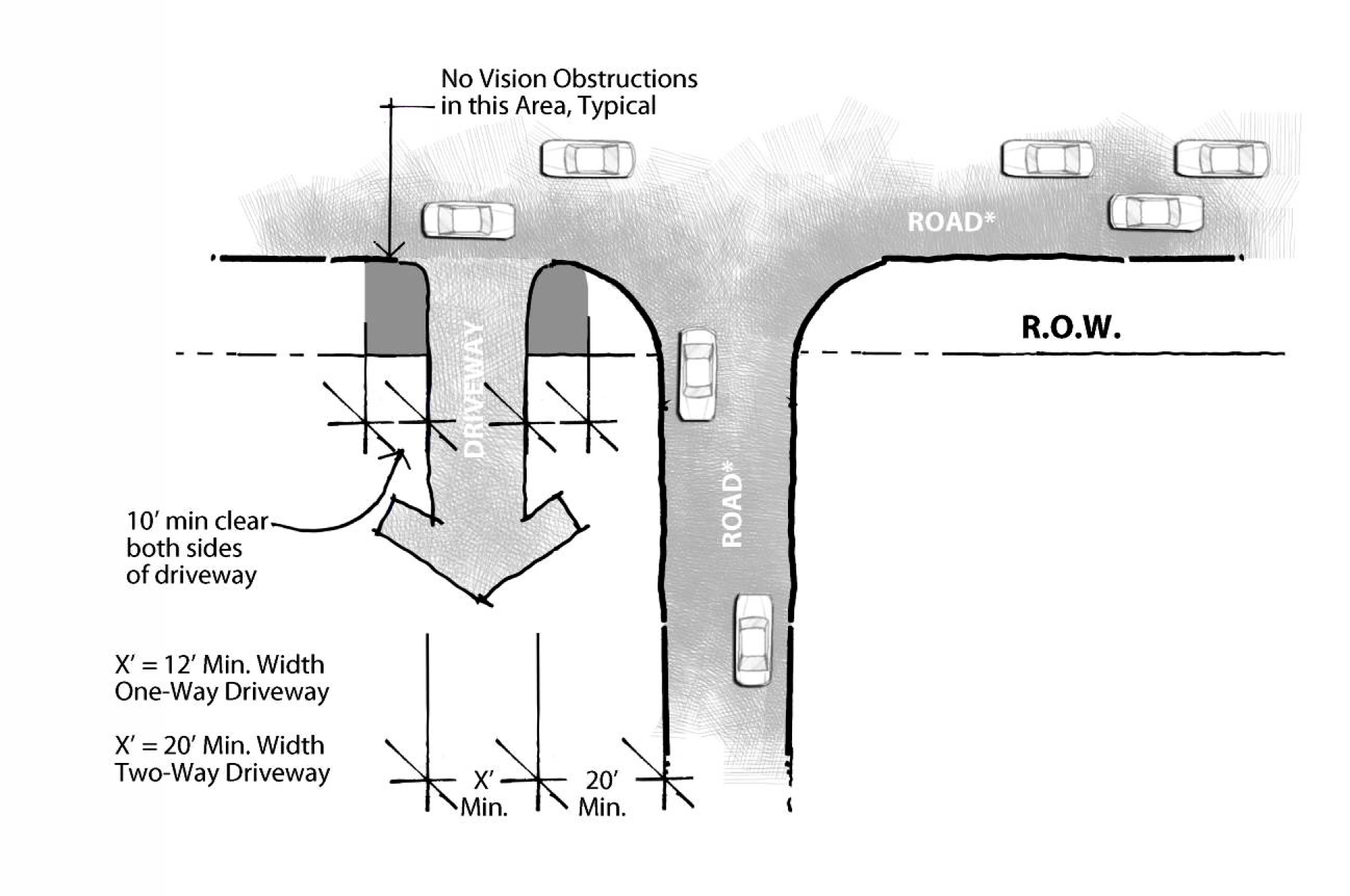
Figure 2.
E.
Driveway Signage. One-way driveways shall be clearly marked with ENTER and EXIT signs.
F.
Driveway Paving. A minimum driveway apron of ten (10) feet shall be provided at the driveway entrance between the thoroughfare and the parking area. The driveway apron shall be paved with a hard surface such as asphalt, concrete, or paving brick. The rest of the driveway entrance to the parking area shall conform to Sec. 9.1.5, Paving, Striping and Signage.
G.
Driveway Drainage. A culvert of adequate size shall be installed whenever a driveway crosses a drainage ditch.
H.
Driveway Curb Cuts. Whenever a new driveway is installed where there is an existing curb cut, and the driveway does not use the existing curb cut, a new concrete curb cut and apron shall be installed and the old curb cut shall be abandoned and replaced with an appropriate curb and gutter and, if appropriate, a landscape strip and sidewalk.
Sec. 10.5 - Pedestrian Mobility
10.5.1 Sidewalks
"The Town of Highlands Master Sidewalk Plan" is adopted simultaneously herewith, may be amended from time to time in accordance with Article 4 of this Ordinance, and shall be permanently kept on file in the office of the Town Clerk. See also sidewalk requirements outlined in Sec. 6.3.2, Multi-Family Dwelling, Item D, and the intent statement in Sec. 5.3.1, B-1 Business District.
A.
Responsibility to Construct. Whenever a new commercial building is constructed on property that adjoins a segment of "The Town of Highlands Master Sidewalk Plan" identified as "Future Sidewalks," it shall be the responsibility of the owner of the property to construct that segment of said sidewalk which adjoins his property.
B.
Standards and Requirements
1.
Sidewalks shall have a minimum width of five (5) feet.
2.
Sidewalks should preferably be placed within the street right-of-way.
3.
See also Sec. 6.5.4, Outdoor Display of Merchandise, for additional requirements for private sidewalks intended for outdoor display.
4.
The sidewalk shall be of a type and design approved by the Town of Highlands, and shall be provided with curb cuts for handicap access at any driveways.
5.
In accordance with G.S. 136-44.14, all street curbs in North Carolina being constructed or reconstructed for maintenance procedures, traffic operation, repairs, correction of utilities or altered for any reason shall provide wheel chair ramps for the physically handicapped at all intersections where curb and gutter is provided and at other major points of pedestrian flow.
6.
Wheel chair ramps and depressed curbs shall be constructed in accordance with details contained in the Department of Transportation, Division of Highway's publication entitled, Guidelines, Curb Cuts and Ramps for Handicapped Persons.
10.5.2 Trails and Paths
Includes trails and paths constructed within the Highlands Greenway, as shown on the Town of Highlands Greenway Plan Map.
A.
Responsibility to Construct. [Reserved.]
B.
Responsibility to Maintain. [Reserved.]
C.
Standards and Requirements
1.
Surfaces of trails and paths may be a maximum of ten (10) feet in width, and may consist of asphalt or any other impermeable or permeable surfaces.
2.
Trails and paths must possess a cross slope of two percent (2%) directed away from any adjacent perennial waterways.
3.
In addition, to insure proper stormwater runoff, catch basins with drains and underground culverts may be required.
4.
See also Sec. 12.3, Riparian Buffers.
Sec. 10.6 - Improvements and Installations
10.6.1 Procedures
A.
Improvements at Preliminary Plat Approval. Upon approval of the preliminary plat by the Board of Commissioners, the subdivider may proceed with the preparation of the final plat, and the installation or arrangement for required improvements in accordance with the approved preliminary plat, the requirements of this Ordinance, or any requirements imposed by the Board of Commissioners as a precondition for approving the preliminary plat.
1.
Following approval of the preliminary plat by the Board of Commissioners, all public and private streets shall be installed strictly in accordance with the plans submitted and approved. The installation of all streets, whether designated "public" or "private," shall be inspected by the Town Engineer, or by another person qualified to inspect street installation as designated by the Town of Highlands, at the subdivider's expense, in accordance with the inspection schedule established by the qualified design professional, to ensure that the streets are installed according to the plans submitted and approved. The subdivider shall be responsible for notifying the Town Engineer in adequate time for the inspections to be made.
2.
The subdivider's qualified design professional shall submit a written report certifying that the private and public streets have been installed in accordance with the plans submitted and approved. The Board of Commissioners shall not approve the final plat, nor accept the responsibility to open, operate, repair, or maintain subdivision streets designated "public," until such report has been submitted.
3.
See also Sec. 4.4.3, Performance Guarantee.
4.
See also Article 15, Inspections, Violations and Enforcement.
5.
Upon approval of the preliminary plat by the Board of Commissioners, the subdivider may proceed with the installation of streets, utilities, all required improvements, and any improvements considered desirable by the subdivider which are neither in conflict with this Ordinance, nor in conflict with any other applicable regulations. If and when a building permit is required (such as when buildings are to be erected concurrently with the required improvements), then such permit may be issued only to the subdivider and only after the approval of the preliminary plat by the Board of Commissioners. The issuance of building permits in such cases is contingent upon compliance with all applicable laws, rules, and regulations. Compliance with this Ordinance is specifically required prior to the issuance of the building permit. Such preliminary approval and issuance of building permits to the subdivider shall in no way alter the requirement that the final plat be approved by the Board of Commissioners prior to the sale or transfer of land in the subdivision or prior to recording of the plat. All public utilities, and all streets, public or private, shall be constructed by an appropriately licensed North Carolina contractor and under the direct supervision of a registered engineer or duly qualified design professional in responsible charge of the project.
B.
Improvements at Final Plat Approval. Prior to approval of the final plat or the sale of any lot in the subdivision, the subdivider shall have installed improvements specified in this Ordinance, or guaranteed their installation by method or means approved by resolution of the Board of Commissioners.
Sec. 10.7 - Wireless Communication Facilities
10.7.1 Development Standards
See also Article 6, Use Regulations, and Article 11, Landscape, Screening and Buffers, and Article 13, Sign Standards, for additional requirements for Wireless Communication Facilities. See Sec. 6.6.3, Preferred Locations for Wireless Communication Facilities and Applicability, Table A.
A.
Height Standards. The following height standards shall apply to all Wireless Communication Facility installations:
1.
Attached Wireless Communication Facilities. Such facilities shall not add more than twenty (20) feet to the height of the existing building or structure to which it is attached (Attachment Structure). However, antenna attachments to existing communication towers shall not increase the height of tower above the maximum original permitted height of that tower;
2.
Wireless Communication Facilities with Support Structures identified in Sec. 6.6.3, Preferred Locations for Wireless Communication Facilities and Applicability, Table A, shall have a maximum height as set out in Table A; and
3.
Wireless Communication Facilities subject to Zoning Board of Adjustment approval shall be reviewed on a case by case basis as part of the Special Use Permit process. However, the height of such facilities should be consistent with the height standards indicated in Sec. 6.6.3, Preferred Locations for Wireless Communication Facilities and Applicability, Table A, for similar properties in similar locations, and shall take into consideration ground elevations, topographical conditions, and other site development criteria within this Ordinance.
B.
Setback Standards. The following setback standards shall apply to all Wireless Communication Facility installations:
1.
Attached Wireless Communication Facilities shall meet the setback provisions of the underlying zoning district in which they are located. However, an Attached Wireless Communication Facility Antenna Array may extend up to thirty (30) inches horizontally beyond the edge of the Attachment Structure so long as the Antenna Array does not encroach upon an adjoining parcel; and
2.
Wireless Communication Facilities with Support Structure, although considered structures, shall meet the setback requirements for buildings in the underlying zoning district in which they are located.
C.
Aesthetics, Placement, Materials, and Colors. The following standards shall apply to all new Antenna Arrays and new Wireless Communication Facilities:
1.
Antenna Array Attachments shall be designed so as to be compatible with the Wireless Communication Facility to which it is to be affixed, including, but not limited to, matching the proposed array with existing structural design, facade colors, and camouflage technology; and
2.
New Wireless Communication Facilities shall be designed to be compatible with existing structures and surroundings to the extent feasible. The proposed Wireless Communication Facility should be consistent with the tower type and height standards indicated in Sec. 6.6.3, Preferred Locations for Wireless Communication Facilities and Applicability, Table A, for similar properties in similar locations, including, but not limited to, considerations of scale and space of the immediate vicinity of the new facility, placement in a location which is consistent with proper functioning of the Wireless Communications Facility, the use of compatible or neutral colors, and camouflage technology.
D.
Lighting. The following lighting requirements shall apply to all Wireless Communication Facility installations. Wireless Communication Facilities shall not be artificially illuminated, directly or indirectly, except for the following:
1.
Security and safety lighting of equipment buildings if such lighting is appropriately down shielded to keep light within the boundaries of the site and does not exceed one hundred (100) watts;
2.
Such illumination of the Wireless Communication Facility as may be required by the FAA or other applicable authority installed in a manner to minimize impacts on adjacent residences; and
3.
Unless otherwise required by the FAA or other applicable authority, the required light shall be red and a type of lens used to reduce ground lighting when the site is within one hundred (100) feet of a residential dwelling.
E.
Radio Frequency Emissions/Sound. The following radio frequency emissions standards shall apply to all Wireless Communication Facility installations:
1.
Radio Frequency Impact. The FTA gives the FCC jurisdiction of the regulation of Radio Frequency (RF) emissions, and Wireless Communication Facilities that do not exceed the FCC standards shall not be conditioned or denied on the basis of RF impact;
2.
FCC Compliance. In order to provide information to its citizens, copies of ongoing FCC information concerning Wireless Communication Facilities and RF emissions standards may be requested from time to time. Applicants for Wireless Communication Facilities shall be required to provide information with the application on the measurement of the effective radiated power of the facility and how this meets the FCC standards;
3.
Sound Prohibited. No unusual sound emissions such as alarms, bells, buzzers or the like are permitted; and
4.
Structural Integrity. Wireless Communication Facilities with Support Structures shall be constructed to the Electronics Industries Association/Telecommunications Industries Association (EIA/TIA) 222 Revision F Standard entitled "Structural Standards for Steel Antennas Towers and Antenna Support Structures" (or equivalent), as it may be updated and amended. Each Support Structure shall be capable of supporting multiple Antenna Arrays.
F.
Co-location Support Structure Design. All Wireless Communication Facilities with a support structure up to a height of one hundred and fifty (150) feet shall be engineered and constructed to accommodate at least three (3) Antenna Arrays. All Wireless Communication Facilities with a support structures greater than a height of one hundred and fifty (150) feet shall be engineered and constructed to accommodate at least four (4) Antenna Arrays.

