
Highlands City Zoning Code
USE REGULATIONS
Sec. 6.1 - Use Categories
The following standards shall apply to all permitted uses, special uses, and limited uses as set forth in Sec. 6.2, Use Table.
6.1.1 General
The use categories of the Town, including principal uses, are set forth below:
A.
Approach to Categorizing Uses
1.
Specific uses, principal uses and accessory uses may be further defined in, Section 2.3, Definitions.
2.
Use categories classify land uses and activities based on common function, product or physical characteristics. Characteristics include the type and amount of activity, the type of customers or residents, how goods or services are sold or delivered, likely impact on surrounding properties, and site conditions. The use categories provide a systematic basis for assigning land uses to appropriate zoning districts.
B.
Principal Uses. The "Principal Uses" portion of each use category lists principal uses typical to that use category, based upon common meaning of the names.
C.
Principal Use Not Specifically Listed. Any use not specifically set forth in the use categories is expressly prohibited unless the Planning and Development Director determines that the use is similar to a permitted use of the Town. Where such similar permitted use is subject to limited use standards or special use approval, the proposed use shall also be subject to such standards or approval. The criteria below shall be used to determine both the appropriate category for a use not specifically listed in the Use Table and whether a use is considered principal or accessory.
1.
The actual or projected characteristics of the activity in relationship to the characteristics of each use category;
2.
The relative amount of site area or floor space and equipment devoted to the activity;
3.
Relative amount of sales from each activity;
4.
The customer type for each activity;
5.
The relative number of employees in each activity;
6.
Hours of operation;
7.
Building and site arrangement;
8.
Types of vehicles used and their parking requirements;
9.
The relative number of vehicle trips generated;
10.
Signs associated with the use;
11.
How the use is advertised;
12.
The anticipated impact on surrounding properties;
13.
Whether the activity is likely to be found independent of the other activities on the site; and
14.
The district intent statement in Article 5, Zoning Districts.
D.
Accessory Uses. "Accessory Uses" are allowed by right in conjunction with a principal use in a specific Zoning District unless otherwise stated in these regulations. Some listed accessory uses may also be considered accessory structures. No accessory use may be established on a site without a principal use.
Sec. 6.2 - Use Table
6.2.1 Key
A.
Types of Uses
1.
Permitted (P). A "P" in the Use Tables indicates that a use is allowed by right in the respective district. Such uses are subject to all other applicable requirements of this Ordinance.
2.
Special (S). An "S" in the Use Tables indicates that a use is allowed only by a Special Use Permit, provided that the use meets the additional requirements imposed by the reference sections in the "Notes" column of the table. Such uses are subject to all other applicable requirements of this Ordinance.
3.
Limited (L). An "L" indicates that a use shall be permitted by right, provided that the use meets the additional requirements imposed by the referenced sections in the "Notes" column of the table. Such uses are subject to all other applicable requirements of this Ordinance.
4.
Not Allowed (X). An X in the Use Table indicates that a use is not allowed in the respective district.
6.2.2 Use Table
(Amend. of 8-18-16(3); Amend. of 10-18-18(2); Amend. of 9-14-22(1), § 2)
Sec. 6.3 - Residential Uses
6.3.1 Single-family Dwelling
Single-family Dwellings in the Town shall be permitted in accordance with Sec. 6.2, Use Table, subject to the following standards:
A.
Single-family dwelling shall include both single-family detached dwellings on individual lots held in fee-simple and single-family detached condominiums.
B.
Modular homes are allowed wherever single-family dwelling detached use is allowed. Modular homes shall expressly exclude manufactured homes.
C.
Manufactured homes, as defined by this Ordinance, are allowed as a regulated use for single-family dwelling detached. All of the following conditions shall apply:
1.
Lot dimensional standards shall be the same as for single-family detached in the applicable district;
2.
The unit is occupied by persons owning the land on which the unit is located;
3.
The tongue, axles, removable towing apparatus, and transporting lights are removed after final placement on the site;
4.
A continuous, permanent masonry curtain wall or foundation, unpierced except for ventilation and covered access, is installed under the unit;
5.
The finished width of the base unit is not less than twenty-four (24) feet;
6.
The pitch of the roof has a minimum vertical rise of one (1) foot for each four (4) feet of horizontal rise (1:4) and the roof is finished with shingles;
7.
The exterior siding consists predominantly of horizontal or vertical vinyl, aluminum, wood, or hardboard siding; and
8.
The unit shall exceed forty (40) feet in length.
6.3.2 Multi-family building or dwelling
Multi-family Dwellings in the Town may be permitted in accordance with Sec. 6.2, Use Table, with the issuance of a Special Use Permit, see Section 4.6 Special Use Permit, including the following additional requirements:
A.
Multi-family shall apply to the erection of multi-family buildings and to the conversion of existing buildings from nonresidential to residential multi-family use. Multi-family dwellings, including apartments, except incidental apartments as defined in Sec. 6.5.5, Incidental Apartments, all condominiums except single-family detached condominiums, cooperatives, single-family attached and any other legally recognized form of ownership for similar dwellings, in accordance with the specific requirements of this Ordinance.
B.
Whenever the term "construction" or "erection" occurs within this Section, the context shall include the conversion of existing buildings to multi-family use.
C.
An owner of a parcel may dedicate a portion thereof to multi-family purposes without dedicating the entire parcel if the portion qualifies for multi-family use within the requirements of this Ordinance.
D.
When a new multi-family building is constructed, it shall be the responsibility of the property owner to construct the sidewalks designated on the Town of Highlands Master Sidewalk Plan that adjoin his/her property in conformance with the Master Sidewalk Plan and related ordinances. See also Sec. 10.5.1, Sidewalks.
(Amend. of 8-18-16(3); Amend. of 9-14-22(1), § 3)
6.3.3 Residential Accessory Uses and Structures
Residential Accessory Uses and Structures in the Town shall be permitted in accordance with Sec. 6.2, Use Table, and Article 4 Applications and Permits, subject to the following standards:
A.
Customary Accessory Outbuildings. Appurtenant to single-family dwellings such as private garages, noncommercial buildings such as greenhouses and workshops. No residential or lodging use of any kind is allowed.
B.
Storage Outbuildings on Vacant Lots. Storage outbuildings of tractors, lawnmowers, and similar equipment for the care or cultivation of property may be constructed on vacant lots subject to issuance of a Zoning Certificate.
C.
Fences and Walls
1.
Fences or walls shall be permitted adjacent to the side and rear property lines. Fences or walls are permitted behind the building setback line from a road right-of-way or road centerline, as defined by this Ordinance. All fences shall meet the following standards:
a.
Six (6) feet height maximum for fences or walls.
b.
Acceptable building materials include wood, coated chain link in dark green, dark brown or black, ornamental iron, aluminum, brick or stone.
c.
Unacceptable and prohibited materials include, but not limited to, uncoated chain link, coated chain link in a color not listed within the acceptable materials list above, plywood, particle board, plastic mesh, chicken wire, barbed wire, non-veneered concrete blocks, or sheet metal.
d.
Exposed framing for a single-sided fence must face the interior of the property.
e.
Any fence constructed, other than the coated chain link mentioned above, shall be stained or painted with a consistent earth tone color from the Town of Highlands Approved Color Chart, in order to blend in with the environment.
2.
Fences and/or walls are strongly discouraged within the building setback line from a road right-of-way or road centerline. However, if fences or walls are built within the building setback line from a road right-of-way or road centerline, the following standards shall apply:
a.
Five (5) feet height maximum for fences or walls.
b.
A minimum setback distance of twelve (12) feet from the travel way or the edge of pavement is required. No fence or wall shall be constructed in the right-of-way. In specific cases, due to topographical factors, the Zoning Administrator may approve a fence within the twelve-foot setback, if all other requirements can be met.
c.
Acceptable building materials include wood, coated chain link in dark green, dark brown or black, ornamental iron, aluminum, brick or stone.
d.
Unacceptable and prohibited materials include, but not limited to, uncoated chain link, coated chain link in a color not listed within the acceptable materials list above, plywood, particle board, plastic mesh, chicken wire, barbed wire, non-veneered concrete blocks, or sheet metal.
e.
Fences or walls may not block the required sight triangle at intersections.
f.
Exposed framing for a single-sided fence must face the interior of the property.
g.
Coated chain link and solid wooden privacy fences shall include a vegetative screen of a minimum of four (4) feet in height.
h.
Any fence constructed shall be stained or painted with a consistent earth tone color from the Town of Highlands Approved Color Chart, in order to blend in with the environment.
3.
Maintenance. All fences and walls shall be maintained in a safe condition, free of graffiti, and in good appearance. Replacement of existing fences must meet the requirement of this Ordinance.
4.
Exemptions:
a.
Retaining walls;
b.
Public Recreation Facilities (tennis courts, etc.).
D.
Exterior Residential Security and Area Lighting.
The purpose of this section is to provide direction in controlling exterior lighting so as to enhance the areas being lit and not adversely affect motorists, pedestrians, and adjacent properties. Lighting intensities should be controlled to assure that light spillage and glare are not directed at adjacent properties, neighboring areas, motorists, or the sky.
Exterior lighting shall be integrated with the architectural character of the building. Downcast, fully shielded, or cut-off type lighting fixtures shall be used to illuminate pedestrian or traffic circulation corridors and signage.
1.
Standards for Exterior Residential Security and Area Lighting. All exterior residential security and area lighting shall conform to the following standards:
a)
Outdoor lighting shall be designed, located and mounted at heights no greater than twenty-seven (27) feet above grade (including a base maximum height of two (2) feet) for fully shielded, cut-off lights.
b)
All lighting poles on residential property must be located at least ten (10) feet from property lines defining rear and side yards.
c)
The maximum light level shall be 0.3 maintained foot-candles at any property line in a residential area, and 2.0 maintained foot-candles at any street right-of-way.
d)
Fixtures should be placed to provide uniform distribution of light and to avoid intense lighting that produces excessive glare.
e)
Light fixtures used to light building and landscaping shall be selected, located, aimed, and shielded so that direct illumination is focused exclusively on the building facade, plantings, or other site features and away from adjoining properties, the sky, and the street right-of-way.
2.
Outdoor Recreational Lighting. Because of their unique requirements for nighttime visibility and limited hours of operation, the lighting of active recreation areas, such as ball fields and tennis courts, are not considered in the Section. Lighting conditions for such uses shall be approved by the Planning and Development Director in accordance with approved standards and specifications.
3.
Design Procedures
a.
The maximum permitted illumination shall be measured in average maintained foot-candles from ground level in accordance with the standards in this Section and in the chart within. These standards are required of all exterior lighting with the exception of street lighting.
b.
The quantity of fixtures to be provided shall be based upon the desired level of uniform illumination as established by the current standards of the Illuminating Engineering Society. Fixture locations should be chosen to minimize the hazards of glare.
c.
The level on illumination shall be based upon the primary activity in each area to be lighted. The following standards for various activities prescribed by the Illuminating Engineering Society Chart within, represents a number of exterior lighting uses for general reference. Foot-candle designations represent measurements for the average intensity at grade.
Illuminating Engineering Society Chart
E.
Recreation Vehicle. Only one (1) camping trailer, motor home, or similar recreational vehicle may be parked within applicable setback lines and not occupied or not connected to any water, sewerage, or power supply.
F.
Customary Incidental Home Occupations
1.
Work activities must be carried on wholly inside the main building or in a fully enclosed accessory building.
2.
See Sec. 13.4.2, Permanent Regulated Signs Allowed without a Permit, Item F, and Sec. 13.5.2, Permanent Regulated Signs Requiring a Permit, Item B.1, for incidental home occupations signs.
3.
There will be no visible display or storage of materials.
4.
No additional noise or unreasonable generation of traffic will be generated than what would be normally expected with a home.
(Amend. of 8-18-16(3); Amend. of 6-20-19(1); Amend. of 9-14-22(1), § 4)
Sec. 6.4 - Public and Civic Uses
6.4.1 Parks and Playgrounds
[Reserved for future specific use standards.]
6.4.2 Golf and Tennis Clubs
Golf and Tennis Clubs in the Town shall be permitted in accordance with Sec. 6.2, Use Table, subject to the following standards:
A.
Accessory uses include such grounds, administrative offices, clubhouses, storage buildings, and other facilities customarily associated with Golf and Tennis Clubs.
6.4.3 Churches and Other Places of Public Worship
[Reserved for future specific use standards.]
6.4.4 Research and Educational
Research and Educational uses in the Town shall be permitted in accordance with Sec. 6.2, Use Table, subject to the following standards:
Together with those structures customarily associated with such uses, or as may be necessary for the operation thereof in furtherance of the research or educational functions being pursued within State-owned research and education-related institutions.
A.
State-owned Research and Education-Related Institutions. New construction, including additions to existing buildings.
B.
Private Schools. [Reserved for future specific use standards.]
C.
Day Care Centers. [Reserved for future specific use standards.]
D.
Public Schools. [Reserved for future specific use standards.]
6.4.5 Nonprofit Visual Art Centers
Nonprofit Visual Art Centers in the Town shall be permitted in accordance with Sec. 6.2, Use Table, subject to the following standards:
A.
Nonprofit Visual Art Centers shall apply to the erection of nonprofit visual art buildings and to the conversion of existing buildings to nonprofit visual art use. Whenever the term "construction" or "erection" occurs within this Ordinance, the context shall include the conversion of existing buildings to nonprofit visual art buildings;
B.
The primary use of the premises as a nonprofit visual art center may not be changed except by rezoning the property for use in accordance with the applicable provisions of this Ordinance;
C.
Primary pedestrian access and primary road access must be provided by the applicant directly from U.S. 64/N.C. 28; or, from a public street that intersects U.S. 64/N.C. 28 that is zoned for commercial use. See also Sec. 10.5.1, Sidewalks; and
D.
Associated building usage for Nonprofit Visual Art Centers shall include, but not be limited to, gallery space, classrooms, office space, dormitories for summer students and small retail shops. Retail sales on the property shall be limited to items usually and customarily sold by visual art centers.
6.4.6 Government Buildings
Government Buildings of any kind shall be permitted in accordance with Sec. 6.2, Use Table.
Sec. 6.5 - Commercial Uses
Commercial Uses shall include Indoor Recreation and Entertainment, Overnight Accommodations, Retail or Wholesale Business and Restaurants, Professional Office or Studio and Industrial Businesses. Commercial shall be permitted in accordance with Sec. 6.2, Use Table, and Article 4 Applications and Permits, subject to the following standards.
(Amend. of 10-18-18(3); Amend. of 6-20-19(3))
6.5.1 Commercial Building Exterior Materials
All exterior siding materials for commercial buildings shall conform to the following standards:
A.
A maximum of three (3) of the following materials can be used on any facade of a commercial building. Approved materials include:
1.
Stucco, float finish, smooth or coarse, machine spray, pebble dash and troweled, and limited to thirty percent (30%) on any one (1) facade;
2.
Wood Clapboard, five inches plus (5"+) to the weather;
3.
Wood Shingles, five inches plus (5"+) to the weather;
4.
Wood Board or Batten Board, eight to twelve (8 to 12) inches;
5.
Wood Shiplap Siding, four inches plus (4"+) to the weather;
6.
Unpolished natural regional stone w/ashlar or random ashlar pattern;
7.
Clay brick, antique or unglazed; or
8.
Simulated Materials: Simulated permitted materials from the above list, may be used, provided such materials are reviewed and approved by the Planning and Development Director.
9.
Uncoated sheet copper, limited to thirty percent (30%) on any one (1) facade. Such copper shall remain unpolished and unfinished, in order to reflect a weathered, oxidized appearance.
B.
All colors for commercial buildings shall generally conform to the official Color Chart, which shall be maintained in the office of the Planning and Development Director. Approved colors need not match specific colors in the chart, but the given shades shall fall within the parameters defined by the chart as determined by the Planning and Development Director.
(Amend. of 10-18-18(3))
6.5.2 Fences and Walls
1.
Fences or walls shall be permitted adjacent to the side and rear property lines. Fences or walls are permitted behind the building setback line from a road right-of-way or road centerline, as defined by this Ordinance. All fences shall meet the following standards:
a.
Six (6) feet height maximum for fences or walls.
b.
Acceptable building materials include wood, coated chain link in dark green, dark brown or black, ornamental iron, aluminum, brick or stone.
c.
Unacceptable and prohibited materials include, but not limited to, uncoated chain link, coated chain link in a color not listed within the acceptable materials list above, plywood, particle board, plastic mesh, chicken wire, barbed wire, non-veneered concrete blocks, or sheet metal.
d.
Exposed framing for a single-sided fence must face the interior of the property.
e.
Any fence constructed, other than the coated chain link mentioned above, shall be stained or painted with a consistent earth tone color from the Town of Highlands Approved Color Chart, in order to blend in with the environment.
2.
Fences and/or walls are strongly discouraged within the front building setback line. However, if fences or walls are built within the building setback line, the following standards shall apply:
a.
Five (5) feet height maximum for fences or walls.
b.
A minimum setback distance of twelve (12) feet from the travel way or the edge of pavement is required. No fence or wall shall be constructed in the right-of-way. In specific cases, due to topographical factors, the Zoning Administrator may approve a fence within the twelve-foot setback, if all other requirements can be met.
c.
Acceptable building materials include wood, coated chain link in dark green, dark brown or black, ornamental iron, aluminum, brick or stone.
d.
Unacceptable and prohibited materials include, but not limited to, uncoated chain-link, coated chain link in a color not listed within the acceptable materials list above, plywood, particle board, plastic mesh, chicken wire, barbed wire, non-veneered concrete blocks, or sheet metal.
e.
Fences or walls may not block the required sight triangle at intersections.
f.
Exposed framing for a single-sided fence must face the interior of the property.
g.
Coated chain link and solid wooden privacy fences shall include a vegetative screen of a minimum of four (4) feet in height.
h.
Any fence constructed shall be stained or painted with a consistent earth tone color from the Town of Highlands Approved Color Chart, in order to blend in with the environment.
3.
Maintenance. All fences and walls shall be maintained in a safe condition, free of graffiti, and in good appearance. Replacement of existing fences must meet the requirement of this Ordinance.
4.
Exemptions
a.
Retaining walls;
b.
Public Recreation Facilities (tennis courts, etc.).
(Amend. of 8-18-16(3); Amend. of 6-20-19(3))
6.5.3 Exterior Commercial Lighting
The purpose of this section is to provide direction in controlling exterior lighting so as to enhance the areas being lit and not adversely affect motorists, pedestrians, and adjacent properties. Lighting intensities should be controlled to assure that light spillage and glare are not directed at adjacent properties, neighboring areas, motorists, or the sky. Exterior lighting shall be integrated with the architectural character of the building. Downcast, fully shielded, or cut-off type lighting fixtures shall be used to illuminate pedestrian or traffic circulation corridors and signage.
A.
Standards for Exterior Commercial Lighting. All exterior commercial lighting shall conform to the following standards:
1.
Outdoor lighting from commercial venues shall not shine directly into the yard or windows of a residence.
2.
Outdoor lighting shall be designed, located and mounted at heights no greater than twenty-seven (27) feet above grade (including a base maximum height of two (2) feet) for fully shielded, cut-off lights.
3.
All parking lot and security lighting fixtures, regardless of output, shall be full cut-off fixtures.
4.
All outdoor lighting shall be designed and located such that the maximum illumination measured in foot-candles at the property line shall not exceed 1.5 for full cut-off or fully shielded lights. The average intensity illumination for outdoor lighting shall not exceed six (6) foot-candles in intensity as measured at grade.
5.
Fixtures should be placed to provide uniform distribution of light and to avoid intense lighting that produces excessive glare.
6.
Light fixtures used to light building and landscaping shall be selected, located, aimed, and shielded so that direct illumination is focused exclusively on the building facade, plantings, or other site features and away from adjoining properties, the sky, and the street right-of-way.
7.
Lighting fixtures in scale with pedestrian activities shall provide for uniform distribution of lighting to produce minimal shadows.
8.
Trees and lighting in parking areas should be coordinated. Landscape plans should show lighting and tree locations.
9.
String lights in commercial zoning districts may not intentionally accent signage and must comply with one of the following two (2) standards:
a.
Holiday lighting
•
Only between November 15 and January 15
•
No permit required
b.
Accent lighting
•
Lights must meet electric and fire code
•
Lights must be commercial grade and hard wired
•
Lights shall only illuminate during a businesses operating hours
•
Light bulbs shall not exceed two (2) inches in diameter
•
No more than two (2) lines of LED string lights are permitted; lines must be a minimum of six (6) feet apart
•
Lights shall be designed, located and mounted at heights no greater than fifteen (15) feet and no lower than eight (8) feet above the floor of the structure in which they're located
•
White or clear lights only
•
Lights shall not exceed 2700 Kelvin or less
•
No individual bulb in the string shall exceed one (1) watt LED
•
Lights must provide a constant uniform distribution of light and shall not move or flash
•
All bulbs shall be maintained in proper working order; strands that are partially lit or not functioning properly must be turned off until repaired
•
Used only as accent lights for dining areas
•
Lights shall only be allowed over one (1) dining structure (Deck, Pavilion, Porch, etc.) per commercial parcel
•
May not be located on or over publicly owned property
B.
Outdoor Recreational Lighting. Because of their unique requirements for nighttime visibility and limited hours of operation, the lighting of active recreation areas, such as ball fields and tennis courts, are not considered in the Section. Lighting conditions for such uses shall be approved by the Planning and Development Director in accordance with approved standards and specifications.
C.
Design Procedures.
1.
The maximum permitted illumination shall be measured in average maintained foot-candles from ground level in accordance with the standards in this Section and chart within. These standards are required of all exterior lighting with the exception of street lighting.
2.
The quantity of fixtures to be provided shall be based upon the desired level of uniform illumination as established by the current standards of the Illuminating Engineering Society. Fixture locations should be chosen to minimize the hazards of glare.
3.
The level on illumination shall be based upon the primary activity in each area to be lighted. The following standards for various activities prescribed by the Illuminating Engineering Society within, represents a number of exterior lighting uses for general reference. Foot-candle designations represent measurements for the average intensity at grade.
Illuminating Engineering Society Chart
D.
Prohibitions. The following are prohibited:
1.
The use of laser source light or any similar high intensity light without a Permit from Town Board.
2.
The operation of searchlights for advertising purposes.
3.
No flickering or flashing lights shall be permitted, except as allowed in Subsection E, below.
E.
Temporary lighting and displays as part of customary holiday decorations, provided strings of lights may only be installed between November 15 and January 15 each year, and must be removed at the end of that period.
(Amend. of 10-20-16(2); Amend. of 11-17-16(3); Amend. of 11-17-16-(7); Amend. of 12-14-23(1))
6.5.4 Outdoor Display of Merchandise
The purpose of this Section is to enhance the economic vitality of established commercial areas by permitting the display of merchandise in outdoor areas under uniform standards. These standards address aesthetics, safety and other matters of public concern, and thereby promote the general welfare of the Town. Outdoor displays of merchandise shall be designed, operated and maintained in a neat and orderly manner so to be compatible in appearance with the existing scale and character of the Town of Highlands. This Section shall not apply to retail plant nurseries.
A.
B-1 and B-2 Zoning Districts. Outdoor displays, as defined herein, shall be allowed only upon compliance with the following provisions of this Section:
1.
Outdoor displays shall be allowed only as an accessory use to operating retail businesses, and only pursuant to a valid outdoor display permit (See Section 4.8 Outdoor Display;
2.
Outdoor displays shall be permitted only on the private property of the permit holder in areas immediately adjacent and contiguous to the front or side facades of the associated commercial building;
3.
No signage associated with an outdoor display may be displayed outdoors;
4.
No material classified as "highly flammable" under County, State, Federal, or other Town ordinances may be displayed outdoors. Firewood and propane cylinders shall not be considered "highly flammable" for purposes of this Ordinance;
5.
No material classified as a Hazardous Household Product as per the North Carolina Cooperative Extension Service, Publication Number HE-368-1, dated March 1996, or the most current publication of said document, may be displayed outdoors;
6.
Outdoor displays shall meet all applicable fire, health, building and handicapped access requirements and regulations. Entrances and/or exits to all buildings shall be maintained free and clear of merchandise or other items, including but not limited to items hung on doors or at entryways as illustrated by Figure 1;
7.
The full width or a minimum of five (5) feet, whichever is smaller, of a private sidewalk which is open to the public, shall be kept clear of outdoor displays as illustrated by Figure 2;
8.
The minimum sidewalk width for new construction where outdoor displays are intended shall be eight (8) feet. See also Sec. 10.5.1, Sidewalks;
9.
An outdoor display permit shall be issued to the commercial business and is not transferable; and
10.
See also Sec. 13.1.4, Exempt Signs, for customary holiday displays.
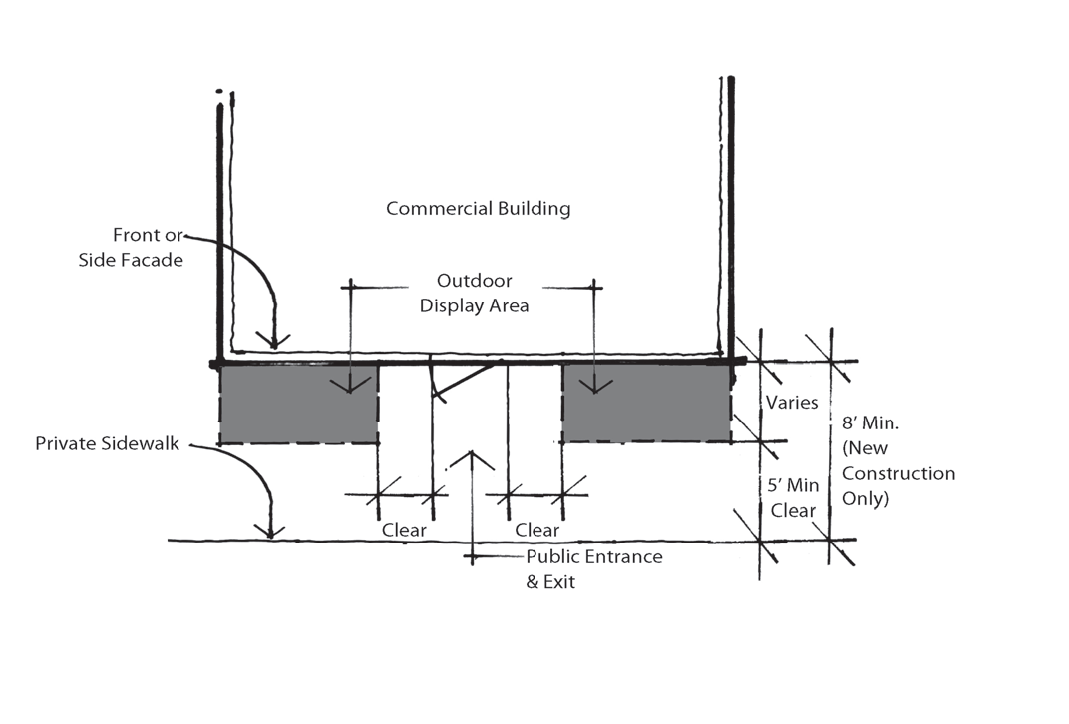
Figure 1
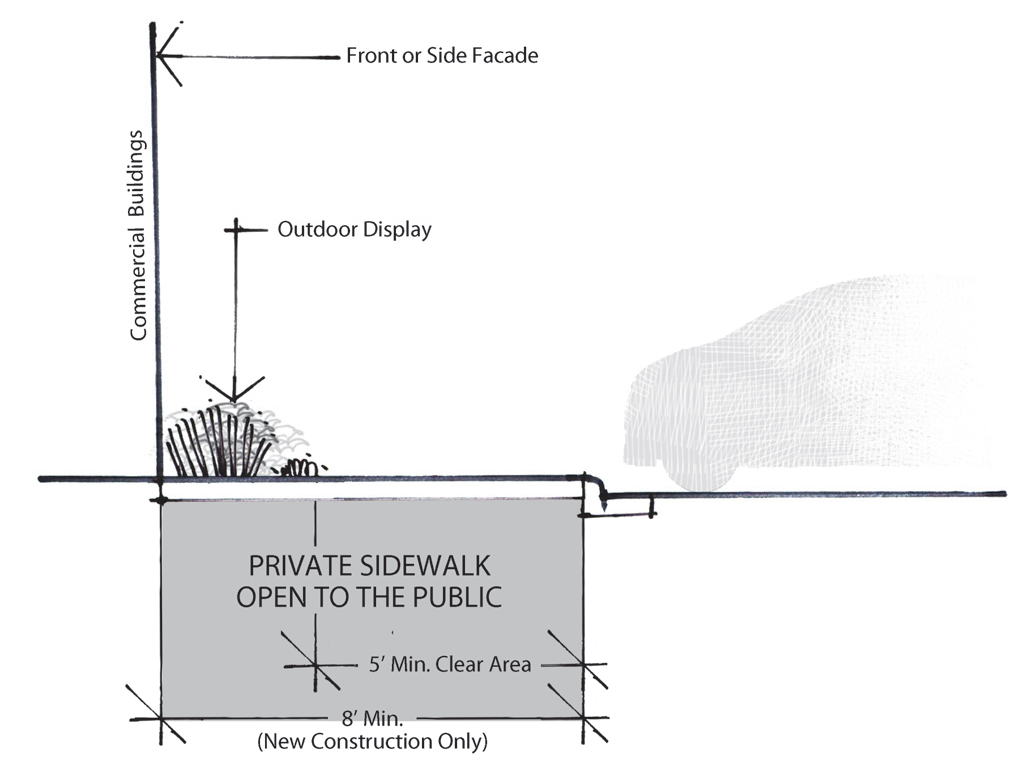
Figure 2
B.
B-3 and B-4 Zoning Districts. The following regulations shall apply in the B-3 and B-4 zoning districts in addition to those required under Item A above:
1.
Outdoor displays shall be limited to an area within twenty-five (25) feet of the front or the side of the principal commercial structure as illustrated by Figure 3; and
2.
Outdoor displays shall not be allowed within twenty-five (25) feet of the edge of pavement of any Town, State or Federal roadway, or within ten (10) feet of the back edge of a public sidewalk, if applicable as illustrated by Figure 3.
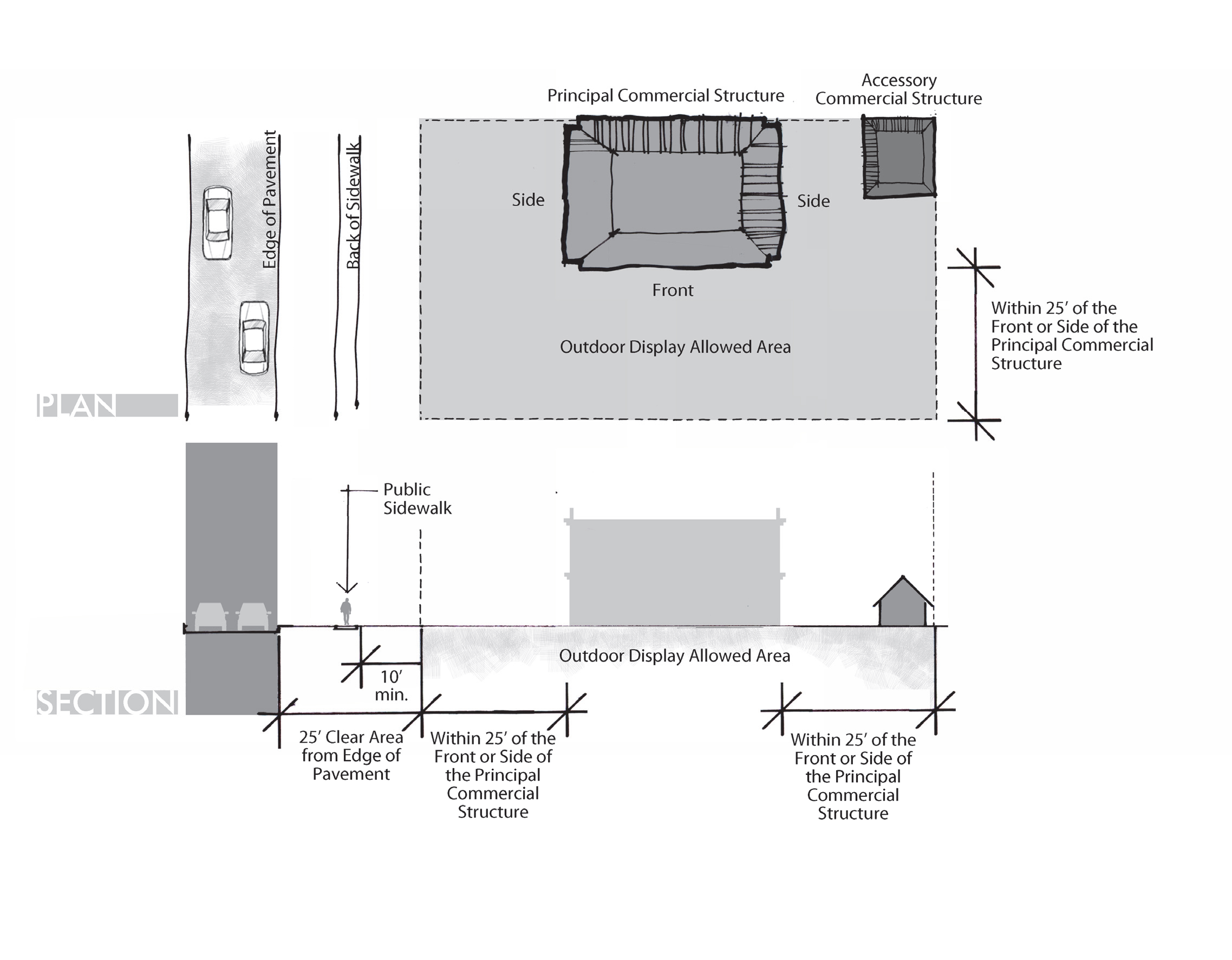
Figure 3
(Amend. of 8-18-16(3))
6.5.5 Incidental Apartments
Incidental Apartments located within, and incidental to, a building used primarily for commercial uses. More than one (1) apartment may be located within a building of mixed occupancy, in conformance with the residential density as defined by Article 8, Dimensional and Density Standards, however, notwithstanding Sec. 6.3.2, Multi-Family Dwelling, the building shall not be considered "multi-family."
6.5.6 Indoor Recreation and Entertainment
Indoor recreation and entertainment facilities may be permitted in the Zoning Districts identified in Sec. 6.2, Use Table, with the issuance of a Special Use Permit (See Section 4.6 Special Use Permit) in the Town, such as indoor theater, dance halls, skating rinks, and bowling alleys or similar.
(Amend. of 8-18-16(3))
6.5.7 Private Social Clubs
Private Social Clubs may be permitted in the Zoning Districts identified in Sec. 6.2, Use Table, with the issuance of a Special Use Permit (See Section 4.6 Special Use Permit and Section 4.63 Additional Application Requirements B. Private Social Clubs), including the following additional requirements: (excluding a Homeowners association, which is any properly constituted homeowners or property association may organize such private social club without reference to zoning areas, so long as the membership of such association is limited to property owners holding lots, parcels, or similar divisions of land located within the boundaries of property for which the association is created).
1.
A complete description of all of the regular activities to be held at the club;
2.
The maximum number of members who will be permitted to join the club. If the club desires to increase the membership over the number allowed in the original permit, then the club must re-apply, and both the minimum parcel size and the amount of parking provided under Article 9, Parking and Loading, must be large enough to accommodate the increase in membership.
(Amend. of 8-18-16(3))
6.5.8 Adult Establishments or Places of Adult Entertainment
Adult Establishments may be permitted in the Zoning Districts identified in Sec. 6.2, Use Table, with the issuance of a Special Use Permit, including the following additional requirements:
•
No place of adult entertainment shall be located, in whole or in part, within two hundred (200) feet of the following:
1.
Any residential zoning district;
2.
Property on which any other place of adult entertainment or adult establishment is located;
3.
Property on which any church or other place of public worship is located; and
4.
Property on which any school, park, library or any other public or private property associated with child care and development.
6.5.9 Hotels and Motels
A Hotel or Motel may be permitted in the Zoning Districts identified in Sec. 6.2, Use Table, with the issuance of a Special Use Permit, including the following additional requirements:
A.
Any application for a hotel or motel, or for permission to increase the number of accommodations in a hotel or motel, shall be considered an application for a Special Use Permit, or amendment of a Special Use Permit.
B.
All off-street parking for a hotel or motel required by Article 9, Parking and Loading, shall be located on the same parcel of property as the accommodations, unless valet parking is approved on a case by case basis by the Board of Commissioners.
C.
All hotels or motels shall be provided with those services customarily provided in hotels or motels, including linen service, maid service, and a lobby or office of adequate size on the same premises as the accommodations.
D.
All accommodations in a hotel or motel shall be located on the same premises.
6.5.10 Tourist Homes
The term Tourist Home may also mean Bed and Breakfast Home.
A Tourist Home may be permitted in the Zoning Districts identified in Sec. 6.2, Use Table, with the issuance of a Special Use Permit (See Section 4.6 Special Use Permit).
No private home shall be converted to a tourist home until a Certificate of Compliance has been issued by the Planning and Development Director. The following conditions must be met before such a Certificate may be issued:
A.
The tourist home shall serve as the residence of the owner or operator, and only one (1) tourist home may be operated by any one (1) person;
B.
The tourist home may be identified only by a sign complying with Sec. 13.5.2, Permanent Regulated Signs Requiring a Permit;
C.
No more than four (4) bedrooms may be provided for accommodations in any tourist home;
D.
All parking areas shall conform to Article 9 of this Ordinance;
E.
The building serving as the tourist home shall be inspected by the Macon County or Jackson County Health Department to determine that it complies with the N.C. Division of Human Services "Rules Governing the Sanitation of Bed and Breakfast Homes, Section .2200 of the N.C. Administrative Code, Title 10, Chapter 10;" and
F.
The building serving as the tourist home shall be inspected by a building inspector authorized to perform building inspection under Volume I of the State Building Code, and certified by said inspector that it is of sound construction and has adequate exits.
(Amend. of 8-18-16(3))
6.5.11 Retail, Service or Wholesale Businesses
Retail, Service or Wholesale Businesses may be permitted in the Zoning Districts identified in Sec. 6.2, Use Table, including the following additional requirements:
A.
Zoning Districts B-1, B-2, B-3: Any retail, service or wholesale business not requiring a Special Use Permit, provided that the same shall have a minimum of eight hundred (800) square feet of gross floor space if located in a new building or in an existing building in which the number of business occupants is increased as a result of remodeling.
1.
Automatic Teller Machines, whether attached to building walls or freestanding, shall not be subject to the minimum of eight hundred (800) square foot of gross floor space required by this Section.
2.
Brewpubs are allowed under this section, but shall be limited to a maximum of one thousand (1,000) barrels of production per year.
3.
Microbreweries, per Section 6.2, Use Table, are permitted with the issuance of a Special Use Permit within the B-3 zoning district only.
B.
Zoning District B-4: Any single retail or wholesale business not requiring a Special Use Permit, provided that the same shall have a minimum of eight hundred (800) square feet of gross floor space if located in a new building or in an existing building in which the number of business occupants is increased as a result of remodeling, and a maximum of two thousand (2,000) square feet of gross floor space; shall be located in a single building and, if located on a lot more than one-half (.5) acre in area, not exceeding a ratio of one (1) building for every one-half (.5) acre of lot size.
C.
Zoning District B-4: Any single retail service business not requiring a Special Use Permit, provided that the same shall have a minimum of eight hundred (800) square feet of gross floor space if located in a new building or in an existing building in which the number of business occupants is increased as a result of remodeling, and a maximum of two thousand (2000) square feet of gross floor space; shall be located in a single building and, if located on a lot more than one-half (.5) acre in area, not exceeding a ratio of one (1) building for every one half (.5) acre of lot size. Automatic Teller Machines, whether attached to building walls or freestanding, shall not be subject to the minimum of eight hundred (800) square foot of gross floor space required by this Section.
6.5.12 Restaurants
A restaurant may be permitted in the Zoning Districts identified in Sec. 6.2, Use Table, with the issuance of a Special Use Permit (See Section 4.6 Special Use Permit).
A.
Application for Permit. Any request to increase the seating in a restaurant, shall be considered an application for a Special Use Permit, or amendment of a Special Use Permit. However, an application to increase the amount of seating in a restaurant pursuant to Sec. 9.2.1.A, Shared Parking for Restaurants, Applicability, shall not be considered an amendment of a Special Use Permit.
B.
Limitations
1.
Restaurants shall be prohibited from selling take-out food from a drive-through window to customers in vehicles.
2.
Nothing in this Ordinance shall prevent a restaurant from preparing and selling take-out food, provided customers actually approach or enter the restaurant on foot.
(Amend. of 8-18-16(3))
6.5.13 Professional Offices or Studios
Professional offices or studios including those of accountants, architects, artists, attorneys, contractors, dentists, engineers, insurance agents, land surveyors, musicians, photographers, physicians, real estate brokers, and surveyors are permitted in the Zoning Districts identified in Sec. 6.2, Use Table.
6.5.14 Self-service Storage Facilities
Self-service Storage Facilities may be permitted in the Zoning Districts identified in Sec. 6.2, Use Table, with the issuance of a Special Use Permit per Section 4.6 Special Use permit and including the following additional requirements:
A.
The owner of every self-service storage facility shall be responsible for operating the facility in accordance with the G.S. 44A-40 et seq.
B.
A self-service storage facility shall be used solely for the purpose of storage and for no other purpose whatsoever. No occupant shall use a self-service storage facility for residential or for retail business purposes.
C.
The storage of welding, flammable, explosive, or other inherently dangerous material is prohibited within any storage unit. Neither shall the occupant do any act or cause to be done any act which creates or may create a nuisance and/or hazard.
D.
All personal property stored at a self-service storage facility shall be entirely enclosed within individual storage spaces.
(Amend. of 8-18-16(3))
6.5.15 Outdoor Storage Yards
Outdoor Storage Yards may be permitted in the Zoning Districts identified in Sec. 6.2, Use Table.
Area containing materials for sale for businesses such as building supply centers, lumber yards, and hardware stores, provided the following conditions are met:
A.
No salvaged, discarded, junk, or other similar material awaiting salvage, recycling, or disposal shall be placed in an outdoor storage yard;
B.
No material shall be placed in an outdoor storage yard which could be moved by the elements out of the storage yard;
C.
No paper, rags, cloth, or other fibers may be stored in an outdoor storage yard;
D.
All materials in outdoor storage yards shall be stored within a chain-link or similar fence; and
E.
All such storage yards which adjoin or are visible from a public road shall be screened from view by appropriate fencing or landscaping in accordance with Article 11, Landscape, Screening and Buffers.
6.5.16 Flammable Liquid Storage, Toxic and Hazardous Materials Facilities
If hazardous materials are either used, stored or manufactured on any premises, the Owner is required to incorporate adequately designed, constructed and maintained spill containment structures. A spill containment plan is required in the Watershed Overlay Districts.
6.5.17 Electronic Gaming Operations
Electronic gaming operation may be permitted in accordance with Sec. 6.2, Use Table, including the following additional requirements:
A.
Days/Hours of operation: businesses engaging in electronic gaming operations activities may operate from 8:00 am until 12:00 midnight each day, seven (7) days per week.
B.
The maximum number of devices used, such as machines, terminals, or computers, in any combination, for any electronic gaming operations business, is ten (10).
C.
If food or beverage is served, the establishment must meet the requirements of the Macon County Health Department, including any and all necessary permits and/or licenses. No alcohol is to be brought in or sold for consumption in the establishment.
D.
Minimum parking spaces, in addition to those required by the principal use, where required by the zoning district: One (1) space for every two (2) terminals or one (1) space per every two hundred (200) square feet of total floor area, whichever is greater, and one (1) space per employee.
E.
All applicable permits, including those for signage, must be issued to the applicant prior to the issuance of the special use permit and the opening of business.
F.
The establishment must be a minimum of two hundred (200) feet from any residential zoning district.
G.
The establishment must be a minimum of two hundred (200) feet from any established religious institution/synagogue, school, day care center/home, library, public park, recreation area or motion picture establishment where "G" or "PG" rated movies are shown to the general public on a regular basis.
H.
The establishment must be a minimum of five hundred (500) feet from any other electronic gaming operation.
I.
Measurement of distance separation shall be in a straight line from the closest point of the buildings at which the electronic gaming operations business is located.
6.5.18 Short-term rentals
Short-term rentals are hereby recognized as an independent use category within the planning jurisdiction of the Town of Highlands.
A.
Short-term rentals are permitted in the Zoning Districts identified in Sec. 6.2.2, Use Table, subject to the following standards:
1.
Short-term rental overnight occupancy shall not exceed two persons per bedroom plus two (2) additional persons. Provided, however, the number of bedrooms permitted for a short-term rental shall not exceed the number of bedrooms approved for the dwelling in an improvement permit issued for the property or, if no improvement permit is available, not exceed the number of bedrooms listed on the property tax record card for the property. For properties served by a public wastewater system, overnight occupancy shall not exceed the lesser (i) two (2) persons per bedroom plus two (2) additional persons; or (ii) twelve (12) persons.
2.
Short-term rentals shall not be used for special events or gatherings in excess of the overnight occupancy limit.
3.
Occupants or guests of short-term rentals shall not park vehicles on the property other than within designated parking area(s) and all parking shall be in compliance with Chapter 7, Article IV of the General Code of Ordinances and Article 9 of this Unified Development Ordinance. Vehicles parked in public right-of-way so as to violate the Town's street or parking ordinances are subject to towing at the vehicle owner's expense.
4.
Household trash shall be bagged and disposed of in Town-approved trash receptacles and short-term rentals shall otherwise comply with Chapter 12 of the General Code of Ordinances, Solid Waste Management.
5.
Occupants of short-term rentals shall at all times comply with the Town's Nuisance Ordinance, Chapter 8; and Noise Ordinance, Chapter 8, Article II of the General Code of Ordinances.
6.
The owner or operator, or an agent of the owner or operator, shall be fully responsive at any time that the property is used as a short-term rental to take and resolve complaints regarding operation of the short-term rental and its occupants and guests. The name and phone number of the owner, operator or an agent of the owner operator shall be conspicuously displayed inside near the main entrance of the short-term rental.
7.
There shall be no more than one (1) short-term rental contract governing a short-term rental during the same period of time the short-term rental is rented. Every contract for a short-term rental shall contain an addendum, in a form provided by the Town, setting forth the requirements of this Section and other applicable provisions of law. The operator shall obtain a signed acknowledgment from the renter(s) that they have received such addendum prior to delivering possession of the dwelling unit.
8.
Exterior signage is allowed in accordance with Sec. 13.4.1.C, Temporary Signs Allowed without a Permit.
B.
Notwithstanding anything in this UDO, short-term rentals in operation as of September 15, 2022 are nonconforming uses in the R-1 and R-2 zoning districts until September 15, 2027. After September 15, 2027, short-term rentals are not permitted in the R-1 or R-2 zoning districts, and all short-term rentals in those districts must be discontinued.
C.
Failure to comply with the standards and regulations as found in this Section may be enforced by the remedies and penalties in Article 15 of this ordinance.
(Amend. of 9-14-22(1), § 5; Amend. of 9-19-24(1) ; Amend. of 12-18-25(1), Exh. A)
Sec. 6.6 - Wireless Communication Facilities
6.6.1 Purpose and Intent
The Town of Highlands, while recognizing the unique character of the community, desires to encourage the orderly development of wireless communication technologies for the benefit of the Town and its citizens. As a matter of public policy, the Town aims to encourage the delivery of new wireless technologies throughout the Town while controlling the proliferation of communication towers. Such development activities will promote and protect the health, safety, prosperity and general welfare of persons living in the Town of Highlands.
It is, therefore, the desire and purpose of the Board of Commissioners of the Town of Highlands to regulate Wireless Communication Facilities throughout the zoning jurisdiction of the Town of Highlands. It is also the policy of the Town of Highlands to apply the standards enumerated herein to Town property located outside its zoning jurisdiction. The regulations set forth in this Article shall: (1) apply to the installation, construction, attachment, removal, and alteration of facilities to accommodate Wireless Communication Facilities; (2) provide the criteria for evaluating such proposed activities; and (3) provide a procedure for the suitability certification and for accomplishing related purposes. See also Sec.10.7, Wireless Communication Facilities, and Article 11, Landscape, Screening and Buffers, and Article 13, Sign Standards, for all applicable Development Standards.
Specifically, the Wireless Communication Facility Development Standards are designed to achieve the following:
A.
Provide a range of locations for Wireless Communication Facilities throughout the Town;
B.
Encourage the location of Wireless Communication Facilities onto existing structures to reduce the number of new communication towers needed within the Town of Highlands;
C.
Encourage co-location and site sharing of new and existing Wireless Communication Facilities;
D.
Control the type of tower facility constructed when towers are permitted;
E.
Establish adequate development and design criteria to enhance the ability of providers of telecommunications services to provide service to the community quickly, effectively, and efficiently;
F.
Protect residential, historic preservation areas, and scenic corridors from the uncontrolled development of Wireless Communication Facilities by requiring reasonable siting conditions;
G.
Promote the use of suitable lands for the location of wireless antennae, towers, and/or Wireless Communication Facilities;
H.
Insure the harmonious, orderly and efficient growth and development of Wireless Communication Facilities within the Town;
I.
Enhance the economy of the Town through the continued use of the Town's public resources;
J.
Provide development standards for the development of Wireless Communication Facilities which are consistent with the requirements of the Federal Telecommunications Act of 1996 and in the best interest of the future of the Town of Highlands;
K.
Provide clear performance standards addressing the siting of Wireless Communication Facilities; and
L.
Streamline and expedite the permitting procedures to effect compliance with the Federal Telecommunications Act of 1996.
6.6.2 Uses Not Covered, Pre-Existing Facilities, Amateur Radio, Relationship to Other Ordinances, Airport Zoning, and Building Codes
Nothing in this Section 6.6 shall reduce any of the permitted uses within the Town of Highlands. Nothing in this Section 6.6 shall affect the right of a property owner to use or develop his or her property in accordance with the provisions thereof. Nothing in this Section 6.6 shall affect the right of a property owner to continue any legal nonconforming use, pursuant to Article 7, Nonconformities, of this Ordinance.
A.
Uses Not Covered. Unlisted uses shall be treated the same as the most similar use listed in Section 6.2 Use Table.
B.
Pre-Existing Wireless Communication Facility. Wireless Communication Facilities that were installed prior to the effective date of this Ordinance shall be considered as non-conforming, per the requirements of Article 7, Nonconformities.
C.
Amateur Radio Exclusion. This Ordinance shall not govern the installation of any amateur radio facility being either federally licensed or Citizen Band.
D.
Relationship to Other Ordinances. This Ordinance shall supersede all conflicting requirements of other ordinances regarding the locating and permitting of Wireless Communication Facilities.
E.
Airport Zoning. Any Wireless Communication Facility located or proposed to be located in airport areas governed by the Federal Aviation Administration shall also comply with the provisions of all applicable local, state, and federal airport regulations.
F.
Building Code. Construction of all Wireless Communication Facilities shall comply with the requirements of the North Carolina State Building Code and permitting process in addition to the requirements of this Section.
(Amend. of 11-17-16(3))
6.6.3 Preferred Locations for Wireless Communication Facilities and Applicability
A.
The following Wireless Communication Facilities may be allowed within the Town of Highlands, per the requirements of Sec. 4.9, Tower and Antennae Use Certificate:
B.
Attachments on lands not identified in Table A. Wireless Communication Facilities with support structures on lands not identified in Table A shall only be permitted by approval of the Zoning Board of Adjustment by means of a Special Use Permit per Section 4.6 Special Use Permit.
(Amend. of 8-18-16(3))
6.6.4 Shared Facilities and Co-location Policy
A.
All new Wireless Communication Facilities shall be engineered, designed, and constructed to be capable of sharing the facility with other applicants, to co-locate with other existing Wireless Communication Facilities, and to accommodate the future co-location of other Wireless Communication Facilities. A Tower and Antennae Use Certificate (TAC) shall not be issued until the applicant proposing a new Wireless Communication Facility shall demonstrate that it has made a reasonable good faith attempt to locate its Wireless Communication Facility onto an existing structure. Competitive conflict and financial burden alone are not deemed to be adequate reasons against co-location.
B.
Co-location Agreement. All applicants for Wireless Communication Facilities are required to submit a statement with the application agreeing to allow and reasonably market co-location opportunities to other Wireless Communication Facility users. The statement shall include the applicant's policy regarding co-location of other providers and the methodology to be used by the applicant in determining reasonable rates to be charged other providers. The Co-location Agreement shall be considered a condition of issuance of a Tower Antenna Use Certificate (TAC). A TAC shall not be issued unless the applicant complies with the co-location policy outlined in this Ordinance.
6.6.5 Removal of Abandoned Support Structures
Any support structure that is not operated for a continuous period of twelve (12) months shall be considered abandoned, and the Town, at its election, may require the support structure owner to remove the support structure within ninety (90) days after notice from the Town to remove the support structure. If there are two (2) or more users of a single support structure, this provision shall not become effective until all providers cease to use the support structure. If the owner of an abandoned support structure cannot be located or is no longer in business, the requirements of this Section shall be the responsibility of the landowner on whose property the support is located.

