
Highlands City Zoning Code
LANDSCAPE, SCREENING
AND BUFFERS
Sec. 11.1 - General
To protect and preserve the natural environment and beauty of the Town of Highlands, the planting of locally adapted and native material is strongly encouraged in landscape and buffer areas. All proposed plants shall generally conform to the official Recommended Plant List of suitable plant types, which shall be maintained in the office of the Planning and Development Director. Approved plants need not match specific plants in the list, but the plants shall follow the parameters defined by the list as determined by the Planning and Development Director.
Sec. 11.2 - Vegetation Protection and Restoration
11.2.1 General
A.
Where a commercial building project is planned or anticipated, no tree in any commercial zoning district shall be removed except upon issuance of a land disturbance permit per Sec. 12.4, Soil Erosion and Sedimentation Control.
B.
For projects in all other zoning districts, all tree removal shall comply with the requirements of Sec. 12.4, Soil Erosion and Sedimentation Control.
C.
See also Sec. 15.3.6, Equitable Remedies.
11.2.2 Tree Protection
The Town of Highlands strongly encourages property owners to save any existing tree eighteen (18) inches or more in diameter whenever possible.
No large or medium tree eight (8) inches DBH (Diameter at Breast Height) or greater shall be removed in any commercial or other non-residential zoning district, except upon obtaining required approvals for a commercial building project or upon issuance of a tree removal permit by the Planning and Development Director for one of the following reasons:
A.
When a tree is dead; or
B.
When a living tree, is damaged due to an act of nature and is required to be removed because of placing life, limb, or property in immediate jeopardy; or
C.
When a tree is diseased, infected, or infested and accompanies a report from an ISA (International Society of Arboriculture) certified arborist.
The approval of any tree removal permit shall include a replacement tree requirement, except for permits approved per Item A. Each replacement tree shall be a minimum three (3) to four (4) inches DBH and must be selected from the Recommended Plant List maintained in the office of the Planning and Development Director. Replacement trees shall be reasonably maintained and attended for a period of not less than eighteen (18) months to promote successful establishment thereof.
Approval shall also be obtained from the Planning and Development Director before conducting any pruning of trees eight (8) inches DBH or larger. The pruning shall be conducted in accordance with specific instructions provided by an ISA certified arborist.
(Amend. of 8-21-14; Amend. of 6-18-15)
11.2.3 Vegetation Protection in Buffers
A.
Vegetation that exists within the designated landscape buffer areas of the property shall not be removed unless the required plan submittal and review finds that:
1.
The majority of the existing vegetation is comprised of dead, damaged or undesirable tree and vegetative species as determined by a certified arborist or other duly qualified professional; or
2.
The removal of some or all of the existing vegetation is required for the installation of utilities, trails or planned roadway improvements.
11.2.4 Vegetation Protection Around Wireless Communication Facilities
The landscape plan for Wireless Communication Facilities shall work to achieve the following land form preservation and minimum site disturbance in order to preserve existing vegetation to the extent possible:
A.
Existing mature tree growth and natural land form on the site shall be preserved to the extent feasible; provided however, that vegetation that causes interference with the antennas of or inhibits access to a Wireless Communication Facility may be trimmed or removed.
B.
Grading for the new Wireless Communication Facility shall be minimized and limited only to the area necessary for the new facility.
11.2.5 Vegetation Restoration
A.
Expiration of Zoning Certificate Before Project Completion. The owner of any parcel of commercial property upon which any grading, excavating, or under brushing is performed, or any trees are removed under a Zoning Certificate, shall agree under the terms of said Certificate that if said Certificate expires before completion of the project, then he shall immediately plant or cause to be planted at his expense such grass, ground cover, shrubbery, trees, or other landscaping measures or devices as may be necessary to:
1.
Stabilize any uncovered areas; and
2.
Restore the parcel of property as closely as possible to its condition prior to issuance of a Zoning Certificate.
B.
If the owner fails in the opinion of the Planning and Development Director to adequately stabilize and restore the parcel of property within a time that the Planning and Development Director deems just, feasible, and appropriate, (i.e., one (1) planting period), then the Planning and Development Director is authorized to enter in and upon said property and plant or cause to be planted, at the owner's expense, by the attachment of a lien or from the building permit fees, such grass, ground cover, shrubbery, trees, or other landscaping measures or devices as the Planning and Development Director may deem necessary to accomplish this objective; provided, however, the minimum requirements of landscape areas of a commercial building project are met.
C.
The owner shall agree and execute the appropriate documentation as prepared by the Planning and Development Director that the expense of such restoration shall be an encumbrance on the land binding subsequent owners of the property.
D.
See also Sec. 15.3.6, Equitable Remedies.
Sec. 11.3 - Vehicular Use Area Landscaping
All new parking areas for commercial buildings shall provide Vehicular Use Area Landscaping as illustrated in Figure 1. Each required Landscape Area and Landscape Strip as described below shall be adequately covered with trees, shrubs, or a combination of both. Additional screening may also apply, per Sec. 11.4, Landscape Buffers and Screening.
11.3.1 Landscape Areas
All new parking areas for commercial buildings provided under this Ordinance which contain more than five (5) parking spaces shall be provided with one (1) or more landscape areas equal in area to not less than ten percent (10%) of the total area of the parking lot, including parking spaces, access aisles, and that portion of the driveway entrance not located within public rights-of-way. Such landscape areas shall be located either adjacent to the parking lot or within the parking lot, but may not be located within any public right-of-way. Each required landscape area of a new commercial building project of two thousand five hundred (2,500) square feet must contain at least one (1) large or medium canopy tree or, as an alternative, each landscape area of nine hundred (900) square feet must contain at least one (1) small flowering understory tree. Any landscape area exceeding fifty (50) square feet in area must contain at least one (1) tree.
11.3.2 Landscape Strip
All new parking areas for commercial buildings which contain more than forty (40) parking spaces shall be provided with a landscape strip five (5) feet minimum width between the parking lot and any adjoining public right-of-way. Any landscape strip exceeding twenty (20) feet in length must contain at least one (1) tree for every twenty (20) feet of the landscape strip.
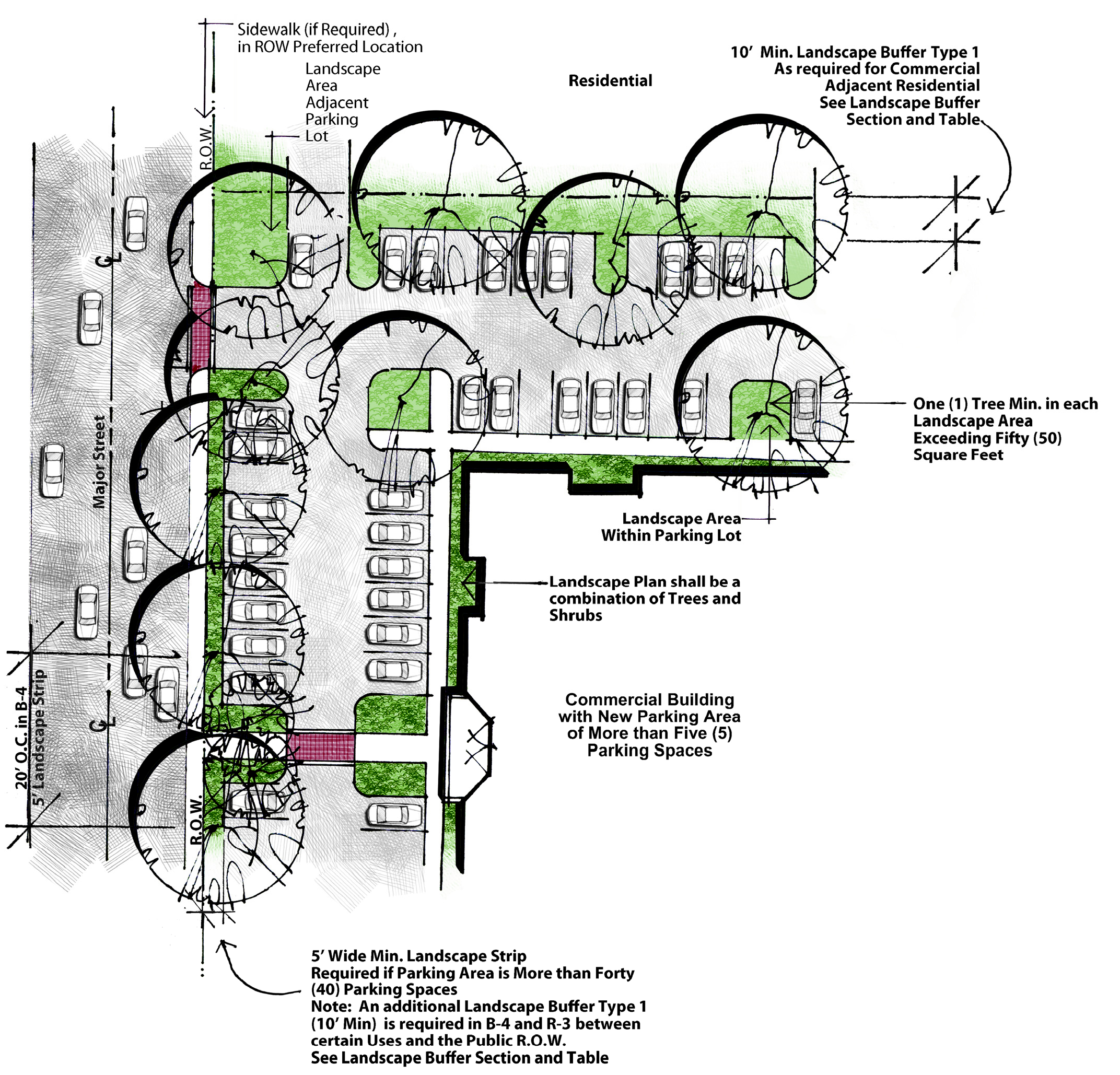
Figure 1
Sec. 11.4 - Landscape Buffers and Screening
See also Article 12, Natural Resources and Environmental Protection, for all Riparian Buffer Standards.
11.4.1 General
A landscape buffer or screen shall be required on new development of parcels adjacent and parallel to a major street or a commercial or industrial development or multi-family development. This buffer strip width shall be measured from the street right-of-way, back of curb, property line or whichever is most restrictive. This strip shall be reserved for the planting of trees and shrubs or other screen by the subdivider, owner, or developer.
A.
Intent. A landscape buffer is intended to provide adequate separation and screening from adjoining uses to enhance the visual image of the Town and promote public health, welfare and safety by:
1.
Reducing noise pollution, air pollution and artificial light glare within the Town; and
2.
Increasing compatibility between abutting land uses and public rights-of-way by providing screening and buffers.
B.
Standards. The landscape buffer or screen may be achieved with existing vegetation, landscaped rock or stone walls, fences, landscaped earthen berms, hedges, new landscaping or a combination of the aforementioned materials that provide an effective visual barrier during all seasons. The following standards shall apply to specific types of landscape buffer or screen materials:
1.
New plant types shall consist of a combination of deciduous, coniferous, and ornamental trees and shrubs at a density that provides a year-round screen and landscape buffer;
2.
Each landscape buffer shall be adequately covered with trees, shrubs, or a combination of both;
3.
Existing vegetation on a site may be used in lieu of required landscaping where approved by the Planning and Development Director or the Zoning Board of Adjustment, as may be applicable;
4.
Landscape buffer density may be increased with supplemental planting utilizing adapted or native plant species;
5.
Landscape buffers shall be substantially opaque. This shall mean that all visual contact is substantially screened by the buffer between the site interior to the buffer and the abutting lands except that the lowest one (1) foot of height may allow visibility. The opaque portion of a buffer shall be opaque year-round;
6.
Additional new screening may be required by the Special Use Permit if existing vegetation consists of dead, damaged or unhealthy species; or, consists of a type or quantity of vegetation that does not provide the density to achieve a year-round screen; and
7.
The sufficiency and composition of a landscape buffer reviewed by the Planning Board shall be determined on a project by project basis.
11.4.2 Landscape Buffer Table
11.4.3 Landscape Buffer Types Defined
A.
Landscape Buffer Type 1. As illustrated in Figure 2.
1.
In addition to any landscape areas and landscape strips required for parking lots, a ten-foot wide landscape buffer shall be provided between any new building or parking area constructed in the B-4 zoning district, or any existing building converted to a commercial use, and: (1) property zoned residential; and (2) the right-of-way line of any public or private road.
2.
A ten-foot wide landscape buffer is required in any Zoning District between commercial parking and residential.
3.
A landscape buffer strip at least ten (10) feet in width shall be required adjacent to a major street or a commercial or industrial development.
4.
Outdoor storage yards which adjoin or are visible from a public road and adjoining property shall be screened by appropriate fencing or ten-foot wide landscape buffer.
5.
New stormwater management facilities and devices shall be landscaped with a minimum landscaped area of ten (10) feet around the perimeter.
6.
Type 1 buffers shall meet the following standards:
a.
Two (2) staggered rows of plant material five (5) feet on center, six (6) feet minimum height at installation, eight to ten (8—10) feet height in three (3) years.
b.
[Reserved.]
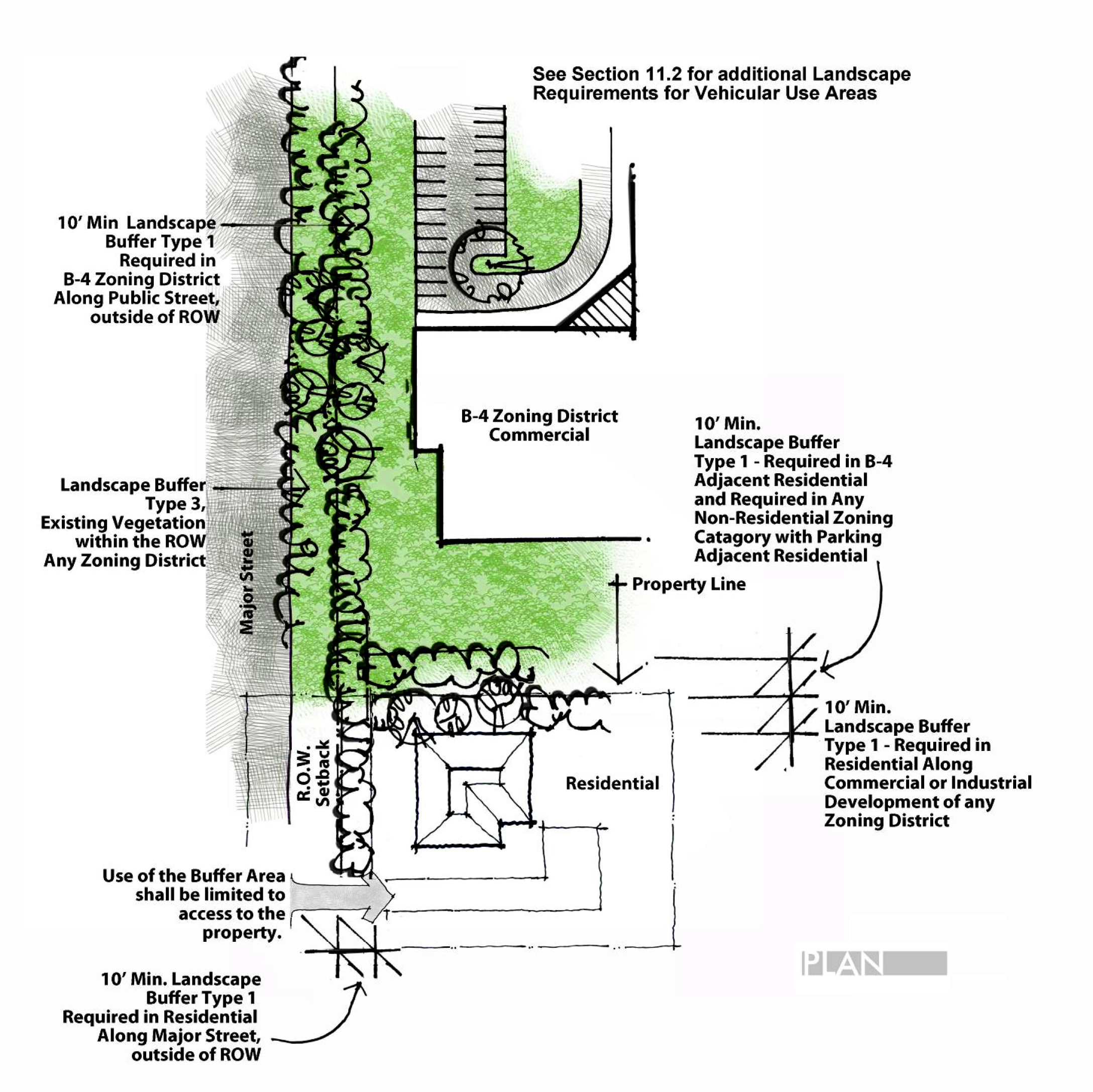
Figure 2
B.
Landscape Buffer Type 2. A green vegetative buffer contiguous with public road rights-of-way (right-of-way setbacks from a North Carolina or U.S. primary route) and adjoining property lines shall be maintained as green buffers, as illustrated in Figure 3, between Multi-Family, and: (1) any property line; and (2) the right-of-way line of any public or private road meeting the following standards:
1.
The buffer area shall be a mixture of various trees and shrubs, with a minimum width of forty (40) feet or as required by this Ordinance;
2.
There shall be two (2) staggered rows of planting material placed five (5) feet on center that are a minimum of six (6) feet in height when installed, and that are expected to achieve a height of eight to ten (8—10) feet within three (3) years. Height is measured from the proposed average ground surface elevation immediately adjacent to the buffer; and
3.
Landscaped earthen berms shall be constructed of clean, suitable native or borrow soil material. The finished slopes shall not exceed 1:3 (rise:run).
C.
Landscape Buffer Type 3. Existing vegetation within a public right-of-way from a North Carolina or U.S. primary route shall be protected in place, as illustrated in Figure 3. Use of the right-of-way setback buffer area shall be limited to roadway access to the property. See Article 8, Dimensional and Density Standards, Sec. 8.1.2, Requirements and Exceptions, Item A.4 for procedure to establish the setback line when a right-of-way is not defined.
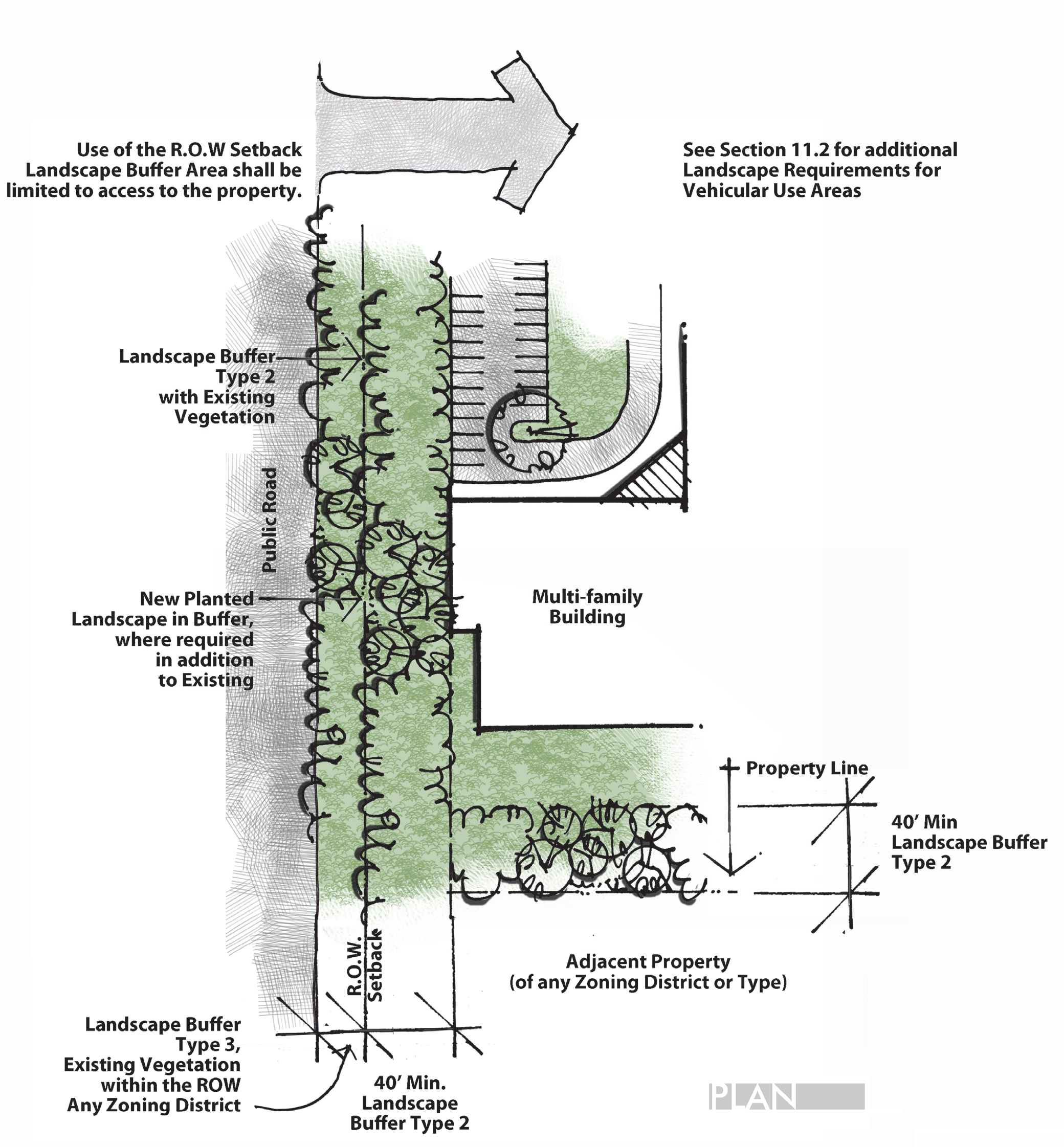
Figure 2
D.
Landscape Buffer Type 4. New Wireless Communication Facilities with Support Structures and Attached Wireless Communication Facilities with new building construction shall be landscaped with a minimum landscaped area of ten (10) feet around the perimeter of the security fence meeting the following standards:
1.
One (1) row of evergreen trees with a minimum caliper of two and one-half (2.5) inches shall be installed with a maximum spacing of fifteen (15) feet; and
2.
Evergreen shrubs capable of creating a continuous hedge and obtaining a height of at least five (5) feet shall be planted with a maximum spacing of five (5) feet. Plants shall be at least five (5) gallon container plants or forty-two (42) inches tall at the time of planting.
3.
Fencing. Wireless Communication Facilities with Support Structures shall be enclosed by an opaque fence not less than six (6) feet in height, consisting of either chain-link with a fabric mesh or slatted wood. Security features may be incorporated into the buffer and landscaping requirements for the site. Nothing herein shall prevent fencing that is necessary to meet requirements of State or Federal agencies.
Sec. 11.5 - Installation and Maintenance
11.5.1 Installation of New Landscape Areas and Buffers
A.
New plantings in the landscaping areas and or buffers shall be reasonably maintained and attended for a period of not less than eighteen (18) months to promote successful establishment thereof.
B.
When any trees or shrubs in such areas die, as determined by the Planning and Development Director, they must be replaced during the next suitable planting season and shall meet the planting requirements outlined per the original approved landscape and buffer plans.
C.
See also Sec. 15.3.6, Equitable Remedies.
11.5.2 Maintenance of Landscape Buffers
A.
Buffers must be perpetually maintained and preserved by the property owner or owners association. Buffers shall be maintained in a healthful and sound condition at all times to meet the criteria of this section. Buffer shall be noted on one of the following documents as a condition of approval:
1.
Conservation Easement;
2.
Duly Recorded As Built Site Plan; or
3.
Restrictive Deed Covenant.
B.
Maintenance of buffers is a continuing special condition of the Special Use Permit.

