
Hollister City Zoning Code
CHAPTER 17
68 - DEFINITIONS
17.68.001 - Purpose and intent.
This chapter provides definitions of terms and phrases used in this Zoning Ordinance that are technical or specialized, or that may not reflect common usage. If any of the definitions in this chapter conflict with definitions in other chapters of the City Code, these definitions shall prevail for the purposes of this Zoning Ordinance. If a word is not defined in this chapter, or other chapters of the City Code, the most common dictionary definition is presumed to be correct. Words used in the present tense shall include the future; words used in the singular shall include the plural; the word "shall" or "must" is mandatory, and the word "may" is directory.
(Ord. 1267, § 2, 2025)
17.68.010 - 24-Hour operations.
Twenty-four-hour operations means any land use which is open to employees, business operations, and/or the public for 24 hours in any single day, with no period of closure.
(Ord. 1267, § 2, 2025)
17.68.020 - Accessory dwelling unit.
Accessory dwelling unit means a second permanent dwelling that is accessory to a legally constructed primary dwelling on the same site in a residential zoning district. A secondary unit provides complete, independent living facilities for one or more persons, including permanent provisions for living, sleeping, eating, cooking, and sanitation. See Chapter 17.32.
(Ord. 1267, § 2, 2025)
17.68.030 - Accessory structure.
Accessory structure is a detached structure which is incidental to a lawfully established principal structure on the same lot and used to support a lawfully established use.
(Ord. 1267, § 2, 2025)
17.68.040 - Accessory use.
An accessory use is a use that is subordinate to the principal use on the same lot as authorized by the specific zoning District and serving a purpose customarily incidental to the principal use, without altering the character of a lawfully allowed use, as determined by the Community Development Director.
(Ord. 1267, § 2, 2025)
17.68.050 - Adult.
An adult is a person aged 18 or over.
(Ord. 1267, § 2, 2025)
17.68.060 - Adult entertainment establishment.
Please refer to Section 17.22.050, Adult Entertainment Establishments, for definitions and requirements for this use type.
(Ord. 1267, § 2, 2025)
17.68.070 - Affordable housing.
Affordable housing means housing units affordable to families earning at or below 120 percent of the county median income, including very low, low, median and moderate-income units. The specific affordability levels shall be established by the Department of housing and community development in the state income limits for San Benito County.
(Ord. 1267, § 2, 2025)
17.68.080 - Agent.
An agent is a person authorized in writing by the property owner to represent and act for a property owner in contacts with city employees, committees, Commissions, and the Council, regarding matters regulated by this Zoning Ordinance.
(Ord. 1267, § 2, 2025)
17.68.090 - Agriculture.
Agriculture means farming, dairying, pasturage, apiaries, horticulture, viticulture and animal or poultry husbandry, but not including the commercial feeding of garbage or offal to swine or other animals.
(Ord. 1267, § 2, 2025)
17.68.100 - Agriculture employee housing.
Agricultural employee housing is living quarters for farm or agricultural laborers located on or adjacent to the agricultural operations.
(Ord. 1267, § 2, 2025)
17.68.110 - Airport.
An airport is an area used for aircraft landing, flight services, administration offices, terminals (executive and general), take-off, storage, and maintenance, airport related buildings, aircraft operations and related facilities, aprons and taxiways, tie-down areas, hangers, control towers, safety lights, communications equipment, and related structures.
17.68.120 - Aircraft chartering and leasing.
Aircraft chartering and leasing is a company which provides a service where a company, individual or organization can hire the company to fly to a specific destination or where a licensed pilot can lease or rent a plane for personal uses.
(Ord. 1267, § 2, 2025)
17.68.130 - Aircraft fuel facility.
An aircraft fuel facility is a facility which sells fuel or lubrication for use in aircrafts.
(Ord. 1267, § 2, 2025)
17.68.140 - Aircraft manufacturing.
Aircraft manufacturing means the manufacture of aircraft or aircraft components, electrical systems, parts or other items used on airplanes.
(Ord. 1267, § 2, 2025)
17.68.150 - Aircraft repair or services.
Aircraft repair or services means the repair of all components of an airplane or servicing of the airplane including washing, maintenance services or painting.
(Ord. 1267, § 2, 2025)
17.68.160 - Aircraft research and design.
Aircraft research and design means a business involved in the design and testing of aircrafts and aircraft related components.
(Ord. 1267, § 2, 2025)
17.68.170 - Aircraft sales.
Aircraft sales is the sale or leasing of an airplane or airplane components or accessories.
(Ord. 1267, § 2, 2025)
17.68.180 - Air cargo facilities.
Aircraft cargo facilities means a place where a company or organization loads and moves goods by aircraft for profit.
(Ord. 1267, § 2, 2025)
17.68.190 - Air freight terminal.
An aircraft terminal means a facility which loads goods onto planes for transport, but does not include the ownership of the planes.
(Ord. 1267, § 2, 2025)
17.68.200 - Aircraft parking, tie-down and aircraft hangers or shelters.
Aircraft parking, tie-down and aircraft hangers or shelters means the parking, temporary locating, or storage of an aircraft within a structure or on a paved area.
(Ord. 1267, § 2, 2025)
17.68.210 - Alcohol sales, retail.
Retail alcohol sales means the sale of beer, wine, and or liquor for consumption off site.
(Ord. 1267, § 2, 2025)
17.68.220 - Alley.
An alley is a public or private roadway that provides vehicle access to the rear or side of lots having other public street frontage and that is not intended for general traffic circulation.
(Ord. 1267, § 2, 2025)
17.68.230 - Ambulance services.
Ambulance services is an establishment which provides ambulance services for the public and includes office, storage and maintenance of ambulances, and temporary sleeping facilities for an ambulance crew.
(Ord. 1267, § 2, 2025)
17.68.240 - Ancillary deli or café.
An ancillary deli or café means the preparation and sale of food items such as snacks, sandwiches, coffee or specialty drinks, salads, etc. as an accessory use to a lawfully established primary use on the same site.
(Ord. 1267, § 2, 2025)
17.68.250 - Animal kennels or boarding.
Animal kennels or animal boarding means facilities for the keeping, boarding or maintaining of four or more dogs four months of age or older, or four or more cats for commercial purposes, except for dogs or cats in pet shops or animal hospitals.
(Ord. 1267, § 2, 2025)
17.68.260 - Animal sales and services.
Animal sales and services means facilities which sells pets or provides grooming, pet washing, or similar services. The retails sales of pet goods and food is included within the general retail use.
(Ord. 1267, § 2, 2025)
17.68.270 - Animal veterinary clinics and hospitals.
Animal veterinary clinics and hospitals means an indoor medical treatment facilities used by veterinarians, including large and small animal veterinary clinics, and animal hospitals.
(Ord. 1267, § 2, 2025)
17.68.280 - Artist studio.
An artist studio is a facility where an individual(s) produces creative items for sale and/or display and includes pottery, photography, painting, sculpting or other similar mediums. Artist studios include creative spaces for production as well as an area for accessory retail sales.
(Ord. 1267, § 2, 2025)
17.68.290 - Assembly building or site.
Assembly building or site means a building or site that is primarily used for assembly use, including but not limited to religious assembly, gymnasiums, libraries, theaters, schools, and community centers.
(Ord. 1267, § 2, 2025)
17.68.300 - Assembly use.
Assembly is a use involving the gathering of persons to participate in group or common activity to observe a presentation, performance, or exhibition.
(Ord. 1267, § 2, 2025)
17.68.310 - Auditorium.
An auditorium is a large room to accommodate an audience for the purpose of speeches, theater and music productions or similar uses, fully enclosed within a building.
(Ord. 1267, § 2, 2025)
17.68.320 - Auto rentals.
Auto rentals means a facility where a consumer can rent a vehicle for a fixed amount of time.
(Ord. 1267, § 2, 2025)
17.68.330 - Automatic teller machine (ATM).
An ATM is a machine used by bank and financial service patrons for conducting automated transactions including deposits, withdrawals and fund transfers, without contact with financial institution personnel. The machines may be located at or within banks or in other locations.
(Ord. 1267, § 2, 2025)
17.68.340 - Automobile dismantling yard.
See "Recycling, Scrap, and Dismantling Yards."
(Ord. 1267, § 2, 2025)
17.68.350 - Banks and financial services.
Banks and financial services means financial institutions including: banks and trust companies; lending and thrift institutions, credit agencies; brokers and dealers in securities and commodity contracts; security and commodity exchanges; mortgage brokers; holding (but not predominantly operating) companies; and other investment companies; vehicle finance (equity) leasing agencies. See also "Automatic Teller Machine."
(Ord. 1267, § 2, 2025)
17.68.360 - Bail bonds.
Bail bonds means an establishment where an individual or agency acts as a surety and pledge money or property as bail for the appearance of a defendant in court.
(Ord. 1267, § 2, 2025)
17.68.370 - Bars.
A bar means a structure or space within a structure where alcoholic beverages are sold for on-site consumption and includes bars, taverns, pubs, billiard/pool halls, restaurants where more than 30 percent of the gross floor area is dedicated to a bar (including the bar and bar seating) and similar establishments. May include entertainment (e.g., live music or dancing, etc.) with approval of a Conditional Use Permit. May also include beer brewing as part of a "brew pub."
(Ord. 1267, § 2, 2025)
17.68.380 - Bed and breakfast inn.
A bed and breakfast inn is a commercial facility designed to appear as a single-family dwelling where bedrooms without individual cooking facilities are rented for overnight lodging (up to 30 days total). This definition does not include "Hotels and Motels," which are defined separately; rooming and boarding houses, which are included under "Multifamily Housing;" or the rental of an entire residence for 30 days or more. Please refer to Section 17.22.080, Bed and Breakfast Inns, for requirements for these types of facilities.
(Ord. 1267, § 2, 2025)
17.68.390 - Beauty salon and barber shop.
A beauty salon or barber shop means an establishment that provides hair cutting, styling, and similar services. In the Home Office Zoning District, these establishments are limited to two chairs and two employees operating at one time.
(Ord. 1267, § 2, 2025)
17.68.400 - Building.
See "Structure."
(Ord. 1267, § 2, 2025)
17.68.410 - Building material store.
A building materials store means a primarily indoor (in a commercial building) retail establishment selling lumber and other large building materials, and also including paint, wallpaper, glass, fixtures, nursery stock, lawn and garden supplies (which may also be sold in hardware stores, included under the definition of "Retail Stores, General Merchandise"). Includes all stores selling to the general public, even if contractor sales account for a larger proportion of total sales. Includes incidental retail ready-mix concrete operations, when the area is not visible from the public right of way. Exterior storage as an ancillary use may be allowed with a Conditional Use Permit and requires screening from the public right of way. These stores may not be located within a mixed-use building.
(Ord. 1267, § 2, 2025)
17.68.420 - Building site.
A building site means the land area, consisting of one or more lots or parcels of land under common ownership or control, considered as the unit of land occupied or to be occupied by a main building or buildings and accessory buildings, or by a principal use and use accessory thereto, together with such parking and loading spaces, yards and open spaces as are required by this chapter, and having its principal frontage on a street, road, or highway not to include an alley.
(Ord. 1267, § 2, 2025)
17.68.430 - Business support services.
A business support service is an establishments primarily within structures, providing other businesses with services including maintenance, repair and service, testing, rental, etc. including blueprinting, business equipment repair (excluding vehicle repair), computer services, copy and printing services, film processing, on-site repairs, janitorial services, and window cleaning.
(Ord. 1267, § 2, 2025)
17.68.440 - Caretaker and employee housing.
Caretaker and/or employee housing means a temporary or permanent residence that is accessory to a nonresidential primary use of the site, where needed for security or 24-hour care or supervision.
(Ord. 1267, § 2, 2025)
17.68.450 - Cargo container.
See "Shipping Container."
(Ord. 1267, § 2, 2025)
17.68.460 - Carport.
A carport is a detached structure enclosed on two or fewer sides without a door used for storage of vehicles used by occupants of the premises.
(Ord. 1267, § 2, 2025)
17.68.470 - Catering.
Catering means an establishment where food is prepared and assembled for the delivery and off-site consumption of food at another location.
(Ord. 1267, § 2, 2025)
17.68.480 - Cemeteries, columbariums and mortuaries.
Cemeteries, columbariums and mortuaries means an internment establishments engaged in subdividing property into cemetery lots and offering burial plots or air space for sale. Includes animal cemeteries; cemetery, mausoleum, crematorium and columbarium operations, and full-service funeral parlors, whether accessory to or separate from a cemetery or columbarium.
(Ord. 1267, § 2, 2025)
17.68.490 - Chemical plants.
Chemical plants are manufacturing establishments that produce or use basic chemicals and establishments creating products predominantly by chemical processes. This use type also includes sales and transportation establishments handling the chemicals described above. Establishments classified in this major group manufacture three general classes of products:
1.
Basic chemicals including acids, alkalizes, salts, and organic chemicals;
2.
Chemical products to be used in further manufacture, including synthetic fibers, plastic materials, dry colors, and pigments; and
3.
Finished chemical products to be used for ultimate consumption including drugs, cosmetics, and soaps; or to be used as materials or supplies in other industries, including paints, fertilizers, and explosives.
(Ord. 1267, § 2, 2025)
17.68.500 - Child.
A child means a person under the age of 18.
(Ord. 1267, § 2, 2025)
17.68.510 - City.
City means the city of Hollister, state of California, referred to in this Zoning Ordinance as "city."
(Ord. 1267, § 2, 2025)
17.68.520 - City Council.
City Council means the city Council of the city of Hollister, state of California, referred to in this Zoning Ordinance as "Council."
(Ord. 1267, § 2, 2025)
17.68.530 - Clothing factory.
A clothing factory is a manufacturing establishments producing clothing, and fabricating products by cutting and sewing purchased textile fabrics, and related materials including leather, rubberized fabrics, plastics and furs. Custom tailors and dressmakers not operating as a factory and not located on the site of a clothing store ("General Merchandise Stores") are instead included under "Personal Services."
(Ord. 1267, § 2, 2025)
17.68.540 - Clubs and lodges.
Clubs and lodges means permanent meeting, recreational, or social facilities of a private or nonprofit organization primarily for use by members or guests, excluding commercial recreation and entertainment. This classification includes union halls, social clubs, community pools, and youth centers.
(Ord. 1267, § 2, 2025)
17.68.550 - Chemical plants.
A chemical plant is a facility which manufactures raw or refined chemicals for use in other industries. Does not include facilities which include the storage, manufacture, or use of hazardous materials.
(Ord. 1267, § 2, 2025)
17.68.560 - Combined zone or zoning District.
A Combined zone or zoning district shall have the same meaning as Mixed-Use Zone or Zoning District.
(Ord. 1267, § 2, 2025)
17.68.570 - Commercial filming.
Commercial filming means the filming of an event, activity, music video, performances, movie, television show, or commercial on public or private property.
(Ord. 1267, § 2, 2025)
17.68.580 - Commercial recreation.
Commercial recreation includes, the following use types. Ancillary sales of food and beverages or goods (related to the use) is allowed for all use types:
1.
Commercial recreation, minor means establishments (under 25,000 square feet) which provide physical fitness services or amusement and entertainment and includes but is not limited to, bowling alleys, ice/roller skating rinks, billiard parlors, martial arts studios, indoor tennis or racquetball courts, dance studios, arcades, health and fitness clubs, exercise studios, boxing gyms, indoor games, indoor soccer, indoor hockey, indoor play or party centers, art classes or other indoor uses deemed similar by the Community Development Director.
2.
Commercial recreation, major means establishments for uses also included in minor commercial recreation which are greater than 25,000 square feet and establishments such as indoor sports arenas (where professional or semi-professional teams meet and where there is a charge for viewing), live theaters, live music establishments, roller derby facilities, bingo halls, indoor mini-golf, indoor go-kart racing other uses deemed similar by the Community Development Director.
3.
Commercial recreation, outdoor means establishments which include indoor and/or outdoor facilities which provide physical fitness services or amusement and entertainment and includes but is not limited to outdoor sport courts, baseball and football stadiums, golf courses, outdoor miniature golf, amusement parks, outdoor go-cart or similar racing, swimming pools, driving ranges, hunting and shooting clubs and other outdoor uses deemed similar by the Community Development Director.
(Ord. 1267, § 2, 2025)
17.68.590 - Commission.
See "Planning Commission."
(Ord. 1267, § 2, 2025)
17.68.600 - Common area.
A common area is an area, or portion thereof, owned in common by all property owners of a subdivision. There may or may not be an open space easement over a common area.
(Ord. 1267, § 2, 2025)
17.68.610 - Common interest development.
Common interest developments includes a condominium, community apartment project, planned development or stock cooperative, as provided by Section 1351 of the Civil Code.
(Ord. 1267, § 2, 2025)
17.68.620 - Community care facility.
A community care facility means a 24-hour residential facility providing non-medial residential care and support for the elderly, sober living, handicapped, group living, dependent children, or those who need non-medical supportive services. Facilities which serve six or fewer persons is considered to be a residential use and is permitted in the residential zoning districts. Facilities which serve seven or more persons requires approval of a Conditional Use Permit.
(Ord. 1267, § 2, 2025)
17.68.630 - Community center.
A community center means multipurpose meeting and recreational facilities typically consisting of one or more meeting or multipurpose rooms, small indoor fitness centers, kitchen or outdoor barbecue facilities, that are available for use by various groups for activities including meetings, parties, receptions, dances, etc.
(Ord. 1267, § 2, 2025)
17.68.640 - Concrete, gypsum and plaster production.
Concrete, gypsum and/or plaster production means manufacturing establishments producing bulk concrete, concrete building block, brick and all types of precast and prefab concrete products. Also includes ready-mix concrete batch plants, lime manufacturing, and the manufacture of gypsum products (e.g., plasterboard, etc.). A retail ready-mix concrete operation as an incidental use in conjunction with a building materials outlet is defined under "Building Material Stores."
(Ord. 1267, § 2, 2025)
17.68.650 - Conditional use.
A conditional use means a land use or activity that is not allowed as a matter of right within a zoning District.
(Ord. 1267, § 2, 2025)
17.68.660 - Conditional use permit.
A Conditional Use Permit or CUP means an approval issued to a landowner allowing a conditional use.
(Ord. 1267, § 2, 2025)
17.68.670 - Condominium project.
A condominium project, as defined in Section 1351 of the California Civil Code, means a development consisting of two or more condominiums.
(Ord. 1267, § 2, 2025)
17.68.680 - Construction contractors yard.
A construction contractors yard means a storage area operated by, or on behalf of a contractor licensed by the State of California for storage of large equipment, vehicles, or other materials commonly used in the individual contractor's type of business; storage of scrap materials used for repair and maintenance of contractor's own equipment; and buildings or structures for uses including offices and repair facilities.
(Ord. 1267, § 2, 2025)
17.68.690 - Community care facility.
A community care facility means a 24-hour residential facility providing non-medial residential care and support for the elderly, sober living, handicapped, group living, depended children, or those who need non-medical supportive services. Facilities which serve six or fewer persons is considered to be a residential use and is permitted in the residential zoning districts. Facilities which serve seven or more persons requires approval of a Conditional Use Permit.
(Ord. 1267, § 2, 2025)
17.68.700 - Convenience store.
A convenience store is a small shop, corner store or mini-mart that sells a variety of household goods included food, groceries, beverages, toiletries, and other household goods.
(Ord. 1267, § 2, 2025)
17.68.710 - Cottage food.
A cottage food establishment means a home-based business, that is incidental to the residential use of the dwelling, where individuals produce and sell approved non-hazardous foods. A Cottage Food operation must operate in compliance with the Health and Safety Code and Chapter 11.5, Cottage Food Operations, of the California Retail Food Code.
(Ord. 1267, § 2, 2025)
17.68.720 - Courier and small package delivery.
A courier and/or small package delivery means an establishment where a person or company delivers letters, small packages, or documents. Couriers include establishments which deliver by hand, vehicle, or bicycle.
(Ord. 1267, § 2, 2025)
17.68.730 - Crop production.
Crop production involves production of grains, field crops, vegetables, melons, fruits, tree nuts, flower fields and seed production, ornamental crops, tree and sod farms; associated crop preparation services and harvesting activities including but not limited to mechanical soil preparation, irrigation system construction, spraying, crop processing and sales in the field of products grown on the premises.
(Ord. 1267, § 2, 2025)
17.68.740 - Cultural institutions.
A cultural institution is an organizations or businesses that preserve, promote, or advance culture, heritage, or the arts and includes the displaying or preserving objects of interest in one or more of the arts or sciences. This classification generally includes libraries, museums, archives, and art galleries where displayed objects are not intended for sale.
(Ord. 1267, § 2, 2025)
17.68.750 - Day care.
A day care is a facility that provide non-medical care and supervision of children or adults for periods of less than 24 hours. These facilities include the following, all of which are required to be licensed by the California State Department of Social Services:
1.
Child day care center means a commercial or nonprofit facility that provides nonmedical care to children under 18 years of age in need of personal services, supervision, or assistance essential for sustaining the activities of daily living or for the protection of the individual on less than a 24-hour basis. Includes day care centers, employer-sponsored child care centers, and family day care homes, as defined by Health and Safety Code Section 1596.750. These may be operated in conjunction with a school or church facility, or as an independent land use.
2.
Family day care home means a home that regularly provides care, protection and supervision for 14 or fewer children, in the provider's own home, for periods of less than 24 hours per day, while the parents or guardians are away.
3.
Adult day care/health facility means an organized day program of therapeutic, social and health activities and services provided to elderly persons with functional impairments, either physical or mental, for the purpose of restoring or maintaining optimal capacity for self-care, as defined in Health and Safety Code Section 1570.7.
(Ord. 1267, § 2, 2025)
17.68.760 - Density, gross.
Gross density means the number of primary residential dwellings per acre of land within a project site.
(Ord. 1267, § 2, 2025)
17.68.770 - Department.
Department means the city of Hollister Community Development Department referred to in this Zoning Ordinance as "Department."
(Ord. 1267, § 2, 2025)
17.68.780 - Detached.
Detached means any structure that does not have a wall or roof in common with another structure.
(Ord. 1267, § 2, 2025)
17.68.790 - Developer.
A developer is an owner, project proponent, or subdivider with a proprietary interest in a proposed or constructed project.
(Ord. 1267, § 2, 2025)
17.68.800 - Development.
A development is any construction activity or alteration of the landscape, its terrain contour or vegetation, including grading, paving and the erection or alteration of structures, alteration of an existing structure or land use, or establishment of a land use.
(Ord. 1267, § 2, 2025)
17.68.810 - Development agreement.
A development agreement is a contract between the city and an applicant for a development project, in compliance with Chapter 17.24.280 of this Zoning Ordinance and Government Code §§ 65864 et seq.
(Ord. 1267, § 2, 2025)
17.68.820 - Development standards.
Development standards are the provisions of this chapter that regulate the site planning and design of a proposed development or new land use, including but not limited to provisions for Floor Area Ratio, height limits, landscaping, minimum lot area and minimum building site area, off-street parking, setbacks, site coverage, signs, and standards for specific land uses.
(Ord. 1267, § 2, 2025)
17.68.830 - Director.
Director means the Community Development Director of the city of Hollister or his/her designee.
(Ord. 1267, § 2, 2025)
17.68.840 - District or zoning district.
A District or zoning district means a portion of the city within which certain uses of land and buildings are prohibited or permitted according to development standards.
(Ord. 1267, § 2, 2025)
17.68.850 - Drive-thru service and sales.
Drive-thru services and sales means facilities where services may be obtained by motorists without leaving their vehicles. These facilities include drive-up teller windows in banks, drive-thru pharmacies, and facilities where food or other products may be purchased without leaving a vehicle. This service does not include: automatic teller machines (ATMs) or service stations, which are separately defined, or car washes.
(Ord. 1267, § 2, 2025)
17.68.860 - Donation kiosk.
A donation kiosk [means] an accessory structure, truck, bin, or other receptable designed for the donation of goods to a non-profit or for-profit organization. Donation kiosks can be manned by an individual or designed so that donations can be made without assistance.
(Ord. 1267, § 2, 2025)
17.68.870 - Elderly.
Elderly means a person 55 years of age or older but also includes other adults who are chronically ill or impaired and who would benefit from adult day health care, as defined in Health and Safety Code Section 1570.7.
(Ord. 1267, § 2, 2025)
17.68.880 - Emergency shelter.
An emergency shelter is a facility that provides temporary (30 days or less) housing for homeless individuals or families.
(Ord. 1267, § 2, 2025)
17.68.890 - Equestrian facilities.
Equestrian facilities means commercial horse, donkey, and mule facilities including horse ranches, boarding stables, riding schools and academies, horse exhibition facilities (for shows or other competitive events), pack stations, and barns, stables, corrals and paddocks accessory and incidental to these uses.
(Ord. 1267, § 2, 2025)
17.68.900 - Equipment sales, services and rentals, indoor.
Indoor equipment sales, services and rentals means a facility that sells or rents equipment, or the related repair or services thereof, to individuals or a business. Equipment can include but is not limited to tools, restaurant equipment, forklifts, machinery, medical equipment and is contained entirely within a building. This use may also include the repair of equipment sold by the establishment. This type of facility is not permitted within a mixed-use building.
(Ord. 1267, § 2, 2025)
17.68.910 - Equipment sales, services and rentals, outdoor.
Outdoor equipment sales, services, and rentals means a facility that sells or rents equipment, or the related repair or services thereof, to individuals or a business, including the storage of equipment outside of a building. Equipment can include but is not limited to tools, construction equipment, forklifts, and machinery. This use may also include the repair of equipment sold or rented by the establishment. Outdoor facilities shall be screened from view by a wall or solid fence. This type of facility is not permitted within a mixed-use building.
(Ord. 1267, § 2, 2025)
17.68.920 - Façade.
A façade is that portion of any exterior elevation on the building extending from grade to top of parapet, or eaves, and the entire width of the building elevation.
(Ord. 1267, § 2, 2025)
17.68.930 - Family.
A family means one or more persons occupying premises and living as a single housekeeping unit, as distinguished from a group occupying a hotel, club, fraternity or sorority house. A family shall be deemed to include necessary servants.
(Ord. 1267, § 2, 2025)
17.68.940 - Farm equipment and supplies sales, indoor.
Indoor farm equipment and supplies sales means establishments selling or renting agricultural machinery, equipment, and supplies for use in soil preparation and maintenance, the planting and harvesting of crops, and other operations and processes pertaining to farming and ranching within an enclosed building. This type of facility is not permitted in a mixed-use building.
(Ord. 1267, § 2, 2025)
17.68.950 - Farm equipment and supplies sales, outdoor.
Outdoor farm equipment and supplies sales means establishments selling or renting agricultural machinery, equipment, and supplies for use in soil preparation and maintenance, the planting and harvesting of crops, and other operations and processes pertaining to farming and ranching which includes sales or storage of products, supplies, or equipment outside or in an unenclosed building.
(Ord. 1267, § 2, 2025)
17.68.960 - Fence.
A fence means continuous physical barrier comprised of wood, wrought iron, chain link, masonry, concrete, or other similar materials as well as vegetation which provides for separation between adjoining sites or areas within a site.
(Ord. 1267, § 2, 2025)
17.68.970 - Financial services.
Financial services are establishments that provide banking, credit unions, loan services, security and commodities exchanges, and investment companies.
(Ord. 1267, § 2, 2025)
17.68.980 - Floor area, gross.
Gross floor area means the total area enclosed within a building, including closets, stairways, and utility and mechanical rooms, measured from the interior face of the walls.
(Ord. 1267, § 2, 2025)
17.68.990 - Floor area ratio (FAR).
Floor area ratio means the total floor area of all buildings on a lot, divided by the area of that lot. For example, a building 3,000 square feet of floor area on a 10,000 square foot lot has a FAR of 0.30. See Figure 17.02-1 (Floor Area Ratio).
Figure 17.68-1 Floor Area Ratio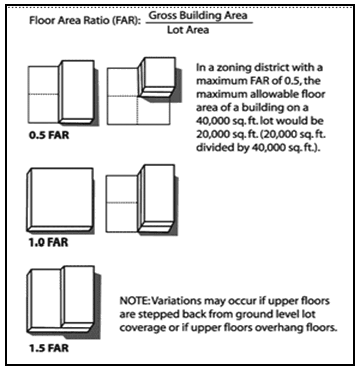
(Ord. 1267, § 2, 2025)
17.68.1000 - Food processing.
Food processing means a commercial facility in which food is prepared, processed, packaged, or bottled for off-site sale or consumption.
(Ord. 1267, § 2, 2025)
17.68.1010 - Fuel and ice dealers.
A fuel and ice dealer means retail trade establishments primarily engaged in the sale to consumers of ice, bottled water, fuel oil, butane, propane and liquefied petroleum gas (LPG), bottled or in bulk.
(Ord. 1267, § 2, 2025)
17.68.1020 - Funeral services.
Funeral services means an establishment that provides a place for individuals to make funeral arrangements and includes space for memorials, visitations, or gatherings but does not include on-site cremation or burial services (see cemeteries, columbariums and mortuaries for full service facilities).
(Ord. 1267, § 2, 2025)
17.68.1030 - Fortunetelling.
Fortunetelling means an establishment where a person is engaged in the forecasting or prediction of the future by means of the occult, psychic power, divination, clairvoyance, prophesy, mindreading, palmistry, tarot reading, astrology, crystal gazing, reading of tea leaves or similar readings or predictions for pay.
(Ord. 1267, § 2, 2025)
17.68.1040 - Furniture, furnishings, and equipment stores.
Furniture, furnishing, and equipment stores means stores primarily selling home furnishings including furniture, floor coverings, draperies, glass and chinaware, stoves, refrigerators, other household electrical and gas appliances including televisions and home sound systems and outdoor furniture including lawn furniture, movable spas and hot tubs. Also includes the retail sale of office furniture and large musical instruments.
(Ord. 1267, § 2, 2025)
17.68.1050 - Garage.
A garage is an attached or detached accessory building used for the storage of vehicles or trailers by the occupants of the premises.
(Ord. 1267, § 2, 2025)
17.68.1060 - Garage or yard sale.
A garage or yard sale means the temporary sale of used household goods or items sold by the occupant of the residential dwelling where the sale occurs. Garage or yard sales are permitted in residential zoning districts and are limited to three sales per year.
(Ord. 1267, § 2, 2025)
17.68.1070 - General plan.
A General Plan means the city of Hollister General Plan, including all elements thereof and all amendments thereto, as adopted by the Council under the provisions of Government Code §§ 65300 et seq.
(Ord. 1267, § 2, 2025)
17.68.1080 - Glass products factory.
A glass products factory means manufacturing establishments producing flat glass and other glass products which are pressed, blown, or shaped from glass produced in the same establishment. Does not include artisan and craftsman type operations which are included under handicraft industries and small scale manufacturing.
(Ord. 1267, § 2, 2025)
17.68.1090 - Handicraft industries, small scale manufacturing.
Handicraft industries, small scale and manufacturing means small scale manufacturing establishments not classified in another major manufacturing group, including arts and crafts, jewelry, embroidery, engraving, glass, musical instruments, toys, sporting and athletic goods, pens, pencils, and other office and artists materials; button, costume novelties, miscellaneous notions; brooms and brushes and other miscellaneous manufacturing industries.
(Ord. 1267, § 2, 2025)
17.68.1100 - Hazardous materials.
Hazardous materials are any substance that can cause harm to humans, animals, or the environment, either on their own or through interactions with other factors. This includes a wide range of items, including chemicals, radioactive materials, biological agents, or some physical substances.
(Ord. 1267, § 2, 2025)
17.68.1110 - Hazardous materials or waste facilities.
A hazardous material or waste facility means any facility or land use that includes the production, storage, transport, or other use of hazardous materials.
(Ord. 1267, § 2, 2025)
17.68.1120 - Health/fitness club.
A health or fitness club means fitness centers, gymnasiums, health and athletic clubs including indoor sauna, spa or hot tub facilities; indoor tennis, handball, racquetball, archery and shooting ranges, other indoor sports activities and limited massage therapy that is incidental to the operation.
(Ord. 1267, § 2, 2025)
17.68.1130 - Height, building.
Building height means the vertical distance from the average contact grade level of the building, "grade" as defined herein, to the highest point of the coping of a flat roof or to the deck line of a mansard roof or to the mean height level between eaves and ridge for gable, hip, or gambrel roofs.
(Ord. 1267, § 2, 2025)
17.68.1140 - Home occupation.
A home occupation is a business activity conducted entirely within or from an enclosed dwelling unless otherwise permitted in an accessory structure with a Conditional Use Permit. See Section 17.22.130 (Home Occupations).
(Ord. 1267, § 2, 2025)
17.68.1150 - Hotel or motel.
A hotel or motel means guest rooms or suites, provided with or without meals or kitchen facilities, rented to the general public for overnight or other temporary lodging (of less than 30 days). Hotels provide access from an interior walkway to most guest rooms that do not have kitchen facilities. Motels provide access to most guest rooms from an exterior walkway. Also includes accessory guest facilities including swimming pools, tennis courts, indoor athletic facilities, accessory retail uses, meeting rooms, restaurants, breakfast rooms, etc.
(Ord. 1267, § 2, 2025)
17.68.1160 - Improvement.
An improvement means the construction, alteration and repair of all buildings, structures and facilities permanently affixed to real property and appurtenances thereto.
(Ord. 1267, § 2, 2025)
17.68.1170 - Junkyard.
A junkyard means the use of any outdoor space where waste, discarded or salvaged materials are stored or handled; including automobile wrecking yards, house wrecking yards, used lumber yards and places or yards for storage of salvaged housing wrecking and structural steel materials and equipment, except when any such use is accessory and incidental to the permitted agricultural use.
(Ord. 1267, § 2, 2025)
17.68.1180 - Laundromat.
A laundromat is a self-service washing machines and dryers for public use. Laundromats are considered to be a "Personal Service."
(Ord. 1267, § 2, 2025)
17.68.1190 - Laundries and dry cleaning plants.
Laundries and dry cleaning plants means service establishments primarily engaged in high volume laundry and garment services, including: power laundries (family and commercial); garment pressing and on-site dry cleaning; linen supply; diaper service; industrial laundries; carpet and upholstery cleaners. Does not include laundromats or dry cleaning pick-up stores without dry cleaning equipment, which are classified in "Personal Services."
(Ord. 1267, § 2, 2025)
17.68.1200 - Live entertainment.
Live entertainment means in person entertainment or performances associated with an established business. Live entertainment includes karaoke, comedy clubs, musical acts (with or without amplified music), theatrical acts, cabaret, DJs, dance performances, or live performances deemed similar by the Community Development Director.
(Ord. 1267, § 2, 2025)
17.68.1210 - Live-work unit.
A live-work unit is a property or properties where residential and commercial uses are allowed where the owner or renter of the unit both lives and operates a business with services or products available to the public on the property. Business operations include all permitted office and commercial uses within the zoning District as well as handicraft manufacturing and artist studios. Telecommuting or remote office work is not considered a live-work use.
(Ord. 1267, § 2, 2025)
17.68.1220 - Lot coverage.
Lot coverage means that portion of a lot or parcel which is occupied by any building or structure. Building and structures include all land covered by the principal dwelling unit, accessory dwelling unit, SB-9 unit, garages, and accessory structures where more than two sides are covered (such as detached garages, carports, sheds, patio covers, covered front porches). All lot coverage calculations are measured at ground level, second stories are not included within the lot coverage calculation.
(Ord. 1267, § 2, 2025)
17.68.1230 - Lot depth.
Lot depth means the distance measured from the front property line to the rear property line, typically along the side property line. Where the lot has angled or irregular side or rear lot lines, the depth shall be measured from the midpoint of the front property line to the midpoint of the rear property line.
(Ord. 1267, § 2, 2025)
17.68.1240 - Lot or parcel.
A lot or parcel is an area of real property under single ownership, its principal frontage on a street or right-of-way, and lawfully created and recorded as required by the subdivision map Act and city of Hollister ordinances, including this Zoning Ordinance. Types of lots include the following:
1.
Corner lot means a lot located at the intersection of two or more streets, bounded on two or more sides by street lines. The front of a corner lot shall be defined by the location of the main entrance door of the primary structure on the parcel. For a commercial, mixed-use, or multifamily properties where the main entrance to a primary structure cannot be clearly determined, the front of the corner lot shall be established by the engineering division at the time at which the parcel is created, or through the address assignment, and shall be the street on which the parcel is addressed.
2.
Double frontage or through lot means a lot having a frontage on, and rights of vehicular access to, two parallel or approximately parallel streets. For the purposes of determining vehicular access to parallel streets pursuant to this definition, alleys are not streets.
3.
Flag lot means an interior lot having access by a corridor having a street frontage of less than 20 feet in width.
4.
Interior lot means a lot abutting only one street.
Key lot. The first lot to the rear of a corner lot, the front line of which is a continuation of the side line of the corner lot, exclusive of the width of any alley, and fronting on the street which intersects or intercepts the street on which the corner lot fronts.
Figure 17.68-2 - Lot Types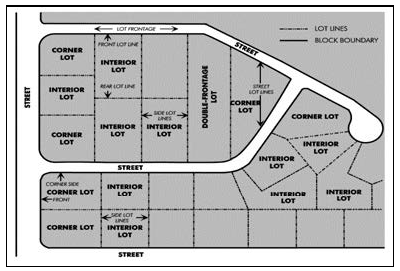
(Ord. 1267, § 2, 2025)
17.68.1250 - Lot width.
Lot width means the width of the lot measured at right angles to its depth at a point midway between the front and rear lot lines. "Average lot width" means the average width of the lot throughout its full depth measured at right angles to the depth.
Figure 17.68-3 - Lot Width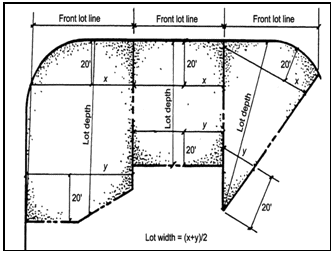
(Ord. 1267, § 2, 2025)
17.68.1260 - Lumber and wood products manufacturing.
Lumber and wood products manufacturing means processing and sales involving the milling of forest products to produce rough and finished lumber and other wood materials for use in other manufacturing, craft, or construction processes. Includes: all types of milling operations and the turning and shaping of wood products on a manufacturing basis; the assembly of products including trusses and structural beams, wood containers, pallets and skids;; and the wholesaling of basic wood products. This use type includes indoor storage only. Outdoor storage of any products falls under the outdoor, storage use category. Craft-type shops are included in "Handicraft Industries and Small-Scale Manufacturing." Other wood and cabinet shops are included under "Furniture and Fixture Manufacturing." The indoor retail sale of building materials, and the sale of construction tools and equipment is included under "Building Material Stores."
(Ord. 1267, § 2, 2025)
17.68.1270 - Manufacturing.
Manufacturing means the process of turning raw materials or parts into finished products or parts, including processing, assembly, fabrication, treatment, and/or packaging of such products or parts. Examples include furniture assembly or production, cabinet making, textile manufacturing or large scale clothing assembly, wood product manufacturing, metal manufacturing and uses deemed similar by the Community Development Director. Does not include uses that contain or produce hazardous materials or waste, see hazardous materials or waste facilities.
(Ord. 1267, § 2, 2025)
17.68.1280 - Medical services—Clinics and laboratories.
Medical clinics and laboratories means facilities primarily engaged in furnishing outpatient medical, mental health, surgical and other personal health services. These facilities include: medical, dental, and psychiatric offices (with more than one therapist or counselor and/or group therapy sessions); medical and dental laboratories; out-patient care facilities; and allied health services. Associations or groups primarily engaged in providing medical or other health services to members are included.
(Ord. 1267, § 2, 2025)
17.68.1290 - Medical services—Extended care.
Extended care means residential facilities providing nursing and health-related care as a principal use with in-patient beds, including: skilled nursing facilities with in-patient beds; extended care facilities; convalescent and rest homes; board and care homes. Long-term personal care facilities that do not emphasize medical treatment are classified in "Residential Care Homes."
(Ord. 1267, § 2, 2025)
17.68.1300 - Medical services—Hospitals.
Hospitals are establishments primarily engaged in providing diagnostic services, extensive medical treatment including surgical and other hospital services having an organized medical staff, inpatient beds, and equipment and facilities to provide complete health care. May include accessory retail uses (see the separate definition of "Accessory Retail Uses,") and emergency heliports.
(Ord. 1267, § 2, 2025)
17.68.1310 - Metal fabrication, machine and welding shops.
Metal fabrication, machine, and welding shops means the assembly of metal parts, including blacksmith and welding shops, sheet metal shops, machine shops and boiler shops, that produce metal duct work, tanks, towers, cabinets and enclosures, metal doors and gates, and similar products.
(Ord. 1267, § 2, 2025)
17.68.1320 - Mixed-use development or building.
A mixed-use development or building means a site or structure with a combination of residential and commercial uses, in a single or physically integrated group of structures.
(Ord. 1267, § 2, 2025)
17.68.1330 - Mixed-use zone or zoning District.
A mixed-use zone or zoning District means any zoning designation where mixed-use development is permitted by the General Plan land use designation, and shall mean all of the zoning Districts labeled as "Combined Zones" in Section 17.02.030.
(Ord. 1267, § 2, 2025)
17.68.1340 - Mobile food vending facility.
Mobile food vending facility shall have the same meaning as facilities permitted by Chapter 10.50 of the Municipal Code.
(Ord. 1267, § 2, 2025)
17.68.1350 - Mobile home.
A mobile home is a trailer, transportable in one or more sections, that is certified under the National Manufactured Housing Construction and Safety Standards Act of 1974, which is over eight feet in width and 40 feet in length, with or without a permanent foundation and not including recreational vehicle, commercial coach or factory-built housing which is equipped for human habitation. For purposes of this chapter, a mobile home on a permanent foundation is considered a structure.
(Ord. 1267, § 2, 2025)
17.68.1360 - Mobile home park.
A mobile home park is any site that is planned and improved to accommodate two or more mobile homes used for residential purposes for stays longer than 30 days.
(Ord. 1267, § 2, 2025)
17.68.1370 - Motel.
See "Hotel or Motel."
(Ord. 1267, § 2, 2025)
17.68.1380 - Natural grade.
Natural grade means the contour of the ground surface before any grading (cut or fill).
(Ord. 1267, § 2, 2025)
17.68.1390 - Neighborhood market.
A neighborhood market means a small pedestrian-oriented store selling food and beverages (excluding alcohol sales) to the surrounding neighborhood.
(Ord. 1267, § 2, 2025)
17.68.1400 - Nonconforming lot.
A nonconforming lot means a lot of record that was legally created prior to the effective date of this chapter, but does not meet the current requirements of this chapter because the lot is of a size, shape, or configuration no longer allowed in the zoning District in which the site is located, as a result of the adoption of, or amendments to, this chapter.
(Ord. 1267, § 2, 2025)
17.68.1410 - Nonconforming structure.
A nonconforming structure means a structure that was legally constructed prior to the effective date of this the ordinance from which this chapter is derived, but does not meet the current requirements of this Zoning Ordinance because the adoption of or amendments to the Zoning Ordinance made the structure nonconforming in its size, type of construction, location on its site, separation from other structures, number of parking spaces provided, or other features.
(Ord. 1267, § 2, 2025)
17.68.1420 - Nonconforming use.
Nonconforming use means a use of land or structure that was legally established prior to the effective date of the ordinance from which this chapter is derived, but does not meet the current requirements of this Zoning Ordinance because the use is no longer allowed in the zoning District that applies to the site, as a result of the adoption of, or amendments to, this Zoning Ordinance.
(Ord. 1267, § 2, 2025)
17.68.1430 - Nursery.
Nursery means the retail or wholesale handling of any article, substance, or commodity related to the planting, maintenance, or harvesting of garden plants, shrubs, trees, packaged fertilizers, soils, chemicals, or other gardening item.
(Ord. 1267, § 2, 2025)
17.68.1440 - Offices.
Offices means establishments including the following:
1.
Business offices means establishments providing direct services to consumers, including insurance agencies, real estate offices, post offices (not including bulk mailing distribution centers, which are included under "Vehicle and Freight Terminals"); and
2.
Professional offices means an office for the conduct of an administrative or professional services. These types of activities do not include the manufacture, storage, or retail sale of merchandise. Professional offices include but are not limited to accountants, advertising agencies, attorneys, brokerages, consultant services, counseling or therapy office where there is one patient and one licensed provider at one time, data processing, employment agencies, government offices, law offices, management services, architectural or engineering offices, support services, photography studios, and other offices deemed similar by the Community Development Director.
3.
Office parks are an area of land in which office buildings are grouped or built together and may be under separate or one ownership. Office parks typically include a consistent circulation pattern, common landscaping, and may include shared parking.
This use type does not include: medical offices, which are allowed under "Medical Services—Clinics and Laboratories."
(Ord. 1267, § 2, 2025)
17.68.1450 - Offices, temporary.
Temporary offices means a mobile home, recreational vehicle or modular unit used as: a temporary business or construction office during construction of permanent facilities on the same site. Temporary offices include a temporary on-site real estate sales office for a development project, temporary construction trailer, or a temporary business office in advance of permanent facility construction as authorized by Section 17.24.190 (Temporary Use Permits).
(Ord. 1267, § 2, 2025)
17.68.1460 - Organizational documents.
Organizational documents means the declaration of covenants, conditions and restrictions, articles of incorporation, bylaws and any contracts for the maintenance, management or operation of all or any part of a project.
(Ord. 1267, § 2, 2025)
17.68.1470 - Outdoor retail sales and activities.
Outdoor retail sales and activities means permanent outdoor sales and rental establishments including autos, other vehicles and equipment, displays, exterior nurseries associated with a building, and other uses where the business is not conducted entirely within a structure. Sidewalk cafés within the public right-of-way and sidewalk cafés are subject to the requirements in Section 17.22.210 (Sidewalk Café).
(Ord. 1267, § 2, 2025)
17.68.1480 - Outdoor retail sales, temporary.
Temporary outdoor retail sales means temporary outdoor retail operations including: farmer's markets; seasonal sales of Christmas trees, pumpkins or other seasonal items; semi-annual sales of art or handcrafted items in conjunction with community festivals or art shows; sidewalk or parking lot sales; and retail sales of various products from individual vehicles in temporary locations outside the public right-of-way. Vendors operating within the public right-of-way and are subject to the provisions of Section 17.22.160 (Outdoor Merchandise Display and Activity), the city of Hollister Municipal Code and applicable state and federal regulations.
(Ord. 1267, § 2, 2025)
17.68.1490 - Overlay District.
An overlay District means a certain portion of the city wherein regulations relating to specific environmental, physical, or other characteristics (e.g., locational, economic, historical) are imposed in addition to those of the base District covering the land in question.
(Ord. 1267, § 2, 2025)
17.68.1500 - Paper products production.
Paper products production means the manufacture of paper and paperboard (both from raw and recycled materials), and their conversion into products including paper bags, boxes, and envelopes. Also includes building paper and building board mills.
(Ord. 1267, § 2, 2025)
17.68.1510 - Parcel.
See "Lot."
(Ord. 1267, § 2, 2025)
17.68.1520 - Paving and roofing materials production.
Paving and roofing materials production means the manufacture of various common paving and roofing materials, including bulk asphalt, paving blocks made of asphalt, creosote wood and various compositions of asphalt and tar.
(Ord. 1267, § 2, 2025)
17.68.1530 - Pawn shop.
A pawn shop means a retail establishment whose business is lending money for property deposited at the shop, which remains at the shop until the property is redeemed or sold to another individual. The sale or lending of money for firearms is not permitted within this use type.
(Ord. 1267, § 2, 2025)
17.68.1540 - Person.
A person means any individual, firm, co-partnership, corporation, company, association, joint stock association; city, county, state, or district; and includes any trustee, receiver, assignee, or other similar representative thereof.
(Ord. 1267, § 2, 2025)
17.68.1550 - Personal improvement services.
A personal improvement service means services or facilities including, but not limited to, music or photography lessons, cooking schools, driving schools (excludes truck driving schools), and diet centers.
(Ord. 1267, § 2, 2025)
17.68.1560 - Personal services.
A personal service means establishments providing nonmedically related services, including beauty and barber shops; esthetician (no medical services), shoe repair shops; tanning salons; laundromats; manicurists; and dry cleaning pick-up stores. These uses may also include accessory retail sales of products related to the services provided.
(Ord. 1267, § 2, 2025)
17.68.1570 - Pipelines and utility lines.
Pipelines and utility lines means transportation facilities for the conveyance of: storm water, wastewater, water and crude petroleum; refined petroleum products including gasoline and fuel oils; natural gas; mixed, manufactured or liquefied petroleum gas; or the pipeline transmission of other commodities. Also includes pipeline surface and terminal facilities, including pump stations, bulk stations, and surge and storage tanks. Does not include offices or service centers (classified under "Offices"), distribution substations (classified under "Public Utility Facilities"), or power plants.
(Ord. 1267, § 2, 2025)
17.68.1580 - Planned development.
A planned development is a development defined by section 1351(k) of the Civil Code, a development (other than a community apartment project, condominium or stock cooperative) having either or both of the following features: (1) The common area is owned either by an association, or in common by the owners of the separate interests; (2) A power exists in the association to enforce an obligation of an owner of a separate interest with respect to the beneficial use and enjoyment of the common area by means of an assessment which may become a lien upon the separately owned lot, parcel, or area in compliance with section 1367 of the Civil Code.
(Ord. 1267, § 2, 2025)
17.68.1590 - Planning Commission.
Planning Commission means the planning Commission of the city of Hollister.
(Ord. 1267, § 2, 2025)
17.68.1600 - Plastics and rubber products production.
Plastic and rubber products production means the manufacture of rubber products including: tires; rubber footwear; mechanical rubber goods; heels and soles; flooring; and rubber sundries from natural, synthetic or reclaimed rubber. Also includes establishments primarily manufacturing tires (establishments primarily recapping and retreading automobile tires are classified in "Auto, Mobile Home, Vehicle and Supplies Sales"). Also includes: establishments engaged in molding primary plastics for the trade, and manufacturing miscellaneous finished plastics products; fiberglass manufacturing, and fiberglass application services.
(Ord. 1267, § 2, 2025)
17.68.1610 - Primary zoning District.
A primary zoning District means the residential, commercial, industrial or special use zoning District to which an overlay zone may be applied.
(Ord. 1267, § 2, 2025)
17.68.1620 - Printing and publishing, limited.
Limited printing and publishing means establishments engaged in "quick printing" services including copy services, newsletters, posters, photographs, architectural or engineering plans, brochures, and forms.
(Ord. 1267, § 2, 2025)
17.68.1630 - Printing and publishing, unlimited.
Unlimited printing and publishing shall mean large-scale commercial printers who engage in the publishing, printing, or binding of newspapers, books, magazines, large print banner signs, direct mailers, and other uses deemed similar by the Community Development Director.
(Ord. 1267, § 2, 2025)
17.68.1640 - Private parking facilities.
A private parking facility means a facility where users are charged a fee for parking vehicles for a set period of time.
(Ord. 1267, § 2, 2025)
17.68.1650 - Public road.
A public road means a street or highway owned and maintained by the city or the state.
(Ord. 1267, § 2, 2025)
17.68.1660 - Public safety and utility facilities.
Public safety and utility facilities includes the following:
1.
Public safety facilities means facilities operated by public agencies including fire stations, other fire prevention and firefighting facilities, police and sheriff substations and headquarters, including interim incarceration facilities.
2.
Public utility facilities means fixed-base structures and facilities serving as junction points for transferring utility services from one transmission voltage to another or to local distribution and service voltages. These uses include any of the following facilities that are not exempted from land use permit requirements by Government Code § 53091: electrical substations and switching, telephone switching facilities; natural gas regulating and distribution facilities; public water system wells, treatment plants and storage; community wastewater treatment plants, settling ponds and disposal fields; corporation and maintenance yards. These uses do not include office or customer service centers (classified in "Offices"), or equipment and material storage yards.
3.
Public utility service yards means a facility owner and operated by a public utility company for the purpose of storage of vehicles and materials related to the maintenance, repair or construction of utilities. These uses may also include ancillary offices or a dispatch center.
(Ord. 1267, § 2, 2025)
17.68.1670 - Recreational vehicle (RV).
A recreational vehicle means motor home, travel trailer, truck camper, or camping trailer, with or without motor power, originally designed for temporary human habitation for recreational, emergency, or other occupancy, which meets all of the following criteria:
1.
It contains less than 320 square feet of internal living room area, excluding built-in equipment, including wardrobe, closets, cabinets, kitchen units or fixtures, and bath or toilet rooms.
2.
It contains 400 square feet or less of gross area measured at maximum horizontal projections.
3.
It is built on a single chassis.
4.
It is either self-propelled, truck-mounted, or permanently towable on the highways without a permit.
(Ord. 1267, § 2, 2025)
17.68.1680 - Recreational vehicle park.
A recreational vehicle park means a facility where people with a recreational vehicle (RV) can stay overnight in allotted spaces. Recreational vehicle parks allow for temporary stays of less than 30 days. Longer stays are allowed in mobile home parks.
(Ord. 1267, § 2, 2025)
17.68.1690 - Recreation facility.
Recreational facility means an area or space within a project (exclusive of any required setback areas) to be used exclusively for leisure and recreation purposes by occupants of units in a project and their guests. Accessory structures such as swimming pools and recreation buildings shall constitute recreation facilities.
(Ord. 1267, § 2, 2025)
17.68.1700 - Recycling facility.
Recycling facility means a facility that accepts reusable material including metals glass, plastic, concrete, paper and organic material. Recycling facilities do not include the donations of other goods intended for resale or charitable purposes and includes the following:
1.
Recycling facilities, major includes the following:
a.
Greenwaste facilities which means a center that accepts yard and other organic materials and reprocess into compost and other products.
b.
Processing facility which means a structure or enclosed space used for the collection and processing of recyclable materials and certified as a recycling facility by the State of California.
2.
Recycling facilities, minor includes the following, but does not include donation stations or facilities for the donation of goods for resale or charity:
a.
Reverse vending machine(s) which means a machine or device that accepts beverage or other containers and provide a refund in return.
b.
Small collection facilities which means a recycling facility which occupy an area of 350 square feet or less and may include:
i.
Mobile unit which means a self contained system designed to accept recycled materials for processing at another location,
ii.
Bulk reverse vending machines which means a a grouping of reverse vending machines occupying more than 50 square feet, and
iii.
Kiosk unit means a kiosk, which may include permanent structures, which accepts goods and/or materials for recycling or donation.
(Ord. 1267, § 2, 2025)
17.68.1710 - Religious assembly.
Religious assembly means any religious organization facility operated for worship or promotion of religious activities, including churches and religious Sunday-type schools; and accessory uses on the same site, including living quarters for ministers and staff, and child day care facilities where authorized by the same type of land use permit required for the church itself, excluding other establishments maintained by religious organizations such as full-time educational institutions, hospitals and other potentially related operations (i.e., a recreational camp).
(Ord. 1267, § 2, 2025)
17.68.1720 - Repair and maintenance—Consumer products.
Consumer products repair and maintenance means service establishments where repair of consumer products is the principal business activity, including: electrical repair shops; television and radio and other appliance repair; watch, clock and jewelry repair; re-upholstery and furniture repair. Does not include shoe repair (included under "Personal Services"). Does not include businesses serving the repair needs of heavy equipment, which are included under "Business Support Services."
(Ord. 1267, § 2, 2025)
17.68.1730 - Research and development (R&D).
Research and development means facilities for research, and the design, development and testing of computer software, and electrical, electronic, magnetic, optical and mechanical components in advance of product manufacturing, that are not associated with a manufacturing facility on the same site. Also includes chemical and biotechnology research and development. Does not include soils and other materials testing laboratories which are defined under "Business Support Services," or medical laboratories, which are included under "Medical Services—Clinics and Labs."
(Ord. 1267, § 2, 2025)
17.68.1740 - Residential accessory uses and structures.
Residential accessory uses and structures means includes any use that is customarily part of, and clearly incidental and secondary to a residence and does not change the character of the residential use. These uses include accessory structures (swimming pools, spas and hot tubs, workshops, studios, greenhouses, garages and similar structures).
(Ord. 1267, § 2, 2025)
17.68.1750 - Residential dwelling or residential dwelling unit.
A residential dwelling or dwelling unit means a self-contained living space consisting of a room or group of internally connected rooms that have sleeping, cooking, eating, and sanitation facilities, but not more than one kitchen, which constitute an independent housekeeping unit, occupied by or intended for one household on a long-term basis, not including a motel, hotel, bed and breakfast or boarding house. Also includes factory-built housing (modular housing) units, constructed in compliance with the Uniform Building Code (UBC).
(Ord. 1267, § 2, 2025)
17.68.1760 - Residential development.
A residential development means a site that contains one or more residential dwelling units and includes any of the following types:
1.
Apartments means a group of two or more individual dwelling units set on one lot that is owned by a single individual or corporation and rented to individuals and/or families. The units may be attached through any combination of common walls, or detached from each other, provided all requirements of zoning are met. The units may also be contained within one or more individual structures on the same lot. An individual unit that is part of a development may be referred to in the singular as an apartment or apartment unit.
2.
Condominiums as defined in section 783 of the California Civil Code, means an estate in real property consisting of an undivided interest in common in a portion of real property together with a separate interest in space called a unit, the boundaries of which are described on a recorded final map, parcel map, or condominium plan in sufficient detail to locate all boundaries. The area within these boundaries may be filled with air, earth, or water, or any combination thereof, and need not be physically attached to land except by easements for access, and if necessary, support. An individual unit that is part of a development may be referred to in the singular as a condominium or condominium unit.
3.
Duets means a pair of individual dwelling units within one residential structure, each with its own entrance, which share a common wall from ground to ceiling set along a property line with each unit located on a separate lot.
4.
Duplex means a singular residential structure containing two individual dwelling units, each with its own entrance.
5.
Fourplex means a singular residential structure containing four individual dwelling units, each with its own entrance.
6.
Multi-family includes duplexes, triplexes, fourplexes, apartments, residential condominiums, and boarding houses. Excludes "single-family attached" dwelling units and "duets." A residence with an accessory dwelling unit authorized by Chapter 17.32 (accessory dwelling units) of this title shall not be considered multifamily housing.
7.
Single-family attached means a group of three or more individual dwelling units contained within a single residential structure which share common walls from ground to ceiling along the side property lines; sometimes called a townhouse or row house. Typically, those units in the middle of a row shall have a zero lot line common wall with a unit on either side; and those units on either end of the row of townhomes shall have one common wall at zero lot line and the required setback of the zoning District on the other. Excludes "Duets."
8.
Single-family detached means a dwelling, set on a separate lot, which shares no common walls with another house or dwelling.
9.
Triplex means a singular residential structure containing three individual dwelling units, each with its own entrance.
(Ord. 1267, § 2, 2025)
17.68.1770 - Restaurant.
Restaurant means a retail business selling food and beverages prepared on the site, where customers are able to consume the products on-premise even if products are purchased to be consumed off site.
(Ord. 1267, § 2, 2025)
17.68.1780 - Restaurant with drive-in or drive-thru.
A restaurant with a drive-in or drive-thru means a restaurant where one can be served without leaving their car.
(Ord. 1267, § 2, 2025)
17.68.1790 - Retail.
Retail sales means retail trade establishments selling many lines of merchandise. These stores and lines of merchandise include but are not limited to artist supplies, auto parts, books, sports equipment, clothing and accessories, grocery stores, pet supply stores, toys and games, florists, specialty shops, convenience stores, handicraft items, and other goods deemed to be similar by the Community Development Director.
(Ord. 1267, § 2, 2025)
17.68.1800 - Roadside stands.
Roadside stands means stands for agricultural products means accessory open structures not more than 400 square feet, 20 feet deep and 15 feet high for the retail sale of agricultural products (except hay, grain and feed sales included under "Farm Equipment and Supplies") located on the site or in the area of the property where the products being sold were grown. Does not include field sales or agricultural products, which is included under "Crop Production."
(Ord. 1267, § 2, 2025)
17.68.1810 - Rooming house and boarding house.
A rooming or boarding house means the renting of individual bedrooms within a dwelling to one or more persons whether or not meals are provided generally a rooming house provides meals.
(Ord. 1267, § 2, 2025)
17.68.1820 - Schools—College and university.
College and university schools means community colleges, public or private colleges, universities and professional schools granting associate arts degrees, certificates, undergraduate and graduate degrees and requiring for admission at least a high school diploma or equivalent general academic training.
(Ord. 1267, § 2, 2025)
17.68.1830 - Schools—Primary.
Primary schools means all public and private schools serving children from transitional kindergarten through sixth grade primary schools can include before and after school care for the students served by the school."
(Ord. 1267, § 2, 2025)
17.68.1840 - Schools—Secondary.
Secondary schools means public and private middle, junior high and high school serving children from, sixth grades. Secondary schools also includes boarding schools and academies.
(Ord. 1267, § 2, 2025)
17.68.1850 - Schools—Specialized aviation education and training.
Specialized aviation education and training schools means schools dedicated to flight, navigation, and repair and/or maintenance of aircraft.
(Ord. 1267, § 2, 2025)
17.68.1860 - Schools—Specialized education and training.
Specialized education and training schools means schools or establishments, where students primarily learn in a classroom, and provide single day classes, seminars, or long term educational services for topics including business, beauty, secretarial, educational services (such as restaurant or service training, drafting, computers, programming, language, finance, health careers, public speaking, management, drivers education classes), personal growth (including cooking, time management, health, self-improvement) and the arts (drama, art, ceramics, painting, sculpture). Minor specialized education and training schools are those that have no more than 15 participants and two instructors at one time and where adequate parking is provided as required by Chapter 17.18, pedestrian, bicycle, parking and loading standards, and as determined by the Director. Major specialized education and training schools are those that have more than 16 students or two instructors or are unable to provide adequate parking."
(Ord. 1267, § 2, 2025)
17.68.1870 - Schools—Vocational and trade.
Vocational and trade schools means schools with provide specialized training related to a job or career and includes programs that provide training essential to job functions, licensing, certificates or required continuing education services to instruct students in specific fields related to construction (such as engineering, installation, carpenter, plumbing, electrical, welding or installation methods), repairs (such as automotive, airplane, HVAC), woodworking, furniture or cabinet making, or manufacturing.
(Ord. 1267, § 2, 2025)
17.68.1880 - Scrap and dismantling yards.
Scrap and dismantling yards means outdoor establishments primarily engaged in assembling, breaking up, sorting, and the temporary storage and distribution of recyclable or reusable scrap and waste materials, including auto wreckers engaged in dismantling automobiles for scrap and the incidental wholesale or retail sales of parts from vehicles. Does not include: places where these activities are conducted entirely within structures; pawn shops and other secondhand stores; the sale of operative used cars; or terminal waste disposal sites.
(Ord. 1267, § 2, 2025)
17.68.1890 - Secondhand stores.
Secondhand stores means indoor retail establishments that buy and sell used products, including but not limited to books, clothing, furniture and household goods. The sale of cars and other used vehicles is included under "Auto, Mobile Home, Vehicle and Parts Sales."
(Ord. 1267, § 2, 2025)
17.68.1900 - Senior housing.
Senior housing means housing that is available only to seniors, in accordance with state and federal housing laws and guidelines.
(Ord. 1267, § 2, 2025)
17.68.1910 - Setback line.
A setback line means a line established by this title to govern the placement of buildings or structures with respect to lot lines, street or alleys.
(Ord. 1267, § 2, 2025)
17.68.1920 - Shipping container.
A shipping container means a receptacle designed to transport materials over long distances using multi-modal transport such as ships, railroad cars, and trucks. The receptacles are typically constructed of corrugated steel and are eight feet in width and 20 feet in length or larger.
(Ord. 1267, § 2, 2025)
17.68.1930 - Shopping center.
A shopping center means a group of commercial establishments designed, built and managed as a unit with ownership under one entity with reciprocal parking and access agreements across all property lines.
(Ord. 1267, § 2, 2025)
17.68.1940 - Sidewalk vending.
Sidewalk vending means a person selling of food or merchandise from non-motorized conveyances such as pushcarts, stands, tables, pedal-driven carts or directly from a person public sidewalks and public pedestrian paths in accordance with Senate Bill 945 (effective January 1, 2019) or as may be amended.
(Ord. 1267, § 2, 2025)
17.68.1950 - Site.
Site means a lot or adjoining lots under single ownership or single control, considered a unit for the purposes of development or other use.
(Ord. 1267, § 2, 2025)
17.68.1960 - Stock cooperative.
A stock cooperative means a development defined by section 11003.2 of the Business and Professions Code and section 1351(m) of the Civil Code, where a corporation is formed to hold title to improved real property and the shareholders of the corporation receive a right of exclusive occupancy in a portion of the real property.
(Ord. 1267, § 2, 2025)
17.68.1970 - Stone and cut stone products manufacturing.
Stone and cut stone products manufacturing means establishments primarily engaged in cutting, shaping, and finishing marble, granite, slate, and other stone for building and miscellaneous uses. Also includes establishments primarily engaged in buying or selling partly finished monuments and tombstones.
(Ord. 1267, § 2, 2025)
17.68.1980 - Storage.
Storage is a place where goods, materials, and/or personal property is placed for more than 24 hours and includes the following.
1.
Storage, accessory means the indoor storage of various materials on a site where the principal use is not storage, where the storage supports the activities or conduct of the principal use. Includes the storage of automobiles (including their incidental restoration and repair), personal recreational vehicles and other personal property, accessory to a residential use.
2.
Storage, outdoor means the storage of various materials outside of a structure other than fencing, either as an accessory or principal use.
3.
Storage, personal means a structure or group of structures containing generally small, individual, compartmentalized stalls or lockers rented or owned as individual storage spaces. This use type does not include the outdoor storage of vehicles or recreational vehicles, see vehicle related sales and services.
(Ord. 1267, § 2, 2025)
17.68.1990 - Story.
Story means that portion of a building included between the surface of any floor and the surface of the floor next above it, or if there is no floor above it, then the space between the floor and the ceiling next above it.
(Ord. 1267, § 2, 2025)
17.68.2000 - Street.
Street means a public thoroughfare which affords principal means of access to abutting property, including avenue, place, way, drive, lane, boulevard, highway, road, and any other thoroughfare except an alley as defined herein.
(Ord. 1267, § 2, 2025)
17.68.2010 - Structure.
Structure means anything constructed or erected, the use of which requires location on or in the ground or attachment to something located on the ground. For the purposes of this title, the term "structure" includes "buildings."
(Ord. 1267, § 2, 2025)
17.68.2020 - Structural alteration.
Structural alteration means any construction, reconstruction, alteration, demolition, removal of, or additions to, the supporting members of a building or structure, including, but not limited to, bearing walls, columns, beams, girders, rafters, or joists.
(Ord. 1267, § 2, 2025)
17.68.2030 - Structural clay and pottery products manufacturing.
Structural clay and pottery products manufacturing means establishments primarily producing brick and structural clay products, including pipe, china plumbing fixtures, and vitreous china articles, fine earthenware and porcelain electrical supplies and parts. Artist/craftsman uses are included in "Handicraft Industries and Small Scale Manufacturing" or "Home Occupations."
(Ord. 1267, § 2, 2025)
17.68.2040 - Supportive housing.
Supportive housing means housing with no limit on length of stay that is occupied by the target population and is linked to on or off-site services to support the residents in retaining housing, improving their health and maximizing their ability (when possible) to live and work in the community.
(Ord. 1267, § 2, 2025)
17.68.2050 - Tasting rooms.
Tasting rooms means an establishment that sells wine on behalf of one or more wineries and allows customers to taste the wine for sale as a regular part of the business.
(Ord. 1267, § 2, 2025)
17.68.2060 - Tattoo or body piercing parlors.
Tattoo or body piercing parlors means an establishment where tattooing or body piercing is carried out by a professional.
(Ord. 1267, § 2, 2025)
17.68.2070 - Telecommunication facility.
Telecommunication facility means those facilities described in the telecommunications facilities section of the Zoning Ordinance.
(Ord. 1267, § 2, 2025)
17.68.2080 - Textile and leather products manufacturing.
Textile and leather products manufacturing means establishments engaged in performing any of the following operations: Preparation of fiber and subsequent manufacturing of yarn, threads, braids, twine cordage; manufacturing woven fabric and carpets and rugs from yarn; dying and finishing fiber, yarn, fabric, and knit apparel; coating, waterproofing, or otherwise treating fabric; the integrated manufacture of knit apparel and other finished products from yarn; the manufacture of felt goods, lace goods, non-woven fabrics and miscellaneous textiles; and upholstery manufacturing.
(Ord. 1267, § 2, 2025)
17.68.2090 - Theaters, assembly, and meeting halls.
Theaters, assembly and meeting halls means indoor facilities for public assembly and group entertainment, other than sporting events, including: public and semi-public auditoriums; exhibition and convention halls; civic theaters, meeting halls and facilities for "live" theater and concerts; motion picture theaters; meeting halls for rent and similar public assembly uses. Outdoor theaters, concert and similar entertainment facilities, and indoor and outdoor facilities for sporting events are included under the definition of "Commercial Recreation."
(Ord. 1267, § 2, 2025)
17.68.2100 - Transit stations and terminals.
Transit stations and terminals means passenger stations for vehicular and rail mass transit systems; also terminal facilities providing maintenance and service for the vehicles operated in the transit system. Includes buses, taxis, railway, etc.
(Ord. 1267, § 2, 2025)
17.68.2110 - Transitional housing.
Transitional housing means temporary housing (typically for 24 months), with supportive services, to facilitate movement to permanent housing for persons with low income who may have one or more disabilities, and may include adults, emancipated minors, families with children, elderly persons, young adults aging out of the foster care system, individuals exiting institutional settings, veterans, and homeless people.
(Ord. 1267, § 2, 2025)
17.68.2120 - Trailer and camp trailer.
Trailer and camp trailer means any vehicle constructed in such a manner as to permit temporary occupancy thereof as sleeping quarters (i.e., camp trailer) or the conduct of any business, trade or occupation or use as a selling or advertising device, or use for storage or conveyance for tools, equipment or machinery, and so designed that it is mounted on wheels and may be used as conveyance on highways and streets, propelled or drawn by other motor power. Camp trailers are considered structures for the purpose of this title when they are parked in a trailer camp or park.
(Ord. 1267, § 2, 2025)
17.68.2130 - Trailer camp and trailer park.
Trailer camp and trailer park means any lot or part thereof, or any parcel of land, which is used or offered as a location for two or more camp trailers.
(Ord. 1267, § 2, 2025)
17.68.2150 - Use, accessory.
Accessory use means a use subordinate and incidental to the principal use of the same building site which does not alter the essential characteristics of the use considered as a whole or as related to other uses permitted in the same District.
(Ord. 1267, § 2, 2025)
17.68.2160 - Use, principal.
Principal use means any use which is not specifically defined and listed as an accessory use and which is the primary intended purpose for the building site.
(Ord. 1267, § 2, 2025)
17.68.2170 - Yard.
Yard means and open space which is unobstructed on a lot and includes the following:
1.
Yard, front means a yard extending across the front of the lot between the side yard lines and measured from the front line of the lot to the nearest line of the building; provided, however, that if any official plan line has been established for the street upon which the lot fronts, the front yard measurement shall be taken from such official plan line to the nearest line of the building.
2.
Yard, rear means a yard extending across the full width of the lot and measured between the rear line of the lot and the nearest line of the main building.
3.
Yard, side means a yard between the side line of the lot and the nearest line of the building and extending from the front line of the lot to the rear yard.
(Ord. 1267, § 2, 2025)
17.68.2180 - Variance.
Variance means a permit issued to a landowner to construct a structure or engage in some action not otherwise permitted under the regulations of this title.
(Ord. 1267, § 2, 2025)
17.68.2190 - Vehicle and freight terminals.
Vehicle and freight terminals means transportation establishments furnishing services incidental to transportation including: freight forwarding services; transportation arrangement services; packing, crating, inspection and weighing services; freight terminal facilities; joint terminal and service facilities; trucking facilities, including transfer and storage; and postal service bulk mailing distribution centers. Includes rail, air and motor freight transportation.
(Ord. 1267, § 2, 2025)
17.68.2200 - Vehicle sales and services.
Vehicle sales and services includes the following:
1.
Brokerage means an office where a broker arranges for the sale of a vehicle to a customer. Vehicles may not displayed or stored on site except for customer pick-up. The business shall have one dedicated parking space (in addition to the required parking for the office space) for temporary parking of a sold vehicle for pick-up by the customer.
2.
Car wash, detailing means the washing, waxing, detailing, or cleaning of automobiles or vehicles equal to or less than one-half ton including the use of mechanical automobile washers.
3.
Service station means a retail business selling gasoline or other motor vehicle fuels, which may also provide vehicle engine maintenance and repair services incidental to fuel sales. May also include accessory towing and trailer rental services, but not the sale, storage or repair of wrecked or abandoned vehicles, vehicle painting, body or fender work, or the rental of vehicle storage or parking spaces.
4.
Vehicle repair facility, major means a place providing a full range of repair and maintenance services for motor vehicles, including any of the following:
a.
Cylinder head replacement;
b.
Valve grinding or replacement;
c.
Clutch replacement;
d.
Repair, replace transmission, rear end, rear axles, king pins;
e.
Body work;
f.
Engine, motor or transmission removal;
g.
Fuel tank repair;
h.
Radiator or heater core repair or replacement;
i.
Painting;
j.
Repair activities requiring the use of open flame or welding;
k.
Exhaust system repair;
l.
Repair activities requiring entry into the engine block;
m.
Upholstery; or
n.
Any repair activity not listed as minor vehicle repair.
5.
Vehicle repair facility, minor means a place performing the following repair and maintenance services for motor vehicles not exceeding a gross vehicle weight of five tons carrying capacity, including any of the following:
a.
Tune-ups means major and minor tune-up involving spark plugs, points, condensers, valve adjustments, carburetor overhauls, adjustment of fuel injection systems, fuel pumps, and all necessary filters;
b.
Lubrication which means oil changes and filter replacement, transmission and rear end oil changes;
c.
Cooling system which includes the replacement of water pumps, heaters, and other hoses; replace thermostats; recharge air conditioners;
d.
Drive train which means the replacement of driveshaft universal bearings, center support bushing, accelerator and brake cables; minor repair of hydraulic systems; replacement of shock absorbers;
e.
Brakes which includes removal and replacement shoes and brake pads; rebuild master and wheel cylinders and disc caliper; adjustment of brakes; machine work related to turning of drums or discs;
f.
Wheels which means the adjustment of steering box; replacement of rubber bushings in suspension; wheel balancing; wheel alignment; replacement of wheel bearings; tire changes and repairs;
g.
Electrical which includes battery charging; remove, repair, and replace starters, alternators, generators, and regulators; rewiring of automobile and lights; repair or replacement of gauges; installation of radios;
h.
Smog checks; and
6.
Fuel system which means the change and repair of fuel lines; replace fuel gauge sending unit.
7.
Any activity combining minor and major motor vehicle repairs shall be defined as "Major Vehicle Repair." Excludes any activity that involves welding or an open flame, a paint booth, or repairs that typically require keeping a car for more than one day.
8.
Vehicle Sales. Vehicle sales means the sale or rental of automobiles, motorcycles, trucks, and recreational vehicles and includes display areas, incidental storage, and minor repair services (incidental to the sales operations).
9.
Vehicle Storage. Vehicle storage means lots for the storage and parking of tow-away and towed vehicles, impound yards, and storage lots for vehicles, trucks, buses, and recreational vehicles. Excludes salvage and wrecking operations. Includes sites where vehicles are stored for rental or leasing. Does not include dismantling yards (classified in "Recycling, Scrap and Dismantling Yards").
(Ord. 1267, § 2, 2025)
17.68.2210 - Warehouse.
Warehouse means facilities for the storage of farm products, furniture, household goods, or other commercial goods of any nature. Includes cold storage. Does not include: warehouse, storage or mini-storage facilities offered for rent or lease to the general public, which are included under "Storage, Personal Storage Facilities;" or warehouse facilities where the primary purpose of storage is for wholesaling and distribution (which is separately defined). Does not include terminal facilities for handling freight (classified in "Vehicle and Freight Terminals").
(Ord. 1267, § 2, 2025)
17.68.2220 - Wholesale bakery.
Wholesale bakery means a facility that produces baked goods in large quantities and distributes them to another business such as a farmers' market, restaurant, hospital, school, grocery store, retails store or similar establishment. Wholesale bakeries do not include direct retail sales to consumers.
(Ord. 1267, § 2, 2025)
17.68.2230 - Wholesaling and distribution.
Wholesaling and distribution means establishments engaged in selling merchandise to retailers; to industrial, commercial, institutional, farm, or professional business users; or to other wholesalers; or acting as agents or brokers in buying merchandise for or selling merchandise to persons or companies. Includes: merchant wholesalers; agents, merchandise or commodity brokers, and commission merchants; assemblers, buyers and associations engaged in the cooperative marketing of farm products; stores primarily selling electrical, plumbing, heating and air conditioning supplies a marketing of farm products; stores primarily selling electrical, plumbing, heating and air conditioning supplies and equipment.
(Ord. 1267, § 2, 2025)

