
Huntsville City Zoning Code
ARTICLE 23
- GENERAL BUSINESS C-3 DISTRICT REGULATIONS4
Within a General Business C-3 District as shown on the official Zoning Maps of the City of Huntsville, Alabama, the following regulations shall apply:
Editor's note— Ord. No. 06-1203, § 2, adopted January 25, 2007, amended Art. 23, in its entirety, to read as herein set out. Prior to inclusion of said ordinance, Art. 23 pertained to similar subject matter. See also the Code Comparative Table.
23.1.- Uses permitted.
No building, structure, or land shall be used and no building or structure shall hereafter be erected, structurally altered, enlarged, or maintained except for one or more of the uses herein cited and subject to the conditions stated herein:
Antique stores.
Apparel stores.
Art and craft galleries and studios.
Bakeries, where not more than five persons are employed on the premises and where the products made are sold exclusively at retail on the premises.
Banks and credit unions.
Barber shops and beauty parlors.
Book, map, card and stationery stores.
Cafes, delicatessens, coffee shops and restaurants without alcoholic beverages.
Churches and similar places of worship.
Commercial and trade schools.
Commercially operated parking garages having at least two levels of parking.
Computer and telephone sales and service shops.
Computer programming, software design and web design services.
Confectionery stores.
Convenience stores.
Dance and music academies.
Drug stores.
Dry cleaning pick-up stations.
Farmers markets.
Florist shops.
Food kiosks and street vendors.
Grocery, health, and ethnic food stores.
Gymnasiums, reducing salons, fitness and exercise centers, health clubs and spas.
Hardware stores, gift shops, hobby shops and variety stores.
Home furnishings stores.
Hotels, motels and bed and breakfasts.
Jewelry stores and watch repair shops.
Launderettes.
Light manufacturing and assembly—Provided the goods are to be sold on the premises only and provided that not more than ten persons are employed in the process.
Locksmiths.
Medical, optical and dental offices and clinics for health professionals, excluding overnight care and ambulance services.
Mobile food vending sites.
Mobile food vending units.
Multiple-family dwellings, accessory structures and uses.
Municipal, county, state or federal uses and facilities.
Music and video stores.
Newsstands.
Newspaper offices.
Notions and dry goods stores.
Nurseries, kindergartens or day care centers for children.
Office supply stores.
Offices for accountants, architects, attorneys and other professionals; consumer service offices such as real estate agencies, insurance agencies, travel agencies and advertising agencies; and administrative offices.
Performing arts centers.
Permitted uses as special exceptions as defined and regulated by subsection 92.5.3 hereof.
Pet supply stores, excluding the sale of live animals.
Photography studios and photo retail sales.
Places of amusement and assembly including skating rinks, bowling alleys, billiard or pool parlors, trampoline centers, miniature golf, baseball batting stations, skateboard parks, but not including theatres.
Private schools.
Quick copy or print shops.
Radio and television studios but not including broadcast towers.
Radio, television and appliance stores and repair shops.
Residential dwelling units—provided such residential units occupy upper-story space within new or rehabilitated existing buildings having non-residential uses on the street level and provided that such residential units are in compliance with all applicable regulations for habitable space. All such residential uses shall have an entrance separate from the non-residential uses on the street level unless the entrance to the building opens into a lobby from which access to each use originates.
Shoe stores, shoe repair shops and tailor shops.
Social, social service, union and civic organizations.
Sound and video recording studios.
Sporting goods shops.
Telephone answering services and telemarketing services.
Upholstering shops employing not more than five persons.
Other uses that are similar to and fit within one of the above categories but not including (1) off-premises liquor retailers, (2) trailer parks, (3) tattoo and body piercing parlors, (4) flea markets and (5) car wash facilities. No use shall be permitted which is not in harmony with the character of the district and with the specifically enumerated uses by reason of noise, odor, dust, dirt, gases, vibration, fire and explosive hazards. It is further stipulated that no exterior storage of wares, goods or materials shall be permitted within this district.
(Ord. No. 06-1203, § 2, 1-25-2007; Ord. No. 07-401, § 2, 6-14-2007; Ord. No. 09-1053, § 1, 12-17-2009; Ord. No. 11-11, § 7, 2-24-2011; Ord. No. 13-882, § 2, 12-19-2013; Ord. No. 14-576, § 4, 9-25-2014; Ord. No. 15-315, § 1, 6-25-2015; Ord. No. 15-406, § 2, 7-23-2015; Ord. No. 12-356, § 1, 6-28-2012; Ord. No. 19-1040, § 1, 12-19-2019)
23.2. - Density controls.
The following yard, density, and height of building requirements shall be observed except as provided in Article 73 hereof:
(1)
Minimum front yard requirements: None, however the maximum setback shall be 15 feet.
(2)
Minimum rear yard requirements: None, except that when the rear lot line abuts a residential district, except across a street, a rear yard of 25 feet is required of which the first five feet of the required rear yard shall be landscaped with a minimum of one small Type 3 or Type 4 tree and six shrubs per each linear 50 feet of yard or portion thereof, and the area shall be planted with a permanent evergreen ground cover or turf grass.
(3)
Minimum side yard requirements: None, except that when the side lot line abuts a residential district, except across a street, a side yard of ten feet is required.
(4)
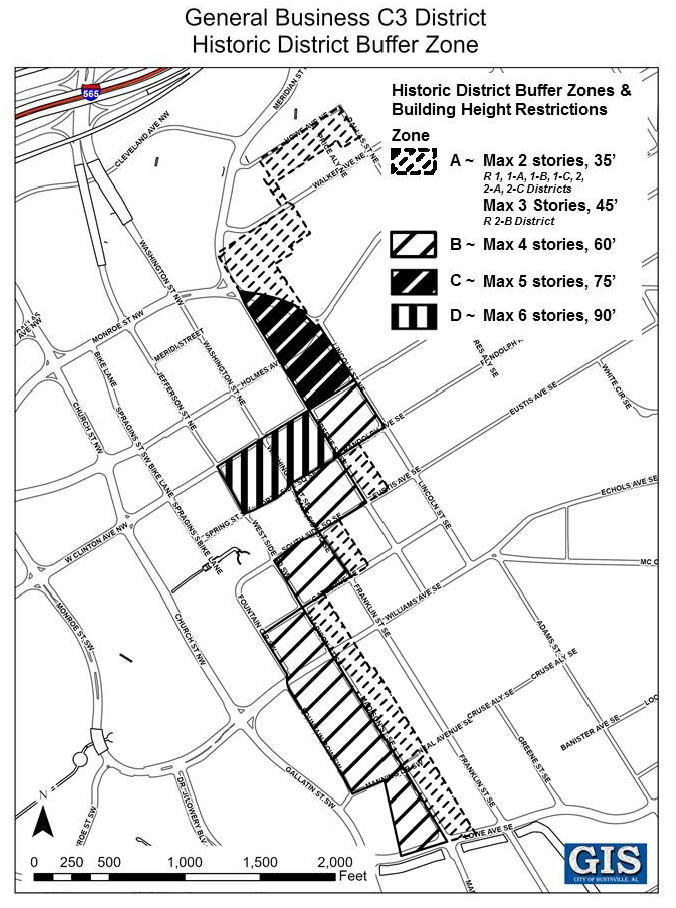
Maximum height for new construction is unlimited; however, where the property abuts a Residence 1, Residence 1-A, Residence 1-B, Residence 1-C, Residence 2, Residence 2-A or Residence 2-C District, except across a street, the maximum number of stories shall be two stories with a maximum height of 35 feet. Where the property abuts a Residence 2-B District, except across a street, the maximum number of stories shall be three stories with a maximum height of 45 feet. The properties that abut residential properties and that fall within these height restrictions shall be designated and referred to as Historic District Buffer Zone A.
Within Historic District Buffer Zone B, the maximum number of stories shall be four stories and with a maximum height of 60 feet.
Within Historic District Buffer Zone C, the maximum number of stories shall be five stories with a maximum height of 75 feet.
Within Historic District Buffer Zone D, the maximum number of stories shall be six stories with a maximum height of 90 feet.
(5)
Maximum total building area is 100 percent of total lot area, except when the side or rear lot line abuts a residential district.
(6)
Where buildings are not contiguous, the space between them shall be a minimum of ten feet and shall be improved for use by pedestrians or vehicles or be landscaped.
(Ord. No. 06-1203, § 2, 1-25-2007; Ord. No. 09-510, § 1, 7-23-2009; Ord. No. 19-1040, § 2, 12-19-2019)
23.3. - Installation and maintenance of landscaping.
(1)
Trees and shrubs shall be well distributed, though not necessarily evenly spaced and shall meet the minimum size standards as set out in Table 1 of Section 71.5.1(2).
(2)
All landscaping shall be installed in accordance with Section 71.5.3—Installation Requirements (1), (2), (3), (4), (7) and (8) and with Section 73.19—Installation of Landscaping.
(3)
The owner, lessee, or his agents shall be responsible for providing, maintaining, and protecting all landscaping in a healthy and growing condition and for keeping it free from refuse and debris. All unhealthy and dead materials shall be replaced within one year after notification or during the next appropriate planting period, whichever comes first.
(Ord. No. 06-1203, § 2, 1-25-2007)
23.4. - Signs permitted.
Signs shall be permitted in accordance with the provisions of article 72—Sign control regulations.
(Ord. No. 06-1203, § 2, 1-25-2007; Ord. No. 21-46, § 1(Exh. A, § B.2.), 2-25-2021)
23.5. - Off-street parking requirements.
Off-street parking is not required in a General Business C-3 District; however, where off-street parking and vehicular use areas are provided, landscaping and lighting are required in accordance with Article 71—Off-Street Parking and Vehicular Use Area Landscaping Requirements. Off-street loading and vehicle standing space shall be provided as required in Article 70 hereof.
(Ord. No. 06-1203, § 2, 1-25-2007)
23.6. - Historic district buffer zone density controls and design guidelines.
Due to the historic nature of this district as a retail, office and residential area, with buildings abutting the sidewalks and sharing party walls, the following density controls and design guidelines shall apply in Historic District Buffer Zone A, Historic District Buffer Zone B, Historic District Buffer Zone C and Historic District Buffer Zone D:
23.6.1. Front yards. None permitted, except:
(1)
A National Register listed building moved from its original site may retain its existing setback to a maximum of ten feet; or
(2)
Where there is located a porte-cochere, plaza, courtyard, or other such public space. In such case, the porte-cochere must be built to the property line along the street frontage.
All open space on a site not covered by building, parking or sidewalks shall be landscaped according to the applicable provisions of section 23.6.7, landscaping requirements.
23.6.2. Side and rear yards.
(1)
Minimum rear yard requirements: None, except that when the rear lot line abuts a residential district, except across a street, a rear yard of 25 feet is required of which the first five feet of the required rear yard shall be landscaped with a minimum of one small Type 3 or Type 4 tree and six shrubs per each linear 50 feet of yard or portion thereof, and the area shall be planted with a permanent evergreen ground cover or turf grass.
(2)
Minimum side yard requirements: None, except that when the side lot line abuts a residential district, except across a street, a side yard of ten feet is required.
23.6.3. Height.
(1)
Where General Business C-3 District properties abut a Residence 1, Residence 1- A, Residence 1-B, Residence 1-C, Residence 2, Residence 2-A or Residence 2-C district, except across a street, the maximum number of stories shall be two stories with a maximum height of 35 feet. Where the property abuts a Residence 2-B District, except across a street, the maximum number of stories shall be three stories with a maximum height of 45 feet. The properties that abut residential properties and that fall within these height restrictions shall be designated and referred to as Historic District Buffer Zone A.
(2)
Within Historic District Buffer Zone B, the maximum number of stories shall be four stories with a maximum height of 60 feet.
Historic District Buffer Zone B is defined as the property that lies within the following boundaries: Begin at the intersection of the centerlines of Clinton Avenue and Monroe Street/Lincoln Street; then in a southerly direction along the centerline of Monroe Street/Lincoln Street to the intersection of the centerlines of Lincoln Street and Randolph Avenue; then West along the centerline of Randolph Avenue to the intersection of the centerlines of Randolph Avenue and Green Street; then South along the centerline of Green Street to the intersection of the centerlines of Green Street and Eustis Avenue; then West along the centerline of Eustis Avenue to the intersection of the centerlines of Eustis Avenue and Franklin Street; then South along Franklin Street to the intersection of the centerlines of Franklin Street and Gates Avenue; then West along the centerline of Gates Avenue to the intersection of the centerlines of Gates Avenue and Madison Street; then South along the centerline of Madison Street to the intersection of the centerlines of Madison Street and Lowe Avenue; then West along Lowe Avenue to a point near the half-block line on the north side of Lowe Avenue between Gallatin Street and Madison Street; then in a northerly direction along the rear lot lines of those properties fronting Madison Street to the centerline of Manning Drive; then West along the centerline of Manning Drive to the intersection of the centerlines of Manning Drive and Fountain Row; then North along the centerline of Fountain Row to the intersection of the centerlines of Fountain Row/Fountain Circle and Williams Avenue; then continue north along the centerline of Fountain Circle to the intersection of the centerlines of Fountain Circle and Gates Avenue; then East along the centerline of Gates Avenue to the intersection of the centerlines of Gates Avenue and Madison Street; then North along the centerline of Madison Street to the intersection of the centerlines of Madison Street and South Side Square; then East along the centerline of South Side Square to the intersection of the centerlines of South Side Square and East Side Square; then North along the centerline of East Side Square to the intersection of the centerlines of East Side Square and Randolph Avenue; then East along the centerline of Randolph Avenue to the intersection of the centerlines of Randolph Avenue and Green Street; then North along the centerline of Green Street to the intersection of the centerlines of Green Street and Clinton Avenue; then East along the centerline of Clinton Avenue to the intersection of the centerlines of Clinton Avenue and Lincoln Street and the point of beginning.
(3)
Within Historic District Buffer Zone C, the maximum number of stories shall be five stories with a maximum height of 75 feet.
Historic District Buffer Zone C is defined as the property that lies within the following boundaries: Begin at the intersection of the centerlines of Green Street and Monroe Street/Lincoln Street; then in a southerly direction along the centerline of Monroe Street/Lincoln Street to the intersection of the centerlines of Lincoln Street and Clinton Avenue; then West along the centerline of Clinton Avenue to the intersection of the centerlines of Clinton Avenue and Green Street; then North along the centerline of Green Street to the intersection of the centerlines of Green Street and Monroe Street/Lincoln Street and the point of beginning.
(4)
Within Historic District Buffer Zone D, the maximum number of stories shall be six stories with a maximum height of 90 feet.
Historic District Buffer Zone D is defined as the property that lies within the following boundaries: Begin at the intersection of the centerlines of Clinton Avenue and Green Street; then South along the centerline of Green Street to the intersection of the centerlines of Green Street and Randolph Avenue; then West along the centerline of Randolph Avenue/North Side Square to the intersection of the centerlines of Randolph Avenue/North Side Square and Jefferson Street/West Side Square; then North along the centerline of Jefferson Street to the intersection of the centerlines of Jefferson Street and Clinton Avenue; then East along the centerline of Clinton Avenue to the point of beginning.
(5)
In order to create a sense of harmony and compatibility, all buildings within the historic district buffer zones shall be designed to be overlooked by taller buildings within the General Business and Central Business districts as well as be seen from surrounding streets and public places.
Elevator shafts and similar structural elements not intended as places of occupancy or storage; heating, ventilating and air conditioning equipment; solar collectors; communication and transmission devices and similar mechanical fixtures may extend above the roof if they conform to the following requirements:
(a)
Such fixtures and structural elements must be completely shielded from view at street level and/or incorporated into the architectural design of the building as a whole; and
(b)
Complementary parapets, screens, shades and superstructures are encouraged to create a visually pleasing and architecturally consistent roofscape for the building.
(6)
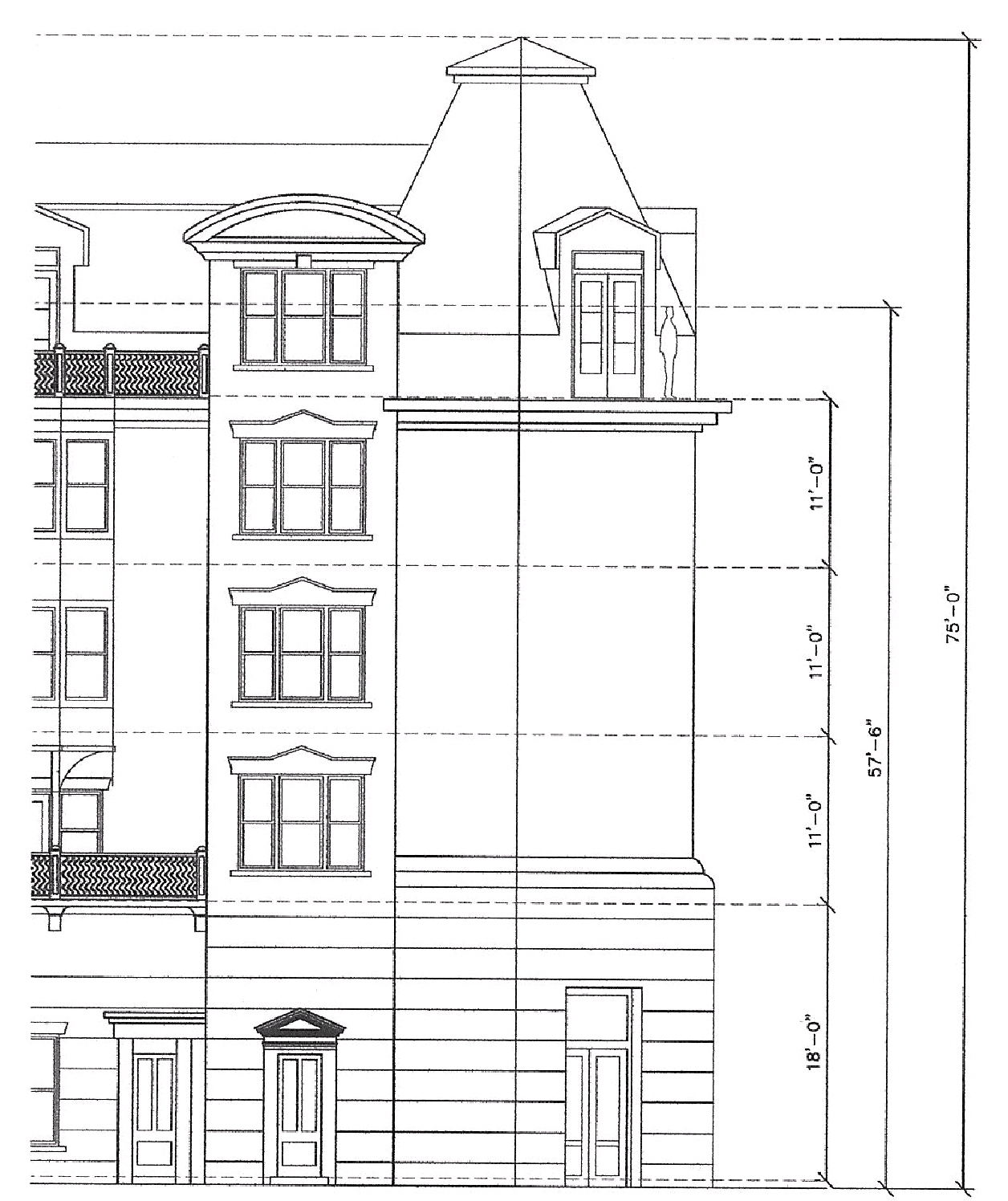
Rooftop gardens, decks and terraces must be completely shielded from view at street level with their railings and screens situated discretely behind parapets so as not to attract attention away from the building cornices. In all historic district buffer zones, roof gardens, decks and terraces are considered to be places of occupancy, and as such, must conform to the height limitations for eye level (defined as six feet above the highest occupied surface). The height limitations for eye level shall be included in calculating the height of the building and shall not be less than six feet below the prescribed maximum height for the building. An example of the height limitations for eye level is presented in the following illustration.
23.6.4. Off-street parking requirements.
(1)
Off-street parking is not required in the General Business C-3 District; however, where off-street parking and vehicular use areas are provided in the Historic District Buffer Zones, lighting is required in accordance with section 71.6, PVA Lighting Requirements. Off-street loading and vehicle standing space shall be provided as required in article 70 hereof. No surface parking or vehicular drive parallel to the street shall be permitted between a building and any street on which it has frontage, except in the case of a porte-cochere. In such case, the porte-cochere must be built to the property line along the street frontage.
(2)
Five or more surface parking spaces must be screened from streets, pedestrian areas, and sidewalks according to the provisions of section 23.6.7(a) and section 23.6.7(b).
(3)
Surface parking shall utilize alleys for ingress and egress. A curb cut from a public street will be allowed only if alternative access is not available.
(4)
No more than 15 percent of a building site or other tract may be utilized for surface parking. If additional spaces are needed, they shall be provided within the building itself or within a parking garage.
(5)
All parking surfaces and unpaved driveways shall be curbed along their perimeters.
23.6.5. Parking garages. Parking garages erected within the Historic District Buffer Zones shall comply with the following requirements:
(1)
All street level garage frontages shall provide commercial space equivalent to 75 percent of the linear frontage of street frontage, exclusive of driveways; such commercial space shall be a minimum of 18 feet deep as measured from the façade of the building.
(2)
Vehicular driveways shall be sited and designed so as to create the least hazard to pedestrians, and curb cuts shall not exceed 25 percent of any street frontage greater than 160 feet.
(3)
The ground floor façade should be differentiated from the upper levels to further enhance the continuity of the street wall and shall comply with the provisions of section 23.6.6[1], street level walls.
(4)
Sloping floor levels shall not be revealed or implied by the exterior design of the garage elevations as seen from any street frontage.
(5)
Parked cars shall be screened from public view to a height of three feet and six inches, consistent with the guardrail height as defined by the International Building Code.
(6)
Façades should be designed to be compatible with the surrounding buildings in terms of scale, color and texture of materials, form and massing, and design detailing.
23.6.6. Site development. The Historic District Buffer Zones are intended to create harmonious transition zones between the urban core and the residential areas. These Historic District Buffer Zones will preserve and enhance the many historic buildings while adding new buildings that will expand and contribute to the low scale, small town, urban environment that makes the downtown attractive for pedestrians. Every effort should be made to preserve and renovate the historic structures and to create new infill construction that is compatible with the old in terms of scale, proportion, materials, design and function without being imitative.
(1)
Street level walls. The purpose of the street level wall requirement is twofold. The first goal is to promote the establishment of a variety of retail, service and entertainment type businesses for the convenience of the office, residential, and tourist populations in the downtown area. The second aim is to promote pedestrian use and activity and to encourage a higher degree of street life and vitality in the downtown. Retailing is enhanced by having transparent store fronts abutting the sidewalk and by assembling a critical mass of continuous retail activities along adjoining streets.
(a)
The front façade of all new buildings shall be oriented toward a public street as shall the principal entrances.
(b)
Doorways shall be recessed into the building interior to a depth sufficient to separate sidewalk traffic from outwardly opening doors, to create focal interest, and to punctuate the street wall.
(c)
To maintain consistency with the existing historic streetscapes, new construction shall utilize natural materials for the exterior cladding of all visible wall surfaces. The facades should be designed to be compatible with surrounding buildings in terms of scale, color and texture of materials, form and massing, and design detailing. Acceptable materials include, but are not limited to, brick, stone, concrete stucco, terra cotta, precast concrete, glass, and where appropriate, cast metal for fenestrations, columns and beams. Polished stone and mirrored glass should be avoided as primary materials. Synthetic and imitation materials as well as aluminum, vinyl and plastic materials are not acceptable.
(d)
To create an animated streetscape, an unbroken expanse of solid or blank wall shall not exceed 20 linear feet. Devices suitable to break such a wall span include doors, windows, display windows and cases, street art, fountains, plazas, trees and landscaping, pedestrian furniture and the introduction of variety in materials, texture, color and/or pattern of wall materials.
(e)
Street level commercial spaces should be configured as units 15 to 50 feet wide in order to stimulate visual interest, establish a predictable rhythm for pedestrians, and encourage the introduction of small retail and service businesses.
(f)
Windows located in street level walls, with the exception of stained glass windows, shall be transparent. Windows located in street level walls shall have a maximum sill height of 48 inches as measured from the sidewalk.
(2)
Utilities and mechanical units.
(a)
All power, communication and other wiring shall be located underground.
(b)
All exterior mechanical equipment, trash facilities, and loading areas shall be adequately screened as well as practicable so as not to be visible from any street or by pedestrians.
23.6.7. Landscaping requirements.
(1)
Landscape buffers for surface parking. Buffer strips required to separate surface parking spaces from streets and pedestrian uses shall be landscaped in one of the following ways:
(a)
A minimum five-foot wide planting bed having a continuous masonry wall between 30 and 42 inches high planted on the street side with at least one nondeciduous vine or shrub for every ten feet of wall length and one small maturing tree for every 30 feet of wall length. Trees, shrubs and vines shall be evenly distributed along the length of the wall. The landscape bed shall be planted with an evergreen ground cover; or
(b)
A minimum five-foot wide bed having a hedge of a nondeciduous species, planted and maintained to form a continuous visual screen at least 30 inches high within one year of planting and one small maturing tree for every 30 linear feet of required planting bed. The bed shall be planted with an evergreen ground cover.
(2)
General landscape requirements.
(a)
Plant material used to fulfill these requirements must be provided with an adequate irrigation system which does not rely on drainage from the street, sidewalk, or buildings.
(b)
All plant material must conform to the current version of the "American Standard for Nursery Stock" published by the American Association of Nurserymen.
(c)
The species of trees used must be consistent with adopted city ordinances concerning urban trees.
(d)
Maintenance of landscaping in a healthy, neat and attractive condition is the responsibility of the owner of the property. Specifically, all plant material shall be watered, fertilized, pruned, kept free from weeds and litter, and replaced if diseased, injured or dead in a manner consistent with good horticultural practices.
(e)
All landscaping shall be installed in accordance with section 73.19, installation of landscaping.
(Ord. No. 09-510, § 2, 7-23-2009; Ord. No. 19-1040, § 3, 12-19-2019; Ord. No. 21-46, § 1(Exh. A, § B.1.), 2-25-2021)
23.7. - Alcoholic beverage establishment regulations.
Alcoholic beverage establishments shall be permitted in accordance with section 75.3 - permitted establishments by districts, subsection 75.3.2, and shall be regulated by article 75 - alcoholic beverage establishment regulations.
(Ord. No. 11-11, § 7, 2-24-2011)

